Sunday, April 08, 2018

The Time Machine.8: Who Makes the Future

“...there is a sense of courage to live for the future because we need no longer be helpless pawns of circumstance but may confidently embark on a course of action to influence the future for good by fostering the best possible development of society and ultimately of the human race." 
 Roslynn D. Haynes

The Traveller sits in the sunshine of his last day in this future, grieving for the human race. His afternoon musings end with a nap. He awakens as evening approaches, and calmly walks towards the building where he is sure the time machine is hidden. With a few remaining matches in his pocket, he carries his crowbar to pry open the bronze door.

He is surprised to find the door open and his time machine visible inside. He drops his crowbar and enters confidently, realizing it is likely to be a trap. Sure enough the bronze door closes and he is in darkness. But he has his matches, and the Morlocks, their eyes remade for darkness, will scatter with the bright light and fire.

Except that these matches won’t light without the edge of the box to strike them on, something he hadn’t noticed before. It is the last in the series of his obvious absent-minded blunders, which began when he failed to equip himself for his time journey in the first place.

The Morlocks attack him but he manages to attach the crucial levers he carried, and he engages the machine. Fighting off Morlocks, he isn’t quite in control of the machine and it careens into the future.

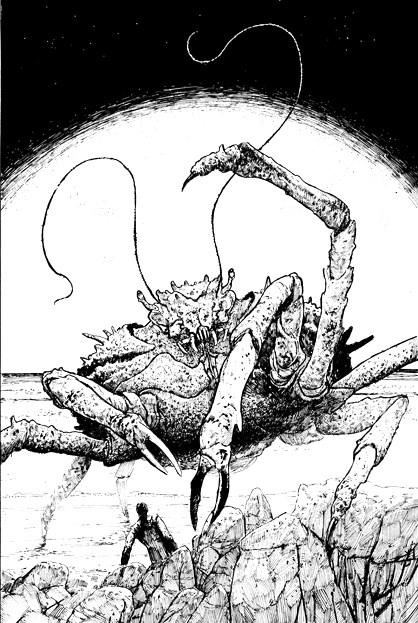
Once again he goes forward, at first accidentally and then several more times deliberately for short visits leading up to the awesomely quiet, gruesomely garish last gasps of the world, shortly before entropy's final triumph. He encounters several life forms, including giant crabs, and a small creature the size of a human head crawling out of a still sea. He is witnessing the last moments of the living planet Earth.

The timing of the world’s end and its general nature are in accord with the science of the times, though later surmises differ. Nevertheless, the eloquence of Wells’ writing remains. This vision greatly impressed readers of the time. It may well be, as Ursula LeGuin wrote, that with this book and this passage in particular, the end of the world first becomes a subject of fiction.

Yet this desolate moment is ennobled for us because the Traveller is there. Once again—and in a sense for the last time—human witnessing transforms what seems to be the cold mechanisms of the universe into something soulful, through the human medium of story.

The Traveller's brief visits to the long distant death of life in a final exhaustion, is more than a coda to the longer tale. It seems to follow from the horrific stasis of the Eloi/Morloch period. Ironically, this is the first story about change through evolutionary time, yet it dwells on a society in which there is no longer even an obvious potential for change.

Humanity has divided against itself, and its houses of culture cannot stand. Without a synthesis that is synonymous with soul, entropy had no countering principle, no gathering of energy and organization. Poetically more than literally, this scene reinforces the sense of doom unwinding from the failure of humanity.

The Traveller returns home, and tells his story. No one believes him. The next day the narrator (whose name, we have just indirectly learned, is Hillyer) sees the Traveller disappear on his time machine.

Disappearance leaves us with a mystery of where the Traveller is, what happened to him, whether he might come back, and of "what happens next"—the momentum of the endless story as well as the mythical promise of the return.

We now see why there was a narrator other than the Traveller in the first place: to confirm the sight of him disappearing on his machine, to tell us that he has vanished for three years, and to leave us with a message of hope in a pretty bleak story.

Readers might find hope for our future in the Traveller's ethical behavior, in his openness to the value of beauty, and in the message—the prophesy-- he brought back as a cautionary tale.

But within the story the hope expressed is by the narrator as he reflects on the Traveller's story and his disappearance. He acknowledges that the Traveller "thought but cheerlessly of the Advancement of Mankind and saw in the growing pile of civilization only a foolish heaping that must inevitably fall back upon and destroy its makers in the end."

Though this is not Hillyer's view he still concludes, "If that is so, it remains for us to live as though it were not so."

To do that requires not denial but stretching the human capability for complex thinking and feeling and acting to meet the challenges of a complex world.

Hillyer’s statement suggests an often quoted observation by the 20th century American writer F. Scott Fitzgerald: "…the test of a first-rate intelligence is the ability to hold two opposed ideas in the mind at the same time, and still retain the ability to function.”

This statement is in turn often seen as an extension of John Keats’ definition of ‘Negative Capability,’ or the ability to remain in a state of uncertainty and doubt. Fitzgerald did admire Keats, but he also admired Wells. (There’s even a long discussion of Wells towards the end of Fitzgerald’s college novel, This Side of Paradise.)  He likely read The Time Machine and Hillyer's statement.

Further suggestion of that comes in Fitzgerald's rarely quote next sentence. He went on to give an example—a very apt example in the light of Hillyer’s observation at the end of The Time Machine.  Fitzgerald’s full statement is this:

"…the test of a first-rate intelligence is the ability to hold two opposed ideas in the mind at the same time, and still retain the ability to function. One should, for example, be able to see that things are hopeless and yet be determined to make them otherwise."

To the ultimate narrator of The Time Machine, the future is still blank, still full of possibilities, as it is for us. This may well be another reason the story is told by Hillyer: he has not experienced the future that the Traveller saw, but only heard an account of it. So for him the future is still what hasn’t happened yet.

If we take the full Fitzgerald statement as an interpretation of Hillyer's, is it what Wells meant? There is some evidence that it is.

A little more than a decade after this book’s publication, Wells walked the White House grounds with President Theodore Roosevelt. He recounted the conversation in his autobiography of the 1930s.

 Roosevelt brought up the vision of the future Wells created in The Time Machine. “’Suppose, after all,’ he said slowly, ‘that should prove to be right, and it all ends in your butterflies and morlocks. That doesn’t matter now. The effort’s real. It’s worth going on with. It’s worth it. It’s worth it, even so...’”

In an earlier paragraph, Wells had already summed up Teddy Roosevelt’s attitude towards “a pessimistic interpretation of the future,” by using—without quotation marks—Hillyer’s words: “Only he chose to live as if this were not so.”

Many years later, on the eve of World War II, Wells affirmed his own similar belief regarding the human future.  "I think the odds are against man," he wrote, "but it is still worth fighting against them."

We should also recall that this future depicted in The Time Machine is not a specific prediction. It’s a story. It depicts one possible way the future could evolve from the present. The way to avoid that future is to change the cause—the stark and growing division of rich and poor-- in the present.

A few years after The Time Machine was published, Wells told an interviewer that he never intended its future to be seen as inevitable and a reason for despair.

“The great thing I had in my mind, as the book developed, was this—the responsibility of men to mankind. Unless humanity hangs together, unless all strive for the species as a whole, we shall end in disaster.”

To live as though it were not so is to help form a future in which humanity survives as a whole: body, mind, spirit and soul. Because hope for the future is a condition of the present. As is the effort to save the future.

To be continued... For prior posts in this series, click on the "Soul of the Future" label below.

Friday, April 06, 2018

April 1968: Martin Luther King


When Martin Luther King, Jr. was assassinated in Memphis on April 4, 1968,  I was a senior at Knox College in Galesburg, Illinois.  I see myself getting the news in the Gizmo, the campus coffee shop, that night.  I was in some early part of the process of directing a play I'd written.  It had a large cast and involved multimedia, so there was a lot to think about.  I wanted to being thinking about it, to be in that creative cocoon and not naked to the daily onslaught of painful information and images, warping the present and endangering the future, including my imminent one.  I didn't want to think about the killing of the man who shaped nonviolent protest and the civil rights movement.

 I'd been among the thousands who heard him speak at the March on Washington in 1963, when I was still in high school.  As some of the articles that appeared this past week noted, things had changed amazingly in those few years, and I was aware of it at the time.  King had to defend his nonviolent tactics and his goals to more militant new leaders and organizations outflanking him within the world of black activism.  Their grievances and goals were larger, more culturally expansive, and some advocated violence.

At the same time, King had lost support within the Lyndon Johnson administration as well as among many white voters by coming out strongly against American involvement in the Vietnam War.  His new emphasis on economic justice for blacks rather than civil and political rights confused, irritated and alarmed many.

Fifty years later his "I have a dream" speech at the March on Washington is linked with his instant image.  (JFK's face flashes on the screen, a two word soundbite: "Ask Not," followed immediately by MLK "I have a dream today.")  The last speech of his life was in Memphis and referred back to the dream but in the language of the promised land, in which he uttered the eerie words "I may not get there with you."

He clearly did not mean simply that the fight for true equality would take more than his natural lifetime, although if he had, he would have been right. He would be 89 now, and despite a twice-elected black President, inequality and pernicious racism still exist--and black people are still dying, still being killed because of it.

He clearly was talking about the possibility of his early, perhaps imminent death. I recall my reaction the first time I saw a clip of that speech: that's a man who knows--or at least suspects--that he's going to be killed.

One of the 50th anniversary stories last week, by Tom Jackman in the Washington Post, stated that the King children and other family members do not believe that James Earl Ray alone killed Martin Luther King.  He also writes: Until her own death in 2006, Coretta Scott King, who endured the FBI’s campaign to discredit her husband, was open in her belief that a conspiracy led to the assassination."

I know that's what she suspected, but I also know she wasn't always open about it.  In 1976 I was the editor of Washington Newsworks, a weekly alternative newspaper in DC.  (In fact, our offices were in the Adams-Morgan area, parts of which still bore obvious signs of the rioting and burning that followed the King assassination in several cities.)  One of our reporters made contact with investigators who were presenting their evidence to a congressional subcommittee on the King assassination.  It outlined a conspiracy.

We were given an advance look at that report.  We were also told that Coretta King was so interested that she was in Washington to attend these hearings, but in secret. Not publishing this fact was a condition of our getting this exclusive.

I edited and arranged this material into a narrative and we made it our cover story. At the last minute before we went to press the investigator-contact got cold feet about publication. I suggested that if we were prevented from publishing the story, any agreement not to reveal Coretta King's presence in Washington would be nullified.

So he relented and we not only published, but several of us from Newsworks personally delivered a copy of that issue to every congressional office on Capitol Hill.  We may have caught a glimpse of a few Members but we were unable to make personal contact with any.

This stuff was toxic then and even fifty years later is considered out there.  But here's the thing: just because most conspiracy theories are crazy, doesn't mean they all are.  It used to be said that such conspiracies could never happen because the secret couldn't be kept, sooner or later someone would talk.  Well, lots of people have talked and none have been believed.  (Once again, just because there are a lot of crazy people who claim to know something, doesn't mean that some people don't really know something.)

Now of course it's all safely in the "no one will ever know the truth" zone, especially in our era when factual evidence has no special standing.   What we have learned (as Jackman's story outlines) is the antipathy and extra-legal surveillance of King by J. Edgar Hoover's FBI, along with the violent antipathy of southern white extremists, who didn't need much encouragement to act.  King must have known something about this.  He may have seen danger to his life in an upcoming protest or he may have sensed something else, but clearly he foresaw the possibility of being killed.


In April 1968 I would have also read or seen the story of how Robert Kennedy spoke to a largely black audience in Indianapolis that same night, and was the one who broke the news to them of King's assassination.  His short heartfelt speech is credited with the fact that no rioting happened in that city that night.  A Washington Post story this week called it "one of the most compelling and overlooked speeches in U.S. political history."

I was not surprised by his speech. For me at that moment Robert Kennedy was the last beacon of hope.  He'd started his campaign for the presidential nomination.  By the time my spring classes and comprehensive exams were over, the primaries would be as well. If he got the nomination,  I looked forward to the possibility of somehow working in his presidential campaign, assuming I would be free to do so--which was, given the draft calls, a large assumption.

But that of course is another story.

Tuesday, April 03, 2018

The Time Machine.7: Evolution of Empathy

“A man, to be greatly good, must imagine intensely and comprehensively; he must put himself in the place of another and of many others; the pains and pleasure of his species must become his own. The great instrument of moral good is the imagination;"
P.B. Shelley

"The soul without imagination is what an observatory would be without a telescope."
Henry Ward Beecher

When the forest fire approaches, most of the Morlocks run off in all directions. The Traveller is safe. Or is he? He sees several coming at him, and he "struck furiously at them with my bar, in a frenzy of fear, as they approached me, killing one and crippling several more."

But then, even in this frenzy of defending against an apparent onslaught, he realizes they are not really attacking him any more. They are blind, at least in the presence of the fire's light, and they are simply blundering towards him in their fearful frenzy to escape the light and heat.

And then the Traveller stops. "But when I had watched the gestures of one of them groping under the hawthorn against the red sky, and heard their moans, I was assured of their absolute helplessness and misery in the glare, and I struck no more of them."

In the physical details of this sentence, and in the words "moans" and "misery," the Morlocks are "humanized" to a new extent. But the Traveller also concludes that they are helpless.  Killing them when they were attacking him, regardless of how good or bad it might feel, was justified and necessary self-defense. To kill them now, however good it feels or however angry he still is, would be murder.

John Huntington notes this sentence, this "I struck no more of them" and a later passage in which the Traveller is mourning the death of Weena and considers revenge ("a massacre of the helpless abominations") but "contains" himself, as key examples of how the Traveller's humanity is different from these species: he can exert self-control.

"It is his ability—a distinctly human ability—to bridge distinctions, to recognize an area of identity within a difference, that sets him apart,” Huntington observes. “The Time Traveller is able to assert an ethical view in the face of the evolutionary competition that rules the future."

The ethical view, beginning with an insight of empathy, that is the human difference. This was the position of Wells' teacher, T.H. Huxley, going back some 30 years but expressed most eloquently in his lecture “Evolution and Ethics,” his final and summary statement which was delivered and published while Wells was writing The Time Machine.

Huxley concedes that natural selection is mostly a brutal process, and that as animal life, the human species has been subject to it. But at this point in its evolution, humanity has developed both consciousness and civilization, which will be the basis of its particular "artificial" evolution.

Huxley didn't believe that evolution meant progress or guaranteed human triumph. Like other species, humanity would naturally peak and then decline, perhaps becoming extinct. But before the earth dies or some outside force suddenly overtakes or wipes out the human species, humanity can exercise a great deal of control over its fate. That will require some counter-force to natural decay, or new skills that will keep humanity going.

Technology is the obvious example of a new skill, except that technology without conscience and conscious control is the best candidate to be the instrument of humanity’s self-destruction.

Huxley believed that the counter-force would be human ethics. Humanity could change the rules of evolution by the ethical decisions to work for the betterment of all:

"The practice of that which is ethically best—what we call goodness or virtue," he wrote, "involves a course of conduct which in all respects, is opposed to that which leads to success in the cosmic struggle for existence. In place of ruthless self-assertion it demands self-restraint; in place of thrusting aside, or treading down, all competitors, it requires that the individual shall not merely respect, but shall help his fellows; its influence is directed, not so much to the survival of the fittest, as to the fitting of as many as possible to survive. It repudiates the gladiatorial theory of existence."

Both Huxley and Wells recognized the importance of cooperation and altruism in biological evolution. Huxley used examples of bees and ants, and Wells wrote in an 1892 essay (“Ancient Experiments in Co-Operation”) that the idea that competition alone causes changes in biological evolution is “a horrible conception, as false as it is evil.”

Some (including G.B. Shaw) would note that in certain circumstances, human self-restraint does enhance survival, and that human reason and ethics add to the fitness of individuals and the species, so they are actually features of human evolution, though perhaps not yet in a Darwinian timeframe. Intelligence, self-knowledge and ethical behavior are successful adaptations for the species.

Nevertheless, even without these assertions, ethics were important to Huxley because they define the human. That’s why it is important that humanity fosters “the survival of the ethically fittest.”

The ethics themselves define the human, but so does the intelligence and creativity to formulate them, the expression of freedom and the act of will to choose them.

So the meat-eating Time Traveller who exults as he strikes and kills, controls the expression of these responses and feelings, by using his ethical conscience. In this case, the situation doesn't require a lot of soul-searching and analysis, as it might in others. Not killing the helpless is recognizably an aspect of English "fair play," and the Traveller's quick decision, which he seems to feel will be obvious to the upper middle class Englishmen listening to his story, suggests that civilization can help to make ethical restraint nearly as reflexive as fight or flight.

Still, the pattern of thought is fairly sophisticated. He realizes that the violent emotion he is feeling towards the Morlocks is not necessarily the same emotion the Morlocks are feeling. He realizes that because he finds the Morlocks loathsome, hateful and threatening at that moment, they don't find him so—if only because they can't see him, and have other things on their minds. They are not a danger to him just because they are ugly and strange. They endanger him only when they attack him.

His decision not to wreak revenge later also seems dependent on this idea of the Morlocks as "helpless," though very soon they prove not to be completely so. Still, there are plenty of real cases, and many stories and feature films, in which violent revenge (or "payback") is a reflex that does not take the current helplessness of the original perpetrator into account at all.

In The Time Machine, Wells subtly undermines the use of science to justify selfishness and conflict. By dramatizing the way evolution works—not as inevitable progress, or progress based on Social Darwinist or racist principles—he shows that left to its own process, natural selection does not necessarily favor the survival of humanity as a conscious, intelligent species.

The science that led up to Darwin had a close relationship to the industrial era. The Darwinian process of natural selection itself, extended as a general rule, sees nature as a kind of machine.

But in Wells’ story humanity achieved the perfection of a machine by dividing, and ending itself. “I grieved to think how brief the dream of the human intellect had been,” the Traveller thought. “It had committed suicide.”

At first a divided society seemed to work out for everyone, he speculated, in harmony with its environment until it became “a perfect mechanism.” By becoming parts of this machine, the elite and the servile became their roles, their unchanging functions. Humanity created its perfection by apparently following the Social Darwinist and possibly racist lines, and separating the species.

It worked for awhile, the Traveller speculates. But they "had lacked one thing even for mechanical perfection—absolute permanency." The environment changed, and the two halves of humanity no longer had the intellectual versatility to cope, other than in the awful way the Morlocks and Eloi did. "There is no intelligence where there is no change and no need of change," the Traveller says.

That versatility is energized in part by humanity's struggle to persist in its environment, but also by the internal energy of differences within humanity that challenges the mind, quickens the heart and deepens the soul.

Intelligence in these terms includes imagination and empathy, which is the imaginative act of understanding the emotions of another—or the Other.
Taking into account the information the Traveller acquired through empathy helped guide his actions. It’s a very human thing to do.

“Empathy” was not yet a known word in English when The Time Machine was written—its first instance is early twentieth century, although it was based on a German word coined a half century earlier. It was first applied to understanding the emotion in works of art, or the aesthetic appreciation of people.

Another feature of the human response that the Traveller applies to this future world is the aesthetic response itself--the appreciation of beauty. 

For example, as he rests among the Eloi after his battle with the Morlocks, he reflects on the beauty of the sunny morning, and on the beauty of the Eloi as they again laugh and play by the river.

The scene may remind us of others in which the Traveller sits and observes the beauty around him. Beauty was the first virtue of this future that he saw, and now it seems to be the last.

It was on the hill as he gazed at the stars, thinking with some awe about the sweep of cosmic time, that he realized what the Eloi's relationship to the Morlocks was. It was then he looked at "little Weena sleeping beside me, her face white and starlike under the stars." With this Wells makes an instant connection between the beauty of the cosmos and the beauty of this frail child-like creature.

Some critics and readers have found the presence of Weena to be cloying and embarrassing, if not faintly perverse. But the childlike quality of the Eloi is metaphorically apt, as well as producing a certain tug of sentiment. Children as a rule are beautiful. It is not only a physical attribute but resides in their affection, trust, curiosity and delight in the world. It is in their eyes.

Otherwise weak and helpless, it is their beauty and the effect it has on adults that makes it their chief survival mechanism. This beauty is common to children of all ethnicities, genders, classes.

As they grow a little older, children reach out to other children, regardless of any distinctions. They have to be taught to judge by skin color. Children naturally get angry and act aggressively, but generally they must be taught to hate.


While ugliness alone is not enough to justify violence, beauty alone is worth preserving. The Time Traveller's impulse to take the beautiful child back with him is an impulse to honor the only living form of value he finds in the future. And though he cannot take Weena, he accidentally takes with him two white flowers that she had placed in his pocket.

It is these flowers that the narrator—the witness to the Traveller's tale—holds onto, "to witness that even when mind and strength had gone, gratitude and a mutual tenderness still lived on in the heart of man."

But before the Traveller can return home, he must retrieve his time machine. There is one more battle to fight, and a series of brief but memorable glimpses into the farthest future.

To be continued...For prior posts in this series, click on the "Soul of the Future" label below.

Sunday, April 01, 2018

Past: Easter Parade


Easter was a pretty big deal where and when I grew up.  Because I went to Catholic schools, there was an even bigger buildup to it than to Christmas.  It started with ashes on Ash Wednesday and that began Lent.  We all had to decide what we would give up for Lent, in addition to the stuff everybody was supposed to give up.  Forty days of it, pal.  Endless.

Then finally Holy Week:  Holy Thursday (the Last Supper, the betrayal), Good Friday (the events of the Stations of the Cross, ending with the Crucifixion), Holy Saturday (Christ in his tomb), Easter (Christ's resurrection from the dead.)  Holy week was Christian and not just Catholic (and downtown was dotted with impressive churches of several denominations), so a lot of stores in town would be closed from noon to three p.m. on Friday, commemorating the hours on the cross. All the stores would of course be closed on Easter Sunday.  Especially since they were closed every Sunday.

The same confusing combinations of secular, folk and religious traditions as Christmas were more extreme at Easter, the feast of blood, death and chocolate.  A bloody scourging, carrying the cross, nailed to it, crucified, dead in the tomb, then gone.  Hearing about all this in great detail in school was usually followed by attending the appropriate ceremony in church.  There was usually a church pretty handy to the school.

So after being assaulted with all this, it was home to decorate eggs, smell the baking, maybe a taste or two of batter or icing. I guess the egg decorating was on Saturday. My only clear memory of this was at my grandmother's, on her white tablecloth in the dining room (same as in the photo above.)The mysteries of food coloring, dipping eggs in hot water, watching them turn yellow or blue and fishing them out when they were your desired shade.  I liked the coloring.  Any decorating beyond that wasn't my style.  I was a minimalist.  And I didn't eat the eggs.  Yucky.

Dressing up for Easter Sunday Mass, a bigger deal for my sisters, but if my mother felt I needed a new shirt or suit or something, I usually got it for Easter.  Maybe a new clip-on bow tie!  I found one photo of my sister Kathy and I in our Easter best, but we were obviously in such a foul mood glowering at the camera that I shouldn't post it.  I'm wearing a snazzy hat, too.

Easter morning there would be our Easter baskets. Chocolate eggs and chocolate bunnies (some were hollow, which was disappointing, but the solid chocolate ones you could gnaw on for hours), marshmallow peeps, jelly beans.

And the Easter Parade.  Which always confused me because there wasn't one.  Just people crowding out of church like every Sunday. But we had to dress up for one anyway.

My grandmother gave us some live Easter chicks (or "peeps") a few times.  They generally didn't make it to chickenhood, though one did.  He hung around for quite a long time, pecking away in the yard. His name was Elmer.

Easter dinner would pretty invariably be at my grandmother's.  It would be the usual feast--the wedding-style soup, pasta dish, meat course (usually roast chicken--sorry, Elmer), salad, and a dozen side dishes.  And my grandmother would distribute the unique Easter pastries she made for us.  They were thick cookie objects shaped like dolls for the girls and horses with a kind of handle at the top for the boys, covered in icing and sprinkles.  This was the only day of the year that these appeared.

This photo above is from fairly late in the game, about 1964. (Click on it to see it without the right edge cut off.)  I'm in the back row, holding my horse.  I'm about to go off to college in a few months.  Next to me, holding one of her children (Nancy) is Rose Severini, my aunt.  Next to her on the right is my grandfather, Ignazio Severini.  This photo doesn't scan very well for some reason, so it's probably hard to make things out.  (Also the shadows of my head and Aunt Rosie's head have merged with our hair.) But the horse my grandfather is holding is covered with chocolate icing--his favorite--so it's more visible.

The front row is my cousin Susan Severini, my sister Debbie, Tom Severini, my grandmother Giaconda with a baby, which must be Steve Severini, and Shirley Severini.

It's not clear in this photo but on the left side of the table is a cake shaped and decorated like a lamb, its white frosting laden with coconut flakes.  Another of my grandmother's specialties, only at Easter.  I'm not sure what that is in the center.  High over our heads is a portrait of a family member from Italy, but I don't recall who.

The lamb is a Christ symbol. (There were lots of fish side dishes at dinner, another Christ symbol.) The eggs, bunnies and chicks however belong to the original feasting day that Easter is superimposed on, celebrating spring and the generating of new life.  There is also a tradition that people went eggless for Lent, and children were presented with a basket of decorated eggs at Easter to celebrate Lent's end.

Horses and dolls, I have no idea, but safe to say, Italian.  Chocolate is apparently a modern American addition, due to availability and the eager support of chocolate manufacturers, as well as the general rule that any excuse is a good excuse for chocolate.

But I am reminded that despite this melange of "traditions", there were boundaries between them, and lines you didn't cross.  Like the chocolate crucifix I saw on sale a few Easters ago.  That would have been considered sacrilegious.

Friday, March 30, 2018

The Time Machine.6: The Other Inside

“And because we are still such barbarians, any trust in the laws of human nature seem to us a dangerous and unethical naturalism. Why is this? Because under the barbarian's thin veneer of culture the wild beast lurks in readiness, amply justifying his fear. 

But the beast is not tamed by locking it up in a cage. There is no morality without freedom. When the barbarian lets loose the beast within him, that is not freedom but bondage. Barbarism must first be vanquished before freedom can be won. This happens, in principle, when the basic root and driving force of morality are felt by the individual as constituents of his own nature and not as external restrictions. How else is man to attain this realization but through the conflict of opposites?"
C.G. Jung

The Traveller tried to remain objective, to continue being the scientific detective of what he called with increasing irony the “Golden Age” of the future.

Why should he care about the fate of the Eloi? That they were “mere fatted cattle, which the ant-like Morlocks preserved and preyed upon...” He tried to think of the entire situation as only “a rigorous punishment of human selfishness.”

But now the Traveller realizes he is not studying this phenomenon from a distance—he is part of it. Because he is living on the surface, the Morlocks evidently consider him one of the Eloi—enough, in any event, to make him meat in their eyes. He has become what the Eloi are to the Morlocks: the beasts who are not us, the prey, the Others. And now the Morlocks have become to him what they are to the Eloi: the ones to be feared, the enemy, the Others.

The Traveller takes Weena to the Palace of Green Porcelain, which turns out to be the remains of a museum. Nearly all the exhibits have decayed and he learns nothing about how this future came to be. But he does find a box of matches in a hermetically sealed container, and an old machine that he dismembers to extract a metal rod that he might use to pry open the bronze door hiding his time machine—or use as a weapon against the Morlocks.
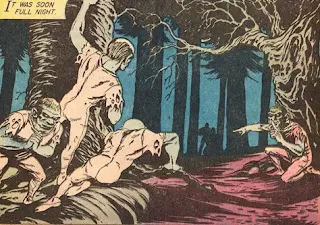
Wells portrays the Morlocks as capable of planning;
this comic book illustration is suitable for children
Now comes the most violent episode of the novel. The Traveller and Weena find themselves in the woods between the Palace and their safe shelter. He lights a small fire to slow the Morlocks down but becomes disoriented as he and Weena flee through the woods. He makes a campfire to spend the rest of the night but falls asleep, and awakes to find the campfire has gone out, and Morlocks are closing in.

He fights for his life with his weapon but is being overwhelmed, when the darkness is suddenly suffused with a dull luminous glow, and the Morlocks begin running away. Then he hears the crackling and smells the burning—"it was my first fire come after me"-- an inferno raging through the forest. The Morlocks scatter, blinded and terrified.

An even more exaggerated Morlock
monster and an even more sexualized
Weena.  This story is a particular origin
of this now familiar imagery.
But when the Traveller turns to find Weena, she is gone. The Morlocks have captured her. For hours he searches for her but in vain, and at first light he is stumbling back into the Eloi's encampment, exhausted and disheartened.

In addition to the violence, in this episode the Traveller expresses the most varied, volatile and violent emotions. He starts out tired and irritable, but afraid of what will happen if he and Weena sleep. In a fever, he rushes forward. When the Morlocks first appear he brandishes fire with aggressive glee. He pushes on grimly, feeling the Morlock's pursuit. In driving them off he loses his sense of direction, and lost in the dark woods he feels panic.

In fighting the swarming Morlocks by striking and killing them with his iron lever, he feels a "strange exultation." When they stop attacking him, he feels hope that they are afraid. He is amazed by the forest fire, distressed by the loss of Weena, and at daybreak, even though he survived, he is feeling wretched and terribly lonely.

The Traveller has been portrayed as a man who thinks scientifically, but he is now swamped by emotions. According to the prevailing view, feelings aren’t supposed to determine the workings of science any more than feelings affect the gears of machines. But although science provides the powerful appearance of objectivity, it can also hide the emotions, drives, and hidden agendas of scientists, as well as its own unacknowledged assumptions and prejudices. In that, scientists are the same as everyone else.

This denial of emotion’s existence is the tragic flaw, the hubris of science and scientists. Thomas Kuhn in his now celebrated theory of paradigm shifts has shown how scientific theories develop when and how they do partly due to the human foibles of human scientists and the pressures and prejudices of the surrounding society, and not just in immediate response to brilliant insights and careful research, in the stately, automatic and emotionless accumulation of knowledge.

Science can be manipulated, and the appearance of science can provide false justification for unacknowledged emotions and complex psychological reactions, as well as simply providing hypocritical cover for self-interest. All of this occurred in the late 19th century, with what historian Peter Gay calls "alibis for aggression" and "the cultivation of hatred."

Some of it would prolong the awful carnage of World War I with jingoistic and pseudo-racial patriotism, often justified by misinterpretations of Darwin. Some would flower in the evils of World War II and the European Holocaust, and some would haunt more recent times, in the long nuclear fear of the Cold War.

Just as science can fool itself unknowingly, people can fool themselves unconsciously. In the second half of the 1890s, a Vienna physician named Sigmund Freud was beginning to discuss his theories on how humans fool themselves. He began a systematic exploration of a known but significantly unmapped territory called the unconscious. So fraught with terrors and wonders was this world within every human, that many denied its existence.
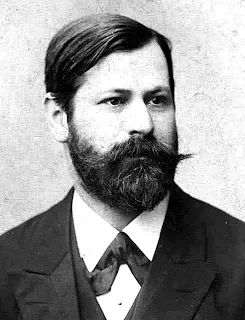
Freud 1895
Freud proposed various mechanisms, such as repression, resistance and transference, to explain observations from his psychoanalytic practice with disturbed and mentally ill patients, and the analysis of his own dreams. In the same year The Time Machine was published, he wrote a paper describing the common stratagem he called projection.

People who are not really being attacked or overtly threatened nevertheless may ascribe terrible motives or sinister qualities to those they fear, with or without rational justification. Freud suggested that they are projecting their own aggressiveness and whatever else they accuse their enemy of, onto the face of that other group, class, race, gender or person. "That other" doesn't even have to be a true adversary, just someone else who can in some way be defined as different: the Other.

We project the ugliness inside ourselves we cannot face, onto the face of the Other. It helps a great deal if we don't know much about this Other, if the face is relatively blank. Then everything horrible we can imagine becomes the face of the Other that we see.

When even in Wells time, actual European travelers came back with stories of newly discovered animals or previously unknown peoples, they often drew pictures of them. They are usually quite inaccurate in very obvious ways. They seem to be exaggerated versions, or combinations of well-known imagery of demons or angels, for instance.

But it's more than a case of seeing what we think we see. Projection is one strategy for denying to ourselves what we actually feel, or even what we really do. And in a further convolution, it can reflect envy for those who we believe do have or can express the quality we vilify in the Other. It can be a product of insecurity, which is rampant in times of change, and possibly even more pronounced when an aggressive war of all against all is supposedly the natural state of affairs.

We are willing captives of the unconscious when we do not accept that we are complex beings, and that the most powerful as well as the most terrifying form of knowledge is the knowledge of ourselves.

We can be captives of our projections even when we are facing an enemy that really is bent on our destruction, as the Traveller was really attacked by the Morlocks. But the difference is when the Traveller takes responsibility for his own behavior, and does not project its cause only outward to the enemy.

The spirit of the scene, though the Traveller is depicted
as younger (and less clothed) than the novel 
At the height of the violence in The Time Machine, the Traveller is pulled down to the ground in the dark woods and covered by Morlocks. "I felt little teeth nipping at my neck." But in the midst of this horror his hand finds the iron lever he had dropped. He renews his struggle to stand, "shaking the human rats from me," and strikes with his iron. "I thrust where I judged their faces might be. I could feel the succulent giving of flesh and bone under my blows, and for a moment I was free."

It is that word "succulent" that critic John Huntington singles out because it "conveys both the pleasure the Time Traveller gets from such battery and the strange similarity between such violent activity and Morlock cannibalism. The Time Traveller here reveals himself as like the Morlocks…"

Though the Traveller is obviously fighting in self-defense, this observation rings true, and seems to be intentional on Wells' part since he includes three notable mentions of the Traveller’s taste for meat-eating: when the Traveller first sees the bloody meat in the Morlocks's lair (and before he knows its origin) he approves that they at least are meat-eaters, and then when he returns to his own time and home, before he tells his story, he calls for and devours some mutton: "What a treat it is to stick a fork into meat again!" (Although this occurs after his journey, we read it at the beginning of the novel.) He refers to this delight again after telling his story.

A taste for flesh is not the only similarity. The attacking Morlocks have evoked reactions and emotions in him—aggressive energy, a "strange exultation" in battle, and a physical pleasure in smashing and killing, which we assume are qualities the Morlocks are more likely to embody than the Eloi.

Does this make the Traveller the same as the Morlocks? Presumably there is some genetic similarity, as the Traveller is a genetic forebearer. (The genetic differences between humans and other animals, particularly apes, were later found to be quite small, which would confirm Darwin and further scandalize his 19th century opponents.) The difference may not be so much in physicality as in behavior, and choices of behavior made according to perception and values.

As artists and storytellers knew long before Freud, what we project on others is often an image based on values in conflict within ourselves. The Eloi and the Morlocks are the Others in each other’s eyes, as they are in ours. In fictional terms, they are archetypes—the angels and the devils—but archetypes functioning as projections of the emotions of Wells’ time.

The Eloi are the working man’s cliché of the artist: weak, simpering, useless; children dancing around in dresses and eating fruit. But more than just ribald sneering at tutus, they are, for example, the projection of all the contempt and envy generations of working and lower middle class parents have heaped upon their artistically inclined children.

Similarly the Morlocks are the muted sorrow and real fear that the rich and middle class have for the gross, clumsy, violent, dirty, proudly mindless but physically strong underclass hordes. But they may also be the projection of all the contempt and envy generations of elite parents have heaped upon their children who feel compassion for the downtrodden, who react with shame and anger at the injustice and separation they see, who don't value money and power and social position over a sense of common humanity, or who even value fair play and a physical life over abstract hypocrisies.

Wells' own background comes into play. He grew up with the real fear of falling down the precipice of poverty and illness. He had a few encounters with industrial workers and how they lived, and he reportedly reacted with repulsion and anxiety. At the same time, he could empathize with the downtrodden. He had grown up poor and deprived, with a low iron ceiling on his hopes.

Early and often, Wells had expressed his anger and contempt for the upper class that limited what he as a child was permitted to learn and achieve because he happened to be born into a lower middle class family. He saw through the pretentiousness of the elite, and the hypocrisy of their piously held—and now pseudo-scientific—views, that conveniently allowed them to feel angelically justified in piling up wealth and power at the expense of everyone else, and especially of anyone who got in their way.

But he also admired the graceful spaciousness of Up Park (the estate where his mother was housekeeper), the educated elite of science, the arts and world affairs, and those among the rich who championed the advancement of knowledge and the dissemination of learning.

Wells' attitudes towards the Haves and the Have-nots of his time, the things he feared or disapproved of, and the things he admired and longed for, are represented in how he structures this story, and the characterizations of the Eloi and Morlocks. Projecting onto the page, projecting the story in the air or on the screen, is part of what artists do. Those images can then be examined, worked with, thought about, by both storyteller and audience.

What feelings do they evoke, what thoughts do they inspire? Free from too close an identification, free from personal criticism or exposure or betrayal, free from sin, we find more freedom in considering fictional characters and situations than in our own lives. Distance lends enchantment; the story is a playground of the soul.

And sometimes the more distant, the clearer we can see the outlines of action, character and meaning. This becomes one of the key discoveries about this kind of fiction, in which aspects of a present time are projected in time or space, to a distant time or a faraway planet, onto faces of beings no one has seen except in that story.

But projection in the real world has real consequences. One purpose of understanding projection is to cut down on the damage that projection and other unconscious stratagems motivate, channel or indirectly cause. We can do this by become aware of what's going on inside us, and by applying tools for understanding at least enough of what's going on inside us so we can question our motives, and when appropriate, change our behavior.

The Traveller for example might understand that for many thousands of years, humans have been omnivores—meat-eating is part of our evolutionary heritage. Cannibalism is so repulsive that it might have some sort of biological component. But in any case, the lines drawn by nature or culture have become part of our values that guide our behavior.

Similarly, the exultation the Traveller feels in battle is a response that has likely helped the human species survive when attacked by predators, or to make the body keener for the difficulties and dangers of the hunt.

On the other hand, while the Traveller’s exultant smashing of the Morlocks may be an organic human response, such pleasure in violence can also result in murder, rape and aggressive war-making which has become an agent of mass death. It may fuel less obvious aggressions, such as those against the natural world, which can endanger the existence of all life on earth.

Some (including a few in Wells’ time) have advocated dampening or eradicating these aggressive tendencies with drugs or genetic manipulation. But the result could well be the Eloi.

The Traveller has qualities of both Morlock and Eloi. From either’s perspective, he contains the Other. That’s the essence of his humanity. He is the living synthesis, and his strength and intelligence are derived from that union. He is both angel and devil, and the difference is in how he sees things, and how he behaves.

It also suggests Wells’ ultimate solution to the human conundrum of natural selection, and the key to human evolution.

...To be continued.  For earlier posts in this series, click on the "Soul of the Future" label below.

Wednesday, March 28, 2018

The Time Machine.5: Humans Divided

“...go, Teachers of content and honest pride, into the mine, the mill, the forge, the squalid depths of deepest ignorance, and uttermost abyss of man’s neglect, and say can any hopeful plant spring up in air so foul that it extinguishes the soul’s bright torch as fast as it is kindled!”
Charles Dickens
Martin Chuzzlewit

The Traveller resists the idea of following the Morlocks to their underground lair, yet if he is to recover the time machine, he knows he must. He senses and begins to share the Eloi’s fear of the dark, and notices his own unreasoning dread of the Morlock’s “pallid bodies...They were “the half-bleached color of the worms” he has seen in the zoological museum.

But with a frightened Weena watching, he climbs down the ladder of one of the wells and enters the underground darkness, equipped with only his last few matches. He sees machinery and some meat on a table, but he cannot communicate with the Morlocks. They quietly attack him, and he barely escapes.

Back on the sunny surface, he considers his emotions, and reconsiders the order of this future world. His third hypothesis adjusts the relationship of the two species descended from the human race he knew in his own time.

“The Upper-world people might have once been the favored aristocracy, and the Morlocks their mechanical servants, but that had long since passed away. The two species that had resulted from the evolution of man were sliding downwards...”

The Eloi “had decayed to a mere beautiful futility.” They had the surface to themselves because the Morlocks could no longer stand the light. “And the Morlocks made their garments” and maintained them “perhaps through the survival of an old habit of service.”

The Traveller takes Weena on an expedition towards a distant structure he calls the Palace of Green Porcelain. But the day wanes before they can return, and they stop for the night on an isolated hill near an expanse of endless woods. It is then that the Traveller's fourth and final hypothesis comes to him unbidden, as he is looking at the stars and thinking gentle cosmic thoughts.

In his brief foray underground he had seen a table of red meat, noted with scientific objectivity that the Morlocks were meat-eaters, and wondered where the meat could come from, for he had seen no animals. Now in the still silence of night he realizes "what the meat I had seen might be. Yet it was too horrible! I looked at little Weena sleeping beside me, her face white and starlike under the stars, and forthwith dismissed the thought."

But with the assurance of dawn he stands up and faces what he now knows to be true. The Eloi are the Morlocks’ lunchmeat. The Morlocks keep them like cattle. And he has his fourth hypothesis, no longer obscured by philosophies or anything less than the biological truth: humanity has divided into predator and prey.

But now the Traveller realizes he is not studying this phenomenon from a distance—he is now part of it, and he must act. He is living on the surface with the Eloi, and the Morlocks evidently consider him one of them—enough, in any event, to make him meat in their eyes. He has become what the Eloi are to the Morlocks: the beasts who are not us, the prey, the Others.

And now the Morlocks have become to him what they are to the Eloi: the ones to be feared, the enemy, the Others.

Though Wells' endows the Morlocks with some human emotion and at least one positive act (as the Traveller later finds, they have carefully cleaned and oiled his time machine), they are portrayed mostly as mechanically capable cannibals. Technically perhaps they aren't cannibals, because they are now a different species from the Eloi. But that of course is the point, and the horror of it: humanity has created its own predator, and made part of itself the prey.

The Time Machine has become a horror story. Humanity has divided into two separate and mutually dependent species, locked together in an ultimate inhuman symbiosis.

It is the final reflection of fears in the Traveller’s own time, where workers fear that the elites will keep them separate and enslaved, and drive them into the depths of despair, while elites fear the dark energy of the lower class and the "lower races" they exploit, so they tamp it down with the oppression of force and the shaming pretensions of science and culture.

The primal fears of the insecurely powerful are fulfilled in this future, as the apparently servile stalk them in the night, to devour them and all they have. Some of the Traveller’s contemporaries would see this future as just a reversal of predator and prey. They would assert that “predatory capitalism,” the rich preying on the poor describes the Traveller’s present.

Of course these fears remain, for the divisions are still with us, however reconfigured and sustained by new technologies and dogmas. And so the story continues to be haunting.

based on the 1960 film
Though the Eloi and Morlocks may be acting out of instinct at the time the Traveller visits them, they are the descendants of conscious humans who must have chosen to separate, and in a sense collaborated to divide. Perhaps violent conflict threatened to destroy them both. So the winners and losers of their common world divided into different environments that they each reinforced with their own creations, and then they each adapted to the environments they created and accepted.

Each species is separate, and both are incomplete. This is the key to Wells' portrayal of them, as simplified and unattractive opposites. Locked in the eternal dark and clanging of machine hell, the morbid, moronic Morlocks are the sketch of death. The Eloi, the cloying elite, are parodies of life and light. The Morlocks are pure evil, the Eloi pure innocence, but neither has the power of demons or angels, or gods of the future. They are satires of parts of humanity and segments of society. And in a sense those parts are interchangeable.

If the Morlocks are satirized Satans and the Eloi are travesties of angels, the two species define each other. Symbolically as well as symbiotically, without each other they don't exist. And this may be the most savage point Wells makes: the Eloi and Morlock devolved as separate species because humanity divided. On what basis they divided is a secondary point—it might be class, or race, religion or gender. It is all based finally on the dualism of the superior and inferior, of Us and Them.

Back in London the guests around the Time Traveller's baronial dinner table were right: it is a trick, a practical joke. The joke is that instead of showing how humans reflect in their cultures aspects of their biological evolution, in Wells' future, humanity has biologically evolved from its own cultural creations—and destruction.

But it's a very dark joke; no laughter interrupts. And the story is not over.

...To be continued.  For prior posts in this series, click on the "Soul of the Future" label below. 

Monday, March 26, 2018

The Time Machine.4: Be Careful What You Ask For

’See the value of imagination,’ said Holmes. “It is the one quality which [Inspector] Gregory lacks. We imagined what might have happened, acted upon the supposition, and find ourselves justified. Let us proceed.’”
Arthur Conan Doyle “The Adventure of Silver Blaze”

Critics have found models for Wells’ Time Traveller in a variety of fictional characters and real people, from Beowulf to Gulliver, Oedipus to Edison. Doubtless there are multiple sources, but there’s one never mentioned that I believe must be prominently included: Sherlock Holmes.

After their paths nearly crossed at the Emporium in Southsea, both Wells and Arthur Conan Doyle became writers whose work sometimes appeared in the same issues of the Strand magazine. They also became neighbors and friends, and traveled together in Europe.

Conan Doyle had the first success, with his Sherlock Holmes stories. Wells read and admired them, and in 1894—a year in which he was completing The Time Machine—he recommended the Holmes stories as a model for writing about science:

“The fundamental principles of construction underlie such stories as Poe’s ‘Murders in the Rue Morgue’ or Conan Doyle’s Sherlock Holmes series, are precisely those that should guide a scientific writer...First the problem, then the gradual piecing together of the solution.”

Conan Doyle called Holmes a “scientific detective.” Like Holmes, the Traveller employs the scientific method in making observations in this completely unknown world of the future, then forms a hypothesis, and makes further observations to test it.

The Traveller’s basic assumption about the future didn’t last very long: he saw the large buildings in the distance and the graceful and beautiful Eloi as evidence of the progress he expected from the future. Then he realized the Eloi were on the level of children.

This poster suggests the size of the Eloi as described
in the text--Weena as child-size.
So the problem becomes: what happened to humanity? Yet even in his disappointment in this passive childlike race, his hypothesis followed the lines of progress, and beyond: The Eloi were the weak heirs of success. Humanity had triumphed over nature and violence, and the beautiful buildings suggested centuries of artistic accomplishment and peaceful living. But no longer needing strength, intelligence and other qualities for the struggle of existence, the species selected for indolence.

The Traveller sat on the crest of a hill to watch the sunset and reflect on what he sees. The landscape is like a garden, with the palace-like buildings embedded in greenery. It was perfect. “The air was free of gnats, the earth from weeds or fungi; everywhere were fruits and sweet and delightful flowers... I saw mankind housed in splendid shelters, gloriously clothed, and yet I found them engaged in no toil.”

Yet for all the peace and beauty, the indolence and indifference of the Eloi suggested “humanity on the wane. The ruddy sunset had me thinking of the sunset of mankind.”

But this hypothesis about this future is soon to be shattered as well.

As darkness falls heralding his first night in the future, the Traveller looks down on the huge marble sculpture of a winged sphinx (part human, part animal) upon a large pedestal. He’d arrived in his time machine on the lawn in front of it. But his machine is not there.

He searches for it frantically that night, questioning the Eloi as his frustration and confusion mount, terrified that he will be marooned in this future.

The next morning he sees impressions on the grass that tell him the machine has been taken inside the pedestal, but he can find no way in.

Over the next few days he continues his explorations and observation, with the disappearance of the time machine always on his mind. He notices a number of circular wells dotting the land, and examines one. He hears a repeating thudding sound coming from below.

Among the Eloi he sees no evidence of machines, yet their clothes appear new. (He has already noted that their clothes are identical, with few clues to their gender.) He notes the absence of tombs. He has no idea who took his time machine—the Eloi seem incapable as well as uninterested.

Publicity still from the 1960 Time Machine feature with a Morlock
menacing a sexualized Weena--by that time, it already was a
monster movie cliche. The Morlock is also larger than the story
describes, and a greenish color rather than white.
Then when he watches the Eloi swimming in the clear river, he notices one is drowning. None of the others attempt a rescue, so he does. He doesn’t expect gratitude but he is surprised when “my little woman, as I believe she was” gave him flowers and clung to him.

“She was exactly like a child.” Her name is Weena, and she becomes his constant companion. She stayed especially close at night, and seemed very afraid of the dark.

The Traveller had already caught phantom glimpses of a “white, ape-like creature” in the night. Then one morning, as he escaped the heat of day (for the weather was “much hotter” than England in his own time), he entered a sheltered space and saw a pair of eyes glaring at him from deeper in the darkness.

He saw the creature clamber down the well shaft. He had met a Morlock. He began piecing together what he had observed. He realized they lived underground, that the wells were ventilation shafts, and that the thuds he’d heard were unseen machines.

So the Traveller forms his second hypothesis.

“But gradually, the truth dawn upon me: Man had not remained one species, but had differentiated into two distinct animals: that my graceful children of the Upperworld were not the sole descendants of our generation, but that the bleached, obscene, nocturnal Thing, which had flashed before me, was also heir to all the ages."

How could this have happened? The Traveller elaborates on his second hypothesis—that two species diverged from one—by speculating on the obvious parallels to his own time: the Eloi descend from the elite, the Capitalists, the Haves; the Morlocks from the servile, Labor, the Have-nots. Specifically the Morlocks descend from the workers of the industrial age, sent down for their short lives into the darkness of the mines, or into the "dark satanic mills." They are sent down there out of sight with the machinery, while the elite above enjoy the fruits of their labor.

What may appear to us now as mostly a metaphor was more powerful and shocking to Wells' first readers. The imagery of the Eloi and Morlocks resonate with us as classic caricature—boldly opposing images of fey beauty and disfigured horror out of folk and fairy tales, or religious images of angels and devils. But citizens of 19th century London could on any given day see suggestions of Eloi and Morlocks walking among them.

As several commentators suggest, the Eloi resemble the ideal look of the fashionable young aesthetes, the gentle hedonists of Aubrey Beardsley's illustrations, somewhere between the innocence of the Pre-Raphaelites earlier in the century, and the Art Nouveau of the period.

The monstrous-looking Morlocks would seem more exaggerated, but are they?  Blake was not the only writer to invoke Satan.  In describing workers in the mills, novelists Charles Dickens and Elisabeth Gaskell use almost exactly the same terms: that they appear as "demons among the flame and smoke" (Dickens.)

But the reality even outside the dark mines and mills was equally monstrous.
Social historian Lewis Mumford praises 19th century working class families for their heroism in just surviving, and his description of their living conditions explains why—even as it eerily suggests the Morlocks:

"…whole quarters and cities, acres, square miles, provinces were filled with such dwellings, which mocked every boast of material success that the 'Century of Progress' uttered. In these new warrens, a race of defectives was created.

 Poverty and the environment of poverty produced organic modifications: rickets in children, due to the absence of sunlight, malformations of the bony structure and organs, defective functioning of the endrocrines, through a vile diet; skin diseases for lack of the elementary hygiene of water; smallpox, typhoid, scarlet fever, septic sore throat, through dirt and excrement; tuberculosis, encouraged by a combination of bad diet, lack of sunshine, and room overcrowding, to say nothing of the occupational diseases, also partly environmental."

The idea of this division was not original with Wells. Dickens wrote about it, as did Benjamin Disraeli with his famous formulation of the "two nations" of rich and poor in an 1845 novel. But it isn't just the fact of this division that Wells is exposing.

There were those in his time who believed this kind of division was regrettable but necessary—not simply that there were always poor people but that poverty and deprivation were simply part of how things naturally worked, and worked out for the best. It was survival—and triumph—of the fittest.

There were several interpretations of Darwin’s natural selection applied to human affairs that came to be known as Social Darwinism.

It was not Darwin but English public philosopher Herbert Spencer who coined the phrase "survival of the fittest." He had applied it directly to humanity a decade or so before Darwin announced his biological findings. But Spencer and others who rallied to a simplified version of Spencer’s views were eager to claim Darwin’s theory as the ultimate scientific justification.

At least implicit in Social Darwinism is that evolution decrees all-out social warfare of the strong against the weak. As unfit losers fade away, the race is strengthened because the fittest survive. Those who obtain wealth and power by any means are acting as nature intends. Large companies should not be obstructed from getting larger, and the defeated in war are to be granted no help or mercy.

John D. Rockefeller
Not surprisingly, the wealthiest and most powerful eagerly subscribed to this notion. “The growth of a large business is merely the survival of the fittest,” said monopolist John D. Rockefeller.

“The laws of competition, while sometimes hard for the individual...is best for the race because it insures the survival of the fittest in every department,” wrote industrialist Andrew Carnegie. “"We accept and welcome, therefore, as conditions to which we must accommodate ourselves, great inequality of environment."

In Wells’ novel, "great inequality of environment" is exactly what could lead, in time, to one species becoming two. In his second hypothesis, the Traveller concludes this is just what happened.

He could see the process beginning in his own time, with the rich and poor separating in every way. “So, in the end, above ground you must have the Haves, pursuing pleasure and comfort and beauty, and below ground the Have-nots, the Workers getting continually adapted to the conditions of their labour.”

“The great triumph of Humanity I had dreamed of took a different shape in my mind. It had been no such triumph of moral education and general cooperation as I had imagined. Instead, I saw a real aristocracy, armed with a perfected science and working to a logical conclusion the industrial system of today. Its triumph had not been simply a triumph over Nature, but a triumph over Nature and their fellow man.”

Wells had given the adherents of Social Darwinism the world they wanted. He made their theory a fact of nature—and then he shows the consequences: two species, neither of them fully human. The fittest survive, but humanity does not.

Yet there are more surprises to come for the Traveller, along with his final hypothesis, and its proof.