Showing posts with label Beatles. Show all posts

Tuesday, March 17, 2026

Joy Among the Ruins


"The last year has been one of the most depressing of my nearly 50 years as a journalist."
 So begins Thomas Friedman's latest New York Times column.  If you are deep into the grip of such a depression, you might want to skip, for example, catching up with Rachel Maddow's latest MSNOW hour.  But if you are looking for a little hope, even a little uplift, try the rest of Friedman's column. (Photo above also from NYT.)

After offering a brief summary of the contributors to that depression ( "It’s not just that I’ve had to watch the Trump administration destroy cherished alliances, like ours with Western Europe and Canada, that have upheld freedom, democracy and global trade since World War II. It’s also been the stunning cowardice and boundless greed with which leaders of big law firms and Big Tech have bent their knees to King Donald and indulged a cabinet of clowns — not one of whom they’d hire in their own businesses."), Friedman quickly continues:

 "But then I spent time in my native state, Minnesota, after something else that I’d never seen in nearly 50 years: a spontaneous uprising of civic activism propelled by a single idea — I am my neighbor’s keeper, whoever he or she is and however he or she got here...It was one of the most courageous battles ever fought by American men and women not in uniform."

I've read (and written) descriptions of the Minnesota Miracle, but this long column adds more information and clarity.  It is moving and inspiring.  It is even joyful.


If you're in the mood for something clarifying and inspiring that is more metaphorical, you might check out the recently streamed concluding first season episode of Star Trek: Starfleet Academy, in which the climax occurs when a powerful villain is exposed as "an angry child with his finger on the trigger, whose entire worldview is based on a lie."  Given that this series was castigated for its woke diversity  by psycho Steven Miller himself, it demonstrates reassuring bravery as well as a concise analysis. Plus the good guys win. It's Episode 10: "Rubincon."  (Another inspiring episode of this outstanding series was #8, "The Life of the Stars," which centers on the Thornton Wilder play, Our Town.)

I haven't seen it yet, but judging from Michelle Goldberg's column about this year's Oscar winner for Best Picture, One Battle After Another, it might be another such candidate. She writes about how it mirrors today's Chaotic America, even though it was made before the 2024 election.  She calls it "forthrightly anti-fascist."  

On the subject of the Oscars, I'd also recommend as a potential source of solace and uplift checking out clips of the winners' acceptance speeches.  They were almost unfailingly generous to the other nominees (there are so many awards shows in awards season and the same people tend to be nominated in all of them, so they've all been hanging out together for months) and instead of just thanking their agents, they acknowledged those who preceded them and paved the way for their achievement.  

This was true of the big awards but also especially of some others-- the first winner in the new category of casting, who called out the names of legendary casting directors who were never honored, and the first woman to win the cinematography award, who asked all the women in the audience to stand, because they made her award possible.  It all made the term "the film community" a little more real, even across time.


But if you'd like several jolts of pure joy untethered to the depressing political present, I wholeheartedly recommend checking out clips from performances through the past two decades of Paul McCartney.  Many can be easily found on YouTube.

Going back to around 2002, McCartney formed a new band that basically has backed him ever since, and their sets are heavy with meticulous renderings of Beatles tunes. Over the years they include some of the earliest songs recorded and performed by the Beatles, as well as later songs that the Beatles themselves never performed--partly because they gave up touring, and partly because these studio-made records couldn't be reproduced on stage, either economically or at all, due to limitations on the technologies of the time.  But now they can.

In the first decade or so of these concerts, McCartney's voice was strong and pure.  In more recent years his voice has thickened and developed a kind of vibrato that takes getting used to, but that happens pretty quickly, especially as the utter thrill of this music takes over.  These are joyful songs to begin with.  Seeing and hearing them performed now...well, you might be surprised how you feel.

The audience really accentuates that thrill.  Not just the miracle of McCartney playing songs that the Beatles played in the 1960s, or never played on stage, but what the songs meant and continue to mean to these listeners. 

These are multigenerational audiences, entire families hugging and dancing. Grandparents going wild next to their enthralled grandchildren. There are girls as young as the ones in the A Hard Day's Night concert scenes (often shown on a screen above and behind the stage) who know every word and every note in music created decades before they were born.  And there are men of various ages just stunned, and moved to tears.

After all the angst, Paul McCartney has lived long enough to be completely vindicated, now with fans in at least three generations. You see the same expression on the face of other superstar musicians he performs with as you see in these audiences--they can't quite believe what's happening. It's an out-of,  in-the-body experience.

 He made amazing music after the Beatles as well, as most recently demonstrated in an excellent new film (currently streaming) on his years with Linda McCartney and Wings.  McCartney has written and recorded so many great songs that among them are songs that have fallen into obscurity, simply because there are too many others.  Yet it is clear that the past and the Beatles live in him every day, and he brings that music to life again.   

Kurt Vonnegut used to say that the purpose of art is to make people happy.  He was asked if any artists actually achieved that.  "The Beatles did," he replied.  They still do. Paul McCartney brings it alive again.  Try it, it may work for you, too.

Sunday, November 05, 2023

Now and Then


On November 2, a new song recording by the Beatles was released, the product of three recordings over 50 years or so: a demo cassette tape that John Lennon made at home in the mid-1970s (latest guess I've heard or seen was 1977, just three years before he was killed), then an aborted attempt to make the song into a Beatles record by Paul, George and Ringo in the mid-1990s, during the time they crafted "Free As A Bird" and "Real Love" from another Lennon tape, and now the final version created this year of 2023.

Technology that filmmaker Peter Jackson developed for the Get Back TV film made it possible recently to extract Lennon's voice from the piano and extraneous noise on the 70s cassette, which was one of the problems that led to the song being abandoned in 1995.  But George had recorded a guitar track before they gave up on it, so that was available for this recording.  With Paul playing bass and slide guitar, and Ringo on the drums, this song--now titled "Now and Then"--includes all four Beatles.  Since there are no known recordings of new songs with both John and George (who died in 2001), this is in effect--and officially--the last Beatles song.  

The song was first played on BBC radio, and became available on vinyl, together with the Beatles first release, "Love Me Do."  The official version appeared on YouTube with just the plain blue and gray box, with the song's title in white.  Although John's demo has been unofficially available, I'd never heard this particular song before.

The first thing that got to me was the clarity and vitality of John Lennon's voice.   At a time when death seems all around, this was less a revival than a resurrection.  The melody is enchanting, and the production is seamless.  I liked the quickly neglected 90s songs more than many others did, but this is a contemporary Beatles record--part now, and part then. 

The song itself has been edited from the demo version (partly because John hadn't finished the lyric), given a slightly faster tempo, and generally gets the Beatles treatment, with guitar solo and a string orchestra section.  Paul and Ringo do new vocals but high harmony backgrounds by George, Paul and John are taken from previous recordings, notably "Because" on Abbey Road.  There is one entire section of the demo that was dropped (which furnished its bootleg title, "I Don't Wanna Lose You,") that's now the center of online debates among Lennon enthusiasts.  There were probably technical reasons for this as well as musical ones, but the song is given a classic Beatles shape, and I love it.

On November 3, the official music video by Peter Jackson was released.  It contained a few images never seen before, but that isn't its main contribution.  Jackson crafted these few minutes to celebrate the Beatles career but most tellingly, he does so in the context of this song.  "Now and Then" can seem to be a wistful meditation on a delicate love relationship, perhaps a lost love (The interrupted relationship with Yoko is an obvious possibility.) But the video presents it as a commentary on the bond among the Beatles themselves, estranged as they were for a time in the 1970s. (Though throughout that decade, two or three or even all four of them continued to work together on solo projects, and the big break between John and Paul was largely healed by the late 70s.)

Instead of just intercutting clips from the past with some shots of the 2023 and 1995 recording sessions, Jackson created dazzling combinations in which Beatles from different eras interacted with each other, and even versions of themselves from another time, just as memory is part of the present.  The video suggests the power of playing together over time, with the visceral effect of presence even in absence.  Now and then exist together. 

 (Another layer is added with the brief shot of Giles Martin, co-producer of this record and son of George Martin, who produced all the Beatles records.  In this shot he even looks like his father.)

The video starts with the reality: Paul and George working out guitar for the song in 1995.  While John's voice is heard, the first images aren't of him but the gauge that measures the sound level, moving with his vocal.  He's present through the machines.  And yet...

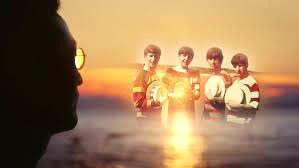
To get inside the song, the first image of him is a kind of silhouette, in which a scene of sunset (or sunrise) on the sea is reflected in his glasses, and a mirage appears of the four very young Beatles clowning around.  Then the dizzying combinations of all four of them in different times, mostly playing together (suggesting a higher octane version of the subtly surreal baggage car scene in A Hard Day's Night, and some scenes in Help!) The images of young Lennon are so bright and full, though Jackson presents only John the cut-up and clown, rather than his more intense or gloomy or distant moments.  In fact, the others are also seen frequently being silly. (Even present-day Paul gets in the act, mocking his shot playing bass, with a mugging young McCartney behind him.)

The video ends with a series of images that go backward in time to the four as young boys, and then the famous early 60s black-and-white bow from the stage with the bright Beatles sign behind them.  Then their images disappear and the light goes dark.  

(It's the last Beatles song, but unlikely to be the last Beatles release. A number of remixed albums are in the works, and I look forward to some machine-learning magic applied to those 1995 vocals, and a new tech update to the accompanying videos.) 

Clearly there is a lot going on in this mesmerizing video, so I suggest that in addition to watching it, you also listen to the song with no visual accompaniment, as I did the first day of its release, to feel its full effect. Either way, joy and tears, now and then. 

Inevitably, the song applies to us as listeners, for however long the Beatles have been part of our lives.  For me there was a time I thought of them every day.  I needed their rhythms to face everyday life. These days I think of them only now and then, and I miss them. But I know they will be there for me.  

Thursday, September 15, 2022

Beatles: Let It Back


The long video chronicle of a month in the life of the Beatles called Get Back has been streaming on Disney Plus since late last year, but the full eight hours was made available on Blu Ray and DVD only in July.  That's the way I watched it, and watched it again, and watched... So it was a major part of my musical experience this summer, especially as it sent me to reviewing other Beatles material I've got. (I've missed recent pricey books and boxed sets, but my decades-long identity as a Beatles fan has reaped gifts of books and music over the years from at least three girlfriends, my sisters, etc.  I've had a lot of birthdays and Christmases. These DVDs were gifts from Margaret.)  I found the series engrossing, mystifying and often enough, exhilarating. 

After completing what's known as the White Album in October 1968 (official title: The Beatles), the Beatles decided to have themselves filmed in the recording studio to be made into a TV special.  At first they were going to do White Album songs, but then decided it would be more interesting to show them creating new songs, rehearsing them, and then performing them in a live show...somewhere.  The day after New Years in 1969, they began.

Until now, all that officially resulted from these sessions were the feature film Let It Be and the album of that title, both released in 1970.  By the time they came out, the Beatles as a band effectively no longer existed.  The movie in particular became known as the story of them breaking up.  

About a half century later, the Beatles' still-existing company called Apple, still had the original 16 mm footage of all the hours filmed that month, plus audio tapes that ran even when the cameras didn't.  Peter Jackson, director of the Lord of the Rings films, jumped at the chance to try to construct a new something or other out of that footage.  When he started watching it (he would say repeatedly to interviewers), he was astonished: the Beatles didn't look like a dour group who hated each other.  They were often affectionate, and often having fun. The sessions had tensions but also a lot of joy.  Sometimes in subtle ways, they showed the earned closeness of a band of self-selected brothers, who had made magic together for nearly a decade, and still could. Some four years later Jackson delivered Get Back, an eight hour selection for Disney to run in three segments, and eventually, for Apple to issue as three DVDs.

Apart from doing it at all, Peter Jackson earns high praise for doing two basic things.  First, he used today's technology to "restore" the visuals and the sound.  I'm guessing that in fact the visuals look even better than the original 16 mm film, although 16 can look pretty damn good.  The sound of the music probably needed less work, but the real contribution was to clean up the sound so that the conversations etc. can be heard.  

Second, Jackson structured the film chronologically, which in itself changes the impressions often created by the Let It Be movie, which was directed by the guy who filmed all those hours, Michael Lindsay-Hogg.   Let It Be has the barest sense of chronology.  It's basically a collection of scenes.  It also looks terrible.  Even when it first came out, blown up to 35 mm, it was grainy and dark.  Surviving versions are often further edited and panned-and-scanned.  The one I have on VHS looks like a series of extreme close-ups shot during a blackout.  My fading memory of seeing it a couple of times in theatres, however, supports the idea that close-ups or one and two shots predominated.  Jackson's film has a larger sense of space.  We get the full studio and the full band. 

But even as a chronology of that month and of these sessions, Jackson's film isn't complete.  Important events outside the studio aren't mentioned, both in terms of background (the Beatles finances were a mess, and Apple was going broke) and specific events.  For example, early in the month, George Harrison suddenly gets up and leaves, quitting the group.  It's a big dramatic moment, and Jackson's film does a great job of showing the other Beatles' responses.  Then a few days later, Harrison comes back, inexplicably cheerful.  Jackson's film doesn't even try to suggest why Harrison left, except to show a painful conversation with McCartney that the Let It Be film also shows part of.  (Some Beatles scholars however suggests George and John Lennon had an off-camera tiff earlier that day, which precipitated George leaving.)  But what Jackson's film doesn't mention is that the day before George quit, his wife Patti left him.  And then she returned at about the time he rejoined the group.  He seemed to remain in a very good mood from then on, very committed to the band.

Apart from leaving out external events (including alleged drug use), Jackson leaves out parts of some conversations, skipping sentences and even moving the order of statements within the same conversation.  I know this because Beatles scholars on YouTube play the original audio tapes, which became available long before Jackson's Get Back was released.   So while this is a huge improvement in understanding what actually happened in these January 1969 sessions, Jackson's film isn't quite as complete or straightforward as it might seem.

Get Back tells a story that seems to be basically accurate.  The initial idea was to make use of the otherwise empty building of the British film company, Twickenham Studio, because Apple had leased it for the month in preparation for the making of The Magic Christian feature film, that was scheduled to begin shooting there in February.  That movie starred Peter Sellars and Ringo Starr, so that was another reasons the Beatles had to finish this musical adventure in January--Ringo would be unavailable.

But the Beatles were miserable at Twickingham. They were in a huge, cold room in the London winter, showing up in the morning at a time they would normally still be asleep, and unaccustomed to making music in a studio that early. The sound in the room was awful. They had to deal with every moment being filmed, as well as still photographers roaming around them constantly.  Director Lindsay-Hogg was badgering them about where they would do the live show.  They couldn't agree.

Harrison's departure seemed to change the game.  The other three Beatles met with him and all agreed they weren't going back to Twickingham, they weren't doing a TV show but the footage could be used for a feature film (they owed their studio one anyway) and they weren't going out of the country for a live show (which is what their director wanted.)   George helped organize the equipment needed to record in the Apple headquarters basement.

The mood lightened immediately when they got there, where a a homey space was created that they all liked.  Though the film shows a disconcerting amount of jamming and fooling around, they got down to working out songs.  This is the stuff that I really like, and I suppose anyone who has been in a musical group, especially one working with original songs, will recognize the process, even if this is on a whole other level. I love artistic process movies.  I love Sting's Bring On The Night.  So even what may seem tedious to others tends to delight me.

But several songs are getting bogged down, with several of the Beatles realizing they need another player, someone to do keyboards live.  Then one day, Billy Preston just shows up to say hello--he has known them since they were all teenagers playing dubious clubs in Hamburg.  (In fact, George Harrison had been talking him up to the others, and invited him to "drop in.")

 They ask him to sit in on the song they're working on ("I've Got A Feeling"), and immediately everything starts to fall into place.    Billy Preston provides the musical spark to several songs that completes them, and gets the juices going.  One of the early highlights of the series is watching Paul McCartney working out the basics of "Get Back" from scratch. Then we see the lyrics gradually change from an anti-racist protest song (anyone remember Enoch Powell?) to the words we know.  Billy Preston's keyboards finally completes it.  He remained part of the group through the rest of the sessions.  His work on "Get Back" has been praised, but he's equally essential to "Don't Let Me Down."  

Throughout we hear each of the Beatles bringing in songs (several times, something they had written the night before), and everyone gets interested.  Most of these songs, and others they are working on, will appear (we know now) either on their next album, the incomparable Abbey Road, or, more hauntingly, on their post-Beatles solo albums.  The explorations of George Harrison's song "Something" are especially fascinating.  The musical accompaniment for once comes easily, and that great tune is there.  But Harrison has almost no lyrics to what will eventually be known as one of the greatest love songs of all time.  It sounds so heartfelt, but for months, George didn't know what "something in the way she moves" attracts me like.  

Of the songs that eventually do make it on the
Let It Be album, one of the most troublesome is "Two of Us."  It was the song Paul and George argued about at Twickingham.  For weeks the group is never satisfied with it, no matter how many times they do it--and they do it a lot.  Paul and John sing it to each other in posh London accents, Scottish accents, Bob Dylan accents, and eventually sing it without moving their lips, like two crazed ventriloquists.  But it is Paul getting tired of playing the electric bass and picking up an acoustic guitar that gets the song going, as a kind of skiffle or folk song, with Ringo's tasty drumming and George playing bass notes on his electric guitar.

Yoko Ono has been a constant presence sitting silently beside John (in Let It Be she seems ominous; in Get Back, pretty neutral. Both she and George Harrison's second wife Olivia are listed as producers for the Get Back series.)  By the third and fourth week of the sessions, the studio opens up.  Paul's girlfriend Linda Eastman (who was shown as present once at Twickingham) brings her six year old daughter Heather to the Apple studio, and Heather's interactions with John, George and Ringo as well as Paul, and her imitation of a Yoko vocal, are highlights. (Paul and Linda would marry a week before John and Yoko. Paul soon adopted Heather as his daughter.)   Patti Harrison and Ringo's wife Maureen also visit the studio, and most of them listen to a day's recordings in the control room together.  These are some of the most affecting scenes.

But the Beatles can still never agree on a live show, and until the last moment, aren't sure if they will do their now famous rooftop concert.  Jackson intercuts the entire concert (just five songs, some repeated).  He included more street reaction than did Let It Be, so Jackson has the narrative of the police officers arriving, being diverted and finally ascending to the roof, all in split screens.  The Beatles road manager finally tries to turn off George's amp, but he curtly turns it back on and they finish the song. 

 Each time I've seen these scenes I've gotten a different impression. Sometimes the street interviews were mindless distractions.  Other times they were overpowered by the energy of the music.  Once I marveled at the reaction of people on adjacent rooftops and the street.  There's no telling how well they could hear (a segment in the Beatles Anthology suggests the sound wasn't really very loud on the street), but they show little emotion.  I couldn't help thinking of the contrast with the years of screams and fainting.  On the other hand, the people complaining about their music and the police showing up could have been straight out of A Hard Day's Night.  That much didn't change.

I was surprised then by how briefly Jackson treats the final day, in which the Beatles alone in the studio record the acoustic "Two of Us" and the two McCartney piano numbers, now classics: "The Long and Winding Road" and "Let It Be."  The movie Let It Be presented full versions of both songs, but without context, it reinforced that movie's narrative of a dominating McCartney, and the others literally (in this scene) sitting at a lower level, playing supporting parts.  In context, it was just the most efficient way to do the final recordings of these two songs, at the end of an exhausting month.  However, it would have been nice to hear more of them.  ( For my money, the best cut of "Let It Be" on film is in the Beatles Anthology.)  

What about the Beatles themselves?  Paul McCartney is neither the authoritarian monster and central villain that the Let It Be movie casts him to be (though his beard and black suit don't help), but neither is he the genial and articulate statesman of interviews.  Emotionally he seems all over the place--capable of far-seeing insights and long monologues of near nonsense. He comes off as a paradox at times.  For example, who was the most actively opposed to doing the rooftop concert? And who looked like he was having the best time doing it?  McCartney, both. 

John Lennon is always the class clown, but he's also very quiet and subdued for long stretches, though when they play in the Apple basement he's right there, energetic and engaged.  There are moments when both McCartney and especially Lennon are pretty open about their fears and insecurities, past and present.  Paul is uncomfortable in his role and worried about the band's direction.  On the music itself, he worries that his classic ballads drag too much.  John is contrite for showing up late and not being at his best. (This may be the result of his reputed occasional heroin use, or he's just sick.  It's the flu season and both Paul and Ringo also complain of being ill at different times.) John is realistic about the limits of his own guitar work, though I was surprised to see that he did the guitar solos on "Get Back," and some of the jams show he had more lead guitar skills than I would have guessed.

George Harrison appears all black or all white, sour or sunny, and in Martin Scorsese's biographical film about him, that's how Ringo describes him: either saint or sinner, nothing in between.  It wouldn't be until Abbey Road and his own All Things Must Pass album (the most successful of all the immediate post-Beatles releases), that the quality of his songwriting was fully revealed, along with his unique, haunting and supple voice.  Just before the Get Back sessions, he had spent six months producing other artists, and his production of All Things Must Pass (despite what Spector did to it) is musically remarkable.  In that sense, he never really had a "solo" career.  He was the instigator of the Traveling Wilburys in the early 90s, which he formed (Olivia  Harrison said in the Scorsese film) because he missed being in a group.  He missed the Beatles. 

Ringo Starr was the backbone of the Beatles sound, and the glue that held the Beatles together. Though he's not heard saying much in this series, it's partly because he does his job so well.  A lot of Beatles songs sound simple until you get into their structure.  For instance, George comes in with a song, "I, Me, Mine," best known now for its eloquent lyrics, that he was inspired to write by seeing a grand waltz performed on a TV movie.  Most of the song is in waltz time (John and Yoko actually waltz to it), though it breaks into a four-four rocker, and back again.  Other songs are replete with even more subtle complications, and Ringo has to engineer these time-jumps seamlessly. 

Even so, Ringo has a nice scene doing a comic take to the delight of Heather McCartney, and also when he brings in the basic idea for "Octopus' Garden"--  George (the other non-Lennon-McCartney songwriter) immediately starts working with him to extend it, soon charming everyone and interesting the other Beatles in developing it.

Transcending all other impressions of this series is this magic opportunity to spend this much time with these four extraordinary people, all of them still in their twenties, as this extraordinary group.  Though this experiment was artificial in that it wasn't how the Beatles made their records anymore, it did bring them together every day over an extended period for the last time.  In the decade to come, as they went their separate ways (though different combinations of them collaborated), they all had periods of depression or despondency, and they all at times had serious drug and/or alcohol problems; two marriages ended, and they all endured tragedies.  John Lennon was weeks past his 40th birthday when he was shot dead.  These hours in the studio, during which they often revisited their past music as well as shaping new songs, seem like a time out of time.

With the benefit of hindsight, we do see suggestions of what would soon break up the band.  We also see the Beatles' luck start to change.  In the beginning they happened to find the right manager, the right producer, and then the right film director to help them blossom.  But this film makes a joke of their association with "Magic Alex," the supposed electronics genius they hired who is exposed as a total and expensive charlatan.  Not so funny is reference to John Lennon meeting Allen Klein, and his glowing account of Klein's knowledge and business acumen.  Eventually, Lennon convinced George and Ringo to make Klein (then managing the Rolling Stones) the group's manager.  Paul saw through Klein, and the resulting conflict was the proximate cause for the Beatles to break up.  Klein did get them more money, but his nefarious schemes eventually turned John and especially George against him.  They all dumped him, and he became an active nemesis for awhile, until more money changed hands.  

Also at about this time, John and George brought legendary producer Phil Spector into their efforts, and Spector's production of the long delayed Let It Be album did not go over well.  Eventually, McCartney backed a re-release that stripped it of Spector's effects, for the album Let It Be Naked. 

Yet, just weeks after the rooftop concert, the Beatles began recording again, this time with their producer of all previous records, George Martin, and did so at their EMI studios on Abbey Road, for their last, transcendent album.  And in the end...  

Thursday, March 14, 2019

History of My Reading/ The Ghost, Lucretia Parsnips and The Great Turkey Heist of 1965


Note to Knox readers: In addition to the usual stuff, this post includes a 54 year old news story.  For the first time anywhere, names are revealed of at least some of the participants in the notorious crime of 1965: the Great Turkey Heist. Read on (or skip down.)

Flipping through a complete set of Knox Students for the 1965-66 school year reveals a few trends.  The college--students, faculty and administrators--was highly focused on the college, with the ongoing Faculty Planning Committee and its preliminary reports, and with pages of Letters to the Editor in the regimes of editors Ed Rust and Bill Barnhart.  Vietnam and related issues began to appear with increasing frequency.   Computers were mentioned, including the Computer Science major to be offered the following year.

Michael Chubrich (right) in debate, Judy Dugan
moderating, Len Borden taking notes. Gale photo.
Michael Chubrich took over as Student Senate president, promising sweeping changes. Guests on campus included Senator Paul Simon of Illinois, J. Allen Hynek, the UFO advocate, the classic filmmaker Joseph Von Sternberg (The Blue Angel) and poets Mark Van Doren, Robert Bly and James Dickey.

Knox theatre's mainstage productions were Shakespeare's The Taming of the Shrew (the last ever to be directed by departing professor Kim Chase) and The Mikado. Kevern Cameron directed Waiting for Godot, locating it in a circus.

Among the Social Board movies was To Kill A Mockingbird.  A few Cinema Club titles inevitably suggest the college ambience: My Life To Live, The Exterminating Angel, Through A Glass Darkly, La Dolce Vita, The End of Innocence.

Immediately upon my return to Knox in the fall of 1965 for my second year, I was very, very busy.  I was news director of WVKC, the campus radio station, and doing music shows as well, which required selecting music from the station's record library (or bringing my own albums), creating a playlist for the engineer, and using a copy of it for my on-air introductions.

I did jazz and folk shows, and filled in occasionally for classical shows--while adopting a slightly different voice suitable for each form (folksy, cool, FM-whispery).  I already had my news voice(s).  As the year wore on and I got more tired and bored, my David Brinkleyisms on the ten o'clock news became more outrageous.

I did have one distinction: I was the first DJ in Knox history to legitimately play a rock song.  They had been forbidden, until the station director (Mike Bourgo) bowed to the inevitable.  The first rock song?  "Help!" by the Beatles. (It was at the end of an original radio mystery that Skip Peterson and I wrote.) My summer conversion to the Beatles was continuing--I was rapidly accumulating Beatles records and other material, as we shall see (read on.)  There was some negative reaction to WVKC's belated rock revolution, however-- from students (including an offended letter to the editor.)

One more note about WVKC.  In February (1966), the first combat death in Vietnam of a Knox alumnus was recorded: Albert Merriman Smith, class of 1960. He'd also worked at WVKC.  His father (also Albert Merriman Smith, though he'd dropped the "Albert" professionally) was the White House correspondent for United Press International, one of the wire news services we used for our newscasts.

I became an editor of Dialogue, the campus essay and issues magazine, now established in its second year.  I joined the editorial board (with students Kevern Cameron, Steve Goldberg and Dennis Stepanek, and faculty members Douglas Wilson, Gordon Dodds and John Pascucci) and by spring, I was functionally the managing editor, preparing the issue for press.

I also began writing a column for the Knox Student, called Metaphor.  I started with a piece ostensibly "explicating" the expression "one book man." For a long time I thought I'd embarrassed myself by totally misunderstanding it. In 1965 I thought it meant a dogmatic person who derived their beliefs from the equivalent of one book.  Later it seemed it really meant an author who manages to write or at least publish only one book.  (An example of that would unfortunately be me.)  But it turns out that the original phrase "man of one book" from Thomas Aquinas meant what I thought it meant in 1965.
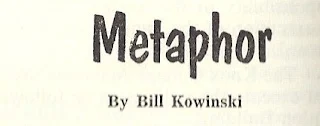
The only Metaphor column anyone remembers was one I wrote on a particularly frenzied night in November (I think I wrote it at the Toddle House, where I spent many late nights after my midnight radio show) that used a strange punning language to describe the weekend as a society or gossip columnist would--in this case "Lucretia Parsnips" or movie columnist Louella Parsons.  The names in particular drew attention (for example,"kafka livingston" was Kathy Lydigsen, "maybe jefferson" was Mary Jacobson, who returned the favor by dubbing me "big coincidence.")

Afterwards I heard from at least one English faculty member about my "Joycean" language, derived from Finnegans Wake by James Joyce.  I smiled and nodded knowingly but in fact I'd never looked at a page of Finnegans Wake.  My model was John Lennon, whose similar punning style was on display in two books, the recently published A Spaniard in the Works and the earlier In His Own Write, which I'd absorbed over the summer.  However, I hastened to acquaint myself with the works of James Joyce outside of A Portrait of the Artist--and he became an obsession for many years.

I have since learned that my experience essentially replicated John Lennon's. When his first book came out, a critic mentioned its Joycean origins, but Lennon hadn't read Joyce either--though he did after he'd been influenced by him.

My fellow columnists for the first semester were Kevern  "Casey"Cameron ("The Noisemaker") and Skip Peterson ("The Styleboat Skipper.") Cameron ignited a letters debate between Professors Brady and Doug Wilson, and Skip and I were envious.  But the three of us also collaborated in different combinations (I believe we may have written each other's columns once--I'm pretty sure I wrote a spoof of Cameron's.) I'm sure the three of us once got together to write a combined letter to the editor we thought was hilarious, after which we repaired to the BV for more liquid refreshment, returning to campus arm and arm and singing, a unique experience in my college career.

Unidentified Englishman (probably a duke by now)
and me
I was still active in the Knox debate club, and in particular participated in a debate with two touring student debaters from Cambridge University in England.  Judy Dugan and I were each paired with one of these lads, on one side or the other of the topic (as we say in America), or the question (as they say in Brit.)  Judy and I did our standard research and serious preparation on whatever it was.  But the Brits were much looser, employing wit, rhetoric and sometimes fanciful argument.  I eventually got into the spirit with a few ripostes of my own that went over well, so we had a great time.

The Gale photo.  Mark Brooks
and Neil Gaston behind me.
But my big public speaking moment that fall was addressing the Student Senate on the issue of how students were selected to participate in the Faculty Planning Committee's work (which is the occasion of my photo on the title page of the 1966 Gale yearbook.)  I was part of a group that drafted a statement, and I wrote the accompanying speech.  I read it first before at least some members of this group, and specifically included the words "denizens of Olympus" so I could see Mary Jacobson make a face--she disapproved of such rhetoric. I made some changes based on their comments (but I kept "denizens of Olympus" in anyway. It gives me a laugh even now.)  As writing, the speech is pretty good--probably more accomplished than my columns--and clearly modeled on the style of Robert Kennedy.

So with all of that elevated activity, none of it having anything to do with college sports, no one would suspect me of collaborating in the crime of the year.  But that was a key to our success--we were not the usual suspects.  So after more than five decades, now it can be told: the true story of....

The Great Turkey Heist of 1965

The closest equivalent college campus to Knox is Monmouth College in nearby Monmouth, Illinois.  The annual football game between the two schools is an historic rivalry, and the winner is awarded the bronze statue of a turkey.  Why?  Beats me.  Anyway, the winning school keeps and displays it until the other school wins it back.  Except...part of the rivalry is finding ways to steal the Turkey in advance of the Big Game.  And this is what a highly unlikely crew did.  Our photos were published in the Knox Student--with our faces obscured.  So prepare to be shocked.

Ed Rust
The mastermind was Ed Rust, editor of the Knox Student.  In a letter to the editor at the end of his tenure I described him: "In conversation he is jittery, his eyes are piercing, his head and shoulders are bent forward, his chin jutted, all giving the impression of disorganized intensity."  Today I would just recall him as a combination of Robert Kennedy and Dennis the Menace.

Rust enlisted the unlikeliest of suspects: Jim Bronson (the tall, clean cut, affable photographer and writer for the Student) and the truly shocking one: Ruth Mesing, recently appointed as one of the first student representatives on the Faculty Committee on Student Affairs, along with Bob Misiorowski.  And, for some reason, little old Indie me.  How Ed talked me into it I don't know, but he could be persuasive about his enthusiasms.  (There were others in that photo but I don't recall who they were.)

RFK with Ed Rust reporting
Rust, who had seen entirely too many James Bond movies (Goldfinger was the latest hit in the series), concocted an elaborate plan, a real caper.  He obtained a car somehow (this was when Knox students weren't permitted to have cars on campus, or even to drive one)and sent Bronson and me to the Monmouth student union.  Jim identified himself as a photographer for the Monmouth student newspaper, and I was his assistant.  He sweet talked the union's (adult) manager into allowing him to take a photo of the Bronze Turkey in the display case.

Only Jim kept getting a reflection from the glass, so he asked the manager to take the Turkey out of the display case.  But we needed still more light--daylight for instance, and so the manager accompanied us as we took it outside.  Just then at that very moment, he got an urgent phone call (Rust? Mesing? calling from a phone booth within sight of us) and had to go back inside.  Bronson was looking into his viewfinder while I held the Turkey.  He motioned me a little farther back.  Then a little farther.  And when he was sure the coast was clear, he waved me away.  We had the Turkey.  It was a heist, though I believe we liked to call it the Great Turkey Coup.

But it wasn't over.  The Rust caper had a few more twists and turns. We met back at the car and Jim drove off, but he didn't head back to our campus directly.  Part way back to Galesburg he pulled off the road into a secluded area, where, under some trees, there was a second getaway car waiting.  It was a station wagon, the back of which had one of those compartments in the floor for the spare tire.  The Bronze Turkey went in there, with a nice rug atop the compartment.

Ruth Mesing and Miz wait for
a Student Affairs meeting to start
Ruth Mesing drove the station wagon, the real getaway car.  I rode to Galesburg with her, while Bronson drove back alone.  So if anyone was looking for two guys riding together, they wouldn't find them.

Meanwhile Ed Rust distributed fake editions of the Monmouth newspaper on their campus, announcing the theft of the Bronze Turkey, by "townies."  My participation ended there, but the fallout continued.  The next day Monmouth dropped a one page edition of the Knox "Stud" on the campus from an airplane.  Later, five pillowcases of feathers were dropped on the Monmouth campus.

 Then Monmouth students tried to raid the Knox campus but one was captured and held overnight in a frat house.  Then Monmouth students did the same to a Knox student.  The escalation might have continued, but by then it was time for the actual football game.  Which Knox won--the team's only victory of the season.

The Theatre of Smoking

I associate two other sets of memories with this school year.  I've previously recounted my New York misadventure with the tape of songs by my hometown folk trio, the Crosscurrents.  But that didn't end the Crosscurrents.  The other two members were high school friends, Clayton and Mike, who attended a college close to home. That fall, Clayton and I decided to write songs together long distance: I would write lyrics, send them to him, and he would write the music.  When I went back, the three of us would work out the song.  We wrote perhaps a half dozen songs that way.  I vividly remember writing one of the lyrics-perhaps the first--on a yellow pad, in the Knox library.  That's a kind of holy memory.  They were good songs, though the lyrics were a little flawed.  One of them became pretty well known among a small audience.

The other memory was of how I took up cigarette smoking.  It happened in the Gizmo, where I was entertaining the table with imitations of how various professors smoked.  Teachers smoking, let alone smoking in class, was new in my experience. But these were the '60s, and pretty much everyone smoked, pretty much everywhere (although at Knox, women were not permitted to smoke and walk at the same time.)  I got laughs by holding a cigarette with two fingers in an erect V, very close to the hand, as Mr. Grutzmacher had.  And smoking the cigarette down to the last quarter inch, as Mr. Haring did in my political science class.

The act was such a hit that I repeated it.  After a few times I just kept on smoking the cigarette, and then I started buying them.  I went from Salems to unfiltered Pall Malls in my senior year with lots of stops between. At some point I discovered the variety of obscure and foreign brands sold in the Knox Bookstore and began trying them all.  I especially got a kick out of the multicolored ones--the actual cigarettes were odd shades of magenta and florescent green and so on.

In the 70s when I quit (after succumbing to Gauloises and Gitanes) I identified this theatricality as part of what made smoking so habitual and (apart from the physical addiction of tobacco) so hard to kick.  How one held the cigarette, when one breathed in and out in rhythm with smoking, especially while talking; the cigarette as "a baton on the end of your gestures," made cigarettes an integral part of personal style and daily identity.

Speaking of theatrical, one of the actual courses I took this year was modern theatre history with theatre professor William Clark, who persuaded me that if I was going to write plays, I ought to know something about theatre.

The text was Mordecai Gorelik's New Theatres For Old.  While I found the class less than mesmerizing  I did get something like a grounding in stagecraft history and theatrical styles.  I read plays and wrote about them.  I particularly enjoyed Ibsen's Ghosts and a little-known Tennessee Williams play, Camino Real.  In later life, when I found myself reviewing and writing about theatre, I maintained the habit of reading the plays I was seeing, and reading as much about them as I could.  This was often more fun and rewarding than seeing the productions.

And speaking of Phil Haring, I took his Modern Political Theory class second semester.  We sat around a large table, and so had plenty of opportunity to observe his smoking.  I remember we read a number of paperbacks, covering political theorists such as Hobbes, John Locke and David Hume, onto more contemporary theories such as applying behavioral psychology in The Behavioral Persuasion in Politics by Heinz Eulau, a taste of things to come.

 I wasn't fond of that approach, as I wrote in a pretty good final paper. I enjoyed instead the observations of Philip Whitaker in his 1964 book we used, that seems to have completely disappeared from the planet since: Political Theory and East African Problems.  His observations on political theory rather than East Africa were on point.  Still, I ended up not being motivated to continue in political science, which I had briefly considered as a possible major.

In future posts, I plan to discuss the two writing courses I took this second year with Sam Moon, and the two literature courses with William V. Spanos (I never could call him "Bill") and the Whitman/Wallace Stevens seminiar with Douglas Wilson--all of which decided me.  But to end this post, I must recount the continuing influence of the man who wasn't there, the Ghost of Fred Newman.

The Ghost Who Talks

Fred Newman's absence was a presence when classes resumed in the fall of 1965. Photos of the demonstration in support of him the previous spring appeared in the Knox Student.  The tensions among students, faculty and administration continued, and Newman was evoked in various commentaries.  Meanwhile Newman himself was in New York, teaching at City College (CCNY.)  That fact led a group of students to a further and ongoing protest--the wearing of CCNY sweatshirts.

 There actually weren't any, we found, and so we had them created.  They arrived all together, and a fairly large group of us repaired to some off-campus apartment (probably Mike Hamrin's) to claim our blue sweatshirts with the white CCNY letters.  We returned to campus together, and entered the Oak Room together for dinner. The effect was slow to sink in but it remained for awhile, including some bitter criticism in letters to the editor, suggesting traitorous behavior.

Newman's ghostly presence continued throughout my year, even academically.  It was most pronounced that fall, when I was using his language and accompanying it with his arm and hand gestures, and the way he rolled back on his heels where he stood.  In the Oak Room after dinner once, Wendy Saul commented on this, and added that I not only was beginning to resemble Fred Newman, "some people think you are Fred Newman."

Since childhood I found myself entering the image, so to speak, of figures I admired.  While other boys got themselves Davy Crockett coonskin caps, I felt myself become Davy Crockett, speaking and moving like Fess Parker had in the TV shows and movies, or rather feeling I was.  I did something similar when I was learning, for example, to play and sing Bob Dylan songs or Beatles songs.  I became them internally, and outwardly imitated their voices and so on.  These were explorations and even ways of learning the songs, so eventually I would integrate their styles in my own way.

But Wendy's comment made me realize I had gone too far this time.  The ghost of Fred was taking over.  I had to let it go. Besides, I had just bought my first John Lennon cap.

Still, all that year the influence remained in my classwork.  I took a philosophy of language course first semester (I don't recall the teacher) and a Theory of Controversy course second semester, taught by speech professor Donald Torrence (who was also in charge of debate.)  That practically was another philosophy of language course; I recall we read A.J. Ayer's Language, Truth and Logic. The text for the philosophy course was probably Readings in the Theory of Knowledge, edited by John Canfield and Franklin Donnell.  I remember we spent a lot of time on long excerpts from Kant's Critique of Pure Reason.

 My papers for both show a marked preference for books from the Newman course the previous year (notably Quine's Word and Object), and a style of discourse often similar to Newman's "Rules and Games" speech.  Even my final paper in Modern Political Theory began with a Wittgenstein/Newman riff on theory, rules and games, and returned to it later.  Reading that paper now, I have to observe that it actually was apropos, and successfully integrated those ideas for observations which I find valuable in looking at political situations today.

Fred Newman however was not actually a ghost, and we were in sporadic contact by letter and phone.  Christmas vacation is often the occasion for big academic conferences (which cover for head-hunting and job-hunting for academic positions) and there was to be a philosophy conference in New York. Senior Michael Hamrin, one of Newman's students (who later entered the Stanford graduate program in philosophy, where Fred got his advanced degrees) had a VW bus at home in Joliet, and the plan was for him to stop by in Greensburg and pick me up on the way to Manhattan.  Judy Dugan, who lived in Chicagoland, would meet up with Hamrin for the trip.

I was excited, not only about New York and the conference, but about the occasion of my two worlds coming together: two Knox friends (especially Judy) would meet my hometown friends, Mike and Clayton.  Hamrin and Judy were scheduled to arrive at my family home on Christmas day.

But the phone rang early on Christmas with Mike Hamrin on the line, explaining how his VW had been rear-ended on a city street.  He and Judy were uninjured but the VW was damaged to the extent that it wasn't safe to drive.  So they didn't come.  There were several further occasions when my two worlds were supposed to meet and didn't.  When they finally did...well, that's another story, for another time.

Fred talked about joining the faculty of Antioch College, a prestigious liberal arts college in Ohio, known for its unconventional academic approach.  I decided to apply for transfer to Antioch, which he encouraged.

By spring, he'd been rejected for the job, and I'd been rejected for a scholarship. He wound up at Case Western Reserve, and I remained at Knox.  Fred also spoke about the possibility of a summer job for me, and for getting me a grant for summer school at Harvard.  Neither of these happened either.  (I'd forgotten most of this, but much of it was recorded in my letters home, which my mother saved.)

Fred Newman returned corporeally to Knox in the spring, gave a well-attended talk in the Commons Room and a long interview on liberal arts colleges in the Knox Student.

There were other highlights to my second year.  Stay tuned for posts on Sam Moon, William V. Spanos and Doug Wilson.  Other posts in this series can be found by clicking the History of My Reading or Knox College labels below.

Tuesday, June 06, 2017

And You're Gone: Sergeant Pepper Memories

It was fifty years ago today, give or take a few days, that I was walking along the main downtown street of Galesburg, Illinois.  I was just passing the department store, heading for the corner where I would cross the street and head down that side street back to the Knox College campus.

But I saw someone turn that corner from campus and head briskly on that side of the main street in the direction opposite to mine.  It was Bill Thompson, a friend and fellow student.  From the brisk and exact way he cut that corner and the sense of purpose in his determined stride, I knew exactly where he was going and why.

He was hurrying down to the town's record store.  He'd evidently heard--by dint of having called or because he was called--that the long-awaited album had arrived: Sergeant Pepper's Lonely Hearts Club Band.

I immediately crossed the street and joined him in his quest.  We returned to his offcampus digs and played the record, both sides, all the way through.  My first response was that I was tantalized.  I wanted more.  But it turned out, more came with repeated listenings, all that summer, and then for the next fifty years.

Rolling Stone magazine, which today officially calls it the best album ever made (while others, me included, aren't sure it's even the best Beatles album), has a series of appealing historical articles on each of the songs.  A lot of the content has been known but there's some deeper research (into people who inspired songs like "She's Leaving Home" and the first part of "Day in the Life") and some stuff that's either new or I'd forgotten it, like the fact that Paul McCartney's "When I'm Sixty-Four" had been a novelty tune in the Beatles repertoire since their live club act.

Other articles are fascinating though, especially the first one, on the Sergeant Pepper idea and song, the haunting story of the first person mentioned in "Day in the Life" (someone in their London scene who ushered McCartney through his first acid trip)  and more background about Lennon's "Good Morning, Good Morning."

That last mentioned article used the well-known story of Lennon being inspired by a cereal commercial he saw on TV (as we all did that year) to make the case that all his lyrics on this record reflect his post-touring life of suburban domesticity, and his ways of escaping the tedium through reverie and creative imagination.

After that first listen, and after a week or so of hearing it pouring from the windows of the residences of the few remaining students, I returned to western PA and what turned out to be a summer of suburban domesticity and tedium.  Before school was out I'd had my choice of three summer jobs.  But I returned to find that the one I'd chosen had fallen through.  So I was separated from my student companions and milieu, stuck at home with no money and nothing much to do.

However, there was Sergeant Pepper, which became the soundtrack of my life.  I played it repeatedly, all day when my parents were out, no matter what I was doing.  I remember it playing while I was in the bath.  If something like mp3 players or Walkman's had existed then, I would have listened to it continuously.  As it was, when I took off walking to town or wherever (braving dumbfounded hostility for my growing hair), it was playing in my head, and when I returned, I would immediately put it on again.

I reveled in the music that matched the beat of my blood and my soul, in the lyrics that sang of a familiar world in a new way.  Even the English major in me reveled, as I noted the irony of "fixing a hole" that "keeps my mind from wandering," you know--closing something up in order to wander freely.  And of course, the multiple meanings in just the title of "Within You Without You."

I thought about it obsessively, devoured anything in print I came across.  It was touted as the first "concept album" but the concept didn't extend to many of the songs.  I figured out one element that gave it unity that I don't think anyone else has since noted: the spaces between the songs on the album were shorter than on previous albums by the Beatles and others.  They would soon be shorter on most albums.

The outside world there was very much the one the lyrics were often about, and the Beatles provided not just a knowing rejection but an upbeat alternative, a bit of acceptance but a lot of finding internal resources, and internal worlds to live in. ("Somebody spoke and I went into a dream.") It's the way that it can be getting better all the time.

At this point I hadn't so much as gotten stoned on the new maryjane yet.  I was high on Sergeant Pepper's, on the music.  It's variety, energy, wit and freedom, its hints of new worlds, all inspired me.

And I was inspired.  In the heat of that summer I spent hours in the cooler basement, writing and performing my own music, recording on an old reel-to-reel that I rigged somehow to do sound-on-sound, so I played with multiple tracks.  I had a guitar which I electrified with an old microphone.  I had a broken down piano and a dubious chord organ, rejected from the living room.  I used empty coffee cans and whatever else for percussion.  I experimented with random overdubs and found sounds.  I wrote at least an album's worth of songs, probably two.  In between takes I cut out pictures from magazines and newspapers and made elaborate collages.

Soon it wasn't just Sergeant Pepper. That was the summer that the music exploded. While the television was the same crap (with something very occasional like a segment on Twiggy) and the local radio stations were unadventurous to say the least (this was still the era of AM), very late at night my transistor radio could pull in a station from Cleveland--and on some nights, from Chicago--that played Jimi Hendrix, Jefferson Airplane and the Doors, including "Light My Fire"--the long version!  

It was also to become known as the Summer of Love.  But that was happening elsewhere.  I was basically alone.  I received and wrote letters, often filled with phrases from Sergeant Pepper songs, as one letter I still have from my PA friend and co-composer Clayton, who was spending the summer with relatives in Los Angeles, though his factory job precluded much scene-making there.  He did bring a bunch of buttons back (buttons were big) including one for me: "Lennon Saves."

I did have one brief adventure in the outside world--my friend Mike and I took the bus into Pittsburgh to see the Mamas and Papas at the Civic Arena, dressed in our best approximations of Carnaby Street duds.  We may even have started moustaches by then. We got there hours early on a hot day, and wandered around in a nearby hotel to escape the heat, eventually chased down by some overexcited teenage girls who took us for members of that evening's warm-up band, Moby Grape.  At one point we pretended to take an elevator up to our rooms, and wound up hiding on a back stairwell, wondering at our only experience of fame.

(We also made futile attempts to find some sort of scene in the Pittsburgh area of Shadyside where it was rumored to exist. The sixties eventually came to western PA-- in the mid 70s.)

"I say in speeches that a plausible mission of artists is to make people appreciate being alive at least a little bit," Kurt Vonnegut wrote in his last novel, Timequake. "I am then asked if I know of any artists who pulled that off. I reply, 'the Beatles did.'"

They did it from their first record to their last.  But with Sergeant Pepper's they also gave us a little ecstasy.  As they were already learning, and as we all would learn in the 60s, a little ecstasy can be a dangerous thing.  But if you can get past the danger, you've had something that lasts the rest of your life.

They opened up the confinements of what was then the normal.  In some ways, the Beatles ruined me.  I could never quite get over not being able to just live in one of their movies, or their songs.  But that wasn't their fault.  They also gave me ecstatic moments of creativity as well as the fantasy and fulfillment in listening. Especially in contrast to how bad the next summer was going to be, living inside Sergeant Pepper's gave that summer a particular definition that, however mixed and complex, remains memorable.