Showing posts with label arctic and antarctic. Show all posts

Tuesday, June 21, 2016

Climate Crisis: Extremes and Extremists


Summer begins with an intense heat wave in parts of the western U.S.   Monday record-breaking heat in Phoenix, Arizona pushed the 115F mark.  Several deaths are already attributable to the heat.

Such temperatures are the beginning of a practical education in extreme heat.  Because at a certain point it is not just hotter.  It is extreme, with its particular and extreme consequences.  For example: "Health experts say even a difference of a few degrees outside can cause the body temperature to spike, potentially affecting the brain and other organs."

Update 6/23: Scientific American: "As many as 3,331 people annually could die from heat waves by 2080 in New York City alone if no steps are taken to adapt to warming temperatures and reduce emissions, a new study warns."

Extreme heat is quiet --it isn't as dramatically obvious as a tornado or a monsoon.  But as a Weather Channel feature titled You Will Never Guess What Kind of Weather is Deadliest says:"Violent winds from a hurricane or tornado, lightning from thunderstorms, and rising floodwaters come to mind. But the weather event that actually produces the greatest number of fatalities is heat."


Extreme heat also has consequences for the natural and human-made environment, including infrastructure.  In part of Arizona yesterday it was even too hot for airplanes to fly safely.

Despite the now routine warnings that come with news of extreme heat--including that due to the climate crisis, there's going to be more of it--extremists still deny the connection, and are therefore less likely to prepare for this onrushing future, personally and at any level of community.

How is this possible? To admit this is something other than some freak weather is to accept the reality of the climate crisis--which is to begin to accept the climate crisis future.  And to realize that there is a discouragingly noisy and contemptuous group that constitutionally and perhaps professionally, deny it and any efforts to address it, and do so with violence.

Even now, it is possible to avoid some of the most ominous signs of the climate crisis.  Maybe news about the increasingly alarming Arctic warming is just too far away.  Or the invisible carbon pollution, that scientists at the same Hawaii observatory that made the first carbon measurements in the 1950s saw spiking to the  level of 400 parts per million--a measurement since confirmed by every observatory in the world, including Antarctica.  This is the highest level in 400 million years, and is unlikely to fall below this level in the lifetime of anyone alive today, implying grave consequences.

Even global temperature rise--which not surprisingly broke records for the 13th straight month in May--are not obvious everywhere.  But the consequences are increasingly obvious, and the situation is so pronounced that scientists are no longer shy about linking effects like the recent European flooding to global heating as a cause.

Some of the tepid or inconstant response to the climate crisis is probably because it's a brand new danger, at least consciously.  Seeing its dimensions, its ramifications to consider when making decisions, requires big adjustments.

So maybe it isn't too surprising that Americans are once again moving in greater numbers to the South, looking for lower living costs and jobs, even though that's where heat and related factors are going to be pronounced.  And again they're moving to Florida, where its already inundated coasts and general low-lying relationship to sea level rise get added to heat and the predicted ferocity of hurricanes.

But a lot is stubborn denial--and denial by its nature is stubborn.  Some denial is healthy, and might even be courage, although in extreme heat, bravado can get you killed.  But a lot of denial is not healthy, and is something like cowardice.

Denial is a powerful habit, a protective mechanism against fear and the necessity of changing to confront dangers.  In his long professional life from the 1930s into the 21st century, American writer Arthur Miller concluded in his autobiography that nothing is more politically powerful and culturally pervasive than denial.

Extremists who huddle together in systematic denial may sooner or later need to confront phenomena like extreme heat, extreme storms, extreme fires, while they deny the causal relationship that could help prepare for dealing better with these effects, and help address the causes that might prevent even worse consequences in the farther future.

By now we know they are always with us, in however dwindling number, and like the extremists who with a straight face can vote against denying guns to terrorists, their residual power--and the power of denial--can still warp our world.

But those who know better and are young must take leadership in saving the future. In a different context recently, history filmmaker Ken Burns quoted Abraham Lincoln, but one part of the quote especially pertains to how we choose to address the climate crisis future: "We shall nobly save, or meanly lose, the last best hope of Earth.”

Wednesday, November 04, 2015

Forty Days to Save the World (Part 2): Ice

Some say the world will end in fire, some say in melting ice.  There's significant news concerning melting in Greenland and especially the Antarctic.

A New York Times web story is less about news than a feature about on-the-ground findings in Greenland, worth a look if only for the spectacular video banner and other graphics.  They're so big in fact that I'm unable to navigate past them.  The conclusion though is that on site research is showing previously unknown mechanisms for melting, suggesting the situation is even worse than previously believed.

The major news concerns the Antarctic. "It may be the biggest climate change story of the last two years," the Washington Post story begins:

In 2014, several research groups suggested that the oceanfront glaciers in the Amundsen Sea region of West Antarctica may have reached a point of “unstoppable” retreat due to warm ocean waters melting them from below. There’s a great deal at stake — West Antarctica is estimated to contain enough ice to raise global sea levels by 3.3 meters, or well over 10 feet, were it all to melt.

The urgency may now increase further in light of just published research suggesting that destabilization of the Amundsen sea’s glaciers would indeed undermine the entirety of West Antarctica, as has long been feared.

Using a new climate model (and the knowledge of how melting works gained by research in Greenland and other places) a study concludes: "if the Amundsen Sea Sector is destabilized, then the entire marine part of West Antarctica will be discharged into the ocean.”

This would result in massive sea level rises, though probably over a very long time period before they reach maximum.  But the article is careful to note that more on site research must be done to confirm these findings, and there are major uncertainties that affect the time frame.  Some scientists fear that serious effects will be felt much sooner.

This story followed by a day the stories about a NASA study that found that ice is currently being added to the Antarctic that outweighs the losses to glacier melting.  This study was immediately exploited by the usual suspects as evidence that global heating isn't happening after all, but that's not the conclusion the NASA scientists draw.

The study found that a long-term trend that increased snowfall in parts of the Antarctic was still adding ice, so that technically the continent does not have less ice than before.  But it's a race between the melting and the ice created by snow, and pretty soon, the melting will likely be winning:

But it might only take a few decades for Antarctica's growth to reverse, according to Zwally. "If the losses of the Antarctic Peninsula and parts of West Antarctica continue to increase at the same rate they've been increasing for the last two decades, the losses will catch up with the long-term gain in East Antarctica in 20 or 30 years - I don't think there will be enough snowfall increase to offset these losses."

Sunday, May 17, 2015

Weekend Update

A few stories from the past week, notably linked.

The War on Trains (and Infrastructure in General): In the wake of a major train crash on the highly traveled eastern corridor that could have been prevented by equipment that has since been installed but wasn't before because Congress won't appropriate enough money, Adam Gopnik's NewYorker piece  on why it's happening, why it matters and especially what trains are all about, is definitely worth a read.  (Some more specific political/ideological reasons for infrastructure opposition here. )

Antarctica Preview: Ice Sheet to Collapse in Five Years or Fewer:  From NASA: "Ice shelves are the gatekeepers for glaciers flowing from Antarctica toward the ocean. Without them, glacial ice enters the ocean faster and accelerates the pace of global sea level rise. This study, the first to look comprehensively at the health of the Larsen B remnant and the glaciers that flow into it, has been published online in the journal Earth and Planetary Science Letters." Conclusion? A new NASA study finds the last remaining section of Antarctica's Larsen B Ice Shelf, which partially collapsed in 2002, is quickly weakening and likely to disintegrate completely before the end of the decade." 

I've read a little about glaciers collapsing and was amazed at how fast it can happen (but then so were scientists.)  This study suggests the nature of that speed: After the 2002 Larsen B collapse, the glaciers behind the collapsed part of the shelf accelerated as much as eightfold – comparable to a car accelerating from 55 to 440 mph.


El Nino Looks Real.  According to Jeff Masters' blog at Weather Underground: The robust El Niño event anticipated for more than a year is finally coming to fruition, according to the latest observations and forecasts. NOAA's latest monthly analysis, issued on Thursday morning, continues the El Niño Advisory already in effect and calls for a 90% chance of El Niño conditions persisting through the summer, with a greater-than-80% chance they will continue through the end of 2015.

The blog notes this is pretty unusual. "Forecasters and computer models alike have been confounded by this event."  That's partly because stuff is happening out of its usual season.  That's climate change for you, it changes things."If this El Niño event does intensify, as models strongly suggest it will (see below), it'll be one for the record books. There are no analogs in the database for a weak event in northern winter that becomes a stronger event by summer. Persisting into northern fall will also greatly raise the odds of this becoming a rare two-year event."

So if it happens, what will happen?  Nobody knows really.  Could mean more rain this winter for California, and then again, maybe not.  It has however meant rain for southern California last week, which is weird.  But that's climate change for you, things get weird.

Thursday, May 09, 2013

State of the Climate


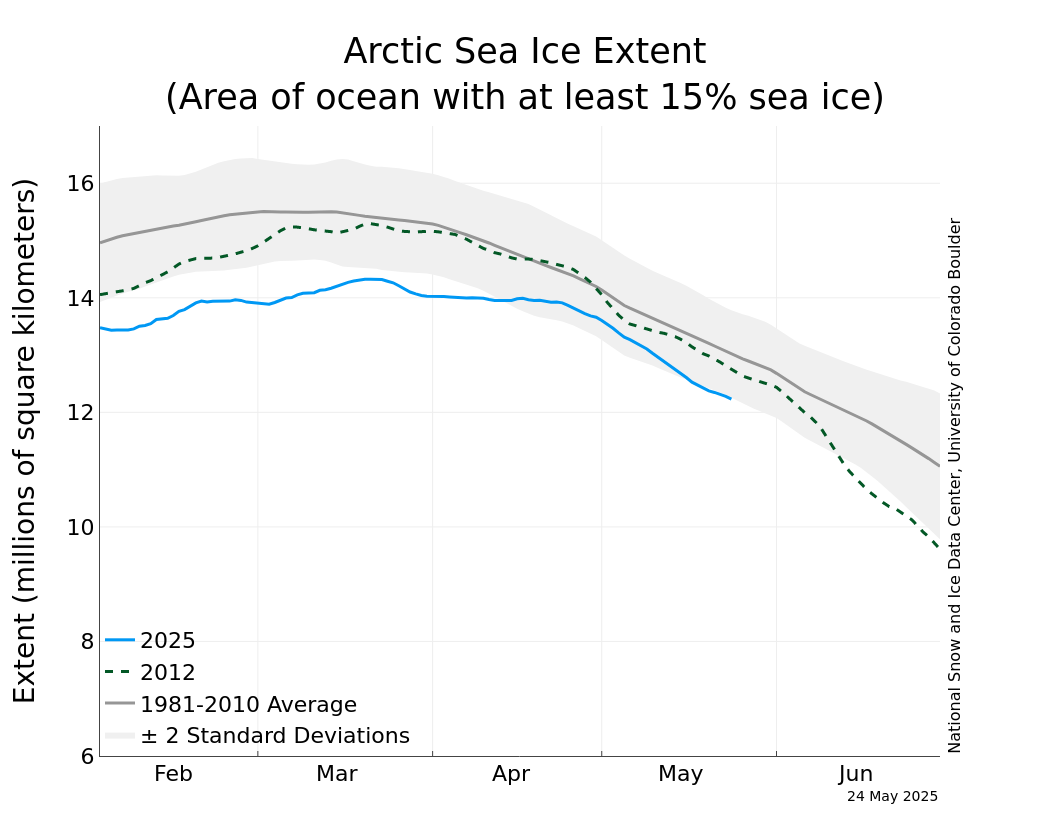
Stop me if you've heard this one--summer ice melt in part of Antarctica is the most extensive in a thousand years. Arctic summer sea ice is melting faster than previously believed, and scientists now expect that it will be gone completely in 2050.

A Peruvian glacier has melted 1600 years worth of ice in the last 25.  Professor Wagstaff (author of the article in The Week) sees this as A Bad Omen.

NPR reports: "The Earth's wettest regions are likely to get wetter while the most arid will get drier due to warming of the atmosphere caused by increased levels of carbon dioxide, according to a new NASA analysis of more than a dozen climate models."

The LA Times, looking at the same report, emphasizes droughts in temperate areas, and includes a little interactive feature, "Your Take," asking the question: "Will we be able to limit the worst effects of climate change?" Yes? No?  Because why would we take the word of people who might know what they're talking about?

Health experts in the UK warn that the climate crisis could bring malaria and other nasty pest-borne diseases that now bedevil the tropics. California and Arizona are already seeing increases in the normally unfamiliar valley fever, due to persistent drought.  Yet another tree-killing insect is threatening new areas--this time in cities--because of climate heating.

And carbon dioxide in the atmosphere is zooming past the levels humanity has ever seen, and may hit the magic in a bad way number of 400 parts per million, this month.  Scientists, says the NY Times, are Alarmed.  Update: The 400 has in fact been reached, as reported on 5/10.

What's potentially even worse--yes, worse--is the CO2 stored in the oceans.  As hot as it's been getting, the oceans have actually lessened the effects of global heating over the past decade by storing more C02 than usual, but when it returns to its usual behavior--or simply has stored so much in its depths that it rises up and out--global heating will resume increasing, and probably faster.

The Arctic Ocean is already showing other effects of heating, such as higher acid content, that won't be reversed for thousands of years.

So back in March the Biggest Picture study so far was announced--covering some 11,000 years (here's a q and a explanation of the study)-- and this chart was widely (if briefly) disseminated.  Possibly because even chartphobics like me get the picture.


Looking at this and all the data, a no-nonsense, thoroughly rational scientist evaluated it and concluded: Compared to the past, what’s happening in the present is scary. The future is scary as hell.

Still, that spike at the end he said might be overstated, for various scientific, chartcentric reasons.  However he provides another chart that he says is probably more accurate, but is basically just as scary:


Look at the spike at the end. The big, and most importantly the steep, scary spike at the end. That’s not an artifact of the way proxy ages were computed, or how the reconstruction was done, or the effect of proxy drop-out as records become more sparse in the later period. It’s what the thermometers say. Ignore them at your peril. As scary as that is, what’s far more frightening is that it’s not going to stop.

He concludes (repeating himself a bit, but the bolding is his:)

In the span of a century or two, man-made changes to the atmosphere wiped out 5,000 years of natural climate change. People can argue about the uptick at the end of the Marcott reconstruction — I’ll do so myself — but for most who do so, it’s just an attempt to divert attention from the fact that global temperature really has increased in the last century, at a speed not seen in at least the last 11,300 years. We know this, thermometers have made it plain, only those in denial still deny it.
We are changing the climate rapidly — on the geologic time scale, in the blink of an eye. This is exactly the kind of rapid change which has caused extinction events in the past. What’s far more frightening is that it’s not going to stop.

So the argument against this overwhelming evidence is ever more obviously, I just don't believe it, science is divided (yeah, 99.9% v. cranks and folks on petroleum payrolls) and I'm just not...going to...listen.

Nor am I going to let anybody else hear about this.  Denialists and other reactionary GOPers have pretty effectively prevented the climate crisis from being taught or talked about in schools.Some two-thirds of public school students aren't learning about it in school.   That's the subtext of this NPR piece on a traveling climate education project.   But one barnstorming guy is not really much.  More may be on the way, as new nationwide science standards recommend teaching about the climate crisis--for the first time.

But we can look on the bright side--we aren't Saturn!  Not yet!  We may be having bizarre rain and snowstorms in the Midwest, fires in California way early in the season, etc.  But we don't get hurricanes anywhere near the size of the one pictured at the top (in a false color photo from the Cassini spacecraft), which is 30 times larger and has winds twice as fast as the biggest Terran hurricane.  On the other hand, it's only called a hurricane. Our hurricanes need water and Saturn has very very little.  Scientists don't have any idea how that works.  Unfortunately, they know all too well how stuff works here.

Wednesday, July 25, 2012

This Fast


Strange, sudden and massive, according to the AP story.  It's the announcement by NASA that: " For several days this month, Greenland's surface ice cover melted over a larger area than at any time in more than 30 years of satellite observations. Nearly the entire ice cover of Greenland, from its thin, low-lying coastal edges to its two-mile-thick center, experienced some degree of melting at its surface, according to measurements from three independent satellites analyzed by NASA and university scientists.

On average in the summer, about half of the surface of Greenland's ice sheet naturally melts. At high elevations, most of that melt water quickly refreezes in place. Near the coast, some of the melt water is retained by the ice sheet and the rest is lost to the ocean. But this year the extent of ice melting at or near the surface jumped dramatically. According to satellite data, an estimated 97 percent of the ice sheet surface thawed at some point in mid-July."


That's almost all of the surface ice.  In four days.

Update: New evidence that melting is happening faster in the Antarctic as well.  News reports on the Greenland melt note that NASA suggests that whether the melt there will lead to an immediate rise in sea levels is unknown at this time, but possible.

Wednesday, August 10, 2011

The Great Disruption


It was the melting of Arctic sea ice--much faster than predicted--that seemed to begin the change in what the writers on the Climate Crisis were saying, and how they were saying it.  The sense of urgency--we've only got 15 years, or 10 years, or 5 years left to act or a catastrophic Climate Crisis will be upon us!--faded, and was replaced by a more somber and careful tone.  Not because the predictions had been alarmist or wrong.  But because they had come true, a little faster than they hoped.

Probably the first signals came from one of the oldest and most eminent of the elders, James Lovelock in his 2009 book, The Vanishing Face of Gaia: A Final Warning, which said the Climate Crisis was inevitably escalating to such a proportion that human civilization was finished.  The only hope was reconstituting it from remnant populations huddled in the Arctic.  The book was mostly ignored as mad prophesy, though informed observers like Bill McKibben critiqued it carefully, and seemed relieved to find some of its assertions based on faulty or not provable science.

But it wasn't long before analyzes with almost as dour outcomes were becoming more typical than not.  Though couched in more careful language, inevitable catastrophe and challenge to the very existence of human civilization were the themes in David W. Orr's Down to the Wire (2009) and McKibben's own Eaarth (2010.)

Now this year there's The Great Disruption by Paul Gilding (Bloomsbury Press.) His point of view is similar: Our first truly human evolutionary test was whether we could anticipate the future catastrophe we were blindly causing, and act effectively in time to prevent it. Well, we flunked that one. Like other recent books on the climate crisis, this one asserts that the global catastrophe is unstoppable.

Gilding, an Australian former human rights and environmental activist as well as a businessman and corporate advisor, is forthright on the irrefutable factors besides the climate crisis that are converging: unsustainable population and economic growth outrunning and crashing resources. He says straight out what others have avoided for years: “I expect we’ll tragically lose a few billion people.”

Yet the buzz about this book is that it’s optimistic.

Gilding asserts that there will come a point, perhaps an event, when the crisis will be really obvious, and humanity will respond in its characteristic “slow but not stupid, late but dramatic” way, as for example when the West geared up to defeat Hitler.

There will be what he calls the Great Awakening: “an exciting and ultimately positive transformation, with great innovation and change in technology, business and economic models alongside a parallel shift in human development. It could well be, in a nonbiological sense, a move to a higher state of evolution and consciousness.” (Presumably that’s if you’re not one of the lost billions.) It’s humanity’s second evolutionary test—and if we blow this one, it’s pretty much over for civilization, because we will have kept on doing what will make the farther future even worse. This event and this transformation, he writes, could begin in this decade.

At least half the book is devoted to Gilding’s ideas of what must be done over the next 40 years to create a sustainable no-growth economy and the values that go with it--ideas tested so far in his speeches and peer-reviewed papers, but now available for wider scrutiny and participation. Though he uses big labels and inspirational generalities, he’s practical and subtle on the process and on as many details as he musters.

Gilding acknowledges the emotional impact of a future of earthquake-like disruptions, and a transition that “will shake us to the core, forcing a substantial rearrangement of human values, political systems, and our physical lives.” This has happened before, but perhaps never so intentionally. He writes that “Grieving is an appropriate response” for the world we’ve destroyed and the resulting pain, “but sustained despair is not.” Any chance for civilization surviving depends on “active, engaged and strategic hope.” Hope is not a response but a commitment. Optimism is “the most important and political choice an individual can make.”

This hope must be enacted partly by working to define the plans necessary to meet this crisis, so when society demands them, they’ll be ready. That makes this a book to keep. It takes awhile to absorb its information and the emotions it evokes. But there’s getting to be a consensus that the catastrophe “that will shake us to the core” is coming. It’s time to choose this way to be human, face the grief and think hard about the future.

Combining a brief sketch of the depth and extent of catastrophe with a brief sketch of a program to get through it and make things better seems a proper enterprise, but it makes for a very weird book. The implications of living through the death of millions--as we're seeing right now in the climate-related starvation in the Horn of Africa--as well as the chaos, the fear, uncertainty (is this intractable recession the beginning of the permanent economic growth collapse?) and denial--seem to need more than a simple acknowledgement they are coming. A little reflection makes the rest of the book seem like whistling in the dark, and the occasional inspirational self-help book tone doesn't help. That's not to say that his program isn't a useful one, or that it won't work. It just makes for a schizoid reading experience. Also, its subtitle is so silly I can't even bring myself to use it. But all of that just has to be acknowledged--then the content of the book worked with and absorbed.

How far we are from engaging with these issues, let alone accepting and confronting them, can be gauged by how little influence on the public dialogue these books are having.  But for the relative few who are engaged, this book should remain of considerable interest for some time to come.

(By the way, the latest studies--despite some of the media reports--support and extend the notion that Arctic ice is melting very rapidly--and may be virtually gone by 2050 or sooner.)

Thursday, May 20, 2010

More Light on Heat

The normally conservative National Academy of Science has issued "the most comprehensive report ever on climate change" in response to a congressional request, affirming that "climate change is occurring, the Earth is warming ... concentrations of carbon dioxide are increasing, and there are very clear fingerprints that link [those effects] to humans," and calling for strong action to confront the Climate Crisis, including mechanisms to put a stiff price on carbon.

Another NAS panel noted that "the government and communities need to prepare for threats that are likely no matter what actions we take," such as consequences of sea level rises and the droughts in the Southwest. In other words, they recognize the need to deal with both causes and effects, something I've been advocating here for several years.

Earlier this week, NOAA and NASA regular climate reports concluded that we've just experienced the hottest March and April on record. A weather expert noted that"the three past seasons with record warm April SST anomalies all had abnormally high numbers of intense hurricanes." NASA's figures show it was also the hottest January to April period, and it is very likely that 2010 will be the hottest year on record. NOAA also found a strong multi-year warming trend in the world's oceans.

There's both anecdotal evidence (from British explorers) and data suggesting that the Arctic ice is melting faster this year than the previous record year of 2007. The data shows an unusually steep curve in seasonal melting, which suggests 2010 could set a new record. Not exactly something you want to cheer for.

Friday, March 05, 2010

The First Stage of Grief

The first stage of grief is denial, and at the moment when the mortal threat to our beautiful planet is so painfully but definitely manifesting, the denial is most assured and quietly hysterical. That the same people who are so fixated on evolution are now involved in this denial, isn't surprising perhaps, but it's all immensely sad.
As is the latest study from the UK Met Office, which examined climate findings since the 2007 UN report, and says the evidence is now even stronger that human-caused climate change is upon us.
The study, which looks at research published since the IPCC's report, has found that changes in Arctic sea ice, atmospheric moisture, saltiness of parts of the Atlantic Ocean and temperature changes in the Antarctic are consistent with human influence on our climate.
"What this study shows is that the evidence has strengthened for human influence on climate and we know that because we've looked at evidence across the climate system and what this shows very clearly is a consistent picture of a warming world," said Dr Stott.
And another study suggests that methane is venting from part of the Arctic shelf. A significant release from the vast store of methane, a potent greenhouse gas, from under the melting permafrost could set off abrupt global heating and runaway climate change (Climate Collapse.) This would likely happen if methane set off a feedback effect, which so far hasn't been detected. But the danger is clear, because it is past and current global heating that is releasing methane from the Arctic. So while grief--especially conscious grief--is appropriate, so is conscious determination and action toprevent the worst, and prepare for the worse.
Update: a RealClimate post urges caution on the methane research, and the whole question of methane's impact on climate change.

Tuesday, February 23, 2010

Melting ice at the poles from 2007 to now constitutes the most potent warning sign of Climate Crisis. See post below.

Tuesday, May 19, 2009

Convergences

Updates 5/20: A NY Times editorial on the case for these new emissions standards as "a huge step forward in the effort to limit greenhouse gases and reduce America’s dependence on foreign oil" as well as "With this deal, America also wins back a bit of energy independence. But the biggest winner could be the atmosphere." Also indication that the climate and energy bill described below will be voted out of committee, on its way to passage.


For all the pain it is causing and will yet cause, the Great Recession is also providing unforeseen opportunities to improve the chances of a better future. The difference is who is President. And it isn't the Recession itself so much as the realities about our past and our future that it brings into sharper focus.

Tuesday, President Obama is expected to unveil new fuel mileage standards for American vehicles that will "mean a 30 percent reduction in global-warming emissions from new vehicles by 2016, with improvements beginning in the 2011 model year," according to this article at Grist. Though Republicans in Congress and in Washington will probably scream about it, the proposal may well have wide support where it counts--apart from the public and environmentalists, from business, including car companies.

Why? The Great Recession not only makes the auto industry more dependent on the federal government, but reduces the margin for error while providing an opportunity to chart a new course to its future prosperity. A number of states have enacted their own standards--California conspicuously--and a single federal standard saves the car companies money, plus it gives them a real blueprint for what they will be expected to do for the next decade:

The move will please the Auto Alliance, the major industry group representing car makers, which has been asking for one standard that unifies emission and fuel-economy standards across the whole country. “We recognize that greenhouse-gas emissions from automobiles need to be reduced,” Charles Territo, a spokesperson for the Alliance, told Grist last month. “At the end of the day, what’s most important is that we have a single, national standard that is achievable, but that is aggressive and cost-effective.”

The standards are also more gradual, giving car companies more time to adapt. Consumers will gradually pay more, at least by today's estimates, though their costs will be offset by spending less on gasoline. This is no small deal--some say it is the biggest and most effective way so far to cut greenhouse gases. It eventually will "equate to taking 177 million cars off the road, or shutting down 194 coal-fired power plants."

This is separate from the cap-and-trade bill now in Congress, the Waxman-Markey bill that now has wide support. Despite Congressional GOPer promises to offer hundreds of nonsense amendments to tie things up, the bill is expected to become law this year. For some environmentalists it is too modest, and fossil fuel industries are pouring millions into opposing it. But on Monday, Paul Krugman made the best case I've read for why cap-and-trade will work. It's estimated that in lessening greenhouse gases, this bill will equate to take another 500 million cars off the road. "After all the years of denial, after all the years of inaction, we finally have a chance to do something major about climate change," Krugman concludes. "Waxman-Markey is imperfect, it’s disappointing in some respects, but it’s action we can take now. And the planet won’t wait."

Supporting the likelihood of both of these efforts are polls which suggest strong public support for regulating greenhouse gases, even if it costs.

One of the reasons Krugman favors cap-and-trade over a carbon tax is that it's international in scope. Everyone knows that without India and especially China, there isn't much hope. So these hints of secret and ongoing negotiations between the U.S. and China on Climate Crisis measures, plus public moves (like Secretary of State Clinton stating that U.S.-China relations should center around climate change) suggests a dramatic agreement may not be far off.

There's other good news in the climate crisis arena: from promising new technology to a suggestion that the Great Recession slowdown coupled with an imminent cap-and-trade system means that the growth of greenhouse gas emissions may have ended in the U.S. But continuing at the current rate will continue to make matters worse--we need to start cutting, and eventually, cut deeply.

Unfortunately however, there has been no good news in what's actually happening in the environment, or in predictions of what is likely to happen. Most of that is getting worse. This includes the widely reported study that cut in half the prediction of how much sea levels will rise as a result of melting from the West Antarctic Ice Sheet. Look under the headline and see that even if this study is correct, it doesn't mean sea levels will be half of previous predictions everywhere. In fact, they will be even higher in certain places--like the West Coast of the United States. Seattle, San Francisco, Los Angeles, San Diego, etc. And also the East Coast. Boston, New York City. With impact on Washington, D.C.

Monday, February 19, 2007

The Climate Crisis Future

More on the "Fix It" Component

It's unlikely to be much consolation for those currently in the deep freeze of a late and fierce winter, but according to the figures just in, the world has just experienced the warmest January ever recorded. According to the National Oceanic and Atmospheric Administration, the combined global land and ocean surface temperature was 1.53 degrees Fahrenheit (0.85 Celsius) warmer than the 20th-century average of 53.6 degrees F (12 C) for January. Land surface temperature was a record 3.40 F (1.89 C) warmer than average. The combined land and ocean figures surpass the previous record set in 2002 at 1.28 F (0.71 C) above average.

That there's more trouble ahead was further emphasized by a story in today's Guardian that asserts: New studies of Greenland and Antarctica have forced a UN expert panel to conclude there is a 50% chance that widespread ice sheet loss "may no longer be avoided" because of greenhouse gases in the atmosphere... Such melting would raise sea levels by four to six metres, the scientists say. It would cause "major changes in coastline and inundation of low-lying areas" and require "costly and challenging" efforts to move millions of people and infrastructure from vulnerable areas. The previous official line, issued in 2001, was that the chance of such an event was "not well known, but probably very low".

In a way this is the sound of another shoe dropping, since the IPCC summary for policymakers didn't include the effects of ice sheet loss in their estimates of future sea level rise. Some scientists criticized the panel for this. But this is unlikely to be the last news coming out of the full report.

The full effects of melting ice sheets and rising sea levels may not be felt for centuries--but some very serious effects will likely be felt much sooner. Just what that means can be illustrated by a local example--a set of maps of the projected effects of Climate Crisis rising sea levels in the San Francisco Bay, assembled by the Bay Conservation and Development Commission for a major feature in Sunday's San Francisco Chronicle.

According to these maps, Parts of Corte Madera, San Rafael, Hayward and Newark and much of the Silicon Valley shoreline would be under water, including a portion of Moffett Field, the site of NASA Ames Research Center, where Google wants to build a 1 million-square-foot campus. Also threatened are the locations of proposed new stadiums for the San Francisco 49s and Oakland As.

But also: Wastewater treatment plants for more than a dozen cities in the South Bay, including San Jose, and the industrial ponds for the Valero oil refinery in Benicia and the Chevron refinery in Richmond, would be inundated by the projected rise in the bay.

The projections are based on rise level rise that is a fraction of the ultimate possibility of 6 meters. Most of them concern a 1 meter rise, which could occur in several decades. The article points out that the construction of seawalls and levees could limit that damage, but the cost in construction and maintenance would be in the billions of dollars. The decisions of what to do, when and how to do it, are the kind of decisions that communities and government on all levels are going to have to face.

But such specific problems also may help focus on the need to do the "Stop It"(from getting much worse in the future by slashing greenhouse gas emissions) actions at the same time as the "Fix It efforts (fix what needs to be fixed now or in the near future, from the already inevitable effects). Those studying these problems in San Francisco are saying that ultimately the extent to which big fixes are needed will be governed in part by how high the sea levels get, and that in turn may yet be governed by global heating caused by future emissions. So in the long run it may cost less to Fix It, if the Stop It strategies are successful.

Even the 1 in 2 chance that "widespread" melting of ice reservoirs will occur means that the worst, or perhaps even the very bad, can be averted. In fact, the 50% odds are themselves a good metaphor for what we need to do: we need to work on the Fix It and Stop It components with equal committment.

Sunday, January 21, 2007

The Climate Crisis

Another Reason It's The Climate Crisis

I began arguing years ago that one barrier to understanding all this was nomenclature: while technically correct, the terms "greenhouse effect" and "global warming" were deceptive in tone--they made the whole thing sound mild, even pleasant. "Climate change" was not much better-- again it's technically correct but deceptive (it hinges on the difference between "climate" and "weather," which is weak in the popular mind) and "change" has too many positive connotations: put them together, and you get "a change in the weather," which, if the weather happens to be bad, is good.

I argued for "global heating" to stress the severity, and "climate crisis" to reflect the urgency. But there's another reason to stick with Climate Crisis: the emphasis on "warming" gives the impression that any weather other than a rise in temperature--and especially a drop in temperature--contradicts the global warming/greenhouse effect thesis. And it doesn't.

Cases in point: this month's weather. A few days ago, large parts of Europe were hit with ferocious storms and hurricane force winds. What
Jeff Masters of Weather Underground describes as an "extra-tropical cyclone" caused what would be called Category 1 or 2 hurricane effects if this happened in the Gulf of Mexico. And the extent of it was massive. I saw a clip of a forecaster in Germany saying that they had never seen such a violent storm that affected the ENTIRE country. But it wasn't just Germany--it killed people in England and the Czech Republic as well.

The greenhouse effect does predict storms that arise from the effects of warmer ocean water on air masses and currents. That temperature is additionally increased now by the El Nino phenomenon, which may or may not be related to global heating. Moreover, these storms in Europe were accompanied by relatively warm temperatures.

But parts of Europe are now experiencing cold and snow. Areas of the U.S. are also getting hit with huge snowstorms and frigid temperatures. Global warming? Well, yes.
Two points: in some places where it is usually cold, it's gotten cold, but not quite as cold as usual. And some places usually too cold for a lot of snow are getting huge snow storms because of warmer air holding more moisture. Even the suddenly falling temperatures could be an indication. After a December that was the warmest in centuries across the northern hemisphere, the cold is simply coming late--possibly because the Arctic didn't freeze sufficiently until now to generate the cold air carried down to us.

But the point here isn't that everything can be traced back to global warming. The point is that we're well into the early stage of the Climate Crisis, and we're going to be figuring out the details of what's happening and why as we go along. We aren't that smart yet. (Although I guess that's obvious, since we haven't been smart enough to take this seriously in the 15 to 30 years warning of warming.) But we do know the basics, and we know the basic preventive for the future. We've got a lot of learning and doing ahead of us, in a short time. But we have to face what's happening. It's the Climate Crisis, the crisis of our future. And we have to deal with it in our now.

Friday, January 05, 2007

It's Up to Us

And so it begins. The Democratic majority in both houses of Congress is an established fact. Rep. Nancy Pelosi has been sworn in as the first woman in American history to be elected Speaker of the House.

Next is the fulfillment of the "first 100 hours" agenda, including raising the minimum wage. The hearings on Iraq and many other matters will soon begin. And the first moves to take back the future are beginning. Thursday's front page Washington Post story begins:

House Democrats are crafting an energy package that would roll back billions of dollars worth of oil drilling incentives, raise billions more by boosting federal royalties paid by oil and gas companies for offshore production, and plow the money into new tax breaks for renewable energy sources..."

"The Democrats are appropriately shifting money from the 20th-century technologies to the 21st-century industries," said Rhone Resch, president of the Solar Energy Industries Association. "If we want to see solar, wind and biofuels, we have to make that investment today."

A number of newly elected Democrats made clean energy and the Climate Crisis important parts of their campaigns. Newly announced Democratic presidential candidate John Edwards is making these issues priorities of his campaign, as he said in his impressive announcement of his candidacy. Governor Bill Richardson, a likely entry into the 2008 field, signed an executive order for New Mexico which

directed state agencies to follow many of the bold recommendations of the Climate Change Advisory Group, which produced a plan to reduce greenhouse gas emissions by the equivalent of 267 million metric tons and create a projected $2 billion net economic savings for New Mexico’s economy.

“Climate change is the major environmental issue of our time,” Governor Bill Richardson said. “Nothing poses a bigger threat to our water, our livelihood and our quality of life than a warming climate. Today I am taking the first step toward implementing as many of these recommendations as are possible, feasible and effective.”

The awareness grows. Global warming is the greatest environmental threat that humanity has ever faced, said a late December editorial in the San Jose Mercury News. The paper calls for Congressional action, private initiative in clean energy technology and the Supreme Court to force the federal government to regulate carbon emissions.

Meanwhile, the crisis grows more ominous. A giant ice shelf, in place for thousands of years, suddenly broke off from the Canadian Arctic, scientists recently discovered. An Australian climate scientist gives ten reasons why the Climate Crisis may be more severe than predicted so far. Such evidence of shockingly rapid melting in the Arctic and Antarctic is one of those reasons. And this scientist is not alone in believing that "the balance of evidence may be swinging towards a more extreme outcome," according to Climate Progress. Several scientists in England believe that a combination of the Climate Crisis and an active el Nino will make 2007 the hottest year in history.

Sadly, the Bush-Cheney administration, loyal lackey of the energy industry, has consistently opposed any national efforts to reduce carbon emissions, wrote the Mercury-News. But elements of the extractive energy industry have done more than simply pull the Smirk's strings. Confirming previous reporting, the Union of Concerned Scientists issued a study showing how Exxon Mobil bankrolled the Climate Crisis Deniers, using many of the "disinformation tactics" of the tobacco companies in their decades of denying the harmful effects of smoking.

Those four British climate scientists, the Independent reported, offered "sobering predictions" that "2007 will be a crucial year for determining the response to global warming and its effect on humanity." It's up to us.

Thursday, December 28, 2006

Posted by Picasa
Is the Polar Bear the Ping-Pong of the Climate Crisis?

For years the U.S. officially declined to admit that China existed. Communist China, that is. China was treated as Cuba was and still is--no travel, no diplomatic relations, and no official recognition. The change came in the Nixon administration. Nixon had been a leader in denying China, a "hard-liner." Eventually he would be the first U.S. President to officially visit Communist China, beginning the relationship that has become so important to both countries. His prior hard line, many said, made him the appropriate president to do so, since he was above reproach politically on this matter. Hence the Vulcan proverb, "Only Nixon can go to China."

But before Nixon went, the first sign of a new approach, the first test of a new relationship, was the seemingly innocuous exchange of ping-pong players, a very big sport in China then. When American ping-pong players played the Chinese in China, it was a cautious first step.

For its entire time in office, the Bush administration has denied the reality of the Climate Crisis. It has prevented scientists from warning of its dangers and its causes, and it has opposed all efforts to regulate the principal cause, carbon dioxide emissions from fossil fuel burning, because doing so, Bush said, would wreck the U.S. capitalist economy. Among the world's nations, Bush's America has been just about the last remaining hard-liner.

But Wednesday the Bush administration announced it would seek to declare the polar bear a threatened species. To do so, it had to say why the polar bear is threatened with extinction. And this led to what the Washington Post described as "the first time the administration has identified climate change as the driving force behind the potential demise of a species. "

As the Post story notes, the polar bear is among the best known and best loved animals in the world, especially by children. The story also notes that some environmentalists and wildlife biologists believe this is too little too late. I heard one say on TV yesterday that he doesn't see how the polar bear survives--that its extinction is almost certain.

But it will be interesting to see if admitting that the Arctic is getting warmer is linked to the generally recognized reason. As the Post put it, Because scientists have concluded that carbon dioxide from power-plant and vehicle emissions is helping drive climate change worldwide, putting polar bears on the endangered species list raises the legal question of whether the government would be required to compel U.S. industries to curb their carbon dioxide output.

Whether the federal government is required by law to regular CO2 emissions is in fact the issue in a case now before the U.S. Supreme Court. How all of this plays out in the days and months ahead will tell us more clearly what this move means--and whether this was an attempted ping-pong play leading to recognizing the reality of the Climate Crisis, and taking action.

Friday, February 10, 2006


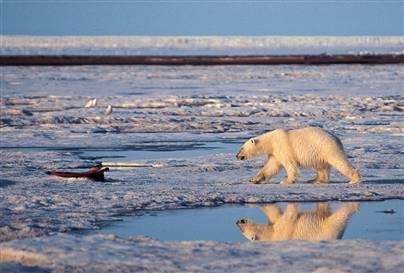
The polar bear is under serious consideration for classification
as a threatened species, because global heating is rapidly
destroying its Arctic habitat. Posted by Picasa

Thursday, January 12, 2006

Saturday, December 17, 2005


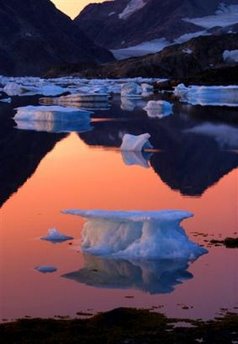
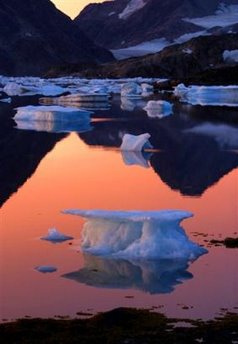
Arctic summer warmer, less ice(here) in Greenland. AP photo. Posted by Picasa
Lag Time Is Over


from AP report:

In the high Arctic, deep in the Atlantic, on Africa's sunbaked plains, climate scientists are seeing change unfold before their eyes. In the global councils of power, however, change in climate policy is coming only slowly.

In New York, NASA' s Goddard Institute projected that 2005 will surpass 1998 to end as the hottest year globally in the 125 years since reliable records have been kept. It said warming has accelerated and is now boosting the mercury every decade by more than 0.3 degrees Fahrenheit.

"The observed rapid warming thus gives urgency to discussions about how to slow greenhouse gas emissions," the NASA researchers said.

Five days earlier in Montreal, however, the annual 189-nation U.N. climate conference ended two weeks of such discussions by failing once again to win U.S. commitments to reduce greenhouse emissions — as almost all other industrialized nations are committed to do by 2012 under the Kyoto Protocol.

The atmosphere now holds more than one-third more carbon dioxide than it did before the Industrial Revolution. In fact, European scientists reported last month that analysis of ice cores from Antarctica shows that today's level is 27 percent higher than any previous peak looking back 650,000 years.

A U.N.-organized network of scientists warns of shifting climate zones, ocean levels rising via heat expansion and glacial melting, and more extreme weather events if emissions are not reined in and average temperatures continue to rise.

Among fresh reports of warming's impact:

_The WMO said Thursday that in the Arctic Sea, where average winter temperatures have risen as much as 7 degrees Fahrenheit over 50 years, the ice cap this summer was 20 percent smaller than the 1979-2004 average.

_British oceanographers reported this month that Atlantic currents carrying warm water toward northern Europe have slowed. Freshwater from melting northern ice caps and glaciers is believed interfering with saltwater currents. Ultimately such a change could cool the European climate.

_In southern Africa, beset by four years of drought, average temperatures during the 12-month period ending last July were the warmest on record, British scientists said. The mercury stood more than 2 degrees Fahrenheit above a recent 40-year average.

_In Vanuatu and Papua New Guinea in the southwest Pacific, rising seas are forcing hundreds of islanders to abandon vulnerable coastal homes for higher ground, according to U.N. and news reports.

A small, vocal minority of climate skeptics, who long theorized manmade emissions weren't influencing the climate, has grown quieter as evidence of global warming and its effects has mounted.

"In a sense, the burden of proof has shifted from the people who are saying there's a risk, to the skeptics now," Michel Jarraud, WMO secretary-general, said in an interview.

In Montreal, Bush administration envoys, who once cited scientific uncertainty in rejecting the Kyoto pact, focused instead on the argument that emissions controls would damage the U.S. economy.

Largely isolated, the Americans agreed only to joining a nonbinding, exploratory global "dialogue" on future steps to combat warming.

Those who ratified Kyoto, meanwhile, decided a working group should develop proposals for emissions reductions by 35 industrialized nations after the current pact expires in 2012. They didn't agree on a deadline for that work, however, and made little headway on how to draw China, India and other newly industrializing countries into the emissions-control regime.