Showing posts with label H.G. Wells. Show all posts

Wednesday, June 01, 2022

The War To Remind Us Of All Wars


 We have not been so intimate with war in a long time.  Ukraine is not so far away from America as other recent foreign wars (some of which are happening now unnoticed), and media coverage is more sustained and specific, with real people seen and heard in real time.

 The people involved are more familiar than, say, the people in Iraq or the Democratic Republic of Congo, or even Nicaragua, at least to the majority that defines itself as White.  Generations of Americans have Ukrainian or other Eastern European ancestors or relatives.  Those who do not may know those who do.  Ukraine defines itself as European, and it is only a few hours by plane from London, Paris and Berlin, Rome and Amsterdam, Oslo and Zurich.  And therefore, a few more hours from New York and Washington.

 In some ways our identification with Ukraine demonstrates our weak imaginations.  We expect we know what its cities are like, though we may not imagine Baghdad in the same way.  What we see convinces us that we understand the similarities of modern culture there.  And for Caucasians, it helps very much that their citizens appear Caucasian. 

 But in other ways, the identification is based on real bonds and resemblances.  We can see ourselves in those who are invaded, whose normal lives in apartment blocks and cafes are shattered by bombs and artillery fire.  Emotionally granting them their humanity, we are deeply shocked by what appears to be especially savage and brutal acts by Russian invaders: the murder of random civilians, the rapes, kidnapping, rendition and apparent targeting of hospitals and schools for explosive destruction.  And overlaying it all, the relentless pummeling of artillery shells and missile-borne bombs, seemingly with no other purpose than to utterly demolish entire cities and towns, taking basic aspects of civilization away from the survivors.  If we can’t have it, the Russian bombs say, nobody can. Russia seems set on ruling a smoldering wasteland.

 Apart from the geopolitical ramifications of this Russian invasion, the obvious brutality is said to be driving US and NATO sanctions and the open supply of armaments to Ukraine.  But is the key word here “obvious?”  Cell phone cameras spreading photos on the Internet and camera-laden drones are documenting atrocities, but are they more prevalent and systematic in this war than in others?

 Nobody really knows the full answer.  War and accurate information hardly ever mix.  One side always accuses the other of atrocities (usually baby-killing) that after the war often turn out not to have been true. Of course, the scale of other atrocities kept hidden may be revealed afterwards as well.  The Nazi Holocaust is a prime example, but hardly the only one.

 Sometimes we don’t know also because we don’t want to know.  The Commission of Inquiry for the International War Crimes Tribunal calculated the effects of American bombing of Iraq in the first (George H.W. Bush) Gulf War in the early 1991.  Summarizing a preliminary report, author Barbara Kingsolver wrote that the US bombed: “all the country’s major dams and most of its drinking water facilities; enough sewage containment facilities to contaminate the Tigris River with waterbourne killers; virtually all communications systems, leaving civilians unwarned of danger and unable to get help;…100 percent of irrigation systems; wheat and grain fields (with incendiary bombs); 28 civilian hospitals and 52 community health centers…[and] more than 600 schools.”

 Is this true?  Some specific instances are on the public record, as are many more in the G.W. Bush invasion of Iraq, in Afghanistan and elsewhere. Systematic torture and rendition by the US and allies after 9/11 are also well known.  Mass killing of civilians, destroying homes and schools etc., are also among the carnage and possible war crimes carried out by forces the U.S. opposed.  But the public usually finds out about them long after the war these acts were part of— if they ever do, or ever care.


More than a century ago, the young British author H.G. Wells saw in the gathering momentum of mechanical invention and energy production the coming of warfare technology capable of destroying civilization.  He wrote books—nonfiction and novels—predicting with great accuracy the ruinous armaments and resulting kinds of warfare that could soon envelope Europe.  His words were noticed but not heeded, and his fictions quickly became the Great War, later known as World War I. 

That war was scarcely over before Wells imagined and predicted huge aircraft bombing entire cities—something that had never been done in a systematic way—with highly destructive weapons including the atomic bomb.  He named the atomic bomb.  He wrote about this prospect in nonfiction and fiction.  He made a movie with scenes that now look like a documentary of the London Blitz, but filmed years before.  And then his fictions became World War II.

 In both cases, he warned that civilization itself was ultimately at stake.  He believed (as philosophical psychologist James Hillman did, and philosopher John Gray does) that war will always be with us. But unless humanity got a handle on the implications of ever more destructive technologies, Wells warned, it would destroy itself. That’s why Wells spent his long public life strongly advocating a single world government.  It perhaps wouldn’t end violent hostilities, but would very likely limit their frequency and destructiveness.

 Once both world wars started, British citizen Wells took sides, seeing that the victory of the other side would itself be catastrophic.  But he mostly promoted and organized a new order after the wars—first the League of Nations, and then the United Nations.  He spearheaded the writing of what would become the UN’s Declaration of Universal Human Rights.  But he wasn’t sanguine about the progress made.  Towards the end of his life (he died in 1946), he told friends that as his epitaph he wanted: “Goddamn it, I told you so.”

 Wells knew the horrible wisdom of Shakespeare’s words: “Cry havoc and let slip the dogs of war.”  The metaphorical dogs of war can only be unleashed; they cannot really be controlled.  Whatever technology or tactic is available will be used, through strategy, anger, adrenaline and fear.  That’s what havoc is.

 For most of this past century, the greatest threat to human civilization was war. There were strong and principled peace movements for all the 20th century. Not so much in the 21st, it seems.

 Perhaps it’s partly because, for the past 30 years or so, war has seemed increasingly an intractable but local threat.  Now the true global threat is the climate crisis, and the global physical environment generally: nothing less basic to all life than air, land and water.

  But the nature of that climate crisis is that it lets loose the Four Horsemen of the Apocalypse and every form of catastrophe known to humanity—among them, famine, disease and tyranny.   Not the least of these are the dogs of war.  There are wars right at this moment being fought because of consequences of the climate crisis, and there have been for decades, even if largely unacknowledged.  

This war in Ukraine may itself be related to implications of the climate crisis, and probably to the politics and economics of fossil fuels and the future.  It certainly has to do with resources.  Just as Hitler’s supposedly inexplicable invasion of Russia was likely about resources Germany needed to defeat the might of America, Russia’s apparently inexplicable and crazy invasion of Ukraine may well be about wheat, fossil fuels and seaports.

 It is in fact one of those Four Horsemen: invasion, conquest.  This war is so deeply startling because it is a throwback to the most ancient wars, as well as a summary of the wars since, being fought with technologies and tactics from World War I on to previews of future warfare.  It turns civilization into savagery.  But all war does that, if not so dramatically and obviously to us.

 Like Wells, we take sides.  We side--I side-- with Ukraine, for all kinds of reasons. But war is only getting more monstrous. Bombing from the air in the 1940s may have been the original sin for self-destructive warfare, but there are other candidates for the normalizing of blanket brutality.  Having failed to address the dangers of war itself, if human civilization doesn’t concentrate on addressing the climate crisis, with full commitment to a decent degree of equity and justice around the world, the end of human civilization will be hastened by wars as well as dislocation, starvation and disease that also follow the havoc of wars. When global supply chains collapse, so does today’s civilization. (For one thing, no country on Earth has the Rare Earth elements sufficient to make its own electronic devices.) And all the guns in the closet won’t protect anyone. 

Tuesday, November 02, 2021

Soul of the Future/ Evolution of Hope: Eight Figures for the Future

“We must take comfort from the fact that human nature gives rise to altruism as well as selfishness, to conscience as well as cruelty.  The hope of the race is that passions of generosity, restraint, and goodness may prove as strong as those of egoism, aggression, and cruelty.”

Eric Bentley

 “Better to make a good future than predict a bad one.”

Issac Asimov

 “The future is not a gift: it is an achievement.  Every generation helps make its own future.  This is the essential challenge of the present.”

Robert F. Kennedy


 “I am curiously not interested in things,” wrote H.G. Wells in his 1917 book, The Future In America, “and curiously interested in the consequences of things.”

 This is the first lesson of evolution, which Wells applied to the future to shape what “the future” means to us.  The consequences of things (technologies, processes, events, inventions, decisions, etc.) in the past and present comprise the conditions of the future.

 Wells is the first of my “eight figures for the future” and sets the agenda for the rest: to fill in his outline of the future.  Most of these figures have appeared earlier in this series, so this is a kind of summation. Significant aspects of their work help form a framework for envisioning and enacting an evolution of hope.  

 From his first public writings to his last over a fifty- year career, Wells was fixed on the future. He learned as he went, and came to another seemingly simple conclusion that seems also to have escaped many other who command the mainstream of assumptions about the future: the causes of future conditions are complex. 

 It was fine for a science fiction story, or a thought experiment, to follow the effects of one change while keeping everything else familiar.  But that’s not how the future works: it’s the consequence of everything.

One technological change—or even technological changes in general—can and usually does have a mighty influence on the future.  But these effects interacted with other factors, including other changes, and with responses that were often unanticipated.  Things happen on different scales, at different rates.  They interact unpredictably.  And the consequences always include the unintended. 

Future reality would be made by the interactions within the whole, and the whole acting on itself.  Analyzing one or two strands of change wouldn’t be enough. “The end of all intelligent analysis,” Wells wrote, “is to clear the way for synthesis.”

 This is a lesson that overwhelmed the sensible futurist of the 1970s, but other more egotistical predictors persist in making the fatal mistake of leaving too much out.  This is a particular habit of those predicting the dominance of technologies, and it still happens. 

 In an online Substack piece of August 2021, the author chides those who make extravagant claims for the rise of certain technologies in the near future, and then offers his more “conservative” or realistic predictions based on current trends for life in 2050.  He issues 18 detailed technological, social and political predictions, employing hundreds of words, and never even mentions climate--not causes nor effects of the ongoing climate catastrophe, or anything involving the context of the natural world.

 Moreover, this was published during the most violently and obviously consequential summer of the climate crisis so far, which included the hottest month ever recorded for the entire planet, and which climate scientists confirm would basically have been impossible without a seriously deformed climate.  

 These are not just omissions; they are serious distortions of the future we know is coming that make his predictions worthless.  His predictions presuppose everything else is stable, and at this point that’s fantasy.  The irony is that based on chemistry and atmospheric science alone, the acceleration of a distorted climate is about the most certain prediction about the future that can be made.

 The habit of holding on to a single through-line for the future based on a narrow interpretation of the past that requires that counter-evidence be ignored, has itself distorted the prospects for the actual future.  Such interpretations tell slightly different but mutually congenial stories about the human historical past and the biological past predating but including humanity—in particular the principles that govern the outcomes of evolution.

 The common story driving western civilization was that man and nature were separate, that at best nature was a useful source (i.e. “natural resources”) but most of the time, an enemy, a barrier to human “progress.” The dominant interpretation of Darwinian evolution complicated this story, without really changing it. The human species was placed in competition with the rest of nature, and that competition was defined as violent struggle, with a few winners—maybe only one-- and lots of losers.

 The idea that the future belonged to the best predators predated and probably influenced Darwin.  But Darwin’s positing of natural selection as determining survival became immediately distorted and supercharged by the ideology now known as Social Darwinism.  That two of its prominent 19th century adherents were John D. Rockerfeller and Andrew Carnegie pretty much explains its dominance.

 Though the 20th century strengthened this view through the reductive misinterpretation of genetics that produced the infamous “selfish gene” theory, it was during the 20th century that other voices countered this view by adding new information and context. 

Much of this information was hiding in plain sight. Another brilliant synthesist (and our second figure for the future) was Paul Shepard.  Credited as one of the pioneers of the science of ecology in the 1960s and 1970s, he braided observations of the natural world and human culture into a unique field, recognized when he became an endowed Professor of Human Ecology.

 Many other ecologists, scientists and thinkers contributed to Shepard’s syntheses, but many more have followed in his unacknowledged footsteps.  He wrote eloquently about the long human development in the Pleistocene, and the deeply human need for connection with the rest of nature, beginning with childhood.  This is “human nature--” physical and otherwise-- that goes back hundreds of thousands of years, and basically it has not changed.  Shepard brought human culture back into the context that nourishes it, and shows how human destruction of the natural world is profoundly self-destructive.

 Most of what Shepard and other ecologists found did not require laboratory experiments or expensive technology.  Archeological discoveries and analysis, a certain amount of quantitative data gathered in the field were part of it, but the new picture emerging also required rediscovering the research and insights that had been ignored because they didn’t fit the dominant program.

 For after all, the behavior among primates that exhibited cooperation, altruism and empathy in a carefully nurtured social structure had been there for researchers to see, centuries before primatologists like Frans de Waal and others showed up. But those earlier researchers didn’t see it because they weren’t looking for it—and since they were not prepared to believe it if they saw it, they didn’t see it.  More broadly, the deep relationship of humans and nature was evident in the words and practices of Indigenous peoples all over the world, but was dismissed as sentimental and exotic, and profoundly threatening.

 However, the 20th century also saw new information unavailable before, because (for example) new technology allowed researchers like Lynn Margulis to study microorganisms that Darwin knew nothing about. There she found evidence for symbiosis and other behavior contrary to the selfish gene theory and other prevailing prejudices. 

 She then eloquently described the implications of her research, inspiring such thinkers as William Irwin Thompson.  Margulis also went from micro to macro by becoming the co-author of the Gaia Hypothesis, a planetary vision of a single self-regulating organism.  She is our third figure for the future.

 Thanks to her and many others, a new synthesis and a more complex view of evolution has begun to achieve acceptance. (In a series of books, British philosopher Mary Midgley is especially trenchant on the weaknesses of the old standard view of evolution.) Whether the species that invented bombing deserves to survive is still a question.  But that humanity is programmed by its genes to self-destruct is no longer a viable scientific conclusion.

 The reality is that both competition and cooperation, both individuals and various kinds of groups, both genetics and epigenetics (when genes turn on or off), drive evolution. This vision has profound implications for the future, and offers hope that the consequences of the ongoing destruction of the natural world as we know it can be recognized more broadly before those consequences become entirely overwhelming.

 Wells came to a second crucial realization when he turned to envisioning an attainable and desirable future.  Wells believed human civilization could not survive much longer if humanity did not unite.  National, racial and other enmities were leading to global catastrophe in a world in which weapons were inevitably going to be more destructive  (Wells foresaw tank warfare before there were tanks, saturation bombing of cities from the air, and the atomic bomb.) 

 He saw that humanity needed a new vision of itself, a new story of human progress. So he wrote The Outline of History to tell that story, and it became the best-selling book of his career.  Well’s history is now outdated.  Progressives who worry about the future have for years called for “a new story.”  Elements of it are contributed by others among these eight figures for the future.

 At their best, utopian stories explore possibilities inherent in our past to create models of better futures. Today as in recent decades, dystopian stories remain plentiful, but there is still only one popular model for a better future: the Star Trek saga.  Over five decades and counting, Star Trek has evolved a capacious vision that has inspired generations spanning the globe.

  Its universe of easy travel to other planets populated by similar beings is very likely a fantasy, but beyond the visuals that delight many, Star Trek has always been blatantly allegorical.  It has championed a profound respect for life, whatever its form (“Infinite diversity in infinite combination” is the motto every fan knows) a spirit of adventure and wonder, but the wisdom of humility.

 In addition to the allegories of principles tested by the unknown, Star Trek: The Next Generation in particular models behavior: courage and civility, discipline and openness, technological expertise and explorations of art and culture, loyalty and compassion, humor, love and the ability to examine behavior and change it.  This is not a utopia without problems: it is a utopia because of how people define and attempt to solve problems together.

 This Star Trek also demonstrates the power of an institutional morality that aligns with individual commitments.  Institutions like the Federation and Starfleet have learned from history.  In their encounters with the alien, the Other, they anticipate the past.  “We are not invaders,” Captain Picard insists.  “We are explorers.”  This time, humans do not export their unconscious in attempting conquest by another name.  Though they do not always succeed, they have rules to help them (the Prime Directive), and (it’s worth repeating) the humility and the tools to reexamine themselves.

 Behind aspects of this vision were dozens of science fiction writers (Heinlein, Clarke, Bradbury, Asimov, Hamilton etc.), moviemakers and Saturday morning television shows, as well as those who contributed their talents to Star Trek itself.  But television writer and producer Gene Roddenberry began this saga, and he inspired others to add their creativity to it by enlisting their enthusiasm for a vision that functionally became theirs as well as his.  For this achievement he is our fourth figure for the future.

Other visionaries have explored enlightening and sophisticated visions of at least aspects of the future through the complexities of story, particularly science fiction.   These have not directly reached as many people as the Star Trek saga but those who have read them have been profoundly influenced.  For her unique achievements that include The Dispossessed, The Left Hand of Darkness, The Word for the World Is Forest, The Lathe of Heaven and Always Coming Home, Ursula K. Le Guin is our fifth figure for the future, but she also represents other significant visionaries from Olaf Stapeldon, Karel Capek,  Yevgny Zamyatin, George Orwell and Aldous Huxley to Kim Stanley Robinson, Margaret Atwood and George Zebrowsky.

 Particularly in the Next Generation series, Star Trek suggested that the journey outward through space was a journey inward, and that each was at least equally important.  Or as Star Trek writer David Gerrold wrote, “"...space is not the final frontier. The final frontier is the human soul."

 In the first half of the 20th century, C.G. Jung drew what he knew was only a rough map of our inner landscape—of the soul or psyche.  As crude as this map is, it suggests a crucial set of conceptual tools for understanding and directing our behaviors.  These tools—such as denial, projection, compensation, and the shadow—help us question and discern whether our thoughts and perceptions are actually products of our conscious mind, or are deceptions and misperceptions arising from our unfathomable unconscious.  For this alone, Jung is among our eight figures for the future.

 The future that evolves from the past is not an entirely rational process, Jung warned.  The mystery of the insistent unconscious—individual, group (or mob) and collective unconscious—persists in waves of human behavior, while the unconscious supplies deceptive reasons to keep the conscious feeling justified.  That’s why these tools are so crucial. 

(Using these tools to openly question our behavior was also modeled in Star Trek: The Next Generation.  The necessity of doing so makes the sometimes ridiculed addition of a ship’s counselor so important.) 

Jung also cautioned against one-sidedness, and called for the integration of rational thought, feeling, perception and intuition, or the head, heart and body that comprise soul.  The inner world is also complex, and the unconscious is a source of power and insight, and something that links all humanity, as well as the repository of raw fears and longings, especially those the society represses. 

 Thanks in part to the fervors surrounding two world wars, Jung saw that group delusion and a kind of mass psychosis fueled by unconscious compensation, self-righteous projection and denial are particular dangers in the modern world.  After World War II, he feared the power-mad Soviets and the suggestible Americans. The grip of this equivalent of shared and mutually reinforcing demonic possession can be broken, he felt, only one person to another.

  Towards the end of his life, Jung begged others to continue the exploration and mapping of the psyche.  “The world hangs on a thin thread,” he said in a video interview.  “That thread is the human psyche… We are the great danger.  The psyche is the great danger. But we know nothing about it.”  Despite the growing reductionism, arrogance and drug dependence of psychology since, others like James Hillman have continued the search—but not enough.

 Part of the necessary synthesis to secure the future is re-integrating the profound experience and insights of ancient traditions.  Particularly in the past quarter century, that work with Native American cultures has begun.

Leslie Marmon Silko (right) with Maxine Hong Kingston 
(left) and Toni Morrison (center.)
This synthesis is the ongoing work of many: Native leaders like Chief Oren Lyons, Native scholars such as Robin Wall Kimmerer and Gregory Cajete, non-Native scholars like Richard Nelson and Keith Basso, and non-Native synthesists like David Peat and Calvin Luther Martin, along with many Native poets, elders, activists, novelists and others. Leslie Marmon Silko, our seventh figure for the future, represents them all in the power and relevance of her writing, in Almanac of the Dead and the works that precedes and follows this American classic. (See the earlier post on The Ghost Dance future, as well as later in this post.)

 The Dalai Lama is among the great synthesists for the future of our time.  Over decades he has brought together scientists and Buddhist practitioners to reconcile religion and science, but especially to advance western science into introspective areas of the mind that Buddhists have been exploring for many more centuries than western science has existed.  These discussions through the Mind & Life Institute,  which led to new scientific experiments partially designed by Buddhist practitioners, have been public, resulting in nearly a dozen books and many hours of video, inspiring even more writing and discussion.

 The Dalai Lama also has articulated principles and ethics that are widely shared and do not depend on doctrines of particular religions, or any religious doctrine at all. “... we are all members of one human race and have the same worries and needs”, he writes.  “This ethical principle is not bound to a specific religion.  Even an atheist can follow it.  It is therefore not at all important whether we believe in God or the idea of rebirth.  We can always do good, even today when we are afraid of the dangers that the future may bring.”

 But this is not a matter only of the lowest ethical common denominator.  It is a re-orientation: the direction of a new story. According to visionary William Irwin Thompson: “...the Dalai Lama becomes not a medieval theocrat, but a global teacher precisely because Buddhism captures some of the dynamics of a worldview based on relationship, dependent co-origination, and compassion.” 

British author John Gray has tried to co-opt Buddhism and Eastern religions in general to support acceptance of inevitable apocalypse inherent in human nature by rejecting active hope for the future.  While it is true that Buddhist meditation focuses on exploring the individual’s present moment without judgment, this is only part of Buddhist tradition, and certainly the Dalai Lama has been outspoken in favor of both the possibility and the urgent necessity of compassionate action to build a better future. 

 Moreover, a core tenet of Buddhism is the value of the non-human world: of beings, of all life. The first precept of Buddhism, as Gary Snyder describes it, is ahimsa: “Cause the least possible harm.”  It applies not just to humans but to everything in the natural world, and requires judgment and forethought as well as this radical empathy.  As many contemporary Buddhists would attest, it applies to the larger questions of what harm humanity is causing to the life of the planet.


 “In order to change the external world,” the Dalai Lama writes, “first we must change within.” That inner world includes imagination and a vision for the future. “If you want a beautiful garden, in the human mind you make some kind of a blueprint in the imagination, and then according to that idea, you implement, so the garden will materialize.”  

 That change may well be underway. The current dominance of rigid denial, Buddhist philosopher David Midgley maintains, “is typical of the terminal phase in the life-cycle of a paradigm, and might be compared to the chrysalis stage in the life-cycle of a moth or butterfly...While the outer shell of the organism seems rigid and immoveable, invisible changes are taking place within, which may erupt dramatically when they reach a critical stage of development.”

 In any case, the activities of hope and personal commitment are essential to create the desirable future by enacting it now. "Whether we achieve what we are hoping for or not, it is important for us to keep hope,” said the Dalai Lama. “Hope is the basis of our future."

 The Dalai Lama is our eighth figure for the future.  But these eight are joined by newer voices, opening up new knowledge and possibilities. 

 The synthesis continues for example with books on parallels of Jung’s writing with Native American tradition and Buddhist practice (such as the connections between Buddhist mindfulness and Jungian consciousness), as well as Jung and nature, and Buddhism and ecology.  Others explore the implications of quantum physics for insights related to various mystical traditions, Indigenous practices and Jungian glimpses (such as synchronicity) into what Star Trek’s cosmic being Q called “the unknown possibilities of existence.” 

But the synthesis is also advanced with new analysis, information and insights. One of the most exciting is literally a new story, called The Dawn of Everything: A New History of Humanity by David Graeber and David Wengrow.  The authors demonstrate that the dominant received history of early human civilization is “entirely wrong,” according to a detailed article in the Atlantic by William Deresiewicz. “Drawing on a wealth of recent archaeological discoveries that span the globe, as well as deep reading in often neglected historical sources,” he writes, “the two [authors] dismantle not only every element of the received account but also the assumptions it rests on.”

 Deresiewicz suggests that this new story demolishes “the idea that human beings are passive objects of material forces.”  Societies at different times and in different places made deliberate choices: they saw the perils of their authoritarian government and changed it, they saw a neighbor’s stratified society based on wealth and avoided it, they refused to become trapped in a single mode of existence, and moved easily as appropriate among farming, gathering, herding and hunting in an “ecology of freedom.”

 “In a remarkable chapter, they describe the encounter between early French arrivals in North America, primarily Jesuit missionaries, and a series of Native intellectuals—individuals who had inherited a long tradition of political conflict and debate and who had thought deeply and spoke incisively on such matters as “generosity, sociability, material wealth, crime, punishment and liberty.”  They call this the “Indigenous critique,” and maintain that it helped inspire the European Enlightenment.

Humanity did not march from hunter-gatherer nomads to total agriculture and then cities.  They mixed and matched and did them backward and forward.  They did not develop from tribal chieftains to kings and bureaucracies.  They governed themselves in a variety of ways, with and without “authorities.”They did not always see civilization as acquiring wealth and power in a top down structure. Civilization might mean “mutual aid, social co-operation, civic activism, hospitality...simply caring for others...”

 Moreover, these weren’t just doomed experiments.  Some of these societies lasted longer than today’s. 

These were stories untold, and there are more, including the stories of women, other Indigenous peoples and subjugated cultures.  The stories include the occluded, ignored and dismissed.  They include overlooked, devalued or derided examples of cooperation, civic duty, kindness, empathy, love of nature, selflessness—the civic and human spirit of “You’d do the same for me.”

These behaviors and these stories emerge in the worst times.  Scholars Pearl Oliner and Samuel Oliner (a Holocaust survivor) studied Europeans who risked their lives sheltering Jews during the Holocaust, and expanded this research into broader inquiries on altruism and compassion.  In The Altruistic Personality and other books, they explored many more examples of altruism under pressure than are mentioned in conventional histories. 

In A Paradise Built In Hell (2009), Rebecca Solnit tells the stories of communities that responded to disaster with creativity and solidarity.  “The history of disaster demonstrates that most of us are social animals, hungry for connection, as well as purpose and meaning,” she concludes.  “Hierarchies and institutions are inadequate in these circumstances...Civil society is what succeeds, not only in an emotional demonstration of altruism and mutual aid but also in practical mustering of creativity and resources to meet the challenges.”

 This is one basis for hope, as we confront the seemingly overwhelming effects of the climate emergency.  But another basis, equally ancient yet reinterpreted for our time, is at least as vital, as we address the causes of what will otherwise be even worse fates. It can be expressed as the Buddhist principle of “bringing the future into the present path.”  It still cannot be said better than in the Great Law of the Haudenosaunee: “In every deliberation we must consider the impact on the seventh generation to come.”  

Remember the future.  Anticipate the past.

  This ends the Soul of the Future series.  I’ve decided to integrate its bibliography with a still ongoing series, History of My Reading.  But eventually it will also bear the Soul of the Future label, for direct access.

Thursday, February 18, 2021

Who Are The Martians?


Getting the joke of this cartoon probably requires knowing the basic plot of H.G. Wells'  novel, The War of the Worlds, in which Martians invading Earth are stymied when they fall prey to ordinary microbes here they don't have at home.  I post this today partly to celebrate the successful landing of NASA's latest rover on Mars.  It's primary mission--at last!--is to search for signs of life, even microbial life, that may have existed in earlier times when Mars had a decent atmosphere.  It will collect soil samples that, it is planned, will be analyzed by many labs using many methods when returned to Earth.  Returning anything from a planet has yet to be accomplished. 

I had higher hopes for this mission when I thought that returning the samples to Earth was part of it.  But it turns out not to be so.  The "plans" are vague, and the mission to do so is not yet scheduled.  If it happens at all, it likely won't be for another decade.  That's disappointing, because the discovery that life has ever existed beyond Earth, let alone that it exists now, would be so wonderful to experience.  I hadn't thought about it much recently, but I have come to believe that this discovery, if it is made at all, will be made some time in the next 50 years.  This looked like the best opportunity for it in my lifetime. Now it seems less likely.

But if some fossil microbial life is found on Mars, that in itself may not be the only discovery.  It is possible that evidence could help answer the question more and more scientists are now asking: did life on Earth originate on Mars?  Mars is much older and had a life-supporting environment much sooner.  Space rocks etc. are exchanged between the planets all the time, and some microbial life could make the journey intact.  Life arose on Earth suspiciously soon after the conditions were right.  Could it have been the blossoming of a Martian seed?  

And so the question above is asked again in actuality as well as fiction: who are the Martians?

Wednesday, January 27, 2021

Soul of the Future: The Utopian Star Trek


"The fundamental job of the imagination in ordinary life, then,is to produce out of the society we have to live in, a vision of the society we want to live in."
Northrup Frye: The Educated Imagination

 There are stories of utopias that reject the apparent present courses of civilization, particularly its developing technologies. One way or another, they suggest the future should be based on an era of humanity’s past, including its Indigenous past (though at least in some ways and in some places, still its present.) 

 There are fewer utopias now that suggest the future should be based on “the future” as we’ve understood it—that is, on the further development of civilization in its current characteristics, including more developed and new technologies.  In recent years, these have been related to the potentials of computers and AI, though apart from their prominent promoters, they seem to inform more dystopias.  These tech utopias used to be more common, though in the pre and post-World War II period, mostly sponsored by industries (including scientific institutions) that looked forward to creating the products of those technologies and that utopia. The most prominent examples were the three- dimensional utopias of the industrial age Expositions and World’s Fairs, especially the 1939 New York World’s Fair. 

But the deadly byproducts of technologies, and how some were and are used—from atomic bombs and other incredibly destructive weapons to chemical pollutions and greenhouse gases—drained the credibility and moral authority of technological utopias. So did the social and psychological damage stemming from the overcrowding, excessive noise and demands of an inhuman speed of life, and the consequences of the money economy interdependent with those technologies, especially the drastic differences between the lives of the rich few and the many surviving on much less. The pernicious relationships of class to race, and the cultural suspicion of difference in general were also part of this context. 

 How can these problems be solved in a better global society that continues its social and technological evolution along this 10,000- year path of what we know as civilization? To some extent, novels by Kim Stanley Robinson are the exemplars of this kind of utopia, especially as they attempt to be highly practical as well as visionary about the process of creating utopia (which KSR seems to define these days as civilization surviving more or less intact while avoiding a mass extinction event among the planet’s lifeforms.)

 But there is one prominent aspirational utopia that enacts “the future” on this evolutionary line, and includes –and to a great extent depends on—higher technology. And it is the utopia that more people on planet Earth know that any other in history. It is the story saga known as Star Trek. 


 In the spring of 1964, Gene Roddenberry completed a 16-page outline for a television series he called Star Trek. As a successful television writer who had just produced a TV drama series, he was equipped and positioned to try to make it happen. 

 There are many curious connections and parallels between the lives, works and ideas of Gene Roddenberry in the mid-20th century, and H.G. Wells in the late 19th. Both were born in relative poverty on the margins of the dominant and most advanced nation of their time. Both had disabling health problems as children that turned them towards avid reading, and changed their lives. 

 This reading inspired a voracious hunger for knowledge, but they both could manage only a spotty mixture of scientific and literary education. Both became self-taught professional writers who gravitated towards the most popular storytelling medium of their time. 

 They used pretty much the same method and philosophy of science fiction storytelling. They both used story as a method of exploring the future, partly by critiquing aspects of their present. They each became the best-known storytellers about the future of their era.
 

Their common concern for the future is their most obvious bond. They even shared a kind of starting point in their judgment of humanity in the present. Roddenberry many times refers to humanity as being in its adolescence. “If there is a single question to which all of Well's books are addressed,” Wells critic Frank McConnell concludes, “it might be phrased as this one: How shall Man live through his own coming of age?" So the chief concern they shared may be stated as exploring the soul of the future.

 Both Wells and Roddenberry absorbed and synthesized ideas and stories of their times as well as the past. As an author (Wells) and as a producer (Roddenberry) they had primary responsibility for shaping their stories. Both had significant help from others but to a greater degree, Roddenberry depended on collaboration, partly because of the nature of his chosen storytelling medium. The television drama series is a unique storytelling form that requires the creative participation over time of many hands. Writers build on previous stories and character developments, directors absorb the innovations of their predecessors, actors become the creative caretakers of their characters. 

 Even if confined to the two Star Trek series that Roddenberry produced (the 1960s original Star Trek and the late 1980s to early 1990s Star Trek: The Next Generation), the Star Trek saga developed over hundreds of storytelling hours. Moreover, due to the feedback mechanisms it pioneered (including the science fiction community and fans), additional layers of participation developed. So Star Trek may be the first collaborative utopian tale. 

 While Roddenberry had the additional menu of science fiction pulp magazines and Saturday afternoon movie matinees in his story diet, he and Wells shared some forms and authors. They both read the cartoons and comics of their times (more advanced in Roddenberry’s childhood, as the adventure comic books developed out of the daily comic strips), the boy’s periodicals and books, adventures such as Robinson Crusoe and Huck Finn, as well as non-fiction accounts of faraway places, exotic creatures and voyages of exploration. In particular, they both developed an affinity for Jonathan Swift in particular, and took Gulliver’s Travels as a guide when each turned to science fiction.


 "My early, profound and lifelong admiration for Swift, appears again and again in this collection,” Wells wrote in a preface to a collection of his science fiction novels, “and it is particularly evident in a predisposition to make the stories reflect upon contemporary political and social discussions."

 “I thought with science fiction I might do what Jonathan Swift did when he wrote Gulliver’s Travels,” Roddenberry told an interviewer. “He lived in a time when you could lose your head for making religious and political comments. I was working in a medium, television, which was heavily censored, and in contemporary shows I found I couldn’t talk about sex, politics, religion and the other things I wanted to talk about. It seemed to me that if I had things happen to little polka-dotted people on a far-off planet, I might get past the network censors, as Swift did in his day.”

 In Swift, each also found a connection to more ancient folk and mythological stories; Swift’s Lilliputians, for example, were preceded by the “little people” in various mythologies of Europe, Asia and the Americas, as well as Tom Thumb, the first fairy tale to be published in English. 

 This was a key observation by Russian writer Yevgeny Zamyatin in his perceptive essay on Wells. ( Zamyatin was the author of the pioneer dystopian novel We, as well as a book editor who published Wells in Russia). “The motifs of the Wellsian urban fairy tales are essentially the same as those encountered in all other fairy tales: the invisible cap, the flying carpet, the bursting grass, the self-setting tablecloth, dragons, giants, gnomes, mermaids, and man-eating monsters,” he observed.

 To these can be added the aliens with an array of unexplainable powers from strange new worlds in Star Trek (plus an actual Greek god.) Such figures reach deep into the cultural unconscious, applied in new ways appropriate to new generations.

 Moreover, they provide a perspective—a way to view humanity and its societies as if from the outside, or in contrast to very different beings and societies. This ability to stand outside the contemporary world, even a little, is essential to the utopian tale.


 But there were also important contemporary influences that Roddenberry shared with his close collaborators. Many were veterans of World War II, some of them (like Roddenberry) combat veterans. Their careers coincided with the presidency of the former Allied Supreme Commander (General Dwight D. Eisenhower) and particularly that of a former Navy lieutenant who commanded a PT boat in the Pacific, John F. Kennedy.

 It probably is not a complete coincidence that Roddenbery wrote his Star Trek series proposal just four months after President Kennedy’s assassination. “Tragedy is amputation,” wrote Norman Mailer in his essay “After Kennedy’s Death”. “So many of the nerves of one’s memory run back to the limb which is no longer there.” Many of the prominent themes of Star Trek can be traced back to the Kennedy campaign and presidency.

 At this remove perhaps, the memory of JFK’s presidency has been reduced to a two-word soundbite (“Ask not...”) and the cliche of a womanizing “cold warrior.” At the time however many heard him as the eloquent voice of a new vision for the future, aspects of which could be classified as utopian. He urged a fresh perspective and necessary change for a better future.

 In the summer of 1960, Kennedy came to the Democratic convention that nominated him in Los Angeles, which was guarded by members of the Los Angeles police that had been Roddenberry’s colleagues when he was in the department, moving up from patrolman to a writer for the Chief. His father and brother were still on patrol.  

Roddenberry would have recognized the Kennedy name: when Navy Lt. John F. Kennedy’s PT boat was destroyed and he and his crew were lost at sea in the Pacific, bomber pilot Roddenberry, based nearby, was slated to search for them, though damage to his plane prevented it.

 Roddenberry was a hereditary Democrat, and Kennedy was the first of his generation to aspire to the presidency. For all these reasons he likely paid attention to Kennedy’s nomination acceptance speech envisioning a New Frontier:


 "I stand tonight facing west on what was once the last frontier. From the lands that stretch 3000 miles behind me, the pioneers of old gave up their safety, their comfort and sometimes their lives to build a new world here in the West….Their motto was not 'Every man for himself,' but 'All for the common cause.'"

 "…we stand today on the edge of a new frontier—the frontier of the 1960s, a frontier of unknown opportunities and paths, a frontier of unfulfilled hopes and threats…" 

 This New Frontier, he said, is “not a set of promises. It is a set of challenges."

” …Beyond that frontier are uncharted areas of science and space, unsolved problems of peace and war, unconquered pockets of ignorance and prejudice, unanswered questions of poverty and surplus."

 “My call is to the young at heart, regardless of age, to the stout in spirit, regardless of party.”

 "…I believe the times demand invention, innovation, imagination, decision. I am asking each of you to be new pioneers on that new frontier."

 Kennedy not only described one crucial characteristic of a utopian future in that speech; he argued its necessity.  “The world is very different now. For man holds in his mortal hands the power to abolish all forms of human poverty and all forms of human life.”  This was but one step short of the Buckminster Fuller choice of Utopia or Oblivion. The future was necessarily one or the other.

 So in that speech launching his campaign, Kennedy asked his fellow citizens to join him in “a struggle against the common enemies of man: tyranny, poverty, disease, and war itself.” 

 He repeated his utopian call in his Inaugural Address, and repeated the choice: “For man holds in his mortal hands the power to abolish all forms of human poverty and all forms of human life.”

 Hardly more than two tumultuous years later, on successive days, Kennedy proposed the first nuclear test ban treaty that broke the ice of the Cold War and led to a series of such international treaties, and the Civil Rights and voting rights proposals that would become law after his death.

 Kennedy began two programs with a particular impact on Star Trek: the Peace Corps, and the first forays into what would soon be called the Final Frontier, with the space program and the Apollo mission to the moon.


 And then, just after inspecting the latest rocketry in Texas, he was shot and killed, and that particular vision disappeared.  But it was not forgotten.  It had already changed many Americans, particularly the young.

 A couple of years later, the idea that Roddenberry and his first collaborators, Robert Justman, Herb Solow and others, worked to develop was not just a new TV series, but a new kind of series. There was nothing like it on network television, at least not anymore.

 Along with westerns, space adventures had been a staple of early television in the 1950s, until they drifted from what was becoming prime time to Saturday mornings, and then disappeared.

 By the late 1950s and early 60s, television evenings were dominated by what at the time were called “adult westerns,” which attempted to develop western-based stories with more realistic plots, and characters with adult problems and relationships, within the strictures of network prime time. Gene Roddenberry had written particularly for one: “Have Gun, Will Travel.”


 But westerns began to fade in the ratings and networks were looking for the next big thing. So the Star Trek pitch became: if the popular western genre could go “adult,” why not adult space adventures? After the success of science fiction anthologies like The Twilight Zone, how about an hour-long prime time science fiction drama series with continuing characters, which they tagged as a “Wagon Train to the Stars.”

 Eventually, for whatever sensible, ridiculous and mysterious reasons these things happened, Star Trek got a deal to go into production. 

 Gene Roddenberry’s greatest skill (according to writer David Gerrold) was his ability to select brilliant collaborators, inspire them with his Star Trek vision and his faith in them, and then to maintain a team with a belief in that vision and a creative stake in their common project. Others (including Roddenberry himself) basically agreed.

 But Roddenberry made the final judgments, and he set the rules. They included basic rules of science fiction storytelling that H.G. Wells had enumerated decades before, in a preface to his collected science fiction novels in 1934. Such stories typically introduce fantastic elements, like a time machine or space aliens, which Wells called “the magic trick.” According to Wells, the trick has to at least sound as if it has a scientific basis, through “an ingenuous use of scientific patter,” but it must also be “explained in commonplace terms.”

 But for readers (or the audience) to suspend disbelief, the trick should be surrounded by familiar reality. You must “domesticate the impossible hypothesis,” as Wells wrote. It’s also best to introduce these elements one at a time, and once its function is demonstrated, it should not change arbitrarily. “Nothing remains interesting when anything may happen.”

 Above all, the trick must be surrounded by believable people. “Then it becomes human,” Wells wrote. “’How would you feel and what might not happen to you’ is the typical question if for instance...you became invisible?” The intent is “to keep everything human and real...the whole interest becomes the interest of looking at human feelings and human ways, from the new angle that has been acquired.”

 Wells could conjure worlds with words, which had its limitations but also its advantages. Roddenberry and his collaborators in televison had the opportunity but also the overriding problem of actually physicalizing the future, and making it at least temporarily believable. They had to build the 22nd century aboard a starship. 

 This was especially crucial because such a future was a very hard sell in the mid-1960s. Anything to do with rocket ships, futuristic gadgets or the future itself was considered fantasy, and kids’ stuff. It didn’t matter that the Old West as portrayed in westerns was itself fantasy—it was at least recognizable.


 In this physical design and beyond it, Roddenberry employed the principles of plausibility and consistency. Even if Star Trek technology was beyond present scientific capability or even known science, it had to seem like it was possible, and the technology had to appear plausible. Once established, that technology—as well as other continuing elements—had to remain consistent over time. The phasers and the transporter (developed as a device to get characters down to planets without expensive shots of the ship landing) had to work the same way on every show. 

 This was one of Roddenberry’s most effective insights. Star Trek technologies themselves came from everywhere—everything from Captain Future novels and Buck Rogers serials in the 1940s to 1950s’ Forbidden Planet and Rocky Jones, Space Ranger. But they also came from technologies actually in early stages of development (like the bio-beds) or therorized by the experts Roddenberry consulted, as well as science fiction writers like Arthur C. Clarke. Other non-tech elements of that future also had earlier science fiction precedent—for instance, the code of the Space Patrol in Robert Heinlein’s story of that title for adolescent readers.

 What Roddenberry did was orchestrate these technologies and elements, embed them in an evolving culture, and adhere to the principles of plausibility and consistency. They created a comprehensible world as the basis for storytelling. 

As a prime time television series in the mid-1960s, Star Trek also had to present believable characters with explicable motivations and others, however exotic (or alien) they might otherwise be. That became the job of the writing and the continuing cast of actors, who—partly because writers and directors were responsible only for individual episodes—became the caretakers of their characters.

 Additionally, most of the main Star Trek cast had training and experience in theatre, and were active in ensuring that stories made dramatic sense. As producer, Roddenberry supervised the writing (and re-wrote scripts), urging series writers to adhere to the principles of drama (he particularly reccommended Lajos Egri’s classic text, The Art of Dramatic Writing.) 

 These stated and implied rules that guided an evolving story universe as episodes followed one another—the whole idea of a story universe or mythology unique to that saga—may now seem too common to be worthy of comment. Indeed, today’s cornucopia of science fiction, fantasy and superhero universes that dominate theatrical film and television—with their related books, games, etc.—are all based on these principles. There certainly were earlier examples, but not in a dramatic science fiction prime time television series. Roddenberry and his co-creators had to reinvent that particular wheel, fight for it and insist upon it.

 One result of these two elements—a plausible and consistent physical reality plus believable human behavior—was the grounding of a utopian vision. Though that vision was only outlined or partially dramatized (and it grew through individual stories), it transcended the abstractions of theories, ideologies and static pictures or statements. And even more than a three-dimensional utopia, it was a utopia in action—a utopia being created and dramatically tested, story after story. 


What began in September 1966 was a vision elaborated over time—the three seasons of the original series plus seven seasons of The Next Generation, and the 10 movies and other series’ episodes created with Roddenberry’s participation, or overseen by collaborators he’d hired and tutored, who adhered to his essential vision. Together they created a utopian saga for our time, and millions of viewers around the world saw it. Many became devoted to it.

 For what Star Trek did, in the eyes of many of its creators as well as its fans, was not simply create a story universe. First of all, it enacted hope. The spectre of the Bomb, the Vietnam war and all the civil disturbances of the 1960s, plus growing concern over pollution and other environment destruction, made it an apocalyptic time. Star Trek proposed that, after all, humanity could survive, and get better.

 Then over time, Star Trek did more--it modeled a future, including the kind of people who could exist in that future. That’s what made it utopian. It suggested and dramatized elements of a better future.

 The evolving mythological future of Star Trek involved humankind after a global war and subsequent societal breakdowns and reversions, all taking place—quite pointedly now-- in the mid 21st century. The discovery of warp drive and contact with alien civilizations unified the planet Earth and led to a transformation that ended poverty, disease and injustice. Humanity sent out stellar explorers, but this time with a code of ethics that respected all civilizations and all forms of life. Starfleet was a hybrid of the Navy, the scientific vessels of Jacques Cousteau and others, and the Peace Corps.


 This utopia modeled a future based not only on technology or systems of governance, but on institutional and personal behavior. This above all made it different.

 It may well be argued that this Star Trek future depends on technologies that are probably impossible, in a universe that is very unlikely. But the elements of this future need not be limited to the one portrayed in this technological fairy tale. They can be characteristics of the soul of another better future.

 What are those characteristics? What is this vision? Next time: The Final Frontier.

Friday, July 31, 2020

Soul of the Future: Utopia or Oblivion

A continuing series...

Though H.G. Wells first articulated it for modern times, and the Bomb made it a real possibility, apocalypse as a story is at least as old as the Bible.  But so, too, is its opposite:the story of paradise. The western Bible begins with the Creation and the Garden of Eden, and ends with the Earthly Heaven after the Last Judgment.

As a literary form (as a tale in writing), the story of paradise on Earth is the older, at least in the form we call utopias, after the prototype with that title by Thomas Moore in the 16th century.

The form which utopias take has changed.  From an isolated and separated but nearly ideal society--usually on an undiscovered island or hidden land--it became a society of the future, or on another planet, or in a parallel reality.  These were all locations in 20th century utopian novels by, once again, H.G. Wells.

Wells also insisted on utopia as a better but not perfect society, and one that changed itself to become better--a "kinetic utopia" as he called it.

Utopian tales led to stories in which societies became far worse: a story form called "anti-utopia" or more often now, a dystopia.

For stories of apparent opposite extremes, utopias and dystopias are closely related.  Most utopias were motivated by what their writers saw was wrong with existing societies, the dystopias of the times.  Utopias were veiled criticisms of existing societies, especially when opposing one's own government and society was too dangerous to do overtly.

The dystopias of stories, on the other hand, were often utopias gone wrong.  Some dystopias were meant as critiques of fictional utopias, showing that instead of a better future, they were more likely to create a much worse one.  This also suggests an overall problem with both types of stories: one person's utopia might well be another person's dystopia.  This is also a feature of politics and the real world.

Some dystopian stories were in fact critiques of actual societies purporting to be utopias-in-the-making, at least partially.  Probably the best example of this is We by Yevgeny Zamyatin, critiquing features of the Soviet state. (Not coincidentally perhaps, Zamyatin also wrote one of the most perceptive appreciations of H.G. Wells.)  Dystopian stories may even describe a future that already exists somewhere, though unfamiliar to most readers.

Underlying many utopias and dystopias alike is the question of equity and inequities, which is a conspicuous factor in an even deeper question: what does it mean to be human, and how does a human society express that?

Many utopian and dystopian stories accented one particular solution or flaw, but in general both types of stories divided on the question of modern technologies. There are utopias based on the rejection of technologies (classic examples include Samuel Butler's Erewhon and William Morris' News From Nowhere), and there are dystopias or post-apocalyptic futures that have little technology left.  Equally there are both utopias and dystopias enabled by high techology.

Dystopias based on techologies are the most familiar.  Either technologies are too dominant in a wealthy society (Aldous Huxley's Brave New World)  or technologies are used by the powerful few to dominate a society of the many deprived (Orwell's Nineteen Eighty-Four.)  Whether uniformly prosperous or a mix of elite and relative poor, technological dystopias institutionalize too much control, either by the machines themselves, or of the many by the few.  In all cases they lead to soulless lives, while ruining (or simply abandoning) the natural world.  A variation of this story is dominance by a particular technology, like computers or robots.

Too little technology can also result in the few who control what technology and resources survive, cruelly dominating the many.  The result is often a kind of Dark Ages model, of warlords in a form of feudal relationship with the downtrodden.  Various aspects of this model play out in, for example, the middle section of the 1936 Things To Come film as well as more recent movies like The Postman and The Hunger Games series.

Things To Come is also a classic example of another relationship: the utopia that comes after apocalypse and dystopia.  In fact, this movie contains three alternatives in its three parts.  In the first part, set at Christmas 1940, a modern city is bombed from the air, starting a mechanized war that goes on for decades.  No large cities had yet been bombed in this way in 1936, and these scenes eerily presage the London Blitz. The film's second section presents a post-apocalyptic dystopia, devastated and plague-ridden, ruled by a warlord called the Boss.  The third section depicts the building of a technological utopia.
Apocalyptic and dystopian stories can function as cautionary tales: they tell us what to avoid.  Apart from our frequent failure to avoid doing in the real world what such stories in the past warned us against, the dystopian mode is insufficient.  It suggests what could go wrong.  But it does not offer a vision to emulate, that  may serve as motivation in making a better future.  That's the job of utopias.

Wells wrote of utopias enabled by technology (though he also wrote dystopias caused by the misuse of technologies.)  But these utopias are perhaps more familiar as stories told in advertisements, promotional films and speeches on the glories of progress.  Worlds Fairs--especially the famous 1939 New York Worlds Fair-- can be seen as three-dimensional stories of utopia enabled by technologies. (The look of the Fair was influenced by the utopian city of Things To Come.)

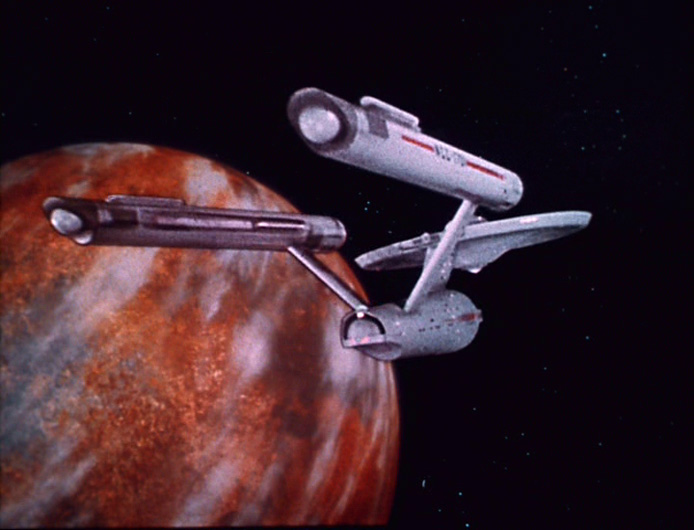
For our time there is, as far as I know, only one major example of a utopian future enabled by technologies: the Star Trek saga.  It is known around the world, and goes far beyond technology itself, or any other such utopian story, to model and embody the process of making a better future.

Though the utopia based on rejection of technologies has its most famous origins in England, in its forms most relevant to the actual future it is characteristically American.  Even actual utopian communities (such as the New England Brooks Farm experiment in the time of Emerson and Hawthorne) were established based at least partly on this rejection.

But in a larger sense this utopian idea can be said to have arisen from the essence of America, beginning in the Elizabethan Age when the New World of the Americas was, to Europeans, the embodiment of utopia.

But perhaps the most potent myth for the actual human future arose in America at a peculiar historical time.  In the late 19th century, just as H.G. Wells was imagining his Time Machine in England, the United States was at the point of finally and tragically ending its uneasy balance between the land of natural bounty with the cultures that lived within that context, and the machine-dominated urban civilization largely imported from England and Europe.

It was the last moment that at least a few indigenous peoples existed in America with their cultures intact, in the final free remnants of their lands, in the same country that was building great cities of iron and steel.  The last clash led to the symbolic expression of the lost and future utopia of America called the Ghost Dance.

It is my belief, and the main thesis of this project, that both of these utopian visions are crucial to envisioning and enacting a hopeful future in our real world. That a synthesis of their best elements must be achieved to even have a human future.

For with the nuclear age, and now even more clearly in the climate crisis age, the alternate if interpenetrating extremes of possible futures have become a binary choice.  We will have utopia (a much better and more just society) or we will have apocalypse. Or as Buckminster Fuller said in the 1960s: utopia or oblivion. For not to go in one direction is to go in the other.

Our leading utopian storyteller today, Kim Stanley Robinson, has recently taken to commenting that our future prospects are so dire that survival without a major extinction event constitutes a utopian vision.  In other words, utopia is defined as simply avoiding apocalypse.

But even to get there requires extensive and even basic change.  To get there wisely requires imagination and evaluation.  So it seems to me still worthwhile to examine these two basic visions for a better future: Star Trek, as expressed in the initial or Gene Roddenberry era of its television and film stories, and the Ghost Dance, as it has been expressed since in the work of Leslie Marmon Silko and Ursula LeGuin, for example.

So next time, we start with Star Trek.