Showing posts with label Jane Jacobs. Show all posts

Sunday, February 12, 2017

Jane Jacobs News

I kind of faded out on Jane Jacobs' Dark Ages Ahead, now that we don't have to wait for one anymore.  Maybe I'll get back to it.  But there's a nice piece on Jane in the Nation from earlier this month by Rebecca Tuhus-Dubrow.  It's a nice primer on her life, work and importance as the author of "Life of Great American Cities (1961), one of the seminal books of the 20th century."

Such insights as: Jacobs’s unconventional politics grew out of her temperament. She was allergic to dogma; she followed not an ideology but a methodology. She did not assume, or imagine, or take things on faith; she observed. But she didn’t stop there: She accumulated observations and distilled them into general principles. For her, empiricism and theory were not opposites but complements.

This piece marks the occasion of a new collection of Jacobs' shorter essays and speeches, Vital Little Plans, and a new biography, Eyes on the Street.

Tuhus-Dubrow also notes that some of the characterizations and criticism of Jacobs comes from people who simply did not read her books very carefully--what they say she didn't critique, she certainly did, in detail.  An unfortunate but not in my experience rare tendency among the professional opinionati.

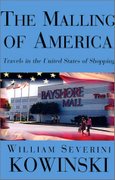
Towards the end of this piece, a Jacobs' essay or speech is quoted about the virtue of little plans rather than big ones in city planning.  It's quoted from a speech she gave in Germany but I vividly remember these sentences from a speech she gave on another occasion that was published in the American Scholar.  That speech, and a TV documentary on the city, were my introductions to her.  She became essential to my work on The Malling of America.

As for Dark Age Ahead, her last book, here's the only video of her talking about it at length, at a bookstore in Oregon.  This also preserves her priceless defense of anecdotal evidence and the most trenchant summary of the limitations of science that omits it.  When thinking about the future, Jane Jacobs is one of the indispensables.

Sunday, January 08, 2017

Dark Age Ahead.2 Family and Community

Continuing discussion of Dark Ages Ahead (2004)by Jane Jacobs.  First part is here.

In warning of the dangers of a Dark Age ahead, Jane Jacobs singles out "five pillars of our culture that we depend upon to stand firm, and discuss what seem to me ominous signs of decay."

Her five pillars are community and family, higher education, "the effective practice of science and science-based technology," taxes and government, and "self-policing by the learned professions."

She immediately recognizes that these are not the most obvious, which would include "racism, profligate environmental destruction, crime, voter distrust of politicians and thus low turnouts for elections, and the enlarging gap between rich and poor along with attrition of the middle class."

She feels these second five have been recognized, and also sees them as results of the first five.  Elsewhere she notes that while her choice of five may not be the biggest threats leading to a Dark Age, they are the stabilizing pillars of the culture that we depend on to make corrections in our cultural course---so if we're on the way to catastrophe, these in a healthy state would help us change direction.

 But if they are weak, we are less able to change culturally to confront such challenges as racism and environmental degradation, and so we're left helplessly watching ourselves head into the Dark Age, knowing what the problems are, but unable to address them.

At the end of the book, Jacobs makes practical suggestions to reverse some of the deterioration in these five pillars.  In interviews about this book she insisted she is basically an optimist, and that despite the title, this is an optimistic book.

First pillar (chapter 2) Families Rigged to Fail

Jacobs makes a distinction between the family as a biological unit (whether nuclear or extended family) and the household, which is an economic unit.  A household can include renters and boarders, or be non-families altogether--from monasteries to armies.

She discusses some of the threats to the nuclear family that are well known, but one of her particular virtues is how she uses statistics.  She finds averages nearly useless, as the so-called divorce rate at 50%, which is made up of averaging very long marriages with very short ones.  But she acknowledges that there are higher proportions of divorce across all income classes, and postponements of marriage and having children, which contribute to lower birth rates.

But her major emphasis is economic.  For 40 years starting in the 1930s, the median income (meaning half made more, half made less) of a family was sufficient to buy a median-priced home or rent a median-priced apartment.  That changed in the 1970s, and by the 1980s, 90% of America families could not afford a median-priced house.  Rents also took up larger proportion of income.

This led to an epidemic of homelessness, and a middle class dependent on low inflation and the paper wealth of mortgages on their homes.  Families depended on at least two incomes to support a household, but it was a losing fight, for expenses increased--especially the need for a automobile or two.

In addition: "Two parents, to say nothing of one, cannot possibly satisfy the needs of a family-household.  A community is needed as well, for raising children, and also to keep adults reasonably sane and cheerful."

Here we're on traditional Jane Jacobs ground, as she describes all the resources a family needs, including those usually provided through government (roads, parks, public health, schools, libraries, emergency services) as well as non-profits and commercial establishments.

Then there are "thoroughly informal, thoroughly intangible, and probably the most important [resources]: speaking relationships among neighbors and acquaintances in addition to friends."

She describes why these are important, and how they function.  But these relationships are less likely in car-dominated suburbia, which also tends not to have a diversity of residents.  She notes how highways obliterated city neighborhoods and how, without mentioning her own substantial role, that kind of city planning was defeated in New York, saving the now fashionable neighborhood of SoHo.

She also describes in some detail how the triumph of the automobile was hardly market-based, it was the work of General Motors in stripping American cities of public transportation, especially the more efficient trolley systems.  (I did a detailed article on trolleys and light rail including the history, and while Jacobs' stats are damning, the history is a little more complicated.)

Some people would find this nostalgia or a quaint memory, but she insists on trolleys as "quieter, faster, more comfortable and more durable and economic" as well as less likely to destroy neighborhoods, and reminds us that when China capriciously jettisoned its ships, people soon forgot them.

Other factors could be added to those Jacobs outlines to contribute to loss of community, but an important concept here is that it is indeed a loss, and not a theoretical one.  For her, the mark of the Dark Ages is a societal forgetting--so that the memory of what was lost is also lost.  That includes specific knowledge (how to do things, how to fix things as well as facts and theories) and it includes what once had physical form, like communities and their landmarks.

Now with more migration and immigration, flexible and strong communities are needed more than ever.  She notes that these observations are fairly obvious, and that she will return to the problem of communities again.  But she warned:

"If the predicaments of North American families continue mounting and climb further up the income ladder, I have no idea what kinds of households will emerge to deal with needs that families are at a loss to fill.  My intuition tells me they will probably be coercive.  This is already true of the most swiftly multiplying and rapidly expanding type of American households at the turn of the millennium--prisons."    

Tuesday, January 03, 2017

Dark Age Ahead: Choosing Ignorance

Jane Jacobs (1916-2006) is rightly remembered for changing how influential people thought about and designed cities, particularly in North America, because of her original and persuasive writings and activism.

But in this culture people get a single label, which is probably one reason that her last book, Dark Age Ahead was praised and ignored when it was published in 2004.

Another reason is that such a subject (a coming Dark Age in America) is hard to think about: difficult because it is complicated, difficult because it requires shedding habitual categories and ways of thinking, and difficult because it is emotionally huge, and invites displacement and denial.  The mind just can't get itself around it, while the emotions blur the brain and suggest sweets instead.

But at this cultural moment, as we really need to be clear on what's going on and what it may portend, this relatively short book may help focus observations and analysis, getting us beyond the usual paths that so many are now taken in trying to explain what's happened, and more importantly, what to do about it.

There is some agreement that this is part of a trend--not the only one, but a powerful one--that has been building and consolidating over years and likely decades.

There is perhaps less agreement that, as I believe, this is not a mere political problem, let alone an accidental outcome.  Though electoral margins were slim and there's the counter-evidence of the popular vote--and clearly the culture is divided-- the failure of the political system (including media) was so total that it more than suggests a larger cause.

In retrospect, for example, we can see the political and economic causes for Hitler's rise in the 1930s.  Something like it was in the cards at the close of World War I and the harshness of the Versailles treaty.

But that doesn't really explain Hitler.  C.G. Jung, who was in neighboring (German-speaking) Switzerland throughout this period--from before World War I until well after World War II--felt strongly that there was a mass psychological component that transcended politics and economics.  It continued to obsess him for years after.  Judging from the monstrousness of what occurred, I am persuaded he's right.

Jacobs doesn't get into the psychological realm, which I believe is part of the story today, and I believe it is directly related to the prospect of the climate crisis.

But Jane Jacobs also looks beyond ordinary politics and economics, though she includes them in her synthesis.  I approach her book now, determined to go through it carefully.

I begin reading with one of my questions in mind: has any civilization, prosperous and powerful and with domestic tranquility relative to many times and places in the past, actually chosen ignorance and thereby self-destruction?

In the early pages of the book, Jacobs cites two strong cultures that did themselves in: Mesopotamia (much of what we call the Middle East) before the Christian era, and late medieval China.

"The difference between these failures and those of conquered aboriginal cultures is that the death or the stagnated moribundity of formerly unassailable and vigorous cultures is caused not by assault from outside but by assault from within, that is by internal rot in the form of fatal cultural turnings, not recognized as wrongful turnings while they occur or soon enough afterward to be correctable. Time during which corrections can be made runs out because of mass forgetfulness.

The initial cause of decline in Mesopotamia was environmental degradation: they cut down their forests.  In China it was the result of a bad decision made by the head of an all-powerful--totalitarian-- central government, that turned the nation inward.

But at some point they made everything worse by choosing ignorance. “Cultural xenophobia is a frequent sequel to society’s decline from cultural vigor. Someone has aptly called self-imposed isolation a fortress mentality," Jacobs wrote.

The fortress mentality conjures up the inevitable image of walls.

Jacobs quotes historian of religion Karen Armstrong analyzing the Mesopotamian decline as continuing because of a shift "from faith in logos, reason, with its future-oriented spirit" to a "conservatism that looks backwards to fundamentalist beliefs for guidance and a worldview."

At its height, medieval China had huge fleets of ships capable of exploring the world.  The decision to destroy the fleets eventually led to government officials destroying all the records, designs, navigational charts, maps and findings associated with the fleet and these voyages.  Centuries of knowledge were lost.  Ignorance was chosen.

Jacobs quotes a vice president of the War Ministry for China of the period as denying the fleet was ever large and impressive, or that the voyages brought back anything of value.

This reminded me of a talk I watched on YouTube by science fiction author and thinker Neal Stephenson who suggested that today's minority views could become predominate, so that in a matter of decades in America it would be generally believed that the Apollo moon landings never really happened.

(By the way, what might have happened had China continued to explore is explored in Kim Stanley Robinson's alternate history novel Days of Rice and Salt.) 

Jacobs adds another interesting comment:

“A fortress or fundamentalist mentality not only shuts itself off from dynamic influences originating outside, but also, as a side effect, ceases influencing the outside world.”

Reading about what could be causing the onset of a Dark Age is not the most pleasant--it can't be called diverting.  So I'm enforcing my reading by committing to writing about Jacobs' book in this space for the next few weeks.