Showing posts with label theatre. Show all posts

Thursday, December 29, 2022

R.I.P. David Warner and other actors 2022


When Alan Rickman died in 2016, stories emphasized his movie roles as villains, despite the actual range of the characters he played in dramas and comedies.  Yet the images and clips accompanying the stories often were from his only romantic lead (however offbeat a romance, in that his character is dead) in the wonderful film Truly, Madly, Deeply.

 Something similar happened when David Warner died in July 2022: stories focused on his villains, though he played more honorable characters, but the images were usually from his only film as an offbeat romantic lead, the 1966 Morgan: A Suitable Case for Treatment, known in the US also as simply Morgan! 

That movie, stylistically a quintessential 60s film directed in England by Karl Reisz, made a big impression on me when it came out.  Caught between working class communism he grew up with, and the self-satisfied world of the rich he married into, partly because he became a commercially viable artist, Morgan is a kind-hearted man who identifies his rebellion with the natural instincts of apes as well as the symbols of revolution.  He longs for his ex-wife, played by Vanessa Redgrave in her first film role, who is also torn between her accustomed comforts and Morgan’s rough charm.  The gap between his idealistic fantasies and reduced reality, as dramatized by his futile gesture of breaking up her wedding reception while dressed in an ape costume, gets him committed to a bucolic asylum.  

Warner’s character and performance in this film suggest what his 1965 performance as Hamlet might have been like: highly physical and mercurial, alternating catatonic brooding with sudden frenzies of speech and action.  When David Tennant was slated to perform as Hamlet in 2008, he made a short TV film in which he interviewed other actors who had played the role.  Most acknowledged that the greatest Hamlet of their lifetime was David Warner.

 Warner did play a lot of film villains, and eventually tired of it, but he also played Bob Cratchit in the 1984  George C. Scott version of Dicken’s A Christmas Carol, and the Klingon Chancellor modeled on Gorbachev (who also died in 2022) in the last Star Trek original cast feature film.  He played historical characters from Jack the Ripper to the young William Wordsworth.  He performed in at least two filmed roles in Chekhov plays: in the 1968 Sidney Lumet feature version of The Seagull, and a 1991 BBC production of Uncle Vanya.  He returned to the stage in the early 21st century, playing King Lear in 2005, the traditional capstone to a career that includes a Hamlet.

 Warner’s voice was always a stage asset, and became the source of his many roles in animated and audio stories that included playing Doctor Who.  Because of Morgan (and the fact that I identified with both the character and the actor), I followed David Warner’s career with affection as well as appreciation and admiration. 

It would take a book to begin to describe the importance of Sidney Poitier’s movie performances in the 1960s, just as the Civil Rights movement was moving into unavoidable prominence.  No history of the racial attitudes and official changes in those years would be complete without referring to A Raisin in the Sun, Lillies of the Field (for which Poitier became the first black recipient of the Best Actor Oscar), Guess Who’s Coming To Dinner, To Sir With Love and In the Heat of the Night.

 His career began in the 1950s, though he was a Blacklist victim for part of that decade.  In addition to more popular movies like The Defiant Ones, he was in some lesser known films I saw on television and loved: Go, Man, Go (a low budget look at the origins of the Harlem Globetrotters) and Paris Blues ( Blacklisted director Martin Ritt’s look at American jazz musicians in Paris, with comment on race issues, costarring Paul Newman and Joanne Woodward as well as Diahann Carroll and Louis Armstrong.) 

After the mid-1960s when he was the biggest box office draw in Hollywood, he turned to directing, producing and playing occasional lead and supporting roles, as well as political activism.  The only comparison I can come up with concerning his onscreen charisma and distinctive line-readings and physicality is Marlon Brando.   In 2009, his list of honors—and his work for racial justice—were capped by receiving the US Medal of Freedom from President Barack Obama.  He died in January 2022 at the age of 94.


 There aren’t too many actors left from the classic Hollywood period before 1950, so I take special interest in the ones whose names get one more mention as their deaths are announced. 

Angela Lansbury is the most prominent among them, for her career started in the 40s with two best supporting actress nominations, but it extended well into the 21st century on stage as well as television, where she was best known for her 1980s series Murder She Wrote.


Marsha Hunt
 Beginning at age 17, Marsha Hunt appeared in Hollywood films of the late 1930s through the 1940s (including the Laurence Olivier and Greer Garson version of Pride and Prejudice, and the 1944 film None Shall Escape, regarded as the first film about the Holocaust), and was Blacklisted for most of the 1950s.  She did theatre and played a few movie and TV parts in the 1960s and afterwards, and in the 1990s appeared in an episode of Star Trek: The Next Generation.  She remained a political activist and humanitarian.  She was 104.

 Mildred Kornman was one of the last surviving cast members of the Our Gang comedies in the 1920s and 30s, though she had a non-speaking role.  She was a bit player in 20th Century Fox films of the 1940s, and a magazine model. She was 97. As a child actor, Mickey Kuhn was the last surviving cast member of the 1939 blockbuster Gone With the Wind.  He appeared in other major films in the 1940s and early 1950s. He was 90.  Faye Marlow played a few leads and supporting roles in 1940s movies and early 1950s TV before becoming an author.  She was 96.  Nehemiah Persoff was a sometimes familiar face (when not disguised) if not a familiar name in supporting roles in more than 200 television shows as well as movie roles, including a few in the late 1940s. He was 102.  

Irene Papas in Zorba the Greek
Memorable performers from 1950s television passed away in 2022, among them: Tony Dow (Wally on Leave It To Beaver), Dwayne Hickman (Dobie Gillis), Tim Considine (Disney’s The Hardy Boys and various Disney movies), June Blair (Ozzie and Harriet—she played and was David Nelson’s wife), and comedian Pat Carroll (Sid Caesar, Danny Thomas shows.)  Actors in 1950s movies include Akira Takarada (Gojira), Hardy Kruger, Linda Lawson, Georgia Holt, Andra Martin and Greek actress Irene Papas, who went on to a film and stage career of more than 50 years.  Bernard Cribbins began his movie and TV career in this decade and it never stopped until he did—he’d become a beloved icon in the UK.

Yvette Mimieux
 Actors who helped characterize the 1960s include Nichelle Nichols, Yvette Mimieux , Henry Silva, James Olson, Mitchell Ryan and Ann Flood as well as European actor Monica Vitti (Antonioni films.)


Sally Kellerman & J. Caan

Actors first associated with the 1970s include James Caan (The Godfather), Louise Fletcher (One Flew Over the Cuckoo’s Nest), Sally Kellerman (M*A*S*H), Howard Hesseman, Dani (Truffaut films), Bo Hopkins, Ruth Madoc, Stuart Margolin (The Rockford Files), David Birney (Bridget Loves Bernie); Emilio Delgado and Bob McGrath (both Sesame Street perennials), Bob Elkins, Susan Tolsky, Jo Kendall and Mary Alice, who began her long film, TV and stage career in this decade. 


William Hurt
Known best for their work in the 1980s and 90s are William Hurt, Fred Ward, Paul Sorvino, Ray Liotta, Anne Heche, Tadeusz Bradecki (Schindler’s List), Kirstie Alley (Cheers), Robert E. Mosley (Magnum P.I.); Al Strobel, Kenneth Welsh and Gary Bullock (Twin Peaks), Mary Mara (Nash Bridges), John Aniston (Days of Our Lives), Estelle Harris and Kathyrn Kates (Seinfeld), Jack Kehler and comedians Judy Tenuta and Bob Saget.  In the 2000s: Robbie Coltrane (Hagrid), Helen Slayton-Hughes, Leslie Jordan, Gary Friedkin; Tom Sirico and Bruce MacVittle (Sopranos.)

 Finally, actors who mostly graced the stage include Joan Copeland (sister to Arthur Miller), Robert LuPone, Rae Allen and Doreen Brownstone.  May they all rest in peace.  Their work lives on. 

Thursday, March 14, 2019

History of My Reading/ The Ghost, Lucretia Parsnips and The Great Turkey Heist of 1965


Note to Knox readers: In addition to the usual stuff, this post includes a 54 year old news story.  For the first time anywhere, names are revealed of at least some of the participants in the notorious crime of 1965: the Great Turkey Heist. Read on (or skip down.)

Flipping through a complete set of Knox Students for the 1965-66 school year reveals a few trends.  The college--students, faculty and administrators--was highly focused on the college, with the ongoing Faculty Planning Committee and its preliminary reports, and with pages of Letters to the Editor in the regimes of editors Ed Rust and Bill Barnhart.  Vietnam and related issues began to appear with increasing frequency.   Computers were mentioned, including the Computer Science major to be offered the following year.

Michael Chubrich (right) in debate, Judy Dugan
moderating, Len Borden taking notes. Gale photo.
Michael Chubrich took over as Student Senate president, promising sweeping changes. Guests on campus included Senator Paul Simon of Illinois, J. Allen Hynek, the UFO advocate, the classic filmmaker Joseph Von Sternberg (The Blue Angel) and poets Mark Van Doren, Robert Bly and James Dickey.

Knox theatre's mainstage productions were Shakespeare's The Taming of the Shrew (the last ever to be directed by departing professor Kim Chase) and The Mikado. Kevern Cameron directed Waiting for Godot, locating it in a circus.

Among the Social Board movies was To Kill A Mockingbird.  A few Cinema Club titles inevitably suggest the college ambience: My Life To Live, The Exterminating Angel, Through A Glass Darkly, La Dolce Vita, The End of Innocence.

Immediately upon my return to Knox in the fall of 1965 for my second year, I was very, very busy.  I was news director of WVKC, the campus radio station, and doing music shows as well, which required selecting music from the station's record library (or bringing my own albums), creating a playlist for the engineer, and using a copy of it for my on-air introductions.

I did jazz and folk shows, and filled in occasionally for classical shows--while adopting a slightly different voice suitable for each form (folksy, cool, FM-whispery).  I already had my news voice(s).  As the year wore on and I got more tired and bored, my David Brinkleyisms on the ten o'clock news became more outrageous.

I did have one distinction: I was the first DJ in Knox history to legitimately play a rock song.  They had been forbidden, until the station director (Mike Bourgo) bowed to the inevitable.  The first rock song?  "Help!" by the Beatles. (It was at the end of an original radio mystery that Skip Peterson and I wrote.) My summer conversion to the Beatles was continuing--I was rapidly accumulating Beatles records and other material, as we shall see (read on.)  There was some negative reaction to WVKC's belated rock revolution, however-- from students (including an offended letter to the editor.)

One more note about WVKC.  In February (1966), the first combat death in Vietnam of a Knox alumnus was recorded: Albert Merriman Smith, class of 1960. He'd also worked at WVKC.  His father (also Albert Merriman Smith, though he'd dropped the "Albert" professionally) was the White House correspondent for United Press International, one of the wire news services we used for our newscasts.

I became an editor of Dialogue, the campus essay and issues magazine, now established in its second year.  I joined the editorial board (with students Kevern Cameron, Steve Goldberg and Dennis Stepanek, and faculty members Douglas Wilson, Gordon Dodds and John Pascucci) and by spring, I was functionally the managing editor, preparing the issue for press.

I also began writing a column for the Knox Student, called Metaphor.  I started with a piece ostensibly "explicating" the expression "one book man." For a long time I thought I'd embarrassed myself by totally misunderstanding it. In 1965 I thought it meant a dogmatic person who derived their beliefs from the equivalent of one book.  Later it seemed it really meant an author who manages to write or at least publish only one book.  (An example of that would unfortunately be me.)  But it turns out that the original phrase "man of one book" from Thomas Aquinas meant what I thought it meant in 1965.

The only Metaphor column anyone remembers was one I wrote on a particularly frenzied night in November (I think I wrote it at the Toddle House, where I spent many late nights after my midnight radio show) that used a strange punning language to describe the weekend as a society or gossip columnist would--in this case "Lucretia Parsnips" or movie columnist Louella Parsons.  The names in particular drew attention (for example,"kafka livingston" was Kathy Lydigsen, "maybe jefferson" was Mary Jacobson, who returned the favor by dubbing me "big coincidence.")

Afterwards I heard from at least one English faculty member about my "Joycean" language, derived from Finnegans Wake by James Joyce.  I smiled and nodded knowingly but in fact I'd never looked at a page of Finnegans Wake.  My model was John Lennon, whose similar punning style was on display in two books, the recently published A Spaniard in the Works and the earlier In His Own Write, which I'd absorbed over the summer.  However, I hastened to acquaint myself with the works of James Joyce outside of A Portrait of the Artist--and he became an obsession for many years.

I have since learned that my experience essentially replicated John Lennon's. When his first book came out, a critic mentioned its Joycean origins, but Lennon hadn't read Joyce either--though he did after he'd been influenced by him.

My fellow columnists for the first semester were Kevern  "Casey"Cameron ("The Noisemaker") and Skip Peterson ("The Styleboat Skipper.") Cameron ignited a letters debate between Professors Brady and Doug Wilson, and Skip and I were envious.  But the three of us also collaborated in different combinations (I believe we may have written each other's columns once--I'm pretty sure I wrote a spoof of Cameron's.) I'm sure the three of us once got together to write a combined letter to the editor we thought was hilarious, after which we repaired to the BV for more liquid refreshment, returning to campus arm and arm and singing, a unique experience in my college career.

Unidentified Englishman (probably a duke by now)
and me
I was still active in the Knox debate club, and in particular participated in a debate with two touring student debaters from Cambridge University in England.  Judy Dugan and I were each paired with one of these lads, on one side or the other of the topic (as we say in America), or the question (as they say in Brit.)  Judy and I did our standard research and serious preparation on whatever it was.  But the Brits were much looser, employing wit, rhetoric and sometimes fanciful argument.  I eventually got into the spirit with a few ripostes of my own that went over well, so we had a great time.

The Gale photo.  Mark Brooks
and Neil Gaston behind me.
But my big public speaking moment that fall was addressing the Student Senate on the issue of how students were selected to participate in the Faculty Planning Committee's work (which is the occasion of my photo on the title page of the 1966 Gale yearbook.)  I was part of a group that drafted a statement, and I wrote the accompanying speech.  I read it first before at least some members of this group, and specifically included the words "denizens of Olympus" so I could see Mary Jacobson make a face--she disapproved of such rhetoric. I made some changes based on their comments (but I kept "denizens of Olympus" in anyway. It gives me a laugh even now.)  As writing, the speech is pretty good--probably more accomplished than my columns--and clearly modeled on the style of Robert Kennedy.

So with all of that elevated activity, none of it having anything to do with college sports, no one would suspect me of collaborating in the crime of the year.  But that was a key to our success--we were not the usual suspects.  So after more than five decades, now it can be told: the true story of....

The Great Turkey Heist of 1965

The closest equivalent college campus to Knox is Monmouth College in nearby Monmouth, Illinois.  The annual football game between the two schools is an historic rivalry, and the winner is awarded the bronze statue of a turkey.  Why?  Beats me.  Anyway, the winning school keeps and displays it until the other school wins it back.  Except...part of the rivalry is finding ways to steal the Turkey in advance of the Big Game.  And this is what a highly unlikely crew did.  Our photos were published in the Knox Student--with our faces obscured.  So prepare to be shocked.

Ed Rust
The mastermind was Ed Rust, editor of the Knox Student.  In a letter to the editor at the end of his tenure I described him: "In conversation he is jittery, his eyes are piercing, his head and shoulders are bent forward, his chin jutted, all giving the impression of disorganized intensity."  Today I would just recall him as a combination of Robert Kennedy and Dennis the Menace.

Rust enlisted the unlikeliest of suspects: Jim Bronson (the tall, clean cut, affable photographer and writer for the Student) and the truly shocking one: Ruth Mesing, recently appointed as one of the first student representatives on the Faculty Committee on Student Affairs, along with Bob Misiorowski.  And, for some reason, little old Indie me.  How Ed talked me into it I don't know, but he could be persuasive about his enthusiasms.  (There were others in that photo but I don't recall who they were.)

RFK with Ed Rust reporting
Rust, who had seen entirely too many James Bond movies (Goldfinger was the latest hit in the series), concocted an elaborate plan, a real caper.  He obtained a car somehow (this was when Knox students weren't permitted to have cars on campus, or even to drive one)and sent Bronson and me to the Monmouth student union.  Jim identified himself as a photographer for the Monmouth student newspaper, and I was his assistant.  He sweet talked the union's (adult) manager into allowing him to take a photo of the Bronze Turkey in the display case.

Only Jim kept getting a reflection from the glass, so he asked the manager to take the Turkey out of the display case.  But we needed still more light--daylight for instance, and so the manager accompanied us as we took it outside.  Just then at that very moment, he got an urgent phone call (Rust? Mesing? calling from a phone booth within sight of us) and had to go back inside.  Bronson was looking into his viewfinder while I held the Turkey.  He motioned me a little farther back.  Then a little farther.  And when he was sure the coast was clear, he waved me away.  We had the Turkey.  It was a heist, though I believe we liked to call it the Great Turkey Coup.

But it wasn't over.  The Rust caper had a few more twists and turns. We met back at the car and Jim drove off, but he didn't head back to our campus directly.  Part way back to Galesburg he pulled off the road into a secluded area, where, under some trees, there was a second getaway car waiting.  It was a station wagon, the back of which had one of those compartments in the floor for the spare tire.  The Bronze Turkey went in there, with a nice rug atop the compartment.

Ruth Mesing and Miz wait for
a Student Affairs meeting to start
Ruth Mesing drove the station wagon, the real getaway car.  I rode to Galesburg with her, while Bronson drove back alone.  So if anyone was looking for two guys riding together, they wouldn't find them.

Meanwhile Ed Rust distributed fake editions of the Monmouth newspaper on their campus, announcing the theft of the Bronze Turkey, by "townies."  My participation ended there, but the fallout continued.  The next day Monmouth dropped a one page edition of the Knox "Stud" on the campus from an airplane.  Later, five pillowcases of feathers were dropped on the Monmouth campus.

 Then Monmouth students tried to raid the Knox campus but one was captured and held overnight in a frat house.  Then Monmouth students did the same to a Knox student.  The escalation might have continued, but by then it was time for the actual football game.  Which Knox won--the team's only victory of the season.

The Theatre of Smoking

I associate two other sets of memories with this school year.  I've previously recounted my New York misadventure with the tape of songs by my hometown folk trio, the Crosscurrents.  But that didn't end the Crosscurrents.  The other two members were high school friends, Clayton and Mike, who attended a college close to home. That fall, Clayton and I decided to write songs together long distance: I would write lyrics, send them to him, and he would write the music.  When I went back, the three of us would work out the song.  We wrote perhaps a half dozen songs that way.  I vividly remember writing one of the lyrics-perhaps the first--on a yellow pad, in the Knox library.  That's a kind of holy memory.  They were good songs, though the lyrics were a little flawed.  One of them became pretty well known among a small audience.

The other memory was of how I took up cigarette smoking.  It happened in the Gizmo, where I was entertaining the table with imitations of how various professors smoked.  Teachers smoking, let alone smoking in class, was new in my experience. But these were the '60s, and pretty much everyone smoked, pretty much everywhere (although at Knox, women were not permitted to smoke and walk at the same time.)  I got laughs by holding a cigarette with two fingers in an erect V, very close to the hand, as Mr. Grutzmacher had.  And smoking the cigarette down to the last quarter inch, as Mr. Haring did in my political science class.

The act was such a hit that I repeated it.  After a few times I just kept on smoking the cigarette, and then I started buying them.  I went from Salems to unfiltered Pall Malls in my senior year with lots of stops between. At some point I discovered the variety of obscure and foreign brands sold in the Knox Bookstore and began trying them all.  I especially got a kick out of the multicolored ones--the actual cigarettes were odd shades of magenta and florescent green and so on.

In the 70s when I quit (after succumbing to Gauloises and Gitanes) I identified this theatricality as part of what made smoking so habitual and (apart from the physical addiction of tobacco) so hard to kick.  How one held the cigarette, when one breathed in and out in rhythm with smoking, especially while talking; the cigarette as "a baton on the end of your gestures," made cigarettes an integral part of personal style and daily identity.

Speaking of theatrical, one of the actual courses I took this year was modern theatre history with theatre professor William Clark, who persuaded me that if I was going to write plays, I ought to know something about theatre.

The text was Mordecai Gorelik's New Theatres For Old.  While I found the class less than mesmerizing  I did get something like a grounding in stagecraft history and theatrical styles.  I read plays and wrote about them.  I particularly enjoyed Ibsen's Ghosts and a little-known Tennessee Williams play, Camino Real.  In later life, when I found myself reviewing and writing about theatre, I maintained the habit of reading the plays I was seeing, and reading as much about them as I could.  This was often more fun and rewarding than seeing the productions.

And speaking of Phil Haring, I took his Modern Political Theory class second semester.  We sat around a large table, and so had plenty of opportunity to observe his smoking.  I remember we read a number of paperbacks, covering political theorists such as Hobbes, John Locke and David Hume, onto more contemporary theories such as applying behavioral psychology in The Behavioral Persuasion in Politics by Heinz Eulau, a taste of things to come.

 I wasn't fond of that approach, as I wrote in a pretty good final paper. I enjoyed instead the observations of Philip Whitaker in his 1964 book we used, that seems to have completely disappeared from the planet since: Political Theory and East African Problems.  His observations on political theory rather than East Africa were on point.  Still, I ended up not being motivated to continue in political science, which I had briefly considered as a possible major.

In future posts, I plan to discuss the two writing courses I took this second year with Sam Moon, and the two literature courses with William V. Spanos (I never could call him "Bill") and the Whitman/Wallace Stevens seminiar with Douglas Wilson--all of which decided me.  But to end this post, I must recount the continuing influence of the man who wasn't there, the Ghost of Fred Newman.

The Ghost Who Talks

Fred Newman's absence was a presence when classes resumed in the fall of 1965. Photos of the demonstration in support of him the previous spring appeared in the Knox Student.  The tensions among students, faculty and administration continued, and Newman was evoked in various commentaries.  Meanwhile Newman himself was in New York, teaching at City College (CCNY.)  That fact led a group of students to a further and ongoing protest--the wearing of CCNY sweatshirts.

 There actually weren't any, we found, and so we had them created.  They arrived all together, and a fairly large group of us repaired to some off-campus apartment (probably Mike Hamrin's) to claim our blue sweatshirts with the white CCNY letters.  We returned to campus together, and entered the Oak Room together for dinner. The effect was slow to sink in but it remained for awhile, including some bitter criticism in letters to the editor, suggesting traitorous behavior.

Newman's ghostly presence continued throughout my year, even academically.  It was most pronounced that fall, when I was using his language and accompanying it with his arm and hand gestures, and the way he rolled back on his heels where he stood.  In the Oak Room after dinner once, Wendy Saul commented on this, and added that I not only was beginning to resemble Fred Newman, "some people think you are Fred Newman."

Since childhood I found myself entering the image, so to speak, of figures I admired.  While other boys got themselves Davy Crockett coonskin caps, I felt myself become Davy Crockett, speaking and moving like Fess Parker had in the TV shows and movies, or rather feeling I was.  I did something similar when I was learning, for example, to play and sing Bob Dylan songs or Beatles songs.  I became them internally, and outwardly imitated their voices and so on.  These were explorations and even ways of learning the songs, so eventually I would integrate their styles in my own way.

But Wendy's comment made me realize I had gone too far this time.  The ghost of Fred was taking over.  I had to let it go. Besides, I had just bought my first John Lennon cap.

Still, all that year the influence remained in my classwork.  I took a philosophy of language course first semester (I don't recall the teacher) and a Theory of Controversy course second semester, taught by speech professor Donald Torrence (who was also in charge of debate.)  That practically was another philosophy of language course; I recall we read A.J. Ayer's Language, Truth and Logic. The text for the philosophy course was probably Readings in the Theory of Knowledge, edited by John Canfield and Franklin Donnell.  I remember we spent a lot of time on long excerpts from Kant's Critique of Pure Reason.

 My papers for both show a marked preference for books from the Newman course the previous year (notably Quine's Word and Object), and a style of discourse often similar to Newman's "Rules and Games" speech.  Even my final paper in Modern Political Theory began with a Wittgenstein/Newman riff on theory, rules and games, and returned to it later.  Reading that paper now, I have to observe that it actually was apropos, and successfully integrated those ideas for observations which I find valuable in looking at political situations today.

Fred Newman however was not actually a ghost, and we were in sporadic contact by letter and phone.  Christmas vacation is often the occasion for big academic conferences (which cover for head-hunting and job-hunting for academic positions) and there was to be a philosophy conference in New York. Senior Michael Hamrin, one of Newman's students (who later entered the Stanford graduate program in philosophy, where Fred got his advanced degrees) had a VW bus at home in Joliet, and the plan was for him to stop by in Greensburg and pick me up on the way to Manhattan.  Judy Dugan, who lived in Chicagoland, would meet up with Hamrin for the trip.

I was excited, not only about New York and the conference, but about the occasion of my two worlds coming together: two Knox friends (especially Judy) would meet my hometown friends, Mike and Clayton.  Hamrin and Judy were scheduled to arrive at my family home on Christmas day.

But the phone rang early on Christmas with Mike Hamrin on the line, explaining how his VW had been rear-ended on a city street.  He and Judy were uninjured but the VW was damaged to the extent that it wasn't safe to drive.  So they didn't come.  There were several further occasions when my two worlds were supposed to meet and didn't.  When they finally did...well, that's another story, for another time.

Fred talked about joining the faculty of Antioch College, a prestigious liberal arts college in Ohio, known for its unconventional academic approach.  I decided to apply for transfer to Antioch, which he encouraged.

By spring, he'd been rejected for the job, and I'd been rejected for a scholarship. He wound up at Case Western Reserve, and I remained at Knox.  Fred also spoke about the possibility of a summer job for me, and for getting me a grant for summer school at Harvard.  Neither of these happened either.  (I'd forgotten most of this, but much of it was recorded in my letters home, which my mother saved.)

Fred Newman returned corporeally to Knox in the spring, gave a well-attended talk in the Commons Room and a long interview on liberal arts colleges in the Knox Student.

There were other highlights to my second year.  Stay tuned for posts on Sam Moon, William V. Spanos and Doug Wilson.  Other posts in this series can be found by clicking the History of My Reading or Knox College labels below.

Friday, April 27, 2018

What's Happened, Baby Jesus?

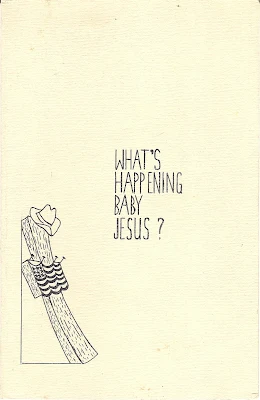
program cover by Tarillis J. Seamans
Fifty years ago tonight, What's Happening, Baby Jesus?, a play I wrote and directed, opened in the Studio Theatre at Knox College.

 At some point after I moved here to California in 1996, a then-current Knox student called me, and said she was researching a paper that involved Knox productions in 1968.  She told me that this play was often mentioned by people she interviewed, and had been talked about a lot at Knox for several years after the production.  It was discussed, she said, even with an incoming theatre department professor. This was all news to me.

Perhaps it was remembered because it was the first multi-media production, involving film and music.  It was in other respects as well, very much of its time.


Hue April 1968
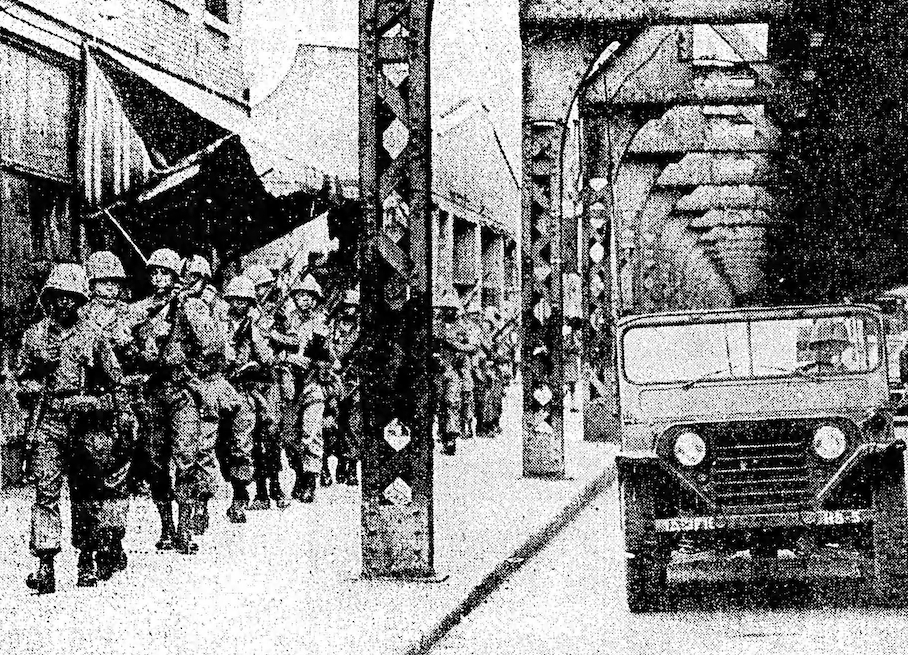
 April 1968 was not just another April, just as 1968 was not just another year.  More American troops were engaged in the Vietnam War, more young American men were drafted, and there was more bombing in both North and South Vietnam than ever before.  Early in the calendar year, the Tet offensive by the Viet Cong caused massive casualties on both sides, and while American and South Vietnamese forces ultimately took back territory--with the city of Hue substantially destroyed-- the offensive exposed the quagmire quality of the war.

New York City April 27, 1968
Antiwar protests continued to grow--the march on the Pentagon, first national mobilization, and a huge protest in New York on April 27, the day our show opened.

Earlier that year, Senator Eugene McCarthy nearly defeated President Lyndon B. Johnson in the New Hampshire presidential primary as an anti-war candidate, Senator Robert Kennedy of New York began campaigning for the nomination in following primaries, also against the war. On March 31, LBJ announced he would not be a candidate for re-election.

Chicago April 1968
But that wasn't all.  Racial conflicts continued, with a civil rights protest in February resulting in the deaths of three students.  The Black Power movement gathered strength. Then Martin Luther King, Jr. was assassinated on April 4, and the ensuing riots and destruction in an estimated 85 American cities that night and the next day left 30 people dead (11 in Chicago alone), more than 2,000 injured and neighborhoods burned out and in rubble, with martial law and National Guard on the streets of American cities.

Three days before we opened, students at Columbia University in New York began occupying administrative buildings, protesting the university's secret ties to a military think tank and the building of a white-only gym encroaching on the black neighborhoods of Harlem.  There were other student protests in Europe and in the U.S. all year.

And if we needed any reminder of the possibility of instant annihilation we'd lived with all our lives, on the day before we opened the U.S. exploded the largest hydrogen bomb ever detonated in the actual United States, at an underground test site 100 miles from Las Vegas.  It was the 34th nuclear bomb explosion at that site since the start of our school year (the test on February 21 was code named Knox).  There would be six more before my class graduated in June.

(And when I say "all our lives," it was literally true for me--the first big post- World War II US atomic bomb test was exploded the day I was born.)

Sequestered as we were in Galesburg, all of this was part of our lives--and our campus. April 26 was national Vietnam Day but at Knox, April 1968 in fact was Vietnam Month.  Although there was lots of tension between students and administration on various political issues,  Vietnam Month was a consensus project.

Howard Zinn 1968
It began with History professor John Stipp lecturing on the history of Vietnam (and not for the first time.  He and other Knox professors held the first teach-in on campus in 1965.)

 Also that week, English professors Moon, Metz and Douglas Wilson talked about war and literature in the Common Room, while recent Knox alum Stephen Goldberg gave two talks about his experiences with the International Voluntary Services in Vietnam, and the director of the AFL-CIO African American Center lectured.

poet Denise Levertov 1968
The following weeks included at least 9 outside speakers, including the Vietnamese counselor for the Vietnamese Embassy, a Brigadier General, a former Green Beret and current antiwar activist (Donald Duncan), a fairly young Howard Zinn, activist and government professor from Boston; and the poet and activist Denise Levertov.

There were additional faculty discussions, and a faculty and a student debate, and a poetry reading against the war.  Though it wouldn't happen until May, the comic and activist Dick Gregory delivered a memorable speech and answered questions in Harbach Theatre.

In the midst of this came the news that Glenn L. Moller, Jr., a 21 year old former Knox student had been killed in combat in Vietnam.  He'd left Knox the previous year, and otherwise would have graduated with our class in June.  He was the third Knox student killed to that point (after Merriman Smith, Jr., son of the distinguished United Press White House correspondent, and Thomas Dean, brother of one of our classmates, Willard Dean.)  He wouldn't be the last.

Meanwhile, the world flowed through by means of newspapers, television, magazines.  The Knox Student weekly newspaper, as edited by Peter Stetson and Jeremy Gladstone, funneled current Liberation Press Service releases and other material like the notorious "Channeling" document of the Selective Service, outlining how the draft and deferments are used to channel men into careers in "the national interest." Draft resistance was a hot topic in 1968.  Knox student Jim Miller ('68) wrote a series of articles on Canada as a haven, for instance.

  Needless to say, complaints appeared in the letters columns.  But the newspaper did not neglect ordinary campus news--in fact, it did a better job of it than many students newspapers that I've seen do now.

So in the bright and wet warmth of April, our campus was sad, conflicted, bewildered, frustrated, angry and helpless all at once, together with the other emotions and experiences of the campus spring.  Games were played, movies were screened, concerts and recitals were given, art work was exhibited, and plays were performed.

A preliminary and editorial word about the Studio Theatre.  There were a few big productions on the revolving stage in Harbach each year, directed by theatre faculty.  But in the Studio Theatre downstairs, there seemed to be student productions every weekend and sometimes during the week.  The plays were usually directed by theatre students.  Many--though not all-- of the plays were by contemporary playwrights, and many--but not all--were in some sense experimental.

Donald Davis, the original American Krapp
in 1960.  There was likely another actor in
the role when I saw this production in 1965.
Theatre students got experience in directing, acting, scene and costume design and all the technical areas.  Campus playwrights could also get productions.  But all of us got the experience of seeing these plays, that we simply otherwise would not have seen.  It's where I saw my first Albees, Becketts, Pinters, Ionesco and Genet (I remember Joelle Nelson in a Genet play I didn't understand and still don't) and many more, as well as my first Kiralys and Petersons.  I saw seldom produced plays by Yeats and Eliot.

 There are some plays I saw only in the Studio Theatre at Knox, and some that remain in my memory despite seeing them in more professional settings elsewhere.  For example, I saw the original New York production of Beckett's Krapp's Last Tape together with Albee's first play The Zoo Story (the summer between my first and second years at Knox) and just a few years ago, another production of the Beckett.  But the performance I remember most vividly was George Otto's Krapp's Last Tape in 1968 in the Studio Theatre--the Expressionist lighting on his hollow cheeks as his long arms reached for the tapes are indelible images.

I've since also observed that these opportunities for students to make theatre as well as to experience it are not found everywhere.  It was free-range theatre of a kind that I doubt exists much at all anymore.

me in senior year,the fall of 1967 in the Gizmo.
Photo by Bill Thompson.
A play of mine had appeared in the Studio Theatre the previous spring, directed by Richard Newman.  By the Sea By the Sea By the Sea By the Sea was a pastiche comedy, heavily influenced by TV sketch comedy, the Beyond the Fringe LP, British movies (namely Morgan! and the Richard Lester Beatles films), the Liverpool Poets and other aspects of Swinging England, as well as by James Joyce and Marshall McLuhan.  Its theatrical highlight was a scene done in pantomime while the entire Beatles song "The Word" played at full volume, climaxed by Willard Dean driving his motorcycle into the theatre and onto the stage, playing a police officer arresting an elderly protester.

In my senior spring, I directed as well as wrote What's Happening, Baby Jesus? I'd never directed anything, so I made not-even-rookie mistakes like casting it without callbacks to actors who auditioned. But I had a Vision, of a multimedia collision of myth and the moment.  So everything about 1968 at Knox I described here, and a lot I didn't, was involved.

For the multimedia, we used a film collage of mostly World War II newsreel footage that Todd Crandall made.  We had about a fifteen minute pre-show as people were coming in, comprised of a music mix, film projection and a kind of light show.  I created the music tape, interjecting periodic taped announcements of "the next show begins in x minutes" as they used to do at drive-in movie theatres. 1968 was a great year for music: Beatles, Stones, Creem, Hendrix, Doors, Airplane, Dead, Janis with Big Brother, Buffalo Springfield, Country Joe and the Fish, Dylan, Donovan, early BeeGees and so on.

Todd's film ran throughout the show, projected on the wall.  I believe we had more than one film running on more than one wall.  Something like that.  My housemate and friend Bill Thompson ran the light show and did the light cues during the show.  I did the sound cues, so we were together in the booth each evening.  Bill Thompson died suddenly almost exactly a year ago.

We also had music cues during the show, including pieces of "The Baby Jesus Song" which I wrote, sang and played, with additional vocal and instrumental accompaniment by Joni Diner, Marilyn Bell and Ric Newman.  We recorded it on one take by sneaking into the band room and taking covers off a few keyboard instruments, plus whatever percussion we could find.

Bill Thompson was in charge of lighting but he knew as much about theatrical lighting as I did about directing, so without a word, the student previously known as Guy Morose got up in the rigging, fixed our lights and gave us our lightboard cues.  He was a hero by any name, though years later I was so happy to hear (from the wonderful Valjean) that he'd changed it (back) to Guyatano Amorosi.

Our set and costumes were designed by dear sweet Charlie Rice, whose murder in Chicago just months later was a terrible shock.  The absolutely perfect program cover design was by Tarillis J. Seamans, Jane.

Marilyn Bell and Jean Rabinow did the costumes, including a yellow flowered shirt (think Magical Mystery Tour, or Donovan) for me to wear in the booth.  I still have it.  Sandy Berger did props, Steve Clark makeup. (Peter Overton, a star of the show, showed up at rehearsal with a shirt with those shiny ivory buttons he found at the western store in Galesburg.  He wore it in the show, and I liked it so much I went down and bought an identical one for myself.)

Ric Newman was technical director and Joni Diner was the stage manager.  Lucy Mitchell chaired the house committee of ushers: Sherwood Kiraly (whatever happened to him?), Larry Baldacci, Jan Byhre, Bruce Hammond, Henry Keighley, Judy Major, Julie Machnicki, Janie Langer, and two other first years who would be part of my later life, Carol Hartman and Mike Shain.

What's Happening, Baby Jesus? was set in a timeless Old West town, simultaneously a familiar tv western set and the paradigmatic locale of the American myth.

The town was run by Marshall Power, played to perfection by Peter Overton.  At that point, the Vietnam War was owned by LBJ, who had a way of pronouncing it "Amurican." He was an overpowering personality in those days, and his cruder aspects became identified with his war policy.  Many people--especially of my generation, and including me, who worked to elect him in 1964--felt betrayed by his escalation of the war.  He'd expressly said he wouldn't do what he did--send American boys to fight in Vietnam.

So he was the western Marshall, who was also a God the Father Figure.  My Catholic education came home to roost with this play, for sure.  Some of the speeches I copied right out of scripture.  His prodigal son (Sonny), played by Ric Newman, was a go-getter salesman of everything commercial.  The real power however was the sexually aggressive Virgin (Celeste Manking), accompanied by her hapless and frustrated husband Joe (Steve Clark.)

When the Marshall and Sonny have their showdown, their violence creates a third figure: Breath, or The Drifter.  He was sort of the Holy Ghost in Catholic mythology of the Trinity, and sort of the human caught in these rivalries, and becomes the object of their projections (though I would have been unable to describe it that way at the time.)  My biggest failure as a director was not being able to give Sandy Simon much help in developing his character as the Drifter.

There were also a lot of bits.  The play began with a brief Beckett parody of two bums (Bill Daniels and Dan Murray) talking, which went nowhere except for the payoff:  "We're waiting."  "Waiting for who?"  "Waiting for Godard."

Because the next scene was a gunfight between the two masters of the French New Wave, Jean-Luc Godard and Francois Truffaut (played by Todd Crandall and Steve Phillips.)  Thanks to David Axlerod and Todd Crandall's Cinema Club, we'd seen a number of their films over my years.  Truffaut and Godard had a bit of a feud after Godard got more political.

I don't know how funny the audience thought this was, but a little more than a decade later I interviewed Truffaut in Hollywood, and I actually told him about this scene.  He laughed.

A scene that did get a big laugh was set up by a couple of blackouts--Mike Shain in a business suit would appear and start to say something but the lights went out immediately.  The third time he did get to say his piece.  It was a pitch by a certain chewing gum company (American Chickle) to recruit Knox students, which I found in my student mailbox.  I literally stapled it into my first draft and added the line: "So come on out and keep America chewing."  Biggest laugh of the night.

One of the other interpolated scenes was a sweet but awkward conversation between a male and female student.  Steve Phillips was the Guy, and Shirley Covington was the Girl.  I don't think Shirley was a Knox student, she may have still been in high school. She was the daughter of an African American minister in Galesburg.  He was head of the church that sponsored at least one Civil Rights march or demonstration there that I participated in.  She just showed up at the tryouts, and I cast her.

When I entered in 1964 Knox had, as far as I know, only one black student.  In 1968 I believe there were about 20.  I may be wrong, but she may have been the first African American to be cast in a Knox production.  At least I don't remember another such instance in my time there.  Not to mention the first portrayal of an interracial relationship.   Her father came to the show, which worried me, given my less than orthodox approach to religious doctrines.  I was also embarrassed by how small the part was.  But they both seemed pleased.

Other actors in the show were Cathy Thompson, Howard Partner, John Hofsas and Bonnie Lucas.  Jeremy Gladstone and Charlie Rice captained the construction crews.

Joni.  Photo by Bill Thompson
Eventually the Marshall and Sonny put the the Drifter and his young disciples on trial (for "self-possession") and they are imprisoned. It's pretty clearly a stand-in for the draft: having them dance to the Country Joe and the Fish song, "I Feel Like I'm Fixin to Die Rag" was a big clue.

In their cells (pools of light) they made quiet statements and restatements ("Try Paradise Apples.  Paradise Apples Get You Off") including a haiku or two, and part of "Rules and Games," a speech written by Fred Newman, a philosophy professor who left Knox after my first year.  (I dedicated the play to Fred, and to Joni, my--what word do I use?  I prefer "sweetheart."  And Muse. )

(Later, after we'd parted ways, Joni left behind the role of supporting the creativity of others and went on the stage herself, acting in Providence, RI.)

The play ended with the Drifter finding apples and sharing them with the other prisoners, a blackout, while last lines of Dylan's song "The Drifter's Escape" played:  "Just then a bolt of lightning struck the courthouse out of shape/and while everybody knelt to pray, the drifter did escape."  Then lights up to an empty stage.

In those years, the Knox Student reviewer came to a run-through and wrote a review that appeared the Friday before the production.  Our show was generously reviewed by Rod Barker ('68), especially considering we were ridiculous rivals in our testosterone-riven writers workshops.  He was right that the production and the script were experimental, and a lot didn't work; that some lines were good and some were dumb. He was right that it was an unfinished work.  But he said it was a fun experience for an audience.  "The play and characters are multi-faceted and multi-dimensional and can be appreciated on many levels.  Everyone, I'm sure, could find at least one."

One of those levels was the one--or ones--appreciated by seeing the show stoned.  Smoking or ingesting the substance now known as cannabis had arrived on the Knox campus secretly a year or two earlier, but it was more open and much more widespread in 1967-68.  And it was a factor in the show's effects (including strobe lights) and multimedia.

Jane Langer and Carol Hartman, among the
first year ushers for the play
But it was also a factor that productions had to face.  At the time, those students who indulged tended to know each other, even if they didn't look the part.  There were "freaks" and "straights."  So I pretty much knew which members of the cast indulged.  I got them together at the first rehearsal and asked them to refrain from coming to rehearsals stoned, and if they did that, we would have a "stoned rehearsal" late in the process, so we would all be on the same "level."

Which we did--one of our last rehearsals before we moved into the Studio Theatre.  We held a run-through in the lobby space.  It was a bit confusing for those cast members not in the know, though at least one responded to the vibe by loosening up his performance.  I asked him later to keep those moments in the show, but it was never quite as good.  The rest of us had a great time, and we all saw new dimensions in what we were doing.  (One cast member, however, confessed he didn't understand the show until running it again in his head at the cast party  closing night.)  This rehearsal ended with an unscheduled blackout--the lights just all went out at precisely the right second.  We all praised our stage manager for an inspired effect, but she claimed that she had simply collided with the light switches by accident.  So in other words, it was perfect.

Also on campus on that Sunday, our second and closing night, was poet, translator and columnist John Ciardi.  He'd finished his talk early enough to get to our show, and came down to the green room afterwards to say how much he liked it.  He'd especially enjoyed the line "Why are all my friends allegorical figures?"  Since he'd translated Dante--I read at least some of his Inferno my first year, along with his Saturday Review column-- I could understand that.  He surprised me--he was known at that point to be unsympathetic to the growing counterculture--and I regret not being more welcoming.  But in general I was a jerk way too often anyway.

What's Happening, Baby Jesus? was of its time in maybe another way.  At about the same time as we did our show, a little musical was opening called Hair.  In 1969 I attended a performance of the now big hit Hair in San Francisco, because Ric Newman was in the cast.  I was standing in the lobby afterwards when suddenly he was embracing me, and babbling about how we should revive Baby Jesus somehow, it was the perfect time.  I was skeptical.  Even though Jesus Christ Superstar would open in 1970, I didn't see much resemblance to these pretty conventional musicals, however daring their subjects or themes.  But it's nice to think we might have done a better version of it.
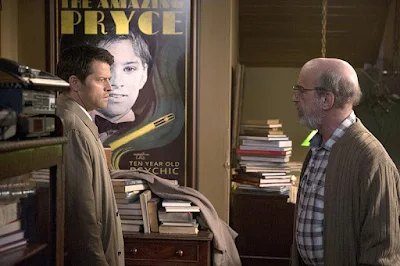
Richard Newman (right) in the 2005 film Supernatural
I saw Ric a time or two more in San Francisco that fall but lost track of him.  Then late one night in the mid 1980s, on the other side of the continent, I was half asleep with the television on a cable movie channel.  My eyes were closed and I wasn't following the movie at all when suddenly I heard this voice: I knew immediately it was Ric.

 But by the time I opened my eyes, the scene was over. I made myself stay awake till the credits when I could confirm it.  It was Finders Keepers, an obscure movie my old favorite Richard Lester made between his Superman and Three Musketeers films.  And there was Richard Newman in the credits. Now thanks to the magic of the Internet Movie Data Base, I found all 181 (and counting) of his credits as primarily a voice actor but also onscreen actor.

It's pleasant to be nostalgic about a common enterprise 50 years ago, with fond memories of people and good moments.  But memories of that time and this play in particular aren't real without the complicated context, and I've barely scratched the surface here.

Looking back on the experience, I enjoyed the collaboration within the process of finding my production.  I recall very early in the process, when I was going over casting possibilities, probably with Ric and Joni, someone suggested that two characters could be combined.  I instantly saw that possibility, not only to solve a casting problem but to strengthen the play.  Later, it was watching what the actors did, and guiding and selecting.

Looking back on the only draft of the script I could find (an early one), I see that it was an awkward search for a way out, past despair, joking all the way.  It blundered towards integrity, freedom and human warmth, not often reconcilable.

So I've gone on at length, on something that not many could write about--in some ways, only me.  The other side of that coin is that it is quite possibly of interest to only myself.  In general, I am reconciled to that.

Monday, April 23, 2018

The Shakespeare Party

In recent years, this was said to be an authentic
portrait of Shakespeare.
When I attended Knox College in the 1960s, the English department threw a Shakespeare's Birthday party every April on the weekend nearest the traditional birth date of April 23.  It's also the traditional date of Shakespeare's death, as well as the actual deaths of Cervantes and weirdly, several other literary figures through the ages.

This party featured a series of hastily arranged and improvised scenes from Shakespeare's plays, performed with text in hand by party attendees drafted on the spot.

The only set piece that repeated year to year was the balcony scene from Romeo and Juliet, in which a blushing but highly pleased Howard Wilson, longtime chair of the department, would read with a woman student especially selected to deepen his blush.  It was one of two annual performances for Wilson, along with a Christmas season reading of A Child's Christmas in Wales by Dylan Thomas, held in the Gizmo coffee shop.

William Brady taught the English Department courses in Shakespeare in those days.  I had taken his 16th century course and was signed up for Shakespeare my junior year, when I took ill with mononucleosis while back in PA for Christmas break, and had to delay my return to campus until well into the term. So I dropped that course and converted my course load to mostly independent studies.  I wound up with the highest gpa that trimester I ever had.  I even made the Dean's List for the only time.  But I never did take a Shakespeare course.

So my experience of Shakespeare was nonacademic.  I saw my first ever Shakespeare play on stage at Knox.  I'd watched a TV adaptation of Julius Caesar when I was 11, but when I arrived at Knox I'd seen exactly one stage play, a university production of Oedipus Rex I attended with my high school English class. (Unless you count my high school's productions of Seventeenth Summer and Time Out for Ginger, or any of the skits and plays I wrote that were performed by grade school classmates and my Cub Scout den.)

I was very lucky in what I saw that first time. It was the 1964 Knox production of Hamlet, the first play produced in the new Harbach Theatre in the new Fine Arts Center, directed by Rowland K. "Kim" Chase.  It starred Jim Eichelberger, a truly awesome actor who later achieved stardom first at the Trinity Repertory in Providence, and then with the Ridiculous Theatre Company, off off Broadway in New York, appearing as Ethyl Eichelberger.

I was actually onstage at Knox with Eichelberger once, in satirical skit that the Mortarboard club mounted each year. He played James Bond. (It was a year before the notorious Batman satire--so notorious that the skits disappeared for years afterward. ) Just to watch him pull a chair out from under a table and sit down was remarkable--his grace was astounding.

Kim Chase wrote eloquently about preparing for that Hamlet production in the first issue of our campus magazine, Dialogue.  It was basically a talk he'd given the previous spring, as part of the Last Lecture series, in which faculty members were invited to speak on a topic as if it were the last lecture they would ever give. In this case, it was close to the truth.  Chase soon left Knox, part of the mid-60s exodus.

I saw a few more Shakespeare plays at Knox, including a performance by the touring Royal Shakespeare Company, and acted in one: Macbeth. Ric Newman played the lead, with Valjean McLenighan as Lady Macbeth.  Both became good friends, Valjean for the longer time.

A production of Macbeth I saw
with Christopher Plummer and
Glenda Jackson.  Still a difficult play.
Also in the cast was Richard Hoover, who went on to fame as a production designer for television and film.  I played the pivotal role of the Thane of Ross (actor's joke) combined with a couple of small parts.  I shared the first scene of the play with Richard (after the witches, that is.)  He played King Duncan.  Once I was still in the green room when the play started,  and I had to run upstairs for my entrance, glimpsing Richard frantically pacing the stage, waiting for my arrival from the battlefield to announce Macbeth's victory. That added a little drama, and some verisimilitude, as I was out of breath when I entered.

I saw a lot of Shakespeare on stage and screen over the next half century.  Especially in my recent years writing a theatre column for a weekly newspaper or publicity for a university theatre, I read a lot about the plays (as well as the plays themselves) and about Shakespeare.  I wrote about more than 20 productions of 16 of the plays, including several at the Oregon Shakespeare Festival.

Shakespeare is produced even more these days than back in the 60s, though becoming a brand has its pros and cons.  In about one year I also saw a comedic condensed Shakespeare, a comedy about actors playing Hamlet (I Hate Hamlet) and a drama in which Shakespeare is a character (Equivocations), all of which included excerpts from actual Shakespeare plays.

I'd been familiar for some years with the granddaddy of this trend, Tom Stoppard's Rosencranz and Gildenstern Are Dead, and finally saw a production five or six years ago. I even at one point contributed to this tendency by writing a prequel to Othello (Young O), although no harm done as it was never produced.

But Shakespeare brand consciousness also led to some unnecessary razzmatazz that too often distorts and deforms the plays. I've seen too many fashionable attempts to change periods, locating the plays in ever stranger times and places. Few succeeded, and some were utter sham.

Ian McKellen's 1990s  film of Richard III located in in a kind of nightmare 1930s was one that did succeed, and a late 1980s or early 90s production of Hamlet at the University of Pittsburgh that mixed periods was very effective.  (It starred Canadian actor Richard MacMillan, who later had a small but juicy part opposite the great Ian Holm in the film The Day After Tomorrow.)  

But All's Well That Ends Well set in a trailer park?  I wish I were kidding.  How about Othello set in the 1980 locker room of the Los Angeles Lakers, retitled Shaqthello?  (Okay, I am kidding about that one.)

In the words of Jorge Luis Borges, such anxiety-ridden transpositions are more often "useless carnivals."  Updating the plays is unnecessary because the audience itself updates them. A production that finds the vitality in the play can't help but to make it relevant to the times, because it will engage an audience living in those times.  Or as Stephen Greenblatt put it:

"We speak of Shakespeare’s works as if they were stable reflections of his original intentions, but they continue to circulate precisely because they are so amenable to metamorphosis. They have left his world, passed into ours, and become part of us. And when we in turn have vanished, they will continue to exist, tinged perhaps in small ways by our own lives and fates, and will become part of others whom he could not have foreseen and whom we can barely imagine."

As for me, all these years of Shakespeare taught me that there's always too much there to get in one viewing; you always miss something, and so you can always go back.  What is always there for me is the music.

So my favorite comedy is As You Like It, my favorite film of a Shakespeare play is the Kenneth Branagh/Emma Thompson Much Ado About Nothing (although the David Tennant/Catherine Tate version is pretty good, too.)

 But my favorite play remains Hamlet, and though I've seen several more productions on stage (including one with Kevin Kline in New York) and especially on screen,  my favorite production remains that first one, at Knox.  It's a theatrical cliche that your first Hamlet is the one you remember,  but I still feel that Kim Chase and Jim Eichelberger gave us the essential Hamlet, a young man in a hostile and hypocritical world not of his making.

As for the Shakespeare's birthday parties, I can recall actual impressions of only one, probably my last, fifty years ago this past weekend.  I remember it as being at least partly in daylight, and mostly outdoors.  April in some ways really was the cruelest month in Galesburg, at least in those years.  The winters were bleak and long, while spring burst suddenly and completely.  Everything was green and flowering almost overnight.  But we barely got a chance to enjoy it before it was time to blinker and fret for final exams and final papers (which included departmental comprehensives senior year.)  Late April and May were soft air and sunlit torture. Spring was as brief as it was luminous--the insufferable Galesburg summer came early and stayed long, too.

I was in a strange head space (as we might have said then) that spring anyway, but that's another story-- possibly several other stories.  I recall realizing even during that party that I was behaving badly.  But I was given a part--I did the Porter's comic speech from, of all plays, Macbeth.  David Axlerod played it in our production the year before, very effectively.  It was a guest star performance--he arrived in enough time to do his makeup, then did his bit, got laughs and lots of applause, and left, while the rest of us careened around in tights for two and a half hours.  (Although my tights seemed to have inspired a few female students in the audience, but that's yet another story, that I am honor-bound not to tell.)

My own Shakespeare performance at the party was very over-the-top, by design.  I recall not sensing the attentiveness or laughter I was going for, however.  But I like to remember that I said the words well.