Showing posts with label bombing. Show all posts

Monday, October 05, 2015

Guns and Bombs

Umpqua Community College
Responses to the Oregon gun massacre and the continuing failure of gun policy in America have continued, as President Obama once again becomes the Mourner-in-Chief.

Hillary Clinton was impressive in her town hall, talking with emotion about gun violence and in general about the changes in law and practice she advocates.  One of her bolder proposals she left to a staff member to explain to the media--something that can be done administratively by the President, which perked up a lot of ears in the general despair that anything will get done soon.  Here and here are articles on a couple of different proposals she made, or is said to make.  And here is some video on the subject from the town hall.

Of all the resonances--about Oregon gun laws, etc.--that have emerged, there's video of an appearance in this very Oregon town by Robert F. Kennedy during his campaign in 1968, in which he advocates for common sense gun control measures, and not to a friendly audience.

So this has been going on a long time.  The state of the debate is suggested in this series of opinion pieces from CNN: "Why We're Still Debating Guns in 2015." It doesn't actually answer that question but the accumulation of views demonstrates that we certainly are.  (Anyway everybody knows the answer: it's money.)

As usual it is the "humorists" who cut through the platitudes and tortured policy discussions.  Australian comic Jim Jeffries video on the subject has reputedly "gone viral."  Andy Borowitz at the New Yorker titles his latest column: Americans Opposed to Being Shot Seek Representation in Washington.

And while this ritual goes on, one of those stories that happens literally every day in America surfaces: an 11 year old shot and killed an 8 year old in an argument over puppies.  A moment that once might have ended with at worst a bloody nose has now forever deformed the lives of two families and their community, killed a child, and left an 11 year old with a murder charge.

Why has nothing been done on such an obvious and tragic problem, even as we learn of the lives ended in this latest massacre?

There is a lot of despair about this.  Some other problems that have been destroying lives for a long time but aren't discussed as much, aren't political issues as much, like mandatory prison sentences, capital punishment, the war on drugs, are actually being addressed at least somewhat, but quietly, or piecemeal in the states.

 It may be that these gun massacres that rivet attention on the topic for a few days or weeks are counterproductive because they force everyone into their rigid political positions, with the opportunity that outrage provides both sides, all sides, to raise money.  Unfortunately, they keep happening.  Plus the powers that are not opposed to people being shot (the NRA) are still powerful, or seem to be.

It may be that a woman President could be the right person to get something done, if she sticks with it. Something isn't enough, but at least it could be something.

Update 10/6: President Obama called for voters who are part of the coalition of  Americans Opposed to Being Shot (and forming such a group is actually not a bad idea) to take positions on gun regulations into account in the candidates they vote for.  Now some powerful Democrats in the Senate want to make those positions clearer by forcing votes on gun legislation

Now to bombs--specifically the bombs that rained down on a Doctors Without Borders hospital in Afghanistan.  That organization and the UN have made a very good case for an international investigation, with possible charges of war crimes.

It seems undisputed that the coordinates of the hospital were known to all combatants, and that the US forces were notified while the bombing continued for some 30 minutes.  Doctors Without Borders denies that Taliban fighters were firing from the hospital grounds, and while the Afghans still maintain this, it seems the US is less willing to confirm.

 Nothing that the US military has said so far seems trustworthy (so I'm not bothering to link to anything.) Although my intuition was that the attack was prompted by Afghan forces, and the latest US statements finally say that, there is still no excuse for the US military to have begun this attack, and even less to have continued it.

There are screwups that kill people, including innocents and your own in every war--that's what letting lose "the dogs of war" means, and why it is such a fatal step.  But this is an extremely serious situation, because this is an international humanitarian organization that provides services that no government and no military provides.  It puts every such mission and every such organization everywhere in question.

 Right now everything coming out of the Pentagon sounds like ass-covering.  That has to stop.  An investigation with judicial powers by an impartial international entity is necessary and right.

Update 10/6: The Pentagon began singing a different tune, and the White House pledged review and changes. Whether this is higher ups throwing underlings under the bus or an accurate assessment of who is responsible remains to be seen.  An international review however is still appropriate. 

Wednesday, August 12, 2015

Coda to 70 Years: The Unacknowledged Monster

Much of my writing this summer was centered on the 70th anniversary of the first--and so far, the last-- atomic bombings of human beings.  In addition to the two essays posted here, I wrote a long piece about the first Godzilla movie and the most recent, which was released last year, on the 60th anniversary of the first.  I caught up to it on DVD in June.  The original Japanese movie was called Gojira, and has essentially never been seen in the US except on DVD, not released until 2004.  That 1954 movie was a direct response to the radiation poisoning of Japanese fishermen from a US hydrogen bomb test in the Pacific.  I wrote on Gojira itself several years ago, and on the two films this summer at Soul of Star Trek.

These were not the first times I'd written on atomic bomb history, or the larger question of bombing of cities.  Several of my previous pieces on these subjects were published in the San Francisco Chronicle, but there were no takers anywhere for the two pieces posted here last week.

By coincidence, I ran across A Zen Life, a video about D.T. Suzuki, renowned for introducing Zen to America and the West in general, beginning before the first World War, gaining traction in the 1950s with the Beat Generation and then in the 1960s. Towards the end of the video were images of Hiroshima and Nagasaki, with Suzuki's words about the apparent efforts of some humans to eradicate their species and much of life on earth--a theme of course that led both of my posts here, though they were written before I saw this video.

In printed material accompanying the video (borrowed from the library), Suzuki had more words to say about the morality of bombing in general.  Soldiers consent to their participation in violent battle, he said, and they accept that they might be killed.  But bombing of women and children in cities is a morally different act.

This extended my thinking again about the issues raised in these 70th anniversary pieces.  We are reluctant to face nuclear realities (or ecological threats), but it strikes me as remarkable that the morality of bombing is never an issue, never a question.

One of my Chronicle essays was prompted by the well publicized likelihood that the US was going to begin its invasion of Iraq with extensive bombing of Baghdad. My piece introduced the concept of Shock & Awe, which I picked out of a CBS News report.  This was happening as I was reading a new book called A History of Bombing.  It's a fascinating if overlooked book that raises such questions.

My piece went on to say:

There are various strategic arguments for bombing campaigns that dovetail with apparent moral concerns, usually involving shortening a war's duration or substituting for ground assaults, thus saving lives, especially the lives of the side doing the bombing.

When facing the possibility that this war would unleash chemical, biological or nuclear weapons that have been largely absent from warfare for decades due to international taboos of one kind or another, it may seem quixotic to argue that bombing of civilian populations should be regarded as an evil in itself, and beyond the pale for nations that desire any sort of international relations. But it seems morally obtuse that there is a stronger taboo against assassinating a declared enemy's head of a state than against slaughtering babies in their beds. Surely bombing should be a last resort, not the first.


All of this brought me back to Gojira.  When Americans took the monster footage, eliminated much of the Japanese story and especially most references to the Bomb and added Raymond Burr as the American star, the movie that resulted (called Godzilla: King of the Monsters) became a US and international sensation.  Toho, the studio that made Gojira, then made a series of Godzilla and other more or less science fiction movies for an international audience.  Susan Sontag wrote about them in her generative 1950s essay, "The Imagination of Disaster."  Many of these films involved wholesale destruction of a big city--New York, London or especially Tokyo.

Movies are about other movies, and a lot of other things, but Gojira was the most intensively about the Bomb.  Godzilla was a creature awakened and strengthened by Bomb testing in the Pacific, and he came ashore to stomp and destroy and eventually to breathe radioactive fire on Tokyo.  Godzilla was the Bomb, and the battle of conscience that a scientist had whether or not to use against him the immense destruction of a weapon he'd accidentally devised was the crisis of conscience that the atomic scientists should have had.  (Some did, but mostly after the fact.)

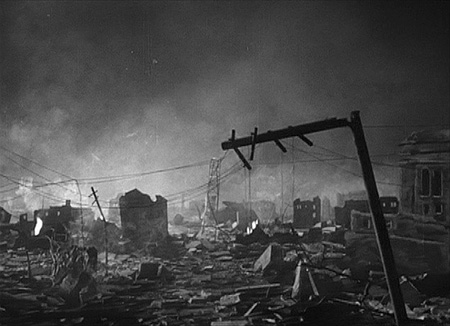
But it hit me more forcefully after reading that Suzuki comment that Godzilla's attack on Tokyo was a reenactment of the actual destruction of Tokyo by American bombs, none of them nuclear, but with sheer numbers and incendiary power.  It is visually inescapable, and there is a moment that the script hints at the equivalence--when a young mother huddles in a doorway with her arms around her small children as Godzilla rampages towards them, and she tells her children that they will soon be joining their father.  A lot of fathers were lost in the war.

from Gojira
Because the only word sufficient to characterize humans bombing each other on this scale is monstrous.  And so Godzilla is the monster of bombing.  The bombing of Tokyo and Dresden and of London, and later of Vietnam and Iraq, as well as of Hiroshima and Nagasaki.

Godzilla, like King Kong, also had the personality that made him lovable, and in later movies he became a kind of hero (as reflected in the otherwise despicable Godzilla of 2014.)  It has been argued that the Japanese moved quickly from mourning to a kind of repression and willed numbness, as reflected in the cuteifcation of their popular culture.  But in the Gojira moment, less than a decade after Hiroshima, the monstrousness of modern warfare was at least metaphorically expressed.

To further tie together the themes of this 70th anniversary, movies about monsters who are resurrected and augmented forces of nature are usually brought to life by some human act.  The Jurassic Park monsters are about scientists playing God with genes, for instance.  The theme of science creating monsters is as old as Dr. Frankenstein.  But these days such movies more clearly attempt to exorcise through entertainment the unacknowledged yet increasingly felt fact that the monsters turn out to be us.

How do we defeat this monster?  The movies tell us this as well: by recognizing the nature, power and effects of the monster.  Then applying courage and ingenuity to defend what the monster would destroy.  Even if we are the monster, we can also be the heroes.

 The monster is vanquished, at least for awhile--driven to the hidden depths.  The sequels suggest we don't learn much--the monster's return always surprises people, who often don't recognize it if it has changed at all.  So the tasks begin again.

People in these movies often deny the monster exists until it is almost too late.  But eventually they see the reality, and they depend on those who saw it earlier and are ready.  Some may panic, but heroes emerge, however humble many of them are.    

Sunday, February 24, 2013

Cry Havoc: How the Iraq War Began


We are weeks away from the 10th anniversary of the Iraq war's beginning.  Books, articles and TV docus have begun, concentrating on the deceptions before the war, and the war's long and terrible extent. 

 On a Sunday almost exactly ten years ago today, the San Francisco Chronicle published my essay on what everyone already knew was the upcoming bombing of Baghdad which would start the war.  It was supposed to be so devastating that the war would be over quickly.  At first it may have seemed that way, and President Bush declared combat operations over.  But of course, it went on for nearly nine more years, at immense cost.

But lost in this history is the horror of the bombing itself, and what it represented beyond introducing the p.r. term of "Shock and Awe."  The piece reflects how it was advertised, and the reality turned out to be even worse.  For weeks some 1700 air sorties including more than 500 using cruise missiles bombed Baghdad, before the first American ground troops arrived.

 I refer also to Shakespeare's Julius Caesar and its line,  "Cry 'Havoc', and let slip the dogs of war."  Once the dogs of war are loose, they are very difficult to rein in.  Once started, the machinery of war is very hard to stop.   The logic of war-including the emotional logic-- is that warfare feeds on itself, and there are plenty of corporate as well as political and ideological interests eager to keep feeding off the continuing warfare.  

The echo of the Iraq war continues to be loud, though now so distorted that it isn't always identifiable.  This war that depleted so much continues to have consequences in what this nation did, and what it did not do.  Those consequences may well continue for a very long time.

And this was a preview of how it began.  Here is the essay as it first appeared in the Insight Section of the San Francisco Chronicle on February 16, 2003.


When Islamic armies were the most powerful in the world, conquerors of Asia Minor and North Africa, and poised at the gates of Europe in the 8th century, Abu Hanifa, founder of a school of law in the city of Baghdad, proposed that the killing, maiming and raping of civilian noncombatants in war be forbidden. It was one of the first attempts to codify some kind of moral and legal restraints on civilized societies engaged in the dangerously uncivilized practice of warfare.

If and when war comes to Iraq, it will likely feature the relentless and perhaps unprecedented bombing of Baghdad. According to CBS News and other sources, the United States is considering implementing a strategy called "Shock and Awe," developed in 1996. The plan could result in at least 300 Tomahawk cruise missiles raining down on Baghdad in just the first day of an aerial campaign - more than were used on all targets in the entire Gulf War. And the plan calls for an equal or greater number on the second day as well, up to 800 total, each capable of carrying 1,000 pounds of explosives. There was no estimate of how many days the bombing would continue.

Although missiles would likely focus on infrastructure including electricity and water supplies, an average of one missile striking a city of 5 million inhabitants every four minutes around the clock could kill and maim thousands of civilians.

"There will not be a safe place in Baghdad," according to an unnamed Pentagon official quoted by CBS. "The sheer size of this has never been seen before, never been contemplated before."

The prospect of war in Iraq is crowded with moral as well as political questions, with multiple possibilities for ethical outrages of stunning proportions. But the continuous bombing of a city of civilians would probably be the first that confronts the watching world.

In A History of Bombing (published by New Press in 2001, and forthcoming this spring in paperback), Sven Lindqvist follows three main threads: the technology and use of aerial bombing in history, the attempts to deal with the moral implications of its use against civilian populations (Abu Hanifa is one example he cites), and social attitudes toward bombing found in sources such as popular fiction.

The historical parallels to the current prospect as well as the ironies are disquieting. The impact of the "shock and awe" strategy is meant to be on hearts and minds: to destroy the enemy's will, and mental and psychological ability to resist. But bombing's ability to terrorize - the sudden explosive death from the sky without warning - was one of the first effects to be observed, noted in 13th century China. It has often been a prime strategy of bombing, according to Lindquist, used extensively by European colonial powers in Africa, India and Asia.

Bombing is especially terrifying when used on the helpless. At first it was shelling from ships far offshore (which is how the United States bombed Nicaragua in 1854), then bombs dropped from airplanes. Bombing was a cost-effective way of keeping subjugated populations in line. Baghdad was a British target more than once in the 1920s.

As airplanes, bombs and cities all got bigger, moralists and diplomats negotiating the international rules of war and definitions of war crimes struggled to keep up. Several prohibitions against air warfare and the bombing of cities were proposed, and some were signed, except by the major powers capable of the bombing. Well into the 20th century, bombing was considered not so bad if the victims were of "inferior races." Some authors wrote glowingly of bombing as a way to civilize the world by permanently subjugating or even wiping out these races.

European bombing gradually got closer and closer to home, until the German military on behalf of Franco tested new kinds of bombs by dropping them on cities in Spain. Japan bombed civilian cities in China. Then in the 1940s, bombing of even the capital cities of combatant nations - Berlin, London, Tokyo - became a normal instrument of warfare, finally leading to the annihilation of the undefended cities of Hamburg and Dresden by British saturation firebombing, and of Hiroshima and much of Nagasaki by the U.S. atomic bomb.

By that time, terror was not the only result of bombing. Fifty thousand civilians were killed in a single night in Hamburg, most of them women, children and elderly. Twice that number died in Dresden. Two atom bombs did fill Japan with shock and awe, and killed several hundred thousand civilians in the process.

There are various strategic arguments for bombing campaigns that dovetail with apparent moral concerns, usually involving shortening a war's duration or substituting for ground assaults, thus saving lives, especially the lives of the side doing the bombing.

When facing the possibility that this war would unleash chemical, biological or nuclear weapons that have been largely absent from warfare for decades due to international taboos of one kind or another, it may seem quixotic to argue that bombing of civilian populations should be regarded as an evil in itself, and beyond the pale for nations that desire any sort of international relations. But it seems morally obtuse that there is a stronger taboo against assassinating a declared enemy's head of a state than against slaughtering babies in their beds. Surely bombing should be a last resort, not the first.

For even if the historical parallels are coincidental and not disturbing echoes of residual racism and empire-building, the bombing of Baghdad to begin this war would have a terrorizing effect on more than its residents. In Shakespeare's time, there was another word for the terror, the shock and awe that accompany a war without moral limits. The word was "havoc," as in the famous quotation from Julius Caesar, "Cry 'Havoc', and let slip the dogs of war."

The bombing and havoc may already be starting by the time you read these words, although according to Los Angeles Times reporter Doyle McManus on the Washington Week in Review, "You can pretty well mark on your calendar March 15. " It's the date formerly known as the Ides of March.

The bombing of Baghdad began on March 19, 2003.

Tuesday, August 31, 2010

Remember: Cry Havoc in Iraq

[Third of three posts]
Tonight President Obama will announce the end of U.S. combat operations in Iraq. At this moment it is instructive to remember how all this began, seven years ago. It began with the bombing of Baghdad, a massive American bombing campaign of a city and a country that had not made war on anyone, including the United States. It was one more escalation in the morally indefensible history of bombing, and it presaged everything that's happened since in that part of the world.

The history of such bombing is considered in the following piece, published in the San Francisco Chronicle several weeks before the Baghdad bombing began, and the evil of bombing, culminating in our time with nuclear bombs, is the thread that runs through my three essays posted here in the past two days, which all originally appeared in the SF Chronicle.

In this piece I refer to what was a new and little known phrase then, but which has since become a cliched description of this bombing campaign: Shock and Awe. It was supposed to break the will of whoever the Bush administration considered the enemy, but it did not.

I also quoted the famous lines from Shakespeare's
Julius Caesar: "Cry 'Havoc' and let slip the dogs of war." I focused on the "havoc" in this piece, but in other writing of the time I emphasized the rest of the quotation. The point of the metaphor of the dogs of war is not only that a pack of dogs are indiscriminately violent but that once loosed, they are very difficult to control or to stop. A war is much easier to start than stop, and it begs the question of how many wars it will take before people figure that out.

Once this war started it was clear to some of us at least, that it would go on for a long time. And it has, with immensely and deeply destructive consequences to the U.S. as well as to Iraq. It has eroded us morally, depleted us financially, destroyed thousands of people physically and psychologically, and distorted our politics. We don't seem to have learned much from it either. If for no other reason than the resources of all kinds it stole from facing up to the double challenges of the Climate Crisis, it has deeply wounded the future.

February 2003

When Islamic armies were the most powerful in the world, conquerors of Asia Minor and North Africa, and poised at the gates of Europe in the 8th century, Abu Hanifa, founder of a school of law in the city of Baghdad, proposed that the killing, maiming and raping of civilian noncombatants in war be forbidden. It was one of the first attempts to codify some kind of moral and legal restraints on civilized societies engaged in the dangerously uncivilized practice of warfare.

If and when war comes to Iraq, it will likely feature the relentless and perhaps unprecedented bombing of Baghdad. According to CBS News and other sources, the United States is considering implementing a strategy called "Shock and Awe," developed in 1996. The plan could result in at least 300 Tomahawk cruise missiles raining down on Baghdad in just the first day of an aerial campaign - more than were used on all targets in the entire Gulf War. And the plan calls for an equal or greater number on the second day as well, up to 800 total, each capable of carrying 1,000 pounds of explosives. There was no estimate of how many days the bombing would continue.

Although missiles would likely focus on infrastructure including electricity and water supplies, an average of one missile striking a city of 5 million inhabitants every four minutes around the clock could kill and maim thousands of civilians.

"There will not be a safe place in Baghdad," according to an unnamed Pentagon official quoted by CBS. "The sheer size of this has never been seen before, never been contemplated before."

The prospect of war in Iraq is crowded with moral as well as political questions, with multiple possibilities for ethical outrages of stunning proportions. But the continuous bombing of a city of civilians would probably be the first that confronts the watching world.

In A History of Bombing (published by New Press in 2001, and forthcoming this spring in paperback), Sven Lindqvist follows three main threads: the technology and use of aerial bombing in history, the attempts to deal with the moral implications of its use against civilian populations (Abu Hanifa is one example he cites), and social attitudes toward bombing found in sources such as popular fiction.

The historical parallels to the current prospect as well as the ironies are disquieting. The impact of the "shock and awe" strategy is meant to be on hearts and minds: to destroy the enemy's will, and mental and psychological ability to resist. But bombing's ability to terrorize - the sudden explosive death from the sky without warning - was one of the first effects to be observed, noted in 13th century China. It has often been a prime strategy of bombing, according to Lindquist, used extensively by European colonial powers in Africa, India and Asia.

Bombing is especially terrifying when used on the helpless. At first it was shelling from ships far offshore (which is how the United States bombed Nicaragua in 1854), then bombs dropped from airplanes. Bombing was a cost-effective way of keeping subjugated populations in line. Baghdad was a British target more than once in the 1920s.

As airplanes, bombs and cities all got bigger, moralists and diplomats negotiating the international rules of war and definitions of war crimes struggled to keep up. Several prohibitions against air warfare and the bombing of cities were proposed, and some were signed, except by the major powers capable of the bombing. Well into the 20th century, bombing was considered not so bad if the victims were of "inferior races." Some authors wrote glowingly of bombing as a way to civilize the world by permanently subjugating or even wiping out these races.

European bombing gradually got closer and closer to home, until the German military on behalf of Franco tested new kinds of bombs by dropping them on cities in Spain. Japan bombed civilian cities in China. Then in the 1940s, bombing of even the capital cities of combatant nations - Berlin, London, Tokyo - became a normal instrument of warfare, finally leading to the annihilation of the undefended cities of Hamburg and Dresden by British saturation firebombing, and of Hiroshima and much of Nagasaki by the U.S. atomic bomb.

By that time, terror was not the only result of bombing. Fifty thousand civilians were killed in a single night in Hamburg, most of them women, children and elderly. Twice that number died in Dresden. Two atom bombs did fill Japan with shock and awe, and killed several hundred thousand civilians in the process.

There are various strategic arguments for bombing campaigns that dovetail with apparent moral concerns, usually involving shortening a war's duration or substituting for ground assaults, thus saving lives, especially the lives of the side doing the bombing.

When facing the possibility that this war would unleash chemical, biological or nuclear weapons that have been largely absent from warfare for decades due to international taboos of one kind or another, it may seem quixotic to argue that bombing of civilian populations should be regarded as an evil in itself, and beyond the pale for nations that desire any sort of international relations. But it seems morally obtuse that there is a stronger taboo against assassinating a declared enemy's head of a state than against slaughtering babies in their beds. Surely bombing should be a last resort, not the first.

For even if the historical parallels are coincidental and not disturbing echoes of residual racism and empire-building, the bombing of Baghdad to begin this war would have a terrorizing effect on more than its residents. In Shakespeare's time, there was another word for the terror, the shock and awe that accompany a war without moral limits. The word was "havoc," as in the famous quotation from Julius Caesar, "Cry 'Havoc', and let slip the dogs of war."

The bombing and havoc may already be starting by the time you read these words, although according to Los Angeles Times reporter Doyle McManus on the Washington Week in Review, "You can pretty well mark on your calendar March 15. " It's the date formerly known as the Ides of March.

Postscript: The bombing of Baghdad and Iraq began on March 19. It involved more than 500 cruise missiles. There is still disagreement on the number of civilian deaths.

Monday, August 30, 2010

Remember: When It Was Real


[Top photo: Hiroshima. Bottom: Nagasaki. First of three posts]

The month of August now ending marked the 65th anniversary of the only nuclear weapons to be used in war, the atomic bombs dropped on Hiroshima and Nagasaki. These anniversaries passed without much notice, although for the first time there was an official American presence at the Hiroshima commemoration. This lack of attention is disquieting, not only to some in Japan, such as this prominent writer, but to others, such as this teacher whose students consider it "ancient history." The further we get from the reality of the damage caused by two atomic bombs of very modest yield by today's standards, the more complacent we seem to be, and therefore the more likely that nuclear weapons will be used again.

What follows is my piece published in the San Francisco Chronicle Outlook section marking the 60th anniversary of Hiroshima in 2005.

July 2005
On July 16, 1945, the cruiser Indianapolis sailed from Hunters Point Naval Shipyard in San Francisco, carrying one 15-foot crate. Inside were the components for the first atomic bomb destined to be dropped on a city. It was being shipped to Tinian Island in the western Pacific, and its final destination a few weeks later would be Hiroshima. It left San Francisco just four hours after the first successful atomic bomb test in history, in the New Mexico desert.

Sixty years is a long time to keep even such an immense memory alive, but several books published recently bring these events into sharper focus than ever before.

Several are biographies of key figures like Robert Oppenheimer and Edward Teller, but one is billed as a biography of the bomb itself. The Bomb: A Life by Gerard DeGroot (Harvard University Press), professor of modern history at the University of St. Andrews in Scotland, benefits from newly available records, especially concerning the Soviet nuclear program. But mostly it is a skillfully condensed narrative of the nuclear era, fascinating in the selection of details and riveting in its revelations of how possessing nuclear weapons changed those involved, and changed America.

On the day of that first test in July 1945, no one knew what would happen. About half the scientists didn't think the device would explode at all. Enrico Fermi was taking bets that it would burn off the Earth's atmosphere.

It did explode, with such brightness that a woman blind from birth traveling in a car some distance away saw it. "A colony on Mars, had such a thing existed, could have seen the flash," DeGroot writes. "All living things within a mile were killed, including all insects."

America was now in sole possession of the most powerful weapon in history. The first effect of the bomb was in Potsdam, Germany, where President Harry Truman was conferring with British Prime Minister Winston Churchill and Joseph Stalin, premier of the Soviet Union, then an ally in the war against Japan. After Truman received the news of the successful test, he was "a changed man" and "generally bossed the whole meeting," according to Churchill.

That the second bomb left San Francisco on the day the first was tested suggests the momentum to use it. Whether dropping the bomb was necessary to secure Japan's surrender before an invasion became necessary is still being debated. DeGroot believes that Japan was looking for a way to surrender in June and July. But there were other considerations, mostly to do with demonstrating American power, especially to the Soviet Union.

Using the bomb quickly became a test of patriotism. "For most Manhattan Project scientists the bomb was a deterrent, not a weapon," DeGroot writes. Physicist Leo Szilard had done as much as anyone to try to persuade FDR to develop the bomb because Germany was doing so. But on the day after that first test, he sent government officials a petition signed by 69 project scientists arguing that to use the bomb would ignite a dangerous arms race and damage America's postwar moral position, especially its ability to bring "the unloosed forces of destruction under control."

The petition was ignored, and Gen. Leslie Groves, the senior military official in charge of the project, began making a case that Szilard was a security risk. It's a pattern that would be repeated often.

DeGroot places the decision to drop the bomb on Japan in the context of the brutalization that occurred during the long years of World War II, with an unprecedented scope of savagery on both sides. The bombing of civilians and cities, morally unthinkable in the West before the war, became a major feature of it by its final years, long past the time many military targets were left. Gen. Groves, he writes, was worried that Japan might surrender before the bomb could be dropped.

Hiroshima was selected as the primary target because it had no allied POW camps. However, there were nearly 5,000 American children in the city -- "mainly children sent to Japan after their parents, U.S. citizens of Japanese origin, had been interred." It seems likely some of those children were from San Francisco.

The nuclear era began with the secrecy of the Manhattan Project, which is perhaps partly why it was accompanied throughout its history by lies and denial. It began with Hiroshima. As many as 75,000 people died in the first blast and fire. But in five years the death toll would reach 200,000 because of what the U.S. government denied existed: lethal radiation.

Even after the hydrogen bomb was developed in the 1950s (so powerful that the first test vaporized an island and created a mile wide crater 175 feet deep), the untruths continued. In 1954, Dr. David Bradley reported on 406 Pacific islanders exposed to H-bomb fallout: nine children were born retarded, 10 more with other abnormalities, and three were stillborn, including one reported to be "not recognizable as human." Such information was denied or routinely suppressed through all the years of testing, even on U.S. soil. Groves even told Congress that death from radiation was "very pleasant."

Even after the war, criticizing the bomb in any way became a threat to national security, an act of disloyalty that only helped the communist enemy. And so people were silent and compliant, and streamed into air-conditioned theatres to see movies about monsters created by atomic radiation.

This extreme weapon prompted extreme and contrary emotions, often within the same people. Some of the same Los Alamos scientists who cheered madly at the first news of Hiroshima were later shell-shocked with regret. Gen. Omar Bradley called his contemporaries "nuclear giants and ethical infants." Yet he pushed for developing the hydrogen bomb.

This peculiar combination of denial plus the immense power of thousands of bombs contributed to an era of deadly absurdities: the age of Dr. Strangelove. Yet reality was not so different, right down to the preposterously appropriate names: the head of the Strategic Air Command, Gen. Tommy Power, gave his philosophy of nuclear war in 1960: "At the end of the war, if there are two Americans and one Russian, we win!"

The warp in American political life created by the bomb might be summarized in two statements. "In order to make the country bear the burden," said President Dwight Eisenhower's secretary of state, John Foster Dulles, referring to the Cold War arms race, "we have to create an emotional atmosphere akin to a wartime psychology. We must create the idea of a threat from without."

The second is more famous, but perhaps its connection to the bomb and its effect on America has been forgotten: Eisenhower's farewell address. "We have been compelled to create a permanent arms industry of vast proportions," he said. "We must not fail to comprehend its vast implications. ... We must guard against the acquisition of unwarranted influence, whether sought or unsought, by the military-industrial complex. The potential for the disastrous rise of misplaced power exists and will persist."

Sunday, August 06, 2006

The Real Terrorism

On August 6, 1945, Hiroshima was destroyed by the first atomic bomb used in warfare. As Norman Solomon recently reminds us, this immense explosion was followed by an immense lie. On August 9th, President Truman told the Amercan people: “The world will note that the first atomic bomb was dropped on Hiroshima, a military base. That was because we wished in this first attack to avoid, in so far as possible, the killing of civilians.” Solomon continues:

Actually, the U.S. government went out of its way to select Japanese cities of sufficient size to showcase the extent of the A-bomb’s deadly power -- in Hiroshima on Aug. 6 and in Nagasaki on Aug. 9. As a result of those two bombings, hundreds of thousands of civilians died, immediately or eventually. If Truman’s conscience had been clear, it’s doubtful he would have felt compelled to engage in such a basic distortion at the dawn of the nuclear era.

In fact, Hiroshima had no military significance, and had not been bombed before--one of the principal reasons it was chosen for the A-bomb, so its destructive power would be more obvious to the Japanese and clearer for Americans studying those effects. It was considered a "safe city" to the extent that some parents in California who were forced into internment camps, sent their children to the safety of Hiroshima. So the victims of the U.S. atomic bomb likely included American children.

Truman's was the first of many lies of the nuclear era, including the initial lies about the effects of radiation. Some 75,000 people died in Hiroshima from the blast and fire of the Bomb. Five years later, radiation effects more than doubled the dead, to some 200,000. The vast majority of those who died from the Nagasaki bomb were from radiation, months and years later.

But the biggest lie is not about the atomic bomb, but the very practice of bombing. The facts show (as described in Sven Lindqvist's A History of Bombing and Gerard DeGroot's The Bomb: A Life, among other works) that the effect of bombing cities is not a strategy of war but a strategy of terror, and that it doesn't work.

The idea of this kind of bombing is not to kill enemy combatants or destroy military bases, but to destroy the population's will by terrorizing them with the threat of random death and destruction. Although the idea of this kind of bombing is now apparently acceptable, it is relatively new in the history of warfare. While many nations experimented with it, especially imperial powers who bombed restless colonies, it was first used as a policy by the British in World War II in Germany. It did not result in a revolt of the German people against its government. The U.S. followed in its bombing campaign against Japan, at first aimed at military and industrial support targets, but eventually using saturation bombing against cities. It was the failure of this campaign to terrorize the Japanese population into submission that led to the decision to use the atomic bomb.

As Gerard DeGroot points out, when We (whoever We are) drop bombs, it is to destroy the enemy's capability to fight--the logic that says if you are going to destroy the enemy's tanks, then destroy the factories that build the tanks, and kill the people who work in those factories. But when They bomb Us, using the same logic, it is brutal, indiscriminate killing. "The difference is contrived--a matter of perspective. Indiscriminate bombing means killing civilians for the sake of attrition--the killing is the object."
But it isn't only attrition, and in less than the kind of total war that World War II was, it is more obviously aimed at terrorizing the enemy population. Hezbollah fires bombs into Israel to terrorize the population, hoping to eventually win concessions or ultimately to destroy the state of Israel. Israel fires bombs into Lebanon to destroy rocket implacements but also to terrorize the population into not supporting Hezbollah, either by allowing them to operate out of their neighborhoods or by supporting them politically. The strategy in both cases is the attrition of terror.

Argument on the morality of targeting civilians in war go back hundreds of years. All too ironically, the first known code that forbade the killing of non-combatants was promulgated by Abu Hanifa, a legal scholar in Baghdad. Western powers adopted a double standard: war between "civilized" European nations would be conducted in this civilized manner. But war against lesser peoples was total war, against the population as well as combatants. Primitive people were not only lesser, but more easily frightened by western technology's advances in explosives and methods of delivering them. World War II ended even these distinctions.

Now bombing is normal, and far from being the last resort, it is often the first option. Nations use it now because it is cheaper, and since no troops are endangered, there is no grumbling at home about the loss of life. Bombs of all kinds constitute a thriving business. In use, they have a very brief productive life before it's time to buy more. And there's plenty to chose from. Small groups can plant various kinds of bombs along roads or in parked vehicles, or use suicide bombers. Larger organizations can use bombs attached to small rockets. Nations can use bombs with sophisticated targetting capabilities, launched on rockets or fired from ships or dropped from airplanes. Long range missiles with thermonuclear weapons are still pointed at the U.S. and Russia.

From the smallest to the largest-yield weapons, bombs are instruments of terror. They sever the limbs of children, burn babies alive, destroy homes that send families into a tailspin of poverty, wreck the urban infrastructure that makes daily life possible, and send millions of traumatized people wandering into nightmare through the piles of broken homes and schools and hospitals, shards of bone, crushed bodies, smoldering flesh, hot twisted metal and clouds of toxic smoke, because they are supposed to. This is what bombs are for.

Friday, July 08, 2005

Terror

The Guardian called Wednesday's transit explosions England's "worst-ever terror attack," "causing the biggest loss of life..."But was it?

If the definition is restricted to postwar violence by parties other than a sovereign state, then it fits. But from the point of view of the targeted population, it was not.

Because around sixty years ago, there was something called The Blitz. And it's terrorism--and a response-- worth remembering.

MORE HERE