Showing posts with label Greensburg PA. Show all posts

Friday, September 02, 2022

Labor Day


The Kowinski family that I am part of seems to have begun in America with my great-grandparents.  John Kolachinski (who went by various names in the U.S., soon settling on John Kowinsky)  came to work in western Pennsylvania coal mines, probably from the impoverished and oppressed region of Silesia in southern Poland, in about 1890.  He was likely in Scottdale, PA during one of the worst mining accidents of the era, killing at least 100 Polish, Italian and other immigrant miners.

 One of John's children, Frank Kowinsky was my grandfather.   He married Catherine Ellis, whose father John Ellis had arrived in America and western Pennsylvania at about the same time as John Kowinsky. John Ellis (originally Ilas) came from somewhere in the Austrian-Hungarian empire of  eastern Europe which include part of Poland and Slovakia, while his wife had a lineage originating in Ukraine.  

 Both my paternal great-grandfathers were in the coal fields for the tumultuous Westmoreland County coal strike of 1910-1911—also known as the Slovak Strike because more than two-thirds of the miners were Slovak. It involved 65 mines and 15,000 coal miners. As would happen again, mine owners used private police and thugs as well as the state and local police and courts to break the strike, which they did, with defeat for the miners. Sixteen miners or members of their family were killed.  Families were thrown out of their lodgings and had no money for food.

There was a larger, more successful national United Mineworkers coal strike in 1919 that involved 100,000 Pennsylvania miners, but industry owners tried to cut the agreed-upon wages in 1922, resulting in another strike.  By this time, my grandparents Frank and Catherine were married, and my father Walter had been born.  Again, families were left homeless. Two of my great-grandparents and their family were living in a tent until winter cold forced them to improvise shelter in an abandoned pool room with several other families. This strike eventually won back the wage levels of 1919.

Attempts to break strikes and prevent organizing were relentless.  In high school I was shown an empty valley where a coal patch town had once existed, with searchlights ringing it so owners could spot when workers moved between houses to attend union organizing meetings.

The Depression of the 1930s hit this area very hard, but in Washington the Roosevelt administration was convinced that to end the Depression required a countervailing force to huge companies in a time of immense disparities in incomes.  Labor union rights were strengthened by law, and over the next decades, national unions became that force.  Better wages, hours and working conditions helped fuel shared prosperity.

By the time I was in high school in the early 1960s, unions comprised an institutional force alongside government and private industry.  Unions became a progressive force and through their political arms, a big factor in elections.  Though in practice many individual unions discriminated, the major union organizations supported diversity, and were among the chief sponsors of the 1963 Civil Rights March on Washington.  

The moral authority of unions was weakened by instances of corruption, and then by union support for the Vietnam War, which alienated the young and some minorities.  Then in the mid to late 1970s, steel mills began to close, and industries moved employment away from the U.S. With membership dwindling, the Reagan administration in the 1980s dealt unions a series of death blows.  Today the percentage of union members in the workforce is tiny.

Also today, in another era of massive income disparities, there are the same patterns of unionizing and company resistance at Amazon, Starbucks and other new corporate giants.  Meanwhile, unions have grown in the public sector of the economy.  In both cases, the actual and prospective union members tend to be more female and non-White.

Now the descendants of those European immigrants that suffered for the first labor unions, and the proud union members of the era of union strength, are left without an advocate, an organization looking out for their interests, a place to go to discuss issues, to listen and to be heard.  Even just a union hall bar to let off steam, talk about their families and look each other in the face. They have no collective power to counter the massive power of corporations and the rich, which includes the power to secretly manipulate the information they receive. 

Instead they have the Internet, where they get their information courtesy of trolls and bots and algorithms that feed them vast quantities of the same  tenor of elaborately presented shameless lying--so much of it that it seems it must be true.  There is no countervailing voice to the corporate interests that fund efforts to blame others for the results of corporate decisions, such as immigrants, minorities, or scientists and self-serving, pointy-headed intellectuals.  Instead of collective and constructive action, they are encouraged to wallow in anger and misplaced rancor, racism and closets of military weaponry, and the thrill of "owning the libs," as fleeting and addictive as a cocaine high.  Their participation is limited to seeing who can attract attention by being the shrillest and most provocative, unless until some of them brought their smartphones to an Insurrection on Capitol Hill.

It only gets said on Labor Day if at all, but the American system is broken in large measure because of the gaping hole left in social and economic institutions by the demise of unions.  It's no coincidence that the democracy that President Joe Biden extolled and declared threatened, flourished in his lifetime when unions were strong, and a vital part of that democracy. 

Monday, August 15, 2022

Learning a Dead Language


There is nothing for you to say. You must
 Learn first to listen. Because it is dead
 It will not come to you of itself, nor would you
 Of yourself master it. You must therefore 
Learn to be still when it is imparted,
 And, though you many not yet understand, to remember.
 
 What you remember is saved. To understand
 The least thing fully you would have to perceive
 The whole grammar in all its accidence
 And all its system, in the perfect singleness
 Of intention it has because it is dead.
 You can learn only a part at a time. 

 What you are given to remember
 Has been saved before you from death's dullness by
 Remembering. The unique intention
 Of a language whose speech has died is order,
 Incomplete only where someone has forgotten.
 You will find that that order helps you to remember.

 What you come to remember becomes yourself.
 Learning will be to cultivate the awareness
 Of that governing order, now pure of the passions
It composed; till, seeking it in itself, 
You may find at last the passion that composed it, 
Hear it both in its speech and in yourself.
 
 What you remember saves you. To remember
 Is not to rehearse, but to hear what never
 Has fallen silent. So your learning is,
 From the dead, order, and what sense of yourself
 Is memorable, what passion may be heard 
When there is nothing for you to say.

--W.S. Merwin

From his first post-college days, W.S. Merwin made his living mostly by translating.  He published many translations of poetry written in many languages, from ancient Chinese poets to Dante to Pablo Neruda.   So this poem can be read in one way as applying literally to learning dead languages, such as Latin. Perhaps it can be applied to reading any poem. But it seems to me that at least some of it applies to memories themselves.

 Anything in the past existed in a context, a kind of language, that has slipped away with that past. It was a context of things, places, people and happenings, and also of feeling.  But we mostly and in a sense necessarily translate our memories of the past into the language of the present.  Yet part of those memories may carry with them something of their context, if we don't try to decide what they mean too quickly.  I think certain powerful lines in this poem apply to all memories, and to memory itself.  But the poem hints at even more powerful ways of apprehending memories, within their contexts and perhaps the wider contexts of our entire lives.  

The photo: The arrow points to the apartment where my parents lived when I was born in 1946, and where the three of us lived for a few more years, at the top of what was then an apartment building in Greensburg, PA on College Avenue, so called because high on a hill opposite this building--and visible from that window--was Seton Hill College.  The building I suspect had been a residence, for this area was once populated by the rich. Up on that hill was a ridiculously large mansion, which came to house the college, and remains part of it.  While still a residence, it contained the first library that a young Andrew Carnegie ever saw.  The building that housed my first home no longer exists.  The writing on the photo is my mother's. 

Monday, September 28, 2020

Poetry Monday: Among School Children


 I walk through the long schoolroom questioning; 
A kind old nun in a white hood replies;
 The children learn to cipher and to sing,
 To study reading-books and history, 
To cut and sew, to be neat in everything
 In the best modern way--the children's eyes
 In momentary wonder stare upon
 A sixty-year-old smiling public man.

 V 
What youthful mother, a shape upon her lap
 Honey of generation had betrayed,
 And that must sleep, shriek, struggle to escape
 As recollection or the drug decide, 
Would her son, did she but see that shape
 With sixty or more winters on its head,
 A compensation for the pang of his birth,
 Or the uncertainty of his setting forth?

 VII
 Both nuns and mothers worship images,
 But those the candles light are not as those
 That animate a mother's reveries,
 But keep a marble or a bronze repose.
 And yet they too break hearts--O Presences 
That passion, piety or affection knows,
 And that all heavenly glory symbolize--
 O self-born mocker of man's enterprise;

 VIII 
Labour is blossoming or dancing where
 The body is not bruised to pleasure soul,
 Nor beauty born out of its own despair,
 Nor blear-eyed wisdom out of midnight oil,
 O chestnut-tree, great-rooted blossomer, 
Are you the leaf, the blossom or the bole?
 O body swayed to music, O brightening glance,
 How can we know the dancer from the dance? 


 --William Butler Yeats Four stanzas from "Among School Children" (1927)

The photo above, taken recently, is of a building on S. Hamilton Ave. in Greensburg, PA that was the Sacred Heart School from 1922 to the early 1960s.  This was my first school as a first grader in 1952.  It was the first building outside my home and my grandmother's house where I'd ever spent an entire day.  I was there nearly every weekday of the school year through the fifth grade, until June 1957.  I remember details of this building as it was then, inside and out, very clearly. 

 Instead of the three windows seen in this photos, there were walls of tall windows from near the edges of the building to that arched central area on both sides of it. In height they reached from slightly above desk level to nearly the ceiling.  There were four long classrooms: two facing the street, two the back.  Another makeshift classroom was eventually assembled in the basement.  Until I started school, the basement had previously been Sacred Heart Church.  It is where I attended my first Mass, and made up little stories for myself, to explain what the Latin singing meant.  

In my time there was a kind old nun or two among the nuns our teachers.  Old to us anyway.  But there was also violence, the rule of the ruler across the outstretched hand and more, the body "bruised to pleasure soul."

Sacred Heart School was abandoned when the newly constituted St. Paul's parish finished building a modern new school just outside of Greensburg in the baby booming 60s.  That school in turn has been abandoned, as Catholic schools in the area contracted to one building complex on Main Street in Greensburg, at least part of which is quite old.  The old Sacred Heart building on Hamilton has had many tenants and uses since it ceased being a school.  For awhile the basement was a dance studio for young girls. 

Monday, July 29, 2019

Dandelion

At the moment there are no tenants in the student rental across the street, and the front lawn is unmowed.  But since the last time I looked at it, something has happened: along with the high grass are dandelions, lots of them.  Now I notice that they are on the fringes of our front lawn as well.

Dandelions were the flowers of my childhood--dandelions and violets and a few others that occupy the area between wildflowers and weeds in the current view of such things.  Other flowers belonged to adults, who grew them, pampered and discussed them, and praised them, making them sources of individual pride.  We children therefore were warned to stay clear of them.  We were never to run in their flowerbeds, or pick them, or even get close to them.

Adults did not care about dandelions.  In fact, they regarded them as harbingers of disgrace if they appeared on the lawn.  Better a dead- looking brown crewcut lawn than a green one with too much yellow in it.  Scandalous!   Dandelionus! Out comes the heavy artillery power mowers of the neighborhood, shattering Sunday silence with the roar and whine of tank battalions on maneuvers.  (Well, by the 1960s anyway.)

But throughout my early childhood there was a field two lots long between my house and that of two of my pals, brothers who lived "next door."  Dandelions ruled there.  We could run through them, roll around in them, pick them, smell and taste them, play with them.  If we'd wanted we could have decorated bikes and hats with them, and disassembled them to make yellow checkers or hairy yellow eyes, and nobody would have cared.  We definitely did chase butterflies or lightning bugs through them, or just scrunched down to see them close-up, and regard the world through yellow caps.

The dandelions of my childhood in western Pennsylvania looked like those above.  Those on the lawns hereabouts are like this one, with a more defined center.   Their textures are slightly different, and they seem to have longer stems.  The California variety is more like other--or recognized-- California wildflowers.  The PA version seems scruffier. Or maybe I'm imagining that. But that's the one that lives in my childhood.

Friday, November 03, 2017

Paperback Reader


This is the last in a series of posts on childhood reading and the origins of my relationships with books, inspired by Larry McMurtry's reflections in  his autobiographical Walter Benjamin at the Dairy Queen. Earlier posts are  on the Book House books, Library Days , Hardy Boys  and other Boy of Summers books, and how books came to be Books in Our House.

Books came into my life as hardbacks. (Even my Golden Books would qualify.) Without necessarily being conscious of these impressions, I learned to love the feel and heft, the quality of print and paper, the smell of the hardback book.

But into my early teens, the cycle of the book experience was incomplete.  I got to choose books from the public library, but I had to give them back.  The books we got in the mail stayed on our shelves, but I mostly didn't select which books came into our house to stay.

I couldn't buy a book at a bookstore because there weren't any.  And they were too expensive anyway.  But when I was in sixth and seventh grade, things began to change.  I was sent to the Cathedral School on North Main Street in Greensburg, which meant I had more opportunities to be downtown.  I also got my first paper routes, and though they were closer to home, I went frequently to the offices of the Greensburg Tribune-Review, which were also on North Main.

Paperboys didn't just deliver papers and collect the weekly fee (42 cents for 6 days.)  We were also the newspaper's largest sales force.  We were continually encouraged to get new subscriptions (or "starts") on our routes or anywhere.  There were always contests and prizes, including trips (I earned my first train trip, to Chicago, this way.)

So there were frequent meetings at the newspaper office, where we learned how to sell.  (There were usually inducements for attending, like a free movie ticket.)  I became such a fixture and favorite in the circulation department that one of the staff gave me her "start" so I could qualify for a trip.

The combination of a little pocket money from the paper routes and my boy-about-town range of activity, especially downtown, meant that I was increasingly a customer for paperback books.  They didn't need bookstores to sell them--they were on shelves and racks in the little confectioners and drug stories on and near my paper routes, and in various stores downtown.

This in fact is how the modern paperback industry was born.  For Greensburg was not unusual--lots of places didn't have a bookstore.  The same was true in England where the Penguin line became the first paperback to prove the market for cheaply priced books sold almost anywhere, and set the example in the 1930s.  American paperbacks followed soon afterward.

Drug stores and neighborhood stores might have a rack or two of paperbacks, but the actual paperback wonderland in Greensburg was located in the two newsstand/tobacco stores off of Main on Otterman Street, below the two movie theaters, the Manos and the Strand.

This photo from years earlier reflects my memory: on the
corner to the left of  Manos movie theater was the
tobacco and news shop with racks of paperbacks.  That
it was once a billiards hall accounts for its size and shape.
Both stores were deep behind their storefronts but the larger was probably the tobacco store next door to the Manos.

It was a forbidding place at first, with old men, some slightly disreputable.  I may have been warned about it, because I don't remember going in when I first started trekking to the Saturday matinee movies at the Manos.

I learned later that there was a reason for any reputation it might have.  Along the inside wall that bordered a side street was a long row of telephone booths.  They were well kept, as I recall, all in a single polished dark wood structure.  There was a door to the street beside them.

Directly across that side street was a bar, which at one time was the center of illegal numbers and other gambling for this side of the county.  (The bar became famous among mystery fans for its frequent appearance in K.C. Constantine's "Rocksburg" series of police procedurals.)  Not too much of a stretch to imagine that the phone booths were convenient for bookies.

But aside from the tobacco counter along the other wall, with rows of newspapers and magazines, much of the rest of the space was taken up by rack after rack of paperback books.  Getting up the courage to enter the place was one thing, but actually browsing the books was another.  I wasn't entirely comfortable doing so until I was in high school.  That was partly because a lot of those paperbacks would be classified as pulp fiction, or worse.

You get the idea.
For shortly after the advent of paperback reprints came the paperback original, often genre fiction--westerns, science fiction, romance, war stories, mysteries, the occult and various combinations.  These were mixed in with reprints of recent hardcover books and classic or at least older books, which is (as the subtitle to Louis Menand's New Yorker piece says) "how Emily Bronte met Mickey Spillane."

Moreover, it was a bit tricky to distinguish the Brontes from the Spillanes because all the cover illustrations tended towards the lurid (Menand describes examples in this excellent review of paperback history.)  A woman not entirely dressed was a common feature.  None of which would have met the nuns' approval.  (My mother would have simply called them vulgar.)

At first my youth probably made the proprietors nervous.  While not actually pornographic, a lot of their books--or their covers--could bring irate parental attention.  I probably felt unwelcome, as well as daring the near occasion of sin, and suspicious eyes watched me.  But I risked it, to find books.

At least this scene is actually in
the book, sort of.
So it wasn't until I knew more of what I was looking for--titles, the names of authors or a particular subject matter--that I overcame my embarrassment for browsing among these covers, and undertook my searches.  They pretty much were all jumbled together--there was no order by category in any of these places. But the price was certainly right: at a time when a regular comic book was a dime and the larger ones were a quarter, a paperback book was anywhere from 25 cents to 75 cents.

Eventually I became a persistent searcher, and there were lots of places to look once my eyes were opened.  That tobacco store was prime, and sometimes the newsstand a block or so down Otterman. (By the time I was high school age, the proprietors became indifferent to my presence.)  But also drug stores, the bus station, and increasingly, the new supermarkets.  They didn't often have those spinning racks but they did stock paperbacks in shelves below the magazines.

 It took a lot of spinning, staring, crouching, picking up, thumbing through, to find the gems.  But they were there.  It amazes me now that they were there.

I know I bought paperbacks before eighth grade, but I don't remember any titles.  They were probably few--my main source of reading outside school was still the public library. But a lot of the books I remember buying in eighth grade and high school I still have--often the very same paperback.  They're the ones I took with me to college.  Any others I left behind disappeared, one way or another.

I started in earnest in 1960 with an enthusiasm for the candidacy of Senator John F. Kennedy for President. I bought Profiles in Courage (for 35 cents) and a biography, John Kennedy: A Political Profile by historian James MacGregor Burns (50 cents.)  I did some work for the local Citizens for Kennedy, and was given a larger paperback copy of Kennedy's Senate speeches, The Strategy of Peace.

These were the first books it was important to me to have bought and to own.  They were the beginning of at least partly conscious self-definition through books.

When JFK was elected, I bought every related book I could find, including one called The Kennedy Government, which was basically a set of bios of his cabinet. (I could then--and still can--name every member of JFK's cabinet, just as I could--and can--name the starting lineup of the 1960 World Champion Pittsburgh Pirates.  I can't do either for any other cabinet or team.)

 Later I got a book of JFK's speeches from his first two years (To Turn the Tide, fifty cents), and The Quiet Crisis (a big 95 cents in 1963) which is an early book on ecology by his Secretary of Interior Stewart Udall, still worth reading.

(I continued collecting Kennedy administration paperbacks in college, including Point of the Lance, a higher-price paperback about the first years of the Peace Corps by its first director, Sargent Shriver.  When I met soon-to-be U.S. Senator Harris Wofford in the early 90s, we got to talking about the Peace Corps--he'd been one of its first officials.  I thought I'd scored major points by remembering the title of this book about it, and even the color of the cover.  But it turned out to bring back mixed memories, for he claimed that the actual uncredited author of that book was him.)

Through his interviews, Kennedy was a kind of tutor on the presidency for me, so I bought a book he recommended (and is still a recognized classic in political science), Presidential Power by Richard E. Neustadt (60 cents.) Later I bought Decision-Making in the White House by JFK's assistant and speechwriter Ted Sorensen.  I found a similar kind of book but about the Eisenhower years: The Ordeal of Power by Emmet John Hughes (75 cents.)

The early space program was part of the Kennedy excitement, though I would have been very interested in it anyway.  So one of those early purchases was First Americans into Space, profiles of the Mercury astronauts by science fiction writer Robert Silverberg. My "Collector's Edition" (as it says on the cover) was 35 cents.

These were all interesting and a bit exciting, but they led to two books that made a big difference to me in high school, as my reading in public affairs areas increased with magazines etc. in connection with speech club and debate.  One was The Other America by Michael Harrington, a startling analysis of poverty in America that surprised and enlightened a lot of people, including President Kennedy, who spoke highly of it.  It's come to light since that JFK was going to make poverty his top domestic issue in the 1964 campaign, and LBJ's subsequent War on Poverty was in part a consequence, and a consequence of this book.

The other was The Fire Next Time by James Baldwin.  I believe I came upon the book before I knew much about him--he was soon to be featured on the cover of one of the newsmagazines I was getting, as the Civil Rights movement was forcing questions about prejudices and racial injustice into public debate. The essays in that book, and in the earlier collection Nobody Knows My Name that I searched out (each cost 50 cents) were stunning and enlightening, the work of intelligence and artistry.  They gave depth  to my empathy as well as the recognition of immoral injustice, and were major contributors to my eagerness to participate in the March on Washington in 1963.

There were other books around the house in those years that grabbed me and led me further on parallel paths, like the paperback of Vance Packard's The Hidden Persuaders that my father brought home, or the anthology of English literature I found in a trunk of books left behind by my uncle and aunt in my grandmother's attic.  There were several poems of Shelley in there that became important to me at the time, especially his elegy on the death of John Keats, which I read several times as I struggled to come to terms with the assassination of President Kennedy. And I explored more in the library--I remember reading my first Sinclair Lewis, for instance.  I also received hardback books as Christmas and birthday gifts (usually from my mother), like a volume of then-recent poems by Robert Frost, In the Clearing.

But most of the books that defined me at that time, as I prepared for college, came from my paperback forays.  I'd obviously become interested in politics, but I had always written.  (It was a play I wrote about a political subject which won a national award and got me access to a couple of college scholarships.)

I loved comedy and satire, and had written it, from the third grade onward.  I bought Mark It and Strike It by Steve Allen, I remember, and a couple of books that used real political photos but with cartoon-like captions.  I still remember some of the jokes (Fidel Castro swinging a baseball bat with the caption: "Quick!  Nationalize the outfield!")

I also got a copy of The Thurber Carnival by James Thurber, which introduced me to a different kind of written comedy.  I also read Thurber's book about his years knowing Harold Ross, editor of the New Yorker (The Years With Ross.)  That made an impression, as I wondered about what a writing career was like.

I had a subscription to the New Yorker at some point, probably my senior year. (In fact I read Dwight MacDonald's long review of The Other America there.) Among other writers, it introduced me to the short stories of John Updike.  I found two paperback collections--Pigeon Feathers (75 cents) and The Same Door (50 cents.)  I devoured those stories, and this began decades of reading Updike. His writing about small towns and particularly adolescence (I especially liked the story "The Happiest I've Been") was important. Whatever other styles and attitudes I absorbed in later years, there was always a respectful place for Updike.

It was then that I fell under the spell of J.D. Salinger. Perhaps it was through the New Yorker (for I remember the much later thrill of coming upon the last story he ever published, after years of silence, in an ordinary issue that had just come out, and I was reading on a bus or train station bench) or in some other way (like his Time Magazine cover).  But it was major.

I searched all his books out--all available in these inexpensive paperback editions--and read them in a kind of holy frenzy: The Catcher in the Rye, Franny and Zooey, Raise High the Roofbeams, Carpenters and Seymour: An Introduction.  Finally, the hardest one to find, Nine Stories.  I have a vivid sensory memory of getting to the last story ("Teddy") and being too excited to sit still, so I started walking, and I read as I walked.  I have that memory of reading "Teddy" as I walked quickly, blindly up Hamilton Avenue.

Catcher in the Rye was intensely popular in my generation--most of my friends read it, and it was a point in common when meeting strangers (for instance, on debate trips.)  That voice got into the heads of young writers, and was hard to shake. (I recall one story by a teen writer which was about precisely that.)

But I didn't know anyone else who had quite as seriously internalized Salinger's tales of the Glass family in his other books as I had.  Though there was a lot of Christian imagery and message, these stories more or less introduced me to some ancient philosophy (I got a friend's sister to take out a volume of the Greek Stoic Epictetus from her college library for me) and especially to Eastern approaches. I'd pick up that thread in college and later with my interest in Zen and Buddhism.

By the time I was off to college, I had some other paperbacks as well as a few hardbacks to take along.  I had the pocket anthology of Robert Frost's poems.  I had Conrad's Lord Jim and a few others.  But mostly I was flying blind, with just these hints and indications.

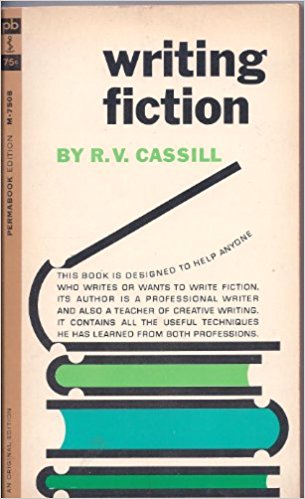
I was going to college to enter a writing program, after nothing but ordinary English courses in high school, if Catholic school courses can be called ordinary. But I did find this one paperback: Writing Fiction by R.V. Cassill, which had two sections of instruction (The Mechanics of Fiction, the Concepts of Fiction), and between them a section of short stories by various authors, mostly contemporary (though also the first Chekhov short story I'd read.)

One of those stories, and (apart from the Chekhov) the only one I remember was "The Best of Everything" by Richard Yates.  Several years after I'd read it alone in my room in Greensburg, Pennsylvania, I met Richard Yates when he spent a few days at Knox College, where I was in a writing class.  I told him how important that story had been to me, and how I had come to read it.

He was astonished that I'd read Writing Fiction all on my own, just because I saw it and could afford to buy it.

"Where did you find it?" he asked.

I guess I was surprised at his surprise.  "At the supermarket.  Or maybe it was the tobacco store."

In more recent years I've come back to hardbacks, which when purchased used or remaindered are often cheaper than new paperbacks.  With larger print and a reassuring permanence, they seem more comfortable at my age.

But beginning with those high school years, paperbacks began to define "books" as I knew them--as I read and handled and bought them, and talked and wrote about them.  That acceleration began in college, where assigned books for lit classes and other classes, and even many textbooks, were paperbacks.  And my purchases in the college bookstore were overwhelmingly of paperbacks.

My voracious forays into the bookstores of Chicago, Iowa City, Boulder, Berkeley, Cambridge, New York, Pittsburgh and--with the advent of mall chain bookstores--even Greensburg, were for paperbacks.

Paperback began to have a wider definition, with different sizes and quality (indeed, a category was born of the Quality Paperback.)  But the classic paperbacks of 7x4 inches or so, remained central to my reading, and to my memories of books and authors: from Ezra Pound, William Carlos Williams, Thoreau, D.H. Lawrence, Wallace Stevens, Vonnegut, Catch-22, Orwell, Donleavy, McLuhan etc. etc. in college, to Kerouac, Henry Miller, Burroughs, Mailer, Hemingway and onward to Marquez, DeLillo, Pynchon, McMurtry and back to Austen, Melville, Tolstoy, Conrad and over to Raymond Chandler, Ray Bradbury, Bester, etc.  

Larger paperbacks of James Joyce, D.H. Lawrence, Fitzgerald, Hemingway, Thoreau, Calvino, Beckett, Stoppard.  Several volumes of James Wright and others in the Wesleyan poetry series.  All of these summon specific sensory memories of those paperbacks, their context in time and place, their aura:

Absorbed in paperbacks of A Separate Peace and, years later, The World According to Garp through long train trips.  Reading Stendahl's The Red and the Black in line at the Cambridge unemployment office.  Pound's ABCs of Reading on a bus. Dorothea Brande's Becoming A Writer on a plane. Calvino's Cosmiccomics at the coffee shop. Long nights with Pynchon's Against the Day.  For example.

(Not to mention Larry McMurtry's All My Friends Are Going To Be Strangers.I spotted a paperback of it one Sunday afternoon in the Boston apartment of a young woman I had mixed feelings about. I never saw her again, but I bought the book and read it several times in succession. It was astonishing, even if I started out slightly annoyed that the title was close to one I had designated for my own use.)

There was a romance to the plain cover editions of Balzac etc. that Antoine Doinel read in various Truffaut films, and to the original plain cover Penguin editions.  These covers said that good books (however funny they might be) are deadly serious things, and they don't need garish introduction. The paperback said they aren't for only the rich.  Together they also and especially said: this reader is serious.

  A popular paperback like Catch-22 could be identified from a distance, its blue cover showing on a coffee shop counter, peeping up from a back pocket, indicating a definite cache.  The books you carried defined you, and occasionally, the books you read.  They informed your forming soul.

And so this journey continues, as it began in the public library, the living room, the drugstores and newsstands, the building blocks of this lifetime house of books.

Friday, October 27, 2017

Books in Our House

This would be my view leaving the public library, walking
north on South Main St. in the 1950s.
When I was growing up just beyond the city limits of Greensburg, PA, its Main Street and the two parallel blocks on either side of it constituted the commercial center of the town and the surrounding township, and in some ways of the entire county.

The two most prominent destinations of my downtown world were near either end of this district: the two movie theaters to the north, the public library at its southern edge.  Between them were three department stores, plus a J.C. Penney and a Sears.  There were a number of specialty shops, for womens' fashions, shoe stores, men's suits, and Joe Workman's for work clothes and bargains.

the five and tens made it into the 70s,
a bit further north on Main  St.
There were two "five and tens," both large and with bare wooden floors.  During a particular period, I got my model airplane kits in Murphy's basement, $1.01 with tax.

Both Murphy's and the other 5&10, McCroy's, which were across Main Street from each other, had a lunch counter and soda fountain.  Sometimes they strung balloons above the counter and a slip of paper inside each one told you how much you would pay for your banana split.

 Several drug stores also had lunch counters and tables or booths, with those little juke box machines at each.  There were other restaurants, quite large ones like Lee's, but other smaller places, more like diners, some of them with entrances below street level.  There was an Isaly's with a meat counter but also lots of ice cream, including their skyscraper cones, and of course, their now famous Klondikes.

There was a camera store, a record store, and a store selling Singer sewing machines. What there were not were bookstores.  The shop selling Catholic items had some books, and maybe one of the department stores.  But basically there were no hardback books on sale on Main Street, or anywhere in Greensburg, or anywhere I knew of.

Neither of my parents attended college.  When they were married, the US Census described them as factory workers (they met in a war plant.)  Soon afterwards my father went to work at that Singer store on South Main Street (its phone number was 409), and my mother was a 1950s homemaker until I was 12 or so, when she worked the night shift in billing at the Westmoreland County Hospital, and over the next decades worked her way up into management.

Greensburg had its rich people, some of whom were probably well educated, and it had a professional class.  But most were like my parents, in the working middle class, with no more than a high school diploma. And the culture was pervasively working class and very local.  I can't remember ever seeing books on display in any of the homes I visited in my childhood. There wasn't much of a market for bookstores.

The only exception I saw was our home, where there were always books. Here's a photo I'm pretty sure was taken in my first residence, an apartment on the top floor on College Avenue.  I'm not yet two years old.


A bit later we moved into what everyone called "the foundation."  It would be the basement of our house, once the house was built on it.  In our neighborhood at least, many families lived in the foundation while they saved for the house.  There are photos of my parents and some relatives there, that show the painted concrete block walls, and again, a small shelf of books.

Eventually the house built above it would have bookshelves in the living room.  My mother expanded this area several times.  There were bookshelves in my room, and after I left, the room became a den with the upper half of a wall of books.

Where did these books come from? (Apart from the little books for me, which I always had, and school books, etc.) Some seemed always to be there, especially the reference books.  I still have the thick Collier's yearbooks for 1946 and 1947 that must have come with a set of Collier's encyclopedias.  (Later I was given my own set of new encyclopedias.  They were relatively thin volumes, blue like the Americana, but "modern" with illustrations, and probably geared to younger readers. I used them for schoolwork.)

There were of course the My Book House books. And there were probably a few old text books or required reading, as my mother's sister and brother had gone to college (my grandfather always was saddened about not being able to afford to send my mother, the first-born.)  My schoolbooks were mostly hardbacks, but they went back to the school at the end of the year.  Probably the most influential such books were volumes on astronomy and science I found on the shelves at the back of my fifth grade classroom when I sat at the last seat in the row.  I read them instead of paying attention to math.

There was a big old dictionary at home, with thumb indexes and a ribbon bookmark, like the big missal the priest used at the altar during Mass.  It could be my sense of words as holy came partly from this.

But as for other hardback books, there were chiefly two sources.  One was the book clubs, namely the Book of the Month Club and the Literary Guild.  These were advertised in magazines and Sunday supplements.  Usually you got several books for very little when you joined.  By joining you agreed to buy a certain number of books a year.  They sent you a brochure describing their next monthly main selection, and if they didn't hear back by a certain date, they would send it. Their monthly brochure also offered other books as substitutes.

I believe we belonged to both clubs at different times.  You could join, fulfill your obligation and stop, then later start a new membership and get that introductory batch of books for a buck each.  By the time I was in high school, I lobbied my mother to join the Literary Guild so I could get H.G. Wells two volume Outline of History as one of the introductory selections.  Eventually we got their special editions of several novels by Hemingway and Fitzgerald.

I don't however remember specific books before that.  My mother got some new novels, like Marjorie Morningstar. She had a biography of Dwight Eisenhower before his presidency that I read.  I recall two others, that interested me for different reasons.  One was a collection of single-panel cartoons, many from the New Yorker, that I pored over for hours.  That kind of wit was new to me.

The other was a collection of columns by war correspondent Ernie Pyle, a very popular columnist through the 30s and 40s, called Here Is Your War.  On the inside flyleaf my mother had recorded the date that he had died, during one of the last battles of World War II, on Okinawa.  That notation puzzled me, so I asked her if she'd known him, but she hadn't.  Still, it's why I remember it.

I'm not sure if Wendell Willkie's book One World was a book club selection, but it was a best-seller in 1943 and became one of the best selling non-fiction books by an American publisher in history.  I remember the title from seeing it at home, so we still had it in the early 1960s. It made an impassioned case for world government, even before the atom bomb.

I still have the hardback copy of The Story of America in Pictures that my mother gave me for Christmas in 1956, when I was ten (as I inscribed myself on the flyleaf, signing my name as William, the name I was called in school.)  This is no thin kiddie picture book as the title might suggest.  It is a 488 page book created by Alan C. Collins, who eventually became an agent with Curtis Brown.  He published the first edition in 1940--this is the "new revised" edition of 1956.  Published by Doubleday, it was a Literary Guild selection, which is likely how it came to me.  Each page has an illustration (photo, drawing, cartoon etc.) and a double column text of maybe 500 words about each event, and it is quite thorough. Twentieth century events in particular are incisively selected, beyond the usual textbook mulch.  It wasn't quite up to the minute--so I added a couple of sentences about Eisenhower winning the 1956 election (the first I paid attention to) to the book's last entry.

The other chief source of hardback books in our house was the Readers Digest Condensed Books, and I remember quite a few of those.  These were thick volumes that came four times a year, each with condensed (or abridged) versions of four or five new books, usually fiction but not always.  Apart from excerpts in the many magazines we got, they were the only way a home like ours was apt to get even that much of the new hardbacks.

These were substantial abridgements, though I'm sure they emphasized plot. They were usually by best-selling popular authors, not literary giants, though there were some outstanding writers among them, and they did occasionally include classic authors like Dickens.  The first titles I remember are from 1955, though that isn't to say I actually read them then.  Those books stayed on the shelves that I examined often, so I could have read them years afterwards.

From the 1955 volumes, I probably read (or tried to read) Good Morning, Miss Dove,a novel about a teacher, and The Day Lincoln Was Shot by Jim Bishop, a popular historian and journalist.  Two I'm certain I read were Run Silent, Run Deep, a novel about submarines, and The Year the Yankees Lost the Pennant, the novel upon which the musical Damn Yankees! was based.

I started it because it was about baseball, and I actually liked the Yankees.  But I vividly remember the passages about the middle aged narrator physically becoming the young ball player, feeling himself able to run.  I ran all the time, and it hadn't yet occurred to me there might be a time when I no longer could.  It was my introduction to how physical aging might feel.  (I also was a bit scandalized and scared by the devil aspect of it, being in Catholic school at the time.  For all I knew it was a forbidden book.  Certainly that "Damn" was suspect.)

As mediocre as much of this probably was, I was alert to things I didn't know from my oddly sheltered life.  We obviously had no Jews in Catholic school, but I caught some connections and some differences in immigrant cultures from a novel called Seidman and Son in which a character is a tailor, like my grandfather.

When I read Advise and Consent, homosexuality was such a forbidden topic that the subplot which involved a gay dalliance was so obscurely suggested that I couldn't figure it out, for I knew nothing whatever about homosexuality anyway.  Still, that was my favorite novel for awhile because it involved the U.S. Senate and a world of government I was getting keenly interested in.

By then--1959--I was catching up, reading the latest Condensed Books volume when it arrived.  Besides Advise and Consent, I also read The Ugly American that year.  Political fiction and nonfiction were becoming a popular trend, just as I started becoming interested in it.

These abridgements made it possible for me to read a book before it became a movie, whereas it had always been the reverse before. (Disney in particular sent me to books, from the Hardy Boys to Johnny Tremain.)

 Among the books I read (in condensed form) before seeing the movie were To Kill A Mockingbird  and Captain Newman, M.D., both movies starring one of my favorite role-model actors from the late 50s and early 60s, Gregory Peck. In this way I could compare the images in my mind (influenced by the illustrations) with the actors on the screen.

From these condensed books I got an overly romantic view of writing from Youngblood Hawke, and an overly romantic view of science from The Microbe Hunters.  I also went on from these abridged versions to eventually read the entire book, in particular Theodore White's The Making of the President 1960 and John Steinbeck's The Winter of Our Discontent.  That Steinbeck novel also sent me to read several of his shorter novels in a single volume my mother had (with her name on the flyleaf), probably from a book club.  (And I could have sworn I read Travels with Charley as a RD condensed book.  But I must have gotten it from the library shortly after it came out.)

We did get a lot of magazines--my mother got all the women's glossies (McCalls, Redbook, Ladies Home Journal), my father got Popular Science and Popular Mechanics (I knew all about the Edsel before it came out), and we usually had Life, Look and the Saturday Evening Post, and of course, Reader's Digest.  Sometimes magazines led directly to authors with samples of their work (I'm pretty sure I learned of the science fiction author Robert Heinlein through Boy's Life) or published book-length work.  I remember seeing photos of Ernest Hemingway in Life Magazine while he was alive, and recall at least leafing through his novel published in an issue, The Old Man and the Sea.  Since I was only six at the time, my memory of reading it there must be incorrect.  But it was I'm sure the first Hemingway I read.

 By the time I was in speech club in high school, the magazine stream was an overflow--the weekly news magazines, plus the New Republic, the Nation, the Reporter, American Scholar etc.   But I mention them in this context because they often referred to the latest books and authors.  Apart from what I could guess from context, I had the condensed books to place me in this ongoing stream of contemporary references, especially with topical books like Seven Days in May.

As I've mentioned in an earlier post or two of this series, and as must be obvious from this one, I was not a particularly precocious reader.  I wasn't, like Katherine Anne Porter, memorizing Shakespeare's Sonnets at age 13.  No, these were gateway drugs, as were the Classics Illustrated Comics I bought, that introduced me to Jules Verne's From the Earth to the Moon and H.G. Wells' The Time Machine before I saw the movie and The War of the Worlds after it--both very different versions.  So that was something else I learned.

By the time I was in college I learned to denigrate such abominations as abridgements and "condensed" books of novels that were too bad to begin with.  My mother's bookshelves would be a middle class embarrassment.  I'm not embarrassed anymore.  There's no point in wishing I had a better education.  In some ways it's a miracle I had any experience of books and book culture.  All I can do is record the means, and frankly, remember them fondly.


There's also this book that was not in our house--at least, not at first.  My first memory of it was in the shade of the little woods across the road where I hung out and played with the same three friends for much of my childhood, right up to high school.  One of them showed it to me: a paperback titled The Book of the Damned. Though there was no salacious illustration--in fact, no illustration at all-- we knew it had to be forbidden just by using that word "damned."  We looked at it in secret.  I must have kept it for awhile because I recall reading at least some of it.

It was by Charles Fort, and had actually been first published in 1919 by Boni and Liveright.  It was re-published and copyrighted in 1941 by Holt, Rinehart & Winston, and reprinted in paperback by Ace at some unknown date.  But of course to us boys in the 1950s it was contemporary.  What Fort meant by "damned" it turned out was information that establishment science etc. had rejected, or (at times) it was Fort's mostly hinted-at explanations of these phenomena (space aliens, often enough) that was rejected, or damned.   

What interested us was the phenomena, some of which was catalogued on the back cover.  Fort had collected newspaper accounts (many from the 19th century) of times and placed where it rained mud or fish or (the example that grabbed us and which I remembered) rained frogs. Or limestone. Or black rain, or red rain.   Strange lights in the sky, triangular clouds, and phenomena we've since associated with UFOs, Mayan mysteries, etc.  

Looking at a copy of that very edition I picked up later, I marvel at the playful density and eccentricity of Fort's prose.  I couldn't have possibly understood much of it, other than the phenomena he named.  However the book was taken at least somewhat seriously in its time.  After all, it was blurbed by Theodore Dreiser.  And at the time I read it, I too wondered what could have accounted for such things,  and why nobody talked about them.  I was primed by science fiction for such wonder.   


 This is one of a series of posts on childhood reading and the origins of my relationships with books, inspired by Larry McMurtry's reflections in  his autobiographical Walter Benjamin at the Dairy Queen. Earlier posts are  on the Book House books, Library Days , Hardy Boys  and other Boy of Summers books.

Wednesday, October 11, 2017

Library Days: The Boy of Summers

I recall the summers of my 11th and 12th year as both my actual initiation into the joys of reading books, and in some ways, the purest and most perfect experiences of them, due largely to the revelations of discovery, the awakening, shimmering clarity of the first time.

Between baseball, bike trips, paper routes and Saturday afternoons at the movies in those hot golden months in western Pennsylvania, my visits to the Greensburg Public Library on Main Street became more frequent and regular.  There I searched and settled on my three allotted volumes, which most times I would easily finish within my two-week limit.

I read outside, including with my back against a huge rock that I discovered in a nearby hillside vacant lot of scattered trees and bushes, my fortress of solitude.  I read sprawled on the sofa in the living room, the curtains drawn against the afternoon heat, Italian style.  I read in my bedroom, on my double bed or in it, within the umbra of my bedside lamp.

I read sipping Kool-Aid, munching an apple or pear, or with a stack of saltines nearby, with butter or peanut butter between two crackers.  I read restlessly and with total absorption, until I got restless again, forcing me reluctantly out of my reading dream.

My choice of reading wasn't at all precocious.  I've noted the Hardy Boys novels.  I also read sports books, both fiction and biographies.  I was beginning to notice the author's name on a book I liked, and to look for other books they wrote.  I read The Kid Comes Back, a baseball story by John R. Tunis, and I remembered his name and found other sports fictions he wrote, like Young Razzle and Go, Team, Go!

Sports books were a staple of fiction for boys--a cache of my uncle's books I discovered in my grandmother's attic had several from his childhood. John R. Tunis was perhaps a more serious writer than most.

The Kid Comes Back was a sequel to The Kid From Tomkinsville, about a rookie with the Brooklyn Dodgers.  Published in 1946, it begins with the hero, Roy Tucker, in France during World War II.  Like a number of Major League players, his career was interrupted by service overseas.  There are thoughtful reflections on regrets for not taking better advantage of school for knowledge that would be an advantage to their survival.

Tucker is injured, and once the novel returns to baseball, it is about his struggle to overcome his injury and war experiences, and find a role as an older player, which is to support the team first.  The baseball sections are detailed, with managerial strategy and game descriptions--just what we wanted at that age, as we were learning the game from radio broadcasts and--if we were lucky enough to run into knowledgeable adults--from coaches and baseball dads.

Tunis is considered the father of modern sports books, and Roy Tucker is an obvious forerunner for Roy Hobbs in Malamud's The Natural.

 His young football hero in All American battles anti-Semitism and racial discrimination. Tunis also wrote on other subjects in his books for young readers. His last book in the 1960s, His Enemy, His Friend, is a poignant and eloquent novel exposing the brutalization of war, centered on the retreat from Dunkirk. In the adult world Tunis was a sports commentator and writer who could be a harsh critic of, for example, the role of money in college football.


Joe Archibald is another author's name I remembered, though I'm not sure which of his scores of sports books I read--probably novels about football and baseball. Archibald wrote fiction and sport biographies, and I also read those. One of the bios I remember (not Archibald's work, I don't think) was about Jackie Robinson (the first African American player in the majors and one of baseball's great all-time star), which opened with him at a young age trying to scratch his black skin off his arm, because of the prejudice he experienced. It was a powerful image and message.

I read adventure stories about sailing ships and pirates,  possibly under the influence of  TV's "The Buccaneers" (another syndicated series imported from England and largely written by blacklisted American writers) as well as the Disney movie of Treasure Island, at least as excerpted on the Disneyland TV show.  One book I specifically remember that wasn't inspired by TV was The Three Musketeers.  I enjoyed following D'Artagnan and didn't even feel much distress over rooting for the Musketeers fighting for the king against the Cardinal's men.  I read an old library hardback and I'm pretty sure I read at least the direct sequel, Twenty Years After.

Though I don't remember any specifically, I may have actually read some Robert Louis Stevenson, but all I recall is that I came up against my limit in reading one of these books about seafaring--it was too long and too hard to follow.  (It might have been one I secreted from the adult stacks.)  But eventually I would return to such tales: a paperback of Conrad's Lord Jim was one of the books I took with me to college.

I was actually much more interested in modern stories about ships and the Navy.  I particularly liked Midshipman Lee of the Naval Academy by Annapolis grad Robb White.  I'm pretty sure I'd already read it when I first saw a TV series called "Men of Annapolis" (it began in 1957 and ran for only one season)-- Robb White was one of its writers.  There was also a West Point Story TV series at the time, which I watched, and I found novels about West Point, too.

I got so enthusiastic I decided that when I was college age I would try to get into the Naval Academy.  I would need to be appointed by our congressman, but my father used to see him at Democratic gatherings, and I'd already corresponded with him, so I thought I had a good chance.  I held onto that dream until one day, descending from my house to the road, I suddenly realized that being deaf in one ear would disqualify me.

But before that terminal thought, I actually did go to the Naval Academy.  During my 11th summer I spent several weeks at my cousins on the eastern shore of Maryland, and when my parents drove down to pick me up, we detoured to Annapolis for a quick drive through the Academy grounds, pausing long enough for me to hop out and have my picture taken.

Something else happened on that trip.  As we were piling into the Ford to leave Federalsburg, my Aunt Toni produced a tin of her homemade cookies and a cardboard box of old science fiction magazines which I assume had belonged to my Uncle Bill.  These were the classic s/f pulps with boldly colored art on the covers, containing mostly short stories.  It was a long drive, and I spent it in the back seat, reading story after story while munching chocolate chip cookies, nut rolls and jumbalones in the speeding summer light.

American science fiction was largely that--short stories published in the pulps, and it had been that way since the 1920s.  The relatively few science fiction novels were usually cheap paperbacks.  This was still a pulp genre.  But in the 1950s, several publishers started a science fiction novel series for young readers--especially baby boomers like me, because there were a lot of us.

Alice May Norton (under the name "Andre Norton") wrote a series for Ace books--I don't remember seeing these.  But I remember the other two.

 Beginning in 1947, Robert Heinlein wrote a series of a dozen "juveniles" for Scribners.  For some reason--possibly because he published short stories in Boys Life--I recognized Heinlein's name early, probably the first science fiction writer's name I knew.  Or maybe I learned to recognize his name from this series. They were published in hardback, expressly for libraries, and their success helped jumpstart hardback science fiction novels for adults.

Among the differences between his adult and juvenile fiction, Heinlein said, was that "the books for boys are somewhat harder to read because younger readers relish tough ideas they have to chew and don't mind big words..."  In fact, these novels track well with the universe Heinlein created in his work for adults.

The most famous of his series was Space Cadet, a major influence on Gene Roddenberry and Star Trek, as well as inspiring the early TV series Tom Corbett, Space Cadet and several other such TV shows that featured variations on the Space Patrol.

The last in the Heinlein series in 1958 (Have Space Suit--Will Travel) has a lot of technical detail on space suits which didn't yet exist, partly because as a Navy engineer in World War II Heinlein had been tasked to design a space suit (or more specifically a high altitude pressure suit), a job he passed on to another officer who would also become a prominent science fiction writer.  The whole idea of the space suit began in science fiction, as did so much of early space technology.

The titles I was most likely to have seen in these years were Citizen of the Galaxy and Time for the Stars, though I have a feeling I read Starman Jones. Tunnel in the Sky (1955) depicted a group of young people marooned on a hostile wilderness planet who split into rival groups but ultimately realize they need to all cooperate to survive. Science fiction historian H. Bruce Franklin believes it was Heinlein's reply to William Golding's famous Lord of the Flies, published the year before.

 But I don't really remember which of this series I read back then, and probably never will, because about four years ago I tracked them all down (some I had, some were actually in the university library's children's room in their original editions, and some were available to buy in quality paperback collections) and read them in order of composition. They are all excellent.  I wrote about them individually here.

Apart from the quality of storytelling and sophisticated scientific detail, they engage moral and ethical questions, and expose various forms of racism and prejudice, as well as authoritarian (and big business) excesses.

The juveniles I remember mostly vividly and even reverently were in the Winston Science Fiction series.  These were written by different authors including Arthur C. Clarke, Ben Bova, Raymond F. Jones, and several (as many as 9 of the 35) by Lester Del Rey.  This series (and the other two) "seem to have started a whole generation toward becoming science fiction fans," Del Rey wrote in 1979.  "People still come up to me to declare that one of my juveniles was the first science fiction book they ever read."

Again, I don't remember which I read, though I'm fairly sure they included Trouble on Titan by Alan E. Nourse, Rocket to Luna by Robert Marsten (one of crime novelist Ed McBain's several pseudonyms) and Son of the Stars by Raymond F. Jones (who authored This Island Earth, which was freely adapted into the script for one of the better 50s sci-fi films.)

The protagonists were usually young and so these novels were typically coming of age stories in which the heroes learned and overcame obstacles that included injustices.  Like Heinlein, these science fiction authors often had strong scientific or engineering backgrounds, and so the details of space travel and technology were usually pretty accurate. When the rockets really started going up in years that immediately followed, there wasn't a lot that surprised readers of these books.

A number of these novels were reprinted in paperback editions by Thunderchild Publishing. These have the virtue of the original cover illustrations but lack the wraparound endpages and the heft of the original.  One (The Secret of the Ninth Planet by Donald Wollheim) includes a marginally informative but ultimately unsatisfying essay on the series.  Original editions with pristine dust jackets are collector's items, but some old hardback library copies are around, and carry more resonance for me.

The Winston series was unified by a distinctive logo and especially the eerie endpapers which were the same for every book.  The cover art was distinctive, too, but I never saw it on my public library copies. But those endpaper illustrations inside the front and back were in every volume, and more than any single book, I remember poring over this art,  trying to imagine a tale that would unite them into a single story.


I wouldn't have seen or read these books but for the public library. (Some cheap editions of Robb White's work were available through schools, though I don't believe they were in mine. Also, I'm not aware that any of my schools had libraries until high school, and that was a small one I hardly ever used.)

None of these are classic authors or books, though I suspect many baby boomers remember them fondly. Their techniques and rhythms prepared me for other literature, I believe, but I still find value in them on their own.  I have copies of many of them today, and have read them in recent years.  That they reawaken and renew the boy that remains an integral part of me is only one of their functions.  For I read them again with calm pleasure and active delight, as well as the thrill of re-discovery.

 This is one of a series of posts on childhood reading and the origins of my relationships with books, inspired by Larry McMurtry's reflections in  his autobiographical Walter Benjamin at the Dairy Queen. Earlier posts are  on the Book House books, Library Days and the Hardy Boys