Showing posts with label J.D. Salinger. Show all posts

Wednesday, March 06, 2019

History of My Reading/ Ticket to Ride Summer 1965

My first year away at Knox College in Illinois, I watched for letters from back home in western Pennsylvania.  I got mail both at my Anderson House residence and in my campus mailbox outside the bookstore in Alumni Hall.  The letters were from family and high school friends, including from girls I hadn't known that well, but who wrote to me at my distant campus with the sweet dutifulness of writing to soldiers at remote postings in countries only slightly more foreign to them than Illinois.

Then when I went home that summer, I watched with even greater anticipation for letters from Knox students I'd met the previous school year.  The situation had become reversed: I was separated from new friends, and a place where I'd begun to feel more at home than my home in Pennsylvania.

The letters I got told of similar feelings--of frustrating jobs, boredom and loneliness.  "I'm going crazy" was a frequent message. One admitted ruefully to a longing to get back to school, but that was implied in several more.  The center of our lives had relocated.

The letters were also something like literary efforts: self-referential (offering a running commentary on themselves) and playful (puns especially.)  My letters back certainly were that way--a reason to write, offer observations and opinions, construct fictions and jokes. One recipient got a call at work from her mother, alarmed that she had received a letter from the Howard Johnson Hotel Complaint Department.  She went home at lunch time to find it was just a letter from me, stuffed in a purloined letterhead envelope. In general, the letters allowed us to reveal interests and a personality that couldn't be expressed in the same way on home grounds.

The bulk of my correspondence was with a young woman I won't name--even a half-century later, I feel the need to be discrete on her behalf.  Our letters were exploratory but ardent and personal. We also exchanged poetry we'd written, and I sent her a short story I wrote that summer.  When fall came our relationship faltered, but her letters were a lifeline that summer.

In response to my letter about events at the end of the school year, I got a letter or two from Mary Jacobson that I can't find.  I recall she passed on a compliment on my writing from Jay Matson, editor of our literary magazine that evidently can No Longer Be Named.  (I agree completely with the decision to dump all official uses of Siwash and Siwashers, but let's face it--the magazine was the Siwasher then, though it appears Knox College no longer describes it as such.)  I remember this compliment because it was one of the first indications I had that my literary writing might be worth pursuing.

I also remember Mary writing that she had just read the Thomas Mann story, "Disorder and Early Sorrow."  I loved the title all right, but found the characters and the story uncompelling, and didn't finish reading it.  But I kept such judgments to myself, while I was learning.

Among the letters that did survive are several from Judy Dugan, a couple from Jim Miller (my Anderson House roommate), and a few from classmate Jill Crawford.  Evidently I'd sent Jill a copy of J.D. Salinger's Nine Stories, and she wrote back enthusiastically about the book, describing the stories she liked best.  She also read the two long Glass family stories collected in Raise High The Roof Beam, Carpenter and Seymour: An Introduction, as well as re-reading the two Glass stories in Franny and Zooey.   


I'd read all of those as well, and in fact the only book I associate with that summer is Salinger: A critical and personal portrait, edited by Henry Anatole Grunwald.  It's a collection of literary essays, book reviews and commentaries by such leading critics of the day as Arthur Mizener, Alfred Kazin and Leslie Fiedler, though the longer and more formal articles were generally by lesser-knowns.  I remember reading it in the bright sunlight in my backyard.

Looking back, that book was probably important for me because it contained a number of differing critiques and evaluations, as well as literary analysis, of a writer whose small body of work I already knew.  I had yet to take a college class that required this kind of literary analysis.  I was still learning about it by osmosis.  It certainly helped that I knew the work being discussed, so I could more or less concentrate on what kinds of things these writers said about it, and how they said it.  I probably was a little aware of this at the time, though it wasn't my principal motive. I was still deeply involved in Salinger's work, and I read this volume of criticism to enrich my experience of the writing. I found some of what I felt articulated, and also plenty to argue with.

Some of the essays and reviews compared Salinger to other authors, which gave me names of books and writers to explore. Fitzgerald was mentioned more than once, for instance, and The Catcher in the Rye compared with Huckleberry Finn. Salinger was very popular in the early to mid 60s, and so some of the critics bemoaned the attention he got over other contemporary writers they named who they considered more worthy. So, more names and more books to investigate. References to Zen and eastern religions piqued my curiosity, just as Salinger's own mention of the Stoic philosopher Epictetus sent me to the Seton Hill College library in high school to peruse a volume of his writings.

portrait of Salinger on the cover of TIME 1961
I saw what criticism could do, for good and for ill.  Editor Grunwald provided a valuable introduction, in which he critiqued the critics for opinions supported and not.  He described literary criticism as many machines: "pull the right lever, and off the conveyor belt will roll social consciousness, depth psychology, historical perspective, neatly stamped-out pedantry and, gratifyingly often, passion for literature."

The pieces I liked best articulated aspects I valued, but did so better than I could. One of these was by literary critic Ihab Hassan (who went on to have a distinguished career), another by a college-age student, Christopher Parker (writing mostly about The Catcher in the Rye.)  They both emphasized the theme of a stubbornly retained openness and innocence--championing innocence as an important ethical element.  Salinger's popularity tracks with the first baby boomers reaching adolescence.  This theme is essential to understanding our experiences and responses, particularly in the second half of the 1960s.

One of the subjects of those letters from home to campus the previous spring had been about summer job prospects.  There seemed to be several decent ones, but none happened.  Finally my father got me a job at the Hempfield Township Supervisors office.  The township of Hempfield surrounded the city of Greensburg, though much of it was to the west.  It was at least as old as the city, beginning with a few large farms in the 18th century. It was now where the postwar housing and population growth was going.  My family lived at the nearest edge since the early 1950s, just a couple of city blocks or so outside the Greensburg city limits, in the district called Carbon, for the mine that used to be there.  Housing was expanding farther out even faster in the 60s, with lots of roadbuilding and so on.

My father was at the time the de facto head of the township's "auxiliary police," which basically did crowd and traffic control as volunteers.  He knew the main administrative supervisor, a fellow Democrat, who wanted to   create an actual township police (paid, and with police powers.) The proposal was to be on the ballot in the fall. My father was set to become the Chief.

So he had some pull and I was hired as one of the young guys with very inspecific job duties.  At first I was sent out with the other two guys to assist the ancient township surveyor, as boring a job as you can imagine, especially in the hot sun.  One of our jobs was fashioning wooden stakes, at which I was spectacularly incompetent.

Westmoreland County courthouse, where I did
research and occasionally viewed trials
Nobody knew what to do with me, but when the young head supervisor learned I could do research and write, he knew a good thing when it fell into his lap. He sent me to the county court house to research deeds and other public information.  Eventually he assigned me the job of researching and writing a report on why having a police force was a good idea.  I did, the report was issued officially and written up in the newspaper--with my father named as the author.  My first experience as a ghostwriter.

However, the police measure failed in the fall, and all that remained of the township police force was a premature gold badge marooned for decades in a basement drawer.

The other aspect of working there I recall--apart from the ambiguous attentions of the township secretary, who chatted enthusiastically about her children as she stroked my arm--was the complaint by the Republican supervisor that I was reading on the job.  Apparently, when I had no assigned duties, it was okay for me to sit and do nothing, but on no account could I read a book.  It was a peek at the working world I would remember.

There were plenty of events on the television and in the newspapers that summer: a couple of Gemini missions and the first flyby of Mars, and after years and years of debate and some drama that summer, both the Voting Rights Act and Medicare passed Congress and were signed into law.

At the same time, there was strife surrounding civil rights demonstrations in Selma and elsewhere in the South, and in August the Watts neighborhood of Los Angeles erupted in six days of violence that resulted in 34 deaths and nearly 300 businesses, public and private buildings burned and destroyed.

In June, the number of U.S. ground troops in Vietnam was increased to 72,000 from the initial 3500 sent in March.  In July, that number was increased again, to 125,000, with draft calls doubled to 35,000 a month.  Anti-war demonstrations continued in Berkeley and a teach-in was held in Washington.

I wrote several letters to the editor published in the Greensburg Tribune Review, often responding to the right wing rantings of an ultra-conservative retiree and frequent letter writer: I defended Medicare (then called "medical care for the aged") and Vietnam war Teach-Ins, and supported Senator Robert Kennedy's efforts to encourage nuclear proliferation treaties.  Something to do in the vacuum of summer.

My big trip of the summer was to New York City in August.  Knox student David Altman was something like assistant station manager at the campus radio station, WVKC, and I had just been named News Director.  He was at NYU for the summer and invited me to visit, and stay in the dorm.

NYU is located in Greenwich Village, so I was keen to visit the folk music clubs there.  I also saw my first off-Broadway plays: what turned out to be the original production of the Albee/Beckett double bill of Zoo Story and Krapp's Last Tape. After seeing Knox studio theatre productions of such contemporary plays, I was at first disconcerted to see adult characters being played by actual adult actors.

We spent a desultory day at the 1964 World's Fair, smothered by the heat and discouraged by the lines.

 Towards the end of my stay, I took a train up to Darien, Connecticut to visit classmate Sue Barry.  I drank beer out of a pewter mug and saw my first four-way stop signs.  I'd written to Sue earlier in the summer about my New York trip, and she invited me to visit.  She mentioned that the Newport Folk Festival would be happening in late July, but I didn't get to New York until August.  That festival would go down in history for Bob Dylan's first "electric" performance with amplified back-up, comprised of players who would later form the Band.

I also had some musical business to do in New York.  I carried with me a tape of several original songs that my folk trio the Crosscurrents recorded in my basement earlier in the summer.  I'd written most of them.  I looked up a talent agency and took it to the address.  They told me to wait and someone would see me.  In the waiting room a slightly older guy advised me that if I had doubts about the quality of my material I should leave, because you usually got only one chance.  But I couldn't come back, so I stayed.

A middle aged man came out and started walking me back to where he would play my tape, his arm on my shoulder.  He was asking about me in a friendly way, and as he held my tape casually inquired what the speed was.  These were reel-to-reel days.  I said 3 and 3/4.  He stopped. He was sorry but they didn't have the equipment to play back at that speed.  Most home recorders had options for 3 3/4 and 7 1/2.  The slower speed meant you could get more on the tape, though at lower quality.  But professional recording was done at 15, and their machinery could play back only that and 7 1/2.

So I left the building without our songs being heard.  As it turned out, that would be as close as the Crosscurrents got to folkie fame.

I found myself blinking in the sunshine, having had my hopes raised and dashed in a matter of moments.  There was a movie theatre across the street, which promised darkness and air conditioning cold.  I went in.  And it was that moment that changed my life.

It was the afternoon and only a few people were in the theater, but I was sure that one guy I saw in front of me was Bob Dylan. I got a pretty good look at him walking past me--he left in the middle of the film.

The movie that was playing was Help! by the Beatles.  It was new that summer. I walked into the theater a folk music snob, and walked out a Beatles zealot.  The music, the style of humor, everything about it blew me away.

I'd been into rock and roll in the 50s (Buddy Holly was my guy) but left it for jazz in high school and then folk music.  I saw the Beatles on Ed Sullivan and all the screaming girls, but it was radio pop, not serious or meaningful or relevant like folk music, so I had no reason to see the Beatles' first movie, A Hard Day's Night. That all started disappearing in the wake of Help!'s opening credits.  By the first musical sequence, the recording of "You're Gonna Lose That Girl," it was gone.  By the ski scenes to "Ticket to Ride" I was transformed.

When I got back home I assembled the Crosscurrents, and we went to see the movie together--several times. (Another time soon after that we saw it again on a double bill with A Hard Day's Night--both of them several times.  Back in Galesburg in the fall I repeated the process at the Orpheum theatre.  I started in the afternoon and was still there for the last show in the evening, when I saw Doug Wilson walk in.)

 Back at his house after the movie that summer, Clayton figured out the chords to all the movie's songs while his younger sister Taffy wrote out the words from memory.  We (Clayton, Mike and I) played them over and over in a frenzy in Clayton's basement, much to the delight of his many younger siblings.  So many things changed, so much of our future direction was reset--musically, culturally and even for me, in my reading and literary pursuits.  It was a new ticket to ride.

Sunday, January 20, 2019

History of My Reading: For Love

At our first meeting during registration for my first college classes, Professor Sam Moon offered to read anything I wrote that I wanted to show him.  I must have shown him my first paper--the result of a semester-long class project--because he was the one who suggested I submit it to Dialogue, the new faculty-student publication preparing its first issue.

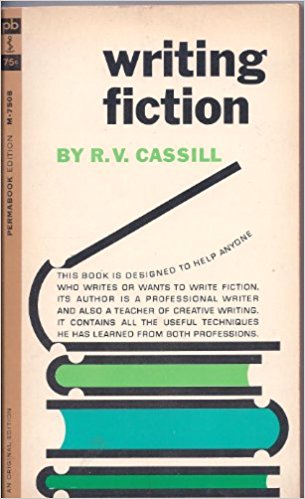
I remember for certain that I showed him the first short story I wrote at Knox.  I'd read somewhere--probably in Writing Fiction by writer and veteran teacher R.V. Cassill (the only such book I owned)--that stories are told in either the first or third person.  Almost no one had adopted the second (or "you") person.  So naturally, for my very first college story, I chose to try it.

It was an interesting exercise but it's clear why it's so rare.  It did create a certain impersonal tone, suggesting a narrator trying to keep a distance from the emotions evoked by the events in the story, while enabling stark expression of those emotions.  Though I doubt I was aware of this at the time.

The subject was leaving home for college (it became a source for details I included in a previous post about that first trip to Knox.)  Mr. Moon honored the feeling, the importance of the feelings in the story, while gently and sometimes bluntly pointing out its many flaws and especially the worn-out expression which I had absorbed from the Reader's Digest and another popular sources, which I was just learning to disdain.

Sam Moon taught poetry writing and play writing (he himself was a poet published in the most respected journals, and edited a book of classic one-act plays.)  The professor who taught fiction was Harold Grutzmacher.  Everyone said he was leaving Knox at the end of the 1964-65 school year, and his second semester fiction workshop would be the last opportunity to have a class with him.

"Grutz" was young, glib, charming and somewhat glamorous. Seldom without a lit cigarette, he exuded the writerly blend of sardonic wit and surprising gentleness. At some point towards the end of first semester I ambushed him outside Old Main and asked to be in his upcoming class.  He refused at first--it was oversubscribed already.  We were interrupted but I stuck around and finally he relented a bit, and told me to drop off a story I'd written, and we'd see.

I may have actually written a story for this purpose, but in any case I provided ten pages of fiction that must have shown enough promise for him to accept me in the workshop.

Looking at that manuscript now, it does have some surprisingly apt turns of phrase and, for a story in which nothing much actually happens, a narrative flow.  I recall that he picked out a single detail he liked: the protagonist reads a letter he's just received, and notices the point at which the handwriting switches from black ink to blue.

My emphasis on physical detail came in part from Cassill's instruction, as well as a bit from the example of John Updike's stories.  But mostly it came from J.D. Salinger, who--especially in his stories--was the poet of clothes and postures, and where cigarettes and ash trays were placed.  In Salinger, that description was more than description; it was substance, and it was style. The switching from black to blue ink was a Salinger-like move (though not literally a steal.)

Moreover, so was the letter.  In the story it functioned as offering a different point of view, a clarifying judgment, on the protagonist's self-absorption.  But the fact of it and the tone of it came from the big brother letters and phone calls in Salinger's Glass family stories and novels, or even the Hollywood big brother D.B. in Catcher in the Rye. I'd recently been missing a big brother's point of view (hard to get when you're the oldest and the only boy.) In my senior year of high school I'd actually invented a big brother for myself in letters to a young woman in nursing school who'd graduated the previous year, as a kind of running joke, and so I would have someone more interesting than me to write about.

The only surviving manuscript or fragment I'm sure was for this course is a memorable one for me: it is my first story analyzed for an hour by other students in the workshop class, presided over by Mr. Grutzmacher.  In fact, it is the very copy, because it contains my marginal notes on what they said about it.  (There are a lot of them on the first page, but they grow sparser--not because there were fewer comments and criticisms, but because there were too many.)

I've always remembered this story as a failure, even as something of an embarrassment because of that workshop, but reading it again now, I can see some interesting features. The opening was criticized for the generality of description.  Fair enough, but the tone of the opening announced that it wasn't strictly speaking a naturalistic story, at least in terms of mood.

 Titled "A Little Less Than the Angels," it was an account of a walk along a wooded fringe of a golf course, taken by two Catholic high school students the summer before college, Ted and Jeanne.  In Ted's pocket is a letter he'd just received from another student they both knew, Lois.  She and Ted had something like a romance that seemed to die out before being unexpectedly revived just a few months before.  In between, he'd been dating Jeanne.  So he couldn't tell her about the letter.

Near the end of the story the letter is excerpted: Lois tells him she had to make a choice, between him and God.  Her choice was to enter a convent.  Summed up like this it seems funny if not cringeworthy, and perhaps the chief accomplishment of the story is that it does not seem so in its context.  It's a crisis for Ted, which among other things, affects his relationship with Jeanne. That part of the story is largely true, compressed in time.

I noted in the margins several times the class critique that the shifts from "realism to romanticism" were confusing. Also "shifts in point of view," a regular criticism of student stories. Certain passages were rightly flagged for being trite in expression.

But the class also discovered possibilities I hadn't seen, or consciously intended. Ted keeps interrupting the conversation with Jeanne by claiming to see a light in the fir trees that she always just missed seeing.  To me, this was just his way of distracting her from places in the conversation he didn't want to go, or just out of boredom with their mundane talk and life.  But others linked it to the larger philosophical issues on Ted's mind, like destiny and faith.  I wrote down one striking comment by an anonymous classmate: "Lois is never going to find God--but Ted will, in a pantheistic way."

There was a lot of discussion about the title and what it could mean beyond what was said--that all humans have some divinity, just a little less than the angels.  I note that Mr. Moon thought Ted sees irony in this when he mentions the phrase, responding to Jeanne's observation of players in a sandlot football game they pass as "animals."  (Was Mr. Moon at the workshop?  Or did he read the story at another time?)

Grutzmacher commented that the story's principal faults were lack of proportion--Ted and Lois are strong, Jeanne is not--and the shifting point of view.  Today I think the story's principal fault (apart from trite expressions) is that it is too long.  Cleaned up and compressed and a third shorter, it might be a decent story.  But that process was probably beyond my capabilities at the time.  I wrote it so instinctively, and the feelings in it were being worked out on the page. I had no real distance.

After this workshop session, I took a real walk with Judy Dugan, who'd become a friend as well as sometime debate partner.  As we re-entered campus, Mr. Grutzmacher saw us and smiled his approval.  It's good to get some consolation after a workshop session, he said, for they can be brutal.  

 I wrote several stories for this course (according to a letter home), and at the end of the semester Mr. Grutzmacher told me he thought I had a writing future and should continue working at it, and to keep taking writing courses.

 Now these many years--and many workshop and writing courses later--I have mixed feelings about writing classes and workshops, and doubts about the nature of their value. (This is no reflection on Grutzmacher, who remains a pleasant memory.) In any event, these days they've become more assembly-line and credentialing for my tastes.

The right teacher at the right time can be crucial to a writer's development and success.  But whatever there is to learn from teachers and workshops, the primary lessons for how to write come from reading.  Absorption, imitation and variation have always been the basis for learning any craft or art, but you don't learn much from watching somebody write (except maybe tenacity.)  You learn from reading what they wrote.  It doesn't surprise me that until very recently, no Nobel Prize winning writer had ever taken a writing workshop.

Like its immediate predecessor, "A Little Less Than The Angels" shows me a continuing J.D. Salinger influence, particularly in the dialogue.  (Not in the letter--it's almost exactly from the real one.)  Even the name Ted was probably suggested by Salinger's story "Teddy." (Or by Ted next door in Anderson House.)

Jeanne's one-dimensional character was in sympathy with Salinger's characteristic over-sensitive male among carefully mundane females, who are still intrigued and attracted. Salinger also dealt with questions of faith and value, even in religious terms, which was a vocabulary familiar to me from Catholic schools.  Salinger's main characters gravitated towards mystical traditions, towards Eastern philosophy and Stoicism, all of which were more appealing alternatives. But this would be my last story in which these issues were overt concerns--except destiny.  That keeps coming up.

Grutz left Knox at the end of that semester, as did several other young teachers--a topic to be taken up next time.  The 1965 yearbook included a snarky comment implying--as I'd also heard at the time-- that he was leaving for Parsons College, widely known as a "party school," for the money.

 In his exit interview in the Knox Student, Grutzmacher did not dispute this--his salary would be doubled, with additional benefits.  But his job would also offer a fresh challenge--administering other teachers in the freshman writing program as well as teaching.

He also noted the uncertainty of the writing program's future at Knox, and the college's commitment to it.  Indeed, he would not be replaced with a full time faculty member until my senior year.

At that point he'd published one book of poetry, titled A Giant of My World (which referred to his young son, Stephen.)  I bought a copy at the Knox Bookstore, and he autographed it for me "with pleasant memories of a hectic year."  I still have it.

Harold Grutzmacher went on to chair the Parsons College English Department, and after an administrative stint at the University of Tampa, returned to the Midwest to become Dean of Students at his alma mater, Beloit College in Wisconsin, another Midwest Conference school along with Knox.

There he was "Hal" and became "an influential member of the Door County community."  In addition to his administrative work, his book reviews and columns, and eventually owning a bookstore, he wrote more poetry.  His second book was a collaboration with his son Stephen, to whom his first book was dedicated.

He continued to teach writing at several schools in Wisconsin, even teaching freshman writing as a Dean.  He helped several writers edit their books. There is still a series of annual awards in writing and other arts in Door County, known collectively as the Hal Prize.  

Harold Grutzmacher died in 1998.  A story about him, along with one of his poems, is here.

There's a corollary to my theory about the college experience--that all of history is experienced Now. The problems sometimes come when something seems Now but isn't. For example, in college we read Hemingway and Fitzgerald, and read about their milieu (Paris as a paradise of the arts, their dedicated editor Maxwell Perkins, etc.)  It all seemed very Now, but most of it was long past, as some of us eventually learned the hard way. This was a more general problem in that the literature we studied stopped years before, mostly years before we were born. There were similar situations in other fields.

When it came to literature and related arts, the Knox counteractive to this absence of the contemporary was Sam Moon and the living writers and other active artists he enticed to campus. My first remembered experience of this was during that second semester spring.  Every year a writer was brought in to judge student writing competitions, and for several days of talks and readings. That year it was the poet Robert Creeley.

Creeley as a writer and a presence electrified a good portion of the Knox student body--certainly all the writers. He seemed to change everything overnight. His late April reading in the Common Room was the first of several memorable moments I experienced there (and it was memoralized by a photo of Creeley taken by Knox student photographer Jim Bronson, which graced the back cover of a Creeley book published later.)

Creeley read poems from his collection For Love: Poems 1950-1960.  It was the way he read them that mesmerized, and remains memorable.  Reading certain lines in the title poem today, I hear Creeley's voice saying the words before I read them.

This in a sense was not a coincidence.  Creeley talked about his poetics, based on William Carlos Williams and especially Charles Olson, with whom he'd worked at the fabled Black Mountain College.  We got a mimeographed handout of Olson's Statement on Poetics (which he developed as a result of correspondence with Creeley), emphasizing the poet's breath as fundamental to the form of the poem.  So Creeley's reading was a key to the form of his poems, with their short, tremulous, fragmented lines.  (In marked contrast to Olson's own full-throated, arm-waving, histrionic style, as preserved in this video.)

Creeley also said that "form is never more than an extension of content."  Olson wrote of "field composition" in which the poet "can go by no track other than the one the poem under hand declares..."  He also referred to poems as energy discharges, and it was that tremulous energy, trying desperately to find expression, that gave Creeley's reading such presence and drama.

Looking back, I see that I hadn't had a real literature course yet, so in a sense these discussions on contemporary poetics was the first such instance in my college education.

Every student involved in writing or reading contemporary poetry was reading For Love that spring, and the following year's issues of the literary magazine (then called the Siwasher) showed Creeley's continuing influence on Knox poets.  That possibly also derived from Creeley as the romantic figure of a contemporary poet: lean, dark-haired, with one eye missing, he looked like he'd stepped out of a western movie (rather than Harvard, where he'd been an undergrad.)  His voice belied his New England background for those with a more experienced ear than most of us, and there was a certain rugged Puritan rigor (and guilt) in his writing and persona, if not necessarily in his behavior.

My copy of For Love has several poems marked, and a note on the page with the poem "After Lorca" which indicates that Creeley said the lines really were Lorca's, but no Lorca scholar could locate them.  But it would be a few years later, though still before I left Knox, that I settled on the poem in it that still means a great deal to me.  I felt then and now that it's somehow emblematic, though of what I can't quite explain.  It's called "The Innocence:"

Looking to the sea, it is a line
of unbroken mountains.

It is the sky.
It is the ground.  There
we live, on it.

It is a mist
now tangent to another
quiet.  Here the leaves
come, there
is the rock in evidence

or evidence.
What I come to do
is partial, partially kept.


Bobbie and Robert Creeley
 Some years later, Creeley would reenter my life.  In early 1970 I found myself in Buffalo, New York, with my visit to Steve Meyers (fellow former Knox student) prolonged beyond my original intention.  He was then a grad student at SUNY Buffalo, so I spent a lot of time on campus, and in the English building--then a kind of glorified long trailer.

  Many things happened in those months, but one of them was spending time with Robert Creeley, on the teaching staff there.  I remember in particular a party at which Bob was holding court at one end of the house, and his wife Bobbie at the other end.  Bobbie read palms, and she loved the maze of lines in mine.

Creeley was instrumental in getting me admitted to the graduate writing program for the following year.  He felt that the small college was no longer adequate preparation for the literary life, and that something more urban like Buffalo would help.  Eventually I decided not to stick around.  The last time I saw him was a year or two later at a reading at Boston College, and I spoke briefly with him afterwards, essentially to let him know that I was there in the Boston area, and doing okay.

I have another 8 or so of Creeley's books: poems, interviews and essays, short stories, his only novel.  One of the poetry collections, Pieces, was an unexpected best seller due to being sent to American troops, though he was a vocal opponent of the Vietnam War.  Creeley thought it was a mistake--somebody thought it was about guns, he surmised, or "pieces."  It's one of his best anyway.

As fragile and self-subverting as he sometimes seemed, Creeley had a long career, publishing some 60 books and becoming an eminent and award-winning poet and teacher.  He helped a lot of young writers along the way.  He died in 2005--forty years after that April week in Galesburg.

Next time: Philosophy, Fred Newman and the exodus of dreams, as the second semester 1965 concludes.

Friday, November 03, 2017

Paperback Reader


This is the last in a series of posts on childhood reading and the origins of my relationships with books, inspired by Larry McMurtry's reflections in  his autobiographical Walter Benjamin at the Dairy Queen. Earlier posts are  on the Book House books, Library Days , Hardy Boys  and other Boy of Summers books, and how books came to be Books in Our House.

Books came into my life as hardbacks. (Even my Golden Books would qualify.) Without necessarily being conscious of these impressions, I learned to love the feel and heft, the quality of print and paper, the smell of the hardback book.

But into my early teens, the cycle of the book experience was incomplete.  I got to choose books from the public library, but I had to give them back.  The books we got in the mail stayed on our shelves, but I mostly didn't select which books came into our house to stay.

I couldn't buy a book at a bookstore because there weren't any.  And they were too expensive anyway.  But when I was in sixth and seventh grade, things began to change.  I was sent to the Cathedral School on North Main Street in Greensburg, which meant I had more opportunities to be downtown.  I also got my first paper routes, and though they were closer to home, I went frequently to the offices of the Greensburg Tribune-Review, which were also on North Main.

Paperboys didn't just deliver papers and collect the weekly fee (42 cents for 6 days.)  We were also the newspaper's largest sales force.  We were continually encouraged to get new subscriptions (or "starts") on our routes or anywhere.  There were always contests and prizes, including trips (I earned my first train trip, to Chicago, this way.)

So there were frequent meetings at the newspaper office, where we learned how to sell.  (There were usually inducements for attending, like a free movie ticket.)  I became such a fixture and favorite in the circulation department that one of the staff gave me her "start" so I could qualify for a trip.

The combination of a little pocket money from the paper routes and my boy-about-town range of activity, especially downtown, meant that I was increasingly a customer for paperback books.  They didn't need bookstores to sell them--they were on shelves and racks in the little confectioners and drug stories on and near my paper routes, and in various stores downtown.

This in fact is how the modern paperback industry was born.  For Greensburg was not unusual--lots of places didn't have a bookstore.  The same was true in England where the Penguin line became the first paperback to prove the market for cheaply priced books sold almost anywhere, and set the example in the 1930s.  American paperbacks followed soon afterward.

Drug stores and neighborhood stores might have a rack or two of paperbacks, but the actual paperback wonderland in Greensburg was located in the two newsstand/tobacco stores off of Main on Otterman Street, below the two movie theaters, the Manos and the Strand.

This photo from years earlier reflects my memory: on the
corner to the left of  Manos movie theater was the
tobacco and news shop with racks of paperbacks.  That
it was once a billiards hall accounts for its size and shape.
Both stores were deep behind their storefronts but the larger was probably the tobacco store next door to the Manos.

It was a forbidding place at first, with old men, some slightly disreputable.  I may have been warned about it, because I don't remember going in when I first started trekking to the Saturday matinee movies at the Manos.

I learned later that there was a reason for any reputation it might have.  Along the inside wall that bordered a side street was a long row of telephone booths.  They were well kept, as I recall, all in a single polished dark wood structure.  There was a door to the street beside them.

Directly across that side street was a bar, which at one time was the center of illegal numbers and other gambling for this side of the county.  (The bar became famous among mystery fans for its frequent appearance in K.C. Constantine's "Rocksburg" series of police procedurals.)  Not too much of a stretch to imagine that the phone booths were convenient for bookies.

But aside from the tobacco counter along the other wall, with rows of newspapers and magazines, much of the rest of the space was taken up by rack after rack of paperback books.  Getting up the courage to enter the place was one thing, but actually browsing the books was another.  I wasn't entirely comfortable doing so until I was in high school.  That was partly because a lot of those paperbacks would be classified as pulp fiction, or worse.

You get the idea.
For shortly after the advent of paperback reprints came the paperback original, often genre fiction--westerns, science fiction, romance, war stories, mysteries, the occult and various combinations.  These were mixed in with reprints of recent hardcover books and classic or at least older books, which is (as the subtitle to Louis Menand's New Yorker piece says) "how Emily Bronte met Mickey Spillane."

Moreover, it was a bit tricky to distinguish the Brontes from the Spillanes because all the cover illustrations tended towards the lurid (Menand describes examples in this excellent review of paperback history.)  A woman not entirely dressed was a common feature.  None of which would have met the nuns' approval.  (My mother would have simply called them vulgar.)

At first my youth probably made the proprietors nervous.  While not actually pornographic, a lot of their books--or their covers--could bring irate parental attention.  I probably felt unwelcome, as well as daring the near occasion of sin, and suspicious eyes watched me.  But I risked it, to find books.

At least this scene is actually in
the book, sort of.
So it wasn't until I knew more of what I was looking for--titles, the names of authors or a particular subject matter--that I overcame my embarrassment for browsing among these covers, and undertook my searches.  They pretty much were all jumbled together--there was no order by category in any of these places. But the price was certainly right: at a time when a regular comic book was a dime and the larger ones were a quarter, a paperback book was anywhere from 25 cents to 75 cents.

Eventually I became a persistent searcher, and there were lots of places to look once my eyes were opened.  That tobacco store was prime, and sometimes the newsstand a block or so down Otterman. (By the time I was high school age, the proprietors became indifferent to my presence.)  But also drug stores, the bus station, and increasingly, the new supermarkets.  They didn't often have those spinning racks but they did stock paperbacks in shelves below the magazines.

 It took a lot of spinning, staring, crouching, picking up, thumbing through, to find the gems.  But they were there.  It amazes me now that they were there.

I know I bought paperbacks before eighth grade, but I don't remember any titles.  They were probably few--my main source of reading outside school was still the public library. But a lot of the books I remember buying in eighth grade and high school I still have--often the very same paperback.  They're the ones I took with me to college.  Any others I left behind disappeared, one way or another.

I started in earnest in 1960 with an enthusiasm for the candidacy of Senator John F. Kennedy for President. I bought Profiles in Courage (for 35 cents) and a biography, John Kennedy: A Political Profile by historian James MacGregor Burns (50 cents.)  I did some work for the local Citizens for Kennedy, and was given a larger paperback copy of Kennedy's Senate speeches, The Strategy of Peace.

These were the first books it was important to me to have bought and to own.  They were the beginning of at least partly conscious self-definition through books.

When JFK was elected, I bought every related book I could find, including one called The Kennedy Government, which was basically a set of bios of his cabinet. (I could then--and still can--name every member of JFK's cabinet, just as I could--and can--name the starting lineup of the 1960 World Champion Pittsburgh Pirates.  I can't do either for any other cabinet or team.)

 Later I got a book of JFK's speeches from his first two years (To Turn the Tide, fifty cents), and The Quiet Crisis (a big 95 cents in 1963) which is an early book on ecology by his Secretary of Interior Stewart Udall, still worth reading.

(I continued collecting Kennedy administration paperbacks in college, including Point of the Lance, a higher-price paperback about the first years of the Peace Corps by its first director, Sargent Shriver.  When I met soon-to-be U.S. Senator Harris Wofford in the early 90s, we got to talking about the Peace Corps--he'd been one of its first officials.  I thought I'd scored major points by remembering the title of this book about it, and even the color of the cover.  But it turned out to bring back mixed memories, for he claimed that the actual uncredited author of that book was him.)

Through his interviews, Kennedy was a kind of tutor on the presidency for me, so I bought a book he recommended (and is still a recognized classic in political science), Presidential Power by Richard E. Neustadt (60 cents.) Later I bought Decision-Making in the White House by JFK's assistant and speechwriter Ted Sorensen.  I found a similar kind of book but about the Eisenhower years: The Ordeal of Power by Emmet John Hughes (75 cents.)

The early space program was part of the Kennedy excitement, though I would have been very interested in it anyway.  So one of those early purchases was First Americans into Space, profiles of the Mercury astronauts by science fiction writer Robert Silverberg. My "Collector's Edition" (as it says on the cover) was 35 cents.

These were all interesting and a bit exciting, but they led to two books that made a big difference to me in high school, as my reading in public affairs areas increased with magazines etc. in connection with speech club and debate.  One was The Other America by Michael Harrington, a startling analysis of poverty in America that surprised and enlightened a lot of people, including President Kennedy, who spoke highly of it.  It's come to light since that JFK was going to make poverty his top domestic issue in the 1964 campaign, and LBJ's subsequent War on Poverty was in part a consequence, and a consequence of this book.

The other was The Fire Next Time by James Baldwin.  I believe I came upon the book before I knew much about him--he was soon to be featured on the cover of one of the newsmagazines I was getting, as the Civil Rights movement was forcing questions about prejudices and racial injustice into public debate. The essays in that book, and in the earlier collection Nobody Knows My Name that I searched out (each cost 50 cents) were stunning and enlightening, the work of intelligence and artistry.  They gave depth  to my empathy as well as the recognition of immoral injustice, and were major contributors to my eagerness to participate in the March on Washington in 1963.

There were other books around the house in those years that grabbed me and led me further on parallel paths, like the paperback of Vance Packard's The Hidden Persuaders that my father brought home, or the anthology of English literature I found in a trunk of books left behind by my uncle and aunt in my grandmother's attic.  There were several poems of Shelley in there that became important to me at the time, especially his elegy on the death of John Keats, which I read several times as I struggled to come to terms with the assassination of President Kennedy. And I explored more in the library--I remember reading my first Sinclair Lewis, for instance.  I also received hardback books as Christmas and birthday gifts (usually from my mother), like a volume of then-recent poems by Robert Frost, In the Clearing.

But most of the books that defined me at that time, as I prepared for college, came from my paperback forays.  I'd obviously become interested in politics, but I had always written.  (It was a play I wrote about a political subject which won a national award and got me access to a couple of college scholarships.)

I loved comedy and satire, and had written it, from the third grade onward.  I bought Mark It and Strike It by Steve Allen, I remember, and a couple of books that used real political photos but with cartoon-like captions.  I still remember some of the jokes (Fidel Castro swinging a baseball bat with the caption: "Quick!  Nationalize the outfield!")

I also got a copy of The Thurber Carnival by James Thurber, which introduced me to a different kind of written comedy.  I also read Thurber's book about his years knowing Harold Ross, editor of the New Yorker (The Years With Ross.)  That made an impression, as I wondered about what a writing career was like.

I had a subscription to the New Yorker at some point, probably my senior year. (In fact I read Dwight MacDonald's long review of The Other America there.) Among other writers, it introduced me to the short stories of John Updike.  I found two paperback collections--Pigeon Feathers (75 cents) and The Same Door (50 cents.)  I devoured those stories, and this began decades of reading Updike. His writing about small towns and particularly adolescence (I especially liked the story "The Happiest I've Been") was important. Whatever other styles and attitudes I absorbed in later years, there was always a respectful place for Updike.

It was then that I fell under the spell of J.D. Salinger. Perhaps it was through the New Yorker (for I remember the much later thrill of coming upon the last story he ever published, after years of silence, in an ordinary issue that had just come out, and I was reading on a bus or train station bench) or in some other way (like his Time Magazine cover).  But it was major.

I searched all his books out--all available in these inexpensive paperback editions--and read them in a kind of holy frenzy: The Catcher in the Rye, Franny and Zooey, Raise High the Roofbeams, Carpenters and Seymour: An Introduction.  Finally, the hardest one to find, Nine Stories.  I have a vivid sensory memory of getting to the last story ("Teddy") and being too excited to sit still, so I started walking, and I read as I walked.  I have that memory of reading "Teddy" as I walked quickly, blindly up Hamilton Avenue.

Catcher in the Rye was intensely popular in my generation--most of my friends read it, and it was a point in common when meeting strangers (for instance, on debate trips.)  That voice got into the heads of young writers, and was hard to shake. (I recall one story by a teen writer which was about precisely that.)

But I didn't know anyone else who had quite as seriously internalized Salinger's tales of the Glass family in his other books as I had.  Though there was a lot of Christian imagery and message, these stories more or less introduced me to some ancient philosophy (I got a friend's sister to take out a volume of the Greek Stoic Epictetus from her college library for me) and especially to Eastern approaches. I'd pick up that thread in college and later with my interest in Zen and Buddhism.

By the time I was off to college, I had some other paperbacks as well as a few hardbacks to take along.  I had the pocket anthology of Robert Frost's poems.  I had Conrad's Lord Jim and a few others.  But mostly I was flying blind, with just these hints and indications.

I was going to college to enter a writing program, after nothing but ordinary English courses in high school, if Catholic school courses can be called ordinary. But I did find this one paperback: Writing Fiction by R.V. Cassill, which had two sections of instruction (The Mechanics of Fiction, the Concepts of Fiction), and between them a section of short stories by various authors, mostly contemporary (though also the first Chekhov short story I'd read.)

One of those stories, and (apart from the Chekhov) the only one I remember was "The Best of Everything" by Richard Yates.  Several years after I'd read it alone in my room in Greensburg, Pennsylvania, I met Richard Yates when he spent a few days at Knox College, where I was in a writing class.  I told him how important that story had been to me, and how I had come to read it.

He was astonished that I'd read Writing Fiction all on my own, just because I saw it and could afford to buy it.

"Where did you find it?" he asked.

I guess I was surprised at his surprise.  "At the supermarket.  Or maybe it was the tobacco store."

In more recent years I've come back to hardbacks, which when purchased used or remaindered are often cheaper than new paperbacks.  With larger print and a reassuring permanence, they seem more comfortable at my age.

But beginning with those high school years, paperbacks began to define "books" as I knew them--as I read and handled and bought them, and talked and wrote about them.  That acceleration began in college, where assigned books for lit classes and other classes, and even many textbooks, were paperbacks.  And my purchases in the college bookstore were overwhelmingly of paperbacks.

My voracious forays into the bookstores of Chicago, Iowa City, Boulder, Berkeley, Cambridge, New York, Pittsburgh and--with the advent of mall chain bookstores--even Greensburg, were for paperbacks.

Paperback began to have a wider definition, with different sizes and quality (indeed, a category was born of the Quality Paperback.)  But the classic paperbacks of 7x4 inches or so, remained central to my reading, and to my memories of books and authors: from Ezra Pound, William Carlos Williams, Thoreau, D.H. Lawrence, Wallace Stevens, Vonnegut, Catch-22, Orwell, Donleavy, McLuhan etc. etc. in college, to Kerouac, Henry Miller, Burroughs, Mailer, Hemingway and onward to Marquez, DeLillo, Pynchon, McMurtry and back to Austen, Melville, Tolstoy, Conrad and over to Raymond Chandler, Ray Bradbury, Bester, etc.  

Larger paperbacks of James Joyce, D.H. Lawrence, Fitzgerald, Hemingway, Thoreau, Calvino, Beckett, Stoppard.  Several volumes of James Wright and others in the Wesleyan poetry series.  All of these summon specific sensory memories of those paperbacks, their context in time and place, their aura:

Absorbed in paperbacks of A Separate Peace and, years later, The World According to Garp through long train trips.  Reading Stendahl's The Red and the Black in line at the Cambridge unemployment office.  Pound's ABCs of Reading on a bus. Dorothea Brande's Becoming A Writer on a plane. Calvino's Cosmiccomics at the coffee shop. Long nights with Pynchon's Against the Day.  For example.

(Not to mention Larry McMurtry's All My Friends Are Going To Be Strangers.I spotted a paperback of it one Sunday afternoon in the Boston apartment of a young woman I had mixed feelings about. I never saw her again, but I bought the book and read it several times in succession. It was astonishing, even if I started out slightly annoyed that the title was close to one I had designated for my own use.)

There was a romance to the plain cover editions of Balzac etc. that Antoine Doinel read in various Truffaut films, and to the original plain cover Penguin editions.  These covers said that good books (however funny they might be) are deadly serious things, and they don't need garish introduction. The paperback said they aren't for only the rich.  Together they also and especially said: this reader is serious.

  A popular paperback like Catch-22 could be identified from a distance, its blue cover showing on a coffee shop counter, peeping up from a back pocket, indicating a definite cache.  The books you carried defined you, and occasionally, the books you read.  They informed your forming soul.

And so this journey continues, as it began in the public library, the living room, the drugstores and newsstands, the building blocks of this lifetime house of books.