Showing posts with label August Wilson. Show all posts

Monday, December 17, 2007

The Dreaming Up Daily Quote

“Freedom is heavy. You got to put your shoulder to freedom. Put your shoulder to it and hope your back holds up.”

August Wilson
Two Trains Running

Sunday, July 02, 2006

R.I. P. Lloyd Richards


I met Lloyd Richards, and though I spent only a few hours talking with him, I observed him over the course of a couple of weeks, and learned a lot about him from others. I didn't know however that our birthdays were one day apart. I found out just now, reading his obituary in the New York Times. He died on June 29, his 87th birthday.

Richards directed the first New York production of Lorraine Hansberry's A Raisin in the Sun in 1957, arguably the first authentic portrayal of African American life on the American stage. It was a classic when I read it in high school in the early 60s. But in his years of directing and discovering and nurturing playwrights of all races, his most important find was August Wilson, a great American playwright, who created the richest and most sustained expression of African American life in the twentieth century.

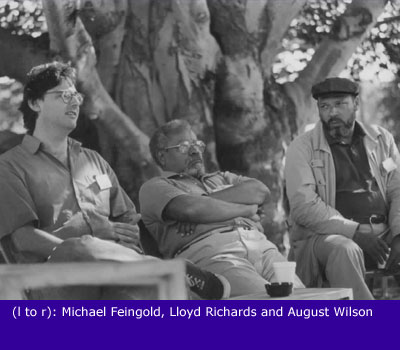
Only hours ago I opened a box of books one of my sisters sent for my birthday--an August Wilson play, an August Wilson essay, and a book on August Wilson (all from my Amazon Wish List.) Richards was instrumental in Wilson's career, and I met them both on the same day (July 1, a day after my birthday) at the Eugene O'Neill Center summer playwrights conference, where they had begun working together. It was Richards who picked out the manuscript for "Ma Rainey's Black Bottom" from the thousand or so that came to the O'Neill, brought the unknown Pittsburgh playwright to Waterford to work on the play, and then mounted its first productions at Yale and in New York.

Lloyd Richards was the heart and soul of the O'Neill, so important to many American playwrights. He transformed it into a community concentrating on honing and freeing new voices in theatre. He was utterly respected by everyone, for his discipline and gentleness, his rigor and humor, his attentiveness to detail and insistence on communicating the big picture, so everyone knew and shared the same vision of the O'Neill process. It hasn't been the same since he retired from being its artistic director.

August Wilson died last year, and so the two giants of African American theatre are gone. And to think just minutes ago I was ordering the last play I haven't read (apart from the one I just got) in Wilson's titanic ten play cycle, one for each decade of the twentieth century. That cycle is a truly stunning achievement, and Richards was part of getting many of those plays to their staged versions. I was looking forward to reading them all in the order of decades. Then minutes later I happened to read this. Of course, it's not as shocking as August Wilson's death at age 61. But it is another indication of an era passing. These two men have left such an incredible legacy to America and theatre everywhere.

Sunday, October 09, 2005


Remembering August Wilson. photo: post-gazette.com Posted by Picasa

In memoriam

There Is A Grace Beyond Matter

How Do We Transform Loss? August Wilson asked this question in a remembrance of Benjamin Mordecai III in the September issue of American Theatre, which will publish the text of Wilson's last play, "Radio Golf," in its November issue.

Mordecai was an associate dean at Yale School of Drama and a former managing director of Yale Rep. He is the only person to have worked on all ten of August Wilson's plays. He also produced Tony Kushner's Angels in America, possibly the only American play of recent decades that is likely to be as well regarded as August Wilson's work . Wilson refers to him as "my friend, my partner, my confidant and my brother." In memoralizing Mordecai, August Wilson wrote these words:

How do we transform loss? How do we mitigate its fierce hold on our consciousness? Time has false contours. Its healing balm is essentially a hoax, a palliative that has little reward. There are some wounds that time broadens. Ben's absense continues to spread over my life like a brutish conspiracy, and I try to find those glorious remarks of faith that sustain and reward the spirit. Now, haunted by the specter of my own death, I find solace in Ben's life, a life lived with dignity and purpose magnified by his indomitable spirit. There is a grace beyond matter. It is our way of knowing, and accepting, the splendor of death with its voluminous atlas. We find it when we must."

August Wilson in the context I remember him: at the
O'Neill Center summer playwrights conference. Posted by Picasa
Remembering August Wilson

In New York Sunday night, the lights of Broadway will be dimmed in memory of playwright August Wilson. A few days ago, only a few hundred miles away and yet very far in other ways, there was a memorial service in the Hill district of Pittsburgh, where August Wilson grew up.

Ben Brantley offered his thoughts on August Wilson in the New York Times. Here is part of what he wrote:

People talk about an artist having an eye. But with playwrights, it's the ear that counts. Mr. Wilson had a peerless pair. His writing comes closer to the sweep of Shakespearean music than that of any of his contemporaries. Edward Albee creates intense and elegant chamber pieces; David Mamet, machine-gun jazz; Sam Shepard, rhapsodic plainsong; Harold Pinter, monastic chants; and Tom Stoppard, jaunty concertos. But these days only Mr. Wilson has written plays that sound like grand opera - and it is no contradiction to say that it is opera rooted in the blues.

Mr. Wilson's majestic cycle of 10 plays of the African-American journey through the 20th century, each set in a different decade, doesn't just sound operatic. Even though his characters are almost all poor and socially powerless, their stories bring to minds the gods of Wagner and the doomed royalty of Verdi.

Poltergeists, mad prophets, fatal curses, visions of unavenged dead men and of roads to heaven, genealogies that twist into constellations of legend, and bloody crimes of passion that seem as inevitable as they are unnecessary. These elements recur regularly in the works of the Wilson cycle, the last of which ("Radio Golf") was first produced this year.

Yet the mythic and otherworldly are always anchored to a landscape dominated by the physical and economic facts of hard lives: the exact costs of shoes and coffins and bottles of liquor; the potential for profit in stolen refrigerators and dog feces; precise psychological descriptions of bodies scarred and shattered by knives and bullets; the hungry before and depleted after of quick sexual couplings. It is the music of Mr. Wilson's prose that connects the mundane and the mystical, and allows earthbound men and women to raise voices that fly to heaven.

In "Ma Rainey's Black Bottom," Mr. Wilson's 1984 breakthrough drama about a fractious recording session of blues artists in the 1920's, the combustible title character speaks about the music she performs. "White folks don't understand about the blues," she says. "They hear it come out, but they don't know how it got there. They don't understand that's life's way of talking. You don't sing to feel better. You sing 'cause that's a way of understanding life."

Not everyone in Mr. Wilson's plays - including, by the way, Ma Rainey - is always in touch with this music of illumination. Nor is this music the same for everyone. Mr. Wilson's major characters are all in search of songs that define them both as individuals, as specifically as handwriting, and as parts of a shared history.

In a prefatory note to his masterpiece, "Joe Turner's Come and Gone" (on Broadway in 1988), set in 1911, Mr. Wilson writes of the African-Americans who have made the exodus from the South to the North: "Foreigners in a strange land, they carry as part and parcel of their bags a long line of separation and dispersement" as they "search for ways to reconnect, to reassemble, to give clear and luminous meaning to the song which is both a wail and a whelp of joy."

This describes not only the quest of Mr. Wilson's major characters but also his own emergence as a playwright. Mr. Wilson said - and said so many times that the story has acquired the burnished sheen of myth - that it was discovering vintage blues recordings, as a young man living in a Pittsburgh boarding house, that made him start to listen to the people around him with a new sense of the notes beneath the words.

Transforming that perception into fluid theater took Mr. Wilson years. He spoke with wry disparagement of the self-conscious poetry of his early work. But it would be foolish to mistake the voices in his plays as mere transcription of overheard conversations from the Hill. That would be like assuming that Elizabethans spoke in Shakespearean blank verse.

The actor Charles S. Dutton, who has starred in several of Mr. Wilson's plays, has said of the dialogue: "It is a lingo that has an inherent rhythm of its own. Most of us have been black all our lives. But we kid each other about August's writing. We'll say, 'I've never heard anything in my life like that, have you?' "

Pick up any play by Mr. Wilson, and a few pages into it, you'll start to pulse to the music. He uses real songs, from children's game-playing chants to raunchy scorchers à la Smith like "Anybody Here Wanna Try My Cabbage" (in "Seven Guitars"). And his characters, especially those wild-eyed soothsayer types who show up a bit too persistently, will sometimes speak in the manner of oracular professors about the nature and importance of song.

But none of this would count for much if Mr. Wilson didn't deliver the music that infuses his characters' talk. It buzzes like traded jazz riffs when men argue about subjects as pedestrian as train schedules. It acquires the wistfulness of Puccinian lament when lonely souls recall love. It shifts into subversively antiphonal call and response when fathers and sons quarrel in the voices of their respective generations. And it soars into gospel chorales when characters journey into the historical night of their slave ancestors, as in "Joe Turner" and "Gem of the Ocean."

In such passages, the subliminal movement is from disjointedness and friction into transcendent, seemingly unwitting harmony. And then there are the arias - the monologues of remembered losses and thwarted ambitions that build in Wagnerian crescendos, given reverberant life on Broadway by actors like James Earl Jones (in "Fences") and Delroy Lindo (in "Joe Turner"). Some of these arias end in defeated dying falls; others in moments of epiphany. But in either case, there is triumph in the very music, in the sense of pain and chaos woven, however briefly, into an ecstatic symmetry.

Music here is always a way of remembering, a congenital, instinctive force that reaches back through the centuries to the first slave ships. It seems telling that in the last play of the cycle, a tale of capitalist pipe dreams set in the 1990's, the music often sounds fainter than before. The central character in "Radio Golf" is an urban redeveloper, which in the world of the Hill means he is an eraser of history. In other words, he has lost his song. Mr. Wilson sets him on the path to looking for it by the end.

August Wilson, probably at the O'Neill. It
looks like his O'Neill "uniform" he wore
every day there. Posted by Picasa
Ervin Dyer talked to a number of people who knew August Wilson as a boy and a young man in the Hill District of Pittsburgh. This is part of his story in the Pittsburgh Post-Gazette.

Dyer starts with recollection of the Hill 38 years ago:

On the corners and in the clubs were a peculiar people, giving life and lyricism to an emerging black pride. They were using their art to carry messages of community and justice.

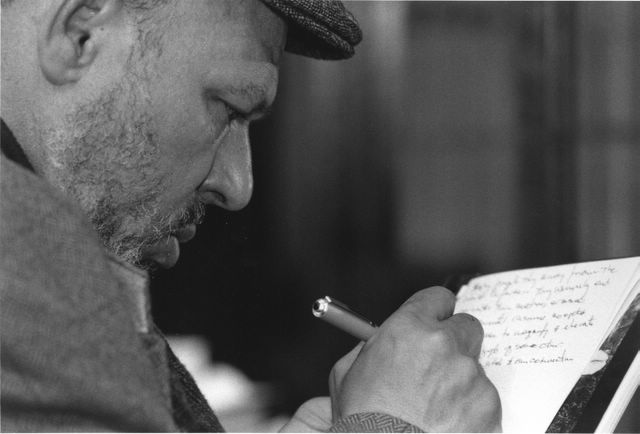
Folded into this eccentric mix was a young man, yellow-skinned and soft-spoken. He often crouched in the shadows, scribbling, always scribbling, capturing snatches of life on napkins or scraps of paper. In his white shirt or natty cap, the young man occasionally stood and recited the poetry of others. Soon, finding the strength and voice to present his own words.

The young man was August Wilson -- before he became a Pulitzer Prize-winning playwright heralded for his 10-play cycle that would chronicle and serve as a metaphor for the 20th-century black experience in America. Much of it takes place in the Hill District.

Mr. Wilson's plays are fueled by strong, unsung characters -- garbage men, blues musicians, ex-cons, domestics and mystics. All streetwise philosophers and storytellers. In many ways, they are like Mr. Wilson, before the fame: as humble and peculiar a character as any that made its way into his opus of black struggle and triumph.

"Everybody was an oddball in the Hill," said Mr. [Amir] Rashidd, sitting in the basement of Monumental Baptist Church, Hill District, where he fondly shared a thousand memories of his old friend.

They included Sy Morocco, painter, sculptor, musician; Charlie P. Williams, poet; Maisha Baton and Rob Penny, poets and writers. Out of this groove came the Kuntu Writers Workshop and the Centre Avenue Poets, who made protest a song.

Mr. Rashidd moved to Pittsburgh in 1976, and over the years, his friendship with Mr. Wilson deepened. In their quiet moments, Mr. Rashidd would pull out his harmonica and the two would sit down and talk. In Mr. Wilson's theatrical world, bits and pieces of real-life show up in his plays: In "Seven Guitars" there's a harmonica player, Canewell, among seven friends in 1940s Pittsburgh.

Mr. Wilson, with his scraps of paper, took notes as life rolled along at Florentine's, a bar on Wylie; at Mom's Pan Fry, where an old man told stories out of the Bible as if he lived through them, and the Virginia Bar, where the proprietress who survived the Depression ruled with a grand flair. Before the night fell, Mr. Rashidd recounted that on many a day, his friend walked over to St. Joseph, a Catholic care home for indigent men.

There, on Bedford Avenue -- not far from where the house he was born in is crumbling -- Mr. Wilson would get a cheap lunch and listen to all the old timers. "He'd ask them to talk about the Hill."

After Mr. Wilson found fame, he'd occasionally come back home and the two would rendevous at Eddie's Restaurant on the Hill. Mr. Rashidd ate peach cobbler and Mr. Wilson drank black coffee and smoked. The owner, Eddie Owens, died five years ago, and the eatery, known for its home-cooked meals, closed soon after. But in its heyday, scruffy little Eddie's was a favorite hangout for Mr. Wilson.

That's where[waitress Thelma] Ms. Smalls met him. "August would come in and sit at the counter. He'd sit there all day." He'd always have the same meal: two eggs over easy, home fries and biscuits with butter and jelly or wheat toast. "He drank his coffee black and he asked that I keep it coming," said Ms. Smalls. He was nice, she recalled, but he was quiet and "people thought he had issues," because he carried all these papers around.

In the restaurant, Ms. Smalls remembered the playwright would joke around only with Mr. Owens, who occasionally put him out to make room for a paying customer. For one day, Mr. Wilson washed dishes for Eddie's. He lost his job when Mr. Owens found him in a booth scribbling, scribbling, always scribbling.

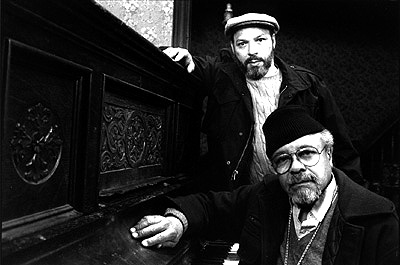
August Wilson and Lloyd Richards Posted by Picasa

Tuesday, October 04, 2005


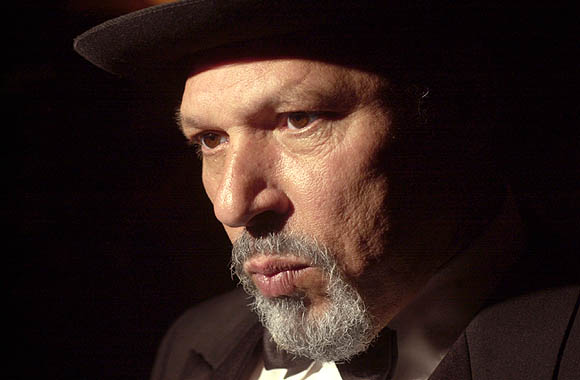
August Wilson Posted by Picasa
Appreciating August

From "The Cycle of August Wilson's Life Over Two Decades And 10 Plays, He Spanned The History Of Black America"
By Peter Marks Washington Post Tuesday, October 4, 2005;

The death of August Wilson does not simply leave a hole in the American theater, but a huge, yawning wound, one that will have to wait to be stitched closed by some expansive, poetic dramatist yet to emerge.

To say that Wilson was the greatest African American playwright the nation has produced -- as some inevitably do -- is to limit the scope of his significance as a contributor to the country's dramatic heritage. Wilson wrote scathingly about racism, yes, in "Ma Rainey's Black Bottom," and the indelible scars of slavery, in "The Piano Lesson" and "Gem of the Ocean." He also wrote about the Oedipal conflict of fathers and sons ("Fences") and the universal quest for the easy score ("Two Trains Running"). His concerns were as multifaceted as the hard-pressed people he wrote about.

Over the past 20 years, Wilson had staked a legitimate claim to the title of nation's most important dramatist. During that time he won two Pulitzers and a Tony, and among his plays he polished off at least three that will rank among the classics: "Ma Rainey," "Joe Turner's Come and Gone" and "The Piano Lesson," along with what will perhaps endure as his favorite with audiences: "Fences," the story of an embittered former baseball prospect, played on Broadway by James Earl Jones.

All this may not have meant as much as it did in the days when playwriting giants roamed the countryside, when a new play by Tennessee Williams or Arthur Miller or Eugene O'Neill had the power to galvanize public discourse, and even land an actor on the cover of a national magazine. We've moved away, sad to say, from the era of the stage as a truly vital pulpit. In the commercial realm, Wilson's plays were usually not moneymakers. But the fact that he could consistently count on clicking the "send" button and having a play end up in the in box of Broadway -- even in this lean and inhospitable time for serious drama -- stamps him as a theater man of nothing but consequence.

Wilson died ludicrously young on Sunday, at the age of 60 in his adoptive home town of Seattle, where he wrote plays, big, garrulous, angry, lyrical, ponderous, often beautiful plays, in an office in his basement. He went public with his terminal liver cancer a little more than a month ago and when he did, he came forward with a breathtaking serenity. He pronounced himself prepared for what was coming. "I've lived a blessed life," he told the Pittsburgh Post-Gazette, the paper of the city of his birth, the metropolis that served as backdrop for many of his major plays. "I'm ready."

MORE HERE

Monday, October 03, 2005


August Wilson in Pittsburgh in 2001. Bill Wade photo
posted on www.post-gazette.com Posted by Picasa

The Daily Quote

"CANEWELL: Having a nice guitar don't make you play no better.
FLOYD: Not if you don't know how to play. But if you already know how to play good, a nice guitar will make you feel better about yourself. If you feel better about yourself, quite naturally you be able to play better. People see you with a nice guitar they know you put the music first...it will work its way to the front. I know. I tried it many a time. I say, 'Let me put this music down and leave it alone.' Then one day you be walking along and the music jump on you. It just grab hold of you and hang on. Ain't too much you can do then."

August Wilson: Seven Guitars

August in St. Paul in 2002, where he became a playwright. Posted by Picasa
August Wilson 1945-2005

August Wilson, one of the great playwrights in American theatre history, died on Sunday. He had been diagnosed with inoperable liver cancer in late summer, and began telling friends that he’d been told to expect only a few months left of life. He died in his home city of Seattle, surrounded by family.

It was a shock to me, for I’d missed the news of his illness. If I still lived in Pittsburgh, I would have seen it in the newspaper there. Chris Rawson, the Post-Gazette drama critic, was one of the first people August told.

I can call him August because I knew him a little. I met him at the Eugene O’Neill Center in Connecticut during the summer playwrights festival, where he had developed his first commercially produced play, “Ma Rainey’s Black Bottom,” and where he returned several times afterwards with new plays.

He was there that summer as a dramaturg, and I was writing a story for Smithsonian magazine. I interviewed him for an hour or so, and we soon got to just talking. We had a surprising amount in common, especially having grown up in western Pennsylvania at around the same time.

The O’Neill program lasts a month, and I was there for two weeks of it that summer. So for half of July, I saw a lot of August. We had us a time or two. Even though I wasn’t there as a playwright or actor (many came up from New York---real pros who you see on New York dramas like “Law and Order” but who care most deeply about theatre), I got a taste of the O’Neill bonding. So when I would run into August after that, always in Pittsburgh where I lived then, we always picked up where we left off.

I saw him after the world premiere of “Jitney,” his early play that he rewrote to be part of the grand cycle, which of course we all called the Pittsburgh Plays (all but one are set in Pittsburgh.) In fact, the locations are so real that the actual neon sign of the bar in this play was borrowed from the real bar in another part of the city.

The last time I saw him was in downtown Pittsburgh, just after a dinner at which he’d gotten one of his many awards. I drove down there just to say hello. Even though he was always surrounded by important people in those settings, he never failed to talk to me. That night he told me proudly that he’d quit smoking. This was an O’Neill thing---everyone there had pledged two goals: to get Lloyd Richards and August both to quit smoking. As it turns out, August didn’t really quit. Chris Rawson reported that in 2004 he was “down to two packs a day.” But he knew it would make me happy to hear it.

He mentioned one or two people we knew in common from the O’Neill, and said he’d lost track of others. “They write me letters, and when I don’t write back, they stop,” he said sadly, with a touch of proper Catholic-school guilt. (Something else we had in common.) So now I feel bad that I never went to see him in Seattle, and though I think I did write to him once from here in California, I may not have actually mailed that letter.

As for the achievement of August Wilson, it is first of all historic. No other American playwright set out to accomplish such an ambitious cycle of plays, and kept those creative energies working until it was done. To combine an acute understand of history and culture with great drama and dialogue is simply unprecedented. Though the earlier plays in the cycle are better known, the later plays establish connections with each other and with these earlier plays, so the ten are a true cycle. Even in the sense that the location of the play set in the first decade is the location of the play set in the tenth.

By his example and by his insistent voice, August Wilson did more to bring African American culture into the precincts dominated by ruling class and upper middle class white culture than anyone else in the past 30 years, and more than any other playwright in the 20th century.

And of course he provided wonderful moments of drama, laughter and song for those of us who experienced those plays, mostly as audience in the theatre, but also as readers. He worked with the rich rhythms of speech, capturing the cadence of black American talk and infusing it with a magical lyricism. He transformed the emphatic repetitions and insistences of people who had to use every device to be heard into incantations with the power of memory, tragedy and soaring spirit.

Even before he was diagnosed, August Wilson’s thoughts had turned to death. In a wonderful interview in 2004 with Christopher Rawson, the drama critic of the Pittsburgh Post Gazette, Wilson admitted that turning 60 was affecting him, and that he thought about death every day, and felt he had to expect its possibility.

But even though he saw the end coming, and at that time was literally seeing the end coming for his cycle of 10 plays about the black experience in America in the 20th century (one play set in each decade), he was still full of ideas and plans. He had several plays planned beyond this cycle, which he described to Rawson. It was something he loved to do. I sat one dinner time at the O’Neill with one or two others and listened mesmerized as he told the story of his next play, doing the voices and the dialogue.

His creative energies were unabated, and his work seemed to be changing with his final play, “Radio Golf,” set in the 1990s. He’d written and performed a one-man show, and one of his planned plays sounded wildly comic. He told Rawson it would make a great movie. He’d also expressed the desire to write a novel, and he always wrote poetry.

The loss of the work he would have done is a loss to us all, and for those of us who knew him, even briefly or in a series of brief experiences, we’ve lost the chance to encounter again all that warmth and vitality, that dangerous fire and that amazing generosity.

But we do have the ten plays, an unprecedented achievement in American drama. And he had the satisfaction of knowing it. “Yeah, man,” he told Rawson, with a big smile, “I did it!”

His sixty years---and especially the last twenty or so---were full and fulfilling. He loved his children, and his last marriage in particular seemed to make him happy. He had the good fortune to find terrific people to work with, and the good sense to stick with them. He was very loyal, and people were loyal to him. I don’t know of any writer who had a better life in the theatre, even in recent years when financing for serious plays got difficult, even by a multiple Pulitzer Prize winner.

He often started his plays at the O’Neill, where he reveled in the participation of actors and everyone in the summer community, gathered from all over the country. He saw and heard his play begin to come to life there, and began rewriting---honing, adding, subtracting—a process that continued in the parade of productions (at Yale, the Huntington in Boston, etc.) that took him to the official premiere.

He took such pleasure in this process. (It’s easy to understand---words and characters that had been only in his head, only written down on pads of paper in coffee shops—walked and talked in front of him!) Everything became part of the process. An actor’s suggestion might become an immortal line. When he saw the costume sketches for several characters in his 1990s play, Radio Golf, he said, “so that’s what they look like!” and this gave him more ideas for changes in the play. It was a magical exchange---the writer and the people who brought his words and dreams to life, all of them grateful for each other.

There is mourning among theatre people all over America tonight, and already there is a Broadway theatre to be named after August Wilson. Even more than to his achievement, it is a testament to to his personality, poetry and vitality that Pittsburgh (where he grew up) and St. Paul( where he lived for over a decade) and Seattle (where he lived most recently) will all be claiming him, as will the O'Neill, and Yale, and the Huntington and all the theatres where his work will continue to be seen. We wish he could have lived longer, but he lived fully while he was here, and we must be grateful for all that he gave.

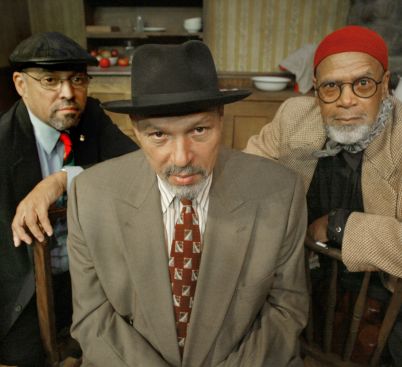
August Wilson at a 2005 rehearsal of his last play, "Radio Golf."
Pittsburgh Post Gazette photo Posted by Picasa

Saturday, July 09, 2005


August Wilson Posted by Picasa

Summer and Theatre, Part I

Summer and theatre go together in many parts of North America. When I lived in Pittsburgh, there was a heady (and hearty) combination of the summer Shakespeare festival at the University of Pittsburgh (with plays in the round stone castle called the Stephen Foster Memorial) and a new plays festival at Carnegie Mellon University down the street.

But the best experience I had was two weeks in Waterford, Connecticut, reporting a story on the National Playwright's festival of the
Eugene O'Neill Theater Center. To closely observe the process of bringing together new plays by new and veteran playwrights with skilled and dedicated directors and dramaturgs, and deeply involved actors from New York, was to glimpse and even touch the special creative energy that I've witnessed only occasionally, but that confirmed what I had hoped and believed such a process could be. Lively, crazy, caring, aware, intelligent, conscious and fun.

Plus I got to hang out with the likes of
'>August Wilson, Lloyd Richards, and some young playwrights who have since been responsible for theatre, movies and especially a lot of the television of the last decade, such as Law and Order and the series we're currently seeing on video,'> Six Feet Under.

This year's conference is going on right now, and features the return of playwright
'>Lee Blessing, who was already a conference legend when I was there. He'd been very young on his first visit, and people remembered seeing his play there, A Walk in the Woods (dialogues between an American and a Soviet arms negotiator) on the Fourth of July.

It was more than a decade ago that I was there, but every year at around this time I think about it. If you'd like to read about that summer, I posted an expanded version of my article---just follow the bouncing link...

MORE