This is part of the intermittent but ongoing series, Soul of the Future. It is a history that eventually leads to speculations on things to come, but always mindful of major current issues likely to shape the future of humankind and planet Earth.
In the 21st century, the most likely apocalyptic future we face involves effects of the ongoing and accelerating climate crisis, as well as the biological, economic, political and societal effects of other ongoing, accelerating, significant and interacting categories of environmental destruction.
In the later half of the 20th century, the most likely apocalyptic future scenario involved thermonuclear war and its effects. Though this threat is by no means over—some believe that chances for accidental triggering of a nuclear exchange are actually higher now than during the Cold War—it has largely disappeared from view. That the threat or even the nature of nuclear weapons has retreated from public consciousness—and perhaps unconsciousness—is part of the danger.
Further, the geopolitical stresses caused by climate crisis effects--which include mass migrations, drought, disease and food shortages--could result in armed conflicts. So the climate crisis may include nuclear war as well.
How 20th century societies dealt with the looming spectre of thermonuclear war, directly and indirectly, may help to illuminate the mood today regarding the climate crisis future, and could offer useful lessons for how to deal with both the actual climate crisis future and the present set of complex responses, that include confusion, fear, anger, and a certain blankness, suggesting both passive and active psychological denial.
The strictly rational attempts to study the future foundered almost immediately, precisely because of the nature and enormity of the Bomb.
There were a number of likely reasons the futurism of the 1950s through the 1970s faded. In some respects it wasn't an internal failure, but the result of political power and cultural mood that preferred to ignore any possible future but more of the same.
But there were internal problems. For instance, the predictive methodology couldn’t accommodate enough of the relevant information. Perhaps the information couldn’t be quantified, or it was unknown or poorly understood, and all too often it was just judged irrelevant, basically because it didn’t fit the system. So it was just not considered.
One area of failed foresight became obvious right at the beginning of the modern approach to prediction, even if those involved could not see it.
 |
| Herman Kahn in 1950s |
As described
earlier in this series, the first methods and technology for predicting alternative futures were developed largely by and for the RAND corporation in the 1950s, and notably applied by Herman Kahn and associates to predicting aspects of future nuclear wars. But the atomic bomb—and even more, the hydrogen bomb—had itself revealed some of the dimensions these operations ignored, which were further focused by responses to the published results, as in Kahn’s books.
Some of these factors had to do with deciding the importance of certain data, such as the effects of radiation and the likelihood of “megadeaths.” The debates over relevant information regarding nuclear explosions and its accuracy involved evidence of government deception and outright lying.
But the Bomb broke the boundaries of the rational. It surpassed ordinary understanding, and responses to it reached deep into the human unconscious. As time went on, and any questioning of nuclear weapons development became unpatriotic as well as seemingly irrational, present fears were themselves driven into hiding, added to the unconscious.
At the same time, purely rational means of discussing and dealing with the Bomb were increasingly seen as absurd. And by the 1970s, purely rational means of studying the future--through computerized comparative analysis, cross-referenced and interacting statistics and so on--were increasingly seen as inadequate.
Instead, public responses--and future visions-- were also expressed and shaped elsewhere: in story. Apocalyptic visions in particular dominated the movies.
The range of allowable opinions became constricted shortly after the end of World War II. But at first, the revelation of the Bomb’s existence and power, especially in the devastation of two Japanese cities (Hiroshima and Nagasaki) came as a profound shock to many. It was widely seen as a doomsday weapon—if not yet, then soon.
A characteristic first response was that of war correspondent Eric Severeid, who became the analytical voice of CBS television news in the 1960s and 1970s. When he first heard about Hiroshima, he wrote in his memoir:
“It was like a heavy blow to the chest, and the concussion left me in a kind of mental coma for days. It seemed then for a time that everything was not only uncertain but pointless. It seemed to me that everything I had learned was junk for the trash barrel, that everything I had seen was senseless illusion, that all I had come to believe was hollow mockery, that all my life to this point had been lived for nothing.”
“Life must go on,” he concluded. “Now the issue was squarely put to me and my generation, whose real trial and test was now revealed to be not at all accomplished [by World War II], as I had imagined, but to lie just ahead.
How was life to go on?”
Immediately after the war, an official US government report strongly supported the international control of nuclear weapons, partly because the US atomic monopoly couldn’t last. The idea was supported by scientists and even high-ranking military officers. But even before the war’s end, the US government had identified the Soviet Union as a dangerous adversary, and immediate postwar moves in Europe solidified this belief. So the government increasingly saw the Bomb as the American advantage.
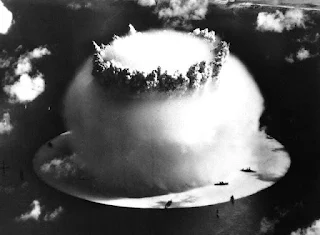 |
Operation Crossroads began on June 30, 1946, with
the Able explosions and later in July, with the larger
Baker series that yielded this iconic image. |
In late June and July of 1946, the US tested a new generation of more powerful atomic bombs at the Bikini atoll in the Pacific, and despite negotiations in the UN, it became clear that US government policy was to maintain and develop nuclear weapons on its own.
After that, suggestions of international controls or world government, or other questioning of government policy regarding nuclear weapons were quickly and thoroughly squelched as unpatriotic.
Such a charge of "subversive" beliefs became particularly potent in the McCarthy era of the early 1950s, when such dissent was not tolerated, and could lead to prison, loss of livelihood and exile from the community. Even without such dark sanctions, social pressure and the habits of identifying with government policy in wartime—now Cold War-time—as well as a certain logic to the standard argument (the enemy has these weapons, so we must have them, and maintain our superiority)-- and a mental and emotional paralysis in response to the inconceivable enormity of the Bomb and its ultimate threat, kept dissent and questioning to a minimum.
For most people, in day to day ordinary life it was better to ignore it all. What else could you do? So any new or nagging questions were driven underground, and those that could not be articulated—even to oneself—might very well end up buried in the unconscious.
Part of the shock was the suddenness. The Bomb was developed and deployed in secret, and the first official news of its existence was the news of its first use to destroy a city. But some saw it coming.
Long before this—even before the first Bomb exploded—science fiction writers were examining possible atomic futures. H.G. Wells wrote about (and named) the atomic bomb in 1914.
In the 1940s, science fiction authors wrote so much about the atomic bomb and atomic energy that John W. Campbell, editor of Astounding magazine who presided over the Golden Age of the pulps (and was trained in physics), was questioned by a US government agent, alarmed that pulp fiction writers might be stealing ideas from the still secret Manhattan Project developing the real atomic bomb, rather than using their own knowledge and imaginations. Tales of atomic warfare horrors became so common even before Hiroshima that Campbell complained he was receiving too many.
The science fiction pulps were marginal, even disreputable to both the mainstream literary culture and to much of the public. When these kinds of atomic horror stories (and the "bug-eyed monsters") made their way into the movies, they were also considered marginal, and easily ridiculed or more often just ignored by officials and official culture. It helped that many were scientifically silly, visually unconvincing and badly done.
But some were especially effective. They were more than old scare stories with modern villains and embellishments. They were an expression and an escape valve for fears and anxieties about nuclear weapons as well as the scientists who created them, and the military industrial complex that supported them.
In particular there was one film that not only expressed layers of emotion from the unconscious, but dealt dramatically with controversies over real world evidence, particularly effects of radiation. It has the singular feature of being both one of the first such movies, and a film that went largely unseen for fifty years. Yet it also created a modern icon, and launched a series of movies that is still ongoing, some 65 years later.
When
Godzilla: King of the Monsters became a hit movie in the US and around the world in 1956, the theme of a monster created or unleashed by nuclear explosions was no longer completely new.
In other respects as well,
Godzilla was an unlikely success. It had no action hero, no damsel in distress. Except for one American, a reporter who did little but observe things (played by a pipe-smoking Raymond Burr, a few years before his fame as TV’s Perry Mason), all the characters were Japanese. Just a decade before, the Japanese were enemies, and widely caricatured as evil, sniveling, cruel, heartless and racially inferior.
Americans still knew little about Japanese culture, and a movie set in Japan was rare. Any foreign-language film was rare. Subtitles were as yet unknown outside of a few art houses.
Godzilla was dubbed, and on the cheap: the voices of all the male Japanese characters were dubbed by the same Asian American actor, and pretty much all sound the same.
Nevertheless, the monstrous Godzilla was the star, and the heavily promoted film not only became a global sensation, it generated a seemingly endless series of sequels and similar movies that transformed the Japanese film company that created this footage into an international studio.
But it took 50 years (and more than 25 Godzilla sequels) before the original 1954 Japanese film, now known as
Gojira, was screened in a few US theatres. It later became available on disk and online. We can see it today not only as an early and conscious response to nuclear weapons using symbolic means, but as a perspective from the only nation that has so far suffered nuclear attack.
(For those who have seen the 2019 bloated film travesty with the same title as the US Godzilla in 1956, I refer to a
critique here. Some of the reasons for this blistering rejection can be found in the differences between that movie and the one I describe here, the 1954 original
Gojira.)
The 1956 US version of
Godzilla added 20 minutes of Raymond Burr and a few Hollywood actors, while cutting some 40 minutes from the original Japanese film, rearranging and re-purposing scenes and characters.
Those 40 minutes turn out to be crucial to what this movie can tell us about how one of the first nuclear monster movies expressed a range of unconscious responses as well as consciously intentional evocations of controversies regarding nuclear weapons, by filmmakers of the country that a scant 9 years before was the sole victim of atomic attacks.
But it was not only a response to history. The precipitating event that led to
Gojira happened just months before it was made, and in the same year that it was originally released.
Still, it is worth reviewing the history. (It is in fact always worth reviewing this particular history.)
On July 16, 1945, the US exploded the first atomic bomb in its only test, near Alamogordo, New Mexico, not far from the Los Alamos laboratory where it was developed. It exploded with such brightness that a woman blind from birth traveling in a car some distance away saw it. "A colony on Mars, had such a thing existed, could have seen the flash," historian Gerald DeGroot wrote in his book,
The Bomb: A Life. "All living things within a mile were killed, including all insects."
On the same day, a fifteen-foot long crate carrying the components of a second bomb was loaded aboard the cruiser Indianapolis at Hunters Point Naval Shipyard in San Francisco, bound for Tinian Island in the western Pacific where it would be assembled. The cruiser left San Francisco four hours after that first explosion.
On August 6, an American bomber dropped this atomic bomb on Hiroshima, destroying much of the city. According to author Arthur Koestler, this made it the most important date in “the history and prehistory of the human race...”
 |
| Nagasaki as the Bomb exploded |
Three days later, another atomic bomb devastated the city of Nagasaki. Some 75,000 people died in Hiroshima from the blast and fire. Five years later, radiation effects more than doubled the dead, to some 200,000. The vast majority of those who died from the Nagasaki bomb were from radiation, months and years later. Some effects of radiation were apparent within days and weeks, which included very ugly and painful immediate illnesses, as people decayed from the inside. Other effects, principally cancers, took years.
 |
| Nagasaki, afterwards |
American officials denied these first immediate radiation effects were real, claiming the reports were Japanese propaganda.William Laurence, the only reporter permitted to follow the Bomb's development, echoed the charge.
But the contrary truth entered public consciousness with the publication of John Hershey’s
Hiroshima, first in an August 1946 issue of The New Yorker magazine, and then as a best-selling book. In it, the stories of six Hiroshima survivors ended with riveting accounts of the ongoing effects of radiation. Yet even after radioactive fallout entered the news, American officials insisted that radiation exposure was painless to humans and test animals. General Leslie Groves, the head of the US atomic program, testified to Congress that radiation poisoning was "a very pleasant way to die."
 |
This well-known image may have inspired the
mother and children scene in Gojira |
US government officials were still denying that radiation posed substantial threats when the first U.S. hydrogen bombs—vastly more powerful than even the largest atomic bomb-- were being exploded in the Pacific in the early 1950s. At this point in history, the US military was occupying the defeated nation of Japan, changing its form of government as well as many aspects of its culture. That official occupation ended in 1952, just two years before
Gojira.
In 1954 Japan was a sovereign nation but still dependent on the US to a degree, as well as a political ally. There were still US troops based in Japan. But given Japan’s recent history as the only nation to have felt the wrath of atomic bombs, many of its citizens cast a wary eye on these thermonuclear bomb tests conducted very close to their shores.
On the first of March in 1954, sailors were on the deck of a Japanese fishing trawler out in the Pacific when they were startled by an astonishingly bright light at the horizon. It lingered long enough to illuminate the clouds and the ocean itself. One of the sailors ran to his cabin where another sailor was humming a song, and blurted out the same sentence as did a distant witness to the first atomic test at Los Alamos: “The sun rises in the west!” Crew members still on deck finally heard the deep rumble of an explosion, and were soon coated with gray ash.
 |
| one of the Lucky Dragon crew with radiation burns |
This was the Diago Fukuryu Maru, translated into English as the Lucky Dragon #5. By the time it returned to port two weeks later, some in the crew of 23 were covered with sores from burns, and many were suffering the classic symptoms of radiation sickness: nausea, bleeding gums, pain in their eyes, headaches. The first death was recorded in September.
The bright light and radioactive ash came from the Bikini Atoll, where the U.S. exploded its most powerful hydrogen bomb. It was twice as potent as expected. Its fireball was more than four miles wide. Its 62 mile-wide mushroom cloud reached 130,000 feet into the sky, dropping radioactive dust on more than 7 thousand squares miles of the Pacific. Susceptible to this fallout were several small islands and more than a hundred fishing boats like the Lucky Dragon #5.
Doctors and scientists in Japan immediately recognized the radiation effects. They had seen them before. They also measured excessive radiation in the fish aboard the Lucky Dragon and other boats, and this new threat caused panic in Japan that spread around the world. United States officials responded to Japanese requests for information with official lies. The head of the Atomic Energy Commission, responsible for the tests, denied any ill effects could be from the Bomb test. It took more than thirty years for such official lies to be fully exposed.
The story of Japanese tuna contaminated with radiation, and the denials of responsibility by American officials, came and went in in US news media but it was a persistent and detailed story in Japan. There the media quoted one of the hospitalized Japanese fisherman: “Our fate menaces all mankind,” he said. Tell that to those who are responsible. God grant that they may listen.”
Almost immediately, Japanese film producer Tomoyuki Tanaka took clippings about the Lucky Dragon incident to the Toho Motion Picture Company and proposed to replace a foundering film project with a movie about a prehistoric monster awakened by the Bomb. The movie would begin with a scene on a fishing boat, evoking the Lucky Dragon incident. If any Japanese viewers missed the point, the detail of a life preserver marked #5 might focus their attention.
 |
| Hiroshima |
Ishiro Honda, a young documentary filmmaker and friend of Japan’s greatest director, Akim Kurosawa, wanted to direct it. The son of a Buddhist monk, he’d been drafted into the Japanese military during World War II and was a prisoner of war in China. Returning to Japan at war’s end, he passed through the devastated city of Hiroshima. This was to be his statement warning of the dangers of nuclear weapons.
This is just one aspect of
Gojira, though it is the organizing principle for everything else. It was first of all a monster movie, something Japanese cinema had not previously attempted. But there had been a recent internationally successful re-release of the original 1933
King Kong in Japan as in most countries. Probably the Japanese filmmakers were aware as well of an American film of the year before,
The Beast From 20,000 Fathoms, which was the first movie monster to be unleashed by atomic bomb explosions. But
Gojira is different in several ways, most notably as reflecting a unique Japanese perspective.
There are many unconscious themes evident in this movie, that suggest the range of possibilities when applied more generally. But the subject of nuclear radiation was also a conscious theme, woven throughout the film.
After the opening scene of the bright light and explosion swamping a fishing boat, the film shows a shipping office, crowded with people worried about those missing from a series of other unexplained ship disappearances. One of the few survivors of these ships washes ashore at a fishing village on Odo Island, barely alive. He is reunited with his family there. A village elder recalls legends of a sea beast called Gojira who had sometimes raided the coast for food. In the midst of a storm at night, a huge but barely glimpsed creature destroys wooden houses and kills many villagers, including that sunken ship survivor.
After several villagers testify before an unnamed government body, an esteemed paleontologist Dr. Yamane leads a team to the island to investigate.
(Yamane is played by one of Japan’s most distinguished actors, Takashi Shimura, who appeared in most of Akim Kurosawa’s films and starred in several of the best known internationally, including
Rashomon and another 1954 release,
The Seven Samurai.) Yamane finds a prehistoric organism in a huge radioactive footprint on the beach. Later he is among those on the island who see Gojira’s head roaring over a high hill.
In a key scene (much of it missing from the 1956 US version), Professor Yamane reports to the same government body. He believes Gojira is from transitional species, a deep sea creature becoming a dinosaur, who was driven from his niche by nuclear explosions.
Further, he believes, those explosions transformed it. Absorbing enormous amounts of radiation, it has itself become radioactive—with the traces of Strontium 90 that link it to nuclear blasts. Gojira was not only evoked by the Bomb; it has become the Bomb. This sense of Gojira will become clearer as the movie goes on.
But this government session quickly erupts in controversy. One faction (represented by a male speaker) wants to keep these finding secret, to avoid public panic. Another (represented by a female speaker) demands that the information be made public, so that people can prepare.
This was perhaps the most political moment of the movie. Secrecy had dominated US policy concerning nuclear weapons, from the initial development of the first atomic bombs at Los Alamos to studies of the Bomb’s effects.
Nuclear bombs kill first with their titanic blast, and then with the fires they create and cause. The scale of these effects are many times greater than conventional bombs, but the basic phenomena were known from other explosives. However the longer-term effects of nuclear radiation was new, and it captured public attention, especially when it was learned that radiation—in what was called “fallout”-- can spread many hundreds of miles, through the atmosphere.
It was on radiation effects that the US government was most secretive, as well as openly deceptive. This only increased public interest and alarm.
Photos of Bomb victims in Hiroshima disfigured by blast, burns and radiation had been widely circulated, even in the U.S., by the mid 1950s. That radiation could cause mutations in the children of those exposed was a particular topic of both justified and unjustified concerns and fears. Gojira represented this aspect as well—radiation had changed it. Even its design incorporated the look of disfiguring scars from photos of victims in Hiroshima and Nagasaki.
Mutation would be an even greater source of anxiety in Japan, because that’s where some of the first evidence emerged, not only as a result of Hiroshima, but of nuclear bomb testing in the Pacific. The U.S. physician and writer, Dr. David Bradley, re-published his best-selling book on the 1946 postwar atom bomb tests,
No Place to Hide, and included new information, such as the results of a study of 406 Pacific islanders (probably very similar to those depicted in Gojira) who were exposed to H-Bomb fallout in 1954: nine children were born retarded, ten more with other abnormalities, and three were stillborn, including one reported to be "not recognizable as human."
This film indirectly confronted the secrecy, silences and lies that fed fears, particularly of nuclear radiation. But that was only the beginning of the strong feelings that this deep sea creature dredged up from the silent depths of the unconscious.
.
..To be continued. For earlier posts in this series, follow the Soul of the Future label, here or below.


.jpg)