Showing posts with label movies. Show all posts

Wednesday, March 22, 2023

TV and Me: Home Movies

 Television and I grew up together.  This is our story.  Latest in a series.

In the early to mid 1970s I lived in Cambridge, Massachusetts, at first freelance writing, then as the book review editor and finally managing editor of the arts section (half the weekly paper) for the Boston Phoenix, before I returned to freelancing, this time for national magazines.  For much of that time I was writing about new books, new records and concerts, new movies, new plays and only occasionally about television. (Although Mort Sahl read aloud from my piece on the Dick Cavett show, on the Dick Cavett show.)  So I wasn’t watching much.

 Most of my TV viewing in those years was late at night on a black and white set with a broken channel changer, and apart from news, PBS and Cavett I mainly watched movies.  There was a long tradition of movies on television, especially in the late hours.

 Movies were the easiest programs for television to broadcast when it began, but Hollywood resisted feeding this threatening upstart.  Movies appeared anyway in the early 1950s, mostly made in the 30s from hand-to-mouth studios like Republic and Monogram, plus British imports.  By 1955 or so, the major studios—now getting into television production themselves—released movies made as late as 1948.  Eventually there might be only a few years between theatrical release and a TV spot.

 As mentioned earlier in this series, movie cartoons, comedy shorts (included silent ones), faded western movies and serials like Flash Gordon were staples of Saturday morning TV for kids even in the early 50s. But in some ways, movies weren’t ideal. TV screens were small, picture resolution wasn’t good and reception was often iffy—this is one reason that most early TV shows were brightly lit and shot in medium and close-up.

 These viewing problems also prompted the TV editors of movies to discard darker scenes and wide shots first, as they looked for footage to snip and replace with commercials. But they weren’t consistent—I recall the Saturday morning boredom of trying to watch galloping cowboys chasing each other in the dark.  Murky viewing wasn’t caused only by television deficiencies—scratchy prints, inept editing and poor projection weren’t uncommon.

 Things had improved somewhat by the mid to late 1950s, when more than a thousand movies were available to appear at all times of the day and night, mostly presented by local stations but also from networks. One survey suggested that in 1955 alone, a quarter of television programming was comprised of old movies.

Carole Lombard in "To Be or Not To Be" (1942)
released to TV in 1955
 So I saw many old movies for the first time on television, including many I’ve never seen in any other way.  That I saw any movies at all before the age of 7 or so is due entirely to television. I couldn’t necessarily follow a complicated plot or dialogue at an early age, but I generally found something to like.

 Until I was 10 or so, I only saw a few movies on the big screen: Disney films at the theatre near my grandparents in Youngwood, and my father took me to see a few at the Manos or the Strand in Greensburg (I recall a Martin and Lewis comedy, and Killers From Space), before my classmates and I were bussed to Pittsburgh to see the latest Biblical epic (The Ten Commandments, etc.) at the big Cinerama theatre.  Eventually I walked every week with neighbor friends to Saturday matinees at the Manos, a faded movie palace just on the near side of Main Street in Greensburg.

 But thanks to television I could see dozens of old movies from the time I was 4, as long as they were broadcast before my bedtime. When they were made didn’t enter into my consciousness—for a kid, everything is either now, soon or in the indiscriminate past—but once again, I had an accidental, sideways education in movie history at an early age, partly because of the studio ban on newer films.

 The movies shown on television included major features with star actors, but most of them—especially at first—were serials (or compilations of serial episodes) and what were known as B movies.

 To tempt people back to theatres as the Depression seemed to ease in 1934, some exhibitors began showing two movies for the price of one.  In late 1935 the two largest theatre chains announced this would be the policy in all their venues across America.  The double feature was born, a movie institution that lasted for more than 30 years.  At first, however, the bonus movie was slightly different: almost always shorter, and shot on a smaller budget with lesser stars (some on the way up, and some on the way out.)  To contrast them with the big budget, big-star “A” films, they were known in the industry as “B” movies, to be shown before the main feature. 

"Bulldog Drummond's Bride" 1939
The B movies were among the first to populate television.  They were cheaper to acquire, and being shorter, they accommodated commercials more easily. Most were genre films—westerns (predominantly) and crime stories, plus war movies, romantic comedies, melodramas and musicals.  The often-strange Bulldog Drummond crime series was an early entry, and the Charlie Chan series. Perhaps even the Torchy Blaine movies (a 1930s woman reporter who became the prototype for Lois Lane.)  On a somewhat higher level, the Sherlock Holmes series with Basil Rathbone and Nigel Bruce made its first appearances in 1954.  I remember seeing Rathbone as my first Holmes. 

 Drummond and other B movies had noticeably quick rhythms, and that must have appealed to me.  (As Superman in the series, George Reeves made the quick movements of serial and B movie heroes, though in those films they were probably augmented by speeding up the camera to enhance the effect—and shorten the movie’s length.)  I adopted quick movement in my play after TV, and I loved running.  There was lots of running in B movies.

 At Dumont, the network that at first scheduled the most movies, both B movies and a few A features were often grouped by genres under banners like Frontier Theatre (westerns) and Adventure Theatre (Tarzan, etc.)  Since the only Pittsburgh station in the early 1950s was Dumont’s cash cow, I could see a lot of these movies. While my attention to the westerns wavered, the Tarzan movies, with action in the relatively contained jungle, were fascinating. There seemed to be a lot of World War II movies on TV, though Hollywood was still making them for theatres in the 50s, along with Korean war films, which we sometimes saw at Saturday matinees later in my childhood. 

 I’m naming some movies and actors I recall for two reasons: they comprise part of my cultural life history, and they became part of the cultural literacy of my generation-- in both cases mostly because of television.

  I saw some film stars of the 1940s on television programs, and perhaps recognized others (like James Cagney, Peter Lorre, Humphrey Bogart and Edward G. Robinson) from their cartoon parodies or variety show impressionists before I saw their movies. But eventually I would see many of those movies on television, if nowhere else.  I probably caught glimpses of their gangster films as a child. 

There are others however I knew directly from their movies, like Katharine Hepburn and Cary Grant (at least one of the films they did together, Bringing Up Baby, was televised in the mid-50s, and I seem to recall seeing Cary Grant in Arsenic and Old Lace.)

 I knew Jimmy Stewart from Harvey and It’s A Wonderful Life, which television made into a Christmas movie.  I knew Spencer Tracy, perhaps from one of his films with Hepburn but more likely from his role as Father Flanagan in Boys Town, a portrayal extolled by the Sisters at school.  And I certainly got an indelible impression of Henry Fonda when I saw The Grapes of Wrath on TV, an unforgettable movie.

Glenn Miller (top left), sax/vocals Tex Beneke
(bottom right) with singer Marion Hutton and
the Modernaires
  I recognized Fred Astaire, so I must have caught a dance or two from the Astaire and Rogers RKO films or his other musicals that were broadcast.  I was likely to have watched parts of the movies featuring Glenn Miller (Orchestra Wives or Sun Valley Serenade) if I happened on one, since I knew my mother had a particular fondness for Glenn Miller’s music, which I knew from records.  I’d seen Shirley Temple movies at an early age, but as with all these films, my attention was inconsistent, especially when I couldn’t follow the story.  By third and fourth grade my attention span improved, along with the ability to follow a more talky plot.

 Among the many movies I likely saw on TV, there were classic films of American and English directors I wouldn’t recognize the names of until later.  Until I left for college, this was virtually the only way I could see them. 

"Mrs Miniver"
I saw my first Hitchcock films on TV.  An early entry to TV was the 1940 Hollywood production of Foreign Correspondent. I seem to recall one of his early British films, The Lady Vanishes, as well as other British films of the 30s and World War II era. I saw British actors in American films or coproductions--I distinctly recall seeing Mrs. Miniver on TV, starring Greer Garson and Walter Pidgeon (who I recognized in Forbidden Planet on the silver screen.)  Perhaps I even saw Greer Garson play Elizabeth Bennet against Lawrence Olivier’s Darcy in the 1940 production of Pride and Prejudice. 

 I certainly saw Oliver on TV in Wuthering Heights and Hitchcock’s Rebecca, probably in high school.  And though it wasn’t until college, I saw Saturday Night and Sunday Morning and other 50s and 60s British films for the first time on television, when I knew to look for them. 

Sims in "A Christmas Carol"
At Christmastime as a child I remember seeing the Alistair Sims version of A Christmas Carol.  I remember my excitement at seeing an old Laurel and Hardy holiday movie in which human sized wooden soldiers come to life (Babes in Toyland, 1934.)

 
Apart from the genre groupings, the more important pictures (or at least the A features) with the biggest stars were seen on prime time or weekend afternoons under marquees like The Million Dollar Movie. I also recall the Sunday afternoon movie on KDKA, introduced by legendary Pittsburgh Post-Gazette movie and entertainment columnist, Harold V. Cohen, who also provided background during commercial breaks.  (Later that function fell to probably Pittsburgh’s most famous radio voice of that era, Rege Cordic.) I don’t recall the movies or what Mr. Cohen said, but I did get the idea that movies could be taken seriously, and that real people made them. 

 So it’s entirely possible that I saw a Charlie Chaplin feature there (Cohen was a Chaplin buff), or even Orson Welles films like The Magnificent Ambersons.  (However, it was at the Orson Welles theatre that I saw Citizen Kane, and remember that as the first time.  Or the first several times.) 

So there were plenty for me to see, though the bulk of movies were shown late at night.  For years, they were just about the only programming past the eleven p.m. news.  They often went by the title—or were referred to colloquially as—the Late Show.  And then the Late Late Show.  At one point back in the Dumont days our Pittsburgh station showed movies all night on Swing Shift Theatre.

 In 1963 the third Pittsburgh station (Channel 11, NBC) premiered the local Chiller Theatre with “Chilly Billy” Cardille (the prototype for SCTV’s parody Monster Chiller Horror Theatre by Joe Flaherty, a Pittsburgh native), but shows featuring horror movies had been around for awhile by then. Though I first saw the Frankenstein and Dracula movies on TV, I wasn’t as fascinated with horror movies as many of my schoolmates (they were especially fashionable in 1957-58, or my sixth grade.)


But I loved science fiction.  Since I’ve now seen most of the 1950s s/f classics on the big screen, I’m not entirely sure which ones I first saw on television, or at a Saturday matinee, or at the Orson Welles Cinema in Cambridge (I wrote about their first sci-fi festivals in the Boston Phoenix under the title “It Came From the Orson Welles.” My friends at the Welles turned the phrase into a t-shirt. This became an annual festival that outlived the Welles itself.)

 I’m guessing The Day The Earth Stood Still is one I did see on TV first.  But I’m sure about several classics made in the UK, especially since I’ve seen them only on small screens: The Day The Earth Caught Fire and Five Million Years to Earth remain two of the best of that era. 


 I also saw the original King Kong and Mighty Joe Young first on TV, enough times to notice, when I saw King Kong on the silver screen, that the first part of it (the preparation for the journey) was routinely cut on TV to fit the time slot and make room for more commercials.

 I saw Olivier’s Richard III on TV, but when I saw it again at a screening at the Westmoreland County Museum of Art, I was dazzled by the prologue that I didn’t remember. Possibly it, too, was cut, so on TV the movie began with Olivier’s “Now is the winter of our discontent…” speech. 

 Such cutting was a major flaw.  Apart from commercials disturbing the mood and narrative drive, missing or truncated scenes hurt the film and at times rendered it incomprehensible.  Seeing these old films whole could be a revelation.   

By the early 1960s, Hollywood studios loosened up on showing their 1950s movies, and their big hits from previous years. By this time some movies were being broadcast in color. The first showings of The Wizard of Oz (beginning in 1956) were big deals. However, most people still had black and white sets so the switch from sepia to Technicolor within that film didn’t have quite the same impact until most homes got color sets beginning in the mid 1960s.

 The networks responded to this new availability of more recent movies—especially color films-- with prime time movie slots: NBC had Saturday Night at the Movies, then adding the Monday Night Movie in 1963. By 1966 there was the ABC Wednesday Night Movie and the CBS Friday Night Movie, and so on.

 Movies became so popular that networks began to make their own, the so-called “made for television” movies, which constituted a genre of their own. With some conspicuous exceptions (like The Day After), I don’t count many of them as movies.  In any case, real movies and TV movies became a major part of prime time into the 70s and 80s. 

 I do have a few indelible memories of movies I first saw on TV at some point: The 1956 Edmund O’Brien version of Orwell’s Nineteen Eighty-Four which I saw in high school; the Ernest Borgnine movie version of Marty, which was one of those primetime network movies.  I recall that we happened to be at my grandmother’s when I saw it. 

Others include Go, Man, Go, the Harlem Globetrotters movie with a very young Sidney Poitier, and Poitier again with Paul Newman, Joanne Woodward and Diahann Carroll (as well as Louis Armstrong) in Paris Blues, directed by Martin Ritt.  Newman and Poitier played expatriate jazz musicians.  When the Newman and Woodward characters wanted to return to the states, the Poitier character didn’t: he felt free of American racism in Paris.  An eye-opener.

 I was probably in high school when I saw the 1959 Gregory Peck film about F. Scott Fitzgerald, Beloved Infidel, and in college when I was taken with the 1962 Jason Robards film of Fitzgerald’s Tender Is The Night.  I recall being especially moved by seeing the 1959 film about the aftermath of a nuclear war, On the Beach on television, though it’s possible I saw it first at a theatre. It also starred Gregory Peck, with Ava Gardner and Fred Astaire.

 I saw both the Glenn Miller Story (Jimmy Stewart, 1954) and the Benny Goodman Story (Steve Allen, 1956) on TV in the 60s, and later taped them from TV to see several times since.  Among the many other biographical films I saw on TV, the most powerful was probably The Life of Emile Zola (1937) starring Paul Muni, with its revelatory scenes exposing prejudice in the Dreyfus affair.

 By the 1970s I was in fact interested in old movies, learning about directors and cinematographers and so on. So at the Orson Welles and other repertory theatres in Cambridge I saw again (and this time, whole) movies I’d dimly encountered on TV. I also had learned enough about film history to know which movies I wanted to see when they appeared in the TV listings.

 So while I might watch whatever was on the late show after an exhausting day and evening at the Phoenix and some work-related outing afterwards, I also scheduled viewings of particular movies I hadn’t yet seen.  Watching movies on TV could be frustrating, broken up by blocks of commercials and often cut down to make time for even more ads. But you could also watch them from bed.

 Once when I was back freelancing, I decided to see how many movies I could watch in one day.  At that time, the Orson Welles Cinema had three screens, and on Saturdays they had a special film or two in the morning, then their regular rotation the rest of the day (usually a double feature per screen), and at least one midnight movie. For various reasons I could see movies for free there at the time, and so I spent one Saturday seeing eight films (though I might have snuck out to see one at another of the three other theatres within walking distance.)  After the midnight shows I went home and watched two more movies on television for a total of ten.  After which I was sick in bed for at least a week. 

There is nothing like seeing a great movie on the big screen of a movie theatre, and I’m grateful I had the opportunity to see many that way, either first run or later. In Cambridge especially, I had the additional experience of seeing directors and actors in person, along with their movies.  In Boston I saw an advance screening of what is now regarded as a masterpiece, A Woman Under the Influence, featuring an intense and heartrending performance by Gena Rowlands, and when the lights came up, there was Gena Rowlands standing in front of the screen, together with the director (and her husband) John Cassavettes. It was an amazing, almost ecstatic moment: the fulfillment of two fantasies--seeing someone step down from the screen into real life, and (a bit more prosaically) being able to talk to someone you've been watching immediately after the film is over (and I did get a chance, with a few others, to chat with them afterwards, in addition to asking questions in the public Q & A, with Gena Rowlands turning that full wattage sympathetic gaze directly on me.) 

 But seeing movies at home is also part of my history, and the small screen brought them to me early and often.  Though seeing films in the cinema is the ideal (I think of "Sullivan's Travels" in this regard),video also has its advantages, principally an intimacy with the screen and its images. Seeing these movies in childhood to adolescence, even if I didn’t follow the plot or notice the nuances, added a depth of feeling and experience when I saw them as an adult.

"The Grapes of Wrath" 1940
 It may be tempting to assume that in the first quarter of the 21st century, the variety and availability of movies is so much greater, what with streaming to a home theatre or a computer screen or a phone, in addition to the residual technologies of cable, satellite and DVD/Blu-ray, with ever increasing resolution and augmented sound.  But I’m not so sure.

  There was a kind of sweet spot in the 1980s, with several premium cable channels showing year-old releases, while channels like Turner Classic Movies and American Movie Channel showed a catalog of old movies, as well as Bravo for a few foreign films.  Meanwhile abundant video stores provided individual choice (and catalogs of foreign language films.) One could buy movies on cassettes or tape them off the TV, and play a particular movie whenever you wanted.  All of this while repertory theatres showing classic foreign and American films still existed in cities and college towns. Those films form the basic cultural and visual vocabulary of movies. 

"Sullivan's Travels" 1941
But now those rep theatres like the Orson Welles are largely gone, as are the video stores.  Those are really big losses, in terms of the movie experience but also curation and availability.

 Meanwhile AMC and Bravo show fewer movies in favor of phony reality shows, and there are fewer choices on the fewer old generalized premium channels. Streaming is a hot mess, as the new and old titans duke it out, and whether you can see a certain movie depends on which services you’re paying for, and whether they are showing that movie that month. 

It's Alive! "Frankenstein" 1931
Even then you may wind up paying an additional fee to see a particular movie, and not just brand new ones.  And that’s if you can find it. It seems to be much harder to see classic films and foreign films just about anywhere than at any time since the 60s. 

 There are a few streaming services currently which show medium-old movies (roughly from the 60s onward) without an additional cover charge, but with commercials.  But how free is it, if you must pay a hefty monthly fee to get Internet streaming, then pay out for Amazon Fire or some such device? In addition to your viewing and listening hardware.  But back when there were four to eight channels on a television set, there were movies galore. And they were all free. 

Thursday, December 29, 2022

R.I.P. David Warner and other actors 2022


When Alan Rickman died in 2016, stories emphasized his movie roles as villains, despite the actual range of the characters he played in dramas and comedies.  Yet the images and clips accompanying the stories often were from his only romantic lead (however offbeat a romance, in that his character is dead) in the wonderful film Truly, Madly, Deeply.

 Something similar happened when David Warner died in July 2022: stories focused on his villains, though he played more honorable characters, but the images were usually from his only film as an offbeat romantic lead, the 1966 Morgan: A Suitable Case for Treatment, known in the US also as simply Morgan! 

That movie, stylistically a quintessential 60s film directed in England by Karl Reisz, made a big impression on me when it came out.  Caught between working class communism he grew up with, and the self-satisfied world of the rich he married into, partly because he became a commercially viable artist, Morgan is a kind-hearted man who identifies his rebellion with the natural instincts of apes as well as the symbols of revolution.  He longs for his ex-wife, played by Vanessa Redgrave in her first film role, who is also torn between her accustomed comforts and Morgan’s rough charm.  The gap between his idealistic fantasies and reduced reality, as dramatized by his futile gesture of breaking up her wedding reception while dressed in an ape costume, gets him committed to a bucolic asylum.  

Warner’s character and performance in this film suggest what his 1965 performance as Hamlet might have been like: highly physical and mercurial, alternating catatonic brooding with sudden frenzies of speech and action.  When David Tennant was slated to perform as Hamlet in 2008, he made a short TV film in which he interviewed other actors who had played the role.  Most acknowledged that the greatest Hamlet of their lifetime was David Warner.

 Warner did play a lot of film villains, and eventually tired of it, but he also played Bob Cratchit in the 1984  George C. Scott version of Dicken’s A Christmas Carol, and the Klingon Chancellor modeled on Gorbachev (who also died in 2022) in the last Star Trek original cast feature film.  He played historical characters from Jack the Ripper to the young William Wordsworth.  He performed in at least two filmed roles in Chekhov plays: in the 1968 Sidney Lumet feature version of The Seagull, and a 1991 BBC production of Uncle Vanya.  He returned to the stage in the early 21st century, playing King Lear in 2005, the traditional capstone to a career that includes a Hamlet.

 Warner’s voice was always a stage asset, and became the source of his many roles in animated and audio stories that included playing Doctor Who.  Because of Morgan (and the fact that I identified with both the character and the actor), I followed David Warner’s career with affection as well as appreciation and admiration. 

It would take a book to begin to describe the importance of Sidney Poitier’s movie performances in the 1960s, just as the Civil Rights movement was moving into unavoidable prominence.  No history of the racial attitudes and official changes in those years would be complete without referring to A Raisin in the Sun, Lillies of the Field (for which Poitier became the first black recipient of the Best Actor Oscar), Guess Who’s Coming To Dinner, To Sir With Love and In the Heat of the Night.

 His career began in the 1950s, though he was a Blacklist victim for part of that decade.  In addition to more popular movies like The Defiant Ones, he was in some lesser known films I saw on television and loved: Go, Man, Go (a low budget look at the origins of the Harlem Globetrotters) and Paris Blues ( Blacklisted director Martin Ritt’s look at American jazz musicians in Paris, with comment on race issues, costarring Paul Newman and Joanne Woodward as well as Diahann Carroll and Louis Armstrong.) 

After the mid-1960s when he was the biggest box office draw in Hollywood, he turned to directing, producing and playing occasional lead and supporting roles, as well as political activism.  The only comparison I can come up with concerning his onscreen charisma and distinctive line-readings and physicality is Marlon Brando.   In 2009, his list of honors—and his work for racial justice—were capped by receiving the US Medal of Freedom from President Barack Obama.  He died in January 2022 at the age of 94.


 There aren’t too many actors left from the classic Hollywood period before 1950, so I take special interest in the ones whose names get one more mention as their deaths are announced. 

Angela Lansbury is the most prominent among them, for her career started in the 40s with two best supporting actress nominations, but it extended well into the 21st century on stage as well as television, where she was best known for her 1980s series Murder She Wrote.


Marsha Hunt
 Beginning at age 17, Marsha Hunt appeared in Hollywood films of the late 1930s through the 1940s (including the Laurence Olivier and Greer Garson version of Pride and Prejudice, and the 1944 film None Shall Escape, regarded as the first film about the Holocaust), and was Blacklisted for most of the 1950s.  She did theatre and played a few movie and TV parts in the 1960s and afterwards, and in the 1990s appeared in an episode of Star Trek: The Next Generation.  She remained a political activist and humanitarian.  She was 104.

 Mildred Kornman was one of the last surviving cast members of the Our Gang comedies in the 1920s and 30s, though she had a non-speaking role.  She was a bit player in 20th Century Fox films of the 1940s, and a magazine model. She was 97. As a child actor, Mickey Kuhn was the last surviving cast member of the 1939 blockbuster Gone With the Wind.  He appeared in other major films in the 1940s and early 1950s. He was 90.  Faye Marlow played a few leads and supporting roles in 1940s movies and early 1950s TV before becoming an author.  She was 96.  Nehemiah Persoff was a sometimes familiar face (when not disguised) if not a familiar name in supporting roles in more than 200 television shows as well as movie roles, including a few in the late 1940s. He was 102.  

Irene Papas in Zorba the Greek
Memorable performers from 1950s television passed away in 2022, among them: Tony Dow (Wally on Leave It To Beaver), Dwayne Hickman (Dobie Gillis), Tim Considine (Disney’s The Hardy Boys and various Disney movies), June Blair (Ozzie and Harriet—she played and was David Nelson’s wife), and comedian Pat Carroll (Sid Caesar, Danny Thomas shows.)  Actors in 1950s movies include Akira Takarada (Gojira), Hardy Kruger, Linda Lawson, Georgia Holt, Andra Martin and Greek actress Irene Papas, who went on to a film and stage career of more than 50 years.  Bernard Cribbins began his movie and TV career in this decade and it never stopped until he did—he’d become a beloved icon in the UK.

Yvette Mimieux
 Actors who helped characterize the 1960s include Nichelle Nichols, Yvette Mimieux , Henry Silva, James Olson, Mitchell Ryan and Ann Flood as well as European actor Monica Vitti (Antonioni films.)


Sally Kellerman & J. Caan

Actors first associated with the 1970s include James Caan (The Godfather), Louise Fletcher (One Flew Over the Cuckoo’s Nest), Sally Kellerman (M*A*S*H), Howard Hesseman, Dani (Truffaut films), Bo Hopkins, Ruth Madoc, Stuart Margolin (The Rockford Files), David Birney (Bridget Loves Bernie); Emilio Delgado and Bob McGrath (both Sesame Street perennials), Bob Elkins, Susan Tolsky, Jo Kendall and Mary Alice, who began her long film, TV and stage career in this decade. 


William Hurt
Known best for their work in the 1980s and 90s are William Hurt, Fred Ward, Paul Sorvino, Ray Liotta, Anne Heche, Tadeusz Bradecki (Schindler’s List), Kirstie Alley (Cheers), Robert E. Mosley (Magnum P.I.); Al Strobel, Kenneth Welsh and Gary Bullock (Twin Peaks), Mary Mara (Nash Bridges), John Aniston (Days of Our Lives), Estelle Harris and Kathyrn Kates (Seinfeld), Jack Kehler and comedians Judy Tenuta and Bob Saget.  In the 2000s: Robbie Coltrane (Hagrid), Helen Slayton-Hughes, Leslie Jordan, Gary Friedkin; Tom Sirico and Bruce MacVittle (Sopranos.)

 Finally, actors who mostly graced the stage include Joan Copeland (sister to Arthur Miller), Robert LuPone, Rae Allen and Doreen Brownstone.  May they all rest in peace.  Their work lives on. 

Tuesday, December 27, 2022

R.I.P. 2022: Jean-Luc Godard and other filmmakers 2022


I probably saw my first Godard film at a Cinema Club screening as a student at Knox College, and doubtless I didn’t know what the hell was going on.  It took awhile for me to absorb especially the narrative language of foreign films.  But Jean Luc Godard was a rising star in the late 60s and early 1970s, so I made sure to see as many of his films as I could during a Godard festival in 1970 at the Orson Welles Cinema in Cambridge, MA.  As I recently described elsewhere, I recall sitting mesmerized in the back of a nearly empty theatre late at night, drinking coffee and smoking Gauloises as I watched.

 Eventually I saw all of his films released in America by 1970 at the Welles, and a few that came to America later.  At their best, scenes in his films were strikingly audacious and expressed a culture that was partly familiar, and partly foreign but magnetically attractive. For example, I loved the simple café scenes in Masculin/Feminin.  They were deliberately imperfect in ways that, for example, the films of his French New Wave contemporary Francois Truffaut were not. Both made offbeat films about the future, but Godard’s Alphaville was more mythic and strange.

 My favorite was always Pierrot LeFou, starring Jean-Paul Belmondo and Anna Karinia.  The road sequences (largely improvised) and the tragic-comic ending are memorable, but I was devoted to the early scenes of Belmondo as the married man Ferdinand, before he runs off with the babysitter.  He reads a book on art in his bathtub (literature, art and bathtubs all recur frequently in Godard), reading aloud a passage about the painter Velasquez as the artist of the spaces between people and objects, “the painter of the evening, of the plains, of the silence…”

 The world he lives in disgusts Ferdinand, shown as a surreal party in which upper middle class young professional couples converse literally in the language of advertisements.  He meets the American director Samuel Fuller who tells him that the cinema is all about emotion.  All of this describes Godard’s aesthetic at the time, resonating with our attitudes about the conventional adult world we were expected to join.

 Godard was an early exponent of the French New Wave, which he helped to define.  With a film vocabulary steeped in his encyclopedic knowledge of movies—especially American movies—he took his camera into the streets, and working from outlines and ideas, quotations and some dialogue, he enacted cinema of the moment.  “But that’s cinema,” he says in an interview published with the Pierrot script.  “Life arranges itself.”

 For awhile, Godard exemplified and symbolized a new creative role for cinema, available to anyone.  He inspired countless young filmmakers, and film schools, as well as moviegoers. He more than any other of these directors changed the culture.

  After this New Wave period he alienated many with political messages, but continued to make gorgeous images.  Personally I didn’t share his fascination with American gangster films and violence, but even his most lurid images are indelible.  He also alienated friends with his mercurial behavior and confused others with his churning intellectual obsessions, but he remained committed to film as art, and will be remembered for this.      


 2022 also saw the death of actor Jean-Louis Trintigant, prominent in several French New Wave films, and two French filmmakers not especially associated with the New Wave but who made two of my all-time favorite movies, each exemplifying cinematic and narrative style found only in European films: Jean-Jacques Beineix (Diva) and Alain Tanner (Jonah Who Will Be 25 in the Year 2000.) 


Peter Bogdanovich was an American director, and a writer and raconteur on Hollywood movies.  After early success as a director with The Last Picture Show and his following two films, he married his fortunes to the Picture Show’s star, Cybill Shepherd.   He cast her as the lead in Daisy Miller, based on the Henry James novel.  He wasn’t wrong about her embodying qualities of the James heroine, but the movie did badly with critics and at the box office.  They made a couple of subsequent failures before he stopped directing for several years, and the relationship ended.  I met them after a screening of Daisy Miller at the Orson Welles in 1974.  They were both nearsighted, and seemed very vulnerable within the circle of frenzied attention that followed them. That was not the last of his ill-fated romances.  But along the way he helped to revive the reputation of Orson Welles himself, also in the 1970s.  


Other filmmakers and movie professionals who died in 2022 (excluding actors) include: American directors Bob Rafelson (Five Easy Pieces) and Ivan Reitman (Ghostbusters), British director Mike Hodges (Get Carter), Japanese film director Akira Inoue, Czech director and screenwriter Dusan Klein, film editor David Brenner, film designer Tony Walton, British cinematographer Sir Sydney Samuelson, production designer Albert Brenner.  May they all rest in peace.  Their work lives on.

Sunday, January 09, 2022

Don't Look Around


By sheer number of viewing hours, the new feature film Don’t Look Up is an enormous hit—the biggest Netflik has had since it began.  Adam McKay’s movie about responses to the warning of a comet about to obliterate life on Earth has also been met with deeply divided critical and popular opinion.  Presumably a large proportion of that opinion is guided by the movie’s metaphorical target: America’s response to the climate crisis.

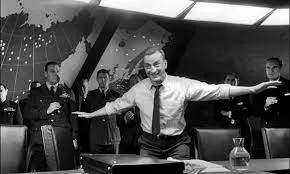
 Apart from comparisons to the satirical standard of Doctor Strangelove (1964), few written reactions to the movie reach back much farther than 1998’s Armageddon, in which Bruce Willis saves the world from an oncoming asteroid (the other such movie of that year—and the better one—Deep Impact, is seldom mentioned.)  But the basic movement of Don’t Look Up follows a template that goes back at least to the 1951 George Pal classic, When Worlds Collide:  Astronomers accidentally find the planet-killing object, they sound the alarm to “the authorities,” they are ridiculed and disbelieved. 

 It is the specifics of how the plot plays out in contemporary America that McKay portrays with mesmerizing precision.  He also manages to get laughs, but it is really the laughter of recognition, the release of seeing the absurdity of our reality playing out. 

 When Worlds Collide emerged at the beginning of another age of absurdity, the nuclear age.  The history of the period makes clear that almost immediately after Hiroshima, a lot of people realized how craziness had come to rule the world.  But official denial in the decade of conformity and McCarthyism forced an eerie and sometimes frantic quietism.  Besides which, the spectre of sudden nuclear apocalypse at any moment was too overwhelming to contemplate.  Official denial became deliberate and then unconscious national denial.

 But then there were all those atomic monsters, alien invasions and cosmic catastrophes in mostly B movies all through the decade. On the Beach (1959) was a drama about nuclear war without showing it. There never was a feature film that depicted nuclear holocaust—and it wasn’t until the 1980s that television took it on, notably with The Day After (1983), watched by 100 million Americans—and President Ronald Reagan, who was powerfully affected by it. 

But by 1964 it could be the subject of satire.  Though Doctor Strangelove is now a widely recognized classic, it was controversial in its day.  Its plot was absurd and yet could happen.  Several of its key characters seemed like caricatures, yet they resembled known types and even real people.  The difference between real life General Curtis Le May and movie character General Buck Turgidson may have chiefly been that George C. Scott was a more expressive actor.

 The characters in Don’t Look Up are notably not so exaggerated.  In the age of Trump, not even Meryl Streep’s President is as over the top.  (Jonah Hill as her son and chief of staff—presumably a stand-in for Don Jr.—may be the movie’ s only overt comic character.)  The absurdity of nearly everyone else is in the main plot is real—in some cases, speeded up, but true to contemporary life. Without blatant stereotypes and simplistic caricatures, some viewers don’t recognize this as satire.  But the history of satire is richer than recent movie history. 

The satire is partly in the metaphor.  The filmmakers are apparently not being shy about saying their intent was to make this movie metaphorically about America’s treatment of the climate crisis.  As some writers have recognized, the metaphor can also extend to the Covid Crisis, and the ongoing political crisis symbolized by January 6. 

 The climate metaphor works in some ways and not in others, but that’s par for the course—otherwise it wouldn’t be a metaphor.  Unlike an annihilating comet collision, the effects of climate distortion destroy over a long time.  Its causes are different, and different measures are required to address it.  Those measures are not as simple as shooting a rocket at it.  In terms of awareness and acceptance, the expensive and long term campaign by giant fossil fuel interests to deny its existence may well have been decisive, and that factor is absent from this film. 

But like a comet on the edge of the solar system, climate catastrophe was a future threat not discernable to the naked eye. And political self-interest as well as media trivializing have been factors in supporting the natural reluctance, the manufactured resistance and the toxic denial that prevented society from facing the consequences before they become inevitable.

 There’s a difference between oversimplifying (always a tendency in movies about a complex subject, as well as  in traditional conventions of satire) and simplifying in order to concentrate on similarities.  In this the movie mostly succeeds.  For its subject, after all, is not climate or comets.  The subject is how America reacts to a credible if unfamiliar threat to its existence--for example, the climate crisis.

 In an otherwise cogent article in Vox, Kelsey Piper rejects the climate metaphor by glibly and without explanation dismissing the idea that the climate crisis is a threat to human survival.  Clearly such destruction would not necessarily happen all at once, like a comet colliding or thermonuclear war.  But there is plenty of evidence that the threat to the survival of human civilization as we know it is real and profound.  The UN has more or less officially linked the climate crisis with the threat of a mass extinction event, meaning that life as we know it on this planet will be over.  If the climate crisis gets predictably worse and mass extinction occurs, some remnants of the human species may survive, but life as we know it almost certainly will not. 

Which brings us to the final scene of Don’t Look Up.  The political conflict in the latter part of the movie is between those who plead for people to “look up” and see the comet, which is the analogue of seeing the evidence, both scientific and in the fires, floods, sea rise and extreme weather in the obvious world.  But the metaphorical MAGA crowd follow their leaders’ chants of “don’t look up.” Which is: don’t look at the fires, don’t notice the Covid death toll, and don’t look at the footage of the attack on the Capitol. Again, as blatant and absurd as the real American moment.

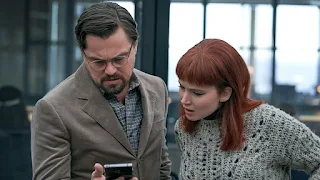
 Throughout the film, the astronomers played by Leonardo DiCaprio (Dr. Mindy) and Jennifer Lawrence (Kate Dibiasky) have tried to get leaders and the public to face the reality and do something about it before it is too late, while their personal lives spiral out of control.  By the end, as the comet is about to arrive, they come together in the DiCaprio character’s Midwestern suburban home, forming a last family, for a final dinner.  They pointedly ignore talking about what’s about to happen, though they do each say what they are grateful for, a ritual that some now observe at Thanksgiving. 

After the meal is over, and they are chatting about apple pie and coffee, Dr. Mindy leans back and says, “We really did have everything, didn't we?”  And then the walls explode.

 To me those are the most devastating lines in the film. As defined by its ending, this is an apocalyptic movie.  Like When Worlds Collide, there are a few human survivors, both on Earth and in the far future and far reaches of space—though it is more than hinted that in neither place are they likely to survive for very long.  The implication of Doctor Strangelove’s ending is that human civilization is totally destroyed, but to the absurdly inappropriate tune of “We’ll Meet Again,” a sentimental song of weary courage from World War II.  The satirical point of it in Doctor Strangelove is that once the bombs start to fall, we won’t meet again. 

 There is some irony in Dr. Mindy’s statement when applied to the climate crisis metaphor, since that “everything” came at a cost of deforming the climate and everything that results.  Still, given the circumstances of that scene, a couple of other interpretations are possible.

 In his Vox article, Piper sees this scene and this statement as motivating action before it is too late. He sees it as urging us to “look up,” to become aware of survival threats, to “acknowledge, and then to actually act.”

 That’s the traditional role of an apocalyptic story: as a cautionary tale.  I might add that “look up” is applicable to more than the sky—especially when there are so many people walking through the unseen world with their eyes constantly cast down to the devices in their hands, and their heads and hearts in virtual communities where agreement is more important than observing the real world.

 This is a perfectly appropriate interpretation, especially for viewers who will likely live into the decades when the dangers increase substantially, particularly the effects of the climate crisis as it jars the world order, and the mass extinctions that tear at the support systems of the planet.

 But I could not help but think of the experience of the person saying those lines in that last scene.  Jennifer Lawrence has her own connections to dystopian stories (The Hunger Games films) but Leonardo DiCaprio is extensively connected to the possibilities of apocalypse in the real world. 

For there is no prominent actor on the planet more deeply and obviously involved in environmental action, and particularly in warning of the threats to survival of the climate crisis than Leonardo DiCaprio.  Those efforts go back to at least 1998 when he formed his foundation to address these issues.  I count at least three documentaries on climate that he narrated, hosted produced or co-wrote, or a combination of these roles: The 11th Hour in 2008, Before the Flood in 2016 and Ice on Fire in 2019.  He used his best actor Oscar speech in 2016 to talk about the climate crisis. He was an official UN representative on climate, and spoke at UN climate summits in 2014 and 2016.

 During that time (from the 90s to now), addressing the climate crisis went from being a bipartisan promise to a wedge issue dividing political parties as well as families.  Actions taken so far, or even pledged, are widely known to be insufficient.  Meanwhile, effects have gotten worse faster than even worst-case scenarios predicted. For the past several years, activists have concentrated on efforts to limit the damage, because some devastation is all but inevitable now.

 But this past year particularly shows that American society is not up to the challenge in significant ways. The ongoing response to the Covid crisis and the crisis of American democracy as well as the ongoing effects of climate suggest this society can’t deal coherently with much of anything.  That’s the awful truth we like to avoid confronting: don’t look around.  But if there is any chance to limit climate related devastation, this must be faced and fixed.  Releasing us to first laugh about it and then deal with it is this movie’s chief contribution.  

When Midwestern American academic scientist Dr. Mindy utters those last words, he knows what’s going to happen, and why.  I suspect that with his own set of experiences in learning the dimensions of the climate crisis, trying to communicate and then observing how things are at this moment, the actor Leonardo DiCaprio might, at least in part, be joining in the same sentiment.  For this remarkable scene in particular makes Don’t Look Up not only a cautionary tale, but an elegy. 

  Footnote (or maybe the after the credits bonus)

In When Worlds Collide film, there’s also intervention at a key moment by a very rich man.  The difference is that in the Pal movie, the millionaire wants to save his own life, so he finances the building of a spaceship. In the McKay movie, the tech billionaire prevents the effort to break up the comet for the prospect of profit—and then when that doesn’t work, he escapes in his own spaceship.  The alarming new roles of tech billionaires, as well as the more familiar corruption and cynicism of politicians (who don’t have to be Trumpians) and the conscious and apparently endemic failures of news media, together move this movie way too close to being a documentary. 

Tuesday, November 16, 2021

Busby Berkeley, Historian


 Busby Berkeley is both famous and notorious for his extravagant dance numbers in movies from the 1930s through the 1950s.  But at least in one instance, two of his musical numbers reflected the times and now attest to their history, though audiences today may not fully understand what they are about.

 “If you want to understand the key to Busby Berkeley’s choreography,” said Berkeley biographer Terry Thomas in a TCM documentary, “you have to consider the military.”

 In 1917, the 22 year-old Berkeley was drafted into the U.S. Army.  By the time he arrived in France as a field artillery lieutenant, the fighting was nearly over and American troops had little to do.  So he was tasked with marching and drilling them, and in the course of inventing new formations and maneuvers, he essentially invented the style that was to characterize the work of his career.  Except instead of just male soldiers, he had armies of beautiful young women, and a camera that found both large geometric patterns and the intimacies of faces and other elements of anatomy.

 After successfully bringing this style to Broadway (minus the camera), Berkeley was drafted by Hollywood.  He soon wound up at Warner Brothers for a series of movies that would revive both musical films and the studio’s fortunes.  He started with two of his most famous, back to back, both made and released in the depths of the Great Depression.

 The first was 42nd Street, released in 1933.  Warners organized a big publicity campaign involving a train loaded with studio stars touring cities, culminating in the film’s premiere in Washington, D.C.  Jack Warner, head of the studio, was a fervent FDR backer, and he timed the 42nd Street opening to Roosevelt’s Inauguration. 

42nd Street was a big hit and a critical success.  It set the template for the series of Warners musicals that starred Berkeley’s choreography: a backstage story about mounting a show, then the featured numbers presented as the opening night.  The music by Harry Warren (with Al Dubin’s lyrics) was innovative in that it included a mix of styles, especially jazz influences.  But it wasn’t a complete break: there were plenty of soporific love melodies.

 Back in Hollywood immediately afterward, Berkeley worked on musical number for the next Warners musical, Gold Diggers of 1933. The story had been the basis for a play and a couple of movies with “Gold Diggers” in the title (and there would be more.)  Directed by Melvyn Le Roy, it was released later that year, and again, it was a major hit.

 Apart from the insipid and cringe-worthy numbers were two that spoke directly to the audience about elements of the Great Depression they had just experienced, and that would continue to affect their lives.

 We’re In The Money

 The first was the now iconic presentation of the song, “We’re in the Money,” featuring a very young Ginger Rogers belting the tune (and singing part of it in Pig Latin crossed with jive) while seemingly wearing nothing but strategically placed coins (although some shots reveal she was wearing a body stocking.)

 The song is usually interpreted as wishful thinking about post-Depression prosperity, but it has a much more specific meaning that audiences in 1933 would understand.

 Upon taking office in March 1933, FDR first of all had to deal with the banking crisis, to keep money in circulation.  Deposits were guaranteed for the first time. Besides new jobs and relief programs, his administration bolstered the economy with price supports for farmers, a minimum wage for workers and uniform rules for businesses. 

But money was still too tight for economic growth, so FDR essentially took the country off dependence on gold as the backing for currency: the so-called Gold Standard.  Everyone knew about this because everyone in the country was required to turn in their gold coins (which came in various denominations) in exchange for paper money or silver, including silver dollars.  Going off the gold standard meant that the federal government could increase the money supply, and it did.  And that’s what “We’re In the Money” is about.

 It’s right there in the first verse:

 Gone are my blues and gone are my tears/

I've got good news to shout in your ears/

The long lost Dollar has come back to the fold/
With silver you can turn your dreams to gold, oh/

We're in the money/
We're in the money/
We've got a lot of what it takes to get along...

It’s been suggested that in this black and white movie, Ginger Rogers and the chorus girls, as well as the set itself, featured gold coins.  But the point is that they aren’t: the coins feature a caricature of the face on the silver dollar.  Those are the silver coins that represent the new flow of money resulting from FDR’s policies (“with silver you can turn your dreams to gold.”)  All of this would have been instantly clear to the 1933 audience.


 Remember My Forgotten Man

 A more poignant and equally specific reference is made in the last big production number, “Remember My Forgotten Man.”  The Depression is not a subtext: it is the text, and is dramatized.  There’s the obvious reference to FDR’s  “the forgotten man at the bottom of the economic pyramid” from a 1932 radio address.  But as Joan Blondell continues to sing about her specific forgotten man, he turns out to be a veteran of World War I. 


  The number features a solo by Etta Moten (who also dubbed part of Blondell’s singing), a distinguished Black singer whose Gospel background emphasizes the bluesy spiritual feel of this elegy.  

Again, the feeling was even more specific to the times, for the plight of World War I vets had been dramatized for all the country to see just the previous spring and summer of 1932.

 In the spring, thousands of American World War I veterans gathered in Washington, D.C. to petition Congress to pay them the war bonus they’d been promised for 1945, because they were in desperate straits.  They remained there in makeshift encampments, many with their families, through the summer, continuing to lobby Congress.  The press covered the story extensively, dubbing them the Bonus Army.

 The veterans organized themselves into units, led by officers.  In contrast to the armed forces in both world wars, their units and their camps were racially integrated.

 Things were at an impasse in late July, with Congress failing to provide the bonus and with President Hoover opposed to it. It was then that a police officer trying to clear away a crowd from the entrance to the Treasury Department panicked and shot a veteran dead.  Hoover called out the Army to settle things down.  Instead, General Douglas MacArthur decided to make war on the Bonus Army.

 MacArthur, with his officers including Major Dwight D. Eisenhower and Major George Patton, deployed tanks and tear gas, routing the veterans and burning down their camps with gasoline. (This was probably the first time tear gas was used by Americans on other Americans.)

  Patton led a cavalry charge with drawn sabers against unarmed men, women and children.  In a deadly irony pointed out by historian William Manchester, among those that Patton’s forces attacked was a World War I veteran decorated for saving the life of Patton himself. 

 Many of the veterans were literally run out of town, in trucks that took them west to Ohio and beyond.  Though newspaper stories of the day tended to support the government line that the Army had thwarted dangerous criminals and radicals, many Americans knew men who were there. Hoover never recovered his political reputation.  If he’d had any chance of winning the election that fall, it probably ended with his administration’s treatment of the Bonus Army. 

All of this could not have escaped the attention of that era’s veterans, like Busby Berkeley.  But the Bonus Army had also inspired a great deal of sympathy and support among the people who would be watching this movie. When they saw and heard “Remember My Forgotten Man,” they would likely remember the Bonus Army.  Even in this dubious context, this song was as close to a memorial that it would get.