Showing posts with label CA. Show all posts

Saturday, August 15, 2020

Too Little, Too Late: HSU Goes Ahead Despite Official Public Health Finding

Dr. Frankovich, Humboldt County Public Health Officer
While my two posts warning of the likely consequences of re-opening HSU appeared here, there was an exchange of several emails between Humboldt County Public Health Officer Dr. Teresa Frankovich and Humboldt State University President Dr. Tom Jackson, which was variously described as "testy"(by Lost Coast Outpost, which obtained the emails as public records) and "salty" (by the Eureka Times-Standard newspaper.)  

After Jackson failed to return her urgent phone call, Dr. Frankovich, Humboldt's public health chief, sent a long email. She ended it with with this summation (with my emphasis added): “I completely understand the enormous impact of this for all involved, including our local community and cannot tell you how much I regret that I do not see any way in which public health can support on-site instruction and dorm living at this time.”

She noted that testing capacity alone was insufficient. "These resources would clearly fall short in meeting demand for a large surge occurring in context of a return of students to dorms and on-site learning at HSU.. Robust testing with fast turnaround is essential to manage cases on campus that will inevitably occur and are very likely to occur quickly as we bring students from across the state to the area, many of whom are coming from places where disease circulation is vastly higher than ours. There will be positive students walking onto campus without question and congregate housing will increase transmission risk enormously. ”

Dr. Frankovich wrote that the return of students could overwhelm the county's current capacity for contact tracing, which the guidelines also required. "While we are managing our current caseload well, we are positioned such that a large number of cases occurring in a short time frame such as return to campus, would be a potential tipping point for overwhelming the system, risking wider spread of the virus."


HSU President Tom Jackson
But it wasn't Frankovich who was testy or salty.  It was Jackson in his email response.  His snark included suggesting Dr. Frankovich read the state's guidelines, which she had in fact quoted in her email, stating that the preconditions for reopening in the guidelines could not be met--the basis for her conclusion that HSU should not bring students back.

 He further accused her of "prejudicial statements" in regard to students from elsewhere as potential carriers, when the publicly available statistics from Public Health clearly show that the recent influx of cases in Humboldt have largely been driven by infections from outside.  And to ignore the data from places like southern California is entirely specious, rhetorical nonsense.

Jackson then threatens the entire community by asserting that if students can't live in dorms they would be released into the community where HSU would have less control over them.  This gives those of us living in neighborhoods into which students are currently returning an eye-opener, as if we needed one.  With the dorms monitored, are these places where the superspreader parties will be?

Jackson absurdly asserted that students are "county residents" even if they've been living hundreds of miles away, and made other rationalizations and arguments that had nothing to do with the Public Health Officer's analysis.  He chastised Humboldt County Public Health for not scaling up its resources sufficiently to accommodate HSU's reopening--the "I am not responsible" defense.

Jackson began his email stating that regardless of Dr. Frankovich's statement, HSU was going ahead with its plans to reopen, and imperiously demanded: "If you have any further plans to use your authority to obstruct this plan..., we must be informed immediately."  He ended his email: "I am copying a number of important individuals so they are aware of this email and its context."  That "important" individuals seems an unusual construction, unless of course you are trying to intimidate a public servant.

 By Dr. Frankovich's end of the week press conference, where for the first time she actually got questions about HSU's reopening,  she acknowledged that HSU's reopening was now a fait accompli and Public Health and the community would have to just make the best of it.
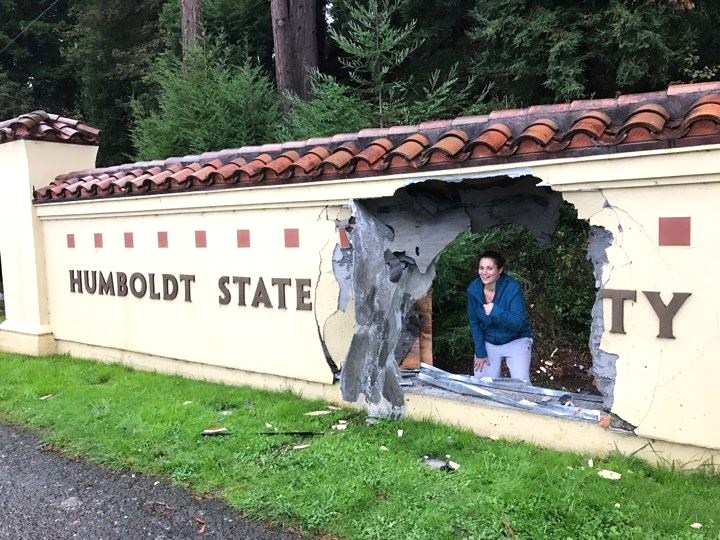
The Times Standard notes that over 200 students have already arrived, and that officially HSU now expects to house 800 students.  There was no number given regarding students to be housed in the community.

HSU is on schedule to be the only CSU school with in-person classes, estimated (according to T-S)  at more than 300.

T-S also notes that half the virus positives registered in Humboldt County this year have come in the past 45 days, and the past week has seen three new hospitalizations.  Most new cases, Public Health previously reported, were from the 20s age group.

This past week California became the first state in the union to surpass 600,000 officially registered covid cases, with as many cases since July 9 as the previous three months.  100,000 new cases were identified in just two weeks.  The death toll has nearly doubled in the past month. More than 1,000 deaths were recorded in just the past week.  California counties report a backlog of more than 300,000 tests.

HSU hurriedly made one important concession--on Friday the university added its own virus testing for incoming students. Before that, it wasn't going to bother. How robust or effective this will be is anyone's guess, but I wouldn't view it with a high degree of confidence.

So without an order from the Chancellor of CSU or an order from the Governor, Arcata and Humboldt County will be endangered by hundreds of outsiders--students and their families--coming in, who may or may not obey masking and social distancing laws--and somewhere in the neighborhood of 700 to 800 students in the dorms and going to class, with an unknown number of other students interacting with them in classrooms and socially, and returning to their housing in the community, interacting with grocery workers and others in Arcata.  But Jackson will get his dorm fees and tuitions.

Saturday, April 11, 2020

Weekend Update: The Good, The Bad and the Big Big Mystery

In terms of sheer numbers, especially of coronavirus deaths, this past week was the worst so far.  But there was also good news: the rate of new transmissions decreased in many areas of the US, and though the number of deaths remain horrendous especially in New York and other hotspots, the predicted number of deaths in the next weeks was downgraded sharply.

The slowing rate of transmissions has already translated into slowing in the rate of hospitalizations and deaths in those areas.  According to Governor Newsom, California is now confident that it has the resources to prevent the medical system from being overwhelmed.  Others are making that conclusion as well.

This is all attributed to the success of widespread isolation and physical distancing.  It is worth quoting again the words of Dr. Emily Landon, a Chicago epidemiologist when Illinois announced its stay-at-home order the third week of March: "It’s really hard to feel like you’re saving the world when you’re watching Netfliks from your couch. But if we do this right, nothing happens. A successful shelter in place means you’re going to feel like it was all for nothing, and you’d be right: because nothing means that nothing happened to your family. And that’s what we’re going for here."

In a recent New York Magazine post, David Wallace-Wells observed:"It can be easy to forget, a few weeks into something like a hemisphere-wide lockdown, just how absolutely unprecedented this public-health mobilization truly is: nearly every American in every state embracing punishing, restrictive quarantine-like isolation for the sake of the country as a whole. We are doing so willingly, with hardly any meaningful resistance to shelter-in-place guidance....This is solidarity I simply didn’t believe was possible in this country anymore and under any circumstances, and it has arrived in the space of just weeks, in the midst of national political chaos with tribal partisanship still boiling at a feverish peak. It is breathtaking."


UPMC 's promising vaccine in an easily manufactured,
distributed and administered delivery system, now
awaits approval for human trials.
Meanwhile there are efforts around the world to develop and test vaccines, antibody tests and treatment protocols.  The resources of the Internet and other computer capabilities are joining a fast, free-flow of information among medical researchers and front-line practitioners.

For example the University of Pittsburgh Medical Center is experimenting with a variety of drug treatments on volunteer patients internationally, and analyzing results via artificial intelligence, in a flexible program which will identify what seems to be working best and use that more often, while adding into the mix any new drug protocols as they are developed.

As more medical professionals have experience with treating the virus, there is also the possibility of modifying existing treatments to make them more effective.  For example, there's a lively discussion about how and whether ventilators should be used.  (Josh Marshall has also been writing about this issue.)

The bad news is the continuing dysfunction of the federal government, while the Trump administration employs their version of Shock Doctrine USA to take total political control and make it permanent.  The Republican party now doesn't even bother to deny that it will manipulate the voting system in ways that benefit it, including sending people of Wisconsin out to risk death in order to vote.  More on this at another time.

That bad news also means that there is as yet no federal plan to manage a Phase Two of the crisis, after this total lockdown but before universal vaccination. “A national plan to fight the coronavirus pandemic in the United States and return Americans to jobs and classrooms is emerging — but not from the White House,” according to the top story in Friday's Washington Post.

“Instead, a collection of governors, former government officials, disease specialists and nonprofits are pursuing a strategy that relies on the three pillars of disease control: ramp up testing to identify people who are infected. Find everyone they interact with by deploying contact tracing on a scale America has never attempted before. And focus restrictions more narrowly on the infected and their contacts so the rest of society doesn’t have to stay in permanent lockdown....But there is no evidence yet the White House will pursue such a strategy.” 

Instead the administration is again considering lifting stay at home guidelines prematurely, without widespread testing or a national consensus.

 According to Ezra Klein and others, none of the public plans for Phase Two even make complete sense yet. Josh Marshall explains the crucial role that widespread testing would necessarily play. But that also depends on what may turn out to be the key Big Big Mystery.

There is a Big Mystery as well, among all the things not yet known about this virus.  The Big Mystery, as outlined by Wallace-Wells, is how infectious the virus really is, and how much it has really spread.  If it is both more infectious and more widespread among people without significant symptoms--as some studies now suggest-- it could be less lethal than believed in terms of numbers, though of course just as lethal to some of its victims.  But the potentially best news if this were true (according to Wallace-Wells): "It would also suggest that we are much further along the timeline of the pandemic and much closer to its conclusion."

But this kind of testing is probably months away, and because of differences in the tests out there (some of them of dubious reliability), without a national standard there will be no actionable information.  As Josh Marshall writes: "With those concepts and definitions in hand, let’s say it simply: You can’t go back to even a semblance of normal economic and social life until you have an integrated, national system of surveillance testing in place that will give us a good shot at avoiding a rolling series of outbreaks and lockdowns for another year. A great system in one state and a crappy one next door won’t cut it."

According to the aforementioned Washington Post story, there are a lot of good ideas on how to ramp up contact tracing (such as assigning these tasks to returned Peace Corps volunteers), but difficulties increase without a federal umbrella and federal money.  Still, if this is a people-driven part of the process, it can be done.  And if California and a few other big states agree on a standard testing system (which may have to be developed not only outside the federal government, but outside Big Pharma), others would likely follow.  It wouldn't be complete but it would be something.

Yet even with more testing, there is the Big Big Mystery, which is: does having the disease once confer immunity? All plans depend on this, yet there are troubling studies that show some patients who tested positive, then tested negative, a short time later tested positive again.  There are studies among patients who had the virus and recovered, showing that up to a third had few antibodies in their systems against the virus, and some had none at all.

It would be astonishing if the virus did not ultimately confer immunity.  But if it doesn't, the basis for all current ideas for modifying or ending lockdown is shattered.  This is a mystery that must be solved.

Locally here in Humboldt County, we ended the week on a surprising but highly welcome note: Friday was the third straight day without a new positive covid 19 case, and the day before that string began there was only one case. Saturday update: no new cases for fourth day in a row.  Our cases are still small enough in number for contact tracing, so it is known that out of 49 active cases, seven are the result of community spread.  We remain at three hospitalizations and no deaths.  Still, California officials are not expecting cases to peak until mid-May. "Let’s continue to hold the line and do this together,” Governor Newsom said. “Give us a few more weeks to see where these trend lines go.”

Tuesday, August 07, 2018

The Fire This Time.2: That's The Way It Is

With a load of our furniture, clothes and books, I drove the biggest truck Ryder rented from Pittsburgh to Arcata, CA almost 22 years ago.  I'd never driven a big truck before. I drove mostly on interstates until I was on the 5 north of Sacramento.  There are only two routes from the 5 west to 101 near the coast, and north to Arcata.  One of these is route 20.  I knew it would be on my left, and as I drove on the flat superhighway outside Sacramento I glanced in that direction to see a line of formidable mountains.

The Ryder was heavy and the mountain was steep on the twisty two-lane 20.  When I pulled over at a truck stop near Clearlake, I asked the guy I bought coffee from if I had more to climb.  He looked at me and must have seen my harried, wild and weary eyes looking back.  No, he assured me, you're pretty much at the top.

In fact the road soon started downward, sometimes steeply, another challenge.  It skirted the lake itself and then Upper Lake, and I marveled at the lush mountain scene, especially the wild flowers, though controlling the truck on that road absorbed most of my attention.

All that area--and much more--is now either in flames or black and desolate.  It's the Mendocino Complex fire, now officially the largest fire in California history.  By Tuesday it covered 450 square miles-- more ground than New York City and almost as much as Los Angeles.

It is the largest of more than 70 major fires in California right now, with some 14,000 firefighters in action.  These fires are uniformly described as spreading faster and behaving differently and more ferociously than fires in the past.

Here on the North Coast, the smoke from fires to the north and east of us is dense at higher elevations (a resident of Kneeland said it was the worst she's ever seen) and mixes with the marine layer here below.  Parts of both route 299 and route 20 connecting to the 5 are in fire zones and are closed.

The height of the fire season would usually be a month away, so it's likely that this will be the worst fire season in California history--although the record might not last very long.  The previous record for the largest fire in the state's history was set eight months ago.

The AP story quotes Governor Jerry Brown from last week: “We’re in uncharted territory. Since civilization emerged 10,000 years ago, we haven’t had this kind of heat condition, and it’s going to continue getting worse. That’s the way it is.”


It is going to continue to get worse just because of past greenhouse gases emissions, and whatever level heating reaches, it will stay at that level for centuries.  But if the causes of this heating continue--if greenhouse gases continue to pour into the atmosphere at accelerating rates, even at current rates--then things could get exponentially worse in the farther future.

Last week yet another report by scientists concluded that the planet is headed for catastrophic heating that will begin feeding on itself.  After an unknown tipping point is reached, the feedback mechanisms that keep the planetary temperature within livable bounds will not only break down but in some instances reverse.  A gradual, fitful climate crisis will become a cascade, and the Earth's fate will be sealed for thousands if not millions of years.

It's quite possible that human civilization will destroy itself even before the runaway climate crisis takes hold.   Meanwhile, the New York Times Magazine has the first part of an extensive report describing how real efforts to address the climate crisis and prevent it from becoming unmanageable almost happened in the 1980s.  It's like a sci-fi movie in which skeptics become alarmed and people in power recognize the common threat, and move to meet the challenge.  But unlike the movies, it was just almost.

I read earlier how the Carr Fire last week created its own tornado but I thought of it only as a normal tornado of wind.  But it wasn't.  It was a tornado of wind and fire.  That should suggest the kind of destruction the climate crisis will bring.  Sometimes it will be relatively sudden and obviously horrific.  But even when it isn't, when heat waves get hotter and longer, droughts get longer and dryer, and the seas rise a little more each year, until they rise a lot in one year, there will always come a time of reckoning.

"That's the way it is" will increasingly inform the pragmatic attempts to address the effects of the climate crisis.  The only prospect for perhaps stopping short of runaway global heating is a complete stop to carbon emissions and only unavoidable emissions of other greenhouse gases, globally, by 2050.

The chances of that happening seem very remote. Some I suppose by then will acknowledge that as human civilization, we did this to ourselves.  Humanity destroyed the planet's ability to support us and much of the life we know.  But whether or not we admit it will not matter, except perhaps in clearing the psychological space to deal more deftly with the effects, for as long as we can.  Because that will just be the way it is.

Friday, December 08, 2017

Climate and the Dog in the Night-time


It's a sobering story that quantifies the obvious though elusive.  It shows that the state of the climate crisis is not about crying wolf.  It is about the curious incident of the dog in the nighttime.

The Guardian headline and subhead to the story by Lisa Hymas provide the premise: Climate change is the story you missed in 2017. And the media is to blame/Some of Trump’s tweets generate more national coverage than devastating disasters. As the weather gets worse, we need journalism to get better"

That the media doesn't cover the climate crisis with the frequency, depth or urgency it deserves is of course not new.  It never has, just as even our best leaders did not talk about it enough or with the appropriate urgency.

But the story doesn't focus on covering the topic of climate change--it looks at the easier aspect to cover, which is the visible, tangible real world result: the devastating storms, fires and other weather-related phenomena, directly related in occurrence, severity or in some other meaningful way to global heating.

This is in a way astonishing.  If it bleeds, it leads is the supposed journalistic law--though it trotted out mostly as an excuse for not covering more complicated stories with greater impact.  But now it's a law being routinely violated, at least in this case.

For a lot of people bleed due to hurricanes, floods and fires.  But these days those stories can't even compete for the lead.  (Or "lede" in the new oafish spelling.)

The Guardian article begins: Which story did you hear more about this year – how climate change makes disasters like hurricanes worse, or how Donald Trump threw paper towels at Puerto Ricans?

If you answered the latter, you have plenty of company. Academic Jennifer Good analyzed two weeks of hurricane coverage during the height of hurricane season on eight major TV networks, and found that about 60% of the stories included the word Trump, and only about 5% mentioned climate change. Trump doesn’t just suck the oxygen out of the room; he sucks the carbon dioxide out of the national dialogue."

In terms of reality this is more important because of the anti-president's climate crisis denial, and because scientists are more confident than ever that these disasters are causally linked to global heating.

 But it's also not really shocking because underplaying if not virtually ignoring the climate crisis has been going on forever.  If you really factor the extent to which the climate crisis threatens people, their places and the long term existence of civilization, as well as a lot of life on this planet as we know it, there's virtually nothing else we're obsessed with that measures up.

But the surprising difference in this year of multiple disasters is that not only didn't the role of global heating in these disasters get a lot of coverage, neither did the disasters themselves, and especially the "aftermath," or the longer term consequences.

This was especially true of Hurricane Maria, probably because it struck Puerto Rico and nearby islands, no longer on the beat of reporters or news bureaus, which hardly exist anymore outside of Washington and New York:

"The weekend after Maria slammed into Puerto Rico, the five major Sunday political talk shows devoted less than one minute in total to the storm and the humanitarian emergency it triggered. And Maria got only about a third as many mentions in major print and online media outlets as did Harvey and Irma, researchers at the MIT Media Lab found."

Coverage bulged during the anti-President's noblesse oblige paper towel-slinging visit and declined to nada immediately afterwards-- "even though many residents to this day suffer from electricity outages and a lack of clean water, a dire situation that deserves serious and sustained coverage."

If the media needed a news hook for this coverage, Hymas provides one: the nature and severity of these weather events were exactly as climate scientists predicted.  That might mean something, do you think?

Sure, the anti-president is viscerally as well as actually a clearer and more present danger, but failure to link these storms etc. to the climate crisis allows people to continue to believe that the consequences of the climate crisis are far in the future:

"But while nearly three-quarters of Americans know that most scientists are in agreement that climate change is happening, according to recent poll, only 42% of Americans believe climate change will pose a serious threat to them during their lifetimes. Too many still believe – wrongly – that climate disasters are just something that will happen in the future. They are happening now."

And they are happening a lot:

"In the first nine months of 2017, the US was assailed by 15 weather and climate disasters that each did more than a billion dollars in damage – in the case of the hurricanes, much more. The combined economic hit from Harvey, Irma and Maria could end up being $200bn or more, according to Moody’s Analytics. And then in October, unprecedented wildfires in northern California did an estimated $3bn in damage."


Credit some coverage, including that of the current horrendous fires in southern California (that's right, in December), for relating disasters to the climate crisis. But against the overwhelming noise of relatively trivial stories, it's not nearly enough.

That the climate crisis is happening now--and is only going to get worse-- is the biggest reason why this lack of attention is harmful.  But failing to cover the consequences as they unfold as well as the causes signals to people that unless they live in a big media market, when disaster strikes they will be ignored, abandoned and forgotten.  This is precisely how not to deal with an unfolding era of disasters, what James Kunstler called the Long Emergency, especially at this stage.

Economics may be the unstated excuse for news organizations, and what news media people are left must feel pressure not to upset their consumers lest somebody more amenable take their place.  Disasters are so exhausting for news consumers as well as reporters (all that standing outside in the hurricane and getting blown around like a fool too stupid to come in out of the rain, just to prove you're really there.)  So let's get excited about this tweet I can instantly inflate the importance of without moving from poolside, so to speak.

But there's no excuse for this craven disregard, especially of the consequences--of what's being done and not being done to help those suffering and in need.  And of the role of global heating that ensures there will be a lot more of this in our climate crisis, now playing near you.

This is the "curious incident of the dog in the night-time."  "But the dog did nothing in the nighttime."  "That was the curious incident," said Sherlock Holmes.  Because an intruder was committing a crime, and the dog did not bark.

Sunday, December 18, 2016

In California, Resistance is Official

It's not just activists and entrepreneurs, and even not just California Governor Brown.  Elsewhere the Resistance to the coming Nazi Millennium is official, according to the LA Times.

The story notes CA reps to the federal government like Nancy Pelosi, Senator Dianne Feinstein and incoming Senator Kamala Harris.  But also various state officials, like incoming state A-G Xavier Becerra, Sec of State Alex Padilla and top members of the state legislatures: Senate President pro Tem Kevin de León and Assembly Speaker Anthony Rendon.

There's state legislation already in the works "which would stymie construction of a wall along the California-Mexico border and SB 31, which would prohibit the state from sharing information to a federally compiled registry of Muslims in the United States..."

Among non-officials and including non-Californians, talking up resistance are scientists who attended the recent American Geophysical Union convention in San Francisco where they heard Governor Jerry Brown's fiery speech, among others.  The Washington Post reported on their first street demonstration, and the determination of individual scientists and groups to defend science, especially climate science, against the Dark Agers of the Nazi Millennium.

The scientists confess they have no experience at political warfare.  Politicians on the other hand do--the question is will they have the stomach for it, beyond popular post-election bravado.  It's not very risky in California at the moment, but there's always the Bush-Cheney technique of getting us into a war or two and making support for the reich a test of patriotism.

Are they ready? Nobody seemed to remember the 2000 election, so why would they remember Iraqnam in 2003?  All these nifty Internet tools are useless when everything surprises you.

Wednesday, December 14, 2016

Fighting Words From the President of California

California Governor Jerry Brown made a hell of a speech Wednesday, as reported in the Sacramento Bee: 

"Gov. Jerry Brown, rallying a room of scientists Wednesday with his most heated rhetoric yet on the topic, suggested California would defy the federal government should President-elect Donald Trump impede the state’s efforts to thwart climate change.

“We’ve got the scientists, we’ve got the lawyers and we’re ready to fight. We’re ready to defend,” he said to boisterous applause at the American Geophysical Union conference in San Francisco.

Brown struck a more forceful tone than he has since the election, suggesting the energy and enthusiasm in the room for him would be needed in the “battles ahead.”...

At one point, Brown warned against proposed budget cuts under the new presidential administration that could effectively eliminate earth-observing satellite programs.

He reminded the scientists that he earned his nickname, Governor Moonbeam, in his first governorship for proposing that the state launch its own communications satellite, and even had an ex-astronaut on his payroll as a space adviser. “I didn’t get that moniker for nothing,” Brown said.

“And, if Trump turns off the satellites, California will launch its own damn satellite,” he added. “We’re going to collect that data.”...

Later, he jabbed at former Texas Gov. Rick Perry, who before becoming Trump’s pick for Energy Department secretary tried to poach jobs from California. “Rick, I got some news for you,” Brown said. “California is growing a hell of a lot faster than Texas. And we’ve got more sun than you have oil.”...

“A lot of people say, ‘What the hell are you doing, Brown? You’re not a country,’ ” the governor said, to laughter.

“Well, judged by measures of gross domestic product of over $2.2 trillion, we’re the fifth or sixth economy in the world. And we’ve got a lot of firepower ... And we will persevere. Have no doubt about that.”

“We will set the stage. We’ll set the example,” Brown added. “And whatever Washington thinks they are doing, California is the future.”

Wednesday, June 08, 2016

"We're in This Together":California Primary Conclusion

With all precincts in--but with an unknown number of mail-in votes still to be counted--Hillary Clinton has won the California Democratic presidential primary with nearly 56% of the vote, to Bernie Sanders 43.2%.  So it wasn't close.  And as Ed Kilgore worked the numbers, whatever the surprise AP announcement Tuesday that Clinton had clinched did to turnout, Clinton had enough momentum from mail-in ballots (which is most of them in CA) to win handily.  If anything, Bernie picked up late momentum.  The LA Times analyzes.

As I expected, Bernie pretty handily won Humboldt.  He did well way up here in the northern counties. But that was pretty much it.  His hopes in the Bay Area and Silicon Valley didn't work out.  Apart from a few rural counties in eastern CA, plus Santa Cruz, his southernmost county were Mendocino and Lake.  Except for Santa Barbara county (50/49), Hillary's lead was usually in the mid 50% to mid 60% range.

Apart from other factors, California is pretty comfortable with women candidates. After all, the state has been represented in the US Senate for decades by two women, and in this election, two women will contend for one of those seats, as Barbara Boxer retires.  Thanks to this new non-partisan primary system for non-presidential candidates (the top two vote-getters regardless of party face off in the general), the two women (Kamala Harris and Loretta Sanchez) are both Democrats.  That was much remarked on, of course, but the fact the race is between two women is too normal to mention.

Clinton earlier won New Jersey (63%-37%), New Mexico and South Dakota primaries.

Bernie Sanders spoke in Santa Monica after the close of voting, when Hillary's landslide victory in California was already obvious.  Wednesday there were conflicting reports on what he is likely to do, and on his state of mind (responding to one set of reports that he remains angry and committed to a convention fight, New Yorker satirist Borowitz posted a column claiming that: Sanders Vows to Keep Fighting For Nomination Even if Hillary is Elected President.)

Eric Levitz parsed the speech in a different way, and isolated this quote: "And tonight, I had a very gracious call from Secretary Clinton and congratulated her on her victories tonight. Our fight is to transform our country and to understand that we are in this together. To understand that all of what we believe is what the majority of the American people believe."

Though Levitz didn't note this, the phrase "we are in this together" indicates not only a common effort to defeat Trump which Sanders had begun his speech saying is the number one objective, but it is a phrase that Hillary emphasized in her victory speech.  "We are all in this together" is a major expression of her "Stronger Together" theme (which wasn't quite...together in the speech, but it's getting there.)  I notice this phrase--which again is one that President Obama uses--because I've long advocated it as the theme we need, to face the challenges of this century.

Whether and when Bernie Sanders and Hillary Clinton are in it together is yet to be seen.  But Sanders meeting with President Obama Thursday, and Obama's endorsement of Hillary as the nominee shortly after, will suggest the shape of that eventuality.

Thursday, December 10, 2015

Meanwhile in Paris: 24 Hours to Save the World?

On Thursday a revised draft of the climate agreement was announced, with some outstanding issues apparently resolved but others still in contention.  There are hopes of a final draft in the next 24 hours, as the conference is scheduled to end on Friday.  But, the NY Times/Associated Press warns, UN conferences rarely end on time.  Update Thurs pm: According to the BBC, agreement is now expected to be presented on Saturday. President Obama and China's president spoke by phone to encourage resolution of remaining issues.

One of the issues still to be worked out is verification.  Though President Obama (who has been personally involved in negotiations from Washington) publicly supports some legally binding provisions, negotiators accept that this is unlikely--not because of intransigence by India or China or Russia or Australia.  But by outright hostility from the US Republican party, with the power to block any provision that Congress would have to pass or ratify, as reported by the New Republic earlier in the week:

"We understand the concerns they have because of the political situation in the Congress and the Senate, and the position of the Republican Party,” Arias Cañete, who is the European Commissioner for Climate and Energy, told reporters. “You cannot make an important agreement in climate change if the second-biggest emitter of the world is not on board. We have to find a solution.”

(Republicans are still at it, with Tail Gunner Ted Cruz spouting the worst kind of debater obfuscations and psuedo-science in the guise of a congressional hearing.)

The draft was held up because of such concerns (among others), the first official delay in the conference.  But now it's out there and the Paris conference enters its final and decisive phase, with most parties expressing optimism on an agreement.

Perhaps the most dramatic related event of the week happened in China, which called its first "red alert" over dangerous smog, closing schools and workplaces. Air pollution, mostly from coal-fueled power plants, has become a major concern.
Addressing climate crisis causes with clean energy is an example of how such efforts simply make life and health better, all on their own.

But air pollution is not China's only climate crisis-related clear and present danger.  Its shrinking glaciers threaten water supplies not only within China but elsewhere in Asia.

The Paris talks have inspired many stories on the climate crisis and the issues and problems it raises, as well as efforts to deal with its causes and effects.  The Guardian has a good article focusing on local efforts in these areas, which is where most of the actual action has been.

 I've noted this here before.  Local, state and regional officials are closer to realities than the reps who go to Washington to spend most of their time raising money so they can stay in Washington.  When Paris comes up with a treaty, local efforts will make it easier to meet.  But as the Guardian piece indicates, state and local governments etc. must be part of the treaty process.

But not to worry--Uncle Jerry and California are on the case.

Friday, August 21, 2015

El Nino v. The Blob: The Latest

In this year's most important grudge match, El Nino v. the Blob, oddsmakers are swinging behind the big hot baby boy of the Pacific, big time.

The latest NOAA outlook forecasts the biggest El Nino since the first weigh-in way back when.  And for this neck of the woods, they say it means the Blob will fall, and we'll get that rain.  So will the high Sierras:

The northern reaches of bone-dry California will get some drought relief this winter, federal climate experts predicted Thursday — the first time forecasters have suggested that the much-hyped El Niño could send storms to the part of the state where they’re needed most.

Optimism for a drought-dampening winter have grown along with measurements of the strength of El Niño. Although there are no guarantees, in general, moderate El Niños boost the chances of wet winters in Southern California while more robust El Niños improve the odds of soaking storms in the north — where mountain runoff supplies the majority of California’s water supply.

 The Blob is already down, though not yet for the count:

The good news is that the weather conditions in the western Pacific tropics that are thought to have created the menacing mass of high pressure have already changed, said Mike Halpert, deputy director of the National Weather Service’s Climate Prediction Center, to reporters last week. Halpert says he expects El Niño to assert itself, and the ridge of high pressure to fade away.

The eastern US can expect a milder and wetter winter, which might mean some big snows as well as ice-storms, sleet and rain.

But it's still August, and the fires are still burning, and Humboldt County has declared a health emergency because of the smoke.

Thursday, August 20, 2015

Salmon and Trees: Drought Beyond the Cities

Another aspect of the California drought that is getting particular attention on the North Coast as well as further up the Northwest is the effect on salmon.  Combined with other factors, the low flow in rivers and the hot ocean near shore are endangering salmon runs.  Die-offs in Washington state have already happened, and a repeat of the massive die-off in the lower Klamath in 2002 is feared here.

Local tribes are agitating for the release of more water to cool down the rivers and streams where the salmon are now going to spawn.  Humboldt member of Congress Jared Huffman wrote to the Dept. of Interior urging such releases.

Coincidentally, on August 30 HSU is hosting a staged reading of a 2006 play created here that concerns the effects of that 2002 salmon die-off.  Salmon Is Everything is also the title of a book that includes the play's text and essays about the issues and the process of creating the play, particularly the relationship with tribal communities.   It will be the 2015-16 HSU Book of the Year. The play places particular emphasis on the cultural impact of salmon, a connection maintained by indigenous communities for thousands of years.

More broadly, the drought is creating crisis conditions for wildlife throughout California, and if the drought continues a new study warns that things could get really bad:

A new report by the Public Policy Institute of California non-profit think-tank paints that distressing picture of California for the next two years if the state’s driest four years on record stretches further into the future.

Written by water and watershed experts working at the policy center, at the University of California, Davis, and elsewhere, the report urges California to do more now to deal with what researchers project to be the biggest drought crises of 2016 and 2017 — crashing wildlife populations, raging wildfires and more and more poor rural communities running out of water entirely.

So far the emphasis has been on big cities and big agriculture, the report says.  But beyond these obvious economic and population centers, the drought threatens the basic ecological infrastructure, as well as people who live in small places within or closer to our forests and rivers.  And ocean, but that's another (sore) subject.

Forest fires continue, and another 3 firefighters lost their lives in Washington.  A National Geographic article describes how they are changing western forests. Another study finds our northern forests are particularly threatened by the climate crisis.

Meanwhile, the speculation over the super-El Nino continues, but nobody believes that even if it brings substantial rain to the state, that this will compensate for the drought, or even break its back.  Even as El Nino builds in strength, the countervailing "Blob" of warm coastal waters remains, and could offset greatly the expectation of even normal rains up here on the North Coast (and the Northwest generally.)  This could also mean the snows will not return to the high Sierras in sufficient quantity to add significantly to the urban water supplies south.

Quantifying the Obvious

July was the hottest month ever recorded worldwide, and 2015 is extremely likely to be the hottest year.  At least until next year.

A longitudinal study confirms that climate change is making the California drought worse.  Based on historical records, 8% to 27% worse, according to Reuters. The NY Times says 15%-20%.  Whatever.  Worse.  And the next one will be worse still.  And not necessarily because of less rainfall, but faster evaporation from higher temps.  What role if any that climate crisis plays in this period of less rain is apparently still a matter of conjecture.

The study itself gets good reviews, according to the Times:

The paper on the California drought echoes a growing body of research that has cited the effects of human emissions, but scientists not involved in the work described it as more thorough than any previous effort because it analyzed nearly every possible combination of data on temperature, rainfall, wind speed and other factors that could be influencing the severity of the drought. The research, said David B. Lobell, a Stanford University climate scientist, is “probably the best I’ve seen on this question.”

Wednesday, August 19, 2015

West in Fire (Updated)

Late Monday night, under a thin haze that permitted a few stars to be visible, the smell of burning wood was so pronounced that I took a walk in the silent neighborhood to make sure nothing very near was burning.

Tuesday, which was uniformly an eerie yellow-gray overcast, ash fragments had reappeared on cars in the street.  There was a small local fire, weeds and grasses in the Manilla dunes, but the smoke in our air more likely is from the forest fires to our northeast and south.  Another 1200 acres burned last night in the Mad River Complex of fires, and 900 more acres burned in the Gasquet Complex of fires, among the fires to the northeast.  About 5000 acres were involved in 7 fires in southern Humboldt that are now pretty much contained.

On Wednesday, NASA satellite imagery confirmed our smoky skies.  Other fires contributing are believed to be several complexes in Trinity National Forest and the Nickowitz Wildfire.

People are talking (or so I've heard) about the psychological effects of the fires even here, where the evidence is evident, but the actual fires are fairly far away. This is a place in love with trees, and put that together with the reminder of dangerous changes, there may very well be aimless anxiety, background depression, unspoken grief.

Western forests, as far north as Alaska, are burning this summer.  One in Idaho reveals something called a firenado. 

Enough of the forest gone and one of the pernicious feedback effects, one of the vicious cycles of the climate crisis engages.  Trees breathe and store carbon out of the pollution causing the greenhouse effect.  But the climate crisis that feeds on excessive carbon and promotes drought, makes the trees vulnerable to fire.  The fire destroys the trees, releasing carbon immediately, and their long-term absence means that less carbon is routinely taken out of the air, which means that more carbon stays in the atmosphere to intensify the climate crisis greenhouse effect. Which intensifies drought and lightning storms, which create more fires, which destroy more trees and releases and leaves more carbon. So when the smoke clears, the heat increases.  If the forests can't keep up, it keeps getting worse all by itself.

Other effects on forests of these megafires are described in a National Geographic article.

Even without fire, climate crisis-fueled drought is killing California forests, and even trees in settled areas, due to water restrictions.

It's not a lot of fun saying that out loud.  But silence feeds denial, and while some denial gets you through the day, it may not get you through the night.

...On the following night, Tuesday, the clouded sky glowed red.

Thursday, May 21, 2015

Duty

"When you’re on deck, standing your watch, you stay vigilant. You plan for every contingency. And if you see storm clouds gathering, or dangerous shoals ahead, you don't sit back and do nothing. You take action -- to protect your ship, to keep your crew safe. Anything less is negligence. It is a dereliction of duty. And so, too, with climate change. Denying it, or refusing to deal with it endangers our national security. It undermines the readiness of our forces.

It’s been said of life on the sea -- “the pessimist complains about the wind, the optimist expects it to change; the realist adjusts the sails.” Cadets, like you, I reject pessimism. We know what we as Americans can achieve when we set ourselves to great endeavors. We are, by nature, optimists -- but we’re not blind optimists. We know that wishful thinking in the face of all evidence to the contrary would set us on a course for disaster. If we are to meet this threat of climate change, we must be realists. We have to readjust the sails."

President Obama
graduation address, US Coast Guard Academy

Meanwhile, California Governor Jerry Brown announced a multi-state agreement to set and meet goals to reduce carbon pollution:

The agreement includes the states of Oregon, Washington and Vermont, as well as the provinces of British Columbia and Ontario in Canada, the states of Baja California and Jalisco in Mexico, and the British country of Wales. Also involved are states and provinces in Brazil, Germany, and Spain.

"We will strive to bring more states into this agreement," Brown said at the event.

Although the terms are not legally binding, by signing the agreement the leaders are committing to specific targets for reducing greenhouse gas emissions by 2050. At that point, emissions would either need to be at least 80% below 1990 levels, or less than 2 metric tons per capita.

Sunday, May 17, 2015

Weekend Update

A few stories from the past week, notably linked.

The War on Trains (and Infrastructure in General): In the wake of a major train crash on the highly traveled eastern corridor that could have been prevented by equipment that has since been installed but wasn't before because Congress won't appropriate enough money, Adam Gopnik's NewYorker piece  on why it's happening, why it matters and especially what trains are all about, is definitely worth a read.  (Some more specific political/ideological reasons for infrastructure opposition here. )

Antarctica Preview: Ice Sheet to Collapse in Five Years or Fewer:  From NASA: "Ice shelves are the gatekeepers for glaciers flowing from Antarctica toward the ocean. Without them, glacial ice enters the ocean faster and accelerates the pace of global sea level rise. This study, the first to look comprehensively at the health of the Larsen B remnant and the glaciers that flow into it, has been published online in the journal Earth and Planetary Science Letters." Conclusion? A new NASA study finds the last remaining section of Antarctica's Larsen B Ice Shelf, which partially collapsed in 2002, is quickly weakening and likely to disintegrate completely before the end of the decade." 

I've read a little about glaciers collapsing and was amazed at how fast it can happen (but then so were scientists.)  This study suggests the nature of that speed: After the 2002 Larsen B collapse, the glaciers behind the collapsed part of the shelf accelerated as much as eightfold – comparable to a car accelerating from 55 to 440 mph.


El Nino Looks Real.  According to Jeff Masters' blog at Weather Underground: The robust El Niño event anticipated for more than a year is finally coming to fruition, according to the latest observations and forecasts. NOAA's latest monthly analysis, issued on Thursday morning, continues the El Niño Advisory already in effect and calls for a 90% chance of El Niño conditions persisting through the summer, with a greater-than-80% chance they will continue through the end of 2015.

The blog notes this is pretty unusual. "Forecasters and computer models alike have been confounded by this event."  That's partly because stuff is happening out of its usual season.  That's climate change for you, it changes things."If this El Niño event does intensify, as models strongly suggest it will (see below), it'll be one for the record books. There are no analogs in the database for a weak event in northern winter that becomes a stronger event by summer. Persisting into northern fall will also greatly raise the odds of this becoming a rare two-year event."

So if it happens, what will happen?  Nobody knows really.  Could mean more rain this winter for California, and then again, maybe not.  It has however meant rain for southern California last week, which is weird.  But that's climate change for you, things get weird.

Saturday, May 02, 2015

In Hot Water

Global heating on its own is causing significant damage and is predicted to do more.  But its greatest current role is as another destructive factor added to others.  Over time, for example, it contributes to the ongoing crash of species, last week predicted to add extinction for one-sixth of those existing now, if present greenhouse gases pollution continues at current growth rates.

But right now we're seeing it and feeling it in California as a strong contributing factor to our drought, and now to the record-breaking temperatures along our shores. Weather Underground's Dr. Jeff Masters: "Ocean temperatures off the coast of California were at record or near-record levels for this time of year on April 29, 2015. Ocean temperatures off the coast of Los Angeles and San Diego were more than 4°C (7.2°F) above average, an astonishingly high anomaly." (See illustration above.)

These temperatures result from an atmospheric trend now 3 years old and a decades-long natural oceanic pattern--and global heating.  It's global heating that has shoved these temperatures into the extreme range.

Hot Pacific waters off our shores does not bode at all well for fish and other marine species.  Farther from shore there's more going on, as something called the Madden Julian Oscillation broke its records for intensity, leading to 3 strong cyclones in the western Pacific in March.   Before that, in February other factors combined for other record-breaking effects that started this heating of our coastal waters and the death of sea life dependent on smaller creatures who thrive in cold water.  This included a sea lion die-off.

The hot Pacific waters are leading several forecast models to predict the likelihood of a strong El Nino emerging this summer.  That's more bad news for ocean life.  It's potentially good news for California as it increases the chances of a wet winter.  But factoring in global heating gives us two general principles: whatever happens is more likely to be unprecedented in some ways, and in some ways more extreme.  So it may be that the rains don't come ashore in the volume expected, or that they sit on one part of the state causing havoc.

To actually break the drought they would have to be close to three times normal winter rainfall, though where the precip goes and when makes that a suggestive if perhaps not totally relevant estimate.  On the other hand, if we do get two or three times the normal rain, that itself is likely to cause havoc with flooding, mudslides, erosion, and other effects we're even less prepared for.

While some experts are betting on this super El Nino, Dr. Masters is holding back for the moment.  It may be June before there's something like consensus.  But even then it's a matter of getting ready for the unknown.  Because global heating screws with everything.

Wednesday, April 08, 2015

The California Way (With Update)

There are many reasons that California is the state making the most news in confronting the drought that affects much of the West.  One reason is that California is able to confront it directly, because its state government actually works--at least on this issue.

California has become even more of a Democratic party state in recent years, reflected in the state legislature as well as the state house.  But Republicans in state government have largely supported Governor Brown's efforts on the drought.  His $1.1 billion drought relief package sailed through and became law within days of its proposal. The new policies he announced on April 2 also got quick and wide support.

So the arguments about water and the drought tend to be pretty substantive.  There are charges of political influence, but those charges transcend parties.  Mostly the questions are of responsibility and efficacy--of who needs to do what.  So far it seems to be a healthy debate.

That doesn't mean that nothing is happening in the meantime.  Regulators are dealing with local water boards and water use in that locality.  As the Washington Post put it:

"State regulators are naming and shaming local water departments that have let water wasters slide — and forcing agencies to slash water use by as much as a third....Since Gov. Jerry Brown declared a drought emergency last year, they’ve largely taken a soft, educational approach to curtail water use. That’s no longer enough, he says.

In response, state regulators have drafted plans that show how much each community has conserved and assign mandatory water reduction targets. A third of the water departments must make the deepest 35 percent cuts because they have high water use."

Another way to put it however is that municipalities with the least per household water use are rewarded, so it's not a 25% cutback for everybody-- for San Francisco with relatively small use they are 10% but for places like Beverly Hills that guzzle the stuff, it's 35%.

Meanwhile, Governor Brown is asking for cooperation among the various uses--households, industries, farming-- rather than blaming each other.  A New Yorker piece suggests there is responsibility to go around.

The erstwhile Governor Moonbeam ( a nickname he got when he was governor during the 70s--and ironically, during the last major California drought) is also looking to the future with his executive order that toilets and faucets sold in California beginning in 2016 must be low-flow.  The state is expected to support the home purchase of new technologies that save water, perhaps including greywater systems, which an advocacy group claims needs only 10% of southern CA home use to save more water than a new billion dollar desalinization plant will generate.

There are still rabid right crazies like apparent presidential candidate Carly Fiorina who blames the drought on "liberal environmentalists."  (The substance of her case is dispatched in the aforementioned New Yorker article.)  But by and large the state is confronting this constructively.

Governor Brown has himself linked the CA drought to the climate crisis, and so far, California is becoming a model of how a polity can address both the causes and effects of the climate crisis--with government action and substantive debate.

Update: An example of this comes from state water officials, stating that some responses to the drought aren't temporary measures, that water use in California will never be the same:

"California needs to use “this crisis as an opportunity to accelerate what we know we are going to have to do under climate change anyway,” said Felicia Marcus, chair of the State Water Resources Control Board, which oversees the state’s complex system of water allocations, and this spring is tasked with writing new usage regulations."

In this Sacramento forum, she specifically mentioned greywater systems as one of those permanent features.

Tuesday, April 07, 2015

Water Doesn't Grow on Trees Continued

The LA Times today has a short piece but with a lot of links on California water in history and literature.  It references this  commentary by Steven Johnson on why the New York Times and other non-California outlets are getting the CA water story wrong.  It's very complex for one thing.

Here on the North Coast for instance.  The local Lost Coast Outpost site, Ryan Burns posts that Humboldt County's problem at the moment is too much water.  The reservoir is full and our area retains water rights commensurate with a thirsty timber industry that is much diminished.  Yet in terms of use, we're to be under the same restrictions as Southern California.

At the moment our water surplus isn't helping anyone else, as it is still comparatively expensive to transport it.  There are also places within the county that may need help, and the possibilities of helping out parched streams and therefore the salmon etc. are being explored.  And anyway, maybe some of that surplus ought to be saved for non-rainy days.  (Although I'm happy to report we had hours of steady rain yesterday.)

Burns' piece by the way quotes our member of Congress, Jared Huffman, expressing similar sentiments to the aforementioned Mark Hertsgaard's piece about industrial agriculture in the state: “A new form of legalized gambling is rampant in our Central Valley: according to CA Dept. of Agriculture, in the midst of this extreme drought, 70,000 acres with 8.3 million NEW almond trees were planted! That’s the opposite of conservation.”

Meanwhile, the LA Times reveals plans for real water rationing in Southern California this summer.

Monday, April 06, 2015

Water Doesn't Grow On Trees

Mark Hertsgaard, one of the most perspicacious analysts of the climate crisis as well as a skilled journalist, has a biting story in the Daily Beast on California agriculture and the drought.

Hertsgaard, who lives in the Bay Area, points out a well known if not often mentioned fact: that California agriculture consumes 80% of the state's developed water.

That fact alone is worth focusing on.  For it means that no amount of reduced lawn care or shorter showers is going to be enough to deal with a drought that is being magnified and extended by global heating.  Not if agriculture is left out of the response.

California agriculture is immensely important to the food supply not only of the U.S. but other countries, including China, especially in particular crops like tomatoes, strawberries, almonds--and pistachios, which Hertsgaard chooses as the symbol of an industry raking in profits because they pay so little for so much water.

And while California agriculture is very important to the state, it constitutes just 2% of its gross domestic product, Hertsgaard writes.  He chronicles recent efforts to reform water rights practices, an arcane but very important system since before the days depicted in Chinatown.  But political and economic interests have successfully limited reforms.

Meanwhile, the thirstiest crops have continued to expand in production and acreage.  Hertsgaard writes;

One striking aspect of California’s water emergency is how few voices in positions of authority have been willing to state the obvious. To plant increasing amounts of water-intensive crops in a desert would be questionable in the best of times. To continue doing so in the middle of a historic drought, even as scientists warn that climate change will increase the frequency and severity of future droughts, seems nothing less than reckless.

On Sunday, the Guardian quoted Governor Brown responding to charges that agriculture is being left out of his latest round of cutbacks, although it did not say to whom Brown was responding or where. “The farmers have fallowed hundreds of thousands of acres,” Brown said. “They’re pulling up vines and trees. Farmworkers are out of work. There are people in agriculture areas that are really suffering.”

Brown said shutting down agriculture production in the state was possible but “that would displace hundreds of thousands of people, and I don’t think it’s needed.” “If things continue to at this level, that’s probably going to be examined,” he said.

Some areas of agriculture are hurting, and of course those who are suffering tend to be the lowest paid workers.  But according to Hertsgaard, some agricultural industries are doing very well for themselves and their stockholders.

California has had long droughts before.  But at least two things are different.  First and most important: 30% of the yearly water supply dried up when the Sierras could not retain the snow that fell in December, to a significant degree because it got too warm.  With some variation year to year, it's simply not going to stop getting hotter.

And second, California agriculture was not quite the scale of industry it is now, especially in its control by large corporations with their particular economic and political power within a system that doesn't care what a corporation does or makes or how, as long as it makes money from one quarter to the next.

So yeah, things probably are going to continue at this level at least, and agriculture is probably going to need to be examined.  As in a lot more.