Showing posts with label RIP 2025. Show all posts

Wednesday, December 31, 2025

R.I.P. 2025


 In  some of the lists of Notable Deaths of 2025 published in various newspapers and other outlets on the Internet, I'm just starting to see some names of people I know little or nothing about.  That proportion will undoubtedly grow for however many more of these I will view in the future.  But for now, the lists are still dominated by names I know very well, and people I may even have encountered in my life.

For example, I once was walking into the West Village in Manhattan with two young women, both writers at the Village Voice, from the West 4th Street subway station down towards Bleeker Street, when on a patch of grass between buildings we saw someone with a cardboard box that was filled with kittens.  We paused a moment, and out of the corner of my eye I saw a couple beside us stop to look.  I didn't recognize the man but the woman was definitely Diane Keaton, just months after her breakout performance in Annie Hall.  I glanced at my companions, who were so engrossed in their New York conversation that they didn't notice anything.  When I looked back, Diane and her companion were hurrying across the street, and around the next corner.  

I've seen her other movies with Woody Allen (she was even funnier in Love and Death) and many of her later films, and read with admiration her book, Then Again.  Once her death was announced, we watched again her 2003 movie with Jack Nicholson, Something's Gotta Give. It may be her best performance in a very good movie. In Annie Hall days she was a kind of model for some young women and a heartthrob for a certain kind of young man (we were born the same year) but for me she also became somebody I paid attention to over the years, because she was so uniquely herself, sensitive, smart and adventurous.  She was probably also high maintenance but I'll bet she was a fascinating friend.

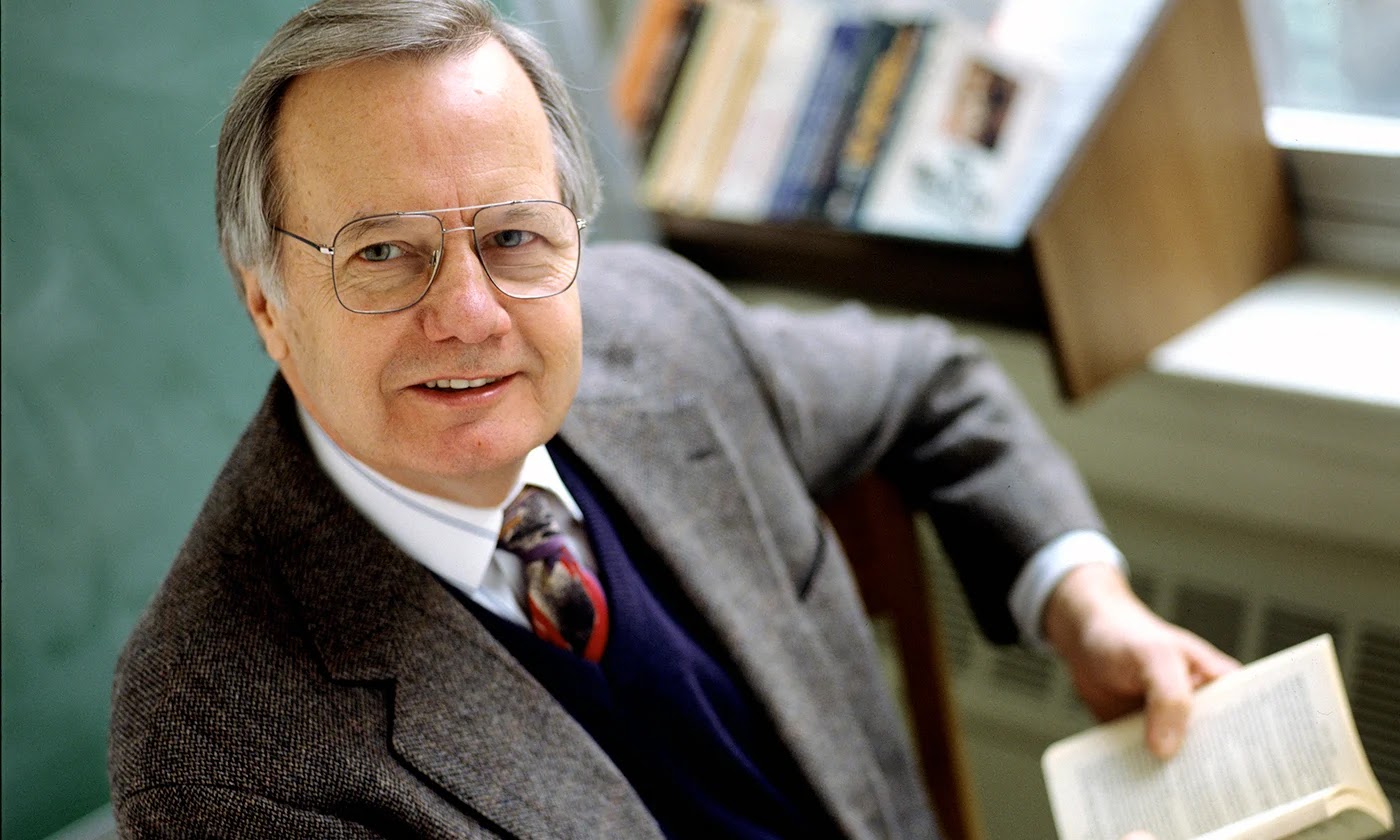
There were other people who died this year I especially admired.  I've already written at length about Bill Moyers, who died last summer.  Months later I realize more acutely that we now have no one like him, and it seems unlikely we ever will.  Rachel Maddow is carving out her own importance in more ways than one, but there's nobody with Moyers' breadth and depth, his abilities as an interviewer and his incisive writing.  I wouldn't like to imagine my life and who I would be without all those years of Moyers.


In her long life, Jane Goodall did so much for what's been called the more than human world--a true inspiration for young people passionate about saving the variety, the beauty and the viability of the planet. When Native American stories and writers burst into TV and film in the 1990s, actor Graham Greene was always there, bringing incisive life to this important moment.  

Robert Redford was a fine actor, a great movie star (some say the last) with a vibrant intelligence both contemporary and classic.  He not only made All the President's Men; he made it happen. I guess my secret favorite of his films is The Electric Horseman, though Three Days of the Condor is maybe his most perfect film.  Though I expect the one closest to his secret self was Jerimiah Johnson.

The Princess Bride, as directed by Rob Reiner, is on a lot of favorite movies lists as well as mine, but the William Goldman book is already a great template. Reiner found another great writer in Aaron Sorkin for the other of his movies on my list of favorite, The American President.  That movie probably birthed The West Wing television series as well.  

In their public lives these were all good people, and forces for good that continue to sustain those of us who were around when they were active, and can serve as inspiration for the young.


When last December I learned of the death of the writer known as K.C. Constantine--too obscure to make the Notable Deaths lists--it led to a couple of months reading all his work, both books I'd read before and those I hadn't, which then resulted in two essays posted on another blog.  This December I've already embarked on a reading (and viewing project), exploring the life, thoughts and works of playwright Tom Stoppard.  It's going to take awhile.  I've started by re-reading the beginning of Hermione Lee's fine biography, and stopping at the points where a play appears, and then reading that play.


Tom Stoppard died in November.  From his first success in the late 1960s--Rosencrantz and Gildenstern Are Dead-- to now, I followed his career and his work longer and more consistently than I have of any other playwright. (One bit of evidence: most of my copies of his plays are first edition paperbacks.) 

From the first I knew he was a writer after my own heart. I was in college then, and experiencing real theatre for the first time.  I came to admire other dramatists of my time (Arthur Miller for example was still alive and writing) but I always suspected that if I had become a successful playwright, my work would be most in sympathy with the work of Tom Stoppard. 

I felt a certain stream in common in those first plays: that ongoing comic exploration of language philosophy so prominent at Cambridge and Oxford, and its relationship with the satire of the 60s--Beyond the Fringe, That Was The Week That Was, the Goon Show and Peter Sellers, Richard Lester and the Beatles, Peter Cook and Dudley Moore, and later Monty Python and Douglas Adams, with further roots in English Music Hall (or American vaudeville), the Marx Brothers, Laurel and Hardy.  These were exciting me and my writing in the 60s as well, but I knew them only from their artifacts.  Tom Stoppard knew many of the people involved--he even wrote for a magazine run by Peter Cook.  And the collision of Shakespeare and Samuel Beckett in R&G Are Dead was also familiar--in a way, that describes much of my college experience. 


Later plays continued the elegance of language, the high and low humor, the unapologetic focus on ideas in philosophy, science, literature and history, with increasing inventiveness if in quieter ways. And it wasn't all fun and games--for instance, he returned several times, from an early play to one of his last, to the question of what is the nature of the good.

Especially in those early years, he seemed to be reading what I was reading or had read.  We had similar literary tastes.  That we would seldom have agreed on political questions in the Reagan/Thatcher era, and we might not agree on some larger subjects, not only didn't bother me, it didn't occur to me.  These were beside the point.  Besides, by the time his work overtly took sides, in favor of free expression in Eastern Europe, we were on the same page.

 From the first also, there were always stories of people and relationships, including love stories, that were sometimes overlooked--even by the playwright.  Plays are a narrative art, Stoppard insisted.

Besides, it appears he was also a left-handed and right-eared Cancerian night owl, with even less digital tech than I have.


Over the years I valued Stoppard's musings in and outside his plays, especially as a writer.  Like his very helpful description of the art in writing as controlling the flow of information.  He was a realist with a deep sense of vocation, who said "One's duty is to write as well as you possibly can, and to write whatever it is that you are now in a fit state to write."  That's a kind of classical conception that seems increasingly fragile.

A few years ago as he was giving a tour of his home library to a guest and his film crew, he remarked: "I'm deeply romantic about literature as a devotion."  I identify with that as well, though it also seems a fading feeling in following generations.


Stoppard often insisted that reading his plays was fairly fruitless, not only because the published plays are notorious for having been changed already by the publication date, but because of the nature of them as "description of a future event."  That event is the production, the performance.

Unfortunately, I've seen only a few productions: I did manage to see The Real Thing in its original Broadway production (directed by Mike Nichols), regional theatre productions of The Invention of Love and On the Razzle, as well as college productions of ArcadiaThe Real Inspector Hound and R&G (and I've seen Stoppard's award-winning movie based on that play several times.) 

But he also has work preserved in the movies: for example, his contributions to the hallucinatory Brazil,  the Spielberg production of Empire of the Sun, and  his voice in the Indiana Jones film with Sean Connery as Indy's father. (Stoppard had previously written the screenplay for John Le Carre's The Russia House, starring Connery.)  Of course he is most famous for his Oscar-winning Shakespeare in Love, which despite co-writer credit is mostly his work.


Perhaps his most sustained work for television was the British miniseries based on the related Ford Maddox Ford novels collected under the title Parade's End.  I admire both the script and the novels greatly.

There are one or two of his other television plays on YouTube, and a few of his radio plays, including Darkside, a remarkably short play that incorporates all of Pink Floyd's classic album, Dark Side of the Moon. (It also concerns the struggle to define the good.)  For those curious about Stoppard, this is not a bad place to start.

Stoppard wrote outrageous comedies and quieter if equally unusual dramas, often incorporating history and playing with concepts of time.  But all his plays had laughs.  The laugh, he told an actor in one of them, "is the sound of comprehension."  


He loved the process of theatre, working with producers, directors, actors, designers, all through rehearsals in major productions, often rewriting on request. That meant the play was still alive. He wrote for small casts and large ones, in one-acts, and in a trilogy (The Coast of Utopia) that took nearly nine hours to perform. In New York, it was the hottest ticket in town.  What was its sensational subject? Mid-nineteenth century intellectuals of pre-revolutionary Czarist Russia. Each of those plays ran separately and consecutively during the week, but all three were performed back to back on Saturdays.  I was in New York briefly during the run and heard the buzz, but the tickets--especially for Saturdays--were sold out far in advance, even if I could somehow afford to buy one. 

Before I started my chronological exploration this month I watched a lot of interviews from recent years, particularly about his last play, Leopoldstadt, a summary work in more ways than one, reflecting aspects of his own life and its previously unknown context--namely that many older members of his Czech Jewish family died in the Holocaust.  The play follows a similar family from the turn of the 20th century to the 1950s.   Performances left people in tears, including on more than one occasion, Stoppard himself.  He was 83 when it was first staged in London, 85 when it came to New York. In interviews he expressed an eagerness to be writing another play, but also admitted that after this play, it was hard to know where to go.

Stoppard died in November, at the age of 88.  "Death is not anything," Guildenstern says towards the end of R&G. "It's the absence of presence, nothing more...the endless time of never coming back..."  He was by all accounts a very sociable man (his large annual parties were legendary), who (he admitted) felt most comfortable alone.  He was a loving husband and father and friend, known for his kindness--and he owned that the kindness was deliberate, a commitment.  A lot of people are missing him.  He's not coming back.  Throughout his life Stoppard quoted another playwright's line to the effect that the obscure current underlying all of life is grief.


His work lives on, and so in this way he lives for me. Stoppard realized his plays would be produced and read for an indeterminant time after his death, but beyond that he felt such speculation was idle. Who knows what will survive and speak, if anything, especially in the increasingly uncertain future. 

Stoppard was committed to writing for the theatre, which of all writing is most obviously experienced in somebody's present. But his reservations duly noted, the same is true of reading his plays, his words.  The writing that is read is also experienced in the present, whenever (and wherever) that present happens to be.


Stoppard's verbal eloquence wasn't restricted to jokes, ironies and epigrams.  In particular I think of the profound and profoundly moving eloquence that appears at the end of play Shipwrecked, the middle play of his Coast of Utopia trilogy.  To me it is as enduring as any lines of any playwright in my lifetime. 

 Alexander Herzen has just suffered the sudden death of his young son.  Michael Bakunin attempts to comfort his by saying, "Little Kolya, his life cut so short! Who is this Moloch...?"  Herzen replies:

 "No, no, not at all! His life was what it was. Because children grow up, we think a child’s purpose is to grow up. But a child’s purpose is to be a child. Nature doesn’t disdain what lives only for a day. It pours the whole of itself into the each moment. We don’t value the lily less for not being made of flint and built to last. Life’s bounty is in its flow, later is too late. Where is the song when it’s been sung? The dance when it’s been danced?...   Was the child happy while he lived? That is a proper question, the only question." 

Monday, December 29, 2025

R.I.P. Clayton Davis (1947-2025)


In terms of years of acquaintance rather than age, I lost my oldest friend this passing year. I first remember Clayton Davis from our fourth grade at Sacred Heart School, when after Christmas we suddenly had a teacher who for the first time wasn’t a nun, but a tall blond young woman named Miss White. 

 For awhile we and some other classmates escorted her on her walk home after school—the girls walking with her while the bedazzled and confused boys shambled behind, until the point where Miss White sent us back. Once on our return walk I recall I accompanied Clayton to his house, and I met his mother and the first group of what would eventually be his nine siblings. They would be a part of my life for a long time.

 His family moved away but Clayton and I became reacquainted at Greensburg Central Catholic High School. We were in the same year and we had most of the same classes. We shared the jubilation of the Pittsburgh Pirates winning the 1960 World Series with what has been called the greatest game ever. 

 That first fall we both volunteered for the local John F. Kennedy presidential campaign, and were rewarded a few years later by being named “ushers” so we could attend the only speech President Kennedy made in Pittsburgh—in the fall of 1962, just a week or so before the Cuban Missile Crisis.

 On November 22, 1963 we heard at the same time the news of Kennedy being shot in Dallas, and then of his death. We walked together after school as we usually did that year—I lived just across the weedy fields and Clayton walked to his former home, now his grandmother’s, to await a ride back to his new home in the country. Mostly that year it was the two of us, talking about school and the endless iteration of who was the “toughest” girl in each class.

 But on that day I had prearranged to bring my debate partner home so we could work on our case. He was Michael Krempasky. We all knew that the conditions of our lives and futures had just changed dramatically. The three of us would become lifelong friends. 

 In the next few years we would form a kind of comedy group, starting with taped skits in the manner of That Was the Week That Was, Beyond the Fringe, Steve Allen and Stan Freberg, then adding music and performance. The folk music boom dominated our senior year, and we became a Kingston-like trio, complete with matching striped shirts: the Crosscurrents. 
 I started writing songs, and Clayton—a serious musician—began writing as well. Then I went off to college some 800 miles away. One day I sat in the college library writing lyrics on a yellow pad. I sent them off to Clayton, and he wrote the music. The song turned out well and so we did it again, as we would off and on for the next 20 years.

 When I got home on vacations, the Crosscurrents would work out how to do these songs together, along with songs that each of us wrote on our own. We soon discovered the magic of the Beatles together, returning from seeing their movie Help!--possibly a few times in a row--to learn and instantly sing the songs in Clayton’s basement. Our own songs changed as well.

 I’m writing about this in some small detail because I know now, as I sort of did then, that communicating through the making of music, through the sharing and shaping and indeed the creating of our songs, made these friendships unique in ways I can’t explain, except to say that there were many intuited levels of what we shared. 

 That was especially true of my relationship with Clayton, particularly as the years went on and he pursued music professionally in a series of groups, often including some of our songs. We would play together informally, and collaborated in a public way as late as the mid-1980s. The three of us had a last hurrah at an open stage in the early 2000s. 

It wasn't all music, of course.  The three of us generally had a good time together.  Clayton had a quick wit, a way with a pun.  Once when we were on an epic road trip in Ohio in Mike's yellow VW bug, Mike felt something on the back of his neck, like an insect bite.  "Is there a red spot there?" he asked.  "No," Clayton said.  "It's a pigment of your imagination."

 Through the years I attended both of Clayton’s weddings, and spent time with his daughter Nora when she was small. He visited me in Boston and Connecticut. He was there for the funerals of each of my parents. After I moved here to California I never returned to western PA without seeing him, though our lives diverged and we talked less. One of our last phone conversations was just after the death of his first wife, Joyce. 

 More than a year ago, he was found unconscious on his kitchen floor in Pittsburgh, with a stroke or something like it. He was unconscious for weeks in the hospital, so long that the puzzled doctors were losing hope. Then one day his son Ian said something that made him laugh. Slowly he came back to full consciousness.

 He had other episodes and never fully recovered, but eventually he was well enough to leave the rehab facility and live happily with Ian and Ian’s wife Stephanie in Pittsburgh, where Clayton was also reunited with his beloved dog Nelson. His daughter Nora and sister Mary were frequent visitors. In September he faded and then slipped away.

 Mike, who lives in central PA, visited him several times, but I was always 3000 miles away. I tried to communicate with him in the way we used to—through music. I sent him several mixes of songs from our past (including the Brubeck jazz we first listened to early in high school) plus some of our own songs we recorded in one basement or another over the years, and once in a real studio.

 I also wrote to him a few times. I learned he was having memory problems, and it seemed he was clearer on the far past, and sometimes felt he was living in it. So in my last letter I recounted some of the same memories from our early days as I have here—the Kennedy experiences in high school, and fourth grade with Miss White.

 His sister Mary told me she’d read him that letter, and he responded: “Miss White! She was hot!” 

 A more complete obituary appears here. May he rest in peace. He lives on in those he left behind, and in the music.  And I'll keep playing our songs, as long as I can.

Friday, June 27, 2025

RIP Bill Moyers


Bill Moyers died on Thursday, June 26 at the age of 91.  He began his second (or third) and lasting career as a television journalist and documentarian in 1971.  Though he effectively retired in 2015 at age 80, he participated in making one last documentary last year, which he also narrated.  On the day of his death, it won for Outstanding Social Issues Documentary at the Emmys. 

 Two American Families 1991-2024 previously won the International Documentary Association's 2024 prize as Best TV Feature Documentary.  It was originally shown on the PBS series Frontline. This Emmys ceremony (for news and documentary awards only) also featured a tribute to Moyers, who had been inducted in the Television Hall of Fame in 1995.

Bill Moyers was the single most outstanding broadcast journalist of his time.  Among his many contributions over the years was an insistent analysis of the news media itself, so incisive that it became prophetic.  "We have an ideological press that's interested in the election of Republicans, and a mainstream press that's interested in the bottom line. Therefore, we don't have a vigilant, independent press whose interest is the American people."  He said this nearly 20 years ago.  Similarly, his warnings about the imminent dangers to American democracy made a decade ago are now coming true in the headlines every day.

His first, brief career was in government, and his accomplishments are astonishing: he helped create the Peace Corps and was instrumental in administering its first years; he helped shape, write and get passed such items on the LBJ Great Society agenda as Civil Rights and Voting Rights, and anti-poverty programs.  He even had a guiding hand in the creation of PBS itself, which later became his principal TV home.

Late in his life Moyers described his career as a "teacher at-large."  He hoped that it would be said of him that "he was a darned good listener."


The old cliche of "we will never see his like again" is this time unfortunately true. The breadth and depth of his television work remains unique. Fortunately, much of his work is still accessible, on You Tube, and the Bill Moyers website., and elsewhere on the Internet as well as in his books.

All I can add is how Bill Moyers shaped my life, only through his TV work and his books.  It's my tribute, and one example out of many of how he influenced individuals as well as our entire culture: everything from highlighting the defining roles of money in politics and the growing chasm between the very wealthy and everyone else, to independent news media and diversity in reporting, the interplay of mind and body in health and the care of the dying; the "world of ideas" existing outside media exposure, and the vital roles of spirit and poetry in many aspects of American life. 

I first wrote about this two years ago in the middle of my last long post of my "TV and Me" series.  What follows is that long section, with a few edits and changes.


 Simply in terms of broadcast journalism, there was no more important figure in the twentieth century  after Edward R. Murrow--and so far in the 21st after no one-- than Bill Moyers.  But with his many programs (often produced by his wife, Judith Davidson Moyers) he went far beyond the usual concerns of journalism. 

Born in rural Oklahoma, christened Billy Don Moyers, and raised in Marshall, Texas, he became a teenage reporter for the local newspaper before studying journalism at North Texas State College.  A summer internship in the offices of Senator Lyndon Johnson led to a long association that ended in the White House.

 After earning a journalism B.A. at the University of Texas, Moyers entered divinity school, and was ordained a Baptist minister and for awhile was a pastor for a Texas church.  In 1960 he rejoined LBJ, now Democratic candidate for Vice President, and went to Washington to work in the Kennedy-Johnson administration, where he was instrumental in establishing the Peace Corps and getting it running. According to the excellent Washington Post obituary, these Peace Corps years were, he said, "the happiest three years of my life."

 Later in the Johnson White House he was instrumental in shaping and lobbying for Great Society social legislation, like Civil Rights, Voting Rights and anti-poverty programs, as well as the early forms of Medicare and Medicaid and environmental laws.

Then his tenure as LBJ's press secretary became compromised over the Vietnam War, and he quit. Moyers returned to journalism to set a stubborn standard for probity and ethics. This kept him changing jobs, which included stints as a newspaper publisher and a commentator on CBS and NBC evening news broadcasts. 

 But it was on PBS, which he helped create in the Johnson White House in 1967, that Moyers operated most often and most fully.  An early (and recurrent) title in his many news-oriented program of reportage, interview and commentary was Bill Moyers Journal, which is the first I recall watching in the early 70s, and even ordered transcripts of some impressive episodes. I also remember A Walk Through the 20th Century. 

Over the years he cut through official excuses and political obfuscation to provide relevant information and succinct critiques of activities and trends that alarmed and depressed me in the 1980s and afterwards. I especially remember his powerful two hour environmental documentary Earth on Edge in 2001, and his early 2000s weekly program, Now. One episode won the Edward R. Murrow award.

 Moyers also focused on journalism and its responsibilities in relation to political life.  I remember his short series, The Public Mind in 1989 as particularly powerful.

   These programs deepened my understanding, and as upsetting as many were, they rescued me from despair because there was someone else who saw what I saw, but in more context and detail, eloquently expressed. I recall Earth on Edge, on interlocking ecological crises, as a model documentary that ought to be taught.  It was so much better than anything else produced at PBS or elsewhere. 

But much as he once dumped journalism for divinity school, Moyers kept turning to deeper and vastly different subjects-- areas of human life and thought that underlie political realms.  These were the programs that made the most difference to me. There were so many I can only mention the ones that were the most personally important.

 Probably Moyers’ most extensive series was A World of Ideas, begun in 1988: some 70 hour-long interviews, subtitled “conversations with thoughtful men and women about American life today and the ideas shaping our future.” 

 Moyers was responding in part to the impoverished national dialogue, the lack of ideas in the political discourse in that election year, but his interviewees were not in politics: they were scholars and thinkers in anthropology and sociology, linguistics and management, ethics and medicine, religion and history, education, physics and environmental sciences.  They were filmmakers, writers, novelists, poet and playwright. He described his “self-appointed” mission:  “ I was attempting to bring to television the lively minds of our time.” 

They were also—Moyers as well as his guest—excellent company.  There were some misses—I thought Moyers wasted an hour discussing Canada as a funny foreign country with (Canadian) Northrop Frye, one of the greatest minds applied to literature in the 20th century.  But mostly they were enlightening and inspiring conversations.  I valued equally the interviews of people I knew of and wanted to know more (like August Wilson, Maxine Hong Kingston, Peter Sellars, Richard Rodriguez, Issac Asimov and Toni Morrison), and with those introduced into my world for the first time (like philosopher Jacob Needleman, anthropologist Mary Catherine Bateson, classicist Martha Nussbaum, educator Vartan Gregorian and historian of religion Elaine Pagels.)  

The timing of these interviews was significant in introducing me to three Native American figures when I was beginning an exploration of American Indian literature and culture that would grow over the next decade of my life: Onondaga chief and national leader Oren Lyons (with whom Moyers also did a separate program), and contemporary American Indian novelists Louise Erdrich and Michael Dorris (pictured.)  Like everything else Moyers did for PBS, these interviews were rerun several times (especially during pledge drives), and I managed to tape quite a few of them for later study.    

 In 1989 Moyers visited a biannual poetry festival to record the readings and interview the poets in the series The Power of the Word.  It would be the first of several such series (for instance The Language of Life in 1995, The Sounds of Poetry and Fooling with Words in 1999, and interviews with individual poets on his revived Bill Moyers Journal) featuring a broad range of poets. 

poets Sharon Olds and Galway Kinnell
The first episode of The Power of the Word with William Stafford, Lucille Clifton Octavio Paz, Robert Bly, Sharon Olds, and Galway Kinnell, shows interactions between poets and students (many in high school) who attended the conference. The atmosphere is warm, and it definitely heats up at the end with Olds and Kinnell trading love poems.


poet Li-Young Lee

  The second explores poetry in prisons with James Autry and Quincy Troupe; the third, “Ancestral Voices” highlights the through-line of tradition in contemporary life with Joy Harjo, Barett Kauro Hongo and Mary Tall Mountain.  Then poets Li-Young Lee and Gerald Stern explore the poetry of memory. 

Lucille Clifton
A full hour is devoted to Stanley Kunitz, then one of the most respected American poets at age 84 (he lived to be 101.)  The final program is  “Where the Soul Lives,” featuring W.S. Merwin, Lucille Clifton and Robert Bly.  Bly ends the series on stage with the Paul Winter Consort reciting a short poem by Rumi, the concluding lines I have since often quoted: “Let the beauty we love be what we do./There are hundreds of ways to kneel and kiss the earth.”  

Again, I taped some of these programs and over the years they continued to nourish and center me.

 Robert Bly was prominent in this episode, and he was a focus of the 1990 production of A Gathering of Men. The so-called men’s movement, and Bly’s part in it, were distorted, trivialized and lied about for years.  They were ridiculed, and the men who participated were cruelly shamed.  Moyers showed that this one event was serious, sincere, not political or a hostile escape from women but an exploration of feelings and their denial, particularly about a man’s relationship to his father.  Though others including psychologists James Hillman and Michael Meade not shown in this program were also leaders of these workshops, they all—like Bly-- employed poetry, myth and fairy tales to explore this and related issues. 

 I’ve never attended a men’s group, and I did not always agree completely with Bly at the pitch of his enthusiasms. But whatever other such gatherings were like, the ones these men led were serious attempts that met a need.  This program on its own is a tentative exploration that remains a useful introduction.  When I first saw it, these questions were new to me, but they immediately resonated.  This arrived at about the same time as related discussions about children of alcoholics and forms of abuse felt by children were being explored for a general public, or at least that’s when they were reaching me. 

Martin Amis, Margaret Atwood
These programs foregrounding poetry are among those that were centered on a particular conference or festival, where the Moyers team filmed the public events and some audience response or interaction, and Moyers interviewed principal participants.  Others include the Spirit and Nature program in 1991, which featured an interview with the Dalai Lama, and the Faith and Reason series in 2006, which provided a rare interview with the revered Buddhist monk Pema Chodron, as well as lively and absorbing conversations with Salman Rushdie, Margaret Atwood and Martin Amis.  Apart from providing a permanent digest of these proceedings for the many who were not there, the words preserved in these programs continue to stimulate thought and suggest new perspectives. 

Other programs were pieced together from research and interviews in various places, as the five-part 1993 series Healing and the Mind.  Modern western medicine had long discounted any connection between mind (including emotions) with physical processes and health: it was all about mechanics, all about the plumbing.  Anything else was considered superstition.  When reports circulated of some Buddhist monks being able to control blood pressure during meditations, it was considered at best an unverified mystery, or more typically as occult nonsense.

 This was only beginning to change in the early 1990s, and this series of programs was groundbreaking in revealing how much practical work and theory was ongoing, even in hospitals and clinics, exploring the relationship of brain, mind and body.  Experts and practitioners discussed relations of the brain and emotions with the immune system, the effects of environment and community on healing, and generally a new, broader attitude to treat patients holistically, as well as ways for individuals to provide for their own health.

 Today most of the practices discussed, from mindfulness and acupuncture to support groups and mothers holding their newborns immediately after birth, are mainstream.  Most therapies are such normal elements of treatment that insurance often covers them.  Similarly, the hospice care I first glimpsed in On Our Own Terms: Moyers on Dying (2000) was a rare approach then, but very much accepted now. 

The segment of Healing and the Mind that most stayed with me was Moyers exploring the work of Jon Kabatt-Zinn at the University of Massachusetts Medical Center’s Stress Reduction clinic, where he was employing the radical idea of addressing intractable back pain with the practice of meditation.  Kabatt-Zinn’s variation on single-point or mindfulness meditation was still relatively new to America, especially outside Buddhist monasteries and related places like the Zen Center in San Francisco.  His techniques were demonstrated, and he talked persuasively about them.

 The program referred to Kabatt-Zinn’s book, Full Catastrophe Living, which included instructions on meditation and the “body scan” he employs, as well as a couple of yoga regimes.  I got that book and the associated tapes in which Kabatt-Zinn speaks you through the process.  When it comes to physical movements I am a slow learner, and group instruction just befuddles me.  So I used the tapes in conjunction with diagrams in the book to learn one of the yoga regimes, and I did it regularly for years.  Though I still use aspects of it, maybe it’s time to return to it in a more formal way. 

 The experience Bill Moyers had was similar to mine, and many others: the body scan was a revelation, while meditation was hard and confusing and a bit irritating.  But it opened the door to learning the practice of meditation in various ways, including a deeper understanding of Zen practice.  This has been a major theme in my learning for the past 30 years, and it effectively began with this segment.  And I still use several of Kabatt-Zinn’s guided meditations, and profit from a couple of his subsequent books on the subject.

 Again, I acquired many of the companion books to these Moyers programs (several published by Doubleday thanks to senior editor Jacqueline Kennedy.)  They remain active resources.  Many of the programs themselves are accessible via YouTube, PBS and the Bill Moyers.com website

I have saved the most popular—and for me the most influential—of these many Moyers programs for last. In 1988, Moyers interviewed Joseph Campbell, previously unknown to the general public, with associated images from his work on world mythologies over six one-hour episodes.  The Power of Myth became one of the most popular TV series in PBS history. 

 I saw it when it first aired (and turned up repeatedly for awhile on PBS fund drives), but a recent re-viewing reminded me of an aspect I hadn’t thought much about: that these interviews took place during the last two summers of Campbell’s life.  This series made him famous, but posthumously. By the time it first aired, this Joseph Campbell-- so alive in personality, knowledge and understanding, who we were meeting for the first time-- was already gone.  He had been dealing with cancer those last years, so mortality was not an academic subject. As I watched it this time I was acutely aware of the additional power in his words on death and its meaning. 

 Campbell's many books, such as The Hero With A Thousand Faces, were influential with scholars and artists.  But it was the six-part The Power of Myth series that made him an icon, as he eloquently explained the patterns of mythology and the meanings he derived from them.

  Though the series included visual illustrations of some myths, the programs were basically little more than Campbell talking, with conversational prompts from a completely engaged Bill Moyers.  Yet the series was enormously popular.  It’s likely that many viewers got their first inklings of Buddhist and Hindu thought as well as traditional stories from Native American and other Indigenous peoples, from these programs. 

 But this wasn’t a mythological travelogue; Campbell distilled his own conclusions and related these stories to questions of the eternal within time, to the importance of the present moment, and the central functions of compassion and the individual experience.  He’d taught college students for many years, and spoke directly to their needs and yearnings. His most famous and therefore most misunderstood statement of “follow your bliss” was a profoundly religious message, shorn of any sense of sectarianism, let alone hedonism.   

Seeing the series again left me with two major impressions.  First, that so much of what has absorbed me in these recent decades in some sense began with this program. I even had forgotten that certain ideas and beliefs that I think of as essential to my life had their origin or at least articulation in these programs. (For example, that religion may have begun when humans dealt with the paradox of killing the animals they revered.)

 This series first aired when I was beginning to explore, in sometimes unrelated ways, Native American cultures and beliefs, the psychology of James Hillman and eventually his source, Carl Jung, and ecology in a deeper way.  This series touched on all of them and more.  Now my bookshelves contain dozens of books on these and related subjects, as well as several of Campbell’s books.

 The second impression is that having explored these topics and these thinkers and writers for the past quarter century and more, I found much more to learn and ponder in re-watching The Power of Myth than I could understand or accommodate back then.   That applies in different ways to other programs that Bill Moyers made.  They continue to nourish, as they once opened up new worlds, rescuing me from becoming mired in the goading limitations of the unembraceable world I was supposed to negotiate. 

These programs represent a small sample of the programs Bill Moyers created, every one of them thought-provoking and informative, and many of them revelatory.  Over the years, Moyers and his collaborators have created more worthy programs than any other individual or group, and perhaps more than some entire networks.

 Bill Moyers demonstrated the power of television to expand and deepen our experience.  There should be a thousand Moyers.  But there was only one.