Friday, December 15, 2006


Snow: the ghost of Christmas past? Posted by Picasa
Let Old Temps Not Be Forgot

News that will stay news in 2007:

The year 2006 will be the fifth hottest on record for the planet Earth (according to NASA) or maybe the sixth (according to the World Meteorological Association).

England had its hottest year since their records began in 1659. The U.S. had its third hottest since 1880. "But all of the reports noted that temperatures greatly above normal were recorded in places as varied as Australia and Scandinavia’s Arctic islands, shattering a variety of longstanding records," writes the New York Times. "The records set this year support various studies that “showed links between human behavior and the warming trend,” said David Parker, a climate scientist at Britain’s Met Office."

2006 was the hottest year in the Netherlands since 1706.

Meanwhile, a team of American and German scientists studying the tricky topic of future rises in sea levels have concluded that previous predictions under-estimate their forecasts by 59%. The study, published in Science, also said (according to this BBC report) that "the observed rate of sea level rise through the 20th Century held a strong correlation with the rate of warming."

Thursday, December 14, 2006

Delay

President Bush has put off announcing his new Iraq policy until after the holidays. Meanwhile the killing and violence accelerate, more American soldiers are killed and injured, and political maneuvering in the Gulf region and in Iraq is likely to be going on at a fever pitch. The Bushites risk having a new situation handed to them (like the fall of the current government) before they can announce how they would have responded to the ongoing one.

But the delay may be inevitable if there is any chance Bush is going to change policy at all. The
reason for the delay and the methodical approach being taken may well be that everybody knows they have to change Bush's mind, and it probably looked as if he was going to retain his faith-based policy if he announced before Christmas, so they've talked him into delaying it and listening some more, in the hopes that he can be persuaded to change.

Except for a few Bush retainers, a lot of people in the White House and Republicans in Washington want to have jobs after Bush leaves, and they can read the polls, which lately show over 70% no confidence in Bush's current Iraq strategy. They know the Iraq policy has to change, and they've got to get Bush to do it. A stubborn man with little patience and curiosity and a dim bulb to begin with, it's not an easy task. However, giving him some bonus time at the ranch before he heats things up again with a policy statement probably appealed to his innate laziness. Maybe it will clear his head as well as some brush, and he'll change.

Wednesday, December 13, 2006


by Paul Klee Posted by Picasa

Captain Future's Bookshelf

The Emotion Machine
Commonsense Thinking, Artificial Intelligence and the Future of the Human Mind
By Marvin Minsky

Science may begin with wonder and strives ultimately for understanding, but as a practical matter, science is interested in how to do things. Physics formulated a few simple laws (governing how falling bodies behave, for example), which enabled engineering and technology to develop.

So when some scientists set out to create intelligent machines -- "machines to mimic our minds" -- Marvin Minsky writes, they looked for simple laws that govern how our brains work. They didn't find them, he argues, because our brains are "complicated machinery" and we need "to find more complicated ways to explain our most familiar mental events." Humans adapt to different environments and situations because our brains are resourceful -- we have lots of different ways to solve problems, and if one doesn't work, we can switch to another. This book is about what Minsky believes those processes are.

continued at The San Francisco Chronicle Book Review.

Tuesday, December 12, 2006


Sun by Yukie Adams at stonington.com. Posted by Picasa
Darfur and the Climate Crisis

Most of the crucial challenges of today and tomorrow are related in some ways, but there is a particularly direct connection between two problems that don't seem to have that much in common: Darfur and the Climate Crisis.

But as former president of Ireland and former UN Commissioner for Human Rights Mary Robinson made a point of saying in an important environmental speech Monday, the economic and social effects of the Climate Crisis will hit the poorest people the hardest, and global heating directly affects some of those poor areas, throwing a vulnerable subsistence into chaos and catastrophe.

Some such areas are already being affected, like Inuit villages in the north but also vast areas of Africa, where persistent drought is diminishing arable land, and various groups may fight over what's left. That's what Kofi Annan, Al Gore and others claim has been happening when Lake Chad dried up, resulting in the ongoing genocide in Darfur, partly a grab of dwindling food-producing land and water.

Kofi Annan also pointed to areas like Kenya where drought partly attributable to global heating is displacing populations, and the spread of malaria, one of Africa's major diseases, to higher regions, as they become hotter and more hospitable to mosquitos. While global heating may be changing the environment in the Arctic, it is likely to be accelerating and exacerbating ongoing desertification in Africa which may have many causes, including manmade ones.

As a global matter, a report last month by former World Bank chief economist Nicholas Stern said that while actions now to curb carbon emissions would cost one percent of world economic output, delay could push the price up to 20 percent. As usual, the brunt of any economic problem hits the poor hardest, even when they live in an area that's less directly affected. That's why Mary Robinson insists that the Climate Crisis be conceptualized as a human rights crisis as well as an environmental one.

Saturday, December 09, 2006


Dunes of Mars. Thanks to Kevin Hoover for sending the link. Posted by Picasa

from dkos. U.S. fatalities in Iraq by home of record. Posted by Picasa
The Fever Victims

In the media and therefore probably in Washington, there seems to be a trend or let's say an increasing awareness of the human cost--at least the American human cost--of the war in Iraq.

It's a theme in coverage these days, with John Kerry's 1971 question about Vietnam (How do you ask someone to be the last person to die for a mistake?) frequently if not obsessively cited. The anguish fuels the misguided efforts to reignite the draft, as if adding more bodies to the count would help. But the anguish is more prominent than ever before, as the War Fever has broken and reality of war sets in.

The reality of this war is that the now nearly 3,000 combat deaths is the tip of the iceberg. There don't seem to be solid figures on the wounded--perhaps 25,000 wounded in combat, perhaps 50,000 total, or as many as 100,000. But one report I caught this week estimated that as many of half of the wounded will not fully recover. Medical technology saves lives, but adds to the number of disabled and seriously and permanently injured.

All this results in more attempts to tell the personal stories, as Meteor Blades did at Daily Kos. He writes about Vietnam as well, in particular about two outstanding young men who were killed within weeks of arriving in Vietnam. I personally knew a young man who met that fate. He was in my class in college. Most of my contemporaries are veterans of that conflict one way or another--the war vets, the antiwar vets, and those whose lives were in one way or another formed and deformed by the military and the draft. I'm not comparing the experience of being under fire in Vietnam with marching on Washington, but I am noting that from that time forward war is always personal to me.

Meteor Blades front page diary includes this map of where the young soldiers who died in Iraq came from. It's pretty interesting, in that many of the clusters are in traditionally Democratic areas, including the "San Francisco values" part of California. This has always been a smoke and mirrors war by a smoke and mirrors administration. Republicans with their moral rhetoric assume the patriotic high ground, but it's all talk, it's basically hypocrisy and lies.

The photos of young people whose lives have been snuffed out--often the portraits we associate with high school yearbook photos--are heartbreaking enough, just because of how young they are. But the photo below also caught my imagination, because of the reality behind the cliche--a rabid football fan (in this case, of the Pittsburgh Steelers), shedding his shirt in sub-freezing weather. But the young man in this photo (the Pittsburgh Post-Gazette caption tells us) is James Montgomery, in the stands at Heinz Field. He's just returned from active duty in Iraq. It's his 30th birthday. The Steelers are sticking it to the Cleveland Browns. In Iraq, soldiers don heavy armor in heat that gets considerably about 100F. To this young man, the freezing cold must have felt like life itself.

His war is not over. It never will be. We have no idea of what is in store for him. We hope he manages his life, and should he need help for medical and psychological problems, that he gets it. War, especially in this age of high tech weaponry and exotic chemicals, etc., war is the curse that keeps on killing. This new concentration on the soldiers whose lives are inevitably changed, even when not ended, is fitting. But it should have been a much bigger consideration before this all started. And it ought to be joined by consideration for the thousands of Iraqis killed and maimed, and the millions displaced--their lives will never be the same either. The time to remember all this isn't just now. It's the next time someone tries to reignite War Fever.

James Montgomery, Iraq vet and Steelers fan, at Heinz
Field Thursday. Photo: Pgh. Post-Gazette. Posted by Picasa

Friday, December 08, 2006


Posted by Picasa
The Sea Change

The most dramatic consequence of this year's election exhibited so far is the changeover on the Senate committee on the environment from Climate Crisis Denier, James Inofe, who spent his last hours upon the stage railing against media alarmism over global heating, to Senator Barbara Boxer, who said:

"Any kind of weakening of environmental laws or secrecy or changes in the dead of night - it's over. We're going to for once, finally, make this committee an environment committee, not an anti-environment committee. ... This is a sea change that is coming to this committee."

One of many articles reproducing this statement, in Forbes, went on to add:

Boxer's first hearing next month also will be devoted to global warming, but from an opposite point of view from Inhofe's. "This is a potential crisis of a magnitude we've never seen," she said Tuesday, explaining that her goal is to impose mandatory caps on carbon dioxide, a step vehemently opposed by Bush's top environmental advisers.

Nonetheless, she promised to hear from all sides before trying to move a bill to Senate passage. "I very much want the environment to go back to being a nonpartisan issue," she said. She said her model will be a new California law that imposes the first statewide limit on greenhouse gases and seeks to cut emissions by 25 percent, dropping them to 1990 levels by 2020. "Real goals, real percentages," she said.

"We want to send a signal to the world," Boxer said, complaining the United States now lags behind more than 50 other countries addressing global warming. She said she has received calls from several foreign leaders expressing hope for a new U.S. environmental policy.

All of that sounds promising and exciting, but the very fact of the change from Inofe to Boxer is certain to have positive effects on Climate Crisis science, regardless of the outcome of those hearings. In "State of Denial," a special report in the November 4 issue of New Scientist, Fred Pearce outlines the efforts of Inhofe and others to intimidate scientists whose conclusions on global heating run contrary to the Deniers' agenda, and the threat to withdraw federal funding.

Inhofe was conducting "investigations" into agencies conducting research he considered hostile, including demands for documents and financial records. All of this was happening as climate scientists are finishing the next report by the Intergovernmental Panel on Climate Change. Its 1995 and 2001 reports provided overwhelming scientific support for the reality of the human- induced Climate Crisis. The new report is due in February 2007.

Of Inhofe's investigation, the magazine wrote: "many climate scientists contacted by New Scientist regard it as a tactic designed to intimidate those working on the IPCC report. "Inhofe's actions appear to be an effort to discourage leading US scientists from being involved in international scientific assessment processes such as the IPCC," Mann says.

This is potentially disastrous for the IPCC. Out of 168 scientists listed as lead authors or reviewers involved in assessing the science of climate change, 38 are from the US - more than twice as many as the second-largest national grouping, the British.

IPCC scientists who spoke to New Scientist insist they are not trying to turn science into politics or to shut down genuine debate. They do, however, worry that their conclusions might be drowned out by some politically motivated and industry-funded sceptics. "I'd hate to see hundreds of people putting years of their lives into producing a report that is then trashed by these people for political ends," says Santer. "That is what happened in my case, and I felt very bad about it."

But Inhofe's McCarthyistic investigations are over: the Boxer Rebellion has begun. Her first Climate Crisis hearings should be happening as the IPCC report is issued, and instead of a hostile Congress, it will find a larger stage than it has ever had. The Deniers are still around, and are still well-funded, but they are about to learn what difference a Senate committee chairperson can make, especially when the whole world and most of the country is ready to hear the truth, and getting ready to act on it.

Willie Parker broke the Steelers single game
rushing record as the Steelers beat the Browns
to win their 4th out of the last 5 games, at snowy,
cold Heinz Field, Pittsburgh. Post-Gazette photo.Posted by Picasa

Thursday, December 07, 2006


Eagle and Dreamer by Gene Thomas
(Onondaga) at vtweb.com. Posted by Picasa
The Last Worst War

The Iraq Study Group report has been made public. It's being characterized as a devastating indictment of the Bushwar policies, not only in Iraq but in the entire Middle East. Last week President Carter said he thought GW would go down in history as one of our worst Presidents; Wednesday, President-elected Al Gore called Iraq "the worst strategic mistake in the history of the United States" but urged Bush to get over himself and understand that it's about the troops (ten more died Wednesday) and the Iraqis and America's future and not about him, so do the right thing. Some people don't think Bush will, or is even capable of that. And some aren't very impressed with what the Group recommended anyway.

But before this all gets lost in details and then forgotten, I want to make one point. While this is clearly among the worsts war this country has ever perpetrated, the real shame--and the shared shame--is that we didn't learn enough from the previous ones.

We have a President whose first impulse and first resort is to make war--to kill and destroy--in order to achieve his ends. He is the American Presidency's first fundamentalist warmonger--it's war first, last and always. The progress made over more than a century in governing the world and settling disputes and solving problems regarding crucial and deeply important and deeply dangerous matters through diplomacy and treaty, negotiation and agreements and commitments, has all been reversed. It was progress paid for partly by the blood of millions, utterly disrespected by this U.S. regime.

And how did this war happen? Because we let George do it. Once again, this country injected itself with War Fever, as if we were born yesterday. This is the shame of this generation. Or one of them anyway.

The Bush legacy has already permeated domestic politics and changed the international arena. Internationally, nobody with half a brain trusts the United States, and trust is the basis for world order. Domestically, it is permissable finally to be against this war, but now more than in a generation, the idea of war as the last resort, as horrific, and the priority of solving problems without violence, are all considered signs of weakness.

In the midst of the past campaign, one "progressive" blog railed against a Republican charge that the Democrats want to start a Peace Department as more reprehensible GOP slander. Clearly the blogger felt that this could lose the election for Democrats. Strictly speaking, it wasn't true (just about the only Democrat to go on record in favor of a cabinet level Department of Peace is Rep. Dennis Kucinich) and the intent was to slander Democrats.

But here at the dawn of the 21st century, that's where we are. In the 1990s, the military challenges the U.S. faced had to do with something called "peacekeeping," which we failed to do in Rwanda but finally did attempt in Bosnia. But U.S. commanders quickly realized that they didn't have any idea how to do it. Their troops are trained to make war, not peace. They haven't called it "peacekeeping" in Iraq, but for much of the past 3 years, it was pretty similiar.

What they found was that it takes skills--different skills, but just as war requires skills, so does peace. A civilized society in the nuclear age, faced with challenges of terrorism arising from a complex of disputes over land and rights, involving poverty and hopelessness, cultural and ethnic conflict, oppression and disrespect--would be devoting as many resources to developing and using the skills of peace as whatever skills of war are finally necessary. A Department of Peace is long overdue.

What did this report say about Iraq, what have generals been saying from their experiences in Iraq but this simple fact: there is no purely military solution. And there never is.

The only way to redeem this shameful time--and we will be paying for this for years---is to see to it that it is the last worst war. And that will require a commitment to developing, learning and using skills of peace--and doing so with the utmost dedication. They go beyond "peacekeeping" in the Bosnia sense, and they involve us all, from understanding as well as practicing diplomacy, communication and conflict resolution, to conscious self-innoculation against push-button War Fever. The survival of civilization depends on it. There are those among us who don't much care about that. Those who do should think very carefully about what this war is really telling us.
Now That's A Gap

While we are all being whirled around by the emotional crosscurrents of spending money to show love, here are a few statistics to ponder: according to the study released by the World Institute for Development Economics Research of the UN University, half of the wealth in all the world is in the possession of 2% of the world's people.

Ten percent of the world's population own 85% of the world's wealth.

If you are an adult worth more than $2200, congratulations: you are in the top 50%. If you're worth half a million, you're in the elite 1%.

That second set of statistics may be pretty meaningless in ordinary life, but the first set is not. The gap between rich and poor has been growing for a generation, and one of the countries with the greatest income inequality in the world is the USA.

This means something. The poor in the world, particularly in poor countries, are consigned to poverty for generations, because they don't have the means to break into the higher brackets--there's no money for education, mobility, investment, starting over.

In America, it's more complicated, yet maybe not so much: how does a democracy function, with a few plutocrats and a lot of losers? We could go on for awhile discussing the ramifications on political as well as personal psychologies. There are dark arguments about how income equality is bad for the economy--some of which are beginning to be confronted.

We've known for half a century that there is more than enough wealth to make everyone reasonably wealthy. Even in the past year, it's been demonstrated how painlessly most of the poverty in the world could be eradicated in a few years. Back in the 1960s, economists worried about what people would do with all their leisure time in the 21st century, because so little time would be required to make a sumptuous living. There were also quite serious proposals for a Guaranteed National Income, which would solve all kinds of social problems, while increasing national wealth in the long term.

But we're leaner and meaner now. That is, the plutocrats and the oligarchs are meaner, and most of the world's people are leaner. (Except, in an irony that Kafka and Kierkegaard might mordantly savor, in America it's the rich who are physically lean. As for the rest, let them eat fatburgers.)

Tuesday, December 05, 2006


Blue Night by Paul Klee Posted by Picasa

The Dreaming Up Daily Quote

"When we were children we were errant enough to want to be birds for the day but there's nothing easier to lose than playfulness."

Jim Harrison
True North
Chalk Up Another One for the Planet

Despite continuing evidence of humanity's inhumanity to humanity, the planet scored another victory, courtesy of some of humanity bravely holding off the rest of humanity to save a small but significant chunk of what once was the pride of planet Earth: its forests.

Specifically in this case, the crucial tropical rainforest. Brazil announced it will protect a significant portion of very endangered rainforest, which also will link existing preserved portions in three other countries, creating an important corridor for wildlife.

According to ABC News: Known as the Guayana Shield, the 57,915-square-mile area contains more than 25 percent of the world's remaining humid tropical forests and the largest remaining unpolluted fresh water reserves in the American tropics.

The article quotes Conservation International President Russell Mittermeier as saying:
"If any tropical rain forest on Earth remains intact a century from now, it will be this portion of northern Amazonia." That's great, but if it indeed is the only intact tropical rain forest, it won't be nearly enough. This is part of a beginning. No less, but no more.

UPDATE: A real good diary on this topic at dkos.

Mixed-race Korean children at Hines Field in Pittsburgh this
Sunday, brought over by Steelers wide receiver and Super Bowl
MVP Hines Ward, himself of mixed-race Korean ancestry.
Photo: Pittsburgh Post-Gazette.Posted by Picasa
Are We Fit To Live?

If you really take it all in, the news most days tells you that the human species is not fit to live. What we've done with our power is scandalous to the extreme. We destroy the planet that sustains us. We destroy the habitat and the lives of the life that also sustains us, and the creatures that are our only known companions in the universe. And we destroy each other--we kill and maim strangers, and we kill and maim members of our own communities, and those entrusted to our care.

We look at Darfur and elsewhere in Africa, in Iraq and the rest of the Middle East, and anywhere there is cruel violence and great poverty, disease and lots of guns, and the only reactions possible begin with horror and shame. But we in the U.S. don't any longer have to look that far. Apart from the normal neglect of the poor and physically and mentally ill, and besides what our firepower is doing elsewhere, we can look to our torture camps, our prisons and our own armed forces, just for starters.

Today we see what one man has endured, with hardly a peep from his community, or another man treated perhaps with less violence but with the kind of injustice that should not be tolerated in this nation. (Both of these links are to Glenn Greenwald's excellent blog, but they in turn link to the appropriate New York Times reportage.)

This violence--and there is no other name for it--extends to our own. Today's NPR report is the latest to highlight the scandal of how the U.S. military treats its own--specifically in this case, those with mental and emotional trauma caused by the warring that the military sends them to do. But the U.S. military and U.S. government shirking their responsibilities to soldiers in the most cynical ways is even more widespread than this. Substandard medical care, and the refusal to even give that; using every pretext and gimmick and trick to deny veterans their benefits; the failure to take care of soldiers' families, and on and on.

The denial of mental and emotional trauma benefits is part of the denial of mental and emotional trauma, which is part of the lie of military service: because they are afraid that if the true cost is known, they will have fewer bodies to throw into battle. Yet it has been clear for a hundred years that virtually noone who has been in battle or even in the armed services escapes some mental and emotional consequences.

And why do authorities get away with torture under any other name? How could so many people be held and subjected to torture without charge or trial for so long, without journalists clamoring for facts and the community clamoring for the truth? It's the denial that is the cold part of war fever.

War Fever--it is expressed in so many ways, actively when bloodlust takes over, passively when flagwavers get a thrill regardless of consequences, and darkly threaten anyone who isn't feverish, who asks questions. We've known about War Fever since before Shakespeare--that's part of what "let loose the dogs of war" means--and yet it comes upon a society in the 21st century as if brand new.

What must we do to deserve to live as a society, as civilization, as a species? We have to get better. To do that, we must first of all believe that we can get better. We aren't fated by human nature or selfish genes or any other propaganda that soothes our conscience while it promotes the interests of those who exploit us for their wealth and power. We must have hope, and faith in ourselves. And all of this will be harder than the reflexive excuses or reversions to violence, projection, scapegoating and denial, and all the other easy steps in the perennial spiral to self-destruction.

Then we have to do something about it. We can't throw up our hands--and apparently it's not enough to know the facts of how we behave badly. We must develop and use the skills that will help us to be better.

We can't revert to managing behaviors because some greater power will punish us. We have to go beyond other kinds of fevers that draw their power from guilt and despair of who and what we are, and that in the guise of religions inevitably lead to the exploitation by the few and war of sect against sect in the name of love and truth.

From traditions and new knowledge in the West and the East and everywhere in our world, we have skills and vocabularies that begin with self-knowledge and embrace better ways of communicating and resolving conflicts. Jung issued his great cry nearly a half century ago--that our problems begin in the human psyche, and yet we know nothing about it. And what we do know, we don't use.

This is hardly a gooey sort of prescription. Because in the course of learning about ourselves, our psyches and our nature as human beings in this world, we learn how we are manipulated and exploited to serve the selfish and cynical interests of the destroyers, and how we can prevent their efforts from succeeding.

We have a long way to go, in a very short time. Whether we as a species and a civilization are fit to live--in the Darwinian as well as the moral meaning of those words--will be decided by our interactions with the planet, with each other and within ourselves.

Sunday, December 03, 2006


African gray parrot. Posted by Picasa
City of the Future: City of Broad Waters?

What is the future of the city? A contest set up by the History Channel gave eight teams of architects in Chicago the chance to (quickly) come up with their visions. As described at World Changing, all of the entries were inspiring. Perhaps because, unlike the utopian visions of the recent past, they were both imaginative and realistic in terms of ecology and energy. And not simply in how the city preserves or enhances its own ecology while using energy efficiently--but in how the city responds economically to the challenge (and the opportunity) of future ecological and energy needs beyond its own borders.

For example, the winning entry was a plan to make Chicago, the city of broad shoulders, a prime producer and exporter of...water. Yes, cool, clear water, pure water, drinking water, because water is likely to no longer be everywhere. The Climate Crisis as well as pollution is very likely to make water the most important natural resource of the near future.

This vision (by UrbanLab) lays out an elegant plan for how Chicago can use its river and access to Lake Michigan to produce clean water and export it, and in the venture, become a greener city, with far less dependence on automobiles.

This will become an entry in a national competition, but the beauty of it is that it is site specific--it could really work for Chicago. While politicians and the media babble on, at least some engineers and architects are looking realistically at the likely needs, conditions and opportunities of the 22nd century (though the water crisis is likely to be a mid-21st century situation, if not sooner) and coming up with imaginative solutions that are of the kind that can very well characterize such future planning: win/win, non-zero sum change.

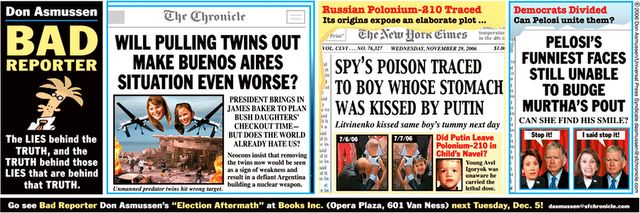
Asmussen in SF Chronicle--click to enlarge. Posted by Picasa

The Daily Babble

Surprises

Got a nondescript looking envelope in the mail, almost threw it out, though the lack of any information on the outside made me curious (for as we all know, CHECK ENCLOSED on the outside only announces a scam, and I got one of those this week, too.) But when I opened this anonymous looking envelope, it did contain a check--for over a hundred dollars.

So of course I read the accompanying material to see what the scam was--like I could cash the check as soon as I bought one of their 20 thousand dollar stadium-size TVs or something. But no. This was a real check, one I had actually earned. It was for the Google ads that have appeared on this blog, and several of my other ones, for years now. It's the first money I've ever seen from blogging. And it took a long time--so long that I stopped checking the account. I couldn't understand it anyway. But I gather that it all accumulated, until it passed a hundred bucks worth, the threshold for writing the check.

The ads pay because of traffic, or click-throughs, or something like that--lots of hits involved anyway. These blogs are not particularly successful in terms of numbers--this one is just now approaching 25,000 total hits, while Soul of Star Trek inches closer to 100,000. But it took years to get even those numbers. Still, it was a nice surprise--and came in handy less than 24 hours later when my fan belt broke as I was passing an auto repair shop. So the money's gone already, and I'm not yet done with repairs apparently.

Numbers aren't everything. I get nice comments at Soul of Star Trek, even a compliment on my Gojira essay, the occasional nice comment here, and even a complaint yesterday that I wasn't writing often enough.

As for that, I've just had a run of deadlines, pretty much done now, and besides the insecurity of steady (part-time) work not resuming for a couple of months, I do hope to pay more attention to my blog garden. This one I'm once again going to try to focus, maybe starting with better links. We'll see.

And now, the news.

Here are a couple of hopeful items to explore: Americans drove less in 2005 than they did the year before, according to a study--the first year-to-year drop in 25 years. Higher gas prices, aging population, are among the factors the study cites, though the linking to higher prices is disputed elsewhere. And...another study suggests that globally, deforestation may be slowing down, and cumulatively, regeneration is on the rise--meaning that instead of dropping steadily, forests may be increasing by 10%. Here's the BBC article, and here's an evaluation from Treehugger.com.


“How does it feel to be a war criminal, Henry?” Peter Jennings asked Henry Kissinger at a media-heavy dinner party, hosted by Barbara Walters, some years ago. Undeterred by the general embarrassment, he asked him again. I wonder when Don Rumsfeld will start getting that question over his soup?

What's really happening in Iraq? Steve Gilliard has a pretty simple explanation. It has the ring of truth, which to me means that I'll keep an eye out for confirmation.

Monday, November 27, 2006


The hummers are hanging in. BK photo. Posted by Picasa
Iraq, Civil War and the Draft

Today the TV talking heads were debating the decision by NBC and a few other news corporations to defy the Bushites and call the Iraq violence "civil war." The Bushites have resisted this for more reason than their usual taste for obsfucation. Obviously they would prefer the news media to stick with "Operation Iraqi Freedom." But the implications of civil war are that the mission for U.S. troops would change, and in a practical sense their presence would lack a rationale.

As for the accuracy of the term, I found one of the talking heads, from Time Magazine I seem to recall, persuasive in saying that it is BOTH a civil war (Shia against Sunni Arab with power struggles within each group) AND an insurgency (just about everybody against the U.S., and many against the current government because of its U.S. ties.) It's two wars, two wars, two wars in one.

The push for a timetable, for "redeployment," which all means withdrawal, is becoming overwhelming in the media as in the Congress and the country. But such is the frustration with the insensibility (way beyond insensitivity) of the neoncon Bushite faction still holding the Executive--specifically with the John Kerry question of how do you ask someone to be the last one to die for a mistake-- that some progressives are falling off the deep end by calling for a draft.

Charles Rangel has made this proposal, and other liberals and "progressives" in the blogosphere agree. They say the burden falls unequally on the working or lower or lower middle class, and minorities, who join the all-volunteer army to finance school. They say the Republicans who support this war haven't served in the military, and none of their children do. (Not precisely true but mostly.) All good points. So they say let's make it all fair, spread the burden, and make sure America as a whole feels the consequences of war--by reigniting the draft.

To which I say, with all due deference, YOU ARE OUT OF YOUR FUCKING MINDS. Here's an idea that is just as practical--why don't you charge upper income white kids college tuition proportional to their family income, so a year of college costs maybe a million bucks. And give them the same deal--the Army will pay for their schooling if they join up. Great idea, huh? And one that will really, really work. Just as well as the draft.

First of all, the proponents' sense of Fairness is that they will structure the draft so that this time, nobody will get out of the draft because they are rich or powerful. I'm sorry, but I can't understand how anyone who has observed Washington or politics in this country can believe this is even remotely possible. Because it's utterly and completely though bitterly laughable that there ever would be a draft (or a draft law) that took rich kids who didn't want to go, or whose parents didn't want them to go. Short of a war that the entire country believed in anyway, enough that everybody was lining up to volunteer. That's the only time a draft can possibly work fairly--when it's just a way to manage the volunteers. And then it works by encouraging the well off and well educated to join up to become officers instead of waiting to be drafted as a lowly grunt.

Then there's the argument that if there had been a draft, Bush would never have gone into Iraq because the American public wouldn't have allowed it. To which I say HAH HAH HAH HAH HAH ETC or in Internetese, LOL to the power of 100. Believe that, and I've got some WMD in Iraq to sell you a war with.

Please: with a draft, we would not only be in Iraq now, but Bush and John McCain would be arm in arm, announcing a new draft call to put another million soliders into Iraq and Afghanistan, to settle things down. And to get ready for the invasion of Iran.

Honestly, were you all comatose during Vietnam? When we had a draft? Our longest war? That in one way or another deformed an entire generation of men, and ruined countless families?

I simply can't believe that anyone who was alive during the last draft could possibly believe that we would have a draft that was "fair," that it would do anything other than provide maniacs like Bush and Cheney with more cannon fodder; that there would be meaningful exemptions for conscientious objectors (handed out no doubt by the folks that brought you Guantanamo and reports on Quaker meetings saying they were a threat to the military), or that there would be a "national service" in which young people could choose to serve in a non-military capacity (tell it to the National Guard, please.)

Some of the proponents want simply to debate the draft proposal, because it would bring home the true cost of this war, or of future wars. I've got a better idea--why don't you just bring home the true cost of this war and future wars, and forget about the stupid draft? Let's get serious and focused. An unworkable system of involuntary servitude and a larger war (and anti-war) culture is not the way to do it. How about funding educational opportunities for everyone, paying soldiers decently so their families don't have to go on food stamps, give them good medical care for the rest of their lives and, by the way, equip them adequately when they are in harms way; and then how about dedicating some of the bucks a draft would cost to developing and nurturing the skills of peace that might actually help global civilization survive? That might be difficult, but at least it isn't insultingly insane.
Corporate Science and School Censorship

In a Washington Post oped Sunday, Laurie David (National Resources Defense Council trustee and founder of Stopglobalwarming.org) wrote that as co-producer of Al Gore's An Inconvenient Truth movie, she'd heard lots of requests from parents that the film be made available to schools. So she offered to donate 50,000 DVDs to the National Science Teachers Association (NSTA) for distribution across the country. They said no.

Is it because they perceive the content--approved as accurate by every climate scientist asked so far--as political, as taking "sides," and therefore as not something they should distribute? It has always been absurd that the Climate Crisis was a political issue. But largely because of a few giant global corporations and their political minions, it was. So if NSTA's position was that it had to remain neutral, or especially if it refused on principle to accept materials that could be in any way construed as propaganda from a source that might have a political or ideological agenda, I could respect that completely.

But that's not really why they turned down 50,000 DVDs, even though it was one of the reasons they offered. Another was much more telling: "Accepting the DVDs, they wrote, would place "unnecessary risk upon the [NSTA] capital campaign, especially certain targeted supporters." One of those supporters, it turns out, is the Exxon Mobil Corp." Exxon contributed some $6 million in a recent campaign; and an Exxonista sits on NSTA's board.

The National Science Teachers Association not only gets bucks from Exxon and other oil companies, they distribute their "educational materials"--that is, their corporate propaganda. As for a political agenda, theirs has been clear. An internal American Petroleum Association memo leaked in 1998 said it all: Informing teachers/students about uncertainties in climate science will begin to erect barriers against further efforts to impose Kyoto-like measures in the future."

Let me quote again from Saturday's Washington Post: 'We have to deal with greenhouse gases," John Hofmeister, president of Shell Oil Co., said in a recent speech at the National Press Club. "From Shell's point of view, the debate is over. When 98 percent of scientists agree, who is Shell to say, 'Let's debate the science'?"

Either NSTA hasn't gotten the memo from their corporate overlords (Shell is another big contributor) or it's all just part of a Shell game, but two things are clear: there is no debate over the science, and corporations with a massive self-interest will continue to work the issue to whatever advantage they can get. Corporations have also partnered with so-called conservatives who cut funding to schools and school programs, so they would be more dependent on the "private sector," i.e. corporate propaganda and control.

Some corporations, especially companies needing to build new power plants, need regulation, so the future is predictable and the playing field is leveled. But corporations are also still trying to manipulate public perception, to get the best possible deals for themselves. Apparently it's not enough to go after voters. They're going after children.

Laurie David makes the analogy to Big Tobacco's promotion of cigarettes to teens and children, symbolized by Joe Camel. Once again, the corporations are going right to the kids. The analogy is more than an analogy. As George Monbiot discovered, the leading Climate Crisis denying lobbying organization was begun by Philip Morris as a tool to deny the hazards of smoking, and especially of second-hand smoke. Many of the same people, using the same techniques and websites, have gotten big money from Exxon to engineer the so-called controversy over the Climate Crisis, where in reality none has ever existed. (Although until recent years, some scientists in the relevant fields wanted more data before they committed, there was never opposition, and today there is virtual unanimity.)

What isn't clear is what America's science teachers are going to do about this. Is teaching Climate Crisis denial any less anti-scientific than teaching Biblical creationism as science? Is it really worth the free glossy propaganda? No doubt science teachiers need more disinterested state funding for their science teaching. But maybe they should show some character first.

UPDATE: On his Countdown program, Keith Olbermann named the president of the
National Science Teachers Association as today's Worst Person in the World.

Saturday, November 25, 2006


By Wayne Sky (Cayuga) at vtweb Posted by Picasa