Saturday, November 25, 2006

The Turning

It's beginning, even in advance of the Democratic takeover of Congress. A story on the front page of today's Washington Post: "While the political debate over global warming continues, top executives at many of the nation's largest energy companies have accepted the scientific consensus about climate change and see federal regulation to cut greenhouse gas emissions as inevitable."

The politics is encouraging acceptance of the science. "'We have to deal with greenhouse gases," John Hofmeister, president of Shell Oil Co., said in a recent speech at the National Press Club. "From Shell's point of view, the debate is over. When 98 percent of scientists agree, who is Shell to say, 'Let's debate the science'?"

And these companies are acting: "The companies have been hiring new lobbyists who they hope can help fashion a national approach that would avert a patchwork of state plans now in the works. They are also working to change some company practices in anticipation of the regulation."

In an immediate sense, this began right after the elections when it became known that Senator Barbara Boxer would become the new chair of the Senate Committee on Environment and Public Works, chaired under the Republicans by the extreme Climate Crisis denier, James Inofe. Boxer immediately made the Climate Crisis her top priority, and an urgent one. Said one story: There's a new environmental policy boss in town, she scowls a lot, and two of her favorite phrases are "global warming" and "extensive hearings."

Then Boxer was joined by two other incoming chairs in the Senate-- Democrat Jeff Bingaman of Energy and Natural Resources, and Independent Joe Lieberman of Homeland Security--in calling on President Bush to support and sign legislation aimed at addressing the Climate Crisis. This happened as UN Secretary General Kofi Anan called out world leaders to give urgent priority to the Climate Crisis.

Then came word that Inofe would not only be replaced by Boxer as chair, but that Senator John Warner would seek to replace him as ranking Republican on the committee, so that Warner could advocate action on the Climate Crisis.

All of this could happen so fast because the Bushites and related Climate Crisis deniers were gradually becoming a small and extreme minority, as the evidence became overwhelming, and political support for change began to grow. When even Exxon Mobil, which in tandem with Philip Morris, financed most of the Climate Crisis denying in the world for the past decade, suggested it might be relenting, resistance began breaking like the Arctic and Antarctic ice. If there are going to be new laws, especially governing new power plants, these companies want to be part of the conversation.

A lot still must happen, a lot of corporate pressure must be resisted on the details, and the Bush administration remains stubbornly entrenched in its denier position. But the Turning has begun. It can't come too soon--not with more warnings that humanity may have a decade or less to institute effective action to save the future, in a world where one report just found that, despite all the global discussion and pledges, the growth in carbon emissions is virtually out of control. When the Turning truly comes, the work can really begin--the work that will absorb the world for the foreseeable future.


The original Japanese film Gojira, a much better and more serious film than the U.S version of Godzilla, is available here for the first time in 50 years. An essay on it now at Soul of Star Trek and (sanitized of Trek references) at The Boomer Hall of Fame. See side panel for links. Posted by Picasa

Thursday, November 23, 2006


 Posted by Picasa
Save Darfur

The most effective television spot I've seen for a long time is devilishly simple: it is comprised of a number of "people like us"--mostly white, but also Latino and African-American--reading briefly from horrific accounts of black Africans caught in the savagery of Darfur.

To hear a white person say he watched a spouse being raped, and then burned, cuts through the automatic numbness of our inability to understand how this can be happening. The actions are so unbelievable--so foreign to our own lives or even what we can imagine in a place like Iraq--that to see fleeting images of it happening to people we almost never see on our televisions--is incomprehensible. It's too much.

The genocide in Darfur but also in neighboring areas is overwhelming, and we hear almost nothing about it. At times like these, it becomes important to find something we can do.

This simple ad was created for an organization called Save Darfur, which is a coalition of faith-based and humanitarian organizations. Because we have all turned away from seeing this for so long, awareness is the necessary first step to effective international action.

This is a good time, because it seems action is possible. Here are some of the actions you can take, to become a voice for Darfur.

As those of us in the U.S. give thanks for what we have, let us remember that the ripples of injustice, need and violence go far across the seas to a place where great beauty and the worst humans seem capable of coexist in a heartbreaking land. Wearing a wristband, or sending an email isn't much. But it's not nothing.

Friday, November 17, 2006


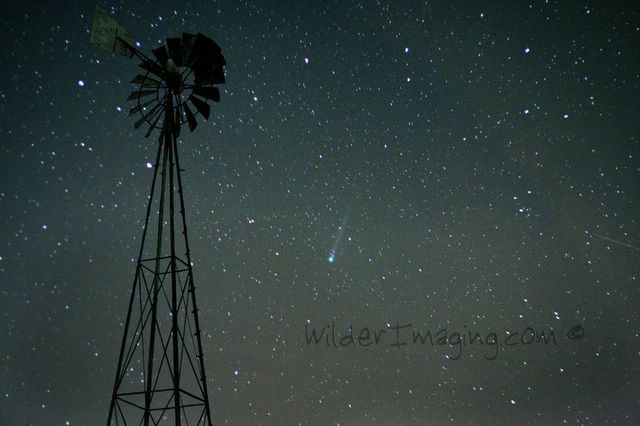
Another photo of the "green comet" visible recently over parts
of the northern hemisphere. Posted by Picasa

The Dreaming Up Daily Quote

"You can't know the unknowable, but you can do the doable."

Jon Carroll
11/16/2006

The Daily Babble

Having just sweated over a difficult book review, I very much enjoyed this line by book reviewer David Wootton in the Times Literary Supplement, concerning a very long book by economist Deirdre McCloskey: "The puzzle is I've ended up rather fond of McCloskey, and very fed up with her book."

What good is a blog if you can't relate a singular experience of absolutely no consequence? So here it is. Back in the 60s, and much further back than that, newspapers used to run little items called "fillers" which were exactly that: they filled out the end of a column when the story didn't quite finish it out. The fillers didn't have anything to do with the story--they were random facts, and sometimes they were close to surrealistic, as one that caught my eye. It was a single sentence: The virginal is a rectangular harpsichord. For any number of reasons, some of which I could name--the sound of the words, the humor inherent in the word "virginal" as a musical instrument--this struck me as so hilarious that it was like a one line work of art.

So I remembered it, and I may have put it in a play or a piece of fiction, as I was fond of collage effects at the time. But I never expected it to come up in conversation--that was part of the beauty of it.

Yet within a few years, it did. I recall I was working in a bookstore--possibly at college, possibly a temp gig in Boston--when one of my coworkers was looking through a book in the back room and making fun of some reference to a virginal. He paused, and--I swear this happened--he asked, "What is a virginal anyway?"

I knew the answer, and I said it, like in a dream. I marvelled at the whole experience and then for the next 30 years or so, I forgot it. Until today.

I was listening to a professor in the Humboldt Music Department describe the Symphonic Band's upcoming concert. One of the pieces was 400 years old, written by William Byrd, though scored for orchestra by a more modern composer. It had originally been written for keyboard only--for the instrument of the time, called a virginal. Did I know what that was?

Well. The years disappeared and the sentence came out of my mouth as if born yesterday: "The virginal is a rectangular harpsichord," I said. He paused, and said, that's right, and it was clear he'd never heard that particular definition. He should read old newspapers more often.

Which reminds me further than I once actually played a virginal. It was in college--I was directing a play I'd written called What's Happening, Baby Jesus? I'd also written a little song, which I wanted to record, so a verse or two could to be played in a few spots during performance. Some cast members, the stage manager and I stole into the orchestra room with a tape recorder, and improvised a little band. I played keyboard, and on one verse, I played their virginal. That the Virgin Mary was a character in the play--as was her very confused, very frustrated husband Joseph--made it all the sweeter.

Wednesday, November 15, 2006


The new, bluer US. Posted by Picasa

A hurricane on Saturn. Or that's what scientists are calling it, although Saturn has no seas, so the physics of it is baffling. But it's very big, and they've never seen one before. Posted by Picasa

Saturday, November 11, 2006


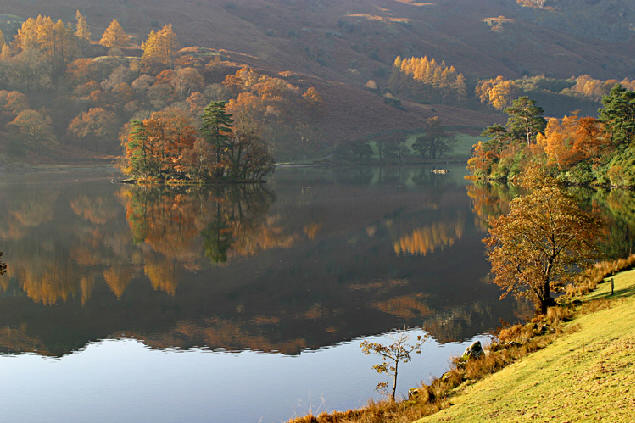
Autumn in England, the Lake District.  Posted by Picasa
Not Just Blue, But Green Too?

Iraq, corruption, even immigration got the headlines, but how well did the environment do this election, and did environmental issues help elect Democrats? According to these environmentalists, the answers are positive.

Said the president of the League of Conservation Voters, "This is the first election I can remember in U.S. history that has put such a specific focus on a top-priority environmental issue, which this year has been a clean-energy future."

This was especially true in races that featured anti-environment incumbents, such as Representative Richard Pombo in California and Senator Conrad Burns in Montana. Senator-elect Jon Tester in Montana was a shining case--a former organic farmer, he ran strongly on promoting Montana as a leader in a new clean energy economy.

Other candidates who made their opponents' anti-environment stands an issue and/or made their own support for clean energy and environmental issues part of their campaign included Senator-elect Claire McCaskill in Missouri, Governor-elect Ted Strickland of Ohio and Governor-elect Bill Ritter in Colorado. Note the names of these states--not always the image of places with "Sierra Club values." But as the political director of the Sierra Club observed, "The striking thing isn't just that the energy/environment issue played a decisive role in these races, it's that it was used to bring an optimistic, inspirational message to an election year marked by lots of negative campaigning."

A few days after his re-election by about 20 points, Governor Ed Rendell of Pennsylvania announced that PA will host the U.S. headquarters of a German solar power integration company--not the first to set up in the Commonwealth. Rendell states flatly: "Pennsylvania's new economy is being powered by clean energy development." Larry West lists his top ten environmental issues affected by the Democrats' win.

This list of candidates the environment helped includes even one Republican--Arnold Schwarzenegger in California--who supported the climate crisis initiative passed by the legislature that the Democrat who will soon to be chair of the Senate Environment Committee--Senator Barbara Boxer of California-- suggests will be the template for proposals on a national scale.

The fact that these wins added up to Democratic congressional majorities and the resulting chairmanships is another major plus. The most dramatic difference is that Senate Environment and Public Works Committee, chaired in this Congress by Republican Senator Inhofe who considers the Climate Crisis a hoax, but chaired in the next Congress by Barbara Boxer, who calls the Climate Crisis "the challenge of our generation."

So it's not just the country that benefitted from this election, but the earth, and most especially the future.

Friday, November 10, 2006


Posted by Picasa

Captain Future's Log

It's A Blue World After All

With Republican concessions in Montana and Virginia Thursday, it became official: it's a blue world after all.

After that initial excitement, what I feel now is a giant sense of relief. The real power of the Democratic Congress at the moment is in the fact of overwhelming electoral victory, which means popular support for change--and the first change is to stop Bush and Republican one-party rule from total domination, leading us to destruction everywhere we looked.

The second achievement is institutional, beginning with the promise of restoring the checks and balances of the Constitution through a Congress that will take its oversight responsibilities seriously, and will not rubberstamp the executive's whims. It is internally institutional as well: restoring integrity to the legislative process, ending systematic corruption. Many of the worst offenders, including their ringleader Rick Santorum, are themselves gone.

Both Speaker-to-be Pelosi and Majority Leader Reid hit just the right notes on Thursday. Reid said the Republicans provided a bad example of not working with Democrats, but it's not an example Democrats will follow. Pelosi talked about progress.

We can hold our heads up again in the world. I think we've come through the fire of the Bush years with a clarity of purpose that is quite impressive. But I also find myself with a feeling I grew accustomed to in the bad election years--I'd like to forget about politics and the news for awhile. That's a lot easier when it's not my job, and the jobs I have are going to require a lot of attention for the next few weeks.

As I try to get used to this, and not get ahead of myself with either too-grand visons and great expectations or anticipating the frustrations that are bound to come, I muse anyway on some of the ramifications.

The news media, for example. For the past several years, major newspapers, magazines and TV networks have slowly but surely responded to what they must have thought was a major conservative shift in the country, as well as the legendary permanent Republican majority. They got rid of their less-than-conservative executives, editors, writers, columnists and replaced them with neocons, fundamentalists and right wing crazies. Now that their transformation of the media is just about complete, what happens but the American public ain't buying that crap anymore.

Really too bad, because it will take years for them to respond. If they ever can. News as entertainment has limited their choices. I'm reminded again of what's passing into history by the sudden death of legendary TV reporter, Ed Bradley. He was an historic figure, as one of the first black journalists on national TV. My Italian grandmother, who came to America as a young woman and lived mostly within the Italian American community, did not come into much contact with black people. They were strangers. She used to watch only a few television shows regularly in her later years. One was Lawrence Welk, in reruns. Another was Family Feud. And the third, unaccountably, was 60 Minutes, which she called "The Clock." I am sure that Ed Bradley was a revelation to her, probably more than any other African American. His curiosity, seriousness, warmth and dignity were palpable. He was a good reporter, and clearly a decent man. Let's hope there are other, younger, newer versions out there, and a few find their way through the usual storms of idiocy, envy and whim to emulate him for the good of the future.

Wednesday, November 08, 2006


Posted by Picasa
The Wave

The dimensions of this, summarized by kos:

We won, and won big. Not only did we take the Senate, take the House, and destroyed Republicans at the state legislative level, but we didn't lose a single senate seat, we didn't lose any House seats, we didn't lose any governorships, we didn't lose any state legislatures. It was a rout of epic proportions.

Kos is also trenchant on the Democrats' agenda, and shoots down the notion that the Democrats elected were conservatives. While some have different positions on social issues (most of which they'll never have to vote on), they are much more progressive and populist on economic issues, against the war and torture, and for constitutional rights. In other words, they aren't extreme right wing lunatics, like the ones who have been running the country. Matt Stoller has more specific details on Dem candidates--the more conservative tended to lose, while the more progressive won. Note especially the support for universal health care.

Georgia10 adds this: When you can't get an abortion ban passed in freakin' South Dakota, America isn't trending conservative. When you can't get a gay marriage ban passed in Arizona, America isn't trending conservative. When opposition to gay marriage bans was more than 40% in 5 of the 8 bans that passed, America isn't trending conservative. When a majority of Americans choose Democrats to represent them, America isn't trending conservative.

Apart from the governator, the Wave swept Democrats into state offices in California. Results on propositions are mixed, but the worst ones were defeated.

Think Progress outlines some of the "firsts" in this tidal wave: the first woman and first Italian American Speaker of the House, more women in the Senate than ever before, the first Muslim elected to Congress, three House committees with African-American chairs, and of course (though TP doesn't mention him) Senator Bernie Sanders, the first declare socialist, who is so down to earth that his socialism is not an issue in Vermont or probably anywhere else.

The first victim of the wave was Rumsfeld, who promptly quit as secretary of Defense. But Bush promptly appointed an insider cut from the same cloth, who may go along with a change in policy but is an interventionist and Republican loyalist deeply involved in Iran-Contra and past machinations that helped create enemies in the Middle East and elsewhere. It seems Bush really wanted to appoint Kissinger, but even the lame duck Senate might not confirm a zombie.

Captain Future's Log

First Thoughts on the Election and the Future

So far it's been about the numbers, and for those who followed individual campaigns, about their candidates. Sometimes it's about the people we don't have to grit our teeth seeing in power anymore. Ricky Santorum, who I disdained from the day he beat Harris Wofford, an intelligent and kind statesman, in 1994, lost to Bob Casey, Jr. (whose father's PA administration I did some pretty good work for, once upon a time) by almost 20 points.

I don't discount the possibility that some of these Democrats, maybe even Casey, will have me gritting my teeth some time in the future, but as for the future as a whole, this was a big win. For the American future it provides the institutional opportunity to restore checks and balances. It can begin to slow down our certain march to self-destruction on so many levels, in so many ways.

But what I think will become more evident in the months ahead is when Democrats take over committees and subcommittees in the House and--as looks likely now--in the Senate. While this means a lot for such high profile issues as Iraq, it means perhaps even more for issues that don't make the front page every day, like energy and the environment, and the issue that brings them together, the Climate Crisis.

Richard Pombo, the environmental dinosaur, is not only gone from the House committees on environment, he's gone from Congress. If Democrats take the majority in the Senate, Senator James Inhofe, who has turned himself into a climate crisis denying industry, will no longer direct the Environment and Public Works committee.

The next wave can build because, with powerful committees and subcommittees--the power to hold hearings and write legislation--it now becomes possible to research and assemble the makings of a future-oriented plan to address the Climate Crisis and other environmental problems, in tandem with new energy policy, which can also result in reinvigorating American science and engineering, with the outcome of creating new industries to build the clean energy systems the entire world will need, to our economic and social as well as environmental benefit. And to do so in time to present it to the American public in the 2008 presidential election.

Tuesday, November 07, 2006

The Wave III

11:15P Pacific--CNN declared McCaskill the victor in Missouri. Jim Webb's lead in Virginia is increasing to about 12,000 votes now, which would put it out of reach of an automatic recount. Democrat Tester continues to lead in Montana. Senate majority is close to going to the Democrats.

It's 10:30 p Pacific. Although Republicans have apparently held on in Tennessee, Democrats have a good chance of winning all three of the remaining Senate races in contention--if there are three. Jim Webb has declared victory in Virginia, and while he has a slim lead, its dimensions will be unknown until tomorrow, and probably a recount will put this in some doubt for a month or more. But he was very smart to declare victory--it's like the officials calling a touchdown, and the video replay has to show convincing evidence to overturn it.

At this hour, Clare McCaskill has gone ahead in Missouri, and Democrat-rich St. Louis has yet to be counted. Jim Tester has been leading from the start in Montana.

So the change has come. Democrats will have a powerful majority in the House. They are winning governorships and state legislatures. And it looks good for a one seat majority in the U.S. Senate.

California returns are still being counted. Ahnold is winning big as expected, but so far he seems to be carrying some important down-ticket offices with him, and some nasty propositions may pass while the most worthy ones may lose.

I realize it's three hours later in the east, but even out here it looks like bloggers are shutting down early. What wimps! Maybe I should reposition this blog as a late night source.
The Wave, Part II

Nearly 9:30p Pacific, the Democratic majority in the House continues to grow. It's closing in on 40 seats, projected. Meanwhile, Webb has pulled slightly ahead in Virginia. If his lead increases to 11,000 votes, he'll avoid an automatic recount. Missouri still looks good, as does Montana, and Tennessee has not yet been called, so they are all still in play for a Senate majority.

Shortly after 8 pm Pacific, NBC and CNN project Democrats will have a majority in the House. It could be a pretty big majority before the night is out. A disappointment in Arizona, where the Republicans held onto their Senate seat. Now the Dems must win 3 of 4 close races. I feel good about Missouri and Montana. But they have to win either Virginia or Tennessee, and Virginia looks so close it will go to an automatic recount.

6:30 pm Pacific:

CNN projects a Democrat pickup for Senate in Rhode Island. That's three. Democrats need three of these four: Virginia, Montana, Missouri, Tennessee, or the outlyer possibility of Arizona.

Early bellwhether House races are going Democrat--not enough yet to say it's a wave, but it bodes well for majority. Now CNN projects another Indiana pickup for Democrats.
The Wave, Part I

NBC projects that the Democrats hold Maryland, so now it's a matter of picking up four more Senate seats. Fly in the ointment: Joe Lieberman is projected to win Connecticut, as an Indepedent, who will caucus with the Democrats. So it's not a loss, it's just not the gain it should be with Ned Lamont (assuming the projection holds.)

CBS and NBC project that little Ricky Santorum, the architect of official corruption in the Senate, is going down: Bob Casey, Jr. will be PA's new U.S. Senator. CBS and NBC also project Sherrod Brown to win the Senate race in Ohio. That's two of the six seats Dems need for Senate majority, assuming they don't lose any. NBC projects Bob Mendendez retains the Dem seat in New Jersey. There's really only one other endangered Dem Senator, in Maryland.

Ken Blackwell, the Dark Lord of 2004 in Ohio, has gone down. Democrat Ted Strickland is projected to win big for Governor. Katherine Harris, Dark Lady of 2000, has gone down as well in her attempt to unseat Democrat Bill Nelson for U.S. Senator in Florida.
Election Day: Early Gleanings

UPDATE: About an hour before first polls close, and two before many in the east do, reports continue to surface of high voter turnouts--in Montana, Missouri and Tennessee in particular. Also high percentages of absentee ballots, which this year may favor Democrats. Early exit polls on general questions show a high percentage voting on national issues. The possibility of The Wave is very much alive.

Turnout is way high in Connecticut, which seems to favor Democrats and Ned Lamont. Turnout also way high in Virginia.

Last polls indicate movement towards Democratic Senatorial candidates in Missouri, Montana, Tennessee.

Lots of problems at polling places, but so far they seem to be equal opportunity problems, affecting everyone. Though Republican dirty tricks operations continue. FBI is investigating Republican voter intimidation in Virginia.

Posted by Picasa
Stop The Insanity

Get rid of the Republican rubber stamp Congress that enables Bush's Iraq madness, that believes getting tough with terrorists means taking away fundamental American and human rights, that cuts taxes to enrich the superrich and impoverish everyone else, that hasn't done anything to address the Climate Crisis but deny it, or make America energy self-sufficient but finds the time to enrich a lot of crony corporations, from Exxon to Halliburton to Enron.

Get rid of this arrogant Republican Congress that has shirked its responsibilities of oversight--that spent all of 12 hours on finding out who was responsible for Abu Gharaib but these same Republicans spent more than 140 hours of hearings on investigating the Clinton Christmas card list.

Get rid of this arrogant Republican Congress that has devastated this institution by refusing to listen to minority views, while it invites its favorite lobbyists to literally write the laws it passes.

Get rid of this dangerous Republican Congress that, together with President Bush, gave away nuclear secrets to terrorists and rogue states, while refusing to join the world in limiting nuclear proliferation.

Stop Bush's power to intimidate his political adversaries, and his power to disrespect and disgust the world. In the eyes of many Bush has become one of the most dangerous men in the world--in England
Bush is rated more dangerous than the president of North Korea. Stop the Torturers in Chief from destroying America's place in the world--from corrupting America's soul.

Get rid of this clueless Republican Congress that won't even raise the minimum wage, that does nothing about health care as businesses fail, families fall apart, individuals die.

Send a message to those who support Bush's insane, tragic war in Iraq, who helped him lie his way into it, who together ignored the disaster they should have foreseen. Just as they ignored the lessons of a simulated hurricane in New Orleans, they utterly ignored the recently exposed
results of a 1999 war game that predicted every awful consequence of the war they nevertheless arrogantly pursued. They have spilled our blood, spent our treasure, and they kill and maim the innocent and destroy another country, and they will keep doing it until we stop them.

And if you need more reason to dump the Republican 109th Congress,
Think Progress has 109 more.

Stop the death, stop the madness. Vote Democratic today. It won't solve everything, but it will slow this insanity down. This is for the future.

Monday, November 06, 2006


A comet near the center of this photo was visible in some places recently. Posted by Picasa
The Day Before

Final Update: A few final numbers. Usually about 5% of counties change voting procedures or types of machines in a given election. This time, it's 50%... The House has never changed parties unless the Senate has, too...The night before the 1994 midterm election when Republicans swept into power, their lead in the polls was 4%. In various polls, the Democrats are leading from 6% to 20%... In the CNN poll, 73% said they were "very angry" about the current state of affairs in America.

Update3: On the ground information suggest an upset may be in the works favoring Democrat Harold Ford in Tennessee, due to a combination of heavy early voting and bad weather forecast for the Republican-heavy area of the state. Also the GOTV efforts in Connecticut may be strong enough for Ned Lamont to upset Joe Lieberman. Lamont is the Dem candidate, Lieberman lost the primary and is running as an independent who will caucus with Democrats.

More Republican dirty tricks: vote suppression efforts in Virginia. This is Karl Rove's unsurprising and biennially disgusting November Surprise.

Update2: More buzz about Republican dirty trick robocalls. They've spent more than $2 million on them, over a half million just in the past few days. They include calling voters at 2 or 3 am. These calls seem to be on behalf of Democrats, but are designed to make voters angry enough to vote for Republicans. More info on robocall abuse with links here.

Update: A SurveyUSA poll with a good track record for catching last minute movement shows Democrat Jim Webb surging ahead in Virginia by an amazing 52-44%. This does conform with reports of small crowds and disorganization at Allen events over the weekend and this morning.
Other predictions: Republican-leaning pundit Larry Sabato predicts Democrats will win control of the Senate by picking up 6 seats, and the House by winning 29 seats. Analyst Charlie Cook gives a range of a 4 to 6 seat Democrat pickup in the Senate, and 20-35 seats in the House. MSNBC state by state polls shows very close races in key states, and predicts the Dems will fall short of Senate control. Kos of Daily Kos predicts a 6 seat Senate pickup and 24 House seats for the Dems. Chris Bowers at MyDD sees just a four or five seat pickup in the Senate, and 25 seats in the House.

Trends and factors: There may be a movement of Republicans "coming home" to hold their nose and vote for GOP candidates. Democrats remain ahead by double digits in generic polls, and continue to show greater interest and intensity. The predictions based on polls all show the Dems winning the House, and are split on getting those 6 seats necessary for the Senate. Another factor is GOTV, which appears competitive in key states, and on the ground operatives in Montana and Tennessee are happy with getting their early voters. Early voting used to favor Republicans, but maybe not this year.

To a certain extent, polling figures are weighted using past experience. If indeed there is a wave, these models are less relevant. Whether there will be a wave is the unanswered question. Interesting that Dem partisan Kos thinks there won't be, while Republican pollster Frank Luntz seems to indicate there will be. "There are some elections where the fear of the status quo is greater than the fear of change," he told the Wall Street Journal."This is one of those elections."


I may update this post throughout the day if there's reason and I have the time, but for now there are these highly interesting developments:

Political Wire reports that a couple of new polls to come out today show that the Senate race in Tennessee is tightening fast, which benefits the Democrat, Harold Ford. Some Dems had begun to write this one off.

One of those polls is the Gallup state by state, which has the Democrat ahead in Senate races in Missouri, Montana, Rhode Island and New Jersey, and with Democrat Webb down two points in Virginia.

Stuart Rothenberg's Rothenberg Report has predicted that Democrats will win the 6 Senate seats they need to win control, and 34 to 40 seats in the House, to claim a larger majority than the Republicans now have, leading to a number of Republican retirements in the next two years.

The American Conservative magazine is recommending that conservatives vote against Republicans to repudiate the Bush administration's prosecution of the Iraq war.

The blogosphere is abuzz with accounts of GOP robocall warfare--especially calls saying that are for Democratic candidates that repeat 6 or 7 times a day, including in the middle of the night. Some of these calls appear to violate several different laws, but so far Republicans are continuing this onslaught. Here's a thread at Kos about combatting them.
California, Here We Go

A lot of campaigns don't pay much attention to us up here in the north country. It's a relatively small population spread over a lot of territory, we're isolated and our issues are often particular to this region. Not that I haven't personally heard from Bill and Hillary today (Bill called in favor of Prop 87, Hillary is against 85) but there are advantages to our remoteness--mainly a minimum of robocalls. And maybe judging statewide campaigns from here isn't quite fair, but...

A couple of years ago, I recall reading an article somewhere about a new breed of Democratic politician coming from state government, tough minded and effective, while committed to a populist agenda: a highly electable combination. The two prominent examples were Eliot Spitzer in New York and Phil Angelides in California... Now Spitzer is ahead in his contest for NY Governor by about a zillion points, and Angelides is behind in California by double digits.

Up here, the Angelides campaign has been all but invisible. Even Attorney General candidate Jerry Brown seems to have many more TV spots (and better ones). So I can't judge exactly what went wrong with Phil's candidacy, but I do know of one opportunity he blew. Shortly after he emerged battered but victorious from the primary, both houses of the California legislature passed a comprehensive universal health care bill. Arnold announced he would veto it.

Health care is a crucial issue in this state, perhaps even more than elsewhere. Angelides was up against the Hollywood Hero, who has transferred that image to the political realm, despite also playing the Villain in both venues. What Angelides needed was a way to be a hero, and health care was handed to him on a platter. If he had announced his support of that bill, challenged Ahnold on it, hammered on this issue, he would have been in the media every day, and he would have at least defined himself. But he may also have found a winning issue.

I am not the only one who felt this was a missed opportunity, not only for Angelides, but for California families, individuals and businesses in critical condition because of the high cost of health care and insurance. Instead of taking this risk, with its enormous opportunity, Angelides seems to have favored a conservative campaign of depending on union support, particularly education unions. They may have won the primary for him, but it is unlikely they will make him governor. And he remains as vague as Ahnold about what he would do on health care.

I am very disappointed in Angelides and his campaign, but Ahnold is a stealth disaster--he plays the moderate and even liberal part, but his off-stage actions run counter to the image. He does not deliver. Although not a terribly clever or effective ad line, in this at least Angelides deriding Ahnold as an actor, not a leader, is accurate. So I will vote for Phil, because he'd be better than Ahnold.

I notice that progressives have pretty much moved on to the more promising down-ballot candidates, and we do have some very good people. Debra Bowen will make an outstanding secretary of state--a very Diebold-conscious one, very astute and articulate. She will not only make the election system work, she will bring the public along in the process. If I needed a reason to vote where my vote could make a difference, she's it.

John Garamendi for Lt. Governor is by all accounts an outstanding public servant, and his Republican opponent is a neocon who even Ahnold is keeping his distance from. Jerry Brown should make an entertaining attorney-general, Bill Lockyer is probably sorry he didn't pursue the governorship but he can stay in the game as state treasurer, and John Chiang for controller.

I have no problem voting for Senator Dianne Feinstein, (otherwise known as Di-Fi), especially because she is one of the few Senators who pays attention to nuclear proliferation and the Bush stealth plans for nuclear rearmament. Despite her reputation for pro-financial institution votes, she was a courageous and sane voice on the bankruptcy bill.

We also have one of the nation's best members of the House of Representatives (and best kept secrets, which may soon change) to re-elect: Rep. Mike Thompson. Both are effectively unopposed.

We've got the usual ridiculous number of propositions on the ballot. I really wish they would go away, but amongst the stinkers at least this time there are some worthy ones. So I vote NO
on 83, 85 (more so-called parental notification bullshit that is a prime reason people hate propositions--we voted this one down before) and NO on 90-- especially 90-- which could have disastrous effects here as a similiar stealth proposal is having in Oregon. Among other things, it makes enforcing environmental regulations nearly impossible. Erik V. Kirk at SoHum Parlance calls it "the worst proposition to make it to the California ballot since Lynden LaRouche's concentration camps for AIDS victims proposal."
I'm voting YES on 87, the alternative energy proposal, which the petroleum lobby has spent millions on defeating. Yes on 84 (water quality and supply), 89 (public financing of campaigns) and 86 (cigarette tax to fund health care. ) Then there's 1A, 1B, 1C, 1D and 1E (you think I'm kidding. I wish.) which I haven't yet braved.

What's really maddening about this: propositions were supposed to be a way citizens could go directly to the people, but instead they are either put on the ballot by wealthy and stealthy interests or opposed by same, and both sides wind up spending millions of dollars and taking up everybody's time. Then if a proposition passes it often gets screwed up by state government, turns out to be illegal or unworkable, or has unintended consequences. I wish I could point to one proposition that has changed things for the better. If you know of one, let me know, because this whole process is too time-consuming to be anything but depressing otherwise.

Frank & Ernest Posted by Picasa
Politics and the Local

This site doesn't deal much with local politics where I live, on the North Coast, Humboldt County, and seldom even with the state of California. There are several newspapers and several web sites that do (SoHum Parlance is very informative about this election.) But I will be chipping in my two cents on California next post, and this time on a local issue that is probably recurring elsewhere.

Here in Arcata we have a city council that is pretty progressive by comparison, so the usual spectrum is weighted that way. There are two seats in contention this time, and a field of candidates that is generally acknowledged to be pretty strong. I frankly haven't yet decided on my second vote for council. But my first vote is going to be for Dave Meserve.

As one of our local papers points out, Meserve is experienced, knowledgeable about local issues and comes to meetings prepared on matters before the council. He also sees the bigger picture and how Arcata fits into it, in key matters such as energy. He's something of a visionary, with a lot of enthusiasm that sometimes gets him in trouble with people who feel he goes too far. Maybe sometimes he does, but he seems pretty practical when it gets down to making decisions.

But what seems most controversial about Meserve, especially with the editor of the Arcata Eye, is that he has brought resolutions before Council on national issues, like supporting efforts to address the Climate Crisis, or in favor of impeaching President Bush. Apart from those who disagree with the outcome of these votes, the objection is to getting City Council involved in issues on a level beyond the city itself. Apart from being a waste of time, it creates a poor image of Arcata in the outside world.

There is an intuitive appeal to this notion, especially when much of the media coverage of Council focuses on these resolutions. And everybody knows of something they wish the City would fix or pay attention to that they aren't. But I've come to strongly disagree with the notion that these resolutions are nonsense.

Beginning with the prelude to the American Revolution, there's a long history of issues of national importance being debated on the local level, and resolutions passed on them, especially when higher levels of government are unresponsive. In the case of impeachment, there is an institutional justification: though it's not widely known, the impeachment of federal officers such as the President can be initiated by state legislatures, and the sense of city councils can contribute to that decision. The impact on this and other issues is political--it provides a sense of what a polity is concerned about, and brings those matters to the attention of state and national legislatures the way no individual or organization can.

The Climate Crisis illustrates this importance. Nations throughout the world recognize this crisis and are struggling to address it. Under Bush, the United States refuses, putting the future of civilization in grave danger. But concerned Americans have refused to be silent or inactive. Right now throughout America, action is being taken within states and through regional partnerships, and by individual cities (this is also happening around the world, partly through the Clinton Global Initiative.)

But to get this action started required political voice and will, and that has come from city councils and similiar bodies on the local level--including many as small as Arcata. The combined power of this should not be overlooked. Arcata was in fact one of the first municipalities to take a stand. Being out in front did subject it to ridicule, but other localities noticed, and many more passed their own resolutions.

So when the names of those localities scrolled across the screen late in Al Gore's movie, An Inconvenient Truth, there among many was Arcata. And I've never been prouder of the place than at that moment.

Other candidates appear to be running away from this important function. Meserve states that these resolutions should be an addition to taking care of the city's business, not a replacement, and no one I know of is saying that he doesn't know his stuff on local matters. So I'm voting for him, even though he is a Green and I am a Democrat with not a lot of admiration for the Green Party.

I also have to say that anybody who actually serves on City Council gets my respect. I've occasionally watched their meetings as cablecast on the public access channel. Not only are they often mind-numbing, they occur in a room that resembles a concrete bunker. I've seen the actual room which doesn't look as bad as it does on TV, but still, I sometimes wonder what these people did to be sentenced to sit there for hours on end in that grey cement horror, caught between the drone of bureaucracy and the free association of public comment. Hats off to them all.

Saturday, November 04, 2006

Captain Future's Log

The Wave

In close election seasons, particularly with saturation coverage of the same news story by so much media at the same time, the weekend before an election is often when the final shift in the political winds can determine the outcome on the following Tuesday.

But not this year. The electorate began moving towards a decision against President Bush, barely if actually reelected in 2004, at least a year ago. Primaries this spring suggested it would affect the Republican Congress. In September a discernable wave against Republicans nationally began to build, and it may still be building, but mostly by feeding on itself. It is ready to roll through Tuesday.

What can stop it or slow it down? Nothing. However, the more pertinent question is: what can prevent it from being fully expressed in votes? The possible barriers are these:

1. Voters against Bush and Republican candidates will stay home while a superior get out the vote effort will be mounted by Republicans;

2. cheating, by repressing registration and intimidating voters, chaos and unlawful activities at the polls to eliminate as many voters as possible who demographically vote Democrat, and fraud by electronic machine or otherwise to manage the outcome, especially where Republicans control the process;

3. so-called wedge issues, like gay marriage, or local issues as well as strengths and weaknesses of individual candidates, that could determine specific races counter to national trends.

But here's how these factors look to me at the moment:

1. GOTV: It seems that part of the building wave is expressed not only in numbers but in intensity. Polls over the past week or so pretty consistently show that Democrats and Independents likely to vote Democratic are motivated to actually vote. As for the Republicans' superior Get Out the Vote technology, Democratic political operative and observer Joe Trippi makes the point that Republican efforts are concentrated in a few races where they expected a fight, but they've gotten a fight in many more places, where they aren't so well equipped, and where other organizations (like labor unions) are gearing up to do their GOTV. This bodes well for Democratic House pickups in particular. Also, passion can compensate for technology, and in close Senate races there appears to be a lot of passion for Democratic candidates.

2. Cheating: News media is/are paying a lot more attention to this possibility, partly because of clearly demonstrated vulnerabilities in electronic voting systems, and partly because of the chaos in certain primaries this year and difficulties caused by the changes that take effect this time in many states that have adopted new rules and machinery. In 2000 and even in 2004, a lot of people didn't believe this was an issue. This year, a lot of people know that it is. That attention may help, if and when there are suspicious instances.

There's also the question of where it may happen. Florida and Ohio are notorious, and they both had Republican state governments where the Secretary of State was a Bush activist with higher ambitions. Both of them (Katherine Harris running for Senator in Florida and Ken Blackwell running for Governor in Ohio) are so far behind in the polls that victories would be highly suspect. The Democrats are expected to win a lot of Ohio House seats and do well in Florida. These aren't "battleground" states this year. In states that are, observers will be watching closely. Cheating is still possible, but it won't be uncontested this time.

There are a few interesting related questions that can't yet be answered but which might influence outcomes. People concerned about problems and cheating may have voted with absentee ballots, or participate in early voting in states where that is permitted. This may skew predictions based on past profiles of absentee and early voters. Also, there may be new voters that skew the "likely voter" profiles of polls. Whether they actually get to vote is another question.

3. Wedge and individual issues/candidates: So far, polls are showing that wedge issues--like the New Jersey Supreme Court decision upholding the rights of gay couples--aren't playing a significant role. Iraq is almost everything. The exception may be in the Missouri Senate race where the issue of stem cell research may make a difference. Although it is hard to believe it will help the Republican, some analysts claim that it may be at the moment.

It finally does come down to individual races, particularly in the contests that will likely determine control of the Senate. But the wave influences how those may go, too. Because the pattern has been set, anything that reinforces it will add to the wave's power, and anything that runs counter to it will have to be very powerful to change momentum.

So the news of Friday, for example, all very negative for Republicans, reinforces the already negative view of Republicans as corrupt, and ineffective on Iraq and even on terrorism. Some of these may have strong enough impact in certain contests to push Democrats over the top. The latest scandal of a prominent evangelical-politico (patronizing a gay prostitute and buying meth) may further depress the religious right vote, but it may have the most tangible effects on close races in Colorado, where said evangelist lives.

The most dramatic may happen Monday, when (according to NBC) the four newspapers of the Military Times Media Group--the Army, Navy, Marine and Air Force Times--will call for the firing or resignation of Secretary of Defense Donald Rumsfeld as Secretary of Defense, because he has lost the confidence of military officers and soldiers. (Kos now has the full text.) As NBC's David Schuster points out, these are the publications that military families read, and this editorial could very well be the final impetus for those with serious doubts about Iraq to vote that way.

There are a lot of military families in Virginia, where Democrat Jim Webb--former Secretary of the Navy--seems to have the momentum to win Senator George Allen's seat. There are a fair number of military families in Tennessee as well, and even though Democrat Harold Ford appears to have fallen behind, this could be a plus for him.

Assuming for the moment that energized and motivated Democrats work hard to show that they can do GOTV, too, and that Democrats and Independent voters turn out in expected numbers or higher, I feel good about the Democrats' chances.

Then there's the distinct possibility that core Republicans, especially religious right voters (as opposed to their currently squabbling and compromised leaders) don't vote in their usual numbers, or don't vote Republican. If that happens, or if there is a much larger turnout than anticipated, the wave could become a tidal wave. Democrats could pick up 50 seats in the House, though they need 15 for a majority. They could sweep all the close Senate races, and even pick up a couple that Republicans don't notice are still up for grabs.

Because it's obvious from reading the latest polls, where something like 8% support Bush's handling of Iraq, that if public sentiment is truly reflected in voting results, we're in for nothing less than a political tsunami.

UPDATE Sunday: Some final polls are showing tightening benefitting Republicans generally, though not all polls agree. Senate races may be in flux, going both ways. Which reminds me that there is one additional and potentially powerful factor mitigating against the wave: habit. To vote for change requires that people change, and voters who have been voting Republican in recent elections may find it difficult to switch. It is in the final moments that voters who feel queasy about changing become most receptive to the messages they accepted before: it increases their comfort level. So the wave can break at the voting booth, if voters don't have the courage to change. Still, the Democrats are likely to control the House and at least come close in the Senate, with the tidal wave of double digit margins in the House and control of the Senate still very possible.