Tuesday, January 24, 2006

The Cost of Uncaring Ignorance and Deception

While the chair of the Senate committee investigating federal "response" to hurricane Katrina accuses the administration of trying to run out the clock without providing information ("My staff believes that [the Department of Homeland Security] has engaged in a conscious strategy of slow walking our investigation in the hope that we would run out of time to follow the investigation's natural progression to where it leads,"), the Washington Post has found some highly damaging documents which show that "In the 48 hours before Hurricane Katrina hit, the White House received detailed warnings about the storm's likely impact, including eerily prescient predictions of breached levees, massive flooding, and major losses of life and property..."

To be somewhat flippant about it, Katrina is the new 9-11. It is the nexus of certain kinds of fears and insecurities, in a situation that is more likely to recur and affect more Americans than another terrorist attack.

A government that cares about the future would be working to fix the system that failed, rather than hiding its failure.
A Million Easy Pieces

Sunday's San Francisco Chronicle Insight published two opinions concerning James Frey and his fabrications in his bestselling memoir, A Million Little Pieces: one by Martha Sherrill, a young writer whose first novel has just been published, and the other by novelist Cynthia Bass.

Sherrill had herself accepted a big publisher advance to write a memoir but found it paralyzing. She felt more comfortable turning the same material into a novel, though she found that readers were still hungry to know what in it was "real" or "true." Though the controversy over the accuracy of Frey's memoir has provided him with even more publicity, she writes that "I do think there's a way he might be helping novelists everywhere. Once they're over their shock and sense of betrayal, Frey's readers might come to realize the fictional bits were some of the best moments in his book -- that without those thrilling embellishments it would have been just another true story. Maybe next time they go to the bookstore, they'll decide to try the real thing: an honest-to-god novel. "

Novelist Cynthia Bass writes that the Frey fray should be a cautionary tale, about just how much "truth" is in any non-fiction. The vagaries of memory, the limitation of one perspective, and the exegencies of telling a good story mitigate against certainty. She points out that before recently memoirs were by famous people concerning public events, with facts that could be easily checked. But memoirs these days are personal stories by previously non-famous people, usually of lurid events--addictions, incest, etc.-- with an arc of redemption. Their factuality has to be taken on faith. "If I claim to have hit a home run at my last at-bat at Fenway, you can look it up. If I claim to have hit a home run at my last at-bat at Patrick Henry Elementary, that's impossible to confirm. "

Yet the authenticity of personal memoirs is even more important to readers (hence the Frey fray.)"The unspoken bond of trust between reader and author is breached. Deliberately doing this to a reader is, for an author and a publisher, as close to a sin as you can get in the world of writing. "

Bass acknowledges that new writers are under tremendous pressure to write in the memoir form because it is potentially so much more commercial than all but a few novels (Only the latest Harry Potter novel has apparently been outselling Frey's first book.) She admits that she was asked to write a memoir instead of a novel and was tempted; and that other writers she saw commenting on the Frey fray found nothing wrong in whatever inventing he did. "The prevailing sentiment is to do whatever it takes. Which is just what Frey did. After failing to sell his book as fiction, he said it was a memoir." She suggests "a rearrangement of attitude: less cynicism from the producers, and more from the consumers. There's nothing more dispiriting than learning what you thought was true -- what you hoped was true -- was a lie, perpetrated for money, ambition and fame. "

But while both Sherrill and Bass make valid points, neither they nor Frey have addressed the most importance qualities of non-fiction or fiction.

I haven't read Frey's book but just the excerpts I saw in the now-famous Smoking Gun analysis were so plainly outrageous, melodramatic and exaggerated, that I didn't believe them on their face. I hope for the sake of his readers than in context they were made more convincing by better writing.

Clearly, the memoir's popularity has something to do with an immense hunger for certain kinds of redemption stories. That is apparently more important than any fact to these readers---the journey from sin to redemption---and especially the redemption-- forms "the truth" of the story for them. Perhaps these memoirs and their redemption stories are an outgrowth of the recovery movement, and the spreading of various new ways of approaching behavior and the big questions of life, from simplified psychology to the varieties of religious experience.

But some prominent writers and teachers, like philosopher Martha Nussbaum (Poetic Justice)and psychologist Robert Coles (The Call of Stories) have found that real literature still speaks to people on a very personal level, and helps them see themselves and the world around them in new ways.

What troubles me beyond truth in labeling is the simplistic analysis of fiction as embroidered memoir. Novels are more than stuff that happened , touched up for effect, like a Photoshop portrait. There is little sense in what either of these novelists said of what a literary work can be, of its complexities and resonances. Children don't seem to have any problem dealing with the literary intentions of the Harry Potter books, so it's not like contemporary readers can't handle it.

Novels are more than "thrilling embellishments." They are stories with their own integrity, following their own necessities. Literature is something alive ; truth is in the reader.

The cynicism of the writers Bass refers to is pretty troubling, especially in an age of institutionalized cynicism, as represented by current commercial capitalism and political fundamentalism. While I see nonfiction as a literary form, I believe that what Frey did was beyond the bounds of nonfiction storytelling; it was dishonest. What little I read wasn't even good pulp fiction, so the intention to deceive for profit wouldn't surprise me in a work that obviously stresses the extreme for easy effect. If so, it's mirror cynicism: a paint-by-number Best-Selling Memoir using the most lurid colors in the box.

We face complex problems in the present affecting the future, and we will face ever more complex situations requiring relatively quick decisions in that future. We need leaders and citizens who can apply the complexities learned from literature to understanding the dimensions of the future and to help them craft solutions to the problems that emerge. This is not a pipedream: it has been a feature of leaders in the West and East throughout history, though not uniformly, and its absense in current U.S. leadership is tragically clear.

It is also not a panacea, as history shows, especially if not widely shared by the citizenry. But literature is accessible to more citizens than ever before, as are opportunities to acquire the skills to augment intuitive responses. These skills are as just as important for an informed citizenry. Lacking leadership in this regard, it becomes a personal and family responsibility.

While we're on the subject of literature, I've still to complete my Jim Harrison journey in this blog. I will, in at least one more essay---sorry, I mean post---and when they're all done, I plan to post them in narrative order on my books blog, Books in Heat.

Monday, January 23, 2006


galactic nursery in spiral galaxy NGC4314 Posted by Picasa

The Dreaming Up Daily Quote

"Do you want to be famous, or do you want to be good? When you're on your deathbed, do you want to say, I had a life, not a negotiation with an agent? I contributed? Then you'll be a craftsman, not a careerist."

Pete Hamil

Daily Downers

Bush is Back?

Bush is back, all right--to his lowest poll numbers: 36% approval for his job as president, 37% among registered voters, according to the American Research Group. Perhaps the most chilling number: all of 14% believe the U.S. economy is getting better, which is half of an already low percentage in December (30%).

How Halliburton Takes Care of the Troops

"Troops and civilians at a U.S. military base in Iraq were exposed to contaminated water last year and employees for the responsible contractor, Halliburton, couldn't get their company to inform camp residents, according to interviews and internal company documents,"according to the Associated Press .

Not So Fast, Scalito

Saying that "Judge Alito may be a fine man, but he is not the kind of justice the country needs right now. Senators from both parties should oppose his nomination. It is likely that Judge Alito was chosen for his extreme views on presidential power..." a New York Times editorial came out today against Alito's confirmation to the Supreme Court.

Many Democratic Senators, including Dianne Feinstein and John Kerry, have announced their opposition, with Kerry mobilizing his online forces. Only one Democrat has said he'll vote in favor, which seems to ensure that the Democrats have enough votes to enforce a fillibuster. It's not clear yet if they will "extend debate," or if the Republicans will actually use their majority to change the Senate rules to outlaw fillibusters entirely. But the easy path to the Court predicted just days ago seems a lot rockier at the moment.

And it's significant that even if the Democrats on the Judiciary Committee couldn't make an effective case on the topic, the Times zeroed in on Alito's "extreme views on presidential power." Which may be a reason that the Bushites are becoming so aggressive on the topic, well in advance of congressional hearings on the NSA widespread spying on Americans.

Guiding Indians to the GOP

Whether or not Republican operatives and pet blogs are being all that successful in spreading the grief of the Abramoff scandal to Democrats, the facts are coming out that while Indian tribes Abramoff was advising continued to donate to Democrats, he advised them to switch more of their gaming revenue contributions to Republicans. Though the Washington Post writer who started a firestorm when she wrote that Abramoff donated to both parties (he didn't) backpeddled on that, she defended herself by saying that his clients did, which is technically correct, but not at his behest. But the Post's Deborah Howell at least made one thing clear. On the charge that "I was trying to say it was a bipartisan scandal, as some Republicans claim," she wrote: I didn't say that. It's not a bipartisan scandal; it's a Republican scandal, and that's why the Republicans are scurrying around trying to enact lobbying reforms.

Steeler fan in Denver holds up a photo
of revered Steelers owner, the late Art Rooney.
Pgh Post-Gazette photo. Posted by Picasa
Steelers Extra

Two things you should know about the Steelers going to the Super Bowl. First, for Pittsburghers, wherever they live now, this is a Big Deal. Second, this truly could not happen to a better team, from owners to players. And I mean better as people and citizens.

The Pittsburgh Steelers and Pittsburgh/western Pennyslvania bonded forever in the 1970s, when the team became a winner for the first time in its long history, and the city began losing the anchor of its identity, its steel mills. Pittsburgh was a working class city, a city of immigrants, some of them rich, many of them working their way into the middle class. But pretty much top to bottom it was a city that shared some values in common: family, tradition and civic virtue. Not that there wasn't crime, corruption and the alcoholism, abuse, intolerance, anti-intellectualism and all the other vices of their virtues. But there was and is a certain character that has its values and strengths.

But when the mills went, so did a lot of Pittsburghers. The city's lost just about half its population. The city government is about bankrupt. But even with the new emphasis on high tech, medical, educational and cultural institutions, the old identity remained. But it was no longer anchored by the mills. It was invested in the Steelers.

The Steelers became the city's heart and heroes, the NFL their deeply felt living metaphor for their confrontation with the larger world, though of course never articulated that way. But that's part of the meaning when one fan--an operations manager in a telephone call center---told a Pittsburgh Post Gazette reporter: "This is not just a game. This is football."

Pittsburgh is the heart of Steeler country. While the Steelers were dueling with the number one ranked team in football, the Indianapolis Colts, last week, eight out of ten televisions that were turned on in the city were tuned into the game.

But the steel mill diaspora, as well as the fascination some fans who never lived here have with the Steelers mystique, means that the Steelers have ardent fans everywhere in America and all over the world. In Denver Sunday:

"An estimated 8,000 Steelers fans watched the game at Invesco Field. Many stayed well after the victory, waving their Terrible Towels in the corner of the stadium above the exit to the Steelers' locker room until security finally had to ask them to leave," Pittsburgh Post Gazette.

I saw another estimate that about 1500 fans traveled from Pittsburgh for the game. That means more that 6,000 live in Colorado.

When I wore my Steelers cap after the game here in far northern CA, somebody congratulated me for the Steelers win. At first I felt silly about it, but then, sure, I earned it--I was a hometown fan of the 70s teams, but I also suffered through Bubby Brister and Mark Malone and Neil O'Donnell, and a couple of decades of broken hearts.

As for the Steelers themselves, there is no one more revered in a city that reveres its cherished elders than the late Art Rooney. He was legendary as much for his individual kindness and his civic generosity as for his guiding the Steelers through thin and thick. Loyalty was important to him in large ways and small. He was the man who bought the Steelers, their first owner. And even in their great 70s years, I remember talking to a sports writer who had left the city for awhile. He got regular postcards from Art Rooney. Eventually he had to come back.

His son, Dan Rooney, is the team owner now. He also has an unassailable reputation for kindness, loyalty and civic virtue. The fact that the Steelers have had only two owners, both in the same family, is reflected in the fact that---almost unheard of in football--it has had, over the past 35+ years, only two head coaches: Chuck Noll, and his successor 14 years ago, Bill Cowher.

And in the national Blue-Red Game, the Black and Gold are True Blue.

The 2005-06 team is not only the best in many years, it has the best people. The reason that Steeler players and fans are so happy that Jerome "The Bus " Bettis is finally going to his first Super Bowl in perhaps his last season, and the game is being played in his hometown of Detroit--is that they all love him. He has established the team character which young Ben Roethlisberger is carrying forward: the Bus is a kind, loyal man, and a stand-up guy.

The Bettis family is in reality what TV commercials had to invent for another team. His mother and father, who have attended every game everywhere in his professional career (except two pre-season games overseas), in fact had the entire Steelers team to their house one year for Thanksgiving dinner.

I'm sure the Seattle Seahawks are fine people, and that city is happy to finally send a team to the championship. But it's hard not to believe that this year is our year. This Steelers team has a destiny.

It couldn't happen to nicer guys. Posted by Picasa

Sunday, January 22, 2006


painting by Gino Severini Posted by Picasa

The Dreaming Up Daily Quote

"I did know, instinctively, that to play was to be."

Yehudi Menuhin (violinist)

Jerome Bettis will play his first Super Bowl in his home town of Detroit, as the Pittsburgh Steelers dominated the Denver Broncos for the AFC Championship.  Posted by Picasa
One for the Bus

You could see him on the sideline shouting, "Home! Home!" Jerome Bettis is going home to Detroit and to his first Super Bowl in what could be his final NFL season.

An emotional speech to the team apparently inspired the Steelers, along with excellent coaching and preparation, as they became the first team to come from the lowest in ranking among playoff teams to get to the Super Bowl.

Pittsburgh Steelers 34
Denver Broncos 17

Congratulations Steelers! Hello Pittsburgh!

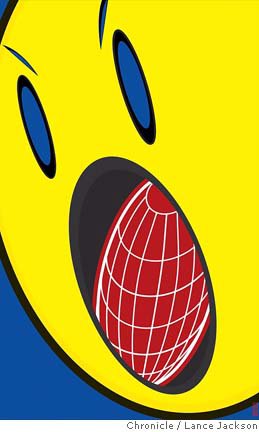
Chronicle illo. by Lance Jackson Posted by Picasa
The Store That Ate The World

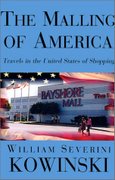
Business journalist Charles Fishman begins with a disarming story of how Wal-Mart produced an environmental benefit when the company decided that paperboard boxes around cans of deodorant were unnecessary. So they disappeared—not only from Wal-Mart but from everywhere—thereby saving many trees. But the reason Wal-Mart did this, and the reason everyone else followed, are also the key factors in a new kind and extent of destructiveness.


Read the rest of my review of two new books on Wal-Mart in today's San Francisco Chronicle Book Review . Or the longer version at Shopopolis.

Hey Pittsburgh, are you ready for some football?
photo: Pittsburgh Post-Gazette Posted by Picasa
Molly to Dems: What Are You Afraid Of?

Karl Rove made a speech promising that Republicans will make national security their key issue in the 2006 congressional elections, drawing a contrast between their "post-9-11" agenda and the Democrats' alleged "pre-9-11" worldview. Some Washington Democrats were apparently already quaking in their slippers at the prospect of being perceived as soft on terrorism by squeaking too loudly about the Bushites ongoing attempt to make the presidency a dictatorship while shredding the Constitution.

If that's not enough, Osama bin Laden shows up for the first time since just before the presidential election in 2004 to remind people why they should be scared. If Osama isn't on Bush's payroll, he should be. Who has been more important to the Big Smirk-- Rove or Osama-- seems pretty much a tossup.

So what's a Democrat to do? While some thought must be given to political realities, it's time to step up. If Al Gore's speech wasn't clear enough, listen to columnist Molly Ivins:

"The recent death of Gene McCarthy reminded me of a lesson I spent a long, long time unlearning, so now I have to re-learn it. It's about political courage and heroes, and when a country is desperate for leadership. There are times when regular politics will not do, and this is one of those times. There are times a country is so tired of bull that only the truth can provide relief. "

While the Repubs have managed perceptions well enough to keep people scared of Democrats almost as much as of terrorists, maybe it's not so dangerous out there as Dems may imagine. As Molly points out:

"What kind of courage does it take, for mercy's sake? The majority of the American people (55 percent) think the war in Iraq is a mistake and that we should get out. The majority (65 percent) of the American people want single-payer health care and are willing to pay more taxes to get it. The majority (86 percent) of the American people favor raising the minimum wage. The majority of the American people (60 percent) favor repealing Bush's tax cuts, or at least those that go only to the rich. The majority (66 percent) wants to reduce the deficit not by cutting domestic spending, but by reducing Pentagon spending or raising taxes.

The majority (77 percent) thinks we should do "whatever it takes" to protect the environment. The majority (87 percent) thinks big oil companies are gouging consumers and would support a windfall profits tax.
That is the center, you fools. WHO ARE YOU AFRAID OF?"

We do know who they are afraid of: the America people who have been so easily made afraid. So what Al Gore said bears repeating:

"Is our Congress today in more danger than were their predecessors when the British army was marching on the Capitol? Is the world more dangerous than when we faced an ideological enemy with tens of thousands of missiles poised to be launched against us and annihilate our country at a moment's notice? Is America in more danger now than when we faced worldwide fascism on the march-when our fathers fought and won two World Wars simultaneously? [Here I think he meant to say "consecutively."]

It is simply an insult to those who came before us and sacrificed so much on our behalf to imply that we have more to be fearful of than they. Yet they faithfully protected our freedoms and now it is up to us to do the same."

These are times that try men's souls. That doesn't mean these are just difficult times. That means they are times when souls are on trial.

John F. Kennedy's book, Profiles in Courage, is about politicians who became statesmen and patriots in moments of crisis and importance. We need the material for new chapters, and soon.

Saturday, January 21, 2006


Oregon forest from roweweb.com Posted by Picasa

The Dreaming Up Daily Quote

"...those few moments, getting rarer all the time by all accounts, when one is first exposed to impossibly high standards, to books that are our judges and not the other way around, that excitement of learning not yet canceled out by careerist fears---that brief time in youth when you read in a pure state, not because you are innocent, but because you are watching yourself get smarter."

Charles Newman

Captain Future's Log

Politics of the Future

Do people care about the future? We all live in the present, and so we value it. We think we can count on a certain number of tomorrows, so we make decisions based on that. But do we care about a future we may not live to see?

I think it's a question that is alive deep in many situations where it might not seem to be. Beyond politics of the present, isn't that part of the debate over the expansion of presidential power? The Bushites say it is necessary to protect lives in the present, meaning the very near future. At least some if not most of those who oppose this are thinking about the long-term damage done by precedent today, and weighing the present risks against the future (although there's also a real question that the Bushite expansions make anyone safer.)

It may even be part of a disagreement in
today's news concerning science and money, politics and trees. A 29 year old graduate student at the Oregon State University's College of Forestry led a team of researchers in examining southwest Oregon forest areas devastated by wildfires in 2002. The area involved in the Biscuit wildfire has since been aggressively logged, under the working theory that such logging actualy helps the forest restore itself. But three years later, Daniel Donato and his team found that the opposite was true. As the AP reports, "Donato's team concluded logging slows forest recovery. They found that logging after the Biscuit fire destroyed seedlings and littered the ground with highly flammable tinder."

Their report was impressive enough that the prestiguous journal Science sent it around for peer review, and when it got good marks, announced it would be published in the journal. And that started a wilfire of a different order.

For Donato's scientific conclusion went directly against Bush administration policy, and advocacy for logging as an instrument of returning forests to health by several current and former highly placed professors in his own college.

His Dean, who had testified before Congress in favor of this logging remedy, led a group of nine OSU professors who teamed up with no less than the Bush administrations' National Forest Service to object to the study's publication. They questioned the science, and the peer review, and asked that Science not publish the article.

The editor of Science stood firm. "There was no failure of peer review in this case," he said, "I'm sorry they don't like the outcome, but I think they have a misplaced case here." He even referred to their attempt as censorship.

It might be at least partly an actual disagreement on scientific grounds, and at least partly on ego of senior professors who take umbrage at being contradicted, and established scientists who normally defend their theories to the death. And at least partly it's about politics and money, namely the Bush administration's willingness to back the science that makes money for their corporate pals and donors, when they are notably unwilling to admit to science that their corporate cronies feel might have the opposite effect.

That something fishy is going on concerning the forests is suggested by another of the objections the professors had to Donato's study. Despite their own conclusions about the efficacy of logging to restore forests, they maintained that no one could actually yet conclude that forests restore themselves best if you leave them alone. This conclusion was "premature," and (in the AP report's words)"the true test of efforts to restore forests will require decades."

So in addition to the values of present ego, corporate funding for your institution, possibly cushy contracts with logging corporations, the Bushite government and its associated think tanks, there's the question of whether you're willing to risk cutting down the forest in order to save it and decades later find out that you're wrong, or whether you do no harm and let the forest restore itself as it has for millenia, so the future has something it desperately needs, in all kinds of ways that have nothing to do with lumber. (Though some brush-burning etc. may enhance forest growth, this logging remedy is not the same.)

There's also the question of whether politics of the situation is wholly in the present, or if there is such a thing as politics of the future. I think there is and there has been before. It's so deep in our past that it is part of our nature---our human nature. And it's in recent enough history, in the fiftful and not always adequate urges of conservation, to be part of memory. Not just academic memory either.

Why Lynn Swann is a legend in PA Posted by Picasa

The Steelers try for another Super Bowl on Sunday
led by a young legend, quarterback Ben
Roesthlisberger. SF Chronicle photo. Posted by Picasa
Political Football

Lynn Swann couldn't had written a better script for himself, at least so far. The former Pittsburgh Steeler wide receiver, a star on the mythic Super Bowl teams of the 1970s, announced two weeks ago that he's running for Governor of Pennsylvania as a Republican.

Two weeks ago, the Pittsburgh Steelers were the underdog in the wild card playoff game with Cincinatti. They won. Last week, the Steelers did what had never been done before--they became the first wild card team ranked last among playoff teams to knock off the team ranked first. They defeated the Indianapolis Colts, who'd gone undefeated for most of the season and were heavy favorites to win this year's Super Bowl.

Pennsylvania's current Governor, Democrat Ed Rendell is running for reelection. He's been popular for most of his term. But in a recent poll , Swann was slightly ahead of him.

Months ago, when Swann's possible candidacy was first floated, I saw a blog discussion that generally ridiculed his chances. I entered it to differ. Some of the participants were in Pennsylvania, though mostly in the east, in the Philadelphia end of the state. Though I left western Pennsylvania almost a decade ago, I didn't dismiss the chances of a Steeler legend--especially not this one. I'd met Lynn Swann, and seen his mouth in action. He's smooth, charming and never at a loss for words.

Years after our interview on the Steelers practice field (which had to be ended by the intervention of another player or Swann might still be talking, and I'd still be enjoying it) I was driving through a fashionable Pittsburgh neighborhood, stopping at an intersection when a car came up behind me fast and stopped practically on my bumper. I looked in the rear-view mirror. An attractive woman was driving, and in the seat beside her, with a big smile and talking a mile a minute, was Lynn Swann.

The poll showed that Swann was attracting more Democrats than Rendell was attracting Republicans. Not surprising, and I'll bet they're largely football fans, if not Steeler fans from the western side of the Commonwealth.

I doubt that many people know where Swann stands on the issues, and these numbers probably won't hold up. On the other hand, celebrity politicians---particularly when they seem centrist, and even a little liberal for Republicans---sometimes make their own rules. Of course Swann isn't a movie star, though he had the looks. But he's a living legend in a state where football counts, maybe even more than pretend Terminators.

And where the primary celebrities are athletes. Part of the celebrity mystique is the association with winning. Swann certainly has that. So, suddenly, do the 2005-06 Steelers.

There are only four teams left playing NFL football. The Steelers are the only team in Pennsylvania among them, and if they're getting front sports page treatment in San Francisco, you can bet they're all over the state's media. Western Pennsylvania is typically in a condition between euphoria and hysteria about now.

The Steelers are an underdog again this weekend when they travel to Denver. If they win that game, they will go to the Super Bowl, probably as the favorite. Lynn Swann will really be smiling then.

Friday, January 20, 2006


Keira Knightley as Elizabeth Bennet in Pride and Prejudice 2005. Posted by Picasa
A Tale of Two Prides

I caught up with the 2005 film version of Jane Austen's Pride and Prejudice at a subrun double feature, presumably before it disappears until DVDed. I loved Austen's novels, which combine great wit and writing, social and character study, with strong stories. Pride and Prejudice has emerged as the story that touches people most deeply and has the most powerful cultural hold of nearly mythic intensity.

Inevitably this kind of story is retold with different emphases at different times, by different storytellers. The 1940 version starring Lawrence Olivier and Greer Garson is one of my favorite movies, for a combination of reasons I can't fully describe. I used to watch it every New Year's Eve. But by now it's clear that like many Shakespeare plays, this Austen novel is too large to be contained in a single movie, and the best a movie can do is emphasize aspects of it with a fresh vision. If done with enough heart and skill, Austen is only enhanced.

This version is a very different kind of movie based on the same novel, and it works for me.

Continued here at Blue Voice.

Thursday, January 19, 2006

This Modern World

I'm writing the little account of blogging I mentioned, basically for an audience unfamiliar with blogs. So it's made me more conscious of not only how weird this world is, but how weird it sounds.

What I mean is: ask yourself what people would say about someone, ten years ago or even just five, who uttered a sentence like: "I googled your blog and hotlinked to mine, then diaried at kos before I checked my rss feeds on my Ipod."

I got the same feeling the other day when I happened to catch a Wall Street report on TV which began with something like "Dow rises led by google and Yahoo." It's not your grandfather's U.S. Steel and General Motors stock market anymore. Can you even picture Walter Cronkite saying "google" and "Yahoo" with a straight face? I admit to watching the BBC News on TV sometimes just to hear them say Yahoo and google.

Or blog.
More Catch-Up

With your fries. Heinz of course.

The house across the street is a student rental that seems to get passed down from jocks to jocks through an unexplained mechanism. There are always a bunch of them living there, and each they tend to concentrate on one sport. One year they were always at the improvized hoop in front of their house, its net quickly shredded to nothing and even a chunk taken out of the top of the backboard. Basketballs would occasionally bounce off Margaret's car parked in front of our house.

Another year it was golf. They would practice their drives with the wiffle ball equivalent on their front lawn. Another year it was football. And so on. This year however is quite novel. It's baton twirling. But not your girly kind. Batons with fire at the end.

It's little unnerving at night to see that intense flickering through the living room blinds, even after you know what's going on. Several guys will be standing around watching another one twirling two very long batons, both of them with flames roiling at both ends. I suppose people pay to watch this act, and I should consider myself lucky to have free entertainment. Yet watching students literally playing with fire in a neighborhood of wood frame buildings is a little unsettling, not to mention when they go into the street with parked cars a few feet away.

Okay, other old business. For the Star Trek fans among you, I forgot to point you to a new post on Soul of Star Trek, concerning the arc of several key characters and the Trek saga itself.

Wednesday, January 18, 2006

Random Notes

Yesterday began with the effects of a stopped drain and a leaky faucet, a combination I don't reccommend, and ended with a thunderstorm. It was a big one, sustained thunder and lightning and heavy rain. I mention it because I haven't experienced a storm like this in Arcata since I arrived here in the fall of 1996. We simply don't get thunderstorms. This one was like a summer storm in Pennsylvania. I felt a time and place displacement, adding to the impact of all that booming and bright light at 3 am or so.

My contribution to a group article in the North Coast Journal will cut into my blogging time for the next day or two. It is an article on blogging, and I'm to write about my experience. A three and a half years, I'm not quite a pioneer but I guess I'm a veteran.

Several recent posts here were eventually frontpaged at E Pluribus Media.

Susanhu has a roundup of media reaction to Al Gore's speech at the Booman Tribune.

Tuesday, January 17, 2006


painting by Rene Magritte Posted by Picasa

The Dreaming Up Daily Quote

"Perhaps a new spirit is rising among us. If it is, let us trace its movements and pray that our own inner being may be sensitive to its guidance, for we are deeply in need of a new way beyond the darkness that seems so close around us."

Dr. Martin Luther King, Jr.
Eleanor

I caught the two-hour biography of Eleanor Roosevelt on PBS yesterday, although I saw the second hour first, and the first hour several hours later. Did you need to know that? Probably not. Anyway, it made me wonder why this woman's achievements, even her presence in history, have all but disappeared from cultural memory.

But she chaired the early UN committee that fashioned and passed the Universal Declaration of Human Rights, one of the 20th century's most important documents. She was a tireless and pretty lonely advocate for racial equality and civil rights beginning in the 1930s through the 1950s, which earned her the covetted continual survelliance of J. Edgar Hoover's FBI, and an FBI file of some 3,000 pages.

She was an advocate for the American poor during the Depression, and later for poor and sick children especially in other parts of the world. She brought attention to fundraising efforts on behalf of health. She was also widely admired and very popular with the American public (though a lightning rod for criticism, like FDR) and was known in her post-White House years as First Lady of the World.

I remember her as a presence on TV and in newspapers from my childhood, though the memories are dim and tend to merge with Margaret Mead as the old lady oracular and combination kindly grandmother and motheringly hectoring figure, usually for the cause of good. However, my most specific memory of Eleanor is of less than her finest hour, when she actively if belatedly opposed JFK's nomination at the 1960 Democratic Convention, favoring Adlai Stevenson. Though the PBS show didn't even mention this, it did say that her support was instrumental in Stevenson getting the nomination in 1952 and 1956 (he lost to Eisenhower both times, in a landslide in '56), though by the second campaign she was having doubts that as brilliant as he was, that he had what it takes to be President.

The program discussed her support for a Depression program to rebuild small communities hard-hit by industrial decline, with new housing and subsistence gardens, as centers to attract new industries. Arthurdale in West Virginia got her most persistent attention, as the program illustrates, but there were others (not mentioned.) One of those was a project that was named after her, Norvelt, PA. (EleaNOR RooseVELT.) This was in the general place where my father's family lived, and where he grew up. I don't think they lived in the project itself; I was always led to believe their house had been part of the company town called United, for the United Coal Company. My paternal grandfather and his father before him were coal miners.

The mythology I received about this was that Eleanor Roosevelt had visited the coal mines there (and she often did visit mines---leading to the famous New Yorker cartoon of two coal miners deep underground with one saying, 'my God, here comes Mrs. Roosevelt.' ) and that led to renaming the town. I heard United, Norvelt and Calumet (an even older name) used more or less interchangeably, although they may be separate entities. Like Arthudale, the Norvelt experiment was not very successful, partly because the program was constantly being changed according to political necessities, and the controversy finally over whether any sort of "cooperative" venture was sufficiently capitalistic and hence "American." But I believe some of the houses still stand, and certainly did in my childhood.

In any case, Eleanor Roosevelt was one of the great figures of the American twentieth century, and perhaps this attention by PBS will help restore her to her rightful place in cultural memory. It has in mine.