Friday, August 03, 2018

History of My Reading: Two Cultures (Part 1)

According to what I hear and read, a high school student selecting a college these days involves at least one family road trip to target campuses, follow-up visits to the short list and then serious negotiations with the top choice (or two), involving conversations in person and on the phone with administrators and teachers.

Colleges often bus or fly "prospectives" to campus for group and personal tours, while prospective interest expressed in a particular field of study might mean texts, emails and a phone call from the relevant department chair.

So my experience in choosing a college in the early 1960s might seem unbelievable. But when I committed to Knox College, I hadn't spoken to a single person there. Until I got out of our black Mercury station wagon in front of Anderson House, my first year residence, I had never set foot in Galesburg, Illinois. The first representative of Knox College I'd actually met was the student who ticked my name off his list and showed me my room at the back of the third floor.

Nevertheless, I had carefully considered what college I would decide to go to. But my decisions were made mostly sitting at my old varnished wood desk in my room, reading. Or lying on my bed, staring up at the light fixture that had been there since the room was new, and I moved in at the age of five.

The Roy Rogers bedspread of my childhood was gone by then.

Probably the brown linoleum with cowboy scenes that covered the hardwood floor of my room was gone by then, too. But the shade on the overhead light was still there: a gold colored fixture shaped like the wheel on the bridge of an old sailing ship, with a pearl white shade that had various nautical decorations on the sides. But facing down at me was a kind of compass, with the four cardinal directions marked in red. The question was: which way would I go?

I wasn't sailing east, down Route 30 a few miles to St. Vincent College, where many of my high school classmates were headed. But should I go south, to Georgetown in Washington, D.C.? That was unlikely. I only applied there to keep my Central Catholic high school teachers off my back--their only interest seemed to be that I go to a Catholic college. I deliberately chose a school that was unlikely to give me the scholarship I would need even to think about it. If lightning struck however, it was the one Catholic university I knew of that I might consider. But basically I wanted out of the stifling insistence of Catholic schools. I had some idea colleges wouldn't be as doctrinaire as high school but I didn't want to take the chance.

I could go north, to Michigan State. The only person I knew who was actually in an out of state college, a second cousin, was going there, and she was enthusiastic. Plus it was pretty cheap. My shot in the dark was Columbia University in New York, which I had visited for a high school journalism convention, but  it was very expensive.

Or I could sail west--either a little ways west, to the University of Pittsburgh. Or farther west, to this school nobody I knew had ever heard of, that liked to call itself the Harvard of the Midwest.

From a 1960s Knox Idea.  Male students in coats and ties--
it didn't last in my years.
I'd only heard about it because I'd entered a Scholastic Magazine Writing Awards contest my junior year, and I placed in one of the categories (Dramatic Script.) It turned out that in addition to a small cash prize, this award made me eligible for a Scholastic Magazines Writing Awards Scholarship at the two institutions of higher learning that gave one: the University of Pittsburgh, which I certainly knew something about (it was 30 miles away, and I'd been on campus several times) and this other place, Knox College, that I knew nothing about. They were both described as full four year scholarships--just what I needed.

I wanted to go away to college. But any chance of college necessitated a scholarship.  So I applied for both.

As for the choice, I was pretty much on my own. Neither of my parents had gone to college. I was the oldest in my generation on both sides of the family, so nobody else had yet gone through this. I literally did not know anyone who had gone to college, except my Aunt Toni (who lived far away in Maryland), my Uncle Carl, and eventually a few students a year ahead of me in high school who were just starting. (I don't count the priests and nuns who taught at my high school, at least some of whom presumably had degrees. They were useless.)

Nobody I knew had experience in this process.  I talked about college a little with classmates, but college shopping was still basically yet another middle class mystery. My uncle and aunt had gone to the two local Catholic colleges, and had lived at home. Most of the students I knew from high school were going to these same schools. Those that weren't--who went off to Pitt or Carnegie Tech or Penn State--just seemed to disappear. I didn't have much of anyone to talk to about my strong need to seek a bigger world, let alone how best to accomplish it.

So I researched the only way I knew how. I read. And most of what I read was what these institutions sent me.

Probably in the spring of my senior year, and certainly by the time I was getting ready for college that summer, my parents presented me with two new matching Samsonite suitcases. They looked like this:

I used one or another of them on trips home, and for years of train, air, auto and bus travel. Decades later they became storage units, repositories of whatever improbably survived from high school and college. In one of them is stored a number of items relating to that college decision (though it was my mother who saved the important papers.)

Such as the letter received by my high school principal on May 3, 1963 from the Scholastic Awards announcing that I had won a second in the national writing awards.  In addition to a $25 check and a pen from the Sheaffer company sent three days later, I learned in a separate letter from the Scholastic Awards that the University of Pittsburgh and Knox College each gave a four year scholarship in connection with the Writing Awards, and as a junior I was eligible.  I could apply for either or both. The letter included forms to fill out and send to them in the fall (between September 15 and November 15), to be passed on to the respective schools. I applied for both.

Junior and senior years involved taking a lot of tests related to college and eligibility for scholarship, the most important being the S.A.T.  There were few guides to taking these tests in those days--too much help was considered unethical. But we did take the PSAT and then the SAT in both junior and senior years.

I remember towards the end of this test-taking process being roused on a Saturday morning and driven to an unfamiliar school to take one.  I was drowsy and in a bad mood and I did badly.  But fortunately I had a good day for the senior SAT, soaring over 700 in verbal and actually topping 500 in math--each being at least 50 points higher than my junior test.  Of course these numbers don't mean much now--the tests have apparently changed several times since then.

I didn't do as well on my senior Achievement Tests, and actually scored higher on American History than English.  Maybe those were the ones I took that Saturday.

I have a December 1963 letter from Michigan State about sending them a deposit to confirm that I was coming, so I must have received the acceptance letter earlier. In early January 1964 I got a letter accepting me into the University of Pittsburgh, with a scholarship offer a few weeks later.  I don't have anything surviving from Georgetown, but I was accepted without scholarship.  I believe I was wait-listed at Columbia.

In February 1964 I got a letter from Allan Christiansen, Director of Admissions at Knox, informing me that I'd been awarded the Scholastic Magazines Scholarship. I had until April 1 to notify them if I was accepting.  Pitt wanted to know by May.

So then it was time to decide.

I'd read somewhere--probably in some august publication like the Reader's Digest--that to make a big decision you should list all the pros and then all the cons.  So that's what I did, and I actually still have the three legal size card stock sheets I used.

I had apparently already eliminated Michigan State.  I'm sure one factor came in the envelope asking for my deposit.  It was my student punch card, the kind with the little holes.  The "do not fold, spindle or mutilate" cards that were even then a symbol of depersonalization.

I was a little leery of such a big school anyway.  High school was claustrophobic, so a large university had some appeal.  But it was also overwhelming and hard to make judgments about.   Their academic programs seemed lost in skills and prep-professional majors, like hotel management. Anyway, once acceptances came in from elsewhere, I had no interest in Michigan State.

So my decision sheets started with what had to be the first consideration: cost. Surprisingly, on paper, Georgetown was not more expensive that Pitt or Knox--in fact, even with room and board, it was slightly cheaper.  But no scholarship. Once scholarship offers came in from elsewhere, it wasn't a practical choice.

Cathedral of Learning interior first floor
I'd marked Georgetown as "large, urban, fairly distant."  Pitt was "large, urban, close."  I actually did know someone who was a first year there, and she loved it.  But Linda tended to be enthusiastic about everything.


She showed me around one day. There were three new high rise residence halls shaped like cleanser cans.  They were officially designated buildings A, B and C, but the students had dubbed them Ajax, Bab-o and Comet.

I'd been to the Pitt campus before (and a few more times at Forbes Field across the street, where the Pirates played.) I was always impressed by the Cathedral of Learning--a building that should be more famous than it is--and the magic I felt the first time I walked into its small offspring, the Steven Foster theatre, never left me.  (I subsequently saw a lot of Shakespeare there.  And eventually, taught a writing course in the basement of the Cathedral.)  Still, I left that visit with the campus still a blank of buildings.

One day my Uncle Carl visited, and came into my room for a private chat.  We sat on my bed, under those four directions on the ceiling lamp.  He suggested that I would make a lot of contacts at Pitt that would be useful to me later.  He was assuming I would stay in western Pennsylvania, an assumption I wasn't making. But this was the best informed advice I got in my decision-making process.

Pitt had sent me a few sheets of information they distributed to Scholastic Magazines applicants, about the English and writing programs.  I noted that these looked good.  My comment was "could not make a mistake going here."  That was the ultimate consideration: the fear of making a huge mistake.

Pitt made sense in many ways.  The campus was far enough away for some independence, close enough for whatever support I might need.  I knew of at least one high school friend who was likely to go, so I wouldn't be starting out completely alone among strangers. So for awhile, it must have looked like Pitt was it.

I'd gotten my first letter from Knox in September 1963, when I'd first applied for the Scholastic Awards scholarship.  That's when they sent me several brochures and a course catalog.  I'd been looking at them for months, but now in the early spring it was time to give them one last examination.

Prof. Douglas Wilson from 1960s
Knox Idea
Unfortunately I no longer have the actual material they sent me, though I picked up similar brochures in 1968.  In addition to the course catalog, the probably sent a brochure introducing Knox College, and they certainly sent the more substantive Knox Idea, and a thin brochure, probably four pages counting the title page and the back, on heavy cream white paper.  On the cover it said "The Writing Program At Knox."

The contents of the late 60s Knox Idea I have appears to be largely the same as the one I received in 1963, especially since the photos of students seem from at least a few years before my time (though I do seem to recognize one or two), and all the faculty are familiar, though perhaps younger.

I remember the same photos of dorm rooms, which made them look improbably large, as students later complained.  I  remember the same photo of Everett Dirksen (Republican Senate leader from Illinois, who bowed to the Civil Rights bills with the quote about an idea whose time has come) in the section on guest appearances.  (And there were no examples of notable guests from my years or later.)

 But the booklet itself is not as I remember it.   I recall the Knox documents I got as being on glossy paper with a unique but old fashioned typeface, and borders and backgrounds of purple and gray.

One element that is definitely different is the trees.  The brochures/booklets I got had photos of the Knox campus, with many trees leafily lining the brick walks and sheltering the grass between earnest old buildings.  The trees were a comfort, a hope, as they were to me in my western Pennsylvania reveries.

 Later editions don't have these photos, probably because most of the trees were cut down.  Those trees gave me an impression of the campus that was very important to its appeal.  But Dutch Elm Disease came.  Some of the trees were gone when I got there, and I awoke in Anderson House too many mornings early in my first year to the portentous whine of chain saws several blocks away on campus.

Still, many trees survived, including the persimmon trees in Standish Park that Mary Jacobson loved during our few walks there in a future year.

What turned me towards Knox? The financials were slightly better than Pitt, enough to cite to my parents as a basis for my decision.  That cream white brochure on parchment paper called "The Writing Program at Knox" was modest but elegant, and gave me a sense of the writing program's independence, importance and its context.

 That my scholarship was identified as the Scholastic Writing Awards Scholarship.  That it was a coeducational liberal arts college.  That it was an unknown land, and yet, in a town I might understand, in the Land of Lincoln.  The campus, the trees, and above all how they filled out the image of the Knox Idea:

The Knox idea of education is to lead students to learn and to think.

The Knox idea encourages students to enter into the spirit of free inquiry essential to a liberal education....Knox College wants its students, in and out of class, to question, to probe, to decide for themselves what is true--and to accept the responsibility for their decisions.

The Knox idea emphasizes that the faculty has, as its principal concern, the intellectual development of Knox students.  Faculty members are firmly committed to the belief that the students' progress is most important and must be served by, rather than subordinated to, an interest in research or in books, buildings, or equipment.

It said that Knox students are expected to "acquire certain abilities:"

To think logically
To speak and write clearly and effectively
To be resourceful in obtaining further knowledge....

And so on.

All of this represented the culture I wanted to be part of.  It meant leaving the culture I was in.  Leaving the limited and deceptive "free inquiry" of  Catholic schools, and the limitations of the time and place that had brought me up so far. Though it was becoming economically middle class, the world I knew was culturally working class.  Most men didn't see the point of college, when there were secure and well-paid jobs in union plants.  But even those who saw college as a step up into professions, expected those students to return to home and family.

It was a delicate dance at best.  Even those who got their education locally and stayed near would run into the attitude expressed in the phrase we all heard: "Who do you think you are?"  Improving your earning ability or even status was understandable, to a point.  But suddenly, betterment meant you think you're better than us, better than me.  Their sense of betrayal and alienation, or simply of inability to understand why, were never far off.

My world had been expanded by television, newspapers, movies, magazines and books.  There was a world I saw in ideas and images, though had not yet touched. A world of principles and expression, of potential to be realized, of gifts to be developed and then given.

So I set sail for Knox College in Galesburg, Illinois.

Did I find any substance to the Knox Idea there?  It was never that pure, seldom articulated, often lost.  But in the end that wasn't the point.  It wasn't a question of whether Knox College believed in the Knox Idea and tried to live it.  It was that I did.

Tuesday, July 31, 2018

The Fire This Time

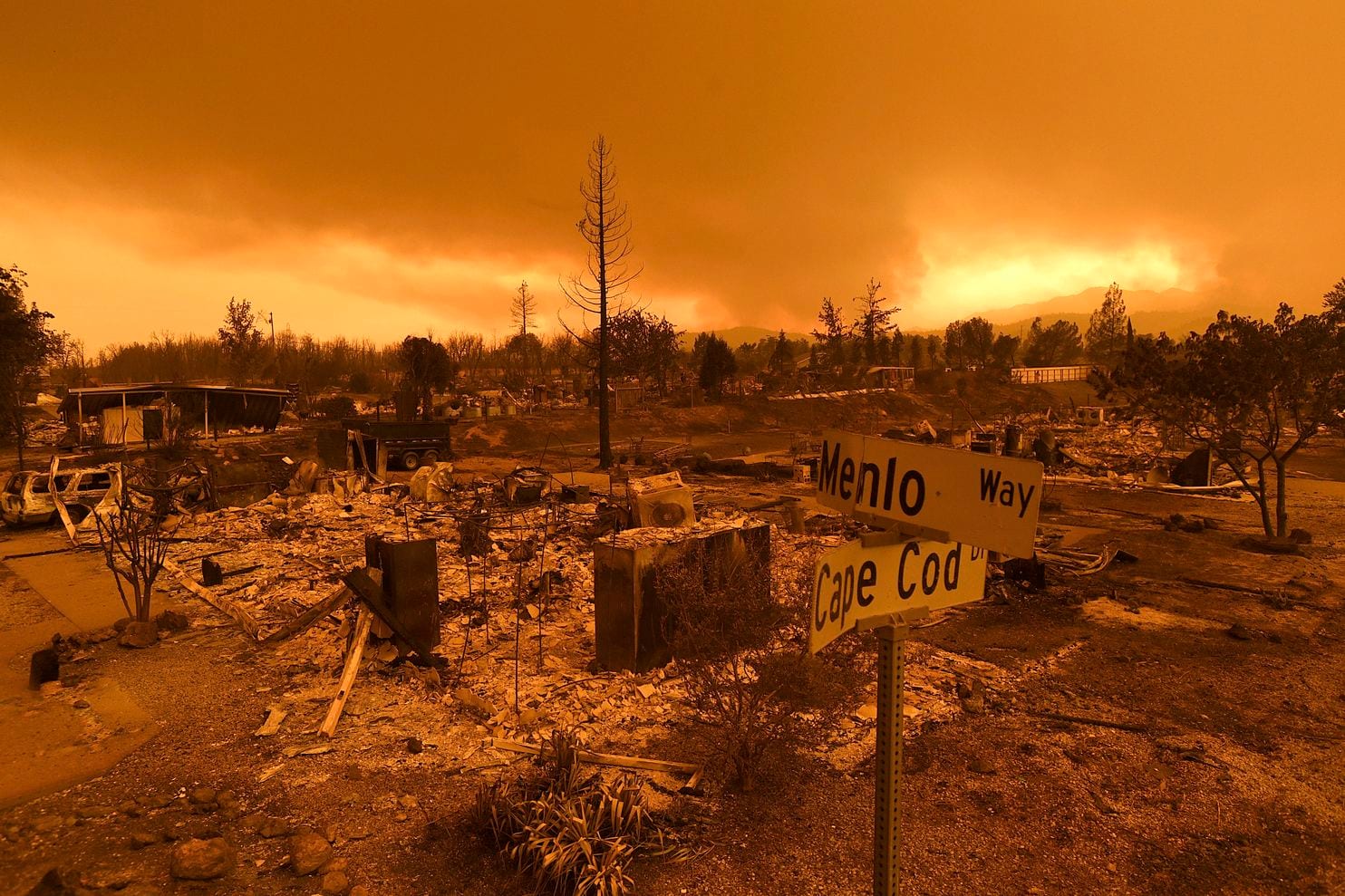
Redding, CA.  From the Washington Post article linked below.
Tuesday's moody gray skies on the North Coast suggested imminent thunderstorms but it was more a case of a marine layer meeting smoke from fires elsewhere in northern California.  The Carr fire in Redding and beyond is burning an area the size of Denver.  At least until today we've been spared the worst of the smoke, which is drifting down central California to Sacramento and eastward as far as Montana.

Humboldt is receiving evacuees from Redding.  And we're all getting glimpses of the world to come, soon.

From the Mercury News: California’s wildfire season is off to its worst start in 10 years. Through Monday morning, 196,092 acres have burned across the state since Jan. 1 — an area seven times the size of San Francisco and more than double the average by July 9 of the previous five years — according to an analysis of federal and state fire statistics by the Bay Area News Group.

Typically the fire season is at its most intense in September and October.  A hot July combined with a lot of dry brush and trees that died during the drought.  But it goes beyond that.

From the Washington Post: “What we’re seeing in California right now is more destructive, larger fires burning at rates that we have historically never seen,” Jonathan Cox, a Cal Fire spokesman, told CNN on Monday morning.

The Northern Hemisphere is warming faster than the planet as a whole, according to the World Meteorological Organization. “That heat is drying out forests and making them more susceptible to burn. A recent study found Earth’s boreal forests are now burning at a rate unseen in at least 10,000 years.”

“The incidence of large forest fires in the western United States and Alaska has increased since the early 1980s,” the assessment concluded with high confidence, “and is projected to further increase in those regions as the climate warms.”

One wildcard is wind, from strange bursts to fires so intense they create their own tornadoes. The result has been devastation, deaths, burnt homes and evacuations.

One practical harbinger of the new reality:

If you ask the crews on the ground, they will tell you it’s not just the hot and dry weather that’s making fires worse. Firefighters have noted recently that fires are behaving differently than they did in the past. For decades, officials depended on a tried-and-true process to prevent wildfires from spreading: fight them from downhill. Fires naturally expand uphill because heat rises, creating uphill winds, and because the lapping flames extend upward, making uphill grass the easiest target.

But KQED reports that firefighters say that process isn’t working as well anymore — the Carr Fire being an example — and no one has a clear explanation as to why.

Monday, July 30, 2018

This Side of Shame

An article by Nick Miroff, Amy Goldstein and Maria Sacchetti in the Washington Post on the failure of this administration to reunite migrant families by the court imposed deadline--excerpted below at length--is detailed and enlightening, but perhaps necessarily does not state the basic inference.  For the "core" of this "debacle" is not management incompetence but the attitude that these migrants are not fully human, that their children are not people and that they are not families.  In fact, as the Post story points out, one agency involved designated them as "deleted families."

The racial and socioeconomic contempt is clear enough in the antipresident's own statements comparing migrants, including those seeking political asylum and fearing for their lives, to vermin.  As "criminals" who end up being charged with misdemeanors, they forfeit their humanity, and their children will pay for it the rest of their lives.

There are many crimes committed by this administration against this country (including the equivalent of treason) and against this planet.  This is a crime against humanity.  Other policies and actions were and are tragic.  This earns shame.

Incidentally, at this end of this story, one of the Homeland Security Advisory Council members who resigned in protest, and who called this policy "child kidnapping" is the same Elizabeth Holtzman who, as a Member of the US House from New York, served on the House Judiciary Committee that voted articles of impeachment for President Nixon in 1974.  I remember being impressed with her then, and told friends I hoped she would run for President.

Here are the Post article excerpts:

"Compounding failures to record, classify and keep track of migrant parents and children pulled apart by President Trump’s “zero tolerance” border crackdown were at the core of what is now widely regarded as one of the biggest debacles of his presidency. The rapid implementation and sudden reversal of the policy whiplashed multiple federal agencies, forcing the activation of an HHS command center ordinarily used to handle hurricanes and other catastrophes.

After his 30-day deadline to reunite the “deleted” families passed Thursday, U.S. District Judge Dana M. Sabraw lambasted the government for its lack of preparation and coordination.“

"There were three agencies, and each was like its own stovepipe. Each had its own boss, and they did not communicate,” Sabraw said Friday at a court hearing in San Diego. “What was lost in the process was the family. The parents didn’t know where the children were, and the children didn’t know where the parents were. And the government didn’t know either.”

"Most of those parents [picked up at the border] were charged with misdemeanors and taken to federal courthouses for mass trials, where they were sentenced to time served. By then, their children were already in government shelters. The government did not view the families as a discrete group or devise a special plan to reunite them, until Sabraw ordered that it be done."

"One result was that more than 400 parents were deported without their children."

"It is the act of separation from a parent, particularly with young children, that matters,” [Sabraw] told the government in court proceedings.

"On June 28, two days after Sabraw’s reunification order, DHS officials held a conference call for members of the DHS’s Homeland Security Advisory Council, a group of security experts and former officials who provide recommendations and counsel to the secretary. One member, David A. Martin, said officials had few answers when dismayed members asked how they planned to bring families back together: “They were saying, ‘Well, we’re working on it.’ ” Two weeks later, he and three other members quit the panel in disgust.

In his resignation letter, Martin said the family separations were “executed with astounding casualness about precise tracking of family relationships — as though eventual reunification was deemed unlikely or at least unimportant.”

Another member who resigned, Elizabeth Holtzman, said the failure to create records to track parents and children demonstrated “utter depravity.”

“This is child kidnapping, plain and simple,” she wrote in her resignation letter, urging Nielsen to quit."

"The American Civil Liberties Union, which brought the lawsuit that led to Sabraw’s order, said it could take months to track down hundreds of deported parents and make arrangements to return their children. Some parents may be hard to reach or hiding from the very threats that prompted them to flee their countries in the first place.

In the meantime, the government will try to place their children with vetted guardians. Otherwise, they will remain in shelters.

“It’s going to be really hard detective work,” said Lee Gelernt, deputy director of the ACLU’s Immigrants Rights Project. “Hopefully we will find them.”

Friday, July 27, 2018

Soul of the Future: Literature of Change

In 2001: A Space Odyssey, the shape of the space helmets suggest the heads
of the apish pre-humans in its first section, "The Dawn of Man."
 This visual metaphor, part of the cinematic toolkit, is an analog
  to literary metaphors in the toolkit of science fiction stories and novels.
Science fiction is a method, a way we see the future—a kind of storytelling by which we imagine, evaluate, contemplate the future in something close to a usefully comprehensive way. Some argue that, in our age, it is the only possible way of envisioning and interrogating the future.

So what is it?

"Attempting to define science fiction, " wrote science fiction author and futures studies pioneer Arthur C. Clarke, "is an undertaking almost as difficult, though not quite so popular, as trying to define pornography."

After reviewing distinctions and definitions, Clarke finally allows that “it is, preeminently, the literature of change...”

Others tend to agree. Though he has his own technical definition, science fiction writer and historian Brian Aldiss wrote, “The greatest successes of science fiction are those which deal with man in relation to his changing surroundings and abilities.”

“Science fiction accepts change as the major basis for stories,” Lester del Rey assented. Author James Gunn called “a belief in a world being changed by man’s intellect” the “one indispensable ingredient of science fiction.”

Historically it was a response to “the conclusion that change was now going to be man’s fate, and that if he wished to be the master of change rather than its victim he would have to start thinking about the consequences of his actions and decisions,” Gunn concludes.

Change implies a difference from the past and especially the present, which seem to be known quantities.  The past however is deceptively solid, its actual ambiguity revealed by changing interpretations of past events. (For example, various “objective” accounts over the years have depicted General Armstrong Custer as the hero, villain or fool of Little Big Horn.)  The present is circumscribed by what we know and accept, not necessarily all that there is. Like the future, neither past nor present is known or stable.

Nevertheless, a fiction of the future seems fanciful to many, and disturbing to some. We know the present involves change, but we naturally try to maintain stability. Fast changes are upsetting, in reality and emotionally. Otherwise, our experience of the slowly rolling present lulls us into assumptions of permanence. (If this seems not to be a contemporary affliction, consider the fortunes always lost when an ascending stock market fails to keep rising and shockingly plunges.)

Science fiction however (as Mark Rose writes) “challenges our sense of the stability of reality by insisting upon the contingency of the present order of things. Indeed, science fiction not only asserts that things may be different, as a genre it insists that they will be and must be different, that change is the only constant rule and that the future will not be like the present.”

This has been true since its beginning. According to science fiction scholar Darko Suvin, “Wells’s basic historical lesson is that the stifling bourgeois society is but a short moment in an unpredictable, menacing, but at least theoretically open-ended human evolution under the stars.”

However scary it might be, and however preposterous stories of the future appear, looking towards the future is a human attribute. An argument can be made that honing abilities to be curious about the future, to imagine and plan and create a future, are key characteristics of a developing human species.

Such curiosity and wonder are within us still. They are so strong that we thrill and are beguiled by the basic question that every science fiction tale poses: What if?

Because new technologies and how people use them constitute such a crucial determinant, and because fiction is often best equipped to explore possible uses, implications, ramifications and effects on individuals and society within a complex context of life as it is lived, science fiction is the best lens on the future.

Or as contemporary science fiction author Kim Stanley Robinson suggests, double lenses. Because fiction (or any form of speculation) cannot entirely escape its origins in the present, and because it is often metaphorically a critique of the present to various degrees, it is a lens on the current world and its place in history. But in depicting changes and resulting patterns and relationships, science fiction is also a lens on a possible future.

Understanding science fiction is a matter of seeing through these lenses simultaneously—as most science fiction readers and viewers informally learn to do. The result is a perspective that glimpses possible futures as well as seeing the present from a different point of view.

The double vision of science fiction to simultaneously view the present and future (both with their implied pasts) is only one of its characteristics that mediates, combines and synthesizes otherwise separate categories.

In fact a key characteristic that enables it to depict present and future simultaneously is the combination implied in its name, the label that Gernsback gave it: science fiction. It brings science to fiction, and the tools of literature to science.

Those tools include not only the logic of stories and the repertoire of literary effects, but the observations and insights we may now associate with the social sciences of psychology, sociology, anthropology, which study aspects of life first examined in literature and storytelling. Literature also traditionally applies philosophic points of view.

Partly because science fiction is informed by a literary sensibility, it can depict change not just as a linear way forward, not simply as progress, but also as cyclical, or as repeating aspects of the past in a new guise.  Or even as retrogression, as in The Time Machine.

 Fiction brings the human element, the persistence of underlying social and cultural systems, to technological change. Literature applies vestigial beliefs, human needs and emotions, patterns and archetypes to imagine effects of the sudden products of science.

Seen broadly as a popular as well as refined art, literature (including various kinds of stage plays and their descendants in newer media) can examine and express all levels of experience.

"Science fiction, we have been in process of discovering for some years now, is not the tawdry, sensationalist literature of the half-educated inhabitants of a roboticized society, but rather one of the few authentic mythologies of the twentieth century, a reexamination of the most ancient psychic dilemmas in the vocabulary of a distinctively contemporary world-view, “ writes Frank McConnell.

“To describe it as a mythology, moreover, is to imply that, at least at its best, science fiction bridges the gap—otherwise a widening one in our [20th] century—between so-called popular culture and so-called high culture.”

It is in popular culture that the pulp era assumes special significance, particularly in expressing unconscious fears and desires concerning the future—as will be explored in later posts in this series.

Yet science fiction also represents the relatively new approach of science—not only new technologies as subject matter, but science as a point of view.

In both areas—literature and science—the model is H.G. Wells. “The question most asked about science fiction is: ‘But is it literature?” notes Sam Moskowitz in his history of science fiction, Explorers of the Infinite. “To this, the science fiction world has one powerful and overriding answer, and that answer is expressed in the name of H.G. Wells.”

As for science, “Wells was the first significant writer to started to write SF from within the world of science, and not merely facing it,” writes Darko Suvin.

Wells applied science to human history to envision the future as partly the product of changes in the past and present. And he wrote about the future using the tools of literature, from describing effects on ordinary people to applying metaphors and creating a literary structure. Most serious science fiction follows both of these models.

By combining aspects of literature and science, science fiction mediates between crucial elements of human concern at all times, but essential to considering the future. “Science fiction’s role as mediator between the spiritual and the material is in alignment with its role as mediator between the human and the nonhuman,” Mark Rose observes.

Such a mediating and synthesizing in humans is, according to some contemporary commentators like Thomas Moore and James Hillman, a function of soul. According to the tradition they follow, mediating body and spirit, thinking and feeling, are the defining characteristics of soul.

Given the role of science and technology, mediating, synthesizing and simply exploring the relationship between science and the provinces of literature are essential to imagining, considering and creating the future.

"If our art…does not explore the relations and contingencies implicit in the greater world into which we are forcing our way, and does not reflect the hopes and fears based on these appraisals, then the art is a dead pretense,” wrote scientist Hermann J. Muller, discoverer of the genetic effects of radiation, in 1957. “But man will not live without art. In a scientific age he will therefore have science fiction.”

What then are the futures that science fiction imagines? There are many and yet, there are only two.

To be continued.  For earlier posts in this series, click on the "Soul of the Future" label below.

Wednesday, July 25, 2018

Signal

Amidst the overwhelming noise, there is signal:
Japan's highest recorded temperature ever was Monday.  The record might not last the week.

"Less than two weeks after torrential rains wreaked destruction across Japan, the country is facing yet another weather-related crisis: a record-breaking heat wave that forecasters say could last until early August. More than 30,000 people have been admitted to the hospital for heatstroke, and at least 77 deaths have been registered in the past two weeks...“This heat is a threat to life,” a spokesman for Japan's Meteorological Agency said in a news conference Monday. “We recognize it as a natural disaster.”

A scorching heat wave that has cooked Japan since the second week of July brought the country its hottest temperature ever recorded on Monday, July 23: 41.1°C (106°F) Forecasts go higher.

"A deadly heat wave across Asia is stretching electricity grids from southern China up to Tokyo and Seoul, sending prices to multiyear highs and sparking warnings of more power stress to come."

At least 74 people are dead in Greece after wind-driven fires swept through areas near the capital of Athens on Monday afternoon. The two largest wildfires--one 10 miles east of Athens near Rafina, and the other 30 miles west of Athens, in Kineta--broke out Monday during hot, dry, windy conditions."

A hot July across much of western Europe will climb to another level this week as a heat wave builds from Spain to Scandinavia. Anyone living in the core of this heat wave will be at a high risk for heat-related illnesses, especially the elderly and young children..."


"The continued hot, dry weather in Sweden will hinder efforts to put out numerous wildfires that have affected the country in recent weeks. Firefighters from several other countries including France, Italy, Norway, Germany and Poland have assisted in the efforts to tame more than 50 wildfires..The Swedish Civil Contingencies Agency has called the recent fires the country's most serious wildfire situation of modern times."

Some locations that may have their highest temperatures of the year this week include Madrid, Spain; Paris, France; Frankfurt, Germany; Amsterdam, Netherlands; and Stockholm, Sweden."

The heat wave, which has included the U.K.'s highest temperatures in 50 years, has also extended through northern Europe. Blistering temperatures and an ongoing drought has turned fields dry and brown from Poland and Latvia to Finland and Sweden. Many European farmers are dipping into their winter food supplies already. They have also warned that crop yields and milk quality will be lower due to the lower quality of the grass."

"An excessive heat warning was issued for a broad swath of the southwestern U.S. on Monday with temperatures expected to approach 120 degrees -- almost 49 Celsius -- this week in what forecasters say could prove to be the hottest days of the year."


US Southwest Suffering Heat And Drought Not Seen Since The 1930's Dust Bowl: "At this moment, almost the entire Southwest is in some stage of drought. Agricultural production has been absolutely devastated, major lakes, rivers and streams are rapidly becoming bone dry, and wild horses are dropping dead because they don’t have any water to drink. In addition, we are starting to see enormous dust storms strike major cities such as Las Vegas and Phoenix, and the extremely dry conditions have already made this one of the worst years for wildfires in U.S. history. "

Health officials issued a heat alert for Los Angeles County’s inland valleys Monday, warning that a multiday heat wave expected for Southern California this week will put the community’s most vulnerable residents at risk.
Temperatures aren’t expected to be quite as blistering as they were during a heat wave that shattered records two weekends ago, but the one expected this week will last longer and reach from the San Gabriel Valley and high desert to the coast, the National Weather Service said."


"At the height of the tourism season, Yosemite Valley is choked in smoke from the Ferguson Fire, and now officials say they plan to close large sections of the national park in California's Sierra Nevada as air quality reaches hazardous levels....The areas of the park will remain closed until at least July 29... "

"The remainder of July will be dominated by a resurgence of heat across the northwestern United States. The recent reprieve from the mid-July heat wave in the Northwest has come to an end as the heat intensifying over the Southwest has expanded northward. "This stretch of heat actually looks to be longer than what was experienced in mid-July," AccuWeather Senior Meteorologist Dan Pydynowski said. "The heat could last right through this weekend."

"The National Weather Service is warning that another round of heavy rain could bring "potentially dangerous, even life-threatening" flooding to the east coast Tuesday and Wednesday. Flash-flood watches and warnings have been issued from North Carolina to Pennsylvania."

On July 5, it reached 124 degrees Fahrenheit in Algeria: an all-time record both for the country and the entire African continent. The following day, Los Angeles set an all-time record at 111 degrees."

If the message carried by the signal isn't clear enough:

Like the heat itself, much of the media coverage was stupefying. “Major broadcast TV networks overwhelmingly failed to report on the links between climate change and extreme heat,” according to a Media Matters survey. “Over a two-week period from late June to early July, ABC, CBS, and NBC aired a combined 127 segments or weathercasts that discussed the heat wave, but only one segment, on CBS This Morning, mentioned climate change.”

Wednesday, July 18, 2018

Soul of the Future: Pulp Fiction


“Looking back upon the place, it may have been a ghetto, but it was a golden ghetto, a place of brotherhood and opportunity and wonder. Before Gernsback, there were science fiction stories. After Gernsback, there was a science fiction genre.”
James Gunn

The turn of the twentieth century saw an outburst of inventions that would transform ordinary life. But for awhile, the automobile was mostly a plaything of the urban rich, motion pictures were as yet sporadically seen (the first Nickelodeon devoted exclusively to movies opened in downtown Pittsburgh, Pennsylvania in 1905) and airplanes were an infrequent curiosity.

But radio sets were a miracle that individuals could put together and own. Years before there was a single commercial broadcast station (again in Pittsburgh, in 1920) there were thousands of radio enthusiasts in the United States alone, sending and receiving radio signals.

One of them was a European immigrant with the ungainly name of Hugo Gernsback. His enthusiasm for new technologies began when as a boy in Luxembourg he wired his family home for electricity. He was also fascinated with American culture, particularly Wild West stories. After studying electrical engineering at a German university, he emigrated to the United States in 1904.

He went into business importing European radio equipment for sale to American radio hobbyists. The association of amateur radio buffs he started in 1909 immediately attracted 10,000 members, and multiplied from there. He sold radio kits and published manuals and catalogs for them. They began including articles, and soon evolved into a series of magazines, such as Modern Electrics, Radio News and Science and Invention.

These publications promoted not only radio but an experimental technology combining picture with sound that Gernsback dubbed “television.” Among his fervent readers were Marconi, Edison, Tesla, rocket pioneer Robert Goddard, and the unsung genius of television, Philo T. Farnsworth, as well as the RCA chief who pirated Farnsworth’s inventions to build a television empire, David Sarnoff.

Gernsback began adding fictional stories of the future, including serializing his own novel (Ralph 124C 41+) in Modern Electrics. Eventually in 1926 he started a magazine devoted entirely to such fictions called Amazing Stories. Its first issue included stories by Jules Verne, Edgar Allen Poe and H.G. Wells. He would republish many of their stories and novels in later issues (17 stories and six novels by Wells alone) but he also began receiving and publishing new stories.

Other such magazines emerged in the 1930s, printed on cheaper pulp paper to keep them inexpensive. (Gernsback’s penchant for paying writers poorly or not at all also contributed.) A genre was born, which after a false start or two, Gernsback named “science fiction.”

Many new stories followed the lead of the elders, creating variations on themes by Mary Shelley, Verne, Burroughs and especially Wells (in an appendix to his book Alternate Worlds: The Illustrated History of Science Fiction, James Gunn produces his somewhat arbitrary list of the most prominent science fiction themes. A work by Wells was cited in 12 of the 14 categories, and was often the earliest.)

The earliest pulp stories tended to emphasize technologies at the expense of story, becoming known as “gadget fiction.” Still, new technologies naturally became an important topic in science fiction, especially as rocketry advanced and rockets to space became a foreseeable possibility. Many of the early 20th century pioneers of rocketry were inspired by science fiction (Russian Konstantin Tsiolkovsy and German Hermann Oberth by Jules Verne, American Robert Goddard by H.G. Wells) and some wrote their own science fiction stories.

Other space technologies were envisioned first by fiction writers. Artificial space satellites were first proposed in novels as early as 1869 (Edward Everett Hale’s The Brick Moon) and an Austrian engineer and a German science fiction writer each described a working space station in 1928.

“Astronautics is unique among all the sciences because it owes its origin to an art form," writes astronomical artist Ron Miller. "Long before engineers and scientists took the possibility of spaceflight seriously, virtually all of its aspects were explored first in art and literature, and long before the scientists themselves were taken seriously, the arts kept the torch of interest burning..."

This relationship remained strong through the golden age of the pulps in the 30s and 40s, when new names were established as science fiction masters. Several of the more prominent writers had science backgrounds: E.E. “Doc” Smith, author of the early Skylark series, had degrees in chemistry and physics, Isaac Asimov in biochemistry and Arthur C. Clarke in physics and mathematics.

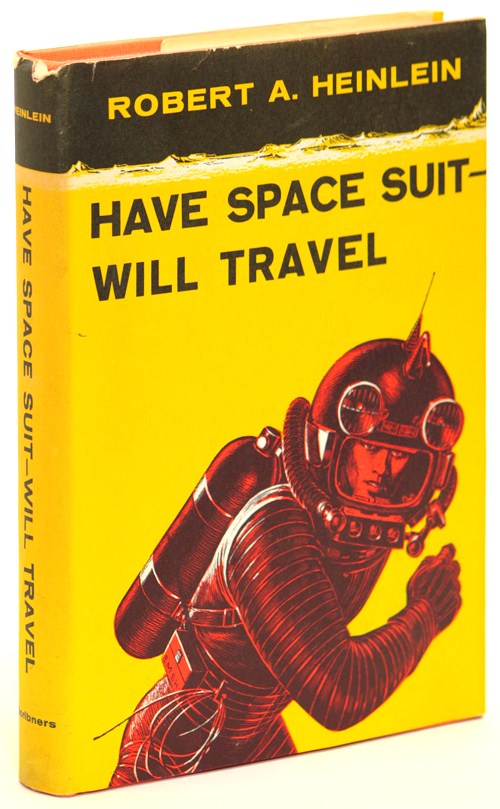
The worlds of science fiction and science—or at least technology—sometimes overlapped more directly. Robert Heinlein, an engineer with graduate work in math and physics and a prominent science fiction author, helped design a high-altitude pressure suit for the U.S. Navy, which he based on the description of a space suit he read in a 1931 pulp story by Edmond Hamilton. Heinlein’s work on the suit was continued by another science fiction writer (and aeronautical engineer), L. Sprague de Camp.

Though early pulp science fiction tended to emphasize the wonders of technologies, at least some stories also dealt with perils, including a 1933 series by Laurence Manning in Wonder Stories (another Gernsback magazine) that at one point depicted a future Earth depleted and ruined by pollution. (The series was later published as a novel of future history called The Man Who Awoke.)

Although some science fiction stories took place in the historical present or past, most were set in a future. Inventing futures became a more serious business in 1938 when John W. Campell became editor of the magazine Astounding. According to Lester del Rey, “He wanted them [his writers] to live in their futures. And he wanted those futures to be livable.”

The writers responded by becoming “future-oriented, with the sense that the present was not the permanent center of everything: to them, the future was a real place. It was three-dimensional.”

To make these futures “real,” Campbell urged his writers to imagine the social implications of new technologies. He urged them to question their assumptions based on the present or even prior science fiction. “’Yes, but’ was one of his favorite openings to a discussion,” del Rey recalls.

Campbell felt that the “fiction” or literary aspect was at least as important as the “science,” so he encouraged his writers to focus on characters, and their responses to change. Those writers would include many of the enduring names in American science fiction, including Robert Heinlein, Isaac Asimov, Poul Anderson, Theodore Sturgeon, A.E. van Vogt and Lester del Rey.

Campbell, according to del Rey, “had no desire to ‘bring science fiction into the mainstream. But he was totally serious about the fact that science fiction was the only fiction that dealt fully with modern reality.”

Meanwhile, two young science fiction pulp magazine fans in Ohio dreamed up a “strange visitor from another planet” who first appeared in Action Comics in 1938. Superman was the first dramatic character in a comic book and the first superhero—beginning a genre that dominates science fiction storytelling in big budget movies during the first decades of the 21st century.

From the beginning, the science fiction pulps inspired a unique readership. Pulps got so many unsolicited and thoughtful letters from readers that letters sections became regular and important features. Some of the most avid letter writers became story writers.

Writer, editor, impressario Forrest
Ackerman in costume from 1936 film
Things to Come, at WorldCom 1 in 1939.
Fans organized and held local, regional and finally national science fiction conventions, interacting with writers and editors—the first such fan gatherings ever held (apart from a few clubbier groups such as Sherlock Holmes devotees.) Fans had their own newsletters and developed their own vocabulary. All the aspects of the huge conventions associated with television and movies—including the costumes and role-playing—originated with the pulp science fiction conventions.

The first World Science Fiction Convention was held in New York in 1939, a few miles away from the World’s Fair and its three-dimensional future that fans could walk around in. A pulp editor told an audience, “I didn’t think you fans could be so damn sincere.”


He promptly commissioned Edmond Hamilton to write the Captain Future series for such young fans. Though it derived from the team of heroes myths such as Jason and the Argonauts, Captain Future and his specialized trio of misfits (a robot, an android and a disembodied brain) became a template for subsequent science fiction and superhero adventures.


Though much of the best science fiction in the first half of the 20th century appeared in pulps or was written by pulp authors, the genre became to some extent defined by lesser work. Pulp science fiction was often simplistic, dressing up standard conflicts in space suits, with one dimensional characters (though not always the muscled heroes and voluptuous damsels of the bold cover art, which might have nothing to do with the stories inside.) Stories featuring attacks by a “bug-eyed monster” were so frequent as to earn that subgenre name.


With their striking but sometimes lurid covers, cheap paper and purple prose, the science fiction pulps defined the genre as a poor and suspect relation of mainstream publishing. At a time when any kind of space travel was considered crazy fantasy, their obsessive fans with such weird preoccupations as space aliens and the future added to the growing isolation of science fiction.

Yet veteran science fiction writer and editor Lester del Rey argued that the pulps and the genre characteristics were crucial to science fiction’s development. Not only did the magazines foster friendships and an international network of associations in a “genuine subculture” with its own beliefs and traditions, but “to some extent, science fiction has developed its own ethics and values.”

Another factor created critical and audience distance. With the rise of what came to be called “sociological science fiction” in the pulps, stories began to examine possible consequences of technology, as well as critiquing society more generally. As U.S. society became more conformist, science fiction could be annoyingly subversive.

The science fiction pulps prospered in the 1930s and 40s, gradually diminishing in the later 50s and 60s. By then, a few science fiction authors were being published in mainstream magazines, and the baby boom generation’s first forays into adolescence led to several series of hardcover novels designed for young readers. (The difference, according to Heinlein was that the books for juveniles “are somewhat harder to read because younger readers relish tough ideas they have to chew and don’t mind big words.”)


Heinlein’s sequence of novels for young readers was among the most successful. Another was the Winston Science Fiction Series, featuring a number of authors including Arthur C. Clarke, Raymond F. Jones, Poul Anderson, Ben Bova and Lester del Rey.

Those books led to a growing market for science fiction novels, especially in paperback, and some became best-sellers. But the taint of the genre remained, so that well into the 21st century, science fiction works and writers, and even actors and everyone outside the effects and costume departments of science fiction films and television, almost never got the big prestige prizes.

A telling paradox of the genre might be that while science fiction doesn’t deal as overtly with personal or emotional matters as more accepted fictions, it evokes strong emotion in readers. But these tales inspire feelings that mainstream stories don’t stir as powerfully, such as wonder, amazement and a sense of possibility.

The inside cover illustration of all the Winston SF novels--For
young readers like me who read library copies without dust
jackets, this was the memorable image.
This is perhaps why the realists of the fantastic often appeal to the young. Isaac Asimov remembered devouring the stories in a new pulp magazine: “when every word was fire, and when the print itself, the images it provoked, the smell of the pulp paper, the feel and weight of the magazine, all combined into a vivid and agonizing transport because I wanted to be part of the story and couldn't…" These science fiction stories "ravished my soul and opened it to a music of the spheres that few can hear…"

In the 1960s the aging writer Henry Miller recalled his youth poring over Rider Haggard's tales in a secret hillside cave with his blood brothers. "...these books were part of our Spartan discipline, our spiritual training…..Our grown-up boys, the scientists, prate about the imminent conquest of the moon; our children have already voyaged far beyond the moon. They are ready, at a moment's notice, to take off for Vega—and beyond. They beg our supposedly superior intellects to furnish them with a new cosmogony and a new cosmology. They have grown intolerant of our naïve, limited, antiquated theories of the universe."

“Something so absurd as a boyhood book momentarily captures the mind and never quite releases it,” a character muses in a novel by Jim Harrison. But these books speak not only to boys.

The young Ursula LeGuin shared copies of Thrilling Wonder Stories with her brother, making favorite phrases from the stories a part of their secret language.

Young Margaret Atwood hid from homework in the basement by reading Rider Haggard and H.G. Wells in old volumes forgotten by her father.

“Wells’ fictions were the first books I read,” proclaimed the erudite scholar and writer Jose Luis Borges. “Perhaps they will be the last.”

They were responding to the age-old fascination of stories. “Let us worship the spine and its tingle," Vladimir Nabokov remarked. "That little shiver behind is quite certainly the highest form of emotion that humanity has attained when evolving pure art and pure science."

That little shiver—of hope or of horror—was leading to the future.

All of which prompts (but does not beg) the question: What is science fiction? And what is its role in exploring the soul of the future?

To be continued...Prior posts in the series can be accessed by clicking on the Soul of the Future label below.

Monday, July 16, 2018

The News

I have recognized that the function of the news for me is torture.  So I avoid it as much as possible these days.

Having let it largely pass me by for weeks now, while I turned my serious attention to subjects that require a larger perspective, a greater expanse of time to consider for cause and effect, I can see a little more calmly that, despite the quickly replaced headlines and new outrages,  nothing much on the political scene is changing or is likely to change.

That this administration is the most morally shameful in my lifetime won't change (and considering that I said the same ten years ago of the Bush II reign, it is even more sobering.)  I grieve for the lives damaged, as I do for the larger effects on the present and the future.  But being tortured by the news doesn't change any of that.

The combined and related effects of the climate crisis, population growth with its carbon pollution implications and species extinctions require major and concentrated efforts in order to forestall civilization-threatening consequences. Those efforts are still insufficient, and without the urgent and comprehensive commitment necessary. Even the resilience of the existing institutions within the federal government and the western allies that could help ameliorate the challenging consequences, is being depleted and damaged.  That won't change with this regime (except to get worse), nor will the consequences.

Nothing in Washington will change, at least until the November elections, but only if Democrats win control of Congress, and win overwhelmingly otherwise.  Even if that happens, the task of slowing down the damage, let alone stopping it, will take years, and just repairing the damage done could take many years. Meanwhile the time that has been lost is probably lost forever.

Some of the news leaks through to me, but it hasn't changed my perspective.  While the antipresident's statements and behavior in Europe are shocking, they aren't surprising.  Whether or not he is being essentially blackmailed by the Russians, his motives are plain and predictable in denying Russian interference.  Like any tyrant, he fears nothing more than threats to the legitimacy of his power, in this case to his own election.  His statements were a desperately global attempt to discredit the special investigator, preemptively tainting the findings that are yet to be known.  And until Congress is out of Republican control, those findings won't matter either.

I don't criticize others for being more involved and especially more active.  More power to them.  But I'm picking my spots, and they are few.  Obsessing over the news is not one of them.