Thursday, July 18, 2013

American Flashpoint


The Zimmerman verdict has become the latest flashpoint on race, proving if it needed proof that black/white race is still alive as a deep cultural as well as political problem.

On the one hand there's the moving yet shocking statement by the African American professor and TV pundit Melissa Harris Perry that she finds herself glad the child she's carrying isn't a boy, because black boys just aren't safe in this country.  On the other, a white woman assaulted and injured an older black man--a veteran soul singer--for dedicating a song to Trayvon Martin.  Demonstrations, with some violence attached, against the verdict, but also people on the side that won are incensed that charges were even brought, screaming their race-crazed conspiracy theories.

Here the trial itself is analyzed--one of the better of many analyses--and here the racial background that fills in the numbers revealing scandalous and persistent racial injustice.  News to all others perhaps, but not to African Americans.

One response--and one that is likely to grow--is Stevie Wonder announcing that he will boycott Florida and all states that have the racialized stand your ground gun law.  (And as someone pointed out, why isn't the NRA claiming that it all could have been avoided if Trayvon Martin had carried a gun?)  Here by the way is a very good meditation on the real core question: exactly what should Trayvon Martin have done?  It reveals what a sick verdict it is.

All of this is happening in the shadow of the Supreme Court's stripping the Voting Rights Act and just before the 50th anniversary of the March on Washington--two topics the great Louis Menard brings together.

Also just after President Obama's trip to Africa, where he visited a disembarkation point for black slaves on their way to America in chains.

Politics Then and Now

I've been reading about the years 1936 to 1941 in the U.S., including the politics of those elections.  There really is disgustingly little difference between the politics of now and then.  1936 was a total preview of 2012, as FDR ran for a second term, was called a Communist by Republican opponents, and worse by right wing splinter groups (their Birthers insisted FDR was really Jewish.) Rs tried to scare people about the horrors of the fully implemented Social Security system (everyone in the country will be taxed for s.s.! And everybody will get a number! And be forced to wear it on a chain around their necks for the rest of their lives!)  Nothing at all like being terrified that Obamacare might actually do some good.

 Meanwhile the Rs including the candidate were certain right up to election day that they would win, because the people would reject FDR.  When the votes were counted, only Vermont and Maine rejected FDR.

And then a chastened, much smarter Republican party in 1940, pretty much did the same damn thing.  In complete denial about Hitler and U.S. vulnerability.  Congressional Rs voted down FDR's defense requests and then castigated him in the campaign for not building up U.S. defenses.  The only difference is that a not insane Wendell Wilkie got nominated by a combination of fluke and actual popularity (but not with congressional Rs) and when they lost again, they still didn't change.

It seems that the Republican party was partly sane in the 50s, some of the 60s and 70s--although they did elect a mad president.  But sanity, that's just not them.  Venality and hypocrisy are merely symptoms.

And perhaps it's too much to ask let alone expect that politics itself be sane.  It sure isn't right now.  There are two themes currently coexisting in the gratefully little punditry I see: the Republican party is falling apart and dooming itself, and the Republican party is likely to regain a Senate majority and probably won't lose the House in the next election.  Huh?

As contradictory as this seems, it suggests a current phenomenon that is actually dooming our political system to inflated ineffectual twittering.  In 2008, those many who voted in the U.S. elected a Democratic president and Congress, to do what they said they'd do.  In 2010, those few who voted in the states elected reactionary Republican fanatics, throwing the U.S. House to the dogs, and doing worse in the states.

With the reelection of the Democratic president in 2012 that all was supposed to change, or change back.  Now there's every possibility that the non-presidential  2014 elections will make things worse.  One step forward, two steps back.  

Another reading of history suggest maybe it will take one more presidential election.  Okay, I'll check back in early 2017.

Saturday, July 13, 2013

Timultuous


After a couple of trying and troubling years with flashes of brilliance, and at the team's nadir in starting pitching along with everything else, Tim Lincecum pitched a no-hitter for the San Francisco Giants on Saturday night in San Diego.

He threw 148 pitches over nine complete innings, striking out 13 (3 in a row and 6 of 7 batters.)  Several fielding gems helped out.  Lots of Giants fans travel down to San Diego and by the final innings in what was already a 9-0 blowout, they were most of the fans watching in the ballpark.

It's true that San Diego is just about the only team that's had a worse month than the Giants, and the Giants have broken their losing stream by taking three straight from them, including a 10-0 game Friday.  But the last time the Giants played in San Diego, they were swept (which is why this didn't look to turn things around for them.)

But now the Giants will go into the All-Star Game break with at least 3 out of their last 4 (pending the day game Sunday.)  Their hitting obviously got well on this trip, too.

You have to admire the perseverance that got Lincecum to this moment.  The two-time Cy Young Award winner who could do no wrong, and then a season and a half of baffling starts, brilliant innings followed by completely ineffective ones, etc.  This was the first time this season he's gotten an out as late as the eighth inning.  And this was his first no-hitter.

Meanwhile, the Pirates won their second close game over the Mets, the team that swept the Giants at home.

Addendum to the Lakers: In his first interview as a Houston Rocket, Dwight Howard confirmed that he had requested Phil Jackson for the Lakers coach, once Mike Brown was fired.  Pretty clearly D'Antoni didn't know how to use him (or anybody else.)  Nobody really knows whether Howard can physically attain his former level, but with Phil Jackson as coach, he could well have been a great player on a much better team--maybe even a championship team (especially after Westbrook went down for Oklahoma, negating their speed advantage.)  Now the Lakers aren't even in the conversation, and the LA team that's on the rise is the Clippers.

Friday, July 12, 2013

On the Other Hand, Maybe Trendy? ZERO TV

I cut the cord.  I mean the cable.

I didn't literally cut it.  It's still attached, as a matter of fact.  It's just turned off.  I called the cable TV company and said I wanted to "discontinue service."  This pleasant female voice asked me why.  I paused, wondering if I should go into my diatribe or opt for quick and simple.  Go on about all those channels of trash--just zapping through them felt like trying to find my way out of a psychopath's mind?  Or the fact that my bill has tripled in just the past several years, rising faster than even the healthcare index?  Or that I hate their insipid ads, and grind my teeth every time they send me oversized junkmail, which I was obviously paying for with my tripled fee?

She saved me by saying, "Not Using?  I have to check off something."  I went for that.  She was surprisingly nice. (I'm told you usually get a sales pitch.)  She said that on the date service was cancelled, "you won't have to be home, you have no equipment to return, and you will receive no more bills."  "That last bit," I said, "those are the magic words."

That was about a month ago.  Except for my college years when I didn't have a set where I lived, I have been connected to television since I was four years old.  We were early adopters, near Pittsburgh, which pioneered a lot of broadcasting history.  I remember seeing a tiny round TV screen built into a radio.  I remember waiting all day for the fifteen minutes of broadcast, which would be a program about ice trays in refrigerators.  One of my earliest memories is a Saturday morning watching Flash Gordon and Dick Tracy.  The bad guys took Dick Tracy's gun.  But he outsmarted them.  He had another gun.  I was impressed.

I could go on--snow and test patterns through the early days of cable, when ours played Stormy Weather four times a day. But it's all gone now.

And now I see that I've accidentally joined a trend!  It's called Zero TV, and it's growing.  I'm not that tech savvy though.  I can watch YouTube on my computer screen but I still want to look at the old TV from a TV  chair or couch, and hooking that up requires...well, it's complicated.

For now I'm happy with DVD rentals (we lost one prime rental store but there are still two more at walking distance) and Netflix, and especially my DVDs (and I can buy more with all the money I'm saving!), and something I suspect not many of the trendy Zero TV folks have: VHS tapes and a VCR to play them on.

For years I not only bought VHS (often used from video stores etc.) but taped off the TV madly: from PBS stuff to my favorite network shows, to sports events, Bill Moyers interviews, all kinds of docus and above all, movies. I even rigged up a way to bypass most blocks and tape from rental store tapes and DVDs. Now I might even watch them.

Sure, the movies don't look that great--but I have some that are hard or even impossible to find in other forms.  It's surprising how much of Book TV is archived online, but PBS is less reliable.  And I have the complete Ronald Harwood theatre series (All the World's A Stage) ---libraries don't even have that.

So since my TV became zero I started off by watching some $1 DVDs I bought years ago but never got around to watching, like three early episodes of the real Lone Ranger (one with DeForest Kelley as guest star) and the Danny Thomas sitcom Make Room for Daddy, the best part of which are the commercials--for Philip Morris cigarettes ("Outstanding--and they are mild") and the new 1955 Dodge. Which reminds me--NO MORE COMMERCIALS!!!

I started through a stash of Doctor Whos of the Tom Baker era, with maybe too many promos for WQEX (Sweet little 16) in Pittsburgh in the late 80s.  Wish I'd taped more from the other Doctors!  Unfortunately even these are incomplete--I recorded them with a timer that was apparently off.  So I was quite happy to get some Tom Baker Doctor Who DVDs for my birthday--the Key to Time series, with the beautiful Mary Tamm as the female Time Lord Romana.  And lots of extras, including commentaries by Tom and Mary---they have little to say about the shows but Tom Baker is such a strange man, and Mary Tamm has since passed on, so these are little privileged moments of just hearing them chat.

And I really don't miss the political shows.  In fact, I don't miss anything.  I suppose if the Giants were playing better I'd miss baseball, but I have become reacquainted with the way I first experienced major league baseball: the radio.

I expect that someday I'll want to watch Hulu or whatever on a big screen.  I suppose Blu-Ray isn't out of the question someday.  But for now, I'm trendy, even if I'm coming at it from the wrong end.

Not Trendy

I learned something just from the catalogue write-up for a forthcoming book from MIT Press, called The Ringtone Dialectic: Economy and Cultural Form by Sumanth Gopinath.  I learned just how out of it I really am.

The book description in the fall 2013 MIT Press catalogue begins: "A decade ago. the customizable ringtone was ubiquitous...Ringtones quickly became a multi-billion-dollar global industry, and almost as quickly, faded away."

A multi-billion-dollar industry?  What else did I miss by being kind of a late cell phone adopter (okay, very late)?

Apparently, enough for a whole book.  "Gopinath describes the technical and economic structure of the ringtone industry, considering the transformation of ringtones from monophonic, single-line synthesizer files to  ...etc.  But that's just the start.  He discusses sociological practices that seemed to wane as a result of these shifts...Gopinath examines 'declines,' 'reversals' and 'revivals' of cultural forms associated with the ringtone and its changes, including the Crazy Frog fad, the use of ringtones in political movements (as in the Phillipine 'Gloriagate' scandal..."  Also "the ringtone's relation to pop music (including possible race and class aspects of ringtone consumption).  Finally, Gopinath considers the attempt to rebrand ringtones as 'mobile music' and the emergence of cloud computing."

The Crazy Frog fad?  Gloriagate?

So there are two prominent possibilities here: (1) This is a work of subtle satire that will have geeky snorting laughter echoing through Silicon Valley (if they still call it that), or (2) All this happened during my long diplomatic mission to planet Vulcan.

On the bright side, the whole thing has "faded away."  So did I miss anything?

Thursday, July 11, 2013

They Once Were Giants

The San Francisco Giants are going through absolutely epic bad times.  A series of injuries to key players set off a losing streak that now seems to be feeding on itself.  If the injuries weren't enough, a decent substitute player was suddenly struck with appendicitis, and is out for several weeks.  Now news that a pitcher brought in to deal with a gap in the starting rotation--and who has been one of the few bright spots--was arrested months ago and is essentially out on bail pending trial.

The Giants are used to being in games that flirt with no-hitters; only the most recent one, they were the ones who didn't get a hit.  Their disastrous road trip--they haven't been a good road team all season--merged with a disastrous homestand.  They played a 16 inning game with the Mets.  They were the home team, so all they had to do was score one run and the game would be over.  They had men on base in at least four of those extra innings, and the bases were loaded--twice.  They lost the game.

A game which is so long to be almost two games and lost that way had to be devastating.  And it was.  Giants pitching gave up a total of 17 runs in the next two games with the Mets, both losses. Matt Cain didn't get out of the first inning for the first time in his career. Out of their last 16 games, they've won 3.  In one of those three wins, they lost a run because of a mistake on the official lineup card meant that a batter batted out of order.

Even in their recent championship years, the Giants were not particularly good in the first half of the season.  But I'll bet not many reigning champs have had an end to the first half like this.  Manager Bruce Bochy is managing this year's All Star Game in a few days.  That distraction hasn't helped, though it's difficult to see what else he could do, but it's not exactly the way you want to go into that game.  Plus the Giants have to get through 3 games in San Diego first.  

Tuesday, July 09, 2013

These Kochs Aren't For You

An interesting piece in the NY Times on the mysterious disease called Valley Fever the other day.  The news had to do with a court ordering thousands of inmates to be transferred from a couple of California prisons with epidemics of the disease.  The nasty, debilitating and sometimes fatal fungus disease, so far without a cure, is related to hot weather.

The Times story discusses the peculiar genetic factors, the medical mysteries, etc.  But two parts of the story stood out for me.  The first was this:  "Many scientists believe that the uptick in infections is related to changing climate patterns."  Other contributing causes being present, global heating is a factor.

The second has to do with impact. “It destroys lives,” said Dr. Johnson, whose daughter contracted a mild form. “Divorces, lost jobs and bankruptcy are incredibly common, not to mention psychological dislocation.”  Lost jobs and divorces might well result from a debilitating disease that requires a lot of attention.  But bankruptcy--that alone also leads to divorces and psychological problems, and destroys lives.  In combination with debilitating illness, it's a frightening, ugly death spiral.

What do these two observations suggest?  The United States is still one of the few countries in the world that  refuses to face up to the realities of the climate crisis, especially in the political system, and most especially in the federal legislature.  And the United States is possibly the only modern industrial supposedly civilized country where people are forced into poverty and despair because of the cost of medical care.

Which brings us to the Brothers Koch, who more than symbolize the reasons.  In large part, they are the reasons.  The Koch brothers and how they spend their money.

The New Yorker reports that a  two-year study by the Investigative Reporting Workshop at American University concludes the Kochs have spent some $75 million "tied to climate inaction:"

In its multi-part report, “The Koch Club,” written by Lewis, Eric Holmberg, Alexia Campbell, and Lydia Beyoud, the Workshop found that between 2007 and 2011 the Kochs donated $41.2 million to ninety tax-exempt organizations promoting the ultra-libertarian policies that the brothers favor—policies that are often highly advantageous to their corporate interests. In addition, during this same period they gave $30.5 million to two hundred and twenty-one colleges and universities, often to fund academic programs advocating their worldview. Among the positions embraced by the Kochs are fewer government regulations on business, lower taxes, and skepticism about the causes and impact of climate change.

Climate-change policy directly affects Koch Industries’s bottom line. Koch Industries, according to Environmental Protection Agency statistics cited in the study, is a major source of carbon-dioxide emissions, the kind of pollution that most scientists believe causes global warming."

In the 2010 non-presidential elections alone:

 Koch Industries’s political action committee spent $1.3 million on congressional campaigns that year. When Republicans did take control of the House, a huge block of climate-change opponents was empowered. Fully one hundred and fifty-six members of the House of Representatives that year had signed the “No Climate Tax Pledge.” Of the eighty-five freshmen Republican congressmen elected to the House of Representatives in 2010, seventy-six had signed the No Climate Tax pledge. Fifty-seven of those received campaign contributions from Koch Industries’s political action committee. The study notes that more than half of the House members who signed the pledge in the 112th Congress made statements doubting climate-change science, despite the fact that there is overwhelming scientific consensus on the subject.

This is a heavily financed attempt to influence the political process for generations on the single most important issue to the future of human civilization.

But the Kochs don't stop there.  The United States has been debating ways to provide medical care coverage to its citizens for much of a century, and very specifically in the past decade.  But duly elected members of Congress passed the Affordable Care Act, and a duly elected President signed it, and a duly constituted Supreme Court said it is constitutional.

The Affordable Care Act, which goes some way towards the kind of medical care coverage that the governments of  most other industrial countries provide, so that fewer people will be ruined, impoverished and terrorized on top of serious illness or injury, is the law of the land.

Yet instead of allowing the implementation to proceed so the country can judge whether this is a better system or not, it seems to be the official position of one political party to subvert it.  This effort, which led to the unprecedented, mean-spirited and virtually treasonous threats by Republicans against major league sports who would dare to produce public service announcements explaining the new system, is being led by the Koch brothers, at least financially.

They are currently "pouring millions" into a disinformation campaign to subvert the ACA implementation.  Critics of the health law spent a whopping $400 million on television spots criticizing the law since 2010, over five times the $75 million that the law’s supporters have spent on ads promoting it. Analysts expect $1 billion in expenditures by 2015.

Ripples


As predicted, the effects of global heating continue to ripple through many elements of human life, from weather to medicine to infrastructure.

The latest tree ring study suggests that global heating has been aggravating the El Nino phenomenon that drives major weather trends.  El Nino was more active in the 20th century than in the preceding 700 years.

Meanwhile, the rising temperatures in the West are taking their toll on already shaky infrastructure.

And another example of the intricate yet vital relationships of nature and its role as our basic infrastructure, there's the coral reefs.  There are lots of reasons why coral has been endangered for years, but now the absolute killer is global heating.  A very definite study yields the conclusion stated in this headline: If Carbon Emissions Aren’t Reduced Now, Coral Reefs Will Die.

So what?  There are lots of reasons coral is important to human life and civilization.  But here's an example of what we may be losing without even realizing it:  genes that defend us from disease originated in coral.  Immune system research is starting to show this, with the possibility of learning how coral can add to our resistance.

Monday, July 08, 2013

The Dreaming Up Daily Quote


"Time, events, or the unaided individual action of the mind will sometimes undermine or destroy an opinion, without any outward sign of the change."
Alexis de Tocqueville

illustration: one in a series positing what planets would look like if they were the same distance from the Earth as the Moon is. (Although in fact it wouldn't--a planet that size would have devastating gravitational effects, so our planet wouldn't be what it is.) This is Neptune.

Friday, July 05, 2013

Sportsweak

The LA Lakers just lost the center they traded for last year, Dwight Howard, the biggest name to ever leave the Lakers after only a year.  Lots of mixed feelings in LA though, because of the way he and the team played last year. The LA Times' Bill Plaschke thinks it's all for the best, but I don't quite see it that way.  Howard left because Mike D'Antoni is a crappy coach, and he's the guy who should be fired.  He's destroying the Lakers.  The Little Buss who hired him should turn this team over to his sister.  Plaschke may be right about Howard's character, but if Phil Jackson had been hired as coach, he would have dealt with that during the season.  But Little Buss's ego wouldn't let him hire Jackson, so the Lakers are likely in for a long slide.  Plaschke's fantasy about the Lakers rebuilding around LeBron James in 2014 is laughable.  Nobody has faith in the Lakers organization or aura anymore.  Until they fix that, nobody is going to think that the Lakers' uniform is gold.  Kobe's chance for one more championship was done the minute D'Antoni was hired as coach.

Meanwhile, the SF Giants are in a major swoon, a kind of slow motion but relentless nightmare in which everything that went right in their dream season has gone sour.  Pitching is getting shelled, they aren't getting timely hits, they are making lots of dumb baserunning mistakes, they aren't scoring in the late innings.  Just as the Giants and the Pirates seemed on parallel tracks earlier in the season, right now they're almost mirror opposites.  The Pirates are winning when they are ahead in the late innings.  They are winning in extra innings.  They are winning against teams they are supposed to beat, and winning against the best at a healthy clip.  Now the Pirates are in first place in their division, about 20 games above .500.  The Giants are last in their division, below .500.

Tuesday, July 02, 2013

The Business Climate

Articles and opeds that tell us how bad things are vis a vis the climate crisis are depressingly frequent.  But this one in the NY Times quotes several facts and studies I missed.  Mostly about the ongoing role of those behemoths of the age, the fossil fuel megacorporations.

Mark Bittman first of all cites this Carnegie Endowment for International Peace report showing that the world is not going to run out of fossil fuels for a very long time, once new technologies to wring the stuff out of sands and rocks etc. are considered.  There's potentially five times as much oil to be tortured out of the Earth than we've soaked up and burned up already.  A lot of the extracting action is likely to be within the U.S. So even if societies balk at the damage and expense of getting all of it, for a century or so there's not much threat of Peak Oil.  There are others that dispute this, however.

Bittman then puts this together with a Rolling Stone report that asserts that the Big Oil companies are no longer even faking a commitment to clean energy.   BP put its $3.1 billion United States wind farm operation up for sale. Last year, ConocoPhillips divested itself of its alternative-energy activities. Shell, with its “Let’s Go” campaign to “broaden the world’s energy mix,” spends less than 2 percent of its expenditures on “alternatives.”

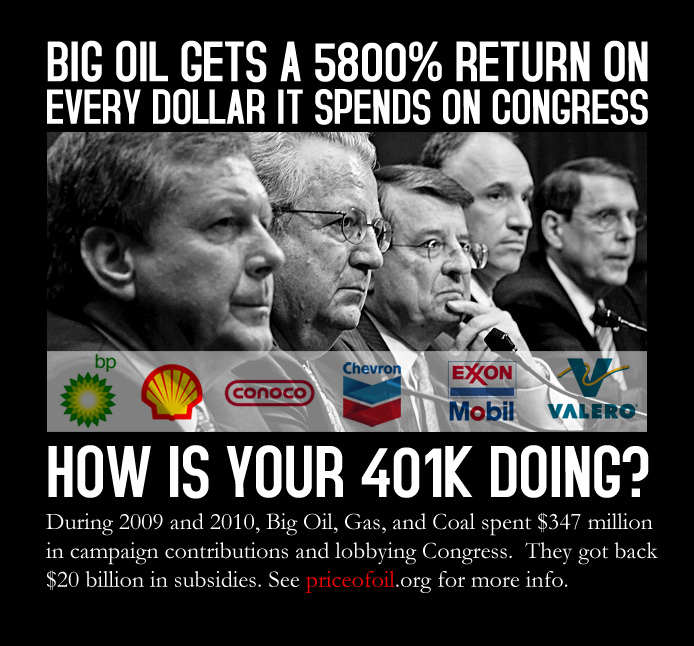
The implication is that Big Oil has figured out that it doesn't have to hedge its bets by getting into clean energy businesses--it's got such a sweet thing going as the world's richest corporations ever, that nevertheless demand and get government subsidies, and that never has to pay any of the estimated $2 trillion in damages to the global environment.  Why bother?  It's like that t-shirt I used to have, with the Exxon logo and the words: We Don't Care.  We Don't Have to Care.  We're Exxon.  It's an all-purpose slogan.

So with almost literally all the money in the world, these corporations can buy all the state legislators they need to keep on pumping and fracking until the ground collapses beneath befuddled non-voters and I Told You So Jesus Apocalyptics.  And they tie up the federal legislature with paid deniers, otherwise known as Republicans, though some Dems are on the payrolls too. Bittman cites an American Progress study  that counts 125 congressional deniers who soak up some $30 million from fossil fuel corps just in "campaign donations."  Which doesn't include speaking and consultant fees, etc.

So the U.S. and the world keep burning the fuels that fuel the climate crisis, and while everybody else struggles to survive the consequences of past pollution, the future is fried for thousands of years after these folks die in their greed-fevered beds.

Tobacco companies were once all-powerful, but regulations limiting smoking eventually became common and pretty pervasive.  The task is even greater this time, because there's no place for fossil fuel corps to shift their business, unless they can market to extraterrestrials.  We have to hope some of them are run by people with a rudimentary conscience, at least about the world their own future generations will inherit. Not to mention the victims of the climate crisis and their children--look no further than the children of the 19 firefighters killed in Colorado.  It will take that, and immense political will and cultural change to make the necessary difference.

Sunday, June 30, 2013

The Dreaming Up Daily Quote


“Nature is far more imaginative than we are.”
--Stamatios M. Krimigis, a scientist at the Johns Hopkins Applied Physics Laboratory
quoted in NY Times  6/27/2013

And a Happy Birthday to Martha P., Bruce D., Graceann P. and all my other birthday twins.

Weather Report

It's hot here.

Of course nothing like much of the rest of the West.  According to the LA Times, on Saturday it hit 122F in Palm Springs, 126 in Death Valley, 113 in Las Vegas, and at least 119 in Phoenix, where airport officials were monitoring temperatures because it would soon be too hot to allow airplanes to fly.

CNN even screamed in a headline that the temperature was approaching "the highest ever recorded on Earth."  The key word would be recorded, but it's an assertion the BBC reported, too.  Later Saturday CNN was concentrating on the death toll.

This huge expanse of heat wave, which began last week, is expected to extend well into next week.  And we are feeling it here as well--the first time a heat wave has included us.  It's nowhere near as intense as these places--but for us, a week or more of highs in the mid to upper 70s and into the 80s is unprecedented.  Our normally high humidity makes these temps seem hotter, and though by next week we may not be cooling down at night quite as much as we are now, we still have cool breezes once the sun goes down.  That's absent for much of the West, including most of California.  Temperatures in Phoenix are staying above 90 at night.

The same change in the Jet Stream that's apparently responsible for this heat and dryness is bringing rain to the East, including places where June was the rainiest on record.

Our heat spell comes as our North Coast area has officially been declared to be in drought.  We had a sunnier and colder winter than normal (I wore wool coats I haven't worn as often since I left Pittsburgh) and while the sunshine was cheery, it also made people really nervous.  It's our rainy season, and it wasn't raining.  We got one but really only one of our usual December storms,and though it had unusually fierce winds (it blew my basketball hoop apart), it brought little rain.  After that there was some stealth rain at night, a few rainy days in February, but not much more. Winter rain has been arriving later and later the past few years, and this year it just didn't come.

Recently it became official--this was the driest winter since North Coast records were kept.

In terms of effects, I'm expecting the unexpected.  But there will be effects, to the drought (moderate, so far) and to the string of hot days that this ecosystem is not used to.  But even in places accustomed to hot summers, the intensity of this heat wave is also something new.

Saturday, June 29, 2013

A Dream of Water

Global heating because of greenhouse gases pollution is not the only contributor to present and future environmental problems and likely crises.  Many however work in tandem with global heating, and/or make the effects potentially worse.

For example, the misuse of water. This spring PBS ran the scary two-part docu by Ken Burns on the Dust Bowl, that profound human tragedy in the 1930s American West caused by the confluence of climate patterns and bad human management of land and water.  It finally ended when FDR's New Deal helped to reform farming practices,  and then the rains came again.

But the docu also mentions that the same area most affected by the Dust Bowl was backsliding.  The lesson of more modest demand on fragile resources ended when the High Plains Aquifer was discovered and tapped, providing water that created agricultural bounty and expansion.  But, the docu warned, when the acquifer is depleted, even more people would be devastated than during the Dust Bowl.

Now it may be starting to happen.  The New York Times reports from Kansas:  The land, known as Section 35, sits atop the High Plains Aquifer, a waterlogged jumble of sand, clay and gravel that begins beneath Wyoming and South Dakota and stretches clear to the Texas Panhandle. The aquifer’s northern reaches still hold enough water in many places to last hundreds of years. But as one heads south, it is increasingly tapped out, drained by ever more intensive farming and, lately, by drought.

Vast stretches of Texas farmland lying over the aquifer no longer support irrigation. In west-central Kansas, up to a fifth of the irrigated farmland along a 100-mile swath of the aquifer has already gone dry. In many other places, there no longer is enough water to supply farmers’ peak needs during Kansas’ scorching summers. And when the groundwater runs out, it is gone for good. Refilling the aquifer would require hundreds, if not thousands, of years of rains. 

It is a "slow-motion crisis," the Times says, but also a completely predictable one.  As predictable as the final draining of oil and other fossil fuels, already begun (or we wouldn't be trying to wrench more fuel out of tar sands and fracking) and just as inevitable.

Now deep in drought, the American West is coming up against its limits, which most often means water.  For example, as this report indicates, the Colorado River, which supports some 40 million people over several states, is already "reduced to a trickle" in some places.  While the discussion underway in the region involves management and conservation (more efficient use of water for agriculture) one participant in this NPR interview noted, And I think just to add on to that, what I think I don't hear very often is: Have we reached the carrying capacity for the Southwest in terms of water? And I don't hear people raise that.

I was once involved in a meeting that includes some big Colorado developers as well as political and civic leaders in Colorado Springs.  I listened to one developer at dinner talk about all the expansion plans, and I raised the question of whether there would be enough water.  He looked startled, but recovered to call me a visionary who cut right to the essence, because it's a pretty damn dry place all right.  But clearly nobody making the decisions was thinking about it.

That was about twenty-five years ago.  And they still aren't.  But if this drought is part of a long-term pattern caused by global heating, rather than just intensified and made a bit longer by global heating, then everybody is going to be thinking about it, and maybe even wondering why it slipped their minds in the first place.

Friday, June 28, 2013

The Future of This Week

The news was pretty full of significant stories this week.  On Thursday the U.S. Senate passed an immigration reform bill, watched by a gallery of DREAMers chanting "Yes we can."  On Wednesday the Supreme Court nullified the Defense of Marriage Act, and essentially allowed gay marriage to proceed in California.  On Tuesday the Court struck down a key element of the Voting Rights Act, and without federal oversight several states immediately jump-started their push for voter ID laws.

On Tuesday as well, President Obama made his speech on the climate crisis.  It will probably come as no surprise that I consider this the most significant event of the week.  The gay marriage progress is a victory for  equal rights, and therefore for us all.  But the actual changes it enables will not affect everyone directly.

And while the Supreme Court affirmed the right of a group of Americans to marry, it also limited the federal government from protecting the rights of other groups of Americans to vote, and the loss of those rights may well have direct consequences for the country as a whole.  Nor is that theoretical, evidenced by the rush to enact voter ID laws for the demonstrable purpose of disenfranchising non-whites and poor and others who are less likely to vote Republican.

And of course the immigration bill is far from law; most predictions are that it will not pass (or possibly even come to a vote) in the GOPer House.

There are several interesting points of view on President Obama's speech on the climate crisis.  Frank Rich suggests that the effect is not in the actions he outlined ("I don’t think anyone believes that he can achieve more than incremental environmental goals by executive order; the legal challenges alone will long outlast his presidency.")  but "by acknowledging that governance is impossible with the current Congress and taking action, he has catapulted over Washington to the voters and strongly identified his party and presumably its next presidential candidate with policies that are in sharp contrast with what he calls the “Flat Earth Society” on the other side...Obama has put his party firmly on the side of the country’s future, not its past." 

Jonathan Chait disagrees on the effect of the executive changes in his plan, which he asserts"taken together, add up to a significant climate response."  And that's before the EPA standards on carbon pollution under the Clean Air Act.  He thinks that together these will mean that "Obama can meet environmentalists’ near-term goal of reducing carbon emissions 17 percent by 2020 on his own," but that to do better, especially after 2020, will require congressional action.

David Roberts acknowledges that "Obama is in a highly constrained position on climate. He faces hostility from Congress and the courts alike, with no broad-based popular movement behind him to scare them into line. All he can do is use the power of the executive branch."  Moreover, Roberts believes that the Obama team scheduled this address deliberately in the midst of what they knew would be a week of big news stories, so it wouldn't inspire "a pitched public battle."

Roberts says that some of the changes are potentially a big deal but that there's no way of knowing if they will actually get the U.S. to a 17% drop in emissions.  He notes also the No Drama Obama rhetoric of the speech, and concludes:

 "This is vintage Obama. He refuses to wage lofty ideological battles, which frustrates the hell out of people who view those battles as necessary and inevitable. He doesn’t direct a lot of energy at bashing his head into walls. He just puts the available resources to work doing what can be done. It’s not enough — it’s not even as much as he could do — but it would be a big mistake to think it doesn’t matter."

Xpostfactoid puts together Greg Sargeant's comment (similar to mine) that Obama's speech "recast the call for climate action as the centrist, common-sense solution" with Chiat's observation that  "Fashioning a long-term growth strategy is, and has always been, Obama’s deepest passion," and points out:  "I must add that if Obama's vision of enacting liberal policies as a means for achieving long-term growth has been left untold by certain parties, those parties don't include Obama. He has never stopped telling that story: it is the very heart and soul of his pitch to America and always has been." 

Though I don't agree entirely that economic growth is "the heart and soul," it certainly is a priority and a theme of the story. (Children, the future, including but not limited by economics, are also themes.)  But he's right that Obama has been telling his story and a lot of journalists haven't really been listening. Which is one reason I've spent so much time summarizing and liberally quoting his speeches--what he says is almost never reported, and when somebody finally listens, they assume he's never said before why they've just heard for the first time.

It occurs to me as well that the timing of this address may also result from Obama being able to cite growth in clean energy technology, seeded in part by his economic stimulus package and other legislation passed in the early Dem majority days.  It helps make the economic argument.

Roberts, who writes for Grist and has environmental cred, is right about the pressure from the enviro left--they want big dramatic speeches and proposals.  One such writer I saw crowed that Obama finally took her advice and made the big speech, but though it was "a nice try" it wasn't going to amount to anything-- classic double-bind bullshit.  And the right is even more extreme, beyond sanity, but some Beltway commentators think their arguments (carbon regs will kill economic growth) are still politically potent.

So given all of this, my sense that this is the most significant act of the week seems in  the distinct minority.  That doesn't surprise me.  All the same things were said about President Kennedy's American University speech fifty years ago--his proposals for a limited nuclear test ban were too modest, and too radical; they wouldn't mean anything, they would endanger American security and hasten war.  But that seed grew, and so will this one.  In the end it will affect more people--and more of the planet--than anything else that happened this week.

As for "nothing new," here's what was new in the speech (separate from the actions or proposals):

An American President declared that addressing the climate crisis is an urgent national and global need.

He declared that addressing the climate crisis means addressing both the causes and the effects.

He acknowledged that even as we address the causes, we will continue to feel the effects for some time to come.

No President has said any of that before.   But it is the agenda and the reality going forward into the future.

Wednesday, June 26, 2013

As a President, as a father, and as an American, I’m here to say we need to act.


President Obama's speech on the climate crisis accurately outlined both parts of the problem, the cause and the effects, and not only proposed a comprehensive range of ways to address particularly the causes, but announced meaningful efforts by his administration, regardless of congressional inaction.

He spoke in the hot DC sun, to an audience of Georgetown University students, deliberately selected because this issue will begin to seriously affect their generation and the following generations.

His rhetoric was mostly simple, though the speech cleverly turned the tables on critics by characterizing them as negative and "doomsayers" on America's potential to deal with environmental challenges and still be economically viable.  He dealt with deniers in just one sentence, as akin to the Flat Earth Society.

His speech is accompanied by an even more comprehensive plan, made available in the form of infographics and a pdf detailed plan. In later posts I plan to look into the plan.  In this post I want to summarize the speech.  Quotes are in italic.

President Obama began by talking about the famous photo that first showed the Earth from moon orbit to the Earth in 1968.  At the same time, scientists were studying changes in the atmosphere brought about by greenhouse gases that threatened that whole Earth.

That science, accumulated and reviewed over decades, tells us that our planet is changing in ways that will have profound impacts on all of humankind. 

He summarized some of the most recent and most compelling evidence, and talked about the effects of storms, droughts and extreme weather made more extreme by global heating. And we know that the costs of these events can be measured in lost lives and lost livelihoods, lost homes, lost businesses, hundreds of billions of dollars in emergency services and disaster relief. In fact, those who are already feeling the effects of climate change don’t have time to deny it -- they’re busy dealing with it.

Having examined the science on the causes of global heating and described some of the effects, the President makes an historic commitment:

So the question is not whether we need to act. The overwhelming judgment of science -- of chemistry and physics and millions of measurements -- has put all that to rest. Ninety-seven percent of scientists, including, by the way, some who originally disputed the data, have now put that to rest. They've acknowledged the planet is warming and human activity is contributing to it.


So the question now is whether we will have the courage to act before it’s too late. And how we answer will have a profound impact on the world that we leave behind not just to you, but to your children and to your grandchildren.

As a President, as a father, and as an American, I’m here to say we need to act. (Applause.)

I refuse to condemn your generation and future generations to a planet that’s beyond fixing.


And that’s why, today, I'm announcing a new national climate action plan, and I'm here to enlist your generation's help in keeping the United States of America a leader -- a global leader -- in the fight against climate change.  

He described some of the progress made, and acknowledged the opposition that has meant that the challenge he gave to Congress to act ("or I will") has gone unmet.  So he will.

But this is a challenge that does not pause for partisan gridlock. It demands our attention now. And this is my plan to meet it -- a plan to cut carbon pollution; a plan to protect our country from the impacts of climate change; and a plan to lead the world in a coordinated assault on a changing climate. (Applause.)

Cutting carbon pollution is to be addressed in three basic ways.  This plan begins with cutting carbon pollution by changing the way we use energy -- using less dirty energy, using more clean energy, wasting less energy throughout our economy.

He talked about the Clean Air Act, passed in 1970 by Congress with one dissenting vote in the House and none in the Senate, and signed into law by a Republican President.  The principle of regulating to preserve the environment and therefore the health and safety of Americans was established, and the pollution that the EPA is now required to regulate includes carbon, by a recent Supreme Court decision.

So new rules will be made and enforced to regulate the currently not-regulated-at-all carbon emissions of both new and existing power plants.  That's probably the major news from this speech, because regulating existing power plants was not thought to be in the cards for the near future.

He notes that critics will say this will crush the American economy, as they have before every major step to regulate harmful pollutants etc., but that the "doomsayers" were always wrong.  American ingenuity always rose to the occasion, and so did business.

 The old rules may say we can’t protect our environment and promote economic growth at the same time, but in America, we’ve always used new technologies -- we’ve used science; we’ve used research and development and discovery to make the old rules obsolete.

Besides using less dirty energy, he advocated for more clean energy. He spoke about successful efforts to expand clean energy, and announced new efforts to expand it further.He spoke in favor of natural gas as a less carbon polluting fuel that can bridge to a more complete clean energy future.

 A low-carbon, clean energy economy can be an engine of growth for decades to come. And I want America to build that engine. I want America to build that future -- right here in the United States of America. That’s our task.

He spoke more generally about not wasting energy, but pointed out once again that energy conservation is one of the easiest ways to address the climate crisis, and one that adds immediately to jobs and the economy.

In all three categories he noted what had already been done or was being done--by states, cities and corporations.  He noted that in some efforts the federal government would be playing catch-up.

Then he turned from causes to the effects--and to the fact that many advocates for action would not themselves face until recently: that global heating is going to continue, and it is going to have effects, even if we do what must be done to blunt the catastrophic effects of climate cataclysm in the farther future.

So using less dirty energy, transitioning to cleaner sources of energy, wasting less energy through our economy is where we need to go. And this plan will get us there faster. But I want to be honest -- this will not get us there overnight. The hard truth is carbon pollution has built up in our atmosphere for decades now. And even if we Americans do our part, the planet will slowly keep warming for some time to come. The seas will slowly keep rising and storms will get more severe, based on the science. It's like tapping the brakes of a car before you come to a complete stop and then can shift into reverse. It's going to take time for carbon emissions to stabilize.

So in the meantime, we're going to need to get prepared. And that’s why this plan will also protect critical sectors of our economy and prepare the United States for the impacts of climate change that we cannot avoid. 

Once again, he was able to describe efforts in this regard already underway in cities and states, including those with Republican governments.  (He'd previously noted that 75% of wind power generated in the U.S. is in Republican states.)  This is another way he was able to undercut critics who say all this is radical and (in the immortal phrasing of John Banal) "crazy."

And we’ll partner with communities seeking help to prepare for droughts and floods, reduce the risk of wildfires, protect the dunes and wetlands that pull double duty as green space and as natural storm barriers. And we'll also open our climate data and NASA climate imagery to the public, to make sure that cities and states assess risk under different climate scenarios, so that we don’t waste money building structures that don’t withstand the next storm. 

The last part of his speech was about the U.S. leading international efforts, not only to meet the Copenhagen goals for 2020 but to go beyond them in following decades by bringing in the developing nations.

What we need is an agreement that’s ambitious -- because that’s what the scale of the challenge demands. We need an inclusive agreement -– because every country has to play its part. And we need an agreement that’s flexible -- because different nations have different needs. And if we can come together and get this right, we can define a sustainable future for your generation. 

We’re going to need to give special care to people and communities that are unsettled by this transition -- not just here in the United States but around the world. And those of us in positions of responsibility, we’ll need to be less concerned with the judgment of special interests and well-connected donors, and more concerned with the judgment of posterity. (Applause.) Because you and your children, and your children’s children, will have to live with the consequences of our decisions. 

President Obama said that addressing the climate crisis must once again return to bipartisan efforts, because this is a responsibility to the future.

Our founders believed that those of us in positions of power are elected not just to serve as custodians of the present, but as caretakers of the future. And they charged us to make decisions with an eye on a longer horizon than the arc of our own political careers. That’s what the American people expect. That’s what they deserve.

And someday, our children, and our children’s children, will look at us in the eye and they'll ask us, did we do all that we could when we had the chance to deal with this problem and leave them a cleaner, safer, more stable world? And I want to be able to say, yes, we did. Don’t you want that? (Applause.)

He called upon citizens to persistently make their voices heard on this issue:


Americans are not a people who look backwards; we're a people who look forward. We're not a people who fear what the future holds; we shape it. What we need in this fight are citizens who will stand up, and speak up, and compel us to do what this moment demands. 

That means insisting that communities, corporations, governments and individual office-seekers take responsibility:

Convince those in power to reduce our carbon pollution. Push your own communities to adopt smarter practices. Invest. Divest. (Applause.) Remind folks there's no contradiction between a sound environment and strong economic growth. And remind everyone who represents you at every level of government that sheltering future generations against the ravages of climate change is a prerequisite for your vote. Make yourself heard on this issue. (Applause.)

And in the year that is the 50th anniversary of so much involving President Kennedy--Berlin,  his American University speech on the nuclear test ban, his Civil Rights speech the next day, and of course his assassination--President Obama contrasted the goals of this effort from the "clear moment of victory" of the Apollo program.  And he did so with rhetoric that more than in any other part of the speech comes closest to  Kennedy's:

 I understand the politics will be tough. The challenge we must accept will not reward us with a clear moment of victory. There’s no gathering army to defeat. There's no peace treaty to sign. When President Kennedy said we’d go to the moon within the decade, we knew we’d build a spaceship and we’d meet the goal. Our progress here will be measured differently -- in crises averted, in a planet preserved. But can we imagine a more worthy goal? For while we may not live to see the full realization of our ambition, we will have the satisfaction of knowing that the world we leave to our children will be better off for what we did.

President Obama returned to the image of the Earth as seen in that 1968 photograph, also a product of the Apollo project (as was the famous Blue Marble whole Earth photo):

“It makes you realize,” that astronaut said all those years ago, “just what you have back there on Earth.” And that image in the photograph, that bright blue ball rising over the moon’s surface, containing everything we hold dear -- the laughter of children, a quiet sunset, all the hopes and dreams of posterity -- that’s what’s at stake. That’s what we’re fighting for. And if we remember that, I’m absolutely sure we'll succeed. 

I'll end this post with one more comment.  I remember President Kennedy's American University speech, and a lot about the JFK years.  The historic importance of that speech of course could not be fully known right away, but at the time the response was mixed.  It, too, was partially driven from headlines by other events, including JFK's own Civil Rights speech the next day.  And even today it is not appreciated for its historic role, but it was a pivot point in history, accomplished in part by his rhetoric and his arguments, that grew more powerful as time went on.

Given all that has happened and has not happened for the past 20 years I've been participating in this debate, President Obama's speech was comprehensive, forthright, strong, clear, rhetorically adept and eloquent.  He delivered it in his low key common sense persuasion mode. (I'm not sure about the "optics" of the hot glare of the sun, wiping sweat from his brow frequently, practically smothered in American flags, but I'll be interested in what others saw.)

That he did what I've become a broken record advocating for a decade--that true and realistic leadership must address both the causes and effects, the "stop it" and "fix it," or what the wonks call mitigation and adaptation (unless I have them confused and reversed again)--leaves me with a feeling of great relief.  Maybe tomorrow I can even exhale.

The other headline of the speech came with an interpolation--that the tar sands oil pipeline will not be approved if it is found to contribute significantly to greenhouse gas pollution.  That decision is still a couple of months off, they say.

Sunday, June 23, 2013

Three Rings of Fire

Things are hot and crazy in the DC circus.

The so-called IRS scandal quickly devolved into partisan madness, despite the emerging facts: that the scrutiny of Tea Party groups was initiated by Republicans in the IRS under the authority of a GW Bush appointed director, and that however clumsily it was done, it had validity in that prominent Tea Party groups may well have been funding political activity while trying to get tax exempt status, which forbids such activities.

But it was such a vivid political wet dream for the rabid right that it took on a life of its own. It  led to the tawdry McCarthyism of Rep. Issa and his "edited" hearing transcripts, and the rabid right's latest conspiracy theory, which is that slowing the approval of tax exempt status for Tea Party groups is how the Dems won the 2012 election.  A paper that makes this contention first of all assumes that the Tea Party is so powerful and popular that it could sway an election, which no actual polls or scholarship support, as Jonathan Bernstein points out.  He also adds this analysis of the second point:

   Got it? The complaint is that the IRS was slow in granting all these groups a tax status that depending on them not being primarily devoting to electioneering, thus preventing them from..."volunteering, organizing, donating, and rallying" for the "midterm elections."

I mean, as far as I can see (and I only read co-author Stan Veuger's summary post, not the whole paper) the entire thing is premised on a "constitutional right" for these groups to get tax-exempt status so that they can do things they aren't supposed to do with that tax-exempt status. And there's not even a pause to explain why some might see something amiss in that.


So there's not much more to be said about that.  The other ongoing controversy, over NSA data mining and the government's response to David Snowden, the person who blew the whistle on it is more substantive, complex and troubling.  There's humor to be found in it of course--as in Andrew Borowitz's Friday piece headlined U.S. Seemingly Unaware of Irony in Accusing Snowden of Spying.  But it's also serious and dangerous.

The dangers are multiple, and Sunday provides examples, as when David Gregory as host of NBC's Meet the Press--as establishment as journalism gets these days--asked leftist journalist Green Greenwald if he should be charged for "aiding and abetting" Snowden, who is under federal indictment.  

Now in my opinion, Greenwald is a demonstrable asshole who is even more often dangerously slipshod in his accusations.  So this could have been provocative payback.   But it demonstrates just how dangerous all this can become. And it's no excuse for Gregory using his wattage to suggest someone might have committed a federal crime that nobody in the federal government has charged him with. 

Wednesday, June 19, 2013

Get To Work on the Climate Crisis


Update: President Obama's speech on the climate crisis is now scheduled for Tuesday, June 25.

President Obama spoke at the Brandenburg Gate in Berlin, joining with Chancellor Merkel in marking an anniversary of President Kennedy's famous Berlin speech in 1963.  "His pledge of solidarity -- “Ich bin ein Berliner” -- echoes through the ages," Obama noted, then added:  "But that’s not all that he said that day. Less remembered is the challenge that he issued to the crowd before him: “Let me ask you,” he said to those Berliners, “let me ask you to lift your eyes beyond the dangers of today” and “beyond the freedom of merely this city.” Look, he said, “to the day of peace with justice, beyond yourselves and ourselves to all mankind.”

Obama's speech made news first of all for what he said about reducing nuclear weapons, which was one of the signal issues of JFK's last years as President, and the realm of one of his most significant accomplishments, the Nuclear Test Ban Treaty.  "After a comprehensive review, I’ve determined that we can ensure the security of America and our allies, and maintain a strong and credible strategic deterrent, while reducing our deployed strategic nuclear weapons by up to one-third. And I intend to seek negotiated cuts with Russia to move beyond Cold War nuclear postures."

Obama spoke of other problems that exist in Europe as they do in America, particularly income inequality and poverty (another issue that the Kennedys often asserted as priority).  But President Obama identified the greatest and now most urgent global problem, especially for the young and future generations, in a way that President Kennedy might have as well.

"With a global middle class consuming more energy every day, this must now be an effort of all nations, not just some. For the grim alternative affects all nations -- more severe storms, more famine and floods, new waves of refugees, coastlines that vanish, oceans that rise. This is the future we must avert. This is the global threat of our time. And for the sake of future generations, our generation must move toward a global compact to confront a changing climate before it is too late. That is our job. That is our task. We have to get to work."

But a global compact is not all that's needed.  To even lead towards one, the United States must show how serious it is.  In this speech President Obama also said: "In the United States, we have recently doubled our renewable energy from clean sources like wind and solar power. We’re doubling fuel efficiency on our cars. Our dangerous carbon emissions have come down. But we know we have to do more -- and we will do more." 

In that regard, stories have been appearing for the past few days about President Obama getting set to announce new initiatives to confront the climate crisis.  The New York Times reported Wednesday:

Heather Zichal, the White House coordinator for energy and climate change, said Wednesday that the president would announce climate policy initiatives in coming weeks. Another official said a presidential address outlining the new policy, which will also include new initiatives on renewable power and energy efficiency, could come as early as next week. Ms. Zichal said none of the initiatives being considered by the administration required legislative action or new financing from Congress. 

The Times story led with a "senior officials" suggesting that President Obama will propose new regulations limiting CO2 emissions from existing power plants.  Other stories note that the EPA still hasn't issued final regulations on new power plants, which could also be part of a package.

Some are speculating however that these announcements may come as counterweight to final approval of the tar sands oil pipeline.  A decision on that is expected to be announced within the next month.  

But for the moment the significance might well be the focus that President Obama can bring to the absolute necessity of strong, multiple and intentional efforts to cut and end global heating emissions and other steps to address both the causes and effects of the climate crisis.  A Bloomberg report from a few days earlier cites a Palo Alto gathering where President Obama is quoted as saying:  "We’re not going to be able to make those changes solely through a bunch of individual decisions,” he said at a June 6 event hosted by Flipboard Chief Executive Officer Mike McCue. “Government is going to have a role to play.” 

When President Kennedy outlined his agenda in his Inaugural he warned that it would not be accomplished in a hundred days, "or a thousand days, or in the lifetime of this administration--But let us begin."  In the speech that reignited negotiations with the Soviet Union for a limited nuclear test ban treaty (which he made in that same summer of 1963), he spoke of future dangers--like nuclear proliferation--and of future hopes.  The years of treaties and nuclear weapons control and reduction have all sprung from that speech.  He began.

That treaty broke the ice of the Cold War and allowed limiting and someday eliminating nuclear weapons to become a legitimate political goal, a topic for open and serious discussion in which advocates were no longer marginalized, and a vision of the future. We can only hope we're going to see history repeat itself when President Obama next talks about the climate crisis.

Tuesday, June 18, 2013

sporting views


Survived the first of the Pirates-Giants series, which the home team (Pittsburgh) won two of three.  Both teams go on, wounded but always entertaining.

I'm not watching the actual games but I am noting the NBA finals--I never thought I'd ever root for the San Antonio Spurs, but they are playing the Heat and now it's all up to a game 7.  It's sort of amazing that the Spurs are still built around the stars that were playing when the Lakers were beating them en route to championships.  Anyway, they came within a shot of winning the 6th game and the series, and keeping LeBron out of the Michael Jordan greatness conversation.  Though the game 5 winner usually wins the 7th, the depressing prospect is that the Heat will finish it.  The Spurs need a big lead in the fourth, because they just don't have a finisher.  On the other hand I'm surprised it's going 7, so I could be happily wrong--not happily exactly, more like grimly satisfied.

Meanwhile there's the sporting event above to report on--the congressional baseball game, won by the Dems 22-0. 

Postscript: On Wednesday afternoon the SF Giants won their second come from behind game in a row against San Diego--they would have won the entire series except for a miraculous catch in the 12th inning Monday night.  They're at home, and with today's game, they've sold out their 200th consecutive game at AT&T Park (as it's called now), the longest active streak in the majors. And this sellout was an afternoon game in the middle of the week.  San Francisco's way too laid back image is obsolete.

Monday, June 17, 2013

That's Why They Call It Global


Last week Colorado was hit with a sudden and surprisingly ferocious series of wildfires.  CNN reported:

Over several hellish days, the Black Forest Fire singed more than 15,000 acres north of Colorado Springs. What's left behind, in some areas, "looks like a nuclear bomb went off," according to El Paso County Sheriff Terry Maketa.

In the first few days after the first broke out, for still unexplained reasons, crews had zero containment on the Black Forest Fire as it ravaged woods and neighborhoods. County spokesman Dave Rose told CNN it appeared to be the most destructive in the history of Colorado -- a state that's all too familiar with devastating wildfires.

By Saturday and Sunday, the Black Forest Fire was mostly contained, but several other large wildfires broke out elsewhere in Colorado.

The Colorado fire and its exceptional nature are no longer exceptional in huge swaths of the United States.  The droughts and dryness and resulting fires are burning up state funds but also the common fund called federal, which thanks to the wolves in Congress, has less money and fewer resources.  This CBS News report:

Fire season has exploded across the country. So far this year, more than 19,000 wildfires have scorched the equivalent of 700 square miles, forcing thousands out of their homes.

"We've had numerous fires already," said firefighter Miguel Martinez. "I foresee a very busy season for us."

Martinez fights fires in California, where the number of wildfires is up 45 percent this year. The reason: unusually dry weather. Nearly half the country is already experiencing moderate to exceptional drought conditions.


"We've seen a significant change for the worse, in terms of how hot fires burn and how quickly they explode," said Tom Harbour, fire chief for the U.S. Forest Service. But federal firefighters are facing another challenge: a loss $50 million mandated by the budget sequester. That forced the Forest Service to cut 500 firefighters and 50 engines just when they're needed most."

Climate crisis effects like fires that require federal responses mean that climate changes in one locality or state  eventually affect everyone in the country, if only through federal taxes.  Then of course there is the economic activity that is lessened, the crops burned up by droughts, etc.  Global heating is not just an atmospheric phenomenon with different local effects.  It is a fact: those local disruptions and catastrophes ripple very far, and the ripples don't necessarily fade with distance.

For another example, a new study found that the impact of climate crisis on the UK is not limited to rising sea levels and hotter summers: an even greater impact may be the availability of food imports.

"What's interesting is that threats from climate change overseas appear an order of magnitude higher than domestic threats," PWC's Richard Gledhill told BBC News.

"This doesn't just refer to the most vulnerable countries like the small island states... climate events in developed countries could damage the UK economy by impacting on food and other resources. We could also suffer damage to assets from events like the floods in central Europe or Superstorm Sandy; this all feeds back into the UK economy."

Many crucial ways of addressing the climate crisis are local, regional, national.  But at least at this level of human civilization, the truth is we're all in this together, and solutions on dealing both with causes and effects of  the climate crisis are necessarily global.