Monday, April 08, 2013

The Right Time


President Obama in Connecticut on Monday (excerpts from the transcript.  Full video is above):

"We have to tell Congress it’s time to crack down on gun trafficking so that folks will think twice before buying a gun as part of a scheme to arm someone who won’t pass a background check. Let’s get that done. (Applause.)

We have to tell Congress it’s time to restore the ban on military-style assault weapons, and a 10-round limit for magazines, to make it harder for a gunman to fire 154 bullets into his victims in less than five minutes. Let’s put that to a vote. (Applause.)

We have to tell Congress it’s time to strengthen school safety and help people struggling with mental health problems get the treatment they need before it’s too late. Let’s do that for our kids and for our communities. (Applause.)

Now, I know that some of these proposals inspire more debate than others, but each of them has the support of the majority of the American people. All of them are common sense. All of them deserve a vote. All of them deserve a vote. (Applause.)"

"...And yet, there is only one thing that can stand in the way of change that just about everybody agrees on, and that’s politics in Washington. You would think that with those numbers Congress would rush to make this happen. That's what you would think. (Applause.) If our democracy is working the way it’s supposed to, and 90 percent of the American people agree on something, in the wake of a tragedy you’d think this would not be a heavy lift.

And yet, some folks back in Washington are already floating the idea that they may use political stunts to prevent votes on any of these reforms. Think about that. They’re not just saying they’ll vote “no” on ideas that almost all Americans support. They’re saying they’ll do everything they can to even prevent any votes on these provisions. They’re saying your opinion doesn’t matter. And that’s not right."

"...I thought about the mom I met from suburban Chicago whose son was killed in a random shooting. And this mom told me, I hate it when people tell me that my son was in the wrong place at the wrong time. He was on his way to school. He was exactly where he was supposed to be. He was in the right place at the right time, and he still got shot. (Applause.)

The kids at Sandy Hook were where they were supposed to be. So were those moviegoers in Aurora. So were those worshippers in Oak Creek. So was Gabby Giffords. She was at a supermarket, listening to the concerns of her constituents. (Applause.) They were exactly where they were supposed to be. They were also exercising their rights -- to assemble peaceably; to worship freely and safely. They were exercising the rights of life and liberty, and the pursuit of happiness. So surely, we can reconcile those two things. Surely, America doesn’t have to be divided between rural and urban, and Democrat and Republican when it comes to something like this."

"I've got to tell you, I've had tough days in the presidency -- I've said this before. The day Newtown happened was the toughest day of my presidency. But I've got to tell you, if we don’t respond to this, that will be a tough day for me, too. (Applause.) Because we've got to expect more from ourselves, and we've got to expect more from Congress. We've got to believe that every once in a while, we set politics aside and we just do what's right. (Applause.) We've got to believe that.

And if you believe that, I'm asking you to stand up. (Applause.) If you believe in the right to bears arms, like I do, but think we should prevent an irresponsible few from inflicting harm -- stand up. Stand up. (Applause.)

If you believe that the families of Newtown and Aurora and Tucson and Virginia Tech and the thousands of Americans who have been gunned down in the last four months deserve a vote, we all have to stand up. (Applause.)

If you want the people you send to Washington to have just an iota of the courage that the educators at Sandy Hook showed when danger arrived on their doorstep, then we’re all going to have to stand up.

And if we do, if we come together and raise our voices together and demand this change together, I’m convinced cooperation and common sense will prevail. We will find sensible, intelligent ways to make this country stronger and safer for our children. (Applause.)

So let’s do the right thing. Let’s do right by our kids. Let’s do right by these families. Let’s get this done. Connecticut, thank you. God bless you. God bless the United States of America."  (Applause.)

Congress of Cowards

Gabriel Giffords was a young, articulate and dedicated Member of Congress, with a bright future of public service.  She was not deterred from what she believed in, even when windows of her Colorado office were shattered right after she voted for the Affordable Care Act.  But she valued dialogue with her constituents, and went out of her way to make it easy for them to approach her.  She was gunned down in a public place, surrounded by constituents and just plain shoppers.

It took many months, heroic effort, and better medical care than most of us can hope for, until she had recovered sufficiently for the media to decide she was all better.  She's not.  Words come with great difficulty.  Her sentences are short, made up of short words.

But besides being visible and audible evidence of the damage done to her, these words and sentences can also be incredibly direct and eloquent.  After Newtown, and just as Congress was holding its first hearings towards crafting new gun control legislation, she spoke to a congressional committee.  In the course of her brief statement, she said a two word sentence, emphasizing both words.  It was the most important sentence anyone has uttered in this debate.  It was directed to her former colleagues in Congress.  "Be brave."

She knew then what we know now.  That despite majorities favoring every aspect of gun regulation on President Obama's list, and despite 90% approval of the simplest measure--universal criminal background checks--Republican Senators are falling over each other, eager to say they will prevent any of these measures from being debated or coming to a vote.  And the senators are supposed to be the sane GOPers.

They are instead redefining the 10% to include corporations that make and sell guns.  They are serving these masters, and cannot disobey.  Nor have all Democrats distinguished themselves in regard to these proposals.

With some exceptions, it is a Congress of cowards.

President Obama, in the speech I've posted above, is more constructive on the subject than I am.  He is leading a citizen revolt against this particular obstruction. He brought 12 parents whose children were killed at Newtown aboard Air Force One, to stay for the week and lobby these sniveling senators in Washington.
 Still it has to be said, because--especially set against the courage of Gabby Giffords-- this cowardice is so craven that it must be named.

Wednesday, April 03, 2013

Wolf Bites Deeper


This man in the John Deere cap is listening to names being announced of children who are going to be allowed to stay in their Head Start classes, knowing that children whose names aren't called will be thrown out of theirs, not because of anything they did, but because of budget cuts mandated by the U.S. Congress in that neutral sounding "sequester."  He's in Columbus, Indiana, a neat little town I've seen, and Columbus was one of two places that resorted to a lottery to determine who would be dropped.  It turned out he wasn't affected, but this AP story quotes a mother whose 4 year old son was thriving in the program, learning the alphabet and numbers. He's out.  "He loves school," Miller said. "I don't know how I'm going to tell him he's not going back."

Study after study has reaffirmed the immense importance Head Start can have at a very crucial time in these young lives.  For families without the resources of the rich, this program is possibly definitive, more important to their children than the Ivy League school might be to the children of rich Members of Congress.

But this is only the beginning.  The White House estimates that Indiana alone could lose 1,000 Head Start slots.

Buzzfeed had another example: a long story on an army vet who just got a 27% pay cut at his new Defense Department job, and figures if the sequester goes on and layoffs start, he'll be the first to go. Since he's not the CEO of Penneys this cut hurt so much he's got a second job cleaning bathrooms at a pizza place. At the age of 40 he's trying to get back to combat, for the income.
 
But these are not just isolated instances. A piece in the Huffington Post asserts: "The grips of sequestration are just now beginning to be felt and the effects are already quite dramatic."  Amanda Terkel and Sam Stein  provide 100 examples of local services closed and people fired: a food pantry in Utah, a rehab center in Alaska, both closed; jobs lost in research, on an Air Force base, and a lot of impact on health care and schools.

It's not only that the rich and well connected aren't feeling this yet.  (Though some private airplane owners are starting to, and all air travelers probably will soon.)  It's a systems dynamics thing--it's sitting in traffic when the light is green, and moving ahead when the light is red.  Part of it is agencies holding off cuts as long as they can, hoping Congress comes to its senses, but when they finally have to cut, they will be deeper cuts.  But part of it is time lag.

The sequester cuts aren't hurting the twittering class, while all the economic news is about growth--factory orders, housing, etc.  Inflated corporate earnings make Wall Street joyous.  But it's not going to last.  None of it.  Not when money is not being spent on jobs, and when money is being taken away from the jobs that still exist, but won't for much longer.

Unemployment checks are going to be 10% lighter this month.  That's money drained out of the consumer economy immediately.  It will show up in the stats in a month or two.  The wolf is biting.  But the wolf is just getting started.

The Connecticut Effect

The NRA calmed its gun company masters and its easily panicked minions by sagely suggesting that staving off anti- massacre-by-gun  laws was just a matter of waiting out the "Connecticut Effect"--the national response to the assault rifle slaughter of 6 year olds in Newtown.

But suddenly there's another kind of Connecticut Effect.  The state government of Connecticut is poised to enact the most "far reaching gun control package in the country."  Its centerpiece is banning high capacity ammunition magazines--all new sales immediately, the registration of all existing magazines, and it bans shooting with these magazines anywhere but at a registered gun range.

Moreover, it is a thoroughly bipartisan plan.  Connecticut has a Democratic governor, and Dem majorities in its legislature.  But a process that included extensive public hearings also included extensive consultations and work with Republican legislators, to craft the legislation.

It is by far the most dramatic and the most hopeful outcome so far.  With the U.S. Congress beset by craven cowardice, it is in the states that progress is being made.  The Connecticut Effect may be to show the way.

Tuesday, April 02, 2013

Read It and Weep

It seems the Board of Directors of J.C. Penney are really upset with how the company is going, and they've decided to punish their CEO.

In a bold if not unprecedented move, they've slashed the CEO's pay--by 97%!

Quoted the New York Times: “The C.E.O. is certainly being given a message,” said Kent Hughes, managing director at the proxy advisory firm Egan-Jones Ratings Company. 

And what a message!  Somehow this guy has to make do on only 3% of his regular pay.  Hard to imagine how he can do it and still concentrate on turning the company around to please the board.

Yes, unless he dips into his savings or his stock portfolio or even his retirement, he and his family are going to have to make do for the entire year on only $1.9 million.

oh and by the way


Wednesday, March 27, 2013

Wolf Bites

The DC CW is that the sequester is here to stay, the Dems lost the issue, etc.  But meanwhile, the pain spreads.

Thousands of furloughs and now pink slips as people lose their jobs.

What keeps us safe?  Our food, water, workplaces?  Jobs that are being cut, work that is not being done.  For instance, threatening mine safety and lives.

But who cares about that?  Or those people?  But the sequestration cuts are also being felt in two important places: airports (with major airport delays likely to increase by summer) and in Republican congressional districts.  GOPers are complaining!  Their solution?  Cut somebody else's district instead.

Monday, March 25, 2013

The Basis of Hope


For years now--ever since I read that article by Mark Hertsgaard in the San Francisco Chronicle and followed up with my own research--I've emphasized two related features of the Climate Crisis: that there is a time lag between cause (greenhouse gases spewed into the air) and effect (climate disruption and change), and because of this time lag (at least 25 years), we will feel the effects no matter what we do now to stop the cause.  (I go into this in my review of Hertsgaard's new book, HOT.  In a recent email to me he said he'd forgotten how early in 2005 he'd written that Chronicle piece.)

At times I've felt like a broken record crying out in the desert. Now new research by MIT's Sloan School of Management kind of proves me right in insisting on this (assuming anyone is listening.)  Their study of why the American public generally believes that climate change is real and is caused by greenhouse gas pollution, but doesn't see a lot of urgent need to deal with it, concludes that it's basically because people still believe this is something that can be fixed at the last minute, that once it's really obvious and destructive, we can bite the bullet, end carbon pollution and end or even reverse climate change.

That won't happen, and if people don't understand what will happen, then there's another crisis which opportunistic politicians are very likely to seize on: we cut emissions at great cost and it didn't work!  Or--we can't afford this cutting emissions, we have to spend all our resources on dealing with the effects--the sea level rise, the floods, droughts, etc.

 We can--and we must--slow down climate catastrophe in the farther future by curtailing and ending greenhouse gas pollution now and soon, and hope that we do it in time to prevent runaway climate change that nothing but possibly eons of time can fix (eons devoid of a lot of current lifeforms including ours.)  

Through some misguided political instinct based on not scaring people I suppose, Al Gore went around for years talking about how to "solve the climate crisis."  Besides being indecent English (you solve a problem, you confront or address a crisis), it was deceptive.  The climate crisis cannot be "solved," that is, ended.  Not in the sense that everything will stay "normal" as it was in say 1999.  Or even as normal as it is now.  The climate is going to change and keep changing for at least a quarter century, and once changed, it's unlikely to go back for centuries.

But even worse, there is this belief that climate change can be "reversed."  That is, not just the claim that we can stay normal, but that we can return to normal.

I'd like to believe that's possible.  Given human ignorance on the complexities of existence, maybe it is possible.  But the current science--meaning not only the data but the basic theories (the laws of physics, etc.)--says it's not.

What are scientists saying?  Justin Gillis, who wrote a series on climate change for the New York Times, told NPR: " When I look at the scientific majority, the scientific mainstream," Gillis says, "I would say that as a group, they fear this is going to be pretty bad. They don't know exactly how bad it's going to get, and they don't know how fast it's going to get that [bad], which might be the ultimate question."

All that being said, the fact that it's going to be bad is old news.  (If I see yet one more headline about yet one more "wake-up call" I'll scream.)  I'd like emphasis on what to do about dealing with the effects and with the causes.  What is being done, what sounds promising, what in fact we all can do.

Some places or elements can possibly be changed for the better, even as global heating itself continues. But for that to make sense, people have to accept this basic feature of this crisis.  We have to deal with the effects because they are inevitable now, and for the foreseeable future.  And at the same time we have to deal with the causes, or the human race is toast in the long run.  But deal with those causes while knowing that they aren't going to "solve" or "reverse" what's coming for the next decades.  Those positive efforts may well make our lives better than they otherwise would be.  They certainly will make our lives more useful, more meaningful.  That to me is the basis of hope, of dreaming up daily. 

Historic and Heartening: Obama in the Middle East


Update: Support for my point of view on the speech, with other substantive arguments, comes from Gershom Gurenberg in "Don't Be Naive.  That Speech Was a Revolution." 

President Obama's trip to the Middle East was historic and heartening.  On a day he visited with both Palestinian and Israeli young people, he made a speech to a mostly young audience in Jerusalem that reaffirmed the moral solidarity of the U.S. with Israel, but also spoke of the humanity of the Palestinian peoples.

"So peace is necessary. But peace is also just... Put yourself in their shoes. Look at the world through their eyes. It is not fair that a Palestinian child cannot grow up in a state of their own. (Applause.) Living their entire lives with the presence of a foreign army that controls the movements not just of those young people but their parents, their grandparents, every single day. It’s not just when settler violence against Palestinians goes unpunished. (Applause.) It’s not right to prevent Palestinians from farming their lands; or restricting a student’s ability to move around the West Bank; or displace Palestinian families from their homes. (Applause.) Neither occupation nor expulsion is the answer. (Applause.) Just as Israelis built a state in their homeland, Palestinians have a right to be a free people in their own land. (Applause.)" 

President Obama's support of Israeli was gratefully acknowledged by Israeli's prime minister, he was given the country's highest honor which no other U.S. President has received, and he crucially brokered a thaw in tense relations between Israel and Turkey.  But his real accomplishment in this trip, and in that speech, probably won't be fully understood for years.

What everyone in the Middle East saw was an American President talking about the just aspirations and human rights of both Israelis and in great detail Palestinians--to an audience in Israel, to the applause of that audience.  This is a real moment.

The current leaders of Israel and the Arab countries saw and heard what that young audience felt and believed.  They want peace, democracy and a two state solution.

This does not even suggest that a two state solution is imminent, even though everyone has wearily known for decades that it is the only solution.  It does suggest that if the region and the world doesn't fall apart first, the two state solution is coming.

Or as Gorenberg concludes: "Yet to continue to repeat all the reasons that a process can't work because it hasn't worked before is to take the naïve, pessimistic view that change never happens, that new methods never work, that people are trapped by history and can't resolve conflicts. If that naïve attitude were true, Barack Obama would never have had the opportunity to speak as the president of the United States.
One speech doesn't make a peace process. But as the beginning of a process, this speech was a revolution."

Tuesday, March 19, 2013

The Man Who Got It Right on Iraq


As the 10th anniversary of the Iraq war beginning hits the political media, the chatter is all about why didn't we know, why didn't we see, why didn't we say?

So who is this we, except an embarrassingly large chunk of the successful mediacracy and Washington political establishment?  It's not me.  And it is most certainly not Bill Moyers.

There is little revealed in the MSNBC documentary that is startling people that Bill Moyers didn't report on at the time.  Every week on PBS he revealed the lies and the costs of those lies in Iraq and America.

He did it so well that he was encouraged to retire, which he did.  For awhile.  But ten years later, at the age of 78, Bill Moyers is back on PBS and once again at the forefront of reporting on foreign policy, the economy, the environment and the climate crisis.

While folks who should have known better are beating their breasts and pulling out their hair in public today, I don't hear a lot of recognition for the guy who got it right: Bill Moyers.

Friday, March 15, 2013

crisis creep

The North Coast of California typically has very stable weather and a stable weather pattern.  We are used to foggy summers and bright autumns, and rainy winters.  Lately we'd had sunnier summers, which is a little weird but hard to argue with.  And in recent years our winter rains have been starting later and later.  Until this winter when, so far, they haven't come at all.

Even our big December storm--with winds so unusually ferocious that they destroyed my basketball hoop stand which had survived many previous winters--brought very little rain to Arcata.  So far this calendar year it has been unusually warm and sunny, with clearer and colder than usual nights.  It felt more than weird.  It became oddly nerve-wracking.  It doesn't feel natural.

The National Weather Service stats bear out this impression.  Though compiled for nearby Eureka, they generally pertain.  January and February--usually the heart of the rainy season--were together almost 8 inches below normal rainfall (as figured since 1981.)  The deficit since July is 4 inches.  The February average rainfall is 5.63 inches.  We got 1.78.

The stats for Arcata in March aren't promising.  We're an inch of rain in deficit already.  It's possible that we'll have a rainy six weeks through the end of April. (Winter was late last year, too, but I'd need to see some good stats to convince me this hasn't been even drier.)  This change in our cycle is undoubtedly already having effects, and will continue to change things large and small.

Compared to the huge effects elsewhere: the sweltering summer heatwaves and fires, hurricanes and perfect storms, floods and huge snowstorms, this is small potatoes.  But small changes can lead to big ones.

It's easy to see the linear effects: less rain, less groundwater.  Less snowpack in the mountains, less runoff into the rivers for summer.  Less moisture in the forests, more potential for fires and firestorms in the ordinarily dry season.

But the nonlinear effects are harder to see, like the change in the lifecycles of animals and plants, right down to insects and fungi.  There's no particular documentation right now on what has pet owners hereabouts talking, which is the sudden influx of fleas and flea allergies in pets, and the resistant nature of those fleas.  Not earthshaking, unless your cat is important to you and you are spending unusual amounts of money on its health.

But elsewhere the effects are clearer, if not the causes just yet.  Scientific American recently ran a story (picked up by other outlets) about a "mysterious" fungus that's killing bats in 21 U.S. states and five Canadian provinces.  Killing some populations at the rate of 70% to  100%.   So who cares about bats?  Insects do, which means that all kinds of agriculture does. "Bats have an important role in regulating insect populations, a function that is vital to successful agriculture. A recent study found that the loss of North American bats could lead to agricultural losses of more than $3.7 billion per year. "  And really that's just for starters.  Insect-borne diseases may seem like ancient history but they very quickly could be very bad news.

The SA story makes no connection to climate change.  But there are other documented disasters that do.  The northern pine beetle has been devastating forests in the northern U.S. and Canada, killing trees at ten times the rate of any previous epidemic.  These beetles are highly evolved to be tree killing machines--they communicate and work together to do it.  But they were previously limited by cold temperatures in these northern mountains.  Now they aren't.  A 2012 New York Times story (when it still had environmental reporters) put it this way:

Because of warming in the West, the voracious mountain pine beetles have moved to higher elevations over the last 25 years. In the 1970’s they did not live at altitudes above 9,000 feet, but they are now found at 11,000 feet and even higher because winter temperatures there are not cold enough to kill them. It is a serious problem because trees above 9,000 feet have not evolved to deal with the bugs and therefore have few defenses. “

This was a story a year ago because it was about to get worse.  Some beetles were breeding twice in a summer instead of once.  Just this week forestry officials in South Dakota are meeting to make dealing with these beetles their top priority.

These kinds of effects of climate change can be the butterfly wings of the climate crisis: seemingly small perturbations that eventually make huge waves.
      

Thursday, March 14, 2013

Popery

I no longer am a Catholic.  As a Catholic or not, I've respected only one Pope as a spiritual leader, and that was Pope John XXIII.  (My favorite Vatican correspondent, Father Guido Sarducci, doesn't count.)  So I'm looking at the ongoing pope puffery with a jaundiced but experienced eye.

Blow away the smoke (white or otherwise) and Pope Francis looks a lot like Pope Benedict Lite: a reactionary on human rights issues who writes ineffective encyclicals on treating the poor better.  He's being promoted as an outsider, which (if I recall correctly) Benedict from Germany was when he was elected.  Yet the Vatican mess is worse than ever.

Of course he could be a surprise.  John XXIII was (or he wouldn't have been elected.)  But with a track record of silence (at best) and collaboration (at worse) during the horrors in Argentina when thousands were simply Disappeared, and an aggressive and high profile attempt to prevent equality for homosexuals in Argentina (he was unsuccessful), it would be a big surprise.  He may turn out to be inspired by Francis of Assisi.  Or he may turn out to be Francis the talking pope.

Tuesday, March 12, 2013

Political Climate


Visit NBCNews.com for breaking news, world news, and news about the economy    
If I did this right, this is a 9 minute plus clip from Rachel Maddow--a succinct big picture on climate crisis politics featuring a neat couple of minutes with Rep. Rush Holt, a nuclear physicist who is also a Member of Congress from New Jersey.  Talking about how we can't afford NOT to confront climate change, he says: "We're not a poor impoverished country--we just act like one.  We should be investing as though we believe there will be a future for us."

Sunday, March 10, 2013

More Gray, No Green


Over at A Plain Blog About Politics Jonathan Bernstein every Saturday asks the question, what mattered this week?  I was otherwise engaged for the weekend, so I'll make my answer here, especially since it's a strange one.  Of all the mostly idiotic things that happened last week, what may have mattered the most is the New York Times shutting down its climate information site, the Green Blog.  This follows the Times' shutting down its environmental news desk in January.

As Revkin points out in his note, the Times still maintains nine fashion blogs and eight sports blogs. But they couldn't be bothered with one on the most important elements in the fate of the planet.  (And I wonder, can Revkin's Dot Earth be far behind?)  What ever happened to that great gray lady responsibility?  She just couldn't think green.

This is a terrible time to be lacking in trustworthy places to find climate reporting.  There were so few sources to begin with, and now the newspaper site with the greatest clout has given up on that.  If the Times had continued, other newspapers with like ambitions would have to as well.  This is a setback.

We need a range, and we need some commitment.  Even while touting its Blue Marble enviro blog,  Mother Jones speculated that the Times action was because environmental news is inherently boring.  What I find inherently boring is progressive as well as regressive trendy cynicism, or the reflexive inflated coverage of every inconsequential stupid thing GOPers and other deniers say plus Joe Romm's ego trip at Climate Progress.  

Real Climate is really for climate scientists,  Grist can be good and also weightless, etc. Elizabeth Kolbert at the New Yorker is consistently solid and eloquent, but she alone is not enough. They all deserve a place in the mix, but where's the mix?  At least enough newspapers and other sites are covering the stories and studies they all believe are big stories that you can compare their reporting and analysis.  But how about a site that does its own reporting, or that can quickly evaluate what's really new in a particular research finding?

As for environmental news being boring, ask folks on Staten Island and on the Jersey shore how bored they are. Frightened certainly--and climate news can be frightening.  That's probably more to the point than "boring."  Less stress to read those nine blogs on fashion, and forget.  

Saturday, March 09, 2013

The Wolf is in the Details

Stock market soars on surprising jump in jobs--236,000 private sector jobs added, and unemployment drops to 7.7 in February.  Celebrate now, because by April, it's unlikely to be the same kind of news.

Despite Washington efforts to downplay the effects of across the board congressional cuts to federal funding that includes state and local projects, Sam Stein and Amanda Terkel at the Huffington Post ( an outlet I don't like to quote because it depends on forcing writers to write for free, although not these two I assume) collected local news reports which showed some of what's starting to go on:

Recovery efforts following a tornado in Atlanta are being drained of federal help because of sequestration related cuts. [WAGA-TV]
The Georgia Department of Labor is figuring out how to reduce unemployment benefits by nearly 11 percent starting on March 31. [WSB-TV]
The Spokane County Meals On Wheels is looking at a $45,000 budget cut. "I'm scared," the program quoted one official with the group saying. "How do we keep serving all the people that need it?" [KREM-TV]
Cleanup efforts following the Hanford nuclear leak in Washington state are complicated by171 million in sequester-related budget cuts. " [KCPQ-TV, KPTV-TV]

The San Diego Housing Commission is staring at $7.5 million in cuts. [KSWB-TV]  Housing and social programs in San Antonio and Austin, Texas are also looking at cuts.
Little Rock, Ark., faces potential losses in funding for domestic violence prevention services. [KARK-TV]
Mississippi food pantries are likely to take a hit with officials expecting "to see more people in line." [WAPT-TV]
Advocates in Kansas City, Mo., are going to Washington to try and prevent expended cuts to scientific research into disease control and prevention. [KCTV-TV]

They also found that airports in Detroit, San Francisco and St. Petersburg are closing airport towers, and six air traffic control towers are closing in Oklahoma.  As for economic impacts:

One official near a military base in St. Louis estimates that there could be a $28 million economic impact in the region. [KSDK-TV]  Approximately 8,500 civilian defense employees at Fort Bragg are facing furloughs, and "officials and business owners say that could have a trickle down effect on the local economy" and that "the sequester will also impact schools at Fort Bragg and its five thousand students." [WRAL-TV]

The writers conclude:

"Not every station was convinced that sequestration would spell doom for their communities, and a more thorough search of local television programs beyond the major markets could of course be done. But the coverage was pretty consistent at the local level, revealing that viewers of these channels are getting a different story about the ramifications of the budget cuts than those simply consuming their news from cable television."

Where the Brains Are in Congress

"By ending his filibuster only when he finally had to take a leak, [Senator Rand] Paul made a powerful case for the proposition that our government might function far more smoothly if our elected representatives’ bladders rather than their brains called the shots."
--Frank Rich, New York Magazine online

Friday, March 08, 2013

Hey Ho

Here's the good news from peer-reviewed research results just published in the journal Science on the last 11,300 years of the Earth's climate:

“We have, through human emissions of carbon dioxide and other heat-trapping gases, indefinitely delayed the onset of the next ice age" said Katharine Hayhoe, an atmospheric scientist at Texas Tech University.

So no ice age to worry about.  And now back to reality. The study also found:

The decade of 1900 to 1910 was one of the coolest in the past 11,300 years — cooler than 95 percent of the other years, the marine fossil data suggest. Yet 100 years later, the decade of 2000 to 2010 was one of the warmest, said study lead author Shaun Marcott of Oregon State University. Global thermometer records only go back to 1880, and those show the last decade was the hottest for this more recent time period.

“In 100 years, we’ve gone from the cold end of the spectrum to the warm end of the spectrum,” Marcott said. “We’ve never seen something this rapid. Even in the ice age the global temperature never changed this quickly.”

When he says "we" he means "we the species that calls itself human beings." This 11,000 years pretty much constitutes the known history of human civilization, beginning with organized agriculture.

The speed of the change tells the story:  "Scientists say it is further evidence that modern-day global warming isn’t natural, but the result of rising carbon dioxide emissions that have rapidly grown since the Industrial Revolution began roughly 250 years ago."

  Or in more scientific language: "What we found is that temperatures increased in the last hundred years as much as they had cooled in the last six or seven thousand," he said. "In other words, the rate of change is much greater than anything we've seen in the whole Holocene," referring to the current geologic time period, which began around 11,500 years ago.

In more other words, for those hoping that today's global heating is part of a natural long term trend that would be discernible with a longer timeline, sorry, no can do.

This actually should be good news.  Because if it were a natural trend, there might be little we could do. But if it's caused by greenhouse gas pollution, stopping it could eventually at least level off the upward trend in time to save that human civilization.

But maybe that is the scariest part.  It could be the rest of Katharine Heyhoe's quote: "...and we are now heading into an unknown future where humans control the thermostat of the planet."

Hey, ho.

Thursday, March 07, 2013

But Not Forgotten

Congressional Republicans pushed back today against critics of their effort to de-fund ACORN in the current budget, a voting registration organization that has not existed since 2010.

"Whether or not ACORN exists is not the point," declared House Subcommittee on Pandering to Useful Illusions chair Flushlord Tuber.  "Some 49% of Republicans surveyed recently agreed that ACORN had stolen the 2012 election for Barack Hussein Obama, and that's good enough for me."

Tuber will now lead an effort to take the passenger pigeon off the endangered species list.

Tuesday, March 05, 2013

Ancient Remains


"You don't believe in that climate change stuff."
"Nah.  Does it feel colder to you?"

Giant Ancient Camel Remains Found in Canadian Arctic

The Future Faces Us


Here are two not just inconvenient but inescapable facts: For the foreseeable future, dealing with the effects of global heating will take up an ever-increasing proportion of human attention and resources. These are the effects of causes in the past.  But in terms of causing more havoc in the future: if human civilization and most of the larger animal species now on this planet are to have any future beyond this century, the spewing of carbon and other greenhouse gases into the atmosphere will have to slow significantly and then pretty quickly stop.

Scientists once settled on a rise in 2 degrees C as the upper limit, not for any damaging change, but for survivable change.  If the planet goes on as it has, we will blow by that and double it to 4C by the end of the century.  At which point this will likely become another planet, with few if any humans on it by, say, 2200.

There is much that can be done with energy efficiency and the already robust course of developing clean energy.  But most observers believe that to have any chance, the use of carbon must be discouraged through some financial mechanism that will raise its price.

Cap and trade is one such system.  The state of California is currently getting a cap and trade program up and running, so far successfully.  But the last national attempt was rejected by Congress.

  Another is a tax on carbon.  Elizabeth Kolbert in the New Yorker wrote persuasively that the carbon tax is attracting support among conservatives as well as others---including fossil fuel behemoths:

"Perhaps because a carbon tax makes so much sense—researchers at M.I.T. recently described it as a possible “win-win-win” response to several of the country’s most pressing problems—economists on both ends of the political spectrum have championed it. Liberals like Robert Frank, of Cornell, and Paul Krugman, of Princeton, support the idea, as do conservatives like Gary Becker, at the University of Chicago, and Greg Mankiw, of Harvard. (Mankiw, who served as chairman of the Council of Economic Advisers under President George W. Bush and as an adviser to Mitt Romney, is the founding member of what he calls the Pigou Club.) A few weeks ago, more than a hundred major corporations, including Royal Dutch Shell and Unilever, issued a joint statement calling on lawmakers around the globe to impose a “clear, transparent and unambiguous price on carbon emissions,” which, while not an explicit endorsement of a carbon tax, certainly comes close. Even ExxonMobil, once a leading sponsor of climate-change denial, has expressed support for a carbon tax. “A well-designed carbon tax could play a significant role in addressing the challenge of rising emissions,” a spokeswoman for the company said recently in an e-mail to Bloomberg News."

A carbon tax makes the price of carbon-based energy higher, which discourages carbon-based energy and encourages the development and use of clean alternatives. It makes financial sense, not only in reducing carbon in the air but in revenue available to help the efforts to deal with the effects of global heating already in the cards, due to the time lag between cause and effect.  At first that might just be to lessen budget deficits, but even that strengthens the ability to respond when needed.

There's another wrinkle to these systems, called "cap and dividend" or in the tax system "fee and dividend."  In the most recent formulation of fee and dividend, introduced as a bill in the U.S. Senate by Sen. Bernie Sanders of Vermont and Sen. Barbara Boxer of California, a fee is imposed on the 3,000 largest carbon polluters, and most of the money collected is paid out to American citizens to help defray their higher energy costs, with some of the rest going to weatherization and other energy efficiency programs.  And the money is substantial: $1.2 trillion over 10 years.

Any mechanism that helps slash carbon and other greenhouse gas emissions begins to pay off immediately by lessening bad health effects of air and water pollution, but it may well help lessen climate effects even within this century, according to a new study.  Though it's no escape clause:  this relatively conservative study suggests it forestalls 20% to 65% of the bad effects.  The greater payoff is if it forestalls runaway climate apocalypse thereafter.

The dimensions and onrushing effects of climate change already underway are beginning to sink in, as in this weekend's USA Today story that signals a commitment to cover climate more systematically.  We are still at the very beginning of understanding its role internationally, as in the turmoil of the Arab Spring.  

According to chaos theory, small changes may lead to very big changes, and very big changes are required.  Sure, another kind of chaos grips politics these days but even though nobody now would bet much that the U.S. Congress is going to pass a carbon tax any time soon, it's still worth talking through the idea and setting the table.  The congressional elections of 2014 loom larger all the time.

Monday, March 04, 2013

Wolf Bites


After a weekend of GOPer pols trying to minimize the impact of their meat cleaver cuts to the money needed to pay for federal employees and federally funded programs, the dimensions are emerging anyway.  Some impacts are being felt now but most will ripple through in the coming weeks.  As the New York Times noted,    those disproportionately and most meaningfully hurt are the poor and the most vulnerable.  This is coming at a time when further evidence emerges that the economic recovery has so far almost exclusively benefited corporations and the wealthy, rather than the middle class or the poor.

And the effects go beyond our shores.  According to the organization One  these cuts result in:
171,900 people would not have AIDS medication, resulting in 39,200 deaths and 77,200 more children becoming orphans
1.2 million fewer insecticide-treated mosquito nets, leading to over 3,200 deaths from malaria
836,800 fewer pentavalent vaccines would be available for children, resulting in 8,900 more deaths from completely preventable diseases
That's the specific background for the cartoon above.


Moreover, according to a new CBS poll, Americans aren't fooled by the GOPer strategy: a majority believe they will feel the pain of the sequester cuts, and they support President Obama's formula of a balanced approach to a deficit deal.  Though in fact such a deal is unlikely to ever be balanced: closing tax loopholes on the uber wealthy will cause them much less pain than any cuts to programs that poor families and children and the elderly depend on.

But maybe the slightly less rich who don't own their own jets or have access to those of their corporate overlord will notice that in the coming weeks the wait time at airports may well double as screeners are laid off.  And that's before we get to air traffic control.

Hot Heads

In the typically deadpan drone, so muted and clotted with quantitative analysis that it comes close to stupidly missing the point way of some scientific research findings, this report on "it's the humidity as well as the heat" study of the effects of global heating dances around what to me is a primary dread about it all, even in the present and very near future.

So these scientists studied people who work outside, and conclude that with more very hot summer days, it will become more dangerous to spend as much time out there as they normally do now.  Well, duh. But at least they factor in the effects of humidity.

My own ahah moment came in a couple of summers at the end of the 1980s in Pittsburgh.  I had experienced searing heat growing up in western Pennsylvania, though it was not as bad as summers in downstate Illinois.  But those weeks of horrendous heat waves changed my life.  They were one big reason I fled at the first opportunity to this strip of very northern California coast, where a heat wave would be more than a few successive afternoons of 75F.  And I haven't experienced one of those yet.

But I'm not talking about the physical effects of being outside.  I'm talking about the effects of heat and humidity on my ability to think straight and feel like myself.  The physical effects as they translate to the band of heat around my head and the humidity taking over my sinuses.

Not everyone is affected to the same degree I suppose, but I'll bet a lot of people are meaningfully affected, and this is something seldom discussed when contemplating the climate crisis and its future. Longer, more frequent and more intense heat waves are already here, and every feature of them will only increase.  So at a time when cooler heads should prevail, we will have more hot heads.  At a time when innovative and systematic thinking will be needed, we will have sloggy brains flailing around in the humid murk.  Not to mention heat prostration, heat exhaustion.

One of those summers I didn't have air conditioning, so I spent as much time as possible in the cold of Eat & Park and other eating and drinking establishments, and movie theatres.  The next summer I had a room air conditioner that I carried from bedroom in the morning to office and back again at night.  That kind of heat and humidity that does not really relent at night cannot be completely blotted out with air conditioning.

These thoughts may seem strange when for example the Midwest is being smashed with another snowstorm.  But that's part of the point.  When it's actually hot you can't actually think straight. I worry about the effects of recurrent persistent high heat and humidity not only on health (something that is itself not taken seriously enough) but on mental health, on the ability to think clearly and make smart decisions.  Especially if we wait until the heat is merciless.

Saturday, March 02, 2013

The Wolf Defined


While media attention was mostly focused on other aspects of President Obama's press conference Friday, the following exchange I felt was the heart of it.  If I had video editing skills I would post a clip of just this portion, because it's much more powerful to see and hear it.  President Obama presented a cool and reasonable demeanor, even when he was not mincing words, and at times he projected a weary optimism about the long-term triumph of common sense.  But during this exchange, his anger and his compassion surfaced.  He was almost overcome by those emotions by the end of these statements, so that he stumbled over getting to the next question.   The best I can do is link to the video, and note that this question is asked at the 21:58 mark.
 Here is the exchange in its entirety.  It's long for a blog post, but then, it's my damn blog.
"Q    What do you say to the people like Mayor Bloomberg -- who is no critic of yours in general; he endorsed you -- who argues that there is some what he calls "posturing" in these claims that there are going to be big layoffs and a lot of people out of work, and thinks that the effects of the spending cuts are being overstated by the administration?
THE PRESIDENT:  Well Jessica, look, I'll just give you an example.  The Department of Defense right now has to figure out how the children of military families are going to continue with their schooling over the next several months, because teachers at these Army bases are typically civilians.  They are therefore subject to furlough, which means that they may not be able to teach one day a week.
Now, I expect that we'll be able to manage around it.  But if I'm a man or woman in uniform in Afghanistan right now, the notion that my spouse back home is having to worry about whether or not our kids are getting the best education possible, the notion that my school for my children on an Army base might be disrupted because Congress didn't act, that's an impact.  Now, Mayor Bloomberg and others may not feel that impact.  I suspect they won't.  But that family will. 
The Border Patrol agents who are out there in the hot sun, doing what Congress said they're supposed to be doing, finding out suddenly that they're getting a 10-percent pay cut and having to go home and explain that to their families, I don't think they feel like this is an exaggerated impact.  So I guess it depends on where you sit.
Now, what is absolutely true is that not everybody is going to feel it.  Not everybody is going to feel it all at once.  What is true is that the accumulation of those stories all across this country, folks who suddenly -- might have been working all their lives to get an education, just so that they can get that job and get out of welfare and they've got their kid in Head Start, and now, suddenly, that Head Start slot is gone and they're trying to figure out how am I going to keep my job, because I can't afford child care for my kid; some of the suppliers for those shipbuilders down in Virginia, where you've got some suppliers who are small businesses, this is all they do, and they may shut down those companies, and their employees are going to be laid off -- the accumulation of all of those stories of impact is going to make our economy weaker.  It's going to mean less growth.  It's going to mean hundreds of thousands of jobs lost.
That is real.  That’s not -- we're not making that up.  That’s not a scare tactic, that’s a fact.
Starting tomorrow, everybody here, all the folks who are cleaning the floors at the Capitol -- now that Congress has left, somebody is going to be vacuuming and cleaning those floors and throwing out the garbage -- they're going to have less pay.  The janitors, the security guards, they just got a pay cut, and they've got to figure out how to manage that.  That’s real.
So I want to be very clear here.  It is absolutely true that this is not going to precipitate the kind of crisis we talked about with America defaulting and some of the problems around the debt ceiling.  I don’t anticipate a huge financial crisis, but people are going to be hurt.  The economy will not grow as quickly as it would have.  Unemployment will not go down as quickly as it would have -- and there are lives behind that.  And that’s real.  And it's not necessary -- that’s the problem."

Friday, March 01, 2013

And Then the Wolf Finally Came

We've been artificially and needlessly pushed to the economic brink so often by GOPers in Congress that on the eve of the March 1 mandatory across the board cuts in the funding of all federal programs and employment, Congress went home early without doing anything, the stock market hit a new high, and the American people aren't exactly caught up in the drama.  According to the overview of the latest Pew poll:
"After a series of fiscal crises over the past few years, the public is not expressing a particular sense of urgency over the pending March 1 sequester deadline. With little more than a week to go, barely a quarter have heard a lot about the scheduled cuts, while about as many have heard nothing at all."

It's a living example of the old fable, The Boy Who Cried Wolf.  Cry "Wolf!" enough times with the wolf not appearing and people are no longer thrown into a panic, or even calmly take precautions, they just ignore it.
That's what most people take to be the moral of the tale.

But that's not the end of the tale.  Because the wolf finally comes.  And no one is prepared.

Absent some last minute miracle, the wolf finally comes tonight in the form of the across the board disappearance of money to fund the federal government. We will see in the coming days and weeks just what will happen, and how ferocious this wolf turns out to be.   But we could see February 28 as the apex of the economy for the rest of the year or longer.  The U.S. economy seems to be turning around, the dollar is strong internationally, and while the rich are still soaking everyone else, there is at least still unemployment insurance and Medicaid, and older people (and others) can count on Medicare and Social Security at current levels.  We'll see what and how much of what the wolf eats up before it's done.

Chairman of the Fed Ben Bernanke testified to a Congressional committee the other day, and said what most other economists and smart people have been saying.  According to the New Yorker:

Departing from his statutory duty of reporting to the Senate Banking Committee on the Fed’s monetary policy, Bernanke devoted much of his testimony to fiscal policy, warning his congressional class that letting the sequester go ahead would endanger the economic recovery and do little or nothing to reduce the country’s debt burden.

There are plenty of articles about how bad this budget sequester is, for everything from daycare to national defense, especially long term but with lots of short term pain.  Just allowing it to go into effect for one day (though it is scheduled to last for ten years!) will cost the federal government a lot of unnecessary expense.
But even though other crises have been averted or dialed back, there are reasons to believe this one will go on for awhile.

One reason is that its basis reflects a failure to communicate--or at least a failure to understand--the real situation of government spending and debt. There are those who think unleashing this wolf is worth it because finally the federal deficit goes down.  It turns out that most American know shit about the federal deficit, let alone the ins and outs of government spending. Something like 6% of Americans apparently realize that the Obama administration has been cutting government spending and dialing down the debt.  That's just a question of fact.  Just as serious is the failure to communicate that government outlays are a vital part of a healthy economy as well as a strong civilized society--that the decrease in government employment at all levels is in fact a major reason the economic recovery is as slow as it is.

The Pew poll is just the latest to show how confused the public is on this.  They say they want the deficit cut as their highest priority, but can name not a single program they're willing to cut.  Except maybe foreign aid, which is commonly thought to be a huge part of the budget, whereas in fact it's tiny.  And they also agree that spending shouldn't be cut when recovery is so tenuous.

The second reason is the most obvious: more than any time in my memory and possibly a lot longer than that,   the opposition between Democrats and Republicans in Washington is a state of war.  So far firearms are not involved, but the opposition is just as profound.

It is worse than it was six months ago or even two months ago, because Republicans have gone faster and harder to the extreme right.  Look no further than the sequestration:  all President Obama is asking for in terms of revenue is cutting tax loopholes on the wealthy and big corporations,which pretty much was supported by Mitt Romney in his presidential campaign.  That was way back in--do you remember?--October.

This time the wolf may be a dog of war.  Political war but just as total.

Wednesday, February 27, 2013

Supremely Racist

In a terse statement in front of the just-unveiled statue of Rosa Parks, Attorney General Eric Holder announced that in response to statements made in oral arguments before the Supreme Court on Section 5 of the Voting Rights Act, he was ordering that a new entity be placed under the protection of Section 5 for its evident predisposition to discriminate on racial grounds.

That entity is the U.S. Supreme Court.  Notwithstanding its various decisions in the past upholding equal rights, Holder said that the Court's historic pattern of racial prejudice has clearly been revived, most notably by the statements of Justice Antonin Scalia, who referred to Section 5 as a "perpetuation of racial entitlement."  Since the only "entitlement" granted under the Voting Rights Act is the right to vote without regard to race, the Attorney General concluded the the Court is now more of a threat to the rights guaranteed under this law than Alabama and Arizona put together.

Reporters asked if Holder had considered placing only Scalia rather than the Court as a whole under Section 5.  He replied that he had considered it, especially since Justice Scalia scoffed at the relevance of the U.S. Congress renewing the Act's provisions for 25 years, after 21 hearings and thousands of pages of testimony, by a near-unanimous vote in the House and a 98-0 vote in the Senate in 2006.  The renewal was signed by President George W. Bush.

That Scalia felt that all of this doesn't matter and that the Court can decide whether Section 5 is needed to safeguard voting rights for minorities, certainly suggests that he should himself be restrained by the Voting Rights Act, Holder said.  But he noted that while their language was less overtly racist, the other Republican-appointed Justices seemed to agree with Scalia on his main points.  Since they seem to have a majority, Holder said he had no choice but to add the Supreme Court to those states and districts within states that require Justice Department scrutiny and possible intervention, in order to protect the equal right to vote in the United States.

Monday, February 25, 2013

Nailed It


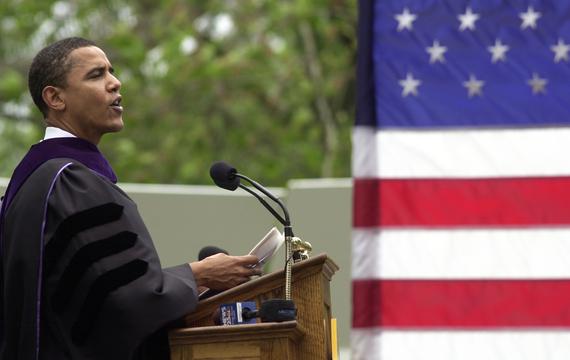
Back on January 23 I noted the continuity of President Obama's Inaugural Address to earlier speeches, in particular his commencement address at Knox College in 2005 (Knox being where I did my four years plus, though in the previous century.)

Now through the Knox alum newsletter I learn of confirmation from President Obama's speechwriter that indeed this Knox address was a major inspiration for the 2013 Inaugural.  Cool.  (Here's another link to the local Galesburg paper which links to an earlier article and includes photos and video of the speech.)

At Knox in 2005 then Senator Obama spoke outside Old Main, a site of a Lincoln-Douglas
 debate, commemorated by that plaque.

Evolution of Mom Dancing


Opening the envelope for Best Picture at the Oscars is one thing--but this First Lady has some serious moves.  P.S. This is what those bangs are made for.

Oscar Night Heist


HOLLYWOOD, CA—Los Angeles police confirmed that Denzel Washington, Naomi Watts, Joaquin Phoenix, and nearly a dozen other top-name actors had gone missing ahead of Sunday’s Academy Awards after following a fake red carpet laid outside the Dolby Theatre that reportedly led into the back of an idling, windowless van. “It appears that the kidnappers were able to use an array of camera flashes, canned fan screaming, and an imposter catty fashion reporter to lure these unsuspecting movie stars right into their grasp,” said police sergeant Mark Morales, noting that Reese Witherspoon, William Hurt, and the entire starring cast of Silver Linings Playbook were seen waving and turning to show their outfits to an assembled corps of fake paparazzi before wandering into the cargo hold of a Ford Econoline vehicle.

Oscar Report from the Onion

Sunday, February 24, 2013

Cry Havoc: How the Iraq War Began


We are weeks away from the 10th anniversary of the Iraq war's beginning.  Books, articles and TV docus have begun, concentrating on the deceptions before the war, and the war's long and terrible extent. 

 On a Sunday almost exactly ten years ago today, the San Francisco Chronicle published my essay on what everyone already knew was the upcoming bombing of Baghdad which would start the war.  It was supposed to be so devastating that the war would be over quickly.  At first it may have seemed that way, and President Bush declared combat operations over.  But of course, it went on for nearly nine more years, at immense cost.

But lost in this history is the horror of the bombing itself, and what it represented beyond introducing the p.r. term of "Shock and Awe."  The piece reflects how it was advertised, and the reality turned out to be even worse.  For weeks some 1700 air sorties including more than 500 using cruise missiles bombed Baghdad, before the first American ground troops arrived.

 I refer also to Shakespeare's Julius Caesar and its line,  "Cry 'Havoc', and let slip the dogs of war."  Once the dogs of war are loose, they are very difficult to rein in.  Once started, the machinery of war is very hard to stop.   The logic of war-including the emotional logic-- is that warfare feeds on itself, and there are plenty of corporate as well as political and ideological interests eager to keep feeding off the continuing warfare.  

The echo of the Iraq war continues to be loud, though now so distorted that it isn't always identifiable.  This war that depleted so much continues to have consequences in what this nation did, and what it did not do.  Those consequences may well continue for a very long time.

And this was a preview of how it began.  Here is the essay as it first appeared in the Insight Section of the San Francisco Chronicle on February 16, 2003.


When Islamic armies were the most powerful in the world, conquerors of Asia Minor and North Africa, and poised at the gates of Europe in the 8th century, Abu Hanifa, founder of a school of law in the city of Baghdad, proposed that the killing, maiming and raping of civilian noncombatants in war be forbidden. It was one of the first attempts to codify some kind of moral and legal restraints on civilized societies engaged in the dangerously uncivilized practice of warfare.

If and when war comes to Iraq, it will likely feature the relentless and perhaps unprecedented bombing of Baghdad. According to CBS News and other sources, the United States is considering implementing a strategy called "Shock and Awe," developed in 1996. The plan could result in at least 300 Tomahawk cruise missiles raining down on Baghdad in just the first day of an aerial campaign - more than were used on all targets in the entire Gulf War. And the plan calls for an equal or greater number on the second day as well, up to 800 total, each capable of carrying 1,000 pounds of explosives. There was no estimate of how many days the bombing would continue.

Although missiles would likely focus on infrastructure including electricity and water supplies, an average of one missile striking a city of 5 million inhabitants every four minutes around the clock could kill and maim thousands of civilians.

"There will not be a safe place in Baghdad," according to an unnamed Pentagon official quoted by CBS. "The sheer size of this has never been seen before, never been contemplated before."

The prospect of war in Iraq is crowded with moral as well as political questions, with multiple possibilities for ethical outrages of stunning proportions. But the continuous bombing of a city of civilians would probably be the first that confronts the watching world.

In A History of Bombing (published by New Press in 2001, and forthcoming this spring in paperback), Sven Lindqvist follows three main threads: the technology and use of aerial bombing in history, the attempts to deal with the moral implications of its use against civilian populations (Abu Hanifa is one example he cites), and social attitudes toward bombing found in sources such as popular fiction.

The historical parallels to the current prospect as well as the ironies are disquieting. The impact of the "shock and awe" strategy is meant to be on hearts and minds: to destroy the enemy's will, and mental and psychological ability to resist. But bombing's ability to terrorize - the sudden explosive death from the sky without warning - was one of the first effects to be observed, noted in 13th century China. It has often been a prime strategy of bombing, according to Lindquist, used extensively by European colonial powers in Africa, India and Asia.

Bombing is especially terrifying when used on the helpless. At first it was shelling from ships far offshore (which is how the United States bombed Nicaragua in 1854), then bombs dropped from airplanes. Bombing was a cost-effective way of keeping subjugated populations in line. Baghdad was a British target more than once in the 1920s.

As airplanes, bombs and cities all got bigger, moralists and diplomats negotiating the international rules of war and definitions of war crimes struggled to keep up. Several prohibitions against air warfare and the bombing of cities were proposed, and some were signed, except by the major powers capable of the bombing. Well into the 20th century, bombing was considered not so bad if the victims were of "inferior races." Some authors wrote glowingly of bombing as a way to civilize the world by permanently subjugating or even wiping out these races.

European bombing gradually got closer and closer to home, until the German military on behalf of Franco tested new kinds of bombs by dropping them on cities in Spain. Japan bombed civilian cities in China. Then in the 1940s, bombing of even the capital cities of combatant nations - Berlin, London, Tokyo - became a normal instrument of warfare, finally leading to the annihilation of the undefended cities of Hamburg and Dresden by British saturation firebombing, and of Hiroshima and much of Nagasaki by the U.S. atomic bomb.

By that time, terror was not the only result of bombing. Fifty thousand civilians were killed in a single night in Hamburg, most of them women, children and elderly. Twice that number died in Dresden. Two atom bombs did fill Japan with shock and awe, and killed several hundred thousand civilians in the process.

There are various strategic arguments for bombing campaigns that dovetail with apparent moral concerns, usually involving shortening a war's duration or substituting for ground assaults, thus saving lives, especially the lives of the side doing the bombing.

When facing the possibility that this war would unleash chemical, biological or nuclear weapons that have been largely absent from warfare for decades due to international taboos of one kind or another, it may seem quixotic to argue that bombing of civilian populations should be regarded as an evil in itself, and beyond the pale for nations that desire any sort of international relations. But it seems morally obtuse that there is a stronger taboo against assassinating a declared enemy's head of a state than against slaughtering babies in their beds. Surely bombing should be a last resort, not the first.

For even if the historical parallels are coincidental and not disturbing echoes of residual racism and empire-building, the bombing of Baghdad to begin this war would have a terrorizing effect on more than its residents. In Shakespeare's time, there was another word for the terror, the shock and awe that accompany a war without moral limits. The word was "havoc," as in the famous quotation from Julius Caesar, "Cry 'Havoc', and let slip the dogs of war."

The bombing and havoc may already be starting by the time you read these words, although according to Los Angeles Times reporter Doyle McManus on the Washington Week in Review, "You can pretty well mark on your calendar March 15. " It's the date formerly known as the Ides of March.

The bombing of Baghdad began on March 19, 2003.