Friday, March 06, 2020

A Thousand Words


This is the first time in more than three years that this face has appeared
on this blog.  But this latest New Yorker cover is just too perfect.

Wednesday, March 04, 2020

The Winner (with Update)

...and still champion

Update 3/6:Elizabeth Warren dropped out of the presidential race on Thursday.  I read several analyzes of her candidacy (including a moving account of what her candidacy meant to women) and future prospects, including speculation on an endorsement (which she has not yet offered), with speculations based on her progressive politics and her gender.  But Senator Warren's first consideration is closer to home: she has to decide whether she wants to be a U.S. Senator.

She is in the Senate now, of course, and now that she's no long running for President she has to decide the level of her commitment to staying there. If she is committed to representing Massachusetts in the Senate, then it seems that she might have some work to do at home.  She came in third in her home state primary.  That suggests she needs to pay her state more attention.  Also, the Democrats of her state just endorsed Joe Biden with their votes.  If she wants to stay in the Senate, she can't disrespect that by endorsing Bernie, at least not yet.  

This is a decision one of her Massachusetts predecessors faced when he failed in his presidential primary bid for the Democratic nomination in 1980.  Senator Ted Kennedy decided on the Senate, and became one of its most distinguished members of his time, and of all time.  I'm not suggesting that this is the commitment Senator Warren ought to make, just that this a consideration she faces.

That's true in different ways for the other ex-candidates from the Senate.  It's especially pertinent for Senator Harris of California.  Several times there have been rumors that she was about to endorse Joe Biden, but she didn't before the CA primary.  Now she has to consider how her state voted, and how long she wants to be in the Senate, and what relationship there is between the two, as well as whether she wants to be a vice-presidential candidate.  Senator Amy Klobachar endorsed Biden just before Super Tuesday, but she too should be thinking about whether she wants to stay in the Senate or accept nomination as the v.p. candidate. Because one of these two is the most likely Biden choice.  Senator Sanders on the other hand must strongly consider Senator Warren.

If Biden is on his way to becoming the nominee, then he also must consider where these Democrats would be most valuable, as the party strives to take the Senate majority so a Democratic President can actually get something passed.

Super Tuesday turned out to be super all right--and a most extraordinary day in politics.  Before the day started, most pundits and analysts allowed that Joe Biden might win a few southern states, but that the day would belong to Bernie Sanders. Instead, Biden won all the southern states (including the big prize of Virginia by 30 points, and North Carolina, both states the Dems hope to get in November), plus two southwestern state (Oklahoma and the big prize of Texas, which pundits gave him no chance to win), plus a Midwestern state (Minnesota) and a couple of northeastern states ( Elizabeth Warren's Massachusetts and the state of Maine, next door to the only northeastern state Bernie won, his home state of Vermont.) Biden ended the day with a delegate lead, and suddenly he is the frontrunner, again, but this time in reality.

Bernie is ahead in the California primary, but nearly half the ballots probably haven't been counted, depending on mail-ins (nobody really knows how many there are.)  At our polling place, Margaret heard that locally there were many more ballots given out than had been returned. But California allows ballots to be mailed as late as election day itself, so it will be a few days before all those will be received, let alone counted.  This could be why the NY Times hasn't called the state for Bernie, though the AP did immediately.  Since people who decided late tended to vote for Biden, those ballots could prove interesting.  Biden won't likely overcome Bernie's lead, but he could increase his share of delegates. In any case, Biden will get a bunch of delegates from California, which will keep him ahead.

The other news out of California is that so far Mike Bloomberg has failed to meet the 15% threshold to get any delegates.  Bloomberg's candidacy was a bust, and now it's over, and he's endorsed Biden.

So what happened?  Biden had spent the least amount of money of any of the candidates and he won in states where he had not campaigned.  Exit polls suggest that a lot of people decided late, after Biden's South Carolina victory on Saturday, and even though the endorsements of Biden by Senator Amy Klobuchar of Minnesota, Mayor Pete and Beto didn't come until Monday, apparently--maybe shockingly--voters noticed.    

It's been clear this past week that the Democratic party establishment and the mainstream media pundits were alarmed by Bernie's electoral prospects (and his negative effect on congressional races) as well as his fitness for the presidency, and perhaps this reflected voters sentiments.

Meanwhile, the stock market has been tanking as the coronavirus spreads and the federal government flounders.  Competence and calm, caring and reassurance look pretty good again.  Democratic voters remember when they had it last, and Joe Biden was in that White House.  The winner of Super Tuesday was Barack Obama.

This is particularly true with black voters, who went overwhelmingly for Biden.  Margaret suggests that black voters particularly resent Trump's reversing Obama policies while he obsessively badmouths Obama without even an absurd pretext. This is an astute observation, for it's been true in the past that while the media may move on to another story, black voters remember.  

They are also very conscious of the racism embedded in the current administration, and realize it will only get worse.  Obama is more than a symbol of that.

A couple of other conclusions are inescapable.  For instance, it turns out that in politics, money isn't absolutely everything after all.  Bloomberg spent almost half a billion dollars, a sum as inconceivable as the paltry number of votes that resulted. On the other hand, his millions will be needed--and will be available--to counter the millions behind the oncoming ugly.

Also, until Super Tuesday, the Democrats seemed to face a Sophie's Choice: if they chose Sanders, a lot of voters would turn away from an avowed democratic socialist.  But if they chose anybody else (except maybe Senator Warren), a lot of Berniecrats wouldn't vote at all.  Either way, they'd risk losing.

But Tuesday's results suggest that Sophie's Choice might not be so fatal if Biden is the nominee, for two reasons.  First, because a lot of Bernie's voters didn't even show up to vote for him, so it's unlikely they'd vote anyway--but more importantly, Bernie's share of the Democratic electorate seems not to have grown since 2016 but diminished.  Second, exit polls showed that the voters' highest priority was picking somebody who could beat Trump, regardless of whether they agreed with that candidate or not.

A side note: There are obvious exceptions, but candidates don't often campaign in the home state of a rival candidate in the same party.  Biden didn't campaign in Senator Klobuchar's Minnesota or Senator Warren's Massachusetts, but Bernie did.  Biden won them both, perhaps the most devastating of Bernie's losses outside of Texas.

All in all, things look very different this week than they did last. Obama may have won but unfortunately he's not on the ballot. Biden is more of an adventure as a candidate and probably as a potential President.  But his particular contrast with Trump suddenly has potency in these sobering times.  His prospects look good at the moment, and Bernie may have hit the wall.  We'll see.  Plenty of spills and chills ahead, unfortunately.  But at least there's hope.

Monday, March 02, 2020

Poetry Monday: Coyote's Tail Tale


Coyote Learns To Whistle

Coyote tied Weasel's tail in a KNOT,
And when Weasel found that tail, she
     knew who did
     THAT.

But she says NOTHING.
She WHISTLED.
And Coyote came over to see what all that
WHISTLING
  was about.

Your TAIL is tied in a knot
Coyote says this to Weasel.

Yes, says Weasel.  It helps me to
    WHISTLE.

Well, says Coyote, I can see that
     It does.
And he tied his tail in a knot
  and BLEW air out of his mouth.

But it SOUNDED like a fart.

You got to pull that KNOT tighter
    says Weasel.
So Coyote did that and tried again.

JUST farting.

Pull it tighter, says Weasel.
so, Coyote thanked Weasel, gave her some
    tobacco for the ADVICE
   and pulled the knot so tight that HIS
   tail BROKE and fell off.

Elwood told that STORY to the Rotary Club
   in town
   and everybody laughed and says what
    a STUPID Coyote.

And that's the problem, you know,
    seeing the DIFFERENCE between stupidity
    and greed.

Thomas King

As far as I know, this poem is not in the particular Thomas King book that has the illustration at the top of this post as its cover.  I found this poem in Native Writers Canadian Writing ( University of British Columbia Press 1992), edited by W.H. New.

Sunday, March 01, 2020

This Moment

What is there to say at just this moment about the ongoing and interlocking dramas of the day, which we could label simply as "coronavirus" and "the 2020 election", although they are hardly that simple?  The answer for me is not really very much.  Most has already been said, and is being said in the journals of the day.  For example, I've been writing about the prospect of pandemics especially as an effect of climate disruption, about the importance of public health readiness etc. for at least ten years in this space alone.  Now it is or isn't playing out in the real world.

That's in fact what I think is particular about this moment: we see and sense the fateful possibilities that are only beginning to emerge and form and play out.  We'll know more about the virus tomorrow and next week and next month.  We'll know more about the election on Wednesday (after the Super Tuesday voting) but we really won't know anything until we know the final election outcome of November.  What we will be watching, along with the separate consequences of these two dramas, is how they will (or won't) begin to interact and change each other.

Then there are the separate questions about our personal actions in response to these dramas: preparedness and attitudes to the one, and political activity in the other.  But I doubt I have anything to add to what's being said about those either.  So basically I'm heeding Wittgenstein's advice, "Whereof one cannot speak, thereof one must be silent."  And I guess I've said all that in order to say, I'm not ignoring it all, at all.  I just don't have anything to add at this moment.

Thursday, February 27, 2020

The Times Spelling Bee Spell

The New York Times "Spelling Bee" puzzle has a number of advantages for me.  First of all it's something to distract me from the news, but because it is in the daily Times, it scratches the itch of checking the newspaper every day.

It's a word game, but not a crossword.  Crosswords drive me crazy for a number of reasons, but mostly because I am compelled to finish them, and will spend hours looking stuff up and so on.  And then there are the particular crossword gimmicks, which I loathe. The Times daily crossword is impossible for me, the daily Mini crossword is sort of silly, but Margaret and I together like to do the monthly thematic crossword, which is somewhere between these two.  She has crossword skills I don't.

The Spelling Bee on the other hand is in my particular wheelhouse of the actual words, their shapes and sounds, which are related to--if not entirely described by--their spelling.

The puzzle is simple.  Seven letters are clustered--six in a circle around the center letter.  The task is to make as many words as possible using any combination of those letters, but always including the letter in the center.  The puzzles never incorporate the letter "s."  I suppose that's because of the multiplication possibilities inherent in plurals.

The words are matched against a list, so you're instantly told if you got one.  In addition, there is at least one word in each puzzle that uses all seven letters, called a Pangram.  The accepted words have a point value, and your points take you through ascending levels, from Beginner to Genius.

I was introduced to the puzzle when Margaret got an Ipad, with a Times subscription for it.  After a few training sessions, I went on a still unbroken series of reaching Genius level and getting the Pangram, every day for at least 100 days in a row now.

Like most of my obsessions, doing the Spelling Bee acquired its own rituals--a certain time and place, a plate of almonds and a glass or cup of something, certain music on low volume, Mozart trios or a double CD called American String Quartets, etc. or the radio on the station that plays swing music.

I soon learned that this puzzle, like all others I've encountered, has its own quirks and techniques.  The puzzle-makers say they try to select fairly common words, with a more technical word or two in each puzzle.  It doesn't take long to see that certain words repeat, pretty often, and not necessarily words that are used everyday.  There are also "trick" words that nobody uses.  I make it a point of honor to get to Genius level without stooping to those. (Except accidentally, when I'm desperately combining letters almost randomly.)  They also allow a lot of questionable slang and spelling, but though I mutter, I go along with that.

I am also annoyed when interesting words aren't on their list, like "neoteny" and "trinitarian." Some absent words are especially puzzling, like "lenten," a word that comes up around now.  Besides some (but not all) technical terms, I've noticed that there are certain categories of words that don't make the cut.  Most words with any sort of ethnic meaning or connotation, for instance. Most cursewords are out, as expected. Proper names of people and places are not allowed, with a few apparent exceptions, like "Manhattan" (perhaps because it's also a drink, or just because, well, it's the New York Times) and-- "Iliad," which I can't figure out.  On the plus side, I've noticed that there is usually at least one word that has something to do with music, like aria, and it always pays to look for variations on mother and father, aunt and uncle etc.

Sometimes getting to Genius means making 20 words or fewer, and other times it takes 60 or more, depending of course on the letters. Sometimes the words are compounds of two other words.  That's part of the problem of the Pangram--is it a single word, or a combination of some word you've found with another word lurking in those letters that doesn't include the required center letter?

 There's no predicting the Pangrams--on one puzzle this past week I got the Pangram with my first word (and getting it early usually makes for a more relaxing game.)  Sometimes there's more than one--I recall three, and once there might have been four.

But also this week, getting it was very, very frustrating two days in a row, and in both cases, the Pangram words sucked.  One was "contently" which is a word I can't recall ever seeing used ("contentedly" is common) and isn't in the dictionary. Today's is "chargrill," which doesn't even seem like a word to me.  Apparently it's an expensive sort of outdoor grill (anywhere from $150 to more than $2,000), which I suppose illuminates the difference between me and the usual Times subscriber.

But I've also noticed that I'm starting to lose interest in completing the puzzles.  I like the game of making interesting words, not trick words or the same words.  I love pulling words out of my subconscious, even (or especially) when I don't recall what they mean.  Sometimes a word pops up that I don't recall using since grade school.

When you hit Genius, you are rewarded with a big pop-up on the screen, told you've reached the highest level and asked if you want to continue.  Unless I've already thought of another word, or haven't gotten the Pangram (it's possible to get to Genius without doing so) I usually stop.  I've gotten to Genius (and gotten the Pangram) in as little time as 20 minutes, with an average of about 40 minutes.  But other puzzles have gone on for hours--including hours after they've stopped being fun, when it's pretty likely that I've found all the interesting words.

So if I continue I might take a different approach, and just quit when I feel like it.  However, I'm vain enough to want to write this while I'm still undefeated.

I've also started to become aware of this as a social media interactive sort of thing, which is not something I participate in.  But it makes sense--after all, the "bee" in Spelling Bee has to do with people getting together for an activity, like a quilting bee.  (The origin of the term is American but otherwise uncertain.  The explanation that makes the most sense is that "bee" is a shortened form of a certain use of the word "been" or "bean" from England, where it referred to neighbors getting together to voluntarily help someone with a particular task.)  So my very private playing is probably out of keeping with the whole idea.

Monday, February 24, 2020

Poetry Monday: Fixers


Fixers

On back roads you can find people
who keep machinery alive.  With a file,
a wrench, a hammer, they scrape, twist
and pound until the old tractor wakes up
or the plough bites again into the ground.

I've bullied rusted iron and made it
remember what to do, and once on a back road
I put out a fire under the hood of a car;
but these greasy geniuses have to conjure
miracles day after day just to keep going.

Often their audience is a customer eager to
get started again, or maybe their little daughter
watching how Daddy fixes things.  And sometimes
only an old dog--wise in the ways of when to jump aside--
studies mechanics and barks when The Master says,

"There!"

William Stafford


The photos are of Mike K.'s tractor, which had been his father's.  Top picture is the "before" (which I took) and the bottom is after some repairs but mostly a custom paint job.  I wasn't there for that unveiling. The man on the left is the guy who did it, with Mike in the middle, and his friend who helped him haul the tractor to and from this road in a very small farming community in central PA.  Click on the photos to see them properly.

Saturday, February 22, 2020

Let George Say It

"At this auspicious period, the United States came into existence as a Nation, and if their Citizens should not be completely free and happy, the fault will be entirely their own."


George Washington
born Feb. 22, 1734

Wednesday, February 19, 2020

Soul of the Future: The Creature Among Us--and Within Us

There were many different expressions of atomic anxiety in popular films (ignored by serious people, of course) in the 1950s and 60s.  In addition to the atomic monster films like Gojira and Them!, there were notable creature features in the 1950s that had nothing directly to do with atomic bombs, yet involved related issues.

The best of these were The Creature From the Black Lagoon and its two sequels, released in a row in the mid- 1950s.  As a concept, these films had an intriguing pedigree. William Alland was an actor in Orson Welles' Mercury Theatre company in the late 1930s and early 40s. He participated in the famous radio "panic broadcast” of H.G. Wells War of the Worlds and had a part in Citizen Kane as the reporter who narrates the tale, but whose face is never clearly seen.

Alland was a guest at a small dinner party hosted by Orson Welles, perhaps during the making of Kane.  Other guests were actor Delores Del Rio (Welles' girlfriend at the time) and Gabriel Figueroa, a Mexican cinematographer already embarked on a distinguished career: he shot Luis Bunuel's Mexican films and won an Oscar for the Hollywood film of Tennessee Williams' play Night of the Iguana.

Gabriel Figueroa
During the party Figueroa told what he said was a true story about a half-man, half-fish who lived outside a village in the Amazon. The creature left the villagers alone except for once a year, when he took one of the village maidens. When others laughed at him, Figueroa became indignant, claiming he’d even seen a photograph.

A decade or so later Alland was a producer for Universal Pictures, which made an earlier generation of monsters and monster movies like Frankenstein, Dracula and the Mummy.  After commissioning Ray Bradbury to write a treatment for what became the 1953 movie It Came From Outer Space, Alland worked on his own film story based on the tale he'd heard at that dinner.

The tale Alland heard--of a monster that accepts the annual sacrifice of a young woman --is similar to much older tales as well as the Gojira legend and the gold standard in monster movies, King Kong.  In his story notes, Alland pretty much copied the plot of King Kong (an unknown and age-old monster in an isolated place with an attraction to a human woman is captured by a showman and displayed in the US, until he escapes, kidnaps the woman and is killed.)  Alland transposed the location from a jungle to underwater, and the creature from a giant ape to the half-man, half-fish eventually called "the gill-man."

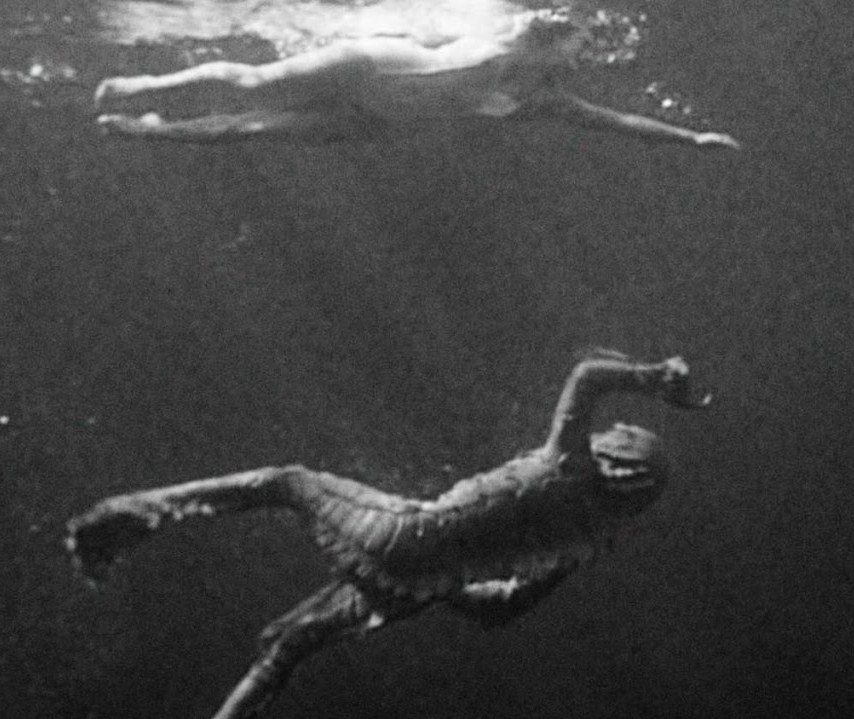
The concept was a cinematic natural.  Expensive effects weren't necessary: the creature could be played by a man in a costume. Plus the water environment meant that the female attraction could legitimately be shown, early and often, in a bathing suit.

 Universal picked the young actress under contract with the best legs (Julie Adams), and Alland hired the lead actor (Richard Carlson), writer (Harry Essex) and the director (Jack Arnold) from It Came From Outer Space. The studio set about creating a spectacle to further exploit their latest gimmick--3-D--to best advantage, in the film eventually called Creature From the Black Lagoon.

But once the writers (Essex and Arthur Ross) and particularly director Jack Arnold got the story ready to film, it went beyond the King Kong themes (with its often referenced but superficial resemblance to the Beauty and the Beast story) to express various 1950s anxieties related to the Bomb, including profoundly mixed attitudes towards science and scientists in relation to society and the natural world.  The two sequels expanded on some of these themes.

The opening of Creature From the Black Lagoon sets the premise with admirable efficiency.  The brief prologue, not uncommon in 1950s science fiction films, also suggests how generally accepted Darwinian evolution was, even among established religions.  It begins with Genesis, the imagery of a newly forming planet and the words: "In the beginning God created heaven and Earth, and the Earth was without form and void."  To the appropriate imagery the narration continued: the planet cools, the oceans form, "living things appear" in great variety, and move from water to land.  "The record of life is written on the land, where 15 million years later, in the upper regions of the Amazon, man is still trying to read it."

We see a geologist ( Dr. Maia, played by Antonio Moreno) unearthing a fossil hand with webbing between the fingers.  As he goes off to get it identified, we see the same hand emerge from nearby water and scratch at the land.  The creature and his lineage are revealed in a few minutes of film.

Visiting scientists to a South American Institute cannot identify the fossil, and decide to form an expedition to search for the rest of the fossil body.  They are main characters Dr. David Reed (played by Richard Carlson), Dr. Mark Williams (Richard Denning) and Dr. Kay Lawrence (Julie Adams), plus Dr. Maia and Dr. Thompson (Whit Bissell.)  They recognize that this fossil could represent a "missing link" between water and land creatures, perhaps even a water-breathing humanoid, a gill-man.

The conflict that builds throughout the movie is between Carlson's character, whose interest is knowledge and research, and Denning's, who is after fame and money to support the institute he runs, and that the others work for.  In addition, Carlson's is involved with Julie Adams', even though Denning's met her first, adding to the tension.

Richard Carlson, Julie Adams, Richard Denning, Whit Bissell
Before they leave, Carlson adds an odd rationale.  They should study past adaptations, he says, because it may help humans adapt to other planets when they travel in outer space.  Learning how evolution works on Earth, "with that knowledge perhaps we can teach men how to adapt to some new world of the future."

It's a fairly nonsensical reason, but worth mentioning because outer space comes up again in the movie and the series, and it may suggest a kind of apocalyptic feeling about the fate of the Earth that becomes explicit in the final gill-man movie.

They travel by boat to the site where Dr. Maia found the fossil hand, and find that the two South American assistants he left behind have been murdered.  The boat captain suggests a jaguar attack because of the claw marks, but we in the audience know better.  We saw the gill-man's hand (and only his hand) do the deed, to the accompaniment of monster music, particularly the brief theme that is repeated literally more than a hundred times during the film.

Disappointed when they can't find more of the fossil, the group travels down the river to the Black Lagoon, where the current may have deposited further evidence.  As they prepare to test the age of rocks on the riverbed to match with the rocks at the site, we in the audience start seeing the gill-man underwater, watching them.  Then Carlson and Denning both catch a glimpse of him.

While the men are busy with their tests, Dr. Kay Lawrence decides to take a swim, setting up the most famous scenes in the movie.  While she swims on the surface, the gill-man is following her below, to the extent of mimicking her movements directly under her in a pas de deux simultaneously suspenseful, balletic and erotic.

The gill-man even touches her foot, but retreats quickly into hiding.  She makes it back to the boat safely.  So far the gill-man hasn't harmed anyone in the expedition.  Carlson and Denning decide to dive again--Carlson wants to take a photograph of the gill-man, but Denning is armed with a spear-gun.  "Why settle for a photo when we can get the real thing?"

Denning shoots a spear into the gill-man's back, setting up the back-and-forth violence of the rest of the film.  Eventually the gill-man kills him, and--weakened by drugs--tries to make off with Julie Adams (a rare case of this perennial poster image actually reflecting a scene in the movie.)  Carlson rescues her, and passes on the chance to finish off the gill-man, who floats away, perhaps dead, perhaps not.

Julie Adams in publicity shot that surprisingly reflects an actual scene in the film
Creature From the Black Lagoon did well at the box office, and two sequels quickly followed.   This first film set up themes underlying the creature feature spectacle that were augmented in the next two. Though the atomic bomb was never directly mentioned, and the Bomb had nothing to do with the monster itself, the movies nevertheless expressed related anxieties and themes.

In particular, all three spoke to the new dominance of science, and the public unease with science and scientists partly if not mostly due to the scientific fruit of the Bomb.  This relates to the sense of the Bomb as unnatural, and (as expressed in the advertising for The Beast From 20,000 Fathoms) an intrusion into forbidden knowledge that tempted retribution. The films also suggest complex human feelings about killing animals, and more generally about destroying life in the natural world. The Bomb's massive power to destroy indiscriminately added to this anxiety.

In addition, this film deliberately dealt with an emerging theme of the 1950s related to the new fact of nuclear weapons.  Enemies in war of any kind may tend to demonize each other, and this became prevalent in the Cold War as well.  Aided by Soviet isolation and control of information, Russians became contradictory stick figures--either primitive peasants deprived of cavity-fighting toothpaste, or mysterious supermen with unknown weapons and powers.  In particular they were possessed of an alien ideology called Communism, that was like an infection within the body politic.  They were the ultimate Other.

The first Other to humans were the animals, both like and unlike people, both beneficial and dangerous.

Though the scientists largely treated him as a wild animal, the gill-man was deliberately portrayed as close to human, with differences that made him fascinating to some, and threatening to others.  Director Jack Arnold confirmed in interviews that he intended to make this point:  Man's inhumanity to man extends to anything that's different.  "We have not progressed as human beings to differentiate between what is superficial [difference] and what is not.  Of course, the sooner we learn the lesson, the better off we will be."

As had happened before (and would again), he used a science fiction story to dramatize a social problem, because (he said) audiences wouldn't accept a polemic, and they'd walk out of the movie.  Or, he added, it would be investigated by the House Un-American Activities Committee.

This last reference was not really a joke.  HUAC was actively investigating directors, writers and actors for crimes like supporting civil rights organizations or being "prematurely anti-Fascist."  The Hollywood Blacklist that banned people and ended careers because of the slightest suspicion was a fact of life in 1954.  It got much of its dark power from the reflexive fear of anyone who might be aiding enemies that could rain down nuclear bombs.

The creature was different, but not so very different.  Identifying with the monster had been part of the monster movie tradition.  It certainly extended to the gill-man, at least to the eight and nine year-olds in the audience like me and my friends.  I felt the revulsion towards creepy animals and the desire to dominate them that seemed part of Denning's motives.  But I recognized the commonality as well as the fascinating Otherness, and felt the empathy that Carlson's character expressed.  His words went into my developing ethical consciousness.


Revenge of the Creature, which essentially told the second half of Alland's King Kong story, was also shot in 3-D, but even though it was a striking effect when properly projected, problems for local theaters in exhibiting 3-D led to its demise, and Universal quickly distributed conventional prints. (I can personally attest to this.  I saw Revenge in 3-D as a nine year old, wearing the flimsy cardboard glasses provided at the door.  But the process required precise projection, and at my movie theater--as apparently at countless others--the projectionist wasn't up to it.  I would catch the 3-D effect once in awhile, but mostly it was distorted and annoying.)

Released in 1955, Revenge of the Creature was also directed by Jack Arnold, whose genre work in the 50s produced several of the decade's characteristic classics.  His chief contribution to this one was pushing the inhumanity towards the Other theme even further, while further exploring the suspicious paradoxes of science and scientists.

Lori Nelson and the Creature
The basic story follows the King Kong template of capturing the Creature and putting him on exhibition.  But the difference is that he is pursued and captured by scientists (a different group from the first film), and held in a Florida oceanarium where tourists can gawk at him between dolphin shows, but also where an animal psychologist (played by John Agar) studies him, using questionable methods.

Agar tries to "train" the gill-man by shocking him with a kind of cattle prod to get him to obey commands, through the latest psychology of "negative conditioning."  Even by 1950s standards of how animals were treated, this was a shocking procedure to watch.  Since in fact it probably wasn't technically possible to cause an electrical shock underwater without harming unprotected humans, these scenes went a long way to make a point.

Otherwise there's not much new in this sequel--another love triangle, another pas de deux in the water by the Creature and the Girl (played by Lori Nelson), an absurd pursuit and attempted kidnap, and a final confrontation.  There's some added excitement when the Creature rampages through the tourists and tosses a few cars out of his way.  Once again, the Creature is left floating on the water at the end--the exact same shot as ended the first movie, all too apparent to those of us who saw this movie (again) at a double feature with the first.


The third and final gill-man movie was The Creature Walks Among Us, released in 1956.  Visually it's the dregs of the series but the paradox of science theme is at the center of the story.  Arnold didn't direct, but the co-writer of the first film, Arthur Ross (who went on to write a lot of television, and the 1980 Robert Redford feature Brubaker), wrote this thoughtful if not particularly artful screenplay.  

This film returns to the antagonism between two scientists being about more than rivalry for a female's attention.  Rex Reason plays a geneticist who wants to capture the Creature to "study it under controlled conditions."  But the surgeon played by Jeff Morrow wants to operate on the Creature to create a new human species (Reason and Morrow were fresh from making the 1955 sci-fi classic, This Island Earth, part of which was directed by Jack Arnold.)

Morrow's reasons are somewhat bizarre, but again (as in the first movie) relate to the future of human space travel.  "I've seen the imperfections of the human body," the surgeon says.  "Modern man is limited, earthbound to the planet which he devours and eventually which will fail to support him.  Yet he's bound to it because he's physically incapable of taking the next giant step...into outer space.  Well, we can make him physically capable."

"I disagree," the Reason geneticist says.  "We can learn from Nature, help Nature.  We can make this Earth a happier place by helping Nature select what is best in us.  And when man's ready, mentally, physically, he'll get to outer space.  But Doctor, there's no shortcut.  You can't bypass Nature."

Jeff Morrow (far left), Rex Reason (far right)
If not yet apparent, Morrow is eventually revealed to be mentally unbalanced, which edges this film into another popular sub-genre, the Mad Scientist movie. With this sequel, the gill-man series leaves King Kong behind, and enters Frankenstein/ The Island of Doctor Moreau territory.

Their disagreement is made moot by an accident during their capture of the Creature, when the gill-man is severely burned and must undergo surgery.  Under his fish-like skin is human-like skin, and while the burns have disabled his gills, it turns out he has lungs to breathe out of the water.

Morrow's Doctor exults: he believes they've created a new species by altering the Creature's metabolism.  Reason again disagrees.  "We only changed the skin, not the animal.  But we can bring out the best or worst in any living thing.  Environment does that.  If we threaten him, if he's afraid of us, he'll revert to the wanton killer.  That's why I've gone along with you-- I want to know for myself.  Because we all stand between the jungle and the stars, at a crossroads.  I think we better discover what brings out the best in humankind, and what brings out the worst.  Because it's the stars or the jungle."

This is a reasonably profound view through an evolutionary lens of the conundrum felt in the apocalyptic 50s, chiefly because of the Bomb.  Humanity was at a crossroads (and Crossroads happened to be the codename for the first postwar series of atomic tests, held for several days in 1946  that included the day I was born.)   The future was either going to have to be utopia or apocalypse, the stars or the jungle, with no third choice.

This movie headed directly for the jungle, as human violence enraged the now Frankenstein human-looking Creature, who escapes, heading for the nearby ocean. He has no place in the human world, but he can no longer return to the water.  He is left on the shore, staring at the sea.

As a coda to to the film, Reason repeats his analogy. Morrow's surgeon, insanely jealous of his blonde wife,  had killed an imagined rival, then tried to blame the Creature, and the enraged Creature killed him. "We're not so far from the jungle after all," another scientist comments.  "We're not so far from the stars either," Reason's scientist answers.  "The way we go depends on what we're willing to understand about ourselves."

"And what we're willing to admit," adds the Mad Scientist's wife.

 It is, in a sense, the creature within us that we need to recognize.  But not just the negative effects of the animal within (or even the human aspects of the unconscious) which we can act against only if we recognize them, but the positive animal (and unconscious) qualities that evoke our recognition and empathy, and love.  Perhaps this can help us act with compassion as well for the other animals outside us, including the human.

Monday, February 17, 2020

Poetry Monday: House Made of Dawn

In the house made of dawn,
in the house made of the evening twilight,
in the house made of dark cloud,
happily may he walk.
In beauty may he walk,
with beauty above him, he walks
with beauty all around him, he walks
with beauty it is finished,
with beauty it is finished.

From The Blessing Way
of the Navajo

"It had been Nashibitti who had taught Leaphorn the words and legends of the Blessing Way...taught him the lessons of the Changing Woman--that the only goal for man was beauty, and that beauty was found only in harmony, and that this harmony of nature was a matter of dazzling complexity...And thus one learned, gradually and methodically, if one was lucky, to always 'go in beauty,' to always look for the pattern, and to find it."
Tony Hillerman
Dance Hall of the Dead.  The Blessing Way lines are from his novel, The Blessing Way.  Illustration adapted from sand paintings associated with The Blessing Way.

Saturday, February 15, 2020

Many Things They Do


I can tell from all your cards and letters that you are wondering whether the Wonders' great song "That Thing You Do" has been performed by any other musicians, even an actual musical group.  And yes it has!  It was most famously performed (with slightly different lyrics appropriate to the occasion) by the A cappella group Pentatonix to honor Tom Hanks at his Kennedy Center Honors in 2014.  It's especially nice for the reaction shots of Hanks' sons, singing along in the audience.

The Wonders were a fictional band, created for the movie.  But the actors who played the band all learned their instruments so they could credibly look like they are playing.  Tom Everett Scott in particular learned to play drums quite well, but all the others could play at least the title song.  When they went on publicity tours overseas, they also went on concert tours: they became an actual band, if only briefly.

Similarly, the label in the film that released their record, that the Tom Hanks character works for, was the fictitious Playtone.  Playtone subsequently became Hanks' real TV and movie production company (Play/Tone) which has won 52 Emmys so far, and produced several of Hanks movies like Cast Away as well as Polar Express, Mamma Mia! and Mark Felt: The Man Who Brought Down the White House.

The actors who played the Wonders remained friends (Steve Zahn, who played the lead guitarist, was the best man for Tom Everett Scott's wedding) and several members "reunited" a few years ago to perform the song in LA on the film's 20th anniversary.  As mentioned before, Charlize Theron (with a relatively small part in her second movie) presented what was essentially a lifetime achievement award to Tom Hanks at this year's Golden Globes.  They were both nominated for top acting awards in this year's Oscars, and though neither won, they sat together in the audience and made news by leading the chants to turn the lights back on for the speech by the producer for the surprise best picture winner Parasite.

The Wonders on record were studio musicians with Mike Viola singing lead and the song's writer, Adam Schlesinger of Fountains of Wayne, singing backup.  The two co-produced the track.  In the movie, the song reaches #2 on the Billboard charts in 1964.  In what is otherwise known as the real world, the song was released on the Playtone Label by Epic, peaking at 41 on Billboard's Hot 100 in 1996 (the year of the movie's release), and scoring in the top twenty on adult contemporary charts.

Among the mostly live performance videos of the song on YouTube are several featuring singer Mike Viola, including this tasty acoustic version with an audience that knew just how to clap and sing along, as well as with various bands including Adam Schlesinger and Fountains of Wayne.  Unfortunately, the audio isn't great.  The audio is much better for another Viola and Schlesinger performance.  Once again, the audience provides the hand-claps.

Johnathon Schaech, who played the lead singer in the movie, has sung the song live here and there, including with Curtis Peoples and with some LA rockers.

 Some amateur ensembles have posted on YouTube, as well as (among others) bands called The Bloomfelds ,  Old Chevy and  Bubbles.  A Japanese band apparently, Shakabitts does a wild version. There are other A capella and acoustic versions, a piano ballad version, guitar only, drum only, etc.  There's even one featuring oboe, cello and violin that's worth sharing:


And of course, there's a "That Thing You Do" karaoke! A lot of people like this song!  There's even a performance  by actual pop stars, Nsnych, playing it in concert, pretty much a note for note cover but with great vocals and energy.  Ironically if appropriately, it was featured in their 60s tribute.


 Still, for me, the Wonders movie version is the best.

The movie's conceit is that the band intended this song to be a ballad, until their new drummer spontaneously gave it a beat during its first performance, and the rest is history.  Actually to my ear, this song structurally resembles "Smoke Gets In Your Eyes," which was a 1959 hit as a ballad by the Platters.

Thursday, February 13, 2020

Another Step Towards the Treich

I was going to begin by saying it's not every day that two absolute essentials of our democracy are simultaneously attacked by the Apprentice Dictator, but then this is 2020, and it does seem to happen every day.  However, recent events surrounding the Roger Stone case present a particular challenge to these essentials: the integrity of the law, and the integrity of elections.

Both may be relative even in the best of times.  But in these dark times, they are being attacked openly by the chief executive of the country and the Justice Department itself in a way that is without precedent in American history.

The relevant context is this: if you are going to create a lasting dictatorship, an autocracy (to use the fancier name), you must above all destroy the impartial rule of law.  That's what's going on at the moment in the Stone case, where four career prosecutors who tried the case have resigned in protest against AG Barr's attempt at the behest of Homegrown Hitler to reduce the sentence the prosecution is recommending, on behalf of the United States.

That's a direct challenge to the impartiality of the law and clear interference by the chief executive to retain his office and his power.  And it may well be just the beginning.

But it's also worth recalling, in the blizzard of these names, what the Stone case was about.  To quote from the original sentencing memo (via Lawfare):

"Investigations into election interference concern our national security, the integrity of our democratic processes, and the enforcement of our nation’s criminal laws …. It is against this backdrop that Stone’s crimes—his obstruction, lies, and witness tampering—must be judged. Stone knew the gravity of the House Intelligence Committee’s investigation when he obstructed it by giving false testimony and tampering with a witness. Indeed, Stone acknowledged as much in his opening statement before the Committee. Stone chose—consciously, repeatedly, and flagrantly—to obstruct and interfere with the search for the truth on an issue of vital importance to all Americans."


Stone's crimes are related to inquiry into interference of the 2016 elections, particularly by Russia.  There has been a war going on between professional, career Justice Department officials and lawyers, as well as professional, career FBI and other agency investigators, and (on the other side) Trump and his political appointees and cronies.  This was a major battle in that war, and the numbers and status of career officials defending the integrity of the law have taken a major hit.

And while it was going on, this regime was openly conducting another purge of insufficiently loyal government officials--people who are supposed to be public servants, but keep their jobs only if they are Homegrown Hitler servants.

We know that the integrity of the 2020 elections is threatened, and this regime has a vested interest in doing nothing about it.  Now it is doing more than nothing, and doing it openly.  So far without consequence.

Now there's been added a major threat to the impartial rule of law.  This is not only essential to our republic but to the entire world, including to the institutions and practice of capitalism--no matter how ironic that sounds.  Everything in the civilized world depends on the presumption of the rule of law.  Otherwise, everything becomes a matter of force and violence.

Governing by force and violence is the next step in solidifying a fascist dictatorship.  But first the conditions for imposing it must be accomplished: the disorder that follows the breakdown in the rule of law.  So many elements of our political culture seem headed in that direction.  This is another very big warning sign, as well as in itself a potential disaster.

Wednesday, February 12, 2020

Now It Begins...

Does what happened in New Hampshire stay in New Hampshire?  That's the big question, and the big mystery, in the Democratic presidential nomination process.

With Iowa a travesty, New Hampshire was the first real contest, but it is in many ways an artificial one.  The next two contests--the Nevada caucuses and the South Carolina primary will tell us more, because those states are not so dominated by white voters.  Any Democrat will need substantial Latino votes and overwhelming African American votes in order to prevail in the general election.

In New Hampshire the first three candidates were very close: Bernie Sanders, Pete B. and Amy Klobuchar.  The two previous frontrunners, Joe Biden and Elizabeth Warren, were way behind.

Sanders won, which positions him pretty well.  But he didn't do as well in New Hampshire or (as far as we know) in Iowa as he did in 2016, and certainly has not emerged with overwhelming support.  Consider that even with the unexpected collapse of Elizabeth Warren--next to Bernie, probably the best known of the candidates in New Hampshire, since much of the state is served by Massachusetts media--Sanders did not noticeably profit.  Either their reputation as the leftist twins is more in the mind of the media and party pros than the voters, or Bernie hasn't gained support from last time.

Even though he came in a close second (and perhaps a close first in Iowa), I am still resisting learning how to spell Pete B.'s name because I find it hard to believe he will last.  Of all the candidates he appears to be the least tested outside a mostly white electorate.

Then there's the surprise surge of Amy.  It could well be that New Hampshire's particulars won't be replicated elsewhere: she had a lot of time and staff in the state, and the major newspaper endorsements in a state that still pays attention to them.  And her performance in the debate just days before gave her local as well as national buzz.

But Amy does have a path to the nomination.  Mostly this is because she has faced a variety of voters before, though not as non-white as upcoming states.  She has to do well in Nevada and South Carolina to remain viable.  If moderate progressives fixate on her in those states, and if Biden loses his advantage with black voters in South Carolina, it could lead to Biden and Warren dropping out.  If that happened, it would not surprise me if both endorsed Klobuchar.

If she can continue to build momentum, Amy has the makings of a consensus candidate with party professionals.  She definitely is the one to watch in these upcoming contests.  She will need a lot of momentum to go up against candidates in Super Tuesday contests less than a month away (on March 3) with huge advantages in money and staff.  Otherwise this process probably continues into chaos, with a Bernie v. Bloomberg clash even at the convention. Which is really living dangerously.

I'm not entirely unhappy with this field.  There's no Obama, but there seldom is.  But Bernie isn't wrong about most things--he's certainly right about the greed of the health insurers and pharma, and that health care should not be for profit.  It's his followers I worry most about.  They tend to be so doctrinaire that they may not vote for anybody but Bernie.  I'm not crazy about Bloomberg, but when he says Trump can't bully him, it's reassuring.  He has the money to compete against the Trump's highly funded disinformation apparatus, and he's committed to applying it even if he isn't the nominee.

The New Hampshire primary was open to anyone who wanted to temporarily be a Democrat to vote in it, and the turn out was excellent.  What nobody knows yet is how strong the feeling in the country is that America can't afford any more of Homegrown Hitler, in any way.  It may not always seem to be, but it might be considerable.

Monday, February 10, 2020

Poetry Monday: One Night

by Rene Magritte

One Night

A voice within my shadow wakened me,
a glowing voice: "I love the dark
too much--I cannot sleep."  And there came
for me again one long away,
her face as it shone in candlelight.

That voice was always kind; it helped
me now to rest, in its long shadow:
"So much we loved the dark," it said,
"that all these years apart I have been
here, like this, hidden in your shade."

William Stafford

Mystery Solved

For generations, Americans have wondered how the people of Germany could have elected Adolf Hitler and especially, how they could continue to support him. They wondered how they could live with themselves for Hitler's treatment of the Jews, including the concentration camps.

Well, that mystery has been solved.  America elected a psychotic white supremacist, and according to the professionals, could re-elect this Homegrown Hitler in November, despite everything they know: the transparent lies, the hourly corruption and daily destruction of everything the US has said it stood for.

They've found it in their hearts to utterly ignore America's concentration camps, where the breaking up of families, the rapes and other abuses have continued and grown larger and worse.

The policies of sending people who apply for political asylum back to the countries they escaped because of violence and oppression have resulted in  hundreds of these applicants being imprisoned or killed upon their return--including at least 138 murdered in El Salvador.

Other applicants have been sent to dangerous Mexican border towns--some 60,000 non-Mexicans in just the past year, including 1600 children.  Hundreds of women and children have also been shipped to Guatamala.

Yet when Homemade Hitler's administration announced rules late this summer that would essentially legalize concentration camps for undocumented immigrant families, it was not a shiny enough object to capture public attention, let alone hold it for more than an Internet minute.

The rule change was pretty much of an afterthought anyway because the concentration camps have existed for years, despite a brief public outcry.  In many cases they are for-profit concentration camps, which not even Hitler was able to imagine.

Trump famously said that even if he shot someone dead on Fifth Avenue he would get away with it.  Would that include death camps?

Friday, February 07, 2020

The Wonders Make It--And Break It


That tune you never get tired of--well, I never get tired of it. In That Thing You Do, the Wonders reach the top with an appearance on a mythical West Coast version of the Ed Sullivan Show--a coast-to-coast network showcase.  The TV studio camera direction scenes are an obvious homage to A Hard Day's Night (and not the first time that film is suggested.)  The "careful girls-- he's engaged" super mirrors the "he's married" under John Lennon's name on the Sullivan show, although in this case it's not quite true.

Also intercut are scenes of Shades' (the drummer, whose story this mostly is) family watching back in Erie: his previously dismissive father and hostile sister and passively accepting mother, plus the guy he replaced as drummer who still wears a cast on his broken arm.  They are (finally) wild with excitement,  Because: he's on TV!

This turns out to be not only the high point for the Wonders but the beginning of a quick end.  Already their bass player has disappeared (off with Marine buddies at Disneyland) and is replaced for this show by a studio musician.  By the end of the day, the band has completely dissolved, and all the romances end.  But of course, another one--the one that we all know shouldn't have happened in the first place--begins.  And they all lived happily ever after, more or less.

Wednesday, February 05, 2020

Here's My Candidate

"He shredded the truth so I shredded the speech."
Nancy Pelosi


Monday, February 03, 2020

Poetry Monday: Giraffe Headquarters


Giraffe Headquarters

Try this, but only for a while.
If it works, you can be said to have lost nothing, 
which is what winning is.  Who can imagine
what you brought to the courtroom?  What beautiful expertise?
The tragic, unquestioning, amusing love of youth
scares everybody up.  I pull on my pants
over my underpants.  Isn't night over yet?
Not really.  In five months my service expires.
Then we shall be together always.

John Ashbery
from Planisphere: New Poems (2009)


Friday, January 31, 2020

Soul of the Future: Them! or Us

The first atomic bomb exploded in the New Mexico desert in 1945.  For the next few years US explosive tests were conducted mainly in the Pacific, but they resumed in the American southwest in 1951, principally in Nevada, where the testing site area was larger than the state of Rhode Island.

In the next decade or so, at least 100 nuclear explosions were detonated above ground, with some 800 underground.  The mushroom cloud from the atmospheric explosions was typically visible for a hundred miles around the site, including from Las Vegas high rise hotels.

In 1953, a nuclear explosion in Nevada was covered by hundreds of reporters and filmed for television and newsreels.  Houses were built on the site, complete with fully equipped kitchens, though inhabited only by manikins.  Reporters called it Doom Town.

 High-speed film images of buildings being blown apart by blast and sundered by suction were widely shown for years.  Cameras showing the aftermath focused on crushed appliances and mangled manikins (though this was supposed to be a Civil Defense demonstration of survivability.)  A survey at the time found that three quarters of the American population saw the test on television or at least heard about it.

News of effects of the tests themselves was more sporadic, but left a cumulative impression.  Increases in cancers as far away as Utah were noted, beginning in the mid 1950s.  A seven year old boy 70 miles from Ground Zero in Nevada who died of leukemia "became possibly the first baby boom casualty of the atomic age," according to Landon Jones, author of Great Expectations. Radiation from a 1951 Nevada test was detected in the snow that fell on Rochester, New York.

There had been at least 20 nuclear explosions in the Southwest by the time that the nuclear-themed monster movie Them! first hit theaters in the summer of 1954.  So the film's spooky opening shots of the empty desert and the spiky Joshua trees on the roadside, was appropriately portentous (the Joshua trees were the tip off however that the movie wasn't filmed in the New Mexico of the story, because they don't grow there. These scenes were filmed in the California desert.)

Fess Parker and James Arness in Them!
Them! was a consequence of the surprise popularity of The Beast From 20,000 Fathoms in 1953.  Though Warner Brothers scaled back its original plan for a 3-D color extravaganza, the decision to use secondary stars and unknowns accidentally gave it a place in Hollywood lore as an audition tape for early television stars.

The unknown James Arness was a principal character, an FBI investigator named Robert Graham.  His performance led to his iconic role as Marshal Dillon on the long-running western Gunsmoke.  Interested in animatronic figures for his theme park, Walt Disney went to see the mechanical giant ants. Instead he saw an unknown actor in a small part named Fess Parker, who he recruited to play another ground-breaking icon of 1950s television, Davy Crockett.

Leonard Nimoy in Them!
To a lesser degree, James Whitmore's performance as the heroic police officer Sgt. Ben Peterson preceded steady work on television and his own TV series, The Law and Mr. Jones.  And though it was more than a decade before Star Trek, fans of Leonard Nimoy note his small part as an army technician.

But Them! survives principally because it is an unexpectedly good movie, with taut storytelling, deft cinematography and highly watchable performances.  It is probably the best of the American atomic monster movies, as well as an early icon of the genre.

James Whitmore
The movie begins with New Mexico police officers searching by plane and car for a child reported to be wandering alone in the desert.  The car with Sgt. Ben Peterson (Whitmore) and trooper Ed Blackburn find her, and then investigate the plane spotter's report of abandoned camper nearby.  The camper was destroyed by an unknown force.  They learn the camper belonged to an FBI man on vacation with his wife and two children.  It turns out the girl is the only survivor.

The first sign of a monstrous presence is an eerie sound.  Later, when trooper Blackburn is killed off-camera, we hear the sound again, along with his screams. These scenes begin the tradition of the monster's slow reveal, copied by later monster movies but with less skill and effect.

For awhile, Them! is a taut police procedural, with scattered clues that don't yet add up, suffused with mystery and menace.  Because the camper belonged to one of their own, the FBI sends agent Robert Graham (Arness) to help investigate.  He sends the cast of an unidentified animal print found in the sand back to Washington. He as well as the New Mexico police are flummoxed when they are told to meet two scientists flying in from Washington--from the Department of Agriculture.

Arness and Weldon
The scientists are Dr. Harold Medford (Edmund Gwenn) and his daughter, Dr. Pat Medford (Joan Weldon.)  Weldon reportedly chafed at being directed to play the scientist more intently than the James Arness love interest.

Gwenn is a slightly more upscale version of Cecil Kellaway in
 The Beast From 20,000 Fathoms. Though, like Kellaway, the roles he played included Santa Claus (in his case, in the classic 1947 Miracle on 34th Street) and numerous priests, bishops, doctors, grandfathers and absent-minded professors as well as Elizabeth Bennet's father, Gwenn had more gravitas, and could do drama convincingly.  Despite one typical comic scene, in this role he made his distraction more a product of dread of the possible consequences of what he discovered.

Without sharing their suspicions, the Drs. Medford lead the others to their first encounter with the creatures (and the obligatory scene of the damsel scientist in distress.)  The elder Dr. Medford tells them what they're confronting: giant ants—“a fantastic mutation probably caused by lingering radiation from the first atomic bomb.”

Ants can become carnivorous, the scientists note, and they kill by injecting their prey with formic acid. Ants also breed quickly and in great numbers. They must find the rest of these monsters before the queens fly off to build other nests, and it’s too late.

They can hear their eerie sounds as the wind whips up the sand and the elder scientist says, “We may be witnesses to a biblical prophesy come true—and there will be destruction and darkness come over creation, and the beasts shall reign over the Earth.”

This is the second variation of atomic monsters: not a creature from the deep past awakened by the Bomb (like The Beast...) or even awakened and altered by radiation (Gojira/Godzilla), but present-day creatures whose evolution is deformed by nuclear bomb radiation.  By this time in the mid 1950s, it was widely known that radiation could cause mutations in future generations, though the secrecy and denial of evidence fueled runaway speculation.

The choice of ants was inspired, not only on the spectrum of creepiness.  Ants are among the most successful species on the planet, relying on communication and a social structure.

 Whether the filmmakers knew of it or not, the evolved ants of Them! were preceded by the evolved ants of H.G. Wells in his short story "The Empire of the Ants."  In what appears to be Wells' version of his friend Joseph Conrad's "The Heart of Darkness," ants in a remote jungle have evolved a deadly poison and the strategic intelligence to challenge human civilization, as they slowly spread into the more populated continents.

This story is an illustration of Wells' warning that the human species should not assume that its place of power is permanent, for evolution continues. "In the case of every other predominant animal the world has ever seen," Wells wrote in an 1894 essay, "the hour of its complete ascendancy has been the eve of its entire overthrow."  In Them! the Wellsian warning against human arrogance was amplified by atomic power.

The giant ants themselves, seen in mostly brief glimpses, are clearly inhuman. This is another difference in the monster genre, for animators and model-makers tended to emphasize characteristics shared with humans when depicting monsters like King Kong, Godzilla and the Beast.

Once the scientists ascertain that a queen ant has landed in Los Angeles, the government calls a press conference and informs the public of the danger.  (The official conducting the conference was played by Charles Meredith, who usually depicted authority figures like bankers and military officers, as well as Secretary Drake of the United Worlds Space Rangers in the 1950s TV series Rocky Jones, Space Ranger. He also did the voiceover for a technical film on the results of an atomic test.)

Meanwhile the montage of citizens watching and listening to the broadcast merges with military teams in jeeps driving through the dry riverbed into the storm drains and into the seven hundred miles of tunnels under Los Angeles, where the last nest was located. It’s a literal descent into the underworld, with the confines of tunnels adding to the suspense and sense of dread.

The climactic battle involves heroism and self-sacrifice, teamwork and violence. The technology of civilization has overcome the threat of nature, deformed by the result of human technology.

With almost no pause, as the surviving principals peer down into the pit, the film ends with this grim dialogue: "If these monsters got started as a result of the first atomic bomb tests in 1945, what about all the others that have been exploded since then?" asks Graham. "I don't know," says Dr. Patricia Medford. "Nobody knows," says her father, the elder scientist. "When man entered the atomic age, he opened the door into a new world. What we eventually find in that new world nobody can predict."

"Nobody can predict" is a statement about the future that these films make, contradicting the official line supported by everyone’s conscious behavior that nuclear weapons were keeping America safe, and ensuring a brighter future. Atomic anxiety—and atomic apocalypse—was finding its way into the open.

As directed by Gordon Douglas, with a final script by Ted Sherdeman, Them! was an exemplary film.  It was also a major box office hit--easily one of Warners top grossing releases of the year, with a long life ahead.

I vividly remember seeing this movie at the theatre when I was a child, either during its first run or shortly afterwards when it hit the Saturday matinees (and quite possibly, both, because I recall seeing it more than once.)

The audience for this movie was largely if not primarily young—the children and preteens born during World War II or afterward. That is worth remembering when examining its classic structure of monster tales—the slaying of the dragon. So while the monster being slain by figures representing those who created it—namely scientists and the military—this ideological outcome, while playing into official US imagery, was the only possible one for a Hollywood movie appealing to children. The ending had to be reassuring. Children needed to believe they will be taken care of, and that people in authority—acting nobly and efficiently—were equal to the task.

It so happens that the adult characters in Them! are notably exemplary. As the anonymous author of the blog and you call yourself a scientist writes:

“One of the most striking things about this film that in any given situation, whoever is best qualified to deal with it is always in charge—which sometimes gives us the military taking orders from the scientists. It is taken for granted that teamwork and cooperation are the best way of dealing with the crisis, with each person’s expertise coming to the fore in turn, and everyone pitching in wherever he or she is needed. (When [FBI officer] Graham is trapped by the collapsing tunnel, General O’Brien rushes to help with the digging). Conversely, almost startling by their absence are the power-plays, head-buttings and tantrums usually associated with this sort of subplot, as a way of creating (artificial) drama.”

Whatever the filmmaker’s intentions, the movie they came up with specifically spoke to the young watching in the dark. The film begins with a child wandering in the desert, clutching her doll, in such profound cataleptic shock that she doesn’t respond to others around her. It is a frightening image, guaranteed to focus our attention, and the gentle care by all the adults she encounters is reassuring. She has survived her encounter with the monsters, though her parents and sibling did not. But it places a child in danger, and in need of protection.

(The unforgettable performance of the little girl was by Sandy Descher, whose unusual and mesmerizing features showed up in another 1950s atomic classic, The Space Children. As a child she specialized in portraying terror, on television and in movies. She went on to a substantial career lasting into the mid 1960s, including a role in the 1955 remake of The Miracle on 34th Street. )

The final showdown with a new colony of giant ants nesting in the Los Angeles sewers occurs because two young boys are missing—boys around my age, and the age of my friends sitting next to me in the huge darkened hollow of the movie palace. Once again, we are placed in the action as potential victims. The James Whitmore character—the policeman who first comforted the little girl-- saves the two boys, at the cost of his own life.

Yes, we were fully aware that this was a monster movie, but the warning of the dark mysteries of the atomic age at the end were not lost on us. How could they be—especially in the coming months and years, when nearly every monster on every Saturday had the same dire origin? We understood that even when the present monster was defeated, the danger persists.

While English language poster emphasized the
innate horror of giant ants, this foreign language
poster names them the Atomic Demons
As that anonymous blog author notes, "Them! is the first American film to really place the possible consequences of “the bomb” front and centre. .. it deals explicitly with the genie out of the bottle, arguing that what started at White Sands did not simply stop at Hiroshima and Nagasaki; that such forces, once unleashed, have a tendency to take on a dangerous momentum of their own; including, perhaps, rebounding against those who set them in motion in the first place.”

Though matinees would feature seemingly innumerable giant insects and other mutant creatures over the next few years, diluting the effect, these first films (Gojira and Them! especially) remain as artful expressions of unconscious anxieties.  For the word "monster," after all, come from the Latin "monere," to warn.  The original English meaning of monster (according to the OED) is "a divine portent or warning."

Though the fashion for them comes and goes, the monster tale is ancient and persistent.  In distilling all stories to seven basic plots, scholar Christopher Booker names the first plot "overcoming the monster."  If the monster is the Bomb itself, these stories suggest that no one can yet figured out how to overcome it.  They concentrate instead on overcoming the more comprehensible monster that the atomic bomb monster created.

The Bomb hovered over our Saturdays even apart from the Bug-Eyed Monsters created by radiation. In fact there was hardly a science fiction movie of the mid to late 1950s that did not refer to nuclear bombs or atomic apocalypse in some way. These variations are also instructive on the power and range of nuclear fear, as will be explored next time.