Saturday, July 27, 2019

Stay Tuned

There is the slow-motion climate crisis, in which each year gets a little hotter (so the hottest June on record was last month) and different places get record-breaking heat, while others get unusually wet months or unusually dry months, and so the definition of "usual" changes.

The saving grace of slow-motion heating is that humans and their institutions get some time and experience to deal with the effects. So the very recent horrendous heat in Europe did not kill as many people as the heatwaves in 2003, seemingly because European countries instituted a set of procedures to deal with these situations when they arise.

Eventually the slow-motion climate crisis will see effects that are more permanent and harder to address. Suddenly the restaurant where you are escaping the heat doesn't have its full menu.  And so on.

But there's no guarantee that a slow-motion crisis is the only kind we'll have.
Right now the heat that gripped Europe is headed for the Arctic.  Nobody yet knows what the effects will be, other than a likely increase in melting.  How great an increase, and what the combined or cumulative or interacting or even chaos theory effects will be, are all yet unknown.

  But there is the potential of this or something like it triggering greater effects that either have relatively sudden impacts--like a larger rise in sea levels--or end up affecting the overall climate to speed up the effects of global heating by radically changing the world's weather.  Particularly vulnerable are major ocean currents and atmospheric patterns.

Such a change--quite possibly an irreversible change--can occur almost any time now, for as much as science knows about the climate crisis, there is much that isn't well understood about the complex workings of larger climate-determining systems.  While the phenomena and effects we're seeing don't surprise climate scientists, the speed of some of them does--particularly when it involves temperatures and melting ice at the poles, and interactions in the oceans.

So stay tuned.  And stay sharp, because our so-called leaders aren't going to tell you anything (the US and now the UK being governed by bought morons, bent on international suicide) and who knows about the media anymore.


Tuesday, July 23, 2019

History of My Reading: Summer of Love

Summer jobs during the college years could have a number of purposes.  They could result in money for school or at least for summer support and entertainment, they provided "real world experience," they were something to do over those long unobligated months. Among the major motivations for summer jobs were money and parents.

Especially for those of us who had just completed our third year, a summer job could also be an opportunity to explore work we might pursue after college.  And in 1967, doing some good in the world was also a goal and a motivation.

They were also something to talk about when we returned, or in letters during the summer. These letters over the years often cast a harsh and despairing light on "real world experience."  After months of unrelenting and often intense mental and emotional stimulation at school, many found their summer jobs to be so tedious they threatened their sanity.  The corruption, greed, stupidity, vapidity, cruelty, arrogance and intolerance exhibited by bosses, coworkers, customers and so on, tended to make "the real world" seem deeply unattractive if not horrifying.

But even the most unpromising-sounding jobs could be enlightening.  I recall Leonard Borden returning one year with admiration for the wisdom of his coworkers collecting garbage on the early morning streets of Wilmette.

Jack Herbig.  Photo by Leonard Borden
Or at least the job could provide a good story or two.  Another Chicago area student--I'm pretty sure it was Jack Herbig--drove a city bus, and was once robbed by a man with a unique weapon: a scorpion.  This driver watched a large man showing various riders the contents of a small box he was carrying, until the last stop came, and he was the only remaining passenger.  He then showed the driver the scorpion in the box, and demanded all his money.  The driver complied, even offering his wristwatch.  After ascertaining that the watch belonged to the driver and not the bus company, the robber declined to take it.  (The story was too good for me not to preserve it at the time.)

Wendy Saul.  Photo by Leonard Borden
I learned from letters during that summer of 1967 that classmate Wendy Saul was working with inner city kids at an Upward Bound program in Connecticut, and Barbara Cottral was a staff writer for her hometown newspaper in Clinton, Iowa. Valjean McLeignhan, who had already graduated, was a summer apprentice at the prestigious Williamstown Theatre in Massachusetts, before beginning graduate school at Iowa in the fall.  Joni Diner was working as a waitress in Denver while taking a biology course at the University of Colorado.

A few months before it seemed I had the choice of several jobs for this summer.  I applied for and got into a program that had agreements with newspapers across the country to supply them with summer interns for their newsrooms, subject to individual approval.

  Back home, my parents assured me there was a job waiting for me with the railroad.  And late in the spring, the Knox publicity director--for whom I'd written an article or two on assignment for the alumni magazine--had taken the initiative to find me a spot with a Quad Cities newspaper, with the stated intent to test my long-hair ways in that ever-popular real world.

I applied for newspaper jobs in several places including in upstate New York. During the break before spring semester I interviewed for one in Pittsburgh and--as my "safety"--on my hometown newspaper, the Greensburg Tribune-Review (not yet a Scaife right wing prototype for Fox News.)  The editor there pretty much assured me of the job, since for one thing it was unlikely there would be another applicant from the program.

With all these choices, I decided against a blistering summer in the Quad cities, and headed back east.  I arrived to the news that the railroad job had fallen through.  As for the remaining newspaper jobs, I got one rejection and did not hear back from the others, including the Tribune-Review, where someone else had applied at the last minute.  Having seen those gray concrete offices and met the pale and uniformly middle-aged male editors, I was not surprised that they chose a bright and energetic young woman when she gave them the opportunity.  So I was left without a summer job.

Parks wrote this book about his
adventures in Tuscarora
Other classmates were similarly free, at least for part of the summer, as a number of them showed up in the tiny "ghost town" of Tuscarora, Nevada, where ceramics prof Dennis Parks hosted a "Summer Retreat and Pottery School."  (Parks did not return to Knox in the fall, and still lives and works in Tuscarora to this day.)  I had letters from Julie Parks (who sadly died just last summer) and Doug Wilson, who included his own "Things To Do in Tuscarora" poem.

I hasten to add that these letters--and others--came in response to letters from me.  For I had plenty of time to write them.

I had various intentions and half-made plans to travel--the West Coast was an incredible magnet (in their letters, former Knox students Mary Jacobson and Mike Hamrin wondered if I was coming to the Bay Area), for this was the Summer of Love, and Scott McKenzie was on the radio advising that "if you're going to San Francisco/be sure to wear flowers in your hair."  These travel ideas also came to nothing, mostly because I didn't have the money, but also because I was otherwise engaged.

I had a few temp jobs over the summer (doing inventory at a discount department store for a week until I managed to get myself fired, for example) but basically, I wound up spending the Summer of Love in my parents' basement. And though it was oppressive in many ways, it also was one of the most creative summers of my life, certainly to that point.

For it turned out that I didn't need to be in San Francisco or LA or London or even Tuscarora, at Haight-Ashbury or on Carnaby Street, to feel the incredible energy of that summer, which had been building in the Bay Area but more generally was chiefly unleashed, formed and amplified by the one and only Billy Shears, and Sergeant Pepper's Lonely Hearts Club Band.

The Beatles were said to have been working in the studio for months, and their new album was widely anticipated.  So when I saw Bill Thompson on Galesburg's main street walking with purpose towards the record store in early June, I knew where he was going and why.  He knew that the album was in, and he was on his way to get it.

I wrote about this and about the summer of 1967 a couple of years back in a fiftieth anniversary of Sergeant Pepper post. Here I intend to do what we old folks do best and repeat myself, while--like some bloviating congressman feeding the Congressional Record--revising and extending my remarks.

I listened to the album straight through for the first time with Bill Thompson, and I probably bought my first copy in Galesburg.  By the time I was back to Greensburg, Sergeant Pepper's Lonely Hearts Club Band had already sold more than a million copies in the US in just a few weeks.  Demand was so great that there were nearly 100,000 back orders.

I more than listened to that album in June--I inhabited it, as it inhabited me.  I played it when I got up, to set my day, on the big stereo in the living room.  I played it while I was in the kitchen, and while I took a bath.  My parents were both at their jobs, and only my 13 year old sister Debbie and I were in the house for most of the day. I reveled in the music that matched the beat of my blood and my soul, in the lyrics that sang of a familiar world in a new way. Even the English major in me reveled, as I noted the irony of "fixing a hole" that "keeps my mind from wandering;" you know--closing something up in order to wander freely. And of course, the multiple meanings in just the title of "Within You Without You."

Not everyone felt this way about this album, or the other aspects of the musical and cultural explosion.  Most were bewildered and many were dismissive, caustic and even angry.  It was all of a piece with alarm over other obvious cultural shifts.  This was definitely the era when I would hear "are you a boy or a girl?" called out to me on Main Street because of my long hair (or what passed for long hair in that year)--nearly every time I walked that hot street, trying to keep the beat in my mind.  The people who yelled it seemed to believe it was clever, and delighted in laughing together in appreciation of their own wit.  Soon I was keeping my daytime trips to town at a minimum.  There were other, more personal incidents that were as unpleasant to experience as they are to remember.

Sergeant Pepper was remaking my world, though much of the world around me seemed oblivious.  But it was too big a cultural story to pass unnoticed, even in the Tribune-Review and the Pittsburgh Press Sunday paper.  Everywhere there were newspaper and magazine stories, reviews and interviews.

There wasn't much of a musical press yet--but Sergeant Pepper would help create it.  Both Rolling Stone and Creem would get started before the year was out.  The only such publication I knew about was a short-lived one called Cheetah.  I was such a fan that I sent away for a Cheetah sweatshirt.  Otherwise there were the teen magazines, some of them dreadful, at least one of them--TeenSet--pretty good. Their interviews with the musicians were particularly interesting, especially since nobody else bothered.

Sergeant Pepper was so pervasive an influence among the self-selected elect that it even created a kind of secret language.  Titles of songs and lines from them made their way into letters and conversations.  If the songs weren't enough, there was that fantastic cover, with the images of pop culture heroes arrayed behind the Beatles transformed into the Sergeant Pepper band.  There would be endless discussion in the coming year over the meaning of every detail, spun out through long cannabis nights. But that was yet to come for me; I still hadn't had a proper toke.

I had my own theories about the album, including why it seemed like one unit, a "rock opera."  There were attitudes that united the songs, a feeling that was undeniable.  But technically I realized they were unified by one small change that hardly anyone mentions these days: the dead space between the tracks was considerably reduced from past music albums.  One song flowed more quickly into another.

There was of course more new music exploding into the air, although it was hard to hear much of it.  We were still deep in the hegemony of top 40 AM radio.  I had to wait until late at night, in my bed in the dark, when I could feverishly search and delicately tune the elusive signals from distant stations in Cleveland or even Chicago on my transistor radio, that would play Jimi Hendrix ("The Wind Cried Mary,"  "Foxy Lady",) Country Joe and the Fish ("Not So Martha Sweet Lorraine"), the Jefferson Airplane songs that Pittsburgh AM wouldn't play ("White Rabbit"), and of course the long version--with the keyboard solo--of the Doors AM hit, "Light My Fire."

One thing to be said for Pittsburgh area radio stations, though, was that there was a long history of playing black music, promoted mostly by WAMO and other black music stations, but going mainstream on the top 40s and the biggest and most establishment station, KDKA. And this was a good summer for Motown (the Supremes "Reflections,") soul singers (including white soul, like Chicago's the Buckinghams), Aretha and Stevie Wonder ("I Was Made To Love Her.")  But it seemed like the psychedelic music coming from England and the West Coast was a bit more threatening.

Sergeant Pepper and this other music became like brain oases in the desert, or in terms of television, the vast wasteland.  Television was then dominated by the likes of The Beverly Hillbillies, Peyton Place, Hogan's Heroes, Petticoat Junction and the Lawrence Welk Show.  I might watch an occasional rerun of Jackie Gleason or Man From U.N.C.L.E., Star Trek or the Monkees, but except for the Smothers Brothers and the Steve Allen summer show, it was a matter of three channels and nothing on.

So Sergeant Pepper blasted during the day, but at night things were different.  My old room had been converted into a den, so I slept on a fold-out in the area of the basement known as "the other side."  It was in fact the space where my parents and I had first lived on this piece of land, before the house on top of it was built, and this cement structure was literally "the foundation."  This became my domain, for hours during the day and certainly at night, safe from the blathering television and other impositions.

Inspired by Sergeant Pepper and all the stories about the Beatles in the studio, I created my own recording studio there.  I took over an old reel-to-reel tape recorder that I somehow manipulated to record on two separate tracks.  I electrified a guitar with an old microphone and even older amplifier and speaker--all this equipment accumulated by way of my father's inconsistent interest in tinkering with amateur electronics as a hobby he didn't really have time for. There was also an old piano salvaged from a neighbor with dubious tuning, bad action and a few broken keys, though it could sound properly bluesy in certain registers.  A small chord organ had migrated to the basement from the living room.

So I became my own Beatles. I knew enough three and four chord progressions on guitar and piano for rock, blues and even some jazz sounds (which at Knox I had too often inflicted on fellow students in line to dinner by means of the piano in the student union), and I was learning new combinations from the music I was hearing.  I wrote song after song, layered instrumentation on the tracks, sang back-up and even tried harmonies and double-tracking, adding homemade percussion with some old rattles, my sister's tambourine, drum sticks and coffee cans.  I experimented with feedback, random overdubs and found sounds.  All with the aid of old earphones that didn't always work.

The 4-track tape recorder for Sergeant Pepper's
The results were hardly professional but often surprising.  I was participating in the kind of exploring the Beatles did on a different level, though technically not so far apart: all the layered sound of Sergeant Pepper had been done on four-track recorders.  By re-recording multiple tracks on one track, and adding to them on the other track(s), the layering could be endless--on my machine as well as theirs.  After Pepper, professional recording rapidly expanded to 8, 16, 32, 64 tracks and up.  The technology wasn't that hard--once the Beatles showed how it could be used.

I didn't stop with music.  There were old magazines and catalogs in the basement, so I cut out pictures and some text, and created elaborate collages, a few of them quite large.  I gave them all away, which seemed like part of the spirit of the thing.  Just endless creating, all gifts.

But sometimes on those humid nights I couldn't contain myself there any longer.  Fortunately there was a new all-night hamburger joint on Main Street, and it was air-conditioned.  Very late, when everyone else in the house was asleep, I escaped into the damp empty streets, safe from hostile stares, and loped through the dark, down and up the hills to town. Then I would sit for hours under florescent light, drinking coffee and writing.  Mostly letters--the letters I sent all these people, who wrote back to me.

I also sent tapes occasionally.  I sent one to Tuscarora which included a few songs I'd written using Emerson images ("Expanding Mellon," "Give All to Love") and a song I wrote about Tuscarora itself, modeled on the Mamas and Papas hit "Creeque Alley."  Apparently they tried to play it at some sort of group function, but the electrical generator gave out, and it slowed and slurred to a premature close.  Which I suppose is the outcome of that summer.

The 1960s paperback
This series of posts is ostensibly about reading, but I don't remember any specific book titles from this summer. I had requested and received a reading list of contemporary fiction from the incoming teacher of fiction writing, Robin Metz, but the titles I recall were those of books I couldn't find in Greensburg, and I'd already read the others.

Basically I was still enthralled with Richard Farina's novel Been Down So Long It Looks Like Up To Me.  For a long time it seemed the most characteristic 1960s novel, although the action takes place on a college campus in 1959.  I tried reading it recently but except for taboos it broke and the beat of the writing, it no longer resonates with me, especially the main character.

This time I read a later paperback edition with an entertaining preface by Thomas Pynchon, who knew Farina at Cornell, and knew people who inspired the characters in this book.  Pynchon claims he didn't know Farina well, but they did once go to a costume party together: Farina dressed as Hemingway, and Pynchon as Fitzgerald.  That, more than the book, blew my mind this time.

I am reminded however, not of books I read but an author I did not read at Knox at all, and wish I had.  That would be Charles Dickens.  He was not taught in any class I took or knew about, which might have been a good thing, given the scholarly opinion at the time reflected in the defensiveness of novelist John Irving's preface to Great Expectations (Bantam edition 1981.)  On the other hand, what Irving says in praise of Dickens makes me wish that I'd gotten to the Iowa Writers Workshop in time to know him, as well as his teacher, Kurt Vonnegut.

What puts me in mind of Dickens in considering the summer of 1967 is his persistent theme of childhood potential either squelched or nurtured by the people and circumstances of the child's world.  That need goes beyond actual childhood.  Perhaps everyone has a Summer of Love in them.  But it is seldom permitted, let alone encouraged to develop, transform and flourish.

Sergeant Pepper, now universally praised and even loved, stood in the middle of a great divide in 1967.  For those whose minds and hearts it opened, it opened them wide.  We experienced ecstasy in the moment, and in the prospect and promise of a new world, or at least a new way, which was especially welcome in the brutal and condemning context of Vietnam and the thermonuclear Cold War.  But others experienced fear and disdain and hostility, and expressed it. That made their hard world seem even emptier and more cruel.  It is less ironic than illustrative that I found communion while alone in my basement.

  I did see a few friends that summer.  My songwriting partner Clayton was in L.A. staying with relatives for the first months, but the other Crosscurrent Mike was living and working in Latrobe, some 10 miles away.  Despite inconveniences of time and distance, we had some adventures.  We tried attending a high school class reunion, but our "long hair" and improvised Carnaby Street gear (complete with granny glasses I borrowed from my actual granny) so mystified and eventually alienated the classmates who showed up that we spent most of the evening talking to each other.

We had some female friends from high school sharing an apartment in Pittsburgh who we visited, sleeping in their living room if it got too late to hitchhike or take the bus home.  But one night our presence became inconvenient, and we wound up walking a considerable part of the 35 miles back, until daylight provided a bus. Despite this, one of the women residents--Joyce--was an important part of this summer, and of my life for years to come.

Our biggest adventure however was the night Mike and I became rock stars.  We traveled to Pittsburgh for a Mamas and Papas concert at the Civic Arena.  We got there hours before the show started.  We escaped the hot sun by ducking into the cool dark lobby of a hotel, where we soon found ourselves the target of a group of enthusiastic teenage girls.  At a loss, we retreated to an elevator, only to have the operator chat with us as if we were guests, and famous ones at that.

members of Moby Grape 1967
We were mystified, as we did not look anything like even the Papas, but we soon learned that there was an opening act called Moby Grape, a new San Francisco group with their first record out, introduced at the Monterrey Pop Festival earlier that summer, a now legendary event engineered by Papa John Phillips.  Evidently they were staying at this hotel, but nobody really knew what the band members looked like.  Or maybe those girls just didn't care--we looked strange enough.  Mike and I wound up sitting on some back stairs, contemplating the price and extreme brevity of our phantom fame.

Eventually, Mike had saved enough from his job to buy a used yellow VW bug, and Clayton returned from L.A. with gifts of buttons (buttons were the rage there), three of which I wore the next year at Knox.  They said "Reality is a Crutch," (which tended to befuddle administrators and faculty members), "Totally Illogical" (I grok Spock) and "Lennon Saves."

These replaced the button I had been wearing my third year--it was white with Chinese characters in red.  I heard whispers of speculation on what they said--a Zen koan perhaps, or a dark revolutionary slogan.  Actually they were supposed to say "We Try Harder."  It was a button from the Avis car rental company, with their current slogan.

The Crosscurrents reunited musically a few times that I remember.  Once at Mike's apartment we tried out the new song on the radio by the Youngbloods, "Everybody Get Together," and nailed harmonies that astonished me.  And down in my basement I finally made use of that chord organ to do the keyboard part on "I'm A Believer" by the Monkees as Clayton and I improvised our version.

The three of us made one road trip together in Mike's VW at the end of the summer, to Canton, Ohio where lived a young woman who Mike had met and dated during the previous school year.  I remember three things from this trip.  Clayton was a natural punster, and he let go with one of his best when Mike asked him, "is there a red spot on the back of my neck?"  To which Clayton replied, "No.  It's a pigment of your imagination."

Second: during a Crosscurrents command performance for the young woman in question, she thought it was funny to burn holes in the lyric sheet of a new song with her cigarette, while we were singing it.  We did not agree, and I believe it damaged that relationship as well as the paper.  We didn't hear anything more about her after this trip.

Beatles playing "All You Need Is Love" for first
global broadcast
But at one point Clayton and I left the couple on their own, while we spent the evening at a local bar.  The Beatles " All You Need Is Love" was a hit single by then, and people played it several times on the jukebox.  Every time it began--with those opening strain of the French National Anthem--Clayton and I stood up and saluted.  We got stared at, but at least we didn't get thrown out.  Later we met two young women, one of them with long dark hair who called herself Cher.  They eventually invited us to leave with them, but in fact they ditched us. So I don't have many warm feelings for Canton, Ohio.   So much for the Summer of Love.

Saturday, July 20, 2019

Going Out to Look In


Fifty years ago today, a human being first set foot on another world. Some 600 million people on Earth were watching and listening as Neil Armstrong descended to the surface of the Moon from the Apollo 11 lunar lander, saying (in words slightly obscured by static) "That's one small step for a man, one giant leap for mankind."

Those of us who were alive and old enough usually remember where we were. I was visiting Colorado, and had spent the afternoon in a car winding through the dry bare mountains near Denver, which seemed to me as desolate as a moonscape. Kathi, the driver, and my girlfriend Joni were from Denver and we were seeing the sights, but I remember this landscape (and possibly the thin air that I wasn't used to) just made me despondent.

A few hours later we were in the basement rec room of Kathi's parents' house as we watched the ghostly image of Armstrong on the Moon. I felt it--that I was watching in real time an extraordinary moment in human history. At the same time, that indistinct black and white image was a little like watching Captain Video on an early black and white television set when I was five or six.

Nichelle Nichols, Neil Armstrong
and Majel Roddenberry
Years later the worlds of science fiction and factual history collided again for me at a Star Trek convention dinner. I stopped to speak to Nichelle Nichols at a table in the darkened ballroom when she said she wanted to introduce me to someone. From the seat next to her up popped a man in a suit holding out his hand--it was Neil Armstrong. I shook the hand of the first human to really touch another world.

Well into the 1950s the prevailing public view was that the idea of rocketing humans into space was childish fantasy, which no sane adult could afford to believe and remain reputable.  Then when it began to happen in 1961, all kinds of vistas seemed to open, along with all sorts of fears.  In the US, the manned space program really caught the public imagination.

The Apollo program to deliver humans to the moon was perhaps the last great public enterprise to engage government, private businesses and the public in a large common endeavor, although it was still fairly limited.  There was a feeling of common purpose that permeated the program and extended to the media.  The story of humans in space, of humanity on the Moon, was so powerful and inspiring that it often overrode selfishness and spin.

Between 1962 and 1972 there were a lot of manned space flights, and a lot of firsts--the first American in space, the first to orbit, the first woman (Russian), the first two-person mission, first spacewalk, etc.  Then the first manned spaceship to orbit the moon, which focused immense global attention.  Finally the first landing and the first humans to step onto the Moon's surface.

The last human on the Moon, so far...
There were more moon landings over the next three years, while the public gradually stopped paying much attention.  Eugene Cernan climbed back aboard his moon lander in December 1972.  He is until this day, more than 46 years later, the last human to walk on another world.

 When asked what surprised him about the space program, eminent science fiction writer and futurist Arthur C. Clarke said that it was that humans would get into space, and then stop.

This year, science fiction novelist Kim Stanley Robinson published Red Moon, which posits that humans are going regularly to the Moon in 2047, and most of them are Chinese.  Despite noise out of Washington, that seems the most likely possibility.

He uses the decades-old experiences to describe what being on the Moon might actually be like.  He's especially good on the persistent complications of lower gravity, and on the intensity of the deeply black-and- brightly white contrasts of the surface.

Much of the action of the book, however, is driven by political developments on Earth, which also seems likely. The US and Soviet space programs were driven financially by Cold War politics.  But then, many if not most scientific discoveries and endeavors in history were driven either by military ambitions or commercial interests.  Apollo was not untainted, but it was as close to furthering an ideal of a united humankind and a common enterprise as any so far.

In interviews as well as his fictions, Robinson suggests that the possibilities for humans in space needs major revisions from the hopes of the 1960s, or even the dreams of some present day promoters. Yes, humans will return to the Moon and probably get to Mars, he suggests, but their habitation will remain on a small scale, basically like scientific outposts in Antarctica.  The chances of large settlements, let alone "terraforming" other planets are remote at best.

As for exoplanets beyond our solar system, even if humans were to develop the means of reaching them, they would face what essentially is the reversal of what H.G. Wells Martians experienced when they tried to invade Earth in The War of the Worlds, and Terran microbes killed them.  If another world is lifeless, humans can't survive there long enough to create conditions for life, and get it started.  If another world has life, it is likely to be lethal to humans on the microbial level.  Not to mention the likelihood that the environment of the Earth is the only one that will sustain the collection of organisms we call the human body.  Or as KSR (among others) repeats: There is no Planet B.  Humans will have to unite their efforts on their own world, or not at all.

The enduring images from the Apollo program are not of the Moon but of Earth--the images known as Earthrise and The Blue Marble. Humans have continued to go into space in low Earth orbit, and have recorded visible increases in pollution, witnessed huge storms and fires. Many have been most deeply impressed by the beauty, fragility and rarity of our planet seen from space.   Perhaps this inward look from space is the most important.

Monday, July 15, 2019

No Director Home

The other night we watched the new Martin Scorsese film on Netfliks: Rolling Thunder Revue: A Bob Dylan Story.  I came to it with innocence and curiosity.  I vaguely remembered reading about Dylan's Rolling Thunder tour in 1975-76, and seeing photos of him with heavy eye makeup and in whiteface. I was still pretty current on the music scene, being in what now historically was the first generation of rock critics, but Dylan was not central to that scene anymore. He was mercurial, changing faster than anyone could follow, and yet a little too familiar.  He would soon lose a lot of cred during his Jesus phase, though his 1974 Blood on the Tracks album was clearly one of his best.  But before we all could absorb it, he changed again with his next record, Desire.

So just about all I knew about the Rolling Thunder tour was what I read in the music press at the time, principally Rolling Stone.  (The only other element I recall is the impression that there'd been ample cocaine use, pretty common in the mid-70s.  Some of the footage here does nothing to dispel that notion.)  So I was very interested to see and especially hear what this tour had been about.

The music does not disappoint.  Dylan was absorbing influences a lot of us were not ready to hear at the time, including perhaps the gypsy violin of Scarlet Rivera. His radically different takes on his own old songs were sometimes jarring then, but hearing them now, they are bracing and revelatory.  Perhaps the most surprising element is how good his singing is; it was never better, before or since, especially in the range of styles he employed.  There were Blood on the Tracks style renditions, very bluesy or rock or jazz renditions that took liberties with the melodies no one else could get away with.

The basic format of the tour was to assemble players, some of whom would have solo spots in the show, and to play smaller venues.  Eventually the tour would include performances by Joni Mitchell, Roger McGuin (the Byrds), and (not shown in the film) Robbie Robertson. Dr. John and Stevie Wonder, plus regulars like Ramblin Jack Elliot and country rock singer Ronee Blakely.

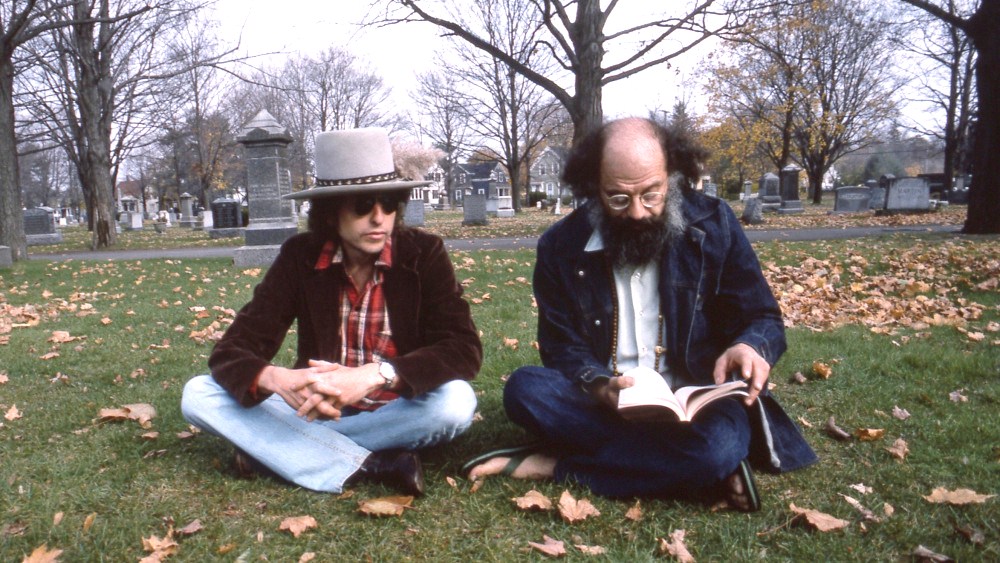
 Joan Baez was on the whole tour, and her participation is a highlight of this film. All the Joan and Bob angst of Don't Look Back and Scorsese's previous Dylan biopic has disappeared. She sings duets with Dylan, dresses up and cavorts and dances onstage.  She was never more beautiful.  Poet Allen Ginsberg is also a positive presence throughout.

The stagecraft is unusual, and this film gives various reasons for it.  The one that makes the most sense was an attempt to adopt a Japanese Kabuki theatre style, with the makeup and the exaggerated formal stage gestures, like the incredible stares Dylan does, or that he and McGuin do at each other in the final number shown in the movie.

But this brings me to the problem that not only spoils the movie for me, but causes me to condemn it.  When the film was over, I thought I'd come to understand something about this tour.  There were some contradictions, and even in present day interviews, Dylan was being Dylan and contradicting himself--the sincere put-on seems a habitual part of his public personality.

But a few things confused me. I was particularly bothered by an interview towards the end of the film, in which a supposed Member of Congress in the 70s spoke at length about how President Jimmy Carter got him in to see one of the Rolling Thunder performances.   It was otherwise a pointless story.  I recognized the man as an actor--I remembered him especially from a Robert Altman film--but of course actors do run for office, and maybe he had.

It was only after looking up information on this tour and Wikipedia's short piece on this film that I learned that significant elements of this Scorsese film were entirely fictional.  In other words, a lot of it was comprised of lies.

The supposed filmmaker, the promoter of the tour are fictional; actress Sharon Stone appears, relating how she became part of the tour as a teenager, and present-day Dylan talks about her, but none of that actually happened. (I'd wondered about this, knowing that she was from my part of the country, not New England.)  And that actor--Michael Murphy--was playing a politician he had originally played in a 1970s series. He'd never been in Congress.  His pointless screen time was also false.

It's become pretty standard for biographies, autobiographies, memoirs to follow the practice of Hollywood films about well-known people (usually dead) in creating composite or fictional characters to collapse a life into a more classically shaped story line.  This is more dangerous when the story is not being re-enacted by actors who clearly are not the real people, but it is a trend in print as well as on film.  In that regard, the character of the promoter is excusable, provided that he is expressing views and experiences of the actual promoters.

But I do not find the other deceptions remotely excusable.  The politician was merely pointless.  But the others deceived viewers on major points, and obscure actual understanding of the Rolling Thunder tour.

In the back of my mind I associated this tour with Renaldo and Clara, though I couldn't remember whether that was the name of an album or what.  I did recall it involved Dylan in role-playing.  It turns out that it's a movie that Dylan and his first wife Sara starred in, that lists Dylan as the director and writer, and that was shot during the Rolling Thunder tour.  It also may have been the major reason for the tour itself.

That film--originally four hours, cut down later to two--has hardly ever been seen.  There are hazy bits of it on YouTube.  Sometimes when a film (or other work) meets with failure at first, it gains new respect later.  That's not the case with Renaldo and Clara, at least not yet.  (Apparently it got a better reception in Europe.)

But this movie is never mentioned (and neither is Sara, to my recollection) in the Scorsese film, and it seems that the deceptions are designed to draw attention away from it.

 That's a bit ironic, in that film historian Scorsese might have been interested to explore how Renaldo and Clara relates to its alleged model, Children of Paradise, a 1945 French language film by Marcel Carne.  It involves members of a 19th century theatre troupe in love with the same woman.  Observers note several similarities between this film and Dylan's, notably the use of whiteface--one of Carne's main characters is a mime.

Faked photo placing young Sharon Stone with Dylan 
If indeed the tour was mostly a setting for a fictional film, and especially if this French film is the inspiration for whiteface and the other makeup and costumes--a possibility never mentioned in the Scorsese film--then the elaborate lies the Scorsese film tells about the origin of the whiteface (including a Kiss concert Dylan is said to have attended, which he did not; the concert itself didn't exist) is intentional dishonesty, and unforgivable.

So are the Sharon Stone sequences--including a composite photograph to show her with Dylan-- which seems to have no purpose other than to further obscure the reason for the whiteface.  In particular, it attributes to Dylan a depth of knowledge about Kabuki that he may not have had.  (Though indeed he might have--Dylan had traveled a lot and knew a lot about American and world culture.  Certainly more than I did in the 70s.)

The fake director
One of the most compelling characters in the Scorsese film is the fictional filmmaker who supposed shot all this footage.  In fact the footage was shot at Dylan's direction for Renaldo and Clara.  Though that film is never mentioned, there are some possible in-jokes referring to it in the Scorsese film.  In snippets of interviews, several tour participants refer to Allen Ginsberg as a kind of "father figure."  (The present day Dylan contradicts this.)  The character Ginsberg played in Renaldo and Clara was called the Father.

Here's the larger problem: because all this footage was shot for the fiction film  Renaldo and Clara, any and all of it from the tour could be fiction.  That includes two of the more affecting scenes: one a conversation between Dylan and Baez, and one a conversation between Dylan and Ginsberg at Jack Kerouac's grave.  I can no longer believe them.  Not only might they have been scripted for a different movie, they are not even seen in the context of the movie they were intended for: a double lie.

This falseness extends to the present day interviews.  In them, Dylan talks about the fictional characters as if they were real, and about Sharon Stone as if she had actually been on the tour.  Others make similar comments.  Now I can't believe anything they said.

Once the fakery is known, how are viewers supposed to respond, especially if they didn't live through the 1970s?  Do they wonder whether there really was a Hurricane Carter, who was wrongly imprisoned for murder, or was he just a character that Dylan made up for a song, portrayed in this movie by an actor?  (Unfortunately, the footage of President Jimmy Carter giving his earnest and silly interpretation of a Dylan song is probably real.)

Cate Blanchett as Dylan in
I'm Not There
It's one thing to do a film about Dylan in which he is played by various actors, including a woman (as Todd Haynes did with I'm Not There. A useless movie in my opinion but still, legitimate.)  That's a pretty clear signal to viewers to take the supposed biographical information with a grain of salt.

But this is a film by a noted filmmaker who has established a record of going from clearly fictional films (however based on actual people and events) to documentaries--in particular one of the best concert films in The Last Waltz and then the later Dylan biography, No Direction Home and the excellent George Harrison biography, Living in the Material World.  Other directors, like Michael Apted and Jonathan Demme, have done the same.  This distinction is what the public now has the right to expect, unless clearly told otherwise.

Despite the excuse in the subtitle--A Bob Dylan Story--this film has all the usual features of a documentary, that may take the usual liberties of such films but is essentially fact-based, and certainly does not elaborate falsehoods.  It is not a reenactment--it features the actual artists and actual concert footage and so on.  It is natural that viewers take this as truth--by the evidence of YouTube videos that pass on some of its falsehoods as truth, at least some viewers have.  But there is nothing trustworthy in this film.

It turns out I'm not the only one to react this way.  A Variety reporter at an event after a premiere wrote this: "It wasn’t hard to gauge the reaction, since in just about every case, when I asked people what they thought about the fakery, that was the very first they’d heard of it. (Unless you have extra sensory perception, you’re going to buy what this movie shows you.) Most of the people I spoke to were wide-eyed with disbelief yet kind of bummed. Over and over, they said that they felt duped, suckered, maybe even a little betrayed. Of the 20 or so people I had conversations with, not one said, “Really? That’s kind of cool!” The fakery left no one with that Andy Kaufman feeling of awe. And this was a crowd of people who were disposed to like the movie, many of them with two or three degrees of separation from Martin Scorsese."

And here for me is the money quote from this reporter about the director's deception:  But the way he does it, as a friend of mine said, “It seems more Trumpian than Dylanesque.”  Perhaps we are a bit more sensitive to lying now, but we have good reason to be.

 If I were still a rock critic (and if there still were rock critics) and got the freebie box set of music performances from the tour and a disk of this movie, I would toss the movie aside.  Only the audio recordings can be trusted.

"Art is the lie that tells the truth," Picasso famously is said to have said.  This film just lies.  Does that make me Mr. Jones?  Possibly.  Or maybe I believe more than I did in respecting the audience as a matter of principle, or at least respecting the form.  I certainly feel disrespected as a viewer, and offended as a writer. This is no direction home.

Friday, July 12, 2019

Textures of the 1940s on Film

The Andrews Sisters in "Buck Private"
It is said that when people get interested in a period of the past, it is usually the era of their parents.  That's been true of me in recent years, when for various reasons I've been intrigued by the 1930s and 1940s.  Partly because there were some significant but not sufficiently known achievements--various Depression era programs like the CCCs and the Federal Theatre Project, then the GI Bill and the Marshall Plan in the 40s--but also because I am connected to these years through my parents, grandparents and older relatives.

I am also connected through the movies and television shows of my youth that were about this era and/or featured entertainers, directors and so on from this era.  Much of early television was actually late radio with somewhat moving pictures.  Many of its stars went back through radio and movies to the Vaudeville era.

So in addition to more serious reading, I like going back to the era's popular culture and entertainment.  I love the Swing era, the Big Bands, for example.  But recently I decided to tap into another connection with a set of 1940s movies called 8 Wartime Comedies.

The set features a couple of Abbot & Costello films, one Francis the Talking Mule movie, comedies starring Bob Hope, Bing Crosby and Tony Curtis, and one comedy classic: Preston Sturges' Hail the Conquering Hero.

I probably saw some of these movies before, mostly on television, though when I was very young my father took me to see one of the Francis the talking mule service-oriented movies (with Donald O'Connor) at a local theatre, and perhaps one of the Abbot & Costello or similar themed films by Dean Martin and Jerry Lewis.  These entertainers were all regularly on television in the early 1950s.

I had to cross a kind of barrier to get back to these movies, though.  Vietnam soured me on attempts to hoodwink people about war through trivial entertainment and phony glamour. The idea of "wartime comedy" remains jarring.  But unlike the satires of the 60s and 70s which were about war (and atomic self-destruction), these movies aren't really set during a war, and aren't about war.  But they are pretty interesting in revealing the mindset of the times.

With this set I've only seen the two Abbot and Costello movies so far.  They were both made and released after what became World War II had started, but before the US officially entered the war against the Axis powers.  Though barely--they were both released in 1941.  Both were big box office hits.

Buck Privates was made first, and was set in 1940, just after the military draft was reinstituted.   (It was also when the US population was 130 million, some 200 million fewer people than now.  In fact, just 60 million more than one-third of today's population.)

 The beginning is a good primer on official attitudes then.  It's clear the US was gearing up for the war, and the participation of the "ordinary guy"--factory worker, farmer, etc.--was emphasized.  But the official theme was defense--defending America against potential but unnamed enemies.

The comedy team of Bud Abbot and Lew Costello play small time confidence men, trying to sell men's ties on the street, when they try to escape from police by joining what they think is a line into a movie theatre, but instead is an Army draft call.  They wind up in the Army.

The subplot involves the first man to be drafted (Alan Curtis), a patriotic working guy, and the rich son of an influential man in Washington (Lee Bowman) who tries to use influence to get out of the draft, unsuccessfully.  They compete for the attentions of the same woman (Jane Franzee), and of course, the rich guy wises up and saves the life of the working guy, and they go off to officer candidate school together.

The movie gets women into it by inventing a corps of women "hostesses" in uniform who accompany recruits to their training camp to keep up their morale (and since it is 1940, that's all.)  This also is the excuse for the presence of the other stars of the movie--and one of its principal attractions to me today--the Andrews Sisters.  This trio of close harmony swing singers was very popular in the 40s, but not a lot of film of them seems to exist from that era.  This movie includes their signature hit of the times, "The Boogie-Woogie Bugle Boy,"  as well as another of their hits, "Apple Blossom Time."

They prove to be a highlight of this movie--not only their singing performance, but their dancing. There's also a number that features a group called The World Champion Boogie-Woogie Dancers, and several of them provide some of the best 40s dancing of the many films that include it.

Abbot and Costello's comedy is gentler and less dependent on slapstick than I remember, although there's not much that's laugh out loud funny.  (Somehow it is pretty funny when a bugler plays Reveille and Costello shouts for somebody to turn off that alarm clock. Had to be there funny anyway.)

This movie was released in January 1941 and was an instant hit, so Universal rushed another one into production.  They certainly could make movies fast in those days--In the Navy shot from April 8 to May 8 and was released on May 30, even with a reshoot that the Navy requested, all in 1941.  Once again, the Andrews Sisters were featured, but another star was added in Dick Powell.

Unfortunately the haste shows.  The script is dull, the songs are dull, and the Andrews Sisters numbers lack focus and care.  Dick Powell does one flat song and not much else.  Clare Dodd is wasted as the comedic love interest. The rear-screen projection is painfully obvious and even the editing is sloppy.  The Abbot and Costello comedy is funnier, though, as they tapped into their classic Vaudeville-style routines--several of which I remembered from their early 50s television show.

But here's the thing about films of the past: they have context that inevitably includes the times in which they are seen.  Or in this case, simply what soon came after.

A couple jumped out at me from this movie.  One is race.  An all-white cast in a 1940s movie is hardly unexpected, though less frequent than you might think in movies that involved bands and music.  But in this film, the Andrews Sisters actually do a song about the Harlem expression "give me some skin" without a black person in sight.

The Nicholas Brothers in the Glenn Miller film Sun Valley Serenade
That might have gone by except for a dance specialty number by the Condos Brothers.  The famous dancing brothers of the era were the Nicholas Brothers, but they were black.  The Condos Brothers were white imitators.  The two 1940s films that Glenn Miller made both include a Nicholas Brothers dance, though it is a separate routine that looks designed to be cut out for Southern theatres.  Once actual World War II movies started, the US armed forces were made to appear integrated, though they actually weren't.  That is, there were separate black units, but not mixed races in the same unit.  Anyway, I was getting really uncomfortable at this point.

Another context is history.  The plot of the movie involved the battleship Alabama sailing to Hawaii in 1941.  There's even a Hawaiian number with the Andrews Sisters (and some background dancers who look like they might actually be Hawaiian, or at least Asian.) The movie came out in May.  In a surprise attack, Japanese war planes bombed Pearl Harbor in Hawaii in December. By the time some audience members saw this film--not to mention me in 2019--this had already happened, with overriding and indelible images of burning ships, and heavy loss of life.  The US officially entered World War II the day after, on December 8.

Fortunately for the film, the Alabama was not one of the battleships sunk or damaged at Pearl Harbor. (Those would be the Arizona, the Oklahoma, the California, the Pennsylvania, the Nevada, the Tennessee, the Maryland.)  In fact at that point there was no battleship Alabama in service--it would not be commissioned until 1942.  But still, it's impossible not to feel the weird dislocation of this movie.  In addition to preserving textures of the times, movies of this era tempt us into nostalgia for a lost home that never existed. But when that illusion is shattered, we learn something more.

Sunday, July 07, 2019

The States of Song


Before this 4th of July weekend is done, something on the lighter side.  Margaret asked this question: does every state have a song?  Not an official state song but a memorable popular tune.

It turns out there are a number of websites and articles on the subject.  They tend to stretch the definition to include the names of cities within the state, or just a reference to the state in the song.

There are also some great songs that reference a number of cities and states, from the classic Woody Guthrie "This Land is Your Land" and  Simon & Garfunkel's "America" to Chuck Berry's "Sweet Little Sixteen" and "Back in the USA,"  Martha and the Vandellas "Dancin in the Street"  and a fairly obscure but wonderful Jimmy Durante tune "Any State in the 48 is Great."

It turns out that a lot of songs with state and city names express longings by people no longer there.  Others seem to be more about the sound of the names than the places.  But then, it's music!

Actually the surprise is that there aren't more songs and better songs about a lot of these places.  I imagine there are plenty about local places--blues songs in the South, bluegrass in the mountains, cowboy songs out West--that were never much heard outside their area of origin.

I've got my own list of favorites that includes some titles that other list makers seem to have forgotten, and here it is:

Alabama
Everybody's choice is Lynrd Skynrd's "Sweet Home Alabama," but there's also the song this was an answer to: Neil Young's lacerating tale of the Old South titled simply "Alabama."  These days that doesn't seem so relegated to the past, so that's my choice.

Alaska
In 1960 Johnny Horton had a tuneful hit in "North To Alaska."  Alaska had been a state for only about a year.

Arizona
Arizona gets mentioned here and there, as in Jackson Browne's "Take It Easy,"or Little Feat's "Willin'" or Randy Newman's "Rider in the Rain," (here's a treat--Newman with Ry Cooder and Linda Ronstadt.)  But there doesn't seem to be a well-known song about the state.  Probably Glen Campbell's "By the Time I Get To Phoenix" is the most famous.

Arkansas
"The Arkansas Traveler" is not only the official state song but a well known fiddle tune that inspired many versions, including Pete Seeger's in 1954.  The song title has provided the name for an annual state award and a minor league baseball team.

California
It's a big state that has inspired many songs, but apart from city-specific classics like "I Left My Heart in San Francisco," there are several that reference state myths of two eras: "California Here I Come," first made famous by Al Jolson in 1924, the Beach Boys 1960s classic, "California Girls." and the Mamas and Papas "California Dreamin."  Then there's Neil Young's apocalyptic "After the Goldrush."

Colorado
Lots of songs reference Colorado, especially as a symbol of lost or longed-for paradise, like "Someday Soon," "Chilly Winds" or even John Denver's "Rocky Mountain High."  There are a few just plain "Colorado" songs, including this one by Stephen Stills. Willie Nelson had a song titled "Denver" and that city appears in others.  But none stands out to me.  Maybe "Chilly Winds" because I thought of it as I crossed Colorado for the first time on a train.

Connecticut
There's David Steven's more contemporary "Connecticut Snow." but my choice is Bing Crosby and Judy Garland's 1945"Connecticut" ( "No matter where I chance to be/Connecticut is the place for me.")

Delaware
A popular song of my childhood but otherwise long forgotten, Perry Como's "Delaware" ("What did Della ware boys...") also names several other otherwise overlooked states.  A betters song if more obscure is Fats Waller's unkind "You're a Square From Delaware."


Florida
"Moon Over Miami" dates from 1935, sung in a compelling fashion in our time by Ray Charles. Jimmy Buffet wrote a bunch of good songs about Key West. The best that name checks a number of cities is the Dixie Chicks "Don't Let Me Die in Florida." But given the long relationship of New York and its vacation/retirement colony of Florida, the best Florida song I know is Billy Joel's "Miami 2017" which isn't about Florida at all, but an apocalyptic New York.

Georgia
Though the song is probably more about a girl than a state, nothing beats "Georgia On My Mind" as recorded by Willie Nelson or Ray Charles--or both.

Hawaii
Hawaiian War Chant" was a popular song of the late 1930s and 1940s as performed by Tommy Dorsey and others. Its original melody and lyrics were written in the 1860s by Prince Leleiohoku.  Perhaps not the most culturally sensitive presentation but there you are.

Idaho
Don't know what it says about a state when the most prominent song written out it is the B52's "Private Idaho."  But it's a fun song.

Illinois
Dan Fogelberg isn't much remembered anymore, but in 1974 his most successful album included this great song about nostalgia during that generation gap time, "Illinois."  Better known tunes tend to be about Chicago.

Indiana
The Music Man furnishes another midwestern state's city song, in "Gary Indiana."  But "Back Home in Indiana"  in this 1965 rendition by Louis Armstrong is one of many great jazz versions, not only others by Armstrong but also by pianist Erroll Garner, Sidney Bechet, Dave Brubeck, Oscar Peterson, Jimmy Bryant and many more.  There are instrumental versions in many styles (especially bluegrass), but this official state song does have lyrics, as evidenced in this jazz version by Carline Ray.

Iowa
Among the famous movies set in Iowa are Field of Dreams, State Fair and The Music Man.  It is from the latter that emerges the song "The Iowa Stubborn."

Kansas
 Kansas has the Kansas City that is not the subject of the classic "Kansas City"--that one is likely in Missouri.  George Hamilton IV had a hit with a very nice tune, "Abilene" which is probably the one in Texas, not Kansas.   Jimmy Webb's "Wichita Lineman" was made famous by Glen Campbell's 1968 recording, and it was subsequently recorded by the likes of James Taylor, Johnny Cash and REM. And that definitely is in Kansas.  Above is a late version by Glen with a terrific guitar solo.  Easy to forget what a great guitarist he was.

Kentucky
Since songs about states are usually about nostalgia by those who've left them, Kentucky is best represented by "My Old Kentucky Home" and "Man of Constant Sorrow" about a man who must leave Kentucky where he was born and raised.  Anyway, good excuse for listening again to the "O Brother Where Art Thou" version.

Louisiana
"How about Louisiana?/Part of Americana?"Lots of songs about New Orleans down to individual streets. There's "Bourbon Street Beat" and Sting's "Moon Over Bourbon Street," about a vampire.  I suppose state residents might prefer "Louisiana Saturday Night," a good timer that was a hit for Mel McDaniel in 1981.  However, its tune and cadence bear some resemblance to a big hit song in 1959 about an event in this state's premier city, Johnny Horton's "Battle of New Orleans." 

Maine
Who says country music isn't a New England thing?  "Tombstone Every Mile" is not only a trucker tune about Maine, it was written by a Maine singer, Dick Curless.

Maryland
Vondra Shepard's "Maryland" is a catchy tune, another lost home song.
Nina Simone's reggae beat version of Randy Newman's "Baltimore" is hard to beat, though it's not exactly complimentary to the city.

Massachusetts
The Bee Gees  hit "Massachusetts" is the obvious choice, though the second verse of "Sweet Baby James" gives a better sense of the state.


Michigan
Simon & Garfunkel's "America" references several cities and states but has no more haunting line than "Michigan seems like a dream to me now."  The Red Hot Chili Peppers have the surreal "Especially in Michigan."  Wikipedia has an entire page of songs about Detroit, Motor City and Motown, but none of them memorable--weird for a city with such a huge musical heritage.  But if we're going for a city, my favorite is the Glenn Miller Orchestra classic, "I've Got a Gal in Kalamazoo." 

Minnesota
Really the theme for this state should be the theme song for "The Mary Tyler Moore" show, set in Minneapolis, but it probably doesn't qualify. There's some reference to Minneapolis in Dylan's "Tangled Up in Blue" though I don't think by name.  Lucinda Williams has a dirgy but evocative song called "Minneapolis."  A lot more upbeat is Prince's "Rock & Roll is Alive and It Lives in Minneapolis."  Let's go with that one.

Mississippi
Lots of great songs about the river but hard to find an old one about the state not tainted by endemic racism.  A pretty sympathetic tune however is Bob Dylan's "Mississippi," not one of his better known songs but nevertheless recorded by Sheryl Crow and in a rousing version by the Dixie Chicks.

Missouri
"The Missouri Waltz" exemplifies problems with a lot of state-referencing songs from the minstrel era, including Stephen Foster songs: the lyrics are more likely to make you squirm than swoon, even though this is still the official state song.  Merle Haggard has a country song titled "Missouri." Fortunately there are a lot of great songs about St. Louis, including the "St. Louis Blues" (Bessie Smith & Louis Armstrong,) or "St. Louis Woman" medley by Billie Holiday, and a little tune I'm fond of tucked into a Steeley Dan album--their rendition of a Duke Ellington song, "St. Louis Toodle-oo."

Montana
Not particularly well known but a song that exemplifies the state's history is "Montana Cowgirl" by Emmylou Harris.


Nebraska
Although it's about a serial killer, Bruce Springsteen did title it "Nebraska."  Waylon Jennings did "Omaha."  Moby Grape had a psychedelic "Omaha" in 1968. Jim Harrison wrote a lot about Nebraska.  You'd think somebody could come up with a better song.  So I'll go with a novelty tune full of skewed geography from 1951 by Groucho Marx, "Omaha, Nebraska."

Nevada
There are songs about Reno and Elko but mostly about Las Vegas.  Boosters love Elvis' "Viva Las Vegas" but I'm partial to Sheryl Crow's "Leaving Las Vegas."

New Hampshire
Next door to Vermont and Massachusetts, New Hampshire remains largely unsung.  Perhaps defensively, it has about a half dozen official state songs.
Eddie Mottau's "Old New Hampshire" is a contemporary take.


New Jersey
The state that gets no respect got at least a little in "Jersey Girl," written by Tom Waits and most famously recorded by Bruce Springsteen.

New Mexico
New Mexico's problem is that there are so many songs about Old Mexico.
Waylon Jennings "Taos, New Mexico" has the virtue of more or less being about Taos.  But the whole state gets a plug plus some white people's dour history in Johnny Cash's "New Mexico."

New York
Most of the New York songs are about the City of--although Frank's tune "New York, New York" at least includes the state.  Sinatra also participated in another "New York New York"--a better song, from the musical film On the Town. I like Sting's "Englishman in New York."  But my top choice is Billy Joel's "New York State of Mind."

North Carolina
There are Carolina songs that don't specify North or South, but it's pretty clear that James Taylor meant North in his classic "Carolina On My Mind."

North Dakota
Lyle Lovett has a song titled "North Dakota."  But a novelty song with clever lyrics is Frank Sinatra's "I Got a Girl in North and South Dakota."


Ohio
There are some nice instrumental tunes with Ohio in the title but the state is always going to be remembered for Neil Young's song about Kent State titled "Ohio", recorded by Crosby, Stills, Nash & Young shortly afterwards.

Oklahoma
There are a number of songs about Tulsa (including Neil Young's haunting "The Last Trip to Tulsa") and the Dust Bowl, including "My Oklahoma Home (Blowed Away)," recorded by Pete Seeger and most recently Bruce Springsteen.
But of course, the one that sticks is the title song of the musical "Oklahoma."

Oregon
The Oregon Trail is deep in the American legend. Woody Guthrie wrote a song with that title, and there was a song called "Westward Ho, the Wagons" with the words "Westward roll the wagons, always westward roll...for Oregon's our goal."  Vaughan Monroe's 1957 recording was popular in my childhood.  It was also the title of a 1956 movie starring Fess Parker, Davy Crockett himself.

Pennsylvania
Most of the songs about Pennsylvania aren't about the state; they're about the railroad, the Pennsylvania railroad station in New York, and the Hotel Pennsylvania, also in New York, with its own phone exchange, which was the subject of a Glenn Miller song "Pennsylvania 6-500."  There are some songs about Philadelphia (like Bruce Springsteen's "The Streets of Philadelphia") and Pittsburgh, plus Billy Joel's "Allentown."  Apart from some really awful official state songs, there's only "The Pennsylvania Polka," done with some harmony and humor by the Andrew Sisters.  But I'll stretch a point to choose Patti Page singing "Allegheny Moon," since the river runs through Pittsburgh.


Rhode Island
A song from 1960 names a lot of other states and cities famous for something, but it turns out that "Rhode Island is Famous For You."  Here's the original Blossom Dearie recording.  Do pencils really come from Pennsylvania?

South Carolina
This time we'll give the unspecified Carolina to the South for "Carolina Moon," in many different versions--here's a nice upbeat one by Dean Martin.

South Dakota
Though the Bee Gees recorded a nice tune called "South Dakota Morning," it's pretty obscure.  But then, so is South Dakota.

Tennessee
With music centered in Nashville and Memphis, there are a lot of songs about both. (I'm partial to the feeling in Paul Simon's "Graceland.") I'm tempted as well by that other Glenn Miller favorite, "Chatanooga Choo Choo," with all those other place names. But for the whole state, it's got to be the "The Tennessee Waltz." Sam Cooke has an upbeat version, though  I remember it sung by Patti Page.   

Texas
Lots of western songs about Texas and various cities. "The Streets of Laredo" for example.  But "Deep in the Heart of Texas" is deeply entrenched.  As is "The Yellow Rose of Texas" which seems to be the same song.  But I'll use the former to link to the Gene Autry version, who made the best cowboy record, "Back in the Saddle Again."

Utah
Marty Robbins has a country/cowboy song about his friend named Utah, which is stretching things. But there are a bunch about Salt Lake City, the strangest of which might be the bluesy "I Lost My Sugar in Salt Lake City"--performed here by Johnny Mercer, who helpfully includes some geography book statistics about the city in 1929.


Vermont
Thank your lucky stars for the moon, or a lot of states would be songless.  "Moonlight in Vermont" is a classic, given (for example) the full Ella and Louis Armstrong treatment.

Virginia
"Carry Me Home To Old Virginny," in its early form goes back to the early 19th century, and was a Confederate favorite.  But there's another version, dating from the late 19th or early 20th century, written by an African American popular songwriter, James A. Bland.  That's the version that Ray Charles does here.

Washington
The most famous song to come out of Washington was, of course, "Louie, Louie." Given its indie music tradition, there are lots of songs about Seattle, but in most cases, what's sung in Seattle tends to stay in Seattle. Brit Mark Knopfler's "Seattle" is nicely evocative, and in this video is paired with shots of the city.

West Virginia
John Denver has the definitive West Virginia song with "Country Roads (Take Me Home)", probably his best song.

Wisconsin
The first song that probably comes to mind is "On Wisconsin," and it may be the only one. It's one of the oldest college fight songs, and a version was recorded by the Glenn Miller Orchestra  There is also a hidden classic: "My Cousin in Milwaukee" was written by George and Ira Gershwin.  Here's the Ella Fitzgerald version.

Wyoming
"And what about Wyoming, with the cattle freely roaming?" Sticking to the "W"s, John Denver did the ballad "Song of Wyoming." Not as good as his West Virginia song, but there's not much competition for Wyoming.