Tuesday, December 05, 2006

Are We Fit To Live?

If you really take it all in, the news most days tells you that the human species is not fit to live. What we've done with our power is scandalous to the extreme. We destroy the planet that sustains us. We destroy the habitat and the lives of the life that also sustains us, and the creatures that are our only known companions in the universe. And we destroy each other--we kill and maim strangers, and we kill and maim members of our own communities, and those entrusted to our care.

We look at Darfur and elsewhere in Africa, in Iraq and the rest of the Middle East, and anywhere there is cruel violence and great poverty, disease and lots of guns, and the only reactions possible begin with horror and shame. But we in the U.S. don't any longer have to look that far. Apart from the normal neglect of the poor and physically and mentally ill, and besides what our firepower is doing elsewhere, we can look to our torture camps, our prisons and our own armed forces, just for starters.

Today we see what one man has endured, with hardly a peep from his community, or another man treated perhaps with less violence but with the kind of injustice that should not be tolerated in this nation. (Both of these links are to Glenn Greenwald's excellent blog, but they in turn link to the appropriate New York Times reportage.)

This violence--and there is no other name for it--extends to our own. Today's NPR report is the latest to highlight the scandal of how the U.S. military treats its own--specifically in this case, those with mental and emotional trauma caused by the warring that the military sends them to do. But the U.S. military and U.S. government shirking their responsibilities to soldiers in the most cynical ways is even more widespread than this. Substandard medical care, and the refusal to even give that; using every pretext and gimmick and trick to deny veterans their benefits; the failure to take care of soldiers' families, and on and on.

The denial of mental and emotional trauma benefits is part of the denial of mental and emotional trauma, which is part of the lie of military service: because they are afraid that if the true cost is known, they will have fewer bodies to throw into battle. Yet it has been clear for a hundred years that virtually noone who has been in battle or even in the armed services escapes some mental and emotional consequences.

And why do authorities get away with torture under any other name? How could so many people be held and subjected to torture without charge or trial for so long, without journalists clamoring for facts and the community clamoring for the truth? It's the denial that is the cold part of war fever.

War Fever--it is expressed in so many ways, actively when bloodlust takes over, passively when flagwavers get a thrill regardless of consequences, and darkly threaten anyone who isn't feverish, who asks questions. We've known about War Fever since before Shakespeare--that's part of what "let loose the dogs of war" means--and yet it comes upon a society in the 21st century as if brand new.

What must we do to deserve to live as a society, as civilization, as a species? We have to get better. To do that, we must first of all believe that we can get better. We aren't fated by human nature or selfish genes or any other propaganda that soothes our conscience while it promotes the interests of those who exploit us for their wealth and power. We must have hope, and faith in ourselves. And all of this will be harder than the reflexive excuses or reversions to violence, projection, scapegoating and denial, and all the other easy steps in the perennial spiral to self-destruction.

Then we have to do something about it. We can't throw up our hands--and apparently it's not enough to know the facts of how we behave badly. We must develop and use the skills that will help us to be better.

We can't revert to managing behaviors because some greater power will punish us. We have to go beyond other kinds of fevers that draw their power from guilt and despair of who and what we are, and that in the guise of religions inevitably lead to the exploitation by the few and war of sect against sect in the name of love and truth.

From traditions and new knowledge in the West and the East and everywhere in our world, we have skills and vocabularies that begin with self-knowledge and embrace better ways of communicating and resolving conflicts. Jung issued his great cry nearly a half century ago--that our problems begin in the human psyche, and yet we know nothing about it. And what we do know, we don't use.

This is hardly a gooey sort of prescription. Because in the course of learning about ourselves, our psyches and our nature as human beings in this world, we learn how we are manipulated and exploited to serve the selfish and cynical interests of the destroyers, and how we can prevent their efforts from succeeding.

We have a long way to go, in a very short time. Whether we as a species and a civilization are fit to live--in the Darwinian as well as the moral meaning of those words--will be decided by our interactions with the planet, with each other and within ourselves.

Sunday, December 03, 2006


African gray parrot. Posted by Picasa
City of the Future: City of Broad Waters?

What is the future of the city? A contest set up by the History Channel gave eight teams of architects in Chicago the chance to (quickly) come up with their visions. As described at World Changing, all of the entries were inspiring. Perhaps because, unlike the utopian visions of the recent past, they were both imaginative and realistic in terms of ecology and energy. And not simply in how the city preserves or enhances its own ecology while using energy efficiently--but in how the city responds economically to the challenge (and the opportunity) of future ecological and energy needs beyond its own borders.

For example, the winning entry was a plan to make Chicago, the city of broad shoulders, a prime producer and exporter of...water. Yes, cool, clear water, pure water, drinking water, because water is likely to no longer be everywhere. The Climate Crisis as well as pollution is very likely to make water the most important natural resource of the near future.

This vision (by UrbanLab) lays out an elegant plan for how Chicago can use its river and access to Lake Michigan to produce clean water and export it, and in the venture, become a greener city, with far less dependence on automobiles.

This will become an entry in a national competition, but the beauty of it is that it is site specific--it could really work for Chicago. While politicians and the media babble on, at least some engineers and architects are looking realistically at the likely needs, conditions and opportunities of the 22nd century (though the water crisis is likely to be a mid-21st century situation, if not sooner) and coming up with imaginative solutions that are of the kind that can very well characterize such future planning: win/win, non-zero sum change.

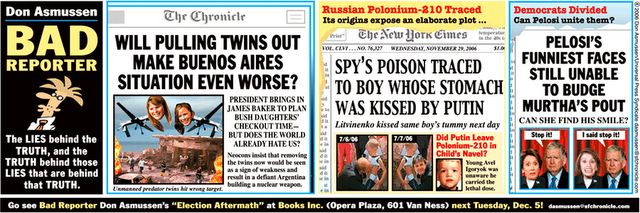
Asmussen in SF Chronicle--click to enlarge. Posted by Picasa

The Daily Babble

Surprises

Got a nondescript looking envelope in the mail, almost threw it out, though the lack of any information on the outside made me curious (for as we all know, CHECK ENCLOSED on the outside only announces a scam, and I got one of those this week, too.) But when I opened this anonymous looking envelope, it did contain a check--for over a hundred dollars.

So of course I read the accompanying material to see what the scam was--like I could cash the check as soon as I bought one of their 20 thousand dollar stadium-size TVs or something. But no. This was a real check, one I had actually earned. It was for the Google ads that have appeared on this blog, and several of my other ones, for years now. It's the first money I've ever seen from blogging. And it took a long time--so long that I stopped checking the account. I couldn't understand it anyway. But I gather that it all accumulated, until it passed a hundred bucks worth, the threshold for writing the check.

The ads pay because of traffic, or click-throughs, or something like that--lots of hits involved anyway. These blogs are not particularly successful in terms of numbers--this one is just now approaching 25,000 total hits, while Soul of Star Trek inches closer to 100,000. But it took years to get even those numbers. Still, it was a nice surprise--and came in handy less than 24 hours later when my fan belt broke as I was passing an auto repair shop. So the money's gone already, and I'm not yet done with repairs apparently.

Numbers aren't everything. I get nice comments at Soul of Star Trek, even a compliment on my Gojira essay, the occasional nice comment here, and even a complaint yesterday that I wasn't writing often enough.

As for that, I've just had a run of deadlines, pretty much done now, and besides the insecurity of steady (part-time) work not resuming for a couple of months, I do hope to pay more attention to my blog garden. This one I'm once again going to try to focus, maybe starting with better links. We'll see.

And now, the news.

Here are a couple of hopeful items to explore: Americans drove less in 2005 than they did the year before, according to a study--the first year-to-year drop in 25 years. Higher gas prices, aging population, are among the factors the study cites, though the linking to higher prices is disputed elsewhere. And...another study suggests that globally, deforestation may be slowing down, and cumulatively, regeneration is on the rise--meaning that instead of dropping steadily, forests may be increasing by 10%. Here's the BBC article, and here's an evaluation from Treehugger.com.


“How does it feel to be a war criminal, Henry?” Peter Jennings asked Henry Kissinger at a media-heavy dinner party, hosted by Barbara Walters, some years ago. Undeterred by the general embarrassment, he asked him again. I wonder when Don Rumsfeld will start getting that question over his soup?

What's really happening in Iraq? Steve Gilliard has a pretty simple explanation. It has the ring of truth, which to me means that I'll keep an eye out for confirmation.

Monday, November 27, 2006


The hummers are hanging in. BK photo. Posted by Picasa
Iraq, Civil War and the Draft

Today the TV talking heads were debating the decision by NBC and a few other news corporations to defy the Bushites and call the Iraq violence "civil war." The Bushites have resisted this for more reason than their usual taste for obsfucation. Obviously they would prefer the news media to stick with "Operation Iraqi Freedom." But the implications of civil war are that the mission for U.S. troops would change, and in a practical sense their presence would lack a rationale.

As for the accuracy of the term, I found one of the talking heads, from Time Magazine I seem to recall, persuasive in saying that it is BOTH a civil war (Shia against Sunni Arab with power struggles within each group) AND an insurgency (just about everybody against the U.S., and many against the current government because of its U.S. ties.) It's two wars, two wars, two wars in one.

The push for a timetable, for "redeployment," which all means withdrawal, is becoming overwhelming in the media as in the Congress and the country. But such is the frustration with the insensibility (way beyond insensitivity) of the neoncon Bushite faction still holding the Executive--specifically with the John Kerry question of how do you ask someone to be the last one to die for a mistake-- that some progressives are falling off the deep end by calling for a draft.

Charles Rangel has made this proposal, and other liberals and "progressives" in the blogosphere agree. They say the burden falls unequally on the working or lower or lower middle class, and minorities, who join the all-volunteer army to finance school. They say the Republicans who support this war haven't served in the military, and none of their children do. (Not precisely true but mostly.) All good points. So they say let's make it all fair, spread the burden, and make sure America as a whole feels the consequences of war--by reigniting the draft.

To which I say, with all due deference, YOU ARE OUT OF YOUR FUCKING MINDS. Here's an idea that is just as practical--why don't you charge upper income white kids college tuition proportional to their family income, so a year of college costs maybe a million bucks. And give them the same deal--the Army will pay for their schooling if they join up. Great idea, huh? And one that will really, really work. Just as well as the draft.

First of all, the proponents' sense of Fairness is that they will structure the draft so that this time, nobody will get out of the draft because they are rich or powerful. I'm sorry, but I can't understand how anyone who has observed Washington or politics in this country can believe this is even remotely possible. Because it's utterly and completely though bitterly laughable that there ever would be a draft (or a draft law) that took rich kids who didn't want to go, or whose parents didn't want them to go. Short of a war that the entire country believed in anyway, enough that everybody was lining up to volunteer. That's the only time a draft can possibly work fairly--when it's just a way to manage the volunteers. And then it works by encouraging the well off and well educated to join up to become officers instead of waiting to be drafted as a lowly grunt.

Then there's the argument that if there had been a draft, Bush would never have gone into Iraq because the American public wouldn't have allowed it. To which I say HAH HAH HAH HAH HAH ETC or in Internetese, LOL to the power of 100. Believe that, and I've got some WMD in Iraq to sell you a war with.

Please: with a draft, we would not only be in Iraq now, but Bush and John McCain would be arm in arm, announcing a new draft call to put another million soliders into Iraq and Afghanistan, to settle things down. And to get ready for the invasion of Iran.

Honestly, were you all comatose during Vietnam? When we had a draft? Our longest war? That in one way or another deformed an entire generation of men, and ruined countless families?

I simply can't believe that anyone who was alive during the last draft could possibly believe that we would have a draft that was "fair," that it would do anything other than provide maniacs like Bush and Cheney with more cannon fodder; that there would be meaningful exemptions for conscientious objectors (handed out no doubt by the folks that brought you Guantanamo and reports on Quaker meetings saying they were a threat to the military), or that there would be a "national service" in which young people could choose to serve in a non-military capacity (tell it to the National Guard, please.)

Some of the proponents want simply to debate the draft proposal, because it would bring home the true cost of this war, or of future wars. I've got a better idea--why don't you just bring home the true cost of this war and future wars, and forget about the stupid draft? Let's get serious and focused. An unworkable system of involuntary servitude and a larger war (and anti-war) culture is not the way to do it. How about funding educational opportunities for everyone, paying soldiers decently so their families don't have to go on food stamps, give them good medical care for the rest of their lives and, by the way, equip them adequately when they are in harms way; and then how about dedicating some of the bucks a draft would cost to developing and nurturing the skills of peace that might actually help global civilization survive? That might be difficult, but at least it isn't insultingly insane.
Corporate Science and School Censorship

In a Washington Post oped Sunday, Laurie David (National Resources Defense Council trustee and founder of Stopglobalwarming.org) wrote that as co-producer of Al Gore's An Inconvenient Truth movie, she'd heard lots of requests from parents that the film be made available to schools. So she offered to donate 50,000 DVDs to the National Science Teachers Association (NSTA) for distribution across the country. They said no.

Is it because they perceive the content--approved as accurate by every climate scientist asked so far--as political, as taking "sides," and therefore as not something they should distribute? It has always been absurd that the Climate Crisis was a political issue. But largely because of a few giant global corporations and their political minions, it was. So if NSTA's position was that it had to remain neutral, or especially if it refused on principle to accept materials that could be in any way construed as propaganda from a source that might have a political or ideological agenda, I could respect that completely.

But that's not really why they turned down 50,000 DVDs, even though it was one of the reasons they offered. Another was much more telling: "Accepting the DVDs, they wrote, would place "unnecessary risk upon the [NSTA] capital campaign, especially certain targeted supporters." One of those supporters, it turns out, is the Exxon Mobil Corp." Exxon contributed some $6 million in a recent campaign; and an Exxonista sits on NSTA's board.

The National Science Teachers Association not only gets bucks from Exxon and other oil companies, they distribute their "educational materials"--that is, their corporate propaganda. As for a political agenda, theirs has been clear. An internal American Petroleum Association memo leaked in 1998 said it all: Informing teachers/students about uncertainties in climate science will begin to erect barriers against further efforts to impose Kyoto-like measures in the future."

Let me quote again from Saturday's Washington Post: 'We have to deal with greenhouse gases," John Hofmeister, president of Shell Oil Co., said in a recent speech at the National Press Club. "From Shell's point of view, the debate is over. When 98 percent of scientists agree, who is Shell to say, 'Let's debate the science'?"

Either NSTA hasn't gotten the memo from their corporate overlords (Shell is another big contributor) or it's all just part of a Shell game, but two things are clear: there is no debate over the science, and corporations with a massive self-interest will continue to work the issue to whatever advantage they can get. Corporations have also partnered with so-called conservatives who cut funding to schools and school programs, so they would be more dependent on the "private sector," i.e. corporate propaganda and control.

Some corporations, especially companies needing to build new power plants, need regulation, so the future is predictable and the playing field is leveled. But corporations are also still trying to manipulate public perception, to get the best possible deals for themselves. Apparently it's not enough to go after voters. They're going after children.

Laurie David makes the analogy to Big Tobacco's promotion of cigarettes to teens and children, symbolized by Joe Camel. Once again, the corporations are going right to the kids. The analogy is more than an analogy. As George Monbiot discovered, the leading Climate Crisis denying lobbying organization was begun by Philip Morris as a tool to deny the hazards of smoking, and especially of second-hand smoke. Many of the same people, using the same techniques and websites, have gotten big money from Exxon to engineer the so-called controversy over the Climate Crisis, where in reality none has ever existed. (Although until recent years, some scientists in the relevant fields wanted more data before they committed, there was never opposition, and today there is virtual unanimity.)

What isn't clear is what America's science teachers are going to do about this. Is teaching Climate Crisis denial any less anti-scientific than teaching Biblical creationism as science? Is it really worth the free glossy propaganda? No doubt science teachiers need more disinterested state funding for their science teaching. But maybe they should show some character first.

UPDATE: On his Countdown program, Keith Olbermann named the president of the
National Science Teachers Association as today's Worst Person in the World.

Saturday, November 25, 2006


By Wayne Sky (Cayuga) at vtweb Posted by Picasa
The Turning

It's beginning, even in advance of the Democratic takeover of Congress. A story on the front page of today's Washington Post: "While the political debate over global warming continues, top executives at many of the nation's largest energy companies have accepted the scientific consensus about climate change and see federal regulation to cut greenhouse gas emissions as inevitable."

The politics is encouraging acceptance of the science. "'We have to deal with greenhouse gases," John Hofmeister, president of Shell Oil Co., said in a recent speech at the National Press Club. "From Shell's point of view, the debate is over. When 98 percent of scientists agree, who is Shell to say, 'Let's debate the science'?"

And these companies are acting: "The companies have been hiring new lobbyists who they hope can help fashion a national approach that would avert a patchwork of state plans now in the works. They are also working to change some company practices in anticipation of the regulation."

In an immediate sense, this began right after the elections when it became known that Senator Barbara Boxer would become the new chair of the Senate Committee on Environment and Public Works, chaired under the Republicans by the extreme Climate Crisis denier, James Inofe. Boxer immediately made the Climate Crisis her top priority, and an urgent one. Said one story: There's a new environmental policy boss in town, she scowls a lot, and two of her favorite phrases are "global warming" and "extensive hearings."

Then Boxer was joined by two other incoming chairs in the Senate-- Democrat Jeff Bingaman of Energy and Natural Resources, and Independent Joe Lieberman of Homeland Security--in calling on President Bush to support and sign legislation aimed at addressing the Climate Crisis. This happened as UN Secretary General Kofi Anan called out world leaders to give urgent priority to the Climate Crisis.

Then came word that Inofe would not only be replaced by Boxer as chair, but that Senator John Warner would seek to replace him as ranking Republican on the committee, so that Warner could advocate action on the Climate Crisis.

All of this could happen so fast because the Bushites and related Climate Crisis deniers were gradually becoming a small and extreme minority, as the evidence became overwhelming, and political support for change began to grow. When even Exxon Mobil, which in tandem with Philip Morris, financed most of the Climate Crisis denying in the world for the past decade, suggested it might be relenting, resistance began breaking like the Arctic and Antarctic ice. If there are going to be new laws, especially governing new power plants, these companies want to be part of the conversation.

A lot still must happen, a lot of corporate pressure must be resisted on the details, and the Bush administration remains stubbornly entrenched in its denier position. But the Turning has begun. It can't come too soon--not with more warnings that humanity may have a decade or less to institute effective action to save the future, in a world where one report just found that, despite all the global discussion and pledges, the growth in carbon emissions is virtually out of control. When the Turning truly comes, the work can really begin--the work that will absorb the world for the foreseeable future.


The original Japanese film Gojira, a much better and more serious film than the U.S version of Godzilla, is available here for the first time in 50 years. An essay on it now at Soul of Star Trek and (sanitized of Trek references) at The Boomer Hall of Fame. See side panel for links. Posted by Picasa

Thursday, November 23, 2006


 Posted by Picasa
Save Darfur

The most effective television spot I've seen for a long time is devilishly simple: it is comprised of a number of "people like us"--mostly white, but also Latino and African-American--reading briefly from horrific accounts of black Africans caught in the savagery of Darfur.

To hear a white person say he watched a spouse being raped, and then burned, cuts through the automatic numbness of our inability to understand how this can be happening. The actions are so unbelievable--so foreign to our own lives or even what we can imagine in a place like Iraq--that to see fleeting images of it happening to people we almost never see on our televisions--is incomprehensible. It's too much.

The genocide in Darfur but also in neighboring areas is overwhelming, and we hear almost nothing about it. At times like these, it becomes important to find something we can do.

This simple ad was created for an organization called Save Darfur, which is a coalition of faith-based and humanitarian organizations. Because we have all turned away from seeing this for so long, awareness is the necessary first step to effective international action.

This is a good time, because it seems action is possible. Here are some of the actions you can take, to become a voice for Darfur.

As those of us in the U.S. give thanks for what we have, let us remember that the ripples of injustice, need and violence go far across the seas to a place where great beauty and the worst humans seem capable of coexist in a heartbreaking land. Wearing a wristband, or sending an email isn't much. But it's not nothing.

Friday, November 17, 2006


Another photo of the "green comet" visible recently over parts
of the northern hemisphere. Posted by Picasa

The Dreaming Up Daily Quote

"You can't know the unknowable, but you can do the doable."

Jon Carroll
11/16/2006

The Daily Babble

Having just sweated over a difficult book review, I very much enjoyed this line by book reviewer David Wootton in the Times Literary Supplement, concerning a very long book by economist Deirdre McCloskey: "The puzzle is I've ended up rather fond of McCloskey, and very fed up with her book."

What good is a blog if you can't relate a singular experience of absolutely no consequence? So here it is. Back in the 60s, and much further back than that, newspapers used to run little items called "fillers" which were exactly that: they filled out the end of a column when the story didn't quite finish it out. The fillers didn't have anything to do with the story--they were random facts, and sometimes they were close to surrealistic, as one that caught my eye. It was a single sentence: The virginal is a rectangular harpsichord. For any number of reasons, some of which I could name--the sound of the words, the humor inherent in the word "virginal" as a musical instrument--this struck me as so hilarious that it was like a one line work of art.

So I remembered it, and I may have put it in a play or a piece of fiction, as I was fond of collage effects at the time. But I never expected it to come up in conversation--that was part of the beauty of it.

Yet within a few years, it did. I recall I was working in a bookstore--possibly at college, possibly a temp gig in Boston--when one of my coworkers was looking through a book in the back room and making fun of some reference to a virginal. He paused, and--I swear this happened--he asked, "What is a virginal anyway?"

I knew the answer, and I said it, like in a dream. I marvelled at the whole experience and then for the next 30 years or so, I forgot it. Until today.

I was listening to a professor in the Humboldt Music Department describe the Symphonic Band's upcoming concert. One of the pieces was 400 years old, written by William Byrd, though scored for orchestra by a more modern composer. It had originally been written for keyboard only--for the instrument of the time, called a virginal. Did I know what that was?

Well. The years disappeared and the sentence came out of my mouth as if born yesterday: "The virginal is a rectangular harpsichord," I said. He paused, and said, that's right, and it was clear he'd never heard that particular definition. He should read old newspapers more often.

Which reminds me further than I once actually played a virginal. It was in college--I was directing a play I'd written called What's Happening, Baby Jesus? I'd also written a little song, which I wanted to record, so a verse or two could to be played in a few spots during performance. Some cast members, the stage manager and I stole into the orchestra room with a tape recorder, and improvised a little band. I played keyboard, and on one verse, I played their virginal. That the Virgin Mary was a character in the play--as was her very confused, very frustrated husband Joseph--made it all the sweeter.

Wednesday, November 15, 2006


The new, bluer US. Posted by Picasa

A hurricane on Saturn. Or that's what scientists are calling it, although Saturn has no seas, so the physics of it is baffling. But it's very big, and they've never seen one before. Posted by Picasa

Saturday, November 11, 2006


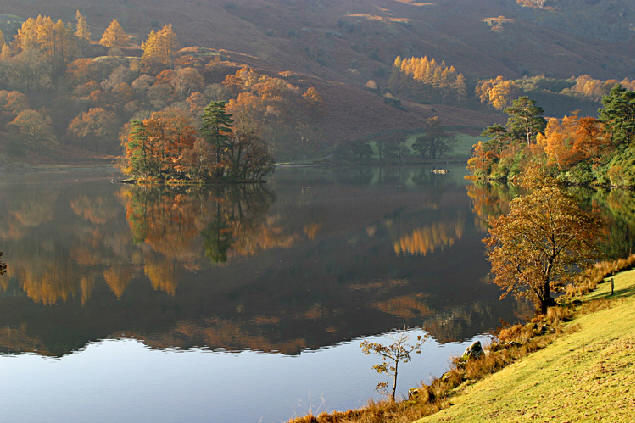
Autumn in England, the Lake District.  Posted by Picasa
Not Just Blue, But Green Too?

Iraq, corruption, even immigration got the headlines, but how well did the environment do this election, and did environmental issues help elect Democrats? According to these environmentalists, the answers are positive.

Said the president of the League of Conservation Voters, "This is the first election I can remember in U.S. history that has put such a specific focus on a top-priority environmental issue, which this year has been a clean-energy future."

This was especially true in races that featured anti-environment incumbents, such as Representative Richard Pombo in California and Senator Conrad Burns in Montana. Senator-elect Jon Tester in Montana was a shining case--a former organic farmer, he ran strongly on promoting Montana as a leader in a new clean energy economy.

Other candidates who made their opponents' anti-environment stands an issue and/or made their own support for clean energy and environmental issues part of their campaign included Senator-elect Claire McCaskill in Missouri, Governor-elect Ted Strickland of Ohio and Governor-elect Bill Ritter in Colorado. Note the names of these states--not always the image of places with "Sierra Club values." But as the political director of the Sierra Club observed, "The striking thing isn't just that the energy/environment issue played a decisive role in these races, it's that it was used to bring an optimistic, inspirational message to an election year marked by lots of negative campaigning."

A few days after his re-election by about 20 points, Governor Ed Rendell of Pennsylvania announced that PA will host the U.S. headquarters of a German solar power integration company--not the first to set up in the Commonwealth. Rendell states flatly: "Pennsylvania's new economy is being powered by clean energy development." Larry West lists his top ten environmental issues affected by the Democrats' win.

This list of candidates the environment helped includes even one Republican--Arnold Schwarzenegger in California--who supported the climate crisis initiative passed by the legislature that the Democrat who will soon to be chair of the Senate Environment Committee--Senator Barbara Boxer of California-- suggests will be the template for proposals on a national scale.

The fact that these wins added up to Democratic congressional majorities and the resulting chairmanships is another major plus. The most dramatic difference is that Senate Environment and Public Works Committee, chaired in this Congress by Republican Senator Inhofe who considers the Climate Crisis a hoax, but chaired in the next Congress by Barbara Boxer, who calls the Climate Crisis "the challenge of our generation."

So it's not just the country that benefitted from this election, but the earth, and most especially the future.

Friday, November 10, 2006


Posted by Picasa

Captain Future's Log

It's A Blue World After All

With Republican concessions in Montana and Virginia Thursday, it became official: it's a blue world after all.

After that initial excitement, what I feel now is a giant sense of relief. The real power of the Democratic Congress at the moment is in the fact of overwhelming electoral victory, which means popular support for change--and the first change is to stop Bush and Republican one-party rule from total domination, leading us to destruction everywhere we looked.

The second achievement is institutional, beginning with the promise of restoring the checks and balances of the Constitution through a Congress that will take its oversight responsibilities seriously, and will not rubberstamp the executive's whims. It is internally institutional as well: restoring integrity to the legislative process, ending systematic corruption. Many of the worst offenders, including their ringleader Rick Santorum, are themselves gone.

Both Speaker-to-be Pelosi and Majority Leader Reid hit just the right notes on Thursday. Reid said the Republicans provided a bad example of not working with Democrats, but it's not an example Democrats will follow. Pelosi talked about progress.

We can hold our heads up again in the world. I think we've come through the fire of the Bush years with a clarity of purpose that is quite impressive. But I also find myself with a feeling I grew accustomed to in the bad election years--I'd like to forget about politics and the news for awhile. That's a lot easier when it's not my job, and the jobs I have are going to require a lot of attention for the next few weeks.

As I try to get used to this, and not get ahead of myself with either too-grand visons and great expectations or anticipating the frustrations that are bound to come, I muse anyway on some of the ramifications.

The news media, for example. For the past several years, major newspapers, magazines and TV networks have slowly but surely responded to what they must have thought was a major conservative shift in the country, as well as the legendary permanent Republican majority. They got rid of their less-than-conservative executives, editors, writers, columnists and replaced them with neocons, fundamentalists and right wing crazies. Now that their transformation of the media is just about complete, what happens but the American public ain't buying that crap anymore.

Really too bad, because it will take years for them to respond. If they ever can. News as entertainment has limited their choices. I'm reminded again of what's passing into history by the sudden death of legendary TV reporter, Ed Bradley. He was an historic figure, as one of the first black journalists on national TV. My Italian grandmother, who came to America as a young woman and lived mostly within the Italian American community, did not come into much contact with black people. They were strangers. She used to watch only a few television shows regularly in her later years. One was Lawrence Welk, in reruns. Another was Family Feud. And the third, unaccountably, was 60 Minutes, which she called "The Clock." I am sure that Ed Bradley was a revelation to her, probably more than any other African American. His curiosity, seriousness, warmth and dignity were palpable. He was a good reporter, and clearly a decent man. Let's hope there are other, younger, newer versions out there, and a few find their way through the usual storms of idiocy, envy and whim to emulate him for the good of the future.

Wednesday, November 08, 2006


Posted by Picasa
The Wave

The dimensions of this, summarized by kos:

We won, and won big. Not only did we take the Senate, take the House, and destroyed Republicans at the state legislative level, but we didn't lose a single senate seat, we didn't lose any House seats, we didn't lose any governorships, we didn't lose any state legislatures. It was a rout of epic proportions.

Kos is also trenchant on the Democrats' agenda, and shoots down the notion that the Democrats elected were conservatives. While some have different positions on social issues (most of which they'll never have to vote on), they are much more progressive and populist on economic issues, against the war and torture, and for constitutional rights. In other words, they aren't extreme right wing lunatics, like the ones who have been running the country. Matt Stoller has more specific details on Dem candidates--the more conservative tended to lose, while the more progressive won. Note especially the support for universal health care.

Georgia10 adds this: When you can't get an abortion ban passed in freakin' South Dakota, America isn't trending conservative. When you can't get a gay marriage ban passed in Arizona, America isn't trending conservative. When opposition to gay marriage bans was more than 40% in 5 of the 8 bans that passed, America isn't trending conservative. When a majority of Americans choose Democrats to represent them, America isn't trending conservative.

Apart from the governator, the Wave swept Democrats into state offices in California. Results on propositions are mixed, but the worst ones were defeated.

Think Progress outlines some of the "firsts" in this tidal wave: the first woman and first Italian American Speaker of the House, more women in the Senate than ever before, the first Muslim elected to Congress, three House committees with African-American chairs, and of course (though TP doesn't mention him) Senator Bernie Sanders, the first declare socialist, who is so down to earth that his socialism is not an issue in Vermont or probably anywhere else.

The first victim of the wave was Rumsfeld, who promptly quit as secretary of Defense. But Bush promptly appointed an insider cut from the same cloth, who may go along with a change in policy but is an interventionist and Republican loyalist deeply involved in Iran-Contra and past machinations that helped create enemies in the Middle East and elsewhere. It seems Bush really wanted to appoint Kissinger, but even the lame duck Senate might not confirm a zombie.

Captain Future's Log

First Thoughts on the Election and the Future

So far it's been about the numbers, and for those who followed individual campaigns, about their candidates. Sometimes it's about the people we don't have to grit our teeth seeing in power anymore. Ricky Santorum, who I disdained from the day he beat Harris Wofford, an intelligent and kind statesman, in 1994, lost to Bob Casey, Jr. (whose father's PA administration I did some pretty good work for, once upon a time) by almost 20 points.

I don't discount the possibility that some of these Democrats, maybe even Casey, will have me gritting my teeth some time in the future, but as for the future as a whole, this was a big win. For the American future it provides the institutional opportunity to restore checks and balances. It can begin to slow down our certain march to self-destruction on so many levels, in so many ways.

But what I think will become more evident in the months ahead is when Democrats take over committees and subcommittees in the House and--as looks likely now--in the Senate. While this means a lot for such high profile issues as Iraq, it means perhaps even more for issues that don't make the front page every day, like energy and the environment, and the issue that brings them together, the Climate Crisis.

Richard Pombo, the environmental dinosaur, is not only gone from the House committees on environment, he's gone from Congress. If Democrats take the majority in the Senate, Senator James Inhofe, who has turned himself into a climate crisis denying industry, will no longer direct the Environment and Public Works committee.

The next wave can build because, with powerful committees and subcommittees--the power to hold hearings and write legislation--it now becomes possible to research and assemble the makings of a future-oriented plan to address the Climate Crisis and other environmental problems, in tandem with new energy policy, which can also result in reinvigorating American science and engineering, with the outcome of creating new industries to build the clean energy systems the entire world will need, to our economic and social as well as environmental benefit. And to do so in time to present it to the American public in the 2008 presidential election.

Tuesday, November 07, 2006

The Wave III

11:15P Pacific--CNN declared McCaskill the victor in Missouri. Jim Webb's lead in Virginia is increasing to about 12,000 votes now, which would put it out of reach of an automatic recount. Democrat Tester continues to lead in Montana. Senate majority is close to going to the Democrats.

It's 10:30 p Pacific. Although Republicans have apparently held on in Tennessee, Democrats have a good chance of winning all three of the remaining Senate races in contention--if there are three. Jim Webb has declared victory in Virginia, and while he has a slim lead, its dimensions will be unknown until tomorrow, and probably a recount will put this in some doubt for a month or more. But he was very smart to declare victory--it's like the officials calling a touchdown, and the video replay has to show convincing evidence to overturn it.

At this hour, Clare McCaskill has gone ahead in Missouri, and Democrat-rich St. Louis has yet to be counted. Jim Tester has been leading from the start in Montana.

So the change has come. Democrats will have a powerful majority in the House. They are winning governorships and state legislatures. And it looks good for a one seat majority in the U.S. Senate.

California returns are still being counted. Ahnold is winning big as expected, but so far he seems to be carrying some important down-ticket offices with him, and some nasty propositions may pass while the most worthy ones may lose.

I realize it's three hours later in the east, but even out here it looks like bloggers are shutting down early. What wimps! Maybe I should reposition this blog as a late night source.
The Wave, Part II

Nearly 9:30p Pacific, the Democratic majority in the House continues to grow. It's closing in on 40 seats, projected. Meanwhile, Webb has pulled slightly ahead in Virginia. If his lead increases to 11,000 votes, he'll avoid an automatic recount. Missouri still looks good, as does Montana, and Tennessee has not yet been called, so they are all still in play for a Senate majority.

Shortly after 8 pm Pacific, NBC and CNN project Democrats will have a majority in the House. It could be a pretty big majority before the night is out. A disappointment in Arizona, where the Republicans held onto their Senate seat. Now the Dems must win 3 of 4 close races. I feel good about Missouri and Montana. But they have to win either Virginia or Tennessee, and Virginia looks so close it will go to an automatic recount.

6:30 pm Pacific:

CNN projects a Democrat pickup for Senate in Rhode Island. That's three. Democrats need three of these four: Virginia, Montana, Missouri, Tennessee, or the outlyer possibility of Arizona.

Early bellwhether House races are going Democrat--not enough yet to say it's a wave, but it bodes well for majority. Now CNN projects another Indiana pickup for Democrats.
The Wave, Part I

NBC projects that the Democrats hold Maryland, so now it's a matter of picking up four more Senate seats. Fly in the ointment: Joe Lieberman is projected to win Connecticut, as an Indepedent, who will caucus with the Democrats. So it's not a loss, it's just not the gain it should be with Ned Lamont (assuming the projection holds.)

CBS and NBC project that little Ricky Santorum, the architect of official corruption in the Senate, is going down: Bob Casey, Jr. will be PA's new U.S. Senator. CBS and NBC also project Sherrod Brown to win the Senate race in Ohio. That's two of the six seats Dems need for Senate majority, assuming they don't lose any. NBC projects Bob Mendendez retains the Dem seat in New Jersey. There's really only one other endangered Dem Senator, in Maryland.

Ken Blackwell, the Dark Lord of 2004 in Ohio, has gone down. Democrat Ted Strickland is projected to win big for Governor. Katherine Harris, Dark Lady of 2000, has gone down as well in her attempt to unseat Democrat Bill Nelson for U.S. Senator in Florida.