Saturday, November 04, 2006

Captain Future's Log

The Wave

In close election seasons, particularly with saturation coverage of the same news story by so much media at the same time, the weekend before an election is often when the final shift in the political winds can determine the outcome on the following Tuesday.

But not this year. The electorate began moving towards a decision against President Bush, barely if actually reelected in 2004, at least a year ago. Primaries this spring suggested it would affect the Republican Congress. In September a discernable wave against Republicans nationally began to build, and it may still be building, but mostly by feeding on itself. It is ready to roll through Tuesday.

What can stop it or slow it down? Nothing. However, the more pertinent question is: what can prevent it from being fully expressed in votes? The possible barriers are these:

1. Voters against Bush and Republican candidates will stay home while a superior get out the vote effort will be mounted by Republicans;

2. cheating, by repressing registration and intimidating voters, chaos and unlawful activities at the polls to eliminate as many voters as possible who demographically vote Democrat, and fraud by electronic machine or otherwise to manage the outcome, especially where Republicans control the process;

3. so-called wedge issues, like gay marriage, or local issues as well as strengths and weaknesses of individual candidates, that could determine specific races counter to national trends.

But here's how these factors look to me at the moment:

1. GOTV: It seems that part of the building wave is expressed not only in numbers but in intensity. Polls over the past week or so pretty consistently show that Democrats and Independents likely to vote Democratic are motivated to actually vote. As for the Republicans' superior Get Out the Vote technology, Democratic political operative and observer Joe Trippi makes the point that Republican efforts are concentrated in a few races where they expected a fight, but they've gotten a fight in many more places, where they aren't so well equipped, and where other organizations (like labor unions) are gearing up to do their GOTV. This bodes well for Democratic House pickups in particular. Also, passion can compensate for technology, and in close Senate races there appears to be a lot of passion for Democratic candidates.

2. Cheating: News media is/are paying a lot more attention to this possibility, partly because of clearly demonstrated vulnerabilities in electronic voting systems, and partly because of the chaos in certain primaries this year and difficulties caused by the changes that take effect this time in many states that have adopted new rules and machinery. In 2000 and even in 2004, a lot of people didn't believe this was an issue. This year, a lot of people know that it is. That attention may help, if and when there are suspicious instances.

There's also the question of where it may happen. Florida and Ohio are notorious, and they both had Republican state governments where the Secretary of State was a Bush activist with higher ambitions. Both of them (Katherine Harris running for Senator in Florida and Ken Blackwell running for Governor in Ohio) are so far behind in the polls that victories would be highly suspect. The Democrats are expected to win a lot of Ohio House seats and do well in Florida. These aren't "battleground" states this year. In states that are, observers will be watching closely. Cheating is still possible, but it won't be uncontested this time.

There are a few interesting related questions that can't yet be answered but which might influence outcomes. People concerned about problems and cheating may have voted with absentee ballots, or participate in early voting in states where that is permitted. This may skew predictions based on past profiles of absentee and early voters. Also, there may be new voters that skew the "likely voter" profiles of polls. Whether they actually get to vote is another question.

3. Wedge and individual issues/candidates: So far, polls are showing that wedge issues--like the New Jersey Supreme Court decision upholding the rights of gay couples--aren't playing a significant role. Iraq is almost everything. The exception may be in the Missouri Senate race where the issue of stem cell research may make a difference. Although it is hard to believe it will help the Republican, some analysts claim that it may be at the moment.

It finally does come down to individual races, particularly in the contests that will likely determine control of the Senate. But the wave influences how those may go, too. Because the pattern has been set, anything that reinforces it will add to the wave's power, and anything that runs counter to it will have to be very powerful to change momentum.

So the news of Friday, for example, all very negative for Republicans, reinforces the already negative view of Republicans as corrupt, and ineffective on Iraq and even on terrorism. Some of these may have strong enough impact in certain contests to push Democrats over the top. The latest scandal of a prominent evangelical-politico (patronizing a gay prostitute and buying meth) may further depress the religious right vote, but it may have the most tangible effects on close races in Colorado, where said evangelist lives.

The most dramatic may happen Monday, when (according to NBC) the four newspapers of the Military Times Media Group--the Army, Navy, Marine and Air Force Times--will call for the firing or resignation of Secretary of Defense Donald Rumsfeld as Secretary of Defense, because he has lost the confidence of military officers and soldiers. (Kos now has the full text.) As NBC's David Schuster points out, these are the publications that military families read, and this editorial could very well be the final impetus for those with serious doubts about Iraq to vote that way.

There are a lot of military families in Virginia, where Democrat Jim Webb--former Secretary of the Navy--seems to have the momentum to win Senator George Allen's seat. There are a fair number of military families in Tennessee as well, and even though Democrat Harold Ford appears to have fallen behind, this could be a plus for him.

Assuming for the moment that energized and motivated Democrats work hard to show that they can do GOTV, too, and that Democrats and Independent voters turn out in expected numbers or higher, I feel good about the Democrats' chances.

Then there's the distinct possibility that core Republicans, especially religious right voters (as opposed to their currently squabbling and compromised leaders) don't vote in their usual numbers, or don't vote Republican. If that happens, or if there is a much larger turnout than anticipated, the wave could become a tidal wave. Democrats could pick up 50 seats in the House, though they need 15 for a majority. They could sweep all the close Senate races, and even pick up a couple that Republicans don't notice are still up for grabs.

Because it's obvious from reading the latest polls, where something like 8% support Bush's handling of Iraq, that if public sentiment is truly reflected in voting results, we're in for nothing less than a political tsunami.

UPDATE Sunday: Some final polls are showing tightening benefitting Republicans generally, though not all polls agree. Senate races may be in flux, going both ways. Which reminds me that there is one additional and potentially powerful factor mitigating against the wave: habit. To vote for change requires that people change, and voters who have been voting Republican in recent elections may find it difficult to switch. It is in the final moments that voters who feel queasy about changing become most receptive to the messages they accepted before: it increases their comfort level. So the wave can break at the voting booth, if voters don't have the courage to change. Still, the Democrats are likely to control the House and at least come close in the Senate, with the tidal wave of double digit margins in the House and control of the Senate still very possible.

Friday, November 03, 2006


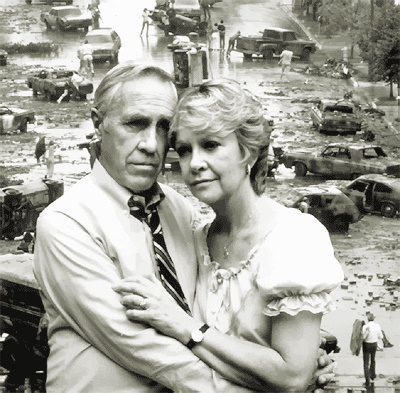
A movie from the 1980s,"The Day After."suggests what
is still an imminent danger, a generation after the Cold War. Posted by Picasa
Bush's More Dangerous Nuclear World

They make you take your shoes off before boarding a plane, but they don't adequately inspect cargo coming into our ports for terrorist bombs entering the country. They put children with common names on no-fly lists but they don't adequately protect nuclear power plants against terrorist acts. They keep people in jail for years without charge, torture people caught in random round-ups, and they demand to know what books American citizens read from their public libraries--yet the New York Times revealed, the Bush government actually posted what amounted to "a basic guide to building an atom bomb" on the Internet, for the world to see.

Now Bush Administration officials are all over the airwaves blaming everybody but themselves for this serious lapse of security. For weeks this information was available to Iran and any other country or group in the world. It was posted on a web site as documentation of the Iraqi nuclear program that had been abandoned in 1991, but which ostensibly was the reason for the Bush invasion of Iraq, even though there was little or no evidence it existed in 2002 and evidence that it did not.

It is one more illustrations of the fact that the Bush administration is not adequately protecting Americans, they only say they are. They are more interested in spreading fear that might help them politically, and in creating scary phantoms and simplistic imagery to make themselves look strong and competent, than in paying attention to what needs to be done.

But the Republican failure to act competently, intelligently and effectively on behalf of U.S. security is only part of this story. This criminal lack of attention to nuclear information dramatizes one of the most dangerous aspects of Bush policy: its attitudes on nuclear weapons.

With inconsistent and ineffective policies on Iran and North Korea, the Bushites are ill equipped to deal with the near term possibilities of significant nuclear proliferation in the world. It's estimated that as many as 40 countries have the technical skill to make atom bombs. Yet the Bush administration opposes international agreements that have restrained proliferation since the 1960s, when President Kennedy brought worldwide attention to this danger.

One reason is that the Bushites want to develop new nuclear weapons. With all the concerns if not panic over North Korea and Iran, the largest nuclear threat is overlooked. The idea that the end of the Cold War automatically ended the threat of thermonuclear apocalypse in the U.S. and for the world at large is false. Here are the facts, from Helen Caldicott, president of the Nuclear Policy Research Institute:

Of the 30,000 nuclear weapons in the world today, the United States and Russia possess 96 per cent of them. Of these, Russia aims most of its 8,200 strategic nuclear warheads at U.S. and Canadian targets, while the U.S. aims most of its 7,000 offensive strategic hydrogen bombs on Russian missile silos and command centres. Each of these thermonuclear warheads has roughly 20 times the destructive power of the bomb dropped on Hiroshima, according to a report on nuclear weapons by the National Resources Defense Council, a U.S. environmental group.

Of these 7,000 U.S. strategic weapons, 2,500 are deployed on intercontinental ballistic missiles that are constantly maintained on hair-trigger alert ready for immediate launching, while the U.S. also maintains some 2,688 hydrogen bombs on missiles in its 14 Trident submarines, most ready for instantaneous launching.

A Rand study found that the chances of accidental thermonuclear war have actually increased since the end of the Cold War.

Terrifyingly, the early warning systems of both Russia and the U.S. register false alarms daily, triggered either by wildfires, satellite launchings or solar reflections off clouds or oceans. Of more immediate concern in both the United States and Russia is the threat of terrorists or hackers entering and disrupting the computerized early warning systems and command centres.

Now experts warn that the widely predicted and feared U.S. attack on Iran could trigger an accidental nuclear exchange if the Russians misinterpret missile launchings as an attack on their terroritory.

The process of deciding to launch these thermonuclear arsenals is designed to take minutes. In such an exchance, big cities like New York would be destroyed by several hydrogen bombs, and virtually everyone would die within days.

Most towns and cities with populations over 50,000 on the North American continent are targeted with at least one hydrogen bomb. Only 1,000 bombs exploding on 100 cities could induce nuclear winter and the end of most life on earth.

Why is this so? Perhaps the Bushite desire for new nuclear weapons discourages talking about the existing arsensals, but clearly the Bush Administration is not focusing attention on this major threat to America and the world. The Bushites would rather start a needless and tragic war, that now claims attention and resources that we need to be placing elsewhere.

With Bush and Cheney in the White House, together with a Congress they tightly control, we will not address this issue. We endanger ourselves and the world. This is perhaps the most silent and most deadly danger in the present moment.

Thursday, November 02, 2006


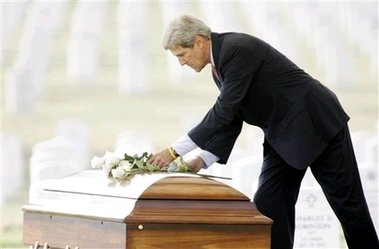
Senator John Kerry at one of several funerals of soldiers
killed in Iraq he has attended. President Bush has attended
none. Posted by Picasa
Iraq and At Home: Rummie's Fantastic Job

On Wednesday, President Bush said that Don Rumsfeld, the architect of military policy in Iraq, will be Secretary of Defense as long as he is in the White House, and Dick Cheney, the strongest supporter of attacking Iraq who recently reaffirmed his belief that the war is going well, will also remain. "Both those men are doing fantastic jobs and I strongly support them," Bush said in an interview with The Associated Press and others.

Also Wednesday, the New York Times published a secret chart from the United States Central Command showing the situation in Iraq edging ever closer to chaos. And this estimate by the U.S. military was made two weeks ago. A few days ago the Prime Minister of Iraq purportedly told his inner circle that the situation in Iraq is nearly out of control.

Now on Thursday, the New York Times releases results of a devastating poll. Showing a sure understanding of the Bush position (reinforced by his Rumsfeld statement), 70% believe that Republicans will stay the course or increase troop committment if they retain Congress. 81% believe that if Democrats are elected, they will try to bring the troops home sooner.

This poll verifies what many others have: that for weeks now, the electorate has been set in its assessments, especially about Iraq and Bush. At this late date, less than a week before the election, the numbers here are truly extreme: "The poll showed that 29 percent of Americans approve of the way President Bush is managing the war, matching the lowest mark of his presidency. Nearly 70 percent said Mr. Bush did not have a plan to end the war, and 80 percent said Mr. Bush’s latest effort to rally public support for the conflict amounted to a change in language but not policy. "

In terms of the elections, the poll verifies the same approximate divide in the "generic" party split nationally: some 52% say they will vote for Democrats, 33% for Republicans. But perhaps most significant in these waning days is the Independent vote: 50% say they'll vote Democratic, and only 23% for Republicans.

The President and Vice-President have been hammering on terrorism the past week, yet the poll shows that slightly more voters believe terrorism would increase under Republicans than under Democrats. Voter intensity also favors Democrats.

According to a story in Thursday's Washington Post, Republicans were in danger of losing their congressional majority just on the issue of corruption--at least nine of their candidates are currently embroiled in scandals.

But as the Times survey and every other poll shows, Iraq is the prime issue. And in reporting from Iraq, detailing the extent of the chaos--the fighting, the deaths and death squads, a million and a half people fleeing their homes-- Patrick Cockburn writes: As American and British political leaders argue over responsibility for the crisis in Iraq, the country has taken another lurch towards disintegration.

From US Central Command. NY Times. Posted by Picasa

Wednesday, November 01, 2006


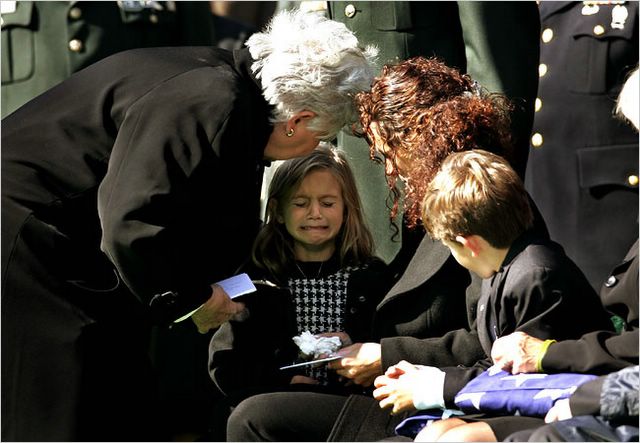
Burial of Scott Dyer. Photo: Doug Mills, NY Times. Posted by Picasa
P.R. War, Real Death and Cost

The Pentagon has admitted to seven families of soldiers killed in Iraq and Afghanistan that they weren't told the true circumstances of those deaths. The seven includes Pat Tillman, the football star who quit the NFL to volunteer after 9-11, who was apparently killed by other American troops, though it wasn't reported that way at first. His family has been quite vocal about uncovering the truth surrounding his death, and it seems likely to me that this Pentagon announcement was mostly cover for their supposedly inadvertent misreporting of the facts of his death. The other six may just be diversions.

Because Tillman's death wasn't just misreported--it was made into a story of heroism for the media. Through the Pentagon or otherwise, the Bush administration has hardly been shy about fabricating stories to make them sound like Hollywood war movies--perhaps the most notorious case was one of the first stories out of the Iraq war, concerning Jessica Lynch. There was hardly an element of the official story that Lynch hasn't since denied, or that others support.

Now the Pentagon wants to spend even more money on a special PR unit to "better promote its image" because the only war Don Rumsfeld concedes the U.S. is losing is an image war. But this shouldn't really be surprising. Controlling imagery and information has been key to the Bush administration's success at selling the war until now. No flag-draped coffins or body bags unloaded from airplanes in the sight of cameras. Very little information from Iraq that isn't controlled in one way or another.

And even though the news media is partly at fault for failing to cover this war objectively and thoroughly, there is one little known fact that is well worth mentioning: more journalists have died covering the Iraq war than died covering Vietnam, Korea or World War II.

But this is part of a larger pattern. All administrations have tried to control information and present a favorable face--they all use PR. It can be a legitimate and useful communcations tool. But this Bush administration is all about PR at its core, with no respect for truth or truth-telling. Lying has become its art.

As Iraq itself demonstrates, the image is more important than the reality, the name of a program or a law is more important than the program or the law itself, and the Administration's chief occupation is PR for itself. To this end it has put so-called journalists on the payroll as propagandists, changed the content of scientific reports by government agencies, and used the power of the Presidency to sell and promote statements, assertions and imagery that have no basis in reality, and which facts and reality often contradict. Let's not forget that ex-cheerleader George W. Bush's only success outside government was doing PR for a baseball team.

Now American voters may have disenthralled themselves, and stopped buying the made for TV version of reality that the Bush government has been selling. They may have even come out from the carefully controlled grip of fear--or in Barack Obama's great phrase, the 9-11 fever may have broken--so they are no longer terrorized by talk of terrorists winning if Democrats obtain a meaningful role in government through election.

The war fever has definitely broken, and that may be why the polls have shown for many weeks now that no matter what else happens, Iraq is foremost on American minds. The public may finally be dealing with the reality. They've stepped back from the administration's game to look underneath the shells, and they see nothing. Except the reality of Iraq.

There is a news report on Iraq that is worth quoting at length:

Iraqi Prime Minister Maliki is telling his inner circle that the situation in Iraq is "nearly out of control," according to CBS News intelligence sources. Pentagon sources tell the network that General Casey will require 100,000 more Iraqi troops than the 325,000 who were to be trained in order to secure the nation. The security situation, however, has worsened and Iraqi troops have proven to be less effective than their American counterparts. Additional American troops may be called up to help train the new Iraqi security forces, and the U.S. may also double the number of advisors in each Iraqi unit.

An AP report says that Rumsfeld has already approved spending an additional $1 billion on more Americans doing more training of Iraqi forces.

The David Edwards report continues:

Prime Minister Maliki has ordered that all checkpoints in Baghdad be lifted. Lara Logan of CBS News reports that some American troops expect that violence will now increase and are left questioning why U.S. Commanders would allow checkpoints to be removed now. The move is widely seen as a victory for Muqtada al-Sadr of Sadr City, who controls one of the largest militias in Iraq.

The Inspector General warns that Iraqis don't even have the capacity to fund or maintain their army. The Pentagon is being called upon to provide better weapons and armored vehicles to Iraqi security forces. The Pentagon's Inspector General has found that 14,000 small arms provided to the Iraqis are now missing. The lost weapons were never registered and can not be audited.

The Washington Post added this:

The top U.S. military commander in Iraq, Gen. George W. Casey Jr., predicted last week that Iraqi security forces would be able to take control of the country in 12 to 18 months. But several days spent with American units training the Iraqi police illustrated why those soldiers on the ground believe it may take decades longer than Casey's assessment.

The problem now is that reality has become more fantastic, verging on madness, than the simple imagery of the Bush PR machine. It is out of control, not only of PR efforts to gloss it over, but tragically, of other efforts in reality.

But the Bushite Republicans cannot afford to allow for sensible debate and a sincere search for solutions, on Iraq or stem cell research or the Climate Crisis, because they are standing on a foundation of phony images and deception. The only tool left to them is the smear, the diversion, the false accusation, and what they know best: inflating and creating an image to distract the public from their lies and failures.

They're doing it in a wave of negative commercials, in the shameful speeches of the president and vice-president, and they've attempted to do it by seizing on an awkwardly delivered sentence to accuse John Kerry of maligning the troops in Iraq. But Kerry drew the line:

"If anyone thinks a veteran would criticize the more than 140,000 heroes serving in Iraq and not the president who got us stuck there, they're crazy. This is the classic G.O.P. playbook. I'm sick and tired of these despicable Republican attacks that always seem to come from those who never can be found to serve in war, but love to attack those who did.

The people who owe our troops an apology are George W. Bush and Dick Cheney who misled America into war and have given us a Katrina foreign policy that has betrayed our ideals, killed and maimed our soldiers, and widened the terrorist threat instead of defeating it. These Republicans are afraid to debate veterans who live and breathe the concerns of our troops, not the empty slogans of an Administration that sent our brave troops to war without body armor.

Bottom line, these Republicans want to debate straw men because they're afraid to debate real men. And this time it won't work because we're going to stay in their face with the truth and deny them even a sliver of light for their distortions. No Democrat will be bullied by an administration that has a cut and run policy in Afghanistan and a stand still and lose strategy in Iraq.

Tuesday, October 31, 2006


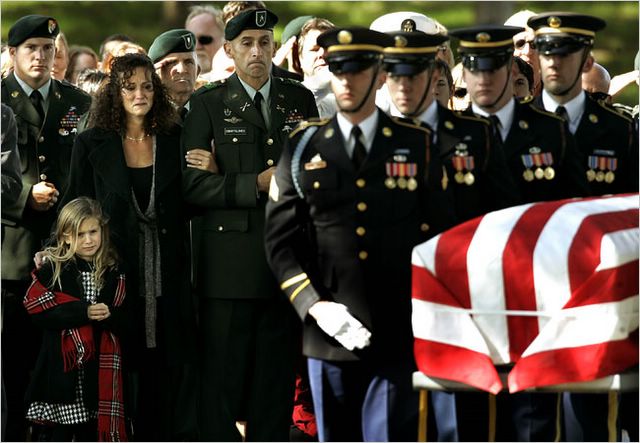
Burial of Sidney Dyer, killed in Afghanistan. Photo:
Doug Mills in the New York Times. Posted by Picasa

Burial of Corporal Carl Johnson. Photo: Doug Mills, NY Times. Posted by Picasa

Burial of Capt. Adcock of VA. Photo: Doug Mills, NY Times. Posted by Picasa
Finally, the Reality

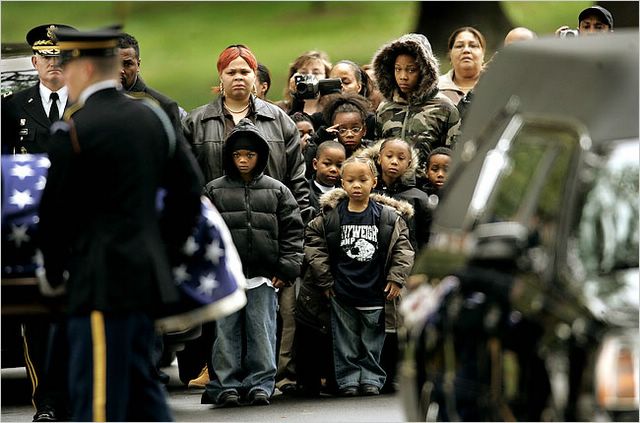
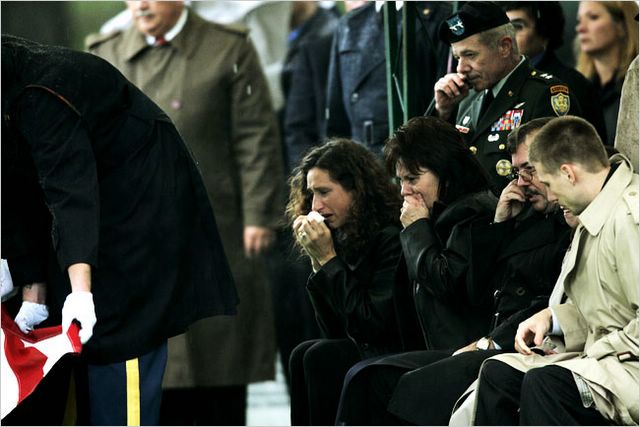
On Monday the New York Times printed a series of searing photographs taken recently at the funerals of American soldiers killed in Iraq and Afghanistan. It was published on the day that the death toll of American soldiers killed in Iraq this month exceeded 100. It was the talk of cable TV. Nancy Grace devoted her hour, normally assigned to castigating alleged criminals, to talking about individual soldiers killed in the Iraq war.

This attention could not come at a worse time for Republicans, and it also happened as the Democratic party unveiled several new campaign ads all focusing on the Bush administration's responsibility for Iraq. The one for James Webb, running for the Senate in Virginia, is devastatingly powerful. The one for Senator Robert Menendez in New Jersey is less impressive by comparison, but Menendez has a strong backup to his message: he voted against authorizing the Iraq invasion. (Webb wasn't in office but wrote a newspaper piece against it before it happened that predicted a lot of what has resulted.)

New polls show Webb moving ahead, Menendez slightly ahead, and one poll shows the incumbent Democrat in Maryland substantially ahead; Ford is moving ahead in Tennesssee. The last week emphasis on Iraq could be the coup de grace.

But I can't help wondering why it took some three years for these images to make it onto the front page and on television. These funerals have been going on every week, somewhere in America. This is one face of war we should always have to face. Finally, some reality.

Saturday, October 28, 2006

The Senate and the Tide

It seems likely now that next Tuesday will see a Democratic tide, affecting state offices and the U.S. House of Representatives. It is also likely that the Democrats will pick up some seats in the Senate, but control of the Senate is another matter.

There are five contests now virtually tied. If incumbents or incumbent parties lose in all of them, the Republicans would lose Virginia, Missouri and Tennessee, but the Democrats would lose Maryland and New Jersey. There are all kinds of combinations of how this may actually break, with the least likely possibility being that the Republicans win them all.

Still, unless the anti-Republican tide is truly historic, the Senate will likely go to one party or the other by two votes, one vote or to the Republicans if it comes out 50-50 (because VP Cheney is the tie-breaking vote.)

So this magnifies the importance of a race that nobody is talking about much: Connecticut. Senator Joe Lieberman, elected as a Democrat, was defeated in the Democratic primary by Ned Lamont. Lieberman is running as an independent, and contrary to many predictions, he is solidly ahead in the polls.

Even in the blogosphere, early enthusiasm for Lamont (and it was the blogosphere that gave him momentum to close the gap and win the primary) has become dark grousing, as in this post at Firedoglake complaining that prominent Democrats (except for John Kerry and Wesley Clark) are not going to Connecticut to campaign for Lamont. The conventional wisdom also has been that as an independent at the bottom of the ballot, Lieberman could not mount a Get Out the Vote operation on election day to get his voters to the polls. Now it's been announced that he is "borrowing" the GOTV operation of Republican Michael Bloomberg, the Mayor of New York City. That means money and bodies, and it's a big blow to the Lamont campaign.

In his campaign, Lieberman has been getting a lot of help and support from Republicans, including from the White House. He has not endorsed Democratic candidates for the House in Connecticut. The Senate Democrats are in a bind, apparently. It was rumored after the primary that there was heavy pressure on Lieberman to get out of the race, and talk of stripping him of his considerable Senate seniority and committee assignments. But clearly some of his Senate colleagues are worried about alienating him, since the polls say he is likely to win.

It is all shaping up then to mean that the flow of power in the U.S. Senate for the next two years will largely depend on one man--Joe Lieberman. In an evenly divided Senate, or even with a one vote majority, he is the unknown quantity. And given all the Republican help that may get him elected against his former party's nominee, it is not likely to be good news for Democrats.

So maybe this is a race that Democrats ought to be paying more attention to. They can't afford to lose more than two of those five Senate elections if they don't want to have to deal with Joe Lieberman, the man without a party, but maybe with a lot of grudges.

Friday, October 27, 2006


Cedars of Lebanon Posted by Picasa
The War on Terra

We're rightly focused on the human casualities of war--the needless deaths of individuals, the rending of families and of communities, most obvious at the moment in Iraq and Darfur. We mention then the economic costs, to the countries devastated by warfare, and to the generations of Americans who will pay for the billions of dollars burned every year, every month, every week. But those billions pay to burn more than bridges or even people. These wars are wars on the earth itself.

This was perhaps most evident last summer in Lebanon, when the New York Times
reported that: Spilled and burning oil, along with forest fires, toxic waste flows and growing garbage heaps have gone from nuisances to threats to people and wildlife, they say, marring a country traditionally known for its clean air and scenic greenery. Many of Lebanon’s once pristine beaches and much of its coastline have been coated with a thick sludge that threatens marine life.

That was July. A month or so later the dimensions of the catastrophe were still growing, as oil slicks threatened the major food supply of fish, and required a year of cleanup costing hundreds of millions of dollars. But even that is short-term. War places a double whammy on the earth, by destroying and polluting, and also destroying the ability of the human population to even try to fix it. And some things just can't be fixed. If ecosystems are damaged enough, or at a vulnerable point, the damage and destruction ripples out, ultimately getting worse.

Some ecosystems never come back. Forests are the prime example. Entire forests were cut down across Europe and the Middle East for fuel but also for warfare--for ships and fortifications and to deny enemies cover. Many of those forests never returned. In some places, other factors combined to turn once green areas into desert. Parts of Lebanon escaped the fate of other areas there. But maybe not this time. The cedars of Lebanon, already endangered, may soon become nothing more than an empty symbol.

The range of environmental construction caused by war and warmaking is just beginning to be counted and studied. But the war on Terra goes beyond war, of course. And we are doing now to the endless oceans what we have done to the endless forests that once covered the land of this planet. We may fight this war until we run out of ammunition, and water, and the variety of food that sustains us, until we are the last primates, the last mammals, on the planet. Then the war will be over, and both sides will have lost.

The earth as the battlefield which will heal itself, and poppies grow where young men stood, may have been true to some extent for some wars in the past. But our weapons are way too destructive now, as are the raw materials needed and the processes of creating them. Now we devastate heedlessly, we poison, we irradiate, and we walk away. War is not always an apt metaphor for our civilization but in this it is. Heedless consumption as well as heedless destruction, and the greed of a few (a factor in war as in the war on Terra) or of many, has opened up a continent-size hole in the ozone layer, and the Climate Crisis moves in our us, to hit us right between our denying eyes.

If civilization survives much longer, the consequences for the environment as well as the seventh generation to come will be a factor in every major decision, because that's simply a tautology. Unless we end the heedless war on Terra, that war will end us.


Frank & Ernest Posted by Picasa
Michael J. Fox on Making A Difference

Michael J. Fox appeared on the CBS News and said this about his Missouri ad:"The irony is that I was too medicated. I was dyskinesic," Fox told Couric. "Because the thing about … being symptomatic is that it's not comfortable. No one wants to be symptomatic; it's like being hit with a hammer."

"At this point now, if I didn't take medication I wouldn't be able to speak."

He said he appeared in the ad only to advance his cause, and that "disease is a non-partisan problem that requires a bipartisan solution."

"This is not about red states and blue states," added Fox, who has also lobbied Congress to lift President Bush's restrictions on funding for stem cell research. "This is not about Democrats and Republicans. This is about claiming our place as the scientific leader in scientific research and moving forward and helping our citizens. That’s all it is. It’s that simple."

Fox said that it is difficult for him to appear in ads and do interviews because of his illness and what it does to him, but he is glad he is given the opportunty. "Honestly, I mean, I really feel this: That you get in your life very few chances to make a difference. And I really feel privileged to do this that I get a chance to do this. But having said that, it's not pretty. It's not pretty when it gets bad..."

Elsewhere...

Hey fellow early boomers, check out Consensus Now at 60's Now.

Political note: Going into the weekend, polls indicate that the Senatorial races in Missouri, Tennessee and Virginia are all essentially tied.

Thursday, October 26, 2006


sunny October. BK photo. Posted by Picasa
Roved Again?

Even Democrats can hardly believe they're going to win, so it's not so surprising that some Republicans can't accept that they will lose... And what if they're right?

Karl Rove is functionally arrogant, but has usually kept from displaying that arrogance too forthrightly--and besides, he's had this oddly unfathomable winning streak. But his arrogance was on full and obvious display in a radio interview with NPR's Robert Seigel. Rove flatly stated that Republicans will retain control of both houses of Congress. When Seigel suggested that "many might consider you on the optimistic end of realism," as of course anybody reading or hearing the news for the last month or so would, Rove shot back, "Not that you would be exhibiting a bias or anything like that. You're just making a comment." A clear and clearly cheap shot at NPR--a Rove trademark, although he usually lets others deliver it--and a ploy at intimidating Seigel into not asking hard questions.

Rove several times insisted that despite the public polls--many of them, contrary to his assertion, polling specific contests--the polls he was seeing showed that Republicans will retain power. Or as Rove modestly put it, "You may end up with a different math, but you're entitled to your math. I'm entitled to THE math."

But perhaps Rove's most arrogant statement was that the public polls showing two-thirds or more of voters saying the Iraq war must end, or the majorities that believe Bush lied them into the war and has kept on lying about it, and all the other national issues that voters are angry at Republicans about--simply don't matter. They "do not impact the outcome."

Specifically he was talking about local issues or other overrriding issues being more important in individual races. But the idea that so many Americans can be so upset about so many important matters, about a war that kills hundreds, even thousands of people a month and is costing this country billions, but can't change the government bungling that war, lying all the way, is profoundly disturbing.

But as many suspect, perhaps Rove has different reasons for his predictions. Stories continue to appear about the likelihood of problems with voting--everything from electronic machines to a dearth of trained poll workers. A new report by Electionline.org, supported by the Pew Charitable Trust, cites ten states as having particular problems this time, including states with crucial races, like Maryland, Ohio, Colorado, and Pennsylvania. Suppression of voters who would most likely vote Democratic is a matter of record and even of law in several states, including Ohio and Florida.

The rollcall of such problems, plus the Rovian district-by-district analysis, prompted election maven Chris Bowers to ask: "How Much Do Democrats Have to Win By to Actually Win?" He quotes at length a study by three political scientists who conclude: If current trends in the congressional generic ballot polling persist (which they have in past election campaigns), the Democrats are near certain to win control of the House. But this assumes a continued Democratic lead of 8 or more points among likely voters in the generic ballot. If the lead dips below this level, the Republicans can rekindle their hope of holding the House.

So in terms of the generic D or R national polls, Dems have to win by 8 points. Bowers concurs with that figure. It may well be that even in individual contests, the Democratic candidate will have to get 8% more votes than the Republican just to come away with a one point victory.

All of which is even more motivation for voters to get out there and vote for Democrats.

UPDATE: Figures just out today show that Democrats have increased their generic national lead to 11 points for the House in one poll, and 18 points overall in another.

Frank n Ernest Posted by Picasa
Stratergy

In addition to their usual terrorist tactics, Republicans are spraying their scattergun attacks of coded messages and sleaze to see what works. So far the scorecard isn't good.

First came the national effort to scare voters with the image of Nancy Pelosi of SAN FRANCISCO as Speaker of the House. San Francisco is a code word for liberal/libertine sin. It supplants Las Vegas as sinner city because, well, a lot of Republicans go to Las Vegas and own big pieces of it, even though prostitution is one of its major industries. San Francisco is the city of gay sinners. Despite, you know, Republican Mark Foley of Florida.

How's that working? Well, every time the charge is made on TV, up comes a picture of Nancy Pelosi. She doesn't look so scary. The message says she'll be the next Speaker of the House. She will be the first woman to be Speaker of the House, third in line to the Presidency. Women are a large and important part of the electorate, and the poll show that most are highly motivated to vote against Republicans this year because they are upset about the war, and about a Republican Congressman who was a sexual predator of teenagers, and the House leadership who covered up for him, and a Republican White House that insisted he run for re-election. Who do they think might represent their feelings and priorities? Like a woman Speaker of the House perhaps? Advantage: Democrats.

Then this week came the ad in Tennesee in which a nearly naked white woman says she met Rep. Harold Ford, the black Democrat running for the Senate, at a Playboy party, and flirtaciously says, "Call me." The ad was roundly criticized as race-baiting and just plain racist, and so it didn't last very long. That alone probably got Ford some more contributions, but perhaps his own response is what turned this to an advantage. He denounced the ad itself, but said that he had indeed attended a party sponsored by Playboy at the 2005 Super Bowl. Ford is a 36 year old bachelor. Here's his statement: "I was there. I like football and I like girls. I don't have no apologies for that."

There are undoubtedly old time racists in Tennesee who respond to the ad's fever nightmare of black men preying on white women. But these days there are a lot of attractive non-white women everywhere, including on TV and in the movies. White men are less likely to let prejudice interfere with sex, at least on a fantasy level. And when a guy says "I like football and I like girls," he just won a ton of votes. In a very close contest, advantage: the Democrat.

But the latest and biggest controversy is over a campaign commercial by actor and victim of Parkinson's Disease Michael J. Fox made on behalf of the Democratic candidate for Senate in Missouri, another close contest that could decide who wins the Senate. Fox spoke in support of candidate Claire McCaskill because she backs stem cell research, which could hold the key to a cure for Parkinson's and other diseases. On his radio show, Rush Limbaugh has repeatedly accused Fox of exaggerating his symptoms for effect.

On MSNBC Wednesday, seasoned political observer Lawrence O'Donnell said that the Michael Fox ad was the most effective political ad he had ever seen, and the Limbaugh accusation gave it even more prominence, in Missouri and all over the country. (Fox has made similar ads for other proponents of stem cell research, including at least one Republican.)

Some commentators believe that Limbaugh succeeded in energizing the Republican base that considers stem cell research as a kind of abortion. But others see it as a major mistake, an attack on a popular and well-liked actor who suffers from Parkinson's, whose career was shortcircuited because of it, and who like other Parkison's sufferers, has visible effects of the disease that might not have to be suffered if stem cell research were successful. An attack that is over the line, even for Republican swiftboaters.

Things were moving towards McCaskill before this, and this is likely to accelerate that movement. As voters in other states have shown, they hate to be nationally embarrassed. Advantage, once again: Dems.

UPDATE: A national study shows that after viewing the Michael J. Fox ad, support for Republicans against stem cell research (that's nearly all of them) drops by 10 %, and support for Dems moves up 10%.

Tuesday, October 24, 2006


From "Animate Earth" by Stephan Harding. Posted by Picasa
That's Intense

As downright otherworldly as they might have seemed even six months ago, polls favoring Democrats and placing Iraq at the top of voter concerns have become familiar, with the only big news being that they are holding two weeks before the election. But the new ABC/Washington Post poll has some surprising nuggets.

This poll shows, as other do, a greater lead for Democrats than for any other election in more than 20 years, and more than a 50% preference for Democrats among Independents. But one of the biggest questions about eventual outcome is voter intensity. This poll found: "Fifty-eight percent of registered voters call the 2006 races more important to the country than past congressional elections in their lifetime. Democrats, in particular, say so — 69 percent of them versus 49 percent of Republicans. " And "Nearly twice as many registered voters say they'll cast their ballot as a way to show opposition to the president (31 percent) as to support him (17 percent)..."

As for issues, after Iraq at the top, this poll found that terrorism led health care by a few points; the latest Newsweek/ NBC poll showed health care actually leading terrorism by a few points. So they're close. The NBC poll also shows more than majority support for investigating congressional wrongdoing and corruption among contractors in Iraq as high priorities. And perhaps the most shocking of all, 51% actually favor Bush's impeachment, with 28% calling it a high priority. That's intense.

Elsewhere

A Trinity from Trinity--poems, essays and a dictionary of the American landscape--at Books In Heat.

Monday, October 23, 2006


Posted by Picasa
It’s Virtue, Not Values That Shapes Politics

As politicians sharpen their message for the stretch run, but also as we think about creating political support around progressive issues in whatever circumstances result from these elections, and looking forward to 08, I’d like to suggest the beginning of a different way to approach those issues, and the electorate.

I suggest we look behind “issues” and particularly turn away from focusing on “values,” which we can only talk about as ambiguous abstractions. I suggest we look to what motivates people to vote on values issues, and on other issues as well.

I believe that people vote on the basis of what makes them feel virtuous. And the candidates that convince voters that voting for them is the expression of virtue will win. The “virtue” over “values” also explains why many people who voted Republican in recent elections are turning against the party this year. But it also could be a way to reorient and reposition progressive efforts in the future.

For years we’ve been obsessed with “values” issues and “values voters,” but we really haven’t gotten very far in understanding them. We’ve been baffled because people seemingly voted against their own economic interests, or were excessively swayed by personality and code words, etc.

At the same time we’ve had limited success in attaining shared clarity in re-framing and the obsessive search for the “elevator speech” that sums up the progressive vision in a few words.

Maybe we’ve been going about it the wrong way. Talking about values means using words like “freedom” that mean different things to different people, though everybody thinks the word means the same thing to everyone, as Lakoff suggests. Or it means arguing over concepts, which generally get more and more abstract, at least in language. Or we end up using our code words that others don’t understand in the same way.

“Values” are names for what we value—what we consider priorities. But why? When it comes down to the personal level, to a person acting—a person voting—isn’t it more useful to consider that what motivates people is what makes them feel virtuous?

It’s unlikely we’re going to convince people to exchange one set of values for another. We can work on changing how people feel about issues and actions by showing them how virtuous they will feel and will be by supporting them.

The right wing, and especially the religious right, has made a living on defining what’s virtuous. They’ve worked hard to simplify all the underlying feelings into one: voting for conservative Republicans is virtuous. Voting against them is not.

There are complex issues that this approach makes very simple—and of course oversimplifies. But let’s stay with this one idea for now: how did the Republican/Religious Right define voting for them as virtuous?

The Republicans have succeeded by using the potential of modern politics to oversimplify, and to infuse those oversimplifications with emotion.

“The new politics of democracy,” writes political scientist Alan Wolfe, “resembles a daytime television melodrama more than an academic seminar: attention is captured when conscience is tempted, courage displayed, determination rewarded, wills broken, egos checked, pride humbled, and virtue rewarded.”

The key is virtue. Despite the hackneyed debates over “values,” voters zero in on more specific demonstration of virtue. Another political scientist, Andrew Hacker, believes the 2004 election turned on the beliefs of the middle of the middle class that their sense of virtue was reflected in Bush-Cheney. These voters felt the war on terror and in Iraq was virtuous—it displayed courage in defense of country and family. They look down on people without sexual self-control, while they themselves “show singular virtue by not doing such things that will lead them to resort to abortion.”

Liberal commentator Jeff Cohen is convinced that for many Americans, “liberal” means “libertine.” The right has defined “liberal” to mean “anything goes.” That’s why they’re now trying to get traction with wild accusations about pornography, or about phantom links to a group advocating an end to restrictions on sexual predation of children.

People feel virtuous when they do the right thing, and in many areas of life that comes down to self-control. The extreme right has managed to convince many voters that liberals are for no self-control. They are for sexual promiscuousness regardless of the consequences, and that’s why they support abortion.

Self-control means obeying the rules, and the rule is that men and women get married, have children and are financially and morally responsible for their families. It doesn’t matter if you want to sleep around, or you want to have sex with someone of your own gender, or you want to bum around instead of working. You do your duty, what you are supposed to do, and that makes you feel virtuous.

There are ways to counter these positions by emphasizing other virtues. Tolerance and community are still virtues in America. In practice, gay couples raising otherwise unwanted children and supporting their community institutions often neutralizes opposition and destroys stereotypes. This is just one example.

But virtue doesn’t apply only to values issues. It operates in economic issues as well. We are trained in this country to believe that working hard is virtuous, and that hard work is inevitably reflected in financial success. So even if they are barely making ends meet, they will feel more virtuous than those who aren’t. They are virtuously providing for their families. And they may feel that people who don’t succeed—who are poor, homeless, can’t pay their medical bills—must not be virtuous enough.

This can be overcome, with the right leadership, especially under circumstances that hit everyone economically, like high gas prices. There is already wide support for a raise in the minimum wage.

Of course, such politically powerful oversimplifications run roughshod over realities. But voters are not going to be convinced by facts without the context of why facts and arguments support their ideas of virtue.

The extreme right Republicans used these oversimplifications, these either/or formulas to create a politics of virtue carried to the extreme. This politics of virtue says we are the virtuous, we are the good people, and those others are not virtuous; they are the evil-doers. It is a short step to believing that because we are the virtuous, everything we do is virtuous, and because they—terrorists, liberals, etc.—are evil, everything they do, think and feel is evil, and always will be.

Republicans have gotten pretty far by fostering this image. I believe it helps to explain why so many Bush voters believed that Bush held positions on issues directly opposite to his actual positions, or facts that supported his positions. It wasn’t simply that these supporters were ignorant of the facts, but that they assumed that the virtuous candidate would hold virtuous positions.

But now we are seeing what happens when people who claim the monopoly on virtue are exposed doing unvirtuous things that no one can ignore forever, like Republicans using their power to steal and cheat and lie, and now to prey on young people, and then cover it up for their own benefit.

This also explains why they need to use fear—fear of terrorism mainly, but also fear of libertine liberals, of weakness and untrustworthiness. Fear pushes everything into either/or extremes: fight or flight, us or them, good or evil. And situations of danger and threat are when virtue is most important.

But at the moment the Mark Foley affair together with increasing anger over lies and failures in Iraq (honesty and competence are virtuous), are removing the halo from Republicans. They are no longer the paragons of virtue.

For some voters that will still not be enough. They will curse all politicians and officeholders as corrupt and incompetent. And even if all Republicans are not virtuous, they need to be convinced why Democrats are. But this provides an opening. Democrats who begin thinking about issues in terms of virtue may find ways to change the political dialogue and the political landscape.

If Democrats do win Congress, they will have an opportunity to begin re-focusing the national dialogue. How they attempt this may be crucial. It won’t be enough in the long run to have benefited from the Republicans losing their halo of virtue.

Democrats will need to convince people that supporting a plan to end the Iraq war and deal realistically with terrorism, plus election reform, universal health care and perhaps the key to everything—an international mobilization to address the Climate Crisis and create new jobs and a new economy at home with clean energy technologies—are all virtuous. They will help them support their families, support their communities, and display the virtuous behavior that is at the core of their religious or ethical and patriotic selves.

Friday, October 20, 2006


Seattle's Science Fiction Musem, designed by Frank Gehry. BK photo. Posted by Picasa
Another Harvest of Shame

For those few--probably among the 16% of Americans polled who approve of this Republican Congress--who believed or wanted to believe that the Bush administration sought extraordinary and ultimately unConstitutional legal powers to deal with some extraordinary future threat of terrorist attack, Karen DeYoung in the Washington Post reports today:" Moving quickly to implement the bill signed by President Bush this week that authorizes military trials of enemy combatants, the administration has formally notified the U.S. District Court here that it no longer has jurisdiction to consider hundreds of habeas corpus petitions filed by inmates at the Guantanamo Bay prison in Cuba."

The Military Commissions Act takes away basic rights of the accused for anyone the feds call an enemy combatant. This Post story is a good one to reference because it goes on to discuss the legal challenges pending and the principles involved, including the often-mentioned but rarely defined doctrine of habeus corpus:

Habeas corpus, a Latin term meaning "you have the body," is one of the oldest principles of English and American law. It requires the government to show a legal basis for holding a prisoner. A series of unresolved federal court cases brought against the administration over the last several years by lawyers representing the detainees had left the question in limbo.

Denying this right is even worse than "guilty until proven innocent," because it doesn't require a trial, a hearing, a show of cause, not even a kangaroo court, for people to be imprisoned more or less indefinitely, as many in Guantanamo have been. But the overall principle is the same: it makes every last one of us subject to being locked up and considered guilty, without the basic rights to enable us to prove innocence, including the right to a speedy and fair trial.

As Keith Olbermann pointed out in his impassioned attack on this Act, there is no procedure in it for anyone who is accused of being an enemy combatant or even a non-citizen eligible to be so classified, to prove these accusations false.

The Act also formalizes torture and attempts to immunize torturers from being subject to the Geneva conventions. So in addition to being held indefinitely with no need for evidence, and subject to tribunals without meaningful legal rights, we can all be legally tortured at the whim of our captors.

The U.S. Supreme Court is just about the only hope of overturning this outrage in the near term. But a Democratic Congress can make an issue of it, and should prevent any further outrages of this kind. These and a yet to be outraged citizenry are the only protections we have against this extremist dereliction of America's most cherished and most proud principles. But it's now inevitably that there will be more victims of this shameful episode.
Getting Back to the Future

Earlier this month, Jerome a Paris, one of the most respected voices in the progressive blogosphere on both sides of the Atlantic (he's the impressario of the European Tribune), wrote about the need for Democrats to talk about the Climate Crisis and energy issues in the current congressional campaign.

But the political conventional wisdom is that Democrats should ride their most popular issues into office, and then work on the Climate Crisis when they get there. Of course, that's never really worked. Al Gore didn't make it the centerpiece of either of his presidential campaigns in 1988 or 2000, because it wasn't supposed to be smart politically, and he lost anyway. And not having said a lot about it as a vice-presidential candidate in 1992 when he did win, it was not central to the Clinton presidency either.

Jerome and others make the point that only by making it an issue in a compaign will the American people be ready for action, and only a politician who has been elected largely on this issue will accrue the political power to make the massive changes and commitments necessary to really do something about it.

So it's really interesting what the acknowledged leader of the Democratic Party, who isn't himself running for anything, has said about this subject--President Clinton himself.

In his masterful speech the other day at the opening of The Center for American Progress-sponsored conference on The Common Good at Georgetown University, President Bill Clinton talked about the problems of growing economic inequality in America, the problems of outsourcing, the massive national debt to countries like China and even Mexico, and solutions to these and other problems. He mentioned the Climate Crisis, which is one of the target areas of the Clinton Global Initiative. In the question and answer period afterwards he said that even though he believed his policies aided the booming economy of the 90s, when the federal government erased its debt and created a budget surplus, and economic inequality declined, he noted that the engine of the private economy was the maturing of information technologies and their spread throughout the society and the world.

He said our economy needs a new source of good jobs and innovation. And he said what astonishingly few politicians are really talking about:

"So government policies can reduce inequality, but we also need new jobs that pay well. And the lay down, obvious, sitting here, slapping-us-in-the-face answer is to make a commitment to a clean, independent energy future. It will create millions of jobs, and many of them are not exportable."

He offered examples--and what he would do politically:

" I was in Denmark a couple of weeks ago. In the last few years their economy has increased by 50 percent. Their energy use during the same time frame increased by zero – nothing. They invested in conservation. They kept jobs. Their unemployment rate is about what ours is, but their wages are rising and inequality is going down because of a combination of new jobs and government policy.

Same thing happened in the U.K., the economy most like ours of all the European economies. They’ve had rising wages and declining inequality because they’re going to beat their Kyoto targets by 50 percent and they created all these new jobs in doing that. So whether its biofuels, conservation, wind, solar – you name it – we are making a big, big mistake not getting after this big time, not only because of climate change and national security implications, but because that’s where the jobs were. If I were here like I was 15 years ago as a candidate I would say to the American people, 'If you want to do this in a big way, vote for me; if you don’t, find somebody else because this is all I’m going to work on till I get it figured out.' Because this is just a huge opportunity."

Of course, with the Republicans handing the Democrats their best issues, particularly with the Mark Foley mess and all it represents, and all it says about Republican corruption and incompetence in Iraq, elsewhere abroad and at home--and with approval of the Rebpublican Congress in one poll down to 16%-- Democratic candidates would be foolish not to ride the tide.

But win, lose or draw, this must be the last election in which dealing with all aspects of the Climate Crisis isn't central to a political campaign.

We can't wait for the media to set that agenda. Though there have been a larger number of documentaries and major magazine stories in the past year, there is not that reality of daily coverage. It's always been a curious irony that the issue with the most importance in terms of the fate of human civilization and the planet as we know it is hardly ever talked about, either politicially or as the source of news stories.

But more importantly, we require leadership to create and set the agenda. It's a complex set of huge problems, and addressing the crisis will transform the economic and political landscape, just as ignoring it eventually will. The difference is that addressing it can transform us for the better.

So we're electing Democrats to stop the madness, to staunch the bleeding, to reverse this tragic, self-destructive course. But we did that in 1992, and it took 8 years, and then this nation allowed it to fall apart again. I don't think we're going to get more than one more chance.

This time it won't be enough to stop the madness. We will have to start the future. Right now the task is to elect Democrats to take Congress. And if they do, the next task will be to insist that they place this issue at the top of the agenda. Give them a few months to raise the minimum wage and stop the bleeding in Iraq, and reclaim our Constitutional rights. But then it's election reform, universal health care, and the Climate Crisis and the clean energy future.

I want to see Congress move on this. And in the 2008 campaign I want to hear a candidate say, if you want to do this in a big way, then vote for me. If you don't, then vote for somebody else because this is what I'm going to work on until we're doing it.