Wednesday, June 18, 2025

The Days After: Joyful Defiance

1. Joyful Defiance

Asheville, North Carolina: Getty photo

I haven't seen a reliable overview of Sunday newspaper coverage of the Saturday June 14 protests, but I'd have to believe a lot of local papers had photo spreads.  More photos were on the Internet (Talking Points Memo for one collected many from readers) and presumably on social media.

By Monday the media consensus had formed, that the protests overshadowed and shamed the Boss Chaos birthday tank parade.  Some of the organizing groups said that more than 5 million Americans participated in more than 2100 communities, and news media mostly went with those numbers.  A crowd-sourcing effort, not yet complete, suggests a range of 4 to 6 million.  The Crowdsourcing Consortium had estimated the 2017 Women's March at between 3.3 and 5.6 million, so it's likely that Saturday was the largest in history--certainly in the number of communities participating.  (This consortium also estimates that there have been over 15,000 other resistance protests since January.)

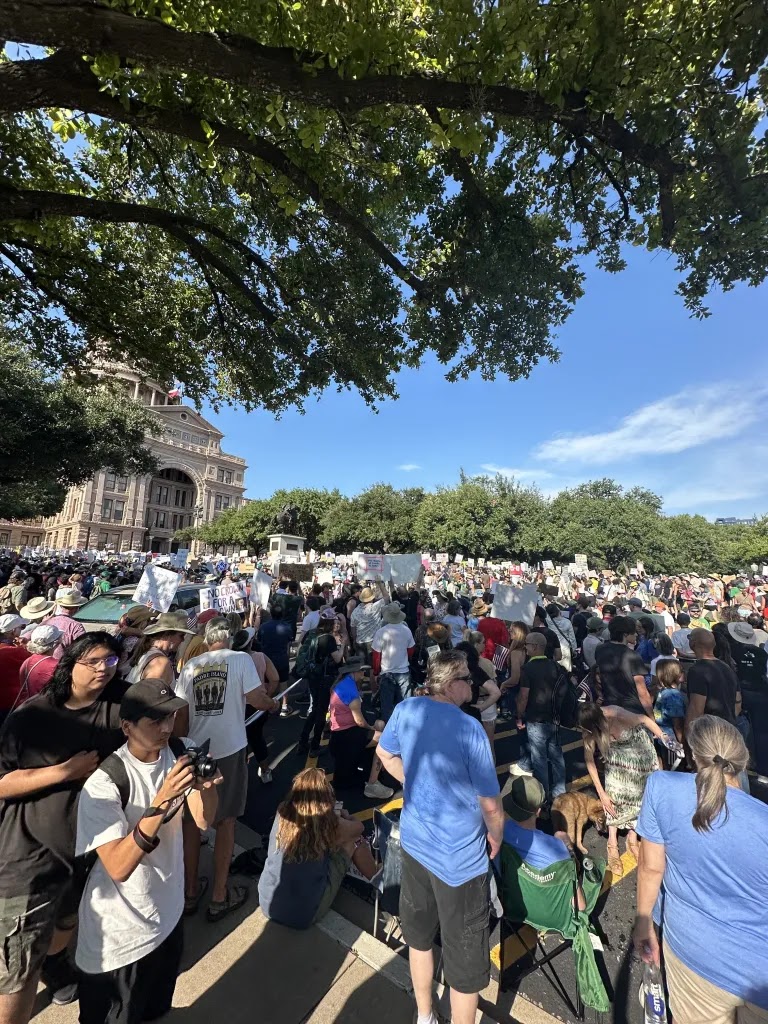
Austin, Texas

Some additional numbers got into the mix.  Organizers in Philadelphia, St. Paul and San Diego claimed there were over or near 100,000. Boston media claimed one million there. As an example of breadth, there were 50 protesting communities in Wisconsin alone. 

Boston,MA  

I continue to be amazed at the wit, the buoyancy and relentlessness of these protests. And the courage, given the lawlessness of the Chaos and Chaos-inspired people. Maybe it was Rachel who characterized the day's mood as "joyful defiance." The diversity of participants is implied by the kinds of places where the protests occurred.   The photos show a lot of white people, who look a lot like the stereotypical Chaos voter.  They may be having a good time, but they aren't out there to party.  And they know why they are there.

There are many differences but some similarities to the 1960s protests of my experience.  The mood of the March on Washington was solemn and even reverent.  Anti-war protests ran the gamut from grimly defiant to very angry, but we had fun, too. But we always felt apart from the mainstream.  I don't think these protestors do.  And poll numbers suggest they are right. 

Chattanooga, Tennessee

What might be the same is the disbelief that the media didn't immediately give them their true significance, often with insultingly low estimates of the numbers participating.  And the high that participating brings, and the letdown afterwards when nothing has changed.

But networking with people you met and maintaining some sort of cohesion should be easier with faster and easier communication media.  The question of what comes next is a real one. 

Oakland, CA

On Monday there was a police report of a gun death at a protest in Utah, in which someone used a handgun to shoot at someone pointing a rifle at marchers.  He hit the gunman but killed someone else--a marcher or a bystander.  On Tuesday it was also revealed that one person was killed as a result of the Washington military parade, run down by a truck carrying a tank. 

There were a couple of known attempts of drivers trying to mow down marchers, and another TPM article reports increased agitation for violence against protesters, especially official violence in Red states and communities, where such acts are no longer severely penalized.

On Thursday, a man who was arrested for carrying a handgun without license at a June 14 protest in West Chester, PA, who also had an AR-14 style rifle in his car, was arrested again when police searched his home and found 13 improvised explosives, grenades and other gear.  He was charged with multiple crimes including possession of weapons of mass destruction. 

But also, by Wednesday, letters to the editor by June 14 participants were starting to appear, as here in the Washington Post, further sharing an experience of a lifetime.  

 2.  The Military Parade

It turned out to be Army vs. Boss Chaos, and Army won.  

The US Army and its career professional leadership has made some significant missteps since January.  Censoring the West Point Library, cooperating with the Chaos political show at Fort Bragg are prominent among them.  But they've also proven adroit at seemingly cooperating with Chaos in Chief while subtly undermining him.  They did as ordered and restored the old names to some bases previously named after Confederate generals.  But they officially named the bases after US Army officers and enlisted heroes who just happen to have the same last names as the generals the US Army fought against in the Civil War. 


Forth Worth, TX

And they followed orders and organized a parade in Washington, which Chaos publicly denied was in honor of his birthday and his presidency, but was honoring the 250th anniversary of the Army.  Then the Army did something vitally subversive: they took him at his lying public word.

So the parade really was an historical pageant and a celebration, with soldiers decked out in period uniforms rented from Hollywood.  The hardware was at a minimum.  Chaos insisted on tanks, and there were tanks of several eras--which is fitting, since tanks are largely obsolete these days, except to scare citizens opposing their dear leader.  Instead the soldiers manning the tanks smiled at the crowd and made hearts with their hands, while their compatriot foot soldiers strolled rather than marched by in lockstep, waving.  According to biographer Michael Wolff, Trump was furious that the parade wasn't more menacing, and blamed his Secretary of Defense. 

There was of course still no excuse for the $25 million to $45 million spent on it.  But Chaos owns that.

Paris, France

Meanwhile by Monday the news media consensus was that attendance at the parade was "sparse" and entirely overshadowed by the national--really international-- protests.  Even though there was to be no "official" No Kings protest in Washington itself, there were several anti-Chaos marches and demonstrations earlier in the day with significant attendance.

But Boss Chaos always wants control, insisting on being the center of attention.  This time his diversion of choice may be to involve the country in yet another war in the Middle East.  He didn't get his jollies with a menacing parade. He may opt for the push-button power of immense military violence.  His policies are already killing hundreds of thousands of children from starvation and disease that USAID would have otherwise prevented.  Soon he may feed his need with more graphic death and destruction, with high danger of protracted consequences.  

Sunday, June 15, 2025

The Day

Chicago on Saturday: NY Times photo

It was a day unique in American history.  In over 2000 communities, millions of Americans marched and rallied their resistance and opposition to the Chaos dictatorship.  Crowds ranged from the hundreds of thousands in big cities like New York, Philadelphia and Chicago, to thousands in almost every sizeable city in the fifty states, and hundreds in smaller communities--like Pentwater, Michigan (pop.800) where 400 participated.


Boise, Idaho: Capital Sun photo

   One New York Times reporter stood on a Portland, Oregon street corner and watched the crowd pass for more than an hour.  "The mood is definitely serious, but also laced with a kind of buoyant joy."  Another reporter observed that in Los Angeles "the scale of the protest in downtown is remarkable...People of all ages have spread across blocks all over downtown."  In Dallas, a Times reporter said the crowd "stretches from curb to curb for at least five blocks, as far as I can see."

Portland, Oregon: Capital Chronicle photo

The San Francisco Chronicle headlined that the demonstration there could be one of the largest in the city's history.  In Chicago, the large crowd shut down the Loop.  

New York City crowd estimated over 200,000

There were instances of police applying forces to divert marchers, but no real violence except perpetrated against the protests, including several cases of cars hitting and attempting to hit marchers.  The worst violence of course was earlier in Minnesota with the assassination of a rising star in state government and the serious gunshot injuries of another official and spouse.  The gunman was reportedly masquerading as police.  Because he was still at large and No Kings flyers were found in his vehicle, the Minnesota protests were officially cancelled.  But the big St. Paul protest went on anyway. 

Des Moines, Iowa: Des Moines Register photo

The millions of Americans committing themselves to active protest underscores the latest polls which show opposition to Chaos in every policy, action or topic; and specifically by a large margin disapproving military intervention in Los Angeles, and some 60% consider the Chaos created military parade a waste of taxpayer money. 

Atlanta, Georgia: Guardian photo


Hartford, Conn.  Courant photo

In Washington the multi-million dollar vanity military parade was met with relative indifference, less than large and more than lethargic crowds, many who left early.  The Times reporter called it desultory and "underwhelming."  Daily Beast observed that Melania and the faux Sec. of Defense appeared bored, and even Chaos looked sour and disconcerted. Politico observed the obvious: that the protests outdid the parade in scale. Many many times over. 

Topeka, Kansas

San Francisco: KQED photo

San Diego, CA

Predictably Faux News giddily covered the parade and the protests not at all.  Other cable networks showed some parade, with more on Minnesota and the Middle East, and showed protests mostly when police were shooting tear gas and their "non-lethal" stuff, as in LA.  But the secret weapon of these protests is they were local, and probably hundreds of city and local television stations and newspapers covered them extensively--they were the biggest news in their locality. And of course, millions of people means millions of social media posts and looks.

Philadelphia, PA : NY Times photo

Louisville, Kentucky

Once again, protestors managed to be more creative and succinct that politicians. In Springfield, Mass. a young woman held up this sign: "Eggs are expensive because all the chickens are in Congress."

Milwaukee, Wisconsin: Journal Sentinel photo

Cincinnati, Ohio


Mt. Kisko, New York: lohud photo

Pittsburgh, PA: Post Gazette photo

I'm not sure where this sign was held but it kind of sums it up:
 "We fought a king in 1775.  We fought a dictator in 1945.  We will fight whatever the hell this is in 2025."  
Los Angeles: NBC photo

Los Angeles: Guardian photo

Friday, June 13, 2025

The Day Before

 
Suddenly everybody's talking about kings.  Governor Newsom of California, House Democratic Leader Jeffries, the manhandled Senator Padilla of California, and most telling, Judge Breyer in his court decision that ended with a restraining order turning control of the California National Guard back to the Governor.  The federalizing of the Guard based on a statute was not justified on the basis of a rebellion, because conditions for rebellion weren't met, he said.  It was not an armed and organized group proclaiming their intent to overthrow the government.  That the Executive doesn't get to unilaterally decide what is rebellion and when to use force is precisely why the US Constitution was written and the US government formed.  That kind of Executive existed: King George.  And the American Revolution was fought to separate from that arbitrary power.

Judge Breyer's decision was "stayed" (the stay of a stay) with questionable legality by a 3 judge panel of the Court of Appeals, until they hear the federals appeal, which is in itself of questionable legality.  But Breyer made the case as clearly as anyone could.  Making it within 48 hours of the No Kings demonstration day was fitting but accidental.


Not so (probably) the vocabulary used by these Democratic officials, who stopped short of urging people to attend the No Kings demonstrations, though mentioning the principle of No Kings was very likely not coincidental. That's an interesting difference from the last two big demo days, in April and May.

Also on Thursday, US Senator representing California Senator Alex Padilla (member of the Judiciary Committee) was wrestled to the ground and handcuffed for attempting to ask Homeland Security boss Kristi Noem a question at her press conference in an LA federal building.  He said he was moved to do so by something she was saying.  It was this:

"We're not going away.  We are staying here to liberate this city from the socialists and the burdensome leadership that this governor and this mayor have placed on this country..."

In other words, the intent of the federalized National Guard and ICE was to overthrow the elected officials of California by force, which does meet the definition of rebellion, or insurrection. Or simply, a coup by the current federal executive.  So that makes it tyranny, the tyranny of dictators, the tyranny of kings. Recall that when Boss Chaos was asked what crime Governor Newsom had committed that warranted arrest, he said in effect the crime of being elected.  (Heather Cox Richardson makes this point.)

Now it's the day before No Kings day, the military parade in Washington.  Now there's sudden warfare in the Middle East which seems to be only beginning.  So yet another fear realized: the bumblers of Chaos faced with a real life international crisis.  So who knows what Friday will bring, and what Saturday (with ominous not entirely metaphorical thunderstorms forecast for DC)  will look like.   

Wednesday, June 11, 2025

Meeting This Moment


This moment is fluid and fast-moving, but its immediate dimensions are consequential enough to be seriously alarming.  

This moment can be seen as beginning with some aggressive raids and indiscriminate roundups of working people by purported ICE agents in Los Angeles on Friday June 6 and coming to some definition on or immediately after Saturday June 14, when a burlesque Hitler/Mussolini/Stalin-style military parade demanded by Boss Chaos is scheduled in Washington while mass protests are scheduled just about everywhere else in the United States.  


What makes it a moment--a crucial and defining moment-- is Chaos seizing control of the California National Guard and deploying several thousands in the LA area, both to police protest areas and to accompany ICE raids with shows of massive and armed force, as well as attempting to involve active military in domestic affairs with a detachment of US Marines.  This began effectively on June 9 and 10.  

This is the aspect of the Hitler playbook that is most feared.  And it literally was part of Hitler's playbook for seizing dictatorial powers, as described in an Atlantic article behind their paywall: manufacture a crisis and respond to it with military force.  

Such an attempt by Boss Chaos was implicit from the beginning, though there were questions about whether and how he could achieve it.  First, could he find within the various federal agencies with police and military capabilities a reliable Secret Police, loyal only to him?  After insulating himself with extreme and clueless loyalists in all the key positions (Defense, Homeland Security, etc.), getting better control of all means of communication and information, and neutralizing if not destroying any watchdog or justice agencies (especially with equally corrupt lapdogs atop Department of Justice), he found or forged just such a Secret Police in ICE and the Homeland Security Investigative service.  

When it came time to involve the military (beginning with the quasi-military National Guard, but quickly moving to the regular forces) could he control them, even when what he demanded that they do is clearly against the Constitution, other laws, ethical practices and the military's own codes?  So far the answer seems to be yes, with a few reports of dissent.  (But he fired most of the potential dissenters first.)  

So far, the National Guard is aiding the immigration roundups without a peep, Chaos turned an address to the military at Fort Bragg into a political rally and there was no dissension from top brass about this obvious violation of their code.  Though at this moment the Marines in LA have no orders, so far there's no pushback there.  There's been some embarrassment expressed about the military parade, but so far nothing else.

So all this makes for a very dangerous situation, mostly because it is likely just the beginning.

Apart from local opposition, largely spontaneous with some organized by labor unions, the national day of opposition was being organized by so far little known figures in very new organizations, who nevertheless carried off at least two previous days of demonstrations across the country.  Joined by other organizations--100 or more--they promised the largest single day of protest in probably thousands of locations on June 14, while the Chaos parade was wasting some $50 million in tearing up the streets of Washington.  

As for leadership in opposition, so far the most public and inspiring voices were Rachel Maddow, Bruce Springsteen and Steven Colbert.  But in one long interview on MSNBC on Monday, California Governor Gavin Newsom did what few political leaders have done effectively: he was real.  And he was real angry.  Some of that intensity survived in his TV address on Tuesday, though the political smoothness also returned. But at the end of it he seemed to be calling for peaceful but massive demonstrations and dissent. 

Newsom appears to be one of those who believes that the Chaos long game involves destroying the power of state governments to oppose him, partly by controlling its own affairs.  With a captive Congress, the federal bureaucracy in shambles, and at best a timid Supreme Court, and the opposition party in apparent leaderless disarray, the states appear to be the final institutional bulwark.   

Some court intervention this week might be possible, and unforeseen events could intervene, but otherwise things are building towards Saturday, with increasing stakes and danger.  Will there be a million, or millions of people who actually show up to protest, given the open intimidation by the bully with the army?  Though there are no No King demos scheduled in Washington itself, could there be protest anyway with unsanctioned activities that either provoke or simply get a violent response?

Whatever happens, there will be more millions of Americans (not to mention a lot of eyes around the world) who will not be directly involved.  This will be the first major test case of what gets through as credible information in this peculiar media age, different from any in a hundred years or more.  

In the era of mass media there were widely credible outlets, eventually with widely shared ethics, and trusted sources of news or of corrections to misinformation.  Wire services brought information from elsewhere to local newspapers, and radio and television news brought reports and then pictures into homes everywhere.  There were decades when I could watch how the three networks covered a particular story, and see where they agreed and where they differed, along with weekly newsmagazines, wire service reports and commentaries by respected observers.  So in a time of perilous events, there was widely shared and commonly held information, with political and ideological beliefs to the side.

We are about to see how much of that survived.  Back then it wasn't always instantaneous--especially when it involved dissent and protests.  It took awhile for even the now revered March on Washington in 1962 to achieve its now widely held story.  

Granted, that today's traditional media has engaged in traditional sensationalization (claiming that LA is "on fire" when nothing burned but a couple of self-driving cars), and has not shown a lot of courage in resisting Chaos intimidation. But now both the immediate and sustained view of what happens is fractured by manipulated and deliberately mislabeled video, doctored photos and false reports, circulated on social media.  

It's happening now in regards to events in LA, with footage of previous violent protests mislabeled as video from this week.  While actual photos obtained by the San Francisco Chronicle of unaccommodated National Guard troops sleeping on floors are called fake news. 

 How far the algorithm-driven ideological distortion of reality has come to dominate and perhaps destroy any common picture of what actually happens may also be answered soon.  How does democracy survive without commonly accepted truth, especially with weakened or seized supporting institutions?  That's another question that may be addressed in this moment.

As some have pointed out (particularly Lawrence O'Donnell in his brilliant June 9 hour), the timing of this militarized dictatorship manufactured crisis is also a huge distraction from newsmaking events that Chaos doesn't want in the forefront, such as his recent media mud-wrestling sessions with Musk, and his budget of cruelty and devastation.  We're all just starting to feel the effects of his tariffs, in gaps on shelves, disrupted supply chains and unpredictable delivery times as well as higher prices.  He sure doesn't want us thinking about that.

Saturday, June 07, 2025

History of My Reading: Florida Fantasies


West Palm Beach--1970s postcard

When I abandoned my Cambridge apartment in late 1975 and arrived in my hometown of Greensburg, PA, I immediately regretted it. I felt I’d made a terrible mistake.

I quickly made a panicked call to Linda, the young woman I’d been seeing who lived on the floor above in my Cambridge building (discounting for her possible regret over youthful folly, I’ve disguised her name.) She assured me I could return, and that settled me for awhile.

But it turned out I wasn’t back for long, at least at that point. First came a car trip with Linda from the desultory north in February, down the gradually warming East Coast to Florida, where I’d never been. We stopped first in West Palm Beach to stay with her relatives, an older couple who had a ranch house in a slightly scrubby wooded area off Forest Hill Blvd.

Her direct relative was Jane, who had lived in Los Angeles in the thirties and forties, working in Hollywood and later, during the latter part of World War II, at one of the many aircraft plants that transformed southern California. Hers made bombers.

I’ve forgotten what she did in Hollywood—maybe the costume department-- but she worked on the 1935 classic “The Informer,” and knew John Garfield, Al Jolson and other stars. Carole Lombard was as “wild off-screen as on.” She recalled that the vibe between Humphrey Bogart and Lauren Bacall was so intense when they met while making To Have and Have Not that people all over the studio lot found a reason to visit the set and watch them together.

Eventually Jane met a young sailor there in Los Angeles and married him. When I met him, Jim was a movie model of an old salt: deep, very tanned wrinkles, thin to the point of seeming frail. He had the slightly haunted demeanor of someone who’d struggled with drink. But he was charming and funny, with a soft southern accent and courtesies. They lived in Florida mostly because he had a good job cooking on board ship for a wealthy shipbuilder.

Jane took a shine to me, and over shrimp at our farewell dinner at Frederick’s French Onion Soup restaurant in Palm Beach, she decided that my real name was John—John Severini. She noted that in every restaurant we ate—sometimes in the company of other of her friends-- the servers presented me with the bill. Before we left Jane gave me some old movie stills from her collection, because she felt I was someone who would appreciate them.

First Lady Jacqueline Kennedy in Palm Beach
Palm Beach was the older and far richer city, settled by millionaires in the 19th century. It received new prominence in the early 1960s when President Kennedy used a family home there. Palm Beach is also the location of the now infamous Mar-a-Lago. There are fewer than 10,000 full-time residents even now.

Contrast that with West Palm, the poorer relation across the Intercoastal Waterway, with a population of 124,000. It was only 23,000 when we visited in 1976.

Even then, the divide between the rich and the rest was keenly felt. Everyone I met in West Palm didn’t really want to be there.

The only other memory I have of West Palm is a sunburn and its remedy. When I complained of the burn, Linda took me outside the house into some small nearby trees in sandy ground, and pointed out a number of plants growing among them. They were aloe plants. She removed some sticky substance, I rubbed it on and the mild burn was soon all but gone. This was years before aloe became so widespread in over the counter products.

From West Palm we drove down to Key West, the final leg being the strangest and straightest highway in America (US Highway 1), much of it over water. We pitched Linda’s tent at a fairly crowded and often raucous campground of mostly young travelers, but at least near enough to decent sanitary facilities.

1976 postcard
Key West is essentially an island at the southernmost tip of the East Coast, a famous 90 miles from Cuba (a figure often repeated during the Cuban Missile Crisis). Because of this location and remoteness, its first and furtive residents were reputed to be smugglers, pirates and bootleggers as well as those engaged in fishing and other legal pursuits, such as harvesting sponge, sea turtles and conch, the mollusk that remains a Key West identifier.

Eventually its weather and the fishing put it on the map. In 1946, President Harry Truman established his Little White House there. Over the years it was devastated several times by hurricanes.

Key West also became known for a tolerance that extended to interracial relationships and homosexuals not as welcome elsewhere in the US. By the 1930s it was attracting artists and particularly writers. Poet Elizabeth Bishop and most famously, fictionist Ernest Hemingway established residences there, as did dramatist Tennessee Williams a decade or so later.

Robert Frost & W. Stevens in Key West
Others in this period made extended visits, sometimes annually. Wallace Stevens is a notable example. The eminently respectable poet who walked to his office every day as a vice-president in one of the major insurance companies in Hartford, Connecticut, and grappled with metaphysical questions in his poems, had a number of drunken episodes in Key West that have entered historical gossip. As a regular visitor Stevens graciously welcomed Robert Frost on his first trip, but after a few too many at a cocktail party, argued incoherently with him at dinner, somewhat scandalizing his fellow New England poet.

On another occasion, Stevens worked himself into an inebriated rage and challenged Ernest Hemingway to a fight, drunkenly swung and missed, then landed a blow that broke his hand. Though Stevens was larger, Hemingway was younger and more skilled. He knocked Stevens into a mud puddle. (Both participants corroborated the basics of this story.)

Beyond indulging in bad behavior away from prying eyes, Key West also inspired Stevens’ poetry, notably the long poem “The Idea of Order at Key West” (not meant ironically, except maybe privately) that literary writer Jay Parini ranked second on his list of the ten best American poems. Both effects—inspiration and inebriation-- recurred among a later generation of writers who began appearing in Key West in the early 1970s.

Guy De Valdene, Tom McGuane with
Richard Brautigan in foreground:
Key West early 1970s
Though Tennessee Williams was still around, Truman Capote visited often, and other writers such as Richard Brautigan (Trout Fishing in America) and playwright James Kirkwood (1976 Pulitzer Prize winner for A Chorus Line) were on the scene at times, the core group was comprised of fishing writer and memoirist Guy De Valedene, novelist Tom McGuane and his close friend from college days at Michigan State, poet and fictionist Jim Harrison. They were there for the fishing (as Hemingway had been) and magical waters as well as the spicy anarchy of the Key West scene.

“It was an island totally devoid of rules of behavior,” Harrison recalled in his memoir Off To The Side, “a tropical island fueled by sunlight, dope, and booze, as far from Kansas as you could ever get in America.”

These three writers were also close friends with an itinerant local musician, Jimmy Buffett. Together they were so embedded in the Key West life that both Buffett and McGuane met future wives at the Chartroom Bar.  McGuane’s choice was Buffett’s sister.

By the time I visited in 1976, I’d read just one slim volume of Harrison’s poems, and McGuane’s 1973 eye-opening novel Ninety-Two in the Shade, a National Book Award nominee set in Key West. (I’ve always remembered—or maybe misremembered—that in its pages someone observes that the great American law is that it’s the squeaky wheel that gets the grease.) I didn’t know of their ongoing connection to Key West. But I was aware of Jimmy Buffett as the reigning spirit of the place.

Jimmy Buffett is his Key West  bar band days
He was just becoming nationally known: his breakout album “Havana Daydreamin’ had just come out weeks before, but its first single was on the radio, and I loved it. “Woman Going Crazy on Caroline Street” had such resonant lines as “she listens to the jukebox for her answers,” and “she slides her dapper legs from beneath the table/as if to reveal some kind of treat” (“dapper legs” is classic) and that haunting chorus: “There’s a woman going crazy on Caroline Street/ stopping every man that she does meet/saying if you be gentle, if you be sweet/I’ll show you my place on Caroline Street.”

We didn’t see any of these notables (and likely wouldn’t have known it if we had) but by 1976 the era was already fading. Tourism was starting to swamp the place (its population then was under 8,000; now it’s 23,000) and we heard complaints about invasions from New York. I saw some of that once when I peeked into the compound surrounding the only chain hotel in the small central area, between the Coast Guard dock and Duval Street: there were hundreds of pale northerners intent on rapid tanning, packed into the area around the pool as densely as a Manhattan subway, or a Coney Island beach.

There was so much marijuana being smuggled in, Harrison recalled, that it was virtually free, but in the late 70s the cocaine trade invaded, with cartels and serious violence. The innocence was gone, the writers were getting older (and better known), and so that scene faded.

Jim Harrison & McGuane, some years later
McGuane retreated to Montana, his highest fame behind him but with enduring new writing, while Harrison would create a body of work over the next several decades that to me seems likely to grow in recognition, a major American writer of his generation. And Jimmy Buffett soon became internationally famous, acquiring a perennially loyal following and almost mythic dimensions below the flavor of the week radar, and becoming a billionaire along the way, as well as—to the astonishment of his old literary buddies—a best-selling author, topping both fiction and nonfiction lists.

Meanwhile, cocaine was already such a big problem that Florida had set up an “Operation Conch” that yielded more than 20 arrests. But while we were in Key West, the big news was that a former City Attorney who’d been busted for delivering cocaine was exonerated, when a snitch finally admitted he lied. He’d also been the source for other arrests. Of the City Attorney, a state law enforcement spokesperson deadpanned, “He was set up. He was framed.” Where was Hemingway when we needed him?

There were probably scattered photos on barroom walls of the 1970s writers but the conspicuous monuments belonged to Hemingway. His spacious house on Whitehead Street was a registered national historic landmark, and at the time, number 18 on the list of 48 Sites To See in Key West.

Hemingway & Pauline 1927
In 1927 Hemingway married Pauline Pfeiffer in Paris, the journalist daughter of a wealthy American. For the birth of their first child, Pauline wanted to return to the United States. Key West may have been suggested as a residence by the writer and Hemingway hunting and fishing companion, John Dos Passos. Pauline’s uncle bought them this house, and they moved there early in the 1930s.

Key West was then as much Cuban as American, and Hemingway may have first visited it from Havana. The English speakers were mostly railroaders, fishermen and descendants of New England sailors. Several Native tribes had been the first inhabitants, and in the mid-19th century Key West became a haven for fugitive slaves. By then it was a major salt supplier, and civil war in Cuba brought Cuban tobacco factories. For a few years Key West was the richest and largest settlement in Florida. Key West cigars were still part of the local economy when Hemingway arrived, though the 1930s Great Depression hit hard, as suggested by his novel To Have and Have Not.

My own history with Hemingway began while he was still alive, and I saw his photo spread that accompanied his novel The Old Man and the Sea, first published in the pages of Life Magazine. I even recall reading it there, though it is unlikely since it was 1952 and I was 6 years old. It became an immense best-seller and led directly to his Nobel Prize in 1954. But whenever it was, I’m sure this was the first of his work I read.

I had some later Hemingway binges, including reading his stories lying mostly naked for days in a tiny room in Berkeley, covered in wet baking soda—a hippie remedy for a bad case of poison oak—while eating Oreo cookies and drinking cheap California white wine from the grocery next door. In 1976 my latest binge had been just a few years before in Cambridge, after I read his just published posthumous novel Islands in the Stream. (Though Jim Harrison had Key West and Upper Michigan rivers in common with Hemingway, and was sometimes lamely and lazily compared with him, he professed not to like most of his work. One of the exceptions was that novel.)

I also knew Hemingway’s classic Paris Review interview, with its reverent if also earthy treatment of the writing vocation. Though in college I’d preferred Scott Fitzgerald, he had still been the figure of the writer I’d grown up with.


Hemingway House tour, evidently during Covid
We took the $1 tour of his Key West house, where whatever quiet observation let alone hushed awe I might have applied was mostly shattered by the company of noisy tourists. I couldn’t even concentrate on his writing studio, being distracted by the young blond in shorts and platform shoes walking in front of me, but I did note the writing tablet and pencil on the desk, and the balled up paper on the floor, just the kind of absurd and inauthentic touch that characterizes modern tourism. I also noted that our tour guide had much more to say about Pauline’s decorative choices, which probably was appropriate.

But Hemingway, in his thirties, really did write there. I recently re-read A Farewell To Arms which he finished there, when I was researching the far northern Italian front in World War I for my Severini Saga, because my grandfather had been there. So had Hemingway briefly, though earlier than the actual war events in his novel. He also wrote To Have and Have Not in that Key West house, which I dipped into more recently, but found pretty much unreadable. It’s also much different from the Bogart and Bacall (and John Huston) movie.

When we were there in late February 1976, Key West was coping with water shortages from a recent drought and an economic recession, but was also experiencing a record year for tourism. Some businesses were shuttered while other areas were rebuilding.

2017 photo by Judd McCrain
Presiding over the Duval Street area of bars and restaurants was Sloppy Joe’s, famous as a Hemingway hangout from the 1930s. Among the resident memorabilia was his birth certificate mounted on the wall.

I remember it as akin to an open air market, with shuttered sides open to the sun-white streets in two directions, though it still managed to be dark inside. The jukebox was formidable: everything from the Eagles to Glenn Miller, Harry Belafonte’s calypso period, and of course Jimmy Buffett. In the men’s room I spotted and copied grafitti expressing what could be the Key West ethic: “Where would we be if everybody did what they were told…”

Sloppy Joe’s was still under its original ownership then (Sloppy Joe himself, reputed to be the model for the barkeep in To Have and Have Not, or his family.) Later management began the annual Hemingway Festival, which includes a lookalike contest yielding unappetizing crowds of bulky men with florid white beards.


At nearby El Cacique Restaurant I ate my first plates of Cuban-style black beans and yellow rice, and my first slices of homemade Key Lime pie. I don’t remember that we made it to Crazy Ophelia’s Cafe on Duval, if indeed it was still there, but in 1972 Jimmy Buffett often played at this counterculture haven—it’s where he first sang “Margaritaville,” his signature song, just after writing the final verse on his way to the gig.

I might mention that at this point in my life—in fact, for most of it—I constitutionally could not maintain a decent relationship with the world unless I played a little guitar or piano every day. So I traveled with my guitar and took every opportunity on every open piano I encountered. And I encountered one at a bar in Key West. I’d been happily playing my blues runs when the owner approached and offered me a job playing there regularly.

He didn’t mention terms but considering that Jimmy Buffett played at a local bar for years for nothing more than free beer and tips, I’d assume they were similar. However I quickly demurred, saying I was just passing through, and got out of there quickly, before he noticed that I could play only variations on the same three and four chord patterns in different keys. Still, it was a memorable occasion (even though it took resurrecting the old notebook to remind me): my one and only job offer as a piano player came in fabled Key West.

1970s Key West
The evening would commence with a gathering down at the Coast Guard dock to watch the sun drop into the ocean, Key West being the only place on the East Coast where this phenomenon occurs. When the orange ball dipped below the horizon and then suddenly disappeared, the crowd would applaud. It was such a well-known custom that food vendors assembled at the entrance, with the occasional street performers. Apparently in later years this has become much more elaborate, and much more for the tourists.

Then we might sample the night life before returning to the campgrounds, which in a notebook I described as our “suntanned tenement.”


O
n our way back north we stopped for a few hours at Walt Disney World in Orlando, my first and only visit. At that time just the Magic Kingdom area was open, and it was only five years old. But already the Disney convenience/control ethos was evident, beginning with the signs on the highway approaching the park directing visitors to tune to a certain AM radio frequency for instructions, and including the parking lots and sections named after Disney characters.

My recollections begin in the same vein as those from my day at the New York World’s Fair in 1965: blinding heat reflected off concrete, and long lines for everything. The “attractions” we selected were fair to middling (but then, we weren’t the target market), and while Space Mountain added complete darkness to the roller coaster experience, I recall still preferring the coasters at Kennywood in Pittsburgh.

The exception was Pirates of the Caribbean (a replica of the one at Disneyland in California, built at popular demand and opened only in 1973.) It started with another winding slow ride in a boat in inches of water with narrow walls around us, past displays more elaborate but otherwise little different from ordinary carnival haunted houses. But then it suddenly opened up, and we were afloat on a large expanse of dark water, heading towards an apparently full sized pirate ship, with cannonballs splashing and some sort of battle going on. It was an actual magical moment, especially for me as it was unexpected.

But we did not leave sadly, or at least I didn’t. Something about the manipulation and replication, the artificial fantasy of the place bothered me. It was an extension of what was done to the Hemingway house. I imagined that same writing room, complete with the phony crumpled balls of paper on the floor, but with an animatronic Hemingway writing at the desk, turning slowly to smile at us behind the rope border and intoning one of his pithy sayings, like “Good writing is true writing,” and turning back to move his lifeless hand over the page.

Possibly such a display would not have him repeat his most famous line from that Paris Review interview: “The most essential gift for a good writer is a built-in, shock-proof, shit detector.”

The one memory I retain about our drive back up the East Coast is located in Georgia. We were on Interstate 85, and I wanted to eat something other than the usual burger, something southern I hadn’t had before. So we stopped at Katherine’s Kitchen for ham and biscuits. But the meal was handed to us in a limp cardboard box by a nervous older woman standing under a handprinted menu, fast-food style. She evidently was trying to go with the flow, which to her meant becoming a cut-rate McDonalds of the South.

President Harry Truman in Key West
My notebooks record disproportionately little of my actual experiences on this trip, along with a lot of the usual bits of ideas for freelance articles I might propose, and stray phrases that might be of things I overheard (“Shalom, y’all”) or seen (The Slice of Life Pizza, the Margaret Truman Launderette) or maybe it was stuff I made up.

But I also recorded observations that suggest I was starting to see the Highway as a place in itself, more or less the same everywhere, with the same food, the same music on the radio, television news, newspapers, and the same faux history and regionalism (I recorded another restaurant advertising southern home cooking that was served on plastic fake pewter.) It was only in going back through these notes and memories that I realized how this trip may have influenced the point of view and subjects of much of my writing in the late 70s and early to mid 80s.

But before all that started I had a long, strange and personally important interlude as a writer and editor at a fledgling alternative weekly in Washington, DC. Be with us next time for: Get Me Rewrite!

Sunday, June 01, 2025

No News and No Evidence

 The news?  There is no news.  There are announcement of intentions that are reversed the next day.  There are court cases that never quite get decided or enforced.  There are fires up there, floods and storms down there. There is continuing vicious destruction and harm, cruelty and lawless violence. There is chaos.  Nothing new about that.

There are variations on the themes. This Chaos administration is now routinely referred to as authoritarian.  But what is not said often enough is that it is the most racist regime in a western country since Nazi Germany.  


That racism is now being extended from brown people to Asians, specifically Chinese.  Here in far northern California, in a history that the Chaos regime is actively demanding be suppressed, the racism of the past, first visited on Native American peoples, was extended to Chinese workers.  When they were no longer needed (and even when they were), almost every person of Chinese birth or extraction was herded onto boats and sent away.  This may well be part of why this section of California is conspicuous for its few Asians.

Democrats failed to nip this resurgent if veiled racism in the bud during the presidential campaign.  They allowed Chaos to make his wild charges without substantive questioning.  Laughing at him clearly wasn't enough.

He said then--and continues to say today--that immigrants are vicious criminals, that other countries opened their prisons and sent their worst here, especially murderers, rapists and violent thieves.  Nobody angrily called him on this.  Nobody demanded the evidence: what countries?  What prisons? What criminals?  Where are the convictions, the statistics, the studies, the reports, the court cases, the names that would justify such outrageous charges?

So when it is finally revealed that the Chaos cabal knew that most of the immigrants it sent to the El Salvador concentration camp had no criminal record, nobody notices.  It's not really news.

Now they add that those wily Asians are spies, instruments of a foreign power. Again without even examples, let alone evidence.

If Chaos had been questioned then, there would at least be a record now, an honorable assertion of what's behind the rule of law, which is evidence.  In today's algorithmic based discourse, doing that once would likely not be enough, but matching the drumbeat of hysterical racism with pointed questioning and demand for real evidence would at least be an honorable fight.  

For most of my adult life this would have routinely happened.  Maybe it did happen more than I know and wasn't widely reported.  If so, that's a failure worth isolating and naming as well.