Tuesday, May 10, 2022

History of My Reading: The Students Are Revolting/ May 1970


[May 1970 falls next in the ongoing sequence of this series.  Since I’d written about it on the 50th anniversary of Kent State, I thought I’d skip over it, but now realize that these events—and these books--are important to what comes after, as well as before.  So this is a revision of that post, placed in the series where it belongs sequentially, and coincidentally, during another early May.]

                        The Context 

I was still in Buffalo, New York, when all three major television networks carried an address by President Richard Nixon at the White House.  It was Thursday evening, April 30, 1970.  With the aid of a map, he announced that American forces were attacking “sanctuaries” and command centers for North Vietnamese and Viet Cong soldiers in the neighboring--and neutral-- nation of Cambodia.

 The U.S. was withdrawing troops and negotiating, Nixon said, but the North Vietnamese were increasing their attacks. Action was necessary to protect American troops, and to avoid American "humiliation" and "defeat." "If, when the chips are down, the world’s most powerful nation, the United States of America, acts like a pitiful, helpless giant, the forces of totalitarianism and anarchy will threaten free nations and free institutions throughout the world."

Reading this speech more than fifty years later, it might seem eminently reasonable--except that by that time, few believed anything that the administration said about Vietnam, and with ample justification. Most of the assertions in the speech have proven to be lies. That phrase--pitiful, helpless giant--would become an epitaph of the era. 

Instead, what jumped out of the TV screen was another escalation, this time an invasion of another country without either its formal request or a declaration of war.  It was also a time of hyperbole, but it isn't much of an overstatement that, almost at the moment the speech ended, America exploded.  In particular, its college and university campuses.  Hundreds of them erupted in protest and in varying degrees of violence.

  At Kent State in Ohio, that violence on campus brought the war home when on May 4 National Guard troops fired on unarmed students and killed four. This instantly led to even greater and more widespread campus consternation.  Within days, the normal functioning of higher education had pretty much stopped.

Eventually this disruption hit the isolated campus of Knox College in Illinois, with a certain surprise--when Time Magazine covered it, the article concluded that if it could happen in Galesburg, it could happen anywhere.  And much to my own surprise, I found myself at the center of it.

 I had been visiting Knox alum Steven Meyers, a graduate student at SUNY Buffalo, as described in the post before this one in this series.  Steve drove us to Galesburg in his MG.  We were escaping the endless Buffalo winter as much as anything else, but I was unprepared for the fullness of the Galesburg spring.  The campus was intensely green after a rain, and the air was soft and warm.  The month of May was the brief glory of the Galesburg year as I remember it—an enchanted moment between the frigid winters and torrid summers.  Only the different stimulus of October came close.

 But in this early May, such delicate and peaceful beauty was distorted by anger and bewilderment.  The war in Vietnam had been expanding for five long years of our young lives, and protests growing along with it. The war at home had become especially bitter since 1968. It included a kind of generational war as well as a counterculture.   Almost from the moment I arrived, I was surrounded by Knox students debating and demanding action. 

 I had been active at Knox on both campus issues and such national issues as Civil Rights and Vietnam, and I'd been a student recently enough that I knew current students, and was generally known on campus.

 My acquaintance with student activism began in high school, in electoral politics, school issues and one major moment of protest: I participated in the March on Washington for Jobs and Freedom in 1962, the only person in my school--the only person I knew--to do so. Books and other reading were often my lifelines in these activities.  I marched in Washington as much for James Baldwin as Martin Luther King, Jr.

It was also in in high school that I read about some of the late 1950s and early 60s student protests in a paperback I found on a hometown Greensburg supermarket rack, called Student by David Horowitz. He described the demonstrations in San Francisco against the House Un American Activities Committee (during which police turned fire hoses on demonstrators), as well as the first Berkely protests that culminated in the Free Speech Movement of 1964-65, my first year at Knox.  That was a formative book for me, though ironically the author later repudiated it and became a right wing extremist. 

In college my activism involved a lot of reading, talk and listening, and the phenomenon of student activism in the late 60s--particularly the worldwide actions of 1968--led to books of reportage and analysis.

 The historical moment of May 1970 was the product of many currents, pulled into the same whirlpool by the issues and situation of the Vietnam war.  These currents can be represented by the phenomenon and the individuals involved in what was first called the Chicago 8.  

Charged with conspiracy associated with the demonstrations outside the Democratic National Convention in Chicago in 1968, their trial—a media circus surrounding a courtroom carnival—lasted from the fall of 1969 until February 1970.  It was covered on every evening news broadcast, and helped sell a lot of the defendants’ books. It would generate numerous other books, at least two plays and eventually a 2020 film by Aaron Sorkin (which I haven’t seen, since the actors don’t look or sound like the originals I vividly remember, a problem possibly only for ancients like me.)  

 Tom Hayden was the most prominent of the Chicago 8 who started in the student movement.  While in college he was a cofounder of Students for a Democratic Society and the principal author of the Port Huron Statement in 1962, that applied the ideals of "participatory democracy" to all aspects of American society.

More broadly, the student movement symbolized political activism applied to internal college and university issues as well as issues that went beyond the campus.  Hayden began in the Civil Rights movement in the early 60s, and became an antiwar activist during Vietnam.  He always brought American-born ideals to these issues, as when he adopted the words of Sitting Bull for the title of his 1972 book on Vietnam, The Love of Possession Is a Disease With Them.  
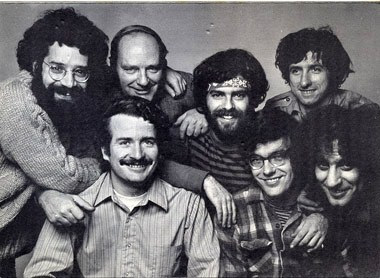
The Chicago 7, after Bobby Seale was separated.
Many had never met before their conspiracy trial.
Several of the Chicago 8 were organizers with roots in earlier traditions, such as unionism.  David Dellinger was the oldest defendant at 54, a pacifist and Civil Rights activist.  But just as SDS had broken into factions, at least one of them advocating violent resistance, there were also stark divisions in the Civil Rights movement, especially since the assassination of Martin Luther King, Jr.  Defendant Bobby Seale was a co-founder of the Black Panther Party for Self-Defense, an organization also proposed with a document setting forth its ideals (and demands) in the Ten Point Platform.  Though the document and many Black Panther Party activities stressed community service and self-determination, the imagery and rhetoric were often militant and violent, emphasizing armed resistance. 

And then there were the Yippies.  The 60s political and student movements joined with the broader cultural revolution, beginning with shared music, dope and sexual liberation.  Chicago defendants Abbie Hoffman and Jerry Rubin founded the Yippies, the political hippies.  They were flamboyant, deliberately and strategically outrageous.  At the time I didn't know much about the Dadaist art movement in Europe between the world wars, but when I read about it, the lineage was clear: the Yippies were Dada with a purpose.  

 So there was conflict and commonality, but it was the commonality that was most apparent to the older generations of conventional America, the Silent Majority (as Nixon called them).  The Generation Gap was its strongest in these years, and it became clear (as in the Anthony Lukas reporting) that jurors were judging these defendants as much on their appearance and demeanor as their alleged actions.  The common culture (or counterculture) was real enough, but the differences, especially in tactics, were also real, though that wasn't apparent to the most threatened outside this culture.

 That hostility had resulted in casual and official violence against activists. Apart from the violence that African American men in particular could expect simply in daily life, black activists were particular targets, and the Black Panthers most of all.

 This was brought home to Knox College students when Fred Hampton, Illinois chairman of the Black Panthers, was ruthlessly gunned down in his bed and killed by Chicago police and FBI in December 1969.  Hampton was engaged in organizing the multicultural Rainbow Coalition that brought together street gangs to work for social change instead of killing each other.  Hampton had evidently visited Knox that year.  When I read of his murder in a Chicago underground newspaper, his photo showed him wearing a Knox sweatshirt.  

Chicago author Richard Stern visited Hampton's apartment after his murder (and that of another man in the apartment), and noted the books that were there. In a brief essay that later became the title piece of his 1973 collection, he wrote:"...it meant that the blood which lumped the mattress and stained the floorboards was in part the blood of the books as well as their readers.  If it didn't make that fierce nest a shrine, it lifted its meanness and anonymity."

 Previously immune white youth were also victims of violence, and not all because of politics.  In a Ramparts collection on the cultural revolution, several articles chronicled routine violence against "hippies" and members of communes--assaults, arson, rapes-- unrestricted by age or gender.

Students experienced beatings and routine tear-gas during political protests, and the campus was no longer a sanctuary.  In response to this violence and to the endless war, some protesters engaged in violence against property.  Some was planned, some spontaneous, some extraneous, and some undoubtedly fomented by government agents, agent provocateurs.

 Violence against student activists was encouraged by the White House, in v.p. Agnew's rhetoric and Nixon's praise of the "hardhats" who attacked protesters.  Even in his Cambodia speech, Nixon asserted: "We see mindless attacks on all the great institutions which have been created by free civilizations in the last 500 years. Even here in the United States, great universities are being systematically destroyed."  There would be more of this after the speech, when the protests started.

The Chicago convention itself was a prime example of official violence, though the trial of demonstrators attempted to distract from this.  The government's own Walker Commission concluded that it was the Chicago police that had rioted. 

The resulting trial in Chicago was mostly theatre of the absurd, thanks not only to Abbie Hoffman and Jerry Rubin but the transparently biased Judge Julius Hoffman.  But the darkness at the heart of it became clear immediately when the judge refused Bobby Seale's request for his own lawyer, or to represent himself.  When he continued to protest, the judge had him bound and gagged in chair in the courtroom.  That image--seen only in the sketches permitted during court proceedings--became indelible.  Bobby Seale was soon separated from this trial, and so the defendants became known through the history since as the Chicago 7.

The verdicts came down in February 1970.  The trial was so manifestly unjust that the anger and alienation it engendered were still in the air in May. (Though some defendants were found guilty on riot charges and on contempt of court, eventually all the charges were thrown out because of the judge’s obvious and active bias.)

 That winter in Buffalo also saw a lot of ferment, including barricades in the street, though most of the issues were with the university.  After spring break in mid March, the intensity was dying down, only to flare up suddenly in response to Nixon announcing the Cambodian invasion. Fighting in the streets between crowds and police resumed at a higher pitch over that weekend.

There were significant protests the next day--on Friday May 1--at Princeton, University of Maryland and other campuses and in cities like Seattle, as well as smaller protests at places like Kent State in Ohio.

Also on Friday, President Nixon spoke to Pentagon employees in a statement that made the front pages by Saturday, saying "You see these bums, you know, blowing up the campuses...I mean, storming around about this issue, I mean you name it get rid of the war, there'll be another one."

 On Sunday, a meeting of representatives of 11 universities met at Columbia U. and issued a call for a nationwide student strike the next week, declaring that “classroom education becomes a hollow, meaningless exercise,” in the face of this escalation of war.

 Over the weekend, a protest march through Kent resulted in some broken windows, while on campus a small group set fire to the old wood frame house devoted to ROTC. It burned to the ground. The Governor of Ohio, whose own rhetoric had become even more heated than Nixon's, sent the National Guard to occupy the Kent State campus. National Guard were also called to the campuses of Ohio State, the University of Maryland and probably elsewhere.

The National Guard presence at Kent State stirred the campus.  On Sunday, a 19 year old student named Allison Krause placed a flower in the gun barrel of a National Guard soldier, who may well have been 19 as well.

 There was no strike at Kent State on Monday, so at noon, some students were going to classes, others to lunch.  A crowd had gathered at the Commons--some to protest the Guard's presence, some for a previously scheduled protest that had been called off.  The Guard ordered them to disperse but many did not. According to witnesses, the two sides were so far apart that the rocks students threw landed in the same open area as the tear gas the Guard lobbed.

The Guard marched up the hill, backing down the students in front of them.  The students behind them were still far away.  But a number of the Guard turned and fired into the crowd.  Whether they were ordered to do so is still at issue, but they may well have been. They killed four students, including Allison Krause. They inflicted wounds on 11, with one student paralyzed for life.

 On Tuesday, an Extra edition of the Spectrum headlined the call for a national strike, with an early report on the Kent State killings.  By Wednesday it was a front page story, with that iconic photo, under the banner headline: "They shoot students, don't they?"

Maybe it was some homing instinct at a time of crisis, but at that point Steve and I got into his MG and headed for Galesburg.

 We had an uneasy moment being stared at during a stop on the Ohio turnpike.  A newspaper I picked up along the way carried a story quoting Nixon as saying that he hoped the fatal shootings at Kent State would convince universities to stand against "the resort to violence."  Vice President Spiro T. Agnew said that they proved he was right to attack violent demonstrators.

Somewhere I also saw a story quoting Kent townspeople who blamed the students for the shootings, with one woman complaining that the newspapers were printing the dead students' high school photos but they didn't look like that when they were shot.

Newspapers also reported that on Friday May 8, 200 construction workers attacked protesters in lower Manhattan, in what became known as the Hard Hat Riot.  It lasted two hours, spilled into City Hall and left 70 injured.

 Around this time, 58% of respondents in a Gallup poll blamed the Kent State students for their own deaths.  Another survey (according to historian Katherine Scott) found that 76% did not support the Constitutional right to assemble and dissent from government policies.  Whatever their accuracy, these polls reflect the atmosphere I remember.

 The Students Are Revolting: An Inside Story

 We must have arrived at Knox College before the huge protest demonstration in Washington on Saturday, May 9.  I'm pretty sure I’d already been party to impassioned discussions students were having.

   I know we were there when the news began to circulate that a Knox student demonstrator had been arrested in Washington--John Podesta.  Though this was two years after my senior year spring, I knew some students who'd been first and second years then, and John was one.  We took up a collection for his bail, with a "Free Podesta" banner, but by then he was already on his way back to campus. 

John Podesta went on to other things, such as White House Chief of Staff to President Clinton, White House advisor to President Obama and campaign chair for presidential candidate Hillary Clinton.  That--and his continued alumni support for Knox--probably contribute to his place in the College's official history of the Knox events of May 1970, as the heroic leader of the protest and takeover of the dean’s office. 

  At the time, the takeover of a dean's office was hardly something that earned a lot of praise from the college administration. In fact, it was scheduled to earn me jail time.  But in retrospect apparently it has become his heroic deed, presaging a prominent future.  He and I actually joked about this over dinner at his house in Washington, when he was between Presidents.  John certainly was intimately involved in the events I am about to recall.  But I'll leave descriptions of his role to his own memoirs.

 Instead I will patch together my recollections with a few artifacts that have survived from that time, along with fragmentary notes I made at various times in the following few years.  This is a personal account, informed by surviving documents, but everyone involved (or observing) probably has their own story.

Some 400 campuses went on strike that week, the first national student strike in US history.  Knox College was not one of them.  Some of its students were upset by this.  I found there the same emotions as on other campuses--anger and sadness, frustration and disbelief, feelings of being betrayed and misunderstood, scapegoated and even hated.

Some months later I summarized what I observed.  The activist students "were small in number, somewhat paranoid about their alienation from the majority of [Knox] students, factionalized and not all overly fond of each other, yet energized by the solidarity they saw [elsewhere] and the frustration they felt that their own campus was so unresponsive."

 I described the situation as "volatile," and I recall some specifics of that.  At one end of the spectrum were those students who wanted to work within established channels and the usual means of petitions, letters and demonstrations.  At the other there was a small number of students angry enough to advocate violence, specifically setting fires and exploding bombs.  And many, probably most, somewhere between them.

Bombing buildings was certainly happening on and around some campuses, and there were individuals and organizations that advocated violence.  These particular students at Knox did not strike me as radical ideologues.  Mostly they were angry young males.  Some of them actually did make a bomb which they attempted to detonate. It may have simply been a stink bomb, I'm not sure, because it didn't work.  But it was enough to be alarming.  I was frankly less worried that they would blow something up than I was that they would blow themselves up. They seemed more impulsively angry than doctrinaire, or competent at bomb-making.

 I recall several meetings held in a large, mostly empty room at the off-campus apartment shared by Carol Hartman and Mary Maddox, where I was staying.  Eventually these meetings coalesced around finding a plan of action that everyone could support.  I saw that it had to be peaceful but forceful, or at least dramatic.

 Taking over administrative offices had become a tactic since the Columbia University demonstrations a year before.  I don't remember who proposed this, but I do recall my contribution at this point, which was to suggest a Yippie-like action.  While I was at Knox that spring I was reading Jerry Rubin's book, Do It!  I'd previously read Abbie Hoffman's books, Revolution for the Hell of It and Woodstock Nation.

I'd been at the big Pentagon demonstration in 1968 that had been in part a Yippie action, described in Rubin's book.  I didn't subscribe to all their ideas but I did feel a certain vibe in common.  Writer Jack Newfield called Hoffman "a pure Marxist-Lennonist: Harpo Marx and John Lennon."  That worked for me.

Hoffman and Rubin's humor was natural to them but also tactical and strategic.  They used humor and outrageousness as political jujitsu, to throw their establishment opponents off balance.  The people who held the power--in government, the military, business and in colleges--couldn't be defeated or even meaningfully confronted on their own terms: in terms of power.  But in other ways they could be.

 Hoffman and Rubin used humor in part the way Madison Avenue did, to attract attention and to make their point through imagery and irony. They used other kinds of theatrics for the same reason, a kind of forerunner of live "memes."  But they also used humor as a weapon, as psychological leverage.  With humor they could expose hypocrisy, pretension and the truth behind these facades.  It opened the opponent to ridicule they brought on themselves. There was also something disarming and winning about humor, especially irony. It made violence against those who employed it perhaps less likely, and certainly less justifiable. 

 By this time, Kurt Vonnegut's novel Slaughterhouse Five had made him a ubiquitous name on campuses in particular.  That novel joined Heller's Catch-22 as cultural--countercultural-- touchstones. Both novels employed what was sometimes described as black humor, but which novelist Vance Bourjaily insisted was more accurately called gallows humor.  In this context it conveyed Mark Twain's view (Twain being one of  Vonnegut's models in particular), that "the source of Humor itself is not joy but sorrow.”  It was a way to work with the pain to get at some sort of meaning.

 The Yippie approach also had the advantage of appealing to almost everyone in that room as a common action, though I'm sure many had their different reservations.  However, many were Yippies at heart anyway. So we proceeded along that line. Was it the best approach to take?  Maybe not.  With a more straightforward approach, there may have been more support among students, faculty and even administrators than anyone in that room believed there would be.  But I don't regret the choice.  Because in the end there were no bombs.  There was no violence.

This being Knox, everyone at the preliminary meetings knew each other.  Black students had organized several years before and a representative attended at least one of the meetings, but the black students decided not to officially participate in a common action, and keep control of their own message.

At the final meeting the target and the time were decided, and the small group of students who would enter first.  I believe there was even lighthearted discussion of style--what kind of outrageous costumes we would wear.  But apart from a couple of opening statements, nothing much was planned.  Most of these actions elsewhere were largely improvised.  But this one was continually improvised by design.  It was part of the point.

 Just about all I knew of what to expect came from reports from other campuses, and books such as The Strawberry Statement by James Simon Kunen, about the Columbia takeovers.  Again, I saw that Kunen took a light, personal approach.  The cover of his book featured an effusive endorsement from Kurt Vonnegut. So that book as well as the Yippie books were in the back of my mind.

At around 4 on Friday afternoon, May 15, a handful of students entered Dean Sanville's office and handed him the Eviction Notice, which began: "In the name of Abraham Lincoln, Bobby Seale, Bobby Dylan and the scholars of Woodstock Nation at Knox College, the current administration is hereby evicted from Old Main."

 It ended by declaring solidarity with the national and international fight to "free Asia from imperialist oppression, to free the nation from racism and repression, to free the planet from self-destruction, to free ourselves."  It was signed: The Students Are Revolting. 

That's the name I came up with: a Yippie pun.  In subsequent documents, it was shortened to the acronym SAR, but it took Time Magazine to point out that the true acronym was TSAR, which was even better because it was funnier and in the same spirit of mirroring expectations and throwing them back.  Happy accidents will happen.

My notes remind me however that the phrase had a Knox precedent. I remembered it from a Mortarboard satirical skit--the last one before they were temporarily banned for being salacious.  "The students are revolting" was a line said, with appropriate emphasis, by the Dean of Students.

 The students in that first group reported that the Dean and his secretary seemed unsurprised by the takeover and left without argument. (They got maybe an extra hour start on their weekend.) After the first group took possession, reinforcements of around 30 arrived.  We locked the doors and opened the first floor window, so that people could enter and exit as Lincoln did when he "went through Knox College" and into Old Main.  (Though not, scholars suggest, by that same window.)

In the office we found the previous night's campus "activity report" which stated: "God provided us rain" Everything quiet on the campus.  We also found college president Sharvey Umbeck's memo on how to deal with crisis situations.  Though it included some surprising humility (" Don't focus on finding a scapegoat...We start by searching our own souls before seeking fault in others") the basic message was to emphasize the positive and "develop a program which turns the crisis to the College's advantage."

We issued a press release: From an original strike force of 2,000 who nonviolently took over the administration, the ranks have grown to nearly a million...We are getting all our orders from Ho Chi Minh.  Then everyone was encouraged to issue their own press releases, which they did, on the best available official stationery. Dean of Students Ivan Harlan stuck his head in, saw us using the phones, and left to have the phones cut off.

I later described the occupation as an open-form action without imposed structure, an expression that became a challenge.  "We're not being violent.  We are having a political party," that first release said.  By evening this was literally true.  Somehow a rock band appeared (again, not previously planned), and set up in the Old Main hallway.  Soon there were hundreds of people outside and inside--talking, arguing, and occasionally dancing. They were students, faculty, the occasional administrator, and the college public relations person.

It was a surreal few hours, in a good way at first ( a rock band playing under a portrait of Lincoln.)  But some students got uncomfortable as the atmosphere got more boozy, especially as some participants, notably faculty members, seemed to be treating it as just another Friday night party.

 There was also a classic Yippie moment when a faculty member went ballistic when told the soft drinks were spiked with LSD.  The actual Yippies had used the same rumor at the Chicago convention demonstration.  It wasn't true then, and it certainly wasn't true at Knox, as inspection of the factory sealed bottles might suggest.

Some of the students who originally threatened bombing were particularly upset by the party atmosphere. By that time news had spread of more students being shot by police, this time at the predominantly black college, Jackson State in Mississippi.  Two were killed and 12 wounded.  So the rest of us responded by pulling the plug on the band and asking people who wanted to discuss further action to stay, and others to leave.

When things quieted down there were (my notes indicate) now about 80 committed to the occupation.  This larger group had a serious and heartfelt discussion that went on most of the night, interrupted for a time by drunken comments and personal insults from the other room (aimed at me, for one) by a few members of the faculty and administration.  A meeting of a faculty committee, probably the Student Affairs Committee, was scheduled for 10:30 in the morning.

The discussion ranged from the war in Vietnam and now at home, to earnest talk about community, ideals and possibilities.   This week that forcibly took everyone out of regular time was an opportunity. A consensus quickly arose (again, I'm referring to more or less contemporaneous notes) that the students who were now present wanted a strike, with official mourning for the Kent State and now Jackson State students, and discussions of relevant issues instead of standard classes.  

 The difference of opinion was whether or not to bring such a proposal to the faculty committee.  Some believed they would consider it, others doubted it.  Almost everyone realized simply making the proposal was a concession, a return to the old power dynamic of asking for something.

Eventually everyone agreed to work out a proposal, and that's what happened the rest of the night. Unfortunately I don't have a copy of it.  But I believe it proposed several days of a "free university" devoted to relevant issues.  A group of representatives was elected, and they took it to the committee in the morning, while everybody else tried to get some sleep on the floors.

I remember one moment from that strange night.  I was walking through a group of students sitting and lying on the floor, when one young woman looked up at me and smiled.  I hadn't known her before, but she looked at me with such faith and trust. I felt a particular responsibility placed on me by that look, beyond what I'd felt from the start of this, and I knew at that moment that I would do my best to see that no harm would come to her or anyone, as the priority.  We all knew that the police might well become involved at some point, for not even Knox College was immune.

On Saturday morning the faculty committee refused to discuss anything with occupation representatives while we occupied the offices, because (they said) that meant the faculty was under duress.  So the representatives roused the sleeping occupier and we all went to the committee room down the hall.  The faculty did not discuss their proposals but rejected their legitimacy, and harshly criticized the occupiers.

Cooler heads might have expected this, and even seen it as a part of the process that would end up in some sort of compromise.  But (my notes more than indicate) most of the students were shocked by its dismissive intensity, involving what would today be called shaming.  The desires and possibilities they had articulated, sometimes tearfully, in the suspended space of the night, were ignored and disdained.

A theorist might suggest that the Yippie/Dada occupation had monkeyed with the structure and mystique of authority, denying its moral validity, and the faculty now reflexively attempted to restore and enforce that authority and mystique.  Or it simply was an angry reaction with rational justification, which felt like violence to the exhausted and vulnerable.

Knox student John Podesta
The faculty meeting did have its Yippie moments.  I noted that John Podesta brought a flashlight to the meeting and pretended to flash messages to confederates outside. He and the other representatives requested donations for the Old Main One--a student who'd been arrested for trying to shoplift chains, to chain up the doors.

In any case the faculty response also seemed like part of a bad cop/good cop strategy, because when we got back from the meeting, the Dean of Students entered, made "a few subtle threats" but offered to negotiate.  "I'll be in my office," he said.  "We'll be in ours!" one of the students shouted, to cheers.  The occupying group seemed on the verge of splintering until that moment.

The deans stuck around and talked with whoever came into their offices.  Perhaps some actual negotiation began at this point, but it mostly became chaos.  The deans' huddle was interrupted by a student asking for a match, and then leaving.  Just as one of the more traditionally liberal members of the occupying group was explaining to the deans that one of these days things might get so bad that somebody might throw a bomb, in slid a long sputtering fuse attached to a loaf of bread. Then 30 of the occupiers got down on the Old Man hallway floor and crawled towards one of the offices crying, "Crumbs!  Crumbs from the table! Please!"

The occupation continued throughout the day on Saturday.  There seemed to be only two alternatives: to acknowledge defeat, or await the police.  We talked about it.  We could ask those not willing to be busted to leave, but the group believed it had achieved something by staying together, and they wanted to remain together. But to some, and especially to me, the whole group staying required trusting that the police would not be violent, and in this week that did not seem a safe bet.

And what would be gained? Injury or worse, radicalization of some, a lot of alienation and turmoil with lasting repercussions. This scenario had become predictable. Issues had been raised and a process begun, however disingenuously. It seemed time for a last act of Yippie jujitsu. I made the proposal, and the group made the final decision, with what seemed like relief.

In the darkness of very early Sunday morning we packed up and left, announcing that we were enacting the solution to the wearisome question of how do we get out of Vietnam?  Our answer was: declare victory and go home.

 That’s what we did.  There was no vandalism, no damage to persons or property.  I’m pretty sure we cleaned up before we left. 

Later I learned, probably from Becky Harlan, Dean Ivan Harlan's daughter, that a police raid had been in the works, working with the college.  Students who participated would simply be sent home, but--as an ex-student Outside Agitator-- I would be arrested, as would the other ex-student present.

Shortly after the occupation, the college did call off classes and held an open university for a day or two.  I can't imagine where they got the idea.

The occupation and my participation in it got me some odd responses.  Some people I knew who I thought would be more positive, weren't.  But one faculty member I expected to be hostile--in fact the professor who'd flunked me and adamantly refused to let me graduate--complimented me on taking an interest in my old school, with a smile.  To this day I don't know if he was sincere, or more skilled at blank sarcasm than I'd ever seen.

The head of college public relations--who I've decided not to name here-- may have felt personally betrayed because he'd employed me writing for the alumni magazine and tried to get me a summer reporting job while I was a student.  In any case he was bitter, angry and very hostile.  

 While it was going on, I'd written a verse parody about the occupation called, naturally enough, "The Students Are Revolting."  The main character was Free Podesta, which wasn't meant to be John specifically, but was a pun referring both to the "Free Podesta" signs and to Abbie Hoffman's adopted name of Free, to designate a kind of Every-Protester.

  Later someone slipped me this p.r. man's own Shakespearian verse parody, quite skillfully written, with personal digs at a number of students but in which the chief villains are me ("King Owinski") and somebody called "Jan Siesta."

All of this reminds me of something Abbie Hoffman said years later:"We were reckless, we were headstrong, we were impatient, we were excessive. But goddammit we were right."  


During the occupation I snuck out a few times, once to go to the library to check out the story about the occupation in Time Magazine (with its immortal quote, "If it can happen at Knox College, it can happen anywhere.")  Oddly, there were a couple of alums I knew who visited Knox that weekend, for reasons of their own.  One was Neil Gaston, one of the first of my classmates I met my first year. I ran into him in front of Seymour Hall. He was in the Army.  He wanted to talk about books.

The other was Valjean McLenighan, in her Dress for Success period.  We had a brief conversation before I had to go back.  I only found her because Dean Deborah Wing saw me and said she was on campus and looking for me.  In all my years at Knox I had hardly a good word to say for Dean Wing, and yet she was calmly civil with me.  

That was the last time I saw or heard from Neil.  And though Valjean and I spoke on the phone, wrote letters and emails over the years, that was also the last time I saw her. Both Neil and Valjean would go on to do great work (Neil wrote major environmental laws in Illinois; Valjean wrote childrens books, did political work, and more) and both were special people.  And both died too young.

 Two other relevant memories:  I did participate in the open university, though my contribution was decidedly undistinguished.  In retrospect it reminds me of the actor's nightmare, in which you find yourself on stage unprepared.  I'd begun something which I'd planned as a multi-media presentation on "the classroom without walls," on old forms restricting new information, but I didn't have anything coherent in shape in time.  And I was exhausted, so I mumbled and grumbled through the nightmare. 

 All I managed to prepare, besides pages of preliminary verbiage, were copies of a page from a McLuhan book.  The first sentence makes the point:"The speed of information movement in the global village means that every human action or event involves everybody in the village in the consequences of every event."  That seemed true in May 1970.  It's certainly true in May 2022.

  Before I left campus I successfully made my first and only movie--a super 8 one-reeler, about 3 and a half minutes long, edited in the camera.  It was about an Allison Krause figure.  She also captured the imagination of many poets and others, probably for the flower in the gun barrel moment.  I had immediately gravitated towards her also because she was from Pittsburgh, and grew up not far from where I did.

 I planned my scenes and shots but while I actually shot the film I had a tune in my head--Paul McCartney's first solo album was just out, and I kept hearing "Maybe I'm Amazed."  The first and I think only time I ran the film, I put the record on, and the film and the song exactly matched, in length and rhythms.  Spooky.

Two postscripts: Sometime in the 1980s I met Jerry Rubin.  He was a millionaire by then, and was beginning to host networking parties. My literary agent at the time was helping him out.  I rode in the back seat of a car with him, and attended one of his parties at his Upper East Side apartment.  It was all carpeted in white.  And I noticed that he served only white wine. I also noticed that I never saw him smile.

Also in the 1980s, when I was back in western Pennsylvania working on my mall book, I got an unusual phone call.  Ivan Harlan and his new wife, the former Lynn Metz, were nearby and invited me to dinner.  They were visiting St. Vincent College in Latrobe, evidently job-hunting.  At one point Ivan told me that his daughter Becky had explained to him what my role was in organizing the occupation, that it had helped keep things from becoming violent.  And he also told me that he missed those days. Students now were so boring.

Monday, May 09, 2022

Enjoy the Day


One morning on a ridgetop east of Loowit
 after campstove coffee

 looking at the youthful old volcano
 breathing steam and sulfur
 sunrise lava
 bowls of snow

 went up behind a mountain hemlock
 asked my old advisors where they lay
 what’s going on? 

they say

 “New friends and dear sweet old tree ghosts
           here we are again. Enjoy the day.”

--Gary Snyder

Some poetry resonates with our daily lives, some poetry takes us to different worlds--worlds of different experiences, places, perspectives--or just worlds of words.  Poems can inspire.  But there's something to be said for poems that refresh.  What this poem does for you can be both, especially when you know the story.

Loowit is in Washington state, near Mt. St. Helens. It is said to also be the "Indian" (Sahaptin) name for the volcano. This poem is from Snyder's 2004 book, Danger on Peaks. Its first section is about this mountain and this area of Washington.  He notes that he first climbed Mt. St. Helens on August 13, 1945, one day before he saw the first photographs of the bombings of Hiroshima and Nagasaki on Aug. 6 and 9.  That day he vowed on the "purity and beauty and permanence of Mt. St. Helens" that he would fight against cruel destructive power for the rest of his life.  He was 15. He is now 92.

Thursday, May 05, 2022

Heat Waves with a Whether Eye


 When author Kim Stanley Robinson spoke here in Arcata in 2014,  I asked him if he believed real action on climate would require a spectacular precipitating event--something like the superstorm that battered the US East Coast in the first of his 2004 climate trilogy, Forty Signs of Rain. His answer then was indirect, but was crystal clear in his latest novel, The Ministry For The Future, published in 2020.  That book begins with a harrowing account of a heat wave in India that kills something like 20 million people in a matter of days. Everything else in the novel follows from that, as the world finally addresses the climate crisis.

A lot has happened, both to the world and to KSR since Ministry was published to great acclaim and international attention.  As one result of it, Robinson was invited to participate in the latest UN climate summit in Glasgow, where he learned a good deal, including ways in which approaches to addressing the causes of climate distortion as well as the causes of some specific effects (like sea level rise) that he fictionalized are in fact being actively considered.  

But he also learned that the latest climate data is even worse, and that the thirty year time frame for saving the planet posited in his novel is about three times longer than we actually have.  So last summer he gave a recorded Ted Talk of 10 minutes or so and updated his ideas of how human civilization can still effectively address the causes and effects of climate distortion.  (For some reason I can't get it to embed, so here's the link.)

In his retrospective look from a better 2071 posited in his talk, the 2020s are a "crux in human history."  And once again, total attention to the climate crisis does not occur until there are killer heatwaves, which in this scenario occur in the summer of 2023.  A combination of heat and humidity measured as "wet-bulb 35" is the point at which, over a short amount of time and absent effective air-conditioning etc., human life cannot survive.  That summer (next summer) of 2023 sees wet-bulb 36 events in India, southeast Asia and the American Midwest.  Everything else in this engaging and even inspiring narrative follows from this.

It's worth noting that the superstorm KSR imagined in that 2004 novel would soon match an actual superstorm on the East Coast in 2012, and even had the same name: Sandy.  Also worth noting is that wet-bulb 35 has been exceeded briefly in several places already, including just outside Chicago.

Right now, in the spring (not yet summer) of 2022, there are ongoing heat waves in India, Pakistan, southeast Asia and South Africa, with temperatures exceeding 120F.  A wet-bulb 36 event seems closer than ever, and it would result not in some sporadic deaths but in many, many deaths: virtually every human being without air conditioning (and high temperatures usually either fry power systems, or the demands on them cause them to crash.)

Nothing so far has dug climate catastrophe out of the collective shadow and into conscious action of the necessary scale.  Not superstorms or massive summer-long fires or deep drought or wars because of drought, or any of the other manifestations of climate distortion.  Not reports from the UN or promises from governments, and greenwashing from corporations. Not even an American Buddhist immolating himself in front of the Supreme Court building, or any other protest. Meanwhile, last month-- April 2022-- saw more CO2 spewed into the atmosphere than any previous month in human history.

KSR is an optimist but not a fool, and especially as a novelist he knows that concerted, concentrated,  committed effort to address the causes and effects of climate distortion would never happen without conflict, pain and periodic chaos, and not everyone would buy into it at any point.  But it would require huge societal changes and a significant popular impetus.

So far, we have every reason to doubt that any single event will change things quickly and thoroughly enough.  After all, the official number of US Covid deaths has just passed one million, and no one seems to notice. The latest estimate of worldwide deaths as a result of the pandemic is 15 million, and who cares.  A lot of deaths all at one time would be a big story, even if it happened in India or South Africa, and certainly if it happened in Illinois or Iowa,  but would attention spans stretch long enough to create momentum for change?  Or would we continue to obey the call to don't look up?  We don't know, yet.

These current heat waves, in not even the hottest parts of the year in these places, suggest we may observe the answer to that in real time, maybe sooner than later.

Tuesday, April 26, 2022

TV and Me: Disney (Part 1) Fantasyland

Television and I grew up together.  This is our story.  Seventh in a series.

 It started with the movies.  The first movie I remember going to was Walt Disney’s Snow White at the Arcadia Theatre on Third Street in Youngwood, Pennsylvania, where children were admitted for a dime. It was 1952, I was five or six, and memorably frightened by the wicked witch carrying that bright red poison apple.

  The Arcadia was up the street and down a block from my grandparents’ house on Depot Street.  Either my mother took me to Snow White, or it was one of the times that I walked to the Arcadia in the charge of older children, a trusted brother and sister, neighbors on Depot Street.  I’d like to think it was my mother, because she had seen this movie when it first came out in 1938, when she was 18. She named it in the diary she kept for most of January 1939 as one of her top ten movies of the previous year. When I saw it in 1952, it was only the second time it had been back in theatres since then.

 I saw other Disney movies and cartoons at the Arcadia and the Manos Theatre in Greensburg, but memories of those are tangled up with learning about them on the television show that over the decades would go by several different names, but which began in 1954 as Disneyland.

 Disneyland the TV show was my strongest connection to Disney stories, and those stories were a major feature of my childhood.  Walt Disney’s reputation has been shaken in more recent years, particularly for his involvement in the Blacklist.  And those stories look different now, not only in aspects that are questionable today.  Some didn’t appeal to me, but on  balance, Disney and his company’s creations and the discoveries they led to, were constructive elements of my cultural education, and my childhood in general, including its quotient of joy. 


 I
n the early 1950s, the movie industry was terrified of television.  It seemed that box office numbers were dropping in proportion to the growing number of TV sets in American homes.  But the industry still had hopes of crushing this fledgling competitor. For as late as 1953, the TV listings in the Pittsburgh dailies were still considerably smaller than either the radio listings or the movie theatre ads.

 The big movie studios principal weapon was denying their recent films and their big stars from appearing on the home screen.  Even as television prospered with older movie content, and made new stars of B movie actors and bit players like Milton Berle, Lucille Ball and William (Hopalong Cassidy) Boyd, the studios stuck to their strategy.  If they could hold out just a little longer…

 The Walt Disney Company meanwhile was a Hollywood  anomaly.  Long before Disney became the behemoth of Hollywood, a conglomerate prospering on creations of companies it bought and absorbed, it was a modest movie studio that released only cartoon shorts and the relative few features it made.  

But Disney prospered by adopting (or inventing) new techniques and technologies, and using them to tell stories.  In 1938 Snow White was not only his first animated feature-- it was the first animated feature movie, period.  It was preceded by more than a decade of Walt Disney’s earlier innovations, among them the first cartoon to use sound synchronized to the action (“Steamboat Willie,” the debut of Disney’s prime star, Mickey Mouse) and the first full color movie cartoon—in Technicolor, no less.

 Snow White became the biggest box office hit of any Hollywood film to that time. But several animated features that followed didn’t do as well. The studio’s fortunes were further stymied by World War II, which cut out lucrative foreign markets except the UK, where Disney movies could be shown but their profits were frozen until after the war, and even then could only be spent within Great Britain.

 After making scores of training films and other patriotic movies during the war, the company clawed its way back by packaging animated shorts.  Then Disney went all in on a new animated feature in 1950—and Cinderella was a huge hit.  

In the early 50s, the company began using those sequestered profits to make some live action movies in the UK.  They did well, and Walt Disney wanted to do more. Then television came calling.

 Disney knew the standard Hollywood argument: that if people could get high quality images-and-sound entertainment at home, they wouldn’t be buying tickets at the box office to see it in theatres.  (This was the era, by the way, when movie theatres were installing—and bragging loudly about—air conditioning, as well as experimenting with 3-D, smell-o-vision and Cinerama.)

 But as usual Disney saw a bigger picture.  As the guy who introduced Mickey Mouse with a cornucopia of merchandising, he intuited that different elements could reinforce each other.  He was going to test that approach with his latest idea: an entertainment theme park he wanted to build called Disneyland.   By Hollywood’s theory, he was subverting the movies by enticing people to get their entertainment in an amusement park.  But he didn’t see it that way.  He didn’t see subtraction.  He saw multiplication.

 So when all three TV networks were wooing him, he imposed an unusual condition: he required that the network contribute a sizeable investment in cash and loan guarantees for Disneyland, the park.

 In the early 1950s, a family-friendly theme park was as unknown as an animated feature film before 1938. Nobody believed the park was going to work. CBS and NBC passed. (Apparently the Dumont network, already on life support, wasn’t considered.)  ABC was almost as small as Dumont but having recently merged with United Paramount movie theatres, it had some cash.   As a major Hollywood movie name, Disney would give ABC instant credibility.  It was worth the risk.  They made the deal in March 1954.

 Disneyland the park was financed and under construction when the weekly series of one-hour television programs, not coincidentally also called Disneyland, premiered on the ABC network at 7:30 on Wednesday evening, October 27, 1954.  It was sponsored by American Motors (Hudson, Nash, Rambler), the ABC network of automakers.

 In 1954, a gallon of gasoline at the pump cost 29 cents (which was paid in cash to the attendant who filled the tank, while wiping the windshield.) A loaf of bread at the corner grocer was about 20 cents, a quart of milk was a quarter.  First class postage was three cents. The average cost of a new house was $1700.  So basically, Back to the Future.

 I was in the third grade.  My classmates and I had just eagerly lined up for our first polio shots, with the vaccine developed by Dr. Jonas Salk in nearby Pittsburgh, who had ended this grim cause of fear for all children.

 The show opened with Tinkerbell from Peter Pan flying in sparkly orbit to the plaintive voice of Jiminy Cricket from Pinocchio, singing “When you wish upon a star, makes no difference who you are…” 

The announcer’s voice (familiar from many movie theatre preview narrations) told us: “Each week as you enter this timeless land, one of these many worlds will open to you: Fantasyland, the happiest kingdom of them all.  Tomorrowland, promise of things to come.  Adventureland, the wonderworld of nature’s own realm. Frontierland, tall tales and true from the legendary past.

 Walt Disney himself was the onscreen host.  The first episode introduced the series, and then moved to the world most associated with him: the animated stories of Fantasyland. 

 Fantasyland: From Alice to Zip-a-Dee-Doo-Dah

 The second half of that first episode provided a quick history of the studio’s biggest star, Mickey Mouse. When presenting animation, especially in this first year, Disney illustrated and explained how it was done.  Some would argue that this could spoil children’s belief in what they saw, or its magical feeling, like opening the curtain to show the Wizard of Oz working the levers and pulling the strings. But I remember being entirely absorbed by it. Disney didn’t talk down to children watching; he explained everything as he would to adults.  It only made me more eager to see the finished product, when I promptly dropped into that world completely.

 The second show was devoted to Alice in Wonderland, his animated feature originally released just three years before. It was an appropriate choice, for Alice was Disney’s first fantasyland star in the 1920s, even before Mickey.  The young animator produced a series of  short Alice comedies which (like the contemporaneous Fleischer “Out of the Inkwell” cartoon series) combined live action and animation.  The live action stars of the first, called “Alice’s Wonderland” were Alice (a very 1920s child) and young Walt himself, setting up the premise as the animator of the wonderland Alice would inhabit.  

Once he began to make feature films, Disney tried to adapt the Lewis Carroll stories several times, as animation, or a live action film (to star Mary Pickford) and even a combination of the two, to star Ginger Rogers.  Storyboards were created, many songs written and scripts attempted (one by Aldous Huxley.)  But it wasn’t until several years after World War II that he found the key to making it work.

  The serendipitous event that made Alice possible was an unpredictable byproduct of one of Walt Disney’s darkest hours.  After years of pleading with management, Disney animators finally organized into a union and went on strike in 1941.  Walt Disney, who worked closely with his creative teams and organized his studio to encourage personal relationships in ways familiar now as a prototype for high tech company campuses, was furious.  He became convinced the union was a Communist conspiracy, and reportedly testified to that view even years later, when he named names to the House UnAmerican Activities Committee.

 Walt Disney refused to negotiate, so he saw a picket line of angry animators and their families and sympathizers on his studio lot, while work on the upcoming animated feature Dumbo slowed to a crawl.  So he accepted a longstanding request from the State Department for a goodwill tour of South America.  He was gone a month, during which his brother Roy Disney, who ran the studio business, came to an agreement with the union that met his animators’ initial demands. 

Meanwhile Walt Disney toured South America with his wife and a studio entourage that included a young artist named Mary Blair.  Photos suggest she was a striking figure (though apparently not on strike), very fashionably dressed and coiffed.  On this trip she was impressed by the juxtaposition of bold and bright colors she found in South America, particularly among native populations and in the rainforests.

 When Disney revived the Alice in Wonderland project after the war, Mary Blair provided some concept sketches that combined these bright colors with the oblique shapes and three-dimensional design found in the California School of Watercolor style that she knew. Walt Disney immediately saw that not only was this a new and dynamic look, but it suggested a narrative emphasis on the whimsically strange elements of Carroll’s book.  He finally had a generative starting point.  Mary Blair determined the color palette for the resulting animation.

 But when the movie was finally finished, Walt worried that the Alice story didn’t pull all the emotional strings common to successful Disney animation features.  Sensing difficulty in the movie marketplace, he made his first foray into television with an hour show meant to promote Alice’s theatrical release, four years before his first Disneyland episode.

 Disney made a one hour show for the 1950 Christmas season, shortly before the release of his Alice in Wonderland. (He consistently related Alice to the English tradition of Christmas storytelling, and the Lewis Carroll story remains a Christmas holiday staple.)  

 Sponsored by Coca Cola, the premise is a holiday party whose guest of honor is Kathyrn Beaumont, the voice and living image of Alice (she also voiced Wendy in Peter Pan.) 

Guests at the party include the ventriloquist Edgar Bergen and his two most famous dummies, the city swell Charlie McCarthy and the country bumpkin Mortimer Snerd (there’s a priceless moment when Mortimer is in conversation with a stuffed Goofy, his Disney counterpart as the tongue-tied country clown.) 

 Other guests included young Bobby Driscoll, winner of a special juvenile actor Oscar who would be the voice of Peter Pan, and Disney’s two teenage daughters.  The entertainment centered on a Magic Mirror, in which a genie (played by Hans Conreid, the voice of Captain Hook) called up a Mickey Mouse and Donald Duck cartoon, and scenes from Disney’s Snow White, Song of the South and, of course, Alice in Wonderland

The show didn’t do much for the Alice box office, but it did turn out to be a prototype for Disneyland.  (Even the Hans Conreid Magic Mirror would turn up again on the show.)

 It turned out Disney was right to worry about the movie.  Alice in Wonderland didn’t do well at the movie box office in 1951, especially compared to the gigantic popularity of its immediate predecessor, Cinderella.  So it wasn’t a hard choice to show a TV hour version of it on Disneyland.  The gamble of it succeeding on television when it didn’t in theatres paid off. 

This Alice in Wonderland was made because of Mary Blair‘s spectacular use of color (she also did Cinderella and Peter Pan in the early 50s), but it became ironic as well as iconic as a popular TV episode in black and white. 

 Disney was a fearless innovator, but he also never did anything once.  Disneyland episodes, or parts of them, were rerun over and over, and the black and white version of Alice is all anybody saw for the next ten years, when it became the most famous version of the Lewis Carroll story, certainly for my generation. 

 Our image of Alice, the White Rabbit (“I’m late, I’m late, for a very important date”), Ed Wynn’s Mad Hatter (including the monologue which matched Wynn improvising) and the Cheshire Cat, were all Disney images. (Of course those images were seen in color in magazines, storybooks and other merchandise, as well as in Disneyland, the park.)

 Once the Disney show moved to NBC for its color capabilities and became Walt Disney’s Wonderful World of Color, the hour version appeared in color for the first time in 1964.  It would be another decade before the entire movie returned to theatres.  I may have seen one or the other of the color versions, but I didn’t fully appreciate the amazing colors until I saw the DVD.  I could understand why the makers of Yellow Submarine copied so much of it, but even they couldn’t get quite as psychedelic as this. 


 In the lean years during and just after World War II when the Disney studio couldn’t afford to make  animated features, they released a series of compilations or “package films” of feature length, but comprised of several short animated films.  One of these in 1949 combined two stories in The Adventures of Ichabod and Mr. Toad.  Both stories memorably showed up on Disneyland in its first two seasons, with different titles. 

Under the title of the original novel, The Wind in the Willows, the Mr. Toad story appeared as the first season episode 15 in February 1955.  The saga of the overenthusiastic Mr. Toad of Toad Hall begins when his animal friends try to dissuade him from causing expensive mayhem by driving his yellow horsecart with reckless abandon.  But Mr. Toad is distracted from contrition and reform by the sight of a brand new wonder, “a motor car!”  I can remember how he said those words, and the look in his astonished, ravenous eyes as he said them, from that day to this.

 The well-known Basil Rathbone (the Sherlock Holmes film series) narrates the tale, and Mr. Toad was voiced by Eric Blore, who in the intervening decades I’ve come to admire as a comic genius in supporting film roles of the 30s and 40s, particularly the Fred Astaire-Ginger Rogers classic Top Hat.

 The Ichabod Crane story, again under its original title of “The Legend of Sleepy Hollow,” a short fiction by Washington Irving, appeared in a second season episode in October 1955.  This is a more sinister, New England Puritan tale, that we knew by the name of the character that most attracted our attention, the Headless Horseman.  Notably it doesn’t have a happy ending.  The ghost story quality is balanced by a comic approach to Ichabod and a breezy narration by Bing Crosby.

 Using the voices of Bing Crosby and Basil Rathbone, well-known to adults, didn’t make much difference to children, but Disney always played to family audiences, never so intently than with his television show. His discourses on techniques of animation and other factual presentations were pitched to interest parents as well as their children. They, after all, had probably seen these classic movies in their own childhoods. By starting his hour at 7:30 p.m., Disney bridged the traditional children’s hour with the start of adult prime time.  And by getting parents interested, it helped insure that their children wouldn’t be prevented from watching. 

 Showing a more or less complete animated feature such as Alice in Wonderland would turn out to be a rare event on Disneyland.  More frequent were the excerpts, along with background and behind the scenes stories, that whetted young appetites for the full meal.  

That technique was first on display in the first season’s sixth episode in December 1954, “A Story of Dogs,” which detailed the making of the upcoming animated theatrical feature, Lady and the Tramp. Fully completed key scenes were the hour’s climax.  A later episode in February showed how the music for the film was created, with more scenes.  By the time the movie came to local theatres that summer of 1955, we were eager to see it.

 This approach worked not only for new movies but for previously released films, especially those that were re-released to theatres in the 1950s.  So we got programs that discussed and showed pieces of Snow White and Cinderella—big hits for the studio—but especially  movies that didn’t do so well on their first run, like Fantasia and Pinocchio (both from 1940) as well as an originally lesser hit, like Bambi (1942.)  These programs preceded their theatrical re-releases (Pinocchio in 1954, Fantasia in 1956 and Bambi in 1957.)

 We all loved Pinocchio, even as it touched a nerve in donkey-inclined little boys (who lacked a Jiminy Crickett companion), but though the TV show got us into the theatre for Fantasia, it did not prevent a bad boy rebellion all around me after an hour of the Saturday matinee. I remember being bored by some of it, but mostly fascinated by the visuals as they worked with the music.  We weren’t used to classical music, so even what I now recognize as conductor Leopold Stokowski’s bombastic approach didn’t make us much more comfortable.  Seeing it today is a mixed bag of brilliance and kitsch. 

Watching excerpts of Bambi on TV prepared us for some of the hardest moments when we saw it at the movies. Though it has since become a cynical epithet, Bambi was such a powerful experience that I’ve almost repressed seeing it.  Small wonder that AFI named it the third best animated film of all time—and Time Magazine included it in its top 25 horror movies.

 In its initial release in 1942 however, Bambi had indifferent box office, and did even worse in its first re-release in the late 40s.  But after its exposure on Disneyland, it did very well in its 1957 return to theatres, doubling the box office of its previous revival.

 The Disneyland TV show became so effective in reaching huge potential audiences that the usual practice of re-releasing the animated features every seven years or longer was accelerated in several cases. For instance, Peter Pan, first released in 1953 just before Disneyland started, went back to theatres in 1958.  

Then there’s the case of the film-that-must-not-be-named.  Song of the South (1946) added animation to a live action story about a boy visiting a Georgia plantation after the Civil War, where he meets a sharecropper, Uncle Remus, who tells him animal stories that apply to the problems he’s having on his visit. 

 Disneyland devoted an hour in its second season (January 1956) to the history of Joel Chandler Harris, who wrote the Uncle Remus tales.  Excerpts were shown from the movie, particularly the “Zip-a-Dee-Doo-Dah” song sequence.  The song won the Academy Award, and James Baskett, who sang it and played Uncle Remus, won a special Oscar.  

Song of the South was re-released to theatres later in 1956, and had several subsequent re-releases for the next 30 years.  But it has since vanished.  It is never shown in theatres, television or any of the Disney streaming channels, and is not available on home video in the US.  To my knowledge only the “Zip-a-Dee-Doo-Dah” song and the attached animated tale is on DVD, as part of the 1950 Christmas show for Alice in Wonderland (a DVD extra.)  Bobby Driscoll (who played the boy in the film) asks the Magic Mirror to show it. 

 Disney knew it could be a sensitive subject when he made the movie, and tried to ensure it would not be racially offensive. However it later became politically unpalatable because of objections to its portrayal of black characters, particularly (I gather) the dialects employed.  It’s difficult to describe this, since I don’t remember the film—except for the song that we loved and sang all the time.  Whoopi Goldberg is among those suggesting it be shown again and discussed and evaluated now.  But we’ll return to this in a later discussion of the whole topic of ethnic humor and 1950s TV.

 Fantasyland on TV also combined with Fantasyland in the park that opened at the end of the first TV season in 1955, in a circle of reified and reinforced imagery and stories.  Disney merchandise, books (Golden Books, comic books, guides to animation, etc.) and newspaper comic strips were also involved.

 But to kids in the 1950s all this populated a world of discovery, of play, and of stories--all new to us, even if a little familiar from fairy tales, Golden Books and My Book House.  Fantasyland presented what Walt Disney had done from the beginning: animating tales and creating animated characters.  But he’d since gotten involved in other areas of filmmaking and storytelling, which then became a major part of Disneyland television. 

By the time the TV show came along, I was starting to age out of the prime animation audience, so these (mostly) live action shows were just as influential on my childhood—perhaps more so, and for longer… For there were three other lands.  And one of them almost immediately produced an effect that shook Hollywood to its foundations.

                               ---To Be Continued...

Monday, April 25, 2022

From Time to Time


It is the moment just before that we
 live over and over in its only time
 and then recount to those who were not there
 the beginning still echoes in laughter
 but resounds unrecognized every time
 and never comes back to begin again
 there are no words for calling after it
 and when it went it left no memory
 but the sound of the running sheep calling 
to the evening from the darkening hill
 what they are calling as they run is Wait
 what each of them is calling is Wait

 --W.S. Merwin
photo by Cartier-Bresson