Friday, April 17, 2020

Weekend Update: Political Speculations (Updated)

While more is being learned about covid at unprecedented speed, not much is really definitively known.  The news on the nature of the disease, the meaning and reliability of testing, treatment and vaccine is just too confusing as this point. So is the issue of ending or relaxing current restrictions designed to slow the infection rate.

By contrast, the chaos of politics is simpler to talk about.

V.P.  A lot of speculation seems to be for the sake of speculating, i.e. clickbait, just like the vast majority of sports stories about anything in the future.  What's realistic: 2020 presidential nominee Joe Biden promised to name a woman.  In doing so, he is naming the automatic frontrunner for his successor as nominee for President, which could be in 2024.  She will likely be not only younger, but clearly younger.   She represents the next generation.

But in these times she must be seen as ready to assume the presidency at any moment.  This does not seem to be the year for an unknown.  So the most reasonable choice would be another presidential candidate with some sort of resume.

Otherwise, the importance of the administrative experience of a governor is clearer now than ever before.  But the covid crisis is not going to be over in November, and politically I don't think it is possible for a sitting governor--of Michigan, let alone New York--to abandon their state to run for v.p. (or President.)

So that brings us back to the Senators who ran for President and actually got some votes, because votes confer some credibility. The old criterion of running mate bringing their home state is pretty much obsolete.  Probably the last meaningful time it worked was 1960.  Similarly, the idea that Senator Amy Klobuchar of Minnesota helps especially in the Midwest isn't supported by a lot.  It didn't do much for her in Iowa, for example.

A black woman would further motivate black voters.  So the natural choice is Senator Kamala Harris of California.  California has a Democratic governor, and even in a special election it is highly unlikely Democrats will lose the seat. California is the most Democratic state in the nation.

To me the most serious alternative is Amy, who has the edge in experience and media savvy.  I gather that some Democratic pols are uncomfortable with the idea of an East Coast/West Coast ticket when so many battleground states are in the Midwest and Mid-Atlantic. And it's not like black voters are going to show up for Republicans in droves.

  On the other hand, though Senator Amy Klobuchar has a Democratic governor in Minnesota and so her seat would be safe for awhile, it is less certain in the subsequent election, likely a special election. The presidency won't mean a whole lot unless the Democrats control Congress as well.

 That's even more of a problem for Senator Elizabeth Warren.  Massachusetts has a Republican governor, and so Democrats would lose her seat at least until an election, which could be crucial.   Otherwise Warren would be a stronger possibility today, because of the covid crisis, and her obvious competence to address it.  But there are other ways she can be important to covid crisis efforts.  Perhaps as a cabinet officer or White House advisor, or if she remains in the Senate, as an unofficial but important advisor to a President Biden.

Update: A new poll is good news for Elizabeth Warren's chances.  In the important midwestern swing states of Michigan and Wisconsin, Warren ran ahead of Kamala Harris and Amy Klobuchar (the others in the top three.)  Black voters preferred Stacey Abrams but the significant news (if the poll holds up) is that "Warren reflected the most consistent support among white and black voters in both states.”

Georgia rep Stacey Abrams is experiencing a boomlet, with a New York Times columnist's endorsement and her own surprising expression of eagerness.  But in these times, her limited resume in Georgia may not inspire voter confidence.  She is articulate and dynamic, and likely would appeal to important segments of the electorate.  But after the ongoing catastrophe of an unprepared president, that may not justify the risk in many voters minds.  I don't think she'll be the nominee this time.

Red flags that show up in vetting aside, it's likely Senator Kamala Harris,  or Senator Amy Klobuchar.  But with the Michigan and Wisconsin poll results, Elizabeth Warren is heading up the charts.

On Bernie.  Already Senator Bernie Sanders has done more to support Joe Biden than he did for Hillary.  That seems to be due in large measure to Barack Obama, who reportedly had longer and more candid discussions with Sanders than he did during his administration.

Once Bernie saw that the tide was not going to turn back his way after Super Tuesday, he had to get used to the idea that he is never going to be President. This comes just after the first period of his life in which it seemed he had a pretty good chance of being President.  Now he has to decide what he wants to do, if Biden wins.  I'd be surprised if that discussion hasn't started.

The other Democratic presidential candidates have to think about this, too.  Once the vp nominee is decided, that will especially be the case for the women candidates who aren't the nominee.  Will they stay in the Senate, or join the administration, and in what capacity?  That will partly depend on what the Senate looks like as a result of the election: if the Democrats control, by how much?

On Joe.  Already the complaints, including that he's not visible enough.  But that belies the fact that he got the nomination while being virtually invisible.  VP Biden is a known quantity.  Otherwise, his candidacy is a repository for all the despair and anger of those who need to put Trump in the rear view mirror.  Remaining relatively invisible is exactly where he should be right now.  It heightens the impact of his emergence in the actual campaign.  Anyway, it's not as if he's hiding or silent.  It's just that the news media feel required to prioritize reporting Trump's latest bombastic idiocy.  And insofar as he thinks ahead at all, Trump knows it.

Wednesday, April 15, 2020

He's Back


The headline was that President Barack Obama officially endorsed Joe Biden for President in 2020.  But this 12 minute video is much more.  It begins with the kind of message on the covid crisis that a President provides.  At last.  It continues with a personal summary about why Joe Biden would make the best President.   But then it goes on to a succinct indictment of the Republican presidency, within a progressive program for the immediate and farther future.  Plus a generous shout-out to Bernie Sanders.

In response to the covid crisis, President Obama called for "leadership that's guided by knowledge and experience; honesty and humility; empathy and grace."  And that leadership should extend beyond "our state capitals and mayors offices. It belongs in the White House."

So the voice we've been missing for almost four years is heard again.  He left the presidency as the most admired man in America, and guess what, he still is.  His silence was partly in service to uniting the Democratic party behind its nominee, and a New York Times article (for one) details how he did so successfully.  Now he's free to speak his mind, and he's not messing around.  We've needed this, particularly now. He's back.

Update: Washington Post gives the video itself a thumbs up review.

Remember Wisconsin


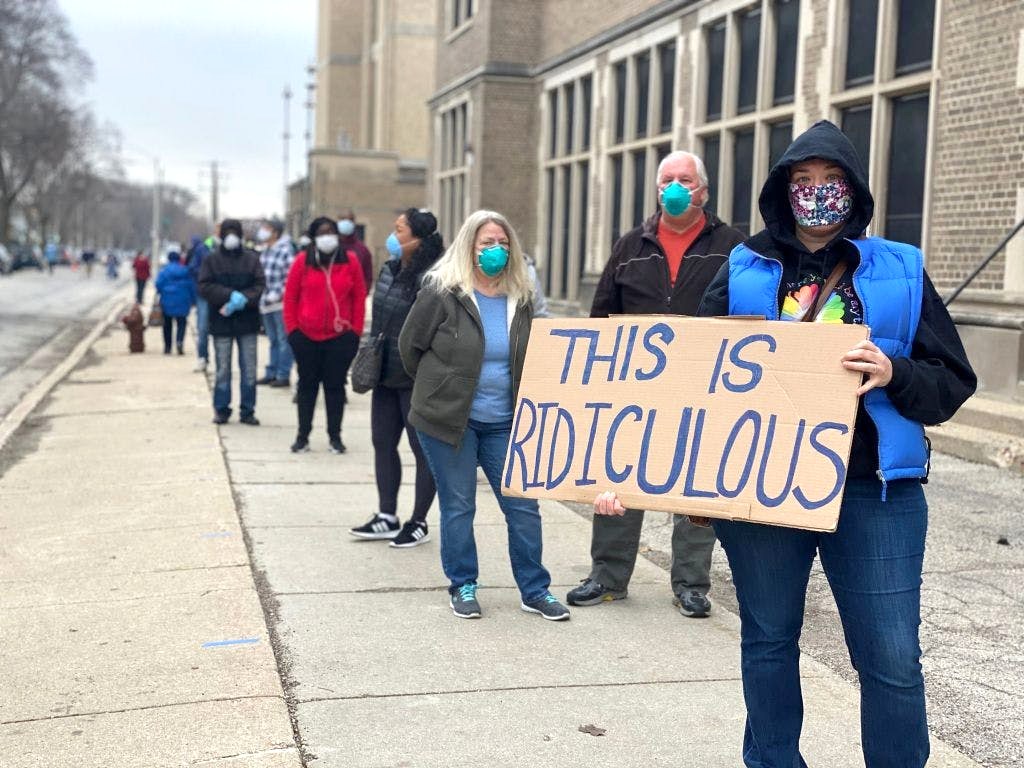
Wisconsin Republican state legislators, backed by Republican majority courts on the state and national level, forced Wisconsin citizens into a deadly and unnecessary decision: risk your life or give up your vote.

They did this for the recent primary election when they refused to call off in-person voting and extend voting by mail, basically to suppress the vote so that the Republican incumbent of the state supreme court would win reelection.  His vote would make it all but certain that the court would uphold throwing thousands of Wisconsin voters off the rolls for the November election.

With the state on covid 19 lockdown, many of the predominantly elderly poll workers would understandably not work.  So over a hundred of polling places in Milwaukee, where much of the black and poor populations reside, were cut down to two.  Polling places in affluent and white areas were pretty much unaffected.

Trying to manipulate the vote for political advantage is hardly unknown in American history.  But not until now has there been a major political party that is openly obstructing the exercise of the vote for potential voters they believe will vote the other way.  Nor has there been a party, or a President, who openly announced that this was a strategy to ensure party dominance.  With easier voting, the apprentice dictator said, no Republican might ever be elected again.

But then came election day, and despite the danger, despite rain and sleet, and hours in long lines, Wisconsin voters who could not get their mail-in or absentee ballots in time, came out and voted.  Turnout was 34%, high for a spring election, and on par with the last presidential nomination spring of 2016.

Interviews with voters on the day told a story that the results announced on Monday confirmed.  Voters were determined to vote no matter what.  And they were angry they were forced into this choice.  And they knew who was responsible.

Among those interviewed by various news media, African American voters in particular were insistent.  They knew of the sacrifices made by their grandparents and great-grandparents, and the deadly obstacles to voting in the South of their heritage.

In elective offices, the Democrats did very well.  Especially in the supreme court election, in which the challenger won handily, only the second to oust an incumbent judge in the past 50 years.  And she won by a lot.  Last year a supreme court seat was decided by a margin of 6,000 votes.  Jill Karofsky won by 163,000.

Joe Biden won the Democratic primary handily, and the next day Bernie Sanders strongly endorsed him, and Tuesday President Barack Obama endorsed him as well, in a video that begins with a truly presidential message on the Covid crisis.

But thousands were disenfranchised in Wisconsin, by the Republican insistence on voting during a pandemic, and by various others means that are becoming all too familiar.

Now Trump and Republicans are engaged in a stealth attack, and an even greater challenge to the November elections.  They not only oppose extending voting by mail, they seek to make it impossible by ending the mail altogether.

The US Postal Service, hit hard by the pandemic and its economics, is in financial trouble.  Trump announced he would veto any pandemic relief bill that included funds to keep the Postal Service in operation.  (This despite a multi-billion dollar bailout of the airline industry.)

Voting by mail is of course impossible without the mail.  And that seems to be what this is about.  The CDC is predicting a second wave of  covid19 epidemic in the fall.  Republicans want to force an entire nation to risk their lives to vote.

The Republican party knows no shame.  Remember Wisconsin, and its unsung heroes who would not be stopped from voting.

Monday, April 13, 2020

Poetry Monday: Mockingbird


The Mockingbird

Look one way and the sun is going down,
Look the other and the moon is rising.
The sparrow's shadow's longer than the lawn.
The bats squeak: "Night is here"; the birds cheep: "Day is gone."
On the willow's highest branch, monopolizing
Day and night, cheeping, squeaking, soaring,
The mockingbird is imitating life.

All day the mockingbird has owned the yard.
As light first woke the world, the sparrows trooped
Onto the seedy lawn: the mockingbird
Chased them off shrieking.  Hour by hour, fighting hard
To make the world his own, he swooped
On thrushes, thrashers, jays, and chickadees--
At noon he drove away a big black cat.

Now, in the moonlight, he sits here and sings.
A thrush is singing, then a thrasher, then a jay---
Then, all at once, a cat begins meowing.
A mockingbird can sound like anything.
He imitates the world he drove away
So well that for a minute, in the moonlight,
Which one's the mockingbird?  which one's the world?

--Randall Jarrell
Randall Jarrell in 1947

Randall Jarrell was an eminent 20th century American poet, critic and author of children's books.  He served in the US Army Air Force in World War II, and his war poems are among his most famous. He was among the few outstanding poets of that war.  His last years were marred by depression, especially triggered by the assassination of President Kennedy in 1963. This poem is from his last book, published in 1965, the year of his death, titled The Lost World.

Saturday, April 11, 2020

Weekend Update: The Good, The Bad and the Big Big Mystery

In terms of sheer numbers, especially of coronavirus deaths, this past week was the worst so far.  But there was also good news: the rate of new transmissions decreased in many areas of the US, and though the number of deaths remain horrendous especially in New York and other hotspots, the predicted number of deaths in the next weeks was downgraded sharply.

The slowing rate of transmissions has already translated into slowing in the rate of hospitalizations and deaths in those areas.  According to Governor Newsom, California is now confident that it has the resources to prevent the medical system from being overwhelmed.  Others are making that conclusion as well.

This is all attributed to the success of widespread isolation and physical distancing.  It is worth quoting again the words of Dr. Emily Landon, a Chicago epidemiologist when Illinois announced its stay-at-home order the third week of March: "It’s really hard to feel like you’re saving the world when you’re watching Netfliks from your couch. But if we do this right, nothing happens. A successful shelter in place means you’re going to feel like it was all for nothing, and you’d be right: because nothing means that nothing happened to your family. And that’s what we’re going for here."

In a recent New York Magazine post, David Wallace-Wells observed:"It can be easy to forget, a few weeks into something like a hemisphere-wide lockdown, just how absolutely unprecedented this public-health mobilization truly is: nearly every American in every state embracing punishing, restrictive quarantine-like isolation for the sake of the country as a whole. We are doing so willingly, with hardly any meaningful resistance to shelter-in-place guidance....This is solidarity I simply didn’t believe was possible in this country anymore and under any circumstances, and it has arrived in the space of just weeks, in the midst of national political chaos with tribal partisanship still boiling at a feverish peak. It is breathtaking."


UPMC 's promising vaccine in an easily manufactured,
distributed and administered delivery system, now
awaits approval for human trials.
Meanwhile there are efforts around the world to develop and test vaccines, antibody tests and treatment protocols.  The resources of the Internet and other computer capabilities are joining a fast, free-flow of information among medical researchers and front-line practitioners.

For example the University of Pittsburgh Medical Center is experimenting with a variety of drug treatments on volunteer patients internationally, and analyzing results via artificial intelligence, in a flexible program which will identify what seems to be working best and use that more often, while adding into the mix any new drug protocols as they are developed.

As more medical professionals have experience with treating the virus, there is also the possibility of modifying existing treatments to make them more effective.  For example, there's a lively discussion about how and whether ventilators should be used.  (Josh Marshall has also been writing about this issue.)

The bad news is the continuing dysfunction of the federal government, while the Trump administration employs their version of Shock Doctrine USA to take total political control and make it permanent.  The Republican party now doesn't even bother to deny that it will manipulate the voting system in ways that benefit it, including sending people of Wisconsin out to risk death in order to vote.  More on this at another time.

That bad news also means that there is as yet no federal plan to manage a Phase Two of the crisis, after this total lockdown but before universal vaccination. “A national plan to fight the coronavirus pandemic in the United States and return Americans to jobs and classrooms is emerging — but not from the White House,” according to the top story in Friday's Washington Post.

“Instead, a collection of governors, former government officials, disease specialists and nonprofits are pursuing a strategy that relies on the three pillars of disease control: ramp up testing to identify people who are infected. Find everyone they interact with by deploying contact tracing on a scale America has never attempted before. And focus restrictions more narrowly on the infected and their contacts so the rest of society doesn’t have to stay in permanent lockdown....But there is no evidence yet the White House will pursue such a strategy.” 

Instead the administration is again considering lifting stay at home guidelines prematurely, without widespread testing or a national consensus.

 According to Ezra Klein and others, none of the public plans for Phase Two even make complete sense yet. Josh Marshall explains the crucial role that widespread testing would necessarily play. But that also depends on what may turn out to be the key Big Big Mystery.

There is a Big Mystery as well, among all the things not yet known about this virus.  The Big Mystery, as outlined by Wallace-Wells, is how infectious the virus really is, and how much it has really spread.  If it is both more infectious and more widespread among people without significant symptoms--as some studies now suggest-- it could be less lethal than believed in terms of numbers, though of course just as lethal to some of its victims.  But the potentially best news if this were true (according to Wallace-Wells): "It would also suggest that we are much further along the timeline of the pandemic and much closer to its conclusion."

But this kind of testing is probably months away, and because of differences in the tests out there (some of them of dubious reliability), without a national standard there will be no actionable information.  As Josh Marshall writes: "With those concepts and definitions in hand, let’s say it simply: You can’t go back to even a semblance of normal economic and social life until you have an integrated, national system of surveillance testing in place that will give us a good shot at avoiding a rolling series of outbreaks and lockdowns for another year. A great system in one state and a crappy one next door won’t cut it."

According to the aforementioned Washington Post story, there are a lot of good ideas on how to ramp up contact tracing (such as assigning these tasks to returned Peace Corps volunteers), but difficulties increase without a federal umbrella and federal money.  Still, if this is a people-driven part of the process, it can be done.  And if California and a few other big states agree on a standard testing system (which may have to be developed not only outside the federal government, but outside Big Pharma), others would likely follow.  It wouldn't be complete but it would be something.

Yet even with more testing, there is the Big Big Mystery, which is: does having the disease once confer immunity? All plans depend on this, yet there are troubling studies that show some patients who tested positive, then tested negative, a short time later tested positive again.  There are studies among patients who had the virus and recovered, showing that up to a third had few antibodies in their systems against the virus, and some had none at all.

It would be astonishing if the virus did not ultimately confer immunity.  But if it doesn't, the basis for all current ideas for modifying or ending lockdown is shattered.  This is a mystery that must be solved.

Locally here in Humboldt County, we ended the week on a surprising but highly welcome note: Friday was the third straight day without a new positive covid 19 case, and the day before that string began there was only one case. Saturday update: no new cases for fourth day in a row.  Our cases are still small enough in number for contact tracing, so it is known that out of 49 active cases, seven are the result of community spread.  We remain at three hospitalizations and no deaths.  Still, California officials are not expecting cases to peak until mid-May. "Let’s continue to hold the line and do this together,” Governor Newsom said. “Give us a few more weeks to see where these trend lines go.”

Monday, April 06, 2020

Poetry Monday: Famous


Famous

The river is famous to the fish.

The loud voice is famous to silence,
which knew it would inherit the earth
before anybody said so.

The cat sleeping on the fence is famous to the birds
watching him from the birdhouse.

The tear is famous, briefly, to the cheek.

The idea you carry close to your bosom
is famous to your bosom.

The boot is famous to the earth,
more famous than the dress shoe,
which is famous only to floors.

The bent photograph is famous to the one who carries it
and not at all famous to the one who is pictured.

I want to be famous to shuffling men
who smile while crossing streets,
sticky children in grocery lines,
famous as the one who smiled back.

I want to be famous in the way a pulley is famous,
or a buttonhole, not because it did anything spectacular,
but because it never forgot what it could do.

Naomi Shihab Nye


Born to a Palestinian father and American mother, Naomi Shihab Nye is a poet, songwriter and novelist.  She is currently the Young People's Poet Laureate, appointed by the Poetry Foundation.  She calls San Antonio her home.

Saturday, April 04, 2020

Two Sides of Denial

The lst British edition cover 1957
In preparing for my next planned post in my Soul of the Future series--which will conclude the posts covering atomic apocalypse movies with the more direct films of the late 50s through the 1980s that followed the indirect atomic monster movies--I began to re-read a novel upon which one of these movies is based.

The novel is On The Beach by Nevil Shute.  As an end-of-the-world novel, it has a particular resonance right now.

Nevil Shute was a British engineer and mid-20th century novelist, popular in the UK especially though little remembered now.  Several of his novels have been made into movies and television mini-series over the years, including this one.  Disillusioned with his native UK, Shute moved to Australia, and this novel is in many ways a descriptive tribute to his adopted country.

Its premise is ingenious, for it enables Shute to write about the consequences of nuclear war without actually depicting the devastation.  When published in 1957, it was a near future novel, set in the early 1960s.  About a year before the novel starts, the world suffered a brief but supremely devastating nuclear war.  Many if not all of the bombs used were "cobalt" bombs, atomic bombs that pack extra radiation.  Such bombs were theoretically possible, and theorized as Doomsday devices. In Shute's novel, radiation has killed everyone in the northern hemisphere: North America, Europe, Asia, northern Africa.  Its deadly radiation is slowly moving south and around the globe.  The novel, set in Melbourne, begins when that city has about six months left.

So when the story starts, Australia has had six months to absorb and confirm all this.  The government has manufactured and distributed suicide pills to its citizens, suggesting they be taken at the first signs of radiation sickness.

The novel follows an American submarine captain in Australia, and the people he meets. These Australians are coping as best they can with their ordinary lives.  There are some everyday changes--mostly that there is little gasoline, since it all came from the northern hemisphere.  (There's no Mad Max in this book.)

The style of the book is straightforward, almost pastoral at times.  Many of the characters are in the military or work with it, and their respect for facts is absolute. They continue to seek knowledge and don't shy away from what they find.  They face having no future with the absurd but almost beautiful and certainly touching combination of accepting it while ignoring it. A young couple plans their garden, and their child's education.  A farmer plants his crops.

The US Navy captain knows his family in Connecticut is probably dead but acts as if they are not. He buys his children presents.  Everyone speaks of the faraway dead as if they are still alive, faraway cities as if they are still functioning.  Yet no one is deluded.  The young Australian officer makes sure he will be home from sea duty in plenty of time to spend the last months with his family.

The 1959 Signet edition I'm reading 
What does this have to do with our current situation?  It got me thinking about denial, and how there are at least two kinds: there's the toxic denial that leads to tragedy, that had something to do with our lack of preparation for this crisis and certainly has a lot to do with the current muddle.

But there is also healthy denial, and the Australians in this novel illustrate it.  The US captain and an Australian woman friend are discussing the young couple who are planning their garden for the next ten years.  They speculate on what's going through their heads, but the captain finally says: "The thing is, they just kind of like to plan a garden.  Don't you go and spoil it for them, telling them they're crazy."

"I wouldn't do that."  She stood silent for a minute.  "None of us really believe it's ever going to happen--not to us," she said at last.  "Everybody's crazy on that point, one way or another."

"You're very right," he said emphatically.  

Certainly there is an underlying desperation to what some of the characters do, but mainly they face the end with grace.  Part of what enables that grace is an active, healthy sort of denial that allows them to act, to share, to give and to perceive, without becoming paralyzed by anxiety and despair.  That includes acting and planning for an illusory future, because that's an activity of the present that defines their lives.

These days we are living the ongoing consequences of toxic denial.  But without some healthy denial, it might be impossible to get through the day.

Friday, April 03, 2020

Today's Headlines

Jennifer Rubin's column in the Washington Post was about all the national news I could stomach.  It is a succinct, cogent and therefore frightening summary of the chaos and craven corruption of this administration and the Republican leadership in confronting the Covid 19 crisis, and it is only getting worse as more corrupt practices are applied to relief efforts.  That includes political favoritism in doling out deliberately scarce live-saving resources and further attempts to turn the $2 trillion bipartisan economic rescue bill into riches for the favored few.

Rubin's column ends:
"The chaos, confusion and incompetence at the federal level magnify our daily anxiety and uncertainty. We have lost control of our lives, and those supposed to lead us through this ordeal are deepening our national trauma. Years of contempt for expertise, for competent government and for truth itself on the right now haunt us all. God help us."

Regionally, the most painful place is the horror that is New York. I keep track of what I can in my current home state of California, and my birthplace of western Pennsylvania.  In both places--and I'm sure in many others--many people are struggling just to feed themselves.  In both states, long lines of cars to food banks now needing the National Guard to distribute an eight-fold increase in the food needed.

Locally, virus testing has identified 10 new cases in the past three days, for a total of 39 active cases and two patients hospitalized.  Per capita, Humboldt is testing more than the national average, and the percentage of positives is less than half the national average.  The average age of the positives is 44, which suggests students are among them but neither Public Health nor HSU has anything to say about this directly.

My current coping mechanisms include: walks with Howdy, backyard hoops, "NCIS New Orleans" (a series I don't see ever coming back on the air) with Margaret, Mind and Life videos and Tony Hillerman mystery novels.

Thursday, April 02, 2020

R.I.P. Adam Schlesinger


Covid 19 induced deaths are mounting, including artists and public figures in every area.  Making news Wednesday was the death of Adam Schlesinger, known to some as a performer in the Fountains of Wayne and others as one of the better pop songwriters of our time, particularly songs for film and TV.

Probably his most famous composition is one you've heard about here recently: "That Thing You Do," the title song of the Tom Hanks-written and directed movie of 1996.

Schlesinger was 52.  His death is described as a consequence of complications arising from covid 19.  He had two daughters.

His death is tragic, but if in his life he left behind nothing more than this irresistibly joyful tune, he did very, very well.  May his rest in peace, while the joy he brings lives on.

The video above is one of a couple on Youtube shot by audience members at small venue performances by Schlesinger (on bass and backup vocals) and Mike Viola with lead vocals and guitar, both of them reprising their roles on the soundtrack recording, which they also co-produced.  I've chosen the one with the best sound.

Wednesday, April 01, 2020

Afloat with the Spelling Bee

At the end of February, I wrote about my ongoing obsession with the New York Times Spelling Bee daily puzzle.  A month ago of course now seems like life on a different planet.  So what was a dubious but mostly harmless recreation has now, in the midst of stay-at-home edicts, empty streets and external horrors, a different kind of lifeline.

It's become a thing for many people, I read: a hobby or hobby-like activity to anchor the day and the pulsing in and out of sanity.  So I am called to do a brief update on mine.  (For those who don't know the game, check my first post on the subject.)

Although I previously expressed a desire to resist the need to meet my twin goals of reaching Genius level and getting the 7-letter Pangram every time,  I have in fact added more than another 30 days to my previously unbroken record of doing so (excuse me if this is becoming a broken record) though I'm not sure how long it actually is.  Over 130 straight days (or, in my case, nights) anyway.

By this time, new puzzles are giving me deja vu--I feel I've done them before.  But if so, this prior experience hasn't resulted in faster results, or at least not much faster, particularly when the puzzle is troublesome.

Some of my blind spots remain remarkably consistent.  The worst case was a Pangram I worked hours on, including reverting to pen and paper to jot down words that don't include the center letter but might be used in compound words, but also because I've found that if I just string out the seven letters in a line I can see patterns I missed when the letters are arrayed in a circle.  Except this time it didn't work.  I was back working with the wheel when I got the word ("typhoid.")  Then, when I glanced back at the letters I'd written in a line, I saw that they pretty much spelled out that very word, with just one transposition. It took me hours to find what was staring me in the face.  Very humbling.

Though I've become a bit faster in finding the words that these puzzles often repeat, at other times I manage to find new words while not finding words I had found in earlier puzzles.  And I remain puzzled by some of the words the puzzle-makers accept and especially the ones they reject.  I really don't understand why they accept "Panhellenic" and not "Hellenic."

I notice that in my previous post I failed to mention the most alarming byproduct of doing these puzzles, which was that my brain continued to shuffle through a random series of words and spellings even when I wasn't doing the puzzle, even to the point where I caught myself doing so in my sleep.  That has fortunately lessened.

I do find myself tiring earlier.  After 25 words in the longer puzzles I'm usually losing concentration.  But all in all, it doesn't seem like a time to look a gift life preserver in the mouth.

Tuesday, March 31, 2020

Today's Headlines

Nationally, it couldn't be said more clearly than this quote from Slate:

“The administration’s response in general has been an abysmal failure, and he compounds that failure by regularly attacking the governors to whom he has passed the buck,” Senator Chris Murphy, a Connecticut Democrat, told me. “I just don’t think we can allow ourselves to normalize a president who is politically attacking the very governors who are trying to save lives right now in the absence of real federal leadership.”

States are currently competing against one another--and with the federal government-- for equipment needed to detect and treat Covid 19.  Senator Elizabeth Warren tells of MA failing to get equipment it had purchased because they were outbid by the federal government.

In Politico:

That is a Darwinian approach to federalism; that is states’ rights taken to a deadly extreme,” said Martin O’Malley, the former Maryland governor who served for eight years on the Homeland Security Task Force of the National Governors Association. “The better read of federalism is that the states and federal government work together when the U.S. is attacked, whether it is by imperial Japan or a pandemic.”

Globally, the current administration picked this moment to weaken air quality and CO2 standards on vehicles, as usual mostly because the Obama administration imposed them.  President Obama responded:

“We’ve seen all too terribly the consequences of those who denied warnings of a pandemic. We can’t afford any more consequences of climate denial. All of us, especially young people, have to demand better of our government at every level and vote this fall.”


Regionally, there's a good piece in Slate praising Governor Newsom of CA as well as Andrew Como of NY for their different styles of leadership in the CoVid 19 crisis.  This is one of several pieces crediting Newsom's early actions (and CA compliance) with bending the curve in the state's case rate.

Locally, Humboldt County has recorded its first cases of the virus believed to be community transmissions--that is, not as a result of foreign travel or contact with someone who was infected as a result of that travel.  There are now 26 active cases in the county, with one hospitalized and so far no deaths. Our first case has recovered.  Health officials currently expect our rate of transmission to peak in about a month.

We are concerned about the consequences of Humboldt State University's decision to allow students who chose to leave the area for spring break to come back, and specifically, HSU's irresponsible and dangerous decision just this past week to actually bus students back from high-contagion areas, namely LA and the Bay Area.  They returned for no reason, as all HSU classes this term are online only.

And very locally, Margaret and I are fine at home.  And, after a too close encounter with a bigger dog, so is Howdy.  So far, all the family members elsewhere we know about are also okay.

Monday, March 30, 2020

Poetry Monday: Air

Air

Naturally it is night.
Under the overturned lute with its
One string I am going my way
Which has a strange sound.

This way the dust, that way the dust.
I listen to both sides
But I keep right on.
I remember the leaves sitting in judgement
And then winter.

I remember the rain with its bundle of roads.
The rain taking all its roads.
Nowhere.

Young as I am, old as I am,

I forget tomorrow, the blind man,
I forget the life among the buried windows.
The eyes in the curtains.
The wall
Growing through the immortelles.
I forget silence
The owner of the smile.

This must be what I wanted to be doing,
Walking at night between two deserts,
Singing.

W.S. Merwin


Merwin published his first book of poems in 1952, and his last in 2016.  He won two Pulitzer Prizes--in 1971 and 2009.  This poem is comparatively early in the incredible span of his writing life, first published in his 1963 volume The Moving Target.  It is included in the collection The Essential W.S. Merwin, published in 2017.  It was included in the 1969 anthology Naked Poetry, edited by Stephen Berg and Robert Mezey, which is where I first saw it.  It is accompanied in that anthology by this photo of the poet as a young man.

The word "immortelles" means "everlasting" and is the name of a tree, and of papery flowers like those of this Caribbean tree, as the tree with orange blossoms in the top photo.

Thursday, March 26, 2020

The Other Side of Apocalypse


It happens in wartime--it happened in World War II for certain, and the Great War, and to some extent during Vietnam.  It happened during the Great Depression.  In the middle of an apocalyptic time, people begin looking beyond it, looking for the silver lining, the changes for the better it might clarify and enable.

The other side of this current apocalypse--of this current revelation--could be a better future.  It's a long way yet to that other side, but that discussion is already beginning.

Anna Marie Slaughter's piece in the New York Times, referenced in a previous post, is one example.  She writes:

"The coronavirus, and its economic and social fallout, is a time machine to the future. Changes that many of us predicted would happen over decades are instead taking place in the span of weeks."

Several of the innovations she mentioned involve increased use of technologies for remote learning, teleconferencing and 3-D printing.  Both remote learning and teleconferencing reduce the need to travel, which helps clear the air and reduces greenhouse gases.  3-D printing is one of the ways communities can reduce dependence for vital supplies on global supply chains. The question is whether universities and businesses go back to the old model or better integrate remote learning and teleconferencing in a new synthesis.

(Other questions are whether any of this stuff works, and how to make them work better.  For those answers, this crisis provides lots of data.)

This crisis, she writes, also increases our awareness of the vital roles of caregivers in our society as well as our economy, she writes, which should lead to valuing them more with better pay.  As for the economy in general, today's crisis argues for more attention to guaranteed incomes, as well as more investment in better broadband capabilities for everyone.  She concludes

"The future is here, whether we like it or not. Although a future dependent on the current federal government looks bleak, we can vote to change that in November. Right now, we can follow the lead of local and regional leaders and step up ourselves. Through the virus, we are rediscovering the dark side of the Rev. Dr. Martin Luther King Jr.’s famous “inescapable network of mutuality, tied in a single garment of destiny.” But we can also rediscover what is possible and what we are capable of as a nation. We can use this crisis to create a better America."


Another example of this kind of thinking is found in a compilation piece in Politico, in which 34 experts forecast how the coronavirus crisis will change the world.  A surprising number of them speculate that despite the horrors it is likely to inflict this year, the crisis and response to it could change the future for the better.

Some of the topics discussed are: "A new kind of patriotism," "A decline in polarization," "a return to faith in serious experts," new forms of reform, a greater appreciation of government, as well as a host of accelerated changes involving technology, new economic models and a society organized more on empathy than hostility.

Certainly some of these reflect the writer's wishlist, and some of them clearly have a dark side.  And there is a long way to go before we get to the other side, in which we will all be tested.  Already we're seeing racism, misinformation and anger erupting, and we're likely to see more.

But some changes, if not transformations, are inevitable, and some offer particular opportunities.  I can't help thinking that all that's being done that was previously unthinkable, was specifically cited as reasons why we weren't addressing the climate crisis with the required urgency.  Giles Tremlett suggests that those governments that acted comprehensively and with urgency to address the Covid crisis provide models for how to address the climate crisis.

Meanwhile--thanks to the vehicles not on the freeways, and the factories not polluting-- the air quality in Los Angeles is suddenly good.  Air pollution is suddenly declining everywhere.  The water is suddenly clear in the canals of Venice, and wildlife is returning.  Locals are talking about controlling tourism there rather than letting it overwhelm them again.

We've known for years that pandemics were becoming more possible for many reasons, but specifically because of global heating--especially those associated with insect-borne diseases. And while I haven't seen anything yet that links this virus to the climate crisis, it has been causally linked to the other paramount (and related) ecological catastrophe of our time--the mass extinction of life forms on the planet.

“We invade tropical forests and other wild landscapes, which harbour so many species of animals and plants – and within those creatures, so many unknown viruses,” David Quammen, author of Spillover: Animal Infections and the Next Pandemic, recently wrote in the New York Times. “We cut the trees; we kill the animals or cage them and send them to markets. We disrupt ecosystems, and we shake viruses loose from their natural hosts. When that happens, they need a new host. Often, we are it.”

This view more than suggests that this is not the last viral pandemic we can expect.  For a better future, and for a longer one, the twin ecological threats to the survival of humanity and all life as we know it--the climate crisis and species extinction--must be addressed with a similar urgency, when we get to the other side of this apocalypse.

Update 3/28: Meehan Crist has an oped in the NYTimes, "What the Coronavirus Means for Climate Change" that is along these lines of looking to the future through this new lens.  But towards the end of this piece is a section about the effects of the suddenly clean air in Chinese cities, usually swamped in smoke and industrial pollution:

"In China, just two months of reduced pollution is likely to have saved the lives of 4,000 children under the age of 5 and 73,000 adults over the age of 70, writes Marshall Burke, an assistant professor in Stanford's earth system science department."  

I'm sure there is more to be said about climate crisis, public health and proportionality.

Monday, March 23, 2020

This Critical Moment

This is not the moment to lose our nerve.  Everything depends on it.

On Monday there were two potentially catastrophic trends.  The first was the wave of stories, prompted by the White House, that social distancing and stay at home orders should be abandoned.  Republicans in particular are losing their nerve about damage to the economy, which translates in their terms to corporate profits.

They are doing so as the number of cases and deaths start to rise, and infection experts (led by Dr. Fauci) unanimously say that social distancing is crucial to slow down and minimize new infections.

Even now, the patchwork guidelines and orders, begun at different times to different degrees in different cities and states, as well as different countries around the world (and they continue) have made effective response a dicier matter than it should be, not to mention the people who are disregarding social distancing guidelines.  These strictures should be strengthened, not ended, the medical experts say.

The medical consequences most likely would be more sickness and death, and especially the implosion of hospitals and the public health system.  All of these would also have economic consequences, worse than shutting things down for awhile.

Jordan Weissmann writes in Slate:

The more sensible approach to taming this virus and saving our economy would be to orchestrate an actual nationwide lockdown for at least three or four weeks while the government essentially pays everybody’s bills (see: the economic aid bill Congress is working on). During that time, the country could ramp up production of tests and ventilators, and put in place measures necessary to set up an effective regime of testing people suspected of being ill and tracing their contacts, which appears to have worked in both South Korea and Taiwan. We’d face a dramatic economic downturn, yes. But we might also enjoy a relatively quick, V-shaped recovery as life returned to some semblance of normality.

The coronavirus crisis is going to create a severe economic hardship. There’s no escaping that. The question is whether it will be a short-lived disaster that we can begin pulling ourselves out of with the help of a serious public health mobilization, or if it will be a long, lingering horror we muddle through as people die. The fact that Trump is already having doubts about the half-measures he took last week unfortunately suggests he doesn’t have the stomach or foresight to pick the right course, because he’s too worried about the daily fluctuations of the stock market. Instead, he’s steering us toward a long pandemic and a depression all at once."

But as sensible as this is, we know we're unlikely to get a comprehensive national policy from this administration.  In the end, however, we are talking mostly about an additional two weeks or so of closed businesses.  The administration's announced policy is to maintain the federal strictures for two weeks in total and then reevaluate.  Medical experts will be consulted, and they are already talking about an additional two weeks at least.

The crucial element is to identify how and where to restart activity. We have to hope the states themselves will be looking at this.  Otherwise with confusion and conflict we risk chaos and an outbreak of panic.

Also on Monday, in the guise of a comprehensive support for the economy, Senate Republicans authored and forced votes on a bill that basically provides bountiful support for those who make millions a year.  In this immense crisis, Senate Majority Leader Mitch McConnell can't seem to get beyond his default position as a partisan bully, trying to get a Trump-controlled corporate giveaway passed as a crisis measure: a classic shock doctrine tactic.  By forcing two votes at high pressure moments, McConnell tried to bully Democrats into voting for a bad--and decidedly not non-partisan-- bill.  They wouldn't.

Meanwhile a more responsible bill is taking shape in the House under the supervision of the only member of legislative leadership I personally trust, House Speaker Nancy Pelosi.  A comparison of provisions (though a partial one) suggests that yes, it contains some Democratic wish-list items that could be eliminated in a bipartisan bill, but in general is a much better and more effective response to this crisis.

The news on Monday night was cautiously better.  The Senate minority leader said that a $2 trillion consensus bill should be finalized on Tuesday morning, that includes at least some of the guarantees and protections for workers and the support for the health system that Democrats can support.  Speaker Pelosi was reportedly in the loop, as was the White House.

We're not going to get the national leadership we need from this administration.  But Trump must at least be forced to back away from his cowardly threat, and his cowering to corporations that don't want appropriately strong measures taken.  We still need time to prevent the worst.

Poetry Monday: A Blessing


A Blessing

Just off the highway to Rochester, Minnesota,
Twilight bounds softly forth on the grass.
And the eyes of those two Indian ponies
Darken with kindness.
They have come gladly out of the willows
To welcome my friend and me.
We step over the barbed wire into the pasture
Where they have been grazing all day, alone.
They ripple tensely, they can hardly contain their
       happiness
That we have come.
They bow shyly as wet swans.  They love each other.
There is no loneliness like theirs.
At home once more,
They begin munching the young tufts of spring in the
       darkness.
I would like to hold the slenderer one in my arms,
For she has walked over to me
And nuzzled my left hand.
She is black and white,
Her mane falls wild on her forehead,
And the light breeze moves me to caress her long ear
That is delicate as the skin over a girl's wrist.
Suddenly I realize
That if I stepped out of my body I would break
into blossom.

--James Wright
James Wright on horseback with fellow poet Robert Bly, who is
the friend mentioned in this poem

Sunday, March 22, 2020

In Memory

     Flora Severini Kowinski   Sept. 13, 1920--March 22, 1974

Saturday, March 21, 2020

Our Asshole In Chief--And Actual Leaders

Rather than a leader or even a help, the Chief Executive of the U.S. continues to be an active hindrance to coming out of this Covid 19 crisis short of complete catastrophe and wanton tragedy.

His press conferences are fonts of callous misinformation at a time when clear information is most important, and his indecisiveness at this critical moment is crucially dangerous. (Today's New York Times headline: Trump Resists Appeals for More Urgent Action.) Every time he speaks the stock market drops into freefall.  That's even before we get to his diversionary racism. No wonder that Rachel Maddow suggests the media stop enabling him, and refuse to carry his statements live.

He outdid even himself at his press conference the other day when an admittedly combative NBC reporter ended a series of tough questions with a slow one, belt high, over the plate: he asked what the President of the United States would tell people who are scared.  Instead of taking this opportunity to offer words of compassion, reassurance and leadership--let alone inspiration--Trump let loose with a pent-up tirade attacking the integrity of the reporter and his entire TV network.  So instead of a leader, we've got--at best--the Asshole-in-Chief.

By contrast, the Chancellor of Germany, Angela Merkel, hit all the right notes in her TV address to her nation.  First of all, the event assumed great importance because it is rare--she simply doesn't bloviate publicly, and rarely gives speeches on TV.  So people were listening, and what they heard informed and inspired them.

She did not minimize the situation, but she did so within a noble framework:  “Since German unification—no, since the Second World War—no challenge to our nation has ever demanded such a degree of common and united action.”

Of the speech, which contained no specifics about required actions, reporter Justin Davidson writes: "Yet what gave her address its force was her tone, which was direct, honest, and searingly empathic. She laid bare not just the test we all face but also the solace that leadership can provide. Without accusations, boasts, hedges, obfuscations, dubious claims, or apocalyptic metaphors she did what a leader is supposed to do: explain the gravity of the situation and promise that the government’s help would flow to everyone who needed it.

This is a war without a human enemy, and Merkel lay no blame. She asked for the sacrifice of discipline, for heroic acts of kindness. She acknowledged the paradox in calling for solidarity and apartness at the same time. She understood how painful it is that just when people desperately want to come together, families and friends have to endure separation."

Further, what Merkel did was praise those whose behavior is a model for the needed behavior throughout the crisis.  But not just medical workers, the most obvious. "Those who sit at supermarket cash registers or restock shelves are doing one of the hardest jobs there is right now.”

America is missing this unifying voice.  It is missing this grasp of the situation and understanding of what is necessary that could deploy the power of the federal government.

But the good news is that others are not waiting helplessly for the asshole in chief and a fractured Congress.  They are utterly ignoring the former.  In terms of governance it is the governors of the states who are leading.

Ann Marie Slaughter in the New York Times chronicles some of these efforts: "But if this crisis is highlighting our weaknesses as a nation, it is also bringing out some of our greatest strengths. In the absence of competent national leadership, others are stepping up. Governors and mayors, business owners, university presidents, philanthropists, pastors and nonprofit groups of all kinds have taken the initiative to mobilize, guide and protect those they lead and serve."

These--as well as true medical experts-- are the people we need to be listening to. Not the Asshole in Chief.

Slaughter continues: "These are the hallmarks of a horizontal, open society, one that is often inefficient but ultimately more innovative and resilient than closed, top-down systems. That is not to excuse the absence of national leadership; many Americans are likely to die who could have been protected had the nation been better prepared and better led. When people are suffering and dying and a virus is propagating, high-quality, centralized, top-down direction is critical.

Over the longer term, however, we are better off with as much experimentation and as many leaders as possible, not only to spur the kinds of innovations that will protect us from the virus (vaccines, treatments, cheaper and better medical equipment) but also to guide our transition to a very different world."

This pivot point of Slaughter's piece leads to the subject of an upcoming post--what people are saying about what may await us on the other side of this.

Thursday, March 19, 2020

Who Are We? (The One You Feed)

Things are moving so quickly there is little to say that would necessarily survive the week.  There is so much information, and it keeps changing; yet there is not enough real information to define or determine much.

Whether this Covid 19 crisis is leading to unprecedented economic destruction has entered the conversation since last week at this time, and one of the problems is that nobody seems to know (or is able to explain clearly) what will help and what won't.

Social distancing has so quickly become normal that it is jarring to see TV characters shaking hands on shows made just weeks or months ago.  Yet as fast as all this is proceeding, it is also moving slowly in daily life in unknown directions.

But there are perhaps things that can be said in general, that apply to other crises but are becoming very real now, very fast.  And that is the nature of our responses.

We all have to deal with anxieties, with the continual cognitive dissonance of daily lives as the world wobbles.  Today (Wednesday) I was reading about how the US economic crisis could be more severe than the Great Depression, when the back of my chair was pulled by an earthquake under me.  And I mean a literal earthquake--a 5.2 offshore that did no reported damage.

Beyond that, and beyond acting with prudence and responsibility on behalf of ourselves, our loved ones and everyone else, there is the question of resilience.

I published a previous post on people in Italy singing, and the clapping across a city to honor healthcare workers--these practices have become viral in the old good sense, spreading all over Europe.

But an essay in Slate   by Lili Loof Bourow provides an astringent challenge to the idea of American resilience.  For example:

"Our situation is different not just because the Trump administration squandered the six weeks it had to prepare while other countries were modeling more and less effective approaches to their respective epidemics, and not just because Donald Trump has taught his followers that nothing scientists or the press says is true, but because some Americans believe that defying expert recommendations isn’t just their God-given right—it’s courageous and funny and even patriotic."

Bourow reminds us that (apart from unheralded heroics by some to survive the Great Recession) our only conspicuous example of resilience in recent years was the response to terrorism and 9-11, and that was to courageously go shopping (as President Bush recommended) while we meekly allowed ourselves to be turned into a surveillance state. "We have been led to believe that consumerism is the only political power we, the people, really have.... this is how we at home win the “battles” that have become notional and emptied of any ideal but rationalized selfishness. There’s no risk. There’s no sacrifice."

Yet for this crisis, the choice of selfishness v. sacrifice is already present, and may turn out to be defining.  Before this transformative weekend, way back on last Thursday (a whole week ago), when all of this started to get real in a big way, the New York Times online published a relevant array of articles/opinion pieces, as the news veered sharply towards national crisis.

For example, three prominent doctors with experience in disaster medicine wrote a piece headlined  How the Coronavirus May Force Doctors To Decide Who Can Live and Who Dies.  The subhead: "In the face of overwhelming demand and limited resources, health care would need to be rationed, with agonizing decisions." Since then, we've learned this may have already happened in other countries.

The headline on regular Times opinionater David Brooks was headlined Pandemics Kill Compassion, Too.  The subhead: You may not like who you're about to become.

"Some disasters, like hurricanes and earthquakes, can bring people together, but if history is any judge, pandemics generally drive them apart."  Brooks goes back centuries for much of his evidence, but also gave examples from the 1918 flu epidemic that killed 675,000 Americans during and shortly after World War I, in which 53,000 Americans died.  He quotes John M. Barry in his book The Great Influenza that when health care workers in "city after city" pleaded for volunteers, "few stepped forward."  "In Philadelphia, the head of emergency aid pleaded for help taking care of sick children.  Nobody answered...There are families in which every member is ill, in which the children are actually starving because there is no one to give them food."

Brooks exempts health care workers from this failure, including those in Washington state responding to the worst coronavirus outbreak in the US.  "It also wouldn't be a bad idea to take steps to fight the moral disease that accompanies the physical one," Brooks concludes.

But there is another view, also presented in Thursday's Times online, in an article that would appear in its Sunday Magazine entitled This is How You Live When the World Falls Apart.  It is apparently from a new book about how (as the article subtitle says) "The Great Alaska Earthquake of 1964 surprised everyone by showing that natural disasters can bring out more kindness than selfishness."

Author Jon Mooallem found that looting and criminal behavior was almost nonexistent, and the norm was immediate helping.  Individuals organized themselves into effective groups to pull people out of the rubble, to put out fires and take care of the injured.

“It’s there in front of you, so you do it,” a nurse named Dolly Fleming would later explain; she could find no more incisive theory to account for all the cooperation she’d witnessed. During the quake, Mrs. Fleming had found herself on a thrashing staircase and, seeing a teetering child in front of her, instinctively tucked him under her arm and strained to keep them both steady. Decades later, at age 93, the one cogent thought she could remember having through those four and a half minutes was: “I’m thankful I’m here. I’m thankful I’m here so I can hold on to this little guy.”

What was especially striking to me about this account was how it comports to what I read in researching an article  I wrote about local scholars who studied altruism--specifically rescuing Jews from the Nazis.  These were longer term and life-risking efforts, and yet they too were spontaneous, and people seemed surprised when asked why they did it.  (However, the answers that these scholars--Sam and Pearl Oliner--finally came to are summarized in their eight elements of caring, appended to the end of my article. They are worth looking at now.)

There are obvious differences between an earthquake and what looks to be a months-long pandemic.  But Mooallem draws some conclusions:

You’d be forgiven for feeling pessimistic, for dismissing what happened in a small Alaskan city long ago as quaint, and far less possible in our society now. And yet: In the 56 years since the Great Alaska Earthquake, an entire field of sociology, disaster studies, blossomed around the Disaster Research Center, with sociologists parachuting into scores of other communities after natural disasters around the world, and it’s stunning to look back and recognize how much of the resilience, levelheadedness, kindness and cooperation those sociologists saw in Anchorage turned out to be characteristic of disasters everywhere.

Many of our ugliest assumptions about human behavior have been refuted by their observations of how actual humans behave — though we seem tragically slow to shed those old myths...

In 1975, 11 years after their work in Alaska, two of the Disaster Research Center’s founders, Russell Dynes and Enrico Quarantelli, speculated about why they continued to find essentially the same scenario repeating itself: why, rather than encouraging conflict or violence, these catastrophes appeared to bring out the best in people. In ordinary times, they wrote, we suffer alone; any acute experience of our own vulnerability can isolate us, or even make us resentful of others: “The victim often feels discriminated against since there are others who have been spared.” But a disaster affects everyone, and peels us away from “mundane matters” to the “very issue of human life itself.”

When “danger, loss and suffering become a public phenomenon,” they went on, “all those who share in the experience are brought together in a very powerful psychological sense.” An unrelenting immediacy sets in: “Worries about the past and the future are unrealistic when judged against the realities of the moment,” the sociologists wrote, and distinctions between people fall away, leaving only “human beings responding to one another as human beings.”

Thrown all together, in one unrelenting present, we are made to recognize in one another what we deny most vehemently about ourselves: In the end, it’s our vulnerability that connects us."

In the end, it's our vulnerability that connects us.  I think that's partly what's behind what has become my favorite and most basic statement of morality: "You'd do the same for me."  That's a statement about fairness and morality, about faith and hope, and about societal and cultural ties that bind.  But it is also based on a statement of fact: sooner or later, I may need somebody's help.

And as the story of Mrs. Fleming suggests, it becomes a statement of what each of us stands for, what each of our lives means. Even if we don't respond spontaneously, do we want to think of ourselves--or to be remembered-- as someone who tried to help?

This is as true for pandemics as other kinds of disasters.  Author Frank Snowden, who has studied pandemics throughout history, tells a New Yorker interviewer:

"Epidemics are a category of disease that seem to hold up the mirror to human beings as to who we really are. That is to say, they obviously have everything to do with our relationship to our mortality, to death, to our lives. They also reflect our relationships with the environment—the built environment that we create and the natural environment that responds. They show the moral relationships that we have toward each other as people, and we’re seeing that today."

The evidence so far from the current crisis is mixed--stories of ordinary denial and panic, and of almost inconceivable opportunism and evil, and misplaced racial fears. But also stories of generosity, dedication and sacrifice as well as responsibility and resilience.  In the end it becomes another illustration of that old teaching story, ascribed to various Native American tribal traditions.  One version:

An old Cherokee is teaching his grandson about life. "A fight is going on inside me," he said to the boy. "It is a terrible fight and it is between two wolves. One is evil - he is anger, envy, sorrow, regret, greed, arrogance, self-pity, guilt, resentment, inferiority, lies, false pride, superiority, and ego." He continued, "The other is good - he is joy, peace, love, hope, serenity, humility, kindness, benevolence, empathy, generosity, truth, compassion, and faith. The same fight is going on inside you - and inside every other person, too."

The grandson thought about it for a minute and then asked his grandfather, "Which wolf will win?"

 "The one you feed," the grandfather replied.

Monday, March 16, 2020

Poetry Monday: Looking for You

Looking For You

Looking for you through the gray rain,
your whole house is a face, windows
for eyes, door for a mouth.  Chimney
breathing, your house waits.  You
come down the street: you get a stare,
straight and slow to change.

No matter how willing and weak your own
face is, you know another face
for you, somewhere in the world: your house,
or a stone you choose on a mountain, or even
the wrinkled sea and its friend the wind.

Far away on an island off Alaska
there's a village gone back to forest,
and there leaning and peering--totem poles,
gray cedar eyes, crest, beak:
all those faces at home, staring from shadows,

Looking for you through the gray rain.

William Stafford