Friday, April 27, 2018

What's Happened, Baby Jesus?

program cover by Tarillis J. Seamans
Fifty years ago tonight, What's Happening, Baby Jesus?, a play I wrote and directed, opened in the Studio Theatre at Knox College.

 At some point after I moved here to California in 1996, a then-current Knox student called me, and said she was researching a paper that involved Knox productions in 1968.  She told me that this play was often mentioned by people she interviewed, and had been talked about a lot at Knox for several years after the production.  It was discussed, she said, even with an incoming theatre department professor. This was all news to me.

Perhaps it was remembered because it was the first multi-media production, involving film and music.  It was in other respects as well, very much of its time.


Hue April 1968
 April 1968 was not just another April, just as 1968 was not just another year.  More American troops were engaged in the Vietnam War, more young American men were drafted, and there was more bombing in both North and South Vietnam than ever before.  Early in the calendar year, the Tet offensive by the Viet Cong caused massive casualties on both sides, and while American and South Vietnamese forces ultimately took back territory--with the city of Hue substantially destroyed-- the offensive exposed the quagmire quality of the war.

New York City April 27, 1968
Antiwar protests continued to grow--the march on the Pentagon, first national mobilization, and a huge protest in New York on April 27, the day our show opened.

Earlier that year, Senator Eugene McCarthy nearly defeated President Lyndon B. Johnson in the New Hampshire presidential primary as an anti-war candidate, Senator Robert Kennedy of New York began campaigning for the nomination in following primaries, also against the war. On March 31, LBJ announced he would not be a candidate for re-election.
Chicago April 1968
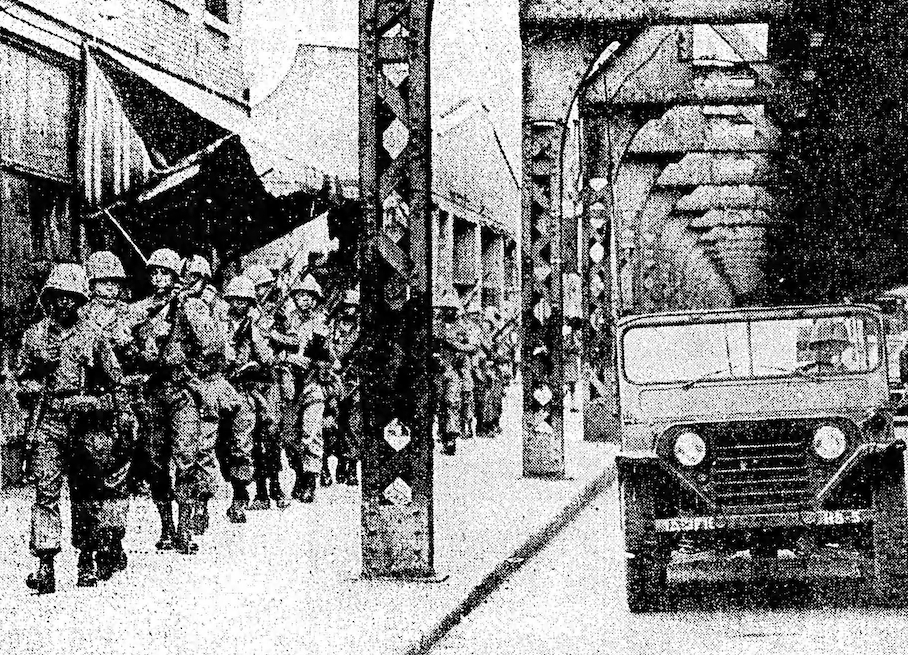
But that wasn't all.  Racial conflicts continued, with a civil rights protest in February resulting in the deaths of three students.  The Black Power movement gathered strength. Then Martin Luther King, Jr. was assassinated on April 4, and the ensuing riots and destruction in an estimated 85 American cities that night and the next day left 30 people dead (11 in Chicago alone), more than 2,000 injured and neighborhoods burned out and in rubble, with martial law and National Guard on the streets of American cities.

Three days before we opened, students at Columbia University in New York began occupying administrative buildings, protesting the university's secret ties to a military think tank and the building of a white-only gym encroaching on the black neighborhoods of Harlem.  There were other student protests in Europe and in the U.S. all year.

And if we needed any reminder of the possibility of instant annihilation we'd lived with all our lives, on the day before we opened the U.S. exploded the largest hydrogen bomb ever detonated in the actual United States, at an underground test site 100 miles from Las Vegas.  It was the 34th nuclear bomb explosion at that site since the start of our school year (the test on February 21 was code named Knox).  There would be six more before my class graduated in June.

(And when I say "all our lives," it was literally true for me--the first big post- World War II US atomic bomb test was exploded the day I was born.)

Sequestered as we were in Galesburg, all of this was part of our lives--and our campus. April 26 was national Vietnam Day but at Knox, April 1968 in fact was Vietnam Month.  Although there was lots of tension between students and administration on various political issues,  Vietnam Month was a consensus project.

Howard Zinn 1968
It began with History professor John Stipp lecturing on the history of Vietnam (and not for the first time.  He and other Knox professors held the first teach-in on campus in 1965.)

 Also that week, English professors Moon, Metz and Douglas Wilson talked about war and literature in the Common Room, while recent Knox alum Stephen Goldberg gave two talks about his experiences with the International Voluntary Services in Vietnam, and the director of the AFL-CIO African American Center lectured.

poet Denise Levertov 1968
The following weeks included at least 9 outside speakers, including the Vietnamese counselor for the Vietnamese Embassy, a Brigadier General, a former Green Beret and current antiwar activist (Donald Duncan), a fairly young Howard Zinn, activist and government professor from Boston; and the poet and activist Denise Levertov.

There were additional faculty discussions, and a faculty and a student debate, and a poetry reading against the war.  Though it wouldn't happen until May, the comic and activist Dick Gregory delivered a memorable speech and answered questions in Harbach Theatre.

In the midst of this came the news that Glenn L. Moller, Jr., a 21 year old former Knox student had been killed in combat in Vietnam.  He'd left Knox the previous year, and otherwise would have graduated with our class in June.  He was the third Knox student killed to that point (after Merriman Smith, Jr., son of the distinguished United Press White House correspondent, and Thomas Dean, brother of one of our classmates, Willard Dean.)  He wouldn't be the last.

Meanwhile, the world flowed through by means of newspapers, television, magazines.  The Knox Student weekly newspaper, as edited by Peter Stetson and Jeremy Gladstone, funneled current Liberation Press Service releases and other material like the notorious "Channeling" document of the Selective Service, outlining how the draft and deferments are used to channel men into careers in "the national interest." Draft resistance was a hot topic in 1968.  Knox student Jim Miller ('68) wrote a series of articles on Canada as a haven, for instance.

  Needless to say, complaints appeared in the letters columns.  But the newspaper did not neglect ordinary campus news--in fact, it did a better job of it than many students newspapers that I've seen do now.

So in the bright and wet warmth of April, our campus was sad, conflicted, bewildered, frustrated, angry and helpless all at once, together with the other emotions and experiences of the campus spring.  Games were played, movies were screened, concerts and recitals were given, art work was exhibited, and plays were performed.

A preliminary and editorial word about the Studio Theatre.  There were a few big productions on the revolving stage in Harbach each year, directed by theatre faculty.  But in the Studio Theatre downstairs, there seemed to be student productions every weekend and sometimes during the week.  The plays were usually directed by theatre students.  Many--though not all-- of the plays were by contemporary playwrights, and many--but not all--were in some sense experimental.

Donald Davis, the original American Krapp
in 1960.  There was likely another actor in
the role when I saw this production in 1965.
Theatre students got experience in directing, acting, scene and costume design and all the technical areas.  Campus playwrights could also get productions.  But all of us got the experience of seeing these plays, that we simply otherwise would not have seen.  It's where I saw my first Albees, Becketts, Pinters, Ionesco and Genet (I remember Joelle Nelson in a Genet play I didn't understand and still don't) and many more, as well as my first Kiralys and Petersons.  I saw seldom produced plays by Yeats and Eliot.

 There are some plays I saw only in the Studio Theatre at Knox, and some that remain in my memory despite seeing them in more professional settings elsewhere.  For example, I saw the original New York production of Beckett's Krapp's Last Tape together with Albee's first play The Zoo Story (the summer between my first and second years at Knox) and just a few years ago, another production of the Beckett.  But the performance I remember most vividly was George Otto's Krapp's Last Tape in 1968 in the Studio Theatre--the Expressionist lighting on his hollow cheeks as his long arms reached for the tapes are indelible images.

I've since also observed that these opportunities for students to make theatre as well as to experience it are not found everywhere.  It was free-range theatre of a kind that I doubt exists much at all anymore.

me in senior year,the fall of 1967 in the Gizmo.
Photo by Bill Thompson.
A play of mine had appeared in the Studio Theatre the previous spring, directed by Richard Newman.  By the Sea By the Sea By the Sea By the Sea was a pastiche comedy, heavily influenced by TV sketch comedy, the Beyond the Fringe LP, British movies (namely Morgan! and the Richard Lester Beatles films), the Liverpool Poets and other aspects of Swinging England, as well as by James Joyce and Marshall McLuhan.  Its theatrical highlight was a scene done in pantomime while the entire Beatles song "The Word" played at full volume, climaxed by Willard Dean driving his motorcycle into the theatre and onto the stage, playing a police officer arresting an elderly protester.

In my senior spring, I directed as well as wrote What's Happening, Baby Jesus? I'd never directed anything, so I made not-even-rookie mistakes like casting it without callbacks to actors who auditioned. But I had a Vision, of a multimedia collision of myth and the moment.  So everything about 1968 at Knox I described here, and a lot I didn't, was involved.

For the multimedia, we used a film collage of mostly World War II newsreel footage that Todd Crandall made.  We had about a fifteen minute pre-show as people were coming in, comprised of a music mix, film projection and a kind of light show.  I created the music tape, interjecting periodic taped announcements of "the next show begins in x minutes" as they used to do at drive-in movie theatres. 1968 was a great year for music: Beatles, Stones, Creem, Hendrix, Doors, Airplane, Dead, Janis with Big Brother, Buffalo Springfield, Country Joe and the Fish, Dylan, Donovan, early BeeGees and so on.

Todd's film ran throughout the show, projected on the wall.  I believe we had more than one film running on more than one wall.  Something like that.  My housemate and friend Bill Thompson ran the light show and did the light cues during the show.  I did the sound cues, so we were together in the booth each evening.  Bill Thompson died suddenly almost exactly a year ago.

We also had music cues during the show, including pieces of "The Baby Jesus Song" which I wrote, sang and played, with additional vocal and instrumental accompaniment by Joni Diner, Marilyn Bell and Ric Newman.  We recorded it on one take by sneaking into the band room and taking covers off a few keyboard instruments, plus whatever percussion we could find.

Bill Thompson was in charge of lighting but he knew as much about theatrical lighting as I did about directing, so without a word, the student previously known as Guy Morose got up in the rigging, fixed our lights and gave us our lightboard cues.  He was a hero by any name, though years later I was so happy to hear (from the wonderful Valjean) that he'd changed it (back) to Guyatano Amorosi.

Our set and costumes were designed by dear sweet Charlie Rice, whose murder in Chicago just months later was a terrible shock.  The absolutely perfect program cover design was by Tarillis J. Seamans, Jane.

Marilyn Bell and Jean Rabinow did the costumes, including a yellow flowered shirt (think Magical Mystery Tour, or Donovan) for me to wear in the booth.  I still have it.  Sandy Berger did props, Steve Clark makeup. (Peter Overton, a star of the show, showed up at rehearsal with a shirt with those shiny ivory buttons he found at the western store in Galesburg.  He wore it in the show, and I liked it so much I went down and bought an identical one for myself.)

Ric Newman was technical director and Joni Diner was the stage manager.  Lucy Mitchell chaired the house committee of ushers: Sherwood Kiraly (whatever happened to him?), Larry Baldacci, Jan Byhre, Bruce Hammond, Henry Keighley, Judy Major, Julie Machnicki, Janie Langer, and two other first years who would be part of my later life, Carol Hartman and Mike Shain.

What's Happening, Baby Jesus? was set in a timeless Old West town, simultaneously a familiar tv western set and the paradigmatic locale of the American myth.

The town was run by Marshall Power, played to perfection by Peter Overton.  At that point, the Vietnam War was owned by LBJ, who had a way of pronouncing it "Amurican." He was an overpowering personality in those days, and his cruder aspects became identified with his war policy.  Many people--especially of my generation, and including me, who worked to elect him in 1964--felt betrayed by his escalation of the war.  He'd expressly said he wouldn't do what he did--send American boys to fight in Vietnam.

So he was the western Marshall, who was also a God the Father Figure.  My Catholic education came home to roost with this play, for sure.  Some of the speeches I copied right out of scripture.  His prodigal son (Sonny), played by Ric Newman, was a go-getter salesman of everything commercial.  The real power however was the sexually aggressive Virgin (Celeste Manking), accompanied by her hapless and frustrated husband Joe (Steve Clark.)

When the Marshall and Sonny have their showdown, their violence creates a third figure: Breath, or The Drifter.  He was sort of the Holy Ghost in Catholic mythology of the Trinity, and sort of the human caught in these rivalries, and becomes the object of their projections (though I would have been unable to describe it that way at the time.)  My biggest failure as a director was not being able to give Sandy Simon much help in developing his character as the Drifter.

There were also a lot of bits.  The play began with a brief Beckett parody of two bums (Bill Daniels and Dan Murray) talking, which went nowhere except for the payoff:  "We're waiting."  "Waiting for who?"  "Waiting for Godard."

Because the next scene was a gunfight between the two masters of the French New Wave, Jean-Luc Godard and Francois Truffaut (played by Todd Crandall and Steve Phillips.)  Thanks to David Axlerod and Todd Crandall's Cinema Club, we'd seen a number of their films over my years.  Truffaut and Godard had a bit of a feud after Godard got more political.

I don't know how funny the audience thought this was, but a little more than a decade later I interviewed Truffaut in Hollywood, and I actually told him about this scene.  He laughed.

A scene that did get a big laugh was set up by a couple of blackouts--Mike Shain in a business suit would appear and start to say something but the lights went out immediately.  The third time he did get to say his piece.  It was a pitch by a certain chewing gum company (American Chickle) to recruit Knox students, which I found in my student mailbox.  I literally stapled it into my first draft and added the line: "So come on out and keep America chewing."  Biggest laugh of the night.

One of the other interpolated scenes was a sweet but awkward conversation between a male and female student.  Steve Phillips was the Guy, and Shirley Covington was the Girl.  I don't think Shirley was a Knox student, she may have still been in high school. She was the daughter of an African American minister in Galesburg.  He was head of the church that sponsored at least one Civil Rights march or demonstration there that I participated in.  She just showed up at the tryouts, and I cast her.

When I entered in 1964 Knox had, as far as I know, only one black student.  In 1968 I believe there were about 20.  I may be wrong, but she may have been the first African American to be cast in a Knox production.  At least I don't remember another such instance in my time there.  Not to mention the first portrayal of an interracial relationship.   Her father came to the show, which worried me, given my less than orthodox approach to religious doctrines.  I was also embarrassed by how small the part was.  But they both seemed pleased.

Other actors in the show were Cathy Thompson, Howard Partner, John Hofsas and Bonnie Lucas.  Jeremy Gladstone and Charlie Rice captained the construction crews.

Joni.  Photo by Bill Thompson
Eventually the Marshall and Sonny put the the Drifter and his young disciples on trial (for "self-possession") and they are imprisoned. It's pretty clearly a stand-in for the draft: having them dance to the Country Joe and the Fish song, "I Feel Like I'm Fixin to Die Rag" was a big clue.

In their cells (pools of light) they made quiet statements and restatements ("Try Paradise Apples.  Paradise Apples Get You Off") including a haiku or two, and part of "Rules and Games," a speech written by Fred Newman, a philosophy professor who left Knox after my first year.  (I dedicated the play to Fred, and to Joni, my--what word do I use?  I prefer "sweetheart."  And Muse. )

(Later, after we'd parted ways, Joni left behind the role of supporting the creativity of others and went on the stage herself, acting in Providence, RI.)

The play ended with the Drifter finding apples and sharing them with the other prisoners, a blackout, while last lines of Dylan's song "The Drifter's Escape" played:  "Just then a bolt of lightning struck the courthouse out of shape/and while everybody knelt to pray, the drifter did escape."  Then lights up to an empty stage.

In those years, the Knox Student reviewer came to a run-through and wrote a review that appeared the Friday before the production.  Our show was generously reviewed by Rod Barker ('68), especially considering we were ridiculous rivals in our testosterone-riven writers workshops.  He was right that the production and the script were experimental, and a lot didn't work; that some lines were good and some were dumb. He was right that it was an unfinished work.  But he said it was a fun experience for an audience.  "The play and characters are multi-faceted and multi-dimensional and can be appreciated on many levels.  Everyone, I'm sure, could find at least one."

One of those levels was the one--or ones--appreciated by seeing the show stoned.  Smoking or ingesting the substance now known as cannabis had arrived on the Knox campus secretly a year or two earlier, but it was more open and much more widespread in 1967-68.  And it was a factor in the show's effects (including strobe lights) and multimedia.

Jane Langer and Carol Hartman, among the
first year ushers for the play
But it was also a factor that productions had to face.  At the time, those students who indulged tended to know each other, even if they didn't look the part.  There were "freaks" and "straights."  So I pretty much knew which members of the cast indulged.  I got them together at the first rehearsal and asked them to refrain from coming to rehearsals stoned, and if they did that, we would have a "stoned rehearsal" late in the process, so we would all be on the same "level."

Which we did--one of our last rehearsals before we moved into the Studio Theatre.  We held a run-through in the lobby space.  It was a bit confusing for those cast members not in the know, though at least one responded to the vibe by loosening up his performance.  I asked him later to keep those moments in the show, but it was never quite as good.  The rest of us had a great time, and we all saw new dimensions in what we were doing.  (One cast member, however, confessed he didn't understand the show until running it again in his head at the cast party  closing night.)  This rehearsal ended with an unscheduled blackout--the lights just all went out at precisely the right second.  We all praised our stage manager for an inspired effect, but she claimed that she had simply collided with the light switches by accident.  So in other words, it was perfect.

Also on campus on that Sunday, our second and closing night, was poet, translator and columnist John Ciardi.  He'd finished his talk early enough to get to our show, and came down to the green room afterwards to say how much he liked it.  He'd especially enjoyed the line "Why are all my friends allegorical figures?"  Since he'd translated Dante--I read at least some of his Inferno my first year, along with his Saturday Review column-- I could understand that.  He surprised me--he was known at that point to be unsympathetic to the growing counterculture--and I regret not being more welcoming.  But in general I was a jerk way too often anyway.

What's Happening, Baby Jesus? was of its time in maybe another way.  At about the same time as we did our show, a little musical was opening called Hair.  In 1969 I attended a performance of the now big hit Hair in San Francisco, because Ric Newman was in the cast.  I was standing in the lobby afterwards when suddenly he was embracing me, and babbling about how we should revive Baby Jesus somehow, it was the perfect time.  I was skeptical.  Even though Jesus Christ Superstar would open in 1970, I didn't see much resemblance to these pretty conventional musicals, however daring their subjects or themes.  But it's nice to think we might have done a better version of it.

Richard Newman (right) in the 2005 film Supernatural
I saw Ric a time or two more in San Francisco that fall but lost track of him.  Then late one night in the mid 1980s, on the other side of the continent, I was half asleep with the television on a cable movie channel.  My eyes were closed and I wasn't following the movie at all when suddenly I heard this voice: I knew immediately it was Ric.

 But by the time I opened my eyes, the scene was over. I made myself stay awake till the credits when I could confirm it.  It was Finders Keepers, an obscure movie my old favorite Richard Lester made between his Superman and Three Musketeers films.  And there was Richard Newman in the credits. Now thanks to the magic of the Internet Movie Data Base, I found all 181 (and counting) of his credits as primarily a voice actor but also onscreen actor.

It's pleasant to be nostalgic about a common enterprise 50 years ago, with fond memories of people and good moments.  But memories of that time and this play in particular aren't real without the complicated context, and I've barely scratched the surface here.

Looking back on the experience, I enjoyed the collaboration within the process of finding my production.  I recall very early in the process, when I was going over casting possibilities, probably with Ric and Joni, someone suggested that two characters could be combined.  I instantly saw that possibility, not only to solve a casting problem but to strengthen the play.  Later, it was watching what the actors did, and guiding and selecting.

Looking back on the only draft of the script I could find (an early one), I see that it was an awkward search for a way out, past despair, joking all the way.  It blundered towards integrity, freedom and human warmth, not often reconcilable.

So I've gone on at length, on something that not many could write about--in some ways, only me.  The other side of that coin is that it is quite possibly of interest to only myself.  In general, I am reconciled to that.

Monday, April 23, 2018

The Shakespeare Party

In recent years, this was said to be an authentic
portrait of Shakespeare.
When I attended Knox College in the 1960s, the English department threw a Shakespeare's Birthday party every April on the weekend nearest the traditional birth date of April 23.  It's also the traditional date of Shakespeare's death, as well as the actual deaths of Cervantes and weirdly, several other literary figures through the ages.

This party featured a series of hastily arranged and improvised scenes from Shakespeare's plays, performed with text in hand by party attendees drafted on the spot.

The only set piece that repeated year to year was the balcony scene from Romeo and Juliet, in which a blushing but highly pleased Howard Wilson, longtime chair of the department, would read with a woman student especially selected to deepen his blush.  It was one of two annual performances for Wilson, along with a Christmas season reading of A Child's Christmas in Wales by Dylan Thomas, held in the Gizmo coffee shop.

William Brady taught the English Department courses in Shakespeare in those days.  I had taken his 16th century course and was signed up for Shakespeare my junior year, when I took ill with mononucleosis while back in PA for Christmas break, and had to delay my return to campus until well into the term. So I dropped that course and converted my course load to mostly independent studies.  I wound up with the highest gpa that trimester I ever had.  I even made the Dean's List for the only time.  But I never did take a Shakespeare course.

So my experience of Shakespeare was nonacademic.  I saw my first ever Shakespeare play on stage at Knox.  I'd watched a TV adaptation of Julius Caesar when I was 11, but when I arrived at Knox I'd seen exactly one stage play, a university production of Oedipus Rex I attended with my high school English class. (Unless you count my high school's productions of Seventeenth Summer and Time Out for Ginger, or any of the skits and plays I wrote that were performed by grade school classmates and my Cub Scout den.)

I was very lucky in what I saw that first time. It was the 1964 Knox production of Hamlet, the first play produced in the new Harbach Theatre in the new Fine Arts Center, directed by Rowland K. "Kim" Chase.  It starred Jim Eichelberger, a truly awesome actor who later achieved stardom first at the Trinity Repertory in Providence, and then with the Ridiculous Theatre Company, off off Broadway in New York, appearing as Ethyl Eichelberger.

I was actually onstage at Knox with Eichelberger once, in satirical skit that the Mortarboard club mounted each year. He played James Bond. (It was a year before the notorious Batman satire--so notorious that the skits disappeared for years afterward. ) Just to watch him pull a chair out from under a table and sit down was remarkable--his grace was astounding.

Kim Chase wrote eloquently about preparing for that Hamlet production in the first issue of our campus magazine, Dialogue.  It was basically a talk he'd given the previous spring, as part of the Last Lecture series, in which faculty members were invited to speak on a topic as if it were the last lecture they would ever give. In this case, it was close to the truth.  Chase soon left Knox, part of the mid-60s exodus.

I saw a few more Shakespeare plays at Knox, including a performance by the touring Royal Shakespeare Company, and acted in one: Macbeth. Ric Newman played the lead, with Valjean McLenighan as Lady Macbeth.  Both became good friends, Valjean for the longer time.

A production of Macbeth I saw
with Christopher Plummer and
Glenda Jackson.  Still a difficult play.
Also in the cast was Richard Hoover, who went on to fame as a production designer for television and film.  I played the pivotal role of the Thane of Ross (actor's joke) combined with a couple of small parts.  I shared the first scene of the play with Richard (after the witches, that is.)  He played King Duncan.  Once I was still in the green room when the play started,  and I had to run upstairs for my entrance, glimpsing Richard frantically pacing the stage, waiting for my arrival from the battlefield to announce Macbeth's victory. That added a little drama, and some verisimilitude, as I was out of breath when I entered.

I saw a lot of Shakespeare on stage and screen over the next half century.  Especially in my recent years writing a theatre column for a weekly newspaper or publicity for a university theatre, I read a lot about the plays (as well as the plays themselves) and about Shakespeare.  I wrote about more than 20 productions of 16 of the plays, including several at the Oregon Shakespeare Festival.

Shakespeare is produced even more these days than back in the 60s, though becoming a brand has its pros and cons.  In about one year I also saw a comedic condensed Shakespeare, a comedy about actors playing Hamlet (I Hate Hamlet) and a drama in which Shakespeare is a character (Equivocations), all of which included excerpts from actual Shakespeare plays.

I'd been familiar for some years with the granddaddy of this trend, Tom Stoppard's Rosencranz and Gildenstern Are Dead, and finally saw a production five or six years ago. I even at one point contributed to this tendency by writing a prequel to Othello (Young O), although no harm done as it was never produced.

But Shakespeare brand consciousness also led to some unnecessary razzmatazz that too often distorts and deforms the plays. I've seen too many fashionable attempts to change periods, locating the plays in ever stranger times and places. Few succeeded, and some were utter sham.

Ian McKellen's 1990s  film of Richard III located in in a kind of nightmare 1930s was one that did succeed, and a late 1980s or early 90s production of Hamlet at the University of Pittsburgh that mixed periods was very effective.  (It starred Canadian actor Richard MacMillan, who later had a small but juicy part opposite the great Ian Holm in the film The Day After Tomorrow.)  

But All's Well That Ends Well set in a trailer park?  I wish I were kidding.  How about Othello set in the 1980 locker room of the Los Angeles Lakers, retitled Shaqthello?  (Okay, I am kidding about that one.)

In the words of Jorge Luis Borges, such anxiety-ridden transpositions are more often "useless carnivals."  Updating the plays is unnecessary because the audience itself updates them. A production that finds the vitality in the play can't help but to make it relevant to the times, because it will engage an audience living in those times.  Or as Stephen Greenblatt put it:

"We speak of Shakespeare’s works as if they were stable reflections of his original intentions, but they continue to circulate precisely because they are so amenable to metamorphosis. They have left his world, passed into ours, and become part of us. And when we in turn have vanished, they will continue to exist, tinged perhaps in small ways by our own lives and fates, and will become part of others whom he could not have foreseen and whom we can barely imagine."

As for me, all these years of Shakespeare taught me that there's always too much there to get in one viewing; you always miss something, and so you can always go back.  What is always there for me is the music.

So my favorite comedy is As You Like It, my favorite film of a Shakespeare play is the Kenneth Branagh/Emma Thompson Much Ado About Nothing (although the David Tennant/Catherine Tate version is pretty good, too.)

 But my favorite play remains Hamlet, and though I've seen several more productions on stage (including one with Kevin Kline in New York) and especially on screen,  my favorite production remains that first one, at Knox.  It's a theatrical cliche that your first Hamlet is the one you remember,  but I still feel that Kim Chase and Jim Eichelberger gave us the essential Hamlet, a young man in a hostile and hypocritical world not of his making.

As for the Shakespeare's birthday parties, I can recall actual impressions of only one, probably my last, fifty years ago this past weekend.  I remember it as being at least partly in daylight, and mostly outdoors.  April in some ways really was the cruelest month in Galesburg, at least in those years.  The winters were bleak and long, while spring burst suddenly and completely.  Everything was green and flowering almost overnight.  But we barely got a chance to enjoy it before it was time to blinker and fret for final exams and final papers (which included departmental comprehensives senior year.)  Late April and May were soft air and sunlit torture. Spring was as brief as it was luminous--the insufferable Galesburg summer came early and stayed long, too.

I was in a strange head space (as we might have said then) that spring anyway, but that's another story-- possibly several other stories.  I recall realizing even during that party that I was behaving badly.  But I was given a part--I did the Porter's comic speech from, of all plays, Macbeth.  David Axlerod played it in our production the year before, very effectively.  It was a guest star performance--he arrived in enough time to do his makeup, then did his bit, got laughs and lots of applause, and left, while the rest of us careened around in tights for two and a half hours.  (Although my tights seemed to have inspired a few female students in the audience, but that's yet another story, that I am honor-bound not to tell.)

My own Shakespeare performance at the party was very over-the-top, by design.  I recall not sensing the attentiveness or laughter I was going for, however.  But I like to remember that I said the words well.

Thursday, April 19, 2018

The Human Future Invades Earth in The War of the Worlds

“To think at all about certain questions was an act of rebellion that sent one oscillating between the furtive and the defiant.”
H.G. Wells: In the Days of the Comet

Though the space alien invasion is now a familiar story type, The War of the Worlds is the first one known. To create it, Wells combined and transformed two popular topics of the time.

The first was the result of a growing anxiety across the western world. After decades of peace, European nations were taking advantage of new technologies and industries to make many new and more powerful weapons for mechanized war. In 1871 an anonymous pamphlet described a future invasion and conquest of England by a barely disguised Germany as if it had already happened. (The author was later identified as George Tomkyns Chesney, a former Captain of the Royal Engineers.)

“The Battle of Dorking” became a sensation throughout Europe. It inspired a spate of similar novels dramatizing invasions of one country by another that were still appearing in the late 1890s.

Another popular topic was the planet Mars. What geology was to the first years of the 19th century, astronomy became to its last decades. Bigger and better telescopes and new instruments led to discoveries that inspired public enthusiasm. So many amateur astronomy societies arose that the British Astronomical Association was formed to organize them in 1890.

Particular interest was focused on Mars, due to discoveries made each time its eccentric orbit brought it closer to Earth. As a result of his 1877 observations, Italian astronomer Giovanni Schiaparelli published maps of the Martian surface which showed a network of lines he called “channels.” But the Italian word (“canali”) got translated as “canals,” and since manmade canals were familiar features of the industrial age, a roar of speculation resulted concerning past or present intelligent life on Mars.

Mars was even closer in 1894, and American astronomer Percival Lowell professed to see even more evidence of canals, which he believed were the work of a civilization desperately trying to irrigate their drying planet.

Also that year, French astronomer Javelle reported “strange lights” on the Martian surface that might be signals. These were taken so seriously that eminences such as Edison, Marconi and Tesla tried to devise ways to signal back.

All of these sensational reports and the keen public interest they generated resulted in at least 50 novels about Mars and Martians.

None of the Mars novels or the invasion novels (with the possible exception of Chesney’s) were very good. But H.G. Wells saw the potential of putting these two topics together, in the first invasion from space story: The War of the Worlds, serialized in 1897 and published in book form in 1898...

Sometime in the early 20th century, a writer on the subject of moral philosophy in the future failed to see through his open study window the fall of an apparent meteor. He lived in the quiet English town of Woking, some 20 miles southeast of London. The meteor fell near the sand pits in the nearby Horsell Common.

He goes to see it, and is in the crowd when the Martians first appear, and witnesses the first deadly use of their heat ray. He is sufficiently alarmed to take his wife to a nearby town for safekeeping, in a borrowed horse-drawn cart.

At first it is believed the Martians are trapped in the pit, but when he gets back to Woking (to return the cart) he is confronted by their giant Fighting Machines, which stride through the countryside incinerating people and buildings with their now-mobile heat ray. Meanwhile, other cylinders are falling to Earth.

Those 1894 lights on the Martian surface, he surmises, were the first blasts of the guns that would send these cylinders across space in a planned invasion.

a more contemporary illustration
Soon the Martians use another weapon—the Black Smoke--which kills everything it touches, destroying all opposition as their giant machines advance. Our narrator flees, at first towards the town where his wife is. The story includes events witnessed by his brother in London itself.

Our chief narrator has encounters with two less than exemplary humans, the Curate and the Artilleryman, and witnesses the Martians feeding on the blood of live human victims.

With the human race on the run all around him, he blunders into London, where he watches the defeat of the otherwise indestructible Martians, by bacteria to which they have no resistance.

a 1915 illustration
Wells, who himself lived in Woking at the time he wrote The War of the Worlds, is exact in his use of real places and the actual topography throughout the book. This would have contributed powerfully to the effect on his first readers, but its specificity is still a key element in its absorbing narrative for readers unfamiliar with that time and place.

 Since the book was published in 1898 and takes place in the 20th century, it qualified as future history for those first readers as well.

Though it is clearly if subtly stated early in his account (and referred to later) that humanity survived the invasion, Wells’ precise description and evocative invention create a compelling and suspenseful narrative experience.

This novel ominously forecast the near future of warfare, from the poison gas of World War I to the effects of bombing and invasion of civilian areas (“Never before in the history of warfare had destruction been so indiscriminate and so universal”) that would characterize World War II, lacking only the inhuman enemies from another planet.

It is also his first to foreshadow technologies of future weaponry—from manned flight to the laser-like heat rays—as well as still speculative uses of cybernetics and psychic communication.

The War of the Worlds repeats and extends several themes of The Time Machine. First, it continues Wells’ challenges to the complacency of his time. “The War of the Worlds like The Time Machine was another assault on human self-satisfaction,” he wrote in his preface to a 1934 collection of novels. Human mastery has not been attained and progress is not inevitable. In this case, humanity is challenged not by another species rising from beneath it on Earth, but by an alien species of greater power coming down from outer space.

To understand this possible fate, Wells suggests the people of his time and place might need to see things from another point of view, such as that of the invading Martians. Several times the narrator suggests understanding how the more advanced Martians might see humans by recalling how humans see ants or small animals.

1905
But the bolder shift is to imagine humans in the place of those animals: not as the dominant species, but as the suddenly dominated one. This again countered human complacency and the assumption of perpetual superiority, especially at the center of the British empire.

This act of imagination seems to have been the seeds of this story. As Wells recounted in a 1920 article of the Strand magazine, he was walking with his brother Frank “through some particularly peaceful Surrey scenery.” They were probably talking about the indigenous inhabitants of Tasmania, an island south of Australia, who were nearly eradicated when the English turned the island into a prison colony. Then his brother wondered, what if some beings from another planet suddenly dropped out the sky and did that to England?

Frank Wells made the first imaginative leap, the empathy of placing himself in the position of another who is perceived to be very different. For this idea, H.G. dedicated the book to Frank, and made a very specific analogy early in the story: “The Tasmanians, in spite of their human likeness, were entirely swept out of existence in a war of extermination waged by European immigrants, in the space of fifty years. Are we such apostles of mercy as to complain if the Martians warred in the same spirit?”

There are several more references to oppressed people overrun by empires, and the theme is sounded early, with a clever use of the word “empire” and a reference to indigenous peoples such as American Indians and Africans who find themselves beset by missionaries:

“With infinite complacency men went to and fro over this globe about their little affairs, serene in their assurance of their empire over matter. It is possible that the infusoria under the microscope do the same.... At most terrestrial men fancied there might be other men upon Mars, perhaps inferior to themselves and ready to welcome a missionary enterprise.”

The Martians have as well the same excuse as humans of Wells’ time used: imperialism is actually natural selection. The Martian race was older and much more advanced. “And we men, the creatures who inhabit this earth, must be to them at least as alien and lowly as are the monkeys and lemurs to us. The intellectual side of man already admits that life is an incessant struggle for existence, and it would seem that this too is the belief of the minds upon Mars.” Again there is the Huxley version of a relentless evolutionary process, which only human ethics and empathy can counter.

But as advanced beings, wouldn’t Martians develop such ethics? This leads to a third theme—perhaps the most subtle and devastating. As an older race, the Martians have had longer to evolve. The beings they have become are physically simple, pretty much just a large head and hands (or more precisely, tentacles.) Though resilient, they are weak. Their strength is in their machines.

To make the game of identifying with the Other more explicit, Wells’ narrator notes that “a certain speculative writer of quasi-scientific repute, writing long before the Martian invasion, did forecast for man a final structure not unlike the actual Martian condition.”

That writer was Wells himself. In his 1893 article “Man of the Year Million” he speculated that, having long before delegated all physical activities to their machines, humans of the far future would become nothing but head and hands. Here he also suggests that with the body gone, the intelligence becomes unfeeling, like the Martians who in the famous opening paragraphs of The War of the Worlds are “intellects vast, cool and unsympathetic.”

This is the fate of humanity when it becomes dependent on technology. These Martians are us. Humanity is being conquered by its own future.

Like the Morlocks in The Time Machine, the Martians are technology-minded beings who raise a biped species as food—they use tubes to extract their blood. Eventually they then do the same to live humans: the first interplanetary vampires. (Bram Stoker’s Dracula was first published at about the same time as The War of the Worlds.) This is the sole relationship to organic life of this technologically dependent race.  Both the Morlocks and the Martians are versions of the human future.

This dehumanizing effect of technology is another theme that will become prominent in the twentieth century. Wells, the biologist and prophet of technology, explores the complex relationship of the machine and the organic in the lives and future of humanity and the Earth.

In The War of the Worlds, the war is won literally by the Earth itself, and by humanity’s long biological relationship to their planet. The Martian machines are defeated when the biological beings inside them die from infection by bacteria to which humans, after many generations of suffering and death, have become immune.

That in the end, it is the organic that saves humanity and the Earth, says quite a bit. It is first of all, almost literally grounding. It is evidence of the realities of dependence, of relationships to the Earth and its organisms that technological humans ignore, partly as expression of the same arrogance that leads to complacency, partly as denial.

With Wells, the machine enters literature as a given, as part of reality. The relationship of man and machine, the machine and nature, and generally the impact of science and technology on human life and the human future, would come to define a new kind of fiction.

Wells set the template for this kind of fiction with the novels and stories he wrote in the first decade of his career. He called them “scientific romances.” It would be nearly 30 years before they would be known by the name we call them today: science fiction.

Not all science fiction stories are directly about the future. But in one way or another, nearly every story about the future is within the realm of science fiction. Its unique history and status is essential to understanding how we confront the future.

To be continued.  For prior posts in this series, click on the Soul of the Future label below.

Wednesday, April 18, 2018

Hooray!

We've heard plenty about the fading away of the newspaper and the print magazine.  Many have gone under, others operate with pitifully few reporters, and even the biggest and strongest have cut their bureaus and foreign staff severely, resulting in terrible news coverage of much of the world, which apparently now includes Puerto Rico.  The hurricane aftermath coverage has been scandalous.

Thanks largely to the Internet, few get paid to report and write.  That's the bottom line for the journalism profession.  When you can't make a living doing it, it mostly doesn't get done.

Nevertheless--the press is not all gone.  Newspapers exist and reporters do good work.  The Pulitzer Prizes celebrate some of this, and this year's include the usual prizes for the big guys, the New York Times and the Washington Post, that are well-deserved, at least partly due to the fact that they can still pay people.

But there are other organizations that got prizes.  Some of them are national and international (the Reuter's news service, USA Today working with the Arizona Republic newspaper), New York Magazine and the New Yorker.  But also the most endangered species, the city newspaper.

So special congratulations to the Press Democrat (Santa Rosa), the Cincinnati Enquirer (pictured above, getting the news of their staff win), the Alabama Media Group, the Des Moines Register editorial writer, and the Daily Progress in Charlottesville.

And a big shout-out to the one and only freelance reporter to win: Rachel Kaadzi Ghansah, writing for GQ.  Share the joy!  Here's the New York Times list of all the winners, including the non-press prizes.

Tuesday, April 17, 2018

After The Time Machine: More Dangerous Futures

“...in the prodigious misery and ignorance of the swarming masses of mankind in England, the seeds of its certain ruin are sown.”
Charles Dickens
in a letter 1843

"In the case of every other predominant animal the world has ever seen, the hour of its complete ascendancy has been the eve of its entire overthrow."
H.G. Wells 1894

“What have my books been from The Time Machine to World Brain and my Fate of Homo Sapiens but the clearest insistence on the insecurity of progress and the possibility of human degeneration and extinction? I think the odds are against man but it is still worth fighting against them.”
H.G. Wells 1939

For the first time in The Time Machine, the future is described as a direct consequence of the past—not through the intercession of magic or as reward or punishment from a deity, but according to the logic of cause and effect. After this immediately popular tale, virtually all stories about the future—and most rational thought—take this as their assumed premise. In this novel, Wells created our axiomatic future: the future evolves.

The crucial supporting point he makes is that the future is not assured by any dominant interpretation of the present. The reigning powers and the cultural consensus, emboldened by a quick, simplistic and self-serving interpretation of Darwinian evolution, foresaw inevitable progress for the human species. Wells demonstrates that this isn’t necessarily so.

In The Time Machine, Wells specifically attacked erroneous readings of Darwin. This novel dramatized the possibility of not progress but the retrogression of the human species.  But it was not the first nor the last time he wrote about this possibility.

contemporary speculation on what a further evolved
rat might look like.
In several articles he wrote in the 1890s, Wells warned that humans as the top species was itself not guaranteed: other species could conceivably develop to challenge humanity.

 He expressed this most succinctly and eloquently in his essay “The Extinction of Man,” published in 1894 while he was finishing The Time Machine: "In the case of every other predominant animal the world has ever seen, the hour of its complete ascendancy has been the eve of its entire overthrow."

Wells suggested that even existing species could someday overcome human dominance. In “Zoological Retrogression”(1891) he wrote that Nature may be "in unsuspected obscurity, equipping some now humble creature with wider possibilities of appetite, endurance, or destruction, to rise in the fullness of time and sweep homo away into the darkness from which his universe arose.”

In an 1894 essay, “The Rate of Change in Species,” he notes that “The true heirs of the future are the small, fecund, and precocious creatures…” able to adapt to large scale changes in climate or environment. In “The Extinction of Man,” he names four kinds of small creatures that could displace humanity: crustaceans, cephalopods, plague bacilli, and ants.

He also wrote several short stories dramatizing this possibility, including “Empire of the Ants” in 1905: A small gunboat is sent up the Amazon river to investigate reports of a plague of ants. The captain is insulted by the ridiculous assignment but the science-minded engineer is curious. The reports mention “a new sort of ant,” somewhat like the leaf-cutting ants in that they act with purpose and appear to obey leaders. “He perceived the ants were becoming interesting,” Wells writes, “and the nearer he drew to them the more interesting they became.”

Eventually the gunboat crew confronts the uncommonly large ants, which are equipped with a natural poison capable of killing humans, as well as the intelligent leadership and learning ability to use it strategically. After the ants kill his lieutenant, the hapless captain can’t think of anything to do but shoot his gun meaninglessly into the forest, and escape.

Telling the story back in England, the engineer reports, "These are intelligent ants. Just think what that means!" They deploy so effectively that they crossed water and other barriers to take control of a large area of the Upper Amazon, causing "the flight or slaughter of every human being in the new areas they invade." Information is scarce because "no eye-witnesses of their activity…has survived the encounter." The story's narrator suggests these intelligent ants will reach Europe by 1960.

It is not one of Wells’ best stories (though not as bad as the 1977 movie with Joan Collins that shares little with the story but the title.) It is intriguing however for how closely it resembles a Joseph Conrad story, especially “The Heart of Darkness.” Wells and Conrad were friends, and Wells’ son Anthony wrote that HG had wanted to write something in the manner of Conrad, which may be how The Island of Doctor Moreau began.

Both “Empire of the Ants” and “The Heart of Darkness” are accounts of voyages in a small boat down a remote river through disorienting jungle wilderness, to investigate some unusual trouble far from the centers of civilization. They even have a scene in common: the shooting of a big gun randomly into the forest, at no particular target (something that Conrad had actually observed along the coast of Africa in 1890.) Both stories are told by a participant, but back in England.

Ants threaten humanity to some degree already in several parts of the world, so they aren’t a bad choice for eventual domination, especially since small creatures like ants are most likely to thrive in a hotter world. But in his fiction, Wells also suggests a different source for a suddenly overpowering species: outer space.

His celebrated 1898 novel The War of the Worlds dramatized the conquest of humanity by a technologically superior species from the planet Mars. But once again, as in The Time Machine, Wells was asking his readers to peer into another possible human future.

To be continued.  For prior posts in this series, click on the "Soul of the Future" label below.

Monday, April 16, 2018

The Cure for Bad News Is-- Worse News?

If you're climate science literate and/or you've read Kim Stanley Robinson's Science in Washington trilogy (more recently republished in a shorter one volume form as Green Earth), and/or if you've seen the climate crisis movie The Day After Tomorrow, you got the significance right away, and it's big: the Atlantic ocean current (including the Gulf Stream) is slowing down, according to a study published in the peer reviewed science journal Nature.

If you read the abstract, you see this has probably been happening for some time, but it's now that researcher confirm that the climate crisis is a cause.  And its impact is potentially immense.  If the current shuts down or even slows considerably, weather in Europe and at least half of the US changes rapidly and radically.

NBC quotes one of the authors:
"We know somewhere out there is a tipping point where this current system is likely to break down," said study co-author Stefan Rahmstorf, a climate scientist at the Potsdam Institute for Climate Impact Research in Germany. "We still don't know how far away or close to this tipping point we might be. ... This is uncharted territory."

Right now the current is slower than it has been in 1600 years, and predictions of what that means happen to comport with what has been actually happening the past few years.

Perhaps Steve Hanley's semi-hysterical report in Clean Technica is more appropriate:

"...While the world is absorbed in high dramas about trade wars, Syrian chemical attacks, whether Germany can extend the lifetime of diesel-powered cars, or the latest tweet from the White House, we are missing the implications of what is happening in the Atlantic Ocean...."

"Think of AMOC as the cooling system in a car with an internal combustion engine. When operating normally, engine temperatures stay within a range that permits continuous operation indefinitely. Reduce the flow of coolant significantly and what happens? Disaster. And here’s the crux of the matter. When that disaster strikes, it happens all at once with little to no warning. One minute you’re motoring along enjoying the view. The next minute you own a useless lump of metal. That, friends, is a tipping point — a clear demarcation between “then” and “now.”

"The results could be catastrophic for Europe. Not only will winters become significantly colder, but heat waves in the summer will also be more frequent. Hello? Is this not precisely what happened on the continent in the past 12 months?! Is anyone listening?! Does anyone care?! What’s that? What about Hillary’s emails? Never mind. Go back to sleep. Nothing to see here. Move along."


Henley emphasizes Europe (his audience) but at least parts of the US are also imperiled.  Rapid sea level rise is a particular danger for the East Coast. Henley's piece has good graphics to explain all this, and even some "cautious optimism."

Meanwhile you can check out the KSR book to see what the beginning of this might feel like in Washington (for instance.)  The kicker is that it may result in really frigid cold spells.  Start making your iceballs to bring to the floor, you moronic R members of Congress!  At least then you'll have an excuse for burning the Constitution--to keep your worthless butts from freezing off.

Today?

It didn't happen Friday, and it may never happen.  But it still looks like it will.

When bombers or big guns behind the lines pound an area before troops advance, it's called "softening up."  Right now Fox News is softening up its public with a continuous barrage of lies and hate directed at Robert Mueller, the deputy attorney general Rosenstein and to an extent, the AG Jeff Sessions.  Not to mention (of course) former FBI director Comey, who is considered proof that the FBI is conspiring against the antipresident.  The antipresident already fired Comey, and it looks like he will try to fire Mueller, even if indirectly by firing Rosenstein or Sessions.

It's either that or just the usual Fox fulminations of those powerless to do anything else, except perhaps try to save a few R seats in November.

Time is running out, though.  NBC reported last week that Mueller's report on obstruction of justice is imminent.  The longer Mueller goes, the deeper into the justice system he gets, and the harder it will be to root out everything he started.

Meanwhile, the antipresident is enjoying what he may perceive as a win on the Syria bombing, and weirdly good approval numbers, at least for his usual low range.  So maybe today.  Almost certainly, if it's ever going to happen, it will be soon.

Saturday, April 14, 2018

Present: A Quotation.6

Once Later

It is not until later
that you have to be young

it is one of those things
you meant to do later

but by then there is
someone else living there

with the shades rolled down
how could you have been young there

at that time
with all that was expected

then what happened to
the expectations

there is no sign of them there
a shadow passes across the window shad

what do they know in there
whoever they are

W.S. Merwin
published in New York Review of Books
May 7,2015

Friday, April 13, 2018

Today

It feels like today could be the day.

It's Friday the 13th--what could possibly go wrong?


Wednesday, April 11, 2018

The Unknown Zone

Has there ever been a film or a novel or story that portrayed an insane or deranged President of the United States?  There must have been, but it seems notable to me that I can't think of one.

Apart from dramatizing some moments late in Nixon's last days, there hasn't been a portrayal based on history.  But even in imaginative fiction, when many shocking things around the presidency have been portrayed, the President himself is usually a steady and sane character.

In the early 1960s, there were several provocative books and movies portraying insanity in Washington.  Seven Days in May (1962) dramatized the unthinkable possibility of a military coup in the US, in which a self-righteous and perhaps insane General comes very close to taking over the country.

 It was a taut suspense drama, with the main character based partly on a couple of real Generals, Edwin Walker and Curtis LeMay--LeMay was the Air Force Chief of Staff.  But the President himself is not insane--he's the victim of the plot.

President Kennedy read the novel and was said to believe such a coup could happen.  There were tensions with LeMay, especially around the Cuban Missile Crisis, when he and other generals were pushing for thermonuclear war.

By the time the movie came out in 1964, Kennedy had been assassinated, and the topic was even more sensitive.  If memory serves, Burt Lancaster played the character of the General as borderline insane.

Fail-Safe, another White House nuclear war crisis suspense drama, came out in those same years--the book in 1962, the movie in 1964. It, too had an unthinkable premise--a US bomber gets the order to bomb Moscow by mistake, and after efforts to recall it and even shoot it down, the President is left with the option of trading the destruction of Moscow by hydrogen bomb with the self-inflicted destruction of New York City, in order to avert a total thermonuclear exchange.

The situation, a product of the Mutually Assured Destruction policy (MAD), was an insane result of an insane policy held by both the US and the USSR for the decades of the Cold War.  Some of the characters--including a White House advisor--proceed so rationally on their abstract premises that they come to insane conclusions about what to do, which again involves unleashing thermonuclear war.  The insanity of it all (including the dependence on supposedly fail-safe technology that started it all by failing) is the point of the book and the movie.  But the President, played by Henry Fonda, is not crazy.

After the book but before the movie came out, was the 1964 movie everybody remembers: Dr. Strangelove.  The premise was basically the same as Fail-Safe but the movie was not: it was the definition of a black comedy.

 Nearly every character in it is despicable and in some sense insane (including George C. Scott's portrayal of an Air Force General also based on Curtis LeMay), except for two: a minor British officer and the President of the United States.  (Though the situation is so insane, even Peter Seller's President occasionally sounds crazy.  "You can't fight in here!  This is the war room!")

There may be other stories I'm forgetting, but in every movie I can think of, in which the President of the US is a character, that person may be many bad things, but not insane.

There is probably good reason.  Even though imaginative fiction has few boundaries, it does have rules.  The fictional premise has to be portrayed in a convincing way, and the situation has to be believable.

 It's difficult to know how to play a crazy President.  (I don't think Anthony Hopkins actually played Nixon as crazy in Oliver Stone's Nixon, but I may not be remembering that movie accurately.)

But in terms of the premise, the idea of a President suddenly showing signs of mental illness or instability shouldn't be outside the realm of the believable.  The drama would be how the other people in the White House and Congress realize it, and prevent it from becoming a catastrophe for the country and the world.

We don't know the extent, but at least a few Presidents (Wilson and Reagan come to mind) may have not been in full possession of their faculties towards the end of their presidencies, but others kept the system working.  So it would be believable that a mentally unstable President could be contained and if necessary, removed.

But the real reason, I believe, that we haven't seen a story about a crazy President is that it is too scary to even contemplate.  Not even in fiction.

But now we have one in fact.  We have a President who is not only psychologically unstable, with little control over his impulses and his temper, who seems to live in a world of delusions, prejudices and profound ignorance.  But he is increasingly surrounded, not by stable, thoughtful and knowledgeable people who can put the interests of country above political and personal consideration, but by mediocre sycophants.  Plus at least one who may be nearly as crazy as he is.

This would be the new National Security Advisor who is a combination of those far right Generals and super-rational MAD theorists of the 60s, and a hot-tempered psycho with impulse issues like his boss.  This is a dangerous situation beyond our collective imagination--even, it seems, in fiction.  (Though not all of us failed to imagine it.)

We are in uncharted territory, the unknown zone, and every day that brings some dramatic development--FBI, Syria most recently--brings up this awful thought from the depths of denial.  And in the short term we're pretty helpless.

But at least we can recognize the extraordinary moment this is.  And hope we get through it.