Friday, June 20, 2014

Climate Inside: Fear

      Image from Venture Galleries

It seems to go against common sense--not to mention the prevailing rational self-interest economic dogma--that very rich people can count on almost-poor people to support the interests of the rich against their own.  But it's an age old alliance, older than democracies, though it's a particularly bedeviling feature of electoral politics in America.

But there is a formula that explains it: greed manipulates fear.  The greedy rich use their vast influence to foment fear among the almost-poor, that the little they have is about to be taken away by...another race, immigrants, liberals, the government, an amazing conspiracy.

This is clearly at work in global warming denial.  The greedy fossil fuel magnates and those whose fortunes depend on them (including of course lots of political officeholders) prey on the fears of the mostly white among the almost- poor, which is most of the almost- poor.  There are several levels to these fears.  First, global heating as part of the liberal conspiracy explained to them on talk radio and Fox News.  But more directly, fear of the climate crisis itself. I mean, what if it's true?

 That fear is especially potent because, let's face it, it's much more realistic than the other stuff.  The climate crisis is scary, and most people who are honest with themselves are frightened by it.  We all wish it weren't true, there are times we all wish we could forget it, ignore it, even not live long enough to have to deal with it. (Too late now though.)

The role of greed is not a pretty sight to see.  We've just seen it big and bold in the statements of Republican Senators threatening to shut down the government this year to prevent the EPA rules limiting power plant carbon emissions from going forward.

The White House called them out on doing so to protect "big polluters," but the really humiliating, really telling event was a few days later when four former EPA chiefs for four Republican Presidents--Nixon, Reagan and both Bushes--went before a Senate subcommittee (in the words of one story) " with a message about climate change: It's real, it's bad and the United States should do something about it."

So no empathy whatever for greed or how craven it makes them look.  But fear is something else--fear is an understandable emotion.  The problem becomes how that emotion is handled, by individuals and by the polity.

It is really the basic test of individuals in our time, and of our civilization: not only do we have the intelligence to figure out ways to address the causes and effects of global heating, but what do we do with our fear.  Do we deny it by denying that global heating is real?  Do we take every possible opportunity to not think about it, think about something else, like the latest conservative/liberal outrage or celebrity misdeed?  Do we latch onto every doubt expressed, even if that doubt is manufactured by the corporations of the greedy, so we don't have to think about it?

Do we despair, because our politics, our country, our world can't possibly confront it, for any or all of a dozen or more reasons?  Or do we acknowledge it, deal with its emotional power, its power to overcome other emotions and rational thought?  Do we use it to motivate our search for solutions, our support for those who want to address it, our own commitments in our own lives?

As President Obama said at UC Irvine, these are particular questions for the young, with the energy, starting out on their paths.  But it is really a question for all of us.  Not guilt-tripping, but being real.  This is the latest test of our civilization and in many meaningful ways it is the most profound one.  It is also shaping up to possibly be the final one.

Thursday, June 19, 2014

The Game of Skins

The decision of the US Patent and Trademark Office to cancel trademark protection enjoyed by the Washington NFL franchise has elicited the predictably if lamentably vicious know-nothing attacks, particularly on the Obama administration.

But some simple reporting on the decision--as in this ESPN story--shows that the decision stems from a court appeal filed during the GW Bush administration and a similar decision by this Office during the Clinton administration.

This week the Office Trademark Trial and Appeal Board denied certain trademark protections because the team nickname is deemed "disparaging to Native Americans."  This was pretty much the same decision that the Office made in 1999, which was overturned on appeal.  A new appeal by Native American clients was filed in 2006,  resulting in this 2014 decision.  The Washington franchise is expected to appeal to the US District Court.

Since this is a hot button issue on the Internet, lots of  political sites weighed in, all the better to get your clicks my dear.  The extreme right now goes well beyond contesting racism in specific instances to denying that racism exists at all.  The political reflex cliche is "playing the race card" frequently mated with "PC" and swiftly therefore on to Nazi dictatorship.

Defenders revert to tradition and the good intent of the franchise to honor Native Americans by naming a team after the supposed color of their skin--all arguments I recall when what is now known only as the N word was commonly spoken in public in the 1950s and early 1960s.

 Meanwhile there is increasing awareness that naming teams after racial and ethnic groups is an obsolete idea--it was always insulting and now it is just obviously so.  Native Americans are historically a particularly egregious case, and the Washington franchise is the worst but not the only such instance.  Perhaps because living Native Americans are invisible to much of the American public, it is apparently still harder for many to see the "disparagement" inherent in these nicknames and logos, which would be obvious to almost everyone if they were applied to black skins, yellow skins or certainly white skins of various ethnicites.  

Monday, June 16, 2014

Hope Enacted is Hope Renewed

"Health reform is a very big deal; if you care about the future, action on climate is a lot more important than raising the retirement age. And if these achievements were made without Republican support, so what?"

Paul Krugman
his NYT column summarized here 
and here.

Krugman's column about Obama as a "very consequential president" joins Jonathan Chiat's of last week.  Both of course are counter to the conventional chatter.  Krugman makes the additional point that President Obama's low approval rating are the result of general political discontent and polarization.  Congressional approval is only about 30 points lower, at 16%.

Meanwhile President Obama keeps doing his job, most of which the media now ignores.  This ranges from big ticket international policy--currently picking through the immense complications of Iraq, Iran, Syria, etc.--to the really overlooked parts of America as well as personal service and connections.  In this past busy week, President Obama visited Indian Country, which very few Presidents have ever done.  Polls treat people as quantities, but actual people whose lives are touched or changed directly have a different perspective in evaluating a President.

Then there are the areas where huge policy meets personal connection, and such an event happened this past weekend when President Obama spoke at the graduation exercises of the University of California at Irvine.  He spoke about the issue that concerns young people since they often can see through the fog of the present to what's important to their future and the future beyond.  He talked about the climate crisis.  (Here's the White House summary. And a transcript of the speech.)

If anybody believes that President Obama has forgotten about hope and change, you need to read or watch this speech.  He identified with the optimism of youth (yes, it's there along with the cynicism and moments of despair), he said there's good reason to be optimistic and above all to create and renew hope by doing.

"We’ve got some big challenges. And if you’re fed a steady diet of cynicism that says nobody is trustworthy and nothing works, and there’s no way we can actually address these problems, then the temptation is too just go it alone, to look after yourself and not participate in the larger project of achieving our best vision of America."

Among the challenges he named are income inequality and gun violence, but he concentrated mainly on the climate crisis.

And since this is a very educated group, you already know the science. Burning fossil fuels release carbon dioxide. Carbon dioxide traps heat. Levels of carbon dioxide in our atmosphere are higher than they’ve been in 800,000 years. We know the trends. The 18 warmest years on record have all happened since you graduates were born. We know what we see with our own eyes...  

So the question is not whether we need to act. The overwhelming judgment of science, accumulated and measured and reviewed over decades, has put that question to rest. The question is whether we have the will to act before it’s too late. For if we fail to protect the world we leave not just to my children, but to your children and your children’s children, we will fail one of our primary reasons for being on this world in the first place. And that is to leave the world a little bit better for the next generation."

He summarized the progress in clean energy and cutting back on carbon, including UC Irvine's contributions. He took on the deniers, including the latest GOP mantra of "I am not a scientist" (the contemporary equivalent I suppose of Nixon's "I am not a crook.")  The President countered:

"Now, I’m not a scientist either, but we’ve got some really good ones at NASA. I do know that the overwhelming majority of scientists who work on climate change, including some who once disputed the data, have put that debate to rest. The writer, Thomas Friedman, recently put it to me this way. He were talking, and he says, “Your kid is sick, you consult 100 doctors; 97 of them tell you to do this, three tell [you] to do that, and you want to go with the three?”

He cut through the Washington fog to ask the key question, clearly on the minds of his audience because of the applause he got: "What’s the point of public office if you’re not going to use your power to help solve problems?"

He got after the news media. "And part of the challenge is that the media doesn’t spend a lot of time covering climate change and letting average Americans know how it could impact our future. Now, the broadcast networks’ nightly newscasts spend just a few minutes a month covering climate issues. On cable, the debate is usually between political pundits, not scientists. When we introduced those new anti-pollution standards a couple weeks ago, the instant reaction from the Washington’s political press wasn’t about what it would mean for our planet; it was what would it mean for an election six months from now. And that kind of misses the point. Of course, they’re not scientists, either.

And I want to tell you all this not to discourage you. I’m telling you all this because I want to light a fire under you. As the generation getting shortchanged by inaction on this issue, I want all of you to understand you cannot accept that this is the way it has to be.

He talked about changing public opinion, which is in line with what he said about this recently, referring to Lincoln's belief in its political power. But nearly 3/4 of the public believe in the climate crisis and support efforts to address it.  So he called for the extra step of direct involvement. "You’re going to have to push those of us in power to do what this American moment demands."

He briefly made the positive economic case--that the country that leads in clean energy and carbon reduction technologies will lead the world economy.  He announced a new initiative--a $1 billion fund applied to dealing with the effects of the climate crisis.

But he always returned to a direct connection with this audience.  He listed some of the professions that would help address the climate crisis, professions that some these graduates could enter. He said that when President Kennedy introduced a new idea, it was usually to a university audience and their interest in the future.

Even when our political system is consumed by small things, we are a people called to do big things. And progress on climate change is a big thing. Progress won’t always be flashy; it will be measured in disasters averted, and lives saved, and a planet preserved -- and days just like this one, 20 years from now, and 50 years from now, and 100 years from now. But can you imagine a more worthy goal -- a more worthy legacy -- than protecting the world we leave to our children?

In the closed universe of Washington media babble, there's a key word that has been absent for a long time.  And President Obama returned to it at the end of this key speech.

And this generation -- this 9/11 generation of soldiers; this new generation of scientists and advocates and entrepreneurs and altruists -- you’re the antidote to cynicism. It doesn’t mean you’re not going to get down sometimes. You will. You’ll know disillusionment. You’ll experience doubt. People will disappoint you by their actions. But that can’t discourage you.

Cynicism has never won a war, or cured a disease, or started a business, or fed a young mind, or sent men into space. Cynicism is a choice. Hope is a better choice."


Sunday, June 15, 2014

R.I.P. Chuck Noll

Chuck Noll, who coached the Pittsburgh Steelers to four Super Bowl victories in the 1970s, died on Friday at the age of 82.  That victory record still stands.  The BBC headlined him as the most successful American football coach in its lead-story obit.

Before there was a Phil Jackson, there was Chuck Noll, who combined football intelligence and attention to detail on the basics, with a philosophy of life as well as playing.  He told his players that life and the pursuit of excellence are processes without end, that the real measure of how good they are is how well they raise their children.

When he retired as head coach in 1991 he didn't join the broadcast booth or become a celebrity.  He stayed in Pittsburgh, living quietly.  He always told his players to think about their lives after football, and he had.

I met him in 1980, on the practice field at St. Vincent College that now bears his name.  When the season started I attended a post-game press conference and asked him a few questions afterwards for a story I was writing on the relationship of Pittsburgh to its sports teams, especially in the troubled years of the 70s.  When I asked him about the fans, his face lit up in a broad smile--something I hadn't seen before.  He credited Pittsburgh's fans not only with inspiring the team but in creating new ways to be a fan that had since spread throughout the league.  "They started it." He praised their creativity.

One of his examples was the tank that fans built and brought onto the field at halftime, as representatives of Franco's Italian Army.  Running back Franco Harris had embraced a biracial identity, and so Italians as well as African Americans embraced him as their own.

The Pittsburgh Post Gazette has many articles on Noll including statements by those who knew him and worked with him, starting here.  Noll was held in as high esteem as royalty, yet he became a normal person who mostly left his public role behind.  Pittsburghers not only respected that--they liked it.

Speaking of Sports

It's happy time in Pittsburgh as the streaking Pirates evened their won/lost record Saturday with a second consecutive victory over the Marlins on the road.  Andrew McCutchen homered--he's extra base hits in seven straight games.  And the Pirates' latest addition, rookie sensation Gregory Polanco had two hits and two RBIs the afternoon after his phenomenal game Friday night, with five hits and his first Major League home run that won the game in the 12th inning.  All that plus a run-saving catch, while his mother watched from the stands--the first time she'd seen him play as a pro in the US.  Polanco is another great story and helps make the Pittsburgh Pirates one of the most thrilling teams to watch in baseball.

Meanwhile the SF Giants are in a horror movie at home.  With the best record in MLB, they've lost 5 out of their last 6, and two this weekend in the ninth inning with their closer on the mound and poor fielding behind him.

In the NBA finals the San Antonio Spurs are one win away from the championship, having dominated Miami Heat in the past two games, losing only one game by two points.  I'm rooting against Miami, and have to hand it to the old guys in San Antonio.  I don't think the next game is a lock, though.  But they'll win the series.

The big NBA news is that Derek Fisher is the new head coach of the New York Knicks, working with head guy Phil Jackson.  I don't know if this means I have to become a Knicks fan but I will no longer be ignoring them. What a string of characteristically New York bullshit teams they've had.  Fisher was always one of my favorite players with the Lakers, and of course I've followed Phil since the Bulls.  Meanwhile the Lakers still don't have a coach, and it's more and more likely that Kobie has seen his last NBA finals unless he gets himself traded to, say, the Knicks.

Thursday, June 12, 2014

All or Nothing


The climate crisis is not a political contest.  It's not an ideological debate.  It's not a test of which tribe you belong to, or a leading indicator of your likely income group.  It is a threat to today's children that they will definitely have to deal with.  If we do not address its causes and recognize its effects, it is a threat to human civilization, perhaps to humanity, and together with other human-caused changes, to life as we know it on Earth.

It is not completely necessary to understand this to begin the needed change, though many people do.  A new Bloomberg national poll finds: By an almost two-to-one margin, 62 percent to 33 percent, Americans say they would pay more for energy if it would mean a reduction in pollution from carbon emissions..

These include a vast majority of Democrats, a hefty majority of Independents (60%) and more than 40% of the Republicans surveyed.  Half of those who plan to vote in 2014 are looking for candidates who support addressing the climate crisis.

Some of this response is driven by the effects already seen.  Insurance companies that are expected to pay the costs of dealing with these effects are starting to sue municipalities that aren't taking seriously the threat of the climate crisis by preparing for it.

But there are larger contexts that come into play.  As the insurance example suggests, the economics involved are shifting.  As Kim Stanley Robinson and others have been pointing out, once the true costs of the climate crisis are admitted, the cost of addressing of it is comparatively small.

The dimensions of this are put into perspective by a new study:

The benefits human civilization enjoys from the world’s natural ecosystems — grasslands, marshes, coral reefs, forests, and the like — amounts to something in the vicinity of $142.7 trillion a year. That’s over eight times the value of the entire U.S. economy ($16.2 trillion a year), and almost twice the value of the world economy ($71.8 trillion a year).

For those who want a succinct and illustrated summary of the science, I've seen nothing better on the subject than the recent episode of the new Cosmos series entitled "The World Set Free."  That's also the title of the H.G. Wells novel that first warned of the threat of atomic weapons, and ended with humanity finally addressing the problem before it became too late.

Here's an article about this Cosmos episode, but it is best seen--and it can be, for free, on the Internet here. 

As for the ultimate stakes, try the three minutes plus in the embedded video above, from another episode of Cosmos.  Its host Neil Degrasse Tyson is spending an appalling amount of time dealing with creationists and deniers, something (as I note elsewhere) that Walt Disney didn't have to do in the 1950s when his science-based programs for children portrayed the history of the universe and the evolution of life.  Nor did Carl Sagan in the original Cosmos, though he may have received enough flack to make violent evangelicals into the principal villains in his novel Contact.

This video features the imagery from the new series with Carl Sagan's voice from the old.  What we're seeing is an animation of what Voyager saw when it paused near Neptune to turn back and take a last photo of the Earth, before heading into interstellar space.  I suggest you click the full screen icon to properly watch it.  It is an amazing three and a half minutes, that provides visually and in words the perspective in which the climate crisis is appropriately seen.  

Wednesday, June 11, 2014

Cantorizing

The historic defeat of  the House majority leader Eric Cantor in a GOPer primary by an unknown tea partier econ professor named--am I making this up?--Brat has the political Internet burning feverishly.  Theories abound, though facts often intervene.  Low turnout?  Low numbers certainly--this political earthquake caused by 65,000 voters--but turnout itself appears to be 50% higher than the last primary. Cantor's pollster (who predicted a 35 point victory and got a double digit defeat) blamed it on Democratic votes but that's already been shown to be false.

Was it the winner's harping on anti-immigration?  That's likely to be a frequent political conclusion, but a Public Policy poll in this district shows overwhelming support for immigration reform, and deep dissatisfaction with Eric Cantor.

Jonathan Bernstein sees the future consequence as GOPer  pols taking primaries much more seriously--and probably going far more to the right in order to neutralize tea party challengers. And despite what that is likely to do to the party's presidential prospects, that could be the general result:

The real surprise would be if Tuesday's earthquake resulted in some serious attempt by mainstream conservatives to confront the radicals and the Tea Partyers. More likely, it means more extreme rhetoric, more attempts to avoid anything even hinting at compromise, more power within the party for attention-seeking talk show hosts and members of Congress willing to be entirely irresponsible and to make irresponsible choices (hopeless and pointless impeachments, government shutdowns without reasonable leverage, messing with the debt limit, and whatever they come up with next).

Andy Borowitz caught this idea and ran with it, in a not too fanciful direction:

The morning after Tuesday’s stunning Tea Party victory in Virginia, House Republicans unveiled a sweeping new legislative agenda, proposing an end to Social Security, a return to child labor, and unprecedented gun rights for pets.

“The Republican Party is the party of common sense,” said House Speaker John Boehner (R-Ohio). “And such common-sense proposals as electronic ankle bracelets for immigrant babies and a barbed-wire fence with Canada are long overdue.”

In practical terms, even if Brat gets elected (not a totally sure thing, although the Democrat in the race is even more unknown) his own influence will probably turn out to be nil, according to Ana Marie Cox. "As an economist and paid follower of Ayn Rand, he will face the added difficulty of not being a very good economist."

This election result, however locally determined it turns out to be, does seem part of a pattern of a certain segment of the population becoming crazier, while finding legitimacy in the Republican party. Politically it seems to insure that the Republicans have not yet hit bottom.  The cherry-picked outrages that liberal sites expose is one thing; that they have been accompanied in the past week or so almost daily by gunfire and gun deaths in public places is more than disquieting.

Tuesday, June 10, 2014

Honestly and Seriously


Jonathan Chiat looks at the domestic agenda--the four challenges President Obama outlined in his 2009 Inaugural Address-- and concludes that (contrary to the rabid right and a lot of political media) with the power plant carbon regulations, he's fulfilled it.  He righted the economy (latest employment numbers continued an upward trend,) passed health care reform (Chiat provides graphs to show the number of uninsured is going down sharply while medical inflation has slowed to the lowest this century) and made progress on education.

"All of Obama’s domestic reforms involved compromises and imperfections, a quality they have in common with every major accomplishment in history...What’s no longer possible is to imagine that historians will look back at Obama’s presidency and conclude not much got done."

The fourth area is energy and climate.  In energy, President Obama has actually exceeded his initial goals. "In 2009, Obama promised to “double this nation's supply of renewable energy in the next three years.” Since then, wind capacity has tripled and solar capacity increased 16-fold. 

On climate, "He likewise called for “a market-based cap on carbon pollution,” which is exactly what the new power-plant regulations would create."

President Obama's approach to the climate crisis is further revealed in an interview that was shown in full Monday on Showtime's global heating series The Years of Living Dangerously.  In the clip above he says the debate about what is happening is over, and the debate is now about how to address it.  He affirms his support for placing a price on carbon, the same way other pollution has been addressed:

"The baseline fact of climate change is not something we can afford to deny. And if you profess leadership in this country at this moment in our history, then you’ve got to recognize this is going to be one of the most significant long-term challenges, if not the most significant long-term challenge, that this country faces and that the planet faces. The good news is that the public may get out ahead of some of their politicians” — as people start to see the cost of cleaning up for hurricanes like Sandy or the drought in California — and when “those start multiplying, then people start thinking, ‘You know what? We’re going to reward politicians who talk to us honestly and seriously about this problem.’”

And in a preview not only of the rest of the Obama Administration but what Barack Obama will continue to champion:


“The person who I consider to be the greatest president of all time, Abraham Lincoln, was pretty consistent in saying, ‘With public opinion there’s nothing I cannot do, and without public opinion there’s nothing I can get done,’ and so part of my job over these next two and a half years and beyond is trying to shift public opinion. And the way to shift public opinion is to really focus in on the fact that if we do nothing our kids are going to be worse off.”

That shift appears today to entail not so much an acceptance of the problem--latest polls show that the deniers are a small and isolated minority--but a sense of urgency to address the causes and the effects forthrightly, boldly and consistently.  That may require getting at deeper issues, as further posts here will suggest.

Monday, June 09, 2014

Emerson for the Day

“Such is beauty ever—neither here nor there, now nor then—neither in Rome or in Athens—but wherever there is a soul to admire. If I seek her elsewhere because I do not find her at home, my search will prove a fruitless one.”
Thoreau

Sunday, June 08, 2014

Pop Quiz

Outside the fevered headlines of the moment there's this curious map that traces the regions of the US where people typically refer to soft drinks as soda, pop or coke. (It's a little hard to tell but according to the key, the "pop" areas are in blue, the "coke" regions in green.)

It's fascinating to me because of where the borders lie.  I grew up calling it "pop," and my western Pennsylvania hometown just ducks into the blue area.  Not too many miles to our east, it's soda (or soda-ish.)  I grew up in what the broadcast media called "the tri-state area," one of many to be sure, but in this case we were a relative few miles from Ohio and West Virginia.  So culturally we had crosscurrents of East, Midwest and South--or at least Appalachian South--as well as influences from the major immigrant countries.  In this case apparently we were more Midwestern.

Which is additionally interesting as I went to college in Illinois, ostensibly the Midwest, but it was in Galesburg, not far from the Mississippi border with Iowa, upriver from Missouri.  According to the map, there's a big red splotch of soda speakers in southern Illinois--Galesburg is either in it or in the pinkish zone of its borders.

Now I recall regional differences there that caught me by surprise--coffee taken black but with sugar (it was either milk and sugar or black at home), salads served before meals rather than after, plus exotic cuisine such as patty melts, pork tenderloin sandwiches and hash brown potatoes.  Differences in language too, though the one that comes to mind is a peculiar use of the word "pimp" as a verb meaning to prank.  But even though I probably heard soda spoken there (we had classmates from Darien and Long Island) mostly it was still pop.

That could be because the plurality if not absolute majority of Knox College students in those days were from "Chicagoland"--Chicago and its many and varied suburbs.  A comment in response to this map in the Washington Post affirms that Chicagoland spoke pop.  

Interesting to see that soda flies over flyoverland to reestablish itself in the West, most definitely in my new state of California, where soda (or the very minority "soft drink") reigns supreme.  Actually I may have first heard it called soda when visiting my cousins in Maryland as a child, and I have vague recollections of hearing the the generic "coke" somewhere.  But I tend to associate soda with places where I've been as ostensibly a grown-up.  In fact, I thought it was a difference not of place but of time: of age, or of the times.

 Before I saw this map,  I didn't see it as a regional difference.   "Pop" is redolent of childhood in the 50s, of the last day of school when the bottling plant next door gave it away, although you had to be quick to get a root beer or else you'd be stuck with orange.  Same with big summer family events--company picnics, wedding receptions-- where the ice chests soon held only something tasteless we did call soda.  Or later the Verners ginger ale I looked for in the coolers of the neighborhood stores on my paper route.  Or before that the flavors of pop-sicles.  A soda however was something with ice cream you got at the drug store soda fountain, though if you had that much money to spend you'd more likely choose a sundae or a milkshake, or--if you had another dime--a banana split.

I'd pretty much forgotten the word from college, and recollect it mostly in context of a letter to the editor in the college newspaper written by the boyfriend and later husband of a girl I knew, complaining of strangers pimping them by throwing "pop cans" into the darkened dorm lounge where they were making out.

Friday, June 06, 2014

June 6

Some will remember June 6 for D-Day, though with the last code talker dying last week, fewer and fewer.  Some will remember a speech Reagan made to commemorate D-Day.  I will always remember the end of a long night and the death of Robert F. Kennedy, shot by an assassin on primary election night in California in 1968, and the death of many dreams.

Monday, June 02, 2014

The Biggest Step for The Biggest Challenge

The first day of the rest of our lives--when the fight to confront the climate crisis is really and truly joined--saw many of the usual suspects saying the usual suspect things: the new EPA coal-fired power plant regulations announced today, with a goal of reducing emissions by 30% (and not the 20-25% predicted last week, the difference between a fifth and a third) got GOPers in a lather about economic costs, federal overreach etc.  Our eloquent House majority leader called them "nuts."

However the LA Times opined "The Obama administration's new effort to reduce carbon emissions from power plants is pragmatic, smart and overdue," and made the case for these specific regulations.

Countering the GOP economic argument, Tom Zeller at Bloomberg wrote that the rules "can boost the economy."  He also wrote in detail about past GOP and fossil fuel industry responding to pollution regs with catastrophic predictions that didn't come true, and noted that a Yale study published last week showed that 64% of respondents were in favor of greenhouse gas regulation on power plants, even if it meant higher bills.

A Washington Post piece notes a recent Pew poll which showed that climate crisis deniers are in the solid minority, isolated as Tea Party GOPers.  Even 61% of non-TP GOPers believe the evidence is strong.  The percentages are especially high among Dem voting groups: 73% of ages 18-29, 76% of nonwhites, 67% of college-educated whites believe the climate crisis is underway.

This could be why, as the Washington Examiner noticed, today's GOPer rhetoric didn't include denial of the climate crisis itself, or why the recent GOPer officeholder mantra has been "I am not a scientist" (as if any of them would be mistaken for one.) And why this Post Morning Plum piece suggests that while the impact on 2014 elections might be minimal one way or the other, the climate crisis will be an issue in 2016, and Dems will be raising it.

The new regs propose to leave many decisions on implementation to the states.  Some states depend less on coal than others, and some states--notably California and New York--have already started reducing emissions in response to the climate crisis (CA is on track to meet the new guidelines now.)

Some environmentalists are disappointed with the details.  But others are on board: "Marcia Bystryn, president of the New York League of Conservation Voters... said the plan would help the nation confront the climate change that many communities are already experiencing. “This is the biggest step we’ve ever taken for the biggest challenge we’ve ever faced,” she said. “The American people support these common-sense safeguards and are sick of the lie that pollution has to be the fuel of our economic engine.”

We actually see this … as the Super Bowl of climate politics,” said Peter Altman, director of the climate and clean air campaign for the Natural Resources Defense Council.

Bill McKibben said of the proposed regs in an email, "To me, most of all, they seem obvious, the kind of thing that should have happened many administrations ago, and that I’m glad are happening now."  He suggested that activists helped make them possible.

  "As we've built a climate movement together with our allies and all of you, politicians have finally begun to sense that they have some space to act, and some pressure to move into that space. If Beyond Coal and Mountain Justice Summer and countless other organizations and campaigns hadn’t made coal an easy target; if the Keystone and fossil fuel divestment campaigns hadn’t turned up the heat on climate change; if hundreds of thousands of you hadn’t marched and written and emailed, then today’s announcement would not have come."

Then there's the international effects. Today's Guardian story:  The regulations could lead to a sweeping transformation of America's energy economy, if they survive an onslaught from business and conservative groups, and Republicans in Congress. The rules could also break open negotiations for a global climate change deal, the United Nations climate chief, Christiana Figueres, said

Yesterday the Guardian quoted President Obama in his foreign policy speech at the West Point commencement last week: “I intend to make sure America is out front in a global framework to preserve our planet,” he said. “American influence is always stronger when we lead by example. We cannot exempt ourselves from the rules that apply to everyone else.”

Now there's action proposed to back up those words.  But it's just the beginning.

The Dreaming Up Daily Weekly Quote

   
“In a living society every day is a day of judgment; and its recognition as such is not the end of all things but the beginning of a real civilization.”
Bernard Shaw
   photo by Kowinski--click for entire view

Saturday, May 31, 2014

The Climate of the Possible


President Obama dedicated his Saturday address to making the case for the power plant regulations he will formally unveil on Monday.  He did so primarily on the basis of their health benefit, while countering arguments that these efforts will ruin the economy.   "That's what they always say," he pointed out, in past debates over health and environmental regulations that did not ruin the economy but fostered innovation that led to new businesses and jobs.  But he also framed these regulations in relation to the climate crisis, which he pointed out is now part of our present. Looking to the future he said, "As President and as a parent, I refuse to condemn our children to a planet that's beyond fixing."

In covering this address, TPM noted that while the new regulations that won't really become effective for years are a compromise with political realities, given current laws it's at the limit of his presidential powers. 


Friday, May 30, 2014

The Oncoming Storm?

What's been anticipated for years, rumored to be coming soon for weeks is now in the first phase of realization. The Guardian is one of several news outlets to report:

"President Barack Obama will unveil a plan on Monday that will cut carbon pollution from power plants and promote cap-and-trade, undertaking the most significant action on climate change in American history.

The proposed regulations Obama will launch at the White House on Monday could cut carbon pollution by as much as 25% from about 1,600 power plants in operation today, according to those claiming familiarity with the plan. Power plants are the country's single biggest source of carbon pollution – responsible for up to 40% of the country's emissions."

No source is given but a conference call with White House advisor John Podesta is mentioned later in the story.  The New York Times has a similar story.

The howls of opposition are already beginning, and will be both loud and legalistic.  The regulatory action in particular is going to hit a number of factions right in the gut of their dogma.

But the politics are unlikely to be one-sided.  There are indications here and there that even in the upcoming 2014 elections, at least some Democrats are going on the offense on this issue.

And there's also evidence that Republican deniers (which means almost every Republican running for anything) are on the defensive.  This story reproduces an uncomfortable Q and A with Florida Governor Rick Scott, illustrating the bind that particularly governors and other state and local officials are in.  As noted here, effects of the climate crisis are already been felt in Florida, notably in flooding that is reaching into middle class Miami Beach homes.  Scott is trying hard to show that he's responding to such effects, while denying that he has any idea of the causes.  It doesn't sound credible.  It sounds really bad.

There's all kinds of potential here.  Stay tuned.

Thursday, May 29, 2014

Dogma Versus the Future

It's become the holy word of Republican orthodoxy, as well as a well-worn mantra of the business class: government doesn't innovate, create jobs or do anything well except spend the money they steal from citizens through taxes.  The way to promote innovation and economic growth is shrink the government, cut taxes on businesses and rich people, then sit back and watch the economy take off.

Despite certain cautionary tales like the Great Depression, this has become a dogma, even though some thinking Republicans recognize it lacks so much nuance as to be self-destructive.  Still it remains the only theology the short shelf of Republican factions can all embrace, and still hope to draw in non-believers.

That it's not true is more than a minor inconvenience.  It's a prescription for failure, and specifically for American failure in the near future.  That's one major conclusion of a couple of new books that Jeffrey Madrick reviews in the April 24 New York Review of Books.

These books in different ways affirm that major innovations--including  recent ones in the tech sector that the Enteprenerurial Liberation Front likes to cite, such as the iphone--were made possible by government funded research.

The two books are The Entrepreneurial State by economist Mariana Mazzucato and Doing Capitalism in the Innovation Economy by William H. Janeway.  Reviewer Madrick quotes:

"For example, she [Mazzucato] shows in detail that, while Steve Jobs brilliantly imagined and designed attractive new commercial products, almost all the scientific research on which the iPod, iPhone, and iPad were based was done by government-backed scientists and engineers in Europe and America. The touch-screen technology, specifically, now so common to Apple products, was based on research done at government-funded labs in Europe and the US in the 1960s and 1970s.

Further: Two researchers cited by Mazzucato found that in 2006, the last year sampled, only twenty-seven of the hundred top inventions annually listed by R&D Magazine in the 2000s were created by a single firm as opposed to government alone or a collaboration with government-funded entities."

Much was made in the 2012 election campaign of the bankruptcy of the solar energy company Solyndra, which received $500 million in government loans.  Apart from the fact that most of the investment money came from private hedge funds, there's this: "But including Solyndra, only roughly 2 percent of the projects partly financed by the federal government have gone bankrupt."

Still, the media loudspeaker made Solyndra a brand name, while nobody much has heard of First Solar--a solar energy company that is both a success and would not exist without government funding.

Mazzucato moves on to show in detail how the technologies for those visionary tech products the Ipad and Iphone "were almost completely dependent on government-sponsored research." One of the crucial ingredients in almost all new tech devices was the government created Global Positioning Satellites, or GPS.  Earlier it was the government-formed and supported research partnership of semiconductor firms (Sematec) that both insured US supremacy in microprocessors when Japan threatened to take over, and continued to innovate to make them smaller and better, making all mobile devices possible.

And of course even earlier, it was government research that created the Internet, and (beginning in the 1940s) to computers.  "Federal funding accounted for more than 50 percent of all US R&D from the early 1950s through 1978"--which includes the last decades when big corporations like Bell, GE, Dupont and Alcoa were spending a lot on research.  They haven't done so since.

But even though President Obama talks about supporting research, Republicans often vote against it.  Meanwhile, the review notes, China is investing heavily, with the threat of dominating future innovations.

It's true that a lot of funding for tech innovation came from or through Defense.  Not so much however in health.  Though the ELF makes Big Pharma into the innovative heroes, sources quoted in these books show that government research was responsible for 75% of the "major original breakthroughs known as new molecular entities between 1993 and 2004" and that of seven high priority drugs created in 2002, only three were from Big Pharma, four from government labs--and arguably they were the more significant.

The review also cites some interesting history, some economics concerning investment in innovation and some ideas on how to better finance innovation through public and private means.  But politically the nub of it all is this:“Many of the problems being faced today by the Obama administration,” she writes, “are due to the fact that US taxpayers…do not realize that corporations are making money from innovation that has been supported by their taxes.” That they are not aware of the benefits to competition seems to be a triumph of free-market ideology over good sense. How many Americans are aware that Google’s basic algorithm was developed with a National Science Foundation grant?"

The review concludes:

"But Mazzucato’s criticism of US innovation strategies goes deeper than the lack of adequate funding. She makes one of the most convincing cases I have seen for the value and competence of government itself, and for its ability to do what the private sector simply cannot. It is not only, as economists argue, a matter of reducing the risk of research and innovation for private enterprise. She argues that government efforts are the source of new technological visions for the future, and—very persuasively—she cites the innovations of the past sixty years to make her case."

Stirring the Potpourri

A couple of ongoing stories not all that prominent in the news media... Starting with the NBA Sterling/Silver affair, Senate Majority Leader Harry Reid stepped up his criticism of the racism enshrined in the name of Washington DC's National Football League team, calling on NFL Commissioner Goddell to have it changed.  Then he organized 49 Dem Senators to petition the club's owner Daniel Snyder to change it himself.  Snyder refused and went on the offensive against Reid, fomenting a Twitter war against him.  So far it is backfiring, as Washington club fans are taking to Twitter to demand the Washington Racists change their name.

European elections last week showed surprising gains for far right parties in France, the UK, Denmark and Austria, widely interpreted as resurgent nationalism and rebukes to the European Union.  I don't know enough about European politics and economics unfortunately but Matt Yglesias has a persuasive critique and I note that in his interview a few weeks ago in the New York Review of Books, George Soros predicted that there would be political upheaval coming as a result of recent EU policies.  Yglesias notes the austerity and widespread unemployment that may be fueling restive anger.  EU policymakers need to take heed.

 The European Union is a developing historic dream and bumps in such an ongoing project are to be expected.  But the timing is worrisome, not only for the world economy, but for the prospects of action on the climate crisis in the upcoming cycle.  

Wednesday, May 28, 2014

R.I.P Maya Angelou

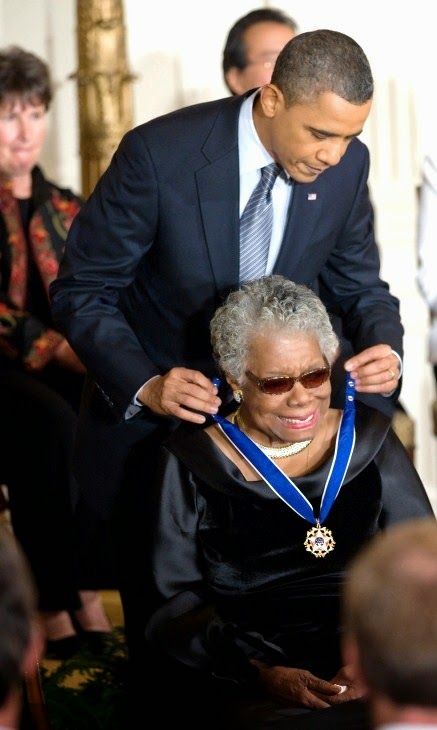
In presenting Maya Angelou with the Medal of Freedom in 2010, President Obama said: "By holding on even amid cruelty and loss, and then expanding to a sense of compassion, an ability to love – by holding on to her humanity, she has inspired countless others who have known injustice and misfortune in their own lives."

Today, on the occasion of her death at age 86, he said: "Today Michelle and I join millions around the world in remembering one of the brightest lights of our time--a brilliant writer, a fierce friend, and a truly phenomenal woman. Over the course of her remarkable life, Maya was many things--an author, poet, civil rights activist, playwright, actress, director,composer, singer and dancer. But above all, she was a storyteller--and her greatest stories were true. A childhood of suffering and abuse actually drove her to stop speaking--but the voice she found helped generations of Americans find their rainbows amidst the clouds, and inspired the rest of us to be our best selves. In fact, she inspired my own mother to name my sister Maya."

May she rest in peace.  Her work and her example live on.

If A Tree Burns in the Forest...

So you may have heard about the tornado in North Dakota, maybe even the huge mudslide in Colorado or the wildfires in Arizona.  But how about the wildfire in...Alaska?  Yes--hot, dry Alaska.

Couldn't be much, though, if there's no news.  Here's most of the brief Reuter's report Tuesday:

The Funny River wildfire was burning on about 250 square miles (650 square km) of forest, most of it inside the Kenai National Wildlife Refuge in southern Alaska, said Willie Begay, the spokesman.

The week-old fire has expanded from about 172 square miles (446 square km) on Sunday, when it was one-fifth contained. 

Almost 600 firefighters are battling the blaze among rolling hills mostly covered with black spruce, Begay said. The area has been without rain for more than a month, and steady winds from the southwest are fueling the flames.

So why isn't it big on the news?  Because it's in a wildlife refuge where there are only animals and trees.  Because few houses--let alone expensive houses-- have been threatened (though this story notes that over 1000 buildings have been evacuated.)

Like trees don't count.  In quantity however, in a heavily forested region, those are carbon breathers we're counting on to slow down global heating.  So not only is this bad news for what it indicates about the extent of climate crisis now (this is wildfire in Alaska), it's bad news for global heating in the near future.

Another thing you probably haven't heard about (unless you live there) is the persistent flooding in southeastern Florida, in Miami, being caused by sea level rise right now. But there it is flooding homes, and so local government and local politicians are paying attention, as this Bloomberg piece notes.

So the climate on the climate crisis may be changing in Florida, but as the climate changes in Alaska, not so much.  Because when a tree burns in the forest and there is no distraught homeowner to photograph for the front page or Youtube, it doesn't make a sound.

Tuesday, May 27, 2014

So Now It's Okay to Like the Bee Gees?

Barry Gibbs, the last living Bee Gee, is playing to large crowds in a solo U.S. tour.  He started in the huge Boston Garden, which is where I once saw the Rolling Stones.  It's very big.

Rolling Stone (the magazine) celebrates this with a collection of YouTube versions of "13 Essential Barry Gibb Tracks," most of them from the Bee Gees, beginning in the late 60s.  The accompanying paragraphs are laudatory.  They suggest that David Bowie essentially copied the Bee Gees in his early albums.

So it's okay to like the Bee Gees now?  Finally?  When they started, the reigning tastemakers at Rolling Stone considered them Beatles Lite.  Their middle period albums were ignored, their hits ridiculed.  And that's before they rode the Disco wave with their songs in Saturday Night Fever, which was of course beneath contempt.

Contempt was the attitude we faced when we included their first albums in our 1967-68 continuous play mix back in the Galesburg House for the Bewildered (169 W. First Street, now a national historical monument.  Wait--update: they tore it down) where the tunes of that fantastic year were our senior year soundtrack at Knox College.  Beatles, Stones, Hendrix, Creem, Doors, Buffalo Springfield, even Vanilla Fudge, but...the Bee Gees?

I purchased and listened to every Bee Gees album in the early and mid 70s.  Idea played at Iowa,  Mr. Natural in PA. My allegiance while I was writing about rock at the Boston Phoenix was considered a puzzling eccentricity. Rolling Stone and other rock imperial powers notwithstanding.  I do remember reading one writer somewhere (it may have even been on an album cover) brave enough to write a positive essay, though a lot of it was about how quixotic he was considered, how defensive he sometimes had to be.

Now Bruce Springsteen is doing a Bee Gees song--and one from the disco era--and Gibb is doing a Springsteen (neither of them terribly good at it.)  But that's less of a departure than Rolling Stone's--musicians by and large did not buy into the snobbery.  Many recorded Bee Gees songs and copied their riffs.  Musicians are like that.

So I welcome the conventional wisdom to what I already knew: the Bee Gees were unique, unquestionably strange, but frequently haunting and oddly joyful.  Welcome to the fan club.

Monday, May 26, 2014

The Dreaming Up Daily Weekly Quote

   Flowers for remembrance, sunshine on the ferns for the unofficial start of summer. BK photo. Click to see it all.

“Yet it is equally clear that knowledge of what is does not open the door directly to what should be. One can have the clearest and most complete knowledge of what is, and yet not be able to deduct from that what should be the goal of our human aspirations.”
Albert Einstein

Friday, May 23, 2014

The Everyday Climate Crisis

I was listening to the SF Giants baseball game with the Colorado Rockies being played near Denver on Thursday.  After a damp third inning the play-by-play turned to describing bright lightning and loud thunder, the tarps being nailed down, and then hail in the outfield like snow. The day before it had piled up three inches deep in some parts of Denver. There was a nearly 90 minute delay, a couple of more innings, another half hour delay before the game was called.

There seem to be more games cancelled by weather this season.  The Pirates saw two in a row in New York, as I recall.  That's one little indication (yet one that sports fans will notice) of what I predicted would happen someday soon: weather-related stories, especially violent and disastrous events, would become frequent in the daily news, along with news of other climate crisis effects, like food prices and illneses.  That someday appears to be now.

In just the past month or so, there were the tornadoes that spun across a wide and long swath of states for several days.  There were the California wild fires.  Then the floods and some 2000 landslides in Bosnia and Serbia, (a house in Serbia in photo above) killing 40 and creating damage "as least as bad" as that left by the 1990s war there, while also exposing land mines from that war.

  Now there are huge wildfires in Arizona, possible tornado damage in Albany NY, severe thunderstorms in Washington DC (and a storm of criticism for the National Weather Service's failure to predict them) and severe storms predicted Friday for New Mexico.

Will such daily evidence change the minds of those who persistently deny the reality of the climate crisis, even when they become an even higher proportion of news stories?  Probably not. The issue is now part of the cultural politics that is becoming absolute, and people may accept whatever "information" supports the view of the culture that they belong to and that embraces them. When your world is defined by Fox, and three-quarters of their climate stories are deceptive, you're safe at home. As climate crisis effects become more obvious and awful, fear may even increase the strength of the denial.

 So what can be done?  Maybe it's time to just stop listening to deniers and count them as a lost cause.  They are noisy--very actively so on the Internet.   There is big fossil fuel money behind them, and one of the two political parties is entirely captive to this money and these deniers.  Right now, no matter how crazy they get (and in some ways, the crazier the better) the structure of American politics and government makes it very likely that they will have some political power.

Still, their noise is much greater than their numbers, and even progressive sites distort their numbers by featuring every outrageous thing they say.

They aren't the majority.  And as Kim Stanley Robinson pointed out here in Arcata, all we need is 51%, and at most 60 votes in the U.S. Senate, to get to work.  It's time to concentrate not on the loud and the lost, but on those who vacillate (they don't want to think about it, they sort of believe but look for any excuse not to, they just want to think about and vote on other things) and those who know in general terms what the climate crisis is and what it might mean.  And especially to motivate those who are already concerned.

I've always wondered about that expression "preaching to the congregation."  Who else does a preacher preach to but the folks who show up?  They preach to the congregation, to the choir, in order to inform them, steel their resolve, motivate them to act, and guide their actions.  

So Naomi Klein can explain to us some reasons why we have trouble accepting the reality of the climate crisis, and exhort us: "And just as we have changed before, we can change again."  Rebecca Solnit can demonstrate the violence that climate crisis is already causing, and the political forces that suppress this knowledge, and what citizens can do about it.

Others bypass the arguments over climate change itself and go directly to such problems as the economics of dealing with it.  While some say there is not enough information generated on the costs of dealing with the effects (such as these fires, storms and droughts), others say the expense of addressing the causes is not ruinous, as the critics say, and the economics actually come out on the plus side. The International Energy Agency "concludes that the switch to low-carbon technologies such as solar power—together with anticipated improvements in efficiency—will bring huge savings from reduced fossil-fuel consumption. As a result, the world actually comes out slightly ahead: the costs of switching will be paid for in fuel savings between now and 2050."   

Another strategy that is in fact widely embraced is to simply work on the problems and ignore the deniers. How to change those minds is a less pressing challenge," write the editors of Bloomberg View, "than how to slow down climate change."  On the federal level, there's relative consensus among non-deniers around some proposals (the carbon tax) and healthy debate on others.  President Obama seems set to act--as soon as early June--to regulate coal fired plants, which may well have a decisive effect in slowing down climate change.

 But on both causes and effects, local, state, regional and international efforts are going on, beneficiaries perhaps of all the surface noise.  And research continues on ways to deal with the causes and effects rather than only predict the effects and prove over and over the causes.

A number of those who realize the reality of climate crisis and see it as the major human challenge of the future (and to the future) must get motivated to create a political movement.  That's the conclusion of several notable figures who started out studying or writing about the coming climate crisis, and now are also activists, such as Bill McKibben, former NASA scientist James Hansen, Mark Hertsggard and others.

Even Hillary Clinton has called for a citizens movement on this issue.  Kim Stanley Robinson says that it needs to be for the long haul and therefore self-perpetuating, led by succeeding generations of young people with the energy, talent and time to keep it going.


One movement strategy that's worked in the past is starting. Stanford University made some news when it decided to divest all coal company stock, but divestment is underway elsewhere.  It's not an exact analogy to South Africa, but divestment certainly worked there.  Some other under-the-radar political efforts are also underway, such as cowboys and Indians organizing against the Keystone pipeline.

So far a mass political movement hasn't happened, but that doesn't mean it won't happen.  In an interview, the late Jonathan Schell had some ideas for what might work but ultimately he admitted, why movements rise when they do is a mystery.  When their time comes, they just do.

Maybe that time begins this year. With an article in the new Rolling Stone, Bill McKibben is organizing a big march in New York City when the United Nations meets in September.

The challenge is daunting, and some--like MSNBC's Chris Hayes--says it is unprecedented, because of all the fossil fuel wealth that would have to be left in the ground.  He writes that such restraint has never happened.  I'm not so sure--there are still some forests left.

But nobody really knows exactly what the future holds, especially in responses to the climate crisis.  We can only form a vision of a better future, and work towards it in the present.  That's all we can do--our best in our present, for the future.

Tuesday, May 20, 2014

Fire, Got That, What About Ice?

It's melting.  Not exactly news, especially since last week, but the studies keep coming in.  According to NBC News:"Three years' worth of readings from the European Space Agency's CryoSat 2 satellite indicate that Antarctica's ice sheets are losing 159 billion tons of ice per year — which is twice as much as the estimates from previous altimeter surveys."  (There's more details in this BBC story, but the numbers are in metrics.)

The same story references another study, of Greenland: "A study published Sunday by Nature Geoscience reports that the canyons beneath the Greenland Ice Sheet are deeper and longer than previously thought. That suggests that there's more ice on the northern land mass available for thawing in a warming world, with the result that Greenland's future contribution to sea level rise could exceed past estimates."

Now how about ice and fire together? "New research on the effects of ice sheet melt in the Antarctic shows climate change is deforming the Earth’s crust, potentially prompting volcanic activity that could cause global sea-levels to rise much more than predicted."

That's if the volcanoes are under the ice and an eruption accelerates the melt.  There are possible sites in Alaska and Antarctica.  This story ends with the chilling news that Australian scientists who have been studying their fairly near neighbor of Antarctica may not be able to continue due to cutbacks in government funding.  Australia has yo-yoed back from being led by climate crisis believers to climate crisis deniers.

The response of the earth's crust to the redistribution of weight (as ice melts into oceans) and perhaps even to atmospheric temperature is another unknown, in this utterly interrelated planetary ecology.  But volcanoes would be one manifestation, earthquakes another.

The new Antarctic study comports with the results of studies released and referenced here in the past week or two.  The conclusion of all the studies is that while scientists cannot yet predict how fast the sea levels will rise, they're now pretty damn sure they are going to rise, certainly enough to threaten coastal cities worldwide and islands and even states (Florida) low in the water.  And maybe by a lot more, and maybe a lot faster.

Monday, May 19, 2014

The Dreaming Up Daily Weekly Quote

"In the end it is a moral question whether individuals apply what they have learned or not."
C.G. Jung
photo: LA Times