Monday, June 02, 2014

The Biggest Step for The Biggest Challenge

The first day of the rest of our lives--when the fight to confront the climate crisis is really and truly joined--saw many of the usual suspects saying the usual suspect things: the new EPA coal-fired power plant regulations announced today, with a goal of reducing emissions by 30% (and not the 20-25% predicted last week, the difference between a fifth and a third) got GOPers in a lather about economic costs, federal overreach etc.  Our eloquent House majority leader called them "nuts."

However the LA Times opined "The Obama administration's new effort to reduce carbon emissions from power plants is pragmatic, smart and overdue," and made the case for these specific regulations.

Countering the GOP economic argument, Tom Zeller at Bloomberg wrote that the rules "can boost the economy."  He also wrote in detail about past GOP and fossil fuel industry responding to pollution regs with catastrophic predictions that didn't come true, and noted that a Yale study published last week showed that 64% of respondents were in favor of greenhouse gas regulation on power plants, even if it meant higher bills.

A Washington Post piece notes a recent Pew poll which showed that climate crisis deniers are in the solid minority, isolated as Tea Party GOPers.  Even 61% of non-TP GOPers believe the evidence is strong.  The percentages are especially high among Dem voting groups: 73% of ages 18-29, 76% of nonwhites, 67% of college-educated whites believe the climate crisis is underway.

This could be why, as the Washington Examiner noticed, today's GOPer rhetoric didn't include denial of the climate crisis itself, or why the recent GOPer officeholder mantra has been "I am not a scientist" (as if any of them would be mistaken for one.) And why this Post Morning Plum piece suggests that while the impact on 2014 elections might be minimal one way or the other, the climate crisis will be an issue in 2016, and Dems will be raising it.

The new regs propose to leave many decisions on implementation to the states.  Some states depend less on coal than others, and some states--notably California and New York--have already started reducing emissions in response to the climate crisis (CA is on track to meet the new guidelines now.)

Some environmentalists are disappointed with the details.  But others are on board: "Marcia Bystryn, president of the New York League of Conservation Voters... said the plan would help the nation confront the climate change that many communities are already experiencing. “This is the biggest step we’ve ever taken for the biggest challenge we’ve ever faced,” she said. “The American people support these common-sense safeguards and are sick of the lie that pollution has to be the fuel of our economic engine.”

We actually see this … as the Super Bowl of climate politics,” said Peter Altman, director of the climate and clean air campaign for the Natural Resources Defense Council.

Bill McKibben said of the proposed regs in an email, "To me, most of all, they seem obvious, the kind of thing that should have happened many administrations ago, and that I’m glad are happening now."  He suggested that activists helped make them possible.

  "As we've built a climate movement together with our allies and all of you, politicians have finally begun to sense that they have some space to act, and some pressure to move into that space. If Beyond Coal and Mountain Justice Summer and countless other organizations and campaigns hadn’t made coal an easy target; if the Keystone and fossil fuel divestment campaigns hadn’t turned up the heat on climate change; if hundreds of thousands of you hadn’t marched and written and emailed, then today’s announcement would not have come."

Then there's the international effects. Today's Guardian story:  The regulations could lead to a sweeping transformation of America's energy economy, if they survive an onslaught from business and conservative groups, and Republicans in Congress. The rules could also break open negotiations for a global climate change deal, the United Nations climate chief, Christiana Figueres, said

Yesterday the Guardian quoted President Obama in his foreign policy speech at the West Point commencement last week: “I intend to make sure America is out front in a global framework to preserve our planet,” he said. “American influence is always stronger when we lead by example. We cannot exempt ourselves from the rules that apply to everyone else.”

Now there's action proposed to back up those words.  But it's just the beginning.

The Dreaming Up Daily Weekly Quote

   
“In a living society every day is a day of judgment; and its recognition as such is not the end of all things but the beginning of a real civilization.”
Bernard Shaw
   photo by Kowinski--click for entire view

Saturday, May 31, 2014

The Climate of the Possible


President Obama dedicated his Saturday address to making the case for the power plant regulations he will formally unveil on Monday.  He did so primarily on the basis of their health benefit, while countering arguments that these efforts will ruin the economy.   "That's what they always say," he pointed out, in past debates over health and environmental regulations that did not ruin the economy but fostered innovation that led to new businesses and jobs.  But he also framed these regulations in relation to the climate crisis, which he pointed out is now part of our present. Looking to the future he said, "As President and as a parent, I refuse to condemn our children to a planet that's beyond fixing."

In covering this address, TPM noted that while the new regulations that won't really become effective for years are a compromise with political realities, given current laws it's at the limit of his presidential powers. 


Friday, May 30, 2014

The Oncoming Storm?

What's been anticipated for years, rumored to be coming soon for weeks is now in the first phase of realization. The Guardian is one of several news outlets to report:

"President Barack Obama will unveil a plan on Monday that will cut carbon pollution from power plants and promote cap-and-trade, undertaking the most significant action on climate change in American history.

The proposed regulations Obama will launch at the White House on Monday could cut carbon pollution by as much as 25% from about 1,600 power plants in operation today, according to those claiming familiarity with the plan. Power plants are the country's single biggest source of carbon pollution – responsible for up to 40% of the country's emissions."

No source is given but a conference call with White House advisor John Podesta is mentioned later in the story.  The New York Times has a similar story.

The howls of opposition are already beginning, and will be both loud and legalistic.  The regulatory action in particular is going to hit a number of factions right in the gut of their dogma.

But the politics are unlikely to be one-sided.  There are indications here and there that even in the upcoming 2014 elections, at least some Democrats are going on the offense on this issue.

And there's also evidence that Republican deniers (which means almost every Republican running for anything) are on the defensive.  This story reproduces an uncomfortable Q and A with Florida Governor Rick Scott, illustrating the bind that particularly governors and other state and local officials are in.  As noted here, effects of the climate crisis are already been felt in Florida, notably in flooding that is reaching into middle class Miami Beach homes.  Scott is trying hard to show that he's responding to such effects, while denying that he has any idea of the causes.  It doesn't sound credible.  It sounds really bad.

There's all kinds of potential here.  Stay tuned.

Thursday, May 29, 2014

Dogma Versus the Future

It's become the holy word of Republican orthodoxy, as well as a well-worn mantra of the business class: government doesn't innovate, create jobs or do anything well except spend the money they steal from citizens through taxes.  The way to promote innovation and economic growth is shrink the government, cut taxes on businesses and rich people, then sit back and watch the economy take off.

Despite certain cautionary tales like the Great Depression, this has become a dogma, even though some thinking Republicans recognize it lacks so much nuance as to be self-destructive.  Still it remains the only theology the short shelf of Republican factions can all embrace, and still hope to draw in non-believers.

That it's not true is more than a minor inconvenience.  It's a prescription for failure, and specifically for American failure in the near future.  That's one major conclusion of a couple of new books that Jeffrey Madrick reviews in the April 24 New York Review of Books.

These books in different ways affirm that major innovations--including  recent ones in the tech sector that the Enteprenerurial Liberation Front likes to cite, such as the iphone--were made possible by government funded research.

The two books are The Entrepreneurial State by economist Mariana Mazzucato and Doing Capitalism in the Innovation Economy by William H. Janeway.  Reviewer Madrick quotes:

"For example, she [Mazzucato] shows in detail that, while Steve Jobs brilliantly imagined and designed attractive new commercial products, almost all the scientific research on which the iPod, iPhone, and iPad were based was done by government-backed scientists and engineers in Europe and America. The touch-screen technology, specifically, now so common to Apple products, was based on research done at government-funded labs in Europe and the US in the 1960s and 1970s.

Further: Two researchers cited by Mazzucato found that in 2006, the last year sampled, only twenty-seven of the hundred top inventions annually listed by R&D Magazine in the 2000s were created by a single firm as opposed to government alone or a collaboration with government-funded entities."

Much was made in the 2012 election campaign of the bankruptcy of the solar energy company Solyndra, which received $500 million in government loans.  Apart from the fact that most of the investment money came from private hedge funds, there's this: "But including Solyndra, only roughly 2 percent of the projects partly financed by the federal government have gone bankrupt."

Still, the media loudspeaker made Solyndra a brand name, while nobody much has heard of First Solar--a solar energy company that is both a success and would not exist without government funding.

Mazzucato moves on to show in detail how the technologies for those visionary tech products the Ipad and Iphone "were almost completely dependent on government-sponsored research." One of the crucial ingredients in almost all new tech devices was the government created Global Positioning Satellites, or GPS.  Earlier it was the government-formed and supported research partnership of semiconductor firms (Sematec) that both insured US supremacy in microprocessors when Japan threatened to take over, and continued to innovate to make them smaller and better, making all mobile devices possible.

And of course even earlier, it was government research that created the Internet, and (beginning in the 1940s) to computers.  "Federal funding accounted for more than 50 percent of all US R&D from the early 1950s through 1978"--which includes the last decades when big corporations like Bell, GE, Dupont and Alcoa were spending a lot on research.  They haven't done so since.

But even though President Obama talks about supporting research, Republicans often vote against it.  Meanwhile, the review notes, China is investing heavily, with the threat of dominating future innovations.

It's true that a lot of funding for tech innovation came from or through Defense.  Not so much however in health.  Though the ELF makes Big Pharma into the innovative heroes, sources quoted in these books show that government research was responsible for 75% of the "major original breakthroughs known as new molecular entities between 1993 and 2004" and that of seven high priority drugs created in 2002, only three were from Big Pharma, four from government labs--and arguably they were the more significant.

The review also cites some interesting history, some economics concerning investment in innovation and some ideas on how to better finance innovation through public and private means.  But politically the nub of it all is this:“Many of the problems being faced today by the Obama administration,” she writes, “are due to the fact that US taxpayers…do not realize that corporations are making money from innovation that has been supported by their taxes.” That they are not aware of the benefits to competition seems to be a triumph of free-market ideology over good sense. How many Americans are aware that Google’s basic algorithm was developed with a National Science Foundation grant?"

The review concludes:

"But Mazzucato’s criticism of US innovation strategies goes deeper than the lack of adequate funding. She makes one of the most convincing cases I have seen for the value and competence of government itself, and for its ability to do what the private sector simply cannot. It is not only, as economists argue, a matter of reducing the risk of research and innovation for private enterprise. She argues that government efforts are the source of new technological visions for the future, and—very persuasively—she cites the innovations of the past sixty years to make her case."

Stirring the Potpourri

A couple of ongoing stories not all that prominent in the news media... Starting with the NBA Sterling/Silver affair, Senate Majority Leader Harry Reid stepped up his criticism of the racism enshrined in the name of Washington DC's National Football League team, calling on NFL Commissioner Goddell to have it changed.  Then he organized 49 Dem Senators to petition the club's owner Daniel Snyder to change it himself.  Snyder refused and went on the offensive against Reid, fomenting a Twitter war against him.  So far it is backfiring, as Washington club fans are taking to Twitter to demand the Washington Racists change their name.

European elections last week showed surprising gains for far right parties in France, the UK, Denmark and Austria, widely interpreted as resurgent nationalism and rebukes to the European Union.  I don't know enough about European politics and economics unfortunately but Matt Yglesias has a persuasive critique and I note that in his interview a few weeks ago in the New York Review of Books, George Soros predicted that there would be political upheaval coming as a result of recent EU policies.  Yglesias notes the austerity and widespread unemployment that may be fueling restive anger.  EU policymakers need to take heed.

 The European Union is a developing historic dream and bumps in such an ongoing project are to be expected.  But the timing is worrisome, not only for the world economy, but for the prospects of action on the climate crisis in the upcoming cycle.  

Wednesday, May 28, 2014

R.I.P Maya Angelou

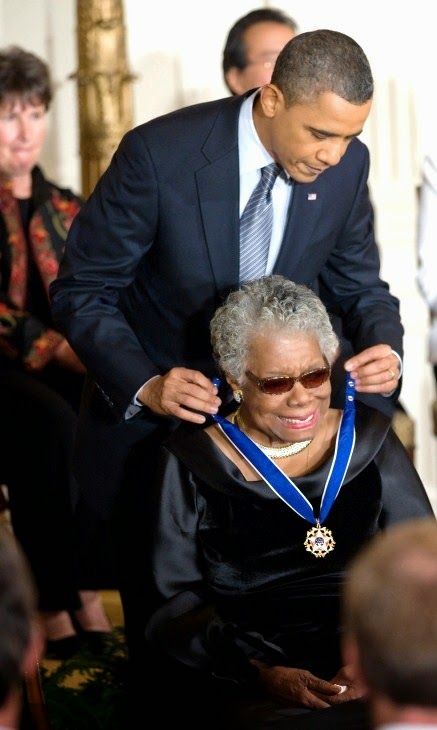
In presenting Maya Angelou with the Medal of Freedom in 2010, President Obama said: "By holding on even amid cruelty and loss, and then expanding to a sense of compassion, an ability to love – by holding on to her humanity, she has inspired countless others who have known injustice and misfortune in their own lives."

Today, on the occasion of her death at age 86, he said: "Today Michelle and I join millions around the world in remembering one of the brightest lights of our time--a brilliant writer, a fierce friend, and a truly phenomenal woman. Over the course of her remarkable life, Maya was many things--an author, poet, civil rights activist, playwright, actress, director,composer, singer and dancer. But above all, she was a storyteller--and her greatest stories were true. A childhood of suffering and abuse actually drove her to stop speaking--but the voice she found helped generations of Americans find their rainbows amidst the clouds, and inspired the rest of us to be our best selves. In fact, she inspired my own mother to name my sister Maya."

May she rest in peace.  Her work and her example live on.

If A Tree Burns in the Forest...

So you may have heard about the tornado in North Dakota, maybe even the huge mudslide in Colorado or the wildfires in Arizona.  But how about the wildfire in...Alaska?  Yes--hot, dry Alaska.

Couldn't be much, though, if there's no news.  Here's most of the brief Reuter's report Tuesday:

The Funny River wildfire was burning on about 250 square miles (650 square km) of forest, most of it inside the Kenai National Wildlife Refuge in southern Alaska, said Willie Begay, the spokesman.

The week-old fire has expanded from about 172 square miles (446 square km) on Sunday, when it was one-fifth contained. 

Almost 600 firefighters are battling the blaze among rolling hills mostly covered with black spruce, Begay said. The area has been without rain for more than a month, and steady winds from the southwest are fueling the flames.

So why isn't it big on the news?  Because it's in a wildlife refuge where there are only animals and trees.  Because few houses--let alone expensive houses-- have been threatened (though this story notes that over 1000 buildings have been evacuated.)

Like trees don't count.  In quantity however, in a heavily forested region, those are carbon breathers we're counting on to slow down global heating.  So not only is this bad news for what it indicates about the extent of climate crisis now (this is wildfire in Alaska), it's bad news for global heating in the near future.

Another thing you probably haven't heard about (unless you live there) is the persistent flooding in southeastern Florida, in Miami, being caused by sea level rise right now. But there it is flooding homes, and so local government and local politicians are paying attention, as this Bloomberg piece notes.

So the climate on the climate crisis may be changing in Florida, but as the climate changes in Alaska, not so much.  Because when a tree burns in the forest and there is no distraught homeowner to photograph for the front page or Youtube, it doesn't make a sound.

Tuesday, May 27, 2014

So Now It's Okay to Like the Bee Gees?

Barry Gibbs, the last living Bee Gee, is playing to large crowds in a solo U.S. tour.  He started in the huge Boston Garden, which is where I once saw the Rolling Stones.  It's very big.

Rolling Stone (the magazine) celebrates this with a collection of YouTube versions of "13 Essential Barry Gibb Tracks," most of them from the Bee Gees, beginning in the late 60s.  The accompanying paragraphs are laudatory.  They suggest that David Bowie essentially copied the Bee Gees in his early albums.

So it's okay to like the Bee Gees now?  Finally?  When they started, the reigning tastemakers at Rolling Stone considered them Beatles Lite.  Their middle period albums were ignored, their hits ridiculed.  And that's before they rode the Disco wave with their songs in Saturday Night Fever, which was of course beneath contempt.

Contempt was the attitude we faced when we included their first albums in our 1967-68 continuous play mix back in the Galesburg House for the Bewildered (169 W. First Street, now a national historical monument.  Wait--update: they tore it down) where the tunes of that fantastic year were our senior year soundtrack at Knox College.  Beatles, Stones, Hendrix, Creem, Doors, Buffalo Springfield, even Vanilla Fudge, but...the Bee Gees?

I purchased and listened to every Bee Gees album in the early and mid 70s.  Idea played at Iowa,  Mr. Natural in PA. My allegiance while I was writing about rock at the Boston Phoenix was considered a puzzling eccentricity. Rolling Stone and other rock imperial powers notwithstanding.  I do remember reading one writer somewhere (it may have even been on an album cover) brave enough to write a positive essay, though a lot of it was about how quixotic he was considered, how defensive he sometimes had to be.

Now Bruce Springsteen is doing a Bee Gees song--and one from the disco era--and Gibb is doing a Springsteen (neither of them terribly good at it.)  But that's less of a departure than Rolling Stone's--musicians by and large did not buy into the snobbery.  Many recorded Bee Gees songs and copied their riffs.  Musicians are like that.

So I welcome the conventional wisdom to what I already knew: the Bee Gees were unique, unquestionably strange, but frequently haunting and oddly joyful.  Welcome to the fan club.

Monday, May 26, 2014

The Dreaming Up Daily Weekly Quote

   Flowers for remembrance, sunshine on the ferns for the unofficial start of summer. BK photo. Click to see it all.

“Yet it is equally clear that knowledge of what is does not open the door directly to what should be. One can have the clearest and most complete knowledge of what is, and yet not be able to deduct from that what should be the goal of our human aspirations.”
Albert Einstein

Friday, May 23, 2014

The Everyday Climate Crisis

I was listening to the SF Giants baseball game with the Colorado Rockies being played near Denver on Thursday.  After a damp third inning the play-by-play turned to describing bright lightning and loud thunder, the tarps being nailed down, and then hail in the outfield like snow. The day before it had piled up three inches deep in some parts of Denver. There was a nearly 90 minute delay, a couple of more innings, another half hour delay before the game was called.

There seem to be more games cancelled by weather this season.  The Pirates saw two in a row in New York, as I recall.  That's one little indication (yet one that sports fans will notice) of what I predicted would happen someday soon: weather-related stories, especially violent and disastrous events, would become frequent in the daily news, along with news of other climate crisis effects, like food prices and illneses.  That someday appears to be now.

In just the past month or so, there were the tornadoes that spun across a wide and long swath of states for several days.  There were the California wild fires.  Then the floods and some 2000 landslides in Bosnia and Serbia, (a house in Serbia in photo above) killing 40 and creating damage "as least as bad" as that left by the 1990s war there, while also exposing land mines from that war.

  Now there are huge wildfires in Arizona, possible tornado damage in Albany NY, severe thunderstorms in Washington DC (and a storm of criticism for the National Weather Service's failure to predict them) and severe storms predicted Friday for New Mexico.

Will such daily evidence change the minds of those who persistently deny the reality of the climate crisis, even when they become an even higher proportion of news stories?  Probably not. The issue is now part of the cultural politics that is becoming absolute, and people may accept whatever "information" supports the view of the culture that they belong to and that embraces them. When your world is defined by Fox, and three-quarters of their climate stories are deceptive, you're safe at home. As climate crisis effects become more obvious and awful, fear may even increase the strength of the denial.

 So what can be done?  Maybe it's time to just stop listening to deniers and count them as a lost cause.  They are noisy--very actively so on the Internet.   There is big fossil fuel money behind them, and one of the two political parties is entirely captive to this money and these deniers.  Right now, no matter how crazy they get (and in some ways, the crazier the better) the structure of American politics and government makes it very likely that they will have some political power.

Still, their noise is much greater than their numbers, and even progressive sites distort their numbers by featuring every outrageous thing they say.

They aren't the majority.  And as Kim Stanley Robinson pointed out here in Arcata, all we need is 51%, and at most 60 votes in the U.S. Senate, to get to work.  It's time to concentrate not on the loud and the lost, but on those who vacillate (they don't want to think about it, they sort of believe but look for any excuse not to, they just want to think about and vote on other things) and those who know in general terms what the climate crisis is and what it might mean.  And especially to motivate those who are already concerned.

I've always wondered about that expression "preaching to the congregation."  Who else does a preacher preach to but the folks who show up?  They preach to the congregation, to the choir, in order to inform them, steel their resolve, motivate them to act, and guide their actions.  

So Naomi Klein can explain to us some reasons why we have trouble accepting the reality of the climate crisis, and exhort us: "And just as we have changed before, we can change again."  Rebecca Solnit can demonstrate the violence that climate crisis is already causing, and the political forces that suppress this knowledge, and what citizens can do about it.

Others bypass the arguments over climate change itself and go directly to such problems as the economics of dealing with it.  While some say there is not enough information generated on the costs of dealing with the effects (such as these fires, storms and droughts), others say the expense of addressing the causes is not ruinous, as the critics say, and the economics actually come out on the plus side. The International Energy Agency "concludes that the switch to low-carbon technologies such as solar power—together with anticipated improvements in efficiency—will bring huge savings from reduced fossil-fuel consumption. As a result, the world actually comes out slightly ahead: the costs of switching will be paid for in fuel savings between now and 2050."   

Another strategy that is in fact widely embraced is to simply work on the problems and ignore the deniers. How to change those minds is a less pressing challenge," write the editors of Bloomberg View, "than how to slow down climate change."  On the federal level, there's relative consensus among non-deniers around some proposals (the carbon tax) and healthy debate on others.  President Obama seems set to act--as soon as early June--to regulate coal fired plants, which may well have a decisive effect in slowing down climate change.

 But on both causes and effects, local, state, regional and international efforts are going on, beneficiaries perhaps of all the surface noise.  And research continues on ways to deal with the causes and effects rather than only predict the effects and prove over and over the causes.

A number of those who realize the reality of climate crisis and see it as the major human challenge of the future (and to the future) must get motivated to create a political movement.  That's the conclusion of several notable figures who started out studying or writing about the coming climate crisis, and now are also activists, such as Bill McKibben, former NASA scientist James Hansen, Mark Hertsggard and others.

Even Hillary Clinton has called for a citizens movement on this issue.  Kim Stanley Robinson says that it needs to be for the long haul and therefore self-perpetuating, led by succeeding generations of young people with the energy, talent and time to keep it going.


One movement strategy that's worked in the past is starting. Stanford University made some news when it decided to divest all coal company stock, but divestment is underway elsewhere.  It's not an exact analogy to South Africa, but divestment certainly worked there.  Some other under-the-radar political efforts are also underway, such as cowboys and Indians organizing against the Keystone pipeline.

So far a mass political movement hasn't happened, but that doesn't mean it won't happen.  In an interview, the late Jonathan Schell had some ideas for what might work but ultimately he admitted, why movements rise when they do is a mystery.  When their time comes, they just do.

Maybe that time begins this year. With an article in the new Rolling Stone, Bill McKibben is organizing a big march in New York City when the United Nations meets in September.

The challenge is daunting, and some--like MSNBC's Chris Hayes--says it is unprecedented, because of all the fossil fuel wealth that would have to be left in the ground.  He writes that such restraint has never happened.  I'm not so sure--there are still some forests left.

But nobody really knows exactly what the future holds, especially in responses to the climate crisis.  We can only form a vision of a better future, and work towards it in the present.  That's all we can do--our best in our present, for the future.

Tuesday, May 20, 2014

Fire, Got That, What About Ice?

It's melting.  Not exactly news, especially since last week, but the studies keep coming in.  According to NBC News:"Three years' worth of readings from the European Space Agency's CryoSat 2 satellite indicate that Antarctica's ice sheets are losing 159 billion tons of ice per year — which is twice as much as the estimates from previous altimeter surveys."  (There's more details in this BBC story, but the numbers are in metrics.)

The same story references another study, of Greenland: "A study published Sunday by Nature Geoscience reports that the canyons beneath the Greenland Ice Sheet are deeper and longer than previously thought. That suggests that there's more ice on the northern land mass available for thawing in a warming world, with the result that Greenland's future contribution to sea level rise could exceed past estimates."

Now how about ice and fire together? "New research on the effects of ice sheet melt in the Antarctic shows climate change is deforming the Earth’s crust, potentially prompting volcanic activity that could cause global sea-levels to rise much more than predicted."

That's if the volcanoes are under the ice and an eruption accelerates the melt.  There are possible sites in Alaska and Antarctica.  This story ends with the chilling news that Australian scientists who have been studying their fairly near neighbor of Antarctica may not be able to continue due to cutbacks in government funding.  Australia has yo-yoed back from being led by climate crisis believers to climate crisis deniers.

The response of the earth's crust to the redistribution of weight (as ice melts into oceans) and perhaps even to atmospheric temperature is another unknown, in this utterly interrelated planetary ecology.  But volcanoes would be one manifestation, earthquakes another.

The new Antarctic study comports with the results of studies released and referenced here in the past week or two.  The conclusion of all the studies is that while scientists cannot yet predict how fast the sea levels will rise, they're now pretty damn sure they are going to rise, certainly enough to threaten coastal cities worldwide and islands and even states (Florida) low in the water.  And maybe by a lot more, and maybe a lot faster.

Monday, May 19, 2014

The Dreaming Up Daily Weekly Quote

"In the end it is a moral question whether individuals apply what they have learned or not."
C.G. Jung
photo: LA Times

Saturday, May 17, 2014

It's Graduation Day at Humboldt State.  The ceremonies are held by college divisions, beginning in the morning and continuing into late afternoon.  I happened to be walking along the soon to be empty streets of Arcata as the last batch was leaving, heading for cars and apartments and restaurants, caps in hand.  None of them I saw was smiling.

There haven't been too many graduation days in recent years opening to robust economic opportunity.  And there are other factors that have prompted fear as well as hope.  I spent my college graduation day watching Bobby Kennedy's funeral.

Humboldt State is not known for bringing in graduation speakers, as least of general note.  But considering the future these graduates face, I thought today of one they could have easily had, who might have given them some genuinely encouraging words about that future.

Author Kim Stanley Robinson, who lives down the coast at Davis, was actually here just last week.  He spoke before a fairly small crowd on campus and then read at Northtown Books.  He was invited, not by any university group or entity, but by an outside environmental organization.  His talk on the economics of the near future was a variation on one that he gave to a different sort of audience in 2011, which is available for viewing   on YouTube.

This 2011 talk was framed as a thought experiment about an optimal future 200 years from now.  He spoke of the economics of getting there, though he said that the exact economic system--which would have to be post-capitalist--is unclear: he called it X.  But notably his vision of that future was less about a system and more about how life would be in a post-consumerist future, where pleasure would be derived from friends, family and community, sports and other activities, rather than buying things.  His novel Pacific Edge fills in a future like this.  

He ended this 2011 talk this way (more or less, this is my transcription) by addressing the students in the audience, in an authentic message that today's graduates should hear :  "The idea that the 1950s were the height of human culture and that we accidentally torched the world and now all you kids have to live like saints and have a lower standard of living than what we had back in those days--it's all wrong in three or four different ways that I hope my talk has elucidated.  Once you've got enough, once you've got the technology growing, once you're engaged in the process of making a sustainable civilization on this planet, you've got more than enough, you've got it better than it was back in the Cold War."

"It's more clever, it's more sophisticated, it's cleaner, it's more stylish--you have all the happiness without so much of the stupid ambition and the waste of your life doing stuff that you don't really want to do, in getting and spending and staying in a money economy that doesn't mean anything to you--we want meaning in our lives.  And making a sustainable civilization, which is now an emergency task, is all the meaning we need. 

 It's a beautiful meaning, and so in a way climate change, the environmental crisis, the tremendously fraught moment that we find ourselves in right now, is really just an opportunity for us to have meaning throughout our careers.  It's meaningful work, and it extends across all disciplines--it's in the sciences, it's in engineering, it's in the humanities, in the arts--all are going to be concerned with getting us through the next century alive and healthy and headed towards this next system, this X that I've been talking about."    

Thursday, May 15, 2014

The Fires This Time

Even though the normal fire season has yet to begin, the huge fires raging in southern California aren't the first of the year--there have been "1,400 wildfires so far this year, double what the state would normally expect" in what officials now consider a year-round fire season.

But it's not just California.  The above map, produced by the U.S. Drought Monitor and published today in Wired, shows that fully half of the contiguous United States are in drought.

Meanwhile, a real time study concludes what other climate scientists predicted: the droughts as well as the extreme weather seen this winter (the polar vortex) are related to the climate crisis.

Another effect likely influencing today's weather is suggested in a NOAA study says that tropical cyclones of maximum intensity have been moving northward, now threatening China and Japan.

In other scientific findings about the climate crisis in the past week or so, after some scientists suggested that the East Antarctic ice may be close to a tipping point which would raise sea levels dramatically above what's been forecast so far, other researchers believe the melting of the West Antarctic has already begun and is probably unstoppable, adding 4 to 12 feet more of sea level rise.   Both of these however will take anywhere from a century to nine centuries to reach their maximum effect.

Today the droughts and storms are threatening food supplies, even food quality (less nutrition in grains) and causing other economic strains that threaten millions of people worldwide.

Tuesday, May 13, 2014

Summarizing


Wednesday Update: Another warm one for us today but nothing like the temps in southern California, where fires were raging, especially in the San Diego area where nine fires have burned over 9,000 acres and a number of homes.

Today (and forecast for tomorrow) it is summer in Arcata.  Record-breaking temps (low 70s to 80 or so, depending on the source) meet the usual high humidity.  Outside the door into the air the immediate difference is smell.  Barely noticeable manure spread on gardens in the neighborhood is suddenly pungent, as is the garbage in the bins outside groceries and restaurants.

New neighbors have a young son with another child on the way.  From over the fence the sound of water from the hose hitting the bottom of a small bright plastic pool.  It prompts an image maybe from memory, of standing in the sun-dazzle trying to wrap my mind around the idea that while I was really hot, in a few minutes, when the little pool is filled and I jump in, I will be cool.  Truth is I'm not sure I ever had a little plastic pool.  I probably played in a wash bucket.  But my sisters had one, and that sound is truly in the memory.

Students converge on Wildberries for their finals prep sustenance. My duty as a reporter forces me to observe that short shorts are in this year.

  From my window-side table, three horses with women riders pass through the parking lot.

Monday, May 12, 2014

The Dreaming Up Daily Weekly Quote

“The experience of France in the Belle Époque proves, if proof were needed, that no hypocrisy is too great when economic and financial elites are obliged to defend their interest.”

Thomas Piketty
quoted by Paul Krugman in his New York Review of Books review of Piketty's Capital in the Twenty-First Century.

Sunday, May 11, 2014

Sunday Sports Prattle

Baseball: The Giants are off to a great start.  Rejuvenated by new acquisitions, including the veterans pitcher Tim Hudson and the power hitter Mark Morse, they lead a competitive division.  Their starting pitching, while not up to standards of championship years, is pretty good, and relief pitching is better. They've gotten timely hitting and though some are (or were) not hitting well, they've been able to pick each other up.  What's most impressive about them, especially in this latest road trip, is their defense.  They are once again a fun team to follow.

I know the most about the Giants because I can listen to their games on radio.  My other team, the Pirates had a rocky start.  Inconsistent hitting but mostly pitching has hampered them.  But they're winning more lately--the Giants won 7 and lost only 3 games on their road trip--two of them to the Pirates.  Their trades seem to be working out well, but I sense a lack of depth.

Basketball: Weird playoffs, with nobody looking that good consistently.  While I'd like to see Oklahoma City get to the finals, right now I don't see anybody defeating Miami in seven.

Meanwhile, the disastrous reign of Dantoni with the Lakers is over.  Kobe is saying positive things about baby Buss but he's the one responsible for passing on Phil Jackson, twice.  Still think his oedipal ego is a huge problem.  However they do seem to have some young players with a future.  As long as they don't trade them away for another marquee has-been.  That's never worked for the Lakers (cf Gary Payton.)

Football: Concussion dangers talked about more but still not seriously addressed at any level.  So it's a dying game.  NFL draft was this weekend--lots of show for something that's more fantasy at this point than fantasy leagues.  Nobody knows how any of those players will perform.  The Steelers seem to have had a decent draft with intentions to completely revamp their defense with more speed, so their games may be more entertaining next year even if their record doesn't improve.      

Saturday, May 10, 2014

We Are All Five Year-Olds Now

Kevin Drum at Mother Jones wrote a column about expressions of dissatisfaction with President Obama's foreign policy--by people who accept or at least admit that they agree with his foreign policy: "Fareed Zakaria is the latest columnist to acknowledge that although President Obama's foreign policy decisions have been largely correct, they've been sadly unaccompanied by any magic powers."

Drum goes on to wonder: "Has any president in history been so widely criticized for doing everything right but not crowing loudly enough about it? I mean, it's nice to think that a silver tongue would have gotten congressional Republicans to support intervention in Syria and Germans to approve harsher sanctions against Russia, but it's just not so. I think everyone knows this perfectly well, but we find it so frustrating that we blame Obama for it anyway. It's as if we're all five-year-olds."

There is something that political scientists have begun calling the Green Lantern Theory, or the expectation that the President alone can right every wrong, fix every problem single-handed and be the hero of the day.  Whereas they have known the limitations of presidential power for at least the past 50 years, since the publication of Richard Neustadt's classic Presidential Power.

But of course it's more than that, because Drum is right: in some ways we are all five year-olds, if that advanced.  We are first and foremost one basic thing (as William Irwin Thompson points out): we are mammals.  We are creatures born of mothers and fathers, and most often nurtured by them.  This is the unconscious source of many of our primary beliefs and assumptions, and the dramas of our lives, including expectations, projections and conflicts.

It's yet another reason that to deny that psychology is crucial in every aspect of our lives, including political, is sheer arrogant folly. If we don't make conscious the possibilities of (for instance) projecting the ideal father on the king or the President, we'll continue to befuddle ourselves and increasingly threaten our democracy, and now our civilization as well as many of earth's lifeforms, including our own.  Unless we at least take this possibility into consideration when evaluating our opinions, we are unlikely to make good decisions.

R.I.P. Jonathan Schell

It was only in seeing an issue of The Nation that is a few weeks old that I learned of the death of Jonathan Schell.  He was a writer and an activist who identified and helped to define the major issues of our time beginning with the Vietnam War, and his influential book of reporting, The Village of Ben Suc.

In the early 80s he wrote one of the most powerful books ever on the human dimensions of nuclear conflict, The Fate of the Earth.  Reading it first in the New Yorker was a powerful, poignant experience.  It had a great deal to do with the nuclear freeze movement of the 80s.

He warned against the Iraq war and remained an articulate opponent.  His 2007 book The Seventh Decade warned of new dangers of nuclear weapons and warfare--all the more dangerous because the common conception is that this danger is over.  It is not.

More recently he turned his attention to the climate crisis.  When asked to compare the threat of nuclear war with the climate crisis in a 2009 interview he said: "They are two of a kind. They’re both threats to species including our own and mutilations of the Earth which is all that we have. The difference is really between detroying ourselves instantly [with a nuclear war] or doing it more slowly with global warming. It’s a threat of a new order and death and magnitude. I think the nuclear danger was an alarm bell for the environment."

The book that binds the others together is his 2003 masterpiece The Unconquerable World: Power, Nonviolence, and the Will of the People.  If democracy and indeed civilization are to have a future, it is a book that will grow in importance.

"Books outlast their writers; his masterpieces are vividly alive now," writes Rebecca Solnit in her Nation remembrance (April 21).  "We can remember Jonathan Schell by continuing to read his incomparable insights and analyses and be grateful that he gave us all those decades of words describing the world in unexpected and important ways."

Monday, May 05, 2014

The Big Pivot


Update Tues. p.m.: Links to the National Climate Assessment Report, to the well constructed White House graphical summary and to one of the news stories about the report.

It begins tomorrow.  Rolling Stone describes it, and the Guardian lays out the immediate agenda that starts with Tuesday's official release of the latest National Climate Assessment. It's the pivot to making the climate crisis a major topic for the rest of the Obama administration.

The Assessment basically says, it's clear: it's here.  The climate crisis is underway and is already causing problems and pain for Americans.  The Guardian in its story headlined Climate change is clear and present danger, says landmark US report : The National Climate Assessment, a 1,300-page report compiled by 300 leading scientists and experts, is meant to be the definitive account of the effects of climate change on the US. It will be formally released at a White House event and is expected to drive the remaining two years of Barack Obama's environmental agenda.

The findings are expected to guide Obama as he rolls out the next and most ambitious phase of his climate change plan in June – a proposal to cut emissions from the current generation of power plants, America's largest single source of carbon pollution. The White House is believed to be organising a number of events over the coming week to give the report greater exposure."

Concentrating on the Assessment is about more than raising general awareness and support.  It's proximate preparation for the EPA rules on coal-fired power plants to be announced in June.  One possible barrier may have been avoided already with last week's Supreme Court decision on regulating power plant pollution.  But the political battle could be epic, with the Koch Oven Brothers and other fossils leading a furious opposition.  Jeff Goodell in Rolling Stone:

It's a gamble that could have a profound impact on energy politics, our economy and our ability to stabilize the climate. But if the president is wrong, it could not only cost his party control of the Senate this fall but also blow the last opportunity we have to save ourselves from life on a superheated planet. "It's a transformative moment," says Democratic Sen. Sheldon Whitehouse of Rhode Island in what may be the understatement of the century.

But the possible payoff, Goodell writes, is immense. If the EPA rules are like those proposed by the Natural Resources Defense Council, it could be that "470 million to 700 million tons of carbon pollution can be eliminated per year by 2020, equivalent to the emissions from 95 million to 130 million autos. NRDC calculates the plan would result in up to $63 billion in health and environmental benefits and up to $120 billion in investments in energy efficiency and renewables."

Reductions like this would place the U.S. in the forefront of reigning in greenhouse gases, in time for the next international climate summit at the end of 2015, providing negotiating muscle for a global agreement.

A chief player in all of this is undoubtedly John Podesta (seen also in the photo at top with President Obama and current chief of staff Denis McDonough.)  My guess is that he joined the Obama White House with this issue and these goals not only in mind, but as the brief that brought him there.  He's quoted several times in the Rolling Stone piece, so it's likely he was a major source.

Speaking of the EPA rules and their consequences: "This is a game-changer on the international front," says Podesta. "It will re-establish U.S. leadership, and it will demonstrate that America is committed to taking significant action to reduce emissions." Podesta points out that other progress has been made on the international front, including a deal with China and most developing nations to phase out so-called "superpollutants" like hydro fluorocarbons, or HFCs, which are used in refrigerators and other industrial applications.

Goodell also writes that even if the EPA rules are strong, the Keystone pipeline is eventually not permitted (his sources tell him this is likely) and there is a global agreement, it won't necessarily be enough to meet the minimum goals of limiting greenhouse gases emissions.  But he notes that Hillary Clinton has been speaking on the subject recently, and Podesta suggests it could be a major issue in her potential campaign.  Again, Podesta is an important connection.  Having served in the Bill Clinton White House (and Bill Clinton also being outspoken on the climate crisis), he represents a strategy that could potentially continue in the next presidency.

As for President Obama, Goodell's story notes early: Taking action on climate is one of the most important goals in the president's second term," John Podesta, counselor to the president and his point man on climate policy, told me a few weeks ago. "He feels a profound and urgent obligation to get as much done as he can before he leaves office."

But Goodell's story ends with Podesta quashing talk in the White House about legacy."It's not helpful in the day-to-day task of getting our work done," he explains. "Besides, if we don't take serious action on climate now, we may not have any history to look back on anyway."

A Tipping Point That Is Really A Tipping Point


Sometimes the "smoking gun" really is a smoking gun.  And now there's the possibly fateful case of a climate crisis tipping point that is actually a point at which something tips over.

That something unfortunately contains enough melting ice to raise sea levels by ten to thirteen feet worldwide, all by itself.  According to a study by climate scientists, it could well happen if global heating continues.  The place is East Antarctica.

"East Antarctica's Wilkes Basin is like a bottle on a slant," said lead-author Matthias Mengel in a statement. "Once uncorked, it empties out."

This basin is much larger than the UK. Right now this bottle is sealed by a rim of ice.  But melting already predicted could pop the stopper.

Sea level rise from Antarctica is projected to increase by 16 centimeters this century. "If half of that ice loss occurred in the ice-cork region, then the discharge would begin. We have probably overestimated the stability of East Antarctica so far," said co-author Anders Levermann.

Once the top is popped, the point is tipped, and the deluge begins. And once started it will continue for estimates of 5,000 to 10,000 years.

Though really a tipping point, it isn't exactly a smoking gun, at least not right now, because it may well take a long time--even hundreds of years--to become evident.  But it does suggest how these things can work.  Once begun, the effects continue, and may be impossible to stop once they are started.  Once the genie is out of the bottle.

Saturday, May 03, 2014

The President and the People

Saturday night saw President Obama in one of his roles that generally gets little criticism--the presidential stand-up at the White House Press Association dinner.

But many of the President's roles are off screen or not covered by the media, including perhaps the most important ones.  White House spiritual advisor Joshua DuBois wrote about one such role in his book, excerpted here.  He writes about President Obama meeting with parents of the children gunned down at Sandy Hook elementary school in 2012:

The president took a deep breath and steeled himself, and went into the first classroom. And what happened next I’ll never forget.

Person after person received an engulfing hug from our commander in chief. He’d say, “Tell me about your son. . . . Tell me about your daughter,” and then hold pictures of the lost beloved as their parents described favorite foods, television shows, and the sound of their laughter. For the younger siblings of those who had passed away—many of them two, three, or four years old, too young to understand it all—the president would grab them and toss them, laughing, up into the air, and then hand them a box of White House M&M’s, which were always kept close at hand. In each room, I saw his eyes water, but he did not break.

And then the entire scene would repeat—for hours. Over and over and over again, through well over a hundred relatives of the fallen, each one equally broken, wrecked by the loss. After each classroom, we would go back into those fluorescent hallways and walk through the names of the coming families, and then the president would dive back in, like a soldier returning to a tour of duty in a worthy but wearing war. We spent what felt like a lifetime in those classrooms, and every single person received the same tender treatment. The same hugs. The same looks, directly in their eyes. The same sincere offer of support and prayer.

The staff did the preparation work, but the comfort and healing were all on President Obama. I remember worrying about the toll it was taking on him. And of course, even a president’s comfort was woefully inadequate for these families in the face of this particularly unspeakable loss. But it became some small measure of love, on a weekend when evil reigned.

And the funny thing is—President Obama has never spoken about these meetings. Yes, he addressed the shooting in Newtown and gun violence in general in a subsequent speech, but he did not speak of those private gatherings. In fact, he was nearly silent on Air Force One as we rode back to Washington, and has said very little about his time with these families since. It must have been one of the defining moments of his presidency, quiet hours in solemn classrooms, extending as much healing as was in his power to extend. But he kept it to himself—never seeking to teach a lesson based on those mournful conversations, or opening them up to public view."

Tuesday, April 29, 2014

Wins

Not a bad day for the good guys.  In what sportswriter Bill Plaschke called "the most spectacular slam dunk in professional basketball history," new NBA commissioner Adam Silver responded to the racist comments of LA Clippers owner Donald Sterling by banning Sterling from any association with the NBA for life, fining him the maximum allowed $2.5 million, and urging the Board of Governors (other team owners) to force Sterling to sell the Clippers.  Silver seemed confident he had the votes to get that done as well.  These are the maximum possible penalties.

Who's going to be the first to call this the Day of Sterling/Silver?  Me I guess.
 Silver appointed an independent investigator to determine if the voice on the widely heard tape was Sterling, and that determination was affirmative.  Sterling admitted to the investigator that the voice was his.  Silver's decision was made easier, if not mandatory, by the turmoil in the league, sponsors leaving the Clippers in droves, and the certainty of a player boycott if maximum penalties weren't exercised.

This spectacular news overshadowed another couple of victories.  A federal judge struck down that state's Wisconsin voter ID law because it imposed an undue burden on poor voters.  The decision could well be a precedent for challenges to voter ID laws in other states.

Earlier the US Supreme Court "upheld a federal regulation requiring some states to limit pollution that contributes to unhealthy air in neighboring states, reversing a lower court ruling and handing a victory to President Barack Obama.

By a 6-2 vote, the court said the U.S. Environmental Protection Agency acted reasonably in requiring 28 states to reduce emissions from coal-fired power plants of sulfur dioxide and nitrogen oxides, which can lead to soot and smog."

This decision reversed a lower court ruling, and apart from its positive effect alone in reducing pollution and scaling back greenhouse gases, it may support the EPA standards now in process for regulating emissions.

The decision has the most immediate effect on coal-fired power plants.  There are scientists and economists who believe that ending the burning of coal over time will be enough to forestall apocalyptic climate change.  Others don't go that far, but do agree that ending major coal use is essential to saving the planet.

Monday, April 28, 2014

Race In Your Face

Talk about chickens coming home to roost.  The sight of President Obama in the White House, acting as head of state, the prime representative of the United States, has driven some people--most of them rabid right Republicans--into a frenzy of madness, tripping over their projections and denial and letting out what perhaps even they are surprised is in their hearts and minds.

Most recently there was Cliven Bundy, a tax dodger hero of the right (except perhaps those who themselves own cattle ranches and don't get a free ride) who spouted off with such racist analysis that conservatives are repudiating the guy who was their hero 48 hours before.  Adam Serwer asks why, when what he's saying simply follows from the rabid right theology.  Their problem was nailed by, of course, a satirist: Andy Borowitz headlined: Republicans Blast Nevada Rancher For Failing To Use Commonly Accepted Code Words.

Now a huge firestorm over intensely and personally racist dialogue that no one seems to be denying is Donald Sterling, owner of the Los Angeles Clippers NBA team.  The best commentary on this situation I've seen is from Amy Davidson here at the New Yorker.

Davidson points out how extreme Sterling's comments are, objecting to his girlfriend (that the guy is married and she is 50 years younger are normally the top details but not this time) posting a photo of herself with Magic Johnson, not only a personal acquaintance of Sterling but of course he's...Magic Johnson.

  "But it’s also worth talking about how we let racism hide in a tissue of supposed dispensations. A Magic Johnson gets a pass—usually—and the people at the parties where he shows up congratulate themselves with the idea that their discomfort around other black people had nothing to do with race at all. It is, supposedly, because of “culture” and attitude, education and status. This presumes that it’s left to black people to erase the racial aspect of their presence (or absence)—that is, to remake themselves so that they fit in certain rooms. That is an unfair obligation to start with. (If Magic Johnson isn’t a respectable person to be seen with, how about the President of the United States?) But the recordings expose the fraudulence of the whole transaction, the whole setup."

The Sterling situation is still gathering force, as the multiple ironies as well as big money involved begin to burn through American society.  Maybe making all of this conscious will turn out to be a good thing, a cleansing thing, but at the moment we're in the phase of facing the ugliness.  And it is important that we really face it.