Saturday, August 17, 2013

"As Someone Once Said:" Jung, Martin Luther King and Quotations

"That which we do not bring to consciousness appears in our lives as fate."
C.G. Jung

It's a great quote, right?  It's certainly a penetrating thought, succinctly expressed.  But is it really a quote?
Did Jung really say or write it--those exact words?

A lot of sites on the Internet think so, or at least they unquestionably accept it as a true quote.  Try it yourself--do a search on the quote.  I just did again--5 out of the first 6 sites at the top use these exact words, attributed to Jung, but without a source named.  One of the top six however varies it a bit: "Whatever is not conscious will be experienced as fate."

To be fair, this last site was quoting a book, or rather a review of a book: a Washington Post Book Review "where it was noted to be the epigraph to Craig Nova's new novel, Cruisers..."

And I first happened on it in a actual physical book as well, in the exact form quoted up top.  It's one of three quotations at the top of an essay ("Flying Rabbits: Denizens of Distant Space") by Margaret Atwood, in her recent collection In Other Words: SF and the Human Imagination.  Atwood is a careful writer and scholar, who noted in a footnote that the quotation came from another book, Meeting the Shadow by Abrams and Zweig.

It happens that I have that book, too. It's a collection of essays by various authors, including Jung.  Eager for an exact citation, I checked it. It's not in the Jung essay, nor in the many footnoted passages from Jung's work in other essays.  The quote is again one of several on the very first page, without source.

By source or citation or attribution I mean, exactly where in Jung's work does it appear?  Nobody seems to know.  And nobody seems to care.  Because it just keeps getting repeated--and thanks to the Internet, over and over. It's even been perpetuated by multiple tweets.  If it's on the Internet it must be true, right?  It's like the quote has been friended about a million times.

Instead we get "as Carl Jung once said..."

 That it appears in slightly different form--always without attribution--is perhaps telling.  The Psyche Wizard quotes it:“Until you make the unconscious conscious, it will direct your life and you will call it fate.” And he calls it "one of the most important quotes ever!"
 
Another site: "When an inner situation is not made conscious, it appears outside as fate." Though this site does attribute some quotes, it doesn't link for this one (though as we'll see, we may be getting warmer...)

For finally, someone does have an attribution to a statement that carries the sense of this one: "The psychological rule says that when an inner situation is not made conscious, it happens outside as fate. That is to say, when the individual remains undivided and does not become conscious of his inner opposite, the world must perforce act out the conflict and be torn into opposing halves." The citation is to Jung's Collected Works Vol. 9.  The book's title is Aion, and this quote is taken from "126" which is a paragraph number I guess.  In the paperback edition it's on p. 72.  (This site comes up earlier if you search Jung and the quotation.)

So what's the point? We know by now that some famous quotes weren't said by the person credited with them, or said at all.  We know that many are not exact.  So people have different attitudes about what constitutes a quotation.  Close still gets a cigar.

On the other hand, we're seeing at the moment a consequence of the inaccurate or paraphrased quotation--namely the one that is being sandblasted off the Martin Luther King, Jr. statue in Washington.  Right now it's touch and go whether the work will be done in time for the 50th anniversary of his speech at the March on Washington.

The controversy there was not so much accuracy as the inaccuracy gave a false impression of King's point.  A lot of the problem was context.  And in some sense that's true of lots of quotations.  For instance, Jung's.  In Aion he's making a very specific point about western civilization, and the split in Christian consciousness.  (The chapter is called "Christ, A Symbol of the Self.")

But of course Jung may well have said something very similar in another context.  He may actually have written or said the exact words of this "famous" quotation.  (I noted it because it is brilliantly expressed, and seemed familiar.  My hunch is that someone paraphrased Jung in just this way--Hillman maybe, or William Irwin Thompson, or Bly.)  But if so, nobody I've seen who quotes it has given any location in his writing where he wrote it--or even an interview where he said it.

What truly bothers me is that nobody seems to care where he said it, in what context, or whether he said it at all.    

Tuesday, August 13, 2013

Telling Truth to Anti-American GOP

Quoted: “Their number priority, the one unifying principle in the Republican Party at the moment is making sure that 30 million people don’t have health care,” Obama told reporters at a televised news conference Friday. “There’s not even a pretense now that they’re going to replace it with something better. The notion is simply that those 30 million people or the 150 million who are benefiting from the other aspects of affordable care, will be better off without it. That’s their assertion. Not backed by fact, not backed by any evidence. It’s just become an ideological fixation.”

Friday, August 09, 2013

New Normal in California

While fires rage in southern CA and north and east of us in national forest areas, California's Environmental Protection Agency issued a 270 page report on other climate crisis effects in the state.  The SF Chronicle story noted: "The combined impact described by the indicators is dramatic," said Matthew Rodriquez, California's secretary for environmental protection, whose agency specialists prepared the report.
"The science is clear that we're already seeing significant changes in every part of the state," he said Wednesday. "If you look at these indicators, you can't really debate that climate change, and its impact, is here." 

The quantified impacts include sea level rise, temperature variation, movement of tree, plant and animal species to higher elevations, fires, decline in salmon, increased sea lion pup mortality and other species disruptions. Many of the changes can be traced back a half century, and many are accelerating in recent years.  For instance (acc. to the Chronicle) The annual average acres burned by California wildfires in the dozen years since 2000 (598,000 acres) is more than double the acreage burned in the 50 years between 1950 and 2000 (264,000 acres).

California newspapers gave the story positive play.  A subsequent editorial in the San Jose Mercury News said: "Climate change is not just some abstract scientific debate," California EPA Secretary Matt Rodriquez told the Mercury News' Paul Rogers. "It's real, and it's already here." Californians understand the seriousness of the threat. In a poll last week from the Public Policy Institute of California, 79 percent of respondents said they support even bolder action from the state, which is already at the forefront. As in so many other matters, Californians can lead the rest of the nation with this. The cost will be high, but the cost of inaction will be higher."

The LA Times story included: "These environmental indicators are leaning very dominantly in a single direction that is consistent with the early phases of climate change," said Dan Cayan, a climate scientist at the Scripps Institution of Oceanography and the U.S. Geological Survey who contributed to the report. "It’s not something that's 100 years away; it's already starting to play out."

An Associated Press story published in the Washington Post, Boston Globe and elsewhere said this: Officials hope it will spur the state and local governments to plan ahead and adapt to a hotter future. Monitoring should continue ‘‘to reduce the impacts of climate change and to prepare for those effects that we cannot avoid,’’ George Alexeeff, head of the state Office of Environmental Health Hazard Assessment, said in an e-mail.

I've written about the climate crisis for a long time, on this blog and elsewhere.  At first my intent was to spread the word, especially about the urgency of addressing it before we started feeling serious effects that were for all intents and purposes permanent.  That ship has sailed, as this report and other indicators over the past several years prove.

My second purpose in recent years was to promote the notion that we now must deal with two crises, or two aspects of the climate crisis.  We must address the causes of global heating--primarily greenhouse gases--in order to save the farther future from catastrophic change that will end life on earth as we know it.  At the same time, we must address the effects of the global heating and greenhouse gas pollution that has already occurred--effects which can't be stopped, and which will build and will be with us for a long time.

Now, when I hear an official like George Alexeeff quoted above make that second point as a matter of policy guidance, then it is becoming conventional wisdom.  That's good.

But I'm not sure what purpose it serves for me to continue to write about the climate crisis anymore.  The effects are going to be cataloged, and some of them will be somewhat surprising (like the yo-yo effect of carbon in the atmosphere reported Thurs.)   More warnings on continued carbon pollution will be made.  More storms, heat waves etc. will be attributed to the climate crisis, along with the denialists denying it (led by--no surprise, but now quantified,-- Fox News.)   More international conferences will grapple with what to do.  More progress will be made on clean energy, and more money from fossils who own fossil fuel companies will fuel denial.

It's now largely in the hands of policy makers, a great many of them on the state, regional and local levels.  Also corporations seeing opportunities, or realizing that their asses are in the fire, regardless of how lovely things are for monstrous oil companies.  If I think I can contribute anything new, then sure.  But in my limited time I wonder if this is the best use of it.

Tuesday, August 06, 2013

Climate Crisis is The New Normal


NOAA's climate report for 2012, issued Tuesday, adds more substance if no real surprises to the climate crisis as--in its words--the new normal.

This report involves 384 climate scientists from 52 countries, and tons of data.  Climate crisis deniers like to point to the slowing of the rate of global heating, which scientists believe is a temporary effect of the latest La Nina.  But there's the ongoing long term trend, and the specific data that supports the dour idea that heating is going to continue and probably accelerate.

The ongoing trend is for more climate records to be broken.  For instance: • Record ice loss from melting glaciers. 2012 will be the 22nd year in a row of ice loss.
• Near-record ocean heat content, a measure of heat stored in the oceans. When the ocean holds more heat than it releases, its heat content increases.
• Record sea level rise of 1.4 inches above average.
• Record-low June snow cover in the Northern Hemisphere. The June snow cover has declined 17 percent per decade since 1979, outpacing the shrinking summer Arctic sea ice extent by 4 percent.
• Record-low summer Arctic sea ice extent. Sea ice shrank to its smallest summer minimum since record-keeping began 34 years ago.
• Record-high winter Antarctic sea ice extent of 7.51 million square miles (19.44 million square kilometers) in September.
• Record-high man-made greenhouse gas levels in the atmosphere. In 2012, for the first time, global average carbon dioxide concentrations hit 392 parts per million and exceeded 400 ppm at some observation sites. The number means there were 400 carbon dioxide molecules per 1 million air molecules.

It's the Arctic melting that forecasts trouble ahead, including sea level rise, but also triggering more heating.  And the consistency of data led one of the report's co-authors to conclude "The near records being reported from year to year are no longer anomalies or exceptions," Richter-Menge said. "They have become the norm for us and what we expect to see in the near future."

NOAA compiles this report for the use of policymakers who are responsible for making policy for the future.  That's where the New Normal comes in.

The report's data indicate "new normal" conditions that can inform planning decisions, instead of relying on models that "count on the future being statistically a lot like the past," Sullivan said at a news briefing.

It  cuts no ice, Arctic or otherwise, with certain irresponsible policymakers.  The U.S. House for example just passed a bill that declared carbon pollution isn't a problem.  (They say you can't legislate morality--but apparently you can legislate reality.)  A GOPer controlled House committee voted to prevent the EPA from regulating greenhouse gases, and then cut its budget by a third to make sure.

None of that is likely to pass the Senate, and at the other end of PA Ave., the Secretary of Interior declared to her employees that she wants no climate crisis deniers among them.  But in terms of the effect on actual policy, this conflict creates what I called in a different context, a "furious stasis."  

This is the U.S.--even though in 2012 the global temp only got into the top ten, while it was the hottest year on record for the U.S.  Meanwhile an unequivocal statement from 60,000 scientists of the American Geophysical Union, just the latest scientific organization to say something similar:

This week the group issued a two-page statement with the headline: "Humanity is the major influence on the global climate change observed over the past 50 years." It added, "Human-induced climate change requires urgent action."

Tuesday, July 30, 2013

Glory Day

It was the best and most important couple of days in Pittsburgh Pirates baseball since Bonds, Bonilla and Van Slyke were the outfielders of dreams at Three Rivers Stadium in the 1990s.  This season the Pirates have been at or near the top in one of the most competitive divisions in baseball, and with three straight victories over their closest rival, the St. Louis Cardinals, they not only climbed back into first place--and it's been a long long time since that's happened after the All-Star break--but at least for the moment they have the best record not only in the division, not only in the National League, but in all of major league baseball.

They did it Tuesday by winning both games of a double-header.  After a tense 11 inning 2-1 victory, they poured it on for a 6-0 win in the second game, behind a great pitching performance by a guy who had just been called back from the minors.

There are two more games in this five game set with St. Louis, and they are all in PNC Park in Pittsburgh, filled to the rafters with hungry fans in a sports city, and for one of the oldest baseball organizations in the major leagues.

I'm catching the wave of excitement way out here, which admittedly is easier to do when contemplating the dive that the Giants are taking--and knowing (as the players must) that this particular World Champion team is not going to be together much longer.  Best then to keep my eyes on the Pirates.  Beat 'em Bucs!

Monday, July 29, 2013

A Note: It's Not Just Me

I've been extensively reporting on President Obama's important speeches and statements here, because I don't see such coverage elsewhere, and particularly because I've read and heard too many people with big media voices claiming that President Obama said something he didn't, or didn't say something he did, or suddenly just started saying something he's said a number of times before, often in the very same way.

I'm not alone in noticing this.  Last week, prominent political scientist Jonathan Bernstein, who writes for the Washington Post and Salon among other outlets, wrote on his own blog about something Josh Kraushaar wrote for the conservative National Journal, claiming that President Obama's economic speech in Galesburg was his first attempt to address the issues of jobs and the economy.  Bernstein called it perhaps "the single stupidest thing I've heard anyone try to peddle yet."

I added this comment: "...while Kraushaar is an extreme example and I'm happy to see him called on it, he is hardly alone. I can't count the number of times I've heard some learned pundit pick out something in an Obama speech or statement as something new, something he should have said long ago, when in fact he'd said it several times before. You like have to listen, or at least read." 

To which Bernstein responded:  Yeah, I really agree with that last point. Not just pundits, either; partisans and activists, too (most definitely including liberal activists who want to know why Obama never says X, when in fact he says it all the time).

The Good, the Bad and the Climate

There is good news, or at least hopeful news, in the struggle to address the climate crisis.

After months of obstruction, Senate Republicans finally relented and consented to President Obama's appointment of the new Environmental Protection Agency director, Gina McCarthy, who has climate crisis cred and considers addressing it as her main mission--as does President Obama.  According to the New York Times, "The president told Ms. McCarthy that his environmental and presidential legacy would be incomplete without a serious effort to address climate change. 'I’m so glad he said that, because if he hadn’t, I wouldn’t have wanted this job,” she said. “It’s an issue I’ve worked on for so many years, and it just can’t wait.”

In the NYTimes interview cited in the last post, President Obama not only affirmed that his decision on the Keystone Pipeline will be "based on whether or not this is going to significantly contribute to carbon in our atmosphere. And there is no doubt that Canada at the source in those tar sands could potentially be doing more to mitigate carbon release."  He also countered arguments that the Pipeline will lower gas prices (it may even increase them in the Midwest, he said) or that it is a job creator (a maximum of 2,000 temporary construction jobs, and maybe 50 permanent jobs.)  He awaits a recommendation from Sec. of State John Kerry, who is also a strong advocate for action on the climate crisis.


Good news continues on progress in clean energy, especially in the key area of energy storage and reliable flow.  Progress has been made in solar, and now in a new generation of wind turbines.  This makes wind power more available to electrical grids.  Though it is also important to note that one of the great advantages of wind but especially solar is its future as decentralized technology, not requiring all energy needs to be met by an immense grid.


But of course, the bad news also continues--as more evidence supports what many have been warning for years.  And sometimes the news is even worse.

In the department of duh (studies supporting common sense),  a study confirms that crime and violence increase with the heat, and throws in a provocative prediction: global heating will add 30,000 murders and 200,000 rapes to the expected US total by 2099.  A survey shows that in the western US, intense heat means increased damage to infrastructure: everything from sidewalks and bridges to railroads and airport tarmacs.  And the hotter temps for more of the year in more places is bringing disease-bearing insects to people and places without recent experience of them, or even any experience at all--such as a blood-sucking insect from Asia that may transmit dengue virus, or West Nile.


The worse news involves--no big surprise--the Arctic.  There's of course ongoing concern about the general heating and melting of the ice.  But there's also a lot of methane buried under the permafrost, and the damage it could cause if released is beginning to be quantified. A new study published in Nature concludes: "The release of methane from thawing permafrost beneath the East Siberian Sea, off northern Russia, alone comes with an average global price tag of $60 trillion in the absence of mitigating action — a figure comparable to the size of the world economy in 2012 (about $70 trillion). The total cost of Arctic change will be much higher."

Let me clarify what "mitigating action" means in current envirospeak.  It means addressing the cause, not just the effects. At least one assumes that's what it means in this context.  And that doubt is one reason I find this mitigation/adaptation vocabulary so pitiful.

The study notes that while some businesses and business writers have been touting the economic benefits of a warmer Arctic, this effect is a far, far greater economic negative.

According to Prof Peter Wadhams from the University of Cambridge, there's increasing evidence that methane is now being released into the atmosphere. "When you look at satellite imagery, for instance the Metop satellite, that's gone up significantly in the last three years and the place where the increase is happening most is over the Arctic," he said.  

Four-Fifths of a Nation

In a strong and even shocking study, AP pollsters supported President Obama's ongoing contention that income disparity and economic insecurity must be addressed--and then some.  Their study found that "Four out of 5 U.S. adults struggle with joblessness, near-poverty or reliance on welfare for at least parts of their lives, a sign of deteriorating economic security and an elusive American dream."

It's time that America comes to understand that many of the nation's biggest disparities, from education and life expectancy to poverty, are increasingly due to economic class position," said William Julius Wilson, a Harvard professor who specializes in race and poverty.

The New York Times published an interview with President Obama in Galesburg that focused on economic matters and the ensuing politics.  In it, Obama related this economic insecurity to race relations.  After correctly reminding reporters that the March on Washington was officially for "jobs" as well as "freedom," he said directly: "And racial tensions won’t get better; they may get worse, because people will feel as if they’ve got to compete with some other group to get scraps from a shrinking pot. If the economy is growing, everybody feels invested. Everybody feels as if we're rolling in the same direction. And so a lot of the other issues that we’re talking about -- whether it’s climate change or immigration, or how we manage our trade relations -- all those are eased if we’ve got our economic act together."


The AP study also noted that while President Obama's elections have bolstered the confidence of non-whites that their economic future will be better, whites are less hopeful.

But race is not exclusively or even mainly a problem for the 80% or 99% of whites who aren't rich and powerful.  When asked about those in Congress who claim he exceeded his authority in delaying implementation of part of ACA, President Obama was blunt: "And if Congress thinks that what I’ve done is inappropriate or wrong in some fashion, they’re free to make that case. But there’s not an action that I take that you don't have some folks in Congress who say that I'm usurping my authority. Some of those folks think I usurp my authority by having the gall to win the presidency. And I don't think that's a secret."

In the interview, President Obama argues strongly for the ACA as essential to economic progress and justice.  On the Republicans efforts to subvert the implementation of Obamacare, Norm Ornstein added his voice to Jonathan Chiat's in a piece entitled The Unprecedented—and Contemptible—Attempts to Sabotage Obamacare, subtitled Doing everything possible to block the law's implementation is not treasonous—just sharply beneath any reasonable standards of elected officials.

Thursday, July 25, 2013

This Thing That Matters


[photos below from Galesburg Register-Mail]

On Wednesday President Obama returned to Knox College, eight years after he made his first important speech  as a U.S. Senator there, to speak again on the American economy.  He reminded his listeners in Galesburg that the trends damaging the middle class began before the Great Recession of 2009.   He'd talked about them at Knox in 2005: principally, structural income inequality.

"And so what happened was that the link between higher productivity and people’s wages and salaries was broken. It used to be that, as companies did better, as profits went higher, workers also got a better deal. And that started changing. So the income of the top 1 percent nearly quadrupled from 1979 to 2007, but the typical family’s incomes barely budged."

The bubble that had obscured these trends burst in 2008, "And the decades-long erosion that had been taking place -- the erosion of middle-class security -- was suddenly laid bare for everybody to see."

Thanks to the grit and determination of the American people, he said--and the policies he fought for and got done, he implied--the U.S. has recovered from the Great Recession. ..."we’ve been able to clear away the rubble from the financial crisis. We started to lay a new foundation for stronger, more durable economic growth. And it's happening in our own personal lives as well, right? A lot of us tightened our belts, shed debt, maybe cut up a couple of credit cards, refocused on those things that really matter. 

As a country, we’ve recovered faster and gone further than most other advanced nations in the world. With new American revolutions in energy and technology and manufacturing and health care, we're actually poised to reverse the forces that battered the middle class for so long, and start building an economy where everyone who works hard can get ahead."


But income inequality continues. "We've got more work to do. Even though our businesses are creating new jobs and have broken record profits, nearly all the income gains of the past 10 years have continued to flow to the top 1 percent. The average CEO has gotten a raise of nearly 40 percent since 2009. The average American earns less than he or she did in 1999."  

This growing inequality not just of result, inequality of opportunity -- this growing inequality is not just morally wrong, it’s bad economics. Because when middle-class families have less to spend, guess what, businesses have fewer consumers. When wealth concentrates at the very top, it can inflate unstable bubbles that threaten the economy. When the rungs on the ladder of opportunity grow farther and farther apart, it undermines the very essence of America -- that idea that if you work hard you can make it here."

And that’s why reversing these trends has to be Washington’s highest priority. (Applause.) It has to be Washington's highest priority. (Applause.) It’s certainly my highest priority. (Applause.) Unfortunately, over the past couple of years, in particular, Washington hasn’t just ignored this problem; too often, Washington has made things worse. (Applause.)

He outlined in deft strokes the obstructionism--past, present and possibly future--and named names: Republicans in the House.  

And that’s why, over the next several weeks, in towns across this country, I will be engaging the American people in this debate. (Applause.) I'll lay out my ideas for how we build on the cornerstones of what it means to be middle class in America, and what it takes to work your way into the middle class in America: Job security, with good wages and durable industries. A good education. A home to call your own. Affordable health care when you get sick. (Applause.) A secure retirement even if you’re not rich. Reducing poverty. Reducing inequality. Growing opportunity. That’s what we need. (Applause.) That’s what we need. That’s what we need right now. That’s what we need to be focused on. (Applause.) 

In fact this got sustained applause.  Then President Obama noted that "some of these ideas I’ve talked about before. Some of the ideas I offer will be new. Some will require Congress. Some I will pursue on my own." That last line also got real applause.

Earlier he noted "This moment does not require short-term thinking. It does not require having the same old stale debates. Our focus has to be on the basic economic issues that matter most to you, the people we represent. That’s what we have to spend our time on and our energy on and our focus on."  Now he completed the thought: " But the key is to break through the tendency in Washington to just bounce from crisis to crisis. What we need is not a three-month plan, or even a three-year plan; we need a long-term American strategy, based on steady, persistent effort, to reverse the forces that have conspired against the middle class for decades. That has to be our project." 

He reassured the audience that "we’ll keep pressing on other key priorities," including... "We need to combat climate change. We’ve got to standing up for civil rights. We’ve got to stand up for women’s rights."  But he made a very wise and telling point that others have also made: 

"But if we don’t have a growing, thriving middle class then we won’t have the resources to solve a lot of these problems. We won’t have the resolve, the optimism, the sense of unity that we need to solve many of these other issues."

After again saying he will work with anyone to advance this effort: " But I will not allow gridlock, or inaction, or willful indifference to get in our way. (Applause.)That means whatever executive authority I have to help the middle class, I’ll use it. (Applause.) Where I can’t act on my own and Congress isn’t cooperating, I’ll pick up the phone -- I’ll call CEOs; I’ll call philanthropists; I’ll call college presidents; I’ll call labor leaders. I’ll call anybody who can help -- and enlist them in our efforts. (Applause.)

Because the choices that we, the people, make right now will determine whether or not every American has a fighting chance in the 21st century. And it will lay the foundation for our children’s future, our grandchildren’s future, for all Americans."

He outlined areas and measures that he will focus on individually, as he began to do later in the day when he spoke in Missouri on higher education and the economy.  But when he got to the topic of health care, he had some choice words for opponents of Obamacare.  He called out the "politically motivated misinformation campaign" and described some of ACA's benefits.

He talked about poverty and about rebuilding ladders of opportunity, and equal opportunity. He challenged businesses to pay better wages, he challenged Democrats to redesign programs where needed.  And again he challenged Republicans, with a line that got a standing O and is likely to be heard again in the runup to 2014: "You can't just be against something. You got to be for something."

He pointed out that "even if you think I’ve done everything wrong, the trends I just talked about were happening well before I took office. So it’s not enough for you just to oppose me. You got to be for something. What are your ideas? If you’re willing to work with me to strengthen American manufacturing and rebuild this country’s infrastructure, let’s go. If you’ve got better ideas to bring down the cost of college for working families, let’s hear them. If you think you have a better plan for making sure that every American has the security of quality, affordable health care, then stop taking meaningless repeal votes, and share your concrete ideas with the country."  Another standing O.

He said that if Congress doesn't royally screw things up by shutting down the government ("just because I want to keep it open") or defaulting on debt, the economy will probably muddle through.  But inequality will continue to grow, and America will slip behind in the world economy.  Some powerful prophecy:

 If we just stand by and do nothing in the face of immense change, understand that part of our character will be lost. Our founding precepts about wide-open opportunity, each generation doing better than the last -- that will be a myth, not reality. The position of the middle class will erode further. Inequality will continue to increase. Money’s power will distort our politics even more. 

Social tensions will rise, as various groups fight to hold on to what they have, or start blaming somebody else for why their position isn’t improving. And the fundamental optimism that’s always propelled us forward will give way to cynicism or nostalgia.

And that’s not the vision I have for this country. It’s not the vision you have for this country. That’s not the America we know. That’s not the vision we should be settling for. That’s not a vision we should be passing on to our children." 

He pledged to concentrate on these issues for the rest of his term. "I care about one thing and one thing only, and that’s how to use every minute of the remaining 1,276 days of my term  to make this country work for working Americans again."  


He made one final moral--and character--argument for redressing this inequality of opportunity:

And in the end, isn't that what makes us special? It's not the ability to generate incredible wealth for the few; it's our ability to give everybody a chance to pursue their own true measure of happiness. (Applause.) We haven’t just wanted success for ourselves -- we want it for our neighbors, too. (Applause.)

When we think about our own communities -- we're not a mean people; we're not a selfish people; we're not a people that just looks out for “number one.” Why should our politics reflect those kinds of values? That’s why we don’t call it John’s dream or Susie’s dream or Barack’s dream or Pat's dream -- we call it the American Dream. And that’s what makes this country special -- the idea that no matter who you are or what you look like or where you come from or who you love, you can make it if you try. (Applause.) That’s what we're fighting for.


So, yes, Congress is tough right now, but that’s not going to stop me. We're going to do everything we can, wherever we can, with or without Congress, to make things happen. We're going to go on the road and talk to you, and you'll have ideas, and we want to see which ones we can implement. But we're going to focus on this thing that matters."


President Obama ended by quoting Carl Sandburg, the American poet that every Knox student of the past century knows was born in Galesburg.  In another time of change, Sandburg wrote: "Yesterday is a wind gone down, a sun dropped in the west. There is only an ocean of tomorrows, a sky of tomorrows.”

Reading this speech, I thought of FDR.  It had his vision, his analysis, his way of relating economic matters to ordinary people, his directness in calling out the opposition, and above all his willingness to try things.

Watching and listening to this speech, I saw some of Bill Clinton and some of Michelle adapted to the basic Obama.  His gestures were eloquent, his body language never better.  Yet also echoes of his classic "Yes We Can" speech.

Even if reporters ignored the speech (reporters and pundits who complain that he doesn't lay out a vision and action plan for the economy, and then complain when he does that it will never get anywhere, and nobody was listening anyway) in favor of the big scoop of the royal baby's name, this speech may be a harbinger of things to come (especially the rest of this year, and into the 2014 campaigns), as well as a speech that will be looked back on as an initial defining statement for Obama's second term.

Monday, July 22, 2013

Perspective Monday


After peaceful weekend demonstrations across the country, Time columnist Toure wrote of President Obama's "Bravery" in his Trayvon Martin statements on Friday:

" It was a treacherous speech politically because for one part of the divide the answer to black pain is: get over it, as Representative Andy Harris recently said. Racism is in the past, white privilege is a myth, profiling is a ghost: Doesn’t Obama’s election prove we’re beyond all that? The President knows better. He asked, in his 19-minute address, that black pain be acknowledged, that internalized bias be taken seriously, that history be understood as not done with us yet."

A poll came out showing a black/white racial divide in opinion over the Zimmerman case.  Don't know how much this tells us.  But it is significant I think that there is the same black/white divide over Stand Your Ground laws and gun control.

Also on Monday, the White House released its selection of photos from the month of June, including several from the Obamas visit to Africa, including the one above, taken at the House of Slaves Museum in Senegal.

Also announced: President Obama will begin a series of appearances highlighting his agenda for the economy with a major economic address on Wednesday, at my old stomping grounds of Knox College in Galesburg, Illinois.  It was the site of a speech he made in 2005 as a Senator that I've noted here before.

Commenting on the "other side of the aisle/planet" in much the same terms as I have here recently, though perhaps even more sharply and certainly more consequently, owing to his rep, his cred, his Twitter followers or whatever, Jonathan Chait of New York Magazine wrote in a column titled Anarchists of the House/The Republican Congress is testing a new frontier of radicalism—governmental sabotage, which he began by narrating Eric Cantor's "smarmy, ultrapartisan" attempt to pass a bill defunding crucial parts of Obamacare.  It failed because even more ultraconservative Rs shouted that it didn't go far enough--it wasn't yet another bill to eliminate Obamacare.  Chait:

 Spectacles like this have turned into a regular feature of life in the Republican House. The party leadership draws up a bill that’s far too right-wing to ever become law, but it fails in the House because it isn’t right-wing enough. Sometimes, as with the attempts to repeal Obamacare, the failures don’t matter much, but in other instances the inability to pass legislation poses horrifying dangers. The chaos and dysfunction have set in so deeply that Washington now lurches from crisis to crisis, and once-dull, keep-the-lights-on rituals of government procedure are transformed into white-knuckle dramas that threaten national or even global catastrophe.

"The Republican Party has spent 30 years careering ever more deeply into ideological extremism, but one of the novel developments of the Obama years is its embrace of procedural extremism," he continues. "The hard right’s extremism has bent back upon itself, leaving an inscrutable void of paranoia and formless rage and twisting the Republican Party into a band of anarchists. And the worst is not behind us."

The rest of this piece is a succinct history of what the congressional Rs have done in the Obama years, right through their recent farm bill debacle.  But "the worst" that's potentially ahead is another battle over raising the debt ceiling, with Rs making even more outrageous--and entirely impossible-- demands than last time, threatening to shut down the government as well as topple the global economy.   "The reign of the Republican House has not yet inflicted any deep or permanent disaster on the country, but it looks like it is just a matter of time."   I guess that depends on your definition of disaster-- the sequester seems deep, and the refusal to acknowledge the climate crisis may be the essence of permanent-- but the debt ceiling could well be an immediate and indisputable catastrophe.  All the more likely because it's absurdly unnecessary.

Update Tuesday: A more optimistic view of the prospects for a fall debt ceiling crisis, as Senate Rs turn more towards the moderates: "The group of Senate Republicans working constructively on appropriations overlaps broadly with the Republicans who’ve backed immigration reform, helped confirm several presidential nominees, and have been working behind the scenes on a budget deal that, if enacted, would replace sequestration and end debt limit brinksmanship, perhaps permanently. They represent the significant minority of Senate Republicans who are opposed to sequestration and fed to the teeth with their party’s dysfunction."

Friday, July 19, 2013

I am Trayvon Martin


With a final reference to Martin Luther King's words almost 50 years ago at the March on Washington, President Obama offers nuanced views on racial progress, but also hard truths on the Trayvon Martin case, the stand your ground gun laws, what it's like to be a young black male in America.  President Obama spoke conversationally and informally in the White House press room.  Yet partly because of that, this may be the most important 17 minutes of words in the history of race relations since that MLK speech.

The parents of Trayvon Martin later issued a statement thanking the President for his "beautiful" words.  They ended their statement: "We seek a future when a child can walk down the street and not worry that others see him as dangerous because of the color of his skin or the clothes on his back. We seek a future where our children can grow up and become the people God intended them to be."

Vigils for Trayvon Martin are scheduled in over 100 U.S. cities for Saturday.

Amy Davidson at the New Yorker quotes from President Obama's statement with comments.

Religion prof Anthea Butler in Politico: "This is a profound moment, not only for African-Americans, but for the nation. While the Zimmerman trial has exposed the deep divide between the left and the right, the aftermath has been brutal. Online and on cable news, this past week has felt like a race war with no end in sight — and it has been draining. Hearing the first African-American president clearly affirm our collective pain as African-Americans is a “balm in Gilead” that will help many."

Thursday, July 18, 2013

American Flashpoint


The Zimmerman verdict has become the latest flashpoint on race, proving if it needed proof that black/white race is still alive as a deep cultural as well as political problem.

On the one hand there's the moving yet shocking statement by the African American professor and TV pundit Melissa Harris Perry that she finds herself glad the child she's carrying isn't a boy, because black boys just aren't safe in this country.  On the other, a white woman assaulted and injured an older black man--a veteran soul singer--for dedicating a song to Trayvon Martin.  Demonstrations, with some violence attached, against the verdict, but also people on the side that won are incensed that charges were even brought, screaming their race-crazed conspiracy theories.

Here the trial itself is analyzed--one of the better of many analyses--and here the racial background that fills in the numbers revealing scandalous and persistent racial injustice.  News to all others perhaps, but not to African Americans.

One response--and one that is likely to grow--is Stevie Wonder announcing that he will boycott Florida and all states that have the racialized stand your ground gun law.  (And as someone pointed out, why isn't the NRA claiming that it all could have been avoided if Trayvon Martin had carried a gun?)  Here by the way is a very good meditation on the real core question: exactly what should Trayvon Martin have done?  It reveals what a sick verdict it is.

All of this is happening in the shadow of the Supreme Court's stripping the Voting Rights Act and just before the 50th anniversary of the March on Washington--two topics the great Louis Menard brings together.

Also just after President Obama's trip to Africa, where he visited a disembarkation point for black slaves on their way to America in chains.

Politics Then and Now

I've been reading about the years 1936 to 1941 in the U.S., including the politics of those elections.  There really is disgustingly little difference between the politics of now and then.  1936 was a total preview of 2012, as FDR ran for a second term, was called a Communist by Republican opponents, and worse by right wing splinter groups (their Birthers insisted FDR was really Jewish.) Rs tried to scare people about the horrors of the fully implemented Social Security system (everyone in the country will be taxed for s.s.! And everybody will get a number! And be forced to wear it on a chain around their necks for the rest of their lives!)  Nothing at all like being terrified that Obamacare might actually do some good.

 Meanwhile the Rs including the candidate were certain right up to election day that they would win, because the people would reject FDR.  When the votes were counted, only Vermont and Maine rejected FDR.

And then a chastened, much smarter Republican party in 1940, pretty much did the same damn thing.  In complete denial about Hitler and U.S. vulnerability.  Congressional Rs voted down FDR's defense requests and then castigated him in the campaign for not building up U.S. defenses.  The only difference is that a not insane Wendell Wilkie got nominated by a combination of fluke and actual popularity (but not with congressional Rs) and when they lost again, they still didn't change.

It seems that the Republican party was partly sane in the 50s, some of the 60s and 70s--although they did elect a mad president.  But sanity, that's just not them.  Venality and hypocrisy are merely symptoms.

And perhaps it's too much to ask let alone expect that politics itself be sane.  It sure isn't right now.  There are two themes currently coexisting in the gratefully little punditry I see: the Republican party is falling apart and dooming itself, and the Republican party is likely to regain a Senate majority and probably won't lose the House in the next election.  Huh?

As contradictory as this seems, it suggests a current phenomenon that is actually dooming our political system to inflated ineffectual twittering.  In 2008, those many who voted in the U.S. elected a Democratic president and Congress, to do what they said they'd do.  In 2010, those few who voted in the states elected reactionary Republican fanatics, throwing the U.S. House to the dogs, and doing worse in the states.

With the reelection of the Democratic president in 2012 that all was supposed to change, or change back.  Now there's every possibility that the non-presidential  2014 elections will make things worse.  One step forward, two steps back.  

Another reading of history suggest maybe it will take one more presidential election.  Okay, I'll check back in early 2017.

Saturday, July 13, 2013

Timultuous


After a couple of trying and troubling years with flashes of brilliance, and at the team's nadir in starting pitching along with everything else, Tim Lincecum pitched a no-hitter for the San Francisco Giants on Saturday night in San Diego.

He threw 148 pitches over nine complete innings, striking out 13 (3 in a row and 6 of 7 batters.)  Several fielding gems helped out.  Lots of Giants fans travel down to San Diego and by the final innings in what was already a 9-0 blowout, they were most of the fans watching in the ballpark.

It's true that San Diego is just about the only team that's had a worse month than the Giants, and the Giants have broken their losing stream by taking three straight from them, including a 10-0 game Friday.  But the last time the Giants played in San Diego, they were swept (which is why this didn't look to turn things around for them.)

But now the Giants will go into the All-Star Game break with at least 3 out of their last 4 (pending the day game Sunday.)  Their hitting obviously got well on this trip, too.

You have to admire the perseverance that got Lincecum to this moment.  The two-time Cy Young Award winner who could do no wrong, and then a season and a half of baffling starts, brilliant innings followed by completely ineffective ones, etc.  This was the first time this season he's gotten an out as late as the eighth inning.  And this was his first no-hitter.

Meanwhile, the Pirates won their second close game over the Mets, the team that swept the Giants at home.

Addendum to the Lakers: In his first interview as a Houston Rocket, Dwight Howard confirmed that he had requested Phil Jackson for the Lakers coach, once Mike Brown was fired.  Pretty clearly D'Antoni didn't know how to use him (or anybody else.)  Nobody really knows whether Howard can physically attain his former level, but with Phil Jackson as coach, he could well have been a great player on a much better team--maybe even a championship team (especially after Westbrook went down for Oklahoma, negating their speed advantage.)  Now the Lakers aren't even in the conversation, and the LA team that's on the rise is the Clippers.

Friday, July 12, 2013

On the Other Hand, Maybe Trendy? ZERO TV

I cut the cord.  I mean the cable.

I didn't literally cut it.  It's still attached, as a matter of fact.  It's just turned off.  I called the cable TV company and said I wanted to "discontinue service."  This pleasant female voice asked me why.  I paused, wondering if I should go into my diatribe or opt for quick and simple.  Go on about all those channels of trash--just zapping through them felt like trying to find my way out of a psychopath's mind?  Or the fact that my bill has tripled in just the past several years, rising faster than even the healthcare index?  Or that I hate their insipid ads, and grind my teeth every time they send me oversized junkmail, which I was obviously paying for with my tripled fee?

She saved me by saying, "Not Using?  I have to check off something."  I went for that.  She was surprisingly nice. (I'm told you usually get a sales pitch.)  She said that on the date service was cancelled, "you won't have to be home, you have no equipment to return, and you will receive no more bills."  "That last bit," I said, "those are the magic words."

That was about a month ago.  Except for my college years when I didn't have a set where I lived, I have been connected to television since I was four years old.  We were early adopters, near Pittsburgh, which pioneered a lot of broadcasting history.  I remember seeing a tiny round TV screen built into a radio.  I remember waiting all day for the fifteen minutes of broadcast, which would be a program about ice trays in refrigerators.  One of my earliest memories is a Saturday morning watching Flash Gordon and Dick Tracy.  The bad guys took Dick Tracy's gun.  But he outsmarted them.  He had another gun.  I was impressed.

I could go on--snow and test patterns through the early days of cable, when ours played Stormy Weather four times a day. But it's all gone now.

And now I see that I've accidentally joined a trend!  It's called Zero TV, and it's growing.  I'm not that tech savvy though.  I can watch YouTube on my computer screen but I still want to look at the old TV from a TV  chair or couch, and hooking that up requires...well, it's complicated.

For now I'm happy with DVD rentals (we lost one prime rental store but there are still two more at walking distance) and Netflix, and especially my DVDs (and I can buy more with all the money I'm saving!), and something I suspect not many of the trendy Zero TV folks have: VHS tapes and a VCR to play them on.

For years I not only bought VHS (often used from video stores etc.) but taped off the TV madly: from PBS stuff to my favorite network shows, to sports events, Bill Moyers interviews, all kinds of docus and above all, movies. I even rigged up a way to bypass most blocks and tape from rental store tapes and DVDs. Now I might even watch them.

Sure, the movies don't look that great--but I have some that are hard or even impossible to find in other forms.  It's surprising how much of Book TV is archived online, but PBS is less reliable.  And I have the complete Ronald Harwood theatre series (All the World's A Stage) ---libraries don't even have that.

So since my TV became zero I started off by watching some $1 DVDs I bought years ago but never got around to watching, like three early episodes of the real Lone Ranger (one with DeForest Kelley as guest star) and the Danny Thomas sitcom Make Room for Daddy, the best part of which are the commercials--for Philip Morris cigarettes ("Outstanding--and they are mild") and the new 1955 Dodge. Which reminds me--NO MORE COMMERCIALS!!!

I started through a stash of Doctor Whos of the Tom Baker era, with maybe too many promos for WQEX (Sweet little 16) in Pittsburgh in the late 80s.  Wish I'd taped more from the other Doctors!  Unfortunately even these are incomplete--I recorded them with a timer that was apparently off.  So I was quite happy to get some Tom Baker Doctor Who DVDs for my birthday--the Key to Time series, with the beautiful Mary Tamm as the female Time Lord Romana.  And lots of extras, including commentaries by Tom and Mary---they have little to say about the shows but Tom Baker is such a strange man, and Mary Tamm has since passed on, so these are little privileged moments of just hearing them chat.

And I really don't miss the political shows.  In fact, I don't miss anything.  I suppose if the Giants were playing better I'd miss baseball, but I have become reacquainted with the way I first experienced major league baseball: the radio.

I expect that someday I'll want to watch Hulu or whatever on a big screen.  I suppose Blu-Ray isn't out of the question someday.  But for now, I'm trendy, even if I'm coming at it from the wrong end.

Not Trendy

I learned something just from the catalogue write-up for a forthcoming book from MIT Press, called The Ringtone Dialectic: Economy and Cultural Form by Sumanth Gopinath.  I learned just how out of it I really am.

The book description in the fall 2013 MIT Press catalogue begins: "A decade ago. the customizable ringtone was ubiquitous...Ringtones quickly became a multi-billion-dollar global industry, and almost as quickly, faded away."

A multi-billion-dollar industry?  What else did I miss by being kind of a late cell phone adopter (okay, very late)?

Apparently, enough for a whole book.  "Gopinath describes the technical and economic structure of the ringtone industry, considering the transformation of ringtones from monophonic, single-line synthesizer files to  ...etc.  But that's just the start.  He discusses sociological practices that seemed to wane as a result of these shifts...Gopinath examines 'declines,' 'reversals' and 'revivals' of cultural forms associated with the ringtone and its changes, including the Crazy Frog fad, the use of ringtones in political movements (as in the Phillipine 'Gloriagate' scandal..."  Also "the ringtone's relation to pop music (including possible race and class aspects of ringtone consumption).  Finally, Gopinath considers the attempt to rebrand ringtones as 'mobile music' and the emergence of cloud computing."

The Crazy Frog fad?  Gloriagate?

So there are two prominent possibilities here: (1) This is a work of subtle satire that will have geeky snorting laughter echoing through Silicon Valley (if they still call it that), or (2) All this happened during my long diplomatic mission to planet Vulcan.

On the bright side, the whole thing has "faded away."  So did I miss anything?

Thursday, July 11, 2013

They Once Were Giants

The San Francisco Giants are going through absolutely epic bad times.  A series of injuries to key players set off a losing streak that now seems to be feeding on itself.  If the injuries weren't enough, a decent substitute player was suddenly struck with appendicitis, and is out for several weeks.  Now news that a pitcher brought in to deal with a gap in the starting rotation--and who has been one of the few bright spots--was arrested months ago and is essentially out on bail pending trial.

The Giants are used to being in games that flirt with no-hitters; only the most recent one, they were the ones who didn't get a hit.  Their disastrous road trip--they haven't been a good road team all season--merged with a disastrous homestand.  They played a 16 inning game with the Mets.  They were the home team, so all they had to do was score one run and the game would be over.  They had men on base in at least four of those extra innings, and the bases were loaded--twice.  They lost the game.

A game which is so long to be almost two games and lost that way had to be devastating.  And it was.  Giants pitching gave up a total of 17 runs in the next two games with the Mets, both losses. Matt Cain didn't get out of the first inning for the first time in his career. Out of their last 16 games, they've won 3.  In one of those three wins, they lost a run because of a mistake on the official lineup card meant that a batter batted out of order.

Even in their recent championship years, the Giants were not particularly good in the first half of the season.  But I'll bet not many reigning champs have had an end to the first half like this.  Manager Bruce Bochy is managing this year's All Star Game in a few days.  That distraction hasn't helped, though it's difficult to see what else he could do, but it's not exactly the way you want to go into that game.  Plus the Giants have to get through 3 games in San Diego first.  

Tuesday, July 09, 2013

These Kochs Aren't For You

An interesting piece in the NY Times on the mysterious disease called Valley Fever the other day.  The news had to do with a court ordering thousands of inmates to be transferred from a couple of California prisons with epidemics of the disease.  The nasty, debilitating and sometimes fatal fungus disease, so far without a cure, is related to hot weather.

The Times story discusses the peculiar genetic factors, the medical mysteries, etc.  But two parts of the story stood out for me.  The first was this:  "Many scientists believe that the uptick in infections is related to changing climate patterns."  Other contributing causes being present, global heating is a factor.

The second has to do with impact. It destroys lives,” said Dr. Johnson, whose daughter contracted a mild form. “Divorces, lost jobs and bankruptcy are incredibly common, not to mention psychological dislocation.”  Lost jobs and divorces might well result from a debilitating disease that requires a lot of attention.  But bankruptcy--that alone also leads to divorces and psychological problems, and destroys lives.  In combination with debilitating illness, it's a frightening, ugly death spiral.

What do these two observations suggest?  The United States is still one of the few countries in the world that  refuses to face up to the realities of the climate crisis, especially in the political system, and most especially in the federal legislature.  And the United States is possibly the only modern industrial supposedly civilized country where people are forced into poverty and despair because of the cost of medical care.

Which brings us to the Brothers Koch, who more than symbolize the reasons.  In large part, they are the reasons.  The Koch brothers and how they spend their money.

The New Yorker reports that a  two-year study by the Investigative Reporting Workshop at American University concludes the Kochs have spent some $75 million "tied to climate inaction:"

In its multi-part report, “The Koch Club,” written by Lewis, Eric Holmberg, Alexia Campbell, and Lydia Beyoud, the Workshop found that between 2007 and 2011 the Kochs donated $41.2 million to ninety tax-exempt organizations promoting the ultra-libertarian policies that the brothers favor—policies that are often highly advantageous to their corporate interests. In addition, during this same period they gave $30.5 million to two hundred and twenty-one colleges and universities, often to fund academic programs advocating their worldview. Among the positions embraced by the Kochs are fewer government regulations on business, lower taxes, and skepticism about the causes and impact of climate change.

Climate-change policy directly affects Koch Industries’s bottom line. Koch Industries, according to Environmental Protection Agency statistics cited in the study, is a major source of carbon-dioxide emissions, the kind of pollution that most scientists believe causes global warming."

In the 2010 non-presidential elections alone:

 Koch Industries’s political action committee spent $1.3 million on congressional campaigns that year. When Republicans did take control of the House, a huge block of climate-change opponents was empowered. Fully one hundred and fifty-six members of the House of Representatives that year had signed the “No Climate Tax Pledge.” Of the eighty-five freshmen Republican congressmen elected to the House of Representatives in 2010, seventy-six had signed the No Climate Tax pledge. Fifty-seven of those received campaign contributions from Koch Industries’s political action committee. The study notes that more than half of the House members who signed the pledge in the 112th Congress made statements doubting climate-change science, despite the fact that there is overwhelming scientific consensus on the subject.

This is a heavily financed attempt to influence the political process for generations on the single most important issue to the future of human civilization.

But the Kochs don't stop there.  The United States has been debating ways to provide medical care coverage to its citizens for much of a century, and very specifically in the past decade.  But duly elected members of Congress passed the Affordable Care Act, and a duly elected President signed it, and a duly constituted Supreme Court said it is constitutional.

The Affordable Care Act, which goes some way towards the kind of medical care coverage that the governments of  most other industrial countries provide, so that fewer people will be ruined, impoverished and terrorized on top of serious illness or injury, is the law of the land.

Yet instead of allowing the implementation to proceed so the country can judge whether this is a better system or not, it seems to be the official position of one political party to subvert it.  This effort, which led to the unprecedented, mean-spirited and virtually treasonous threats by Republicans against major league sports who would dare to produce public service announcements explaining the new system, is being led by the Koch brothers, at least financially.

They are currently "pouring millions" into a disinformation campaign to subvert the ACA implementation.  Critics of the health law spent a whopping $400 million on television spots criticizing the law since 2010, over five times the $75 million that the law’s supporters have spent on ads promoting it. Analysts expect $1 billion in expenditures by 2015.

Ripples


As predicted, the effects of global heating continue to ripple through many elements of human life, from weather to medicine to infrastructure.

The latest tree ring study suggests that global heating has been aggravating the El Nino phenomenon that drives major weather trends.  El Nino was more active in the 20th century than in the preceding 700 years.

Meanwhile, the rising temperatures in the West are taking their toll on already shaky infrastructure.

And another example of the intricate yet vital relationships of nature and its role as our basic infrastructure, there's the coral reefs.  There are lots of reasons why coral has been endangered for years, but now the absolute killer is global heating.  A very definite study yields the conclusion stated in this headline: If Carbon Emissions Aren’t Reduced Now, Coral Reefs Will Die.

So what?  There are lots of reasons coral is important to human life and civilization.  But here's an example of what we may be losing without even realizing it:  genes that defend us from disease originated in coral.  Immune system research is starting to show this, with the possibility of learning how coral can add to our resistance.

Monday, July 08, 2013

The Dreaming Up Daily Quote


"Time, events, or the unaided individual action of the mind will sometimes undermine or destroy an opinion, without any outward sign of the change."
Alexis de Tocqueville

illustration: one in a series positing what planets would look like if they were the same distance from the Earth as the Moon is. (Although in fact it wouldn't--a planet that size would have devastating gravitational effects, so our planet wouldn't be what it is.) This is Neptune.

Friday, July 05, 2013

Sportsweak

The LA Lakers just lost the center they traded for last year, Dwight Howard, the biggest name to ever leave the Lakers after only a year.  Lots of mixed feelings in LA though, because of the way he and the team played last year. The LA Times' Bill Plaschke thinks it's all for the best, but I don't quite see it that way.  Howard left because Mike D'Antoni is a crappy coach, and he's the guy who should be fired.  He's destroying the Lakers.  The Little Buss who hired him should turn this team over to his sister.  Plaschke may be right about Howard's character, but if Phil Jackson had been hired as coach, he would have dealt with that during the season.  But Little Buss's ego wouldn't let him hire Jackson, so the Lakers are likely in for a long slide.  Plaschke's fantasy about the Lakers rebuilding around LeBron James in 2014 is laughable.  Nobody has faith in the Lakers organization or aura anymore.  Until they fix that, nobody is going to think that the Lakers' uniform is gold.  Kobe's chance for one more championship was done the minute D'Antoni was hired as coach.

Meanwhile, the SF Giants are in a major swoon, a kind of slow motion but relentless nightmare in which everything that went right in their dream season has gone sour.  Pitching is getting shelled, they aren't getting timely hits, they are making lots of dumb baserunning mistakes, they aren't scoring in the late innings.  Just as the Giants and the Pirates seemed on parallel tracks earlier in the season, right now they're almost mirror opposites.  The Pirates are winning when they are ahead in the late innings.  They are winning in extra innings.  They are winning against teams they are supposed to beat, and winning against the best at a healthy clip.  Now the Pirates are in first place in their division, about 20 games above .500.  The Giants are last in their division, below .500.

Tuesday, July 02, 2013

The Business Climate

Articles and opeds that tell us how bad things are vis a vis the climate crisis are depressingly frequent.  But this one in the NY Times quotes several facts and studies I missed.  Mostly about the ongoing role of those behemoths of the age, the fossil fuel megacorporations.

Mark Bittman first of all cites this Carnegie Endowment for International Peace report showing that the world is not going to run out of fossil fuels for a very long time, once new technologies to wring the stuff out of sands and rocks etc. are considered.  There's potentially five times as much oil to be tortured out of the Earth than we've soaked up and burned up already.  A lot of the extracting action is likely to be within the U.S. So even if societies balk at the damage and expense of getting all of it, for a century or so there's not much threat of Peak Oil.  There are others that dispute this, however.

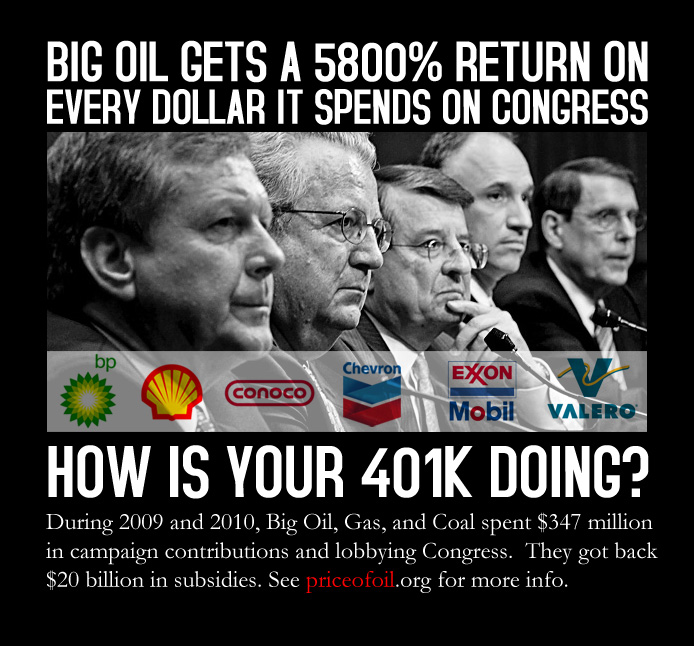
Bittman then puts this together with a Rolling Stone report that asserts that the Big Oil companies are no longer even faking a commitment to clean energy.   BP put its $3.1 billion United States wind farm operation up for sale. Last year, ConocoPhillips divested itself of its alternative-energy activities. Shell, with its “Let’s Go” campaign to “broaden the world’s energy mix,” spends less than 2 percent of its expenditures on “alternatives.”

The implication is that Big Oil has figured out that it doesn't have to hedge its bets by getting into clean energy businesses--it's got such a sweet thing going as the world's richest corporations ever, that nevertheless demand and get government subsidies, and that never has to pay any of the estimated $2 trillion in damages to the global environment.  Why bother?  It's like that t-shirt I used to have, with the Exxon logo and the words: We Don't Care.  We Don't Have to Care.  We're Exxon.  It's an all-purpose slogan.

So with almost literally all the money in the world, these corporations can buy all the state legislators they need to keep on pumping and fracking until the ground collapses beneath befuddled non-voters and I Told You So Jesus Apocalyptics.  And they tie up the federal legislature with paid deniers, otherwise known as Republicans, though some Dems are on the payrolls too. Bittman cites an American Progress study  that counts 125 congressional deniers who soak up some $30 million from fossil fuel corps just in "campaign donations."  Which doesn't include speaking and consultant fees, etc.

So the U.S. and the world keep burning the fuels that fuel the climate crisis, and while everybody else struggles to survive the consequences of past pollution, the future is fried for thousands of years after these folks die in their greed-fevered beds.

Tobacco companies were once all-powerful, but regulations limiting smoking eventually became common and pretty pervasive.  The task is even greater this time, because there's no place for fossil fuel corps to shift their business, unless they can market to extraterrestrials.  We have to hope some of them are run by people with a rudimentary conscience, at least about the world their own future generations will inherit. Not to mention the victims of the climate crisis and their children--look no further than the children of the 19 firefighters killed in Colorado.  It will take that, and immense political will and cultural change to make the necessary difference.

Sunday, June 30, 2013

The Dreaming Up Daily Quote


“Nature is far more imaginative than we are.”
--Stamatios M. Krimigis, a scientist at the Johns Hopkins Applied Physics Laboratory
quoted in NY Times  6/27/2013

And a Happy Birthday to Martha P., Bruce D., Graceann P. and all my other birthday twins.