Saturday, June 25, 2011

Climate Inside: Roots of Resentment, Overcoming Denial

I’d hoped this post, the last one on this topic for awhile, would be shorter than the rest. Probably it won’t be, but I’ll try to suggest and define rather than fully explain or explore.

Not everybody who seems to deny the Climate Crisis is motivated chiefly by ideology, politics or religious dogma. Nor are they all people getting wealthy from fossil fuels, or getting wealthy by working for people who are getting wealthy from fossil fuels and related industries.

There are skeptics—not so much of the science itself but of scientists. And there are especially people who see this as a class issue, though they might not define it that way.

Americans have been of two minds about scientists and their technology since the dawn of the industrial age. That was especially true during the first decades of thermonuclear threat, when we had Einstein and Doctor Strangelove. It was true in medical science over the years ( Doctor Salk v. Doctor Mengele.)

But in particular ways it also was a religious and class issue. Some historians believe that the fundamentalist Christian opposition to Darwinian evolution in America began with the Eugenics movement of the late 19th through the early 20th century, which used Darwinian evolution as its basis. Civic Biology, the textbook that was at issue in the 1925 Scopes Trial for teaching evolution, included the suggestion that if insane, retarded and epileptic humans were lower animals, “we would probably kill them off to prevent them from spreading.”

There were eugenics laws on the books and others proposed in several states, including one to prevent couples with incompatible Rh factors from having children. Some eugenicists went so far as to advocate certain races and nationalities as inferior and a drag on human development—so Hitler wasn’t crazy all by himself. Immigrants, even the poor (undesirable because of their possible dependency) might justifiably have felt threatened.

Even today some conservatives see abortion and birth control, population control and by extension environmentalism (because it is argued that it values other life over human life, and because environmentalists are concerned about overpopulation) as modern eugenics.

So there is perhaps a sense that science is a tool of the educated and wealthy to oppress the less educated non-wealthy. In any case, wealth and class do enter into the Climate Crisis debate.

That seems essentially to be what’s behind the sneers aimed at Hollywood stars who try to increase awareness of the Climate Crisis. The message they get is that these “superior’ people are telling them that that the Climate Crisis is caused by what they do to live their own lives. By their cars, their electricity, the accoutrements of their hard-won lifestyles. All that has to change. But what does that mean?

What a lot of non-wealthy people in non-Hollywood hear is that they’re supposed to get rid of the vehicles they’ve built a life around, and buy a hybrid, which they can’t afford. They also can’t afford to install solar panels or any of the other costly changes to their homes that would reduce their carbon footprint. And to give up their cars and their big screen TVs is giving up about all the relief they’ve got from arrogant moronic bosses and stupid hard work. Yet if they don’t, those Hollywood people will look down on them from their shiny new Priuses—which they’re driving to their private jets.

There are several reactions here. First, a lot of people are helpless to make such major changes on their own. And second, they see people advocating such changes as hypocrites in their own lives. All of this came down on Al Gore like a ton of bricks after he joined with Hollywood to make a glossy movie of An Inconvenient Truth. His energy use, his travel, and the money he made from his advocacy were subjects of political invective, which spoke to even those who didn’t care that he was once the Democratic candidate for President.

Add to the perceived call for people to make such radical changes in their lives the current lack of obvious impact of this “theoretical” crisis some time in the future, and some people see the Climate Crisis as the self-indulgent hysteria of those loony Hollywood liberals, so out of touch with what ordinary lives are like.

This image has recently been extended with high absurdity to climate scientists, who are supposedly advocating climate change for the money. In a sense it’s a class thing (though academics are typically on the low end of professional incomes) for there’s probably a residual sense of smart people as being stuck-up and superior. (Rich industrialists avoid this because they advocate the “American” lifestyle that people are pursuing, that depends on fossil fuels, and therefore is what is making them rich.)

Still, all of this is grist for the political mill of FOX and others who turn class resentment (which they of course would never call it) against advocates for action to address the Climate Crisis (along with a grab-bag of other associations, including the attempt to make labor unions appear to be among the privileged. Now with a black President, the race projections can adhere to the federal government, as well as those pushing from underneath—immigrants taking jobs away or any minorities "living free off taxpayer money.")  It all plays into the conviction, common to both the religious right and the otherwise far right, that the facts these scientists and environmentalists etc. assert are only expressions of their political point of view, meant to persuade (or trick) people into supporting their political side.  Any assertion of a scientific process or sincere observation is dismissed.  It's all us vs. them. 

All of this makes people more susceptible to related political arguments such as the reputed cost in taxes to address environmental concerns, and the predicted bad effects on business and therefore jobs. But it all especially makes denial possible—both the comforting denial of the Climate Crisis science (grasping at every reassurance by any putative scientist or expert) and the psychological denial that narcoticizes doubts about the effects of one’s politics or lifestyle, let alone the future of one’s children and grandchildren and the planet itself.

copyright 2001 by Melo-D
 Psychological denial is a natural human tendency that can be healthy and useful, but can also be suicidal. The antidote is to know that denial is a natural response of the unconscious, and it is up to the conscious mind to decide when it is useful and when it is harmful.

Nothing could be more natural in response to the threats that the Climate Crisis poses: the quick degradation of the world we have known, and perhaps even its end. Who would want to face that? Who has the psychological strength to face it head on, constantly?

I’ve read a lot on this subject and related works about energy and environment, particularly by Mark Hertsgaard, Bill McKibben, David Orr, Jim Kunstler, Jane Jacobs, Stephan Faris, and on and on. None of it has been easy to read or absorb. Now I’m working my way through Paul Gilding’s The Great Disruption—generally billed as a comparatively optimistic book that nevertheless assumes global apocalypse. I’m taking it slow with lots of breaks for walks in our June green loveliness, and old David Tennant Doctor Who episodes.

But even as I let myself respond with denial for awhile, I know what my ultimate responsibility is. I also know that just because this information hurts—and I wish it weren’t true so much that I can barely allow myself to accept it—this response doesn’t mean the information isn’t true. And the science behind it is profound and unforgiving.

Here’s my way of seeing all this: humanity has been a successful species largely because humans have the ability to think about the future. Like other intelligent species—perhaps all species, in a way—we are on the lookout for two things: danger and opportunity. Our survival depends on anticipating danger before it overwhelms us, and on perceiving, imagining and acting on opportunities that enhance our survival. Keeping out of the lion’s mouth and finding new sources of food and water are the templates of our survival.

We can see that other animal species are also keen on sensing and avoiding danger, and on seeking out and taking advantage of opportunities. But humanity developed a kind of consciousness that made it incredibly adaptable.

Consciousness has another particular function for us, that serves these purposes. We can identify our own impulses and to some extent control their expression according to whether they will have a desirable effect. This causes more trouble for our unconscious, but it is a tremendous advantage for our species.

The Climate Crisis is the greatest test we’ve had so far of our ability to think about the future with a complexity that matches the complexities governing that future. Thinking about the Climate Crisis, even as an abstract problem, is difficult. It involves such arcane concepts as lag times, feedback effects, tipping points. (Though I suspect it is a crisis that aboriginal humans would grasp in general without these concepts, simply by applying their observations of relevant experience in nature.)

It is a test as well of our psychological and social intelligence. It is perhaps our ultimate test.

Gilding and others note that there is a record of human societies facing and overcoming a crisis, though as Jared Diamond has chronicled, there is also a record of human societies collapsing because they could not see or face a crisis.

So we have a chance. And there are ways forward--to doing our best to deal with the effects while we do our best to attack the causes and prevent the worst from happening, if that's still possible. This has to be the message. It will require leadership. That’s why for all I admire about President Obama, I think it’s healthy that Al Gore called him out in his Rolling Stone article (published today.) After noting all of President Obama’s accomplishments in reducing greenhouse gases and seeding American green energy, Gore is direct:

“Yet without presidential leadership that focuses intensely on making the public aware of the reality we face, nothing will change. The real power of any president, as Richard Neustadt wrote, is "the power to persuade." Yet President Obama has never presented to the American people the magnitude of the climate crisis. He has simply not made the case for action. He has not defended the science against the ongoing, withering and dishonest attacks. Nor has he provided a presidential venue for the scientific community — including our own National Academy — to bring the reality of the science before the public.

Here is the core of it: we are destroying the climate balance that is essential to the survival of our civilization. This is not a distant or abstract threat; it is happening now. The United States is the only nation that can rally a global effort to save our future. And the president is the only person who can rally the United States.”

(Gore was also measured and specific, unlike the inflated and deliberately offensive charges by Joe Romm at Climate Progress. Yet it must be said that Gore didn’t make the Climate Crisis central to either of his presidential campaigns, and the progress while he was vice-president was even less impressive than Obama’s.)

Denial can’t blind us. That’s profoundly self-destructive. The media’s habits are well known—as Jon Stewart says, the so-called news media of our era fixates on the sensationalistic, and on simplistic presentation—what Stewart calls laziness. Gore goes after them as well on the Climate Crisis issue.

George Soros (in the New York Review of Books of June 23) applies the concept of denial to the public dialogue in our putatively free and open society. He notes that the American public is generally averse to facing harsh realities. “When reality is unpleasant, illusions offer an attractive escape route. In difficult times unscrupulous manipulators enjoy a competitive advantage over those who seek to confront reality... The two trends taken together—the reluctance to face harsh reality coupled with the refinement in the techniques of deception—explain why America is failing to meet the requirements of an open society. ”

As for the class component, given my own background and current income (which would have to double for me to make it up to the “low income” category) I can understand some of these feelings. But while I’m sad that I can’t afford a Prius, I don’t feel guilty about it, and certainly don’t feel hypocritical for driving my old Volvo, though I don't drive it much. I believe that a lot of working people would respond to leadership on this issue, though it might take a pretty clear crisis. Still, a crisis relatable to global heating in itself is not enough—leadership is still required. The time may not yet have come in a political sense, but it won’t wait much longer.

“Maybe it's just easier, psychologically, to swallow the lie that these scientists who devote their lives to their work are actually greedy deceivers and left-wing extremists — and that we should instead put our faith in the pseudoscientists financed by large carbon polluters whose business plans depend on their continued use of the atmospheric commons as a place to dump their gaseous, heat-trapping waste without limit or constraint, free of charge,” Gore writes. “The truth is this: What we are doing is functionally insane. If we do not change this pattern, we will condemn our children and all future generations to struggle with ecological curses for several millennia to come. “

Gore and Soros and others have identified political and social factors. I’ve tried to add two other considerations: in this particular post, a suggestion that class is part of the puzzle, and in this series, that concepts exist to explain some of the psyche’s role, and even more importantly, suggest conceptual tools for  understanding what’s going on within us. By making these responses conscious, they are available for us to evaluate and to take into consideration, as we decide how we are to act to address this mortal challenge.

Wednesday, June 22, 2011

Climate Inside: Varieties of Denalists

Before I get to the reasonable concerns behind some Climate Crisis denial, a few other reasons why some people are Climate Crisis denialists.

The word "denial" in this context is a bit tricky, since it denotes a psychological response but also a position on the issue by people who deny that global heating is happening, etc.--but not because they are "in denial."  They've got other reasons, though in the end, those reasons are "inside."

The first group of denialists are those who maintain their position (global heating isn't happening, or it isn't all that bad, or it's not caused by humans and we can't do anything about it, at least not without wrecking the economy etc.) because it is in their economic self-interest to do so.  These range from the fossil fuel industrialists to those they hire to doggedly and often viciously promote this line, to others who simply work for these companies and others related to them, who more distantly and more modestly depend on them economically.  They are in the situation famously described by Upton Sinclair, who said "It is difficult to get a man to understand something when his salary depends upon his not understanding it."  

Though they adapt to the latest media, the propaganda approach driven by these corporate zealots and their hired p.r. guns is time-tested, and yet both the public and the media seem always to fall for the same program.  It is most familiar in its present form from the massive campaigns run by the tobacco companies just a decade or two ago to convince us that scientists were biased in claiming that smoking is bad for your health, and anyway the economy and America's freedoms couldn't survive regulation of smoking.


 But as Paul Gilding reminds us in The Great Disruption, their basic attacks on Climate Crisis science were on view in the 1960s attacks sponsored by big chemical companies against Rachel Carson and Silent Spring, her landmark book on the dangers of DDT and other pesticides: she was hysterical and not acting as a scientist, and if her warnings on pesticides were heeded it would mean economic ruin and "the end of all human progress."  There were even snide observations that her warnings about extinctions were disproven when there seemed to be plenty of birds still around.  Recall of course the snide observations that the globe can't be heating with all these snowstorms.  (Here's an interesting blog post on the war against Rachel Carson and its similarity to the tobacco company strategy.)


The second group, related to the first, are those who are dependent on an ideology and political affiliation--often financially supported by fossil fuel and related corporate interests--that has made Climate Crisis denialism an article of their faith.  They tend towards the most virulent and mendacious forms of "it's all a hoax," that is, an insidious, deliberate and systematic deception by their political opponents: one more way of demonizing their enemies and making their supporters afraid so they'll close ranks.

  They are nourished by what has become a powerful network of institutions and relationships.  Their roots are in the late 60s and 70s, as chronicled recently by Eric Alterman in The Nation (March 28, 2011), as "a series of right-wing institutions to undermine the bipartisan establishment and recast its view of reality"  Along with far right "think tanks" there were political organizations that found and fostered young talent, and nurtured several generations of right wing activists from the 1980s forward.  Then came right wing talk radio, and Rupert Murdoch's newspapers and FOX news.

The Climate Crisis became a political issue for a variety of reasons, I suspect: mostly at the behest of corporate financiers of the right, but the political label became easier when Al Gore, the Democratic candidate for President, became the foremost voice on the Climate Crisis.

In any case, it has become a very political issue for the right, and the insulated world of right wing ideology has stepped up its rigidity and discipline on this issue as well as others.  The virulence of all of this, I am convinced, has been further strengthened by the Internet.  Right wing blog sites were early adopters, and in many ways set the tone for current Internet behavior: a tone of fanaticism, of bullying and attack with no boundaries.  They were also early in instituting a hive mind on their sites, a Borg-like sense of  membership and self-absorption, a contagion that some lefty sites have caught.

I've mentioned before the propensity of right wingers to stick with the media that always reflects their views: the Limbaughs of radio and Fox News primarily.  (The difference is that non-wingers might gravitate towards advocacy sources on the left but also read or watch other sources, especially for news and other content.  But then, the pure right winger believes that everything from the New York Times to Scientific American  is intently spewing left wing propaganda.)  But according to Eli Pariser in his book The Filter Bubble: What the Internet Is Hiding from You,  as reviewed by Sue Halpern in the New York Review, another feature of the Internet may mean that variety of information sources is less accessible for everyone than we might believe.

Pariser notes that Google searches are now personalized, so that your searches yield results ranked in part according to searches you've previously made, similar to how Netflix and Amazon come up with titles they think you will like. As Halpern writes "In other words, there is no standard Google anymore.” It’s as if we looked up the same topic in an encyclopedia and each found different entries—but of course we would not assume they were different since we’d be consulting what we thought to be a standard reference....Among the many insidious consequences of this individualization is that by tailoring the information you receive to the algorithm’s perception of who you are, a perception that it constructs out of fifty-seven variables, Google directs you to material that is most likely to reinforce your own worldview, ideology, and assumptions.

Pariser specifically relates this to climate change.  "Pariser suggests, for example, that a search for proof about climate change will turn up different results for an environmental activist than it would for an oil company executive and, one assumes, a different result for a person whom the algorithm understands to be a Democrat than for one it supposes to be a Republican."

But Helpern makes a larger connection, covering the entire phenomenon of information by means of ideology, whether deliberate or as a byproduct of  Internet algorithms or social networks:   "Why this matters is captured in a study in the spring issue of Sociological Quarterly, which echoes Pariser’s concern that when ideology drives the dissemination of information, knowledge is compromised. The study, which examined attitudes toward global warming among Republicans and Democrats in the years between 2001 and 2010, found that in those nine years, as the scientific consensus on climate change coalesced and became nearly universal, the percentage of Republicans who said that the planet was beginning to warm dropped precipitously, from 49 percent to 29 percent. For Democrats, the percentage went up, from 60 percent to 70 percent. It was as if the groups were getting different messages about the science, and most likely they were. The consequence, as the study’s authors point out, was to stymie any real debate on public policy. This is Pariser’s point exactly, and his concern: that by having our own ideas bounce back at us, we inadvertently indoctrinate ourselves with our own ideas. “Democracy requires citizens to see things from one another’s point of view, but instead we’re more and more enclosed in our own bubbles,” he writes. “Democracy requires a reliance on shared facts; instead we’re being offered parallel but separate universes.”


There is another category of denialists, both political and ideologically related to both the self-interested industrialists and right wing political ideologues.  That's at least one politicized wing of Evangelical Christians.

Perhaps all of us are guilty of not consciously understanding where our assumptions come from.  But I know that I need to be reminded of how differently some people think about public policy issues--and in this case, how stringently dogmatic their views are, regardless of how they seem in the public arena.

Michelle Golberg's piece on Michele Bachmann in the Daily Beast is the latest reminder of this mindset.  Just how an anti-gay convinction is justified from the contradictory record of the Bible, let alone what the Bible has to say about climate change, is really beside the point.  The point is that these issues have incorporated as dogma, often due to the influence of particular charismatic clergy-- in Bachmann's case, of Francis Schaeffer:

  A key moment in her [Bachmann's] political evolution, as for many of her generation, a was the film series "How Should We Then Live" by the theologian Francis Schaeffer, who is widely credited for mobilizing evangelicals against abortion, an issue most had previously ignored. A Presbyterian minister, Schaeffer argued that our entire perception of reality depends on our worldview, and that only those with the right one can understand the true nature of things. Christianity, he argued, is "a whole system of truth, and this system is the only system that will stand up to all the questions that are presented to us as we face the reality of existence." Theories or assertions from outside this system—evolution, for example—can be dismissed as the product of mistaken premises.

This accounts for some of the bafflement that occasionally greets Bachmann's statements. "Michele Bachmann says certain things that sound crazy to the general public," says author Frank Schaeffer, Francis Schaeffer's son and former collaborator. "But to anybody raised in the environment of the evangelical right wing, what she says makes perfect sense."

The dogmatism of the true believers, most obvious when linked to religion but also part of the glue for  the hordes of social networking ideologues, seems as impervious to factual information and ethical arguments as do the perhaps cynical but self-interested positions of fossil fuel corporatists and their propagandists.  Probably most of them will never change, and it's fruitless to think they can be reached with fact and argument.

 But some among all these groups may be reached,especially when some of their legitimate concerns--the concerns as well of denialists outside these categories-- are explored.  Now for sure that's next time.

Monday, June 20, 2011

The Dreaming Up Daily Quote


"In the generations of thought, man's sons
And heirs are powers of the mind,
His only testament and estate.
He has nothing but the truth to leave.
How then shall the mind be less than free
Since only to know is to be free?"

Wallace Stevens

--Happy Medicare Birthday, Joe K!

Saturday, June 18, 2011

I'll Follow the Sun


Just a few days past the famous Bloomsday and of course Captain Picard Day, today is International Solar Day!   

Seriously though folks, of all the green power/clean energy forms out there in various stages of practicability and promise, solar power always has seemed to me to be the most sensible form, with the most potential.

 The sun after all is the ultimate source of all our energy, so why not go right to the source?  Plus--and this to me is the best argument and solar's greatest advantage: its technologies are theoretically and practically the most diversified and scalable.  Unlike wind farms that have to be huge, or wave power that has to be in the ocean, solar power can be generated by very big devices for a lot of people, or by very small devices for a few.  And these days, solar power can be just about anywhere.

I think that's the future: a system that provides redundancy and autonomy, where you have enough power to run your house or even individual devices as well as your city and region.  Solar devices can eventually be made so small that we can wear them, or string them on the outside of vehicles to run them.

With almost no one noticing, solar power has been dropping in price for decades, and new breakthroughs may well be on the horizon to drive the costs down further--the Obama administration is betting on at least one of these.

I'll leave it to the experts to make the range of technical and economic arguments.  But regarding the whole climate crisis/energy crisis future, this is one of the few things I've got a good feeling about.  Other technologies, including some pretty exotic bio-based ones, should also be explored, but as for me, I'll follow the sun.     

Two Milestones in Modren Living

Two milestone moments recently--one not surprising, the other more so.

The U.S. Postal Service announced that for the first time, it was handling more junk mail than first class mail.  Although first class mail is reportedly its financial backbone, I kind of thought this milestone had been passed a long time ago.  We certainly get more junk mail than first class mail, and I use maybe one stamp a month.

Also recently, Amazon announced that for the first time, it was selling more e-books than real books.  This did surprise me, even though this seemed in the works for years.  I didn't think it would happen this soon.

I suspect its the Kindle, which did catch on, and which Amazon has been promoting relentlessly.  Apparently the Kindle has been a hit especially with women, and since women buy most of the books, I guess this makes sense.

I'd have to see a breakdown of titles being sold via ebook versus real book to be sure, but I suspect that a lot of the books sold for Kindle and such devices are the kind you'd just as soon throw away when you're finished--when you know whodunit, or who done whom, or such equally disposable nonfiction.  So in that sense, there may not yet be a mortal threat to real books.

I suppose it was a bit of a surprise to me for the same reason the Postal Service story wasn't.  I don't use first class mail much anymore, but I don't have a Kindle, and don't want one.  At least not yet.  I still prize the physicality of books, and besides, ebooks aren't any cheaper really.  Plus there's something weird about buying a book and not really owning it--it still resides somehow on somebody else's cloud, where Amazon or somebody can decide who gets to read it, how and when and even whether.  No thanks.  Too modren for me.      

Friday, June 17, 2011

Happy Ending, Maybe

Catherine Ferguson Academy was a unique school in the Detroit public school system.  It educated 250 high school girls at a time, pregnant or new mothers, offering daycare to more than 100 of their babies.  The girls helped run a small farm, in addition to academic studies that all together provided a plus 90% graduation rate, and a high percentage going on to higher education.

But when Michigan strengthened its laws giving power to single overseers, and the one in charge of Detroit public schools set his sights on Catherine Ferguson, controversy ensued.  Students getting set to begin a sit-down protest strike in the school were hauled out and arrested, while police sirens wailed to block out their cries.  All this got the attention of Rachel Maddow on MSNBC who did several segments on the school and its plight, including on Wednesday, which was the day that Catherine Ferguson was slated to close forever.

The city's newspapers belatedly but strongly decried the decision to close the school.  A protest rally was scheduled for noon Thursday, with Danny Glover among the speakers.  But then the apparent Hollywood ending--at the last minute the announcement came that Catherine Ferguson Academy had been saved--taken over as a charter school, with the promise of more resources.

It was a perfect ending---maybe too perfect.  The company that will run the school (and made a deal the same day for two other public schools that would close but send its students to their charter school) seems to have a record working with disadvantaged kids, and seems initially at least a much better choice than another company rumored to be in the running, which ran a school with a graduation rate closer to 10%.

But the whole thing was suspect from the beginning.  The decision to close Catherine Ferguson was ostensibly to save the city money, but most of its budget was paid for by federal and state grants.  There were other schools closed, but the money saved was far short of expectations. 

Two things are certain: a private company now has what once was a groundbreaking and highly successful public school, and just as pointedly, the teachers at Catherine Ferguson will no longer be union members.

So excuse me for being a little suspicious of all this, the timing in particular, and of what will happen over the next year or two at Catherine Ferguson, once the celebs have left and the cameras have moved on. 

I suspect that thought has also crossed the mind of the school's founding principal,  Asenath Andrews.  Amidst the joy and relief of the school not closing, she mentioned to Rachel Maddow on Thursday (transcript not yet posted) that she hoped she felt the same way the next day, or next year, when she might need to go on Rachel's program again.  Maddow also made a cheery but definite point of saying she will keep in touch, and will visit the school in the future.         

Thursday, June 16, 2011

Climate Outside: Wet and Dry

photo: NY Daily News

Dr. Jeff Masters of Weather Underground on Tuesday:

"Nature's fury reached new extremes in the U.S. during the spring of 2011, as a punishing series of billion-dollar disasters brought the greatest flood in recorded history to the Lower Mississippi River, an astonishingly deadly tornado season, the worst drought in Texas history, and the worst fire season in recorded history. There's never been a spring this extreme for combined wet and dry extremes in the U.S. since record keeping began over a century ago, statistics released last week by the National Climatic Data Center (NCDC) reveal."

Also on Tuesday, the head of the Forest Service testified before a Senate committee:

"As fires like the voracious Wallow Fire spread throughout the Southwest, the U.S. Forest Service and the Department of Interior are being pressed to offer solutions. Forest Service Chief Tom Tidwell, one of the witnesses present at the hearing, cited research from within the service to link fires and climate change.

"Throughout the country, we're seeing longer fire seasons, and we're seeing snowpacks that, on average, are disappearing a little earlier every spring," he said, as well as devastating droughts. As a result, fire seasons have lengthened by more than 30 days, on average.

"Our scientists believe this is due to a change in climate," said Tidwell....

According to the daily fire site report released by the National Interagency Fire Center, 1.2 million acres is burning in the United States, nearly two-thirds of it in the Southwest.

Committee Chairman Sen. Jeff Bingaman (D-N.M.) introduced discussion on several funding and management initiatives from U.S. public lands agencies... Bingaman tied many of this year's natural disasters to climate change in his opening address, citing the recent "America's Climate Choices" report from the National Academy of Sciences.  "Since climate change will continue into the future, we can expect the incidences of severe weather and the further drying out of the already arid regions of the West to continue," he said.

Also taking on the connection between wildfires and climate change, this New Republic article:

"The Wallow wildfire is still raging after more than two weeks, today becoming the largest wildfire in Arizona history. The Wallow wildfire has already burned over 733 square miles, but as of yesterday, only 18 percent had been contained, with more than 4,000 firefighters working to put it out. The monster fire has some people wondering—does climate change mean there will be more fires like this in the future?

Probably, scientists say. A study by A.L. Westerling and H.G. Hidalgo called “Warming and Earlier Spring Increase Western U.S. Forest Fire Activity” found that wildfire frequency in the western United State “increased suddenly and markedly in the mid-1980s.” The authors argue that climate change is a better explanation for the increase in wildfires than land-use change alone, although land-use changes have also had an effect. As temperatures rose, the average number of wildfires quadrupled between 1987 and 2003, compared to the average number from 1970 to 1986. The total area burned also increased by six and a half times. The average season length (time between first wildfire and last) increased 64 percent. Additionally, the authors found a correlation between wildfire frequency and the timing of the first snow melt.

Westerling and Hidalgo note that climate change will likely exacerbate these trends. “Virtually all climate-model projections indicate that warmer springs and summers will occur over the region in coming decades,” they note. “These trends will reinforce the tendency toward early spring snowmelt and longer fire seasons. This will accentuate conditions favorable to the occurrence of large wildfires, amplifying the vulnerability the region has experienced since the mid-1980s.” They also fear a feedback loop. Citing studies that estimate that western forests capture 20-40 percent of CO2 in the United States, Westerling and Hidalgo note that sparser forests cannot absorb as much carbon, further increasing atmospheric carbon dioxide and exacerbating the greenhouse effect. If current temperature trends continue, we could be putting out a lot more fires."

But maybe if they just arrest some hikers who may or may not have neglected to put out their camp fire, everything will be okay.  And so it's fine for GOPers in the House to cut disaster preparedness funding by $1.5 billion, and for Mittless Romney to advocate for the privatization of FEMA and disaster relief, which is sure to be a profit center for the future.

Wednesday, June 15, 2011

Climate Inside: Knowing the Shadow

Note: This is one of a series of posts under the label Climate Inside.  Previous posts were on Jungian concepts of projection, denial and an introduction.

Those unacknowledged and repressed elements of ourselves we may project on others come from the unconscious, from what Jung called "the shadow."  Our sense of ourselves comes from the conscious ego, the bright and solid face and form we see in the mirror and show to the world.  But we also carry with us a large part of ourselves that is kept in darkness.  It follows us as a shadow does.

"The shadow is that part of us we fail to see or know," writes Robert A. Johnson in his very useful little book, Owning Your Own Shadow.  Into our personal shadow we relegate aspects of ourselves that we've learned are bad, that civilized society and our particular culture in our particular time and place tell us are wrong, or not useful to us.  They are feelings and behaviors that aren't part of the identity of a real man or real woman, a gentleman or a lady, a real American, a civilized person, a dressed for success person, etc.

But these feelings and behaviors are part of the human heritage.  Cultures in the past have tried to deal with them by somehow acknowledging them in order to discourage destructive behaviors resulting from them.  Our culture, dominated by a particular form of Christianity but also in other ways, tries to deny their existence.  Instead of using methods of understanding and dealing with these impulses, our culture insists they are outside what's human: they are the work of the devil.  But even among those who reject religion (though they are inevitably influenced by the culture shaped by Christianity and other forces) and take a scientific attitude, many deny the existence of the shadow, as well as other aspects of the psyche, as unscientific superstition.  

When an entire society denies that the elements of the personal shadow are part of being human, it sustains a collective shadow.  The collective shadow is a kind of cultural possession, leading to destructive projections and their very destructive consequences.  Marie-Louise von Franz connects the two, suggesting for instance that people fell into the collective shadow of Naziism first through their personal shadows.  Perhaps they went along with Hitler for their own economic gain, and wound up being captive to activities that were much worse than they would normally have done.  Certainly this was true of those who took financial advantage of the persecution of Jews in Germany, as it was here in California of those who took the property of Japanese Americans sent to camps during World War II.


Let's pause here for a moment to emphasize that in all of these psychological processes--denial, projection and the shadow itself--there is a positive as well as negative side.  Denial of a kind keeps people from unhealthy obsessiveness and a sense of helplessness.  Positive projections form one basis for empathy.  And the shadow contains all rejected qualities, including positive ones that a person or society doesn't value and may be ashamed of.  For instance a man might consider tenderness as unmanly, and a culture may call it unmasculine, so it goes into the shadow.  Or generosity may be frowned upon as being dumb, or not looking out for number 1 or even number 1's family.  "Curiously, people resist the noble aspects of their shadow more strenuously than they hide their dark sides," Robert Johnson writes.

But besides being the source of so much destructiveness, the shadow itself, the unconscious itself, is of enormous value to the individual. There are familiar myths and stories that deal with the division of light and dark within people, such as Robert Louis Stevenson's Doctor Jekyll and Mr. Hyde.  But there's another story that explores the value of both sides--it's a famous episode of the original Star Trek series, called "The Enemy Within," in which a transporter accident divides Captain Kirk into two Kirks. One is his good side--reasonable, contemplative, courageous, but indecisive and unable to understand evil.  The other is his dark side--animalistic and driven by appetites, violent and cowardly, full of rage and cunning, but also decisive, strong and energetic.

After observing both Kirks, the ever-analytical Mr. Spock observes to McCoy, “His negative side, which you call hostility, lust, violence, and his positive side, which earth people describe as compassion, love, tenderness.” Then he asks, “What is it makes one man an exceptional leader? We see indications that it is his negative side that makes him strong---that his evil side, if you will, properly controlled and disciplined, is vital to his strength.”

Eventually McCoy agrees, and confronts the good Kirk. “Jim, you’re no different than anyone else. We all have our darker side. We need it. It’s half of what we are. It’s not really ugly—it’s human. Yes, human. A lot of what he is makes you the man you are” McCoy is forced to agree with Spock, “Your strength of command lies mostly in him.”

“What do I have?” the good Kirk asks. “You have the goodness…” “Not enough!” “The intelligence, the logic---it appears your half has most of those, and perhaps that’s where man’s essential courage comes from. For, you see, he was afraid. You weren’t.”

Then the good Kirk, who is also the conscious Kirk, confronts himself. "I have to take him back inside myself, I can’t survive without him. I don’t want to take him back! He’s a thoughtless, brutal animal! Yet it’s me! Me!”  It is only when the two are integrated--in Trek fashion, through the transporter--that Captain Kirk reemerges.

It's a script for which Jung could have been the scientific advisor.  People must accept their opposites consciously, and use their consciousness to deal with them, while respecting and honoring the unconscious for all that it provides--not only in leadership over oneself, but in creativity and getting in touch with the profound mysteries of existence.  And it takes work, techniques, eternal vigilance and lifelong comittment.  But it's also a satisfying process of connecting with yourself and life itself.

The danger for individuals and the people associated with them--family members, neighbors, co-workers, lovers, friends--is the unconscious projection of images from the shadow.  When someone denies tendencies within themselves, they have to go somewhere, and often they are projected on others.  Individuals who do this not only see what may well not be there (at least to such a great degree) in another, while failing to see what's prompting this eruption from within themselves.

But all of this becomes even more dangerous in the public sphere, as individual shadows come together to create large and powerful collective shadows.  "The tendency is see one's shadow 'out there' in one's neighbor or in another race or culture is the most dangerous aspect of the modern psyche," Johnson writes.  "The ego becomes unable to hold its own among the primitive impulses and dissolves in mass movements," writes Robert Bly in another useful little book, A Little Book on the Human Shadow.

  A contemporary Jungian, Samuel L. Kimbles, puts it in more textbook terms. He defines "complexes" as "basic, naturally occurring" patterns that "express themselves in powerful moods and repetitive behaviors...Without psychological work complexes function compulsively and autonomously through our reactions to others and the world, i.e. through projections.  Caught in such automatic modes of acting and reacting, we feel moved or carried by the force of a powerful energy over which we have little control.  Psychologically, this can lead to an inflated sense of one's own righteousness or a deflated sense of one's own inferiority in relation to others."

It sounds very primitive, and not something common in the rational modern world--at least until you look around, and look behind the pretenses of objectivity and "fair and balanced."  But of course it does happen, and without psychological reflection, the instruments of the modern world only amplify group projections and mass psychoses. Hitler and Mussolini used radio.  Today the Internet is a powerful addition to the communications arsenal, for just as it empowers individual voices, it empowers and amplifies individual shadows.

 Besides the ease of communicating globally, the Internet provides relative anonymity and the lack of face-to-face contact which is very important to sustaining projections as well as liberating people from personal responsibility for what they say, so they can unleash every vile expression from their shadows. The speed of expression, the fashion for brevity and the Internet's own brands of cliches and argot all encourage direct expressions from the unconscious.  Shadow expression is even socially acceptable and expected--for example, in the comments on political sites.  The violence of expression would be unacceptable in person--at least until Internet shadow behavior began migrating to public meetings and other occasions in real face-to-face life.

I began seeing these shadow eruptions becoming more prevalent in public life during the Clinton administration, when it seemed America was literally turning itself inside-out: consciousness was retreating into hiding while the shadow was out on Capitol Hill every day.  It's gotten noticeably worse and even more savage since President Obama was elected.  It is the savagery of some of his opponents that they project using the convenient African American stereotypes.

 But it is a longer term problem, of course.  Some of the energy may well be coming from a general dehumanization in this crowded, fast, complex world, and in this society dominated by mechanized lives, large dominant organizations, monopoly capitalism that devalues the individual, and sees people just as markets to sell products to, including pills to soothe their behavioral symptoms.  Diplomat and friend of Jung Laurens van der Post suggested that these pressures on the individual have destroyed democracy, and in these conditions the shadow tends to come to the surface.


We return finally to Jung:

"The great events of world history are, at bottom, profoundly unimportant.  In the last analysis, the essential thing is the life of the individual.  This alone makes history, here alone do the great transformations take place, and the whole future, the whole history of the world, ultimately springs as a gigantic summation from these hidden sources in individuals." 

"In our most primitive and most subjective lives, we are not only the passive witnesses of our age, and its sufferers, but also its makers.  We make our own epoch."

These concepts are only a few of the ideas in Jung and post-Jungian psychology, and I've presented only a very basic version of them.  Besides which I am hardly an expert.  But I see them as tools of reflection that empower individuals with concepts to test their own perceptions and behaviors.  And perhaps to help them guide themselves to clearer understandings of their own lives and selves, as well of as public policy issues.  With these tools and others, individuals can take some sort of control over themselves and their behavior in the world, that would otherwise elude them.

When looking at the debate over global heating--the most consequential events of our lifetime, with the future of civilization and with increasingly likelihood, that of life as we know it on Earth in the balance--the role of the psyche is only clumsily acknowledged, if at all, but it seems to explain some of what's going on.   If all we needed were reasoned arguments (as Marie-Louise Von Franz noted), we wouldn't be in the mess we're in, since we've had lots of those.  Understanding the role of the unconscious by using such conceptual tools as denial and projection seems a necessary and probably crucial task, both in general and by individuals in regards to their own perceptions and expressions.

In remarks to his associates, particularly towards the end of his life, Jung provided a warning and an encouraging word.  Jung noted that humanity had become so technologically powerful that it could unintentionally destroy itself.  He warned that unless people reflect and take back their projections, and take back their opposites into themselves, there will be total destruction in the world.

 But Jung also noted that a human being who withdraws his shadow from his neighbor is doing work of immense political and social importance.

  Living in the shadows may mean being blind to lies, dismissing contrary claims out of reflexive hostility and projection of motives on others.  But there are reasons in reality for such excesses, both in terms of the violence of psychological responses, and in what motivates them.  A few thoughts on the case for resentment next time.

Tuesday, June 14, 2011

Summer and Smoke

photo: smoke from Arizona wildfire Monday by wunderphotographer rixx.  Wildfires in two corners of Arizona continue, with one threatening to become the largest in state history.  And conditions favor it spreading today.  Fires have spilled across the border into New Mexico.

Graphic Proof

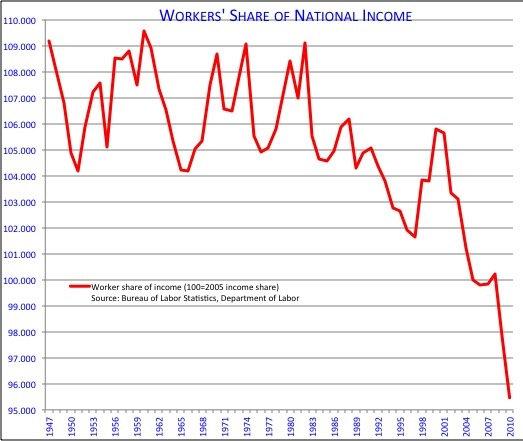
The top chart shows the share of U.S. income received by workers falling off a cliff for the past several years, while corporate profits (in the second graph) are zooming up again.  The charts--and the sad story-- are from TPM.  President Obama met with a private sector task force on creating jobs that provided suggestions, but confirmed just how difficult the task is.  Still, it seems time to point out what's happening and how GOPers in Congress are deliberately obstructing job creation efforts for political motives.

Monday, June 13, 2011

And the Winner of the GOPer Debate Is---


WASHINGTON—According to a Quinnipiac University poll conducted this week, a homemade anti-Obama sign has surged to the front of the 2012 Republican presidential field, emerging as the clear favorite to earn the party's nomination in next year's primaries.

The telephone survey of 773 likely voters indicated the sign, a piece of poster board bearing the handwritten phrase "NOBAMA 2012" in bold red letters, would defeat former Massachusetts Gov. Mitt Romney, its nearest rival, by a landslide 17 percentage points if the primaries were held today. The poll also found the sign had a "favorable" or "highly favorable" rating among 94 percent of registered Republicans, a figure greater than all other presumptive GOP candidates combined.

"We're seeing that voters find the sign more charismatic, more likeable, and much more engaging than other Republican candidates," said political analyst Mark Halperin, adding that the poster's message resonates strongly with conservatives. "In the end, it comes down to two things: the ability to energize the party base, and the power to instill confidence and appear presidential. Right now, it's the sign by far."

"Frankly," Halperin added, "this is the brightest star to emerge from the Republican ranks in the last several elections."

According to Halperin, the 22-by-28-inch poster emerged as a serious contender for the Republican nomination because it offers a clear, consistent vision and refuses to compromise on its fundamental principles.--

Reported by The Onion

Sunday, June 12, 2011

Climate Inside: Us Versus Them


art by Anthony McCall at Serpentine Gallery
 Projection has become the main and most effective political tool wielded by Republican operatives and the extreme right. Nearly everything they say is a variation of the school yard taunt: “That’s what you are, what am I?”

Apart from the cynical politics of the Big Lie, some of the power of this comes from vengeance, for the left’s calling Bush and Cheney etc. fascists, Hitler, anti-Christ, etc. when they were in power. So now Obama is Hitler, Mussolini, Stalin and the anti-Christ all in one.

But projection is a big and very powerful part of it. It is particularly powerful when projections are reinforced within a group that defines itself in large measure by asserting the same projections. Moreover, the power increases when the object of the projections is also an identifiable group. Then it becomes Us versus Them.

This is most apparent in wars. The enemy is composed of cold-blooded killers, who have no regard for human life. They hate us. They are so perverse than they aren’t even human. In modern wars, they are like machines without conscience. They murder, rape and torture without a thought. They worship false gods or no gods. They fight to conquer and suppress people. They are nothing but evil.

Allies anti-German World War II

North Korean anti-American, Korean War


We on the other hand are good. We fight for right. We don’t seek war, and we are humane as possible. We worship the right deity, and our culture reflects our intelligence and decency. We don’t fight for conquest or power. We don’t torture, though if we do, it’s because it gives us information necessary to our defense that we can’t get in any other way. We fight for freedom.  That's what We all say, and what We all believe.


Factually, some of our claims about ourselves and about the enemy are true. (But some of their claims about themselves and us are also true.) But defining ourselves as opposites is what allows this projected dynamic: that the enemy is totally evil and we are totally good (when in daily life we hardly ever run into people like that.) The enemy is completely foreign, everything that we aren’t, including not really human. The enemy is the Other.

“The other” is not just a Jungian or even psychological term. (And in this general meaning, it is different from the way French deconstructionists use it.) It simply means people who aren’t us—usually people we don’t have a lot of contact with. We define ourselves partly by who we aren’t, and who we aren’t is The Other.

Basically, projection is defining others— and especially in defining The Other—with what you are afraid you might be capable of. It doesn’t mean others don’t have evil tendencies, but that projection exaggerates those tendencies and defines others by them.

Of course, real enemies exist and defending against aggression may be necessary, but projections go far beyond that.  “The real existence of an enemy upon whom one can foist off everything evil is an enormous relief to one’s conscience,” Jung writes. “You can then at least say, without hesitation, who the devil is; you are quite certain that the cause of your misfortune is outside, and not in your own attitude.”

Just how powerful projection is can be suggested by looking at what people say about their enemies in wartime—especially when, not many years later, their enemies have become friends.

Consider what one President called the enemy who is “aiming at the exclusive domination” of the world, “lost in corruption” and with “deep-rooted hatred towards us, hostile to liberty wherever it endeavors to show its head, and the eternal disturber of the peace of the world.”

That was said by President Thomas Jefferson in 1815, of the British. From a geopolitical perspective, there was probably a lot of truth in it. But the language is that of wartime propaganda, which Jung calls the extreme of projection. Even worse was said of the Russians throughout the Cold War, and now we’re trading and security partners, and our astronauts work together on the International Space Station. Ditto the Japanese and the Vietnamese.


The Other is especially easy to define when the physical characteristics of color and race are different. The Japanese in World War II, Koreans, Vietnamese, were all racially stereotyped. The settling of America depended on considering American Indians as the Other, as less than human. Slavery in the West depended on Africans being considered inferior, less than human. Both groups were vile, without conscience, until they were subjugated, and then they were childish dependents. But you have to be careful because they can revert to violence at any time. 

Often we don't really know much about the Other.  They are strangers, and therefore strange. That makes it easier to project onto them. But human communities have long had a double response to strangers. There is fear of aggression. But there has also always been recognition of benefits. Strangers mean the possibility of trade, new ideas, and help from outside when it is needed. Sustaining peaceful relations with others is deeply embedded in the oldest cultures—in encouraging intermarriage, for instance, or in peaceful competitions, from potlatches to games. The oldest cultures value hospitality to strangers and retain its rituals. In one of many tragic ironies, hospitality to strangers in a particular tradition in Iraq.  There is an uneasy tension in these responses, but projections take just one side, and make it everything.

Wartime demonstrates how pervasive and super-heated projections can get--and how hard it becomes to accept that some of the traits that define the Other are demonstrably in Us.


Fear under other circumstances is easy to isolate and exaggerate, and fear of the Other is a chief tool of demagogues throughout history. For Hitler the Others were the Jews and the Slavs, Catholics and homosexuals. Today in America the Others are Muslims, Mexicans and other immigrants, and homosexuals. Politicians of the extreme right compete to demonize these groups.

Projection on The Other is more difficult when you know people in that group—when the Other is in some sense one of us. But that’s not the whole answer. For many years, African Americans have been chief among the Others in America. Whites resisted integration partly because it meant that some projections would no longer be possible. It would no longer be possible to consider the entire race as inhuman and lacking in intelligence. But that doesn’t mean the projections have stopped. They are buried deep in the cultural components of individual psyches.


Those racial projections emerged with the election of Barack Obama. Even before Obama ran, political and cultural observers suggested that racism had not disappeared in America, but only gone underground. It was no longer overt, because racial prejudice against African Americans had become culturally disapproved. Besides, life is more integrated, which short-circuits some projections. So in order to project all manner of evil onto President Obama, it became necessary to define him as Other—as literally foreign.


But some good old-fashioned racist stereotypes bubbled up as well.

Demagogues use positive as well as negative projections: that is, defining Us as well as Them. By defining “American” in a restrictive manner, and by making the rest of the world into The Other (which is the outcome of the Right’s definition of American Exceptionalism), everything evil is projected onto Others, allowing the self-image to be of nothing but Good. And anybody who doesn't agree that everything about America has always been and is always Good by definition is of the Other.  The only problems are caused by the conspiracy of Others to defile the Good and install Evil.  We want our country back.


What’s the point of identifying projection? It helps account for the emotional power and extremism of our political polarities. It's not that people are too stupid to understand the facts. Projection is natural, powerful and unconscious, and until it is made conscious, its content continues to feel like certainties, which accumulate their own rationalizations. These kinds of projections appear on all sides. I’ll never forget the look of contempt on the face of a man wearing a Save the Whales t-shirt as he regarded a group of people watching a sporting event on television in a bar (plus, this was in Canada.) But these days, the addition of the racialized Other that President Obama symbolizes, as well as the powerful machinery supporting these projections, makes the far right far and away the champions of political projection and the resulting extremism.

Political figures have promoted and exploited such projections for a very long time. Today the information environment provides the means for targeting audiences to create and sustain projections that define a group. The Christian Right has been doing this for decades, and talk radio as well as Fox news has created an overlapping Us that feeds off the Christian Right and coopts it. We’ve seen some attempts to use this closed circuit world to sustain a presidential campaign, and we may see a bigger attempt if Sarah Palin declares as a candidate. Rachel Maddow has predicted that she might well restrict her interviews to Fox and extreme right media—to the Us that’s characterized by “grievance, resentment and belonging.”

(Here's a fuller Maddow quote from her program: "FOX News took the Rush Limbaugh formula and adapted it for television in 1996. The FOX News slogan of “fair and balanced” when what they‘re mostly doing is right wing commentary has always seemed to the rest of the world like an affront—fair and balanced? It‘s like a mockery of the terms fair and balanced. But to the FOX audience, it is really the core of what they are offering. You cannot trust anyone else to talk to you. Everyone else is out to get you. Ask somebody who is a FOX News aficionado what they think about the fair and balanced slogan. You will hear them use it without irony and with criticism because they believe that the only place they can get fairness and balance is from FOX, that the rest of the media is biased and only FOX is the truth. They‘re selling their audience grievance, resentment and belonging.")

The sense of grievance, while having real substance that society ignores to its peril, can also be a way to project onto the outside world what one can’t admit or deal with as an individual. It can be motivated by fear, by anger, by guilt and by a convoluted sense of shame, based in part on not measuring up to the positive projections of idealized figures, such as the rich and famous.

In a revealing Rolling Stone piece by Tim Dickinson, author Richard Perlstein makes this point: “What Nixon did—and what [Fox News chief Roger] Ailes does today in the age of Obama—is unravel and rewire one of the most powerful human emotions: shame. He takes the shame of people who feel that they are being looked down on, and he mobilizes it for political purposes. Roger Ailes is a direct link between the Nixonian politics of resentment and Sarah Palin’s politics of resentment. He’s the golden thread.”


The politics of resentment creates a mirror world in which projecting tendencies on others allow those tendencies to be given free reign within the group, ostensibly as self-defense. One new study suggests that white Americans believe discrimination against them has increased (it also suggests that facts can’t compete with projections in political views.) Extreme right whites are convinced that President Obama is taking their tax money to give to black people and brown immigrants. So the extreme right has to be xenophobic and defend themselves, for they are the victims of discrimination on the basis of race. In a larger sense, the restoration of white privilege is what restoring America and American freedoms means to them. You can hear them say this, but they seldom can hear themselves.

The very wealthy have been exploiting the resentment of the very not-wealthy for generations, particularly in the push-button targeting of race. They’ve also used patriotic and religious association to create an idealized all-white version of capitalist America, as opposed to the socialist, welfare state (welfare=freeloading blacks and Latinos) of the Other.

The Us vs. Them of the Cold War (free market vs. Soviet and U.S. Communists) became the Us vs. Them of Reagan conservatives vs. liberals in the 1980s, and now the Other is defined as Obama socialists. Socialism is defined as what would have been regarded as ordinary government functions, at least until the 1980s. This is probably the most dangerous Us vs. Them issue for the future: the demonization of government at the time its role is most needed.  (Yet even this is a matter of perception by projection. In many ways, government has become more intrusive in state governments won by Republicans in 2010.)

But not in my lifetime has the polarization of American politics been this extreme. There has always been reflexive political opposition to whatever the other party is for, but not this extreme. The Republican House refused even to honor the Navy Seals team that took out Osama bin Laden, because President Obama is their Commander-in-Chief. That wasn’t on a matter of principle—that’s just one more way of saying that Obama is not the real President, no matter what he does, and that we have a Republican Tea Party Christian Right America plus a conniving cabal of Democrats etc. that happen to live here for the moment. Things like this happen all the time now, things that never would have happened at any time in the past 50 years.


This is what political polarization really is, on the level of the psyche: an Us versus Them world, with some real ideological, political and cultural differences, but made extreme by, among other things, projection. Not much else can account for the extreme right believing what is factually not true, because their media and their heroes always tell the truth, and the media and villains of Them always lie.

“Everyone is entitled to their own opinions,President Obama has said several times, “but not to their own facts.” However, the emotional power of projection makes opinions into facts.

Only the psyche can explain the intense power of this, but “we know nothing about it,” and ignore and disdain it. Reasoned argument on content can only get so far before running up against the resistance of the psyche. Different additional strategies are necessary, beginning with trying to understand the mechanics of denial and projection, but also trying to understand the point of view that adds fuel to the fire.

But before speculations on that subject, one more useful Jungian concept regarding the unconscious.  To better understand projections on the Other, there’s another concept introduced next time: the shadow.

Note: This is one of a series of posts under the label Climate Inside.  Previous posts were on projection, denial and an introduction.

Friday, June 10, 2011

Need to See


Visualization of Bill McKibben's oped role-playing the climate crisis denier, courtesy of Patriot Daily Clearinghouse. It's a powerful four minutes of need to see.  Oh, and two other things not to see as connected either: Arizona wildfires and thinning Rocky Mountain snows threatening water supplies.

Beyond the Weiner Roast

Apart from a graphic illustration of some of the psychological concepts reviewed here recently, the Anthony Weiner frenzy is significant mostly in what it evokes in both the media and the media audience, which is in effect--and I suspect, also a choice--a dangerous distraction from more pressing important matters.

I was going to say so early on Thursday but I found that E.J. Dionne in the Washington Post had more or less said it for me.  And he's used to the Beltway political circus, so his alarm is even more alarming than mine.

A distraction from the threat of GOPer obstructionism, especially on the debt ceiling, a disaster with fresh numbers attached to it.  A distraction from the ongoing perils of the U.S. economy, and especially the possibility that this is the beginning of the future--of escalating fossil fuel costs due to dwindling supply, declining food production due to climate disruptions which manifests first as rising costs.  The role of China and increasing demand for fossil fuel in the current spate of rising gas prices (now falling, though GOPer Gospel to the contrary is unaffected) is documented here.

President Obama is not responsible for high gas prices, but environmentalists are taking him and his administration to task for a number of recent questionable decisions.  These are questions that deserve answers.  As annoying as the environmental lobby can be at times (and I say this as a card carrying member of the Sierra Club), they are right to become louder on these issues, and on the needed leadership directly on the Climate Crisis.

But what everybody is hiding from the most is dramatized in the video above, using Bill McKibben's Washington Post oped words and some very powerful images and revealing graphs.