Sunday, December 11, 2005


Earth, as seen by the Rosetta spacecraft on its way to Venus. Posted by Picasa

The Dreaming Up Daily Quote

"To be an artist means never to avert one's eyes."

Kirosawa

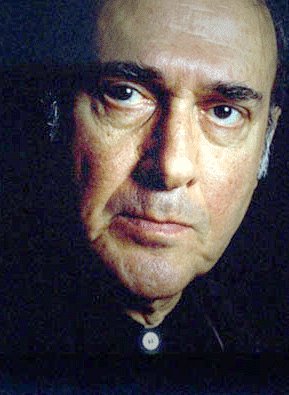
Harold Pinter Posted by Picasa

Perspectives

Nobel Literature Prize Speech: The Search For Truth Can Never Stop

from Nobel Prize Speech by Harold Pinter

In 1958 I wrote the following: 'There are no hard distinctions between what is real and what is unreal, nor between what is true and what is false. A thing is not necessarily either true or false; it can be both true and false.'

I believe that these assertions still make sense and do still apply to the exploration of reality through art. So as a writer I stand by them but as a citizen I cannot. As a citizen I must ask: What is true? What is false?

Truth in drama is forever elusive. You never quite find it but the search for it is compulsive. The search is clearly what drives the endeavour. The search is your task. More often than not you stumble upon the truth in the dark, colliding with it or just glimpsing an image or a shape which seems to correspond to the truth, often without realising that you have done so.

But the real truth is that there never is any such thing as one truth to be found in dramatic art. There are many. These truths challenge each other, recoil from each other, reflect each other, ignore each other, tease each other, are blind to each other. Sometimes you feel you have the truth of a moment in your hand, then it slips through your fingers and is lost.

I have often been asked how my plays come about. I cannot say. Nor can I ever sum up my plays, except to say that this is what happened. That is what they said. That is what they did.
Most of the plays are engendered by a line, a word or an image. The given word is often shortly followed by the image. I shall give two examples of two lines which came right out of the blue into my head, followed by an image, followed by me.

I always start a play by calling the characters A, B and C. It's a strange moment, the moment of creating characters who up to that moment have had no existence. What follows is fitful, uncertain, even hallucinatory, although sometimes it can be an unstoppable avalanche.

The author's position is an odd one. In a sense he is not welcomed by the characters. The characters resist him, they are not easy to live with, they are impossible to define. You certainly can't dictate to them. To a certain extent you play a never-ending game with them, cat and mouse, blind man's buff, hide and seek. But finally you find that you have people of flesh and blood on your hands, people with will and an individual sensibility of their own, made out of component parts you are unable to change, manipulate or distort.

So language in art remains a highly ambiguous transaction, a quicksand, a trampoline, a frozen pool which might give way under you, the author, at any time.

But as I have said, the search for the truth can never stop. It cannot be adjourned, it cannot be postponed. It has to be faced, right there, on the spot.

Political theatre presents an entirely different set of problems. Sermonising has to be avoided at all cost. Objectivity is essential. The characters must be allowed to breathe their own air. The author cannot confine and constrict them to satisfy his own taste or disposition or prejudice. He must be prepared to approach them from a variety of angles, from a full and uninhibited range of perspectives, take them by surprise, perhaps, occasionally, but nevertheless give them the freedom to go which way they will. This does not always work. And political satire, of course, adheres to none of these precepts, in fact does precisely the opposite, which is its proper function.

Political language, as used by politicians, does not venture into any of this territory since the majority of politicians, on the evidence available to us, are interested not in truth but in power and in the maintenance of that power. To maintain that power it is essential that people remain in ignorance, that they live in ignorance of the truth, even the truth of their own lives. What surrounds us therefore is a vast tapestry of lies, upon which we feed.

As every single person here knows, the justification for the invasion of Iraq was that Saddam Hussein possessed a highly dangerous body of weapons of mass destruction, some of which could be fired in 45 minutes, bringing about appalling devastation. We were assured that was true. It was not true. We were told that Iraq had a relationship with Al Quaeda and shared responsibility for the atrocity in New York of September 11th 2001. We were assured that this was true. It was not true. We were told that Iraq threatened the security of the world. We were assured it was true. It was not true.

The truth is something entirely different. The truth is to do with how the United States understands its role in the world and how it chooses to embody it.

Everyone knows what happened in the Soviet Union and throughout Eastern Europe during the post-war period: the systematic brutality, the widespread atrocities, the ruthless suppression of independent thought. All this has been fully documented and verified.

But my contention here is that the US crimes in the same period have only been superficially recorded, let alone documented, let alone acknowledged, let alone recognised as crimes at all. I believe this must be addressed and that the truth has considerable bearing on where the world stands now. Although constrained, to a certain extent, by the existence of the Soviet Union, the United States' actions throughout the world made it clear that it had concluded it had carte blanche to do what it liked.

Direct invasion of a sovereign state has never in fact been America's favoured method. In the main, it has preferred what it has described as 'low intensity conflict'. Low intensity conflict means that thousands of people die but slower than if you dropped a bomb on them in one fell swoop. It means that you infect the heart of the country, that you establish a malignant growth and watch the gangrene bloom. When the populace has been subdued – or beaten to death – the same thing – and your own friends, the military and the great corporations, sit comfortably in power, you go before the camera and say that democracy has prevailed. This was a commonplace in US foreign policy in the years to which I refer.

The tragedy of Nicaragua was a highly significant case. I choose to offer it here as a potent example of America's view of its role in the world, both then and now.

The United States supported and in many cases engendered every right wing military dictatorship in the world after the end of the Second World War. I refer to Indonesia, Greece, Uruguay, Brazil, Paraguay, Haiti, Turkey, the Philippines, Guatemala, El Salvador, and, of course, Chile. The horror the United States inflicted upon Chile in 1973 can never be purged and can never be forgiven.

Hundreds of thousands of deaths took place throughout these countries. Did they take place? And are they in all cases attributable to US foreign policy? The answer is yes they did take place and they are attributable to American foreign policy. But you wouldn't know it.
It never happened. Nothing ever happened. Even while it was happening it wasn't happening. It didn't matter. It was of no interest. The crimes of the United States have been systematic, constant, vicious, remorseless, but very few people have actually talked about them.

You have to hand it to America. It has exercised a quite clinical manipulation of power worldwide while masquerading as a force for universal good. It's a brilliant, even witty, highly successful act of hypnosis.

The United States no longer bothers about low intensity conflict. It no longer sees any point in being reticent or even devious. It puts its cards on the table without fear or favour. It quite simply doesn't give a damn about the United Nations, international law or critical dissent, which it regards as impotent and irrelevant. It also has its own bleating little lamb tagging behind it on a lead, the pathetic and supine Great Britain.

What has happened to our moral sensibility? Did we ever have any? What do these words mean? Do they refer to a term very rarely employed these days – conscience? A conscience to do not only with our own acts but to do with our shared responsibility in the acts of others? Is all this dead?

Look at Guantanamo Bay. Hundreds of people detained without charge for over three years, with no legal representation or due process, technically detained forever. This totally illegitimate structure is maintained in defiance of the Geneva Convention. It is not only tolerated but hardly thought about by what's called the 'international community'.

This criminal outrage is being committed by a country, which declares itself to be 'the leader of the free world'. Do we think about the inhabitants of Guantanamo Bay? What does the media say about them? They pop up occasionally – a small item on page six. They have been consigned to a no man's land from which indeed they may never return.

At present many are on hunger strike, being force-fed, including British residents. No niceties in these force-feeding procedures. No sedative or anaesthetic. Just a tube stuck up your nose and into your throat. You vomit blood. This is torture. What has the British Foreign Secretary said about this? Nothing. What has the British Prime Minister said about this? Nothing. Why not? Because the United States has said: to criticise our conduct in Guantanamo Bay constitutes an unfriendly act. You're either with us or against us. So Blair shuts up.

The invasion of Iraq was a bandit act, an act of blatant state terrorism, demonstrating absolute contempt for the concept of international law. The invasion was an arbitrary military action inspired by a series of lies upon lies and gross manipulation of the media and therefore of the public; an act intended to consolidate American military and economic control of the Middle East masquerading – as a last resort – all other justifications having failed to justify themselves – as liberation. A formidable assertion of military force responsible for the death and mutilation of thousands and thousands of innocent people.

We have brought torture, cluster bombs, depleted uranium, innumerable acts of random murder, misery, degradation and death to the Iraqi people and call it 'bringing freedom and democracy to the Middle East'.

How many people do you have to kill before you qualify to be described as a mass murderer and a war criminal? One hundred thousand? More than enough, I would have thought.

Therefore it is just that Bush and Blair be arraigned before the International Criminal Court of Justice.

Death in this context is irrelevant. Both Bush and Blair place death well away on the back burner. At least 100,000 Iraqis were killed by American bombs and missiles before the Iraq insurgency began. These people are of no moment. Their deaths don't exist. They are blank. They are not even recorded as being dead. 'We don't do body counts,' said the American general Tommy Franks.

Early in the invasion there was a photograph published on the front page of British newspapers of Tony Blair kissing the cheek of a little Iraqi boy. 'A grateful child,' said the caption. A few days later there was a story and photograph, on an inside page, of another four-year-old boy with no arms. His family had been blown up by a missile. He was the only survivor. 'When do I get my arms back?' he asked. The story was dropped.

Well, Tony Blair wasn't holding him in his arms, nor the body of any other mutilated child, nor the body of any bloody corpse. Blood is dirty. It dirties your shirt and tie when you're making a sincere speech on television.

The 2,000 American dead are an embarrassment. They are transported to their graves in the dark. Funerals are unobtrusive, out of harm's way. The mutilated rot in their beds, some for the rest of their lives. So the dead and the mutilated both rot, in different kinds of graves.

Here is an extract from a poem by Pablo Neruda, 'I'm Explaining a Few Things':

And one morning all that was burning,
one morning the bonfires
leapt out of the earth
devouring human beings
and from then on fire,
gunpowder from then on,
and from then on blood.
Bandits with planes and Moors,
bandits with finger-rings and duchesses,
bandits with black friars spattering blessings
came through the sky to kill children
and the blood of children ran through the streets
without fuss, like children's blood.
Jackals that the jackals would despise
stones that the dry thistle would bite on and spit out,
vipers that the vipers would abominate.

The United States possesses 8,000 active and operational nuclear warheads. Two thousand are on hair trigger alert, ready to be launched with 15 minutes warning. It is developing new systems of nuclear force, known as bunker busters. The British, ever cooperative, are intending to replace their own nuclear missile, Trident. Who, I wonder, are they aiming at? Osama bin Laden? You? Me? Joe Dokes? China? Paris? Who knows? What we do know is that this infantile insanity – the possession and threatened use of nuclear weapons – is at the heart of present American political philosophy. We must remind ourselves that the United States is on a permanent military footing and shows no sign of relaxing it.

Many thousands, if not millions, of people in the United States itself are demonstrably sickened, shamed and angered by their government's actions, but as things stand they are not a coherent political force – yet. But the anxiety, uncertainty and fear which we can see growing daily in the United States is unlikely to diminish.

A writer's life is a highly vulnerable, almost naked activity. We don't have to weep about that. The writer makes his choice and is stuck with it. But it is true to say that you are open to all the winds, some of them icy indeed. You are out on your own, out on a limb. You find no shelter, no protection – unless you lie – in which case of course you have constructed your own protection and, it could be argued, become a politician.

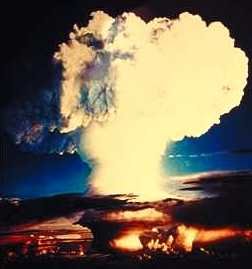
another denial Posted by Picasa
Nobel Peace Prize Address: Nukes Should Be As Repugnant As Slavery

From: Reuters By John Acher and James Kilner

The world should work to make nuclear weapons as universally condemned as slavery or genocide, UN nuclear watchdog chief Mohamed ElBaradei said on Saturday after receiving the 2005 Nobel Peace Prize.

ElBaradei, head of the International Atomic Energy Agency (IAEA), said the world had 27,000 nuclear warheads and "to me, that is 27,000 warheads too many."

"The hard part is how do we create an environment in which nuclear weapons -- like slavery or genocide -- are regarded as a taboo and a historical anomaly?" ElBaradei, an Egyptian, said in his acceptance speech.

Announced as laureates in October, ElBaradei and the IAEA shared the Peace Prize for their work to prevent the spread of nuclear arms and promote the safe use of atomic power in a year marking the 60th anniversary of the atomic bombing of Hiroshima and Nagasaki in Japan.
ElBaradei and IAEA Board of Governors Chairman Yukiya Amano of Japan received gold medals and Nobel diplomas at a ceremony at Oslo City Hall to applause from about 1,000 guests.

ElBaradei urged a halt to proliferation of nuclear arms and disarmament by the "eight or nine" states that now have them. "We must ensure -- absolutely that no more countries acquire nuclear weapons," he said, adding: "We must see to it that nuclear weapon states take concrete steps toward nuclear disarmament."

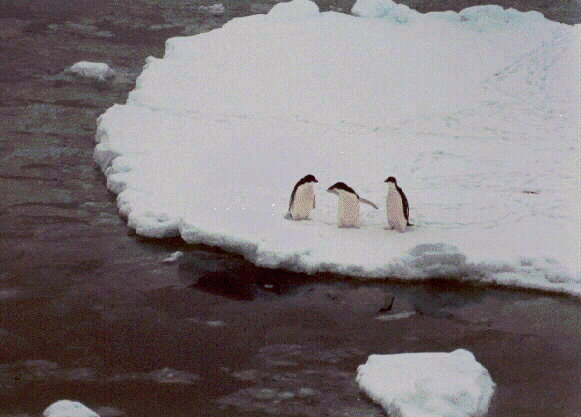
Where the march of the penuins ends Posted by Picasa
The Deadliest Denial

From: The Psychology of Global Warming:
By Bill Blakemore ABC News

One expert warns temperatures could climb to highest level in 500,000 years.

Journalism has no precedent for a story of the scale or seriousness of global warming. The vast majority of credible climate scientists - well over 95 percent, according to specialists in assessing scientists' opinions - agree that the average temperatures of the oceans, the land surface of the planet and the lower atmosphere (anything lower than the tip of Mount Everest) have been climbing at an accelerating rate.

The same specialists say that nearly as many scientists agree that manmade greenhouse gas emissions are a significant factor - and a good many say the only significant factor - in the dangerous global warming now under way.

If 95 of the world's best, most experienced experts in child well-being were to tell you that your child was under lethal attack - and with dramatic signs already visible if you only look - would you say, "I think I'll wait until the other five experts are convinced before I do anything about it?"

It would be the other way around, and yet that is how a lot of people - and some parts of what's called "the mainstream media" - often seem to be reacting to what the vast majority of scientists are telling us.

The latest news includes a study by one of the Galileos of global warming, NASA's Dr. James Hansen, who told the 11,000 Earth systems scientists at their annual meeting that mankind has at most 10 more years within which significant emissions cuts must get well under way or else the planet's temperatures will, within the next 30 to 40 years (by the time today's toddlers are entering middle age), climb to levels higher than at any time in the last 500,000 years.

Civilization is less than 10,000 years old.

At the worldwide global warming talks in Montreal, scientists elaborated on surprising new reports that the Atlantic currents' "conveyor belt" system has already slowed down - one of the predicted effects of global warming, possibly spurred by fresh water pouring in from the melting Greenland ice cap.

These slowing currents include the Gulf Stream, which carries tropical heat up past New England and over to Britain and northwest Europe. If these currents stop completely, which a new University of Illinois study gives a 45 percent chance of happening before the end of the century, these regions would be far colder.

Alarming news from scientists has accelerated in the past few months:

Arctic summer ice has melted back 30 percent in 30 years, and may disappear in the next several decades.

Non-polar glaciers around the world are disappearing much faster than scientists thought possible.

This year now holds several extreme heat records. Half of all plant and animal species are showing impacts of the warming - in some cases by going extinct.

The World Health Organization estimates that, every year, manmade global warming, aggravating disease and direct heat impact, kills at least 150,000 people and makes 5 million sick.

Alarmist or Alarming?

Psychologists tell us that denial is an inevitable and natural first reaction to such news. We don't want to think we can actually have had such effect on the entire planet any more than a young child wants to believe it can hurt its protective and nurturing parent. Nor do we like to think about drastic change. Nor feel moved to fix the leaks in the roof when it isn't raining, especially when we have never experienced a rain storm.

And for journalists, there is a natural and initially worthy desire not to risk seeming grandiose or alarmist. "Alarmist" is defined in my American Heritage Dictionary as "One who needlessly alarms others."

Two decades ago, many people without questionable motives - and some with - called NASA's James Hansen an "alarmist" when he stood before Congress and said his calculations showed that global warming had begun and was "changing the climate now."

Then his alarm-ing descriptions - and predictions - panned out. Now, with a new set of calculations, Hansen - no longer so alone, joined now by thousands of concerned scientists - is again challenging our psychological capacities to deal with hard news.

Saturday, December 10, 2005


Montreal December 2005 Posted by Picasa
KNOCK KNOCK: Unprecedented Drought in Amazon

FROM A Record Amazon Drought, and Fear of Wider Ills
By LARRY ROHTER FOR New York Times

MANAQUIRI, Brazil - The Amazon River basin, the world's largest rain forest, is grappling with a devastating drought that in some areas is the worst since record keeping began a century ago. It has evaporated whole lagoons and kindled forest fires, killed off fish and crops, stranded boats and the villagers who travel by them, brought disease and wreaked economic havoc.

In mid-October, the governor of Amazonas State, Eduardo Braga, decreed a "state of public calamity," which remains in effect as the drought's impact on the economy, public health and food and fuel supplies deepens. But other Brazilian states have also been severely affected, as have Amazon regions in neighboring countries like Peru, Bolivia and Colombia.

"There have been years before in which we've had a deficit of rainfall, but we've never experienced drops in the water levels of rivers like those we have seen in 2005," said Everaldo Souza, a meteorologist at the Amazon Protection System, a Brazilian government agency in Manaus, the nine-state region's main city. "It has truly been without precedent, and it looks like it is only going to be December or January, if then, that things return to normal."

Scientists say the drought is most likely a result of the same rise in water temperatures in the tropical Atlantic Ocean that unleashed Hurricane Katrina. They also worry that if global warming is involved, as some of them suspect, it may be the beginning of a new era of more severe and frequent droughts in the region that accounts for nearly a quarter of the world's fresh water.
"The Amazon is a kind of canary-in-a-coal-mine situation," said Daniel C. Nepstad, a senior scientist at the Woods Hole Research Center in Massachusetts and the Amazon Institute of Ecological Research in Belém.

"We have no idea of the game we have played into by running this worldwide experiment of pumping so much greenhouse gases into the atmosphere," Mr. Nepstad said. Even more than in other parts of the world, people who live in the world's largest rain forest depend on water for transportation, food, sewage removal - in short, just about everything, so the drought has touched nearly every aspect of their lives.

"I am very frightened," said Jair Souto, the mayor of a sleepy market town, Manaquiri, that started seeing signs of drought in September. "One thing goes wrong, and the entire system follows."

Much MORE HERE
Montreal: The Last Try

from BBC News Saturday

Ministers at the climate change conference in Montreal have made a series of breakthroughs in plans to combat global warming. On the conference's last day, Kyoto Protocol signatories agreed to extend the treaty on emissions reductions beyond its 2012 deadline.

And a broader group of countries including the US agreed to non-binding talks on long-term measures. The US had refused to accept any deal leading to commitments to cuts.

Earlier, former President Bill Clinton said the US approach was "flat wrong". After Mr Clinton's remarks - which were warmly received - the official US team appeared to shift its position.

The BBC's Tim Hirsch in Montreal says the deal was finally agreed in a mood of some euphoria after a last-minute procedural objection by the Russians held up the talks for several hours.

Formal talks can now begin over the precise targets which will be set when the first phase of the Kyoto agreement expires in 2012. Our correspondent says that, crucially, it sets the scene for discussing how large developing countries like India and China could be brought into the system of limiting greenhouse gas emissions. Canadian Environment Minister Stephane Dion, who is hosting the conference, described the agreement as "a map for the future, the Montreal Action Plan, the MAP".

on events of the evening before the agreement, from the Guardian:

The US administration was facing condemnation last night after it refused to sign up to a UN statement intended to reopen worldwide talks on how to tackle climate change.

The American move, at a high-level summit in Montreal, after two weeks of talks appeared to renege on a commitment made at the Gleneagles G8 summit, and promised embarrassment for Tony Blair, who has spent 18 months trying to woo George Bush back into the debate on global warming.

Undeterred, more than 150 other countries were poised last night to take the Kyoto protocol into a second phase, extending the international agreement to cut emissions of greenhouse gases when its first phase expires in 2012.

MORE HERE

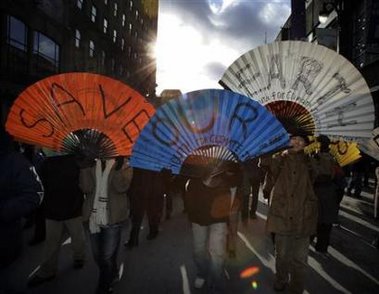
As UN conference begins, climate crisis
demonstrations around the world,
including here in Montreal. All photos AP. Posted by Picasa

Canadian PM Paul Martin:"I say there is such a thing
as a global conscience, and now is the time to listen to it.” Posted by Picasa

We are not amused: U.S. rep Paula Dobriansky.
U.S. delegates came in before they walked out. Posted by Picasa

Clinton to UN: Bush is flat wrong on opposing treaty
Posted by Picasa
Montreal: Bushcorps Temper Tantrum, World Sighs

Bush Delegation Stages “Walk Out” at Climate Talks from Think Progress

Not content with simply remaining outside the international agreements on climate change, the Bush administration is now trying to block other countries from making progress without it.

The American delegation staged a dramatic walkout last night in a bid to scuttle the entire U.N. climate change conference in Montreal. The theatrics were billed as a protest of Canadian Prime Minister Paul Martin’s harmless remarks from Wednesday. (Martin said, “To the reticent nations, including the United States, I say there is such a thing as a global conscience, and now is the time to listen to it.”)

Compounding the embarassment, the U.S. delegation actually had to first walk in to the negotiations before they could “walk out,” because they hadn’t been regularly attending the meetings.

U.S. frustrations aren’t based in substance: the U.S. delegation rejected language that was lifted directly from the G8 communiqué that President Bush himself signed in July. Rather, the problem is that this week’s negotiations reinforced that the Bush administration is more isolated than ever in dealing with global climate change. Simply put, the U.S. delegation recognizes that the rest of the world is making progress, and it is pulling out all the stops in order to keep that from happening.

Later: “Bush-administration officials privately threatened organizers of the U.N. Climate Change Conference, telling them that any chance there might’ve been for the United States to sign on to the Kyoto global-warming protocol would be scuttled if they allowed Bill Clinton to speak at the gathering today in Montreal, according to a source involved with the negotiations who spoke to New York Magazine on condition of anonymity.”

from Clinton Says Bush Is 'Flat Wrong' on Kyoto AP

Delegates from around the world worked into the final hours of a U.N. climate conference on Friday to produce a plan for deeper cuts after 2012 in greenhouse-gas emissions, buoyed by a last-minute message of support from former President Clinton.

Clinton, in an applause-filled appearance at the Montreal meeting, said President Bush was "flat wrong" to claim that reducing greenhouse-gas emissions to fight global warming would damage the U.S. economy. But the ex-president urged the negotiators from more than 180 nations to find a way to "work with" the current U.S. administration.

Throughout the two-week conference, the Bush administration repeatedly rejected Canadian and other efforts to draw it into future global talks on emission controls, just as in 2001 it renounced the existing Kyoto Protocol and its mandatory cuts.

Despite Clinton's message, many here seemed resigned to waiting for a political change in Washington.

"It's such a pity the United States is still very much unwilling to join the international community, to have a multilateral effort to deal with climate change," said the leader of the African group of nations here, Kenya's Emily Ojoo Massawa.

"The administration just doesn't seem to get it. They don't understand the world is suffering from climate change," said Jennifer Morgan of the environmentalist group Climate Action Network.

Negotiations among the more than 150 nations that ratified Kyoto went on until dawn Friday and then resumed later in the day, as they hammered out final details of a plan whereby a working group would begin developing post-2012 proposals. The tentative document included no deadline for that work, but said it should be completed early enough to ensure that no gap develops after 2012.

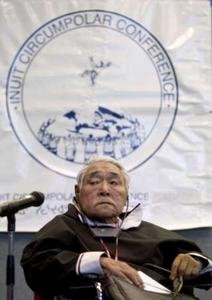
At UN conference,Mucktar Akumalik
registers Inuit formal accusation
against Bush government for violating
Inuit human rights by failing to act on
climate and thaw of their Arctic homelands. Posted by Picasa

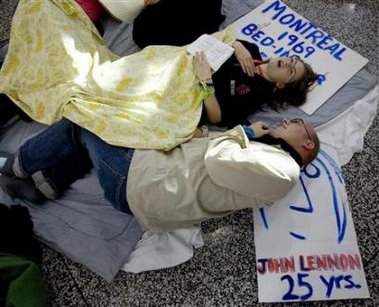
On the 25th anniversary of John Lennons murder, young
Montreal demonstrators adapt the John & Yoko bed-in
for peace in Montreal, this time for global climate crisis. Posted by Picasa

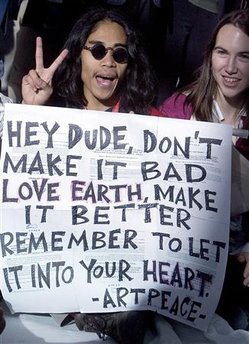
Voice of Youth "Stop asking how much
it will cost you and start asking
how much it will cost us." Posted by Picasa
Montreal: Give Earth A Chance

from "Youths Make Spirited Case at Climate Meeting" in New York Times
By ANDREW C. REVKIN

MONTREAL On Wednesday night, as negotiations over the future of two international agreements on global warming ground on, it was time for a break.

The lobbyists for coal and oil companies and the nuclear power industry fanned out to Montreal's storied restaurants and high-priced hotels. The campaigners for big environmental groups hunkered down to talk strategy.

But a stream of participants hiked through the frigid night to a corner building on the far side of Chinatown that pulsed with light and thudding music. Inside, a local nonprofit group called Apathy Is Boring was giving a party.

There was no apathy in attendance - just 300 people, most in their 20's, who had come from as far away as Australia and Los Angeles to pester the "fossils" - the legions of gray-suited negotiators who, these young people said, were hijacking their future.

"Major social changes start with a shift in philosophy, and then a new generation is born with that at their core," said Josh Tulkin, 24, who works for a group focused on climate issues in the region outside Washington, D.C., and also for a network of youth organizations called SustainUs. "That generation is us."

Some wore T-shirts emblazoned with a message aimed at delegates: "Stop asking how much it will cost you and start asking how much it will cost us."

Through nearly two weeks of treaty talks here, the young attendees, more than 500 in all, have been staging daily demonstrations, mainly lighthearted, to highlight the meeting's importance for their generation. And they have been buttonholing delegates to share their concerns about the lack of significant new action to cut greenhouse gases linked to global warming.

On Thursday, the major action of the day was a "bed-in" on the sprawling polished floor outside the main meeting rooms. About 15 people lay down on pillows near pictures of a similar protest staged in Montreal in 1969 by John Lennon and Yoko Ono.

They started singing old Beatles songs, but with new lyrics: "We all live in a carbon-intensive world" and "All we are saying is give youth a chance."

The first young people who attended climate negotiations came at the invitation of Greenpeace in 2000, fanning out in the halls at a meeting in The Hague aimed at completing the Kyoto Protocol, one of the agreements being discussed here. But in the past, they were mostly recruited by big international environment groups. Now many of them are from homegrown independent nonprofit groups of their own making, many focused on local issues like cutting universities' use of fossil fuels. They have their own Web sites, with one Web log, itsgettinghotinhere.org, the centerpiece.

"It has gone viral," said John Passacantando, the executive director of Greenpeace USA, in a telephone interview. "There's never been a social movement that didn't have young people as the moral standard bearers. They realize the fate of their world is being decided in the shadows at these conventions."

There is little time for leisure. While some delegates went shopping with the per diem money provided by the United Nations, the campaigners, wielding cellphones and laptops, continued pressing delegations for meetings. On Thursday, about a dozen young people trooped through a maze of corridors to a room used by American negotiators for confidential talks. There they sat around a rectangular table with Daniel A. Reifsnyder, the director of the State Department's office of global change.

They met in part to lay out their case for new actions to reduce greenhouse gases, but also to complain about the fate of Nia Robinson, a young campaigner from Detroit working for Environmental Justice and Climate Change Initiative, a group focused on the social impact of global warming.

She had been ejected from the meeting hall on Wednesday for trying to deliver a "climate change survival pack" to American officials, consisting of a face mask for air pollution, a life jacket to counter the threat of rising sea levels and a can of Spam, symbolizing the potential disruption of traditional food sources for indigenous people.

They were politely told that the United States had nothing to do with her expulsion, which was carried out by security officials working for the United Nations. They were also told that the United States had no plans to start negotiating new agreements on climate change, that existing policies were already producing results.

As they emerged, Mr. Tulkin, of SustainUs, was near tears.

While this upsets us, it also motivates us to go back and fight as hard as we can back in the United States," he said. "We know we have to take it back into our own hands. That's what we're doing at the cities, the campus and our communities. This is our future and we need to take control of it right now, today, take action."

Friday, December 09, 2005


jansma from doors of perception.com. Posted by Picasa

The Dreaming Up Daily Quote

"For every poet it is always morning in the world. History a forgotten, insomniac night; history and elementary awe are always our early beginning, because the fate of poetry is to fall in love with the world, in spite of history."

Derek Walcott

Holiday Books from 2005: Design & the Future

The Things of Shapes To Come

SHAPING THINGS
by Bruce Sterling
Mediawork Pamphlet Series
The M.I.T. Press

I tend to see the future in terms of story, while real professional futurists see it in terms of design. (Then there’s Star Trek, which sees it as both. I know, you don’t want to hear about Star Trek.)

As a science-fiction writer and a futurist, Bruce Sterling also sees it as both. This particular slim but very full of pith and moment book (under 150 pages) is about designing---and redefining---things, as leading the design of the future.

Things, as created objects, and more. “Properly understood, a thing is not merely a material object, but a frozen technosocial relationship. Things have to exist in relationship with an organism: the human being.” Though this book comes pre-underlined and highlighted, that’s a quote I lifted all on my own.

But things are not generic. They are, for example, artifacts, machines, products, gizmos, spimes and arphids. My spell-check doesn’t like spimes and arphids, they come pre-underlined in red, but that’s because these are new words Sterling coins to extend the technosocial relationships into the present and future of new proportions of physicality and information.

This is all pretty fascinating, especially when Sterling links the design future to the sustainable society he understands as the only lengthy future we can have as a civilization, though he assumes this more than makes a case for it. There are real designers referenced---the section on Raymond Loewy, for example, is informative and entertaining. I like the brisk elegance and wit of Sterling’s prose, so I went along for the ride even when I wasn’t quite sure where I was going, or even where I’d been.


MORE OF THIS REVIEW PLUS TWO OTHER RECOMMENDED BOOKS HERE

click image to enlarge. For an even better look, go to the
source: San Francisco Chronicle. Posted by Picasa
More Tax Cut Socialism for the Wealthy: The Rich Get Richer, America Gets Poorer for Longer

from New York Times

The House passed the last and biggest part of $95 billion in tax cuts on Thursday, a move that reflected the willingness to place tax cuts above the risk of higher deficits in years to come.

Voting 234 to 197, almost purely along party lines, the House approved $56 billion in tax cuts over five years, one day after it passed other tax cuts totaling $39 billion over five years. The biggest provision would extend President Bush's 2001 tax cut for stock dividends and capital gains for two years at a cost of $20 billion.

That was welcome news for a president whose tax plans looked all but dead a few weeks ago. All the maverick Republican conservatives in House, who had pushed party leaders to pass $51 billion in spending cuts, voted enthusiastically for tax cuts costing nearly twice as much.

Democrats accused the Republican majority of expanding the cuts to the very richest families while cutting programs to help the poor.

"The choice is clear, tax relief that goes to people making a million bucks or more and cutting student loans, cutting food support for people who need it and cutting child support," Representative Sander M. Levin, Democrat of Michigan, said.
Take Away American Rights and Call It the Patriot Act--Not So Fast This Time

From the New York Times

House and Senate negotiators reached a compromise agreement Thursday to extend the antiterrorism law known as the USA Patriot Act, but critics from both parties said they found the plan unacceptable because it did not go far enough in protecting Americans' civil liberties.

The plan is expected to come up for final votes in the House and Senate early next week, but its passage was uncertain Thursday, with some Democrats, including Senator Russell D. Feingold of Wisconsin, threatening a filibuster to block a vote.

After weeks of what negotiators described as extremely difficult negotiations, the compromise plan would retain most of the expanded surveillance and investigative powers given to the federal government after the Sept. 11 attacks, permanently extending 14 of 16 provisions set to expire at the end of the year. But it would also put in place additional judicial oversight and safeguards against abuse.

Three of the most-debated measures would have to be reviewed again by Congress in four years, rather than the seven-year window originally favored by some House leaders in a tentative agreement that was reached last month but then derailed by last-minute concerns from members of both parties.

Those measures that would be extended for four years involve the government's ability to demand records from libraries and other institutions, conduct "roving wiretaps" in surveillance operations and single out "lone wolf" terrorists who operate independently of a larger group.

In another concession to lawmakers who pushed for greater government restrictions, the plan agreed to on Thursday eliminated a proposal that would make it a crime punishable by one year in prison for anyone receiving certain types of records demands from the government to disclose them publicly.

The current plan also does not include measures that would have increased penalties on some terrorism-related crimes and would have expanded the government's ability to seek the death penalty in some cases.

Senator Arlen Specter, the Pennsylvania Republican who leads the Judiciary Committee, acknowledged that he would like to have seen tougher civil liberties safeguards included in the compromise plan, but he faced resistance from House negotiators and administration officials who argued that new restrictions could limit the government's ability to fight terrorism.

Mr. Specter added that Bush administration officials "have been very worried that they wouldn't get a bill, and we came perilously close to not getting a bill at all."

Even before Mr. Specter finished announcing the agreement at a news conference, a bipartisan group of six senators who have been active in the debate were attacking the compromise, saying they were "gravely disappointed" in the deal and would oppose it.

"We still can, and must, make sure that our laws give law enforcement agents the tools they need while providing safeguards to protect the constitutional rights of all Americans," the senators said in a statement, which was signed by three Republicans, Senators Larry E. Craig of Idaho, John E. Sununu of New Hampshire and Lisa Murkowksi of Alaska, and three Democrats, Senators Feingold, Richard J. Durbin of Illinois and Ken Salazar of Colorado.

Senator Patrick J. Leahy of Vermont, the ranking Democrat on the Judiciary Committee, refused to sign on to the compromise plan, saying Democrats were excluded from important negotiations. With provisions of the law set to expire at the end of the year unless Congress acts to renew them, Mr. Leahy proposed a three-month extension unless a different plan was reached.

The American Civil Liberties Union, meanwhile, called the agreement a "sham compromise" and said it would not prevent possible abuses by the Federal Bureau of Investigation in demanding records and conducting surveillance operations that may have little or no connection to terrorism.

The latest deal drew praise from the Bush administration, with Attorney General Alberto R. Gonzales calling it a "comprehensive" bill and urging quick passage.

Thursday, December 08, 2005


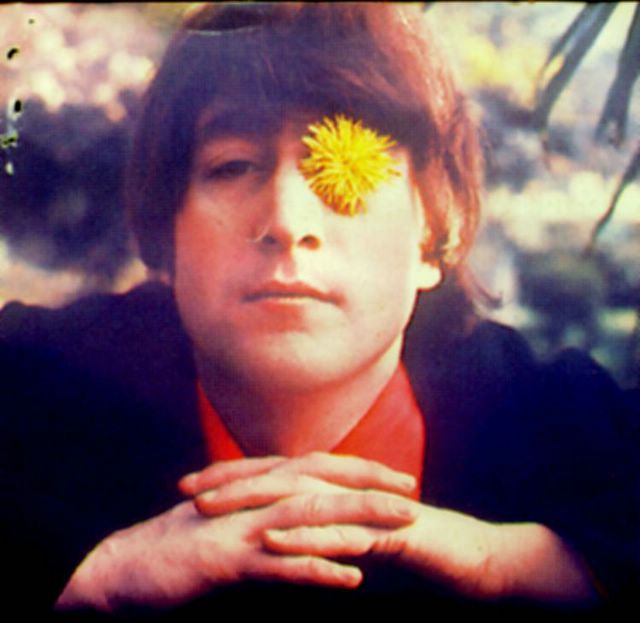
 Posted by Picasa
It's Still A Drag

I was in New York City the last day of John Lennon’s life. We breathed the same cold air. I was flying west when he was shot. I learned about it in Los Angeles. That made it even more surreal---in that sudden soft air and sunshine, after the dirty wind and gray chill of New York.

The radio played his songs, Beatles songs, constantly the next day when I was driving around in a rental car, and there was a period of silence that Yoko Ono asked for as a memorial, which I spent on Santa Monica Beach. When it was over and I was walking back to the car, I saw his name written in the sand. Imagine. Lennon Lives.


Paul McCartney's first quoted reaction, widely criticized at the time, was "It's a drag." Now I know all the inarticulate grief locked in those words. It's still a drag.

I’ve resisted joining the chorus reevaluating Lennon today. I guess 25 years since the day he died is a reasonable day to do that, but I don’t want to remember him for his sudden and sickening murder. Plus the friend I spent the most time with that evening and the next day, sharing all those half-spoken feelings of awe and dread and the tentativeness of being alive, is also dead now. She also died young and suddenly, not many years later. And more beauty was lost from the world.

The Beatles are certainly still part of my life, even of a lot of days. I’ve felt closest to George the past few years, and I admire how Paul and even Ringo have conducted their lives as they age beyond what we could even imagine then. But John was the one I admired the most then, who opened the most doors to perception.

Oddly, the John song I like doing the most these days is a minor one, "Crippled Inside." But it's so John.


You can shine your shoes and wear a suit

You can comb your hair and look quite cute

You can hide your face behind a smile

One thing you can't hide/ is when you're crippled inside


These days the song I feel closest to is one of Paul’s, which I didn’t take note of much when it came out about two years after John's death, called “Tug of War.” It's only been in the last year or two that I've come to feel these lines:

“In another world, in another world
We could stand on top of the mountain with our flag unfurled;
In a time to come, we will be dancing to the beat

played on a different drum…”

And these:

“In years to come, they may discover
what the air we breathe and the life we lead
are all about.
But it won’t be soon enough,
soon enough for me.

No, it won’t be soon enough,
soon enough for me. “

Wednesday, December 07, 2005


Snow leopard Posted by Picasa

The Dreaming Up Daily Quote

"Others only have to look at me and suddenly I'm what they say I am. That's
what evil is."

Max Frisch