|
| Carol and me with kittens from Stuff's litter at our Cambridge apt. |
I returned with Carol and company to Cambridge after my
Cummington community experience in August 1970. By this time Carol and her Knox College friends had moved into a
summer sublet—probably more of a housesitting gig—on a quiet leafy side street
at 13 Ellery St., apt.4. It was about
half a block from the central artery of Massachusetts Avenue, known
colloquially as Mass Ave: a roughly 16 mile road that begins in Boston and
defines the heart of Cambridge before heading onward past Somerville to Concord
and the fabled Lexington Green, and beyond.
 |
| 13 Ellery St. |
It wasn’t until I’d gone to college in the Midwest that I
heard people give city directions in terms of north/south, east/west (cf. “Go
north three blocks and turn west.”) In western Pennsylvania as in most of the
northeast, cities were ordered by the borders of serpentine rivers and
eccentric coastlines, as well as hills and ridges and valleys. So while Cambridge is vaguely north of
Boston, it is connected by Mass Ave in a way that defies the compass. Orientation reverts to directions like left
and right.
So emerging from the tree-shadowed Ellery Street to busy,
noisy Mass Ave puts Central Square (Cambridge) and Boston to your left, and
Harvard Square a few long blocks to your right. While I was living there the
rest of that summer, the first commercial building to the right on Mass Ave
housed several businesses, including the F-Stop camera store, Cheap Thrills
records, a music and musical instrument store, and the Orson Welles Cinema. At the time I first saw it, the Welles was a
single screen, so-called “repertory cinema” showing foreign and offbeat
American movies. (It had a film school as well, though that was not immediately
obvious to me.)
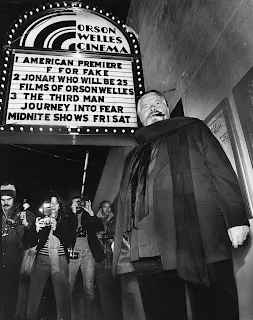 |
| Orson Welles at the Orson Welles |
The Orson Welles intrigued me. I’d been increasingly
interested in film and filmmaking. I had one film course at Iowa, and in my
months at Buffalo I got to know film professor (and McLuhan pal) Gerald
O’Grady. I attended a number of his
film classes, especially when they were showing movies.
Carol had gotten interested in film, too, especially after
she read The Film Director as Superstar by Joseph Gelmis, a collection
of interviews (Kubrick, Bertolucci, Lindsay Anderson, Richard Lester, John
Cassavettes and a very young Francis Ford Coppola, among others), a book I’d
left with her when I was at Cummington.
We emerged from one of our first movies there when I saw a
familiar face in the lobby. It was
Steve Goldberg, formerly of Knox College, who turned out to be the theatre
manager. He remembered me, and in the
course of our conversation, suggested I try writing for the local weekly paper
called the Phoenix. I laughed before I
nodded an acknowledgement. I didn’t see where I would fit in. I knew nothing
about Boston or Cambridge, and though I’d seen the Phoenix a few times, I still
didn’t have a handle on it. It was more
seriously journalistic than an underground newspaper, but it wasn’t like a
daily either. A few years later in his defining New Yorker piece, Calvin
Trillin would describe the growing number of such journals as “sea-level”
newspapers. Today, their descendants are usually lumped together as
“alternative.”
(As if meeting a former Knox student there wasn’t
coincidence enough, I soon after walked into the music store next door to see
behind the counter someone I’d known at Greensburg (PA) Central Catholic High
School. Paul Lenart had been a year ahead of me, and had gone off to Columbia
University on a football scholarship, which made him a subject of my envy since
that was my aspirational and unaffordable first choice school. But he’d been injured early on, lost his
scholarship and was now a guitarist in a regionally popular band that sometimes
played at Jack’s bar near Central Square, famous then for featuring Bonnie
Raitt before she went national. Eventually
he sold me my next guitar.)
 |
| Pierrot Le Fou |
I soon had my first immersive film experience, when the
Welles programmed a Jean-Luc Godard festival, a bill of Godard double-features
that changed every couple of days. I
got a discount ticket book and saw many of them, almost all for the first time
(among them “Band of Outsiders,” “Alphaville,” “Contempt,” “Masculin Feminin,”
and my favorite, “Pierrot le Fou” with Jean-Paul Belmondo and Anna Karina),
eventually watching from the back row while drinking coffee and smoking
Gauloise cigarettes. Mass Ave and the
Welles would turn out to be mainstays of my time in Cambridge and Boston.

Past the Orson Welles, two particular wonders of Harvard
Square awaited. First, the
bookstores. There was one before the
square, but more past the high brick walls of Harvard Yard that began the
Square proper. Harvard Bookstore was right there on Mass Ave, shortly to be
joined by its book annex, with hurt books and remainders. Around the corner was the Grolier Bookshop,
reputed to be a gathering place for poets, though I never experienced
this. It was one of the contacts that
Robert Creeley wrote down for me.
The huge Harvard Coop had a big book section. There were
more bookstores on Brattle Street behind it, including one of my favorites,
Reading International. Across from
there and below street level on Mt. Auburn St. was Passim, a bookstore during
the day, and a music venue at night—it had formerly been Club 47, where Joan
Baez first sang in concert, among many other luminaries of the folk revival
1960s.
But bookstores weren’t the only sources of books. There were two Ecology Action storefronts
and a couple of other such organizations that collected and gave away surplus
books, and since it was Cambridge, the quality was high. I scored a mother lode of books at one such
place on a memorable afternoon, and walked out embarrassed at my haul, but
ecstatic.
I was soon reading Henry Miller for the first time, and his
rhapsodizing descriptions of Paris bookstores suggested that this might be my
Paris. That feeling was reinforced by the cafes, some with outdoor seating, an
anomaly in America at the time. There were not varieties of coffees available
on every corner in the 70s, but in and around Harvard Square there were coffees
closer to their foreign origins, such as the Turkish coffee in a dark café
buried in a complex of shops.
 |
| Harvard Sq 1970. BK photo. |
Soon I had a favorite place: the unpretentious Patisserie
below street level on the section of Brattle Street that wound around to the
left as you faced the Harvard Coop. Its
menu was modest but everything tasted great.
I loved especially their almond croissants. Its French coffee had a
taste still unique in my experience. It
tasted blue, the equivalent of Gauloise smoke.
I was a frequent enough customer that the owner (who was Greek) knew me
by sight, and remarked on how long it might have been since I was there last.
The riches of the cafes included the newspapers left by
patrons and strewn around, not only the Boston Globe and the counterculture and
political papers but the New York Times and Washington Post. There were magazines of all kinds from
everywhere at several of the bookstores, with walls of them at the Out of Town
News just outside the Harvard Square subway entrance.

The cafes completed the mental ambience of the bookstores,
and I felt as comfortable as I got, reading and writing in them. That extended
to less exotic but still strange venues, like the ice cream place with the
delicate 1890s wrought iron tables and chairs, and the Pewter Pot, which served
a variety of muffins (very big in Boston) and 15 cent coffee in Pewter
mugs. I was reading and writing there
once when I glanced up and saw a man passing quickly by the window, looking my
way with a wistful half smile. I was sure it was the writer and actor Buck
Henry. And it might have been, for this was Harvard Square, where I routinely
saw Nobel Prize winners bicycling by.
The apartment on Ellery Street was large and well kept,
though mostly empty. It was on the top
floor, with easy access to the flat roof, where a lot of sunbathing had gone on
all summer, and continued while I was there.
But with fall, the sublet was up, Carol’s friends returned to school,
and we had to look for another place.
 |
Repainted and gentrified, 325 Columbia St.
now. First floor apt. was ours. |
We clearly couldn’t afford anything so spacious in such a
prime area, but we did find a large room at the front of a duplex in East
Cambridge, at 325 Columbia Street. (According to a notebook, I found it by
answering an ad in the Phoenix titled ISMAEL COME HOME.) The street turned out to be a kind of local
truck route, so the rumbling was fairly constant, but I eventually got used to
it.
We painted our room teal blue, with lighter blue around the
sort-of bay windows. We painted the
living room in shades of sea green and violet. The previous tenants had left a
lot of psychedelic posters, which I cut up and affixed to a wall in the narrow
hallway as collages. (Through unforwarded mail and some detective work, I
learned that this apartment had been the gathering place for poets and others
in the antiwar movement, and that poet Denise Levertov had often been there.
She confirmed this in an exchange of letters. We had met my senior year at
Knox.)
My Cambridge reading started there with authors unauthorized
in my college lit classes. Both Carol
and I read Jack Kerouac, beginning with
The Dharma Bums (in which a
character based on Gary Snyder has a large role) and
Big Sur, even
before
On the Road.
I moved on to Henry Miller, whose style I found enthralling
despite the sometimes questionable content: the novels Tropic of Cancer
(my sun sign) and Tropic of Capricorn (Carol’s), his narrative
nonfiction (The Air Conditioned Nightmare, The Colossus of Maroussi)
and essays (The Books in My Life and The Wisdom of the Heart, in
which he described his Zen-like approach to writing.)There was soon
something of a Henry Miller boom in the 70s, and at the Orson Welles I saw an
autobiographical film on him, and another on his compatriot Anais Nin (I also
acquired and read some of her volumes of diary entries which were then
popular.)
I tried reading William Burroughs, whose theories of
writing—especially his cut-up method—fascinated me, but I didn’t match up with
his resulting fiction. There were
others, but I most recall Kerouac’s ecstatic discoveries as reflecting the
flavor of those first few months for us on Columbia Street.
I was still attracted to poetry with a surrealistic flavor.
I read Robert Bly’s translations of Pablo Neruda, more of Bill Knott (who I’d
encountered in New Haven) and a new poet, James Tate, who I heard read and met
in Cambridge. (He had exasperated tales of trying to help Knott just get
through life and empty the garbage.) I’d admired Jon Anderson’s first book of
poems, Looking for Jonathan, in 1968, and now the harder edged Death
and Friends in 1970.
 |
| Gino Severini self-portrait |
In the next months my reading expanded in different
directions. For example, I began
seeking out books on the modern artists of the early twentieth century, from
the Dadaists to those artists who clustered in Paris—Surrealists, Cubists, Futurists
and more. It was then I discovered the
Italian Futurist Gino Severini—the only one of that group who lived in Paris and knew
everyone from Picasso to Erik Satie. With the same last name as my mother, I
learned he might have been a blood relative of my grandfather, but even if only
a relative in imagination, he became a guide over the years.
At the same time I also discovered Dorothea Tanning, the
only American and only woman enrolled in the Paris Surrealists. She was a native of Galesburg, Illinois,
and (as I later found) a Knox College student who preceded me (by several
decades) as an editor of the college literary magazine. My fascination with this place and period,
which had begun with the expatriate writers like Joyce, Fitzgerald and Hemingway, brought
me around through the painters to other writers, particularly the French poets Guillaume Apollinaire
(another friend of Gino) and Paul Eluard.

Thanks to the extensive collection of cheap art prints at
the Harvard Coop department store (the large ones were a dollar), we had our own modern gallery
(though the Vermeer in the living room—a print I still have—was the exception):
a Magritte and Picassos in our room, a Max Ernst
in the kitchen and a Paul Klee in the bathroom, which otherwise featured a
large ceramic bathtub with a Moby Dick shower curtain but no shower, and an
ancient pull-chain flush toilet.
I continued reading about ecology, including Paul Shepard’s
second anthology, Environ/Mental.
I don’t remember what precipitated it, but I began reading Buckminster
Fuller obsessively. The autobiographical
sections in Ideas and Integrities grabbed me—his despair at his lack of
worldly success and acceptance of his ideas that drove him to the edge of Lake
Michigan, contemplating suicide. That
resonated. But even navigating his
strange vocabulary I saw him as literally a sailor (he’d served in the Navy)
who knew what he was talking about with his concept of Spaceship Earth—that all
we needed to live was aboard, but we were limited mostly to what was on the
ship.
Fuller’s concept of an “anticipatory design science” made a
lot of sense, even if I couldn’t follow all his proposals. A few years later I
attended one of his improvised lectures at M.I.T., and saw him up close as I
joined a cluster around him afterwards to hear more.
I got hold of a new anthology for students called Worlds
in the Making, which related ecology to the future. I was already looking at the future as a
subject. Carol and I were also reading ostensibly more serious books
in the psychedelic/countercultural vein, including on astrology, and we got our
charts done (I’ve lost mine but I still have Carol’s.) I was nervously
consulting the I Ching, which never quite assuaged my frustrations at my lack
of worldly progress, probably not the best attitude.

And we were surrounded by lots and lots of music. For awhile
we didn’t have any at home, but Carol made a trip back to Chicago and shipped
more of her belongings to Columbia Street, including the component stereo she’d
had at Knox. By the end of 1970, the Beatles breakup led to an efflorescence of
new albums: McCartney’s solo album (which we had from the previous spring),
Lennon and Ono’s separate Plastic Ono Band albums, Ringo’s “Sentimental
Journey” and “Beaucoups of Blues,” and George Harrison’s triple album, “All
Things Must Pass.” The flood continued in 1971 with “Ram” (McCartney),
“Imagine” (Lennon) and the multi-disk live album from Harrison’s all-star
concert for Bangla Desh, the first such charity event.
 |
| J.T. & Carole King |
James Taylor was a kind of favorite son in Boston, and the
“Sweet Baby James” album that made him a star was played everywhere. “After the Goldrush” also came out in 1970,
and began my Neil Young obsession.
Carol and I had to be selective in the concerts we attended, but we did
see Neil Young play in Boston, and caught a concert in the now legendary James
Taylor and Carole King tour. The
strangest concert I remember we attended was when Poco opened for the Moody
Blues. We went to hear Poco, assuming the Boston crowd was there for the
psychedelic Moody Blues. But Poco blew
that audience away, and nobody much was in the mood for the Moody heaviness
afterwards.
There were also free concerts, including a few in the
Cambridge Common, just beyond Harvard Square.
Carol and I heard the distant music one Sunday in Harvard Square and
walked over there. We passed a smiling
young woman coming the other way and asked her who was playing. “It’s a beautiful day,” she said. We agreed, it was a beautiful, sunny
day. But who was playing? She laughed. “It’s A Beautiful Day.”
Yes, there was such a group—I remember staring stoned at their album
cover a few years before in Galesburg.

The ex-Beatles releases, the back-and-forth accusation songs
of Lennon and McCartney, and John and Yoko’s events and interviews were widely
discussed in the pages of Rolling Stone and other music papers as well as the
Boston area weeklies, and among people we met.
Lennon’s first album and Neil Young’s “Goldrush” in particular grabbed
me and didn’t let go for years. But
Carol and I also listened alot to John Phillips’ (of the Mamas and Papas) solo
album, even though the music media dismissed it. I don’t think I ever quite
convinced her of the brilliance of the Bee Gees though, even if I played their
“Odessa” double album too often.
In a new relationship and a home of our own, and with the
stimulations of my Cambridge baptism, I was bursting with creative
expressions. I wrote in every form from
verse to polemic. I was writing songs
at a furious clip, enlisting Carol to add bits of gentle percussion to tapes I
made of them, at first just to not forget what I’d written.
Inspired by Dadaist
Kurt Schwitters, I resumed constructing collages, as did Carol. I briefly continued my Cummington
experimentations with painting. And I
devised and physically made a board game—the Cambridge Conspiracy Game. It was arranged like a Monopoly board but
with Cambridge sites. Its purpose however was as a kind of anti-Monopoly. The
object was not competition. The only
way to win was for players to cooperate.
Everybody won, or everybody lost.
Columbia Street extended down from Mass Ave on the Boston
side edge of Central Square a considerable distance before it got to us. Our
building was a bit run down, and so was the immediate neighborhood. It was not
fashionable or even recognizably Cambridge. It evidently had been Irish and (a
bit further on) Italian, but was now mostly Portuguese.
We shopped for major
groceries at the Purity Supreme supermarket in Central Square, but we also
explored the shops in Inman Square: a walk down Columbia St. for a long block
in the opposite direction from Mass Ave, and then the streets to the left that
eventually led to the Harvard Square area.
My impression was
that Inman Square had once been the Italian area, and there was a very good but
decently priced Italian restaurant there, that we could afford occasionally.
There was also an authentic German bakery, and a large deli restaurant called
S&S, that is apparently still there.
.jpg) |
| Inman Sq. early 1970s |
There was an old fashioned 5&10 next to a small grocery
that sold $1 bottles of French Bordeaux wine (vin ordinaire in Paris), not far
from a blues club. Legal Seafoods was the Cambridge choice for fresh seafood.
We took our clothes to the Laundromat in Inman Square, where each washer and
dryer had an individual name inscribed on it.
If we wanted to leave while our clothes were still in process, the
Italian who owned it would watch over them, and we might come back to see them
folded and waiting for us.
This end of Cambridge was noisy and sooty, as urban a place
as I’d ever lived. But we also belonged to a co-op that every week delivered
organic vegetables from nearby farms (in the revolution talk of the day, it was
called the Food Conspiracy.) We also
were asked to work in the fields periodically, which I remember doing
once. For awhile Carol and I tried the
brown rice diet recommended by John and Yoko, so we wouldn’t be “sampaku”
(supposedly you were if there was white all around your eyeballs, and it wasn’t
a good sign.) We gave that up pretty
quickly, and I wrote a song about it.
I extended my ecology commitments to the household, perhaps
a little too much (a succession of housemates weren’t thrilled.) But I was
motivated to do kitchen cleanup and some of the cooking. Carol made amazing Irish stew I still
remember.
Early on we added a tricolor kitten to the household, a
female we named Stuff, on the theory that cats respond to sibilants when
called. Soon Carol adopted a young stray, a black male we called Muk (I think
as a reference to milk, which he loved.)
However, we failed to monitor their maturation, and soon we had a
pregnant Stuff.
One day I awoke to
find that Carol and our housemate Andrea had panicked when they thought Stuff
wasn’t delivering properly, and had rushed her to the vet who said she was
fine, but that adventure caused Stuff’s labor to stop. We had to take her back to induce birth, and
by then I was the only one with the nerve to be present for the actual
births. Stuff had six kittens of
various hues and combinations, including a silver gray male. We decided to keep him, and named him
Gray. Those three cats—Stuff, Muk and
Gray-- would be under my care for the next twenty years.
All this may sound idyllic but of course it wasn’t quite. We both had demons to work through, and after the initial
overriding bliss, we had each other to get used to. Neither of us had anything but vague direction, and so along with
the freedom of exploration, we had anxieties.
Plus the complications of family pressures, housemates, and a few
neighborhood and apartment problems, etc. But complications is all they were.
We had what Carol would later describe as a good little life.
Carol started out working as a waitress at the counter of
the Brigham’s ice cream shop in Central Square, which was also a kind of
luncheonette, with coffee, sandwiches, etc. She wore a light brown uniform and
dispensed “frappes” (Bostonese for milk shakes) and ice cream cones with
“Jimmies” (sprinkles) on top. She soon figured out how to sneak me almost free
meals. She thought the manager didn’t
notice, but it turned out he did, and didn’t care.
The main Cambridge post office building was nearby, and it
may have been an employee having lunch at Brigham’s that alerted Carol to job
openings at that post office. She took the Civil Service exam and was quickly
hired, perhaps as a temporary for the Christmas season rush, but she was kept
on afterwards. To my surprise she liked
it there, especially her co-workers, and she visibly began to open up again to
the outside world.
I “took in” typing, edited and rewrote graduate school
papers, and had temp jobs, such as working in college bookstores during
textbook rush or doing inventory, and painting the vast interior of a former
Harvard eating club preparing to become a restaurant, Grendel’s Den on Winthrop St. and across Brattle from my
Patisserie, near Harvard Square. It’s still there. (Though I thought I did good work on those walls and ceilings, I
was fired for insubordination, for sticking up for a colleague being bullied.
He probably thought I was a dope for doing so.)
 |
| hawker later in 70s (not me) |
I eventually added a
weekly gig as a “hawker,” selling one or both of the counterculture papers on a
street corner (in my case, at Prospect and Mass Ave in Cambridge.) By
then—probably early 1971—the Cambridge-based Phoenix had been joined by Boston
After Dark, which had started out as a tabloid of mostly entertainment
listings and stories, but by then had expanded to a full weekly newspaper, with news and
arts coverage.
Unlike most alternative weeklies since, these papers weren’t
given away, but sold. Both had gained initial circulation with free classified
ads, personals mostly. The next
attraction was coverage of the kinds of arts and entertainment that appealed to
young readers, including the hordes of college students at the many colleges
and universities in the Boston area.
The writers were also young, and spoke the same language, unlike the
stodgy dailies. That applied to the
cultural and political coverage and point of view of news stories. There was a huge potential readership that
had nowhere else to go locally.
For some reason lost to history, I gravitated towards
selling Boston After Dark. I took the T
(Boston area’s subway/light rail system, which Carol likened to amusement park
rides) to the Boston printing plant, picked up and paid for the number of
papers I was gambling I could sell, and transited back to my Cambridge corner.
There were a lot of hawkers. Every corner in and near Harvard Square was taken, and often
enough, one or two of the corners near me were also claimed. There were
occasional turf wars, but generally hawkers respected the claims of
regulars. Where I was, the clientele
came from surrounding office buildings, usually at lunchtimes. My best customers were young women from
those offices, who bought their copy from me with their friends watching from
the floors above.
Since I didn’t always sell them all, I had lots of
opportunities to read what was in them.
I read the Phoenix as well. Meanwhile, I fantasized my own publication,
complete with articles I’d like to see in it. Eventually the light bulb went
off, and I realized I might pitch these existing publications with those
ideas. That took a surprisingly long
time.
I was always sending things out, poems and stories but
increasingly also reviews and articles.
I had my first acceptance in Rolling Stone, with an unsolicited review
of the book,
A Child’s Garden of Verses for the Revolution, by my
erstwhile teacher and correspondent, William Eastlake. I did a piece on Henry
Miller accepted by a west coast publication called Organ. The editor liked it, and agreed to assign a
piece on Buckminster Fuller. I think
the magazine folded before it could be published, but I did get paid.
I’ve found the notebook from this time which contains my
first draft of a long poem called “Ears.”
I remember it as inspired by a Kenneth Koch poem on the theme of eyes
that I heard him read, but I can’t locate that poem and don’t remember where
the reading was. A version of “Ears” as well as several other poems and a prose
piece of impressions of Cambridge, appeared in a one-off publication called Words
Cambridge in spring 1971. The
people who appeared in it put the publication together, assembling and binding
it in the offices of the Orson Welles cinema.
Another version of “Ears” would appear at the end of the year in a more
professionally produced though also short-lived literary magazine, Cotelydon.
 |
| Carol 1968 at Knox. Bill Thompson photo. |
Both Carol and I had various physical complaints that sent
us for tests at the Cambridge hospital and especially to Massachusetts General,
which because it was a teaching hospital, was more open to doing tests for
people who couldn’t otherwise pay for them, as long as students could observe
or participate. My tests proved
inconclusive. The best advice I got was
“drink more water.”
So I was not unduly concerned when Carol went for tests at
Mass General, after my repeated urging. Her health had always been somewhat
shaky, but there had been two recent incidents in which she’d been overcome by
fatigue. We’d attended a screening at
the Orson Welles and met the filmmaker Stan Vanderbeek, who was about to show
one of his films beamed by multiple projectors onto the inner dome of a
building—the Moviedrome at Stony Point in New York state. The audience would be lying on the floor
looking up. The film would last for
several hours—a truly immersive experience.
We signed up for the bus to go, but when the day approached Carol
suddenly felt extremely tired, so we cancelled.
Another wave of fatigue prevented us from meeting up with
some Knox friends. We were literally
out our front door when she said she had to go back. The prospect of a long bus ride to the Moviedrome had been
daunting, but this outing was not going to be so strenuous. It seemed more serious.
I was back in our room when she returned from her visit to
Mass General. I asked her what the
doctor said. She brought up something
else that had us both laughing. Then I
asked her again what the doctor said.
She suddenly burst into tears.
After initial tests she had been sent to a doctor in the
hospital who diagnosed her with what was then called Hodgkin’s Disease (now
Hodgkins lymphoma.) Through her tears,
and fear that she would die, she provided what turned out to be an accurate account
of what the doctor said (I’ve unfortunately forgotten his name.)
The diagnosis was
serious, he said, but the good news was a new treatment that had excellent
results, available at only two hospitals in the U.S.: Stanford and
Massachusetts General. It involved
removing the spleen, followed by two rounds of treatments, some combination of
radiation and chemotherapy. Because they'd caught it at an early stage, after that she should be fine.
She repeated the words but did not seem to believe them
until I repeated them back to her. Part of her despair resulted from a stop at a library or bookstore on the way home where she read that the disease was usually fatal.
But soon she accepted the assurances she brought back from her doctor. Later I
did what research I could, which confirmed what she’d been told.
In the early 1970s, it seemed most cancers were mysterious
and fatal. Not many years before that, the word “cancer” was not even uttered
in polite company (comedian Billy Crystal had a routine that reflected
this.) I was becoming a little familiar
with the radiation and chemotherapy treatments because my mother had recently
undergone some, and would undergo more, after Carol completed hers. But I
wasn’t around for most of my mother’s, and my parents were generally secretive
about such things, so I was somewhere between discreet (not wanting to
embarrass my mother) and frightened. It was very different with Carol.
I was there with her completely, every moment, every step. I
was at the hospital for her spleen removal operation, and her initial
treatments. Sometimes, instead of remaining in the waiting room, I would spend
the estimated time outside on Boston Common before returning. Carol waited her turn in an area reserved
for patients, where she befriended a few regulars also waiting for their
treatments, and heard their stories.
Some had much less hopeful prospects.
Later, when she felt stronger and self-reliance was important to her,
she bolstered her confidence by going to the treatments on her own. She found
her courage, partly in making it ordinary.
At home, I took care
of her as best I could. We talked about
everything involved, what she thought and how she felt, and I tended, however
watchfully, to follow her lead. She
needed to comprehend and cope with what was happening to her. A part of her body was cut out, and the rest
of it subjected to the damage (including to her beautiful hair) caused by
radiation and chemicals, as well as the eventual healing.
I could also offer a
different perspective. “You felt your
body broken,” begins a poem I wrote to her, “but I saw it whole/with such/ joy
at its aliveness/its softness and beauty/that the tubes hanging out/were proof
only/that your loveliness/was present/transcendent…”
She wanted above all to be not sick, so we tried to
keep things as normal as possible. She had taken up knitting, as did her
friends at the hospital, to pass the time before and after treatments. She knitted at home as well, including a six
foot long, blue and green scarf for me—not often very practical (except for
Doctor Who conventions) but beautiful.
I still display it. When effects of the treatments accumulated, we
watched a lot of TV on our small black and white set, and she began painting,
as well as making rude sculptures out of play dough.
 |
Carol on one of our visits to Cape Cod. BK photo
|
The cats helped, particularly the kittens while we had them
(we placed them in other homes when they were old enough. Stuff had a second litter of four, all black.) I recall sitting in our armchair reading,
while several of the kittens chased each other, up one of my arms and down the
other.
Looking back through our earlier correspondence, a pattern
of precedent emerged from the previous year—particularly Carol’s series of
inexplicable fevers and fatigue. She
had been hospitalized in Galesburg months before I arrived, and one of the
reasons she didn’t want to go back was her fear that she would die there.
Over the years I’ve wondered what fate led us to Boston,
where this disease could be treated.
Though the treatments themselves had serious medical consequences for
her years later (they are no longer done in the same way), and both the disease and the treatments may have led to her
final illness, she nevertheless had another fifty years of what might even be
characterized as a fabulous life.
Jeremy Gladstone
visited us in Cambridge, on his way back to Europe (he didn't finish his dinner with us because he was "shrinking his stomach" in preparation for being on the road.) He and Carol had a previous relationship (they’d lived together
in the same house in Galesburg and the same rooms as I had the year before) and
they remained friends. They
corresponded when he was in Lausanne, in French-speaking Switzerland. He assured her that she could teach English
there, and urged her to at least make a long visit. Carol was intrigued, and having the goal of a European trip helped her through her treatments.

In the fall of 1971 I finally sent an article to Boston
After Dark, with a letter inquiring about writing book reviews. The associate
arts editor Jake Kugel wrote back, said he liked the article but couldn’t use
it, and suggested I come in to the office to see what books they had that they
wanted reviewed. I did, and came away
with at least one. But before my first
review was due, it was announced that the Chilean poet Pablo Neruda would
receive the 1971 Nobel Prize in Literature.
I dashed off an article about him and sent it to Kugel. It was published in early November.
By the end of the year I’d published two book reviews
(including one of Sylvia Plath’s novel The Bell Jar) and an article on
Norman Mailer in Boston After Dark.
Meanwhile, I was in touch with Dave Marsh, editor of the Detroit-based
magazine Creem (actually, their address was Walled Lake, Michigan.) Though the now-legendary Creem was mostly a rock music magazine, it
published more. I may have published a review of The Greening of America there, but the first I recall of a flurry of
pieces for Creem—a review of the movie “Omega Man” starring Charleston
Heston—appeared in December.
Suddenly the apparently random aspects of my life seemed to
be coalescing in these opportunities—the aimless observations of counterculture
in Boulder and Berkeley, the seemingly wasted hours watching movies, listening
to the latest music and discussing it all in perilous detail, and the instinctive
reading and cultural curiosity, as well as the years of unread writing, of
absorbing and searching for forms and expression.
Now I was suddenly getting published regularly and meeting
new people, especially at Boston After Dark.
But Carol still felt intimidated by what she perceived of that world,
which was becoming my world. And then
she felt well enough, and it came time for the dream of Europe to become real.
I went with her to
Logan airport and saw her off for her first trip to England, Greece and France (sending me a pile of postcards) before settling in Switzerland. She worked part time while taking French courses every morning, and she learned to drive. Eventually, true to Jeremy's prediction, she was hired as an English teacher in Lausanne. She came back for visits and
follow-ups at Mass General a couple of times.
At the end of one of these visits of several weeks (including a trip to
see her parents in Chicago), I put her on the train to New York, where she
would get a direct flight to Switzerland. But before the train left I
impulsively bought myself a ticket to New York (it was all of $10 then) and
joined her, intending to return on the next train back. On the way she decided to stay longer, so we
spent a few days in New York (hosted by Michael Shain) and Cambridge and again in New York, before she
flew back to Europe.
I have many blue airmail letters from those first years she
was in Switzerland. Early on, there was
some thought of my joining her there or in England, but as my involvement in
Boston increased and her attraction and commitment to Europe solidified, those thoughts faded.
Years passed, and eventually she wrote that she was getting married to
someone she met there. I could only wish her well. I didn’t hear from her for many years not long after that. It was clear
that she blossomed in Europe, just as we both suspected she would not be
fulfilled if she stayed. Our roads and
our lives diverged. But we always had Cambridge.




.jpg)




.jpg)