Friday, September 27, 2019

That Which Survives

Among the many things that were generally predictable the morning after the 2016 election was what happened this past week: the furor over impeachment dominated the news, easily overshadowing everything coming out of the UN climate session, including the new UN report which warns of a very dim future for the oceans, hence human civilization.  (In passing let me say that I've tried to face up to effects of the climate emergency, even keeping informed on the deeply sorrowing fate of the forests.  But I've turned away from directly confronting detailed estimations of the oceans' fates--it's just too ultimate a subject. But I can't any longer.)

Still, it hasn't taken impeachment to distract from climate crisis news.  Almost anything will do--any shiny object to distract us from the predator hiding in the hills.  But a couple of things did break through last week: the worldwide climate strikes by young people last Friday and today (with total participation estimated at 6 million people), and a girl named Greta.

Greta Thunberg, who is usually described as the teenager from Sweden, has led these enormously successful strikes, and has become a global public figure, with the predictable consequences of being lionized by some and demonized by others. Her 495 word address to the United Nations is already being compared to Lincoln's Gettysburg Address.


Is this the inflection point it appears to be--a generational change?  For several years, veteran writer and climate activist Bill McKibben has focused his energies on organizing young people in a gradually accelerating global movement.  But now it has a young leader speaking clearly and eloquently for her generation.

How this goes remains to be seen, of course.  In the US there seemed to be a generational change in opposition to America's gun spree, when  high school survivors of a mass shooting spoke out, but that seemingly has faded.

This may be different.  Greta's generation--including college-age young people --is more aware and more focused on the climate emergency than any other issue. What made Greta's UN comments especially effective was her emphasis on the future that her generation will inherit.

That has been the concern of this old fart for some years. In the past year or so I've paid particular attention to ideas about what the world will actually be like for those now growing up, because it will be the world in which they live their lives. According to the latest scientific findings, it is unlikely that human civilization will be wiped out in this century (though global pandemic and/or thermonuclear war resulting from climate stresses could change that.)  At the same time, it is highly likely that the climate emergency will dominate much of that future.  So what do they do?

I happened upon an interview with Sarah Myhre, an American climate scientist in her late 30s, with a 5 year old son.  It is enlightening on several subjects (she warns against depending wholly on science; she points out that this current movement is not just of young people but more chiefly of girls) but her words to young people about their future are especially relevant.

She tells of her encounter with a teenage boy who was "really, really profoundly upset" and despairing about the world's future, and the irrevocable ruin of the natural world in particular.  She told him this:

"So I tried to counsel him as best I could in the moment, around this window of time being a gift and an opportunity, and that he was born onto a changing planet—he did not betray the world. And that although many things will change in the future, not everything will change as well. Getting really clear about the things that are not on the table to change can help us feel safer in this moment.

In the future, regardless of the scale and the nature of the chaos and the climate breakdown, there are certain things that we will not lose. The world will always be beautiful. We will always make art, we will always sing songs, we’ll always be family, and we’ll always love one another. 

There are really important pieces about what it means to be a human being that are not on the table to change in the future. That can help folks feel secure and sort of nourished, in order to be able to look more squarely at what is on the table in the future."

Though she is certainly right that not everything will change (or fall apart) overnight, Myhre is perhaps a little too definite about the values that will survive. Though they will probably survive, it may well take effort and attention to make sure they survive.  That is part of the work of the future that these young people will need to do.  If they do, they will have lives worth living.  If as well they devote their working lives to efforts to address the causes and effects of the climate emergency, their lives will have more meaning than many lives do today.

Every generation faces a world they did not make, and challenges caused and left unmet by previous generations.  Some generations face more serious challenges than others, and surely the future is likely to be greatly challenging.  But it does present opportunities for more meaningful lives, not only in what people do for the world but in the example they set, of decency, compassion and courage.  President Obama's advice remains appropriate: "be kind, be useful, be fearless."

Thursday, September 26, 2019

The Storm After the Storm

In a book published in 2003 when he was turning 80, Norman Mailer remarked that "the most haunting question" of the 20th century was Nazism.  "Liberalism can't come near to understanding this incredible phenomenon... of a fascism that went far beyond the bounds of totalitarianism into the most despicable and extraordinary extermination of vast numbers of people.  And this, coming out of a nation that had always been exceptionally--even comically--law-abiding, suggests that the unconscious was truly a place of hideous ambushes and horrors."  

His reference to the unconscious is appropriate, for no combination of economic conditions, geopolitics, internal politics, individual ambitions or historical forces is sufficient to explain the Nazi horrors, nor the apparent free choice of Fascism.

This is perhaps even more starkly evident in the emergence of fascist and white supremacist forces and personalities in this time.  There are plenty of explanations for the basically inexplicable rise of Trump, a perfect storm of political, cultural and social currents on a given day in November 2016, despite a booming US economy and Barack Obama's successful, wholesome and inspiring presidency.  But in the end, they are also insufficient.  They also do not explain the rise of these forces in other countries, even factoring the corrupt manipulation of elections that occurred elsewhere as well as here, nor the unfamiliar impact of the Internet, though that gets closer to the nub.

The missing factor is the mysterious unconscious, individual and in combination.  As C.G. Jung warned when he was 80, the unconscious is immensely powerful and yet "we know nothing about it."  Unfortunately, the bulk of psychology has since gone mechanistic and small, so what little Jung and others had observed tentatively about the unconscious has been largely been forgotten, though perhaps the few key concepts that have become fairly ordinary (denial, projection, the Shadow, the Other) need to be taken more seriously.

Jung expressed his alarm in the 1950s, but part of the basis for that alarm is his work in the 1930s and 40s on precisely the topic Mailer identified as the most haunting question of that century.  In 1946, he published a collection of these writings about Nazism and related matters, called Essays on Contemporary Events.  These essays were later translated and appear in permanent form in the Bollingen Series of his Collected Works, named Volume 10: Civilization in Transition. 

There are several shorter collections of Jung's work available in paperback, but these essays are not usually reprinted.  But I find them extremely valuable.  It is no coincidence that I quoted from them here on this blog in the days immediately following the 2016 elections.

Jung wrote of the national acceptance of Nazism as a "mass psychosis," which basically means that people were gripped by delusions, by shadow projections and so on, while believing they were making rational choices based on evidence. They found the perfect leader in Hitler, a liar who seemingly believed his own immense lies, a psychological disturbance that Jung recognized.  Only this accounts for Hitler's hypnotic power, when those who were not so enthralled often characterized him as an unimpressive and inarticulate man with an awful speaking voice.  His message--a New Order--thrilled those who believed themselves to be powerless, and played upon their own smoldering resentments and angers as well as their hopes.

The power of the unconscious is manifested today in the same way as then, as for example when obvious and evident falsehoods are apparently believed, and especially when the true factual information exposing them cannot get through.

For example, former UK Prime Minister David Cameron noted that Boris Johnson and other Brexit supporters were telling outrageous lies to convince voters to back the UK's exit from the European Union, while Cameron and other "remains" could not get through. As he told the Guardian, “I loved the explaining and arguing and that side of politics, persuasion, but then, as it went on, I just felt more and more bogged down. It turned into this terrible Tory psychodrama and I couldn’t seem to get through. What Boris and Michael Gove were doing was more exciting than the issues I was trying to get across. I felt like I was in a sort of quagmire by the end,” he said.

There are numerous examples of Trump's lies and corruption that were exposed before the election, and numerous warnings of the consequences of electing him.  Most voters didn't vote for him, but enough in the right places did--more than were expected or predicted.  It's likely that many prospective voters even lied to pollsters about both who they would vote for, and who they actually did vote for.
Mendacity ruled.

In both the UK and now in the US, an important step has recently been taken as their respective national legislatures have begun to stand up against the lying leaders and their abuses of power.  In both cases, events have brought things to a head, forcing their hands.  But legislators may also be feeling that the fever has broken, and the public can hear what they are saying.

These eruptions from a collective unconscious are inexplicable, partly because we are so ignorant and stupid about the unconscious.  It's easy enough to point to factors such as the rampaging gap between the rich and the rest--at an historic high in the US--and feelings of fear, suspicion and helplessness, brought on by immigration and desperate increases in refugees brought about ultimately (in many cases) by effects of the climate emergency.  But this is explanation afterwards--these factors need not produce the racist resurgence and proto-fascism we've been seeing, nor the authoritarian abuse of power.  It's natural to be shocked that it has been all in plain sight, but that is further evidence that the unconscious is profoundly involved.

The best we can hope for is that this particular eruption is settling down, as inexplicably perhaps as it began.  As the Brexit drama continues, and the US faces Trump's imminent impeachment, we'll see if this holds true.  If it doesn't, and the next elections don't reflect enough of such a reversal as to change the outcome, then these key democracies will be deeply wounded, and distracted enough that civilization will likely lose its last chance for a long future, if indeed it still has one.

But even if this eruption is calming, there will still be consequences and deep dangers, if Jung is any guide. Both the right and the left cast shadows.  Evil inspires evil, in both enemy and ally.  To a certain extent, Jung wrote, this is inevitable if justice is to prevail.  So even if we survive this eruption from the unconscious, our ignorance of it may mean the effective balance will be difficult to achieve.

In these essays about the collective unconscious, Jung stressed that ultimate responsibility is in the individual and that person's consciousness and unconscious.  We each must heal ourselves, regardless.

But Jung had high hopes for democracies characterized by diversity, and diverse points of view freely expressed.  Perhaps this has turned out to be not enough.  In the US we see that in certain places and certain spheres, the rightist analysis--whether accurate or not--holds sway, and enforces its shadow projections on the others.  And we also see that in certain places, on certain issues and in certain spheres, the leftist analysis--whether accurate or not--holds sway, and enforces its shadow projections on process.

It turns out that modern democracies also may amplify the human tendency to get along, which in a hierarchical society often means to follow the leader, and to get in line, or at the very least, keep your head down.  It also means sticking with your own kind, right or wrong.  Until the worm turns.  (So much about societies comes down to a march of cliches.)  The US is diverse, and there is unlikely to be consensus on much of anything.  Nevertheless, power shifts--and what happens afterwards shapes the future.

Things are happening fast in Washington.  It reminds me of Mailer's analysis of modern society as being like plastic--it looks perfectly intact, until it suddenly breaks and falls apart.  It may be too early to speculate on the response.  But wanted or not, the unconscious will be present.

Monday, September 23, 2019

Poetry Monday: Autumn Equinox


Autumn Equinox

One time I was almost ready to be born
before I had begun to remember
the palms of my hands had not yet unfurled
on the one tree of the whole of darkness
the tree before waiting the hearing tree
the left hand had not yet told the right hand
This is our time our season is now
the only time and you must wake and begin
to remember and to know who you are
you will come to remember but forgetting
comes on its own and you will try to tell what cannot be
told and you will have only
the old words and will try to use them
for the first time but the beginning
has gone from the words and there is no way
now to bring it back to them again
the right hand learns but the left hand is the prophet
Pain was waiting that time with her one key
long before the first daylight had appeared

W.S. Merwin
Garden Time

Friday, September 20, 2019

Human Change Over Climate Change

Washington Post:

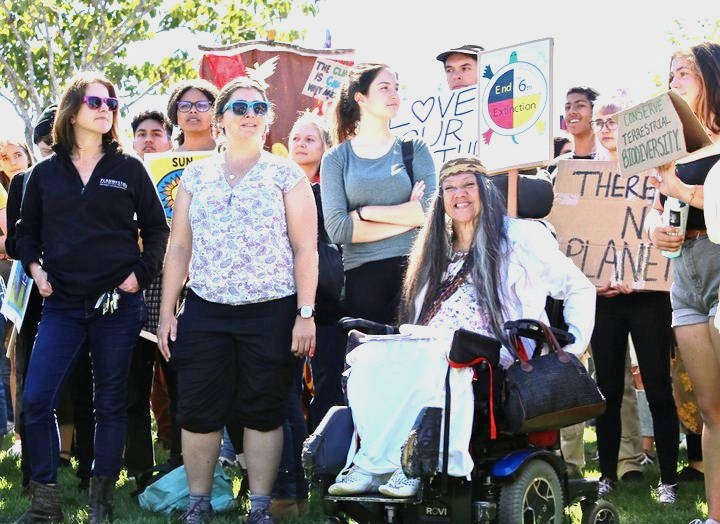
"In one of the largest youth-led demonstrations in history, millions of people from Manhattan to Mumbai took to the streets around the globe on Friday, their chants, speeches and homemade signs delivering the same stern message to world leaders: do more to combat climate change — and do it faster.

From small island nations such as Kiribati to war-torn countries such as Afghanistan and across the United States, young people left their classrooms to demand that governments act with more urgency to wean the world off fossil fuels and cut carbon dioxide emissions.

“Oceans are rising and so are we,” read the sign that 13-year-old Martha Lickman carried through London.

“Whose future? Our future!” shouted students from Montgomery Blair High School in Silver Spring, Md., as they made their way to the U.S. Capitol."

The climate strike was global.  Most outlets covered it in photos.  The photo above is from the Guardian, as is the one directly below.  It is followed by three photos from here in Arcata, from Lost Coast Outpost .


Monday, September 16, 2019

Poetry Monday: Rain at Daybreak


Rain at Daybreak

One at a time the drops find their own leaves
and others follow as the story spreads
they arrive unseen among the waking doves
who answer from the sleep of the valley
there is no other voice or other time

W.S. Merwin
from his last book,  Garden Time


Thursday, September 12, 2019

Daily Lear


--words and images
by Edward Lear

Tuesday, September 10, 2019

Dreaming Up Daily Quote: Wendell Berry

--Wendell Berry

Can't say I agree with everything he says, but this profile at the Nation (from whence comes the above illustration) provides perspective on an admirable life.

Saturday, September 07, 2019

Atwood's Tale

Margaret Atwood's sequel to The Handmaid's Tale has just been published, titled The Testament.  She is 80, and in a recent interview suggested this could be her last novel.  The Nobel Prize in Literature must be awarded to a living writer.  The Nobel committee screwed up royally when it failed to give the literature prize to Ursula LeGuin.  They must not make the same mistake with Margaret Atwood.  There is no writer I know of--no writer in the western world--more deserving.

In an interview for a New York Times story, Atwood said that every time a writer writes, the act of writing implies a reader, "and it's always a future reader," because the writer is almost always separated from the reader in time and space.

"It's always a leap into the unknown future to write anything."

Elsewhere Margaret Atwood argues that writing is "an act of hope," like a message in a bottle.

These perennial facts are intensified by writing on the Internet, which can instantly reach billions of readers, or eventually reach some readers, though it usually is read by very few.

Her comments are illuminating to me in several ways, a few of them personal.  So I have added the quote in bold to the permanent marquee below the title of this blog.  For which the future is largely the subject, even when it seems to be the past.  And the future is the potential audience.

Thursday, September 05, 2019

Daily Lear


words and images by Edward Lear

Filey is a seaside town in the UK.

Among its products are caps, t-shirts etc. which bear this Edward Lear limerick.

The MP for Filey and Yorkshire is Kevin Hollinrake.  He supports fracking because, he says, it will help combat climate change.  Who says that nonsense died with Edward Lear.

Hollinrake is a Conservative who voted with the Brian Johnson Conservatives on the latest Brexit vote.  So he is not one of the British legislators who actually stood up to their Homemade Hitler.


Saturday, August 31, 2019

Mything Links

Recently I had reason to think about the concept of degrees of separation.  The idea that everyone in the world is connected by six or fewer acquaintances--the Six Degrees of Separation thesis-- was proposed by a Hungarian writer in 1929, and made famous by a 1990 play of that title by John Guare.

Various studies of often shaky procedures have attempted to test it, with mixed results. One suggested that the number of connections that link nearly everyone on the planet more likely exceeds ten.  But the idea has fascinated people anyway.

There is in particular a game called Six Degrees of Kevin Bacon, in which players attempt to connect a given actor to the actor Kevin Bacon, who had claimed to have worked with or known everybody in Hollywood.  The first--and probably the only--game I ever played online was a variation of this.  I don't remember the site that hosted it, but the game was to propose the names of two actors, and the person who could connect them first through movies they were in, and with the fewest links, won that round and got to propose the next pair.

So the names could be Will Smith and Laurence Olivier.   Here's how that might go: Will Smith was in the film version of Six Degrees of Separation with Ian McKellen.  McKellen starred in a film version of Richard III with Maggie Smith. Maggie Smith played Desdemona in a film version of Othello starring Laurence Olivier.  (There's also another path to Maggie Smith and Othello.)

Or Will Smith was in several Men in Black films with Tommy Lee Jones, who was in Lincoln with David Straithairn, who starred in Good Night, and Good Luck with Robert Downey, Jr. who costarred with Gwnyeth Paltrow in several Iron Man films and with Jude Law in several Sherlock Holmes films; both Paltrow and Law starred in Sky Captain and the World of Tomorrow, which featured a video cameo by Laurence Olivier.  

But what interests me are connections in real life, especially mine. Mostly but not only, from years as a journalist, I've met a number of people who provide connections to a lot of prominent people in various fields. Some (but not all) were or are themselves pretty prominent.  Through spending time with Billy Joel and briefly meeting Paul Simon, I am two degrees from, say, Paul McCartney (I have several other routes to being 2 degrees from John Lennon and George Harrison) as well as Springsteen, Sting and, of course, Garfunkel.

 Through a brief exchange with Neil Armstrong, I am 2 degrees from probably every astronaut who rocketed to the moon, and through Nichelle Nichols, several women astronauts on the Shuttle.  From meeting Kim Stanley Robinson and Ursula Le Guin, I am 2 degrees from any number of science fiction writers, and by several routes (including agents and editors), 2 degrees from any number of novelists, such as Jim Harrison.  I am even 2 degrees from the super-reclusive Thomas Pynchon, because he once lived here on the North Coast for awhile, and I met someone who met him.

Through Frank Rich (NYTimes theatre critic) and a lot of theatre actors (for example, at the O'Neill Center) I'm second degreed with a lot of stage names, and probably third degreed with many more. And through Janet Maslin (NYTimes film critic), as well as my own interviews with film actors and directors (especially veterans like Martin Ritt) as well as several friends who wound up in the movie biz (not to mention a memorable encounter with the young Karen Allen), I've got a number of additional two degree Hollywood connections to rival Kevin Bacon. Names newly prominent might require an extra degree.

Not bad for somebody you never heard of, as well as somebody a lot of these famous secondary connections never heard of either.

But what about degrees of separation across time as well as social and other kinds of space?   That's what fascinates me now.

For example, if a simple handshake creates a degree, my separation from President John F. Kennedy is 1.  Otherwise it is 2.  Through Harris Wofford (former US Senator from PA, with whom I worked on a project when he was PA Secretary of Labor and Industry) I am 2 degrees from JFK as well as RFK and Martin Luther King.

I am 2 degrees from President Obama, through Knox classmate and friend John Podesta, and he is my most direct connection to a number of Washington figures of the present and recent past, including the Clintons.  (I am also distantly related to the Bushes, Clintons and Obamas, though that's more tenuous.)


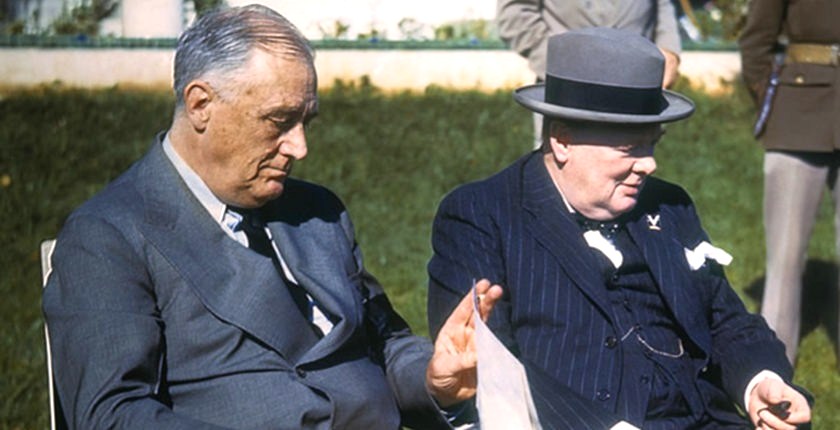
But I am also 2 or 3 degrees from President Franklin D. Roosevelt, and 3 degrees from a number of prominent figures of the World War II era, including Winston Churchill, General George Marshall and Harry Hopkins. And Adolf Hitler.

And as I recently discovered to my awe and astonishment, I am no more than 5 degrees from President Abraham Lincoln.

The route for these connections begins with Larry Jackson, a friend for several decades, who I met in Cambridge, MA.  He knew actor and famed director Orson Welles quite well.  Welles is my connection to FDR, Churchill, Marshall and others, who he knew.  (Recall that Citizen Kane was released in 1941, and before that, Welles was active in the Depression era Federal Theatre Project.  He campaigned several times for FDR.  Add to the many important people he met in his long life as a globe-trotting celebrity, those he met as the child of a wealthy and well-connected father.)  Welles also met Hitler when Hitler was a colorless member of the fringe Nazi Party.

I learned much of this from recently re-watching an interview Welles did with Dick Cavett, in which he also talked about a fascinating woman he knew when he was quite young and she was in her 90s.  And she had known Abraham Lincoln.

This started me considering other connections through time, and some are surprising.  I can name two routes through which I am 3 degrees from H.G. Wells, whose writing career began in the 1890s.  That puts me no more than 4 degrees from Carl Jung and Conan Doyle (not to mention Lenin and Stalin), and 5 degrees from Charles Darwin. Probably 5 degrees as well from Charles Dickens.

If my JFK handshake is allowed, I'd be two degrees from FDR (who JFK must have met when his father was FDR's Ambassador to England) and therefore 3 degrees from Teddy Roosevelt and others of that era, through FDR.

Through meeting Gary Snyder and Allen Ginsberg, I am 2 degrees from Jack Kerouac and William Carlos Williams. But through meeting Buckminster Fuller (grand-nephew of Margaret Fuller), I am four degrees  from Emerson and Thoreau.

I am also 2 degrees from Ernest Hemingway (through writer William Eastlake) and F. Scott Fitzgerald (through a waiter at his favorite St. Paul hotel bar.)  And through a writer I never met but with whom I exchanged letters, 2 degrees to Pablo Picasso.  They seem very remote now even in time, though all but Fitzgerald were alive in my lifetime.

There's something mysterious about all this and how it feels.  Maybe many mysteries in fact.  But at the very least it comports with a stretched sense of time that is acquired with age.  It is not surprising to me that I shook hands with JFK, heard Martin Luther King speak at the March on Washington, and also voted twice (actually four times) for Barack Obama. For someone younger, it might seem incredible. That's also how I feel when I look at the past before my life: it seems so remote and spread out.

So for instance I was astounded to read an interview with Rebecca West, once the lover of H.G. Wells, who mentioned meeting contemporary playwright Tom Stoppard.  Wells and Stoppard seem like figures in different time universes, which in most senses they are, but not altogether.  They were in fact alive at the same time, though barely.

Cocteau, Picasso, Stravinsky, Olga Picasso
Or that Jean Cocteau knew Braque and the young Picasso (and Gino Severini), and had his last film produced by Francois Truffaut.  In fact, only 30 or 40 years separates the Paris of Picasso from the Paris of Truffaut.  (And since I met Truffaut, I'm 2 degrees from Cocteau, and 3 from everyone he met, including Uncle Gino.)

Still, it is one thing to try to realize that my great-grandparents may well have been alive when Lincoln was, and another to be able to count the links in my chain of connection to Lincoln himself.  Especially since it is possible if not likely that none of my great-grandparents in their European hinterlands had much of an idea of who Lincoln was.

What is it about these connections?  In truth, I make more direct connections with these people through reading their words, listening to their music, watching their films and so on.  I guess some of it is physical.  The tradition of shaking the hand of someone who had shaken the hand of someone famous (however many hands are involved in that chain) goes back at least to a famed 19th century boxer John L. Sullivan.  I remember I spent a day shaking hands with my high school classmates when I returned from the JFK Inaugural weekend.

The physical connection suggests family or community, which is also I suppose the point of the degrees linking all of humanity.  Perhaps it also suggests the fact that we breathe the same air, that we are composed of the same molecules, as everyone living or who has ever lived.

But it also makes time, history and greatness more intimate.  A short chain of touch stretches from me to Abraham Lincoln.  I suppose that soon no one will be able to claim even those five degrees of touch, so this also grounds me in my time, even as it widens that ground.

Like any kind of historical consciousness, this suggests that more is possible than what we have in the present, and surprising elements of our present have close precedents in the past.  But it makes all that more visceral, while it nourishes and strengthens the imagination.

It also frees me from this moment, this troubled and slowly suicidal context, in which it seems scarcely possible that someone like FDR ever existed.  But a chain of touch of (at most) two people separates me from him, and links me to him.  Through those links, he lives.  In those links, I live.

Saturday, August 24, 2019

History of My Reading/ Fall 1967: The Music Is Your Special Friend

My first of three trips out of Galesburg during the fall term of 1967 was the October bus trip to the March on the Pentagon in Washington.  My second was the shortest: the 200 or so miles up to Chicago in early November, also with Knox College classmates, to attend a Donovan concert.

Judging by this ticket stub on sale on ebay, the concert was on Saturday November 11 at the Opera House on Wacker Drive at Madison St.  I don't recall exactly who went or even how we got there and back.  I only remember camping out overnight on the living room floor of Jeff Katz's parents house.  So I'm guessing Jeff was one, and maybe Steve Meyers, Howard Partner, Susan Isono, Karen Miyake--but those are just guesses.

Donovan was pretty much at the height of his fame.  After his folk period--influenced by Dylan and other American artists, but also with roots in Celtic traditional song--he had two huge pop hits in "Sunshine Superman" and "Mellow Yellow."  He was becoming a psychedelic troubadour, which was very much the imagery of this show.  In addition to his hits and other past songs, he performed songs from his forthcoming double album, Gifts From a Flower to a Garden, the musical expression of that imagery.   


His Chicago gig was part of a US tour. Amidst flowers, incense and other trippy trappings, each two hour concert began with an introduction by his father.  I remember that his first tune was the simple but mesmerizing "Isle of Islay." He played solo guitar, and then on some numbers he was accompanied by a jazz quintet (there were jazzy arrangements on his Mellow Yellow album especially), and did two songs backed by the Metropolitan String Quartet (according to a letter I wrote at the time.)

We had good seats in one of the center sections, third row--close enough, I noted in that letter, that we caught flowers that he threw into the audience at the end of the concert.

My third trip was the longest in distance and time.  In late November--probably during Thanksgiving break--I flew to San Francisco.  So months after the Summer of Love had cooled, I finally got there.

I went as an official representative of Knox College, to the national convention of the Associated Student Governments.  I suppose I got the gig because I was still one of the student representatives on the Faculty Student Affairs Committee, and possibly because I was one of the few students still around during Thanksgiving break.  There were three of us: Bill Larkin, Karen Miyake and me.  I don't recall seeing much of Bill Larkin while we were there, but I did hang out a lot with Karen.   


Demo against Dow Chemical and Vietnam War at U. of Wisconsin
in fall 1967--just one example of what this convention ignored. 
The convention was held in a downtown hotel, and I dutifully attended various sessions and seminars.  I wrote an article about it, published in the Knox Student. I noted that the male attendees mostly wore identical dark suits and thin ties, and seemed chiefly interested in promoting one or another candidate for ASG president.  It was clearly and disturbingly a clueless establishment organization, and I noted the contrast between the reactionary rhetoric and what was actually happening on university campuses at that moment. I heard with some satisfaction the luncheon speech by Paul Goodman (who had also been at the Pentagon), expressing my own evaluation. He asked, "Is the ASG for real?"

I recall one seminar I mention, that was billed as being about experimental colleges but was actually about sensitivity training and t-groups, the first time I'd heard of them, and I left laughing but with chagrin as I suspected there would be more and worse ahead (EST anyone?)

But I especially recall one session I didn't include in my article: a panel about drugs on campus.  I sat in the audience waiting for it to begin, and I suppose I was fairly conspicuous sans thin tie etc.  Apparently spotting my boots and long hair, someone came down from the platform to ask me if I'd like to come up and be on the panel.  I was clearly being asked as an obvious representative of the country's campus potheads (or "freaks" in the parlance of the day.)  As I had gotten authentically stoned for the first time earlier that autumn, I did not feel qualified, and immediately lost confidence in the panel itself.  I not only declined, I got the hell out of there.

Reading this article is interesting to me now because I see in it glimmers of the writing I would be doing professionally in a few years, for the Boston Phoenix and later for Esquire and other magazines: accurate reporting but with a cultural point of view. In this article I noted that: "We had also been issued a gift bag as we entered the hotel, which contained toothpaste, mouthwash, soap and deodorant, which meant that in addition to looking the same, everyone soon smelled the same as well."  (I noticed this phenomenon many times in later years at various conventions I attended as a reporter or speaker, though I began to see it as an unconscious element in the strange solidarity that often develops.)

But the memorable moments of the trip came outside and after the convention.  I don't recall how we connected, but one evening Jay Matson came by the hotel and drove me and Karen back to the apartment he shared with another ex-Knoxite--I believe it was Buddy Blatner. Their apartment was on an upper floor, with a view of downtown San Francisco, especially a fancy high rise hotel, all steel and glass, with a bubble-like glass elevator that operated on the outside of the building.  They told us an outrageous story of noticing one night that the elevator had stopped.  They tried to report this to the hotel, but instead got connected to the elevator itself.  It went on from there.  To this day I'm not sure if that actually happened, or Karen and I were the gullible audience of an urban legend.

On a glorious day we were driven up Highway One to the rocky seacoast in Marin County, surely one of the most beautiful places I'd ever been.  Mike Hamrin was probably there, and Mary Jacobson definitely was.  When I returned I wrote a song about that day (since lost), sort of on the order of "San Francisco Bay Blues."  The only line I remember was: "Mary's hair was shining for a thousand miles."

And I remember an evening that Karen and I saw a double feature at a theatre not far from the hotel: Doctor Strangelove, in the most incredibly brilliant black and white print I've ever seen, and The War Game, Peter Watkins' 1965 graphic and apocalyptic faux documentary about nuclear war and its aftermath in England.  It's the only time I've ever seen that film shown in a theatre, and one of the few times I've seen it at all.  The films were powerful and the walk back to the hotel decidedly melancholy.  We were continually fighting off the feeling of being a doomed generation anyway.

As for the residual Summer of Love, we visited Haight-Ashbury and I was not especially inspired.  It looked pretty tawdry.  The cannabis culture was more impressive.  In my few months of experience, I was used to watching seeds and stems being separated, small joints being twisted roughly into shape and passed around whatever group had assembled. In San Francisco, the joints were neat machine-made cigarettes in yellow paper, and everyone got their own.

I did make my way to the Avalon Ballroom, one of the two or three hip venues for the burgeoning San Francisco music scene.  I was hoping to see Jefferson Airplane but instead caught a new band called Big Brother and the Holding Company, with a raucous lead singer.  There was a light show blanketing the auditorium and I was pretty far from the stage, so I note with appropriate irony that I spent considerable time trying to figure out if the singer was male or female.  Female, I finally decided.  She was Janis Joplin.

Karen and I had stayed on after the convention was over.  I believe Jay hosted us. Then Karen looked at me sadly and said, "We have to go back."  It was true, and so we did.  But I didn't return empty-handed--the convention had unexpectedly provided some lasting souvenirs.  On its last day I heard someone say that a record company representative was giving away record albums.  I rushed to the appointed room, and got the last two he had.  One was John Fahey's Requia, a series of his meditative composition on acoustic guitar, which I listened to a lot over the years.

The other was the second album by Country Joe and the Fish: I Feel Like I'm Fixin To Die, which we played over and over that year on First Street, in the house Bill Thompson dubbed "The Galesburg Home For the Bewildered."

Karen and I arrived back at Knox in time for a dance in the darkened Oak Room.  Prominent among the music played that night were both sides of the just-released new Beatles single: "I Am the Walrus," and "Hello Goodbye."

Which suggests a point to be made about these 1960s college years: the music gave us pleasure, thrills, wonder, solace, the beat of our lives.  But it also provided much of the text of our lives as well.


Sergeant Pepper's Lonely Hearts Club Band was innovative in many ways, and one of them was the back of the album cover, imprinted with the words to the songs.  Printing the lyrics then became standard practice in the late 60s and 70s.  This only emphasized what was already true: these were the words we knew, we talked about, we even debated.  We communicated using them.

In fact I'd read an interview (and clipped it from a teen magazine) in which Donovan made this very point.  He referred to "Eleanor Rigby" as a three minute novel.

Of course, as Phil Spector had famously insisted (immortalized in a profile by Tom Wolfe), the meaning of the words was also in the music, the beat.  They couldn't be separated.  Still, these were the texts of those days as much or more than any books.

Movies were also important, of course.  We had access to some films from around the world, both old and new, including experimental film. Todd Crandall inherited the Knox Cinema Club, and deputized me to run a packaged experimental film series--which basically meant advertising it, picking up the movies and delivering them for exhibition in the Round Room of the CFA.

In those packages I recall a lot of trippy shorts and animation, especially from the Film Board of Canada, and a live action short I remember to this day, and have never been able to track down. (For awhile I thought it might be Steven Spielberg's Amblin, but it's not.) It was about a young male hitchhiker, picked up and seduced by a young woman, and then abandoned by the side of the road.  What I most remember is their conversation in the cabin where they spent the night.  She asked him what he wants to be, and he shrugged and said, "I'd like to be a Beatle."  Pretty much my less than secret sentiments. All of this led to interest in film techniques, and in 1967-68, English professor Richard Alexander offered the first filmmaking course I know of at Knox.

Even some Hollywood films were culturally important.  I made a list of a couple of dozen that were significant to us and the times in some way by 1968, and apart from the movies I've previously mentioned that were important to me, our generation more generally got catch phrases and visual imagery from movies as well as a few books.  During our time at Knox the most important movies generally would have to include Dr. Strangelove, Who's Afraid of Virginia Woolf?, Bonnie and Clyde, Blow-Up, The Graduate in 1967 and 2001: A Space Odyssey in 1968.

But music had a special place, and that school year of 1967-68 also happened to be a remarkable year for popular music.  Some years later, when I knew a lot of people in the movie business around Los Angeles, I was having lunch with some technicians working on an independent production--a sound guy and a camera guy.  One was an older veteran with lots of stories, the other was about my age.  He and I started talking about the albums released in 1967 and '68, at a level of detail that included the season if not the month of release.  "You guys sound like a couple of medieval scholars," the older man observed.

These days I need a little goosing from the Internet, but there are records I remember vividly.  With three housemates and assorted friends, this was the first time I had multiple people contributing to a common cache of albums.  We played older ones (all the Dylan electrics, for example) but the new ones came in a flood.
We arrived still listening to Sergeant Pepper as well as Hendrix Are You Experienced?, Jefferson Airplane's Surrealistic Pillow, Donovan's Mellow Yellow and Sunshine Superman, Dylan's Blonde on Blonde.  Tim Hardin's first two albums were making the rounds.  I recall watching Anne Maxfield stare intently at the phonograph as she listened to a Tim Hardin record to the end, then sent the needle back to the beginning again.

The school year began with the Doors' second album Strange Days joining their first;  Buffalo Springfield Again, Arlo Guthrie's Alice's Restaurant and Procol Harum, joined in late autumn by Cream's Disraeli Gears,  Jefferson Airplane's After Bathing At Baxter's, and (thanks to my San Francisco trip), Country Joe and the Fish I Feel Like I'm Fixin to Die.
   
Winter releases included Dylan's John Wesley Harding,  Hendrix Axis: Bold As Love, Traffic's Mr. Fantasy, The Songs of Leonard Cohen, Van Dyke Parks' Song Cycle, The Notorious Byrd Brothers, Aretha Franklin's Lady Soul, Steppenwolf, The Graduate soundtrack of songs by Simon & Garfunkel, The Who Sell Out, Donovan's A Gift from a Flower to a Garden, the Stones Their Satanic Majesties Request, and the Beatles Magical Mystery Tour.

The spring saw Joni Mitchell's first, the Supremes Reflections, Simon & Garfunkel's Bookends, Moby Grape's Wow/Grape Jam, the Papas and the Mamas, the Beach Boys Friends.

All these plus blues from Paul Butterfield and John Mayall, new albums from Motown, from Judy Collins and Joan Baez, and who knows how many psychedelic bands that came and went (the  Electric Prunes, Quicksilver Messenger Service, the Seeds, Iron Butterfly, Electric Flag, H.P. Lovecraft, the International Submarine Band etc.)

 Also on turntables were the Velvet Underground, Mothers of Invention (Frank Zappa) and the Fugs. I was listening as well to Ravi Shankar and this strange new singer, Harry Nilsson.

Bill Thompson introduced me to Vanilla Fudge, a white soul band gone psychedelic, and to the Buffalo Springfield's first album.  I listened to several songs on it over and over, and found in "Do I Have to Come Right Out and Say It" some echo of my own awkwardness.

 I  introduced him to the Bee Gees first album, and then their second (Horizontal) that winter.  He especially liked the song "Daytime Girl."  That year women students were wearing ponchos, some with Native American-style designs.  He saw a woman in a poncho raising her arms when he heard the line "spreading her wings like a high-flying eagle..."

The texts of the songs, and the songs themselves, reflected and articulated feelings and insights of the times, as well as of more timeless situations.  There was an edge to them borne partly by rebellious responses to the dominant culture.  They broke old boundaries, and though this was often due to new techniques, influences of different styles of music, and pure imagination, there was that element of cannabis and psychedelic drug experiences and the attitudes they suggested.

All of this probably made us more receptive to certain poets and writers working in other media.  But that is a subject for another post.
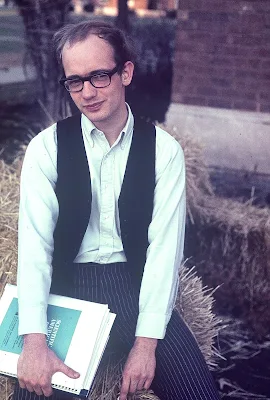
Ric Clinebell. Leonard Borden photo
First we read, then we write, as Emerson said.  First we listened, then we played and/or composed.  I learned what I could from the records, but housemate Ric Clinebell got a little frustrated with my guitar playing, and taught me a few basic bass runs and accompaniments.  Figuring out and learning new songs with different chords and patterns also inspired my own compositions.

Me and Steve Meyers, again on one of those
Knox construction sites.  Photo courtesy of
Howard Partner.
A few times--maybe including this year-- I sat on the floor in a circle with Dick Wissler and Steve Meyers as we improvised together on guitars.  I was not skilled as they were in playing licks low on the neck but I had noticed in the guitar improvisations by Country Joe and the Fish, there was a chord or chord pattern that anchored it all, so I did that.

I first remember Dick Wissler when he was in a band, and came into the Gizmo one night with his band mates.  They were standing at the counter when they suddenly broke into "He's a real Nowhere Man" in full harmony.  I thought that was the coolest thing.  Back home when Clayton, Mike and I learned those harmonies, I loved the moments when we spontaneously sang that opening line. One of us would start and the others immediately joined in.  We got it right every time.

This pretty much concludes this long-winded tour through my college years.  I dealt with the rest of my senior year in a series of posts around the time of my class of 1968's 50th anniversary (winter here and here, spring here and here)--these posts can also be accessed through the labels Knox College, 1967, 1968, 60s.

I will however continue with posts on "books of the 60s" that cover multiple years with additional memories for a kind of floating context.  And go on from there.