Saturday, June 05, 2010

There are many photos around now of birds saturated in heavy oil, dead, dying or helpless, as a result of the BP oil gusher in the Gulf. At a certain point reproducing them seems indecent, but they must be seen. This one is tragic enough. The more graphic images perhaps must be seen to understand the consequences to other beings, although the images themselves are apparently not sufficient. Even progressive writers and talkers have no vocabulary to recognize other beings--they are "wildlife" or "the environment," just abstractions in the political noise, as they have been in the so-called scientific noise. Governor Bobby Jindal was so intent on making political points that he watched one oiled bird flop around in front of him without trying to help. These beings deserve some dignity as well as recognition. More on this point in the post below.

Bird Brain

I'm fascinated with this interview with a neurobiologist who studies the neurobiology of music. First of all, this is the first instance I've run across of a key scientific finding that started with a viral YouTube video (which I referenced on this site at the time, of Snowball the dancing cockatoo.)

Then there's this suggestive statement: "What do humans have in common with parrots? Both species are vocal learners, with the ability to imitate sounds. We share that rare skill with parrots. In that one respect, our brains are more like those of parrots than chimpanzees." I suspect there is more than this one respect, but it does emphasize the importance of the auditory in humans, especially when visual primacy is so heavily promoted.

I note once again that like too many other human endeavors, science is a prisoner of fashion. Studying the neurobiology involved in making and responding to music is a relatively new field, even though humans have been making and responding to music since probably before they were human. But fashion dictated that music wasn't scientific enough. "One of the founders of this field, Dr. Robert Zatorre, before 2000, he never used the word music in a grant application. He knew it would get turned down automatically because people thought this was not scientific. Instead, he used terms like “complex nonlinguistic auditory processing.”

Finally, the reason that this finding is so earth-shattering is not that it is a new phenomenon, nor one that would especially surprise people who have been around birds a lot. It's the latest in a growing line of corrections to human (scientific) arrogance. Man, the only tool maker and tool user? Not really. Man, the only maker and user of language? Hardly. Now add to that, man, the only musical creature. Not so much. Seriously. That a bird--moreover, a bird that can imitate virtually any sound, including melodies--can dance to a beat has astounded modern science.

It is only because of scientific arrogance--serving the worst of human arrogance--as our species has separated itself from all others. And is now the agent for ridding the planet of other species--thousands of them every year, from plants to our closest genetic relatives.

Indigenous peoples who lived in the same context as other animals learned music from bird song. Their stories and traditions--surviving into the 20th century, as chronicled by Richard Nelson among others--profess the notion, so apparently odd to our official knowledge, that we are not the only beings on the planet. But we are so far away from those other beings that it takes the pomposity of neuroscience to square the circle. We will lose so many of those beings before we figure out once again how to relate to them, or even how to talk about them except as objects and abstractions.

Thursday, June 03, 2010

The Dreaming Up the Future Daily Quote


"It’s our job as a nation to advocate on behalf of the America that we hope for -- to make decisions that will benefit the next generation -- even if it’s not always popular; even if we can’t always see those benefits in the short-term. We make decisions like this on behalf of our own children every single day. And while it’s harder to do with an entire country as large and diverse as ours, it’s no less important.

The role of government has never been to plan every detail or dictate every outcome. At its best, government has simply knocked away barriers to opportunity and laid the foundation for a better future. Our people -- with all their drive and ingenuity -- always end up building the rest. And if we can do that again -- if we can continue building that foundation and making those hard decisions on behalf of the next generation -- I have no doubt that we will leave our children the America that we all hope for."


President Barack Obama
Pittsburgh, PA
June 2, 2010

Technology and the Politics of Hope

Can technology save the future? There are a lot of answers to that question, such as "Maybe, if we use it right," "If it doesn't, what will?" or "Sure, if we can afford to buy it from China."

Technology can't prevent a lot of what may happen, not anymore. But it can help us deal with it. And it can make everyone's future better than it might otherwise be, while it may still be able to save the farther future. The future is an adventure, and technology should be part of it.

In an eloquent address at Carnegie Mellon University in Pittsburgh, President Obama described his efforts dealing with the economy in the political context, and as an expression of his philosophy of government. He also talked about the future, the contributions of new technologies, and specifically, the crucial role of renewable energy technologies.

"But there’s no natural lobby for the clean energy company that may start a few years from now," he said. "There’s no natural lobby for the research that may lead to a lifesaving medical breakthrough. There’s no natural lobby for the student who may not be able to afford a college education, but if they got one could end up making discoveries that would transform America and the world.

It’s our job as a nation to advocate on behalf of the America that we hope for -- to make decisions that will benefit the next generation -- even if it’s not always popular; even if we can’t always see those benefits in the short-term."

He praised Pittsburgh as an example of a community working for the future, transforming itself from the rust belt to green technologies, health care and education. "All of this came to be because as a community, you prepared and adapted and invested in a better future -- even if you weren’t always sure what that future would look like."

President Obama also said that putting a price on carbon pollution is essential to creating a new energy economy, and he pledged to support climate and energy legislation. "And, Pittsburgh, I want you to know, the votes may not be there right now, but I intend to find them in the coming months. (Applause.) I will continue to make the case for a clean energy future wherever and whenever I can. (Applause.) I will work with anyone to get this done -- and we will get it done."

The Pittsburgh speech was Obama's clearest statement yet as President of what Arthur Schlesinger Jr. defined as the politics of hope--the politics that looks forward to the future.

Elements within the U.S., but also efforts elsewhere in the world with stronger government backing, are advancing clean energy technology and capabilities. But as this report shows (among others) is that clean energy is a key to the future of the U.S. economy, not just domestically but in international trade. These opportunities are forging new economic models.

But we are in danger of being left behind. China is advancing more aggressively. Apart from the Climate Crisis itself, this is the greatest challenge to our ability as a nation to safeguard our country's future, and to participate in the world's future.

In a general sense, there are lots of ideas out there for technologies that cooperate with nature rather than fight it. Some combination of them could be revolutionary beyond our imagination, in providing clean energy, in helping us deal with the effects of the Climate Crisis, and even to address its causes directly.

Though we're tempted to see massive projects as evidence of success, the technologies that will give the future the best possibilities will be small-scale, extremely efficient, easy to replicate and use locally by individual families and communities, very hardy, flexible and adaptable.

There are dangerous technologies, too, battling for attention and development money, that appeal to our arrogance. The roles and powers of technology have been themes of thought and art since the dawn of the industrial revolution, and those issues are even more pressing today. We are in many ways dominated now by powerful technologies gone wrong: our extractive energy technologies, our wasteful, destructive and cruel technologies for feeding ourselves, and the other wasteful, destructive and suicidal technologies of our society, such as our technologies of violence and war.

And there is also the apparently strong current--stronger that we might have imagined in this day and age--of opposition to science and the most settled scientific questions. A resurgence of impulses we associate with the Dark Ages. This, too, as much as powerful technologies gone wrong, threatens the future.

In this regard, I am haunted by a scene in the 1953 movie version of H.G. Wells' The War of the Worlds, which relocated the action from England to southern California. At one point, the scientists at Cal Tech trying to study how to defeat the Martian invaders, must evacuate to a lab in the mountains. But before they can get there, a panicked mob waylays their truck, destroys their equipment and injures several of the scientists. I wonder if metaphorically this isn't what's happening now, and I fear it suggests what may happen.

Fortunately at the moment we have a President who has a vision of the future and a commitment to science and knowledge. (Also on Wednesday, while at the White House receiving a Library of Congress award for songwriting, Paul McCartney quipped that "it’s great to have a president who knows what a library is.") He is supported by enough Democratic members of Congress to at least get a bill increasing funding for science and science education passed, despite a pathetically cynical GOPer maneuver.

Technology by itself won't save us. But together with the politics of hope, maybe it can help give the future a chance.

The President says he has no doubt that we will create a better future. I have doubts. But doubts don't matter. What you believe will happen doesn't matter. What matters is believing that working towards a better future in whatever ways you can is how you want to live your life.

Wednesday, June 02, 2010

Gulf Disaster & the Climate Future: The Shadow Government is You


As the Climate Crisis leaches into Climate Cataclysm, we're likely to see more disasters. Some of them, like hurricanes and other storms, will spend their first fury within a relatively short period of time, with a long aftermath of coping and recovery. Others, like droughts and other climate effects, will be slow-motion catastrophes. Still others will be something in between, similar to the current BP oil disaster in the Gulf of Mexico: they will happen and keep happening over time, with effects that are both immediate and long-lasting.

The prospect of such disasters fill us with forboding, because they cause a lot of pain, and often change things for a long time for many people and for a particular place, with some effects continuing forever. But we fear these disasters not only for what hurricanes or whatever forces do, but for what we may do to each other, or not do for each other. And in this regard, Rebecca Solnit has some reassurance, although she also finds some truth in another fear.

San Francisco-based author Rebecca Solnit explores how people responded to historical and contemporary disasters, from the 1906 San Francisco Earthquake to hurricane Katrina, in her book A Paradise Built in Hell: The Extraordinary Communities That Arise in Disaster (Viking.) Her two principal findings contradict conventional expectations, and in Katrina particularly, suggest that what we think we know through media coverage is pretty close to dead wrong.

From movies and TV as well as common philosophies of human nature we expect responses to disasters that range from fearful selfishness to predatory violence. But time after time, as evidenced by reporting and scientific studies, the opposite happens: people share, help each other, and work together, Solnit finds. And despite the dire circumstances, they do so joyfully.

This happened in New Orleans, although this catastrophe wasn’t reported that way. Which follows from Solnit’s second conclusion: authorities like police and military often make matters worse by treating civilians as dangerous criminals, and the media reports from their point of view.

Think of the New Orleans Superdome, which we heard was a nest of violence, gangs, murder and rape. The truth was slower to emerge: no murders, and the "gangs" were often young men who organized to prevent rapes and to “loot” stores—for food, water and supplies, with particular attention to the needs of babies and the elderly. Meanwhile, the people there and elsewhere in New Orleans were all but abandoned by authorities, not only unable to help, but obsessed with keeping order and afraid of the people who looked to them for help. They even discouraged volunteer rescuers. That the New Orleans police and white vigilantes murdered black citizens, often rescuers, is documented and now slowly coming to trials.

Solnit’s book ends before the Haiti earthquake, but reporting from there supports these observations: authorities were often more afraid of ordinary people than they were intent on helping them stay alive.

Solnit’s general conclusion is that the existing system, built on fear, “is mitigated every day by altruism, mutual aid, and solidarity, by the acts of individuals and organizations who are motivated by hope and by love rather than fear. They are akin to a shadow government—another system ready to do more were they voted into power. Disaster votes them in, in a sense, because in an emergency these skills and ties work while fear and divisiveness do not.”

This, frankly, doesn't surprise me. It's not just that people are naturally compassionate. It's that people have capabilities they never get to use, for a purpose they know is good. They are often eager to do so.

The heartening message is the ability and willingness of ordinary people to focus on helping each other, because typically that’s all the help there is for at least the first 48 hours after a big disaster. That's a comfort for those of us in a perennial danger zone, as many of us are (here on the North Coast, a catastrophic earthquake is inevitable, probably within a generation.) But the dismaying message is the tension between authorities and people. The paranoid Rabid Right analysis of police and government has some basis in fact, though as New Orleans shows, the white middle class people promoting it have less to fear than minorities, including the objects of the Rabid Right's Arizxenophobia.

We also see perhaps a new wrinkle on this tendency in the Gulf, where it is a mega-corporation that is pushing people around--including (reportedly) preventing people from wearing protective masks when cleaning up toxic oil and chemicals from the beaches. When police are basically in the employ of corporations--or, as in the case of mercenaries like Blackwater in New Orleans--are corporations themselves, then people and their communities are in danger from the very people that finance Tea Partiers, and that they and their libertarian ideologues support.

At the very least, I hope Solnit's book is read by disaster response planners, government officials, police and the military, and it helps them focus on ways to help people instead of treating them as the enemy.

Don't Forget, Don't Neglect

The media simply isn't covering the biggest economic, cultural, social and political story going, beyond the BP oil Armaggedon: unemployment benefits have run out for an estimated one million Americans, with many more behind them as their benefits run out.

The House has passed an extension, as well as a bill stripping tax breaks for companies that export jobs out of the U.S. But the Senate left Washington on recess without passing it, because of opposition. The arguments against it are counterfactual, as usual--for one thing, the extension is likely to create thousands of new jobs and is a proven economic stimulus. But GOPers and the resurgent Rabid Right is particularly good at the reverse equivalent of the schoolyard taunt, "That's what you are, what am I?" When they sling charges and call names, they're very often saying, That's what I am, what are you? Every time their opponents raise a social justice issue, the GOPers cry "Class War!" When class war is exactly what they are waging. It's the Rich against everybody else.

As Paul Krugman wrote, the latest self-reinforcing congressional delusion is that cutting the deficit is more important than stimulating the economy, and more to the point, helping the victims of The Rich First, Last and Always economy keep their heads above water. "More and more, conventional wisdom says that the responsible thing is to make the unemployed suffer. And while the benefits from inflicting pain are an illusion, the pain itself will be all too real."

Functionally, the deficit is this case is just a reason that the rich might someday get taxed more. This is even clearer here in California, where the poor, the helpless and the old will be abandoned in Ahnold's budget, so that the wealthy--like the Republicans spending hundreds of millions of dollars on their campaigns--won't have to pay for the consequences of their rapaciousness.

Tuesday, June 01, 2010

Oily News That's Fit to Print: Welcome to the Future


Welcome to the future. More than any event so far, the BP oil disaster is a preview of the near future: A future of consequences, of dreadful crises--often more than one happening at once-- with no easy solutions and maybe no solutions at all, of media panic and Internet hysteria feeding on itself, people feeling pain needing someone to blame, with unrealistic expectations and the propensity to destroy the best they can ever expect to get. A future that will call for courage, imagination and self-awareness, the ability to step back, and to step up, to do what can be done. A future of unlikely and unknown heroes, and of perseverance in the whirlwind of self-destruction.

BP's Top Kill unsurprisingly failed, and as the company gets ready to trot out an even riskier fix, BP is further alienating scientists and the White House. According to this report in the Guardian, BP is challenging scientific findings of underwater oil plumes: "BP's claim is likely only to further anger environmentalists and the White House, which has grown increasingly suspicious of the company's claims to be frank and transparent on developments. The president's environmental adviser and director of the Office of Energy and Climate Change Policy, Carol Browner, has accused BP of misstating the scale of the leak."

The Guardian also reports that "the US military has ruled out taking charge of the operation to stem the flow of oil from the blown-out BP rig. The chairman of the joint chiefs of staff, Admiral Mike Mullen, today said that military chiefs had looked at the available equipment and concluded that "the best technology in the world, with respect to that, exists in the oil industry".

However, the Guardian erroneously reports that "former US secretary of state, Colin Powell, said the military should step in because the crisis was now "beyond the capacity" of BP to stop." What Powell actually said was that the military might be able to help, but that current military leaders would know better if they in fact can.

Another report on the underwater oil:"researchers say the disaster in waters where light doesn't shine through could ripple across the food chain."Every fish and invertebrate contacting the oil is probably dying. I have no doubt about that," said Prosanta Chakrabarty, a Louisiana State University fish biologist.

"Recent discoveries of endangered sea turtles soaked in oil and 22 dolphins found dead in the spill zone only hint at the scope of a potential calamity that could last years and unravel the Gulf's food web."

Dispersing the oil lower into the water column protects beaches, but also keeps it in cooler waters where oil does not break down as fast. That could prolong the oil's potential to poison fish, said Larry McKinney, director of the Harte Research Institute at Texas A&M University-Corpus Christi. "There's a school of thought that says we've made it worse because of the dispersants," he said."

President Obama meets Tuesday "with the leaders of a panel he created to probe the worst oil spill in U.S. history... as a giant slick from BP's blown-out Gulf of Mexico well poses a new threat to the coasts of Mississippi and Alabama."

Also today, "U.S. Attorney General Eric Holder will meet with federal prosecutors and state attorneys general in New Orleans. It will be Holder's first trip to survey the damage before what legal experts believe will be a criminal investigation into the disaster."


Meanwhile, the first named storm of the season, Tropical Storm Agatha, killed more than one hundred people in Central America, with torrential rains, and a sinkhole that swallowed a city building.

Monday, May 31, 2010

The Dreaming Up Daily Quote

"Over the bleached bones and jumbled residues of numerous civilizations are written the pathetic words: 'Too late.'"

Martin Luther King, Jr.

Friday, May 28, 2010

Oily News That's Fit to Print: Hysteria Isn't Helping

President Obama visited Louisiana and conferred with public officials there. He said: "Understandably, the feelings of frustration and anger, the sense that any response is inadequate -- we expect that frustration and anger to continue until we actually solve this problem. But in the meantime, we’ve got to make sure that everybody is working in concert, that everybody is moving in the same direction. And I want everybody to know that everybody here -- at every level -- is working night and day to end this crisis. We’re considering every single idea out there, especially from folks who know these communities best."

The President is more understanding than I am. Certainly there is justifiable anger, and in particular continuing suspicion about BP's attempt to manage news about the entire situation, including alleged strongarm tactics versus reporters. But the cable hysteria, once started, is apparently unstoppable, and it's getting wilder in its misinformation, misinterpretations and irresponsibility. Hysteria isn't helping.

There's a certain disingenuousness about it, as if reporters who are supposed to be informed are suddenly aware of bullying and deception by oil companies, or that years of stripping the federal government of resources and regulatory ability empowered by their mindlessly repeating the political oversimplifications of the shrink the government until you can drown it in the Gulf of Mexico Rabid Right.

What misinformation and misinterpretation? Chris Matthews and his crew going off half-cocked about the Coast Guard chief who seemed not to know that the Top Kill procedure was "suspended." Well, it wasn't suspended. Sending the mud down the pipes was suspended, according to plan, so the pressure could be more effectively studied. Now CNN is criticizing Allen for saying the mud was being sent down when it wasn't. Is that really what he said? This is media hysteria. Yes, the whole thing is extremely bad and it's going to get worse, and the effects will be felt for a very long time. If the genocide of wildlife species isn't enough, there's the human beings who are going to be sickened as well as driven into poverty. We can expect more hysteria when the Top Kill procedure doesn't work. But as President Obama said, when the cameras move on, the government will still be there, doing what can be done.

In a comment on a Daily Kos thread I wrote this: I agree that limiting media access unless areas are too unsafe is outrageous. But there are two other things going on here, regarding government response.

First is that the Obama administration is hampered by government capabilities that have been shrunk. People don't want to pay for government, and then when they need government, they want them to have every advanced resource on hand immediately.

Second is that some things just can't be done or done instantly--it's not humanly or institutionally possible. Yet we've got 24 hour coverage and panic-inducing screamers like Chris Matthews screeching misinformation and ignorance along with legitimate concerns.

Today I thought about a little history: about the months and months at the start of World War II, before the U.S. fully geared up its resources, that the Allies lost battle after battle. The U.S. forces were getting slaughtered in the Pacific for months. What if the media was panicking people 24 hours a day then?

This is a crisis with no good solution. It's going to have long and deep consequences. We're paying the piper. This is the future. Grow up and put your shoulder to the wheel."

Another commenter replied: "What are you doing on this blog? You make sense for chrissakes."

President Obama ended his remarks in Louisiana with this statement:

"But as I said yesterday, and as I repeated in the meeting that we just left, I ultimately take responsibility for solving this crisis. I’m the President and the buck stops with me. So I give the people of this community and the entire Gulf my word that we’re going to hold ourselves accountable to do whatever it takes for as long as it takes to stop this catastrophe, to defend our natural resources, to repair the damage, and to keep this region on its feet. Justice will be done for those whose lives have been upended by this disaster, for the families of those whose lives have been lost -- that is a solemn pledge that I am making."

Oily News That's Fit to Print: "The Federal Government is Fully Engaged"


Early in his term, President John F. Kennedy listened to CIA and military experts who assured him that their plan to invade Cuba, formulated in the Eisenhower administration, would liberate the island. The result was the Bay of Pigs disaster. Early in his term, President Obama is learning who he can trust--and who he cannot. He's learned one such lesson the hard way, in the Gulf oil gusher crisis. “Where I was wrong,” he said in his one hour-plus press conference Thursday, “was in my belief that the oil companies had their act together when it came to worst-case scenarios.”

The New York Times account noted the novelty and directness of his admission: "But the president’s concessions of missteps were striking. Admitting fault, after all, is not a common presidential habit, and happens only under great duress. The passive voice has been a favorite technique. President George Bush said “mistakes were made” during Iran-contra. President Bill Clinton said “mistakes were made” during campaign finance scandals. And President George W. Bush said “mistakes were made” during the firing of federal prosecutors."

But as well as admitting where he was wrong, President Obama pushed back on critiques he said were contrary to the facts. Though he was "angry and frustrated" about how the gusher situation has transpired, he said that the government has made “the largest effort of its kind in U.S. history” and was in charge of BP’s response. “Those who think we were either slow in our response or lacked urgency don’t know the facts,” he said. “This has been our highest priority since this crisis occurred.”

While noting the disastrous contributions of BP and the regulatory agencies staffed by Bush-Cheney, he made something very clear going forward: “In case you’re wondering who’s responsible, I take responsibility,” Mr. Obama said as he concluded the news conference. “It is my job to make sure that everything is done to shut this down. That doesn’t mean it’s going to be easy. It doesn’t mean it’s going to happen right away or the way I’d like it to happen. It doesn’t mean that we’re not going to make mistakes. But there shouldn’t be any confusion here. The federal government is fully engaged, and I’m fully engaged.”

Full transcript of the press conference here. It's worth reading--it answers a lot of questions the media and its screechers have raised. The President visits Louisiana on Friday.

Meanwhile, BP's Top Kill effort has been re-started after a long suspension. The more I hear about it, and about prior attempts, the less likely it seems that it will be successful. But if it is successful, it will be due mostly to the outside scientists assembled by the federal government who are advising on the procedure. Because oil companies have seldom succeeded with this technique, and never in water this deep.

In other Oily news that's fit to print, a federal team issued a new preliminary estimate of the quantity of oil gushing into the Gulf, at between 12,000 and 19,000 barrels a day, which would certainly make this the largest oil leak disaster in U.S. history.

A preview of the consequences of its extent as well as its nature as a deep ocean gusher, scientists believe they've discovered a huge toxic underwater plume of oil and chemical dispersants, six miles wide and more than 3,200 feet deep-- which is 3/5 of a mile.

Meanwhile, NOAA issued its official hurricane forecast for the coming season, which is in line with other scientific predictions: "The Atlantic hurricane season is likely to be a busy one that may spawn as many as 23 named tropical storms, including up to seven major hurricanes, the National Oceanic and Atmospheric Administration said Thursday. It predicted that 8 to 14 storms would strengthen into hurricanes, with winds of 74 m.p.h. or higher. Three to seven of those could reach Category 3 status or higher — meaning they bring sustained winds of at least 111 m.p.h. “The greater likelihood of storms brings an increased risk of a landfall,” said Jane Lubchenco, the agency’s administrator. “In short, we urge everyone to be prepared.”

This adds yet one more potentially powerful factor to a situation that is unprecedented in several ways. No one knows how the poisoning of deep water will affect the ocean ecology, nor how much the oil will damage endangered species as well as the Gulf fish. Now no one knows how hurricanes will affect the oily waters. Perhaps drive oil to land. Perhaps disperse it faster. It's all beyond what we know, and all very much out of our control.

That's why you take care of the land and the waters in the first place. As President Obama noted today, growing up in Hawaii he learned that "the ocean is sacred." That's a lesson and an attitude that should be foremost, as well as deep in our values.

Thursday, May 27, 2010

The Dreaming Up Daily Quote

The “disposition to admire, and almost to worship, the rich and the powerful, and to despise, or, at least, to neglect persons of poor and mean condition...is...the great and most universal cause of the corruption of our moral sentiments.”
Adam Smith
Illustration: Keeper of the Beach by Tim Paul at Spirit Wrestler Gallery.

Oily News That's Fit to Print: Wednesday Update, Thursday Preview

President Obama will hold a press conference Thursday. He'll announce new oil drilling policies, reportedly including suspension of all drilling in the Alaskan Arctic. But what he has to say about the Gulf will be the most important. If he masters this press conference, he goes to Louisiana on Friday clearly in charge.

In the Gulf, BP is conducting its Big Kill experiment to plug the damn hole, though they say they won't know if it's at all successful for 24 hours or more. Rachel Maddow did report that BP was encouraged because what was coming up from the well was the "mud" they were piping into it, not oil. I'm not sure why this was encouraging, since the mud was on top of the oil and so would naturally be what came up at first, but what do I know?

Rachel also had a real stunner--NBC news footage that showed step by step the uncanny resemblance of this catastrophe to a similiar one in the Gulf in 1979, right down to the same company involved, and especially the same techniques used to to stop it--all of which failed, and the leak went on for months. It wasn't so close to shore, however, and it was in June--not mating season in the marshes, but closer to hurricane season. Plus it was a well 200 feet down, not more than 5,000.

Back to President Obama. The criticism continued today, getting screechier, to the point that a couple of commentators were criticizing Obama for talking about how this disaster suggests the U.S. needs to turn more decisively to clean energy--this was too bloodless for them, not germane to the Gulf. Maybe, except that what they were criticizing was a soundbite, taken out of a speech in which he did talk about the Gulf situation as a tragedy. (Interesting however that making this connection to the energy bill was lauded in the blogosphere.)

Though I think the President needs to take command on this issue, and I hope and expect him to explain just what's been going on, we also have to concede that he has other problems to deal with. It did look for a day that a new Korean war might erupt, and that danger hasn't entirely passed. Immigration, gays in the military, etc. are all heating up in Congress, but the most important and under-covered issue is the Jobs Bill, which includes crucial extensions of unemployment benefits. It's the closest we'll get to a "second stimulus" at a critical moment in economic recovery.

Another under-covered story--and I'm surprised that the Rabid Right media hasn't jumped on this one--is the beheading of the White House Court Jester for inappropriate jokes about the national debt.

Tuesday, May 25, 2010

Oily News That's Fit to Print

Updates late Tuesday:

Reuters:
"Dogged by delays and intense pressure from the Obama administration, BP faces a pivotal day on Wednesday as it attempts a tricky plan to clog the gushing Gulf of Mexico oil well five weeks into the disaster. If the "top kill" procedure joins the list of BP failures to plug the leak, U.S. President Barack Obama's government may have no choice but to take central charge of the response to what is considered the worst oil spill in U.S. history.

Obama has told aides in recent days to "plug the damn hole" and he will head to the Louisiana Gulf coast on Friday for the second time since the April 20 rig blast that killed 11 and unleashed the oil. "

There was some indication that by Tuesday night Pacific, the Top Kill effort had begun.

President Obama is expected to outline new policies regarding deep oil leases on Thursday.

Commentators Lawrence O'Donnell and David Gergen joined the chorus calling for "a bullhorn moment" from President Obama, and a more forceful and coordinated federal effort. Gergen even declared that if World War II had been run like this operation, we would "all be speaking German," which--and somebody might look this up--sounds like something he's said before, perhaps about Katrina.


BP may or may not be about to try something else--the so-called "Top Kill"-- to stop the Gulf gusher. The effort was scheduled for Wednesday but at this moment is in some doubt.

President Obama is scheduled to visit the Gulf region on Friday.

There's a lot of noise, a lot of justified emotion amidst the political opportunism. President Obama needs to speak to this, but actions aren't always dramatic--here's a piece on what the government is doing. It's big but dull and hence invisible.

And speaking of what we can't see, there's as much or more damage happening underwater.

The Washington Post reports growing conflict between some in the Obama administration and BP on efforts related to the Gulf gusher. AP is the latest to show that BP was deeply involved in the notorious Exxon Valdez spill.

The New York Times looks at a forthcoming report that documents the extent to which Bush-Cheney "regulators" were wholly owned by the oil companies.
TIME has a similar story. Bob Herbert writes about the results of this "cosy relationship."

The Gulf gusher has raised concerns over expanded offshore drilling in Canadian waters. Canada's oversight and regulations are much more stringent than U.S., but none of the articles I reviewed confirmed something intriguing I heard on TV: that Canada requires a relief well be dug at the same time as the main well. A relief well is only tested method for stopping the flow. One is being dug at the Gulf site but won't be ready until August at the soonest.

Don't Panic, It's Towel Day!

Among the wisdom embedded in the immortal Hitchhiker's Guide to the Galaxy is the home truth that "A towel is about the most massively useful thing an interstellar hitchhiker can have." So on May 25, Douglas Adams fans carry a towel everywhere they go, in his honor. Earthlings may be turning out to not be mostly harmless, but it's a great fiction anyway. For more on this 9-year tradition, here's Wired.

Monday, May 24, 2010

Danger Zone

The anger and dismay over the visible damage caused by the Gulf oil gusher is increasing, and at this moment the Obama administration is in danger of being swamped politically unless the President gets personally and visibly involved, and there is some direct response and visible action.

Here's why I say this now. First, sharp criticism is coming from Democrats as well as Republicans, particularly those with ties to Louisiana and the Gulf region. Also among them now is Keith Olbermann, who has gone to the extent of dumping his count of the days since Bush declared Mission Accomplished in Iraq, and is now counting the days since that oil rig exploded.

Second, administration responses to criticism and news over the past 24 hours has been awful. The Coast Guard Commandant in charge on the scene may be technically correct, but his message about federal helplessness, and contradiction of the Secretary of Interior, isn't helpful.

There has been no effective answer to the New York Times story about new permits and waivers being granted for even deeper ocean drilling. Energy Secretary Chu made a disastrous joke to Rachel about only knowing what he reads in the papers, about actions presumably within his own department. [Correction: this may have been the Interior Dept.'s area, not Energy.]

Plus, BP has out and out said it is defying an EPA order to use less toxic contaminants, and the EPA seems to be backing down. This may be realistic--it may be that BP hasn't been able to find a substitute in time--but it looks pretty bad.

The bottom line is that the mantra of this becoming Obama's Katrina is gaining traction. When a reporter like Howard Fineman says that his Gulf sources claim the Obama administration "doesn't get it," this is a huge red flag.

President Obama has maybe 48 hours, maybe just 24, to prevent this story from taking control, with disastrous long-term effects on his presidency. And this does mean something beyond politics. A lot of people are seeing very scary imagery--oil on shore next to inserts of oil continuing to gush from the well--and they need visible leadership. All that we load onto our presidents in terms of expectations may not be realistic or fair, but we do it. And people are crying out for visible leadership.

There are two main elements to this crisis: the ongoing gusher that needs to be plugged, and the oil coming onto beaches and marshes and up waterways that needs to be held off, and cleaned up when it does arrive. I don't credit a lot of the barroom proposals for stopping the gusher, but I do listen to experienced people in the Gulf who say they know how to stop the oil from coming in, if they just had the permits. I say give them the damn permits, help them out, it can't be worse than doing nothing, or leaving that aspect of the crisis to BP.

It's the Innocent Who Are Paying

Photo: A young heron lies dying in the oil-soaked marsh.

AP: "Several pelicans were coated in oil on Barataria Bay off Louisiana, their usually brown and white feathers now jet black. Pelican eggs were glazed with rust-colored gunk, and new hatchlings and nests were also coated with crude.

It is unclear if the area can even be cleaned, or if the birds can be saved. It is also unknown how much of the Gulf Coast will end up looking the same way because of a well that has spewed untold millions of gallons of oil since an offshore rig exploded more than a month ago. "As we talk, a total of more than 65 miles of our shoreline now has been oiled," said Louisiana Gov. Bobby Jindal, who announced new efforts to keep the spill from spreading."

Sunday, May 23, 2010

Latest from the War on Terra

Now that oil is reaching land plus the video feed of the continuing gusher, this story is dominating news and the blogosphere. Most of the rec diaries at Kos concern it, including a couple that pick up on this article that suggests the EPA is considering an action that would instantly void all U.S. contracts with BP.

Meanwhile, EPA head Lisa Jackson is on the scene for several days, and Interior Sec Salazar is going to be. The NY Times quotes Salazar as saying about BP: "if we find they’re not doing what they’re supposed to be doing, we’ll push them out of the way, appropriately.”

Though U.S. attention is focused on the Gulf, that Icelandic volcano is still causing problems for air traffic in Europe and the UK. And the coincidence of poor initial media coverage and this monster Gulf story has perhaps permanently obscured the significance of what's being called "Nashville's Katrina"--the superflood in early May that this piece suggests is a harbinger of the Climate Crisis future.

The President v. the Fulminators

All that keen live video of the oil gushing out has given cable bloviators more time to fill than they have knowledge on the Gulf oil gusher. I caught one segment on CNN in which they interviewed just about anybody who said they had an idea on how to stop the spill. Maybe some idea will turn out good, but this is a lot like journalism as barroom bullshit.

President Obama appointed a bipartisan commission to investigate how such spills can be prevented and if not stopped, then dealt with better. As Climate Progress pointed out, this is already more than Bush was willing to do for the monumental failures of Katrina response. But while people are understandably upset at what's going on, and want somebody to solve it--somebody like our official daddy, the President--it's a bit irresponsible (though hardly unusual) for some cablemouths to be fulminating about presidential lassitude without finding out the facts of the matter.

Chris Matthews has been very vocal about it--I want Harry Truman! he shouts. Send in the Seabees, send aircraft carriers and submarines, plug up the damn oil! What he learned from an expert, though, was chastening--and appropriately scary. He found that the President and the federal government are doing all it is possible for them to do--partly because after decades of privatization, tax cuts to the rich and starving the government of resources--the only institutions with the technology to deal with this are corporations, and other countries. For example, the U.S. literally does not have a submarine capable of functioning at those depths. Oil companies do. And so does Russia, China, Japan and France.

This of course is a classic and not unforeseeable problem of depending on corporations like Halliburton and Blackwater to run your wars, disaster relief and increasingly your country. When they're the problem, you have no solution, and no resources to apply.

Here are some excerpts from this interview in a diary by NedSparks at Kos, with links to the full interview transcript and the White House page on what the government is doing in the Gulf to deal with this unfolding tragedy.

Saturday, May 22, 2010

Chickens Arriving to Roost


NPR: "Thick, brown and rust-colored, sticky oil is washing up on the beaches, marshes and wetlands of some parts of southern Louisiana, threatening wildlife and vital habitat. Those communities not yet seeing oil on their shores are bracing for the worst."

CNN: "The damaging effects of the massive oil spill in the Gulf of Mexico will be felt all the way to Europe and the Arctic, a top scientist told a congressional panel Friday."

Climate Progress: President Obama uses his weekly address to talk about the Gulf gusher.

Measuring the Edge of Extinction

We can say that species are "endangered," and that the gulf oil gusher threatens them, but what that means in the context of today's situation of very depleted life comes a great deal clearer with something like this, concerning the threat of this oil and chemical disaster to sperm whales in the Gulf :
"A 2009 stock assessment report by the National Oceanic and Atmospheric Administration (NOAA) estimated that the potential biological removal, or PBR, level for the Gulf of Mexico sperm whale population is three. That means the whales' long-term survival is at risk if, in addition to natural deaths, three sperm whales a year are killed or removed by human causes. The loss of a handful of whales each year can impact a population of hundreds, because sperm whales—especially females—require a very long time to reach sexual maturity. Females then give birth to just three or four calves during their entire lifetimes. "

The Daily Babble

I'm a computer stuck-in-the mud: I use PCs with Microsoft browser, email and word processor. But I'm getting pretty sick of it all. Basically because they keep changing it, and making "improvements" that almost always cost me more time and effort to do what I want to do.

I've got Vista on my desktop. It's not so bad, I've gotten used to it, and I've learned to control the Microsoft Updates. But HP--or somebody--snuck something by me, and now switching between windows is two to three times more time consuming, and I can't figure out even where to find the change it made.

The new version of Explorer was snuck in when I had this machine in the shop, and now cutting and pasting for this blog takes a couple of extra steps each time. My new laptop has the post-Vista operating system, version 7, which is supposed to be so much better, but for my purposes, is just more complicated and worse. Plus I can't work on it for more than a few minutes before some message pops up on the screen demanding that I update this or that, or some damn thing.

And what's with Windows Mail? When email started, the email couldn't be read by anything but the Microsoft program that created it, which made it impossible to store email and read it on another machine, without importing it into the same email program. And damn if however many years later, this hasn't been fixed. Windows Mail isn't read by anything else--it's incompatible with Word and associated programs. I realize most people trash their email immediately. But this is the only way we get mail these days. I have a trunk full of letters from pre-email days. It would be nice to be able to keep letters I receive electronically without copying them into word processing and/or printing them individually. Is that really too much to ask?

I've managed to hold onto my 1998 version of Word, which is the only thing that instantly boots up when I access it. I'm staying away from new versions of Word and Office like the plague they seem to be. Though I don't know how much longer the Lords of the Internet will let me.

And these PCs, apparently loaded with capabilities which remain completely hidden. No explanations, no logical paths, no manual (of course)--print or online. Just a lot of ways to waste tremendous amounts of time and energy, often with no result, because they make a gazillion variations on their machines, and apparently can't keep track of how to do stuff on each one of them.

So that's that. As for these blogs, again I realize how much time I spend on them with little excuse in terms of numbers of readers. I like doing these little essays or feature stories, almost like a real magazine or something, but I don't seem to be doing much else with my non-jobs time. So instead of running away from the traditional blogging concept, I'm experimenting with moving closer to it. It might even be starting to look like tweeting. Don't know how long that will last, but if things seem to be changing around here, don't be too surprised.

Generational Shift

I can remember people and the press complaining in the first years--and what turned out to be the only years--that JFK wasn't doing enough. I've read of the deep disillusionment with FDR from the left. And even I have things I wished the Obama administration was doing, or doing more of, or faster. But maybe the wingnuts have it right, for the wrong reasons: the change now underway is significant.

That in any case is the theme of a New York Times lead article today, that begins: "With the Senate’s passage of financial regulation, Congress and the White House have completed 16 months of activity that rival any other since the New Deal in scope or ambition. Like the Reagan Revolution or Lyndon Johnson’s Great Society, the new progressive period has the makings of a generational shift in how Washington operates."

Friday, May 21, 2010

As the Camera Turns

The Gulf Gusher is a big topic on cable blather stations today. Is there some new compelling story? Not exactly. It's awful and getting worse, but that hasn't focused their attention so much before. The reason is simple: live video of the gushing oil is now available. So they're running it continuously, and so they have to talk about it. As the camera turns.

Thursday, May 20, 2010

Gulf Gusher Updates

More malfeasance and more oil: Jed Lewison has an update with links on the latest news concerning the Gulf gusher. And Climate Progress has even more.

More Light on Heat

The normally conservative National Academy of Science has issued "the most comprehensive report ever on climate change" in response to a congressional request, affirming that "climate change is occurring, the Earth is warming ... concentrations of carbon dioxide are increasing, and there are very clear fingerprints that link [those effects] to humans," and calling for strong action to confront the Climate Crisis, including mechanisms to put a stiff price on carbon.

Another NAS panel noted that "the government and communities need to prepare for threats that are likely no matter what actions we take," such as consequences of sea level rises and the droughts in the Southwest. In other words, they recognize the need to deal with both causes and effects, something I've been advocating here for several years.

Earlier this week, NOAA and NASA regular climate reports concluded that we've just experienced the hottest March and April on record. A weather expert noted that"the three past seasons with record warm April SST anomalies all had abnormally high numbers of intense hurricanes." NASA's figures show it was also the hottest January to April period, and it is very likely that 2010 will be the hottest year on record. NOAA also found a strong multi-year warming trend in the world's oceans.

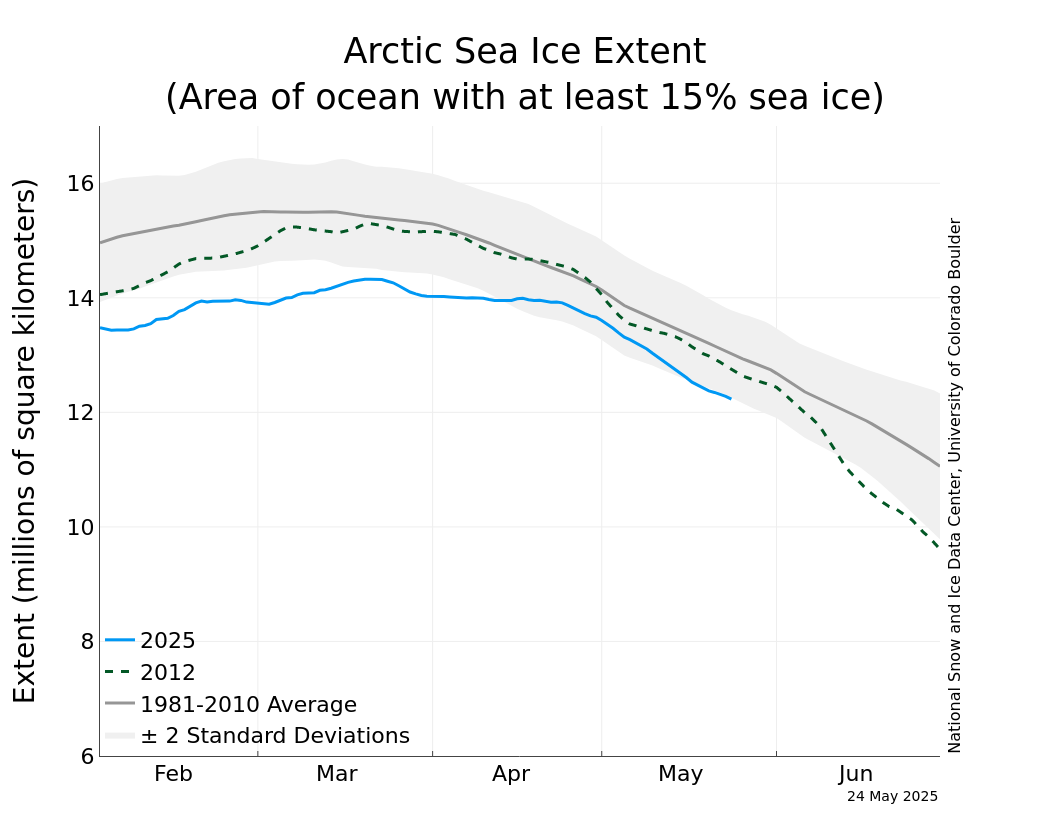
There's both anecdotal evidence (from British explorers) and data suggesting that the Arctic ice is melting faster this year than the previous record year of 2007. The data shows an unusually steep curve in seasonal melting, which suggests 2010 could set a new record. Not exactly something you want to cheer for.

Wednesday, May 19, 2010

Oil Wrongs


photo: wake of a ship through the oil in the Gulf of Mexico


As BP's chief said on Tuesday that the environmental impact of the oil gush is likely to be "very, very modest," and the company whose faulty equipment, shoddy procedures and fraud caused the explosion was busy dividing up more than a billion dollars in dividends, the New York Times reported: "A thin stem of oil stretching east from BP PLC's spill is increasingly likely to enter the Loop Current, a powerful Gulf of Mexico flow that runs past the Florida Keys and up the Atlantic Seaboard, the National Oceanic and Atmospheric Administration chief said today."

Once oil is in the current, it would likely reach the Florida Keys within 10 days. By month's end, the oil could reach Miami, oceanographers have also warned...Any oil or dispersants pulled south to the Florida Straits could pose an environmental hazard, especially for coral reefs, said Nan Walker, the director of the Earth Scan Laboratory at Louisiana State University. "The dispersants could kill corals," Walker said earlier this month.'

According to a TIME Magazine report:

" Federal officials have also raised alarms about the damage that has already been done to turtles, sea birds and marine mammals. And in response to concerns about the impact on undersea species, the National Oceanic and Atmospheric Administration (NOAA) on Tuesday expanded the no-fishing zone; nearly one-fifth of the Gulf, more than 47,000 sq. miles, is now off limits for fishing. Far from having a "very, very modest" effect, the Gulf oil spill will linger for a very long time. "Make no mistake," said Rowan Gould, the acting director of the U.S. Fish and Wildlife Service. "This spill is sufficient to affect wildlife in the Gulf and across the region for years and perhaps decades."

A Reuters' roundup adds: "In a sign of the widening environmental impact, the United States nearly doubled a no-fishing zone in waters seen affected by the oil gushing from the blown well, extending it to 19 percent of U.S. waters in the Gulf." There were reports of oil reaching beaches and marshes.

In Washington, President Obama has called for an independent commission to investigate the situation, several Senators are requesting that the Justice Department open civil and criminal probes, the Secretary of Interior has promised reforms of the responsible regulatory agency, and Senate Republicans are blocking legislation to increase the cap on oil company liability for the effects of their actions.

Meanwhile, this Houston Chronicle article articulates more of the concern expressed in my last post on this subject: "The oil has not yet caused a visible catastrophe — so far only 23 oiled birds have been found dead — but there is increasing concern about the array of life below the Gulf of Mexico's surface, too deep to watch closely. “What concerns us the most is what we can't see,” said Rowan Gould, the U.S. Fish and Wildlife Service's acting director."

A couple of other interesting links: This piece by Douglas Brinkley about the Breton National Wildlife Refuge, one of the places threatened by the oil and chemicals, and this very adept primer, ostensibly for reporters but also a great consumer guide, on the realities and misinformation (or truth and lies) involved in the "Gulf oil geyser," by Mark Sumner, coming out from behind his Kos screenname of Devilstower, which I assume makes him more employable as a science writer elsewhere. He should be--he knows his stuff.

Monday, May 17, 2010

The Dreaming Up Daily Quote

“I am dreaming, and I want to do good. For the good you do is never lost. Not even in dreams.”

Pedro Calderon de la Barca

Sunday, May 16, 2010

Heeding Invisible Voices


Over the past few days, scientists have figured that there's a lot more oil coming out of that gusher in the Gulf--estimated at about ten times more per day. This oil is gushing a mile below the ocean surface, and now scientists believe not all of it is coming up, at least not right away: "Scientists are finding enormous oil plumes in the deep waters of the Gulf of Mexico, including one as large as 10 miles long, 3 miles wide and 300 feet thick in spots. One scientist adds: “There’s a tremendous amount of oil in multiple layers, three or four or five layers deep in the water column.”

Oil depletes oxygen in the water, among other toxic effects, and it happens potentially over a long period of time. It kills life, plain and simple. (This Kos diary puts other relevant articles together.)

There are a lot of lessons about this gusher we're going to painfully learn that apply in a shorter time scale to expected Climate Crisis effects: devastating local effects that accumulate over time, and then cause secondary disasters that spread invisibly to the rest of the world, felt perhaps more measurably as economic effects but with other less quantifiable elements subtracted from the world we know, and the world we need.

We already knew that oil coming into wetlands and shores will kill nesting birds and other wildlife, as we knew that oil on the surface will kill endangered species as well as the fish and shellfish that the Gulf supplies as food to the world. Now underwater oil further threatens species we know, like dolphins, whales and turtles. But such vast quantities of oil so deep may erase a world of life we almost never see, a world of immense beauty, and for all we know, as essential to our own lives as the honey bee. This, too, is a metaphor for the Climate Crisis. A warning if we need one, of what is to come. And of course, it's more than a metaphor. It's a spreading, almost inconceivable reality.

But the time scale is part of our perception problem. Though this is a shorter time scale, it is longer that we are accustomed to pay attention, especially in this novelty-driven data age. We didn't even pay attention to Katrina and New Orleans long enough to understand what really has happened there. We have to use a little imagination, and some perseverance in paying attention.

Our attention to this catastrophe is already waning: there are no new pictures. What is happening is happening invisibly, at least for the moment. This catastrophe is exposing realities, and also our weaknesses.

The Climate/Energy Bill Debate

On the Climate 'n Energy bill in the Senate: the Conventional Wisdom says it doesn't have much of a chance, and like everything else these days, it is attacked from the Right and the Left. From the Left, there's Phil Radford of Greenpeace debating Joseph Romm of Climate Progress. I love Greenpeace but Radford didn't make much sense, and Romm was right to call him out on misstatements. Radford did make one cogent claim, though: the carbon costs imposed by this bill aren't high enough to jump-start clean energy and energy conservation. That's an important concern, although I don't necessarily accept that his opinion is correct. I'd like to see this point joined more specifically.

(His other claim--that the bill isn't strong enough to give Europe and the rest of the world the cover to continue their efforts--was also simply an assertion, surrounded by faulty data. So someone else will have to produce evidence to make this claim more credibly.)

Otherwise, Romm is persuasive: the idea is to turn the ship around, get it going in the right direction: towards penalizing the production of heat-trapping gases and incentives for clean energy. Maybe it's not enough. But the alternative, which is pretty clearly not doing anything at all, is definitely not enough.

But issues that need to be clarified: are individual states going to be prevented from establishing stronger rules, and if so why, and how it that going to work anyway? And if they are going to take the only weapon now in the arsenal away--EPA's ability to regulate carbon based on the Clean Air Act--what enforcement with the force of law will substitute?

Thursday, May 13, 2010

The First Victims


These are among the first known victims of the Gulf gusher: fish, turtles and brown pelicans (bottom photo) are turning up dead, and yesterday it was reported that six dolphins so far are among the dead. For the dolphins, it appears that the chemicals being spread in huge quantities to disperse the oil are as deadly as the oil itself.

Meanwhile, as quoted by Climate Progress, the Washington Post reported on House hearings: A senior House Democrat said that the blowout preventer that failed to stop an oil leak in the Gulf of Mexico had a dead battery in its control pod, leaks in its hydraulic system, a “useless” test version of one of the devices that was supposed to close the flow of oil and a cutting tool that wasn’t strong enough to shear through joints that made up 10 percent of the drill pipe."

Climate Progress also quotes a Coast Guard Captain slams industry "self-certification" of BOP: "Manufactured by industry, installed by industry, with no government witnessing oversight of the installation or the construction."

And the rig flew the Marshall Island flag to further escape U.S. oversight.