Saturday, December 10, 2022

These Books Matter 2022


 Lots of books are published each year, and many of them contribute in some way: they inform, remember, correct the record, advance a new idea, edify, inspire and/or entertain.  But there are a smaller number of books that matter.

Though what matters can mean different things.  Some books matter because of their consequences over time.  Novels (like plays, movies and songs) can become beloved, or in the overused term, "iconic" or even "classic." Typically they speak to different people in different ways, saying different things to each.  Yet they remain memorable for many, and eventually become cultural touchstones that nearly everyone knows at least a little.  

However, identifying such books is best accomplished years afterwards.  Less time needs to pass perhaps to see a novel's influence in the world.  For example, Kim Stanley Robinson's The Ministry of the Future, published almost two years ago,  has clearly become a book that matters.  Not only is it the author's best-selling novel but it has entered into, and in some ways focused, discussions on how to address the climate crisis future, not only in the U.S. but perhaps even more strongly in Europe and internationally.  Richard Powers' two most recent novels, The Overstory and Bewilderment, have also exerted strong responses and focused emotions, inquiry and discussion on a range of related topics: not just forest issues, but questions of what constitutes life and intelligence, and the relationships of humans to the rest of life--what is increasingly called the "more than human world."   


Nonfiction books can perhaps be more easily identified more quickly as books that matter.  Published nearly a decade ago now, Thomas Picketty's Capital in the Twenty-First Century is clearly a book that matters.  Applying contemporary economic and historical analysis to very basic questions, Picketty both inspired and coalesced important thinking about basic changes in economic structures needed to make a stable and better future.  Its analysis of the failures of today's economic order and prevailing conservative philosophy, particularly showing the dangers of the huge gaps between the few at the top and everyone else, has become influential even to approaches less radical than Picketty might favor, such as a simple return to the Keynesian economics that prevailed in the U.S. from FDR until Reagan.  That analysis which shows that prosperity is attained by supporting the middle class and public sector investment is becoming U.S. policy again under the Biden administration, in what journalist Michael Tomasky is calling Middle-Out Economics, the title of his new book: perhaps a candidate for a book that matters. (In the meantime, this Politico piece and interview is a good summary.)

But books can matter before their influence is measured simply by being crucial contributions on crucial topics. They are groundbreaking in important ways, though not necessarily unique.  Their importance depends as well on how riveting they are to read.  I have several candidates for books that matter on this basis, published in the past year or so.  It's not an exhaustive list; perhaps the minimum.  The order in which I present them does not imply rank.  What links them is that they present in a generous if not full way a dramatically new synthesis that tells us something startling about our world that upends conventional wisdom and offers a new framework for perceiving and acting in the world.  In that sense, they bring the news.

The Dawn of Everything: A New History of Humanity

by David Graeber and David Wengrow


Published towards the end of last year, this book is already influencing newer work.  Its scope is enormous: nothing less than the human story.  The linear story of development (or evolution of society) is a comfortable one for many reasons.  It simplifies textbook categories, and it leads logically and inevitably to contemporary "advanced" societies, the apex of it all: from caveman to capitalism.  Who loves this story?  The same type folks who extracted "Social Darwinism" from the complexities of Darwinian evolution.  Robber barons like John D. Rockerfeller and Andrew Carnegie saw that it was good, and gave it their monied blessings.

According to the two Davids, both archaeologists, the story is wrong, right from the beginning. Modern humans weren't the sole apex of evolution--other humanoids had real societies, too, with all the elements of intelligence and expression.  We carry some of their genes. 

Society did not develop or even change from hunter-gatherer to agricultural to urban.  All these forms coexisted and intermingled, and there were many hybrids.  There were urban societies without kings or rulers, and tyrannical hunter-gatherers.  The Davids may be a little judgey in their descriptions of the varieties of Native (North and South) American societies, but they make their point--they were not simple or primitive or identical; they were often sophisticated, complex, various and sometimes large.  

This book emphasized an historical point that has since been taken up by others: that the form of democracy that governed the Six Nations Confederacy (the Haudenosaunee) that lasted longer than our democracy has so far, was patiently explained to Benjamin Franklin and others by some of its leaders, and informed the formation of the non-Native American democracy.  Too bad it didn't also adopt the Prime Directive of the  Haudenosaunee: in all decisions take into account the seventh generation to come.

This book of 692 pages is replete with examples, written with verve and wit, so it can read like a wonder book.  We don't really need Marvel or the other purveyors of outsized fantasies:  it's there in the histories that have either only recently discovered or studied, or conveniently ignored because they complicate or contradict the main story--the one that has gone a long way towards the fix we're in, on the brink of destroying it all.

An Immense World: How Animal Senses Reveal the Hidden Realms Around Us

by Ed Yong 


In Richard Powers’ novel The Overstory, the character that most readers noted and remembered is a woman scientist who discovers that trees in a forest communicate with each other, and help each other chemically to ward off disease.  She is ridiculed by scandalized scientists and forced out of academia until her research is vindicated, and she becomes a kind of folk hero.

 This character is based on a real life researcher, Suzanne Simard, whose book Finding the Mother Tree subsequently became popular.  But even more popular was a book on the same theme published a few years earlier by forester Peter Wohlleben, with the more arresting title The Hidden Life of Trees: What They Feel, How They Communicate.

 That book’s success, expanding on revelations about the complex life of the forest, led to a series of similar books by Wohlleben and many others, with titles often beginning with “The Hidden Life of” or “The Secret Life of” various animals, plants and other natural phenomena, including ice.  These books reflected new research but also observations that had gone unnoticed or derided because they contradicted established views on the natural world as comprised of simple if sometimes mysterious living objects, of interest mostly as exploitable for human ends.

 All of this helped prepare readers for the June 2022 publication of An Immense World by the much praised science journalist Ed Yong. It turns out that everything has a life hidden to humans, partly because our current preconceptions block awareness, but also because other lifeforms experience the world in vastly different ways.

 The key concept here is umwelt, named by early 20th century zoologist Jakob von Uexkull.  It refers to the sensory world of animals, determined by what senses they have and what they can do.  As Yong demonstrates through scientists he visits, these vary considerably.  Some creatures taste with their feet, others hear ultrasound or see into the ultraviolet. They may sense electromagnetic waves.

   Senses that we share with other animals are used in different ways, and the balance among them can be radically different.  Dogs smell and hear better than they see—so their world is one of aroma trails.  Even their color vision is different, and one of the more startling illustrations in this book compares the colors in a typical room that we see, and how dogs see them.

Though sometimes based on dismissed and forgotten insights, most of the research is new, as scientists use new technologies to dispel old assumptions.  That birds can’t smell is one of them, but there are many more.  Some of these discoveries are astonishing:  for instance, the vocalizations and communication that goes on out of human hearing range.  We can detect only a fraction of whales’ songs, and it turns out that mice sing to each other.  At some points this book starts to sound like Douglas Adams’ humorous takes in The Hitchhiker’s Guide to the Galaxy (that mice actually run experiments on humans, that dolphins can escape human catastrophe) may have more substance than expected.

 Apart from the wondrous details, there are larger points here.  Humans assumed a lot about other life based on their own sensorium, but we’ve missed quite a lot.  “Our Umwelt is still limited; it just doesn’t feel that way.  To us, it feels all-encompassing.  It is all that we know, and so we easily mistake it for all there is to know.  This is an illusion, and one that every animal shares.”

 But science and other forms of observation at the service of human imagination can help us see not only some of the ways other lifeforms live and communicate, but how our own activities disrupt their lives.  Light pollution wreaks havoc on various birds and other animals; noise pollution in the oceans endangers whales and other sea creatures.  

Despite the book's length, Yong's precise but informal voice and his flourishes of wit make it eminently readable, yet the science reporting itself is admirable. Even the footnotes are interesting reading. It helps that what the science is reporting remains continuously fascinating. 

 This research has greatly complicated human conceptions of what other lifeforms are, and expands the notions, extent and range of sentience and intelligence. It is this theme that James Bridle takes up in his book.

 Ways of Being: Animals, Plants, Machines: The Search for Planetary Intelligence

By James Bridle 

Bridle writes and thinks chiefly about technologies, and his disquiet about the direction and limitations of artificial intelligence sent him to explore other kinds of intelligences in the natural world.

 Again, the concept of Umwelt is evoked. Bridle also refers to both Richard Powers’ The Overstory and Kim Stanley Robinson’s The Ministry for the Future as starting points for his own explorations.  He ranges far and wide, from our humanoid ancestors to the intelligence of slime mold, and applies his observations to the new machines.  “The idea of forming new relationships with non-human intelligence is the central theme of this book,” he writes.  “It emanates from a wider and deeper dawning: the increasingly evident and pressing reality of our utter entanglement with the more-than-human world.”

 Bridle’s cogent and provocative musings apply not only to the possible futures of machine intelligence but, as Yong’s book does, to the endangered life of this planet and the necessity to actively preserve it.  As we discover and admit the extent of intelligent life and its beautiful complexity, we are close to destroying it.

 The singular and expressive organization of information and the inspired insights more than compensate for some slackness and an editorial lapse or two. Bridle's ideas and their expression in this book merit serious attention.

This recent run of books on non-human life, culminating so far in Yong and Bridle, should end any credibility given to the traditional notion of animals as natural automatons, important only as they are useful to humans, with no feelings to consider or intelligence to respect and learn from.  Gaia expanded the definition of life, and now we grapple with kinds of intelligence not only in familiar animals but plants, microbes and other life. We'd better start learning.

 One of the ideas that Bridle interrogates is the notion promoted by digital industries and other enthusiasts that intelligence is primarily based on calculation.  That is a theme in the latest novel by Dave Eggers.

 The Every: Or At Last A Sense of Order, Or The Final Days of Free Will, or Limitless Choice is Killing The World

A novel by Dave Eggers 

The Hollywood pitch for this novel might be Alice in Wonderland meets Nineteen Eighty-Four, or perhaps Brave New World would be a closer match to its onrushing dystopia.

 In this stand-alone sequel to Eggers’ The Circle, the Facebook-like corporation has merged with Amazon (referred to here as the Jungle) to form a monopolistic continuum, not only of business, not only of culture, but of shared reality.  Welcome to The Every.

 Delaney is a young woman intent on destroying The Every from the inside.  She is intelligent, intuitive, creative and acutely observant, but the plot hinges on her also being repeatedly naïve about the outcome of her efforts, as she proposes a series of outrageous changes that turn out to be big hits with The Every users, which seems to include Everyone.

 Eggers is not shy about stating his theme early in the novel: “the war on subjectivity.”  Everything is objectified to decision by calculation. (This includes the maximum number of allowable pages in a readable novel, which is 577—as it happens, the exact length of this book.) Ironically this also results in the disappearance of actual objects and authentic life, in favor of digital imagery and ideological judgments.  The result is a society caught in self-referential stasis, that punishes difference. 

 The novel does not fall easily into political categories. It exposes corporate conformism, but also its effect of cancel culture. The reasons (or excuses) given for much of the social pressure to conform are to save the environment and promote social justice.

 Delaney is a former forest ranger, so it may have seemed natural to her to organize an outing of The Every employees to visit Pacific Coast seals, but it was a disaster from start to finish, especially when they were confronted with the realities of these animals and their lives.  This incident is outrageously exaggerated and yet totally believable, and ultimately dystopic, especially given what these previous books tell us.

 It’s also funny, as is the novel generally, in a Dr. Strangelove sort of way. It has some characteristics of a satire of a monomanical corporate culture becoming a monoculture at large. Delaney’s best friend and fellow skeptic is the first to succumb to The Every’s embrace, supplying a horror movie vibe (think Invasion of the Body Snatchers.)  Delaney’s own fate involves a confrontation with the head of The Every, who was the naïve young woman protagonist of The Circle.

 There are many other related issues raised in the novel, in an entertaining narrative context that feels real right now.  The story is in development for a TV series, but right now this is a book that matters.

These four books matter because they give us crucial new information that creates a new context of how we see the world, our society and ourselves.  Right now there is no more important context that the relationship of humanity to the rest of life, and secondarily to the digital life humans are creating (for if we don't solve the survival problems associated with the first, the second won't much matter.)  They are robust enough to generate further discussion, and they cry out for action. 

Tuesday, December 06, 2022

R.I.P. 2022: Family


 William C. Kowinski, Seaman, circa 1943-45

I had just started work on this series of tributes to people who died in 2022 when I got word that a member of my own extended family passed away.

 My uncle, William Charles Kowinski, died on November 30.  In a few weeks he would have been 97 years old.  Beyond family and those who knew him (and that advanced age), he was notable as one of the last surviving 1% of the 16 million Americans who served in the armed forces during World War II.  In fact there may be as few left as around 100,000.  As of the beginning of this year now ending, there were just 9,675 living in the Commonwealth of Pennsylvania, including my uncle.

 Until recently I’ve only known him to even refer to his wartime experiences once, and that was a single comment I overheard as a child.  A few years ago, however, he began talking about them, and went public for Memorial Day in 2020.  

 Bill dropped out of high school after his second year to join the Navy.  He told me that since both of his older brothers were found medically unfit for the armed services, he felt it was up to him.  He wanted to serve his country.

 After basic training at Great Lakes Naval Training Station in Illinois and further training at Pearl Harbor, he joined the crew of 2700 aboard the battleship USS Pennsylvania in September 1943.  He was 17.

 The Pennsylvania was classified as a super-dreadnought battleship, built in the first decade of the 20th century.  She was too advanced to see action in World War I (she ran on scarce diesel fuel instead of coal) and by the time World War II began, she was limited by older technology, particularly radar.  But the Pennsylvania was used heavily to support troop landings, recon and other activities in the war in the Pacific with suppressing fire. It’s probably why, as Bill told me, this ship fired more rounds than any other in the history of war.  I can't even imagine what it was like to be in the bowels of an enormous ship while those huge guns were firing for hours and days at a time. 

Bill in 2020

Bill had barely a month to get used to the ship when the Pennsylvania began shelling Makin Atoll, where it was under fire from Japanese planes, and shaken by an explosion on a smaller vessel nearby.

  In January and February 1944, the Pennsylvania bombarded several of the Marshall Islands. After a memorable liberty in Australia in April, the ship began weeks of shelling various targets in Guam and other islands.

 In October 1944, the Pennsylvania was tasked with providing covering fire for activities in preparation for the assault on Leyte in the Phillippines. It was there, in the Suriago Strait, that the Pennsylvania was present and tangentially involved (chiefly anti- aircraft) in one of the decisive naval battles of the war, where US forces defeated and mostly destroyed the remnants of the Imperial Japanese Navy.  This was probably the battle that as a child I heard my Uncle Bill mention—he said that ships were “bottled up” (or prevented from leaving the Strait—probably referring to Japanese ships as much as American), an expression that stuck with me.

 The Pennsylvania returned to San Francisco in February for overhaul and training, probably preparing for the expected final assault on Japan itself, and didn’t leave again until July 1945.  After bombarding Wake Island, the ship arrived at Okinawa on August 12, as the flagship of Task Force 95.  Fighting had been going on for that island just 400 miles from Japan since April.  However, by the time the Pennsylvania arrived, the first atomic bomb had destroyed the city of Hiroshima in Japan on August 6, and another atom bomb obliterated Nagasaki on August 8.  Afterwards the US had communicated its terms for Japan’s surrender. 

 But at about 8 p.m. on its first night at Okinawa, a torpedo from a Japanese airplane ripped into the Pennsylvania.  The explosions awoke seaman Bill Kowinski, catching a few hours of sleep before his midnight watch.  “From that moment on it was chaos,” he told a newspaper reporter in 2020.  He followed his orders—“You just wanted to do what you could to save the ship.” 

 There was a huge hole in the ship’s side, but that area was sealed off (at the cost of 20 lives, including those killed in the explosion) and the ship survived. Three days later, the war was over, so the Pennsylvania became the last major ship to be damaged by enemy fire in World War II.

 Temporary repairs began there and later in Guam, before the ship sailed for port in the state of Washington, USA. Meanwhile, a young communications officer was tasked with organizing the burial at sea of those who’d died.  His name was Johnny Carson, known until then for doing magic tricks and telling jokes to entertain the crew.  He was a funny guy, who claimed he once pranked an admiral.

 While my Uncle Bill and the Pennsylvania were at sea on their way home, my mother and father were married. They'd met while working at a war plant.  Bill was honorably discharged in February 1946.  That summer, the Pennsylvania was back in the Pacific (without him) as a floating guinea pig in the first postwar atomic bomb tests called Operation Crossroads, which began on the day I was born.

 Bill told me that his most frequent job on the Pennsylvania was fixing radios.  After obtaining his GED from Greensburg High School, he followed up this talent by studying radio and television repair in Chicago, probably on the GI Bill and possibly at Devry Institute, for my father later took their correspondence courses on the same subjects. 

 But Bill soon began working for the Elliott Company, an engineering and manufacturing firm of turbines and related technologies.   He retired 36 years later as a quality control engineer.  His obituary notes that his goal was to enjoy retirement for at least as long a time as he was employed, and he succeeded.  He’d been born in western Pennsylvania, and except for war service, worked and lived there all his life, and died there.  But during retirement, he told me, he and his wife Carmella traveled to every state in the Union.

 Like his older brother Walter (my father), Bill married an Italian.  Many years later he would reverse-engineer a recipe for lemon pepper pasta that he tasted on a visit to Carmella’s ancestral home in Italy, and won a newspaper competition for it.

 I have a photo of Uncle Bill talking to me during a family outing on a beach when I was four.  He and Carmella  had two daughters, Carmen (“Carmie”) and Charlotte, and they, too, were part of my childhood. When I was about 12, I needed a “sponsor” to stand behind me during the Catholic ritual of Confirmation, and I selected him.  At the crucial moment he was supposed to place one hand on my shoulder, and at the actual service he added a sacrilegious squeeze. 

 We reconnected as adults—old adults—by letter, email and phone the past several years, and he helped me with Kowinski family history.  He was sharp and funny past the age of 95. I remember him as a complicated personality who became a happy and generous old man.  May he rest in peace. 

Rose Severini in the center of this Easter tableau at my grandparents, in perhaps 1964.  Except 
for my sister Debbie and me (standing), all the children are Rose and Carl's. We're holding
up Easter pastries made by my grandmother.

E
arlier this year, we lost someone from the other side of my family, my aunt Rose Severini.  I remember the first time I saw her as a child, when my Uncle Carl brought her home to his parents (my grandparents) in Youngwood, PA. She was very pretty and almost as tall as Carl—the tallest person I knew—and I caught them sitting in the same living room chair—at the same time!   

 Soon she was Aunt Rosie, and their wedding reception at the Penn Albert Hotel Roof Gardens was a highlight of my childhood, as it was probably the first time I’d ever heard a live band.

 As Rose Morozowich, she grew up on a farm in western PA.  I remember visiting there a couple of times in my childhood.  She and Carl had five children, and eventually nine grandchildren and three great-grandchildren.  As is common in “mixed marriages” of non-Italians and Italians, the Italian side of the family became the family center, so I would see her frequently through the years at family dinners at my Severini grandparents.  Eventually, she and Carl took over this function until her own family was grown and dispersed. 

In addition to their home in Murrysville, she and Carl had their own farm in Indiana County, and they also traveled, especially after Carl’s retirement.  When I saw them last in 2019, they told me how many cruises they’d taken, a number I’ve forgotten but seemed to me enormous.  On that occasion my sisters and I visited them in the home we’d come to know very well over the years.  It turned out to be shortly before they gave it up and moved closer to one of their daughters in central PA. By then they'd endured the tragedy of losing their youngest child to illness, Steven, one of their two sons. They were married some 67 years.  I remember Aunt Rosie with great affection. 

 Rose passed away from the effects of a stroke.  She was 91.  May she rest in peace.

Monday, December 05, 2022

The One Who Is At Home


 Each day I long so much to see 
The true teacher. And each time
 At dusk when I open the cabin
 Door and empty the teapot,
 I think I know where he is:
 West of us, in the forest. 

 Or perhaps I am the one
 Who is out in the night,
 The forest sand wet under
 My feet, moonlight shining
 On the sides of the birch trees,
 The sea far off gleaming.

 And he is the one who is
 At home.  He sits in my chair
 Calmly; he reads and prays
 All night. He loves to feel
 His own body around him;
 He does not leave his house.

 --Francisco Albanez 
translated by Robert Bly

Wednesday, November 30, 2022

RIP 2022: Nichelle Nichols


It's been my tradition on this blog to write at the end of each year honoring some of the people in public life I admired who died that year.  This time I'm planning to do several such posts, about an individual or several individuals at a time.  This is the first.

I first met Nichelle Nichols at what’s become known as the Farewell Scotty convention in Los Angeles in 2004, when I was writing a story about Star Trek for the New York Times. I believe I was the only reporter at the Saturday night formal dinner, seated with several Star Trek fans at a table near the front, and the area in front of the dais where distinguished guests would dine.  The lighting in that area was dim, so I could not distinguish all the figures whose backs were to us, but I did see Nichelle Nichols arrive and sit at one end of the table nearest to me.

 So in a lull before serving began, I approached that side of the table.  I quietly introduced myself to her, so she might recognize me in the hubbub of the convention when I would seek to briefly interview her.  I was ready to duck back to my table when she said, “Let me introduce you to someone.”  That someone was Neil Armstrong, the main speaker that night. I hadn’t even seen him when he popped up out of the darkness near the other end of the table, and suddenly I was shaking hands with the first human being to touch another world.

 I’ve often wondered why she did this, what prompted her to instantly, spontaneously perform this act of grace that included introducing me by name, even though she had only heard it once.  It was a moment of singular generosity and thoughtfulness.  It was the act of a singular lady.  

She was Uhura, and (as asserted in the title of her autobiography), she was beyond Uhura.   Her story as she told it in her book is a very American story.  The heritage within her included African American, European White (a grandfather) and Native American (her mother was half Cherokee.)   She grew up in Robbins, Illinois, a town founded in the late 19th century by Henry E. Robbins, who purchased land some 30 miles from Chicago from disappointed speculators, and began selling lots and homes to Black and mixed race families, otherwise shut out of home ownership solely because they weren’t White (Robbins was himself a White southerner.)  That’s why from that day to this, Robbins has always had a Black mayor.

 In the 1930s, that mayor was Nichelle’s father.  It was in the era that Al Capone and other mobsters fought and ruled in Chicago over the liquor trade that Prohibition made illegal, and gave Chicago an international image that lasted well beyond that decade.  This led to a situation that begins Beyond Uhura, in which, just months before Nichelle’s birth, her mother held a gun on Capone’s brother in her parlor. 

But mostly her childhood was idyllic, full of art and books, though her mother was troubled by a psychic gift for precognition.  Nichelle loved to sing and dance, and after rigorous local training in early adolescence, she became the first Black dancer to be accepted into the Chicago Ballet academy.  But after two years of training to become a ballerina, she wandered into a class of Afro-Cuban dancers, and quickly converted.  This soon led to her first professional appearances.

 But there were difficult times.  A failed early marriage left her a single mother with a young son to support. She became a popular night spot singer and entertainer, which at times involved her with organized crime figures who for decades either owned or controlled many clubs.  Once on tour in the 1950s she was brutally refused a hotel room because of her race (not in the deep South but in Utah.) In another incident, a prominent citizen in the town where she performed sexually assaulted her, and left her alone overnight in an isolated cabin in the woods.  But she was not intimidated: she reported him to the police and returned to testify at his trial, where he was convicted and sentenced to prison. 

The brief summaries of her life and career that have appeared since her death often leave out important details.
  She not only sang with the Duke Ellington band—Duke himself commissioned her to choreograph and perform in an Ellington dance suite, in addition to later featuring her as a singer.  Years later, she not only acted in a triumphant Los Angeles premiere production of James Baldwin’s first play, she essentially produced it for the theatre company she started with her partner, actor and director Frank Silvera. That production went on to succeed on Broadway.

   When more years later, she created a one-woman show in which she sang new songs in the style of past greats, she didn’t have to research them through old records and film clips.  She’d known many of them and heard them perform, including Josephine Baker, Sarah Vaughan, Ella Fitzgerald and Lena Horne. 

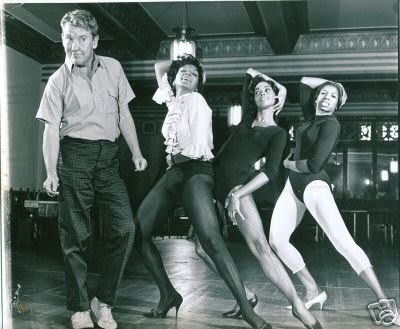
 A small part in the movie of Porgy and Bess made her known to Sammy Davis, Jr. (with whom she had a sort of romance), Sidney Poitier, Dorothy Dandridge and her dancing partner, Maya Angelou, whose fame was to come later as one of the great writers of the age.  

She costarred in an ill-fated Broadway show with Burgess Meredith, and was a hit in her debut as a singer at New York’s Blue Angel. Through Frank’s theatre and film work, Nichelle came to know many other luminaries, including Marlon Brando, Jane Fonda and Tony Bennett.  But hobnobbing with the stars didn’t stop racism from being a fact of life and occasionally surfaced in a blatant way, as when she and Frank were refused residence in a house they had rented in Manhattan when the caretaker saw Nichelle.  Sexism of the most Hollywood sort also came into play, when she lost a lucrative contract with MGM because sleeping with an executive was required. 

Then in 1963, Frank asked her to do an acting scene with one of his students, Don Marshall.  Another student named Joe D’Agosta was so impressed that he told his employers at a television production company about them. The executives watched Nichelle and Marshall do the scene (from Arthur Miller’s A View From the Bridge—a title that would soon take on different meaning), and hired them both.  It was for an episode of the TV series The Lieutenant, produced by Gene Roddenberry.  D’Agosta would become the casting director for Star Trek.

 With Star Trek, she would become probably only the third Black woman featured in a continuing non-stereotyped dramatic role in series television. (The first two played the same social worker-- a very young Cicely Tyson, with Diana Sands substituting for one episode-- in the short-lived but significant social drama East Side West Side in 1963, starring George C. Scott.) Nichelle Nichols’ presence was more prominent, but still…

 With prodigious talents expressed on stage and screen, Nichelle Nichols lasting fame results mostly from what must be described as a relatively small role. For three years she had to get up in the middle of the night to appear on set, where typically she would sit in one place, and say and do very little.  Given her skills and experience, it is reasonable to wonder why she bothered.

 The answers begin with expectations: she had reason to hope her part at Lieutenant Uhura would be larger.  She saw scripts in which she had better scenes, more lines and more to do.  Her book makes it clear that in Star Trek’s first year, her part was diminished due primarily to network and studio demands, which involved fears of audience reaction, but in the end reflected race and gender bias.  How deep that went is indicated by her assertion that executives kept most of the fan mail she was getting (almost equal to that of stars Shatner and Nimoy) from being delivered to her. In other words, she’d proven them wrong—she was accepted and she was popular.  But they had to deny it.

  By then she was ambivalent about her role (a feeling played in a different way by Celia Rose Gooding as the younger Uhura on the Strange New World series, which also seems to be dramatizing aspects of Uhura’s backstory that Nichols and Roddenberry invented, but never could portray.)

 So it wasn’t surprising that she was leaving the series after that first season, until her now famous encounter with Martin Luther King, Jr., who talked to her about the power of her presence on television, and in the 23rd century.  Her status as a role model for Black and minority viewers, especially children, and most especially girls; the ground she was breaking in television for other Black and minority performers, and the simple fact that she embodied a Black presence in the future, were all reasons to stay, even knowing that she was missing other opportunities, and possibly typecasting herself indefinitely.  And even when her role was further undermined in the second season and thereafter by William Shatner’s insisting (with the connivance of the Suits) that scripts focus heavily on Captain Kirk, and then Mr. Spock and Dr. McCoy.

 But an equally compelling reason that she stayed seems to have been that she believed deeply in Gene Roddenberry’s vision of the Star Trek future.  Her book describes the vagaries of their personal relationship, but her devotion to his vision never wavered.  Her absolute conviction is expressed in this extraordinary sentence in her book: “Every time I sat down at my console on the bridge of the Enterprise, I felt that I was in the twenty-third century, that I was Uhura.” 

 It was this conviction that resonated with fans and made her a convention favorite.  It was this nobility as well as her intelligence, experience and cultural depth that made her an eminence as her hair turned silver.

 By accounts and observation, she was energetic, thoughtful, kind and at times mercurial, with a wicked sense of humor. Her book makes clear that she was a proudly passionate person, as also suggested in person by her occasional naughty references and raucous laugh.  But from the start, and especially as she grew older, she radiated and embodied a confident dignity.

 Before her final years and the conflicts surrounding them, she valued her prodigious memory. She put it to work in Beyond Uhura. Those who wish to honor her life can do so by learning more about it—by reading her autobiography.  Our lives and what we experienced and learned ultimately are our legacy. 

She was always more than what was obvious. It’s become widely known that in the period between the Star Trek TV series and the movies, she helped recruit minority and women to NASA, especially candidates for Space Shuttle astronauts.  But this achievement has also been slighted in some quarters.  In fact, this inclusion was a need she saw, and a proposal she made, carried out as one of a number of contracts by the company she ran.  She was astute at business and organization as well as artistically multi-talented.

 Her efforts were among the principal reasons that the world of fictional space exploration and real space exploration intermingled in public, leading to among other things, the first human to step foot on the moon speaking at the Scotty Farewell Star Trek convention of his wish to pilot the Enterprise.


 I did interview her on the Sunday at the end of that convention. She was direct and articulate. “Because the fans are loyal to Gene’s dream,” she told me, “we are loyal to the fans.” But she also wasn’t abject before them.  When a fan tried to talk to her during our interview, there was iron in her voice when she prevented the interruption.

 When my story appeared on the New York Times arts section cover Monday morning, she was the one who held it up to the crowd gathered to witness the ceremony marking the installation of James Doohan’s star on the Hollywood Walk of Fame.

 I saw her again two years later at the 40th anniversary convention in Seattle, where I led a panel on the soul of Star Trek. I was one of several people greeting her as she entered “the blue room,” where participants gathered, and wondered if she would recognize me.  In any case she greeted me with an embrace and the brush of a kiss.   

May she rest in peace.  Her work and her legacy live on.

Monday, November 28, 2022

Freedom


Freedom is not following a river.
 Freedom is following a river, 
  though, if you want to. 
 It is deciding now by what happens now.
 It is knowing that luck makes a difference.

 No leader is free, no follower is free—
   the rest of us can often be free.
 Most of the world are living by
 creeds too odd, chancy, and habit-forming
   to be worth arguing about by reason.

 If you are oppressed, wake up about
 four in the morning; most places,
 you can usually be free some of the time
 if you wake up before other people.

--William Stafford

Thursday, November 24, 2022

Happy Franksgiving


Thanksgiving began as the American version of the harvest festival.  It featured food native to this place: turkey, potatoes, corn, cranberries, etc.  It was also introduced by pious ideologues and racists, and that strain of it continued past the obliteration of Native American societies that first harvested those foods.

Then there was the bizarre 1930s version of Red v. Blue, when President Franklin D. Roosevelt declared Thanksgiving to be celebrated on the fourth Thursday of November instead of the traditional last Thursday, which that year (as this year) was the fifth Thursday.  Many Republicans refused to celebrate this holiday then, calling it Franksgiving.  

These days there are many variations in menu and activities, which now often include football and searching on the Internet for bargain gadgets.  It also begins the holiday season when families measure themselves against the ideal--in this case, Norman Rockwell's Thanksgiving paintings--and find that there are at least as many angry words, sulks, disappointments, bewilderments and tears as radiant smiles and gratitude.

The gratitude behind it all originally was for nature's bounty, or at least the subsistence nature provided.  Beginning with those first ideologues in New England and Virginia,  Americans' relationship to nature however has been more hostile than grateful.  Settlers and their descendants have been busy ruining the land and waters and even the air for several centuries, and we are close to finishing the job.  But maybe we can acknowledge this with a little grace as we're saying grace, and try to do better.  The natural world is the source of life, including our big and dubious brains.  The rest of nature would be grateful if we'd start using them wisely.

Tuesday, November 22, 2022

Thank you, Nancy

When Nancy Pelosi announced that she was retiring as Speaker of the House and leader of House Democrats on the floor of the House of Representatives, she wore a white pants suit.  It was the style of pants suit that has become the standard uniform for women in Washington public life, and for all I know it was started--and certainly aided and abetted--by her.  The color of white was likely in honor of the Suffragettes, and therefore an acknowledgement of the history she made as a woman.

There have been important and powerful women in the federal government before.  For example, the 1930s New Deal under FDR was one of the most consequential sets of programs in American history, and three key women were crucial to its character and consequences: First Lady Eleanor Roosevelt, Secretary of Labor Francis Perkins and administrator of the Federal Theatre Project Hallie Flanagan.

Since then there have been women as Secretary of State, White House advisors and now as Vice-President. But no woman has risen to as conspicuous leadership role as Nancy Pelosi.  As Speaker of the House she set the agenda and (when the President was a Democrat and sane) managed the President's programs, while herself being second in the line of succession to the Presidency itself.

Attaining that status made history for women and for gender equality.  But Nancy Pelosi made history in wider ways, as one of the most effective House Leaders and Speakers of all time.  In support and in opposition, she was the key figure in Washington of the past 19 years.  She was both daring and reliable,  leading through listening and keeping promises.  

As Leader, she raised many millions of dollars and actively recruited and supported Democratic candidates.  She was in large part responsible for the majorities that she led in her two terms as Speaker, and instrumental in many successful elections in 2022 that allowed Democrats to beat the odds. 

In the chaos that Washington has been throughout this century, she was the one person whose presence gave me any sense of stability and control throughout most of that time.  She could count votes, and she could be counted on.  

She endured levels of hate and abuse for decades that would break most of us in days.  When her husband was attacked with a hammer in his own bed by a man looking to shatter her kneecaps, she said it would figure in her decision on her future.  It did--it did not dissuade her from keeping her agreement to yield leadership this year, but it did cause her to remain as a Member of the House, just so they wouldn't get the satisfaction. 

She knew how to not make perfection the enemy of the good, and still she stood on principle even when others in her party got squeamish.  She was at one time one of the few prominent Washington leaders to openly support the Dalai Lama and Tibet against the tyrannies of China.  I believe her more recent act of defiance is supporting human rights in Taiwan stems from this experience.

She was oriented towards the future.  That's the meaning behind her often repeated mantra of supporting (for example) childcare and family leave but also efforts to address the climate crisis with the words "for the children."  She was also the first mother--and first grandmother--to be Speaker of the House.

Thank you, Nancy for your courage and grace, and all you did to hold back the ugliness and chaos, and to advance important programs like Obamacare and the remnants of the Green Deal (otherwise known as the Affordable Care Act and the Inflation whatever act.)  Now the torch is passing to a new generation.  Let's hope they can hold it as high.     

Monday, November 21, 2022

Solitude Late at Night in the Woods


I
The body is like a November birch facing the full moon
 And reaching into the cold heavens.
 In these trees there is no ambition, no sodden body, no leaves,
 Nothing but bare trunks climbing like cold fire!

 II
 My last walk in the trees has come. At dawn
 I must return to the trapped fields,
 to the obedient earth. 
The trees shall be reaching all winter.

 III
 It is a joy to walk in the bare woods.
 The moonlight is not broken by the heavy leaves.
 The leaves are down and touching the soaked earth,
 Giving off the odor that partridges love.

--Robert Bly

Saturday, November 19, 2022

Where is the non-military aid to Ukraine?

 I read stories about American military aid to Ukraine, but so far no stories about non-military aid.  At the moment Ukraine is facing winter with half its power-producing infrastructure out of commission because of Russian missile attacks.  Why isn't America responding?

The US saved a starving Berlin with around the clock airlifts of food when the Soviets blockaded the city after World War II.  The geopolitical situation is different, but in essence, the real situation is not so different: Ukraine needs help.  They need to quickly repair lots of infrastructure, and in the meantime, they need the means for their population to not freeze, and to maintain health and safety with working water and sewage systems (which require electricity.)  

Why aren't we hearing about humanitarian aid to a country suffering from war crimes?  From the bombing of civilian infrastructure with no other purpose than to make people suffer, to deny them the means of life? This isn't the case of insurmountable problems in a remote country. We're openly providing military aid to Ukraine.  Where is the non-military aid when they need it?

Where is Europe, where is America?  Where are the stories about how they are helping? 

Wednesday, November 16, 2022

Thoreau for the Day


 "In any weather, at any hour of the day or night, I have been anxious to improve the nick of time, and notch it on my stick too; to stand on the meeting of two eternities, the past and the future, which is precisely the present moment; to toe that line."

Thoreau

Walden: "Economy"

Monday, November 14, 2022

Fall Wind


 Pods of summer crowd around the door;
 I take them in the autumn of my hands.

 Last night I heard the first cold wind outside;
 the wind blew soft, and yet I shiver twice:

 Once for thin walls, once for the sound of time.

 --William Stafford

Saturday, November 12, 2022

Eyes Quietly on Kherson

 I have a queasy feeling about Kherson, the city in Ukraine abandoned by the Russian military.  Previously Russian civilians and sympathizers were evacuated to Russia.  Today elite elements of the Ukraine armed forces are in the city and the region, greeted as liberators by the remaining population loyal to Ukraine.  The Kremlin has been uncharacteristically quiet about all this.

I am trying to trust that American and other Intelligence would know or at least suspect if Russia were preparing for a nuclear strike on Kherson.  But Russia laid the groundwork for justifying it in the past month or so.  I'll take comfort that if Russia has laid the trap as well as the groundwork but does not launch nuclear bombs on that city in the very near future, then it is unlikely it will use nuclear weapons anywhere in Ukraine. (Though if the reason they don't is that Kherson is too close to Russia itself, then that assumption is shaky.) 

I hope this triumph for Ukraine holds up, and the world isn't being suckered, only to awaken to the greatest shock of the century so far. 

Friday, November 11, 2022

This Week is Not Last Week

 John Kenneth Galbraith coined the phrase "the conventional wisdom" back in the 1950s, and for awhile it became a conventional description, until it mostly faded away.  Too bad.  It's even more necessary now. The conventional wisdom is always powerful, and is made more powerful by the echo chamber of news media and social media.  The problem is that while it becomes conventional, it does not always reflect wisdom.  Hence the 2022 elections.

In the early 1970s, journalist Timothy Crouse came up with the phrase "pack journalism." (This in turn was a play on the earlier phrase, "hack journalism," popular in his father's day.)  Tim observed its manifestation aboard press buses during the 1972 election campaign.  In those days, the wire services were very powerful--their news stories were published in hundreds of newspapers around the world.  Reporters who didn't file the basic story that the wire services did on a given campaign day had to justify their different story to their editors.  Most simply found out what the wire service reporters were saying the story of the day was, and they more or less parroted it.  

That was the most obvious form of pack journalism.  But just a busload of reporters, together all day and every day, talking about the campaign, tended to form the news into a conventional wisdom.  They wrote the stories, and politicians etc. had to react to it; editorial writers and other reporters picked up on it, and so on.  Pack Journalism.

Today there's no leader of the pack--nobody has that authority--but there is pack journalism nonetheless.  The busload of journalists is now called the Internet plus cable news.  The conventional wisdom can form fast and is sped around the world mostly by social media. In this sense, the conventional wisdom becomes an algorithm.  It is self-enforced, and self-reinforced. Everybody is their own editor--they are afraid to be wrong, so they amplify the echo.  

Several columnists analyzed why the media was so wrong; Dana Milbank in the Washington Post was especially specific.  But those who blame only the punditry have it half right: the same conventional wisdom that the pundits push markedly influenced news headlines and coverage.  That's one reason I stopped reading the news a week or more before the election.  They clearly had a story and they were sticking to it.  There would be nothing new to learn.

Last week's conventional wisdom was the coming Red Tide of Republican victories.  This week's conventional wisdom is that Democrats did amazingly better than expected.  In between, voters voted, with quite possibly no reference to either story.

The overall outcomes of this election are still unknown, since many elections--including key ones--are not yet tallied.  The initial fallout suggests however that things have calmed down.  The elections worked well, candidates who lost mostly conceded, there was no appreciable violence during or after Election Day.  Most of the offices that handle elections will still be run by people who respect the results.  

A parallel story this week involves the chaos at Twitter.  Facebook seems to be a primary conduit for right wing craziness at the grassroots, but Twitter has been the chief social media enabler of pack journalism and the moment-to-moment conventional wisdom.  (At least that's how it seems to me. All I know about social media is what I read in the paper.)  A wounded (and hence less fashionable) Twitter might help calm the info waters at that level as well.  It may be that particular fever has broken, too.  Who knows?

It may not be more than a momentary lull, time enough for a deep breath, and maybe a subtle reset or two. Meanwhile, the fate of the Earth is being addressed at the COP27 Climate Conference.  Serious people have made a serious proposal for nations that enriched themselves with carbon-producing industries to start taking responsibility to help the poorer nations that are already victims of catastrophic climate disruptions.  It's good to know that American democracy can still basically function (a low bar in other years.)  It's even better if there really are serious people at work on the world's critical problems. 

Tuesday, November 08, 2022

The Real Work


“The real work is becoming native in your heart, coming to understand we really live here, that this is really the continent we’re on and that our loyalties are here, to these mountains and rivers, to these plant zones, to these creatures.  The real work involves developing a loyalty that goes back before the formation of any nation state, back billions of years, and thousands of years into the future.”

 Gary Snyder

(Interview with Bill Moyers, 1995)

Sunday, November 06, 2022

Thoreau for the Day


"There are nowadays professors of philosophy, but not philosophers. Yet it is admirable to profess, because it was once admirable to live.  To be a philosopher is not merely to have subtle thoughts, not even to found a school, but so to love wisdom as to live according to its dictates, a life of simplicity, independence, magnanimity, and trust.  It is to solve some of the problems of life, not only theoretically, but practically."

Thoreau

Walden: "Economy"

photo of Albert Camus by Cartier-Bresson

Saturday, November 05, 2022

Reminder

Don't forget to turn back your clocks...to 1933 

Friday, November 04, 2022

Winter is Coming

  In the 2022 elections, some voters—no one yet knows how many—will cast their votes for a government that might best be described as authoritarian anarchy.

 This description may seem paradoxical, but unfortunately it fits.  Authoritarian dictators are at least supposed to make the trains run on time (which contrary to cliche, I'm told Mussolini didn't.)  In our 21st century American version, the trains may run only in the metaverse and on social media.  In the shared world of complex functions and dangers come breakdowns and chaos.

But on second glance, anarchy is the eventual state of authoritarian government, even (eventually) a police state.  These authoritarians at least are detached from reality twice: first because of their fealty to fanaticism, and more directly, because they are thoroughly corrupt.

For the Republican party is led by authoritarian demagogues, whose disdain for basic American democracy is loud and ever more audacious. But they have no actual policies that bear any kind of scrutiny, only slogans.  Most of them have no interest in governing nor skills to do so, and don’t much care. They are not serious people.  If they get the reigns of power in their hands, self-perpetuation will be their only goal, with other problems left unsolved, addressed only by hate and lies. Even previously routine functions are endangered by their ideological screen.  The end result is anarchy, and because of prior damage to previously resilient institutions, that end could come quickly.

 While these and other voters may have legitimate grievances, especially against the wealthy corporations and individuals that have stolen their incomes and redistributed it upwards, those grievances will once again not be addressed, and since they were enabled by several previous Republican administrations, likely made worse.

 Some of these votes, probably many of them, are in protest, and those who have thought this through may assume that, as in the past, this protest will result in the governing party (the Democrats) mending its ways and becoming more responsive.  But this time, with the very institutions that could make that possible under attack, it may become almost impossible.  Because this kind of anarchy is a kind of domestic war. 

 Most of these voters cannot imagine that the anarchy they loose will actually affect them.  But it will.  It reminds me of the notorious election of 2000, when well-meaning people on the left bought into the “Gush v. Bore” notion that there would be little difference between the presidencies of Al Gore and George W. Bush, and so it was safe to vote in protest for a hopeless third party candidate.  The next few years were shocking for all of us, but most of all for them.

 Imagination is an under-appreciated survival tool.

  Although a history through the past several decades can be traced that lead in this direction, it is supercharged to a frenzy by social media, and the resulting tendencies of news media that emphasize their worst impulses.  Still, in the still of the night, it is hard for me to imagine why anyone would vote Republican in this election.  It’s hard for me to imagine what people are thinking, as they spout venomous slogans against “the elite” that looks down on them, and then support candidates whose few discernible policies further empower the actual elites, who are already so powerful that in nearly every situation—prosperity, recession, inflation, peace, war and pandemic—they make even more money.  However, even for them, eventually the wolf will surely come.  That’s the future of authoritarian anarchy. 

Tuesday, November 01, 2022

October Surprise

 I saw a headline yesterday that provided the number of annual threats against Members of Congress, and added that it's surprising there aren't more.  This followed a headline about the attack on Paul Pelosi that said it was terrible but "not surprising."

Not surprising, that in America an 82 year old man is attacked with a hammer while asleep in his bed and  his skull is fractured, by an attacker whose stated intent is to shatter the kneecaps of his victim's wife, an 82 year old woman?  Who is second in line to the US Presidency?

When media cynics say shit like this, they add to the normalizing of the Dark Age that is coming upon us. They tell the many who are surprised, who are shocked, that they're wrong to be. We must be surprised, we must be shocked, or the humanity and human civilization that lives within each of us will die.    

Sunday, October 30, 2022

Thoreau for the Days


 "These beans have results which are not harvested by me.  Do they not grow for woodchucks partly?...Shall I not rejoice also at the abundance of the weeds whose seeds are the granary of the birds?"

Thoreau

Walden: "The Bean-Field"

Thursday, October 27, 2022

Are You Thoreau for the Day?


 "Public opinion is a weak tyrant compared with our own private opinion. What a man thinks of himself, that it is which determines, or rather indicates, his fate."

Thoreau

Walden: Economy

Wednesday, October 26, 2022

Emerson (Thoreau really) for the Day


 "The finest qualities of our nature, like the bloom on fruits, can be preserved only by the most delicate handling.  Yet we do not treat ourselves nor one another thus tenderly."

Thoreau

Walden: Economy

Friday, October 21, 2022

Emerson for the Day


“What is a course of history, or philosophy, or poetry, no matter how well selected, or the best society, or the most admirable routine of life, compared with the discipline of looking always at what is to be seen?  Will you be a reader, a student merely, or a seer?  Read your fate, see what is before you, and walk on into futurity.”

H,D.Thoreau

 Walden: "Sound"

  Photo: "Blue Chair with Chickens" by BK

Monday, October 17, 2022

Man with One Leaf in October Night


The leaves turn black when they have learned how to fly
 so does the day
 but in the wind of the first hours of darkness
 sudden joy sent
 from an unknown tree 
 I have not deserved you

--W.S. Merwin

Friday, October 14, 2022

The Armageddon Watch


The question of whether Putin's Russia will deploy a nuclear weapon in Ukraine is a live one.  If it happens, it is likely to happen soon. The tenor in the so-called liberal media is that Putin is losing and weak, without options. But last week I believe it was the NYTimes conservative columnist Brett Stephens who predicted Putin will deploy nukes, and he suggested Kherson as a possible location. Kherson is the first city and region that Russian troops controlled at the beginning of their invasion, but Ukraine troops are closing in on it.  The Ukraine forces have already retaken a number of villages in the region.

 Since that prediction, it looks to me that the chances of a nuclear weapon being used there has increased.  So far I've only seen the Guardian reporting on the evacuation of Russians and Russian sympathizers from the region, announced by the Russian puppet governor who requested and received official Russian help in evacuating.  To me, this is an ominous sign.  If a nuclear explosion is planned there, this would be a first step. 

Putin's apparent weakness is a reason it could happen. Russia's missile attacks on Ukraine this past week were seen as a vicious but futile response to recent humiliating defeats, without military advantage.  Russia used a number of expensive weapons in the attack, and western analysts say they are likely to be depleting their available missiles, since they cannot get high tech parts from western sources anymore.  If this is so, then Putin has pretty much only his sizable arsenal of tactical nuclear weapons left as "options."  Several weeks ago Putin repeated that all types of weapons can be used--and more than hinted this includes nukes--in Russia's self-defense.  He then began the elaborate charade of essentially annexing parts of Ukraine into Russia, and one of those places is Kherson.  All of this looks like step by step preparation, though so far no one in the west is saying so publicly.

Putin's groundwork has also allowed the US and western Europe to figure out exactly what they will do if Russia uses nukes.  The element of surprise is gone.  The world will be shocked, but it is unlikely that Putin will gain military advantage because of it.  Quite the opposite.  But exactly what will happen can't be known, except that it could happen very fast.  This is another case of letting slip the dogs of war, of self-renewing and escalating violence--with uncontrollable consequences.  It all has a tragic inevitability about it.

Here in the US, the slow motion Armageddon of democracy seems about to move faster, one way or another.  Several things are coming to a head.  Donald Trump is likely to face indictment for crimes on the federal level (either directly related to Jan.6 or to crimes associated with his theft of classified documents, or both), and on the state level (in Georgia, for election tampering; and New York, for financial crimes, not to mention a rape trial.) No one knows when any of these will happen, but one or more of them could be relatively soon.

Why is that a threat to the Republic?  There was a debate in the pages of the NYTimes this past week on whether the US faces a second civil war.  As usual, the semantics of it cloud the issue (exactly what is a civil war?)  But one journalist who has been interviewing far right/Christian right zealots for decades, wrote in the Atlantic that if and when Trump is indicted for just about anything,  large scale political violence is likely to break out.  He cited in particular how heavily armed these people are, and what they are expecting to do with those weapons.  He said that at gun shows during the Obama presidency, the reason people gave for stocking up on military weapons was the fear that because of school shootings, the feds were going to come after their guns.  Now (he said) what he hears more often is that they are convinced they are fighting a war against the Great Replacement etc., and the government is their enemy.  They are preparing to fight the federal government in particular.

Another participant in the discussion, a NY Times columnist with a deep knowledge of American history and the Constitution, agreed that political violence is likely, but the US has often suffered some small scale political violence.  And he wondered if these people have the stomach for large scale, sustained warfare against trained troops.  I agree that this is uncertain. So far political violence has been perpetrated by individuals or small groups, almost always against the defenseless: congregations in a church or synagogue, old people in a supermarket, children in school.  In other words, the act of heavily armed, camo-clad cowards.

Even the attack on the Capitol last January showed division.  Some people came to commit violence against the Capitol police and anyone who stood in their way.  Most others seemed more interested in taking video with their phones and posting it, breaking things and taking souvenirs.  No one can really predict what might happen (the dogs of war again) but we are quite possibly going to find out.

Then there is the upcoming election--another grave threat on many levels.  The election polls appear useless and other surveys of attitudes etc. are contradictory, but the punditry suspects the momentum in favor of the Democrats because of the abortion decision is waning, and continuing inflation and rising gasoline prices are favoring Republicans. Because they are so much more likely to fix that, and their candidates have detailed policies and plans to do so.  Just kidding.

 The old 33% of the electorate who were Always Trumpers now seems to have become 40%, and Republican power brokers are looking only at the R, not the candidate.  Will voters follow, and support the certifiably insane, the holy warriors, the authoritarians and white supremacists, the thoroughly corrupt, the dangerously stupid?  Will this be a wave election one way or another, or a state by state, district by district decision?

We probably won't know for days and possibly weeks after election day.  And unless our news media has gotten better and better equipped to cover this story, we may not know how corrupted the election processes are in individual districts and states.  We can be sure that Rabid Right Republicans will extol every one of their victorious candidates as elected righteously, and every election they lose as illegitimate.

Again, all this domestic potential for Armageddon has historical preparation, and an air of tragic inevitability.  But it may not happen on a very large scale, at least not this year.  However, a Republican controlled House and/or Senate next year may well usher in mayhem, as they hold the country and world economy hostage to go after old people (by slashing Social Security and Medicare) as well as young women, immigrants and the planet. Meanwhile as officeholders these brainless and heartless fanatics will have no capacity to govern, especially in times of complex crisis.  

Well, enjoy your day.  Every day you can enjoy.