Wednesday, August 02, 2017

Obama We Hardly Knew Ye


There are days--many days--when it seems it was all a dream.  Barack Obama was President?  For eight years, without the breath of a scandal, without a lie or a serious misstatement of fact, with intelligence, a mastery of fact and logic, with dignity, grace, humor and kindness?

Nah, couldn't have happened.


To say that the current incumbent makes the Obama presidency look better is very faint praise indeed.  I often think that the greatest beneficiary of the apprentice dictator in the White House has been George W. Bush.  He is quite unexpectedly yet undeniably no longer the worst president in American history.  Lucky guy!  And in less than a decade after he exited, taking an extra helicopter turn to view the more than a million and a half very excited and very relieved people assembled for his successor's inaugural.

In his columns and his book Audacity, Jonathan Chait made the case that Barack Obama's achievements are such that he will be viewed as one of the best and most accomplished US presidents in history.  Recently (in what reads like the introduction to a paperback edition of Audacity) Chait looked again at the Obama legacy six months after he left office. (Six months?  Seems like six years.)  And despite the obsessively thorough efforts of Obama's successor to undo and reverse his achievements, Chiat sees only more reason to value President Obama's legacy.

Chiat notes that those who complained about inaction as well as opponents may now realize that "governing is hard. "Obama’s critics complained endlessly about the slow pace of legislation and the endless compromises wrung by interest groups and recalcitrant moderates. Liberals spent his presidency pining for imagined alternatives who could overpower the opposition. High-minded centrists endlessly blamed the president for his failure to dissuade Republicans from their strategy of total opposition, and in so doing helped reinforce the success of that opposition. Throughout his time in office, Obama labored against the contrast of hazy memories of presidents of yore who could supposedly reason with or overpower their foes and impose their legislative will."

Turns out "governing is hard."  Though around here I noted that the same complaints were made about President Kennedy, there apparently was the sense that somebody with bluster and will could get things done.  Hasn't worked out so well.  And there are many more examples of magical thinking that didn't come true, though you had to be awfully stupid to believe they would.

As for Obama's legacy being wiped out, even with such malevolent intensity, Chiat disagrees:  "Large chunks of Obama’s achievements are not even theoretically vulnerable to reversal — most obviously, the stimulus, bank rescue, and auto bailout, which rescued the economy from a second Great Depression."  


Other achievements won't be touched without a 60 vote Senate majority, while others--like the jumpstart to alternative energy technologies--have taken lives of their own in the business economy and are very likely to triumph despite the worst efforts of this apocalyptically regressive regime.  The situation is similar generally in regard to addressing the climate crisis--Obama's quiet gains and his international leadership have created a momentum that so far survives.

Then there's Obamacare, which is more popular now than at any time in the Obama administration. "Half a year of Republican-run government has systematically exposed the right-wing arguments against Obamacare as bad-faith rhetoric or outright fantasy. One small-business owner, who told the New York Times in 2012 that he opposed the law as something jammed down the public’s throat, was re-interviewed this year. “I can’t even remember why I opposed it,” he now says."

Chiat makes no claims for current Democrats but notes that the Obama coalition has proven more potent than the one boasted about by the current incumbent:

"Even coasting on the crest of the Obama-era economic expansion, and having yet to face a crisis he did not create himself, Trump’s approval rating sits in the 30s...
When the wreckage from this presidency is cleared away, there will be only one party that possesses a politically and substantively workable governing model. Trump’s administration may have the power to destroy, but Obama’s had the power to build."

Also in recent days, another view of the Obama years as well of the current regime came from an unlikely source: the conservative Senator Jeff Flake.  Most of the stories derived from his book emphasize his rebellion against that current regime and its fearful leader.  But he also acknowledges that whatever lack of achievements there were in the Obama years were the Republicans' responsibility, with consequences we're seeing now.  In his Politico excerpts he writes:

"But we conservatives mocked Barack Obama’s failure to deliver on his pledge to change the tone in Washington even as we worked to assist with that failure. It was we conservatives who, upon Obama’s election, stated that our No. 1 priority was not advancing a conservative policy agenda but making Obama a one-term president—the corollary to this binary thinking being that his failure would be our success and the fortunes of the citizenry would presumably be sorted out in the meantime. 

It was we conservatives who were largely silent when the most egregious and sustained attacks on Obama’s legitimacy were leveled by marginal figures who would later be embraced and legitimized by far too many of us. 

It was we conservatives who rightly and robustly asserted our constitutional prerogatives as a co-equal branch of government when a Democrat was in the White House but who, despite solemn vows to do the same in the event of a Trump presidency, have maintained an unnerving silence as instability has ensued. To carry on in the spring of 2017 as if what was happening was anything approaching normalcy required a determined suspension of critical faculties. And tremendous powers of denial."

Monday, July 31, 2017

Hero of His Own Life? Notes on Dickens' Copperfield

Bob Hoskins as Micawber, Daniel Radcliffe
as young David in the 1999 BBC/PBS version.
“Whether I shall turn out to be the hero of my own life, or whether that station will be held by anybody else, these pages must show.”

It's one of the most famous opening lines in literature, and after reading Charles Dickens' David Copperfield again,  I'm struck by the ambiguous answer I might give. For in key moments, it isn't David Copperfield who is heroic, but other characters.

The novel has the usual thoroughly evil Dickens' villains: David's cruel stepfather Murdstone and Murdstone's echoing sister Jane, the craven and cruel schoolmaster Creakle (a brief appearance but so meaty that Laurence Olivier and Ian McKellan both made a ham sandwich of him in film versions) and the unforgettable Uriah Heep.  There are the usual slyly satiric portraits of institutions of law and order, and the men who make their livings from them, more than hinting at Dickens' underlying outrage and disdain.

 There is also a hero (at least in David's eyes) who commits acts of villainy that Copperfield condemns, yet he persists in remembering him "at his best."  There is a kind of angel or goddess, a child woman, a girl who yearns too much, a wayward girl, and an old woman servant with a heart of gold.  There are the stalwart and large-hearted men of the sea, Mr. Peggotty and Ham.

And there are the somewhat comic characters that populate a Dickens novel: his Aunt Betsey and her friend Mr. Dick, the eternal complainer Mrs. Gummidge, Copperfield's school friend and later companion the hapless Traddles, and the most famous of all, the scoundrel with a heart of gold, Mr. Micawber, and his long-suffering wife.

As he does in other novels, Dickens' pegs several of these "minor" characters with their repeated turns of phrase and small repeated behaviors.  But notably and in some respects unexpectedly, several of them do the heroic deeds.  It's Micawber and Traddles who bring Uriah Heep to heel.  It's Aunt Betsy who rescues young David, Mr. Peggotty who with the help of the wayward girl rescues the girl who yearns too much, Emily. And it's Ham who dies attempting to rescue a survivor of a storm at sea.  Even Mrs. Gummidge becomes heroic.

It's true of course that classical heroes often have decisive help, and couldn't accomplish their goal without aid.  And David does have his moments, particularly when he suddenly becomes the financial support of others and applies himself with discipline and hard work.  But it took the special interest and attention of others, as well as their good-heartedness and generosity, responding to  David's good-heartedness and generosity, for him to succeed.

The Signet edition I read, which was the
first to include the entire text
Since I knew the story, both from having read the book before and from seeing a couple of film versions, the emotional response to key happenings was muted, and I was better able to appreciate how Dickens created his effects, and generally to savor the details.  So while it didn't have the emotional resonance of reading W.G. Sebald's enigmatic The Emigrants, which I also recently finished, it provided other pleasures.

But it's probably more than that.  When I was younger I was more than impatient with the pace and language of 19th century novels--it took great effort to sit still for them.  I craved faster prose and faster styles of storytelling that I found especially in some contemporary authors.  I was young, it was the 1960s, my metabolism was set to rock music.  I eventually could become immersed in the images of foreign films but I found these books difficult to sink into.

That's not a problem now.  My old metabolism is happy to read those long sentences and long books, though I take my time, and read not much more than a chapter at a sitting.  For both reasons, I read with delight, savoring the language and narrative skill.

For example, he gives us the murderous-hearted Mr. Murdstone (need it be said for a character in Dickens that he's aptly named?  J.K. Rowling must have known her Dickens) and his sister, Miss Murdstone, as the tyrants of David's young life.  Then after leaving them behind in David's boyhood, he inexplicably and a bit awkwardly makes Miss Murdstone the paid companion of David's employer's daughter who he loves and intends to marry.

But it pays off in a confrontation scene.  After Miss Murdstone has informed on David, the father opposes the marriage.  As the scene begins with formalities, Dickens reminds us of Miss Murdstone's character with a memorable expression.  He doesn't say that David takes her cold hand in greeting, but that "Miss Murdstone gave me her chilly finger-nails, and sat severely rigid."  What a sentence!
The novel was originally serialized, and
structured so that each installment ended
in a "cliffhanger."
But the resonance is given additional power at the end of the conference, as David observes: "Miss Murdstone's heavy eyebrows followed me to the door...and she looked so exactly as she used to look, at about that hour of the morning..." when she glowered at him over his lessons.

It's true that David doesn't exhibit much psychological acuity, apparently not sensing that his first choice for a wife replicated qualities of his mother.  But on more general matters he shows some insight. “I had considered how the things that never happen are often as much realities to us, in their effects, as those that are accomplished.”

This was a popular work of fiction, serialized in a periodical.  So the philosophical observations in the writing may not be earthshaking but remain essential--and especially essential to Dickens, as in the ruminations of a very minor character near the end of the novel:

“Dear me,” said Mr. Omer, “when a man is drawing on to a time of life, when the two ends of life meet...he should be over-rejoiced to do a kindness if he can... And I don’t speak of myself particular, because, sir, the way I look at it is that we are all drawing on to the bottom of the hill, whatever age we are, on account of time never standing still for a single moment. So let us always do a kindness, and be over-rejoiced.”

As for the film versions, they may guide the reader through main events and give visual references to the characters, but they are far too short to suggest the richness and riches of the book.  It's good to have a guide through the story, though, and fun to see good portrayals of the characters.

Probably the best version is the 1999 BBC/PBS miniseries, mostly because it is the longest.  But even this one is not full enough--after lavishing attention on the earlier parts of the novel, it rushes through climactic scenes and invents others.  One notable change is the fate of Uriah Heep.  In the movie he is arrested and is seen as a prisoner to be transported to a penal colony in Australia.  But in the novel, Micawber and Traddles force Heep to make restitution and return funds he had stolen, under threat of exposure.  Dickens clearly doesn't trust the justice system of his day. (The film's solution also muddles the positive meaning of a new life in Australia for other characters in this book.)

But this film version features a fine performance by Daniel Radcliffe as the very young David, shortly before he became Harry Potter.  Other performances are definitive: Maggie Smith is Aunt Betsey, Nicholas Lyndhurst is Uriah Heep and so on down the line--in particular, Bob Hoskins as Mr. Micawber (and that's saying something, since the role was also played in movie versions by Ralph Richardson and W.C. Fields.)

The one questionable role was the adult David Copperfield, and that seemed to be the case in all other film versions.  Probably it is not the fault of the actors--in this case, perfectly serviceable--but in the role.  He is the center of the action, but he mostly reacts.  Still, it's notable that well-known actors played the "minor" roles, and not this one.

Which suggests again but doesn't answer the first question posed.  David is the narrator of the story, and he becomes a writer in the course of the book. (Which could be one reason why Dickens named this as the favorite of his novels.) But is   he is the hero of his own life? Well, we might say of him as of ourselves: if not, who is?

Saturday, July 29, 2017

Has Homegrown Hitler Found His Goebbels and Himmler? With Update

Has Homegrown Hitler found his Goebbels and Himmler?

Joseph Goebbels
His latest appointments--a brutal communications director and a former General as chief of staff--certainly reflect his dictatorial tendencies. Anthony Scaramucci, the communications director clearly wants to be HH's propaganda minister, his master's mouthpiece, in complete control of information unfettered by truthfulness.

But his lack of media experience, the over-the-top threats of a paper bully as exhibited in his now infamous rant to Ryan Lizza, and the distinct possibility that he isn't very smart, may limit his effectiveness.  His dictatorial tendencies and loyalties are clear enough, though.  Of his boss, "Scaramucci told CBS, “I don’t know if he’s going to get what he wants next week, but he’s going to get what he wants eventually, because this guy always gets what he wants. O.K.?”  With some so far invisible ability to learn, and especially some dumb luck, he could become dangerous as well as disgusting.

Himmler
The appointment of Homeland Security chief and former Marine General John Kelly to be chief of staff is maybe of another order.  Most of the early stories are fairly measured, and commentaries tend to question whether he or anyone can bring discipline to this White House.  But that may not be where the danger lies.

Kelly first of all got the job by proving his loyalty to some of HH's worst tendencies on immigration, as well as his efficiency.  Even joking that HH should use a ceremonial sword on "the press" is enough to set off alarms, if not a full red alert.  So whether Kelly can run the White House isn't the chief question; the question is whether he may wind up running the country, as a General carrying out the wishes of Homegrown Hitler.

According to some reports, Kelly has exhibited dictatorial tendencies and reach as Homeland Security chief.  What has seemingly saved this country from HH's dictatorial wishes being carried out to a greater extent has been his incompetence and inconsistencies.  Now what will he be able to do with a General as his chief executive?

While this may be a groundless fear, in fact Kelly has not been tested at this level of power.  One key to his intentions may be what now happens at Homeland Security.  Will he try to keep control of it, from the White House?  The first tipoff will be the person appointed to officially take his place--how close to him, and how independent.

When I use the analogy of Goebbels and Himmler, I'm not saying that these appointees are as bad, or are likely to be.  The point is that they are primed to fill the roles of Goebbels and Himmler in the Nazi regime (of master propagandist and master administrator), and in any other totalitarian regime.

Still, this General in the White House along with other recent news has prompted other alarming thoughts.  I was particularly struck by a comment by Jill Lawrence in USA Today in the content of decrying the craven chaos in the White House:

"And that might be the least of it. While this administration wallows in a self-absorbed cycle of insults, betrayals, firings, lies, leaks and incompetence, North Korea is building nuclear capacity and on Friday launched a ballistic missile capable of hitting our cities. Somebody needs to be president. I just don't know who that will be."

Homegrown Hitler's surest way to sustained dictatorial power has always been military--with the pretext of a terrorist attack or attack on US forces (a ship off the Korean shore, say, be it real or invented), to start a war.

Now look at where we are: HH and his party are politically both in conflict and reeling.  His poll numbers are down, and his fears that federal investigators are closing in are up.  This past week, even congressional Republicans began boxing him in to prevent any firing of Mueller or even attorney-general Sessions.

Meanwhile, North Korea is again making headlines that tend to simplify matters by claiming that their missiles can reach the US.  The generally accepted estimate that their ability to dispatch a nuclear warhead on such a missile and accurately hit a target is five to ten years away usually appears at the bottom of a story, if at all.

Most analyses say essentially that there are no good options in forcing North Korea to relent, which is not what Americans want to hear.  If fears are stoked sufficiently, starting a war may seem to be just what HH needs.  With other more obvious options cut off or not working, he may believe it is worth the risk.

 Worth it to him, that is, and his power.  If it works, his poll numbers go up, he's at last given the deference of his office while the invisible investigations disappear from the news.  Besides, the hundreds of thousands of casualties will be mostly Korean, North and South, if all goes well that is.  What this does to the country and the world doesn't matter much to him.  This is the guy who took America out of the Paris agreement to save the planet because the president of France bragged that he won their handshake tussle and it pissed him off.

HH can't do this by himself.  His White House is divided against itself.  Much if not most of the federal government doesn't trust him.  Even in the best of times a president has problems getting orders followed, and there are stories out there about discussions within the government and the military about whether to obey HH's.

But now there's a General in the Oval Office.  That may be enough to tempt HH to start a war.  It's not yet likely, but I believe the chance of such attempt in the next year is above 50%.  Kelly may be the key factor.

"Somebody needs to be president. I just don't know who that will be."  Could it be General Kelly?

Postscript/update: Two relevant articles in Politico on 7/30: historical background on the power of presidential chiefs of staff, notably the previous General to serve: Alexander Haig, in the Nixon White House, who ended up pretty much running the presidency.  And a piece detailing how the previous chief--Reince Prebus--was the sole connector to the Republican party, its officeholders, funders and conservative organizations.  This is significant because it was the White House direct connection to at least some viewpoints, and the political support for particular issues.  Now there's just a General. 

Also Sunday, New York posted a piece about North Korea that references tweets by reporter Laura Rozen indicating that some "Strangelovian" alternatives are being discussed in the White House regarding North Korea,  and that the White House wants a win on the North Korea issue this year.

On Monday, Eliot Cohen in the Atlantic expressed his misgivings about the appointment of General Kelly, in similar if less spelled out terms as I did here.  And one question I raised got answered: Kelly got Scaramucci fired, so no, he won't be HH's Goebbels, at least not as communications director in the White House. 

Meanwhile, in Slate, Joshua Keating joins me in suggesting HH might well start a war because he feels stymied domestically and haunted by investigations, though he does so in a more scholarly manner. 

Friday, July 28, 2017

Heroes and Villains

Senator John McCain's week is already becoming legendary.  Diagnosed with brain cancer, he made a dramatic reappearance in the Senate, and was the deciding vote to take up the Republican unhealthcare bills.  He promptly made a speech castigating the secret, cynical and increasingly corrupt process led by Mitch McConnell and maintained by his fellow Republicans.

 He reminded them that matters of this weight and complexity require the regular committee process and open discussion, and that matters that involve virtually every American and a significant chunk of the economy require at least an attempt at bipartisan legislation.  Then he stunned his colleagues by being the deciding vote that brought down the last Republican unhealthcare plan, and ended this particular long nightmare for the time being.

McCain's first vote should not have been a surprise.  When asked earlier if he would vote to take up the bill he replied "I always do."  That's part of the regular order of how Senate business is conducted.  His vote against the plan mostly supported what he said in his speech, which Andrew Sullivan considers was significant in itself:

"And I wonder if historians will one day look back and see Senator John McCain’s speech last Tuesday as some kind of turning point. Diagnosed with an aggressive brain cancer, McCain nonetheless returned to give one of the best-scripted speeches of his career. Excoriating the chaotic process by which repeal of the ACA was being forced through the Senate, McCain reminded his fellows that they are the president’s equals in the government of this country and not his subordinates. He appealed for a bipartisan fix for a national problem, and for a return to regular order. He spoke for a mere 15 minutes, but they remain worth watching several days later. He seemed for a few moments like an actual voice of authority in a capital where all such authority has withered into mere positioning or cowardice. And in the early hours of Friday morning, McCain appropriately provided the critical vote to kill the skinny repeal of the ACA. It was, in some ways, his finest hour."

(Parenthetically, I find myself agreeing with Sullivan, the former conservative, not only on the Republicans but on excesses of the left, particularly the stifling of free speech, and on Democratic failures.  His column from two weeks ago merits serious consideration.)

But lost in all the attention on McCain was the courage of Alaska Senator Lisa Murkowski, who defied actual and meaningful threats from the Sec. of Interior and backed by the apprentice dictator in the White House, threatening to screw the state of Alaska if she didn't play ball on unhealthcare.  It was no small threat.  Interior essentially runs more than half the state.

Murkowski, who in 2010 fell in the primary to a far right fellow Republican but spectacularly won on a write-in vote, cast an essential no vote on unhealthcare anyway, when fellow Republican Senators who knew better took the coward's way out.

It's significant that the threat got big play in Alaska itself, and worth noting that administration outrages make the local press, too, in areas where the apprentice dictator looks for his constituency, as in Long Island Newday's coverage of the a.d.'s encouraging police brutality.

He also made a lot of waves in middle America with his bizarre speech to a gathering of Boy Scouts, where scouting and its traditions are as close to sacred as anything secular.  The Borowitz satire that the Girls Scouts obtained a restraining order preventing the a.d. from coming within 300 feet of their gatherings, had the unfortunate ring of an actual news story.  As did the tweet he imagined the a.d. issuing in response:“Failing Girl Scouts bad (or sick) guys,” Trump wrote. “Mints, cookies terrible. Sad!

As for villains in this unhealthcare saga there are at least 49, but the most pernicious needs to be named: Mitch McConnell, who now holds the record for the most evil perpetrated by an American over the past nine years.  Even without formidable ongoing competition in the White House, let's hope he's done his worst.

Obamacare Lives


The last ditch, post-midnight effort by Republicans ended in failure when Senator John McCain joined the only other Republican Senators with an ounce of courage: Senator Susan Collins and Senator Lisa Murkowski in voting no on the last gasp version of a Republican unhealthcare bill.

The vote was viewed with triumph and optimism by Jonathan Chait, so since that's pretty rare these days I'm passing on excerpts:

"I remember where I was and how it felt when the House of Representatives held the deciding vote to establish the Affordable Care Act. It was a feeling of elation, but, sitting in my living room by myself, an oddly solitary one. I ran out into the street of my residential neighborhood, half-expecting jubilant V-J Day-style crowds. But it wasn’t just that my neighbors were at work. The months and months of legislative grinding had cast a pall of depression over even many enthusiastic Obama-voting liberals, who saw the health care law as hardly worth celebrating.

The death of Obamacare repeal, in the early morning hours of Friday, July 28, was a very different experience. “Nothing in life is so exhilarating,” as Churchill is reputed to have said, “as to be shot at without result.” Obamacare has gained not only positive approval in broad opinion polls but a genuine mass following. Hundreds of thousands of Americans rallied to its defense, making its repeal impossibly painful for the Republican government that had once assumed it would sweep the law away in a January lightning strike."

Republicans in power will weaken Obamacare, Chait cautions, but America will never go back to the way things were done before Obamacare became law of the land.

"The desire on the right to destroy Obamacare will probably never disappear. In 2005, 70 years after the establishment of Social Security, confident Republicans sought to privatize the hallowed program. That, too, was a painful failure. And there is a lesson in this. While elections swing back and forth between right and left, there is a reason that the United States is more humane place today than it was 25 or 50 years ago. Social Security, civil rights, Medicare, Medicaid, and Obamacare have survived. Legalized child labor, supply-side economics, and unlimited pollution have withered. Ideas that bring real improvement to peoples’ lives have more staying power than ideas that do not.

Obamacare has brought life-changing access to modern medical care to 20 million Americans. It will endure."

Yet there is that other reality to face, and it becomes starker every day.  Check out this remarkable opening to Eugene Robinson's Washington Post column this morning:

"The Court of Mad King Donald is not a presidency. It is an affliction, one that saps the life out of our democratic institutions, and it must be fiercely resisted if the nation as we know it is to survive.

I wish that were hyperbole. The problem is not just that President Trump is selfish, insecure, egotistical, ignorant and unserious. It is that he neither fully grasps nor minimally respects the concept of honor, without which our governing system falls apart. He believes “honorable” means “obsequious in the service of Trump.” He believes everyone else’s motives are as base as his.

The Trump administration is, indeed, like the court of some accidental monarch who is tragically unsuited for the duties of his throne. However long it persists, we must never allow ourselves to think of the Trump White House as anything but aberrant. We must fight for the norms of American governance lest we forget them in their absence."

Thursday, July 27, 2017

Zombies v Vampires


The Republican attempts to kill healthcare and millions of Americans along with it have several times been given up for dead, but they keep coming back, led by McConnell, a description of whom as "reptilian" gets us in the ballpark but understates the reality, as abetted by the snarling Homegrown Hitler. A new poll this week shows that HH is dangerously close to being weakly approved by one-third, with his strong base down to 25%, a few ticks away from Nixon's at the moment he resigned. He has lost ground in all the battleground states he won, and half of those polled don't believe he'll make it to the end of his term. In other words, politically he's dead. And yet, there he is.

And there he or someone like him will always be, because they are one version of the living dead. They are the Vampires.

Vampires, from their earliest 19th century emergence in popular storytelling, were always aristocrats: Count Dracula and so on. Even in more recent imaginings in decadent New Orleans or among suburban teens, they are among the 1% or so. Blood-sucking capitalists, vampire capitalism. Today they are the Plutocrats--a perfect name for them. Pluto the god of the underworld, where the gold is, and the dead, so he is the god of both wealth and death.

The very rich have always pulled the strings but now the US has an officially plutocratic government of billionaires. It used to be that the laws against conflicts of interest kept the very wealthy out of government, but it turns out there are no such laws after all, and the wealthy get to keep their businesses  and use their high government positions and access to the federal coffers to make more money. As Jonathan Chait points out, our apprentice dictator defines conflict of interest as not swearing loyalty and fealty to him.

Presiding over all this is the adult family of the apprentice dictator, all of them pretty obviously vampires. I mean, look at them.  (But not here--none of their photos have appeared on this site since election day, nor any of their names except within quotations.  Nor will they ever.  I'm not feeding them their lifeblood if I can help it.)

The other undead are the zombies. As reimagined by George Romero--who died last week--they are the living dead who swarm in huge groups, eager to eat the brains of the living, turning them into zombies.

 Zombies have captured the popular imagination in recent years, and no wonder. If vampires are the 1%, zombies are the 99%, fighting each other for the dregs. Zombies are "the precariat"--holding precariously onto some semblance of respectability-- or those who have already fallen off the precipice. To be joined by 16 to 26 million of the precariat, depending on which Republican unhealthcare bill eventually becomes law, if any.

So who are the brainless living dead out to eat everybody's brains? We're tempted to suggest they are the people who show up at Homegrown Hitler's rallies. The adults at least--turning the Boy Scouts into Homegrown Hitler Youth I hope was not as real as it was scary.

Here the origins of the zombie myth is instructive. It comes from Haiti, where through sorcery, plantation bosses were able to dig up fresh corpses and turn them into slaves to work the fields, or commit crimes if needed.  Zombies were portrayed as mindless slaves of their masters in stories before Romero's Night of the Living Dead.  And though it seems to have created the template for all the succeeding zombie dramas, nobody called them zombies in that movie. They were mostly called ghouls.

In political and economic life, the rich few have been able to expand power by getting the unrich many to fight their wars, and to keep power by somehow convincing them their plight was caused by others even more unrich than they.  The Vampires have been using their Zombie armies for centuries, and their Zombie voters.

Romero actually made a related political point in Night of the Living Dead (as Brent Staples pointed out recently) by showing the living in endless squabbles and conflict when confronted by the relentless undead, and the hero who leads them --a black man--is shot dead by someone in the posse, who assumes he is a zombie.  Staples:

"But for Mr. Romero, these effects were incidental to his broader theme: how mutual contempt and tribal self-interest so often prevent people from banding together in the face of a mortal threat. The flesh-eating dead, at least, come together in mindless self-interest. But the embattled residents of the farmhouse bicker and betray one another even as the darkness closes in. Mr. Romero viewed them as a metaphor for a society so deeply invested in petty enmities that it failed to see it was being swallowed alive."

The metaphorical equivalence of Vampires as the plutocratic wealthy and Zombies as the unrich came to me some months ago, as it must have to others--like s/f writer Kim Stanley Robinson, who came up with roughly the same formula and actually trademarked the title Zombies V. Vampires.

Right now it seems the Vampires still have a tight hold on their Zombie followers, but they know that could change, and recently a self-identified Plutocrat came out in public and said so. Nick Hanauer in Politico:

"Since Election Day, I’ve been overwhelmed by anguished calls, emails and conversations from you, my wealthy friends, who, for the first time, are confronting the real possibility that our cozy utopian, urban, pluralistic lifestyles may be in peril. I share your fear. And with good reason.


Three years ago, in these pages, I warned you that the pitchforks were coming. I argued that 30 years of rising and accelerating inequality would inevitably lead to some sort of populist revolt that would disrupt the fantastic lives we elites enjoy. I cautioned that any society which allows itself to become radically and indefensibly unequal eventually faces either an uprising or a police state—or both.  And here we are."


All the rich may fear an uprising, but not all of them, I fear, fear a police state.  Though given ample opportunity to see a more equal society works better for all, many of them can't stop sucking all the blood they can get.  If there's a tax they must avoid it or end it.  There isn't a wage that can't be lower. There isn't a lie that can't be spread if it means a destructive industry can squeeze out more money for a little longer. And if there's a way to even temporarily keep raking in the blood with slave labor overseas, they do it, and pretend it's not their fault, it's that dreaded Invisible Hand, against which they are powerless.

Now the Vampires, pretending to be on the side of the Zombies, are in power, and the comparative economic quiet could well be deceiving--it's only been six months but with the progress made by the Obama administration being reversed, and even older institutional structures being smashed, the damage may be suddenly obvious, and it could be quite bad quite quickly.  It may take more than the promised industrial jobs not materializing, but even that could make the Vampires sweat, if the Zombies get restless.

Then we'll see, but Zombies v. Vampires may not be a fantasy after all.

Sunday, July 23, 2017

My Book House

These days I live in a house of books.  There are book shelves in nearly every room, and in the two rooms where I spend the most time alone, overflowing bookcases line several walls in each, from floor to nearly the ceiling.

Growing up most of a continent away, there were always some books in our house (though none in most other homes I visited), and I always had books to hold and look at.  I had Golden Books of the 1950s, and other child-size books like Little Toot and The Little Red Caboose.  But I also had a library of particular book-size books.  My first house of books was My Book House.

Officially called The Book House For Children, they were illustrated anthologies of verse and prose edited by Olive Beaupre Miller and published under its own imprint in Chicago.  The first set came out in a series beginning in 1920, and some version would continue to be published until 1971.

Writer Jim Harrison, a few years older than me, wrote about the influence of this set on his childhood.  And fellow western-Pennsylvanian Mr. Fred Rogers remembered an even earlier encounter--right down to a particular story read to him as a very young child.

The set that I grew up with was published in 1943.  The prior 1920s editions were six thick volumes but by the 40s the same basic material was in twelve volumes of more than 200 pages each. They were deep blue, thinner but larger in size to better accommodate illustrations.

We had fifteen books in all, for the set included a Parents' Guide Book and two extra volumes, the orange Tales Told in Holland and the lighter blue Nursery Friends From France, both unchanged from 1927, when they accompanied the original sets as "My Travelship."  There was a third Travelship volume called Little Pictures of Japan, but I don't recall we had it, possibly because it wasn't offered in 1943 since the US was at war with Japan.

Our set must have been acquired at my birth in 1946.  I believe my mother's sister Antoinette, who was a teacher, either gave us the set or advised my mother to buy it.  It became central to my childhood and that of my sisters, Kathy and Debbie.  I have the set now, and evidence of each of us survives in the books themselves: my scrawls of the alphabet and attempts to print my name in pencil and crayon, a number of blank endpapers in the Parents' Guide volume decorated with Kathy's drawings, and a clutch of napkins stuck in one volume upon which Debbie wrote and drew--and signed, when she was seven.

We were not the only ones who grew up with these books, of course.  In recent years they've become a favorite of home schoolers. Writers remember them. Novelist Jim Harrison mentioned the Book House set several times in his fiction and nonfiction.  Larry McMurtry writes a few words about it in his autobiographical Walter Benjamin at the Dairy Queen, which I've recently read and which prompted these musings on my early experience with books.

For me now, the color, slight shine and heft of these volumes, the very touch of their cool surfaces, still define "books."  As I view their contents, browsing by the light of the floor lamp that had once been in my grandparents' living room, now nearest to the shelves where these books repose, I can be taken back to earliest impressions, especially by the relationship of these evocative, colorful and now singular illustrations to the text.  


The content is comprised of verse and prose, often by (or adapted from) classic authors from many countries. The twelve volumes were arranged in a graduated sequence of readings for children from babydom to early adolescence.  This approach is codified in a general way by the Parents Guide Book titled In Your Hands.  It provides advice and information in a direct and informal tone, like the then wildly popular books by Doctor Spock.

Once I'd learned to read I don't recall my mother offering any guidance as suggested, but she seems to have heeded some of the suggestions on reading to babies.  (I have the advantage of having my own very real memories confirmed by watching her with my younger sisters, particularly Debbie, who was born when I was 8.)

For example, the book suggests how to hold a baby's arms and clap while mother recites "Pat-a-cake, pat-a-cake, baker's man" (which sounded more like "patty-cake" to me) and how to play with the babies toes for "This little piggy went to market." It's exactly how my mother did it, although she sometimes added a rhythmic bouncing as she held me on her knee, which I believe was important in showing me that whatever else words in such arrangements were about, they were first of all about rhythm and music.  


Since my mother's own babyhood was in Italy and the Italian language, and I was the eldest child of two eldest children in the vanguard of my generation,  I believe she was following this book's instruction, including gradually getting me to chant along, and to anticipate the words and rhymes.  The rhythmic bouncing, however, was probably homegrown. Since I remember my grandmother doing that with us, she probably had done so with my mother. But other instruction she ignored, just as we ignored many of the other selections in that first volume, In the Nursery.

I know that we used this book even for these common nursery rhymes because I remember poring over the illustrations.  Many of the illustrations were comical, many quite literal, many romantic in a 19th century style.

When I look at them now, I feel the resonance of their magic then. Like the animals around a music stand under the verses about the sounds they make ( Bow-wow," says the dog; "Mew, Mew," says the cat; "Grunt, grunt," goes the hog; And "Squeak!" goes the rat.)  Or the cow flying over the moon accompanying "Hey diddle diddle," the subject as well--as my mother once pointed out to me--of our cookie jar.

After fifty pages of common nursery rhymes, there are successive sections of short rhymes from Scotland, Wales and Ireland; Norse, Italian, Spanish, Swiss, South American, Mexican, Polish, Swedish, Chinese and East Indian nursery rhymes, and one Japanese lullaby, before national and regional rhymes from America, including American Indian Songs.

Then another set of short sections of German, French, Dutch, Czechoslovakian, Canadian, Russian, and Hungarian rhymes, and a Roumanian lullaby.  Rhymes from Finland, Africa; rhymes from Shakespeare, verse from Keats, Robert Burns, Tennyson, Christina Rossetti, Robert Lewis Stevenson.

Some of the verses get longer before the book turns to prose, and explores childhood experience in a neighborhood, on a farm, in a big city and so on, sometimes in stories similar to those found in an early grade reader, sometimes adapted from authors like Hans Christian Andersen.  Ending up with tales from Greece, Rome and the Bible.  All in this first volume.

This resolute international inclusiveness, the combination of folk stories, myths and work of classic authors, set one pattern for further volumes.  Olive Beaupre Miller would change the mix over the years, but this edition seems to preserve some authentic cultural fragments, perhaps otherwise lost, with no apology for how puzzling many selections were and are.


Volume 2 is appropriately named Story Time because it introduces stories rather than anecdotes and descriptive narratives, including fables (Aesop and otherwise), folk tales from many cultures (one retold by Tolstoy), Bible stories ("Noah's Ark") and classic tales (Peter Rabbit, the Nutcracker) interspersed with verses, including two by William Blake, one ("Owl and the Pussycat") by Edward Lear, and one by the Indian poet Tagore.

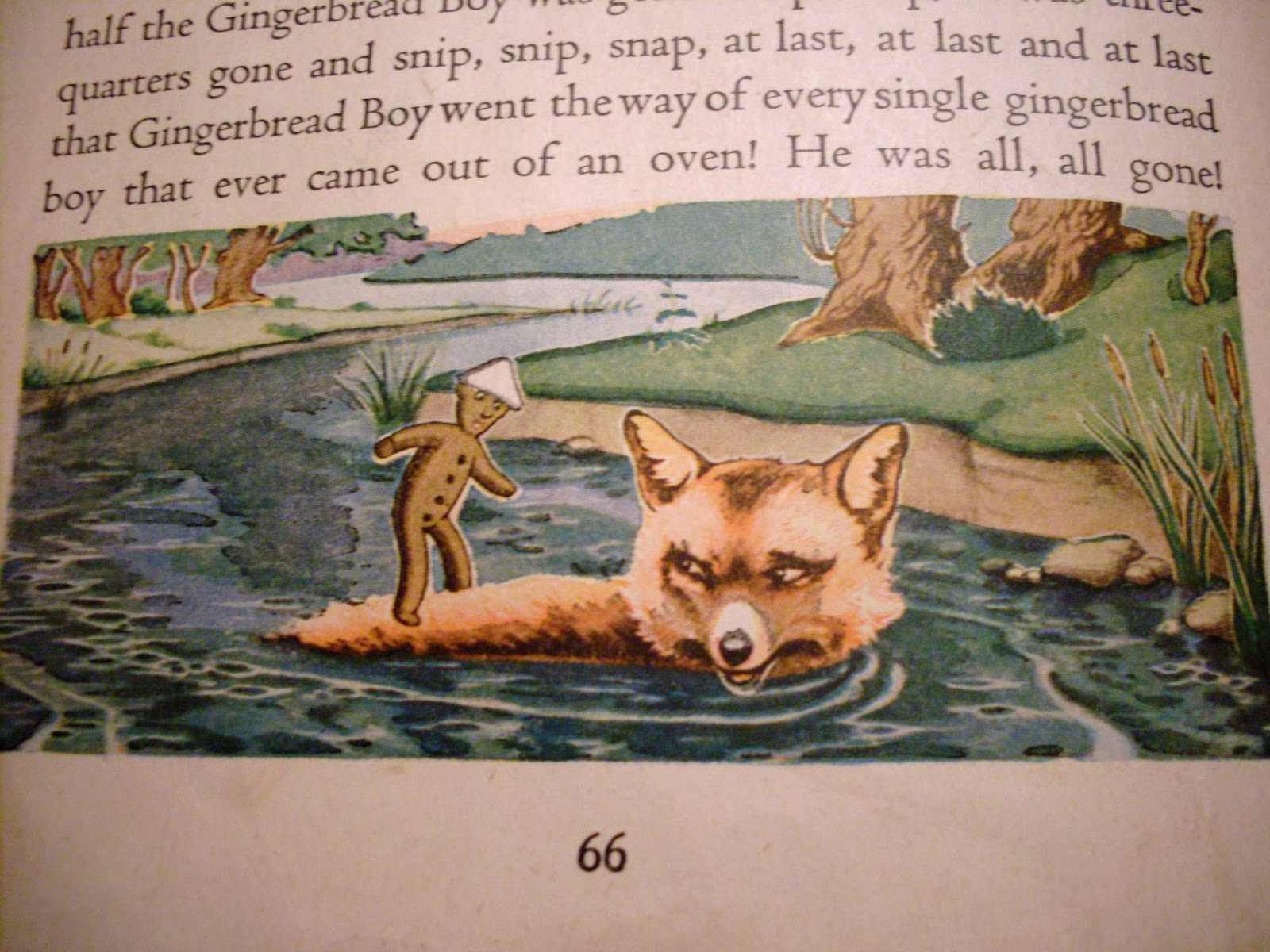
Some stories have morals and messages, but they aren't all "The Ugly Duckling" and "The Little Engine That Could" (which are included.)  The one that stayed with me is "The Gingerbread Man" (who in the story is called the Gingerbread Boy.) The Gingerbread Boy comes to life, leaps out of the oven and over 8 madcap pages inset with illustrations, he laughs and outruns everybody.  Until the last page when he reaches the river, still being pursued, and accepts the fox's offer to carry him across on his back.  As the water gets deeper the fox counsels him to jump up on his shoulder and then his nose, until the fox eats him.

Not exactly a strive and succeed sort of story, but the impact of it hit me with the final illustration.  Most of the figures had been cartoonish, except the fox in the final one, which is rendered with startling realism.  I'm surprised now to see how small this illustration is, down at the bottom of the page, because it made a big impression on me, when my mother read me the story.

The illustration in this book I most loved however was of the Sandman holding his wondrous umbrella over a sleeping child.  The umbrella reminded me of a similarly shaped and decorated lampshade on a table lamp at my grandparents.  (I believe my sister Kathy has it now.)


Volume 3, Up One Pair of Stairs was transitional--I remember reading parts of it myself.  I learned to recognize words on my own, but didn't really read until taught to do so in first grade, where I was in the Rosebuds reading group, the most advanced one.  We started with the classic Dick and Jane readers, though possibly a Catholic edition.

This volume of My Book House has more and longer prose stories, and the illustrations have changed.  In the first two volumes the colors were bright and varied, with variations of reds.  Though I believe they all were done with a four-color process (illustrations using similar colors appeared together), the palate mostly became restricted in this and subsequent volumes to shades of blue and orange as well as black and white, and more like art deco.  They were less prominent usually, deferring to the text, but not always.

Both my sister Kathy and I especially remember the final selection, "Water Babies," with verses based on the story by Charles Kingsley.  A kind of fairy tale that I can now see is touching upon issues of innocence, socialization and nascent sexuality, its illustrations probably seemed daring to us, as they modestly portray the nudity implied in the text.

By volume 3, the books in my set are also in better shape, showing less handling than the first two.  Now I seem them as treasuries, but at the time they competed with schoolbooks and later with comics and library books.  But I did read selections in all of the volumes, often in bed and especially when restricted to bed by my many childhood illnesses (mumps, chicken pox, measles twice as well as colds, flus, etc.)

In volume 4 (Through the Gate) I'm sure I read about Paul Bunyan and Pecos Bill, Johnny Appleseed and the Fisherman and His Wife, a cautionary tale about greed.

Volume 5 (Over the Hills) wove in more history, with several pieces about Abraham Lincoln (and the Gettysburg Address verbatim), along with Jack and the Beanstalk, a poem by Emerson, and William Dean Howell's "The Pony Engine and the Pacific Express" (I especially loved stories about trains, like those I could see a few blocks from my grandmother's house.)


Volume 6 (Through Fairy Halls) emphasizes magical worlds, though hewing close to impressive classical sources, such as libretto for operas, a tone poem by Debussy, Shakespeare (prose telling of A Midsummer Night's Dream) and Dickens, and stories about Leonardo da Vinci and composer Felix Mendelssohn.  The versions of stories we would know in more popularized form like Hansel and Gretel and Sleeping Beauty are closer to original sources.  Again, a mix of international tales, including Alaskan, Hawaiian, Northwest and Winnebago Native tales, and  poems by Basho and Eugene Field.

Now when I browse subsequent volumes I see poems, excerpts and rewritten tales from authors and works I've since read.  If I read these as a child, their influence was subconscious, but then much of education is.  There are bookmarks left in them (one indicating 1962) by one or another of us.

The one volume I remember best is the eighth: Flying Sails.  At some age--perhaps 11 or so--I became passionately interested in tales of ships and the sea, and voyages.  And of all the stories in this volume, the one I recall definitely reading first there is "Gulliver's Travels to Lilliput."

 Comparison to Jonathan Swift's text shows this to be only lightly edited and condensed, so Swift's voice is preserved as well as the now classic story.  Again I remember reading it here because I recall the illustrations.  But these illustrations are not so numerous, and the story lasts for some forty pages.  The point being that while I was transported by the wonder of the story, I was given the opportunity to absorb its literary merits as well.


Volume 12 (Halls of Fame) is devoted largely to biographical sketches of authors, including authors of famous fairy tales with suggestions of their hidden historical references.  It notably includes a long, illustrated retelling of Goethe's Faust.  This final volume ends with an index to the entire set, plus a child development index that sends the parent or reader to appropriate pages for views on bravery, courtesy, imagination, shyness etc.

These books existed in my life within a context that prominently included movies (especially Disney), radio (early on) and television, as well as phonograph records.  (I still have my battered 78 version of Tubby the Tuba.)   But the point is that books were represented, and not just picture books or school books (which barely registered as books.)  My Book House provided living examples of what books are, and the template for my further and continuing explorations of these nurturing, magical objects.

I may have begun to learn to read when my mother read from the early volumes of the Book House, and in other ways a pre-school child picks up the shape of letters matching with words in advertisements, etc. But mostly I started in first grade, where we read a Catholic-approved version of the Dick and Jane readers. We had a large class (in the same classroom as the second grade, so I listened to their lessons, too) and were split into reading groups, with the names of flowers.  I was in the top group--the Rosebuds.  These books had their own odd poetry of repetition, but I recall being energized in third or fourth grade when the readers suddenly took on new life, and there were verbs liked "zipped."  Eventually we got lists of vocabulary words, which to me were like new worlds.

Another influence had to be our main text, the Baltimore Catechism, with its question and answer guide to Catholic doctrine that provided another repetitive cadence.  Our Catechism had a cover with white figures on a blue background.
 
Throughout twelve years of Catholic school, the day began with the entire class standing and reciting from memory a parade of prayers--the Our Father, Hail Mary, Glory Be, Apostles Creed and the Confetior (in addition to the Pledge of Allegiance to the flag and another to the Cross.)  Throughout grade school we attended Mass one day a week in addition to the required Sunday, and adjourned to church to say rosaries and perform other rituals, all of which involved reading and reciting verses and prayers, with their imagery and particular language.  We did not read the Bible per se, but we certainly got major parts of it in the Epistles and Gospels at Mass, and chunks of the Old Testament in school.  It wasn't exactly the King James version, but close.  So these and their particular cadences and vocabularies were repeated experiences in my reading.

Tuesday, July 18, 2017

But Us Chickens (Everything is Broken)


A certain level of prophesy is not that hard.  In fact, it's an indispensable part of making decisions about the future, which we all do every day, and specifically on election days.

It wasn't that hard for me to see the disaster that George W. Bush was going to be, when the smart people were making jokes about Gush and Bore in the 2000 campaign.  It was even easier for me to see what a total catastrophe was going to quickly ensue after the election results of 2016, as much for what the outcome said about the electorate, the media and the other swells as the candidate.  As I wrote at the time, when the voters elect the candidate that 60% of them say in exit polls is unqualified to be president, there's a lot that's badly broken.  Both of these elections ushered in prolonged and very painful dramas, and of course, one of them is far from over.

But far easier than either of these, were the prophesies--made by many others as well as me--that greeted the so-called Reagan Revolution in the early 1980s: the era of "privatization," tax cuts supposedly leading to instant prosperity along the Laffer curve (and what a laugh it was),  the superior morality and even heroism of getting rich by any means possible, with the corresponding devaluing of public service and starving of the public sector.  Despite the repeated failures of these ideas, they continue as Republican gospel, and continue to dominate how things are done in the United States.

The consequences we all predicted have come true, over and over, until here we are: a broken country, in just about every way.

Witness Jonathan Kay's musings in the Atlantic, prompted by what should be a shocking situation: a bridge between the US and Canada is falling down, a bridge that carries over $200 billion worth of commerce each year.  Canada is calmly rebuilding their half.  But the US is too paralyzed--and the city of Detroit too broke--to rebuild theirs.  So Canada is footing the bill for the whole bridge, including the customs station on the US side.

Kay acknowledges other problems presided over by Canada's government.  But the question he addresses is: what has happened to the United States?  His answer:

"The United States is falling apart because—unlike Canada and other wealthy countries—the American public sector simply doesn’t have the funds required to keep the nation stitched together. A country where impoverished citizens rely on crowdfunding to finance medical operations isn’t a country that can protect the health of its citizens. A country that can’t ensure the daily operation of Penn Station isn’t a country that can prevent transportation gridlock. A country that contracts out the operations of prisons to the lowest private bidder isn’t a country that can rehabilitate its criminals."

The problem is the most basic one identified in 1980, using all of the knowledge gained in grade school arithmetic: you get what you pay for, and in public infrastructure and services, that means taxes.  Kay continues:

"It’s really quite simple: When Canadian governments need more money, they raise taxes. Canadians are not thrilled when this happens. But as Justice Oliver Wendell Holmes Jr. put it, taxes are the price paid “for civilized society.” And one of the reasons Canada strikes many visitors as civilized is that the rules of arithmetic generally are understood and respected on both sides of the political spectrum."

Tax cutting and tax avoidance have become unshakably sacred in America, despite the fact that they benefit the very wealthy the most.  Kay suggests that the US could have at least as robust a public sector as Canada does--including universal health care--with a raise in the average tax burden of 10%.

Apart from the magical thinking of Reaganist Republican economics, there are deeper questions of the public good and how to address it.  Privatization of prisons and schools were supposed to work because, the theory said, private companies would have incentives to do a good job in order to make money, whereas public servants have no incentives at all.  Apart from the insult to teachers etc., it turned out that the only incentives were to make profits at the expense of everything else, including by both illegal and immoral behavior,  just don't get caught.

Gradually the cultural context changed so much however that elements of our shared lives that had always been recognized as a public good became profit centers.  In a New York Review of Books piece, Jerome Groopman and Pamela Hartzband summarize the great and tragic change in American healthcare that has made human suffering into a money-maker.

From the days not so long ago that most medical insurance was underwritten by the nonprofit Blue Cross/Blue Shield to today's profit-centered system, regulated at last to some degree by Obamacare, it is clear that apart from the consequences in suffering, we've rather nicely corrupted ourselves, and don't even seem to know it.

I grew up in a United States that used taxes to build highways and airports, water and sewage systems, in which water, gas and electricity were public utilities.  I grew up with Blue Cross and nonprofit hospitals.  It was far from perfect, but it was better than this cacophony of hype and hypocrisy, merciless monopolies and unapologetic profiteers, presiding over a broken country.

Playwright Arthur Miller used to say that a drama begins at the moment the chickens come home to roost--that is, the moment when past actions and inactions present consequences.  But there have been many such moments since the 1980s, and we don't notice them, or not for long.  Yet the consequences are all around us, with no solace to those who foresaw them.  And there's nobody here but us chickens.