Wednesday, February 27, 2013

Supremely Racist

In a terse statement in front of the just-unveiled statue of Rosa Parks, Attorney General Eric Holder announced that in response to statements made in oral arguments before the Supreme Court on Section 5 of the Voting Rights Act, he was ordering that a new entity be placed under the protection of Section 5 for its evident predisposition to discriminate on racial grounds.

That entity is the U.S. Supreme Court.  Notwithstanding its various decisions in the past upholding equal rights, Holder said that the Court's historic pattern of racial prejudice has clearly been revived, most notably by the statements of Justice Antonin Scalia, who referred to Section 5 as a "perpetuation of racial entitlement."  Since the only "entitlement" granted under the Voting Rights Act is the right to vote without regard to race, the Attorney General concluded the the Court is now more of a threat to the rights guaranteed under this law than Alabama and Arizona put together.

Reporters asked if Holder had considered placing only Scalia rather than the Court as a whole under Section 5.  He replied that he had considered it, especially since Justice Scalia scoffed at the relevance of the U.S. Congress renewing the Act's provisions for 25 years, after 21 hearings and thousands of pages of testimony, by a near-unanimous vote in the House and a 98-0 vote in the Senate in 2006.  The renewal was signed by President George W. Bush.

That Scalia felt that all of this doesn't matter and that the Court can decide whether Section 5 is needed to safeguard voting rights for minorities, certainly suggests that he should himself be restrained by the Voting Rights Act, Holder said.  But he noted that while their language was less overtly racist, the other Republican-appointed Justices seemed to agree with Scalia on his main points.  Since they seem to have a majority, Holder said he had no choice but to add the Supreme Court to those states and districts within states that require Justice Department scrutiny and possible intervention, in order to protect the equal right to vote in the United States.

Monday, February 25, 2013

Nailed It


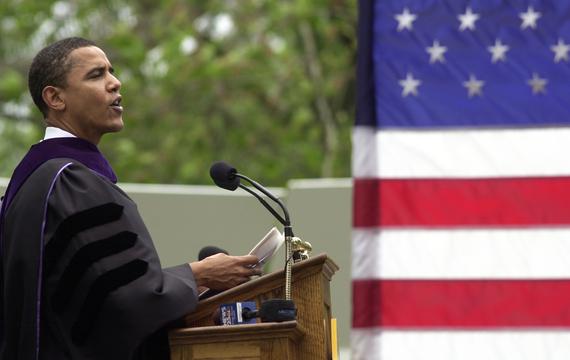
Back on January 23 I noted the continuity of President Obama's Inaugural Address to earlier speeches, in particular his commencement address at Knox College in 2005 (Knox being where I did my four years plus, though in the previous century.)

Now through the Knox alum newsletter I learn of confirmation from President Obama's speechwriter that indeed this Knox address was a major inspiration for the 2013 Inaugural.  Cool.  (Here's another link to the local Galesburg paper which links to an earlier article and includes photos and video of the speech.)

At Knox in 2005 then Senator Obama spoke outside Old Main, a site of a Lincoln-Douglas
 debate, commemorated by that plaque.

Evolution of Mom Dancing


Opening the envelope for Best Picture at the Oscars is one thing--but this First Lady has some serious moves.  P.S. This is what those bangs are made for.

Oscar Night Heist


HOLLYWOOD, CA—Los Angeles police confirmed that Denzel Washington, Naomi Watts, Joaquin Phoenix, and nearly a dozen other top-name actors had gone missing ahead of Sunday’s Academy Awards after following a fake red carpet laid outside the Dolby Theatre that reportedly led into the back of an idling, windowless van. “It appears that the kidnappers were able to use an array of camera flashes, canned fan screaming, and an imposter catty fashion reporter to lure these unsuspecting movie stars right into their grasp,” said police sergeant Mark Morales, noting that Reese Witherspoon, William Hurt, and the entire starring cast of Silver Linings Playbook were seen waving and turning to show their outfits to an assembled corps of fake paparazzi before wandering into the cargo hold of a Ford Econoline vehicle.

Oscar Report from the Onion

Sunday, February 24, 2013

Cry Havoc: How the Iraq War Began


We are weeks away from the 10th anniversary of the Iraq war's beginning.  Books, articles and TV docus have begun, concentrating on the deceptions before the war, and the war's long and terrible extent. 

 On a Sunday almost exactly ten years ago today, the San Francisco Chronicle published my essay on what everyone already knew was the upcoming bombing of Baghdad which would start the war.  It was supposed to be so devastating that the war would be over quickly.  At first it may have seemed that way, and President Bush declared combat operations over.  But of course, it went on for nearly nine more years, at immense cost.

But lost in this history is the horror of the bombing itself, and what it represented beyond introducing the p.r. term of "Shock and Awe."  The piece reflects how it was advertised, and the reality turned out to be even worse.  For weeks some 1700 air sorties including more than 500 using cruise missiles bombed Baghdad, before the first American ground troops arrived.

 I refer also to Shakespeare's Julius Caesar and its line,  "Cry 'Havoc', and let slip the dogs of war."  Once the dogs of war are loose, they are very difficult to rein in.  Once started, the machinery of war is very hard to stop.   The logic of war-including the emotional logic-- is that warfare feeds on itself, and there are plenty of corporate as well as political and ideological interests eager to keep feeding off the continuing warfare.  

The echo of the Iraq war continues to be loud, though now so distorted that it isn't always identifiable.  This war that depleted so much continues to have consequences in what this nation did, and what it did not do.  Those consequences may well continue for a very long time.

And this was a preview of how it began.  Here is the essay as it first appeared in the Insight Section of the San Francisco Chronicle on February 16, 2003.


When Islamic armies were the most powerful in the world, conquerors of Asia Minor and North Africa, and poised at the gates of Europe in the 8th century, Abu Hanifa, founder of a school of law in the city of Baghdad, proposed that the killing, maiming and raping of civilian noncombatants in war be forbidden. It was one of the first attempts to codify some kind of moral and legal restraints on civilized societies engaged in the dangerously uncivilized practice of warfare.

If and when war comes to Iraq, it will likely feature the relentless and perhaps unprecedented bombing of Baghdad. According to CBS News and other sources, the United States is considering implementing a strategy called "Shock and Awe," developed in 1996. The plan could result in at least 300 Tomahawk cruise missiles raining down on Baghdad in just the first day of an aerial campaign - more than were used on all targets in the entire Gulf War. And the plan calls for an equal or greater number on the second day as well, up to 800 total, each capable of carrying 1,000 pounds of explosives. There was no estimate of how many days the bombing would continue.

Although missiles would likely focus on infrastructure including electricity and water supplies, an average of one missile striking a city of 5 million inhabitants every four minutes around the clock could kill and maim thousands of civilians.

"There will not be a safe place in Baghdad," according to an unnamed Pentagon official quoted by CBS. "The sheer size of this has never been seen before, never been contemplated before."

The prospect of war in Iraq is crowded with moral as well as political questions, with multiple possibilities for ethical outrages of stunning proportions. But the continuous bombing of a city of civilians would probably be the first that confronts the watching world.

In A History of Bombing (published by New Press in 2001, and forthcoming this spring in paperback), Sven Lindqvist follows three main threads: the technology and use of aerial bombing in history, the attempts to deal with the moral implications of its use against civilian populations (Abu Hanifa is one example he cites), and social attitudes toward bombing found in sources such as popular fiction.

The historical parallels to the current prospect as well as the ironies are disquieting. The impact of the "shock and awe" strategy is meant to be on hearts and minds: to destroy the enemy's will, and mental and psychological ability to resist. But bombing's ability to terrorize - the sudden explosive death from the sky without warning - was one of the first effects to be observed, noted in 13th century China. It has often been a prime strategy of bombing, according to Lindquist, used extensively by European colonial powers in Africa, India and Asia.

Bombing is especially terrifying when used on the helpless. At first it was shelling from ships far offshore (which is how the United States bombed Nicaragua in 1854), then bombs dropped from airplanes. Bombing was a cost-effective way of keeping subjugated populations in line. Baghdad was a British target more than once in the 1920s.

As airplanes, bombs and cities all got bigger, moralists and diplomats negotiating the international rules of war and definitions of war crimes struggled to keep up. Several prohibitions against air warfare and the bombing of cities were proposed, and some were signed, except by the major powers capable of the bombing. Well into the 20th century, bombing was considered not so bad if the victims were of "inferior races." Some authors wrote glowingly of bombing as a way to civilize the world by permanently subjugating or even wiping out these races.

European bombing gradually got closer and closer to home, until the German military on behalf of Franco tested new kinds of bombs by dropping them on cities in Spain. Japan bombed civilian cities in China. Then in the 1940s, bombing of even the capital cities of combatant nations - Berlin, London, Tokyo - became a normal instrument of warfare, finally leading to the annihilation of the undefended cities of Hamburg and Dresden by British saturation firebombing, and of Hiroshima and much of Nagasaki by the U.S. atomic bomb.

By that time, terror was not the only result of bombing. Fifty thousand civilians were killed in a single night in Hamburg, most of them women, children and elderly. Twice that number died in Dresden. Two atom bombs did fill Japan with shock and awe, and killed several hundred thousand civilians in the process.

There are various strategic arguments for bombing campaigns that dovetail with apparent moral concerns, usually involving shortening a war's duration or substituting for ground assaults, thus saving lives, especially the lives of the side doing the bombing.

When facing the possibility that this war would unleash chemical, biological or nuclear weapons that have been largely absent from warfare for decades due to international taboos of one kind or another, it may seem quixotic to argue that bombing of civilian populations should be regarded as an evil in itself, and beyond the pale for nations that desire any sort of international relations. But it seems morally obtuse that there is a stronger taboo against assassinating a declared enemy's head of a state than against slaughtering babies in their beds. Surely bombing should be a last resort, not the first.

For even if the historical parallels are coincidental and not disturbing echoes of residual racism and empire-building, the bombing of Baghdad to begin this war would have a terrorizing effect on more than its residents. In Shakespeare's time, there was another word for the terror, the shock and awe that accompany a war without moral limits. The word was "havoc," as in the famous quotation from Julius Caesar, "Cry 'Havoc', and let slip the dogs of war."

The bombing and havoc may already be starting by the time you read these words, although according to Los Angeles Times reporter Doyle McManus on the Washington Week in Review, "You can pretty well mark on your calendar March 15. " It's the date formerly known as the Ides of March.

The bombing of Baghdad began on March 19, 2003.

Thursday, February 21, 2013

Moronic Inferno


Once more unto the brink my friends.  We unhappy many, we band of blatherers.  Once more our GOPer congressmorons are taking Americans through an elective crisis, a self-inflicted disaster rapidly becoming a self-fulfilling catastrophe.

Congress passed a law mandating across the board cuts in the federal budget, with no judgement allowed in what is to be cut.  The uber-morons of Fox and the Rabid Right don't think these cuts are even deep enough, yet just about everybody else recognizes they'll cripple the country and sink the economy.  These cuts were meant to be this bad--to be soooo bad that Congress would do anything to forestall them, even come up with rational budget changes that would cut the deficit without trashing the economy.  They didn't, and now the cuts are coming.

Did they have to do this?  No.  Can they stop it easily by just...well, stopping it?  Yes.  Are they talking like they will do that?  No.  "As simple as it is stupid," as Rachel Maddow says.

President Obama outlined some of the consequences:

Now, if Congress allows this meat-cleaver approach to take place, it will jeopardize our military readiness; it will eviscerate job-creating investments in education and energy and medical research. It won’t consider whether we’re cutting some bloated program that has outlived its usefulness, or a vital service that Americans depend on every single day. It doesn’t make those distinctions. 

Emergency responders like the ones who are here today -- their ability to help communities respond to and recover from disasters will be degraded. Border Patrol agents will see their hours reduced. FBI agents will be furloughed. Federal prosecutors will have to close cases and let criminals go. Air traffic controllers and airport security will see cutbacks, which means more delays at airports across the country. Thousands of teachers and educators will be laid off. Tens of thousands of parents will have to scramble to find childcare for their kids. Hundreds of thousands of Americans will lose access to primary care and preventive care like flu vaccinations and cancer screenings."

Though Medicare and Medicaid aren't affected directly, the cuts will of course hit the poor hardest.  They'll hit  families with children as Head Start gets cut, teachers are disappeared. But as the President noted, the business class will also feel it, at the airport.  And those are just some of the direct consequences.  When people lose their jobs, a lot of other people eventually lose their jobs too.

There's a kind of apotheosis to this latest apocalypse, partly because there's no ongoing drama.  No negotiations, just fatalism.  Unless Speaker Banal's attempt to blame this all on Obama is a clever preliminary to saving the country from him by cancelling the cuts--by declaring victory and going home--there is no exit strategy.  Congress isn't even bothering to be in session.  

This is the seventh time GOPers have gone to the brink in a hostage-taking, manufactured crisis, since Obama was elected (the first time.) Each time, the U.S. economy has paid, the federal deficit has grown because of it.   And it's not like they've gained political advantage.  The latest polls show President Obama's approval at from 51% to 55%,  with GOPers anywhere from 20 to 40 points behind that.  Most Americans surveyed believe this is the GOPers fault.

So what's really at work in this moronic inferno (a phrase coined by Martin Amis in the 80s)?  Apart from the imploding GOP, on the brink of a nervous breakdown, or more likely having one.

Maybe they have to manufacture apocalyptic crises because they dare not face a real one--one so big and frightening that they can't even admit it exists, let alone put in the emotional work as well as the long, difficult intellectual and political work to confront it.  It's a crisis that is going to be here for a very long time, and it can't be ignored away.  And the longer we fail to confront it with all the energies we possess, the worse it is going to be.

  Secretary of State John Kerry on Wednesday called for action to combat climate change and spur the American economy by investing in clean energy technologies.

"We share nothing so completely as our planet," Kerry said in his first major speech since becoming secretary of state at the University of Virginia. "If we waste this opportunity, it may be the only thing our generation - generations - are remembered for."

Wednesday, February 20, 2013

This Week in Fascism (Updated)


Uncivil War among the GOPers has become so vicious that a Tea Party group had to apologize for creating the above portrait of Karl Rove as a Nazi stormtrooper.  They're still a tad upset that he wants his billionaires to back non-crazy (i.e. non-Tea Party) candidates.  So to review: a Rabid Right fringe of the Republican White Peoples Party thinks Karl Rove is a Nazi.  Pot, kettle, black?

Also in the department of reaping your own damn whirlwind, John McCain faced his own Rabid Right whites  in Arizona, shouting at him for not deploying soldiers to shoot to kill on every inch of the southern border.  Another GOPer suggested a model for our border security should be East Germany.  Build up that wall, Mr. Gorbachev!

But the prize goes to the Show Me state, where a GOPer legislator wants to make proposing a gun control law a felony crime in Missouri.  You know the old saying in politics, if you can't beat 'em, arrest 'em!  Or as stormtrooper Karl might say, if you can't arrest 'em, beat 'em!

But actually the prize for effectively installing fascist dictatorship while hidden in plain sight goes to the state of Michigan, which re-installed its Emergency Manager law that was voted down in 2012 (but this time in a new voter-proof package!) and is looking towards the GOPer state government-mandated totalitarian takeover of the big prize, the city of Detroit.  

Meanwhile, not separated at birth:


Senator Ted Cruz


Senator Joseph McCarthy


Monday, February 18, 2013

Cardinals Not Happy with Pope Distraction


It’s not as if they’ve got nothing else to do. As the Cardinals gather for spring training in Palm Beach, they’ll be trying to figure out how to replace injured starting pitcher Chris Carpenter and the second baseman they traded to the Dodgers, Skip Schumaker. Among other problems.

And suddenly they’re faced with one more task: electing the next Pope.

“The Pope’s resignation just came out of left field,” said a clubhouse source at Roger Dean Stadium where the Cardinals train. “And the Vatican’s a holy mess. We were one game away from the pennant last year. We really don’t need this. It's a high massive distraction.”

One of the Cardinals’ coaches agreed, though not for attribution. “We’re breaking in a new second baseman. We’ve got to figure out how to keep Rafael Furcal and Jaime Garcia healthy. And Carlos Beltran isn’t getting any younger. But instead of concentrating on all that, we’ve got to go through all these bios and resumes, organize a conclave—Jesus, it’s a mess.”

Several observers noted that second year manager Mike Matheny will be under particular pressure. “Mike’s just figuring out what minor leaguers and draft choices to look at,” said one veteran scribe. “Now he’s supposed to come up with a supreme pontiff? The truth is nobody in the organization is prepared for this. Nobody even knows how to make the white smoke.”


Though only pitchers and catchers are present at training camp so far, the Cardinal organization insists that the election of a Pope will not interfere with the spring schedule. Not everybody agrees.

"They're working out a plan for like conclave in the morning, workouts in the afternoon, but who knows how long this is going to take?" said an informed batting practice catcher.

“We’ll probably cancel an exhibition game or two,” said pitcher Marc Rzepczynski. “Personally I’m rooting for another Polish Pope but I’m just one vote. Quote me as saying I’m keeping an open mind. And spell my name right.”

The Whimpering Warmongers

Beginning with Presidents Day, this week might well turn Zeitgeist's attention to the international arena, and wars past, present and to come.  On Monday MSNBC premieres a documentary on the presidential-level lies that promoted the Iraq war.  According to its narrator, Rachel Maddow, it will ruffle some political feathers.  Those same feathers are already in tatters, after an ugly barnyard brawl with Chuck Hagel.

The unprecedented filibuster stalling the new Secretary of Defense from taking office, and preventing him from accompanying the President to an important international conference this week, is definitely part of this mix.  The GOPer Senate filibuster, led by the permanently confused John McCain and the ever more craven Lindsay "Cracker" Graham, seemed like just another moronic inferno--continuous blather about issues that appointee Chuck Hagel had nothing to do with or will never set policy on, while neglecting to even try to find out if he can do the actual job of defense secretary.  But Josh Marshall at TPM makes a very interesting case that this is all still about Iraq and to a lesser extent Afghanistan, and the warmongering foreign policy those wars represented.  It's the neocon's last hurrah.

"Basically everything Barack Obama has done since coming into office has been to unwind the thicket of commitments, practices and open wars begun under George W. Bush. People who don’t know the policies and the agendas in detail can miss this," Marshall writes.  But the neocons know exactly what's going on, and they don't like it--they especially don't like that Republican Chuck Hagel agrees with this dismantling, and said so even while Bush Lite was in office.

The American people are so far past this that President Obama's announcement in the State of the Union that half the troops still in Afghanistan would be home by year's end didn't even make much news.  But the neanderthalic neocons don't care.  They have security consultants and gun manufacturers to feed, and their carefully cultivated mad voters' buttons to push.   But they're losing.  So they weaken their own country's defense and international standing, just to express their pique.

These are the guys responsible for thousands of deaths, billions of wasted dollars, immense human suffering and more than a decade of awful displacement of the energy and attention needed to save the planet.  No wonder they're reacting like terribly guilty criminals.

 But at least they're not going out with another bang.  Just with an ugly whimper.

Sunday, February 17, 2013

Towards Climate Action


"Today was the day. Finally, powerfully, decisively -- the movement to stop climate change has come together," activist and writer Bill McKibben wrote in an email to 350.org supporters.

"This was the biggest climate change rally in US history. By our count, 50,000 people gathered by the Washington Monument and then marched past the White House, demanding that President Obama block the Keystone XL pipeline and move forward toward climate action."

Other sources put the number at 35,000--USA Today said "tens of thousands" in their story, with its unflattering photo of McKibben, so reminiscent of press coverage of early Civil Rights and antiwar marches.  The Sierra Club news release contains a list of speakers and excerpts from speeches.  Think Progress has a brief story and photos.

Friday, February 15, 2013

We Are All Newtown


From Thursday's rally in Connecticut  marking two months since the Sandy Hook assault weapons massacre.

Thursday, February 14, 2013

Happy Valentine's Day

Response to Reaction

The day-after political/ media "analysis" of the State of the Union included the typical mixture of cynicism and stupidity.  State of the Union addresses never have any effect or are remembered (except of course when they are.)  This speech was just another "laundry list," which apart from being the easiest cliche to find in the deeper recesses of small minds, may well be the impression you'd get if you weren't actually listening, but busily twittering and tweeting and checking others doing so.

Those wearing the typical political blinders said it was "partisan" because it didn't cave to the extremely bad ideas of the GOPer sulking in the audience. 

Here's a decent summary of some of the proposals in what Bob Shrum called the most progressive agenda of the past 50 years.  

Wednesday, February 13, 2013

The Next Great Chapter


I got the sense of a liberated Obama in his State of the Union address, but not because he doesn't have to worry about be re-elected, as the pundits say.  Let me do something novel and take him at his word.  He began the speech by referring to how the country has come out of the Great Recession with which he was greeted on his first Inauguration, and how the second of the two wars he inherited is being ended.  "So, together, we have cleared away the rubble of crisis, and we can say with renewed confidence that the state of our union is stronger."

So the rubble is cleared, and it's time to build it.  And that's what I heard: the Obama we probably would have heard in 2009 if  the GOPers Wall Street hadn't conveniently tanked the economy during his presidential campaign.  The 21st century America that he wants to build.

This address was full of proposals and declarations of the directions we need to go, and why.  It was clearly and logically articulated in the language of common sense.  The sense we have in common, and of what we do in common.  "Obama's repeated plea to the nation tonight was to face reality: his tone was relentless reasonability," wrote xpostfactoid in the critique that best reflects my own response of any I read.

(Here's the transcript of the speech as delivered.)

Yet President Obama did not dwell on a single issue or argument but proposed an exciting scope of ideas and initiatives.  A lot will depend on follow-through, but I did get the sense that these were not thrown-together notions at a p.r. brainstorming session but legislative proposals that were worked out in terms of cost, and either executive actions or public-private initiatives that have been started. 

The more you look into issues like the climate crisis, the more you see that valuable stuff can be accomplished without Congress.  And what choice do we have?  It's clear that little of significance is going to be done by this Congress except through the back door (i.e. the Senate and a majority of Dems with some GOPers in the House, but only on a few issues), so you have to go to working with the states, with business and academia, etc. as well as through executive action and going to the citizenry for political heat.

Howard Fineman on msnbc said he was in the chamber for the speech and felt that President Obama's mantra on gun violence legislation was very powerful in the room, and that translated over the TV.  "Hadiya’s parents, Nate and Cleo, are in this chamber tonight [the Chicago teenager gunned down days after performing in the Inaugural parade], along with more than two dozen Americans whose lives have been torn apart by gun violence. They deserve a vote. They deserve a vote. (Applause.) Gabby Giffords deserves a vote. (Applause.) The families of Newtown deserve a vote. (Applause.) "  

As someone said, President Obama was shaming the Republicans in this and other sections of the speech, but this mantra was applicable as well to Senate Majority Leader Harry Reid, who doesn't want to bring the assault weapon ban to a vote.  It's going to be very hard for him to deny it now.

But he ended the speech with what will live from it in quotation--yet another distillation of President Obama's core belief, and a subtle transition to tomorrow (which is today)--when he goes out on the road and takes his case beyond the Beltway:

"We may do different jobs and wear different uniforms, and hold different views than the person beside us. But as Americans, we all share the same proud title -- we are citizens. It’s a word that doesn’t just describe our nationality or legal status. It describes the way we’re made. It describes what we believe. It captures the enduring idea that this country only works when we accept certain obligations to one another and to future generations, that our rights are wrapped up in the rights of others; and that well into our third century as a nation, it remains the task of us all, as citizens of these United States, to be the authors of the next great chapter of our American story." 

Monday, February 11, 2013

Idle No More

U.S. environmentalists have allies to the north, including this First Nations protest in Canada against the tar sands exploitation, specifically of Native land, that is the front end of the Keystone pipeline.  As described in this Rolling Stone article, these First Nation protests have spread beyond Canada to a very interesting spot across the border in the U.S.---the Mall of America in Minnesota.

Building a Movement

This weekend 350.org , along with the Sierra Club, the Center for Biological Diversity and other groups is organizing a Forward on Climate Rally (on Sunday the 17th) and other activities in Washington in support of federal action on confronting the climate crisis, and specifically calling for the Obama administration to deny approval for the Keystone pipeline.

Demos and pressure from groups and people who are otherwise allies can be very helpful not only in spurring action but in giving the Administration some political room to act.  It was the March on Washington in 1963 that told Washington there was a lot of support for Civil Rights legislation, which gave President Kennedy the political room to propose what became the Voting Rights Act and other laws.

One of the problems on responding to the climate crisis as well as other issues has been the lack of a cohesive and persistent progressive movement.  It still doesn't exist--marches like this should have the kind of broad institutional support that the March on Washington had, from most Civil Rights groups to religious groups to Big Labor.  We'll see if this particular march has made any progress in that regard.

So the 350.org web site's call to action --"Tell Obama to Step It Up!"--is relevant, although as everybody knows, the real problem is Congress.  Still, there are things that the President can do and advocate that don't require Congress, and I hope we do hear some of those in the State of the Union.

But it's very important to the effectiveness and credibility of this effort not to go too far in personalizing this, especially in regard to President Obama.  And that's for a very clear political reason.  As this last election proved, there are millions of voters who feel very protective of President Obama.  They are mostly but not exclusively people of color, and members of other minorities.  They are very sensitive to the kind of slights they've heard about themselves, and they won't tolerate personal attacks on this President. 

To name a conspicuous example, Joe Romm at Climate Progress declared the Obama administration a "failure" because it didn't succeed in passing cap and trade or otherwise do what Romm wanted them to do.  That was (if memory serves) barely two years into Obama's first term, although Romm has repeated it several times since.  It got him attention, but not all of it was positive.  It turned people off, including me.

Whether an administration is a success or failure is a judgment for history, when more is known and the consequences are clearer.  We all wish the last 5 Presidents, including Obama, had been more successful in leading on what is very probably the most consequential issue of our time. If we fail to confront this crisis, there will be plenty of blame to go around.  But making a premature judgment on success or failure of a presidency is arrogant and unfair--and in this case it has been perceived as such.  Repetition of this will only alienate more people. 

 The environmental movement needs to move beyond affluent white liberals, and the perception that it still is that.  The necessary environmental coalition--let alone the necessary progressive coalition--will not happen if a lot of natural allies are driven away.

Sunday, February 10, 2013

Winter Hurricane


(Reuters) - "The U.S. Northeast started digging itself out of a blizzard that dumped up to 40 inches of snow with hurricane force winds, killing at least nine people and leaving about half a million customers without power."

Dr. Jeff Masters: "A historic Nor'easter roared through New England overnight, bringing snowfall measured in feet, not inches, hurricane-force wind gusts, and serious coastal flooding. The snow was heaviest in coastal Connecticut, where snowfall rates of 6"/hours were recorded, and an astonishing 40" piled up in Hamden. An all-time snowfall record was set in Portland, Maine, where 31.9" fell, and numerous cities in the Northeast recorded top-ten snowfall amounts, including Hartford, CT (2nd all-time with 22.3"); Worchester, MA (3rd all-time, with 28"); Providence, RI (8th all-time, with 17"); Concord, NH (2nd all time, with 24"), and Boston, MA (6th all-time, with 21.8.")

The great storm, dubbed "Nemo", bombed out to a central pressure of 971 mb at 7 am EST Saturday, February 9. This is the type of central pressure one sees in Category 1 hurricanes, and Nemo generated numerous hurricane-force wind gusts along the coast, including a 76 mph gust at Boston's Logan Airport. Significant wave heights of 30' were measured in Massachusetts Bay, and 35.4'at the Cape Ann Buoy 44098, off the east coast of Massachusetts...


The high winds from the storm drove a damaging storm surge into the coast of Eastern Massachusetts Friday night and Saturday morning. Hardest hit was the coast of Cape Cod Bay southeast of Boston, where major flooding forced residents of low-lying areas to evacuate. A storm surge in excess of four feet inundated roads, damaged coastal buildings, and caused severe beach erosion."


The global heating relationship to this storm is probably most obvious in the warmth of the ocean leading to snow but also winds.  Higher sea levels mean higher storm surges.  Here's one piece on the global heating contribution, and here's another.

This storm is also notable for the response.  The New York and New England state governments closed highways and roads in advance of the storm, quickly issued emergency declarations when it hit, and used new sophisticated means for dealing with it, like GPS on emergency vehicles and snowplows, with computer mapping of affected areas and where the vehicles were.

That these governors and governments are doing this is encouraging because a lot more can and must be done to minimize deaths, suffering and damage of these less and less rare but larger and larger weather events.

Fortunately this storm hit chiefly in these Blue states where governments take their responsibilities seriously, plan and spend money to prepare.  Other states may not be so prepared, and the consequences may be even greater.  

Friday, February 08, 2013

The Dreaming Up Daily Quote


"There is nothing like a dream to create the future.  Utopia today, flesh and blood tomorrow."

Victor Hugo

Thursday, February 07, 2013

It's Not All Bad

Republicans may want to fight a new Civil War in America, but right now they're fighting a Civil War with themselves.

Fox News ratings are falling.  The most trusted name in news is PBS. 

Democrats--including President Obama--are sounding optimistic about midterm elections, especially because women who don't normally vote in midterms are set to vote on the gun issue.

About the midterms I'd be happier hearing that the Rabid Right is going to be turned out of state houses and state legislatures, in PA, Michigan, Virginia, Florida, Wisconsin, Ohio, etc. etc. That's where the real damage is being done.  But what President Obama is suggesting-- that both houses of Congress could again be Dem for his last two years--might mean some small chance for climate crisis legislation, and energy infrastructure.  Right now the "experts" don't think Dems will win enough seats to take the House.  But the experts also pooh-poohed Obama's suggestion in the fall that the political landscape would change after his reelection.      

Today in Fascism

Our freedom-loving, government intrusion-hating Rabid Right keeps on showing its true colors.  For instances:

BOISE – Coeur d’Alene Sen. John Goedde, chairman of the Idaho Senate’s Education Committee, introduced legislation Tuesday to require every Idaho high school student to read Ayn Rand’s “Atlas Shrugged” and pass a test on it to graduate from high school.

When Sen. Bob Nonini, R-Coeur d’Alene, asked Goedde why he chose that particular book, Goedde said to laughter, “That book made my son a Republican.”

The Spokesman-Review story goes on to suggest it wasn't a serious proposal--he was ticked off about other  actions by the State Board of Education.

The same can't be said about the Iowa state legislator who proposed a law that would declare abortion by any means to be criminal murder:

Those charged with murder, under the bill, would include a mother who takes abortion-inducing drugs or a doctor who performs an abortion. It also grants no exceptions for rape, incest or to protect the life of the mother.

Though he doesn't expect the bill to pass, he's entirely serious in proposing it.

Tuesday, February 05, 2013

Gun Nuts

So the Arkansas legislature passed a bill to permit guns in churches.  Of course!  Praise the Lord and pass the ammunition!  States are seemingly falling over each other to permit guns to be carried and concealed in every conceivable place: college campuses, bars, at sports events (soccer moms with guns!), government public hearings, K-12 schools, maybe pre-schools next, etc.   Even the Obama administration got in the act by allowing guns into national parks.

Why is this insane?  Let me splain it to you.  If I know that the family in the next tent, or the guy sitting on the next stool at the bar, or the folks next to me in the pew, or folks at a heated public meeting, might be packing firearms, I've got new choices to make.

I may choose to stay home a lot more.  I may choose to be very careful about what I say, in public, and especially to strangers but also anything that might anger anybody.  Like a joke that might be taken the wrong way.  In other words, to be fearful and unnatural, like in a totalitarian society where I have to be afraid of every word or the interpretation of every act.

Or another choice is, that if people around me in church are going to be armed, I'd better take a gun to services as well.  If there's going to be a shootout between the fans wearing red and the fans wearing blue at the Little League field, I better be able to "defend myself."

Of course, some of them might be packing a more powerful gun, with greater firepower.  So I'd better carry an even better gun--a nice lightweight assault-type weapon, semi-automatic, with lots of bullets in the mag.  And I better be ready for trouble.  Can't let anybody get the drop on me.

We learned all this from watching westerns, and the logic of it is unassailable.  It's why getting guns out of ordinary situations was essential to civilized life.

Right now the NRA is fighting like hell to prevent any restrictions on guns, including universal criminal background checks, which they used to favor--way back in 1999.  People wonder why but time to grow up.   The NRA knows that almost everybody is in favor of these checks and a law will get passed, but they want everybody to be arguing about it so nothing else gets passed, like bans on high capacity ammo and assault weapons, which are expensive products with nice profit margins for their funders.  As well as being the fetishistic comfort food of survivalists, the equivalent of pacifiers. Everybody on TV and in the movies has them--why can't I?

Here's the essential point nobody is talking about.  It's anger.  There are lots of angry people out there, and this society breeds anger, justifiable and insane.  For a person with a gun, the damage that results from  blinding anger--momentary or motivating, paranoid or righteous-- depends on how many bullets you can fire, and how fast and how easily you can fire them.  Simple as that.

I'm hearing that gun control experts say that the background checks will actually do more to reduce gun violence than anything else.  But it wouldn't have helped those children and heroic adults in New Town.  At the very least, we must ban high capacity ammunition.  If we don't also ban semi-automatic assault weapons,  and until we ban firearms from public places--I question whether we can ever think of this as a civilized society.        

Monday, February 04, 2013

Now a former Secretary of State, Hillary Clinton no longer must represent the U.S. on important missions like this nicely color coordinated one.
Now the Secretary of State is John Kerry, seen here practicing his mean sneer in his 2012 role as Mitt Romney for President Obama's debate prep.

Evidence Based

Challenges to evidence-based public policy dialogue come from many sources.  The easiest to finger are the demagogues, the crazies whose outrageous utterances are quickly refuted, though not always with the style and thoroughness of Dan Amira's entertaining takedown of a rant by Arkansas State Senator Jason Rapert that surfaced last week.  It's titled very simply Bigot is Also Liar and it's profusely illustrated with the relevant photos.

But there are other assertions that are not evidence-based that nevertheless become part of the conventional wisdom through 1)politically motivated repetition  2) inadequate refutation by the target's allies 3) mindless repetition by the media.  Because everyone assumes they are true, they influence public policy debate even though the evidence is otherwise.

One big example of that is President Obama as a big spender who is inflating the deficit and national debt, thus enslaving future generations.  That in itself is not true--federal spending during Obama's first term grew at a slower rate than any administration since Eisenhower.

But it's corollary is perhaps the most harmful--an expanding government is sapping the economy.  As Paul Krugman pointed out in this exchange, not only is government spending not expanding, public sector jobs are   declining month after month, and that's the biggest drag on the economy.  Up until now it's been felt at the state and local level, where school teachers and firefighters, etc. are losing their jobs.  Public needs are not being met and those lost incomes aren't buying stuff.  But in the fourth quarter of 2012, the economy contracted slightly (by early figures) entirely because of a large drop in federal spending.

If we accepted this evidence, we would be increasing government spending, on essential services and infrastructure at the local level, and on strengthening public health, emergency services, etc. as well as investing in the future of education and energy technology.  

Saturday, February 02, 2013

Deadly Beauty

Those lovely blue blobs in the foreground of this photograph of a lake are frozen methane, which are now solid but will melt into air.  Methane is one of the more potent of the greenhouse gases.

Climate, Politics and Evidence

In covering Hillary Clinton's last day as Secretary of State, Rachel Maddow on Friday quoted her AP exit interview in which Clinton reflected on the Bengazi controversy by noting that there are too many people in politics and the media who simply refuse to  " live in an evidence-based world."  This segment ends with Chris Hayes talking about the particular danger of the political power wielded by those who are rigidly not evidence-based to addressing the problem that the new Secretary of State John Kerry calls a major global issue: global heating and the climate crisis.  When nations of the world gather to negotiate climate treaties, Hayes said, they know that the United States Senate which must ratify such a treaty (with a two-thirds vote no less) is clotted with climate crisis deniers for whom no evidence will ever be relevant, let alone convincing.

The climate crisis is the most comprehensive crisis humankind has faced since humans first spread across the globe.  It is first of all a challenge to the sophistication of our knowledge and our understanding, because it is about effects that will happen or are happening long after their causes.  And those effects will eventually challenge the interrelationships of our natural planet and our increasingly interdependent civilization, so that dealing with these effects will require timely, complex, careful and simultaneous efforts, for a long time.

It would be a daunting challenge even if we were at our best--that is, the best we've been so far.  Unfortunately our politics and much of our society is as reactionary and primitive as any I've seen in my lifetime.  That's not because people with these views didn't exist before.  They simply weren't as powerful and as accepted as normal and legitimate in our public life.

At a time when we need to be better, we've fallen back.  But that's not the whole story.  There is an even greater divide in our country than between rich and not rich.  It is the divide between the rabidly reactionary and the common sense progressives.  And an even greater divide between the intentional ideology of ignorance and those with knowledge and skills beyond any before.

Progress on addressing the climate crisis is happening apart from the political circus.  It's happening in universities and industries, in cities and states and regional groups.  It's happening in departments of the federal government.  And as Chris Hayes noted, it is happening in other countries.

Here in America it may well take the political power of the citizenry, expressed in some old ways (like the march on Washington scheduled for February) and in new.  There is no clear way forward past the barrier of the Senate and the intentionally delusional--not as long as they keep making money and financing their campaigns by publicizing their delusions (which, hypocrites as many are, they probably don't even believe.)  But as the previous post indicates, there are only a few years left to find that way.    

Climate, Crisis and Time

NPR's Ira Flatow interviewed a group of prominent American climate scientists on Friday.  Radio interviews have their disadvantages: they can hop from brief answer on one topic to brief answer on another topic without the necessary length and depth on each.  But they also can have the salutary effect of getting experts to say things plainly and succinctly, especially in answer to pertinent questions we'd all like to ask.

Here's one such exchange, between Flatow and the very prominent climate scientist, Michael Mann:

FLATOW: So we are set on some kind of climate change course that is irreversible at this point?

MANN: Well, we're committed to a certain amount of additional warming of the globe. We've already warmed a little under one degree Celsius. We're probably committed to at least another half a degree Celsius just because of the heating that we've already put in the pipeline. So that means that we don't have a whole lot of wiggle room if we're going to avoid two degree Celsius warming of the globe relative to pre-industrial time, that's three and a half degrees Fahrenheit.

That's what most scientists who study climate change impacts say is sort of where we enter into the red zone, the danger zone, where we start to see some of the most severe impacts of climate change play out.

FLATOW: And what time, what part of the century might that happen?

MANN: Well, we only, as it turns out, have a matter of a few years to bring our global carbon emissions to a peak and begin to ramp them down pretty dramatically if we are going to avoid crossing a threshold in terms of the concentration of CO2 in the atmosphere where we are committed to that warming. So there is still time to avoid that dangerous threshold, but there isn't a whole lot of time. There's an urgency to the problem."

Flatow then goes immediately to the extent of the problem, which emphasizes its urgency:


FLATOW: Are these future projections of four to five degrees Celsius, are they averages for the planet, the entire planet, the land surfaces, just which parts?

MANN: Sure, yeah, in the event where we basically pursue business as usual, where we don't enact any policies to bring down our carbon emissions, we're probably committed to somewhere between four and five degrees Celsius, that's seven to nine degrees Fahrenheit, warming of the globe by the end of this century.

That is just a global average. It turns out that the land warms faster than the ocean. So we'll see more warming than that where we live, on continents. And in the Arctic, we'll probably see twice that much warming. So if you're worried about the shrinking polar icecap, if you're worried about the Greenland ice sheet and the potential destabilization of that ice sheet and the associated sea-level rise that would come from that, we are headed on a course where we will see those things play out if we don't enact some changes now."

As other guests join in, the conversation turns to China and its aggressive, huge but schizophrenic energy policy.  I'll save that part of the interview for another time, or...you can just follow the link to the source.

Wednesday, January 30, 2013

Right to Life


Lessening gun violence may be politically hard to do, and even operationally a bit difficult, but the reason for it is very simple.  Gabby Giffords short statement is eloquent in so many ways.  Thanks to gun violence, she can only speak simple sentences, but more complicated ones are hardly needed.

Also very direct was another statement made on Wednesday was this one by David Wheeler, father of one of the first graders massacred in New Town, who testified before the Connecticut legislature’s Bipartisan Task Force on Violence and Public Safety.  He quoted the opening sentences of the Declaration of Independence and its assertion that governments are created to secure certain inalienable rights, and the first of these is simply "life."  The right to life of his six year old son, and of all others massacred or killed while laughing with friends, as was a girl in Chicago Wednesday who had marched in the Inaugural parade.

No one knows what Connecticut will come up with, but at least Mr. Wheeler wasn't heckled, as was another father of another slain New Town boy earlier in the week.

For the opposition by the gun profit lobby and the gun obsessed remains fierce. Giffords appeared before a Senate committee, but even the Democratic majority is already dismissing the chances of a renewed ban on assault weapons, perhaps even high capacity magazines, hoping for universal background checks as the optimal outcome.

How did we get here?  It seems obligatory for every advocate of gun regulation to pronounce a steadfast belief in the broadest interpretation of the second amendment as guaranteeing the right to own as many guns as you can acquire.  They take pains to assert they shoot guns themselves--they're hunters, or skeet shooters.

Sometimes actual hunters can add something effective to the discussion, like Rep. Mike Thompson (who had to wait until he was no longer my congressman to make a name for himself) who pointed out that right now by law, duck hunters are limited to weapons firing three rounds.  That's to protect the duck and migratory bird population.  But protecting the life of people, apparently not permitted.

But why should those who want to lessen gun violence have to crow about being gunslingers?  What's happened to this country?  I even heard that CNN Brit who is a gun control proponent describe the tradition of Americans owning guns for personal protection.  That's simply not true.  I doubt it was even true in the 18th century or in much of the country in the 19th century, and certainly not true in most of the 20th century.

When and where people hunted for food or were isolated, sure. They kept a rifle, prized for accuracy and durability.  They might keep a shotgun for heading off trouble. But town people and city people, not really.  I grew up in western Pennsylvania, when every fall I was aware of just when rabbit and pheasant and deer seasons were.  Men hunted, and took their sons.  But if any of them kept weapons "for personal protection," they didn't say so.  It just wasn't part of civilized life.

It's possible to live a full life in the U.S. and never fire a gun.  Is that so impossible to believe?  Are we that far gone?  Don't we even aspire to being a civilized people anymore?

Tuesday, January 29, 2013

Waste, Fraud and Abuse

A new UK study suggests that global heating can only be successfully addressed by using less cement, plastic, steel and other materials, and by cutting down the energy used to make what we need to make.  That could be classified under the category of efficiency, or also as cutting down on waste.

Waste is nature's biggest and most important product, but at least it's mostly organic.  Waste is also an alarmingly large part of human civilization these days.  There is tremendous waste in making things, because what's wasted is temporarily cheaper than the cost of wasting less.  But water, land, a host of metals and trace minerals, not to mention energy, will get expensive enough to curtail waste only when they're dangerously close to running out or running dry.

There is mind-boggling waste in making way more stuff than is strictly necessary.  And then there is waste when those products are "thrown away," and claim more resources--either the resources to dispose and recycle them, or the resources they poison, or the human and public health costs when they poison people, and the natural resources people depend on.

A lot of progressives are nodding their heads.  But could you suggest that they eschew a new smart phone or other electronic device?  Or consider what the apparently magical Internet actually costs in energy and materials?  All those miles of servers holding your clouds, so you can share millions of photos of --what exactly?

Sure, new technologies with new functions enhance lives.  And certain technologies are changing so fast that yesterday's is obsolete.  But that's not all that's happening.  There's fashion and addiction, and with both, there is denial.

And the basis is the same market capitalism that sells everything else. I saw a commercial today in which a father was shamefacedly shopping at Radio Shack for a new phone with more and better features, because his current cell phone embarrasses his children.  So there you are.  That's consumer capitalism  in a nutshell.


Ewaste is a huge problem--Americans toss out 100 million cell phones a year.  That's one discarded cell phone for about every three people, a year.  We discard over 41 million computers a year.  And only about 13% of all ewaste is recycled.

It's no better elsewhere.  The EU countries produce 10 million tons of ewaste annually, and it's growing fast.  China disposes of 100 million cell phones a year but that figure is set to rise dramatically--7 times over 2007 levels of ewaste annually by 2020. Worldwide, the UN estimates that ewaste could well rise by 500% over the next decade.

But recycling is itself a huge problem, when the materials are dumped in poor countries and the recycling process involving toxic materials is unsafe.  It's not impossible but it takes admitting there is a problem.

If we wasted less energy just by insulating buildings, smarter design, etc. it would cut carbon emissions substantially.  Remember REDUCE, REUSE and recycle?  More with less?  Or maybe just less. But the psychology of waste is basic to contemporary culture, even as it has a certain desperate quality.  That has to be dealt with.

So does fraud--the fraud perpetrated by fossil fuel companies, their obscene government subsidies and well funded lying.  And so does abuse--abuse of the planet.  You want to cut waste, fraud and abuse?  Here you go.

Sunday, January 27, 2013

If It's Sunday, There is No Climate Crisis

According to a Media Matters study:

Since 2009, climate coverage on the Sunday shows has declined every year. In 2012, the Sunday shows spent less than 8 minutes on climate change, down from 9 minutes in 2011, 21 minutes in 2010, and over an hour in 2009. The vast majority of coverage -- 89 percent -- was driven by politics, and none was driven by scientific findings.

In 2012, the Sunday shows did not quote a single Democratic politician on climate change. Most of the politicians quoted were Republican presidential candidates, including Rick Santorum, who went unchallenged when he called global warming "junk science" on ABC's This Week. More than half of climate mentions on the Sunday shows were Republicans criticizing those who support efforts to address climate change.

In Four Years, Sunday Shows Have Not Quoted A Single Scientist On Climate Change. Of those who were asked about climate change on the Sunday shows, 54 percent were media figures, 31 percent were politicians and not one was a scientist or climate expert. This is consistent with a previous Media Matters analysis which found that none of the Sunday shows quoted any scientists on climate change between 2009 and 2011.

Sunday Shows Obscured Scientific Consensus On Climate Change. Not only did the Sunday shows shut out those who accept the science of climate change, but they also failed to inform their audiences that the vast majority of climate scientists agree that climate change is occurring and is driven by human activity. Only 11 percent of coverage implied that scientists agree on global warming, while 44 percent failed to correct a guest who questioned the science."

However, outside the study, on the MSNBC cable channel, the Up with Chris Hayes weekend program frequently covers the climate crisis, including Sunday morning today, and Saturday.