Thursday, February 07, 2013

It's Not All Bad

Republicans may want to fight a new Civil War in America, but right now they're fighting a Civil War with themselves.

Fox News ratings are falling.  The most trusted name in news is PBS. 

Democrats--including President Obama--are sounding optimistic about midterm elections, especially because women who don't normally vote in midterms are set to vote on the gun issue.

About the midterms I'd be happier hearing that the Rabid Right is going to be turned out of state houses and state legislatures, in PA, Michigan, Virginia, Florida, Wisconsin, Ohio, etc. etc. That's where the real damage is being done.  But what President Obama is suggesting-- that both houses of Congress could again be Dem for his last two years--might mean some small chance for climate crisis legislation, and energy infrastructure.  Right now the "experts" don't think Dems will win enough seats to take the House.  But the experts also pooh-poohed Obama's suggestion in the fall that the political landscape would change after his reelection.      

Today in Fascism

Our freedom-loving, government intrusion-hating Rabid Right keeps on showing its true colors.  For instances:

BOISE – Coeur d’Alene Sen. John Goedde, chairman of the Idaho Senate’s Education Committee, introduced legislation Tuesday to require every Idaho high school student to read Ayn Rand’s “Atlas Shrugged” and pass a test on it to graduate from high school.

When Sen. Bob Nonini, R-Coeur d’Alene, asked Goedde why he chose that particular book, Goedde said to laughter, “That book made my son a Republican.”

The Spokesman-Review story goes on to suggest it wasn't a serious proposal--he was ticked off about other  actions by the State Board of Education.

The same can't be said about the Iowa state legislator who proposed a law that would declare abortion by any means to be criminal murder:

Those charged with murder, under the bill, would include a mother who takes abortion-inducing drugs or a doctor who performs an abortion. It also grants no exceptions for rape, incest or to protect the life of the mother.

Though he doesn't expect the bill to pass, he's entirely serious in proposing it.

Tuesday, February 05, 2013

Gun Nuts

So the Arkansas legislature passed a bill to permit guns in churches.  Of course!  Praise the Lord and pass the ammunition!  States are seemingly falling over each other to permit guns to be carried and concealed in every conceivable place: college campuses, bars, at sports events (soccer moms with guns!), government public hearings, K-12 schools, maybe pre-schools next, etc.   Even the Obama administration got in the act by allowing guns into national parks.

Why is this insane?  Let me splain it to you.  If I know that the family in the next tent, or the guy sitting on the next stool at the bar, or the folks next to me in the pew, or folks at a heated public meeting, might be packing firearms, I've got new choices to make.

I may choose to stay home a lot more.  I may choose to be very careful about what I say, in public, and especially to strangers but also anything that might anger anybody.  Like a joke that might be taken the wrong way.  In other words, to be fearful and unnatural, like in a totalitarian society where I have to be afraid of every word or the interpretation of every act.

Or another choice is, that if people around me in church are going to be armed, I'd better take a gun to services as well.  If there's going to be a shootout between the fans wearing red and the fans wearing blue at the Little League field, I better be able to "defend myself."

Of course, some of them might be packing a more powerful gun, with greater firepower.  So I'd better carry an even better gun--a nice lightweight assault-type weapon, semi-automatic, with lots of bullets in the mag.  And I better be ready for trouble.  Can't let anybody get the drop on me.

We learned all this from watching westerns, and the logic of it is unassailable.  It's why getting guns out of ordinary situations was essential to civilized life.

Right now the NRA is fighting like hell to prevent any restrictions on guns, including universal criminal background checks, which they used to favor--way back in 1999.  People wonder why but time to grow up.   The NRA knows that almost everybody is in favor of these checks and a law will get passed, but they want everybody to be arguing about it so nothing else gets passed, like bans on high capacity ammo and assault weapons, which are expensive products with nice profit margins for their funders.  As well as being the fetishistic comfort food of survivalists, the equivalent of pacifiers. Everybody on TV and in the movies has them--why can't I?

Here's the essential point nobody is talking about.  It's anger.  There are lots of angry people out there, and this society breeds anger, justifiable and insane.  For a person with a gun, the damage that results from  blinding anger--momentary or motivating, paranoid or righteous-- depends on how many bullets you can fire, and how fast and how easily you can fire them.  Simple as that.

I'm hearing that gun control experts say that the background checks will actually do more to reduce gun violence than anything else.  But it wouldn't have helped those children and heroic adults in New Town.  At the very least, we must ban high capacity ammunition.  If we don't also ban semi-automatic assault weapons,  and until we ban firearms from public places--I question whether we can ever think of this as a civilized society.        

Monday, February 04, 2013

Now a former Secretary of State, Hillary Clinton no longer must represent the U.S. on important missions like this nicely color coordinated one.
Now the Secretary of State is John Kerry, seen here practicing his mean sneer in his 2012 role as Mitt Romney for President Obama's debate prep.

Evidence Based

Challenges to evidence-based public policy dialogue come from many sources.  The easiest to finger are the demagogues, the crazies whose outrageous utterances are quickly refuted, though not always with the style and thoroughness of Dan Amira's entertaining takedown of a rant by Arkansas State Senator Jason Rapert that surfaced last week.  It's titled very simply Bigot is Also Liar and it's profusely illustrated with the relevant photos.

But there are other assertions that are not evidence-based that nevertheless become part of the conventional wisdom through 1)politically motivated repetition  2) inadequate refutation by the target's allies 3) mindless repetition by the media.  Because everyone assumes they are true, they influence public policy debate even though the evidence is otherwise.

One big example of that is President Obama as a big spender who is inflating the deficit and national debt, thus enslaving future generations.  That in itself is not true--federal spending during Obama's first term grew at a slower rate than any administration since Eisenhower.

But it's corollary is perhaps the most harmful--an expanding government is sapping the economy.  As Paul Krugman pointed out in this exchange, not only is government spending not expanding, public sector jobs are   declining month after month, and that's the biggest drag on the economy.  Up until now it's been felt at the state and local level, where school teachers and firefighters, etc. are losing their jobs.  Public needs are not being met and those lost incomes aren't buying stuff.  But in the fourth quarter of 2012, the economy contracted slightly (by early figures) entirely because of a large drop in federal spending.

If we accepted this evidence, we would be increasing government spending, on essential services and infrastructure at the local level, and on strengthening public health, emergency services, etc. as well as investing in the future of education and energy technology.  

Saturday, February 02, 2013

Deadly Beauty

Those lovely blue blobs in the foreground of this photograph of a lake are frozen methane, which are now solid but will melt into air.  Methane is one of the more potent of the greenhouse gases.

Climate, Politics and Evidence

In covering Hillary Clinton's last day as Secretary of State, Rachel Maddow on Friday quoted her AP exit interview in which Clinton reflected on the Bengazi controversy by noting that there are too many people in politics and the media who simply refuse to  " live in an evidence-based world."  This segment ends with Chris Hayes talking about the particular danger of the political power wielded by those who are rigidly not evidence-based to addressing the problem that the new Secretary of State John Kerry calls a major global issue: global heating and the climate crisis.  When nations of the world gather to negotiate climate treaties, Hayes said, they know that the United States Senate which must ratify such a treaty (with a two-thirds vote no less) is clotted with climate crisis deniers for whom no evidence will ever be relevant, let alone convincing.

The climate crisis is the most comprehensive crisis humankind has faced since humans first spread across the globe.  It is first of all a challenge to the sophistication of our knowledge and our understanding, because it is about effects that will happen or are happening long after their causes.  And those effects will eventually challenge the interrelationships of our natural planet and our increasingly interdependent civilization, so that dealing with these effects will require timely, complex, careful and simultaneous efforts, for a long time.

It would be a daunting challenge even if we were at our best--that is, the best we've been so far.  Unfortunately our politics and much of our society is as reactionary and primitive as any I've seen in my lifetime.  That's not because people with these views didn't exist before.  They simply weren't as powerful and as accepted as normal and legitimate in our public life.

At a time when we need to be better, we've fallen back.  But that's not the whole story.  There is an even greater divide in our country than between rich and not rich.  It is the divide between the rabidly reactionary and the common sense progressives.  And an even greater divide between the intentional ideology of ignorance and those with knowledge and skills beyond any before.

Progress on addressing the climate crisis is happening apart from the political circus.  It's happening in universities and industries, in cities and states and regional groups.  It's happening in departments of the federal government.  And as Chris Hayes noted, it is happening in other countries.

Here in America it may well take the political power of the citizenry, expressed in some old ways (like the march on Washington scheduled for February) and in new.  There is no clear way forward past the barrier of the Senate and the intentionally delusional--not as long as they keep making money and financing their campaigns by publicizing their delusions (which, hypocrites as many are, they probably don't even believe.)  But as the previous post indicates, there are only a few years left to find that way.    

Climate, Crisis and Time

NPR's Ira Flatow interviewed a group of prominent American climate scientists on Friday.  Radio interviews have their disadvantages: they can hop from brief answer on one topic to brief answer on another topic without the necessary length and depth on each.  But they also can have the salutary effect of getting experts to say things plainly and succinctly, especially in answer to pertinent questions we'd all like to ask.

Here's one such exchange, between Flatow and the very prominent climate scientist, Michael Mann:

FLATOW: So we are set on some kind of climate change course that is irreversible at this point?

MANN: Well, we're committed to a certain amount of additional warming of the globe. We've already warmed a little under one degree Celsius. We're probably committed to at least another half a degree Celsius just because of the heating that we've already put in the pipeline. So that means that we don't have a whole lot of wiggle room if we're going to avoid two degree Celsius warming of the globe relative to pre-industrial time, that's three and a half degrees Fahrenheit.

That's what most scientists who study climate change impacts say is sort of where we enter into the red zone, the danger zone, where we start to see some of the most severe impacts of climate change play out.

FLATOW: And what time, what part of the century might that happen?

MANN: Well, we only, as it turns out, have a matter of a few years to bring our global carbon emissions to a peak and begin to ramp them down pretty dramatically if we are going to avoid crossing a threshold in terms of the concentration of CO2 in the atmosphere where we are committed to that warming. So there is still time to avoid that dangerous threshold, but there isn't a whole lot of time. There's an urgency to the problem."

Flatow then goes immediately to the extent of the problem, which emphasizes its urgency:


FLATOW: Are these future projections of four to five degrees Celsius, are they averages for the planet, the entire planet, the land surfaces, just which parts?

MANN: Sure, yeah, in the event where we basically pursue business as usual, where we don't enact any policies to bring down our carbon emissions, we're probably committed to somewhere between four and five degrees Celsius, that's seven to nine degrees Fahrenheit, warming of the globe by the end of this century.

That is just a global average. It turns out that the land warms faster than the ocean. So we'll see more warming than that where we live, on continents. And in the Arctic, we'll probably see twice that much warming. So if you're worried about the shrinking polar icecap, if you're worried about the Greenland ice sheet and the potential destabilization of that ice sheet and the associated sea-level rise that would come from that, we are headed on a course where we will see those things play out if we don't enact some changes now."

As other guests join in, the conversation turns to China and its aggressive, huge but schizophrenic energy policy.  I'll save that part of the interview for another time, or...you can just follow the link to the source.

Wednesday, January 30, 2013

Right to Life


Lessening gun violence may be politically hard to do, and even operationally a bit difficult, but the reason for it is very simple.  Gabby Giffords short statement is eloquent in so many ways.  Thanks to gun violence, she can only speak simple sentences, but more complicated ones are hardly needed.

Also very direct was another statement made on Wednesday was this one by David Wheeler, father of one of the first graders massacred in New Town, who testified before the Connecticut legislature’s Bipartisan Task Force on Violence and Public Safety.  He quoted the opening sentences of the Declaration of Independence and its assertion that governments are created to secure certain inalienable rights, and the first of these is simply "life."  The right to life of his six year old son, and of all others massacred or killed while laughing with friends, as was a girl in Chicago Wednesday who had marched in the Inaugural parade.

No one knows what Connecticut will come up with, but at least Mr. Wheeler wasn't heckled, as was another father of another slain New Town boy earlier in the week.

For the opposition by the gun profit lobby and the gun obsessed remains fierce. Giffords appeared before a Senate committee, but even the Democratic majority is already dismissing the chances of a renewed ban on assault weapons, perhaps even high capacity magazines, hoping for universal background checks as the optimal outcome.

How did we get here?  It seems obligatory for every advocate of gun regulation to pronounce a steadfast belief in the broadest interpretation of the second amendment as guaranteeing the right to own as many guns as you can acquire.  They take pains to assert they shoot guns themselves--they're hunters, or skeet shooters.

Sometimes actual hunters can add something effective to the discussion, like Rep. Mike Thompson (who had to wait until he was no longer my congressman to make a name for himself) who pointed out that right now by law, duck hunters are limited to weapons firing three rounds.  That's to protect the duck and migratory bird population.  But protecting the life of people, apparently not permitted.

But why should those who want to lessen gun violence have to crow about being gunslingers?  What's happened to this country?  I even heard that CNN Brit who is a gun control proponent describe the tradition of Americans owning guns for personal protection.  That's simply not true.  I doubt it was even true in the 18th century or in much of the country in the 19th century, and certainly not true in most of the 20th century.

When and where people hunted for food or were isolated, sure. They kept a rifle, prized for accuracy and durability.  They might keep a shotgun for heading off trouble. But town people and city people, not really.  I grew up in western Pennsylvania, when every fall I was aware of just when rabbit and pheasant and deer seasons were.  Men hunted, and took their sons.  But if any of them kept weapons "for personal protection," they didn't say so.  It just wasn't part of civilized life.

It's possible to live a full life in the U.S. and never fire a gun.  Is that so impossible to believe?  Are we that far gone?  Don't we even aspire to being a civilized people anymore?

Tuesday, January 29, 2013

Waste, Fraud and Abuse

A new UK study suggests that global heating can only be successfully addressed by using less cement, plastic, steel and other materials, and by cutting down the energy used to make what we need to make.  That could be classified under the category of efficiency, or also as cutting down on waste.

Waste is nature's biggest and most important product, but at least it's mostly organic.  Waste is also an alarmingly large part of human civilization these days.  There is tremendous waste in making things, because what's wasted is temporarily cheaper than the cost of wasting less.  But water, land, a host of metals and trace minerals, not to mention energy, will get expensive enough to curtail waste only when they're dangerously close to running out or running dry.

There is mind-boggling waste in making way more stuff than is strictly necessary.  And then there is waste when those products are "thrown away," and claim more resources--either the resources to dispose and recycle them, or the resources they poison, or the human and public health costs when they poison people, and the natural resources people depend on.

A lot of progressives are nodding their heads.  But could you suggest that they eschew a new smart phone or other electronic device?  Or consider what the apparently magical Internet actually costs in energy and materials?  All those miles of servers holding your clouds, so you can share millions of photos of --what exactly?

Sure, new technologies with new functions enhance lives.  And certain technologies are changing so fast that yesterday's is obsolete.  But that's not all that's happening.  There's fashion and addiction, and with both, there is denial.

And the basis is the same market capitalism that sells everything else. I saw a commercial today in which a father was shamefacedly shopping at Radio Shack for a new phone with more and better features, because his current cell phone embarrasses his children.  So there you are.  That's consumer capitalism  in a nutshell.


Ewaste is a huge problem--Americans toss out 100 million cell phones a year.  That's one discarded cell phone for about every three people, a year.  We discard over 41 million computers a year.  And only about 13% of all ewaste is recycled.

It's no better elsewhere.  The EU countries produce 10 million tons of ewaste annually, and it's growing fast.  China disposes of 100 million cell phones a year but that figure is set to rise dramatically--7 times over 2007 levels of ewaste annually by 2020. Worldwide, the UN estimates that ewaste could well rise by 500% over the next decade.

But recycling is itself a huge problem, when the materials are dumped in poor countries and the recycling process involving toxic materials is unsafe.  It's not impossible but it takes admitting there is a problem.

If we wasted less energy just by insulating buildings, smarter design, etc. it would cut carbon emissions substantially.  Remember REDUCE, REUSE and recycle?  More with less?  Or maybe just less. But the psychology of waste is basic to contemporary culture, even as it has a certain desperate quality.  That has to be dealt with.

So does fraud--the fraud perpetrated by fossil fuel companies, their obscene government subsidies and well funded lying.  And so does abuse--abuse of the planet.  You want to cut waste, fraud and abuse?  Here you go.

Sunday, January 27, 2013

If It's Sunday, There is No Climate Crisis

According to a Media Matters study:

Since 2009, climate coverage on the Sunday shows has declined every year. In 2012, the Sunday shows spent less than 8 minutes on climate change, down from 9 minutes in 2011, 21 minutes in 2010, and over an hour in 2009. The vast majority of coverage -- 89 percent -- was driven by politics, and none was driven by scientific findings.

In 2012, the Sunday shows did not quote a single Democratic politician on climate change. Most of the politicians quoted were Republican presidential candidates, including Rick Santorum, who went unchallenged when he called global warming "junk science" on ABC's This Week. More than half of climate mentions on the Sunday shows were Republicans criticizing those who support efforts to address climate change.

In Four Years, Sunday Shows Have Not Quoted A Single Scientist On Climate Change. Of those who were asked about climate change on the Sunday shows, 54 percent were media figures, 31 percent were politicians and not one was a scientist or climate expert. This is consistent with a previous Media Matters analysis which found that none of the Sunday shows quoted any scientists on climate change between 2009 and 2011.

Sunday Shows Obscured Scientific Consensus On Climate Change. Not only did the Sunday shows shut out those who accept the science of climate change, but they also failed to inform their audiences that the vast majority of climate scientists agree that climate change is occurring and is driven by human activity. Only 11 percent of coverage implied that scientists agree on global warming, while 44 percent failed to correct a guest who questioned the science."

However, outside the study, on the MSNBC cable channel, the Up with Chris Hayes weekend program frequently covers the climate crisis, including Sunday morning today, and Saturday.

Saturday, January 26, 2013

"We [the GOP] must stop being the stupid party."
--Bobby Jindal

"Stupid is as stupid does."
--Gov. Ed Rendell

Wednesday, January 23, 2013

The Speech (Continued)

I should have known that if I wanted something useful on the Inaugural Address I'd best go to the New Yorker.  Editor David Remnick found a historical parallel with FDR: In 1933, F.D.R. came into office with an Inaugural Speech calling for fearlessness in the face of horrific adversity; four years later, with greater confidence, he outlined the framework of a liberal state—“the need to find through government the instrument of our united purpose to solve for the individual the ever-rising problems of a complex civilization.” That seemed to be what Barack Obama was after Monday, an echo of F.D.R. in 1937—a reassertion of government, of commonality.

I see Remnick's point in how Obama's two speeches contrast.  But in this speech President Obama did what he has been doing since the weeks before the 2012 campaign began, and all the way through it: redefining the center, the common sense space where most Americans agree.  Most Americans support Medicare, equal pay, immigration reform, addressing the climate crisis--even gay rights and gay marriage, and everything he has proposed on guns.  Most Americans even want the government to regulate commerce, safeguard public health and fix the damn bridges.  What is so controversial, except with a shrinking minority of loudmouths?  

Also at the New Yorker, Amy Davidson noted a transfigured echo of Lincoln's second Inaugural in this section from Obama's: "Through blood drawn by lash and blood drawn by sword, we learned that no union founded on the principles of liberty and equality could survive half-slave and half-free. We made ourselves anew, and vowed to move forward together."  It's the lash and sword sentence.  She didn't need to point out that "half-slave and half-free" are also Lincoln, as in the echo of "anew."  JFK echoed the "anew" in his Inaugural, and quoted the "half slave and half free" line on another occasion.  The "by lash" is of course a reference to slavery, and it is a reference of particular power from the nation's first black President, as well as his recognition of a past unforgotten in the black community.

Early in the speech, he linked the Constitution ("We, the people") and Declaration of Independence ("most evident of truths" etc.) to Martin Luther King's famous speech at the Lincoln Memorial which in essence was simply that: a link from the Founding assertions to the future:

We, the people, declare today that the most evident of truths – that all of us are created equal – is the star that guides us still; just as it guided our forebears through Seneca Falls, and Selma, and Stonewall; just as it guided all those men and women, sung and unsung, who left footprints along this great Mall, to hear a preacher say that we cannot walk alone; to hear a King proclaim that our individual freedom is inextricably bound to the freedom of every soul on Earth.

Well, that has special meaning for me because he was talking about my footprints--I was in that crowd on the Mall .  We were 400,000 strong that hot August day.  This year they were a million (including Mike and Alice) from all over the country and the world.

Amy Davidson moves smoothly from the Inaugural Address to the only piece I've read all the way through on the First Lady's Inaugural Ball dress, and her sense of style.  Cool.


The Daily Noodle

The Speech.  I've seen the Inaugural Address, listened to the frequently played excerpts, listened to and read commentary--most of which doesn't seem to be about the speech I saw and heard.  I mean from anybody.

I definitely heard the vocal timbre, the cadences and delivery of Obama's most famous speeches--his 2004 Dem convention speech and his "Yes We Can" speech after the New Hampshire primary in 2008.  There were clear echoes of both in the content.  So what is surprising people?  I even went back to a 2005 speech he gave at the commencement at Knox College in Galesburg, where I once roamed but did not commence.  It's more specific but along the same lines, and even some of the vocabulary and repeated phrases are similar:  "We chose to act, and we rose together."  Action, act, together--very prominent anchors in the Inaugural.  Actually I'll bet he's sorry if he forgot that specific 2005 phrase, it's got the kind of music to it you'd want to play again.

I'm sure he's sincere about leading on responding to climate change.  But the conventional wisdom that he's going to approve the Keystone pipeline is depressing. 

The South is Rising Again.  Here's the perfect example: on Inauguration Day, the Virginia senate took advantage of the absence of one of the Dems--a Civil Rights era hero who attended the Inaugural--for a blitzkrieg passage of a redistricting plan nobody had seen before, that gerrymandered the state further so the Dems would be in a perpetual minority.  Then they adjourned--not in honor of the Inaugural, nor in honor of Martin Luther King Day, but in honor of the birthday of the Confederate general Stonewall Jackson.

This is where it's going: the GOP is becoming a white supremacist party located ideologically as well as mostly geographically in the Confederacy.  They're busy trying to turn their deep South sections of PA, Ohio etc. into rural fiefdoms that will not only take control of the states but of the nation for the white supremacist minority.  And if you try to get in their way, well, what do you really think all those guns are for?  The federal government they see as the enemy is the one that enforces Civil Rights, voting rights and related laws.  They're openly talking nullification even more than secession. The Party of No, the rigidly ideological party that had worked hard to make political positions out of recognizing or not recognizing facts, it's all just media prep: it's the war between the states of reality.

Roe. On the 40th anniversary of Roe v. Wade, Rachel's latest report on abortion in America focused on the primary fact that has almost always gotten lost in the debate: before abortion was legal, death by botched illegal abortion was a leading cause of death for American women of childbearing age.  Today, legal abortion is safer than childbirth, and isn't even in the top 100 causes of death in that age bracket.  Illegal abortion was a public health nightmare, and we don't need to reacquire one.  We're going to have enough public health problems in the climate crisis future, even if we don't yet recognize the ones we have in the present.

Monday, January 21, 2013

The Dreaming Up Daily Quote


"We, the people, still believe that our obligations as Americans are not just to ourselves, but to all posterity. We will respond to the threat of climate change, knowing that the failure to do so would betray our children and future generations. Some may still deny the overwhelming judgment of science, but none can avoid the devastating impact of raging fires, and crippling drought, and more powerful storms. The path towards sustainable energy sources will be long and sometimes difficult. But America cannot resist this transition; we must lead it. We cannot cede to other nations the technology that will power new jobs and new industries – we must claim its promise. That is how we will maintain our economic vitality and our national treasure – our forests and waterways; our croplands and snowcapped peaks. That is how we will preserve our planet, commanded to our care by God. That’s what will lend meaning to the creed our fathers once declared."

President Barack Obama  2nd Inaugural Address   January 21, 2013

Inauguration 2013

Two stellar warm-up acts for Beyonce at the Inaugural Monday, seemingly working off the same American page: President Obama's Inaugural Address, and a poem for the occasion by Richard Blanco.  That scene is the photo below.  Above: the first of several dances at several Inaugural balls.  If you can call them dances--they were makeout sessions, just what the nuns warned us about. Click on the photos to get their width. By the way, as I predicticated, crowd estimates were misunderestimated.  At least a million happy citizens were there.

Saturday, January 19, 2013

Our People, Our Future


In this brief pre-Inauguration message, President Obama previews the goals and themes of his second term.  Meanwhile people are gathering in Washington for Inaugural weekend.  (Hi Mike!  Send me some exclusive photos!)  In one crowd by their booth on Saturday, CNN found people from all over the country and beyond our shores.  I have a feeling that, like the election, the number of people participating will turn out to be misunderestimated.

As he says in the video, the slogan for the Inaugural is "Our People, Our Future." President Obama is sworn in for his second term officially on Sunday (as per the Constitution, January 20) though the public ceremony and Inaugural Address are Monday, which also happens to be Martin Luther King, Jr.'s birthday holiday.   With an approval rating ranging from 51% to 54% depending on the poll, perhaps his best pre-Inaugural gift is knowing that his refusal to negotiate on the debt ceiling has won the day, and the GOPer House leadership has announced they'll pass it. 

Meanwhile, the Obama campaign is reconstituting as Organizing for Action, an advocacy group with three principal issues on the immediate agenda: reduce gun violence, climate change and immigration reform.  I'm in.

And according to Andy Borowitz,  Fox News will be shutting down for scheduled maintenance on Inauguration Day.   Roger Ailes explained the timing of the shutdown, which will be the first in the history of the network: “We wanted to pick a time when we were positive nothing would be happening that our viewers would want to see.”

Thursday, January 17, 2013

Gun Rights


President Obama's announcement of proposals for legislation and executive orders on guns and related health matters was an historic moment in an historic presidency.  His speech was the most impressive mix of common sense, reasoned argument, political sense and righteous emotion that I think I've ever heard.

A number of key moments have been shown and quoted.  But I want to highlight a section that hasn't gotten a lot of attention, in which he talks about rights other than the right to own guns:

"This is the land of the free, and it always will be. As Americans, we are endowed by our Creator with certain inalienable rights that no man or government can take away from us. But we've also long recognized, as our Founders recognized, that with rights come responsibilities. Along with our freedom to live our lives as we will comes an obligation to allow others to do the same. We don’t live in isolation. We live in a society, a government of, and by, and for the people. We are responsible for each other.

The right to worship freely and safely, that right was denied to Sikhs in Oak Creek, Wisconsin. The right to assemble peaceably, that right was denied shoppers in Clackamas, Oregon, and moviegoers in Aurora, Colorado. That most fundamental set of rights to life and liberty and the pursuit of happiness -- fundamental rights that were denied to college students at Virginia Tech, and high school students at Columbine, and elementary school students in Newtown, and kids on street corners in Chicago on too frequent a basis to tolerate, and all the families who’ve never imagined that they’d lose a loved one to a bullet -- those rights are at stake. We’re responsible."

This is what I think of when I think of rights.  The right to have a cup of coffee in a restaurant without worrying that somebody with one too many and a gun is going to take offense at how I raise my eyebrow when I read the paper.  The right to sit at my kitchen table without being blown away by a bullet fired several blocks away or a half mile away at somebody else, or at nobody at all.  The right to go to a sporting event without being shot by a fan for the other side.  Not to mention the rights of  family members to go about their lives, to go to school, to their workplace, to public buildings without being mowed down by a gun made for massacre. 

All of these are more specific instances of the most fundamental right in a civilized society: the right to live.  The right of children to grow up.  Place these next to the right for any individuals who can operate a credit card to buy whatever guns they want whenever they want them. Not a close comparison. 

These very small restrictions being proposed and attacked with ferociously mendacious rhetoric are the least a responsible society can do.  Another measure of how far we've fallen is the end of restrictions in so many states and in so many places on where people can legally carry loaded guns, concealed loaded guns.  Such restrictions have been traditional since the nineteenth century.  And now when guns are more lethal than ever, and some people are apparently more homicidal than ever, we want fewer restrictions on guns than on driving a car or transporting live plants across state borders. 

It's probably true that gun legislation will require the support of gun owners, and the wearying rhetoric of supporting the rights of people to own all the guns they want as long as they aren't capable of slaughtering 20 children in seconds.  But hello?  There are some of us out here--in fact quite a lot of us out here--who don't want guns anywhere near us.  Although it's true that a gun owner is just as likely to be killed by one of these high powered guns with especially lethal bullets, when he or she is sitting at their kitchen table.

For another point of view by another non-owner of guns, here's Josh Marshall at TPM.

Tuesday, January 15, 2013

What Climate Assessment? Asks the Pack

Allow me to point out how ignored the previous story has been in the media as well as by politicians.  The draft report of the National Climate Assessment, which sets forth the parameters of the future of the United States as well as the world, was a half day story, at best.  It never made it on any cable news show that I saw, it just has not entered the conversation.

It broke at a bad time, certainly: late Friday afternoon is the worst.  But this is Tuesday night, and it's as if it never happened.

One reference I did see was that it didn't say anything new.  But of course it did, and I outlined many of those elements in my post.  It clarified as never before the two separate challenges of the climate crisis--dealing with the effects and dealing with the causes, simultaneously.  It quantified the crisis in terms of expected temperatures and time frames.  It rejected the notion that some parts of the country or some parts of the world would not feel effects.  And above all, it said outright that the crisis was already happening.  It said all this with the highest authority so far.

And it's true that there were other important news events and stories.  But there always are, and they are usually the kinds of events and stories that everybody is familiar with.  Yes, the debt ceiling, gun violence, wars, etc. should all be prominently covered.  But there is still room for more.  And that room is typically crowded out by non-stories that the media does for no better reason than...the rest of the media is doing it.

The prime example in this time frame--since the Climate Assessment was made public--is the "controversy" over whether the second term Obama administration is "diverse" enough.  How this story developed reminded me of a book I had already recalled when Jonathan Bernstein at his blog asked  for titles of great books on politics and government.  The book I named--and the book I thought of this weekend--was The Boys on the Bus by Timothy Crouse.


Tim Crouse was the other guy that Rolling Stone sent to cover the 1972 presidential campaign, principally the McGovern campaign.  Their prime guy was Hunter S. Thompson, but Thompson was so, well, quixotic that they wanted to have a, let us say sober assessment available as well, and that was Crouse.

But he used his time on the press bus to study the press and so he came up with The Boys on the Bus.  It's a lively book, with portraits of media personalities of the time.  I was briefly on that bus in 1972, after I'd read one of his Rolling Stone stories and chatted with Tim himself--I recall running into him in Harvard Yard at some point later on--and so I could see those folks through his eyes as well as mine.  (And you couldn't believe how beautiful Connie Chung was in 1972. Television never did her justice.)

But the book also had a premise: pack journalism.  Crouse described how everybody watched what the wire service reporters and the New York Times made the lead story, and that became everybody's lead story of the day.  They were the lead wolves and the pack followed.

Maybe the reason that this book is still in print 40 years later is that the phenomenon is not an historical oddity.  The media has changed immensely since then, but the basic practice of pack journalism has only gotten worse.

  Now maybe the pack follows the hot YouTube video that everybody is tweeting about, or what outrage starts on the Drudge Report or whatever.  But often enough, it's exactly the same--the New York Times has a lead story in the morning (which these days means posted in the middle of the night) and everybody follows.

That's exactly what happened with the Obama administration diversity story.  Hours after it appeared in the New York Times it was a prime topic on every cable news show I saw (including simultaneous blather about it on CNN and MSNBC), as well as every political site and blog.  And then well into the weekend.  And then a question at the Obama news conference on Monday.  While there were no questions on the Climate Assessment.

Now diversity may be an issue, but what else accounts for everybody discovering it on the same day?  Pack journalism and nothing else.  As it turns out, there isn't really very much substantive to say on the matter since, as the President pointed out, he's hardly even started appointing people to his cabinet and White House staff.  But of course, debunking the story itself became a story, as in this one titled "The First Pointless Controversy of Obama's 2nd Term."

So let's review: chunks of finite print space, air time and attention span were devoted to speculation on a matter of some importance that was so incomplete that it clearly could not be proven either way, instead of a matter of transcendent importance that was in the act of being proven to be very highly consequential now and into the foreseeable and unimaginable future.

Pack journalism is not the only reason.  But it is one that was clearly operating this time.

Saturday, January 12, 2013

Assessing the Climate Crisis 2013


The draft report of the Third Climate Assessment by 240 scientists, business and academic leaders was released Friday.  The LA Times story on it began: "The impacts of climate change driven by human activity are spreading through the United States faster than had been predicted, increasingly threatening infrastructure, water supplies, crops and shorelines, according to a federal advisory committee.

"Climate change, once considered an issue for a distant future, has moved firmly into the present," the report says. "Americans are noticing changes all around them. Summers are longer and hotter, and periods of extreme heat last longer than any living American has ever experienced. Winters are generally shorter and warmer."

NPR's printed report added:

Temperatures will continue to rise in America, "with the next few decades projected to see another 2 degrees [Fahrenheit] to 4 degrees [Fahrenheit] of warming in most areas," according to the latest National Climate Assessment, which came out Friday afternoon.

That means we can expect to see more "extreme weather events," according to the report, such as heavy precipitation — particularly in the Northeast and Midwest — and intense Atlantic hurricanes. Other parts of the U.S. will experience heat waves and droughts, especially in the West.
By 2100, U.S. temperatures are projected to rise 3 to 5 degrees, under the most optimistic estimates — and 5 to 10 degrees if global greenhouse gas emissions continue to increase."

The report says that evidence for climate crisis effects is now strong:

"Many more impacts of human-caused climate change have now been observed. Corn producers in Iowa, oyster growers in Washington State, and maple syrup producers in Vermont have observed changes in their local climate that are outside of their experience. So, too, have coastal planners from Florida to Maine, water managers in the arid Southwest and parts of the Southeast, and Native Americans on tribal lands across the nation."

The Guardian story noted this:

"Future generations of Americans can expect to spend 25 days a year sweltering in temperatures above 100F (38C), with climate change on course to turn the country into a hotter, drier, and more disaster-prone place.

"Climate change is already affecting the American people," the draft report said. "Certain types of weather events have become more frequent and/or intense including heat waves, heavy downpours and in some regions floods and drought. Sea level is rising, oceans are becoming more acidic, and glaciers and Arctic sea ice are melting."

By the end of the 21st century, climate change is expected to result in increased risk of asthma and other public health emergencies, widespread power blackouts, and mass transit shutdowns, and possibly shortages of food.

"Proactively preparing for climate change can reduce impacts, while also facilitating a more rapid and efficient response to changes as they happen," said Katharine Jacobs, the director of the National Climate Assessment.

"As climate change and its impacts are becoming more prevalent, Americans face choices," the report said. "Beyond the next few decades, the amount of climate change will still largely be determined by the choices society makes about emissions. Lower emissions mean less future warming and less severe impacts. Higher emissions would mean more warming and more severe impacts."

As the report made clear: no place in America had gone untouched by climate change. Nowhere would be entirely immune from the effects of future climate change."

Here's the White House summary of this report, which is now open to public comment.

Outside of this report, the reality of  U.S. rising temperatures in 2012 is quantified here.  Note that temperatures were higher than normal for 16 months straight.

But North America is hardly alone in feeling the effects.  A New York Times report Friday notes that "Around the world, extreme has become the new commonplace.

"China is enduring its coldest winter in nearly 30 years. Brazil is in the grip of a dreadful heat spell. Eastern Russia is so freezing — minus 50 degrees Fahrenheit, and counting — that the traffic lights recently stopped working in the city of Yakutsk.


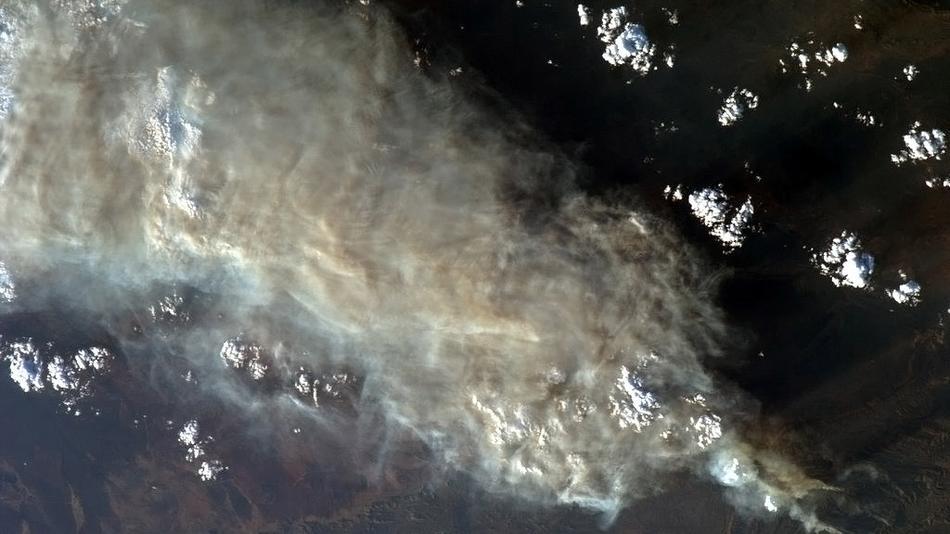
Bush fires are raging across Australia, fueled by a record-shattering heat wave. Pakistan was inundated by unexpected flooding in September. A vicious storm bringing rain, snow and floods just struck the Middle East.  “Each year we have extreme weather, but it’s unusual to have so many extreme events around the world at once,” said Omar Baddour, chief of the data management applications division at the World Meteorological Organization, in Geneva. " [Note: photo is of the Australian fires from space.]

In the UK, the Times reports, "The Met Office, Britain’s weather service, declared 2012 the wettest year in England, and the second-wettest in Britain as a whole, since records began more than 100 years ago. Four of the five wettest years in the last century have come in the past decade (the fifth was in 1954). The biggest change, said Charles Powell, a spokesman for the Met Office, is the frequency in Britain of “extreme weather events” — defined as rainfall reaching the top 1 percent of the average amount for that time of year. Fifty years ago, such episodes used to happen every 100 days; now they happen every 70 days, he said. "

There is more excellent reporting in the Times piece, but it comes on a day with bad news for the future of such much needed reporting.  A few days ago, the New York Times setting up a dedicated beat on the climate crisis and the environment was hailed as one of the bright spots in journalistic coverage of the topic in 2012.  Now comes word that the Times is closing its Environment desk.  The paper issued the standard reassurances that this won't affect coverage, but that's a very hard sell.

The weakening and the demise of real news gathering organizations like the New York Times as well as the slipshod reporting on the climate crisis up to now is only one of the debilitating factors in the necessary attention to this crisis, now and in the near future.  An active media goading government and helping to spread information is part of what's needed.  And the decline of that capability and focus is yet another reason to doubt that we're adequately addressing these challenges.

What should be happening now is that a sufficiently informed and motivated public is supporting a very informed and motivated U.S. government in a two track effort: to prepare for and deal with the present and near future effects of global heating, and to go after the causes of global heating in the farther future by severely reducing the greenhouse gases that enter the atmosphere. 

In particular, the U.S. should be using the current economic situation--relatively high unemployment and very low borrowing costs--to make substantial investments in both efforts, which would employ more Americans and stimulate economic activity as well.  Use the fact that infrastructure is neglected and aging to replace it with energy efficient and low-carbon infrastructure.  Help regional and state entities prepare for their specific challenges, like sea level rises or the physical effects of extreme weather.  Invest in public health to deal with outbreaks of diseases when and where they haven't occurred much before, due to temperature changes that affect disease-bearing insects as well as plant ecologies and even atmospheric changes that are unprecedented challenges but could have very sudden effects.  And so on.

And of course, investing in energy efficiencies, waste reduction, new technologies and new energy sources and technologies as part of reducing greenhouse gases. 

(As for sea levels, also this week, RealClimate posted a two part assessment of where the science now is on sea level rise. Its general conclusion is that "The recent improvements in understanding have confirmed the concerns of many sea-level experts, namely that the 4th IPCC report has understated the risks of future sea-level rise because the projection models used were not mature."  )

Some cities, states and regions are taking this seriously, within their resources. What the federal government is doing in these areas is being done largely sub rosa, and though a rosa by any other name still helps, it's not sufficient.  But with the federal government gridlocked by an increasingly extreme minority, possessed of a Dark Ages mentality, such sensible commitment seems unlikely in the near future.  Their paranoid fantasies of needing to defend themselves with arsenals of automatic weapons in a chaotic country is pushing us towards that self-fulfilling prophesy.

We'll soon see just what President Obama has in mind for the near term.  The beginning of the end of ruinous military commitment in Afghanistan helps to lessen the unnecessary drain.  But the apparent necessity of fighting political battles of a century ago or more, rather than really facing the future as a society, does not inspire a lot of confidence in adequate government response.  But we can still hope, and make that hope real in what we do.   

Friday, January 11, 2013

A Few on Lew

Nasty GOPers were joined by Bernie Sanders in opposing Jack Lew's appointment as Treasury Secretary.  Sanders was upset that somebody else "from Wall Street" was going to run Treasury.  But Lew's experience seems much more in federal government, as the Budget Director at the end of the Clinton presidency (where he presided over the last 3 surpluses in U.S. history) as well as in the Obama administration.

So here's a link to Rachel Maddow's pretty positive segment on Lew, as well as this story on why he scares GOPers.

Rachel by the way featured President Obama repeating (in his statement thanking outgoing Sec Geitner and introducing Lew) a "saying around the Treasury Department": "No peacocks, no jerks, no whiners."  Rachel suggested it should be translated into Latin and mounted somewhere prominent in Washington.  One of her viewers promptly gave her the translation:

Nulli Pavones, Nulli Turbatores, Nulli Vagientes

To which I can only add:

Amen

Wednesday, January 09, 2013

Thwip!


This is said to be President Obama's favorite photo from the White House photographer's selection of his favorites of 2012.  It's the child of a White House staffer at a pre-Halloween party. (I've edited it slightly to fit this page, but it's still too wide.  Click on it to see it larger.)

The previous post notes that people are finally beginning to hear what President Obama has been saying on the debt ceiling.  They might also note what he says on other topics.  There's been lots of debate on whether the fiscal cliff deal is a good one for the economy, the deficit, or politically.  But it was clear from what President Obama said about it that his priority was to make sure the middle class retained its tax cut, so that its vulnerable members are able to better their lives in an era where the rich got very much richer and everybody else fell back.  Similarly, when he appointed Chuck Hagel as Defense Secretary, everybody shouted about everything except what President Obama said--that the troops and their families come first, during and after their service.  Only on gun violence were the President's words heard clearly, although he will probably have to repeat his focus on people--on children like the one in this picture--as the gun violence debate becomes more central.

cliffnotes continued, plus Cockroaches More Popular Than Congress

There are three remaining cliffs: the debt ceiling, renewing the funding for the federal government, and the sequestered budget cuts.

For awhile it seemed they might be happening simultaneously, but now, maybe not quite.  It turns out that the U.S. will be unable to pay its bills in mid-February, requiring that the debt ceiling be raised.

President Obama has been saying for some time now that he will not negotiate on the debt crisis.  Before the tax cliff deal, those words were being ignored by GOPers and the media.  They figured President Obama would have to negotiate.  But he kept saying he won't.  And Democrats in Congress kept saying it.  And now, media and GOPers alike are beginning to believe him.  And GOPers are beginning to back away. Commentators on Lawrence suggested that Obama may even get authority for all presidents to raise the debt ceiling on their own, so that this issue will go away forever.

Partly this seems a judgment that the GOP can't win on this.  The polls clearly show that the public believe President Obama handled the tax cliff deal better.  Republicans were even harder on Banal than the public in general.


That Congress itself is reviled isn't news.  But a new PPP poll found that in head to head matchups, cockroaches are more popular than Congress.  So are root canals.  So is Genghis Khan.

How much more reviled can Congress get?  Well, they're still more popular than Gonorrhea.

Climate Crisis Comes Home

A lot of poorer countries already suffering from effects of the climate crisis are justifiably upset that bigger and richer countries--principally the United States--have contributed much more to the crisis but aren't paying much of a price to address it.  Well, there's some solace in a few stats from 2012.

NOAA announced  Monday that 2012 was the hottest year in the contiguous U.S. since its record-keeping began in 1895.  It was 1 degree F hotter than the previous record-holder (1998) and 3.3 degrees hotter than the average year.  It was also a very dry year.

All that had consequences.  According to Climatewire a few days ago, it was also a banner year for weather-causes disasters, mostly in the U.S., with the U.S. sustaining 90% of the insured losses.  The average year is 65%.

Insurers are still tallying the October storm's impact, but it's expected to cost the industry $25 billion or more, surpassing the financial losses of the Sept. 11, 2001, attacks and perhaps even topping the wreckage of Florida's Hurricane Andrew of 1992. Sandy promises to be the second or third costliest disaster in U.S. history. Its total economic costs are estimated to be more than $50 billion.

But the second most expensive weather related disaster in the world last year was the drought in the U.S. midwest.  Its insured losses topped $20 billion.

Meanwhile, by one measure, media coverage of the climate crisis decreased slightly last year, and by a couple of other measures, increased slightly.  But the increases are interesting.  Many more stories related weather related disasters to the climate crisis, and the New York Times began covering the climate crisis as a beat, not just a subject.  That's a development that should affect U.S. media coverage in general in 2013.

Although this change at the Times has been in the works for awhile, Sandy probably changed forever how the New York-based U.S. media covers the climate crisis.  More effects like those that cost all that money as well as pain and suffering last year will only accelerate that change. Meanwhile, that the U.S. is feeling the impacts is not in itself a cause for joy anywhere, but it may well help this country finally face its twin responsibilities, of seriously addressing both the causes and effects of the climate crisis.

It's oddly like the situation with gun violence in the U.S.  The horror of Newtown was the Sandy equivalent in focusing feeling and attention.  In both cases, what's politically possible will not entirely address the problem, but any positive action may well save some lives, and save some people from pain.  The difference is that what is actually possible could reduce gun violence substantially.  But nothing known is going to prevent further climate crisis effects for many years, nor change what is already happening for centuries.  But the analogy still holds: things can still be done to make things better.  And in the case of the climate crisis, save the far future for humanity and life as we know it on Earth.

Sunday, January 06, 2013

Choosing Children Over Guns


When 20 first graders and 6 teachers and administrators were shot dead in a few minutes at a school in Newtown, Connecticut, probably everyone in America experienced it in a terribly personal way.  This is a photo of President Obama when he was first briefed on that massacre.  He called it the worst day of his presidency.


It remains a personal matter to him, and several photos (including this) released as part of White House photographer Pete Souza's choices as his favorite photos he took this year (collected at TPM ) involve this horrific event.  Another is this photo, of President Obama preparing his speech for the Newtown vigil. He is doing so during breaks in a rehearsal he attended, of a school performance of the Nutcracker, which included his 11 year old daughter, Sasha.


This is one of many photos of President Obama with beaming children, who seem to take to him.  But this photo was taken when he visited with families of victims of the Sandy Hook school shootings.  The children are siblings and cousins of Emile Parker, one of the 20 children killed. (The family gave permission for the photo to be published.)

These photos should remind everyone why this must remain personal, and why (according to this TPM story) President Obama is intent on quickly passing laws to ban assault weapons and high capacity ammunition, as part of a thoughtful, heartfelt and sustained effort to reduce gun deaths and gun violence in America.  Update: a story on how broad this package might be, simply on changes to gun laws.

(I plan to post some of the other Souza picks in the coming days, taken on happier occasions.)

When It's Too Far

There are big changes coming due to the Climate Crisis and over the next decades a lot of them are going to be caused by something that seems to be getting very little notice.  It goes by the neutral name of transportation.

Transportation of goods and people by means of cars and trucks, airplanes, ships and (to a lesser extent) railroad, together account for the largest share of greenhouse gas pollution.  They also cause a lot of other pollution with very real detriments to human health, as well as to other categories of the living environment and even the built environment.

But instead of minimizing the amount of transportation necessary, our global economy has exploded it over the past few decades.  Goods and even fresh food are shipped over immense distances.  Goods that were made in America and sold in America are more often made in China and shipped here (in ships that often go back nearly empty.)  Fruits and vegetables that used to be grown in abundance here in California are now trucked here from Mexico, shipped and flown here from South America and who knows where else.

This transport all contributes to making global heating worse for the future.  As a cause, it cannot go on as it now does.  But probably before it is limited because of its causal contribution--or because it becomes too expensive-- it will lessen because of the effects of global heating.  It is already doing so, especially in foodstuffs from the U.S. because of the current drought in our grain-growing states.

So much is being transported so far because it's cheaper to do it that way that to build or grow nearer to the intended customers.  Capitalism alone cares not for the future and seldom even considers it.  It does not reckon costs to be borne by the future.  Above all it doesn't reward prudence, and it usually ignores redundancy, or an alternative means to achieve necessary ends, especially when the primary means no longer functions.

 For decades and with increasing speed in the past few decades, the world has become structured according to cheap transportation, so that there is less land immediately available to grow food nearer where it will be consumed.  Less capacity to manufacture goods, and so on.

In several ways--felt pretty much all at once--this system will no longer function as it has in recent years.  The poor, especially in other countries, are already feeling this.  Then the effects will move up in class and appear in richer countries.  Some observers have already charged that food riots and other violent manifestations of  food scarcity and drought are seldom reported as such, or news of them is actively suppressed, since these are very threatening to the established order.  But the established order better figure out that these problems are big and real, and start addressing them.

Saturday, January 05, 2013

NFL Preview

The NFL playoffs begin today and the Pittsburgh Steelers aren't in them.  Sadly, they don't deserve to be.  Bad luck was one contribution.  You have to wonder about conditioning with so many injuries and coaching with so many lapses.  But who knows.  They just didn't play that good.  And they've got better and more exciting competition.

Even though it's not likely that anybody is going to beat Peyton Manning and the Denver Broncos, the Wild Card round this weekend has some potentially entertaining matchups. Three of the games test late season momentum against experience and stats. Unless they crash--and I don't think they will just yet--the inspired Indianapolis Colts could take the wilting Baltimore Ravens.  The Cinncy Bengals have mo and might even overcome the crashing Houston Texans, though the Texans were a pre-season fave to win it all.  Of the two upstarts, I like Luck and the Colts.

In the NFC the Minnesota Vikings beat their rivals the Green Bay Packers to get into this game, so they have mo.  But very likely not enough.  Adrian Peterson may or may not have a big day but the Packers probably will.

Another flashly frosh in RGIII has given the Washington Negroes instant cred, and the Seattle Seahawks had late season mo.  The Seahawks defense will be tested by the Washington Rednecks wide-open offense, but the Washington Dagos will have to play their best game to get through it, and also stop Seattle's offense.  The Seahawks could have a down game but they should overcome the  challenge of the Washington Spics, a fun team to watch but with a racist name that is a disgrace to their country, conveniently located in the nation's capital.

Thursday, January 03, 2013

Cliffed


Thanks to the holidays, I had a certain amount of distance from the cliffhanging in Washington.  It felt good, in a sad sort of way.  I hope not to be drawn into the coming tragic nonsense, which is likely to be considerable.

As to evaluation of the deal, the analysis that makes the most sense to me was Lawrence O'Donnell.  He makes a couple of key points: no Democratic President in memory has gotten congressional Republicans to raise taxes on anybody.  The last time some GOPers voted to raise taxes was with Bush I in the White House, and fewer of them voted for that than voted for the deal this time.

But the biggest point is that when taking inflation into consideration, the $400,000 tax bracket in this deal is precisely the same as the $250,000 bracket in the Clinton era.  In other words, if the Clinton tax structure had never been altered by Bush II, it would be exactly the same as the deal that Obama-Biden made.  Plus they got the unemployment benefits renewed, and a number of other crucial items.  They didn't cave.  Other Democrats--especially from high cost of living places like NY and southern CA--thought the $250,000 level was too low.  They're happier with 400K.

Another random thought.   Jonathan Chiat thinks Speaker Banal's proclaiming that he won't negotiate with Obama is crazy.  Taking Banal literally, it's not crazy.  Banal has tried it twice and run away from the deal twice.  He either can't back up a deal with votes or he realizes he's out of his depth and getting rolled, or both.  He'd be crazy to keep doing it.  Chiat's point is that if the House wants to actually do anything, they have to know if Obama will sign it.  But they don't need Banal going to the White House to find that out.  All this worked for years through various means (aides talking, back-channel phone calls, signals through the media, etc.) so that both sides had a pretty clear idea where the other side stood on specific legislation and provisions, without "negotiations."

In fact, Banal going to the White House to negotiate with the President like he was a head of state was always more of a symbolic win for the GOP, placing their leader on equal ground with the POTUS.  But Banal has failed so spectacularly in public, he's better off being as invisible as possible.

The new Congress was sworn in today--the most diverse in history, and for the first time, white men aren't the majority.  Still, Michele Bachmanniac is back, and she introduced the first bill, to repeal Obamacare.  Positive change is happening, but the old craziness is still powerful, and it's a crap shoot at this point whether positive change is happening fast enough to avert multiple catastrophes.  

Wednesday, January 02, 2013