Tuesday, April 27, 2010

Look Ma, I'm Blogging!

The Unpronounceable Volcano of Iceland is quieter, at least for now, but its eruption inspired a couple of volcano-related web gems, one about the role of such ice-covered volcanoes in the study of climate change, and another about how a really big eruption is potentially as much a doomsday scenario as any wandering asteroid.

While the Senate climate bill has been dead, crappy anyway, alive, dead again and maybe not so dead, the effects of climate change that scientists predicted continue to accumulate, though noted in separate little stories. Apart from the weird weather, tornadoes and storms last week and this, the effects on the birds and the bees of spring coming early, not to mention the pollen count, and the spread of a fungal disease south of its usual range. Update: And this story about present and future loss of beaches on the U.S. East Coast, due mostly to climate change.

Meanwhile, Governor Ed Rendell of PA said on Rachel last week: " the Tea Parties get tremendous coverage. And think about it—week before the health care vote, they had a rally in Washington, got 1,000 people, maybe not even that. The tax day rally, the big rally to protest federal taxes got less than 1,500 people showing up, according to their own organizer. Other people thought it was in the 400 or 500 range...And yet, the media, including the so-called liberal and progressive media, have given the tea party-ites elevation in terms of the impact they‘re having on the national debate and discussion—way above what they deserve."

And as if the point needed proving, there is a rumor that there were between 100,000 and 200,000 people on the Washington mall Sunday demonstrating about something called Earth Day. If true, this would be a gathering of about a hundred times more people than the Tea Party tax rally which got endless coverage and discussion.

Sure, the Tea Parties are newer, whereas the first Earth Day crowds were forty years ago, and the wingnuts set off alarms the nice green tea-sipping enviros don't. They probably sat around singing you know what. I fault the environmental movement for part of the invisibility--this was no coalition effort, its political content was tepid, its form unimaginative. But the corporate media is also culpable. To cover the Tea Party people to such an extent, and ignore a much larger show of support for what the wingers deride, is inexcusably biased. Even, as Rendell notes, on the part of the so-called progressive media, just as locked into hot-button political issues of the moment over the ones that ultimately count so much more.

Monday, April 26, 2010

The Dreaming Up Daily Quote

"Call it preaching to the choir if you will, but I've always thought the choir a good place to direct one's efforts. Presumably they know something about music; and, whatever their doubts, they have at least made it to church."
--Jonathan Lear
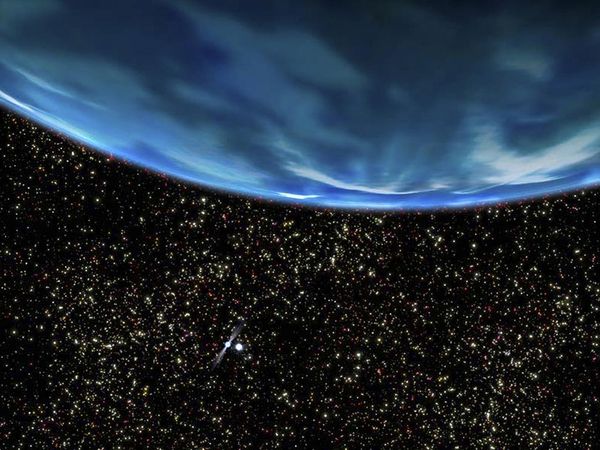
And Happy Birthday to the Hubble telescope, author of the image above

Thursday, April 22, 2010

Eaarth Day


Besides the deafening silence today versus the two million shouting voices forty years ago, this Earth Day has some significant differences from the first. For example, there is 40% less sea ice in the world, and much of what remains is melting. There are 8.5 million square miles more that must deal with a tropical climate; half of Australia and much of the American Southwest are in permanent drought. River water has shrunk by a volume equivalent to the Mississippi. Glaciers worldwide are shrinking, and some are virtually gone.

There are tens of thousands--probably hundreds of thousands--fewer species of life. There are fewer edible fish in the sea, and life there is dying out fast. There is less water in many places on land, and partly as a consequence the world produces 40 million fewer tons of wheat, corn and barley per year. There are more storms, more heat waves, more diseases in more lifeforms, more forest fires and other destruction, not only in the U.S. but in the Amazon. "We're seeing the end of some forests as we know them," says a U.S. forester.

At the foot of a melting glacier in northern Tibet, a young man from a small village there was asked to explain the reason for the change. His answer was neither ethereal nor complicated. "Global warming," he said. "Too many factories." A simple and much more than an inconvenient truth. The Climate Crisis is not some vision of the future--it's been with us these forty years, it's gotten worse, and now it's having effects that only the self-blinded and deluded can deny. But still...we can stop it, right? We may be able to prevent the very worst-- runaway climate change in the far future, although what governments around the world are so far willing to do won't be enough. In any case, for the foreseeable future, it's only going to get worse. And then at the very least it is going to stay that way, for thousands of years.

That was the message of David Orr's book, Down to the Wire, last year. This year it is no longer a new message-- not among climate scientists and those who follow their work. It is the starting point for Bill McKibben's new book (all the facts above are from it.) We no longer live on the same planet as existed on the first Earth Day. He gives the planet we will be living on from now on a new name: Eaarth. So in a sense, this is the first Eaarth Day.

McKibben's book, Eaarth: Making a Life on a Tough New Planet (Times Books) uses only about a quarter of its 200+ pages to describe the current situation and trend lines, but is no less devastating for that. "The vast inland glaciers in the Andes and Himalayas, and the giant snowpack of the American West, are melting very fast, and within decades the supply of water to the billions of people living downstream may dwindle. The great rain forests of the Amazon is drying on its margins and threatened at its core. The great boreal forest of North America is dying in a matter of years. The great storehouses of oil beneath the earth's crust are now more empty than full. Every one of these things is completely unprecedented in the ten thousand years of human civilization."

He counters the assertion of some on Earth Day that it isn't the earth but humanity that's threatened. It's an understandable attempt to create urgency through self-interest, but it's deceptive and ultimately counterproductive. Yes, McKibben says, the planet will survive, "but it won't be anything like the planet we've known. We're hard at work transforming it--hard at work sabotaging its biology, draining its diversity, affecting every other kind of life that we were born onto this planet with. We're running Genesis backward, de-creating."

The rise in heat-trapping gasses in the atmosphere is leading to a rise in global temperature unprecedented in millions of years. McKibben devotes another quarter of his book to explaining the inadequacy of the proposed responses to the Climate Crisis, and the extreme unlikelihood that large-scale changes in policy, energy generation etc. can be made in time to head off very major changes in how human life on this planet is to be lived. "And if our societies start to tank, we'll be in worse shape than those who came before. For one thing, our crisis is global, so there's no place to flee. For another, most of us don't know how to do very much--in your standard collapse scenario, it's nice to know how to grow wheat."

McKibben comes right up against the logical conclusions, the doomsday scenarios of nuclear wars over oil and water, mass migrations from islands going underwater, the world's coastal cities and increasing areas of unlivable heat; eventually a dieback of half or 3/4 or more of humanity, leading to the day-to-day life for the survivors imagined for us in a host of grim movies, from Mad Max to The Road. Instead he backs off, partly because (I imagine) it's as David Orr wrote--if this is indeed the future, there's not much point in writing a book about it. Instead, he writes: "The rest of this book will be devoted to another possibility--that we might choose instead to try to manage our descent. That we might aim for a relatively graceful decline." [Emphasis is his.]

So the second half of the book is about how to do that. It emphasizes local and small-scale solutions--living "lightly, carefully, gracefully." Locally generated clean power, focus on maintenance instead of growth, no more consumer culture or the world it represents. Except for the Internet. Because local utopias are likely to get stifling without contact. "Which is why, if I had my finger on the switch, I'd keep the juice flowing to the Internet even if I had to turn off everything else."

McKibben makes his case for all this being well within the possible, sometimes persuasively ( although I'm dubious about the Internet surviving.) He notes that part of the problem is that "We lack the vocabulary and the metaphors we need for life on a different scale." He offers his "candidates for words that may help us think usefully about the future." They are: durable, sturdy, stable, hardy, robust.
Good words, and useful for the kind of society he foresees. McKibben made a choice in both the language and content of this book: not much philosophy or generalizing, a lot of practical specifics and common sense. But I doubt that this vocabulary is going to be enough. For one thing, there are some slightly higher-order words that will be very important, like courage, compassion, attention, dedication, fairness. But even beyond that, people need a larger vision, to guide and inspire them. And if it's going to really work, it has to be the right vision.

There were good words and visions at the first Earth Day, that helped inspire the effort leading to most of the environmental progress that was institutionalized in the first decade of the environmental movement, and has continued on that momentum. But mostly, environmentalists have been terrible at vision, and especially at "good words." With the switch from the soft-sounding and not even accurate "greenhouse effect" to the vaguely pleasant sounding "global warming" and "climate change," the response to global heating has especially suffered. As for the titanic struggle ahead between those who want to use resources to stop the cause of global heating to those who insist we can only afford to fix the effects, what environmentalists offer us is the mind-numbing choice of mitigation versus adaptation. Which more or less guarantees that a sensible discussion of these issues won't occur in enough time to have clear policies before the panic and politics combine to drive the situation out of control.

But in the past thirty years there is one word, one concept and one vision that has the proven power to move human souls: Gaia. The sense of our planet as a living organism, prefigured in myth and science, proposed as a hypothesis by James Lovelock and refined by him and others into a real scientific theory, it has also proven to be an inspiration and a possible focus.

The breadth and depth of what Gaia can mean for the future is brilliantly suggested in the new compendium of essays, Gaia in Turmoil ( the MIT Press), edited by Eileen Crist and H. Bruce Rinkler (with an introduction, by the way, by Bill McKibben.) This volume includes various views of the science (including its relationship to systems theory and cybernetics), the historical resonance of the ideas, the applications to policy and how people relate to their planet in their moment to moment lives. There are trenchant essays on Gaia and evolution, forest systems, water, biodiversity, and on its relationship to ethics, education and governance. Particularly striking are the essays by Martin Ogle on Gaia as model and metaphor, and David Abram on Gaia and the transformation of personal experience of the everyday world. I don't think I am exaggerating when I suggest that an entire curriculum could be built around this book, producing a very valuable education for the future.

I place this book at the top of my indispensable Eaarth Day books, along with
McKibben and Orr, and one other: A Paradise Built in Hell by Rebecca Solnit (Viking). Solnit's book explores responses to recent disasters to pose the key questions "Who are you? Who are we? In times of crisis, these are life-and-death questions." This is another component of how we realistically face this tougher future. I'll probably be writing more here and elsewhere about these last two books.

The Quiet Crisis


Between last Earth Day and today--in fact, in March, during the final healthcare votes--Stewart Udall died. He was appointed by President Kennedy to serve as Secretary of Interior in 1961, and stayed under President Johnson until 1969, just before the first Earth Day. He was an environmental pioneer, part of the transition from conservation to environmental activism. The first environmental laws were passed, or were proposed (and passed soon after the first Earth Day, in the Nixon administration) on his watch.

Udall also wrote one of the pioneer books on the environment, though The Quiet Crisis is not much remembered. It followed by a year the first environmental classic and best-seller, Rachel Carson's Silent Spring. Udall's book took a more historical view, chronicling American conservation efforts. But crucially it also took a wider view, beyond chemical pollution to the total environmental effects of the growth-at-any-cost economy: "In a great surge toward 'progress,' our congestion increasingly has befouled water and air and growth has created new problems on every hand. Schools, housing, and roads are inadequate and ill-planned; noise and confusion have mounted with the rising tempo of technology; and as our cities have sprawled outward, new forms of abundance and new forms of blight have oftentimes marched hand in hand."
Although it preserves signs of hasty writing, The Quiet Crisis remains remarkable in the appropriate breadth of its content. He dealt not only with facts but the underlying and overarching philosophy. He elevated the work of Aldo Leopold and his "land ethic", now acknowledged as a central figure in even contemporary environmentalism, into public policy discussion. He went after examples of air, water and soil pollution--and assembled the first official endangered species list--but he also looked to the historical and spiritual sources that support and sustain attention to the natural world. He could be eloquent on this topic. "To pursue his vision more intently, Emerson steeped himself in Plato, Goethe, and fresh air. The easiest way to develop Olympian insights was to turn the mind into an aeolian harp and attune it to the winds and sounds and rhythms of nature."

In this book, he also dealt with urban environments as well as wilderness, with needed legislation and individual action. That the book has an introduction by President Kennedy shows that the environment was on the agenda almost a decade before Earth Day.

Stewart Udall was also one of the voices heard throughout this year's American Experience documentary, Earth Days. He was part of the mass movement before and just after Earth Day in 1970 that led to the laws that saved the United States--from erasing more wilderness, from poisoning more water, earth and air and therefore poisoning itself. But as this documentary notes, expanding effective environmental change to the world, and applying it to the most deadly threat human civilization has ever faced, climate change (which, the documentary documents, was talked about in a national news broadcast on the first Earth Day) has failed.

Udall called it the Quiet Crisis in 1963. It became pretty noisy on Earth Day 1970, when 2 million Americans participated, and soon after, when the fledgling movement targeted and defeated anti-environment legislators. But on its 40th anniversary, it has gone quiet again. Seemingly because it is so accepted, but let's face it, there's an awful lot of denial involved. Earth Day was utterly invisible in the media today. We'll see if there's real coverage of the Sunday demo in Washington, and the climate bill scheduled to be introduced next week, but I wouldn't count on it. I get emails from several different enviro organization, and nobody is talking about the Sunday demo. There still is no collective, focused action by environmentalists. Too much separate noise can also add up to a quiet crisis.

The Dreaming Up Daily Quote

"One of the penalties of an ecological education is
that one lives alone in a world of wounds."
Aldo Leopold
A Sand County Almanac

Tuesday, April 20, 2010

The Dreaming Up Daily Quote


"I truly believe that we in this generation must come to terms with nature. And I think we are challenged as mankind has never been challenged before to prove our maturity and our mastery not of nature, but of ourselves."

Rachel Carson
quoted in Earth Days

Monday, April 19, 2010

Dunkirk II?


Update: From Tuesday morning's NY Times:"European transport ministers announced a plan to begin easing the six-day ban on aviation traffic around the Continent, but a new ash cloud spreading south from the erupting volcano in Iceland on Tuesday raised fresh concerns about arrangements to restore anything resembling normal schedules."

The UK government, said the Guardian, has "launched an unprecedented plan to bring home an estimated 200,000 people stranded abroad by the volcanic ash cloud – including possible deployment of the Royal Navy – as European airlines staged a series of successful test flights and urged governments to reassess flying restrictions."

Though airlines were pressuring governments to lift restrictions, they are expected to remain in force through midweek. Ryanair, Europe's largest short-haul carrier, cancelled all flights in northern Europe until Wednesday afternoon with BA and BMI scrapping schedules for tomorrow after Nats, the national air traffic controller, maintained a no-fly zone until at least 7pm [Monday]evening.

There are airlines that fear bankruptcy because of this, and the Prime Minister warned ground transportation and ferry companies not to profiteer. But with thousands of UK citizens stranded in Europe, including school children on holiday, the government is considering using Navy vessels to bring them home. If they do, it could be this generation's version of Dunkirk--the flotilla of boats that rescued what was left of British forces in France against the advancing German army early in World War II. But this time, it's not a mighty military force, but the atmosphere, and tiny particles in the air from a volcano in distant Iceland.

Meanwhile, the ripple effect continues--and it ripples out to the farm fields of Kenya.

Saturday, April 17, 2010

It Takes a Volcano


This volcano in Iceland erupted, sending tons of smoke, steam and tiny particles into the air, which has paralyzed air travel in Europe for days. Almost two-thirds of all transatlantic flights into European airports were cancelled and authorities shut down airspace over France, Denmark, Norway, Sweden, Finland, Belgium, Italy, Switzerland, Slovakia, Croatia and Hungary. As the cloud moved east, flights were halted at Frankfurt, Europe's third-busiest airport, and at 10 other German airports.

There are expected to be few if any flights in the UK and western Europe over the weekend, "placing yet more strain on road, rail and ferry networks already struggling to cope with thousands of stranded passengers." The ripple effect is being felt in the U.S., causing delays and cancelled flights. European airlines are losing billions. And there is still some danger of new eruptions--perhaps even of a larger volcano nearby, which historically erupts soon after the current one does.
Update: A NY Times story on the volcano effects, calculating the problems and speculating on what happens if it goes on for weeks rather than days.
Update2: The volcanic ash over Europe has forced President Obama to cancel his planned trip to Poland to attend the funeral of the president of Poland, killed in an air crash along with his wife and many senior members of the Polish government.

All of this is an object lesson in systematic vulnerability: the vulnerability of interconnected vital systems to the cascading effects of relatively small disruptions. Given the likelihood that "natural disasters" like storms, floods and droughts are going to increase as the Climate Crisis phases into Climate Cataclysm, responsible parties--namely governments--need to be looking into these fragile systems we've come to depend on so completely, in so short a time.

Those who are thinking about dealing with such problems in the future--intense and local ones, but eventually several simultaneously--talk a lot about "resilience." But our infrastructures are not resilient. If they aren't too old, they are too new and without sufficient redundancy. And there is shrinking capacity in secondary systems to use as alternatives if the main systems fail.

Europe is actually in better shape that we are to cope with a crisis like this--they have a better rail system, in terms of capacity and reach, and also in speed: they have more high speed trains and routes than we even currently dream of. If air travel is curtailed for longer than a few days, they are in better position to cope.
This is an issue beyond climate-related emergencies. What happens if for some reason the Internet goes down, or communication with GPS satellites? At least we know our electrical grids are dangerously old and fragile, even if we haven't done much about it.

Through climate data, we are learning how vulnerable our planet is to certain changes (especially in the atmosphere), as resilient as it otherwise is. What will it take to convince us how vulnerable this civilization has become, when our food and even our water comes from far away? When our livelihoods, our economies depend on interconnected energy, transportation and information systems? Put these two areas of vulnerability together--in a crash in the ocean food chain, or the disappearance of honey bees--and face just how fragile this is, the life we take stupidly for granted. And maybe pay attention to doing something about it, before it becomes way too obvious.

Friday, April 16, 2010

Encouraging Terrorists by Calling Them Patriots

In some ways it's becoming an old story, but we can't approach it that way: the continuing escalation of violent language, along with systematic lying--of asserting pretty much the opposite of what's true--is becoming the most prominent feature of Republican rhetoric. The GOP is becoming little more than the party of of decadent and dangerous demagogues.

Republicans in Congress are flat-out lying about the financial reform bill, both in terms of process and in what it proposes to do. This kind of Nineteen Eighty-Four politics, besides being lethal to democratic decision-making, tends to lend credibility to the extreme rhetoric, which continues to escalate.

It was striking that for a few minutes today, two cable channels (CNN & MSNBC) were covering the explosion in extremism, while two others (FOX & CNBC) were providing living examples of it.

On CNN, Wolf Blitzer was interviewing President Clinton, who talked about parallels between now and the Oklahoma City bombing in 1995, which is the subject of a revealing documentary on Timothy McVeigh by Rachel Maddow that has been excerpted all week and airs in full on Monday. In terms of threats against President Obama specifically, the former President said "I worry about it." This is the most explicit statement at the highest level of experience indicating we should all be paying attention to it.

Of the anti-government Rabid Right Clinton said: "Some are serious, some are delirious. Some are connected and some are unhinged...We need to be intellectually honest about what some words might do to people who are unstable."

The systematic process now underway encourages domestic terrorists and potential assassins by suggesting they would be patriots--fighting for freedom, "taking out" the "gangsters" of the "totalitarian" federal government, using the guns they are encouraged to proudly carry and display.

The most decadent element of this is that nothing that happens is likely to change it. Even if there is a dramatic violent event--another Oklahoma City or an assassination attempt--this echo chamber of profit-making liars will turn it on its head, and will continue. They will never admit to their responsibility, but now is the time to mark it: if violence happens, they are responsible for fueling it and suggesting that people who engage in it are patriots, and will be praised. Turning terrorists into patriots, after all, is consistent with the GOPer policy of lying outrageously, and asserting the opposite of what is true.

Maybe the only thing that stops or slows it down is electoral rejection, or reflection in the polls. Unfortunately this extremist violent and often racist rhetoric and the systematic lying are apparently being rewarded by poll numbers. It's like the runup to the Iraq war. You know people are going to be sorry after it happens. But they get helplessly fooled, and they do get fooled again.

Tuesday, April 13, 2010

Those Were the Days

To Seek A Safer World

Nobel Peace Prize Laureate and President of the United States Barack Obama took forceful and successful steps in the past week to control a major threat to human civilization: nuclear weapons.

These accomplishments, resulting from quiet diplomacy over the past months, were completed and announced in quick succession. Though any one of them would be of great importance, the combination is an amazing culmination, with more to come.

Momentous in itself, the signing of the arms reduction treaty with Russia that cut another third from both nuclear arsenals was a necessary prelude to actions on controlling nuclear weapons and the material needed to make them, worldwide.

As a result of an international meeting President Obama convened in Washington this week, today The leaders of almost 50 countries have pledged to secure all vulnerable nuclear material within four years. Some other deals were announced, including an agreement by the United States, Canada and Mexico agreed to work to convert the fuel at Mexico's nuclear research reactor to a lower grade of uranium unsuitable for nuclear weapons...[this] would eliminate all highly enriched uranium in Mexico.

There are two goals of the Obama policy: to secure existing nuclear material and prevent it from being used by terrorists, and to move expeditiously towards a non-nuclear world. That second goal is addressed dramatically in an agreement between the U.S. and Russia to eliminate weapons-grade plutonium in their military, commiting each country to "irreversibly and transparently" dispose of at least 34 metric tons of weapons-grade plutonium... enough for 17,000 nuclear weapons... the agreement prevents any future military use of the plutonium."

The dangers posed by nuclear weapons are still substantial. Apparently there is not yet a formal agreement by the U.S., Russia and China on how to deal with Iran's possible nuclear weapons program, although news stories the other day said that China had agreed to stronger sanctions. Besides the possibility of terrorists or rogue states obtaining and using such weapons, there is the always-present danger of states that have these weapons using them against their neighbors. This is particularly acute involving Pakistan, India and Israel. The simmering conflicts in those regions are only going to be pushed further by effects of the climate crisis.

But President Obama has provided the international leadership to get trends moving in the right direction, fulfilling the promise recognized by his Nobel Prize. Despite the domestic insanity that U.S. media prefers to emphasize, this is solid achievement towards a less dangerous world. This is change I believe in.

Saturday, April 10, 2010

Emerson for the Day


"It is a secret which every intellectual man quickly learns, that beyond the energy of his possessed and conscious intellect he is capable of a new energy (as of an intellect doubled on itself), by abandonment to the nature of things, that beside his privacy of power as an individual man there is a great public power on which he can draw, by unlocking, at all risks, his human doors, and suffering the ethereal tides to roll and circulate through him; then he is caught up into the life of the Universe, his speech is thunder, his thought is law, and his words are universally intelligible as the plants and animals."
Emerson (The Poet)
photo: Milky Way

What is the Future Worth?

This weekend's Climate Crisis reading is Paul Krugman in the New York Times Magazine writing on "the economics of lessening climate change." It's a long article, helpfully summarized at Climate Progress with additional links.

Environmentalists are generally applauding the piece for making the case that action to reduce heat-trapping gases is necessary (the consensus of climate scientists), that it can be done with minimal cost (the consensus of environmental economists) and that to not do it will have ruinous economic consequences. But some (like Alex Steffan at Worldchanging--not my favorite but worth hearing) think Krugman actually underestimates the economic costs of failing to severely reduce heat-trapping gases and shift to clean energy, by a lot.

Krugman starts off by discussing the arguments for cap & trade versus a pollution tax. While the pollution tax is simpler, cap & trade seemed politically more feasible, at least until recently. He points out that this exotic notion of cap & trade has already worked: "experience suggests that market-based emission controls work. Our recent history with acid rain shows as much. The Clean Air Act of 1990 introduced a cap-and-trade system in which power plants could buy and sell the right to emit sulfur dioxide, leaving it up to individual companies to manage their own business within the new limits. Sure enough, over time sulfur-dioxide emissions from power plants were cut almost in half, at a much lower cost than even optimists expected; electricity prices fell instead of rising. Acid rain did not disappear as a problem, but it was significantly mitigated."

He briefly notes three axioms concerning the climate science: "The first is that the planet is indeed warming... the upward trend is unmistakable: each successive decade since the 1970s has been warmer than the one before."

"Second, climate models predicted this well in advance, even getting the magnitude of the temperature rise roughly right... So the fact that climate modelers more than 20 years ago successfully predicted the subsequent global warming gives them enormous credibility...


...my third point: models based on this research indicate that if we continue adding greenhouse gases to the atmosphere as we have, we will eventually face drastic changes in the climate. Let’s be clear. We’re not talking about a few more hot days in the summer and a bit less snow in the winter; we’re talking about massively disruptive events, like the transformation of the Southwestern United States into a permanent dust bowl over the next few decades."

Krugman then argues for a mixed approach, part market-based (like cap & trade) and part directed government action, like "direct controls" on burning coal. He suggests international cap & trade as well as other instruments such as carbon tariffs to tackle the problem of reducing global emissions.

He returns then to the reasons to do all this, and the urgency. "In public discussion, the climate-change skeptics have clearly been gaining ground over the past couple of years, even though the odds have been looking good lately that 2010 could be the warmest year on record. But climate modelers themselves have grown increasingly pessimistic. What were previously worst-case scenarios have become base-line projections, with a number of organizations doubling their predictions for temperature rise over the course of the 21st century. Underlying this new pessimism is increased concern about feedback effects..."

He notes predictions of a 9 degree F rise in average temperature from the start of this century to its end, with the accompanying storms, floods, droughts and other major disruptions. "And the troubles would not stop there: temperatures would continue to rise."

Krugman maintains his even and reasonable economics tone, but the climate facts are leading him into a different order of change. He writes: "The other is that while modern economies may be highly adaptable, the same may not be true of ecosystems. The last time the earth experienced warming at anything like the pace we now expect was during the Paleocene-Eocene Thermal Maximum, about 55 million years ago, when temperatures rose by about 11 degrees Fahrenheit over the course of around 20,000 years (which is a much slower rate than the current pace of warming). That increase was associated with mass extinctions, which, to put it mildly, probably would not be good for living standards."

And since he is still writing about the economics, he discusses the price tags, but notes that making economic decisions may depend on how they are applied to time, and what people making these decisions care about: the very near term, the near future, or the farther future.

He thinks that even in the near term the cost of inaction is probably higher than previously estimated, because "substantial global warming is already “baked in,” as a result of past emissions and because even with a strong climate-change policy the amount of carbon dioxide in the atmosphere is most likely to continue rising for many years. So even if the nations of the world do manage to take on climate change, we will still have to pay for earlier inaction." That's the Fix It function, as I used to call it, dealing with Effects, now and soon, and continuing for at least the next 40 years, and probably the next 400.

But if serious efforts are made now to reduce carbon and other heat-trapping gases, costs to do that will begin immediately. If those efforts aren't made, it will cost much, much more in 30 or 40 years to deal with the Effects of what those present emissions Cause, because there is something like a 30 year lag time between emissions Cause and Effect on climate. And the logic of that continues--if the Cause continues, the cumulative Effects will grow even stronger into the next century, with a much higher price.

Then Krugman looks at the economic rationale for action. He mentions the uncertainty of predictions, but notes that the risk is high enough to act--the operative economic model is not cost-benefit analysis, but risk assessment.

This is the economic language for a position many have held for awhile now, articulated especially by Greg Craven in his handy little book, What's the Worst That Could Happen: that given the strong scientific evidence and the consequences science predicts, the risks associated with responding to climate change even if it turns out to be not so bad are nowhere near as great as the risks of assuming it's not going to happen. Especially since there are plenty of other good reasons to cut heat-trapping pollution and convert to clean energy.

Krugman then looks at the arguments for a gradual approach to reducing carbon, and the "big bang" model of doing it bigger and sooner. "So what I end up with is basically Martin Weitzman’s argument: it’s the nonnegligible probability of utter disaster that should dominate our policy analysis. And that argues for aggressive moves to curb emissions, soon." He then assesses the Congressional mood as not very likely to act, and concludes: "We know how to limit greenhouse-gas emissions. We have a good sense of the costs — and they’re manageable. All we need now is the political will."

As time goes on, complicating all of this-- economically as well as in most other ways-- is the conflict I've been writing about for awhile, which is the collision between dealing with Cause and dealing with Effects. The debate is now being cast in the mind-numbing terminology of Mitigation vs. Adaptation, which is maybe why nobody much cares about it but policy wonks. But the need to do both--to cut heat-trapping pollution and switch to clean energy at the same time as we're dealing with long-term disasters (droughts, sea level rise, higher incidences of insect-borne diseases etc.) and an avalanche of short-term emergencies (storms, floods, killer heat waves, etc.)--is the economic as well as civilizational challenge of the future. Which is rapidly intruding on the present.

Like a lot of economics, and even science, this is fairly abstract. The reality won't be, and the possibilities aren't. Which will continue to be a topic here.

Thursday, April 08, 2010

The Dreaming Up Daily Quote


"Who can think of the sun costuming clouds
When all people are shaken
Or of night endazzled, proud,
When people awaken
And cry and cry for help?

The warm antiquity of self,
Everyone, grows suddenly cold.
The tea is bad, bread sad.
How can the world be so old be so mad
That the people die?

If joy shall be without a book
It lies, themselves within themselves,
If they will look
Within themselves
And cry and cry for help,

Within as pillars of the sun,
Supports of night. The tea,
The wine is good. The bread,
The meat is sweet.
And they will not die.

--Wallace Stevens

Wednesday, April 07, 2010

Thoughts on the White Working Class

A few disorganized thoughts on the white working class, in the news in three diverse stories: the still- increasing virulence ostensibly over the healthcare bill and now a second arrest for death threats to a Member of Congress; the West Virginia mining disaster which killed at least 25 miners; and the return of talk about Barack Obama's problems attracting white working class support.

First of all, I grew up in the white working class (not all that far from those West Virginia mines, and with a grandfather who worked in western PA mines), although in a different time. But I've seen what has happened over time, and rather than rehash what others are saying, let me contribute a few thoughts of my own.

The working class--also known as the lower middle class--joined in the rising American prosperity after World War II, mostly due to three factors: lots of manufacturing jobs; strong unions, particularly in manufacturing; federal government programs, from Social Security and Medicare to FHA mortgages and the GI Bill of Rights that put college in play for veterans, and the various federal and federally guaranteed grants and loans that made college possible for children of the working class, like me.

Manufacturing jobs have been disappearing from America since the late 1970s. That's when the steel industry and Pittsburgh were hit hard, and that has spread, until the biggest product of the U.S. is waste. Real wages have declined, unemployment risen. This happened during the Reagan administration and onwards, with some progress made for working incomes in the Clinton years, but the trend towards lower income at the lower annual income percentiles reasserted itself in the Shrub years. Beginning with Reagan, union power diminished along with manufacturing.

The winners in these changes were Wall Street and the biggest corporations. They shipped jobs overseas where workers were paid much less, with appalling conditions and unsafe workplaces. They intimidated workers to reject unions, and were helped by Republican governments. So the rich got infinitely richer, and then got tax cuts on top of that. The white working class was competing with lower paid workers in other countries but in their daily lives seemed to be mostly in competition with minorities previously kept out, including immigrants.

Now the white working class is angry--that is, their anger is being encouraged and channelled in a particular direction. Cultural differences with "liberal elites" are emphasized. But these days what is mostly emphasized in the "white" in white working class. It's the usual sinister divide and conquer strategy, because the total working class is being destroyed economically, not racially, by corporations and the same Republicans who are whipping up racist frenzy, sometimes with their Confederate code words, and often these days, without even that pretense.

JFK and RFK could appeal to the white working class partly with their eloquence and policies, but partly because they were white, and even though wealthy they were not so far from their immigrant roots, as the white working class at that time was not so far from theirs--they might be second or third generation Americans at that point. And unions were strong.

Unions weren't ever perfect or without abuses, but they did keep the working class together and focused on their own interests, which included advocating for safe working conditions, like those that don't exist in that non-union mine. Also it is true that some whites have personally paid a price for the redress of past racial discrimination, that they personally had nothing to do with. That's also true of some men, when women benefited from preferential hiring, etc. There's really no point in denying that this has happened, and even if it didn't happen a lot, once was enough if it happened to you.

White males by some statistics have borne the brunt of the current unemployment. But that's part of this longer trend. The reason that white working class anger is being expressed now is that it is being exploited and given a vocabulary. Most of the cause behind it falls to the responsibility of the same corporations and Republican pols who are exploiting it.

But they are able to exploit it partly through the power of persuasion enabled by their funding, and their ownership of corporate media. But partly, they are using the still potent hot button of race. This has everything to do with a black President in the White House. There's no getting around it. It has pretty much nothing to do with President Obama's policies, which are exactly the kind of policies that benefit the working class, and that the working class applauded in the days of FDR, Truman, Kennedy and LBJ. It's all about diverting frustration and fomenting anger fueled by the incendiary reactions of race hatred.

This has become the frenzy of the Republican right in primary election season. The Governor of Virginia may have pushed it too far with his celebration today of the Civil War, praising the Confederacy and never mentioning slavery. But maybe not. Maybe there is worse to come.

Monday, April 05, 2010

President Obama in Portland, Maine, doing his best to move the country along (for example, with a health insurance system still less advanced than Europe for the past thirty years), but up against an apocalyptic madness, suggested in the post below.

Too Stupid to Live?

Are "humans too stupid to prevent climate change," as the Guardian says James Lovelock said? Ignore for a moment that he didn't actually say this--he knows the climate has already changed, and will keep changing for a long time to come, and what he actually did say was "I don't think we're yet evolved to the point where we're clever enough to handle a complex a situation as climate change," which is a little different.

The real question here isn't about human intelligence, or inventiveness, adaptability, ingenuity, etc. For me, the question concerning the Climate Crisis has for a long time been: has human civilization developed far enough to meet this challenge? It's more a question of whether we as a society--as various polities, organized in the fashions we are (however you describe how America is governed for example)--are ready, are up to the tasks.

For the past decade or so I've thought of this as an open question--the most important open question regarding the future. An affirmative answer would mean what seems the most desirable future: a continuous civilization that changes for the better, with the least destruction and trauma, preserving the hard-won best of its past.

These days it seems very unlikely that this will happen. It does seem that human civilization is flunking this test--that its most destructive and self-destructive aspects will overcome its best potential. Because this is the crisis of crises--and it can't be confronted by indirection or accidentally doing the right things for the wrong reasons. It's too big for that. The reality of it has to be understood and accepted, and efforts to address it comprehensively must be clear and sincere. Whatever saved civilization from its previous major test--thermonuclear war--won't alone work this time.

Reading the Lovelock interview, I found much to ponder and much to disagree with. So my reasons are perhaps different from his, but I have to agree with him on this point--that human civilization has not developed "to the point where we're clever enough to handle a complex a situation as climate change."

Apparently, as a society we aren't able to deal with the nature of the problem: of anticipating and preventing catastrophe this far in advance, or of understanding why this catastrophe is likely to happen, and why we must act now.

But it's more than not understanding lag times, feedback and tipping points. It's not just a matter of being clever, of coming up with ingenious technologies (which some folks are doing.) Partly it is the same problem that H.G. Wells identified more than a century ago--the inability to think comprehensively and act seriously as an entire civilization, as a human species.

Some of the reasons for that were identified by C.G. Jung, for example, and they reside more in the parts of the psyche outside what we regard as "thinking" (observing, conceptualizing, etc.) It's become clearer to me from the crude violence and willed ignorance of our politics, that our civilization is tipping towards psychosis--an apocalyptic madness.

Maybe it's an epidemic of denial, stoked by fear of what so many need to deny. Maybe it is the flowering of something deep in the culture, as Jungian Edward Edinger believed, that's more consciously promoted by certain fundamentalist Christians. Certainly it is the American refusal to take the psyche seriously, to use the conceptual tools that Jung identified to temper the unconscious with consciousness of its power and habits.

The fact that we have no one like Wells or Jung today--no one who speaks on this level, of civilization as a whole-- is further evidence that we're on a downward spiral, with no help in sight.

We don't seem to even have a prominent figure with the moral authority and moral courage of Martin Luther King--who stirred up such intense opposition with his Civil Rights stands, and later, even more with his opposition to the Vietnam War. Nobody seems to gets that response anymore, either for or against.

We're fortunate to have the best mind and heart in several generations in the White House now, but as President Obama pointed out in his Nobel Prize acceptance speech, he is a head of state, and that has limitations as well as powers built into it. And even at that, look at the virulent hatred that confronts him, as well as the slipshod thought and cynical lying that dominates our establishment politics and public discourse. That his at times frustrating middle-of-the-road approach, his gentle nudging forward--is vilified as extreme socialism, is evidence of how far we haven't come, how we seem actually to be regressing.

This species, capable of such intelligence and imagination, may well turn out to collectively be too stupid to stop destroying itself. That seems to be the trajectory, though it may take many years for it to play out (and then again, it may not.) But that seems to be the logic of it now.

As for dealing with the near future--which can become the present at any minute--some thoughts on that another time.

The Drill

Catching up on President Obama's announcement last week that he was opening up new offshore areas to the possibility of exploration and drilling for oil and gas... This was variously interpreted as a political move to get support for climate change legislation (which it may in part be), a political flip-flop (which it wasn't, as the rest of this speech explained) and a blow to environmental allies and the Obama base, just feeling good for a change after the healthcare victory. It certainly was that.

It was also a risky move, not in the short term (because it changes nothing), but in setting a precedent. Another President, far less careful and demanding about environmental protection, could use this decision as political cover.

The fact is that it results in no immediate drilling, and it is more of a contingency for a bridge period to new energy forms: "given our energy needs, in order to sustain economic growth, produce jobs, and keep our businesses competitive, we're going to need to harness traditional sources of fuel even as we ramp up production of new sources of renewable, homegrown energy."

"And we'll be guided not by political ideology, but by scientific evidence"
in the final decisions to open these sites. He also emphasized that this is part of a long-term strategy emphasizing a clean energy future.

"And while our politics has remained entrenched along worn divides, the ground has shifted beneath our feet. Around the world, countries are seeking an edge in the global marketplace by investing in new ways of producing and saving energy. From China to Germany, these nations recognize that the country that leads the clean energy economy will be the country that leads the global economy. Meanwhile, here at home, as politicians in Washington debate endlessly whether to act, our own military has determined that we can't afford not to."

Moving toward clean energy is about our security. It's about our economy. And it's about the future of our planet. And what I hope is that the policies we've laid out - from hybrid fleets to offshore drilling, from nuclear energy to wind energy - underscore the seriousness with which my administration takes this challenge. It's a challenge that requires us to think and act anew."

Less covered or noticed last week, the EPA took a major step to enforcing the Clean Water Act to end mountaintop removal by the rapacious coal industry. (Here's the news release.)

The EPA also joined with the Department of Transportation to establish "historic new federal rules that set the first-ever national greenhouse gas emissions standards and will significantly increase the fuel economy of all new passenger cars and light trucks sold in the United States. The rules could potentially save the average buyer of a 2016 model year car $3,000 over the life of the vehicle and, nationally, will conserve about 1.8 billion barrels of oil and reduce nearly a billion tons of greenhouse gas emissions over the lives of the vehicles covered."

So in the short term, this announcement probably did deflate the euphoria in the Obama base, and it is risky, because the Obama agenda for energy and the environment is going to take more than eight years to accomplish. But so what? No risk, no reward. If it starts to work in that period, maybe reality will actually defeat the psychotic politics--who knows, anything's possible. And if it really starts to work--if clean energy takes off (and there are a number of scenarios by which that could happen), then the drilling thing becomes moot. Nobody will have the appetite for it.

Saturday, April 03, 2010

The Dreaming Up Daily Quote

"Those lines on your palm they can be read
for a hidden part of your life that only
those links can say--nobody's voice
can find so tiny a message as comes
across your hand. Forbidden to complain,
you have tried to be like somebody else,
and only this fine record you examine
sometimes like this can remember where
you were going before that long
silent evasion that your life became."
William Stafford

Tuesday, March 30, 2010

No Quarter For Coral...Or Anything Else

At least corporations and governments usually promise to do good things for the environment, even when they don't follow through. But the recent 175-nation Convention on International Trade in Endangered Species (CITES) meeting in Doha, Qatar didn't even bother doing that. The nations attending just out and out refused to enact trade restrictions to protect from extinction the Atlantic bluefin tuna, six shark species and 31 types of coral (including red coral, pictured above), all of them crucial or keystone species in the waters that humans as well as other life depend on.

This group has protected thousands of species in the past. But this time..."This failure is not because negotiators weren't doing their job," says Andrew Rosenberg, an adviser to President Obama's ocean policy task force. "It's because short-term economic interests dominated this conference. Some nations just could not give up the last remaining money to be made on tuna and shark fin soup."

And the nations involved were hardly shy about it. In the forefront of blocking restrictions were the Japanese, who "hosted dinner at the Japanese embassy, and served blue tuna the night before the vote."

If any evidence were needed to support James Lovelock's just-published lament that "I don't think we're yet evolved to the point where we're clever enough to handle as complex a situation as climate change."

The Roles of Gubment 2: Time After Time

In terms of time, government has two roles. One is to do what other parts of society can't or won't do to protect and make better the future.

Especially these days, corporations won't look beyond the quarterly report. And while government policymakers often won't look past the next election, it falls to them (and the unsung, often stereotyped career professionals within all branches of government, as well as citizen advocates) to transcend the nearest fears and opportunities to do what is in the best interests of the country and the planet long-term.

This is embedded in nearly every speech that President Obama makes, and is explicit in his epigrammatic statement from earlier this year: "Our future shouldn't be shaped by what's best for our politics; our politics should be shaped by what's best for our future." But the principle is stated most profoundly in the Great Law of the Haudenosaunee, the Iroquois: “In every deliberation we must consider the impact on the seventh generation to come.”

Though the Great Law is hundreds of years old, perhaps a thousand years old, it is still a novel concept among us. It is this future orientation that is our only hope for getting ahead of the curve of the Climate Crisis, or even responding in a timely way to its effects.

The second role of government in terms of time is to respond to the needs of the moment that no other entity can effectively address. For me, this function is summarized in something Harry Hopkins said to FDR about the need to address the Depression with policies of immediate effect: "People don't eat in the long-term. They eat every day."

Government must often respond to the needs of both kinds of time. The health insurance reform law, the last aspects of which will be signed today, responds to a need of now, and to the specific failure of insurance companies to meet the need. The effects of the law will occur over time, with some provisions beginning this year, and others in a few years.

It is perhaps evidence of the limitation of our thinking that we see this as addressing needs long-term. On the one hand, there is the somewhat laughable attempt to cost it out over decades, as if the world was economically and socially predictable. Such estimates are informed guesses, and if we were sane about time, we would admit that we need to respond to the unforeseen or to changes over time. But in this toxic political environment, everything is a political issue, especially when the rich suspect they might not get richer fast enough--this year.

And while the precise effects of global heating--its manifestations in event and in time--can't be predicted, at least using the tools we usually apply, the outlines of the long-range physical effects are about as certain as we ever get. So chances are that in the future--perhaps 10 or 20 years, perhaps 50, almost certainly in 70--the changes in the U.S. healthcare system so painfully made, and still so controversial, will seem puny and inadequate. And if we are in the full grip of Climate Cataclysm, pretty much irrelevant.

So I see this more as a response to the needs of the present, and for perhaps a generation, than really for the future. But that's okay. Because people need health care every day.

Monday, March 29, 2010

Which Testimony Would That Be?

The Hutaree, which is not a nebula or a folk group but the apocalyptic Michigan militia group busted by the FBI for seditious conspiracy, are “preparing for the end time battles to keep the testimony of Jesus Christ alive.”

That would be the Jesus Christ who "lifted up the lowly; he has filled the hungry with good things, and sent the rich away empty." (Luke: 1:52-3.)

Or would it? Sounds like socialism, don't it, Glenn?

Saturday, March 27, 2010

Lights Out Night


Back in Pittsburgh, when I had a column in the weekly paper, I was sitting in a bar near the Pitt campus talking with a few casual acquaintances. The conversation drifted to the most recent "Light-Up Night," when downtown Pittsburgh turned on all the office building lights, usually to show off to a national TV audience during a Monday Night Football game or some such occasion. A young woman in the group wondered what it would be like if instead all the lights were turned off--we might actually see what the sky over Pittsburgh looked like.

I immediately stole the idea and proposed a "Lights-Out Night" in my next column. Now the idea has become a reality: cities in 121 countries are participating tonight in Earth Hour-- organized by the World Wildlife Fund, cities go dark (sort of) for an hour (between 8:30 and 9:30 pm local time), to support efforts to address global heating.

Landmarks to go dark for Earth Hour for the first time in 2010 include South Dakota's Mount Rushmore, Niagara Falls at the U.S.-Canada border, the Leaning Tower of Pisa in Italy, the Great Pyramids in Egypt, Table Mountain in South Africa, and the Hiroshima Peace Memorial in Japan.

I don't know if Pittsburgh or our little cities hereabouts are participating, but apparently people on their own are joining in:"Cities and businesses are the ones you're always hearing about, because they have the skyscrapers and the big marquees. But Earth Hour has always been an event about families and individuals as well," Aun said.

The intent is different from Lights Out Night, but in participating cities, the opportunity I saw is being included--people are also being urged to look up and see a night sky they may not otherwise see as clearly.

And tonight offers a neat show: The moon should be gorgeous on the night of March 27, as it will be its closest to Earth for the whole month around midnight that night. But in addition to the usually visible moon, sky-watchers can look for the bright star Regulus shining above the moon, Saturn near the moon's lower left, the star Spica below Saturn, and another star Arcturus down and to the left.

And then there's, well, the rest of the universe.

The Roles of Gubment: Predator Protection

To start wrapping things up for now on the health insurance reform bill--the first of two observations on the roles of government.

In terms of what it does best for American society, government has two basic functions: it does for the country what individuals and smaller groups cannot do for themselves, and it protects individuals, groups within the society, and the society as a whole, when no other institution or entity can (or will.)

Individuals, groups and other institutions benefit from both functions, including businesses. Without government building and maintaining infrastructure--the roads, bridges, ports etc.--or performing necessary support and regulatory functions to keep vital institutions running--businesses would not prosper. Without government setting the rules that all businesses must adhere to, the competitive necessity would sooner or later drive them all into helpless destruction and self-destruction. When not playing political games, businesses know this, and they look to government to fulfill both functions.

But government also protects citizens from the harmful effects of predatory capitalism. That capitalism is predatory isn't controversial; using different words perhaps, it's capitalism's proudest boast. Dog eat dog. Survival of the fittest--it's no wonder that Darwin got his first and most enthusiastic hearing among American robber barons and other 19th century capitalists, who embraced especially the Herbert Spencer interpretation and its application to society known as Social Darwinism.

The mechanism of predatory capitalism is simple, and there's no better recent example than health insurers. Thanks in part to the 1990s debate on health insurance and the ultimate failure of the Clinton plan, new and old health insurance companies coopted the new and apparently efficient system known as HMOs--Health Maintenance Organizations. At first a thousand such flowers bloomed, but not for long. The logic of predatory capitalism is for small companies to merge until they become big enough to simple absorb smaller companies--the big fish eat the little fish, until there are only a few fish in the sea, or in the case of health insurers, just one or two fish in each lake (or state.)

At first, in order to grow and establish market share, these companies offered lots of services at affordable rates. But as they ate up the competition, they took tighter control of services, cut costs while raising prices. That's the privilege of monopoly, and monopoly is the natural goal of predatory capitalism.

Only government can protect people against the excesses of predatory capitalism. It's a dynamic and messy process most of the time. Government bureaucracies commit their own excesses, but at least government has mechanisms of accountability, like courts and elections. Health insurers are the latest monopolies to operate outside and above the law, in the ways that counted most. They are in the best business in the world--they charge money for services they refuse to render. Well, the best outside war zones: outfits like Blackwater and Halliburton that steal billions, as well as arms manufacturers who can count on repeat customers since their products are immediately destroyed.

I saw President Kennedy in 1962 speak with disgust that the U.S. was 30 years behind England and years behind most of Europe in providing health care for its citizens. But maybe even more to the point, such is the power of predatory capitalism in the U.S.--economic, political and power over the imagination--that we've actually allowed a predatory capitalist business to traffic in human life and suffering.

So maybe this law doesn't do enough to see that decent health care is provided to all Americans, absent at least a public option. But it does attempt to de-fang the predators known as insurance companies, and offer protection to citizens. And the one policy that did get bipartisan support--ending their anti-trust exemption--may turn out to be a pretty good tool as well.

Thursday, March 25, 2010

Towards the Future


There are a lot of white people--like those today in Iowa--who aren't fomenting Civil War III (see post below.) The future includes more of all races like four year old "'Lil Barack," who met his presidential namesake today, also in Iowa. Click photos to enlarge.

Civil War III

The American Civil War in the 1860s was the deadliest in American history, with some 620,000 soldiers killed. Because of the nature of this war, virtually all the deaths and injuries were American, both military and civilian, and all the destruction was in the United States.

So the Civil War is singular. But major underlying issues of that war had descendants that contributed to continuing conflict and violence in the U.S., that flared into focused public conflict and violence in the Civil Rights era.

In the mid 19th century, the South depended on slavery for its agrarian economy, chiefly cotton. The North had an industrial economy, and its farms did not depend on slaves. It's difficult to call the South's support of slavery "racism," since the white leaders and citizens of the North by and large did not consider people indigenous to Africa, then called Negroes, as their equals in most ways. If not "equally" racist, the prevailing view in all of America was racist.

Whether Southerners were "more racist" is conjectural. That they supported their arguments for slavery with racist rhetoric is undeniable. Similarly, they defended their economic position (dependent on slavery) with the principle, or at least the rhetoric, of state's rights.

A century later, some of the same elements played into to the confrontations of the Civil Rights era (late 1950s through the 1960s.) By losing the Civil War, and losing slavery, the South did take a big economic hit, and arguably had not recovered a century later. While cities grew in the North, Midwest and West, the South remained far less urban.

Especially after the Civil War, the South was characterized as backward and undereducated. Southerners considered the North as elitist, overeducated and overbearing. The hostility on both sides had elements that were defined by class. The South had its own culture, defined by its own brand of Christian fundamentalism, as well as by a continuing sense of being aggrieved and oppressed. White Southerners in some ways defined themselves in contrast to Negroes, but also seemed to feel that, as in the Civil War, the North--and the federal government--threatened their economic position and way of life by changing the status of Southern Negroes.

Though of course nowhere near the violence of the Civil War, the Civil Rights struggle did involve violence and death--including innocent children, white as well as black Civil Rights workers, and a leader whose life is now celebrated with a national holiday. In the South, city and state governments resisted changing discriminatory laws and in some cases fomented violence against Civil Rights advocates. Officials and political leaders incited violence and opposition by white citizens.

When the Civil Rights struggle moved North, the violence and opposition of some white citizens showed a commonality: they, too, felt threatened by racial equality. Apart from a racial repugnance, they believed as well that racial equality threatened their way of life and their economic status. Ending discrimination in hiring etc. meant more competition for jobs and contracts, and efforts to compensate for past discrimination made that worse.

The fears and resentments handed down, augmented and amplified from the Civil War were still most potent in the South--where federal Civil Rights legislation led to the Democrats losing the "Solid South" forever--but the underlying class-oriented component had strengthened and spread to the whole country. The archetype of "the North" became less geographically centered, and became a perceived oppression by a powerful cabal.

In the 1960s, historian Richard Hofstader defined some of these beliefs in his books, The Paranoid Style in American Politics and Anti-Intellectualism in the United States. The perceived characteristics and membership of this cabal had changed over time, but there are two common threads: perceived class distinctions (expressed in wealth, power and education) and specific threats to what whites had, seemingly by right of white supremacy. Those who believed this most intensely tended to be the most economically and culturally vulnerable lower middle class whites, supported by politicians, religious leaders and others who made their living feeding this frenzy.

This is not to say that racism did not and does not remain within the ranks of middle class and wealthy whites. It does, and it functions to support political positions that seek to funnel even more wealth to the wealthy. This is also a protection of class position, but in this case, there's often willingness to rob from lower classes, regardless of race.

After the laws of the land changed to institute legal equality, and black Americans became more integrated into everyday life and the larger culture, overt racism died down. But writers such as Thomas Frank noted that even in the 21st century, white racism remained a potent political and cultural force, although couched in euphemisms and code words. It seems pretty clear now that the election of America's first black President in 2008--particularly in combination with the Great Recession-- brought these fears, resentments and hostilities closer to the surface, expressed in an anger and in the rhetoric of violence. If the Civil Rights era was in effect Civil War II, we now seem in the midst of Civil War III.

I'm not going to catalogue the latest manifestations--the violence and threats directed at Democratic Members of Congress ostensibly over the health insurance reform bill--especially since they continue to grow in number and seriousness. Fortunately the news is widely reporting them, and they are being discussed on TV and the Internet. Instead I want to speculate on the underlying elements.

Some of the mechanisms of Civil War III are repeated: politicians and other leaders inflaming and exploiting and directing the resentments; the rhetoric of state's rights and of oppression by powerful sinister forces. Instead of overtly naming regional, ethnic, racial or religious enemies, the rhetoric follows from the 1950s McCarthyite tactic of ascribing an ideology that moreover has deceptive and subversive intent (i.e. "socialism" and the imagery of Hitler, Stalin, etc.) But the racial component is pretty obvious, especially in the ingenious combination of racial subtext and conspiracy in the persistent charge that President Obama was not born in the U.S, or that he is secretly a Muslim ( a religion both identified racially and as foreign source of terrorism.)

A recent Harris poll confirms an earlier poll's finding that a majority of Republicans surveyed profess to believe that President Obama is a socialist and a Muslim. Such beliefs--and others, such as the "birther" contention, Obama as totalitarian and Democrats as threatening liberty --are central to the Tea Party movement, with a membership that is overwhelmingly white.

In what may be a difference, this phenomenon is financed and directed to a large extent by some corporations and their political P.R. and lobbying firms. This is perhaps only a reflection of the increased sophistication necessary for a fast-paced, media-dominated culture. But it is not at all unusual for the most powerful business interests to manipulate those much further down in the class system, in order to protect and extend their political and economic power. It's at least as old as kings convincing peasants to fight their wars by demonizing some neighboring country or tribe.

But why are such issues as health care or climate change inflaming Civil War III, if it is actually an outgrowth of the previous Civil Wars? Some of it is because these are advocated by President Obama, and anything a black President does is at least symbolically a threat. At least, that is the political calculation made and exploited by Republican professional politicians and political consultants.

But it is probably more direct than that. Despite the fact that white people are victims of the insurance companies, or that lower middle class whites are primary victims of growing income inequality, it may well be that the healthcare reforms are seen as benefiting mostly blacks, Latinos and Asian immigrants. After all, it was the federal government that gave racial minorities more economic power. This is just one more federal attempt to weaken the competitive position of lower middle class whites--especially white men, who arguably are taking the brunt of Great Recession unemployment as well as elements of economic and social change. This may be couched in the language of taxes and deficit, but the persistence of this belief in the face of facts that counter it suggest there's something more behind it.

There is also the rhetoric of state's rights, the beleagued sense of federal power and conspiratorial forces. But once again they revolve around elements of race and class.

Similarly, while some component of anti-choice ideology is sincerely based on religious conviction and a visceral support of life, some of it is fueled by class resentment (the image of choice advocates as rich white women and Hollywood stars), and some of it is probably part of a fear that poorer whites are targeted for extinction that goes back to the alarm over eugenics in the early 20th century. Almost certainly, the demographic reality of a growing non-white population--of whites as a soon-to-be minority race-- plays into all of these fears.

There's probably a class component even in climate crisis denial. As one writer put it, they are convinced "that it's a hoax cooked up by self-righteous environmentalist elites who can't stand to see common people have their mechanized fun." (ecologist J. Baird Callicott in Gaia in Turmoil.)

In any case, several people--including those who were victims of violence in the 60s--have noted that the current wave of violence and violent rhetoric and advocacy is reminiscent of the Civil Rights era. (This includes slurs not much heard since then.) I believe that's partly because the sources are the same, with the additions and alterations of history, that go back to the original Civil War. (As does some of the rhetoric. Secession anyone?) While the proportion and eventual political power of the white resenters is shrinking, they can still be still mortally dangerous. Their rhetoric of a Last Stand should be taken very seriously.

We need to be clear about taking the current threat seriously, if we are to avoid the horror of violence and assassination. Those who want to provoke more widespread racial and class violence may see this as their best opportunity. We also need to look beyond the political and ideological talk to the deep sources of these impulses. They tell us that those who are inflaming extremism and violence are sanctioning violent expression of powerful resentments and anger, and that they are responsible for any violence that ensues.

Tuesday, March 23, 2010


"Our presence here today is remarkable and improbable. With all the punditry, all of the lobbying, all of the game-playing that passes for governing in Washington, it’s been easy at times to doubt our ability to do such a big thing, such a complicated thing; to wonder if there are limits to what we, as a people, can still achieve. It’s easy to succumb to the sense of cynicism about what’s possible in this country.

But today, we are affirming that essential truth -– a truth every generation is called to rediscover for itself –- that we are not a nation that scales back its aspirations. We are not a nation that falls prey to doubt or mistrust. We don't fall prey to fear. We are not a nation that does what’s easy. That’s not who we are. That’s not how we got here.

We are a nation that faces its challenges and accepts its responsibilities. We are a nation that does what is hard. What is necessary. What is right. Here, in this country, we shape our own destiny. That is what we do. That is who we are. That is what makes us the United States of America.

And we have now just enshrined, as soon as I sign this bill, the core principle that everybody should have some basic security when it comes to their health care. And it is an extraordinary achievement that has happened because of all of you and all the advocates all across the country.

So, thank you. Thank you. God bless you, and may God bless the United States."


President Barack Obama
March 23, 2010

This Year

From President Obama's remarks before signing the health insurance reform bill:

"It will take four years to implement fully many of these reforms, because we need to implement them responsibly. We need to get this right. But a host of desperately needed reforms will take effect right away.

This year, we’ll start offering tax credits to about 4 million small businessmen and women to help them cover the cost of insurance for their employees.

This year, tens of thousands of uninsured Americans with preexisting conditions, the parents of children who have a preexisting condition, will finally be able to purchase the coverage they need. That happens this year.

This year, insurance companies will no longer be able to drop people’s coverage when they get sick. They won’t be able to place lifetime limits or restrictive annual limits on the amount of care they can receive.

This year, all new insurance plans will be required to offer free preventive care. And this year, young adults will be able to stay on their parents’ policies until they’re 26 years old. That happens this year.

And this year, seniors who fall in the coverage gap known as the doughnut hole will start getting some help. They’ll receive $250 to help pay for prescriptions, and that will, over time, fill in the doughnut hole. And I want seniors to know, despite what some have said, these reforms will not cut your guaranteed benefits. In fact, under this law, Americans on Medicare will receive free preventive care without co-payments or deductibles. That begins this year."

The President went on to talk about the insurance exchanges, the other tax credits and provisions that will be phased in over the next four years. But there are other reforms that patients and their families will see in the medical system they encounter, some of them soon, all of them within that four year time frame. Ezra Klein in the Washington Post named several:

Merrill Goozner points out another little-noticed provision in the bill: "Drug and device companies will soon have to report payments to physicians in a national database, thanks to a little noted section of the health care reform bill called the Physician Payments Sunshine Act."

...hospitals will have to post prices. Insurance products will be presented with standardized information, consumer ratings and quality measures. The payments physicians take from drug and device companies will be in a public database. There will be independent funding for research on the relative effectiveness of different treatments. Some of these changes are small and some are big, but put together, the system is going to become a lot more visible in the coming years
."

As President Obama said later at the Interior Department, the purpose of the bill is not to give the government more control or the insurance companies more control, but to give patients and the people paying the premiums more control over their health care and their health.