Monday, April 24, 2006

Everybody But Bush? (And Why GE is ASKING for Government Regulation)

Things get lonely when you're at 32% (in today's CNN poll) and gasoline prices are rising past the horizon. Now even Republican lawmakers and corporations---even energy corporations--are abandoning Bush on the Climate Crisis. They are suddenly recognizing that it's real, and we need to do something about it.

We're not just talking Ahnold, but members of Congress. The corporations include General Electric, and what they're talking about is very instructive. For all the rhetoric about de-regulation and getting the gubment off the backs of polluters like DeLay (a small time pest controller so aggravated by health regulations on the poisons he used that he ran for Congress), businesses have usually understood that government regulation is a way of leveling the playing field so nobody gets a competitive advantage by doing something that is eventually going to hurt everyone, businesses and customers alike.

So now a GE division is backing legislation to control carbon emissions, for the additional reason that if they are to invest in clean energy technology, they want some assurance that a market will be there:

Two years ago, we weren't talking about it; it's a dramatic change,'' John Krenicki, head of Atlanta-based GE Energy, a unit of Fairfield, Connecticut-based General Electric, said in an interview. He predicts that a greenhouse gas limit will be in place in less than five years.
GE Energy, the world's biggest maker of power-plant equipment, and Charlotte, North Carolina-based Duke Energy, the largest U.S. utility owner, are among companies that told the Senate Energy Committee earlier this month they welcome carbon regulation.
The companies say they want certainty before making billions of dollars in investments in ``clean'' technologies. They also are wary of having to deal with a hodgepodge of state standards.


This is how the marketplace works--with government---for everyone.
All Aboard---The New Impeachment Train

This is a story that is accelerating by the minute. A representative in the Illinois state legislature named Karen A. Yarbrough found an obscure rule of the US House of Representatives which says that a joint resolution of a state legislature can initiate federal impeachment proceedings. The U.S. House then has to take up the bill of impeachment.

She promptly put such a resolution forward in the Illinois legislature, charging George W. Bush with impeachable offenses. Now an impeachment resolution has been proposed in the California legislature, that includes not only Bush but Cheney. On Sunday, the L.A. Times published an editorial calling for Cheney to resign.

When news of this hits Washington, lawyers are going to be scrambling to see if this interpretation of the House rule really works. Republicans in the House are going to be sweating and scrambling to find parliamentary ways of derailing this. And other legislatures are going to be debating articles of impeachment.

All kinds of questions arise. If nine legislatures pass nine resolutions with different charges against Bush and/or Cheney, does the House have to consider them all? Is there anything like double jeopardy involved in impeachment? Or does that only apply to the Senate, if at all?

At the very least, the back and forth over the rule, and the legislatures vying to be the first to pass such a resolution, will put impeachment before the public in a way that not even a Neil Young song could. This is one of those unexpected and unforeseen possibilities that always seem to arise. In the past, a few good people in the right place at the right time, with the right procedures and rules, saved this Republic. So far it hasn't looked like it would happen this time. But maybe...

Sunday, April 23, 2006


noohlmahl mask by Joe David at Inuit.com Posted by Picasa
Dissenter In Chief

Yesterday John Kerry spoke at Fanuiel Hall, Boston's historic symbol of free speech, about the right and the responsibility to dissent, especially when dissent is necessary. It is a right and an act dear to the hearts of many veterans of the 1960s, and not just veterans of the war but of the anti-war. Some of us paid for that dissent, in large ways and small, for the rest of our lives. Here is some of what Senator John Kerry said:

Thirty-five years ago today, I testified before the Foreign Relations Committee of the United States Senate, and called for an end to the war I had returned from fighting not long before.


I know that some active duty service members, some veterans, and certainly some politicians scorned those of us who spoke out, suggesting our actions failed to “support the troops”—which to them meant continuing to support the war, or at least keeping our mouths shut. Indeed, some of those critics said the same thing just two years ago during the presidential campaign.

I have come here today to reaffirm that it was right to dissent in 1971 from a war that was wrong. And to affirm that it is both a right and an obligation for Americans today to disagree with a President who is wrong, a policy that is wrong, and a war in Iraq that weakens the nation.

I believed then, just as I believe now, that the best way to support the troops is to oppose a course that squanders their lives, dishonors their sacrifice, and disserves our people and our principles. When brave patriots suffer and die on the altar of stubborn pride, because of the incompetence and self-deception of mere politicians, then the only patriotic choice is to reclaim the moral authority misused by those entrusted with high office.

I believed then, just as I believe now, that it is profoundly wrong to think that fighting for your country overseas and fighting for your country’s ideals at home are contradictory or even separate duties. They are, in fact, two sides of the very same patriotic coin.

For more of the speech, go to 60's Now
. For the complete speech: Raw Story here.
UPDATE: A commentary on the speech and the speech itself.

Captain Future's Log

The Climate Crisis in Review

Sunday's New York Times Week in Review features a summary piece on the latest global heating science and public awareness of the issue, called Yelling Fire on a Hot Planet.

The Times is deliberately conservative, trying to review the certainties and uncertainties:

Between the poles of real-time catastrophe and nonevent lies the prevailing scientific view: without big changes in emissions rates, global warming from the buildup of greenhouse gases is likely to lead to substantial, and largely irreversible, transformations of climate, ecosystems and coastlines later this century.

Here's the "middle" view: The latest estimates, including a study published last week in the journal Nature, foresee a probable warming of somewhere around 5 degrees should the concentration of carbon dioxide reach twice the 280-parts-per-million figure that had been the norm on earth for at least 400,000 years. This is far lower than some of the apocalyptic projections in recent years, but also far higher than mild warming rates focused on by skeptics and industry lobbyists.

As a result, by 2100 or so, sea levels could be several feet higher than they are now, and the new normal on the planet for centuries thereafter could be retreating shorelines as Antarctic and Greenland ice sheets relentlessly erode. Rivers fed by mountain glaciers, including those nourishing much of south Asia, could shrivel. Grand plans to restore New Orleans and the Everglades would be rendered meaningless as seawater advances. Manhattan would become New Orleans — a semi-submerged city surrounded by levees. In summers, polar bears would be stuck on the few remaining ice-clotted shores around the largely blue Arctic Ocean. Nothing about species extinction, the interaction of climate with deforestation, overfishing and ocean pollution, continued development, etc.

Projections of how patterns of drought, deluges, heat and cold might change are among the most difficult, and will remain laden with huge uncertainties for a long time to come, said M. Granger Morgan, a physicist and policy expert at Carnegie Mellon University in Pittsburgh. This is conservative, too, as is the assertion that current Arctic melting and more ferocious storms are linked to the Climate Crisis by a minority of climate scientists.

On Public Perception and the Road Ahead:

A Gallup survey last month shows that people are still not worried about climate change. When participants were asked to rank 10 environmental problems, global warming was near the bottom, far below water pollution and toxic waste (both now largely controlled). Toxic waste largely controlled? I don't think so. Out of sight of the New York Times demographic maybe. If water pollution is no problem, why is everybody drinking bottled water? Still, the basic point is well taken---Americans are worrying about problems that were basically confronted in the 1970s, not global heating, which had its first burst of publicity in the long hot summers of the late 1980s.

Here's the nub, though:Without a connection to current disasters, global warming is the kind of problem people, and democratic institutions, have proved singularly terrible at solving: a long-term threat that can only be limited by acting promptly, before the harm is clear. Though the point is well taken, an example or two might be more enlightening. In many respects, this is a pretty new kind of situation. Science just hasn't been able to forecast as well, and we as a species haven't actually endangered the entire future and the planet as we know it before.

Stressing the problem's urgency could well be counterproductive, according to "Americans and Climate Change," a new book by the Yale School of Forestry and Environmental Studies. The book notes that urgency does not appear to be something that can be imposed on people. Moreover, it says, "Urgency is especially prone to being discounted as unreasoned alarmism or even passion." It is true that this is a difficult paradox, it is urgent to act now, though many of the problems won't appear right away. On the other hand, if "alarmism" (let alone "passion") is non-motivating, what the hell are we doing in Iraq, or fighting something nebulously called the war on terror?

Among its recommendations, the Yale book suggests something radical: drop the reluctance to accept adaptation as a strategy. Adaptation to climate extremes has long been derided by many environmentalists as defeatism. But, the book says, adaptation may help people focus on the reality of what is coming — and that may motivate them to cut emissions to limit chances of bigger changes to come. Actions could range from developing drought-resistant crops to eliminating federal insurance and other subsidies that have long encouraged coastal development.
I agree about what they call "adaptation." I'd rather call it dealing with the immediate crisis. But at the same time, prevent the greater crisis. The Climate Crisis and The Climate Catastrophe. And scientists, as well as the enviros, do too often fall into the either/or mindset of the culture at large, when they're trying to be "realistic."

Could stressing adaptation work? The Yale group calls global warming "the perfect problem" — meaning that a confluence of characteristics make it hard, if not impossible, to solve. Its impact remains clouded with scientific uncertainty, its effects will be felt over generations, and it is being amplified by everything from microwaving a frozen dinner to bringing electricity to an Indian village. So what? Uncertainty is no excuse. Try reading your own columnist, Nicholas Kristof, who wrote in a recent colum:"The White House has used scientific uncertainty as an excuse for its paralysis. But our leaders are supposed to devise policies to protect us even from threats that are difficult to assess precisely -- and climate change should be considered even more menacing than a nuclear-armed Iran....The best reason for action on global warming remains the basic imperative to safeguard our planet in the face of uncertainty, and our leaders are failing wretchedly in that responsibility."

"I wish I were more optimistic of our ability to get a broad slice of the public to understand this and be motivated to act," said David G. Hawkins, who directs the climate program at the Natural Resources Defense Council, a private group. Wishing won't make it so, bub. So get off your butt and make it so. So sayeth Captain Future.

Saturday, April 22, 2006


Dwarf galaxy NGC 1569 from Hubble telescope. Posted by Picasa

The Daily Babble

Numbers Game

Here are some numbers to play this weekend:

33: Smirk's approval rating in the latest Fox poll. Yes, Fox. As one of TV's rocket scientist commentators mentioned on Friday, "That's four points from being in the twenties."

75: Dollars, the record high price of a barrel of crude oil. Very crude.

330: $3.30 buys you a gallon of regular hereabouts. Big news Friday was that it hadn't gone up from Thursday. But today is another day.

60: As in "60 Minutes" on CBS Sunday. The main guest is an ex-CIA analyst who says that the White House had intelligence well before invading Iraq that Iraq had no WMD, but chose to ignore it, to lie to the American people, because "regime change" was the goal.

33: Ooh, that number again. Roughly the number of months before Smirk's term as president ends. Although there's also:

8: months until congressional elections, which could mean 10 until Impeachment begins.
Scientists Warn of Nuclear Disaster

Thirteen of the nation’s most prominent physicists have written a letter to President Bush, calling reported U.S. plans to use nuclear weapons against Iran “gravely irresponsible” and warning that such action would have “disastrous consequences for the security of the United States and the world.”

The physicists include five Nobel laureates, a recipient of the National Medal of Science and three past presidents of the American Physical Society, the nation’s preeminent professional society for physicists.
MORE HERE.

This is in addition to a petition signed by more than 1,800 physicists, including seven Nobel laureates, to oppose the United States using nuclear weapons against non-nuclear states. The letter and this petition were begun by two University of California physicists, because it was physicists who made possible the first atomic bomb 61 years ago this summer.

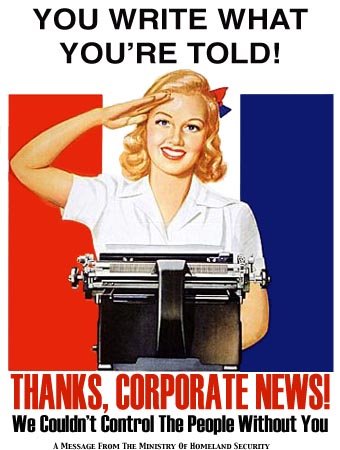
Who needs Chinese-style censorship when we've got this? Posted by Picasa
Dr. Hu

Emperor Hu of China had a great time in the U.S. Oh, there was that nasty woman who shouted at him during a White House press conference, which was loud enough to upset Smirk but apparently not enough to wake up the napping Cheney. But according to a PBS News Hour report, nobody in China heard about the shouting (she was upset about persecution of religion in China) or, for that matter, the napping---they just got great pictures of the 21 gun salute.

Hu got to be photographed at the White House and he met Bill Gates of Microsoft, and officially the U.S. got nothing--none of the agreements they wanted. But maybe they got some advice. So far (according to the PBS report) China has been pretty successful at free enterprise, including a free press---as long as they stick to celebrities, crime and local stories, that is. The Chinese strictly control political information on all media, including the Internet.

Though Bill Gates and other computer mavens are likely to deplore this publicly, they are all pretty much cooperating, and probably helping China devise more efficient means to police the Net. (Maybe there's a TV series in it? Drag/Net 2006?) Nobody has the guts to ignore the China market.

And maybe the Bushites got something out of Hu's visit after all. Thanks to the control of a few greedy and ideologically rightwing corporations, as well as timid and overpaid celebrity media "reporters" working for Cro-Magnon management too stupid to see that their efforts to appease the right are coming several years too late, when the tide is turning, Bush has had a pretty easy ride media-wise. The press has been in his corner and under his thumb for most of his tenure.

Though these days, not so much. So maybe Hu was able to give Bushites some tips on how China does it. Whatever ails Bush's control of the media, Dr. Hu can fix it.

He could also pass along data on how well the Internet controls are working. A free Internet, even as free as it is now, is not likely to last. Between greedy corporations and Bushite totalitarians, the whole blog thing could disappear overnight. Or just be gradually transformed into pay-per-view, open only to the same megacorporations that control just about every other source of information and "free speech."

Friday, April 21, 2006


Chateau by Rene Magritte Posted by Picasa

click to enlarge. from the San Francisco Chronicle. Posted by Picasa

The Daily Babble

Hu's on First?

No, this isn't going to be a diatribe about how the Bushites and their corporate cronies are so eager to sell out to China, providing them with all the military technology, manufacturing jobs and debts they need to bury us, Khrushchev style. Although I could write that.

It's about humor. Did you get the joke in the headline? What do you have to know to know it's humor (whether you think it's funny or not is another matter)? You have to know something about today's news, that the Emperor Hu from China is in the U.S. meeting with Smirk. Okay, so he's not the emperor, officially. (Probably you have to know something about the old Flash Gordon serials to know why calling him the Emperor Hu is possibly a little funny, but that's another joke.) And you have to know the Abbott and Costello routine. If you don't know the one I mean, why should I even tell you?

What percentage of America do you think would get this joke? That's what I thought, too. Pretty depressing, isn't it?

This line of thinking came to me as I perused the back page of the Wednesday San Francisco Chronicle. It had the Asmussen panel I've stolen for the occasion. To find it funny you have to know at least the headlines about "missing links" recently discovered, or maybe there was just one missing link (and lots of headlines): the fish with legs, sort of. And you'd have to know about John McCain's recent forays into Pat Robersonland looking to be the Bushite candidate for 2008, a strange but somewhat delightful strategy, since it seems self-destructive, and there's nothing like self-destructive Republicans who aren't destroying other countries and many other people in the process, to brighten up the day.

But that wasn't what got me started. It was one panel cartoon on the same page, a Bizarro by Piraro. I will try to steal that one, too but I'm not sure I can. So I'll describe it---specifically my experience of it. I saw a cartoon of a police officer cuffing a young man, saying (via the balloon above his head) "Anything you say can & will be used against you in a future life..." The legend at the bottom of the picture says, KARMA MIRANDA ACT.

Not only did I get it and laughed, but I really admired its elegance. And when you find something funny and really admire its elegance you want to immediately tell somebody about it, share it. And then the thought came to me: like, with who? Who can I be absolutely sure will understand this? And the answer was...almost nobody.

I knew some people who would get the Karma part. And some people who would know what the Miranda Act warning is (if only from a billion TV cop shows.) And some people might know who Carmen Miranda was, especially if they noticed the fruit on top of the cop's head, which I didn't catch until I looked at the cartoon again. But the joke doesn't work unless you get all of the references. And I can't quite be positive. That anyone would.

I'm tired of explaining references all the time, even though I don't do it all the time, because I try not to make them, so I don't have to explain them. It's partly an age thing, of course. Carmen Miranda did not discover radium or was she even under-secretary of state. The same kind of people who know who all the Simpsons are would know who Carmen Miranda is, if it happened to be the 1940s or 50s. I first learned of her from cartoon parodies made in the early 50s or earlier, that ran very early Saturday mornings on TV when I was in grade school. Later I probably saw her on variety shows, though my only clear memory of her is in a movie with Groucho Marx. But for someone in my generation, you just knew who Carmen Miranda was. An odd looking Latin dancer who wore hats with piles of fruit on them.

But you have to know at least the name Carmen Miranda to get the pun. Karma, Carmen, get it? I really didn't want to have to explain that. So is this what old age is going to be, especially in an era of galloping ignorance...me chuckling to myself, and being ashamed of getting an elegant joke?

You can really cheer me up by commenting in outrage about how you feel personally insulted because I didn't know you would get this joke immediately.

Thursday, April 20, 2006


The only one we've got. Posted by Picasa
The Nuclear Difference

The prospect of a U.S. attack on Iran is unnerving. But the task of preventing that attack, and especially of preventing the use of nuclear weapons, is not helped by incorrect charges and information, such as today's panic in the blogosphere over a bomb test in Nevada long scheduled for early June. Unless everyone concerned is lying--which of course given this administration's record, is entirely possible--it will be the biggest non-nuclear explosion ever seen. However big, and however related it may be to the effort to create a nuclear"bunker-buster" bomb, it is still non-nuclear. Calling it a "nuclear explosion" is not helpful. Because, well, it's not. And the distinction matters.

Oppose it for any number of reasons, including its possible purpose, or the fact that it is being held on land long claimed by the Western Shoshone, a claim upheld by the UN. But please don't call it nuclear.

Not only does this feed the image of "wild speculation" that the Bushites would like to tar its opposition with, but in particular, the nature of so-called conventional weapons and of nuclear weapons should not be confused. That only plays into the strategy and perhaps even the beliefs of the Bushites.

As Senator Feinstein wrote last Sunday: " There are some in this administration who have been pushing to make nuclear weapons more "usable." They see nuclear weapons as an extension of conventional weapons. This is pure folly."

Sy Hersh made the same point in his New Yorker piece. He quotes a former senior intelligence official: He went on, “Nuclear planners go through extensive training and learn the technical details of damage and fallout—we’re talking about mushroom clouds, radiation, mass casualties, and contamination over years. This is not an underground nuclear test, where all you see is the earth raised a little bit. These politicians don’t have a clue, and whenever anybody tries to get it out”—remove the nuclear option—“they’re shouted down.”

In the planning for an Iran attack, William Arkin in the Washington Post wrote: The new task force, sources have told me, mostly worries that if it were called upon to deliver "prompt" global strikes against certain targets in Iran under some emergency circumstances, the president might have to be told that the only option is a nuclear one.

The military understands the difference between nuclear and non-nuclear in terms of the physical effects and the geopolitical effects. The geopolitical effects have to do with the fact that no nation possessing a nuclear weapon has ever used it against an enemy, not in the 61 years since the U.S. bombed two cities in Japan, when it was the only nation in the world that had atomic weapons.

That nations have never used nuclear weapons has been perhaps the world's only achievement in preventing civilization's self-destruction.

That's all I will say about the political difference in this post. I'll also save the moral argument for another post. In this post I want to emphasize the physical difference of nuclear weapons. Even this won't be complete in one go. So much of this is embedded in history. It will take some time to explain.

I am not a scientist. I am attempting to report as accurately as I can what has been written on this subject. First, on the nuclear attack on Iran. Then on a bit of early atomic history, to flesh out what this might mean.

Bunker Busting

The bomb in the US arsenal most often mentioned as the "bunker-buster" is the B61-11. There is some uncertainty about its yield. Some say it has a fixed yield of 10 kilotons. Others that it has a variable yield of up to 340 kilotons. Compared to other nuclear bombs the US possesses, this is relatively small. On the other hand, the yield of the bombs that destroyed Hiroshima and Nagasaki were between 15 and 20 kilotons.

But the B61-11 can't penetrate rock. To destroy a bunker 1,000 feet below the surface would require a larger bomb, on the order of 1.2 megatons, as in the proposed Robust Nuclear Earth Penetrator. According to the National Academy of Sciences, the blast from this weapon would create a crater 1,200 feet wide, and the explosion would send some 300,000 tons of radioactive debris 15 miles into the sky. They estimate the total casualities could exceed one million.

In a scenario developed by Physicians for Social Responsibility, an attack on a bunker in Iran with a 1.2 megaton weapon would kill over 3 million people, and expose some 35 million people in Iran, Pakistan, India and Afghanistan to significant radiation, including the 20,000 Americans deployed in the region for the war on terrorists.

As far as we know, a "bunker buster" weapon with this size yield does not yet exist. So the US is apparently considering using the smaller yield B61-11 even though it can't penetrate to 1,000 feet. Supposing it is used, what would be its effects?

The Physicians for Social Responsibility point out the common misconception that sending an atom bomb into the ground---an Earth Penetrating Weapon (EPW) lessens the radioactive fallout. That's not true. A nuclear EPW would actually create more fallout than a ground-burst or airburst weapon, due to the increased distribution of radioactive debris from detonation at a shallow depth in soil or rock, the report says.

The report quotes the congressional testimony of Ambassador Linton Brooks, head of the National Nuclear Security Administration: "I really must apologize for my lack of precision if we in the administration have suggested that it was possible to have a bomb that penetrated far enough to trap all fall-out. I don’t believe the laws of physics will ever let that be true. It is certainly not what we’re trying to do now. What we are trying is to get in the ground far enough so that the energy goes deep into the ground to hold at risk the deeply buried facilities. But it is very important for this committee to recognize what we on our side recognize... There is a nuclear weapon that is going to be hugely destructive over a large area. No sane person would use a weapon like that lightly... I do want to make it clear that any thought of ...nuclear weapons that aren’t really destructive is just nuts."

Probably the major physical difference of nuclear weapons, apart from sheer power--which vaporizes and incinerates people-- is lethal radioactivity. The effects of radioactivity alone kills people within 60 seconds, then in days, and then in weeks and months. In those it doesn't kill, it suppresses the immune system and can cause cancers and other diseases, and it may cause genetic abnormalities in the next generation.

Radioactive fallout from a bunker buster carrying even a one kiloton bomb is not contained beneath the ground. It rises in the soil to the surface and into the air. Winds disperse it farther.

Standardizing Catastrophe

Atomic bombs have been used directly on people only twice. There are no exact statistics, but the ones generally accepted (I take them from The Bomb: A Life by Gerard DeGroot) are these: Some 75,000 people died immediately in Hiroshima in the blast and fire. After five years, some 200,000 had died from the Bomb. (p.95). The Hiroshima bomb was approximately 15 kilotons.

In Nagasaki, some 40,000 people were killed in the blast, "70,000 by the end of the year and perhaps as many as 140,000 in total." (p.101) The Nagasaki bomb was approximately 20 kilotons.

Please note that more than half of those who died in five years had survived the blast in Hiroshima. In Nagasaki, it was more than two-thirds. No one knows how many cancers and other illnesses resulted.

To repeat: some say the bunker busters now in the US arsenal have a yield of 10 kilotons, but most believe the yield goes up to 340 kilotons, more than 22 times the yield of the bomb that destroyed the city of Hiroshima, and reduced human beings to lumps of charcoal a half mile away. The first atom bomb ever exploded, in a New Mexico test, was about 17 kilotons. It killed every living creature for a mile radius, including insects.

In that summer of 1945, when Norman Cousins read the first detailed reports on the development of the atomic bomb in the same issue of the New York Times that told of that bomb’s first use in destroying Hiroshima, he wrote an essay that would be published within days in the magazine he edited, the Saturday Review of Literature. Though it may sound like a sedate and specialized publication now, it was widely read, with a circulation of over half a million. It became a well-known and much discussed essay, especially when Cousins expanded it into a small book, titled Modern Man Is Obsolete.

Cousins advanced several philosophical and political arguments in this essay, but he began with the most vital assertion: the dropping of the Bomb meant that humanity had entered an entirely new era. Total destruction of civilization and possibly of humankind, perhaps of most life on earth, was now possible. This fact had to brought into the consciousness of the species, so humanity could try to take control of its fate. The power of the atomic bomb “must be dramatized and kept in the forefront of public opinion, “ he wrote. “The full dimension of the peril must be seen and recognized.”

But that task was always going to be difficult, as he learned just a year later. Cousins was one of the reporters who witnessed the first postwar atomic bomb test at Bikini island, in the summer of 1946. The bomb was dropped into the ocean, with numerous naval vessels in the vicinity to test the extent of its destructive power. But the observation ship was far away, and the bomb had missed the target so the devastation it caused was not immediately obvious. The first reports to the world gave the impression, Cousins wrote, “that the bomb had been ‘oversold’—that it was ‘merely’ another weapon.”

For at least the next 40 years, there were always people in government and the military who tried to minimize the Bomb, as just another weapon. At first they denied that radioactive fallout existed. Then they said it wasn't very harmful. And then they said that death by radioactive poisoning was "pleasant."

Then we were supposed to forget about the effects. Nuclear war was supposed to become normal. Cousins called it "the standardization of castastrophe."

It soon became apparent, even in 1946, that the Bomb test Cousins witnessed had indeed been enormously destructive, and the second bomb exploded in this series surprised even the bomb-makers with its ferocious power, sending a half-mile wide column of water a mile into the sky in a single second, and spewing quantities of radiation farther than the military anticipated. These were the first tests at Bikini island, a place still too radioactive for human life today.

These first tests were called Operation Crossroads. I was born on the day of the first one. The atomic Bomb was a political and moral crossroads for humanity, because it was so powerful and so different. Today's conventional bombs are themselves far more destructive than conventional weapons in the past. Depleted uranimum munitions and various chemical agents have long term effects. But even so, the Bomb is a difference in kind. It is the Bomb. We must never forget that. Never. And especially, not now.

Note: Versions of this essay are front-paged at Booman Tribune and E Pluribus Media.

Wednesday, April 19, 2006


Mandala (fractal) Posted by Picasa
Take Nukes Off the Table

Asked by a reporter if he would take the nuclear option off the table in what action he might take against Iran, President Bush said he would not. Within hours, the price of oil shot up to nearly $72 a barrel, as a direct result of such threats and Iran's defiance.

Bush's refusal to take nuclear attack "off the table" is received in different ways. But absolutely none of them has a positive outcome.

Some believe it is a sign of weakness---a signal that he has few options in dealing with Iran, having squandered his credibility, political capital and military flexibility on Iraq. Weakness in the face of a possible threat (more reasonable and more direct from North Korea, but in terms of the region, potentially from Iran) is not good.

Others insist it's a bluff, an attempt to intimidate, or at least to keep Iran off-balance, not knowing what Bush might do. As a New York Times editorial pointed, this kind of threat is best made privately, as apparently the Clinton administration did (though it's not known if the threat was ever nuclear.) But the uncertainty now extends to America's allies, and come to that, to Americans. Bush probably worries Iranians less than he worries the British and certainly the citizens of his own country. He's got us scared to death.

Because at least some of us realize the enormity of the so-called nuclear option. Dropping atomic bombs--which is what these "bunker-busters" are--on a sovereign state with an elected leadership, that has no nuclear weapons and has committed no act of war, merely on the suspicion that Iran intends someday to have nuclear weapons--would easily qualify as one of the most monstrous acts of at least the past several centuries.

Such an attack, which is likely to kill thousands and possibly millions directly, and sicken even more millions in 3 or 4 countries (including Americans in Afghanistan) with radiation-caused illnesses, with other injuries, illnesses and genetic transgressions over years and generations, would be the first time in 60 years nuclear weapons would be used in war.

The economic effects, the likelihood of escalations and wider warfare, spreading death and pain and suffering across the world, make a list of possible horrors. But one thing is just about certain: the morning after such an attack, America will be a pariah in the world. The name of America will be spoken with same inflection as Nazi Germany for generations. No American now alive, nor their children and grandchildren, will live down this disgrace.

That's what we are justifiably afraid of. But even the act of keeping the nuclear option on the table makes nuclear warfare more likely. It has re-introduced nuclear weapons as thinkable. Which nation will threaten their use next? And which nation will feel compelled to use them, just to make their threat credible?

The use of nuclear weapons must be taken off the table. Or there will be no table.

There are a number of efforts to tell that Members of Congress and others that the nuclear option is unacceptable, and urge them to take action. One of these, a 14 day campaign called Off the Table, can be found here.
More American Shame

From the Independent:

The United States emitted more greenhouse gases in 2004 than at any time in history, confirming its status as the world's biggest polluter. Latest figures on the US contribution to global warming show that its carbon emissions have risen sharply despite international concerns over climate change.

Carbon dioxide levels in the atmosphere are now a third higher than they were before the Industrial Revolution began in the 18th century, and probably higher than they have been for at least 10 million years.

Scientists have suggested that if the international community is to try to stabilise carbon dioxide levels at twice pre-industrial levels then countries such as the US and Britain need to reduce emissions by about 60 per cent by the middle of this century.

Tuesday, April 18, 2006

Plenty of Pre-Owned SUVs At Great Prices!

So says the TV ad. Good luck: regular unleaded hereabouts is at $3.20 a gallon, and that's before oil hit $70 a barrel---oops, it's $72.
Into the Blue

A new Washington Post poll begins to plumb the depths to which GW Bush has fallen. Almost half of the electorate strongly disapprove of his presidency. That's not just "disapprove," that's 47% strongly disapprove. Only 1/5 of those surveyed strongly approve, less than half the percentage of those utterly disgusted.

Another poll citied in this article says that 82% of those who voted for John Kerry in 2004 plan to vote for a Democrat in the 2006 elections, but only 64% of those who voted for Bush plan to vote Republican.

Why? A former Bush voter is quoted: "My husband and I think he lied to us, and he won't admit he's lied to us" about starting the war in Iraq. Another Republican: She recounted a conversation with neighbors who support Bush because of "moral issues." "I said, 'While he's not killing babies, he's killing you' " with high gasoline prices, a soaring deficit and other problems, Bruce said. "He is going to bankrupt us all."

UPDATE: a Survey USA poll puts Bush's overall disapproval at 61%, with a positive job approval rating in just four states. So here are the Red States: Utah, Idaho, Wyoming and Nebraska.

Monday, April 17, 2006


Aurora from Maggie Mt, Kentucky. Photo by Dwight Stone. Posted by Picasa

Today in Baby Boomer History

Been missing this fave feature? It's now at 60's Now.
War on Iran?

Over the weekend, two oped pieces in major U.S. newspapers came out strongly against military action against Iran. In the Los Angeles Times, California Senator Dianne Feinstein, who attacks the Bush doctrine of pre-emption for being dangerous (relying on spywork that is never completely accurate), for discouraging diplomacy and encouraging the very behavior the world is worried about, seeking and possessing nuclear weapons, for only with such weapons is a nation safe from preemption.

But Feinstein, who has been keeping an eye on Bushite nuclear weapons development when few others have, saves her most scathing pronouncements for the possibility that the Bushites intend to use nuclear weapons against Iran:

The dangers inherent in preemptive action are only multiplied by reports that the administration may be considering first use of tactical, battlefield nuclear weapons in Iran: Specifically, nuclear "bunker busters" to try to take out deeply buried targets.

There are some in this administration who have been pushing to make nuclear weapons more "usable." They see nuclear weapons as an extension of conventional weapons. This is pure folly.

As a matter of physics, there is no missile casing sufficiently strong to thrust deep enough into concrete or granite to prevent the spewing of radiation. Nuclear "bunker busters" would kill tens of thousands, if not hundreds of thousands, of people across the Middle East.This would be a disastrous tragedy. First use of nuclear weapons by the United States should be unthinkable. A preemptive nuclear attack violates a central tenet of the "just war" and U.S. military traditions.

In the New York Times, former national coordinator for security and counterterrorism Richard Clarke and former National Security Council senior director for counterterrorism Steven Simon write that in the 1990s they were party to a White House inquiry into bombing Iran. The result was " the highest levels of the military could not forecast a way in which things would end favorably for the United States." They warn that today the resulting warfare, quickly involving escalation on both sides, would be more costly and disastrous than Iraq.

But after the near unanimous condemnation of the attack Iran plan this past week--including the story that Prime Minister Tony Blair has told Bush that Great Britain won't support or aid in such a war-- isn't all this just unnecessary rhetoric? Not according to William Arkin at the Washington Post, who writes a piece that is meant to support Pentagon contingency planning for war on Iraq and indeed just about anybody else, especially (he says) now that the U.S. won't wait to be attacked and "is a first strike nation." He also supports letting potential enemies know that these plans exist, as a deterrent. However all that is viewed, there are several particularly chilling paragraphs:

The day-to-day planning for dealing with Iran's missile force falls to the U.S. Strategic Command in Omaha. In June 2004, Rumsfeld alerted the command to be prepared to implement CONPLAN 8022, a global strike plan that includes Iran. CONPLAN 8022 calls for bombers and missiles to be able to act within 12 hours of a presidential order. The new task force, sources have told me, mostly worries that if it were called upon to deliver "prompt" global strikes against certain targets in Iran under some emergency circumstances, the president might have to be told that the only option is a nuclear one.

And his final graph:

The war planning process is hardly neutral. It has subtle effects. As militaries stage mock attacks, potential adversaries become presumed enemies. Over time, contingency planning transforms yesterday's question marks into today's seeming certainty.

Like the Iraq panic, the frenzy to attack Iran is being driven at least partly by exiles with an ax to grind, such as the son of the deposed Shah. As Senator Feinstein noted, to start a war based solely on spying, that spywork must be infallible. That sure didn't turn out to be the case in Iraq. We're in even murkier waters in Iran. Of course, we did have somebody watching nuclear developments in Iran, but thanks to the Bushites, she's no longer working for the CIA in that capacity. Valerie Plame was her name.

Though the rhetoric is heated, partly because the Bushites have gone to war disastrously before, the situation is complex, as outlined in this useful overview from the Guardian. While some insist that planning to attack Iran has gone far beyond mere contingency planning, there is great conflict in Washington, even within the Bush administration and Pentagon. And also to the point, conflict within Iran and the Iranian government.

All this is happening when most experts say that Iran is five to ten or more years away from a useable nuclear weapon, if the weapons program they claim they don't have exists and runs smoothly for that period. While some estimates are shrinking, they are easily traced back to within the Bushite camp. Which in itself is an ominous reminder of the run-up to Iraq.

Stay tuned.
Bringing Bushite Ideals to Iraq

According to the Boston Globe, American contractors swindled hundreds of millions of dollars in Iraqi funds. But while courts in the United States are beginning to force contractors to repay reconstruction funds stolen from the American government, Iraq is out of luck. Why? Not only is their no provision in U.S. law, it just so happens that one of the very first laws passed during the American occupation by the Iraq "government" gave American contractors immunity from prosecution. So contractors who failed to do the work they were paid for are home free.

''In effect, it makes Iraq into a 'free-fraud zone,' " said Alan Grayson, a Virginia attorney who is suing the private security firm Custer Battles in a whistle-blower lawsuit filed by former employees. A federal jury last month found the Rhode Island-based company liable for $3 million in fraudulent billings in Iraq.

The West Winger

Transition

The funeral was for Leo McGarry, but the tears were for John Spencer.

But contrary to the impression left by the teaser last week (which I wish I hadn't erased on the tape), this episode was at least as much about the transition to the new presidency as about Leo. Spencer's image never appeared, except in the opening credits. That was realistic, of course. Or in this video age, was it?

Anyway, Josh is going to be chief of staff, the v.p. isn't going to be anyone we've seen, and although many figures of the past were seen at the funeral mass, only a few appeared in the story. Marie-Louise Parker, whose character was offered a post, Timothy Busfield, who is now strictly C.J.'s love interest, and the blond who is asking to be White House counsel but really can't since she's a regular on one of those CSI shows I don't watch.

All in all, a pretty tame, pretty disappointing episode for one so close to the end.

Sunday, April 16, 2006


Beginning by Andy Everson, at inuit.com. Posted by Picasa
Happy Spring Holidays.
Climate Crisis and Climate Catastrophe

What a few were saying is now becoming a stronger message: there are two distinct (if overlapping) parts to the climate future: there's the Climate Crisis we are now in, and must deal with, and there is the unimaginable future of an unrecognizable Earth, if we continue to feed the furnaces of global heating. (I've been calling it Earth=Venus, or Earth=Mars, but perhaps I need to come up with a better image, because people seem to get hung up on the technicalities. Then again, the current European space mission to Venus may make the image more pertinent.)

But it is still a confusing message, at least as it is reported. Last week, Professor Sir David King of the British government forecast a temperature rise of 3C over the next century if the world continues on its current C02 course. The
BBC story quoted a report by Hadley Centre projecting the likely effects of a 3C rise." It warned the situation could wreck half the world's wildlife reserves, destroy major forest systems, and put 400 million more people at risk of hunger. "

The story quoted King as counselling against fatalism and despondency, but calling for urgent action to save the future. At the same time, it quoted him as saying that even if a global agreement could be reached on limiting emissions, climate change was inevitable.

This is true, but news style made the message seem contradictory. It's not.

Probably the best short piece I've seen recently is
here at World Changing by Alex Steffen. He applauds the recent burst of awareness on global heating, like the Vanity Fair cover, which features celebrities bringing attention to the issue, something I have long advocated. But he finds that given today's knowledge, the so-called solutions are inadequate.

Except for one thing: the solutions. By and large, the solutions being offered by many of these newly-minted climate allies are quite simply out of whack with the magnitude of the crisis we face. Take
the Vanity Fair green issue, in which associate editor Heather Halberstadt offers this prescription for action: "Turn off the faucet while you're brushing your teeth or recycle your Sunday newspaper. Little things can have an impact on a global scale; it doesn't necessarily mean buying a hybrid vehicle."

A few years ago, he writes, this would have been trite, but now, given the latest knowledge about how fast global heating is happening, it's just silly. It's way not enough.

Indeed, in study after study, model after model, what we are learning is that our society is not a little out of alignment with sustainability, it is massively and nearly completely unsustainable.
With an increasingly well-documented and articulated global ecological crisis on our hands, turning off the faucet and recycling the newspaper (while fine things to do) are pretty meaningless. The 21st Century does demand that we buy hybrids -- indeed, it demands much more: it demands that we imagine, build and buy cars which ecologically make hybrids look like hummers. It demands a complete redesign of our industrial civilization, from the chemicals we use to the energy we create to the cities we design to the way we deal with water and waste to the buildings in which we live. We are way, way beyond tinkering at the margins here.

We have maybe ten, maybe twenty years to do this. But we will be helping the far future, not our future. Steffen makes this clear, in a paragraph we should all be required to memorize:

We cannot "stop global warming" at this point. We are
committed to a certain degree of climate disruption already. What we can do is stave off the truly catastrophic levels of climate change which will be our fate if we do not act. Unfortunately, there is a ridiculously large disconnect between what we must do to reduce our climate footprint and what we have so far been willing to even discuss.

Maybe we'd be better off calling these two situations The Climate Crisis (the near-term effects of global heating we must deal with, like crisis level prepardedness for hurricanes) and The Climate Catastrophe of the far future, which we can lessen or stop by serious action.

As for how we can make those tremendous changes, the clean little truth is that the knowledge to do so is out there, or much of it is. And some people, even some countries, are taking action. Did you know, for instance, that 80% of the cars in Brazil run on ethanol made from sugar cane?

The potential for biofuels is just beginning to be explored, and right now people are eagerly trying them out, because gasoline prices are so high, as is the expense of getting rid of "waste" like cooking oil, which can run an ordinary truck or car, with a bio-converter that often pays for itself in savings.
Paul Solman had an eye-opening report on this on the PBS News Hour.

That's just one area of promise. I don't believe we really know, for example, the real potential for solar power and other clean technologies, even at the current state of development. Perhaps examples like Brazil and concerted efforts by many individuals, some major corporations, some cities and states, can get things started. But we truly need to mobilize, to understand the stakes, and see this as our adventure. With leadership and a widespread bedrock citizen commitment, there is hope.

Saturday, April 15, 2006

Building Vatican City in Baghdad

Now under construction and otherwise shrouded in secrecy, the new American Embassy in Baghdad. Conjure an image of a sedate but solid white building, surrounded by a high wrought iron fence, a guard at the gate?

Not exactly. The so-called Embassy is a compound composed of 21 separate buildings on 104 acres in the heart of Baghdad. It will be six times larger than the United Nations in NYC, roughly the size of Vatican City, with its own power supply and water.

This is separate from several new military bases that have the same scale, size and sense of permanence. The AP report on them began:

The concrete goes on forever, vanishing into the noonday glare, 2 million cubic feet of it, a mile-long slab that's now the home of up to 120 U.S. helicopters, a "heli-park" as good as any back in the States.At another giant base, al-Asad in Iraq's western desert, the 17,000 troops and workers come and go in a kind of bustling American town, with a Burger King, Pizza Hut and a car dealership, stop signs, traffic regulations and young bikers clogging the roads.At a third hub down south, Tallil, they're planning a new mess hall, one that will seat 6,000 hungry airmen and soldiers for chow.

The Embassy and the bases are more than huge: they are permanent. Why else would they be going up when the Bushites say the Americans are turning things over to the Iraqis, and will leave when asked ? What does this say about what the Bushites are really doing in Iraq? What does the secrecy itself tell us?

The Bushites have masked their operations in melodrama, the fighters for freedom against the evil-doers, both for political gain in American elections, and to cover their operations in Iraq. Apart from enriching Halliburton and other crony corporations, they are establishing a corporate base in the Middle East, and the waning American middle class as well as the poor, plus several unborn generations, are paying for it all.

A political key is not creating more of a fuss at home over cost. That's where the tax cuts for the wealthy come in. Bush has provided the wealthiest Americans with four successive tax cuts and is now promoting their permanence. He is enriching the rich at the expense of everyone else, and is investing what's left of our money in seeing that his wealthy cronies get wealthier.

This is the future that the Bushites are building.

Friday, April 14, 2006


Oxtongue Lake by Nancy Rotenberg at naturaltapestries.com. Posted by Picasa

The Dreaming Up Daily Quote

"No nation could preserve its freedom in the midst of continual warfare."

James Madison