Sunday, September 11, 2005
from Raw Story
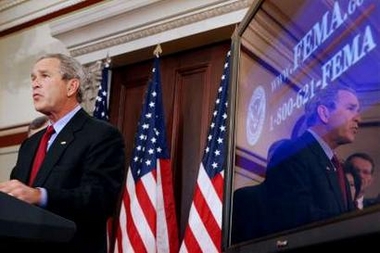
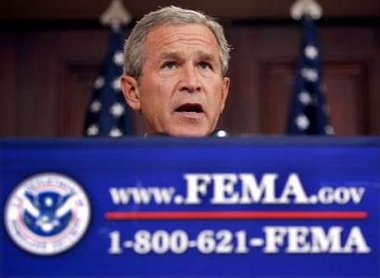
President George W. Bush's approval ratings have fallen across the board in the wake of Hurricane Katrina and a seemingly flawed government response to the disaster, according to the latest Newsweek Poll. Bush's job-approval rating dropped to 38 percent, the lowest ever in the Newsweek Poll. Sixty-six percent of those polled say they are dissatisfied with the way things are going in the United States at this time; just 28 percent are satisfied, another record low in the poll.
A 52-percent majority of Americans say they do not trust President Bush to make the right decisions during a domestic crisis, 45 percent do. The same number-52 percent-do not trust him to make the right decisions during an international crisis, again, 45 percent do. In addition, 57 percent of Americans say the slow response in New Orleans has caused them to lose confidence in the government to deal with another major natural disaster, 41 percent say it has not; 47 percent say it has made them lose confidence in government to prevent another 9/11-type attack; half (50%) say it has not, the poll shows.
The president's ratings on issues having little if anything to do with domestic disasters also declined. Bush's approval on handling terrorism and homeland security is 46 percent, a five-point drop from the August 2-4, 2005 Newsweek Poll. For the first time in the Newsweek Poll, more Americans disapprove of Bush's handling of terrorism and homeland security (48%).
Almost half (49%) of all those polled say taking military action against Iraq two years ago was not the right thing to do; 46 percent say it was. This is the first time ever in the Newsweek Poll that more Americans have said going to war was not the right thing to do than said it was.
The Storm Next Time
By NICHOLAS D. KRISTOF
New York Times (excerpts; emphasis added)
If the White House wants to move the debate about Hurricane Katrina beyond what it calls the "blame game" for bodies decomposing in the streets of New Orleans, then here's a constructive step that President Bush could take to protect people in the future: Tackle global warming.
True, we don't know whether Katrina was linked to global warming. But there are indications that global warming will produce more Category 5 hurricanes. Now that we've all seen what a Katrina can do - and Katrina was only Category 4 when it hit Louisiana - it would be crazy for President Bush to continue to refuse to develop a national policy on greenhouse gases.
Hurricanes derive their power in part from warm water, and so forecasting models show future hurricanes becoming more severe as sea surface temperatures rise. One summary of 1,200 simulations published in the Journal of Climate last year showed that rising levels of greenhouse gases could triple the number of Category 5 hurricanes.
Moreover, there's empirical evidence that hurricanes have already become more intense (but not more frequent). Nature magazine this summer reported a new study by Kerry Emanuel, a hurricane guru at M.I.T., indicating that by one measure hurricanes have almost doubled in intensity over the last 30 years.
That reflects natural cycles as well. But Professor Emanuel writes: "The large upswing in the last decade is unprecedented, and probably reflects the effect of global warming."
He adds: "My results suggest that future warming may lead to ... a substantial increase in hurricane-related losses in the 21st century."
Remembering 9/11
It is in the spirit of freedom that this editorial from the New York Times is a fitting memorial, and a call to action.
Abu Ghraib Unresolved
Ever since the world learned of the illegal detentions and brutal behavior at American military prisons, the Bush administration has bet it could outlast public outrage with phony investigations and stonewalling.
Just before Congress went on summer holiday, Republican leaders actually yanked the military budget from the Senate floor rather than face two amendments intended to impose the rule of law on the camps.
One measure would define the nature of detainees taken in antiterrorism operations according to constitutional principles and international treaties - and prohibit abuse and torture. The other would create a panel like the 9/11 commission to finally give Americans the truth about how the administration's prison policies led to out-of-control camps like Guantánamo Bay and Abu Ghraib.
The new laws were sponsored by two Republicans, Senators John McCain of Arizona and Lindsey Graham of South Carolina, who have shown remarkable courage on this issue. But they and other Republicans have withheld support for the investigation, which was proposed by Senator Carl Levin, Democrat of Michigan.
Mr. McCain and Mr. Graham have said they think it is more important to look forward than to hold an investigation. We respect their views, but they are missing the point. The American public needs answers about the prisons, and it is simply not acceptable that a few low-level reservists go to jail while the civilian lawyers who wrote the torture policies get promoted and the general who devised the interrogations escapes even the mildest rebuke.
Beyond that, the problems have not gone away. Many of the interrogation policies that the military's own lawyers considered repugnant are still in place; American troops have only a vague notion of what is allowed; and the administration still claims that Mr. Bush can ignore the Constitution as long as he does so in regard to foreigners.
Just this week, the White House argued that the Supreme Court should not review the case of a Yemeni prisoner charged with war crimes. He admits he drove Osama bin Laden's car, but says he never attacked American troops. The administration wants to try him without judicial oversight, under ever-changing rules and without letting him see all the evidence. Even if he is acquitted, the administration says it will keep him in jail. In another case, the White House wants to deny hearings to 20 Kuwaitis arrested after 9/11 who want a chance to prove their innocence.
In both cases, the administration says it needs to be able to hold on to dangerous terrorists. Of course it does, and nothing prevents it from doing that. But no amount of concern about terrorism gives it the power to detain innocent people or brutalize even those who are guilty. That is why this nation has laws, courts and judges. We can never be sure any new laws will be enforced until we know the truth about how the old ones were swept aside.
That is why Mr. McCain, Mr. Graham and other Republicans who understand the importance of these issues should support an independent inquiry. Given the need to investigate the Katrina debacle, this may seem one examination too many. But healing the wounds of the prison camps is vital to American values, the country's image and the safety of its soldiers.
Saturday, September 10, 2005
The Daily Quote
Virgil Thompson
From "Casualty of Firestorm: Outrage, Bush and FEMA Chief" [excerpts]
The New York Times September 10
By ELISABETH BUMILLER
To Democrats, Republicans, local officials and Hurricane Katrina's victims, the question was not why, but what took so long?
Republicans had been pressing the White House for days to fire "Brownie," Michael D. Brown, director of the Federal Emergency Management Agency, who had stunned many television viewers in admitting that he did not know until 24 hours after the first news reports that there was a swelling crowd of 25,000 people desperate for food and water at the New Orleans convention center.
Mr. Brown, who was removed from his Gulf Coast duties on Friday, though not from his post as FEMA's chief, is the first casualty of the political furor generated by the government's faltering response to the hurricane. With Democrats and Republicans caustically criticizing the performance of his agency, and with the White House under increasing attack for populating FEMA's top ranks with politically connected officials who lack disaster relief experience, Mr. Brown had become a symbol of President Bush's own hesitant response.
Behind the president's public embrace of Mr. Brown was the realization within the administration that the director's ignorance about the evacuees had further inflamed the rage of the storm's poor, black victims and created an impression of a White House that did not care about their lives.
One prominent African-American supporter of Mr. Bush who is close to Karl Rove, the White House political chief, said the president did not go into the heart of New Orleans and meet with black victims on his first trip there, last Friday, because he knew that White House officials were "scared to death" of the reaction.
Mr. Bush, characteristically, did not officially dismiss Mr. Brown, instead calling him back to Washington to run FEMA while a crisis-tested Coast Guard commander, Vice Adm. Thad W. Allen, was given oversight of the relief effort. The take-charge Admiral Allen, who commanded the Coast Guard's response up and down the Atlantic Seaboard after the attacks of Sept. 11, 2001, immediately appeared on television as the public face of the administration's response.
In Baton Rouge, Mr. Brown appeared briefly at Mr. Chertoff's side before heading back to the capital, where, the secretary said, the director was needed for potential disasters.
"We've got tropical storms and hurricanes brewing in the ocean," Mr. Chertoff said.
Captain Future's Log
Thousands crowded for anxious day after despairing day in the sealed darkness of a gleaming domed enclosure, confined with little food or water, trapped in an extreme nightmare of violence, death, heat and excrement.
Families marooned on baking slivers of interstate highway, or waving frantically from rooftops at blind helicopters passing by on fathomless missions. All surrounded by roiling waters of spilled oil, toxic chemicals, sewage, and decaying human remains.
Then even as rescue began, two-mile lines of ambulances waited to bring patients into the only working medical facility, in the passenger concourse of the New Orleans airport. There, as Dr. Mehmet Oz reported on a harrowing hour of Oprah, those who were too ill to be helped were moved to the makeshift morgue while still alive.
Bodies rotting in the street for days, dead men, women and children left to decompose in their own homes. This cannot be America, everyone was saying. This cannot even be…civilization.
This was perhaps the most sobering of many shocking realizations. Beyond political responsibilities and human failings, beyond the truth or illusion of national self-image, even beyond the physical suffering and material deprivations, there was the sense that civilization itself had broken down.
If it had, whose fault would it be? The people who were improvising survival under unimaginable duress, some of whom interpreted the absence of rescuers and resources as attempts to ignore or even kill them? Or those who failed in their designated tasks as the representatives of civilization? Or perhaps even those who set the terms of this civilization?
Was it the hardship---no electricity or running water, scant food and water---that meant civilization had broken down? Or was it these horrific hardships, plus the absence of response, of the hand of help from unaffected others?
We aren’t quite sure yet what and who most endangered our sense of civilization by allowing or causing so much degradation and suffering. Was it those who act completely on the belief that only politics is real, and governing is illusion? Was it an unfortunate coincidence of apathy and August vacations? Was it simply a failure of officials we expected to exercise an older sense of decency while we pursue a happiness redefined as acquiring and consuming with blind greed and obsessive selfishness?
There was inadequate preparation for Katrina’s assault on New Orleans on Monday, August 29th, to say the least, and an even greater failure in the days after the winds passed. But by the weekend, civilization reasserted itself. We know now that many people wanted to help earlier and were essentially prevented from doing so. But as the outrage fomented by media reports became an outpouring of aid and understanding, we saw feeling become action, from simple acts of kindness to considerable committment, and skilled, determined people doing what they always do to keep civilization together.
Help came, including search and rescue teams from California, National Guard units from Massachusetts and West Virginia. Survivors were welcomed into cities and towns and homes all over America. Baton Rouge and some Mississippi towns doubled their populations, and Houston and Dallas brought in thousands. But places farther away opened shelters, like Des Moines and Phoenix, Los Angeles, Baltimore and Chicago. Families took in distant relatives, and others hosted complete strangers, with nobody knowing what comes next.
Help, or offers of help, came from Canada, Cuba, Mexico, Venezuela, the European Union, the United Nations. A million dollars came from Bangladesh.
Civilization may be nothing more and nothing less than a society’s commitment to particular values, reflected in its philosophies, institutions and actions, continually renewed and extended. It is finally expressed and confirmed by individual citizens and their associations.
The world saw our civilization break down in the Katrina zone, and we saw that, contrary to recent rhetoric, the failure of government can be catastrophic. But civilization reasserted itself, based on a principal civic value, which can’t be expressed any better than in the phrase, “you’d do the same for me.”
I’ve been thinking about this phrase for more than a decade, since the afternoon when it was uttered to me by a black man in his sixties, working as a custodian in a neighborhood coffee bar. When he retrieved and returned the pen I had just dropped, and I thanked him, all he said was: “You’d do the same for me.” He said it with a casual gravity, as though it was something he said regularly, but it also had the quality and weight of a personal mantra of some importance.
It wasn't the first time I'd heard it of course, but this time it hit me differently, mostly because of who said it to me and the sound of his voice. Gradually I realized what an important statement it is. It sums up entire philosophies and puts many book-length ethical treatises to shame. "You'd do the same for me" is nothing less than the basis of civil behavior, from courtesy to heroism.
By saying it to me, moreover, this man was stating both his own moral standard and his faith that others share it in the delicate informal system of day-to-day civilization. In the direct matter-of-factness of this statement, in its earnest assumptions, he was educating me and challenging me to rise to this standard. It is in some ways an ultimate equality, and a testament of faith in human possibility and the human heart.
It’s been said in much more trying circumstances: by fireman in the aftermath of 9/11, explaining why he was starting a 24-hour shift digging through the rubble of the World Trade Center to search for fellow firefighters buried there. They were his brothers, he said, and “they’d do the same for me.”
But it doesn’t require words: every act, every bottle of water a stranger hands to a survivor, every home opened to dazed and displaced relatives, every dollar donated to relief funds, says these words implicitly.
It’s the basis of hospitality and sharing in time of trouble that characterize traditional cultures all over the world. It is more subtle than the Golden Rule, for it carries expectation as well as personal responsibility. “You’d do the same for me” is a challenge in the form of a statement of faith.
Compassion and altruism often depend on empathy, which in turn depends on imagining ourselves in the circumstance of another. This is easier for some than for others. While “You’d do the same for me” reflects an ethic based on empathy, it doesn’t require it. It combines a feeling of human kinship with a utilitarian deduction: we can’t guarantee we will be helped in time of trouble, but if we support an ethic of helping others by our actions, our chances will be better.
In a complex society, individual freedoms and opportunities depend on a shared sense that in the final analysis, we’re all in this together. “You’d do the same for me” is the basic bargain of civilization, the confirmation of the faith in each other and in our institutions necessary to make it all work.
Senator John Kerry announced he will introduce a package of legislation to respond to the Katrina crisis.
The proposals cover small business relief, both in the area and help for all small business to cope with rising gasoline prices; creating permanent planning and coordination for disasters, a system of evacuation centers, provisions for housing and expanding the federal YouthBuild program.
The proposals are designed to not only respond to the Katrina crisis, but better prepare for future emergencies. Details are posted here.
From "World summit on UN's future heads for chaos/ UK leads last minute effort to rein in US objections "by Ewen MacAskill, diplomatic editor
Saturday September 10, 2005 The Guardian [excerpts]
The British government is mounting a huge diplomatic effort this weekend to prevent the biggest-ever summit of world leaders, designed to tackle poverty and overhaul the United Nations, ending in chaos.
The Guardian has learned that Jack Straw, the foreign secretary, has made a personal plea to his American counterpart, Condoleezza Rice, for the US to withdraw opposition to plans for wholesale reform of the UN. He has asked Ms Rice to rein in John Bolton, the US ambassador to the world body.
Mr Bolton has thrown the reform negotiations into disarray by demanding a catalogue of late changes to a 40-page draft document which is due to go before the summit in New York on Wednesday.
The British government, in a rare divergence from the US, is fully behind [UN Secretary General Kofi] Annan's reforms and fears the summit will fail to build on the agreements on aid reached at the G8 summit at Gleneagles.
Aid agencies and other international groups monitoring the talks expressed fears yesterday that ambitious goals on aid, protection of civilians and curbs on the arms trade will be lost.
Nicola Reindrop, head of the New York office of Oxfam International, said: "Negotiations are on the verge of collapse."
Friday, September 09, 2005
By Paul Simao
NEW ORLEANS (Reuters) - The Bush administration moved to quell a political storm on Friday by replacing the embattled head of emergency operations along the U.S. Gulf Coast, as rescue workers in New Orleans ended recovery efforts and began collecting the dead victims of Hurricane Katrina.
Homeland Security Chief Michael Chertoff announced he was appointing Vice Admiral Thad Allen, chief of staff of the U.S. Coast Guard to take charge of recovery operations in Louisiana, Mississippi and Alabama, and recalling FEMA head Michael Brown to Washington to coordinate the response to other possible disasters.
Brown had been the target of furious bipartisan criticism for the government's slow initial response to the hurricane and some of both political parties have called for his firing.
By John Whitesides, Political Correspondent (Reuters) - [excerpts, with emphasis added]
President George W. Bush' image suffered in public opinion polls taken after Hurricane Katrina hit the U.S. Gulf Coast, with some finding growing doubts about his leadership and the country's direction.
After a week of criticism for a slow response to the devastation caused by Katrina, polls released on Thursday registered drops in Bush's approval ratings and in confidence in his leadership.
A Pew Research Center poll found 67 percent of Americans believed Bush could have done more to speed up relief efforts, and just 28 percent believed he did all he could. His approval rating slipped to 40 percent, down four points since July to the lowest point Pew has recorded.
The Pew poll also found a shift in public priorities after Katrina caused a jump in gasoline prices last week, with a majority saying for the first time since the September 11, 2001, attacks that it was more important for Bush to focus on domestic policy than the war on terrorism.
"Americans are depressed, angry and very worried about the economic consequences of the disaster," said Andrew Kohut, director of the Pew poll.
A CBS poll taken September 6-7 found 38 percent approved of Bush's handling of the storm's aftermath, while 58 percent disapproved. That was a dramatic shift from immediately after the storm last week, when 54 percent approved and 12 percent disapproved.
The CBS poll also found confidence in Bush during a crisis had fallen and only 48 percent now view him as a strong leader -- the lowest number ever for Bush in the poll. A year ago 64 percent of voters saw Bush as a strong leader.
Bush's approval rating fell to 41 percent in a new Zogby poll, with only 36 percent giving him a passing grade on his handling of the response to the storm.
The Zogby poll also found broad pessimism among a majority of Americans after the storm, with 53 percent saying the country is headed in the wrong direction and 42 percent saying it is on the right track.
A CNN/USA Today/Gallup poll taken on September 5-6 found 42 percent believed Bush did a "bad" or "terrible" job handling the storm and subsequent flooding, while 35 percent thought he performed "great" or "good."
A Washington Post/ABC News poll taken September 2 offered more mixed results, with 46 percent approving of Bush's performance and 47 percent disapproving.
Political Wire adds, quoting the Pew Report: Most striking shift: "Uncharacteristically, the president's ratings have slipped the most among his core constituents Republicans and conservatives."

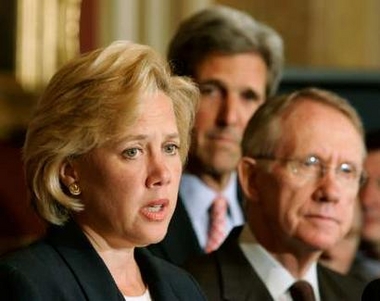
Democrats Senator Mary Landrieu (LA), Senator John Kerry,
Minority Leader Harry Reid, among those protesting
Republican attempts to whitewash Bush bungles in
the Katrina zone. AP photo
By Donna Smith (Reuters) - [excerpts]
Democratic leaders pushing for an independent commission to investigate the government's response to Hurricane Katrina spurned on Thursday a plan by majority Republicans for a joint congressional inquiry.
House of Representatives Democratic Leader Nancy Pelosi of California, called the House-Senate investigation announced by Republican leaders on Wednesday a "sham" and said it would not produce an objective assessment of what went wrong in the hours and days following the storm.
The partisan proposal that Republican leaders outlined yesterday is completely unacceptable," Pelosi said. "House Democrats will not participate in a sham that is just the latest example of congressional Republicans being the foxes guarding the president's hen house."
Senate Democratic leader Harry Reid of Nevada also said he would not participate in the Republican-led inquiry. "The only way to ensure that all levels of our government are held accountable to the people is to take this process out of the hands of politicians with a vested interest in the outcome," he said. Reid also declined to name Democrats to the panel saying its current structure would not yield the truth.
Both Pelosi and Reid have called for an independent commission similar to the one that investigated intelligence failures before the September 11, 2001, attacks.
Sidney Blumenthal wrote in Salon (see yesterday's Dreaming Up Daily) that FEMA became a fully professional emergency response agency in the Clinton administration. Also in salon, Farhad Manjoo wrote about FEMA's failures under Bush. He talked to Amy Goodman at Democracy Now! about how things were done in the Clinton years:
I talked to George Haddow, who was one of the deputies in the Clinton administration's FEMA under James Lee Witt, and you know, he talked about how when they knew that a disaster was coming or when a disaster occurred like the Northridge earthquake in California or the Midwestern floods, all of the kind of the principals who were in charge of disaster relief from the federal government, from the state government, from local government would meet in a room and talk about what should be done, and there weren't sort of people pointing fingers at each other and blaming each other.
That's very different from what's happening here. And it leads to, you know, a complete breakdown in the response and in coordination to the point where federal officials last week had no idea what was going on in New Orleans. I mean, they didn't learn, even though it was all over TV, they didn't learn until sometime in the middle of the week that there were people at the Convention Center who had no food and water and were waiting to be evacuated.
FEMA Was Unprepared for Katrina Relief Effort, Insiders Say
From ABC NEWS:
FEMA was an independent agency, answering directly to the president, until it was folded into the Department of Homeland Security two years ago. However, the latest government figures show that 75 cents out of every $1 spent on emergency preparedness goes to anti-terrorism programs. Well before Katrina, FEMA insiders were sounding the alarm.
A timeline of events leading up to the hurricane illustrates what went wrong.
On Saturday at 8:30 p.m. -- about 35 hours before Katrina hit the Gulf Coast -- Max Mayfield, director of the National Hurricane Center, was so concerned about the storm, he personally called the governors of Mississippi and Louisiana as well as the mayor of New Orleans to make sure they understood the severity of the situation.
The next day, President Bush listened in on a FEMA conference call during which Mayfield warned of a storm surge of more than 20 feet of water rolling over levees.
FEMA had 1,300 disaster assistance workers pre-positioned, and FEMA Director Michael Brown assured Bush they were ready for the storm.
But inside FEMA, longtime emergency managers were convinced the agency was not ready for Katrina.
"All of us were just shaking our heads and saying, 'This isn't going to be enough, and the director has to know this isn't going to be enough.' But nothing more seemed to be happening," said Leo Bosner, president of the FEMA Headquarters Employees Union.
Bosner has been with FEMA since it began 26 years ago. He says the agency has been systematically dismantled since it became part of the massive Department of Homeland Security.
"One of the big differences I see," said Bosner, "besides taking away our staff and our budget and our training, is that Homeland Security now, in my view, slows down the process."
The union warned Congress in a detailed letter about FEMA's decline a year ago. State emergency managers also warned Capitol Hill and Homeland Security just weeks ago that DHS was too focused on one thing -- terrorism.
"We've had almost zero support for a natural disaster and an all-hazards approach," said Eric Holdeman, director of the King County Office of Emergency Management in Washington State.
By TRAVIS REED, Associated Press Writer
NEW SMYRNA BEACH, Fla. - Tropical Storm Ophelia strengthened into a hurricane as it stalled 70 miles off the northeast Florida coast Thursday, churning up waves that caused beach erosion and drenching Kennedy Space Center with rain.
Thursday night, Ophelia had top sustained winds of 75 mph, just over the threshold to be classified as a hurricane, forecasters at the National Hurricane Center said.
But forecasters said it was still unclear where Ophelia was headed. If it hits Florida, it would become the third hurricane to strike the state this year and the seventh in the last 13 months.

Outside the Reliant Center in Houston, where survivors stood
in long lines to get their $2,000 debit cards. AP photo.
Captain Future's Log
"All that's missing from the Katrina story is an expensive reconstruction effort, with lucrative deals for politically connected companies,” Paul Krugman writes, comparing the Bush administration's response to Katrina with its efforts in Iraq in today’s column excerpted here, “ But give it time - they're working on that, too.”
Indeed they are, and we can only begin to count the ways.
A storm is growing around Joseph Allbaugh, the Bush-appointed FEMA director before the current one, Michael Brown. Allbaugh is a former campaign manager for GW Bush. After leaving FEMA in the care of Brown, his college roommate, he went into the lobbying business with former national Republican honcho Haley Barbour, now governor of Mississippi. He got his wife a gig in the firm, as well as Neil Bush, the Bush brother the family tries not to talk about.
Allbaugh is putting his disaster experience (gained entirely as head of FEMA, since he had no previous qualifications) to good use. On Democracy Now! Amy Goodman quoted the Washington Post as noting that Allbaugh is helping Louisiana,to ‘coordinate the private sector response to the storm.’”
Judd Legum, research director for the Center for American Progress, added this:. "And what's interesting is that Allbaugh actually beat Michael Brown, the current director of FEMA down to Louisiana. He was there far in advance of when Michael Brown came down, in Louisiana, essentially securing private contracts for his clients. And he recently, although the contract was signed before he started representing Halliburton, secured the agreement of the government to tap into that contract to clean up naval bases in the Louisiana area. So, he's already paying dividends for Halliburton, certainly, and probably will for a lot of his other clients as this very large disaster relief effort continues. "
This may not be just an ironic indication of where the Bushcorps priorities are. It may be an indication of why FEMA's response was so apathetic, and why FEMA initially spurned help from so many sources, both within the US and from outside. The whole idea may have been to turn over disaster relief to Bushcorp's corporate partners, like Halliburton. Again, pretty much as they've done in Iraq.
According to the Dallas Morning News, Allbaugh’s presence has also drawn the attention of the Project on Government Oversight, a watchdog group. Citing Allbaugh’s connection to Halliburton, "the government has got to stop stacking senior positions with people who are repeatedly cashing in on the public trust in order to further private commercial interests," said Danielle Brian, the group's executive director.
There’s potential for a lot of cashing-in. Of the $51.8 billion just allocated for Katrina zone relief, the Republican controlled Congress put $50 billion in the hands of Allbaugh’s roommate, Mike Brown at FEMA.
If Bush-backing corporations cash in on this as they did on all those billions spent on Iraq and Homeland Security, they’re likely to make out even better. President Bush issued an executive order that permits federal contractors in the Katrina zone to pay below the prevailing wage. That means less money for workers, and more of that $50 billion for Bush’s greedy corporate pals. It is also likely to mean the kind of substandard work that has kept Iraq unreconstructed.
Two Democrats immediately protested. "The administration is using the devastation of Hurricane Katrina to cut the wages of people desperately trying to rebuild their lives and their communities," Rep. George Miller of California Miller said.
"One of the things the American people are very concerned about is shabby work and that certainly is true about the families whose houses are going to be rebuilt and buildings that are going to be restored," said Senator Ted Kennedy.
But Joe Allbaugh, Halliburton and Dick Cheney (who still profits from his Halliburton stock) aren’t complaining. Mike Brown may be a little upset that he’s only getting to funnel the money, but there’s a payday ahead for him, too, no doubt. And with his executive track record so far, Neil’s brother is going to need some help finding another job.
From Point Those Fingers, New York Times, Friday Sept. 9, 2005
By PAUL KRUGMAN [excerpts, emphasis added]
To understand the history of the Bush administration's response to disaster, just follow the catchphrases.
First, look at 2001 Congressional testimony by Joseph Allbaugh, President Bush's first pick to head the Federal Emergency Management Agency. FEMA, he said, would emphasize "Responsibility and Accountability" (capital letters and boldface in the original statement). He repeated the phrase several times.
But those were rules for the little people. Now that the Bush administration has botched its own response to disaster, we're not supposed to play the "blame game." Scott McClellan used that phrase 15 times over the course of just two White House press briefings.
It might make sense to hold off on the criticism if this were the first big disaster on Mr. Bush's watch, or if the chain of mistakes in handling Hurricane Katrina were out of character. But even with the most generous possible assessment, this is the administration's second big policy disaster, after Iraq. And the chain of mistakes was perfectly in character - there are striking parallels between the errors the administration made in Iraq and the errors it made last week.
In Iraq, the administration displayed a combination of paralysis and denial after the fall of Baghdad, as uncontrolled looting destroyed much of Iraq's infrastructure.
The same deer-in-the-headlights immobility prevailed as Katrina approached and struck the Gulf Coast. The storm gave plenty of warning. By the afternoon of Monday, Aug. 29, the flooding of New Orleans was well under way - city officials publicly confirmed a breach in the 17th Street Canal at 2 p.m. Yet on Tuesday federal officials were still playing down the problem, and large-scale federal aid didn't arrive until last Friday.
In Iraq the Coalition Provisional Authority, which ran the country during the crucial first year after Saddam's fall - the period when an effective government might have forestalled the nascent insurgency - was staffed on the basis of ideological correctness and personal connections rather than qualifications. At one point[ Bush press secretary] Ari Fleischer's brother was in charge of private-sector development.
The administration followed the same principles in staffing FEMA. The agency had become a highly professional organization during the Clinton years, but under Mr. Bush it reverted to its former status as a "turkey farm," a source of patronage jobs.
As Bloomberg News puts it, the agency's "upper ranks are mostly staffed with people who share two traits: loyalty to President George W. Bush and little or no background in emergency management.”
All that's missing from the Katrina story is an expensive reconstruction effort, with lucrative deals for politically connected companies, that fails to deliver essential services. But give it time - they're working on that, too.
Why did the administration make the same mistakes twice? Because it paid no political price the first time.
From Democracy Now! Amy Goodman's Interview with Phyllis Bennis of the Institute for Policy Studies:
BENNIS: [speaking about international aid offered to US for Katrina relief, and the aid that was rejected and what was accepted: )
What's rather extraordinary is that the offers that have been accepted the most quickly are those that are duplicative of the kind of material that the U.S. military provides all over the world. So, for example, the U.S. has accepted transport planes from Singapore and Canada. They have accepted fully equipped cargo planes from Spain. They have accepted MREs from Germany and Italy. These are the meals ready to eat that the Pentagon provides to countries around the world. That's what they're now accepting here.
And what it says is, while we're fighting a war in Iraq, we have to depend on the charity of other countries, including donations like $25,000 from the tsunami-ravaged country of Sri Lanka or $1 million from Bangladesh, one of the poorest countries in the world. Those offers are being accepted because while the U.S. is fighting a war in Iraq that we're being told is designed to make us safer, it makes it impossible for the U.S. to provide even their own citizens with this kind of basic protection.
That's a huge admission of the failure of unilateralism of this country, that what all of the people of this country have been saying, the war in Iraq is not making us safer.
The war in Iraq is taking away our resources. The war in Iraq is the reason that one-third of the National Guard troops in Louisiana were not available because they were deployed to Iraq. Almost half of the equipment of the National Guard in Louisiana that was not available because it's in Iraq, all of the amphibious equipment, amphibious boats, the National Guard in Louisiana is the only National Guard in the United States that has that kind of equipment. They're the only ones who need it, but they can’t get to it now, because it's in Iraq. All but two of their rescue helicopters are not available because they're in Iraq. So, the war in Iraq, this illegal, unilateral war, has dramatically impacted the ability and capacity of the United States government to respond to this emergency. As well as the issue of FEMA and FEMA's own inability, led by Michael Brown, the former international director of the International Arabian Horse Association, which has shown itself incapable of dealing with this crisis.
So, the international acknowledgement by the United States that the most powerful, wealthiest country in the world is unable to support its own population in this dramatic moment of crisis for the poor and impoverished and overwhelmingly black community of Louisiana and Mississippi is a very stark reminder of the price we pay in this country, particularly the price being paid by the poorest and the communities of color for a war in Iraq and for the efforts of the United States to prove to the world that it doesn't need the rest of the world. We have seen that proved as a lie.
Thursday, September 08, 2005

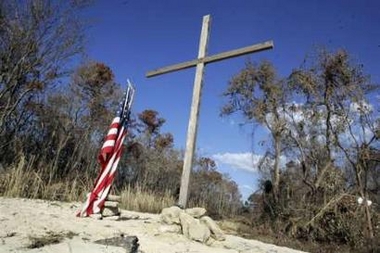
One of the few dead to receive burial, on the site of a home
now gone in Ocean Springs, Mississippi. AP photo.
The Daily Quote
John F. Kennedy
By Raja Mishra, Boston Globe Staff [excerpts]
BATON ROUGE -- At one point while his family was evacuating New Orleans the day before Hurricane Katrina hit, 5-year-old Frank Joshua Smith asked his mother whether God planned to kill the whole world.
Specialists on the mental health of children say many of those displaced could suffer long-running emotional trauma as this jarring new reality sets in. As the relief effort turns from crisis management to long-term resettlement, health care volunteers at shelters housing evacuees around the country are on the lookout for signs of distress among children and plan to begin sending children to local counselors and therapists if necessary.
''Grief and loss will be the biggest issue. Everything familiar to them is gone," said Vicki North, an American Red Cross volunteer running mental health services at Baton Rouge's main shelter, where more than 550 children were housed yesterday. ''When we find out about the death toll, we may find they lost friends."
But at the same time, some children may prove to be the storm's most resilient victims, able to take the upheaval in stride. Interviews with dozens of children in the shelter at the Baton Rouge convention center found evidence of both reactions.
[M]any children in the shelter worried about what became of their pets. Angel Sylve, 8, said she had not seen her puppy Bull since the day before Katrina struck.
''Maybe someone found him and is taking care of him," she said. ''Or maybe he's at another shelter."
As Angel talked to a reporter, her father, Adam Sylve, 41, angrily questioned a Red Cross volunteer about when federal housing grants would become available.
''The parents are going through so much, the kids aren't getting the attention they need," said Sarah Hargadine, 20, a Red Cross volunteer from Boulder, Colo., who has helped run a children's activities center in the shelter. ''Some of [the children] say they are fine. But then you realize that they still think they're going home."