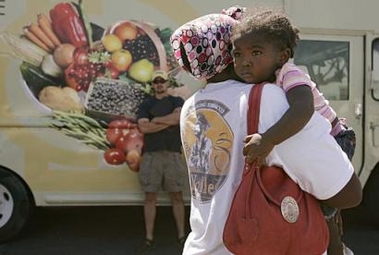
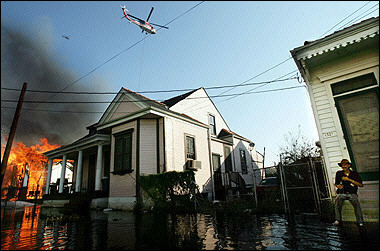
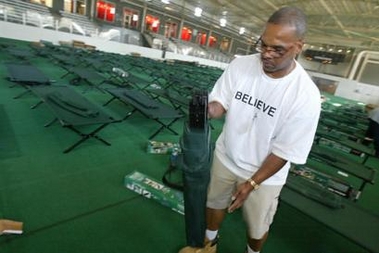
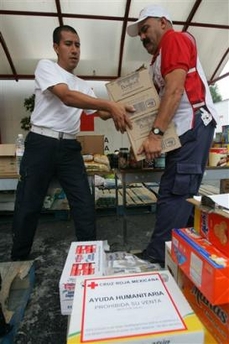
New Orleans, Sept. 7. AP photo

Cronyism Trumps Governance
from an article
by Sidney Blumenthal, in salon [excerpts, with emphasis added:]
The Bush administration's mishandling of Hurricane Katrina stands as the pluperfect case study of the Republican Party's theory and practice of government. For decades conservatives have funded think tanks, filled libraries and conducted political campaigns to promote the idea of limited government. Now, in New Orleans, the theory has been tested. The floodwaters have rolled over the rhetoric.
Under Bush, government has been "limited" only in certain weak spots, like levees, while in other spots it has vastly expanded into a behemoth subsisting on the greatest deficit spending in our history. State and local governments have not been empowered, but rendered impotent, in the face of circumstances beyond their means in which they have desperately requested federal intervention. Experienced professionals in government have been forced out, tried-and-true policies discarded, expert research ignored, and cronies elevated to senior management.
Before Katrina, the Republican theory received its most apposite formulation by a prominent lobbyist and close advisor to House Majority Leader Tom DeLay, Grover Norquist, who said about government that he wanted to "drown it in the bathtub." In relation to the waters that surround it, New Orleans has been described as a bathtub, and it has served as the bathtub for Norquist's wish.
Only two people in the light of recent events have had the daring to articulate a defense of the Republican idea of government. House Speaker Dennis Hastert, asked about rebuilding New Orleans, volunteered: "It doesn't make sense to me." He elaborated: "I think federal insurance and everything that goes along with it ... we ought to take a second look at that."
The second defender was Michael Brown, director of the Federal Emergency Management Agency…,. On Sept. 1, Brown stated: "Considering the dire circumstances that we have in New Orleans, virtually a city that has been destroyed, things are going relatively well."
Even as the floodwaters poured into New Orleans, unimpeded by any federal effort to stanch the flow, the White House mustered a tightly coordinated rapid response of political damage control. Karl Rove assumed emergency management powers. The strategy was to dampen any criticism of the president, rally the Republican base, and cast blame on the mayor of New Orleans and governor of Louisiana, both Democrats. It was a classic Bush ploy against the backdrop of crisis. The object was to polarize the nation along partisan lines as swiftly as possible. While policy collapsed, politics reigned. Once again, Bush the divider, not the uniter, emerged.
Yet others operated off-message, casting aspersions on the hurricane's victims. The president's mother, Barbara Bush, interviewed on American Public Media's "Marketplace" program," said of the displaced from Louisiana who are temporarily housed in Houston's Astrodome, "What I'm hearing, which is sort of scary, is they all want to stay in Texas. Everyone is so overwhelmed by the hospitality. And so many of the people in the arena here, you know, were underprivileged anyway, so this -- this is working very well for them."
And Sen. Rick Santorum, R-Pa., suggested that the residents of New Orleans who failed to escape the flood should be punished. "I mean, you have people who don't heed those warnings and then put people at risk as a result of not heeding those warnings. There may be a need to look at tougher penalties on those who decide to ride it out and understand that there are consequences to not leaving."
The White House sought to turn back the rising tide of anger among blacks by deputizing Secretary of State Condoleezza Rice. A week after the hurricane, Rice mounted the pulpit at a black church in Whistler, Ala. "The Lord Jesus Christ is going to come on time," she preached, "if we just wait."
An anatomy of cronyism
President Clinton appointed James Lee Witt as the [FEMA] director, the first one ever to have had experience in the field. Witt reinvented the agency, setting high professional standards and efficiently dealing with disasters.
FEMA's success as a showcase federal agency made it an inviting target for the incoming Bush team. Allbaugh, Bush's former campaign manager, became the new director, and he immediately began to dismantle the professional staff, privatize many functions and degrade its operations.
After Allbaugh retired from FEMA in 2003, handing over the agency to his deputy and college roommate, Brown, he set up a lucrative lobbying firm, the Allbaugh Co., which mounts "legislative and regulatory campaigns" for its corporate clients, according its Web site. After the Iraq war, Allbaugh established New Bridge Strategies to facilitate business for contractors there. He also created Diligence, a firm to provide security to private companies operating in Iraq. Haley Barbour, the former chairman of the Republican National Committee and now governor of Mississippi, helped Allbaugh start all his ventures through his lobbying and law firm, Barbour Griffith and Rogers.
Indeed, the entire Allbaugh complex is housed at Barbour Griffith and Rogers. Ed Rogers, Barbour's partner, has become a vice president of Diligence. Diane Allbaugh, Allbaugh's wife, went to work at Barbour Griffith and Rogers. And Neil Bush, the president's brother, received $60,000 as a consultant to New Bridge Strategies.
On Sept. 1, the Pentagon announced the award of a major contract for repair of damaged naval facilities on the Gulf Coast to Halliburton, the firm whose former CEO is Vice President Dick Cheney and whose chief lobbyist is Joe Allbaugh.
Hurricane Katrina is the anti-9/11 in its divisive political effect, its unearthing of underlying domestic problems, and its disorienting impact on the president and his administration. Yet, in other ways, the failure of government before the hurricane struck is reminiscent of the failures leading into 9/11. The demotion of FEMA resembles the demotion of counterterrorism czar Richard Clarke. In both cases, the administration ignored clear warnings.
In a conversation with a former diplomat with decades of experience, I raised these parallels. But the Bush administration response evoked something else for him. "It reminds me of Africa," he said. "Governments that prey on their people."
From Perspectives.
Mel Brooks once said, "it's good to be king." Well when it comes to hurricanes, it's even better being the President's brother. Especially in a vital swing state. In an election year.
Louisiana's Democratic Governor Kathleen Blanco is learning that the hard way. While her state suffered through a disastrous, disorganized and delayed response to Katrina from FEMA and the Bush administration, Florida governor Jeb Bush had no such problems as his state weathered four hurricanes in 2004.
There is no mystery to this discrepancy, as GovExec.com wrote in "How FEMA Delivered Florida for Bush" on November 3rd, 2004, literally the day after the President won reelection:
Now that President Bush has won Florida in his 2004 re-election bid, he may want to draft a letter of appreciation to Michael Brown, chief of the Federal Emergency Management Agency. Seldom has any federal agency had the opportunity to so directly and uniquely alter the course of a presidential election, and seldom has any agency delivered for a president as FEMA did in Florida this fall.
FEMA's preparation, performance and questionable largesse during the four 2004 Florida hurricanes stands in stark contrast with its abysmal failure in New Orleans in the wake of Katrina. While severe, the four Florida hurricanes (Charley, Frances, Ivan and Jeanne) caused under 100 deaths and $22 billion in damage, a fraction of Katrina's destructive force. Yet FEMA's proactive role and President Bush's timely and personal involvement in Florida bear no relation to 2005:
Hurricane Charley in August 2004 saw FEMA, National Guard troops, relief supplies and President Bush on stand by before the storm even made landfall. As the St. Petersburg Times reported on August 17th, 2004, "Governor Jeb Bush sought federal help Friday while Charley was still in the Gulf of Mexico. President Bush approved the aid about an hour after the hurricane made landfall."
Cargo planes flew FEMA supplies supplies from a Georgia Air Force base to a staging area in Lakeland, and the U.S. Army Corps of Engineers had stockpiled 11 truckloads of water and 14 truckloads of ice. Guy Daines, the former Pinellas County director of emergency services, was pleased and impressed with the rapid response of the National Guard and the delivery of pre-positioned supplies, stating "It amazed me how they got over 4,000 National Guard troops in there that quick. Rather than sit there and react, they are trying to get a jump-start on everything."
FEMA again prepositioned personnel, supplies, and equipment for the Frances, which struck in the first week of September. A FEMA press release offered a laundry list descriptio of preparations for Frances. 30,000 tarps, 100 truckloads of water and 100 truckloads of ice were already in place. Emergency medical teams and four urban search and rescue teams were already in place.
By September 6, 900,000 Meals Ready to Eat (MRE's) were stockpiled in Jacksonville. President Bush himself got into the act, distributing ice to Florida hurricane victims with brother Jeb.
This performance was repeated for Ivan and Jeanne, which hit two and three weeks later, respectively. Again, FEMA was in place with food, ice, water, and financial aid in advance of the arrival of the storms. By September 29, FEMA was providing detailed daily updates on its relief eforts, including over $360 million in aid to individuals. This assistance was augmented by the IRS, which granted tax relief for Florida hurricane victims.
Large and timely federal recovery funding was never an issue for the Florida Four. Congress passed $13 billion in recovery spending for the 2004 hurricanes, the bulk of which went to Florida. By August of 2005, $5.6 billion had been spent.
Whether that money had been spent wisely by FEMA director Michael Brown is another subject altogether. On May 18, 2005, the Senate Committee on Homeland Security and Government Affairs held hearings about waste and corruption in the Florida programs. In a session titled, "FEMA’s Response to the 2004 Florida Hurricanes: A Disaster for Taxpayers?,"
Senators Collins, Nelson and others grilled Michael Brown over his agency's largesse to residents of Florida. Florida Senator Nelson detailed numerous frauds perpetrated by Brown at FEMA. This featured over $31 million in payouts, including paying for home and car repairs, in Miami-Dade County, which had been virtually unaffected by the storms. More morose, FEMA managed to pay the costs of over 300 funerals statewide, even though medical examiners attributed only 123 to the hurricanes.
The rest, as they say, is history. Bush carried Florida over John Kerry by a surprisingly comfortable margin. As GovExec noted after election day, 2004:
"Bush later made a handful of other Florida visits to review storm-related damage, but the story on the ground was not Bush's hand-holding. Rather, it was FEMA's performance. It's impossible to know just how much of an effect FEMA had on the Florida vote...Even so, in a closely contested state where hundreds of thousands of voters suffered storm-related losses, it's equally hard to imagine that they didn't notice the agency's outreach."
As for Louisiana Governor Blanco, she shouldn't expect the Jeb treatment any time soon. In fact, portraying her and other state local officials as the bogeymen in the Katrina disaster is essential to the White House's strategy for Bush's political survival.
UPDATE (9/6): AP is reporting that FEMA Chief Mike Brown "waited until hours after Hurricane Katrina had already struck the Gulf Coast before asking his boss to dispatch 1,000 Homeland Security employees to the region — and gave them two days to arrive, according to internal documents." And yet, "Brownie" seems to enjoy job security.