Wednesday, February 02, 2022

TV and Me: Saturday Morning in Outer Space


Television and I grew up together.  This is our story. Fourth in a series.

 First, the Saturday morning television experience, not necessarily of any specific year, but of 1950s memory…

 We awaken very early.  Our parents are still asleep when the TV set first goes on.  Perhaps it’s just me, or me and my sister Kathy (four years younger) and later, my sister Debbie (8 years younger.) 

 In the early morning we watch the snow. It’s not outside, most of the time. Instead, flecks of it scatter in grainy grays across the television screen, accompanied by a loud even whisper, a constant shshshshsh, like the rush of unvaried water.


 On the floor in front of the television, munching cereal and cinnamon toast, sleepy-eyed and expectant, gazing into nothing… but the snow.

We wait anxiously for something to happen.  Sometimes a wavy line crosses the screen, suggesting a beginning, but no.  Snow.

 I click impatiently from WDTV channel 3 (later 2) to WJAC channel 6, but it’s still just more snow.  I need to be right up at the TV to do this.  Everything is done with knobs on the front: off/on and volume knob, big slow clicking station-changing knob, and little knobs between them for clearing the picture, the horizontal and vertical hold buttons. 

We’re not supposed to play with these but sometimes we do. They make the lines go up and down fast or bend across slow.  There are unaccountable times that the picture starts to flip around, bend, and divide, so the bottom of the image is at the top.  These controls are supposed to fix that. They seldom do. But if you want to see the show badly enough, you watch it upside down.

  Right now however there’s nothing to flip or distort besides those gray flecks of snow…until the sudden appearance of—


 The test pattern.  And we stare at that, its mysterious spirals, lines and symbols (some include an Indian in feathered headdress.  Why?)  Sometimes I stare at it so much that the lines and patterns start to move: a taste of being stoned (not uncommon in childhood.)

 Eventually the test pattern disappears, the sign-on ritual begins (sometimes featuring the Star Spangled Banner, though that becomes the traditional sign-off) and then the shows begin, usually with old cartoons originally made for the movies. 

There might be a few Bugs Bunny or Daffy Duck or other Warner Brothers favorites, but most are more obscure, and older, including George Pal’s 1940s Puppetoons (now very hard to find) and a lot of Fleischer Studios cartoons from the 1930s, including Betty Boop and Popeye. Other Fleischer cartoons didn’t have major characters but were just as surreal.  My favorite was the “Out of the Inkwell” series, some of which were actually from the 1920s.  I was fascinated by the cartoon characters coming to life as they were drawn.  

 It’s easy to get away with cartoons so old they were originally made in black and white—because everything on television is in black and white.

 I recall that some of these cartoons (including Looney Tunes from the 30s and 40s) included parody versions of famous people. I could vaguely recognize Edward G. Robinson, James Cagney and Humphrey Bogart, and I learned to know Mae West and Lauren Bacall, but who is that recurring bandleader who kept saying in a soft sing-song voice, “Is everybody happy?” (It is Ted Lewis, who was topical in the World War II period but not after.)  So besides an accidental tutorial in animation history, we get inadvertent lessons in cultural history as well.

 Also in the early Saturday morning hours we might look even deeper into movie history through silent comedy shorts and early sound shorts featuring Laurel and Hardy, Buster Keaton, Our Gang (repackaged as L’ll Rascals) and occasionally Charlie Chaplin, W.C. Fields and Harold Lloyd. 

Then came the old western movies and serials, with  Johnny Mack Brown, Tex Ritter, Lash LaRue and so on.  Some of these were so faded (with horseback chase scenes that seemed to be filmed in the dark, if not underwater) and their stories so obscured by cuts that I tune out, waiting for the real shows to start, while gathering up the next round of snacks—the graham crackers (with or without butter or cinnamon), the celery stalks or Saltines slathered with peanut butter, a bowl of grapes, a peach, a pear.


Occasionally there’s a different kind of movie—an old Tarzan or Jungle Jim, the repackagd 1936
Flash Gordon with Buster Crabbe.  These are a little more interesting, but still…

 In the early 1950s this went on nearly all Saturday morning.  The first actual show I recall was Smilin’ Ed and His Buster Brown Gang, which I knew it simply as the Buster Brown Show.  Genial old Ed McConnell’s  Smilin’ Ed’s Gang had been a popular radio show for years, and a bonanza for sponsor Buster Brown shoes, that in some years spent its entire ad budget on this one program.  Smilin’ Ed brought it to television in 1951, when he more or less had late Saturday morning to himself.

 The show was typical in that a big chunk of it consisted of movies that Ed introduced, though the movies themselves verged on the bizarre.  They were all about a boy and elephants in India, with jungle footage from other movies spliced into the choppy narrative.  All I recall is that the boy kept shouting “Tee-lah! Tee-lah” at the elephant.  I watched with mostly impatience: I wanted to see the star of the show.

 Supposedly the star was Smilin’ Ed, or even Buster Brown and his dog Tige in the frequent commercials. There were other characters enacting skits and stories (on radio, Ed had read fairy tales), like Squeaky the mouse, whose most memorable moments were terrorizing everyone by buzzing them in his tiny airplane, and Midnight the cat, whose comment on the action was invariably, “Nice!”  (These were actual animals and toys, manipulated on film.  Unlike most other shows, this one was filmed and cut together with stock shots of the always hysterically laughing audience of kids.)  

But the unquestioned star was Froggy the Gremlin.  Ed would stand next to a raised platform and say the words, “Plunk your magic twanger, froggy!” and in a puff of mist, Froggy would appear, calling out “Hiya kids, hiya hiya!”  Ed would elicit promised from Froggy that he would be good this time, and then the guest speaker would replace him. 

 The speaker (a rotating cast of comic actors doing versions of the mad professor) would attempt to demonstrate something, but Froggy’s throaty suggestions invariably threw them off, as they became increasingly hysterical.  One such speaker, attempting to show how visual aids can enhance a story, recites “Little Jack Horner” while holding a pie: “He stuck in a thumb/and pulled out a plum--” “And put the rest in his eye,” Froggy suggests, the speaker repeats, and slaps the pie in his own face.  Froggy laughs, bouncing side to side.  Another guest (a police chief) shouts at Froggy, “Are you trying to make a fool of me?”  “It’s too late,” Froggy replies.

 Froggy was unique.  Clarabell the clown added a touch of wish fulfillment anarchy to Doodyville, chasing adults and squirting them with water from his seltzer bottle.  But Froggy was a master of subversion: he got adults to pie themselves, or break eggs on their foreheads, or dump the contents of a mixing bowl on their heads.  There’s never been anyone on TV like this rubber frog with the wide smile and disconcerting laugh.

 (After Smilin’ Ed’s offscreen demise, the show was taken over by Andy Devine, best known at that time as Bill Hickcock’s comical sidekick Jingles—“Hey Wild Bill-- wait for me!”)


 Through the decade, many shows ruled the Saturday morning.  Some were Saturday originals, like Winky Dink, Paul Winchell and Jerry Mahoney, and live action Ramar of the Jungle, Captain Midnight, Sky King (his niece Penny and his airplane the Songbird), and Fury (a horse and his boy) with Peter Graves.

  Other shows started in early evening slots and migrated to Saturday morning, including Captain Video, Howdy Doody, Pinky Lee, the Lone Ranger, the Cisco Kid, Roy Rogers, Dick Tracy, Lassie, Rin Tin Tin, Sergeant Preston of the Yukon, Buster Crabbe’s Captain Gallant of the Foreign Legion.

 In other words, cartoon and puppet shows, animal shows, westerns and other contemporary or historical adventures.  But also part of that mix—and for one glorious season, dominating Saturday morning—were adventures in the future, in outer space.


Though a couple of these shows were already airing in 1952, and three of them remained on the Saturday schedule in the 1954-55 season, there seems to have been just one year during which it was possible to see all four on the same Saturday morning. That was during the TV season (and the school year) of 1953-54 (for me, second grade) when there were four rocket shows back to back--Tom Corbett, Space Cadet at 10, Rocky Jones, Space Ranger at 10:30, Space Patrol at 11 and Rod Brown, Rocket Ranger at 11:30.  It was Saturday morning in outer space. 

 Remember that in 1954, the first rocket to shoot a satellite into orbit around the Earth was three years in the future--and it was a Russian rocket.  The US was still working on rockets modified from the German V-2, and mostly for military purposes.  Spending money to send a rocket into space was considered frivolous, if not crazy.

 Still, there were space ships in a few movies and movie serials, there were comic books and radio shows, and then in 1949, television was transformed by the success of Captain Video.  

There were also science fiction pulp magazines, a lot of them purchased by adolescent boys.  As the dimensions of the postwar baby boom became clearer, several science fiction book publishers commissioned established science fiction authors to write novels especially for young readers. Ace had a series of these “juveniles” (as they were called), mostly written by Alice Mary Norton, under the pseudonym Andre Norton.  The largest was the fabled Winston Science Fiction series (with the legendary illustration above, and this logo) that issued 35 novels at the rate of about six a year beginning in 1952.  Their authors included Lester del Rey (who wrote nine), Arthur C. Clarke, Ben Bova, Raymond Jones and Poul Anderson.

 But the first and probably most influential series was written for Scribners by the best-known science fiction author of his time, Robert Heinlein.  He wrote a dozen juveniles published over as many years.  Many of their science fiction ideas, plots and characterizations show up in subsequent television shows and movies.  But their first influence was on these Saturday morning shows.

 Heinlein’s second novel in this series, published in 1948, was perhaps his most influential: Space Cadet. Heinlein didn’t write for the TV series of that name, and the show’s early stories were based on one of its writers’ comic strip ideas, but it did use a lot of Heinlein’s concepts, characterizations and vocabulary, though vastly simplified, if not simplistic.  The Space Cadet novel seems to have established the basic story universe of not only the Tom Corbett series, but of all the 1950s shows.

 Tom Corbett, Space Cadet raised ship for the first time in 1950. At first a three times a week serial (with a companion radio show) it moved quickly from CBS to ABC, with episodes appearing briefly on both ABC and NBC the same summer, before landing on Saturday mornings as a 30 minute show, first for Dumont in 1953, then NBC in 1954-55.  It broadcast live from a New York City studio.

 So on Saturday morning, the announcer proclaims “Tom Corbett…Space Cadet!”Then we see Tom at the controls of the Polaris space ship, calling into his microphone: “Stand by to raise ship!  Blast-off minus five…four..three…two…one—ZERO!” –at which Tom throws his head back and himself back into his chair, simulating a G-force acceleration, while the engines mildly roar.

 This was the first countdown on television, a device invented by filmmaker Fritz Lang in his 1929 German feature Woman in the Moon, long before we heard it on actual live TV rocket launches in the 1960s. 

The series centers on Tom Corbett (played by Frankie Thomas), a cadet in the mid-24th century Space Academy, and his two shipmates: cadet Roger Manning (Jan Merlin), is the “wise guy” and borderline 1950s juvenile delinquent who provides conflict and ethical contrast (when Merlin left the show, he was replaced by a similar character.) Cadet Astro (Al Markham) is Corbett’s quiet ally, who was born and grew up on Venus as a child of human colonists. That’s enough to make him an outsider.

  Captain Steve Strong (played by Edward Brice, who replaced the first actor in the role even before the first serialized story was completed) is their mentor and captain of the spaceship Polaris, where much of the action takes place. 

In this first story in the series, Strong provides historical background to an Academy class: Space exploration began in the 20th century, aliens were found on Mars and Venus but mistakes and misunderstandings led to warfare in which  “cities, countries, entire civilizations” were destroyed.  But in the 23rd century, the Solar Alliance was formed and war was outlawed.  The Solar Guard was established to keep the peace.  Members are expected to meet people of other worlds in peace, and “deal with them with honor and trust.” 

This first story, “The Mercurian Invasion,” exemplifies this ethic.  Previously unknown aliens from the dark side of Mercury invade Venus because they feel threatened by Solar Guard explorers.  When Corbett and crew render them helpless, Captain Strong tells the Mercurian leader he’s free to return to Mercury.  He tells him that “there is no such thing as a preventive war,” a striking thing to say given 1950s geopolitics.  He offers negotiation and friendship.  His offer startles the Mercurian (played by Tom Postin, about to gain fame as a 50s comic actor, in heavy makeup), who reciprocates with a handshake.

 This very popular series was notable less for its stories however than for its attempts to inject actual science about space and space travel into those stories.  Willy Ley, a prolific author on these subjects, and a close associate of German rocketeer turned U.S. space program director Werner von Braun, was the series technical advisor.

  Both the penetration of the series into the popular mind and Ley’s participation prompted the New Yorker magazine to publish a feature article that included observing a story meeting with Ley.  He gave scientific advice but was not above suggesting what Star Trek writers would later call “technobabble” to account for dubious story points. Still, viewers learned more about these previously little understood subjects.

 The sets and effects were low budget but creative, and pretty convincing for the time—and for the mostly young audience.  I don’t have particular memories of this show, except that I watched it, and that I especially enjoyed scenes in the ship itself.  For this season, Tom Corbett shared its time slot on alternate Saturdays with the 30 minute weekend edition of Captain Video.

  Then at 10:30, to a short pounding theme, the announcer proclaimed: Rocky Jones, Space Ranger with an echo at the end, so we heard Space Ranger, Space Ranger gradually diminishing. (This opening was modified in later stories. But each episode ended with a different eerie theme, probably the first TV use of an electronic instrument, the Theremin, which soon became a s/f movie cliché.) 

Its most striking difference compared with the other three live shows, is that Rocky Jones was filmed—the first for TV space shows. Apart from sharper images and better continuity, it also meant outdoor scenes.  These included spaceship countdowns and blast-offs (with the unique use of something called the synchronizer—basically a series of ever-quickening high pitched tones.) Effects shots were superimposed on Space Rangers headquarters, which looks like it was shot at an electrical power station.  These were among the first such scenes seen on TV.

 There was also liberal use of exteriors of L.A.’s Griffith Observatory, and some shots inside the Palomar Observatory.  Other southern California landscapes provided alien planets, though these tended to be represented by generic buildings and matte paintings. 

 This series didn’t hit the airwaves until the spring of 1954. Its stories were usually told over three episodes of 30 minutes (with commercials), though the episodes rarely ended in cliffhangers.  The original run ended in early 1955, but its life was extended for awhile in syndication.   And because it was on film, serial episodes could be re-edited into 75 minute movies, which played on television beginning in 1956. Film also meant that all its episodes have survived. 

The characters were on the Flash Gordon level, with aliens often depicted as humans in costumes vaguely suggesting non-U.S. areas in earlier periods of history.  The cast was amiable and stereotyped, with Richard Crane as the handsome, muscular, straight-arrow Rocky Jones, with a quick smile and authoritative announcer’s voice.  Sally Mansfield was the sweet but never silly navigator in the short skirt favored in space opera futures.

  The 10 year old honorary cadet Bobby (Robert Lydon,) was the ward of white-haired Professor Newton (Maurice Cass), who always spoke with great importance even when his words were pretty much nonsense.  Secretary Drake, the head of the Office of Space Affairs for the United Worlds and chief of the Space Rangers, was played by Charles Meredith, so identified with authority figures that the U.S. Defense Department employed him to narrate their documentaries, such as one on atomic bomb tests.

 Premises of the stories were imaginative though not exactly scientifically rigorous, while the stories themselves were the usual chase/capture/escape, good over evil tales, and involved fist fights more than ray guns.  There was perhaps a little deadpan humor in the bureaucratic dictatorship of the planet Officious. 
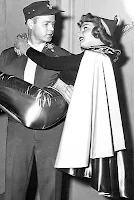
 The series improved when several cast members were replaced. Former child actor Scotty Beckett as Rocky’s  sidekick Winky was unavailable (in prison, for real) so the more credible Jimmy Lydon took over as co-pilot, while Reginald Sheffield became the more believable Professor Mayberry and the evil Cleolanta gave way to the good Juliandra (who nevertheless had an evil twin), played by Ann Robinson, a year or so after co-starring in the George Pal classic feature of War of the Worlds.  Though these last episodes were better, they are also harder to find.

 I listened to the pseudo-science and I probably followed the rudimentary plots, but I’m sure my main interest was Rocky’s ship, the Orbit Jet (later, the Silver Moon), its takeoffs and its landings, and the shots of the space stations and brief battles in space.  

But the show I was waiting for was at 11—my favorite, Space Patrol.  To flashes of sleek rockets in space, and rockets taking off from different kinds of launchers, the announcer’s fast excited voice:  Space Patrol! High adventure in the wild reaches of space…Missions of daring in the name of interplanetary justice. Travel into the future with Buzz Corey, Commander in Chief of….the Space Patrol!

 This Space Patrol should not be confused with the British 1960s Space Patrol that employed marionettes, and was so effectively parodied by Peter Cook and Dudley Moore, or even the later swinging 60s’ brief but fascinating German series Raumpatrouille, sometimes translated as ‘Space Patrol.’  Or the various animated and anime versions that followed. This was the original.


In the early 1950s, a number of science fiction/fantasy oriented shows were produced by local stations, such as Captain Z-Ro in San Francisco, Mr. I. Magination in New York, and Space Patrol in Los Angeles.  Some made it to Saturday mornings through syndication (though not everywhere), but none was more successful than Space Patrol

 It began locally in 1950 with several fifteen-minute segments during the week and a 30 minute Saturday show, as well as a radio show with the same cast.  By the year after it started, the ABC network was broadcasting the Saturday morning half-hour nationally at 11 a.m. Eastern time.  It remained a live presentation from the Los Angeles studio, and became the first morning show to be seen live everywhere, using a complex series of cables and relays across the country. 

 To prevent the cast (and the writers) from dying of exhaustion, the weekday segments were dropped (though not the radio show), so by 1953-4, all the effort (and budget) was devoted to the very popular Saturday morning TV show.

 Though Space Patrol was set in the even farther future of the 30th century, its universe was familiar: wars and conflicts in space abounded until the 29th century, when the United Planets and its Space Patrol were formed.  (The Space Patrol was what the Space Cadets in Heinlein’s novel were training to join, but this series got on the air a few weeks before Tom Corbett, so his outfit became the Solar Guard.)

 Space Patrol was created by Mike Moser, who trained pilots for the U.S. Navy in World War II. Commander Corey was played by Ed Kemmer, who had been a young military pilot in that war, and if network publicity is to be believed, he learned to act in a Nazi POW camp after being shot down on his 48th mission. 

 Lyn Osborn (also an ex-pilot) played Cadet Happy—with his mobile face and expressive voice, he could carry the comedy and the plot exposition, the jobs of the s/f sidekick. Corey was aided by Security Chief Robertson (Ken Mayer) and not one but two women in those futuristic miniskirts: the dark-haired Tonga (Nina Bara) and the blonde Carol (Virginia Hewitt), daughter of the Secretary-General (who was played by one of the show’s writers.)

 Corey’s spaceship was the Terra, which was redesigned several times until it was the sleek Terra V. Commander Corry and the Space Patrol battled space pirates, evil scientists and other interstellar bad guys. But like all of these shows, they also warned of the dangers of radiation and promoted peaceful solutions and even disarmament. After Buzz Corey encountered a planet that had destroyed itself through hatred, he returned determined to see that it didn’t happen again.

 One intriguing element of the Space Patrol universe was that the Patrol’s home base was on Terra, an artificial planet.  The Earthlings of the actual Earth don't seem to be very much respected.

 Space Patrol was the best-written and acted of the aforementioned space shows, with bigger sets, more inventive camera direction and special effects done live.  It got the better actors for its villains—notably Marvin Miller as the identity-changing Mr. Proteus. (Miller’s 1950s TV fame came as Michael Anthony, the dispenser of fortunes on The Millionaire.  But his talents were best displayed in his voice work on radio, TV and in films—he was Robbie the Robot in Forbidden Planet.)

 Apart from the special effects and especially the many scenes inside the spacecraft, I was drawn to this show by Ed Kemmer as Commander Corey.  He was a relatable hero, with an ease, a sense of authority but also concern and compassion, and a subtle sense of humor that inspired confidence. 

 I remember watching these shows but except for their lead characters and program opening (especially to Space Patrol) I remember little else that’s specific.  But I recall a somewhat important moment in my childhood prompted by one episode of this series.

 I was watching a story in which Commander Corey and Happy were back on 20th century Earth.  My mother had paused to watch, and asked me if I knew what century it was now.  Startled, I said I didn’t.  It’s the 20th century, she said.  And this show is in the 30th century.  She mentioned that she used to listen to Buck Rogers on the radio, and that was set in the 25th century.

 Apart from being surprised that my mother had ever listened to a space program, I remember this because suddenly I became aware of the centuries, and that kind of time.  In that way, a big moment.

 Some years ago I wrote a fictional account of this day—of watching these Saturday morning space shows, and of this moment, as well as what usually happened afterwards: going out to play with my neighborhood friends, and inventing stories as we acted them out, based on what we had watched that morning.  It was part of a larger fiction based on my actual childhood, so I needed to find a Saturday that fit into the ongoing narrative.

 I settled on Saturday, October 23, 1954.  I was writing this narrative before there was as much information and especially video available on the Internet as now, but there was some.  In particular, I then found a list of air dates for Space Patrol.  On October 23, 1954, Space Patrol broadcast an episode titled “Mystery of the Stolen Rocketship,” in which Buzz Corey is forced to use the Terra V’s timedrive to go back to the 20th century Earth—specifically to 1954…I had selected the date of the very episode I remembered.

 After five and a half seasons, 210 Saturday mornings plus 900 of the 15 minute episodes and 129 radio shows, Space Patrol stopped making new stories in 1955.  Kinescopes of many episodes were preserved, and some showed up as “Satellite Police” later in the 50s after the launch of Sputnik revived interest in space. But these recordings (available commercially and on YouTube) were films taken of images on a TV monitor, and even with considerable efforts to improve the images, they are only approximate representations of what the shows looked like.  

Then at 11:30-- CBS Television presents--- Rooodddd Brrrroooowwwn of the Rooocket Raaaangers! Surging with the power of the atom, gleaming like great silver bullets, the mighty Rocket Rangers space ships stand by for blast off! [Roar of ignition.] Up, up, rockets blazing with white-hot fury, the man-made meteors ride through the atmosphere, breaking the gravity barrier, pushing up and out, faster and faster, and then... outer space and high adventure for the Roooocket Raaaaangers!"

 I don’t remember this series, and no video seems to exist to remind me.  But Rod Brown of the Rocket Rangers was on the CBS schedule for about a year starting in the spring of 1953, which means that our Pittsburgh station almost certainly broadcast it, and I watched it.

 It was done live from New York, never rerun and apparently no kinescopes survived. But it was a top drawer production for this kind of program, having stolen some seasoned pros from the original Tom Corbett team, and using young talent that later went places, like director John (The Manchurian Candidate ) Frankenheimer, and most conspicuously the actor who played Rod Brown: Cliff Robertson.   His long career of major roles in TV and film included playing astronaut Buzz Aldrin and a young John F. Kennedy in PT-109. One of his last roles was as Peter Parker’s Uncle Ben in Spider-Man, in which he says the famous line that is a variation of a JFK quote (“With great power comes great responsibility.”)

 Rod Brown made First Contact with the winged girl of Venus, battled a bank-robbing robot on Mars, and discovered earth's twin planet on the other side of the sun (a sci-fi idea used more than once before and since.) There was also a Venusian ocean octopus, the tiny inhabitants of Mercury, stickmen from Neptune, and shadow creatures from the 5th dimension (forerunners perhaps of the Lectoids from the eighth dimension Buckaroo Banzai encountered.) The globe men of Oma! The phantom birds of Beloro! The Colossus of Centauri! Pretty busy for a series that lasted 13 months.

The serious mid-50s theme of radioactivity was tackled at least three times, including one about the spread of radiation sickness called "The Apples of Eden." And the series built stories around at least a couple of pretty advanced sci-fi ideas: aliens without form or mass, and a radioactive meteor that converts energy into matter.  Too bad I don’t remember it, and that nothing remains but a few still photographs.

 There were other futuristic Saturday morning shows, though they didn’t air everywhere, or for very long.  There was a 1950 version of Buck Rogers that aired briefly and may have made it to Saturday morning in syndication, and a weird mid-50s version of Flash Gordon made in Germany, with an American actor as Flash, and villains mostly reminiscent of Nazis in war movies.  I do remember seeing the Commando Cody: Sky Marshal of the Universe series in 1955—produced by Republic Pictures, which made a lot of movie serials, including variations of Commando Cody. 

Though not really a space show, Captain Midnight was related in spirit as a Saturday morning adventure. 


It opened with shots of an airstrip, a dome and other intriguing buildings, as the announcer intoned:"On a mountaintop high above a large city stands the headquarters of a man devoted to the cause of freedom and justice, a war hero who has never stopped fighting against his country's enemies, a private citizen who is dedicating his life to the struggle against evil men everywhere...Captain Midnight!

 In other words, he was an Earthbound Captain Video with a jet plane (the Silver Dart) instead of a spaceship. This series, starring Richard Webb, began on Saturday mornings in 1953, and became so popular that it was soon moved to a prime time evening slot.  It returned to Saturdays later in the decade, with a new name: Jet Jackson.  Apparently the sponsor (Ovaltine) of the long-running radio show as well as this new TV incarnation owned the rights to the Captain Midnight name. 

This show’s variation on the adventure series trio was the action hero Captain, the scientist Tut/aka Aristotle Jones (Olan Soule), and the comic relief sidekick mechanic, Ichabod Mudd (Sid Melton.) They communicated with small cigarette-lighter sized devices according to their special call letters—Captain Midnight was SQ-1. “SQ-1 to SQ-3, come in Tut.” Though it was without spaceships, there was enough science fiction (particularly in the gadgets that Tut invented weekly) to add to the derring-do of battling criminals and spies. 

 Even with the strange headgear aboard the Silver Dart (a kind of psychedelic football helmet), in his form-fitting flight jacket ex-World War II Captain Richard Webb was a credible hero.


 Those of us who watched these Saturday morning space shows may have been thrilled to see real space travel begin in the 1960s—the Vanguard and Explorer launches, the Mercury and Gemini missions, the Apollo journeys to the moon—but we weren’t surprised by much.  We’d see how rockets blast (or lift) off, what space-suited astronauts (though that was a new word) looked like coming down the ladder and stepping onto the moon.

 We also may have become Star Trek fans more than a decade later, but the accouterments of that universe were mostly familiar to us.  On Rocky Jones, we’d seen the view screen and the spaceship doors that opened automatically with a swishing sound. On Tom Corbett, we’d seen phasers (or ray guns) with a stun setting—in fact, on Tom Corbett it was the only setting. 

 We’d seen “star drive” and time travel on Space Patrol.  Though space was very white in the 50s, Rocky Jones at least had a woman navigator on the crew.  And those Star Trek miniskirts weren’t just a bow to swinging sixties fashions— as evidenced by these 50s shows, they reflected a long science fiction tradition of the wish-fulfillment future (particularly on the covers of the pulp magazines, to attract young male readers.)   Tom Corbett had an alien on the bridge, who was badgered in borderline racist ways by another regular just like Spock and McCoy.

 Like Space Patrol, Star Trek was created by a former World War II naval aviator, Gene Roddenberry, who was working in Los Angeles Police Department when Space Patrol hit the local airwaves. Star Trek’s future history and current organization was basically the same as all of these shows: Earth survives horrific wars, ultimately unites in a global government and joins a United Federation of Planets (United Worlds, United Planets etc.), with a peace-keeping and exploratory Starfleet, and its Starfleet/Space Academy.   Even the ethics of embracing diversity, respect for sovereignty and peaceful negotiation when possible also guided these earlier Space Patrols, Solar Guards and Rocket Rangers. 

These 1950s shows generated a lot of products (especially Tom Corbett) and premiums (Space Patrol and Captain Midnight.) Ovaltine was the time-tested champion of premiums from radio, and I sent in my Ovaltine inner seal and twenty-five cents in coin to obtain my Captain Midnight decoder badge, signet ring and membership card in the Secret Squadron. I probably had something from Space Patrol, but I don’t remember what.  Apart from these premiums, and my cardboard spaceship (not directly related to a specific show), the only product I recall having from these shows was a tablet with Rocky Jones on the cover.


But these shows stayed with a lot of people, including the actors who performed in them. In 2005, actual astronaut Stephen Robinson brought his Tom Corbett lunch box aboard the Space Shuttle Columbia.  Cast members of the various shows appeared at fan conventions all over the country and some abroad.  The most recent one I could find was in 2019 (attended by the indefatigable Ann Robinson.) 

 Though the lead actors went on to the rest of their lives, these shows and these roles often remained defining.  Richard Webb credited the ethics of Captain Midnight with helping him reorient his own life.  Though Ed Kemmer had a long acting career playing mostly authority figure roles (he was briefly considered for the captain of the starship Enterprise), he returned to Space Patrol, attending many fan events, particularly in his 80s.  He died in 2004.

 Frankie Thomas had been a very active actor on stage and screen since childhood when he got the role of Tom Corbett, but when it was over and he was in his mid 30s, he gave up acting entirely.  He became a professional bridge player and novelist, but remained attached to the Tom Corbett persona.  He also remained life-long friends with his two original costars, Jan Merlin and Al Markim.

Ed Kemmer, Frankie Thomas in 1984
 He was 73 when he was reunited with surviving cast members at an Old Time Radio convention in 1993, where they performed an audio reenactment of a Tom Corbett story.  After that he appeared at many events, often wearing his original Space Cadet uniform.

 His last appearance was at the Williamsburg Film Festival in March 2006. Together with Jan Merlin and Rocky Jones’ actor Jimmy Lydon, he performed in a new Corbett audio story.   He died that May.  Jan Merlin attended his funeral, where the Space Cadet oath was recited and the Space Cadet song was sung.  Frankie Thomas was buried in his Tom Corbett, Space Cadet uniform. 

 Next time: The Adventures of Superman, and more Saturday heroes...

Monday, January 31, 2022

The Wonder of the Imperfect


Nothing that I do is finished
 so I keep returning to it
 lured by that notion that I long
 to see the whole of it at last
 completed and estranged from me

 but no the unfinished is what
 I return to as it leads me on
 I am made whole by what has just
 escaped me as it always does
 I am made of imcompleteness
 the words are not there in words

 oh gossamer gossamer breath
 moment daylight life untouchable
 by no name with no beginning

 what do we think we recognize

 --W.S. Merwin

photo of Henri Matisse by Henri Cartier-Bresson
click on photo to see it all

Friday, January 28, 2022

The Dreaming Up Daily Quote

 “Self-righteousness is an addictive drug.  It’s not good for you.”

Kim Stanley Robinson

2020 Possible Worlds lecture

Monday, January 24, 2022

Peace in Every Step


Take my hand.
 We will walk.
We will only walk.
 We will enjoy our walk 
without thinking of arriving anywhere.
Walk peacefully.
 Walk happily.
 Our walk is a peace walk.
 Our walk is a happiness walk.
 Then we learn
 that there is no peace walk; 
that peace is the walk;
 that there is no happiness walk;
 that happiness is the walk. 
We walk for ourselves. 
We walk for everyone
 always hand in hand.
 Walk and touch peace every moment.
 Walk and touch happiness every moment.
 Each step brings a fresh breeze.
 Each step makes a flower bloom under our feet.
 Kiss the Earth with your feet.
 Print on Earth your love and happiness.
Earth will be safe 
when we feel in us enough safety. 

 --Thich Nhat Hanh

 On Monday, Buddhists and others around the world will be observing the third day in an eight day memorial for Thich Nhat Hanh, known in the United States as a teacher, writer, poet and activist. His death was announced Saturday. He was 95. Several obituaries note that his reputation as a spiritual leader was second only to the Dalai Lama.

 His teachings and his example helped form an American brand of Buddhism, along with the Dalai Lama and Shunryu Suzuki, founder of the San Francisco Zen Center. That Thich Nhat Hanh was Vietnamese, Sukuki Japanese, and the Dalai Lama is Tibetan speaks to the character of American Buddhism. 

 Thich Nhat Hanh contributes an example that unifies the apparent (but not real) yet integral paradox of American Buddhism: he taught both the practice of mindfulness meditations, and the necessity of “engaged Buddhism,” of activism in the world. His early opposition to the Vietnam war (at the side of Martin Luther King, Jr.) and many projects to aid the victims of war regardless of who or where they were, are examples of his outward commitment. His many books and guided meditations express his inward commitment. Yet to him they are both mindfulness. 

 In recent months we have used selected guided meditations recorded on the Internet for our daily meditation time. One of those I find most helpful is one of his. The first instruction: “Breathing in, I know I am breathing in. Breathing out, I know I am breathing out.” The essence of the practice, it is direct and immediately actionable.

Some of his other instructions end with “enjoy.” Meditation is the discipline of relaxation. It can be richly and directly rewarding.

 A later instruction goes something like this: “Breathing in, I smile. I smile to everything—even my suffering, my difficulties. Nothing is more important than my peace, my joy. Breathing out, I release, I let go. Smile. Release. This is the practice of freedom.”

 “This is the practice of freedom” says so much to me. This is the effect of what is usually translated as “non-attachment.” Awareness both bathes us in the moment, and provides a perspective on our usual ways of thinking. For that moment we can be free from the shackles of our usual responses, obsessions, fears, anxieties, grievances, etc. or self-image based on the opinions and social pressure of others. It is a practice that can lead to clarity, and action in the world. 

 Suggestions for today’s memorial acts include walking meditations, the subject of this poem.

Wednesday, January 19, 2022

TV and Me: Say Kids--What Time Is It?


Television and I grew up together.  This is our story.  Third in a series.


 Early TV couldn’t depend entirely on old motion picture footage.  There was just too much time tumbling down those television channels.  Another source of time-filling material was its other mass media ancestor: radio.

 Radio’s most popular programs would soon be the templates for early television shows.  But even as that was beginning to happen, an even simpler transfer took place: there were certain kinds of radio shows that needed only a few cameras and some lights and they became television shows.

 They weren’t the scripted dramas or comedies—which were normally done by actors standing in front of microphones, with somebody off to the side doing sound effects to simulate the action.  But there were also radio shows that were essentially live stage shows, performed before audiences (soon to be known as "the studio audience.")  These were the easiest to adapt to TV. So two of the biggest stars in early TV were two popular hosts of radio shows, doing basically the same shows on television.

 Arthur Godfrey was a former local radio announcer who hosted the first successful quiz show on radio in 1937, Professor Quiz.  He became famous for his live coverage on CBS radio of President Franklin D. Roosevelt’s state funeral in 1945, a very emotional moment for the country that had depended on FDR for more than 12 years, through the Great Depression and World War II.

 In 1945 Godfrey began his own program on CBS Radio called Arthur Godfrey Time.  It ran for an hour and a half every weekday morning. It was part talk, part monologue, part entertainment with skits, singers and a live band.  Godfrey often improvised, suddenly breaking into song he accompanied on his ukelele, with the band trained to follow.

 In 1946 Godfrey also began hosting the weekly Arthur Godfrey’s Talent Scouts on CBS radio.  It became one of the first programs to be simultaneously broadcast on television in 1948, every Monday evening.  Professional entertainers vied for their big break, including Tony Bennett, Marilyn Horne, Patsy Cline and Lenny Bruce.  It was the country’s most popular TV show in 1951-2, and remained in the top ten for most of its decade on TV. 

Julius LaRosa with Godfrey
Some of the talent scout winners began showing up as regulars on his Wednesday night television variety show, Arthur Godfrey and Friends in 1949, including singer Julius La Rosa (who had several hits including the Italian language novelty number, “Eh Cumpari”) and the Chordettes (who had big 1950s hits with “Lollipop” and “Mr. Sandman.”)  They also frequently appeared on his radio morning show, especially when an hour of it was added to the CBS television lineup in 1952.  Not bad for a guy who mostly sat at a desk and talked into the camera (and the microphone.) 

 I remember him from all of his television shows in the early and mid-1950s, including the daily morning show.  He was so omnipresent that some weeks I saw more of him than my own father.

 Godfrey became controversial, both for his liberal (against racism, for the environment) and conservative politics, and his off-camera tyranny. He was famous for firing singer Julius La Rosa on the air for no apparent reason, though it wasn’t on television as often claimed—it was during the radio-only portion of his morning show.  The contrast between his folksy friendliness on air and his backstage behavior allegedly inspired A Face in the Crowd, the classic film starring Andy Griffith. 

Another famous early TV figure who moved his operations from radio was Art Linkletter. He was a radio success in the 1940s with his shows People Are Funny and Art Linkletter’s House Party. He got his television feet wet in 1950 with the fledgling ABC network’s Life With Linkletter, and a fifteen minute program interviewing children that was mostly a local New York show. These interviews were also a regular segment of his House Party radio show, which itself was added to CBS network television in 1952, when the ABC series ended. It incorporated the kids segment, which became the basis for Linkletter’s best-selling books, Kids Say the Darndest Things.)

People Are Funny was an audience participation show that moved to television in 1954.  One show I recall featured a man who would win a large cash prize if he could go a week without breaking any laws.  He was so careful that week, Linkletter noted, that when he opened a pack of cigarettes he didn’t tear the official stamp on the top of the pack.  That’s when we all learned that not tearing the stamp was illegal.   For some reason. 

Godfrey and Linkletter were comfortable performing live—another reason they were successful on television. That was also the advantage of stage performers—nightclub singers, vaudeville comics, jugglers and puppet shows.  Even radio actors and announcers, unlike movie actors, were used to performing at the same time the audience experienced their performance.

 Live performers were often needed even when early TV did run those old movies, movie serials and cartoons. A live host or act that attracted an audience would introduce them, and more importantly, plug the sponsor.  This was especially true when the audience was primarily composed of children.

 (There is one notable exception to the “live” part.  Captain Midnight was a well-known radio hero, but his first appearance on TV was a short piece of film that introduced every Saturday’s half hour of Zorro and other old movie serials—claiming they were adventures of Secret Squadron members-- as well as shilling for Ovaltine. Eventually Captain Midnight made the full transition to a dramatic TV show.)

 Most of the programs built around showing truncated old movies, serials, old cartoons and repackaged shorts like the Old Gang comedies that became the Little (or L'll) Rascals on TV, were created at local stations. 

Knish, Stohl, Rodney
 For example, on Pittsburgh’s WDTV (the city's first and for years only TV station), a program of Popeye cartoons was introduced by puppets created and operated by local announcer Hank Stohl.  But his creation of Rodney J. Hackenflash and Knish, as well as other puppets, themselves became so popular that they took more and more screen time, until the cartoons became an afterthought.

 (A subsequent Pittsburgh show in the late 50s, “Adventure Time” with host Paul Shannon interacting with a studio audience of schoolkids, began showing old Three Stooges comedies to such acclaim that their careers were revived.) 

 But the Pittsburgh puppets were going along a road already established in Chicago by puppeteer Bert Tillstrom and what eventually became known as Kukla, Fran and Ollie.  Tillstrom started developing his repertory company of puppet characters during the Depression through the Federal Theatre Project, and became so successful that his troupe (the Kuklapolitans) appeared at the New York Worlds Fair in 1940. 

 In 1947, he got a weekday TV show on a local Chicago station.  To his puppet characters like Kukla and Ollie (the one-toothed dragon), he added a human interlocutor, singer Fran Allison.  To fill the hour, they introduced cartoons and movies, but their improvised conversations and situations became the program’s chief draw. 

 It would be awhile before TV networks became truly national, but Kukla, Fran and Ollie became the first TV show originating in Chicago to be hooked up to the East coast and cities in between, via NBC’s new coaxial cable in 1949.  Its format and broadcast time changed over the years, so I remember watching it when I could.  Its gentle wit also made it a hit with discerning adults.


Also in the late 1940s, the New York-based Howdy Doody Show developed from a circus premise, a few characters and old comedy shorts to a more elaborate world of Doodyville and numerous characters. In its heyday of the early to mid 1950s, the show’s originator and host Buffalo Bob Smith interacted with marionette characters ranging from the old fussbudget Mayor and Howdy nemesis, Phineas T. (Mr.) Bluster, to Dilly Dally and Flub-a-Dub, as well as human characters Clarabell the clown, Chief Thunderthud and the Indian maiden, Princess Summerfall Winterspring.

Flub-a-Dub and Dilly Dally

 Howdy Doody was another major hit of early television. I was a faithful viewer at 5:30 pm every weekday.  In the early fifties, it was the first show of the day on NBC, and might be preceded by a test pattern, then another with Howdy’s face in the middle.

 By 1954, I was watching it after the Pittsburgh brand new community owned “Educational TV” station WQED's 5 p.m. show The Children’s Corner, hosted by Josie Cary, and featuring puppets by an as yet unseen Fred Rogers.  (I already felt I was a bit too old for this show, but I had younger sisters. Still, I watched Howdy Doody until it moved to Saturdays in 1957 when I was 11, and perhaps a little longer.)  

The impact of the Howdy Doody show may still be measured by how firmly aspects of it remain in the memories of those who saw it as children.  Everyone likely recalls Buffalo Bob’s opening shout: Hey kids—what time is it?  And the thunderous response of the Peanut Gallery of kids in the studio: It’s Howdy Doody time!  Then at least the first line of the song, and the tune (coincidentally the same as “Ta-ra-ra Boom-de-a”): “It’s Howdy Doody time/it’s Howdy Doody time/ Bob Smith and Howdy, too/ say howdy do to you/ Let’s give a rousing cheer/ cause Howdy Doody’s here/ It’s time to start the show/So kids let’s go! 


But the true test is whether this song jogs the memory, to the tune of “Madamoiselle From Armentieres”) “Who’s the funniest clown you know?/ Clarabell!/  And who’s the clown on Howdy’s show?/ Clarabell! / His feet are big, his tummy’s stout, but we could never do without/Clara-Clara-Clarabell! 

Howdy Doody was as real to me as anything in life. I remember Chief Thunderthud (and his exclamation, Kowabonga!) being challenged by another Indian he called Chief Thunderchicken. I’d never heard of a seltzer bottle until Clarabell began wielding one. I loathed the oppressions of Mr. Bluster. (Jeff Greenfield once wrote an article claiming that Howdy Doody’s rebelliousness towards his elders paved the way for the 1960s.)  I even believed the commercials, when Happy Tooth triumphed over evil Mr. Tooth Decay, thanks to Colgate Dental Cream. (Even though, if I recall correctly, they were unanimated drawings.) I especially was smitten with Princess Summerfallwinterspring, and when she disappeared from the show (the actress playing her was killed in an auto accident, though of course we weren’t told that), I felt an early touch of wistful grief. 


The ancient form of the puppet show was only one Howdy Doody source.  True to its origins, the circus was another, especially clowning.  Yet another was vaudeville, with its song and dance, sketches, slapstick and other comic bits.  The mixture was even more evident in contemporary imitators like the Pinky Lee show. Howdy Doody was also another wellspring of products, and I’m pretty sure my first phonograph was a Phono-Doodle. 


Another variation on the live performer as host for old films was Captain Video, another early TV hit, possibly the Dumont network’s most successful program. 

It debuted in 1949 as a 30 minute show several times a week.  A pretty close knockoff of Captain Midnight crossed with Edmund Hamilton’s print-only Captain Future, Captain Video was originally designed to fulfill the same function as the first TV Captain Midnight did later: basically introduce film footage.  At different points in this show’s history, that did become part of it—in the guise of adventures of distant Video Rangers, excerpts from old westerns would fill the screen. 

 But even as the show was being conceived, the idea grew that actors could enact dramatic adventures as most or all of the show.  By the time I recall regularly watching it, Captain Video and His Video Rangers was a fifteen minute show with nothing else added, broadcast every weekday at 7 p.m.  Like just about everything else in 1953, it was done live. 

To the stirring strains of Wagner's Overture to "The Flying Dutchman," the announcer intoned: "POST--the cereals you like the most...take you to the secret mountain retreat of Captain Video! Master of Space! Hero of Science! Captain of the Video Rangers! Operating from his secret mountain headquarters on the planet Earth, Captain Video rallies men of good will and leads them against the forces of evil everywhere! As he rockets from planet to planet, let us follow the champion of justice, truth and freedom throughout the universe! Stand by for...Captain Video...and his Video Rangers!

 By then, Captain Video had evolved from an earthbound scientist and inventor to an interplanetary adventurer in the year 2254. His spaceship, the Galaxy, was the first ever on a television show. 

 It was in this period that the program introduced another first, and its most memorable character: Tobor, the first TV robot.  For several agonizing episodes, his huge, all-powerful form stood inert behind Captain Video and other humans, who couldn’t figure out how to activate him.  His name was “robot” spelled backwards (even though it was also adopted for the name of a human villain in the 1951 Captain Video movie serial—the first time a TV show had generated a movie.)  He was a mechanical marvel, but his nameplate had been tacked on backwards.  That sounds like the future we're living in.

 I stared at that robot, alert to any tiny signs of movement while characters chattered on, for what seemed like an infinite series of episodes. (The show sometimes moved at the pace of a soap opera.)  Then of course I missed the episode when Tobor actually came alive.  When I caught up with the story, he was already in space, menacing the Galaxy.  Tobor figured in subsequent story lines, eventually as a good guy hero.  

As a Dumont show, Captain Video’s budget was tiny, mostly poured into its few and often repeated spaceship special effects. There were cardboard sets and lots of flubbed lines. We didn’t notice. The show generated premiums and other merchandise for its young audience, but adults also watched it.  The writers who contributed to Captain Video reads like pages from a Who’s Who of 1950s science fiction.  They included Issac Asimov, Arthur C. Clark, James Blish, Damon Knight, Milton Lesser, Walter Miller, Jr. (author of the classic A Canticle for Leibowitz) and Cyril M. Kornbluth.  They seeded the stories with some actual science, as well as messages of fairness, tolerance, equality and democracy.  Captain Video was even seen negotiating an interplanetary peace.

For most of its run Captain Video was played by radio actor Al Hodge, who took his role as role model seriously. Hodge also taught Sunday School, so he took to heart his moments on the program talking directly with the "Rangers at home." As the Museum of Broadcasting site comments: "While messages on other children's programs would focus on children's issues such as safely crossing the street, Ranger Messages dealt with more global issues such as freedom, the Golden Rule, and nondiscrimination." Showing the scientist and his shadow side (in the villain) also emphasized the potential for good and evil within everyone, and the importance of asserting and living up to these ideals. Hodge even told a congressional committee that Captain Video never used the word "kill."

 Captain Video had a family audience, but its popularity with kids is suggested by this recollection: one day in grade school we had a young substitute teacher who brought in a phonograph, and said she would play something, and we should all draw what we thought of as we listened.  There was a titter in the class when we heard the first strains of the Flying Dutchman theme, which the teacher obviously didn’t relate to Captain Video—until she got back a lot of drawings featuring robots and space ships.

 The success of Captain Video suggested another area of storytelling beyond the western with both kid and family appeal.  Soon there were other captains and commanders and other heroes rocketing across our screens, in particular joining the TV menagerie defining a new kid TV zone...  So stay tuned for our next exciting episode: Saturday Mornings in Outer Space!

The series so far:

1. Million Year Journey to Johnny Jupiter

2. Serials to Cereals