Wednesday, August 07, 2019

Soul of the Future/ Monsters From the Depths: Godzilla (part 2)

Broadly speaking, everything not in consciousness inhabits the unconscious.  It includes personal memories and motivations as well as cultural assumptions and unresolved elements of personal and common experience.   Particularly powerful are those emotions and beliefs that are suppressed or ignored by personal and collective consciousness.

All of these elements are from the past: the personal past, the cultural past, the human and animal past, back beyond even imagined time.  When not in consciousness, these elements are unseen, undefined, seemingly not there anymore. As Carl Jung said, "The unconscious is really unconscious."

But they are there.  They may make themselves known in the present.  And they are another factor that shreds the idea of the future as something completely new.

So to remember the future, anticipate the past.

The original Gojira film of 1954 indirectly dealt with conscious lies and information that was available to consciousness, especially in its evocation of nuclear bomb radiation, at a time when nuclear weapons were widely tested and deployed, and seemed the most obvious threat to the future.

But Gojira also expresses complex and even contradictory emotions suppressed from Japanese consciousness most specifically, as Japan struggled with the rapid changes begun by the US Occupation after World War II that further transformed traditional culture.

In Part 1, we left the film after Professor Yamane reported to the Japanese government that Godzilla was a prehistoric beast both driven from its habitat and transformed physically by nuclear bomb tests.  Some government officials wanted to keep this information secret, while others insisted the public be informed.  Without saying anything more about it, the next scenes showed that the media was fully reporting on Godzilla, and the military efforts to stop it.

The first effort--bombing its undersea haven with depth charges--fails.  Godzilla then makes a series of forays--first into Tokyo Harbor and then onto land, each time met with escalating military attacks.  The final foray is the most extended, as Godzilla rampages through several sections of Tokyo, destroying much of the city.

The first destruction in the film was the equivalent of the atomic bomb blast--bright light and waves of force through the air (although how all this directly relates to Godzilla is never explained.)  When Godzilla comes ashore, it causes fires that rage out of control--the second destructive effect of the Bomb.

By this time it has already been established that Godzilla is radioactive, and leaves deadly radiation in its wake.  But in this final attack, Godzilla reveals another feature--the "atomic breath" that seems a kind of combination of heat and radiation.  Godzilla has become the Bomb, not simply in essence but in action.

The destruction of Tokyo is the film's long centerpiece.  It is very thorough, for the filmmakers constructed scale models of existing buildings to be destroyed.  For citizens of Tokyo, these would include familiar landmarks, with those who saw the movie in the city's largest downtown theater witnessing the destruction of the building they were in at that moment.

After the attack, the imagery of the destroyed city intentionally suggested photos of Hiroshima--particularly one image, which the US version extracted and put at the beginning of the film.   But it was still unmistakably Tokyo, which had another set of resonances.

For like some 80 other Japanese cities, Tokyo had also been devastated towards the end of World War II, not by a single atomic bomb but by many powerful but non-atomic bombs.  In a single raid on Tokyo in March 1945, American bombers killed upwards of a hundred thousand people, and left the city burning.

While it is tempting therefore to see Godzilla as representing a monstrous US, the emotions appear to be more complicated.  Many Japanese felt culpable for the suffering, death and destruction unleashed by the war promoted by their leaders, and for the savage actions of their military.  There was shame and guilt about the war itself, as well as shame for losing it.

In addition, according to literary critic and professor at Waseda University Norihiro Kato in his 2006 essay, "Goodbye Godzilla, Hello Kitty," the Japanese people never resolved their feelings about the more than 3 million Japanese soldiers and other victims who died in the war.  Heroic defenders of their country or innocent victims during the war, the soldiers in particular "came to be viewed as participants in a shameful, aggressive war..."

So conflicted feelings buried in the unconscious become expressed in a ritual reenactment of Tokyo's destruction.  The relationship, obvious in the imagery, is confirmed in one brief scene (largely cut from the US version) in which a mother huddles in a doorway with her three young daughters, promising them that they will soon join their father, a fairly explicit suggestion that he was killed in the war.

The scenes immediately after Godzilla's Tokyo rampage are almost unique in what became a series of atomic monster films.  They depict a triage center, and linger on the dying and injured, and their families--particularly children.  (To its credit, the US version includes these.)

 They are a plot device, but also an expression of empathy for the victims.  Those feelings or considerations were not often given much weight in the first decisions about the Bomb, as they don't seem to be in decisions about war and bombing otherwise.  These feelings can be driven into the societal and individual unconscious--for unwanted positive feelings can be suppressed just as can unwanted negative feelings.

Another approach to empathy for human consequences can be seen in this movie's interlocking subplot involving Professor Yamane's daughter.  While the family scenes are perhaps the most characteristically Japanese elements of the movie, mixing traditional and modern values, they can be seen as part of the human counterpoint to the Bomb.

All of this becomes tangled with the spectre of the Bomb, a monster who lurks in the depths of the unconscious, ready to maim, kill and destroy.  Who is responsible for unleashing it?  While this movie does not directly implicate human villains, it does bring forward, by indirection and contrast, a theme that is more prominently and variously explored in other atomic monster films, and in other related films of the era, as well as in science fiction itself.   That theme is the role of the Scientist.

It is generally considered that science entered fiction with Mary Shelley's 1818 Frankenstein: or The Modern Prometheus.  This story has itself inspired a long and various series of monster movies.  But the original story focused not on the "monster" but his scientist creator: he is the Dr. Frankenstein of the title.

In using electricity--the apparent spark of life--to reanimate dead matter, what Dr. Frankenstein did would be described by some as unnatural, ignorantly and arrogantly upsetting a balance that could well have unforeseen consequences, and by others as usurping the role of God in creating life.  It is believed to be a boundary humans should not cross--inviting punishment from God, the gods, nature or the unconscious.

From its beginning, the atomic bomb was widely seen as just such a transgression. Since Shelley's Dr. Frankenstein, or a little later when the Scientist acquired that name and title, the public view of scientists has been complex and contradictory.  When finding and applying cures for terrible diseases, they are wonder-workers and benefactors.  When inventing new technologies, making new discoveries or proposing astonishing new theories, they become geniuses and celebrities, intimidating but admired.

But they are also feared, not only because of the break with the past they engineer and represent, but because of the power they unleash, and its consequences on ordinary lives.  For example, some believe that the scientists who advocated eugenics to strengthen the human race in the 19th and early 20th centuries--decades before the Nazis--scandalized and scared people particularly in the Southern US, resulting in a hostility towards scientists by Christian fundamentalists that remains to this day.

Even folk morality that sees arrogance as dangerous, or the wisdom of the Greeks that saw hubris as tragic, can be applied to the Scientist.  A more psychological approach might suggest that irrational emotions and motivations from the unconscious are often rationalized, so that one may think that a motive or belief is based on reasoning, when it actually expresses something powerful erupting from the unconscious.  That includes the motivations for denial.

All of these apply to the atomic scientists--as some of them (notably Robert Oppenheimer) eventually realized.  With their faith in "pure science," they did not see that their own obsessions and fascinations with their work was overriding or simply obliterating considerations of the consequences of that work.  Oppenheimer came to believe that his darkest emotions, suppressed from consciousness, nevertheless motivated him.

The scientists at Los Alamos of course knew they were working on an enormously destructive weapon, but that hardly makes them unique.  Many scientific discoveries (including some basic physics) and technologies were accomplishment by those on the payroll of some ruler attempting to gain a military advantage.  The difference, if there is any, might be that many such discoveries were eventually applied to much more, and lasted long after the weapons they enabled had crumbled to dust.  While the US government and industry talked a lot after the war about the peaceful uses of the atom, all the atomic bomb itself seemed to lead to was the hydrogen bomb, which an atomic bomb ignites.  So it is not surprising that the figure of the mad scientist returned to doomsday fictions, including some later atomic monster movies.  But not in Gojira.

This film Gojira features two scientists.  The first is Dr. Yamane, the elder paleontologist who spends most of the movie deeply saddened and angry that everybody wants to just kill Godzilla rather than study it--especially to learn how it survived the thermonuclear inferno.

The second is Dr. Serizawa, a haunted young research scientist.  Working alone, he has accidentally discovered a process which destroys all the oxygen in water, killing all life.  The drama of Gojira becomes whether Dr. Serizawa can be persuaded to use the Oxygen Destroyer to kill Godzilla.

There are a few notable aspects to this young scientist.  For example, he is the only major character identified as a war veteran, which left him with physical scars that several characters mention, and resulted in his black eyepatch.  He is also a scientist working alone--already an anachronism--in a below-ground laboratory that in appearance suggests older film depictions of Dr. Frankenstein's lair.

All of this surprisingly sets up a complete reversal, for Dr. Serizawa is anguished with the knowledge that his discovery can be used as a weapon, and he is determined that its secrets do not wind up in the hands of any military.  He clings to the hope that he can still redeem his work, that his process can be turned to some good end, but in the meantime, he keeps it a complete secret--until he divulges it to Dr. Yamane's daughter, Emiko, to whom he has been betrothed since childhood.

But distraught after helping to nurse victims of Godzilla's Tokyo attack, Emiko betrays his secret to Ogata, the young man she is now in love with, and together they try to persuade Serizawa to prevent further rampages by using his device to kill Godzilla.  He explains why he cannot, suggesting that even if he destroys his notes, he might be forced by some government (using torture, it is implied) to recreate the process.

But after seeing a broadcast of a girls' school singing the Prayer for Peace ("May we look to tomorrow with hope/May peace and light return to us,") Serizawa relents: he will himself use the Oxygen Destroyer just once.  He immediately burns his research, but that is not the end of his plan.  He insists on taking his mechanism himself to the bottom of Tokyo Bay, and after he is satisfied that Godzilla is about to be destroyed, he cuts his lifeline and dies with the atomic monster in the depths of the sea.

The scientist--metaphorically the creator of the Bomb--chooses to die with the consequence that became the Bomb, in order to prevent his knowledge from being used to make an at least equally devastating weapon.  He consciously realizes that humans are unlikely to resist the motives from the unconscious leading to violence, and he makes a conscious decision to die rather than become the instrument of more death.

An unquestioned premise of the civilized life of humanity in the past ten thousand years or so is the absolute right of human dominion over animals and the rest of life.  But for hundreds of thousands of years before that, humans lived with animals and plants as part of their daily conscious life.  Humans identified themselves with animals, and that relationship is one basis for some human religious beliefs as well as science, art and ethics.  But in cultures and societies that use and serve industrial and technological processes much larger than any human individual,  the complex relationships with other organisms sinks deep into the unconscious.

This is another conscious theme in Gojira.  Several commentators have pointed out the repeated shots of birds in cages and fish in tanks, perhaps symbolizing nature as a captive of atomic science.  That proves to be a feature of Godzilla as well--exiled from its natural habitat and transformed into an unnatural monster by nuclear explosions.

The movie's last scenes are singular in the atomic monster genre.  Godzilla is located, apparently asleep in the depths of Tokyo Bay.  Even when the divers approach it, the creature is slow to respond.  The long underwater sequence (including the successful use of the Oxygen Destroyer, Godzilla surfacing for one last cry before turning to a fleshless skeleton) is accompanied by dirge-like music.  There is no pulse-pounding soundtrack here, none of the movie's signature march music; only an extended requiem.

There is a brief moment of celebration on the boat above when the monster is vanquished, but the music doesn't change.  When it becomes known that Dr. Serizawa has sacrificed himself, the mood is again somber, and the dirge continues.  There is no dramatic confrontation, no sense of triumph.  It is instead a moment of tragedy.

The last images of Godzilla are not of the destroyer, but of simply a creature. The filmmakers likely noticed that despite his destructiveness, King Kong became something of a sympathetic figure, and his death was sad, perhaps even tragic. Like King Kong, and unlike many other atomic monsters, Godzilla had mammalian eyes and a recognizable face.  Attributing human identification to this sort of anthropomorphism has some truth to it, but ultimately it is too reductive.  There is more that is stirred from ambiguous memories lodged in the unconscious.  In any case, that Godzilla had this effect on viewers is undeniable, with something like 30 more films over the next 65 years--in which Godzilla is often a hero-- as evidence.

This is another complex feature of the Bomb, which might be characterized as irony or paradox or ambiguity, or simply a statement of consequences.  The Bomb derives its power from humans unlocking a basic secret of nature, and one of its effects is to either destroy natural life or hold it captive.  This is often consciously ignored, but in Gojira and some other films of the period, it is expressed in a way that evokes feelings.

Gojira ends with a peculiar monologue by the elder Dr. Yamane as he gazes into the deep, apparently speaking only to himself.  He doubts that this Godzilla was the only creature to be changed by atomic testing, and that somewhere in the world another Godzilla might appear, especially if nuclear testing continues.

This ending did not appear in the US version of Godzilla.  That film concludes with the voice of Raymond Burr urging the world to "start living again."

This suggests some of the differences that would be obvious in American movies about atomic monsters that flooded movie theaters--and especially Saturday matinees--throughout the middle 1950s.  But they also evoked emotions regarding the Bomb in the US, and paved the way for movies that took further steps into consciousness.

To be continued...

The first Gojira/Godzilla post is here. Prior posts in the Soul of the Future series can be accessed by following this link, or the "Soul of the Future" label below. 

Saturday, August 03, 2019

Soul of the Future/ Monsters From the Depths: Godzilla (Part 1)

This is part of the intermittent but ongoing series, Soul of the Future. It is a history that eventually leads to speculations on things to come, but always mindful of major current issues likely to shape the future of humankind and planet Earth.

In the 21st century, the most likely apocalyptic future we face involves effects of the ongoing and accelerating climate crisis, as well as the biological, economic, political and societal effects of other ongoing, accelerating, significant and interacting categories of environmental destruction.

In the later half of the 20th century, the most likely apocalyptic future scenario involved thermonuclear war and its effects. Though this threat is by no means over—some believe that chances for accidental triggering of a nuclear exchange are actually higher now than during the Cold War—it has largely disappeared from view. That the threat or even the nature of nuclear weapons has retreated from public consciousness—and perhaps unconsciousness—is part of the danger.

Further, the geopolitical stresses caused by climate crisis effects--which include mass migrations, drought, disease and food shortages--could result in armed conflicts.  So the climate crisis may include nuclear war as well.

How 20th century societies dealt with the looming spectre of thermonuclear war, directly and indirectly, may help to illuminate the mood today regarding the climate crisis future, and could offer useful lessons for how to deal with both the actual climate crisis future and the present set of complex responses, that include confusion, fear, anger, and a certain blankness, suggesting both passive and active psychological denial.

The strictly rational attempts to study the future foundered almost immediately, precisely because of the nature and enormity of the Bomb.

There were a number of likely reasons the futurism of the 1950s through the 1970s faded.  In some respects it wasn't an internal failure, but the result of political power and cultural mood that preferred to ignore any possible future but more of the same.

But there were internal problems.  For instance, the predictive methodology couldn’t accommodate enough of the relevant information. Perhaps the information couldn’t be quantified, or it was unknown or poorly understood, and all too often it was just judged irrelevant, basically because it didn’t fit the system. So it was just not considered.

One area of failed foresight became obvious right at the beginning of the modern approach to prediction, even if those involved could not see it.

Herman Kahn in 1950s
As described earlier in this series, the first methods and technology for predicting alternative futures were developed largely by and for the RAND corporation in the 1950s, and notably applied by Herman Kahn and associates to predicting aspects of future nuclear wars. But the atomic bomb—and even more, the hydrogen bomb—had itself revealed some of the dimensions these operations ignored, which were further focused by responses to the published results, as in Kahn’s books.

Some of these factors had to do with deciding the importance of certain data, such as the effects of radiation and the likelihood of “megadeaths.” The debates over relevant information regarding nuclear explosions and its accuracy involved evidence of government deception and outright lying.

But the Bomb broke the boundaries of the rational.  It surpassed ordinary understanding, and responses to it reached deep into the human unconscious.  As time went on, and any questioning of nuclear weapons development became unpatriotic as well as seemingly irrational, present fears were themselves driven into hiding, added to the unconscious.

At the same time, purely rational means of discussing and dealing with the Bomb were increasingly seen as absurd.  And by the 1970s, purely rational means of studying the future--through computerized comparative analysis, cross-referenced and interacting statistics and so on--were increasingly seen as inadequate.

Instead, public responses--and future visions-- were also expressed and shaped  elsewhere: in story.  Apocalyptic visions in particular dominated the movies.

The range of allowable opinions became constricted shortly after the end of World War II. But at first, the revelation of the Bomb’s existence and power, especially in the devastation of two Japanese cities (Hiroshima and Nagasaki) came as a profound shock to many. It was widely seen as a doomsday weapon—if not yet, then soon.

A characteristic first response was that of war correspondent Eric Severeid, who became the analytical voice of CBS television news in the 1960s and 1970s. When he first heard about Hiroshima, he wrote in his memoir: “It was like a heavy blow to the chest, and the concussion left me in a kind of mental coma for days. It seemed then for a time that everything was not only uncertain but pointless. It seemed to me that everything I had learned was junk for the trash barrel, that everything I had seen was senseless illusion, that all I had come to believe was hollow mockery, that all my life to this point had been lived for nothing.”

“Life must go on,” he concluded. “Now the issue was squarely put to me and my generation, whose real trial and test was now revealed to be not at all accomplished [by World War II], as I had imagined, but to lie just ahead. How was life to go on?

Immediately after the war, an official US government report strongly supported the international control of nuclear weapons, partly because the US atomic monopoly couldn’t last. The idea was supported by scientists and even high-ranking military officers. But even before the war’s end, the US government had identified the Soviet Union as a dangerous adversary, and immediate postwar moves in Europe solidified this belief. So the government increasingly saw the Bomb as the American advantage.
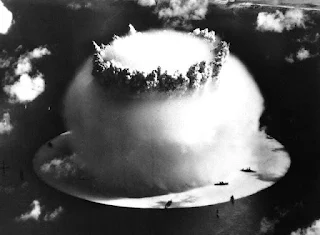
Operation Crossroads began on June 30, 1946, with
the Able explosions and later in July, with the larger
Baker series that yielded this iconic image.
In late June and July of 1946, the US tested a new generation of more powerful atomic bombs at the Bikini atoll in the Pacific, and despite negotiations in the UN, it became clear that US government policy was to maintain and develop nuclear weapons on its own.

 After that, suggestions of international controls or world government, or other questioning of government policy regarding nuclear weapons were quickly and thoroughly squelched as unpatriotic.

Such a charge of "subversive" beliefs became particularly potent in the McCarthy era of the early 1950s, when such dissent was not tolerated, and could lead to prison, loss of livelihood and exile from the community. Even without such dark sanctions, social pressure and the habits of identifying with government policy in wartime—now Cold War-time—as well as a certain logic to the standard argument (the enemy has these weapons, so we must have them, and maintain our superiority)-- and a mental and emotional paralysis in response to the inconceivable enormity of the Bomb and its ultimate threat, kept dissent and questioning to a minimum.

For most people, in day to day ordinary life it was better to ignore it all. What else could you do? So any new or nagging questions were driven underground, and those that could not be articulated—even to oneself—might very well end up buried in the unconscious.

Part of the shock was the suddenness.  The Bomb was developed and deployed in secret, and the first official news of its existence was the news of its first use to destroy a city.  But some saw it coming.

Long before this—even before the first Bomb exploded—science fiction writers were examining possible atomic futures. H.G. Wells wrote about (and named) the atomic bomb in 1914.

In the 1940s, science fiction authors wrote so much about the atomic bomb and atomic energy that John W. Campbell, editor of Astounding magazine who presided over the Golden Age of the pulps (and was trained in physics), was questioned by a US government agent, alarmed that pulp fiction writers might be stealing ideas from the still secret Manhattan Project developing the real atomic bomb, rather than using their own knowledge and imaginations. Tales of atomic warfare horrors became so common even before Hiroshima that Campbell complained he was receiving too many.

The science fiction pulps were marginal, even disreputable to both the mainstream literary culture and to much of the public. When these kinds of atomic horror stories (and the "bug-eyed monsters") made their way into the movies, they were also considered marginal, and easily ridiculed or more often just ignored by officials and official culture. It helped that many were scientifically silly, visually unconvincing and badly done. 

But some were especially effective. They were more than old scare stories with modern villains and embellishments. They were an expression and an escape valve for fears and anxieties about nuclear weapons as well as the scientists who created them, and the military industrial complex that supported them.

In particular there was one film that not only expressed layers of emotion from the unconscious, but dealt dramatically with controversies over real world evidence, particularly effects of radiation. It has the singular feature of being both one of the first such movies, and a film that went largely unseen for fifty years. Yet it also created a modern icon, and launched a series of movies that is still ongoing, some 65 years later.

When Godzilla: King of the Monsters became a hit movie in the US and around the world in 1956, the theme of a monster created or unleashed by nuclear explosions was no longer completely new.

In other respects as well, Godzilla was an unlikely success. It had no action hero, no damsel in distress. Except for one American, a reporter who did little but observe things (played by a pipe-smoking Raymond Burr, a few years before his fame as TV’s Perry Mason), all the characters were Japanese. Just a decade before, the Japanese were enemies, and widely caricatured as evil, sniveling, cruel, heartless and racially inferior.

 Americans still knew little about Japanese culture, and a movie set in Japan was rare.  Any foreign-language film was rare. Subtitles were as yet unknown outside of a few art houses.  Godzilla was dubbed, and on the cheap: the voices of all the male Japanese characters were dubbed by the same Asian American actor, and pretty much all sound the same.

Nevertheless, the monstrous Godzilla was the star, and the heavily promoted film not only became a global sensation, it generated a seemingly endless series of sequels and similar movies that transformed the Japanese film company that created this footage into an international studio.

But it took 50 years (and more than 25 Godzilla sequels) before the original 1954 Japanese film, now known as Gojira, was screened in a few US theatres. It later became available on disk and online.  We can see it today not only as an early and conscious response to nuclear weapons using symbolic means, but as a perspective from the only nation that has so far suffered nuclear attack.

(For those who have seen the 2019 bloated film travesty with the same title as the US Godzilla in 1956, I refer to a critique here. Some of the reasons for this blistering rejection can be found in the differences between that movie and the one I describe here, the 1954 original Gojira.)

The 1956 US version of Godzilla added 20 minutes of Raymond Burr and a few Hollywood actors, while cutting some 40 minutes from the original Japanese film, rearranging and re-purposing scenes and characters.

 Those 40 minutes turn out to be crucial to what this movie can tell us about how one of the first nuclear monster movies expressed a range of unconscious responses as well as consciously intentional evocations of controversies regarding nuclear weapons, by filmmakers of the country that a scant 9 years before was the sole victim of atomic attacks.

But it was not only a response to history. The precipitating event that led to Gojira happened just months before it was made, and in the same year that it was originally released.

Still, it is worth reviewing the history. (It is in fact always worth reviewing this particular history.)

On July 16, 1945, the US exploded the first atomic bomb in its only test, near Alamogordo, New Mexico, not far from the Los Alamos laboratory where it was developed. It exploded with such brightness that a woman blind from birth traveling in a car some distance away saw it. "A colony on Mars, had such a thing existed, could have seen the flash," historian Gerald DeGroot wrote in his book, The Bomb: A Life. "All living things within a mile were killed, including all insects."

On the same day, a fifteen-foot long crate carrying the components of a second bomb was loaded aboard the cruiser Indianapolis at Hunters Point Naval Shipyard in San Francisco, bound for Tinian Island in the western Pacific where it would be assembled. The cruiser left San Francisco four hours after that first explosion.

On August 6, an American bomber dropped this atomic bomb on Hiroshima, destroying much of the city. According to author Arthur Koestler, this made it the most important date in “the history and prehistory of the human race...”

Nagasaki as the Bomb exploded
Three days later, another atomic bomb devastated the city of Nagasaki. Some 75,000 people died in Hiroshima from the blast and fire. Five years later, radiation effects more than doubled the dead, to some 200,000. The vast majority of those who died from the Nagasaki bomb were from radiation, months and years later. Some effects of radiation were apparent within days and weeks, which included very ugly and painful immediate illnesses, as people decayed from the inside. Other effects, principally cancers, took years.

Nagasaki, afterwards
American officials denied these first immediate radiation effects were real, claiming the reports were Japanese propaganda.William Laurence, the only reporter permitted to follow the Bomb's development, echoed the charge.

 But the contrary truth entered public consciousness with the publication of John Hershey’s Hiroshima, first in an August 1946 issue of The New Yorker magazine, and then as a best-selling book. In it, the stories of six Hiroshima survivors ended with riveting accounts of the ongoing effects of radiation. Yet even after radioactive fallout entered the news, American officials insisted that radiation exposure was painless to humans and test animals. General Leslie Groves, the head of the US atomic program, testified to Congress that radiation poisoning was "a very pleasant way to die."

This well-known image may have inspired the
mother and children scene in Gojira
US government officials were still denying that radiation posed substantial threats when the first U.S. hydrogen bombs—vastly more powerful than even the largest atomic bomb-- were being exploded in the Pacific in the early 1950s. At this point in history, the US military was occupying the defeated nation of Japan, changing its form of government as well as many aspects of its culture. That official occupation ended in 1952, just two years before Gojira.

 In 1954 Japan was a sovereign nation but still dependent on the US to a degree, as well as a political ally. There were still US troops based in Japan. But given Japan’s recent history as the only nation to have felt the wrath of atomic bombs, many of its citizens cast a wary eye on these thermonuclear bomb tests conducted very close to their shores.

On the first of March in 1954, sailors were on the deck of a Japanese fishing trawler out in the Pacific when they were startled by an astonishingly bright light at the horizon. It lingered long enough to illuminate the clouds and the ocean itself. One of the sailors ran to his cabin where another sailor was humming a song, and blurted out the same sentence as did a distant witness to the first atomic test at Los Alamos: “The sun rises in the west!” Crew members still on deck finally heard the deep rumble of an explosion, and were soon coated with gray ash.

one of the Lucky Dragon crew with radiation burns
This was the Diago Fukuryu Maru, translated into English as the Lucky Dragon #5. By the time it returned to port two weeks later, some in the crew of 23 were covered with sores from burns, and many were suffering the classic symptoms of radiation sickness: nausea, bleeding gums, pain in their eyes, headaches. The first death was recorded in September.

The bright light and radioactive ash came from the Bikini Atoll, where the U.S. exploded its most powerful hydrogen bomb. It was twice as potent as expected. Its fireball was more than four miles wide. Its 62 mile-wide mushroom cloud reached 130,000 feet into the sky, dropping radioactive dust on more than 7 thousand squares miles of the Pacific. Susceptible to this fallout were several small islands and more than a hundred fishing boats like the Lucky Dragon #5.

Doctors and scientists in Japan immediately recognized the radiation effects. They had seen them before. They also measured excessive radiation in the fish aboard the Lucky Dragon and other boats, and this new threat caused panic in Japan that spread around the world. United States officials responded to Japanese requests for information with official lies. The head of the Atomic Energy Commission, responsible for the tests, denied any ill effects could be from the Bomb test. It took more than thirty years for such official lies to be fully exposed.

The story of Japanese tuna contaminated with radiation, and the denials of responsibility by American officials, came and went in in US news media but it was a persistent and detailed story in Japan.  There the media quoted one of the hospitalized Japanese fisherman: “Our fate menaces all mankind,” he said. Tell that to those who are responsible. God grant that they may listen.”

 Almost immediately, Japanese film producer Tomoyuki Tanaka took clippings about the Lucky Dragon incident to the Toho Motion Picture Company and proposed to replace a foundering film project with a movie about a prehistoric monster awakened by the Bomb. The movie would begin with a scene on a fishing boat, evoking the Lucky Dragon incident. If any Japanese viewers missed the point, the detail of a life preserver marked #5 might focus their attention.

Hiroshima
Ishiro Honda, a young documentary filmmaker and friend of Japan’s greatest director, Akim Kurosawa, wanted to direct it. The son of a Buddhist monk, he’d been drafted into the Japanese military during World War II and was a prisoner of war in China. Returning to Japan at war’s end, he passed through the devastated city of Hiroshima. This was to be his statement warning of the dangers of nuclear weapons.

This is just one aspect of Gojira, though it is the organizing principle for everything else. It was first of all a monster movie, something Japanese cinema had not previously attempted. But there had been a recent internationally successful re-release of the original 1933 King Kong in Japan as in most countries. Probably the Japanese filmmakers were aware as well of an American film of the year before, The Beast From 20,000 Fathoms, which was the first movie monster to be unleashed by atomic bomb explosions.  But Gojira is different in several ways, most notably as reflecting a unique Japanese perspective.

There are many unconscious themes evident in this movie, that suggest the range of possibilities when applied more generally. But the subject of nuclear radiation was also a conscious theme, woven throughout the film.

After the opening scene of the bright light and explosion swamping a fishing boat, the film shows a shipping office, crowded with people worried about those missing from a series of other unexplained ship disappearances. One of the few survivors of these ships washes ashore at a fishing village on Odo Island, barely alive. He is reunited with his family there. A village elder recalls legends of a sea beast called Gojira who had sometimes raided the coast for food. In the midst of a storm at night, a huge but barely glimpsed creature destroys wooden houses and kills many villagers, including that sunken ship survivor.

After several villagers testify before an unnamed government body, an esteemed paleontologist Dr. Yamane leads a team to the island to investigate.

(Yamane is played by one of Japan’s most distinguished actors, Takashi Shimura, who appeared in most of Akim Kurosawa’s films and starred in several of the best known internationally, including Rashomon and another 1954 release, The Seven Samurai.) Yamane finds a prehistoric organism in a huge radioactive footprint on the beach. Later he is among those on the island who see Gojira’s head roaring over a high hill.

In a key scene (much of it missing from the 1956 US version), Professor Yamane reports to the same government body. He believes Gojira is from transitional species, a deep sea creature becoming a dinosaur, who was driven from his niche by nuclear explosions.

Further, he believes, those explosions transformed it. Absorbing enormous amounts of radiation, it has itself become radioactive—with the traces of Strontium 90 that link it to nuclear blasts. Gojira was not only evoked by the Bomb; it has become the Bomb. This sense of Gojira will become clearer as the movie goes on.

But this government session quickly erupts in controversy. One faction (represented by a male speaker) wants to keep these finding secret, to avoid public panic. Another (represented by a female speaker) demands that the information be made public, so that people can prepare.

This was perhaps the most political moment of the movie. Secrecy had dominated US policy concerning nuclear weapons, from the initial development of the first atomic bombs at Los Alamos to studies of the Bomb’s effects.

Nuclear bombs kill first with their titanic blast, and then with the fires they create and cause. The scale of these effects are many times greater than conventional bombs, but the basic phenomena were known from other explosives. However the longer-term effects of nuclear radiation was new, and it captured public attention, especially when it was learned that radiation—in what was called “fallout”-- can spread many hundreds of miles, through the atmosphere.

It was on radiation effects that the US government was most secretive, as well as openly deceptive. This only increased public interest and alarm.

Photos of Bomb victims in Hiroshima disfigured by blast, burns and radiation had been widely circulated, even in the U.S., by the mid 1950s. That radiation could cause mutations in the children of those exposed was a particular topic of both justified and unjustified concerns and fears. Gojira represented this aspect as well—radiation had changed it. Even its design incorporated the look of disfiguring scars from photos of victims in Hiroshima and Nagasaki.

Mutation would be an even greater source of anxiety in Japan, because that’s where some of the first evidence emerged, not only as a result of Hiroshima, but of nuclear bomb testing in the Pacific. The U.S. physician and writer, Dr. David Bradley, re-published his best-selling book on the 1946 postwar atom bomb tests, No Place to Hide, and included new information, such as the results of a study of 406 Pacific islanders (probably very similar to those depicted in Gojira) who were exposed to H-Bomb fallout in 1954: nine children were born retarded, ten more with other abnormalities, and three were stillborn, including one reported to be "not recognizable as human."

This film indirectly confronted the secrecy, silences and lies that fed fears, particularly of nuclear radiation. But that was only the beginning of the strong feelings that this deep sea creature dredged up from the silent depths of the unconscious.

...To be continued.  For earlier posts in this series, follow the Soul of the Future label, here or below.

Thursday, August 01, 2019

Heat Check

That hot air that blanketed Europe has gone north, reaching the Arctic.  Sure enough, it has made a hot summer there much hotter.  This story is typical:

Greenland forest fires the largest ever monitored by satellite
"The heat wave that smashed high temperature records in five European countries a week ago is now over Greenland, accelerating the melting of the island’s ice sheet and causing massive ice loss in the Arctic.

More than 10 billion tons (11 billion U.S. tons) of ice was lost to the oceans by surface melt on Wednesday alone, creating a net mass ice loss of some 197 billion tons (217 billion U.S. tons) from Greenland in July, she said.

The current melting has been brought on by the arrival of the same warm air from North Africa and Spain that melted European cities and towns last week, setting national temperature records in Belgium, Germany, Luxembourg, the Netherlands and Britain.


Smoke from fires in Siberia has reached the US
In Russia, meanwhile, forest fires caused by hot, dry weather and spread by high winds are raging over nearly 30,000 square kilometers of territory in Siberia and the Russian Far East — an area the size of Belgium. The smoke from these fires, some of them in Arctic territory, is so heavy it can easily be seen in satellite photos...

Greenland has also been battling a slew of Arctic wildfires, something that Mottram said was uncommon in the past."

Another scientist on the scene spoke to NPR, and noted that melting in the center of the ice sheet hasn't happened since 2012, "which was a record amount year. But before that, we hadn't seen it happen since 1889. And by drilling into the ice sheet, we could look even earlier, and the last time it happened before that was 680 years earlier. So having these two large melt years happening quite close together certainly raises alarms about the loss that we're seeing. But it's really this year-to-year build-on of ice loss year after year that's particularly concerning. And unfortunately, that's headed into the ocean and showing up on our coastal shores."

Even a very small increase in sea levels adds to the dangers of hurricanes and other big storms, such as several that are currently brewing in the Atlantic and Pacific.  Greenland's ice specifically affects coastal flooding in Florida.

Elsewhere in the Arctic region, the state of Alaska is seeing sustained record heat:

The nation’s 49th state is warming faster than any other, having heated up more than 2 degrees Celsius (3.6 degrees Fahrenheit) over the past century — double the global average. And parts of the state, including its far northern reaches, have warmed even more rapidly in recent decades.

Temperatures have been above average across Alaska every day since April 25. None of the state’s nearly 300 weather stations have recorded a temperature below freezing since June 28 — the longest such streak in at least 100 years. On Independence Day, the temperature at Ted Stevens Anchorage International Airport hit 90 degrees for the first time on record."

But as profound as the dangers are of Arctic heating, sea levels around the world as well as ocean temperatures and salinity that affect major ocean currents, all feel much more impact from Antarctic melting, because there is so much more ice there, and it is on land.  When it melts into the sea, it increases water volume more directly. But any heating of ocean water--including from Arctic melt--increases melting in Antarctica:

"Like Greenland, the Antarctic ice sheet is losing ice and contributing to unabated global sea level rise. But there are worrying signs Antarctica is changing faster than expected and in places previously thought to be protected from rapid change. 

On the Antarctic Peninsula—the most northerly part of the Antarctic continent—air temperatures over the past century have risen faster than any other place in the Southern Hemisphere. Summer melting already happens on the Antarctic Peninsula between 25 and 80 days each year. The number of melt days will rise by at least 50 percent when global warming hits the soon-to-be-reached 1.5℃ limit set out in the Paris Agreement, with some predictions pointing to as much as a 150 percent increase in melt days.

But the main threat to the Antarctic ice sheet doesn't come from above. What threatens to truly transform this vast icy continent lies beneath, where warming ocean waters (and the vast heat carrying capacity of seawater) have the potential to melt ice at an unprecedented rate."

Meanwhile, records on the month of July are starting to come in, but even without adding the last several days, it has been the hottest July in recorded history in several New England cities, including Boston and Hartford, as well as the hottest of any month in more than 100 years.  Forecasts for August call for higher than average temperatures to continue in New England and the eastern states generally.  Of the lower 48, only the Midwest is predicted to have normal or slightly below average temps for the month.

Monday, July 29, 2019

Dandelion

At the moment there are no tenants in the student rental across the street, and the front lawn is unmowed.  But since the last time I looked at it, something has happened: along with the high grass are dandelions, lots of them.  Now I notice that they are on the fringes of our front lawn as well.

Dandelions were the flowers of my childhood--dandelions and violets and a few others that occupy the area between wildflowers and weeds in the current view of such things.  Other flowers belonged to adults, who grew them, pampered and discussed them, and praised them, making them sources of individual pride.  We children therefore were warned to stay clear of them.  We were never to run in their flowerbeds, or pick them, or even get close to them.

Adults did not care about dandelions.  In fact, they regarded them as harbingers of disgrace if they appeared on the lawn.  Better a dead- looking brown crewcut lawn than a green one with too much yellow in it.  Scandalous!   Dandelionus! Out comes the heavy artillery power mowers of the neighborhood, shattering Sunday silence with the roar and whine of tank battalions on maneuvers.  (Well, by the 1960s anyway.)

But throughout my early childhood there was a field two lots long between my house and that of two of my pals, brothers who lived "next door."  Dandelions ruled there.  We could run through them, roll around in them, pick them, smell and taste them, play with them.  If we'd wanted we could have decorated bikes and hats with them, and disassembled them to make yellow checkers or hairy yellow eyes, and nobody would have cared.  We definitely did chase butterflies or lightning bugs through them, or just scrunched down to see them close-up, and regard the world through yellow caps.

The dandelions of my childhood in western Pennsylvania looked like those above.  Those on the lawns hereabouts are like this one, with a more defined center.   Their textures are slightly different, and they seem to have longer stems.  The California variety is more like other--or recognized-- California wildflowers.  The PA version seems scruffier. Or maybe I'm imagining that. But that's the one that lives in my childhood.

Saturday, July 27, 2019

Stay Tuned

There is the slow-motion climate crisis, in which each year gets a little hotter (so the hottest June on record was last month) and different places get record-breaking heat, while others get unusually wet months or unusually dry months, and so the definition of "usual" changes.

The saving grace of slow-motion heating is that humans and their institutions get some time and experience to deal with the effects. So the very recent horrendous heat in Europe did not kill as many people as the heatwaves in 2003, seemingly because European countries instituted a set of procedures to deal with these situations when they arise.

Eventually the slow-motion climate crisis will see effects that are more permanent and harder to address. Suddenly the restaurant where you are escaping the heat doesn't have its full menu.  And so on.

But there's no guarantee that a slow-motion crisis is the only kind we'll have.
Right now the heat that gripped Europe is headed for the Arctic.  Nobody yet knows what the effects will be, other than a likely increase in melting.  How great an increase, and what the combined or cumulative or interacting or even chaos theory effects will be, are all yet unknown.

  But there is the potential of this or something like it triggering greater effects that either have relatively sudden impacts--like a larger rise in sea levels--or end up affecting the overall climate to speed up the effects of global heating by radically changing the world's weather.  Particularly vulnerable are major ocean currents and atmospheric patterns.

Such a change--quite possibly an irreversible change--can occur almost any time now, for as much as science knows about the climate crisis, there is much that isn't well understood about the complex workings of larger climate-determining systems.  While the phenomena and effects we're seeing don't surprise climate scientists, the speed of some of them does--particularly when it involves temperatures and melting ice at the poles, and interactions in the oceans.

So stay tuned.  And stay sharp, because our so-called leaders aren't going to tell you anything (the US and now the UK being governed by bought morons, bent on international suicide) and who knows about the media anymore.


Tuesday, July 23, 2019

History of My Reading: Summer of Love

Summer jobs during the college years could have a number of purposes.  They could result in money for school or at least for summer support and entertainment, they provided "real world experience," they were something to do over those long unobligated months. Among the major motivations for summer jobs were money and parents.

Especially for those of us who had just completed our third year, a summer job could also be an opportunity to explore work we might pursue after college.  And in 1967, doing some good in the world was also a goal and a motivation.

They were also something to talk about when we returned, or in letters during the summer. These letters over the years often cast a harsh and despairing light on "real world experience."  After months of unrelenting and often intense mental and emotional stimulation at school, many found their summer jobs to be so tedious they threatened their sanity.  The corruption, greed, stupidity, vapidity, cruelty, arrogance and intolerance exhibited by bosses, coworkers, customers and so on, tended to make "the real world" seem deeply unattractive if not horrifying.

But even the most unpromising-sounding jobs could be enlightening.  I recall Leonard Borden returning one year with admiration for the wisdom of his coworkers collecting garbage on the early morning streets of Wilmette.

Jack Herbig.  Photo by Leonard Borden
Or at least the job could provide a good story or two.  Another Chicago area student--I'm pretty sure it was Jack Herbig--drove a city bus, and was once robbed by a man with a unique weapon: a scorpion.  This driver watched a large man showing various riders the contents of a small box he was carrying, until the last stop came, and he was the only remaining passenger.  He then showed the driver the scorpion in the box, and demanded all his money.  The driver complied, even offering his wristwatch.  After ascertaining that the watch belonged to the driver and not the bus company, the robber declined to take it.  (The story was too good for me not to preserve it at the time.)

Wendy Saul.  Photo by Leonard Borden
I learned from letters during that summer of 1967 that classmate Wendy Saul was working with inner city kids at an Upward Bound program in Connecticut, and Barbara Cottral was a staff writer for her hometown newspaper in Clinton, Iowa. Valjean McLeignhan, who had already graduated, was a summer apprentice at the prestigious Williamstown Theatre in Massachusetts, before beginning graduate school at Iowa in the fall.  Joni Diner was working as a waitress in Denver while taking a biology course at the University of Colorado.

A few months before it seemed I had the choice of several jobs for this summer.  I applied for and got into a program that had agreements with newspapers across the country to supply them with summer interns for their newsrooms, subject to individual approval.

  Back home, my parents assured me there was a job waiting for me with the railroad.  And late in the spring, the Knox publicity director--for whom I'd written an article or two on assignment for the alumni magazine--had taken the initiative to find me a spot with a Quad Cities newspaper, with the stated intent to test my long-hair ways in that ever-popular real world.

I applied for newspaper jobs in several places including in upstate New York. During the break before spring semester I interviewed for one in Pittsburgh and--as my "safety"--on my hometown newspaper, the Greensburg Tribune-Review (not yet a Scaife right wing prototype for Fox News.)  The editor there pretty much assured me of the job, since for one thing it was unlikely there would be another applicant from the program.

With all these choices, I decided against a blistering summer in the Quad cities, and headed back east.  I arrived to the news that the railroad job had fallen through.  As for the remaining newspaper jobs, I got one rejection and did not hear back from the others, including the Tribune-Review, where someone else had applied at the last minute.  Having seen those gray concrete offices and met the pale and uniformly middle-aged male editors, I was not surprised that they chose a bright and energetic young woman when she gave them the opportunity.  So I was left without a summer job.

Parks wrote this book about his
adventures in Tuscarora
Other classmates were similarly free, at least for part of the summer, as a number of them showed up in the tiny "ghost town" of Tuscarora, Nevada, where ceramics prof Dennis Parks hosted a "Summer Retreat and Pottery School."  (Parks did not return to Knox in the fall, and still lives and works in Tuscarora to this day.)  I had letters from Julie Parks (who sadly died just last summer) and Doug Wilson, who included his own "Things To Do in Tuscarora" poem.

I hasten to add that these letters--and others--came in response to letters from me.  For I had plenty of time to write them.

I had various intentions and half-made plans to travel--the West Coast was an incredible magnet (in their letters, former Knox students Mary Jacobson and Mike Hamrin wondered if I was coming to the Bay Area), for this was the Summer of Love, and Scott McKenzie was on the radio advising that "if you're going to San Francisco/be sure to wear flowers in your hair."  These travel ideas also came to nothing, mostly because I didn't have the money, but also because I was otherwise engaged.

I had a few temp jobs over the summer (doing inventory at a discount department store for a week until I managed to get myself fired, for example) but basically, I wound up spending the Summer of Love in my parents' basement. And though it was oppressive in many ways, it also was one of the most creative summers of my life, certainly to that point.

For it turned out that I didn't need to be in San Francisco or LA or London or even Tuscarora, at Haight-Ashbury or on Carnaby Street, to feel the incredible energy of that summer, which had been building in the Bay Area but more generally was chiefly unleashed, formed and amplified by the one and only Billy Shears, and Sergeant Pepper's Lonely Hearts Club Band.

The Beatles were said to have been working in the studio for months, and their new album was widely anticipated.  So when I saw Bill Thompson on Galesburg's main street walking with purpose towards the record store in early June, I knew where he was going and why.  He knew that the album was in, and he was on his way to get it.

I wrote about this and about the summer of 1967 a couple of years back in a fiftieth anniversary of Sergeant Pepper post. Here I intend to do what we old folks do best and repeat myself, while--like some bloviating congressman feeding the Congressional Record--revising and extending my remarks.

I listened to the album straight through for the first time with Bill Thompson, and I probably bought my first copy in Galesburg.  By the time I was back to Greensburg, Sergeant Pepper's Lonely Hearts Club Band had already sold more than a million copies in the US in just a few weeks.  Demand was so great that there were nearly 100,000 back orders.

I more than listened to that album in June--I inhabited it, as it inhabited me.  I played it when I got up, to set my day, on the big stereo in the living room.  I played it while I was in the kitchen, and while I took a bath.  My parents were both at their jobs, and only my 13 year old sister Debbie and I were in the house for most of the day. I reveled in the music that matched the beat of my blood and my soul, in the lyrics that sang of a familiar world in a new way. Even the English major in me reveled, as I noted the irony of "fixing a hole" that "keeps my mind from wandering;" you know--closing something up in order to wander freely. And of course, the multiple meanings in just the title of "Within You Without You."

Not everyone felt this way about this album, or the other aspects of the musical and cultural explosion.  Most were bewildered and many were dismissive, caustic and even angry.  It was all of a piece with alarm over other obvious cultural shifts.  This was definitely the era when I would hear "are you a boy or a girl?" called out to me on Main Street because of my long hair (or what passed for long hair in that year)--nearly every time I walked that hot street, trying to keep the beat in my mind.  The people who yelled it seemed to believe it was clever, and delighted in laughing together in appreciation of their own wit.  Soon I was keeping my daytime trips to town at a minimum.  There were other, more personal incidents that were as unpleasant to experience as they are to remember.

Sergeant Pepper was remaking my world, though much of the world around me seemed oblivious.  But it was too big a cultural story to pass unnoticed, even in the Tribune-Review and the Pittsburgh Press Sunday paper.  Everywhere there were newspaper and magazine stories, reviews and interviews.

There wasn't much of a musical press yet--but Sergeant Pepper would help create it.  Both Rolling Stone and Creem would get started before the year was out.  The only such publication I knew about was a short-lived one called Cheetah.  I was such a fan that I sent away for a Cheetah sweatshirt.  Otherwise there were the teen magazines, some of them dreadful, at least one of them--TeenSet--pretty good. Their interviews with the musicians were particularly interesting, especially since nobody else bothered.

Sergeant Pepper was so pervasive an influence among the self-selected elect that it even created a kind of secret language.  Titles of songs and lines from them made their way into letters and conversations.  If the songs weren't enough, there was that fantastic cover, with the images of pop culture heroes arrayed behind the Beatles transformed into the Sergeant Pepper band.  There would be endless discussion in the coming year over the meaning of every detail, spun out through long cannabis nights. But that was yet to come for me; I still hadn't had a proper toke.

I had my own theories about the album, including why it seemed like one unit, a "rock opera."  There were attitudes that united the songs, a feeling that was undeniable.  But technically I realized they were unified by one small change that hardly anyone mentions these days: the dead space between the tracks was considerably reduced from past music albums.  One song flowed more quickly into another.

There was of course more new music exploding into the air, although it was hard to hear much of it.  We were still deep in the hegemony of top 40 AM radio.  I had to wait until late at night, in my bed in the dark, when I could feverishly search and delicately tune the elusive signals from distant stations in Cleveland or even Chicago on my transistor radio, that would play Jimi Hendrix ("The Wind Cried Mary,"  "Foxy Lady",) Country Joe and the Fish ("Not So Martha Sweet Lorraine"), the Jefferson Airplane songs that Pittsburgh AM wouldn't play ("White Rabbit"), and of course the long version--with the keyboard solo--of the Doors AM hit, "Light My Fire."

One thing to be said for Pittsburgh area radio stations, though, was that there was a long history of playing black music, promoted mostly by WAMO and other black music stations, but going mainstream on the top 40s and the biggest and most establishment station, KDKA. And this was a good summer for Motown (the Supremes "Reflections,") soul singers (including white soul, like Chicago's the Buckinghams), Aretha and Stevie Wonder ("I Was Made To Love Her.")  But it seemed like the psychedelic music coming from England and the West Coast was a bit more threatening.

Sergeant Pepper and this other music became like brain oases in the desert, or in terms of television, the vast wasteland.  Television was then dominated by the likes of The Beverly Hillbillies, Peyton Place, Hogan's Heroes, Petticoat Junction and the Lawrence Welk Show.  I might watch an occasional rerun of Jackie Gleason or Man From U.N.C.L.E., Star Trek or the Monkees, but except for the Smothers Brothers and the Steve Allen summer show, it was a matter of three channels and nothing on.

So Sergeant Pepper blasted during the day, but at night things were different.  My old room had been converted into a den, so I slept on a fold-out in the area of the basement known as "the other side."  It was in fact the space where my parents and I had first lived on this piece of land, before the house on top of it was built, and this cement structure was literally "the foundation."  This became my domain, for hours during the day and certainly at night, safe from the blathering television and other impositions.

Inspired by Sergeant Pepper and all the stories about the Beatles in the studio, I created my own recording studio there.  I took over an old reel-to-reel tape recorder that I somehow manipulated to record on two separate tracks.  I electrified a guitar with an old microphone and even older amplifier and speaker--all this equipment accumulated by way of my father's inconsistent interest in tinkering with amateur electronics as a hobby he didn't really have time for. There was also an old piano salvaged from a neighbor with dubious tuning, bad action and a few broken keys, though it could sound properly bluesy in certain registers.  A small chord organ had migrated to the basement from the living room.

So I became my own Beatles. I knew enough three and four chord progressions on guitar and piano for rock, blues and even some jazz sounds (which at Knox I had too often inflicted on fellow students in line to dinner by means of the piano in the student union), and I was learning new combinations from the music I was hearing.  I wrote song after song, layered instrumentation on the tracks, sang back-up and even tried harmonies and double-tracking, adding homemade percussion with some old rattles, my sister's tambourine, drum sticks and coffee cans.  I experimented with feedback, random overdubs and found sounds.  All with the aid of old earphones that didn't always work.

The 4-track tape recorder for Sergeant Pepper's
The results were hardly professional but often surprising.  I was participating in the kind of exploring the Beatles did on a different level, though technically not so far apart: all the layered sound of Sergeant Pepper had been done on four-track recorders.  By re-recording multiple tracks on one track, and adding to them on the other track(s), the layering could be endless--on my machine as well as theirs.  After Pepper, professional recording rapidly expanded to 8, 16, 32, 64 tracks and up.  The technology wasn't that hard--once the Beatles showed how it could be used.

I didn't stop with music.  There were old magazines and catalogs in the basement, so I cut out pictures and some text, and created elaborate collages, a few of them quite large.  I gave them all away, which seemed like part of the spirit of the thing.  Just endless creating, all gifts.

But sometimes on those humid nights I couldn't contain myself there any longer.  Fortunately there was a new all-night hamburger joint on Main Street, and it was air-conditioned.  Very late, when everyone else in the house was asleep, I escaped into the damp empty streets, safe from hostile stares, and loped through the dark, down and up the hills to town. Then I would sit for hours under florescent light, drinking coffee and writing.  Mostly letters--the letters I sent all these people, who wrote back to me.

I also sent tapes occasionally.  I sent one to Tuscarora which included a few songs I'd written using Emerson images ("Expanding Mellon," "Give All to Love") and a song I wrote about Tuscarora itself, modeled on the Mamas and Papas hit "Creeque Alley."  Apparently they tried to play it at some sort of group function, but the electrical generator gave out, and it slowed and slurred to a premature close.  Which I suppose is the outcome of that summer.

The 1960s paperback
This series of posts is ostensibly about reading, but I don't remember any specific book titles from this summer. I had requested and received a reading list of contemporary fiction from the incoming teacher of fiction writing, Robin Metz, but the titles I recall were those of books I couldn't find in Greensburg, and I'd already read the others.

Basically I was still enthralled with Richard Farina's novel Been Down So Long It Looks Like Up To Me.  For a long time it seemed the most characteristic 1960s novel, although the action takes place on a college campus in 1959.  I tried reading it recently but except for taboos it broke and the beat of the writing, it no longer resonates with me, especially the main character.

This time I read a later paperback edition with an entertaining preface by Thomas Pynchon, who knew Farina at Cornell, and knew people who inspired the characters in this book.  Pynchon claims he didn't know Farina well, but they did once go to a costume party together: Farina dressed as Hemingway, and Pynchon as Fitzgerald.  That, more than the book, blew my mind this time.

I am reminded however, not of books I read but an author I did not read at Knox at all, and wish I had.  That would be Charles Dickens.  He was not taught in any class I took or knew about, which might have been a good thing, given the scholarly opinion at the time reflected in the defensiveness of novelist John Irving's preface to Great Expectations (Bantam edition 1981.)  On the other hand, what Irving says in praise of Dickens makes me wish that I'd gotten to the Iowa Writers Workshop in time to know him, as well as his teacher, Kurt Vonnegut.

What puts me in mind of Dickens in considering the summer of 1967 is his persistent theme of childhood potential either squelched or nurtured by the people and circumstances of the child's world.  That need goes beyond actual childhood.  Perhaps everyone has a Summer of Love in them.  But it is seldom permitted, let alone encouraged to develop, transform and flourish.

Sergeant Pepper, now universally praised and even loved, stood in the middle of a great divide in 1967.  For those whose minds and hearts it opened, it opened them wide.  We experienced ecstasy in the moment, and in the prospect and promise of a new world, or at least a new way, which was especially welcome in the brutal and condemning context of Vietnam and the thermonuclear Cold War.  But others experienced fear and disdain and hostility, and expressed it. That made their hard world seem even emptier and more cruel.  It is less ironic than illustrative that I found communion while alone in my basement.

  I did see a few friends that summer.  My songwriting partner Clayton was in L.A. staying with relatives for the first months, but the other Crosscurrent Mike was living and working in Latrobe, some 10 miles away.  Despite inconveniences of time and distance, we had some adventures.  We tried attending a high school class reunion, but our "long hair" and improvised Carnaby Street gear (complete with granny glasses I borrowed from my actual granny) so mystified and eventually alienated the classmates who showed up that we spent most of the evening talking to each other.

We had some female friends from high school sharing an apartment in Pittsburgh who we visited, sleeping in their living room if it got too late to hitchhike or take the bus home.  But one night our presence became inconvenient, and we wound up walking a considerable part of the 35 miles back, until daylight provided a bus. Despite this, one of the women residents--Joyce--was an important part of this summer, and of my life for years to come.

Our biggest adventure however was the night Mike and I became rock stars.  We traveled to Pittsburgh for a Mamas and Papas concert at the Civic Arena.  We got there hours before the show started.  We escaped the hot sun by ducking into the cool dark lobby of a hotel, where we soon found ourselves the target of a group of enthusiastic teenage girls.  At a loss, we retreated to an elevator, only to have the operator chat with us as if we were guests, and famous ones at that.

members of Moby Grape 1967
We were mystified, as we did not look anything like even the Papas, but we soon learned that there was an opening act called Moby Grape, a new San Francisco group with their first record out, introduced at the Monterrey Pop Festival earlier that summer, a now legendary event engineered by Papa John Phillips.  Evidently they were staying at this hotel, but nobody really knew what the band members looked like.  Or maybe those girls just didn't care--we looked strange enough.  Mike and I wound up sitting on some back stairs, contemplating the price and extreme brevity of our phantom fame.

Eventually, Mike had saved enough from his job to buy a used yellow VW bug, and Clayton returned from L.A. with gifts of buttons (buttons were the rage there), three of which I wore the next year at Knox.  They said "Reality is a Crutch," (which tended to befuddle administrators and faculty members), "Totally Illogical" (I grok Spock) and "Lennon Saves."

These replaced the button I had been wearing my third year--it was white with Chinese characters in red.  I heard whispers of speculation on what they said--a Zen koan perhaps, or a dark revolutionary slogan.  Actually they were supposed to say "We Try Harder."  It was a button from the Avis car rental company, with their current slogan.

The Crosscurrents reunited musically a few times that I remember.  Once at Mike's apartment we tried out the new song on the radio by the Youngbloods, "Everybody Get Together," and nailed harmonies that astonished me.  And down in my basement I finally made use of that chord organ to do the keyboard part on "I'm A Believer" by the Monkees as Clayton and I improvised our version.

The three of us made one road trip together in Mike's VW at the end of the summer, to Canton, Ohio where lived a young woman who Mike had met and dated during the previous school year.  I remember three things from this trip.  Clayton was a natural punster, and he let go with one of his best when Mike asked him, "is there a red spot on the back of my neck?"  To which Clayton replied, "No.  It's a pigment of your imagination."

Second: during a Crosscurrents command performance for the young woman in question, she thought it was funny to burn holes in the lyric sheet of a new song with her cigarette, while we were singing it.  We did not agree, and I believe it damaged that relationship as well as the paper.  We didn't hear anything more about her after this trip.

Beatles playing "All You Need Is Love" for first
global broadcast
But at one point Clayton and I left the couple on their own, while we spent the evening at a local bar.  The Beatles " All You Need Is Love" was a hit single by then, and people played it several times on the jukebox.  Every time it began--with those opening strain of the French National Anthem--Clayton and I stood up and saluted.  We got stared at, but at least we didn't get thrown out.  Later we met two young women, one of them with long dark hair who called herself Cher.  They eventually invited us to leave with them, but in fact they ditched us. So I don't have many warm feelings for Canton, Ohio.   So much for the Summer of Love.