Friday, January 16, 2015

A Critical Need


"Aside from issues of life and death, there is no more urgent task for American intellectuals and writers than to think critically about the salience, even the tyranny, of technology in individual and collective life. All revolutions exaggerate, and the digital revolution is no different. We are still in the middle of the great transformation, but it is not too early to begin to expose the exaggerations, and to sort out the continuities from the discontinuities. The burden of proof falls on the revolutionaries, and their success in the marketplace is not sufficient proof...

Every technology is used before it is completely understood. There is always a lag between an innovation and the apprehension of its consequences. We are living in that lag, and it is a right time to keep our heads and reflect. We have much to gain and much to lose."

Leon Wieseltier
an essay in this Sunday's New York Times Book Review

Thursday, January 15, 2015

Keyless for the Brainless

Phones and other electronic devices may be smarter, but people are heading the other way into a brainless stupor.

It's not just the kids who literally cannot be separated from their phones without psychological and even physical trauma.  There's an even more serious form of dependency, and it is becoming less and less avoidable, even for those who reject it.

For instance the keyless car.  An item in Consumer Reports recently affirmed that new cars in all price ranges are coming equipped with this technology.

What is this electronic marvel?  It allows you to start your car without sticking a physical key into a physical slot.  You just push a button on your device, known as the key fob (even though there is no key attached to it.)

What a miracle!  You can start your car with your hands full of something else--your smartphone probably.  Although you've had to push a button on the fob to get into the car, and then you still have to push another button in the car.  But you don't need that damn inconvenient key.

So let's start with the basic rule of electronic wonders in and on your car, which is that, for all their benefits, they are each something else that can go wrong.  Usually more than one something else.  And almost always nothing you can fix yourself.

So there are things that can go wrong with your fob, such as the batteries, and if you don't have a backup system (electronic or key), you're screwed.  You ain't moving.  It may mean a tow, and it definitely means time and money.

But that's minor compared to the much more likely possibility--you misplace or lose the fob.  Then without a mechanical key system, you are really really screwed.  And CR says replacing the fob could cost hundreds of dollars, and who knows how much time and trouble.

Think about it.  When somebody swiped my jacket with my car keys in the pocket, I got someone to drive me home, wait a minute while I got my duplicate key, then he drove me back to my car.  Duplicate keys cost a few bucks, and you can make as many as you want and stow them in as many convenient places as you wish, so losing your car keys is not a catastrophe.

But for the dubious benefits of a "keyless" ignition, you still have to have that fob (although eventually there will be an ap on your phone device, which will make losing that even more catastrophic), and the cost of losing it is much much greater than losing that terrible old fashioned key.

Behind this is the survival principle of redundancy, along with hedging your bets with alternatives (a gas stove that operates even when the electricity is off, etc.)  Everybody loses stuff, so you cut down the consequences with redundancy (i.e. duplicate keys.)  That is, while you can still buy a car that allows you to start it with a key.

And that's the most brainless part of it.  An entire society so dazzled with new toys that they never bother to think ahead to what could go wrong, and what the comparative consequences might be. It's great for the car companies etc. who sucker you into this, and then charge you hundreds of dollars for a fob, and thousands for extra electronic toys that may or may not improve the operation of your vehicle, but certainly make it harder and more expensive to repair.  When something goes wrong.  And something always does.

  But you have no alternative.  How smart is that?

Monday, January 12, 2015

At the Speed of Tweet

It's hard to know what to say about the events surrounding the assassinations of cartoonists in Paris, except that they've happened with blinding speed: from the horrific incident to international protest involving millions of people including European heads of state leading a march in Paris of up to a million and a half people, to becoming a fashion statement at a show business award show, and the backlash to the response (for example here and here.)

Meanwhile, here's an interesting post at Daily Kos about one of the cartoonists who was assassinated, at the age of 74.  It suggests the dangers inherent in the reaction, understandable and necessary though they might be, increasing police and military presence and power.  That and the accelerated right wing and racist bushwah.

 On the whole though, it strikes me that the Europeans are handling this with a lot less inflated panic and hyperbole than the Bushites did 9/11.  Or that the right wing here continues to do,  focusing on the US participation in the Paris event, which the White House clumsily has made into a bigger story today.  But it's a story only in US politics, not in Europe.

Insight Ephemeral

Whatever the future of this site will be this year, I've already determined that it will not follow the 2016 presidential election campaigns.  I've done enough of that.  So there will be no 2016 label to join the previous ones.

On the other hand, I still read the news headlines at least and I'm not cancelling my email notice of Andy Borowitz satirical commentary, and he's already come up with two wonderful posts: First Smart Move of 2015--Jeb Bush Resigns as George W. Bush’s Brother, and today's:Poll: Most Americans Now Consider Romney a Stalker.

Really, isn't this all you need to know?  A laugh, being a brief outburst, seems the proper response to insights about the ephemeral.

Monday, January 05, 2015

One Amazing Old Trick to Make Millions!

Shocking Top Ten of All Time Made Easy!
photo credit
Andrew Marantz in the New Yorker recently profiled young Emerson Spartz, crowning him King of Clickbait.  The Spartz new-media company made millions in ad revenue last year, and attracted even more millions in venture capital.  At 27, Spartz is widely admired, the article says, he's "inspiring," "awesome," "impressive."  One of his investors is quoted as calling him "a Steve Jobs kind of guy...I think his stuff is indicative of where digital media is heading."

If that's true it's heading in the direction of manipulation on the order of Orwellian cubed. And theft.  Theft is very old news, and apparently very new media.  For that seems to be how the Spartz sites make money.  They steal the work of others.

It's not just that Spartz is a self-righteous Philistine whose idea of how to make a great song is to get 40 people to record vocals, ask thousands of people to pick their favorite, then use the winner. "To me, that’s a trickle in an ocean of possible ways you could improve every song on the radio, he says. "Art is that which science has not yet explained.”

Or even that his model for success is relentless cynicism, which is admittedly widely shared among those trying to get attention through the Internet.  His websites are all about attracting traffic, and learning what content and packaging attracts the most traffic at a given moment.

It's the same sort of technique that fills my inbox with email appeals for political donations that vary mostly by the subject line and the purported sender. (At least I hope President Obama isn't spending a lot of time drawing boxes for me to check beside the amount of my donation.)  The idea is to throw a lot of subject lines out there, see which ones succeed the best, take the top five or so and use them, throw out the rest, and invent another five to test tomorrow.  Or more likely, later today.

Similar techniques are used to test and select photos and copy, including the kind that appear as ads on just about every web site, and contribute to making otherwise substantive sites look and feel like the back pages of tabloid papers and cheap magazines.

But moron bait (and there's a moron lurking in all of us) is only part of it.  There's the content, and where it comes from.  One of Spartz Inc.'s sites, called Dose, publishes lists.  (Lots of sites do that these days, because as Spartz proclaims, "Lists just hijack the brain's neural circuitry." This is your brain.  This is your brain on the Internet.)  For example, “23 Photos of People from All Over the World Next to How Much Food They Eat Per Day.”  But all Spartz did was slightly repackage this information (as other similar sites had already done.)  They didn't do the research, and didn't even link to the guys who did, let alone pay them a fee or a cut of their winnings. On Dose, the list got 200,000 page views, very good for advertisers, and very good for Dose. The New Yorker:

'The Dose post, which received more Facebook shares than its precursors, briefly mentioned D’Aluisio and Menzel (though D’Aluisio’s name was misspelled). But their book, “What I Eat,” went unmentioned, and they certainly did not share in the advertising revenue. “This took us four years and almost a million dollars, all self-funded,” Menzel told me. “We are trying to make that money back by selling the book and licensing the images. But these viral sites—the gee-whiz types that are just trying to attract eyeballs—they don’t pay for licensing. They just grab stuff and hope they don’t get caught."'

But when you have no respect at all for content or for authorship, theft is probably not how you think about it.  Spartz admits that content is of no interest to him: "We considered making Dose more mission-driven,” he said. “Then I thought, rather than facing that dilemma every day—what’s going to get views versus what’s going to create positive social impact?—it would be simpler to just focus on traffic.”

As someone who creates "content" (i.e. writes stuff) on the Internet, I'm waiting for the argument that convinces me that making millions from somebody else's work isn't theft.  Sure seems like it to me.

Maybe it doesn't occur to them that real people have worked to gather information, judge its value, see patterns, check it, find where it fits in larger contexts, craft it into a story etc. or even a damn list.  Because most of their work is done by mindless algorithms.

But not even that charitable excuse will wash.  Spartz himself says why. On earlier sites they featured novel combinations of images, with text that reflected at least a few minutes of online research—but with Dose “we’ve stopped doing that as much because more original lists take more time to put together, and we’ve found that people are no more likely to click on them.”

Right--stealing is so quick and easy! Let other people do the creative and actual work.  It's been the secret of success for generations of robber barons.  How inspiring!

What's really amazing is that Spartz got started at the age of 12 by creating a Harry Potter fan site.  He got to meet J.K. Rowling.  Does he now think that the way to create a Harry Potter saga is to propose alternative plot points, and choose what happens by vote?  Not that plot is the only factor in the saga's success--there's characters and their characteristics, descriptions, pacing, chapter order, chapter content, right down to the individual words. Not to mention the values, morality and emotion within it all. Got algorithms for that?  And if you did, do you really think the whole Potter thing would have happened, including inspiring a 12 year old in Chicago to create a fan site?

And how do you suppose Jo Rowling feels about somebody appropriating somebody else's creative work--say, Harry Potter?  Maybe let her lawyers answer that for you, although she's been known to show up in court herself to defend her intellectual property.

The New Yorker article mentions an internal study at the New York Times lamenting that their Internet site isn't creating these viral blizzards.  What's scary about this memo is that journalism in its various forms and functions is talked about only in the argot that Spartz and his ilk own.  When you define what you are doing by the premises and terminology of those whose mission sees yours as irrelevant, and they're out to destroy you or just suck you dry, you've pretty much lost already.

The New Yorker article ends with Spartz' ultimate solution: “The lines between advertising and content are blurring,” he said. “Right now, if you go to any Web site, it will know where you live, your shopping history, and it will use that to give you the best ad. I can’t wait to start doing that with content. It could take a few months, a few years—but I am motivated to get started on it right now, because I know I’ll kill it.”

I'm guessing that Marantz, with some old media skills, didn't end the piece with "kill it" by accident.

Spartz begins his canned speeches by proclaiming that he wants to change the world.  Apparently he is doing so.  He's helping to make it way way worse.

Saturday, January 03, 2015

Endangered

“The list of species extinguished in the past hundred years is a long one; the list of species threatened with extinction today is still longer. No new species arise to replace those exterminated. It is a swift, distressful impoverishment of life that is now going on. And this time the biologist notes a swifter and stranger agent of change than any phase of the fossil past can show—man, who will leave nothing undisturbed from the ocean bottom to the stratosphere, and who bids fair to extinguish himself in the process.”

H G Wells The Fate of Man 1939

2015: Monarch butterfly considered for Endangered Species List

Thursday, January 01, 2015

Re-Dedication 2015

The first day of the new year might be a good time to renew one's vows, and certainly any day is a good day to clarify them.  Happy New Year.

"...[G]enuine society preserves the continuity of the dead, the living and the unborn, the memory of the past, the reality of the present, and the anticipation of the future which is the one unbreakable social contract.  Continuity and consistency are the only sources of human dignity, and they cannot be attained in the dissolving phantasmagoria of the newspaper world, where we have constantly to focus on an immediate crisis, where a long-term memory is almost a handicap."

Northrop Frye
1970

Monday, December 29, 2014

Remembering A Few

In late Decembers, for some years now, I've been remembering and honoring some of those who died during the year.  As usual this year, I've done so on my blogs in specific areas: of books, the stage, Star Trek and science fiction, popular culture in the baby boom era, and Pittsburgh figures at American Dash.  This is probably the last year for all of that, but here I want to just add my favorite photos of some of these memorable people, with a few words.


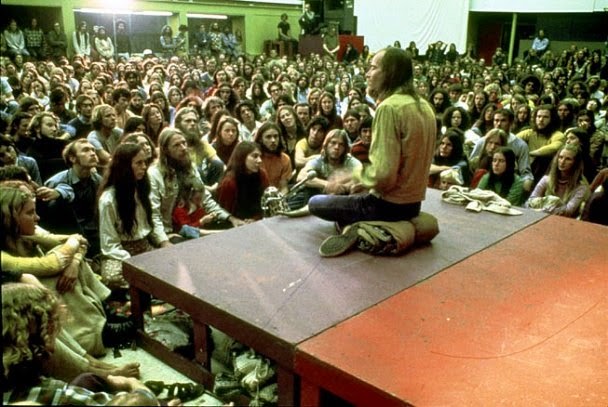
I'll start with someone few have heard of: Stephen Gaskin.  I happened to be in Berkeley when his Monday Night Class at the Family Dog ballroom in San Francisco was packing in 1500 or so seekers in 1969.  It culminated in those months in the First Annual Holy Man Jam, at which I was ordained a minister in the Universal Life Church by means of a scroll conferred upon me with the holy word Zap! and a toke on the world's longest bong.

Great days.  As Gaskin, always wise, wisely said more recently, "You’ve got to be a rich country to have hippies. They’re a free, privileged scholar class that can study what they want. They’re like young princelings. That’s why the only other places to have produced hippies are countries like Germany, because they’re rich enough. It’s really been an upscale movement, in a way, except for when it broke through. And when it broke through was when it was the most revolutionary and really scared the Establishment, because hippies bond across cultural, religious, and class lines."

Above is what Gaskin looked like at the time of the Monday Night Class.  I have a couple of books that preserve some of what he said, and one of the last surviving magazines to keep faith with that era's best instincts, The Sun Magazine, printed an excerpt with Gaskin's pretty recent commentary, as part of a project to annotate and republish these old volumes.

Shortly after the Holy Man Jam he left the Bay area and started a particular kind of commune called The Farm which he talks about in The Sun  interview from the mid 1980s. He remained an activist, speaker and widely admired man. This photo is from 2009.

The Maestro.  No writer in my lifetime made as many people happy reading his work, particularly A Hundred Years of Solitude.  I saw the same joyful look on the faces of literary editor Ted Solataroff and the casual readers who read it on my recommendation.  He remains an heroic example.  In this click-happy age, his words are even more powerful: "Some say the novel is dead.  But it is not the novel.  It is they who are dead."  His work and his spirit are immortal.


This photo from the New Yorker says everything I want to say about Mike Nichols.  He was the most approachable yet incisive interpreter of our age, from the 1950s of Nichols and May to the 1960s of The Graduate to the  1970s of Carnal Knowledge to 1980s of Working Girl to the 90s of Regarding Henry and beyond. He brought both Who's Afraid of Virginia Woolf? and Angels in America to the screen. He was the medium cool of New York. Though I never met him,  I'll remember him for one week in 1984 when I saw two new plays he directed on Broadway: Tom Stoppard's The Real Thing and David Rabe's Hurlyburly. There haven't been too many years on Broadway like that since. He had discernment and taste, and his gift was witty and accessible presentation.  He was the perfect host.


 The closest I got to Ruby Dee was at the Pittsburgh airport, when she and Ossie Davis were paged, but unfortunately they didn't come to the white courtesy telephone nearest me.  She was a familiar figure in the performing arts and in the public sphere from the 60s on, and by the 80s and 90s she was revered.

 But long before that she began breaking barriers for black women especially, beginning when she was a young woman in the 1940s.  

Robin Williams broke through the sitcom's mannered sterility in Mork & Mindy, and his frenzied humor remained to surprise and challenge the established forms. His hilarious genius in mating very different things is best expressed for me in his Elmer Fudd singing "Fire."  But then in the movies he played Garp with a natural humanity that was equally surprising.  Most of his film roles were like that.  Thinking about him is to think hard about the vagaries and vicissitudes of life, of what we're given from birth, and how we use and handle them.  There was a nobility about him, and a vulnerability too.

I once met a woman who had worked in Hollywood in the 40s who said that the romance between Bogart and Lauren Bacall was so smoldering that people from all over the lot came to watch the filming of To Have and Have Not.  Bacall was magic on the screen in the 40s, and a strong presence in her films and plays thereafter.  She lived beyond Hollywood, in circles that included writers and political figures.   She made her mark on her times in positive ways.  She was almost 90.
Peter Mathiessen wrote about his hard and extensive travels to places where few people were or go, and his face became the definition of weathered.  He wrote books on Leonard Peltier and Indian Country that didn't help his career, and got deeply into Buddhism.  His travel writings emphasized the ecological.  All of which I relate to.  He also wrote novels about a violent southern outlaw I couldn't relate to at all.  His life and his writing were part of the same persistent quest and journey.  Like the snow leopard he wrote about, he may have been among the last of his kind.

This is Mona Freeman in That Brennan Girl, released in 1946, the year I was born.  She was never a movie star, and worked most of her career through the 50s and 60s in television series dramas, in supporting roles.  She was a working actor, with another 40 years of life after her TV career.  But in this 1946 role, she was the face of a generation, of hope and yearning, of the future.  She stands in here for all the actors and others who did something that got their deaths mentioned in wikipedia or elsewhere, but who have been long forgotten.  I want to honor them too. Maybe another stranger will see this photo, and remember her--or discover her.

Sunday, December 28, 2014

What If You Ended A War and Nobody Came?

On Sunday, a military ceremony officially ended U.S. and NATO combat operations in Afghanistan.

On Christmas, President Obama visited a military base in Hawaii to thank troops for their efforts, and to announce that combat operations had ceased.

Neither story got much play.  Perhaps they were anti-climactic, or because thousands of troops remain in Afghanistan on training missions. Or because US military personnel are involved in operations against ISIL forces in the region.  Or because somehow it is old news, and a forgotten war.  Or whatever.

But it does seem a little weird that the end of a trillion dollar war passes without notice--can you even imagine what a trillion dollars could have done for this country? Or that the US being not at war anywhere for the first time since the first year of this century seems to mean nothing.  Especially since ending these wars in Iraq and Afghanistan, more than any other single issue, got Barack Obama elected President in the first place.  

Tuesday, December 23, 2014

Evaluating 2014

The transcript for President Obama's final press conference of the year has just become available.  Though the questions were mostly about North Korea and Cuba (which I'll skip), he began by emphasizing decisions and policies that came into fruition in 2014, some going back to the start of his administration 6 years ago:

"In last year’s final press conference, I said that 2014 would be a year of action and would be a breakthrough year for America. And it has been...  The steps that we took early on to rescue our economy and rebuild it on a new foundation helped make 2014 the strongest year for job growth since the 1990s. All told, over a 57-month streak, our businesses have created nearly 11 million new jobs. Almost all the job growth that we’ve seen have been in full-time positions. Much of the recent pickup in job growth has been in higher-paying industries. And in a hopeful sign for middle-class families, wages are on the rise again.

Our investments in American manufacturing have helped fuel its best stretch of job growth also since the 1990s. America is now the number-one producer of oil, the number-one producer of natural gas. We're saving drivers about 70 cents a gallon at the pump over last Christmas. And effectively today, our rescue of the auto industry is officially over. We've now repaid taxpayers every dime and more of what my administration committed, and the American auto industry is on track for its strongest year since 2005. And we've created about half a million new jobs in the auto industry alone.

Thanks to the Affordable Care Act, about 10 million Americans have gained health insurance just this past year. Enrollment is beginning to pick up again during the open enrollment period. The uninsured rate is at a near record low. Since the law passed, the price of health care has risen at its slowest rate in about 50 years. And we’ve cut our deficits by about two-thirds since I took office, bringing them to below their 40-year average."

"...And in less than two weeks, after more than 13 years, our combat mission in Afghanistan will be over.
Today, more of our troops are home for the holidays than any time in over a decade. Still, many of our men and women in uniform will spend Christmas in harm’s way. And they should know that the country is united in support of you and grateful not only to you but also to your families.


The six years since the crisis have demanded hard work and sacrifice on everybody’s part. But as a country, we have every right to be proud of what we’ve accomplished -- more jobs; more people insured; a growing economy; shrinking deficits; bustling industry; booming energy. Pick any metric that you want -- America’s resurgence is real. We are better off.

I’ve always said that recovering from the crisis of 2008 was our first order of business, and on that business, America has outperformed all of our other competitors. Over the past four years, we’ve put more people back to work than all other advanced economies combined. We’ve now come to a point where we have the chance to reverse an even deeper problem, the decades-long erosion of middle-class jobs and incomes, and to make sure that the middle class is the engine that powers our prosperity for decades to come.

To do that, we're going to have to make some smart choices; we've got to make the right choices. We're going to have to invest in the things that secure even faster growth in higher-paying jobs for more Americans."


cartoon from the New Yorker
Expressing a desire to work with Congress to get stuff done, he also expressed skepticism of GOPer rhetoric on why they couldn't do anything in the last Congress:

"If Republicans seek to take health care away from people who just got it, they will meet stiff resistance from me. If they try to water down consumer protections that we put in place in the aftermath of the financial crisis, I will say no. And I’m confident that I’ll be able to uphold vetoes of those types of provisions. But on increasing American exports, on simplifying our tax system, on rebuilding our infrastructure, my hope is that we can get some things done.

"I’ve never been persuaded by this argument that if it weren’t for the executive actions they would have been more productive. There’s no evidence of that. So I intend to continue to do what I’ve been doing, which is where I see a big problem and the opportunity to help the American people, and it is within my lawful authority to provide that help, I’m going to do it."

President Obama, in setting out the facts concerning the tars sands oil pipeline from Canada, found nothing good to say about it.  So the GOPers really will have to consider whether they want to make their first big fight over this, which benefits the Koch brothers and other oil barons, and nobody else.

After discussing racial issues in a low-keyed way, he ended with a statement of belief based on his experiences and special perspective:

"The one thing I will say -- and this is going to be the last thing I say -- is that one of the great things about this job is you get to know the American people. I mean, you meet folks from every walk of life and every region of the country, and every race and every faith. And what I don’t think is always captured in our political debates is the vast majority of people are just trying to do the right thing, and people are basically good and have good intentions.

 Sometimes our institutions and our systems don’t work as well as they should. Sometimes you've got a police department that has gotten into bad habits over a period of time and hasn’t maybe surfaced some hidden biases that we all carry around. But if you offer practical solutions, I think people want to fix these problems. It’s not -- this isn’t a situation where people feel good seeing somebody choked and dying. I think that troubles everybody. So there’s an opportunity of all of us to come together and to take a practical approach to these problems.

And I guess that's my general theme for the end of the year -- which is we’ve gone through difficult times. It is your job, press corps, to report on all the mistakes that are made and all the bad things that happen and the crises that look like they're popping. And I understand that. But through persistent effort and faith in the American people, things get better. The economy has gotten better. Our ability to generate clean energy has gotten better. We know more about how to educate our kids. We solved problems. Ebola is a real crisis; you get a mistake in the first case because it’s not something that's been seen before -- we fix it. You have some unaccompanied children who spike at a border, and it may not get fixed in the time frame of the news cycle, but it gets fixed."

And a theme we're likely to hear again in the State of the Union:

"And part of what I hope as we reflect on the New Year this should generate is some confidence. America knows how to solve problems. And when we work together, we can't be stopped."

Though he proceeded gently, his emphasis not only on outcomes but on the problem-solving process and the time that it takes, identifies something important and doubtlessly true.  For this process takes time: identifying the actual problems, identifying possible solutions, analyzing costs, benefits and possible collateral and unintended consequences, deciding on a course of action, organizing the administration of that action, getting it started, monitored and modified if necessary, then watching as changes affect the course of whatever it is--all of that takes time, and definitely does not "get fixed in the time frame of the news cycle."

I can only marvel however at his faith in people being "basically good," with good intentions.  It's especially difficult to say this in the face of the ongoing racial situations in which police are killing black men with impunity, and now the New York City police union leader is essentially declaring war on protesters, at the very least.

However he is perhaps on firmer ground in believing that there is good in nearly everyone than whatever faith he has (or must have) in the American government and the international political process.  2014 did not buttress my faith in either, and 2015 will likely be crucial in this regard.  It's true that President Obama can veto the worst the GOPers can do here.  But this is the year that governments can really commit human civilization to do its best for its own survival in confronting the climate crisis.

Saturday, December 20, 2014

The Dreaming Up Daily Quote

"It is a paradox of the work of Artificial Intelligence that in order to grant consciousness to machines, the engineers first labor to subtract it from humans, as they work to foist upon philosophers a caricature of consciousness in the digital switches of weights and gates in neural nets.  As the caricature goes into public circulations with the help of the media, it becomes an acceptable counterfeit currency, and the humanistic philosopher of mind soon finds himself replaced by the robotics scientist."

William Irwin Thompson
"The Borg or Borges? Reflections on Machine Consciousness"
in honor of the news that bots now outnumber humans on the Internet.

Thursday, December 18, 2014

The Dreaming Up Daily Quote

"Change is hard –- in our own lives, and in the lives of nations. And change is even harder when we carry the heavy weight of history on our shoulders. But today we are making these changes because it is the right thing to do. Today, America chooses to cut loose the shackles of the past so as to reach for a better future –- for the Cuban people, for the American people, for our entire hemisphere, and for the world."

President Obama on Wednesday, announcing the immediate establishment of normal diplomatic relations between the United States and Cuba, and other measures.  But most of these words pertain to other aspects of the future, such as addressing the climate crisis.

Wednesday, December 17, 2014

Climate Notes

It's a kind of subsurface story from Lima but one that bears watching: some real discussion and support for a bold longterm goal: zero carbon pollution by the year 2050.

That the story appeared in the Washington Post begins to tell you on what level this is being considered.  How Lima turned out may not be a great indicator of the possibility, but the idea that it is practical is getting around.

The story points out that corporations want some kind of longterm goal for their planning.  Right now, absent international or national goals, they are dealing with regional, state and local regulations and models.

We'll see how far the idea gets in Paris.  In Washington, we may be in for a kind of showdown over the Keystone Pipeline early in 2015, as the GOP majority leader has announced it is first priority.  With oil prices so low, it makes less economic sense, except for the fossil fuel billionaires to whom the craven GOP officeholders are beholden.

But the goal itself could begin to transform energy, economics and global society, and give human civilization a fighting chance to survive this, while at last getting closer to living up to its promise.

Meanwhile, a scholarly survey of scholarship on climate as an important factor in history.

Tuesday, December 16, 2014

Reality-Based? Fear-Based? You Decide

                      Doonesbury from this past Sunday.

The Torture Doctors

Apart from the nature and extent of the brutality, I didn't think there was much new to learn from the Senate torture report itself.  But it did expand on a little known aspect of it--the role of "professional" psychologists, and indeed, the organization that purportedly represents professional psychology.

Those are the allegations in this report on Slate.  It begins: Thanks to revelations in the newly released report from the Senate Select Committee on Intelligence, it is now widely known that the CIA’s torture program was created, supervised, and implemented by two licensed clinical psychologists—James Mitchell and Bruce Jessen—who were paid millions of dollars for their efforts. Less widely known is that the Bush administration’s torture operation, at both the CIA and the Pentagon—at “black sites” and at Guantanamo—was devised and supervised largely by clinical psychologists.

The piece by Steven Reisner goes on to note that the only major professional organization in medicine not to forbid their members to engage in torture is the American Psychological Association.

This has more than symbolic significance.  These professional associations police their membership.  If members are found guilty of ethical violations, they could lose their right to practice. Yet, Reisner writes:

"Recent revelations in James Risen’s new book, Pay Any Price: Greed, Power, and Endless War, add an additional dimension to this story—it appears that senior staff members of the American Psychological Association, the world’s largest association of psychologists, colluded with national security psychologists from the CIA, the Pentagon, and the White House to adapt APA ethics policy to suit the needs of the psychologist-interrogators."

I've made the observation before that the psychology seems to be the only science that's actually gone backwards in the past few decades.  I based this on the lack of scientific rigor, and the rise of behavioral psychology which is deterministic and mechanistic on the most basic levels.

Implicit in this is the power to manipulate behavior, something that's largely absent from the psychology of William James or of Carl Jung, which sought to provide tools to individuals to help them guide their own behavior.

Now we see where these trends in psychology lead.  Led by craven opportunists, with apparently little or no self-knowledge.  Unless of course they knew they were evil and just didn't mind.      

Monday, December 15, 2014

Lima Call for Climate Action

The UN climate conference in Lima ended with a glass half-full, half-empty agreement.

The glass half-full was that there was an agreement at all, but especially that, as the Guardian subhead declared: Deal would for first time commit all countries – including developing nations – to cutting emissions.

The Guardian story also has the full text of the agreement, and a summary of what is in it, and what is not.

It is an agreement in principle.  As the Guardian wrote: The five-page text agreed on Sunday – now officially known as the Lima Call for Climate Action – represents the embryonic phase of the deal due to be delivered in Paris.

As sketched out in Lima, all countries, rising economies as well as rich countries would pledge action on climate change. Wealthy countries would help developing countries fight climate change, by investing in clean energy technology or offering climate aid.

Countries already threatened by climate change – such as small island states which face being swallowed up by rising seas – were promised a “loss and damage” programme of financial aid.

The all-inclusive nature of the emissions cuts constitutes a break with one of the defining principles of the last 20 years of climate talks – that wealthy countries should carry the burden of cutting carbon dioxide emissions.

The Guardian described the agreement as "embryonic."  Others derided it as weak. The Reuters story took the dim view, with its headline: Lima climate talks fall short, making 2015 breakthrough less likely.  Its story stated:Lima had a straightforward agenda: agree the scope and schedule for the Paris agreement.
But countries split on both big fundamentals and many of the details of a future agreement, and the meeting ended with a far more modest agenda than many had hoped for.

Both stories have accurate facts, and mostly state them differently, or with different emphasis.  There will be a lot of that going around.  But the fact is that nobody knows yet what will turn out to be more important: the agreement in principle, or the resistance to setting specific and tough standards.

Will reality sink in and urgency surface in Paris?  All the media's pundits and all the presidents men don't know either.    

Saturday, December 13, 2014

A Nation of Witnesses

Thousands in Washington, more thousands in cities across America, marching to protest killings and coverups that have become too numerous and obvious to hide.

Friday, December 12, 2014

Rain of Drought


Right here on the North Coast, the biggest storm in five years to hit California didn't amount to much.  The rain was sometimes heavy but mostly moderate to light, and actually that's good, especially as it was spread out over time. We had some temporarily flooded streets (though the photo above is from southern CA.) There was some wind but not alot and not for long.  We had two brief losses of electricity here-- the one last night seemed to go on a long time but when the lights came suddenly back on, it had only been about 20 minutes.

We were prepared for "Rainageddon" especially by Lost Coast Outpost, probably our most reliable source of local news, where the rain puns ("rain of terror") were rife.  They had an ongoing watch on the rivers, but they never got close to flood level. (An aside: Lost Coast Outpost picked up the Person of the Year story below from my post on one of my other blogs.)

But Rainageddon was no misnomer elsewhere in the state.  The Bay Area and the LA area both got hammered, with copious rain and attendant mudslides, flooding, power outages, coastal collapse, cancelled flights, etc.  Also some relief from the drought, as reservoirs and rivers got replenished, and the falls at Yosemite flowed again.

The best long-term news is that the precipitation in the Sierras improved  to 147% of normal for this time of year, although the total snowpack is still only 40% of normal. Many places depend on the melt for their summer water.

But the reign of drought is not over. Though the moisture this month and this storm especially have provided some relief, it will take a very wet winter (75 additional inches of precip) and probably two to end the drought.  Or as Wired reports, about a dozen more epic storms like this one.  This report has a lot of stats and graphs about this storm's dimensions.

There were also stories the other day indicating that the California drought was not "caused" by the climate crisis.  This is a common dodge based on the lack of appreciation for the real complexities (though it's not quite as bad as laughing at the idea of global heating because it snows.)  As Dr. Jeff Masters suggests, the unprecedented heat over the past three years in California likely made the drought worse but about a third--enough to make this drought the worst in 1200 years (that research, as well as before and after photos of the Yosemite falls, are in this Weather Underground post.)

Thursday, December 11, 2014

Person of the Year

Time Magazine has chosen its Person of the Year for 2014: The Ebola Fighters.  One of the five covers belongs to Ella Watson-Stryker, the Doctors Without Borders worker I referred to without naming in a previous post.  She's one of our own here in Humboldt--the daughter of a long-time friend, Betsy Watson, and a person we've watched and been proud of for a long time.

According to the magazine's description, Ella didn't even want to spend the ten minutes on having her picture taken, as it was distracting her from her work.

Her mother writes that Ella is good health, and very proud of the work they and the US military did in Liberia, where Ebola has been virtually eradicated.  But after some time in Europe training other workers and some r&r over Christmas in the states, she's back in the fray in Sierra Leone, where things are dire indeed.

I didn't mention her name before because of the stigma that was ignorantly attached to these heroes.  And even now, Ella has to go out of her way in entering the US to avoid airports where she could be forced to spend her holidays in quarantine.

It's hard to have much faith in humanity after something like the wanton torture the US engaged in, as we are being reminded again.  Then there's Ella, and Doctors Without Borders.  And even Time Magazine, for doing this.  A better world is possible.

Wednesday, December 10, 2014

Water You Saying


Yeah, I know the torture report is hogging all the headlines.  And that it was issued, with unequivocal statements by Senator Feinstein that there was not a single instance in which these barbaric horrific acts yielded any information, and that everybody is forced to face it now--all righteous things.  But as long ago posts here and previous blogs show, it's not new.  We knew all this, if not in such horrifying detail.  And the GOPer response is also not exactly unpredictable, though Borowitz summarized it well in his satiric column claiming that Cheney called for an international ban on torture reports.

But let's talk about something else.  Like water.  It's coming down, East Coast, West Coast.  Changes in the dispersal of water from the heavens over time is likely to be a major effect of the climate crisis.  Deserts will grow, other places will persistently flood.  Food supplies, power generation, transport, health, let alone the human need for drinking water every day, all are disrupted.   It's happening now.

And here's the thing for our vaunted scientific expertise: nobody knows what water really is.  They fool you with that familiar grade school formula: H20.  Two hydrogen atoms and one atom of oxygen.  Sound simple.

But if it is so simple, and so simply described, why can't they make it in the lab?  They make all other kinds of stuff.  Some labs claim they're making organic life out of inorganic material.  But on the most useful possible bit of manufacturing, they come up empty.  They can't make water.  Except by pissing in the wind.

We don't even know where water came from.  There's new research on that--scientists say that at least half of the water on the Earth is not only older than the planet, it is older than the sun.

If not even the Earth knows how to combine two hydrogen and one oxygen atoms,  where did our water come from?  Some place older than the solar system, it seems.  A prominent theory was that comets delivered it, a very long time ago, from cosmic space.

Now there's data from the Euro Space Agency probe that landed on a comet that the water it harbors isn't the same as the water on Earth. (That's the comet up there, real photo, minus tail.)

 Apparently the comet theory has been controversial for some time.  The best story on the whole topic I read today is this one in the NY Times.  It says this kills the comet theory.  Other stories say it suggests it is wrong, but more evidence is needed.

So the prevailing theory now is that water arrived here via asteroids.  The Times story concludes:

In October, in another Science paper, researchers found that meteorites that originated from the large asteroid Vesta, which is believed to have formed inside of the snow line, also possess Earthlike deuterium levels. These scientists believe that ice-rich asteroids from outside the snow line were pushed inward and were among the pieces that combined to form Vesta and Earth hundreds of millions of years before the late heavy bombardment.  In other words, Earth may have been wet from almost the beginning.

So by this description the Earth was originally a large snowball in space. (Asteroids are getting other kinds of attention, too, including the likelihood that one may come this way.)  But the asteroid belt is between Mars and Jupiter, within the solar system.  So that still doesn't explain where the water came from originally.  Or how it came to be.  Or what it is.

Storm Day

It's raining.  We're into a storm that's reputedly to be the strongest in five years, and will last into Friday.  High winds inevitably lead to power outages here, so I'm taking this opportunity now.  That photo is supposedly what the winds look like.  So Van Gogh was a meteorologist?  If this storm really has as much moisture in it as predicted, it's going to help the snow pack in the Sierras a whole lot.  Flooding of course is a worry almost everywhere, including here.  There are also hints that this is going to be a wet winter up here, to remind us of what normal was.  

Sunday, December 07, 2014

Tech Deception, Digital Slavery

In a New York Times oped, George Mason University economics professor, Tyler Cowen claims that the answer to income inequality in America might well be more and better computer technology.

Applying technology in smarter ways could bring down the costs of education and medical care. "We can easily imagine medical diagnosis by online artificial intelligence, greater use of online competitive procurement for health care services, more transparency in pricing and thus more competition, and much cheaper online education for many students, to cite just a few possibilities. In such a world, many wage gains would come from new and cheaper services, rather than from being able to cut a better deal with the boss at work."

Income gains, he suggests, are limited now by lack of computer skills. "Not everyone can work fruitfully with computers now. There is a generation gap when it comes to manipulating electronic devices, and many relevant tasks require knowledge of programming or, more ambitiously, the entrepreneurial skill of creating a start-up. That, in a nutshell, is how our dynamic sector has concentrated its gains among a relatively small number of employees, thus leading to more income inequality."

But simpler "human-computer interfaces" such as computers that respond to spoken commands will open up new job opportunities, such as supervising smart robots on the factory floor.  Income inequality could also lessen as emerging nations like China and India begin to innovate products that are now expensive and make them cheaper.

Cowen's argument in general is that income inequality is not structural, as Thomas Piketty famously wrote, but a product of an application lag in technology and the ability of many people to use this technology.  His conclusion: "growing inequality is highly contingent on particular technologies and the global conditions of the moment. Movements toward greater inequality often set countervailing forces in motion, even if those forces take a long time to come to fruition. From this perspective, rather than seeking to beat down capital, our attention should be directed to leaving open the future possibilities for innovation, change and dynamism. Even if income inequality continues to increase in the short run, as I believe is likely, there exists a plausible and more distant future in which we are mostly much better off and more equal. The history of technology suggests that new opportunities for better living and higher wages are being created, just not as quickly as we might like."

This analysis, hardly reassuring to begin with, and clotted with all its meaningless buzzwords, is wrong on so many levels it's hard to know where to begin, as should be obvious to anyone who lives in the actual world rather than the economics world.  But for a cogent blast of cold water, there's Jacob Silverman in The Baffler which exposes the actual dark side of the computerization of everyday life, including the rise of digital slavery.

I don't mean digital addiction, I mean working for nothing, or next to nothing, which Silverman describes in detail.  We know about the digital sweatshops but most of those are abroad.  He writes about digital slavery in America:

"Increasing numbers of people receive their instructions from, and report back to, software and smartphones. Whether operating a bin selector in an Amazon warehouse or freelancing from a coffee shop, many Americans work long days without having contact with other human beings—neither coworkers nor supervisors. (There are no subordinates for this class of workers.) Everything they do is tracked, because efficiency is the sine qua non. Some of them work for online labor markets like Elance, oDesk, and Amazon’s Mechanical Turk, which offer micro-jobs that can be done remotely, with little to no training. They complete surveys, tag photos, and transcribe interviews, for pay of a few dollars per hour or at a piecework rate of little more than a few cents per task...These labor markets depend on a kind of internalized offshoring."

Contrary to Cowen, computer literacy isn't confined to well-paid professionals.  It is the structure of the market, as well as the devious propaganda of the tech giants, that enslaves people and keeps their incomes down.  And it's all done automatically, without apparent human intervention, as so much in the world as wired now is:

"The software facilitating this transaction acts as the ultimate mediator; the employee and the employer never have to deal with one another directly. Payment can be unreliable and is wholly contingent on the employer accepting the laborer’s product. If the former doesn’t like what he receives, he can simply reject it and not pay the worker for his time. Contract employees have no chance, in this setup, to appeal or to revise their work."

According to Silverman, this is the real meaning of "crowdsourcing." Moreover, it is building into the market an increase in income disparity, by paying a lot of people a little, and forcing them to compete with each other, forever:

Companies begin to think in terms of short-term spending rather than long-term investment, as borrowing and hiring both atrophy. More and more of us are forced to be contingent laborers, freelancers, crowdsourced volunteers, or “permalancers” always on the lookout for more opportunities, always advertising ourselves through social media and public networks, knowing—with a sense of generalized suspicion—that our public utterances on social media may influence our future job prospects. Risk assessment algorithms may already be parsing our social media profiles, pooling information to be used in a future background check."

A lot of this, Silverman writes, is being sold to people as a libertarian ideal, when it is pretty much the opposite: "Workers, in turn, have more mobility and a semblance of greater control over their working lives. But is any of it worth it when we can’t afford health insurance or don’t know how much the next gig might pay, or when it might come? When an app’s terms of service agreement is the closest thing we have to an employment contract? When work orders come through a smartphone and we know that if we don’t respond immediately, we might not get such an opportunity again? When we can’t even talk to another human being about the task at hand and we must work nonstop just to make minimum wage?"

So far in history, capitalism has been unable to survive without slavery somewhere.  With the slaves of the South and elsewhere, slave labor in South American mines, industrial wage slavery, outsourced and piecework slavery in the digital age. Update: Slavery exists in prison labor; the state of California has officially argued it needs prisoners for their slave labor. That's a problem capitalism doesn't even recognize, so of course it has no solution.

Meanwhile, it consumes the planet like the mindless mechanism it is, when people with minds refuse to see the problem.

Saturday, December 06, 2014

Can't Breathe

I can only take note of the ongoing actions in cities across America protesting the police killings of young unarmed black males.  I did see that the protests in Pittsburgh shut down part of the Parkway, something that to my knowledge has not happened since the 1960s.

Protests have included members of the St. Louis Rams football team making the "hands up" gesture, referring to the killing in Ferguson, Mo., and now NBA player Derrick Rose, wearing a t-shirt with the symbolic last words of a black man who died after a police officer had him in a choke hold in New York.

While these incidents were in the courts and in the news, a 12 year old black male was shot and killed by a police officer who described him as 20 years old, and an unarmed 33 year old black father in Phoenix was shot and killed by a white police officer while bringing food to his two daughters.  Remind you of anyone?

Thursday, December 04, 2014

Lima Update

Silence in the media--what else is new?  Here's an NPR report on the terms of discussion at the climate talks in Peru.  Kyoto only applied to developed nations, but this time there's movement in expanding to all countries.  The big fund to aid developing countries in confronting the climate crisis is an incentive (and a huge business opportunity for clean energy.)

But most nations haven't met Kyoto voluntary goals, but by setting their own goals publicly, there is at least accountability.  The story asks, what happens if even the self-set, voluntary goals don't add up to enough to stop runaway climate catastrophe?  That may be what confronts the treaty-making meetings next year, for which Lima is a crucial preliminary.

Meanwhile, the world is on track for its hottest year in recorded history in 2014, and Antarctic ice is melting faster than ever, and California's drought is the worst in 1200 years.  

So here's a pretty elementary shot at understanding the psychology of climate crisis denial.  How is it that the so-called science of psychology seems to have actually gone backward in the past 75 years?

Monday, December 01, 2014

The Climate in Peru

Climate talks begin in Peru Monday, and some diplomats are expressing optimism, according to the Guardian:

UN climate negotiations opening in Lima on Monday have the best chance in a generation of striking a deal on global warming, diplomats say.

After a 20-year standoff, diplomats and longtime observers of the talks say there is rising optimism that negotiators will be able to secure a deal that will commit all countries to take action against climate change.

The two weeks of talks in Peru are intended to deliver a draft text to be adopted in Paris next year that will commit countries to reduce their greenhouse gas emissions without compromising the economic development of poor countries.

Diplomats and observers of the UN climate negotiations said recent actions by the US and China had injected much-needed momentum.

I have never felt as optimistic as I have now,” said Tony de Brum, the foreign minister of the Marshall Islands, which are sinking as sea levels rise in the Pacific. “There is an upbeat feeling on the part of everyone that first of all there is an opportunity here and that secondly, we cannot miss it.”

The New York Times also spots the optimism and emphasizes the stakes:

After more than two decades of trying but failing to forge a global pact to halt climate change, United Nations negotiators gathering in South America this week are expressing a new optimism that they may finally achieve the elusive deal.

Even with a deal to stop the current rate of greenhouse gas emissions, scientists warn, the world will become increasingly unpleasant. Without a deal, they say, the world could eventually become uninhabitable for humans."

"Unpleasant" is an uneasy euphemism for what may already be on the way.  Besides the long term goal of saving planetary life as we know it,  an agreement on attacking the causes of global heating has another crucial purpose: it makes it more possible to openly acknowledge and deal with these effects that have already begun, and which will increase from now on.

Michale Oppenheimer, a Princeton professor geosciences and international affairs is quoted in the Times piece setting forth what is now the generally accepted future.

“What’s already baked in are substantial changes to ecosystems, large-scale transformations,” Mr. Oppenheimer said. He cited losses of coral reef systems and ice sheets, and lowering crop yields.

Still, absent a deal, “Things could get a lot worse,” Mr. Oppenheimer added. Beyond the 3.6 degree threshold, he said, the aggregate cost “to the global economy — rich countries as well as poor countries — rises rapidly.”

People can extrapolate from the changes they see to what could come in the far future, but increasing attention is inevitably going to be focused on dealing with the effects as they happen.  So it is important to deal with the causes now, for a couple of reasons.

First, because there is not yet an overwhelming clamor to deal with effects that could drown out any attempt to attack causes.  Second, because opponents of attacking causes (fueled by reactionary titans of the fossil fuel industries) cannot acknowledge effects if they deny the phenomenon of global heating caused by greenhouse gases emissions.   An international treaty is a broad acknowledgement of the climate crisis.  It could at least gradually sap the power of deniers, and especially the attention they are afforded by a somewhat captive media.

Effects are already on the agenda in Lima. Peru  is already experiencing effects of their diminishing glaciers, vital to fresh water supplies.

 A Reuters story focuses on these issues, which go by the name of adaptation. "From the Andes to the jungles, communities are doing what they can, but their efforts will never be enough without ambitious global action to tackle climate change,” said Milo Stanojevich, CARE International's Peru director.  He advocates help for poorer countries to deal with effects as part of the international agreement.

Sunday, November 30, 2014

Hey Cuz, I Mean Mr. President

Thanks to stumbling on my parents' names in a genealogy online, I discovered for the first time that I've acquired new relatives.

An email exchange to the person who posted it confirms that the daughter of one of my first cousins married into this family.  But in first trying to figure out why my parents were part of this family tree, I followed one of the branches to find some familiar names: George Bush, George W. Bush.  Yeah, those Bushes.


So I am distantly related to the Bushes, which means I am even more distantly related to the Clintons and the Obamas, because they are all related.


So, however distantly, I am related to the last four Presidents of the United States, and maybe the next one.


And not one of them invited me to Thanksgiving dinner.