Masha Gessen Surviving Autocracy
In my ongoing Soul of the Future series,
this is the last of several installments on stories about the Bomb, this time mostly in the 1960s through the 80s.
I'm posting it just as the US and Russia are about to enter nuclear talks, and the Trump administration is threatening to start exploding nuclear bombs again.
It is also a time in which apocalyptic problems of pandemic and economic hardships are the background to a long overdue reckoning on racism, particularly involving police and deadly force. Nevertheless, the truly apocalyptic problem of our time--the climate crisis--has not gone away. Each year and each month is getting hotter, carbon continues to pollute the atmosphere in record amounts, as forests burn in Brazil even faster, the poles melt and the atmospheric and oceanic conductors that govern our regional weather and climate show more signs of deforming.
So this post ends with a few observations on why similar stories aren't being told about this new apocalyptic challenge of the climate crisis. The present includes the future as it includes the past. Remember the future; anticipate the past.

Most of these were stories published in the science fiction pulp magazines, beginning in the 1940s, even before the first actual atomic bomb test in 1945.
Such stories began to appear as early as 1941, months before the U.S. got into World War II and years before the Manhattan Project that developed the Bomb had started. Military secrecy did not end the appearance of these stories, though reputedly the FBI visited the author of one published in Astounding magazine in 1944, interested in how he knew so much. (These 1940s and 50s were the years, by the way, that many prominent s/f writers had degrees and practical experience in sciences and engineering.)
Many of these stories dramatized the destruction and ultimate doom of humanity caused by atomic warfare, which was widely forecast by scientists and military experts. Just a year or two after World War II ended, nuclear doomsday became such a persistent pulp magazine theme that (according to James Gunn in his history of sci-fi pulps, Alternate Worlds) stories about the post-atomic horror were “almost impossible to place in a science-fiction magazine” because there were so many. But, he added, such stories were also becoming impossible to avoid in mainstream magazines.

Even early television occasionally aired Bomb-themed stories, though they were often Civil Defense-approved sanitized versions of thoroughly survivable atomic attacks. An episode of the popular series "Medic" (starring Richard Boone), in 1955 was somewhat more realistic about the medical consequences (I remember watching this at age 9.)
But with a few low-budget exceptions, movies stayed away from depicting effects of the Bomb.
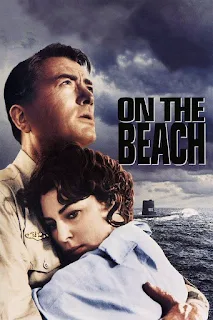
The movie was the 1959 release On the Beach, starring Gregory Peck, Ava Gardner, Anthony Perkins and Fred Astaire (in his first dramatic role.) Produced and directed by Stanley Kramer (known throughout his career for socially conscious films like Judgment at Nuremberg, Inherit the Wind and Guess Who's Coming To Dinner), the movie was based on the 1957 best-selling novel of the same title, by British/Australian novelist Nevil Shute.
The premise of both novel and movie is that a nuclear war has killed everyone in the northern hemisphere. US Navy Captain Dwight Towers (Peck) sails into the harbor of Melbourne, Australia, in the atomic submarine Swordfish which has been submerged and escaped the lethal radiation. He arrives at an Australian Navy base, where the Australian characters all know that air currents are slowly carrying the deadly fallout to them. They have five months to come to terms with the fact that death is inescapable, that they are among the last living humans because humanity has destroyed itself.
There is some talk about the war, though no one for sure seems to know what happened or even who started it. They occasionally wonder how humanity could create the conditions for its own extinction. But the characters mostly just adapt to their circumstance in their normal lives (they have little oil, for instance, and rely on bicycles, horses and electric trams.) Towers and the Australian military maintain discipline and chain of command to such an absurd extent that towards the end Towers is officially appointed head of the US Navy everywhere, as he is the highest ranking officer left alive, once his commander elsewhere in Australia is about to succumb to the radiation.
About halfway through the movie, The Swordfish goes on one last mission to the Arctic and down the US West Coast, to test a theory that the radiation might be dissipating (it isn't) and to locate the source of radio signals coming from San Diego, beeps from a telegraph key but in no discernible pattern.
The ship pauses briefly in San Francisco Bay, with indelible scenes of the periscope focusing on empty streets and undamaged buildings, and where a seaman jumps ship to spend his last few days in his hometown. In San Diego they find the signals are being keyed by a cola bottle tangled with a window sash, randomly striking the key as the wind blows.
There is more detail in the book about the war, and the use of what Shute calls cobalt bombs, hydrogen bombs that kill with huge amounts of long-lasting radiation. In the movie there appears to be little damage to buildings and infrastructure in San Francisco, which could mean it was not itself hit by bombs, or that these fictional bombs had the reputed (if unproven) characteristic of neutron bombs, of killing people but not destroying things with short-lived radiation.
In the book it is even clearer how most of the characters act with calm and heartbreaking grace. The movie as well tells the story of ordinary people--like those watching in the movie theater-- facing certain doom, but without gruesome scenes (even bodies are never seen) that might alienate viewers, or pulse-pounding action to distract them.
This depiction of the characters' behavior seems to reflect the more Stoic culture of Australia and the kind of diffidence that Shute usually presented in his novels but also (according to Shute) to make the point that nuclear war can happen to good ordinary people living their lives, through no fault of their own. However, it also models behavior in crisis, as well as showing the human race at its best, as it ends.

As the radiation approaches, there are drunken revelers and religious revivals in the city, as well as people calmly registering for their suicide pills, to avoid the lingering radiation sickness. The movie ends with the Swordfish returning to the sea, and shots of the now empty Melbourne streets, and the abandoned revival banner now meant for us: "There is Still Time...Brother."
Even towards the end, characters can't keep themselves from planting gardens and planning for a cancelled future. Each character has an arc of coming to terms in their own way. But it is this constant evocation of ordinary life coming to an end that gives this film such power.
Though Kramer's lyrical powers as a filmmaker were not quite up to Shute's writing, he hit exactly the right notes with the musical score, particularly the repeated theme with the melody of the Australian tune, "Waltzing Matilda." An orchestral version was released as a record, and made it to #47 on the Billboard charts.
The film was not a box office hit but eventually reached a large audience on television. It was more influential among opinion-makers. In a sense it was an ice-breaker, making the subject more acceptable for the movies, and making it generally more acceptable to question and even oppose nuclear weapons. Nobel Laureate and anti-Bomb activist Linus Pauling said, “It may be that some years from now we can look back and say that On the Beach is the movie that saved the world.”

A full Hollywood production with major stars, On the Beach was filmed almost entirely in and around Melbourne, Australia, partly because the US military refused its cooperation, specifically any Navy ships. So even at least one of the scenes set in the U.S. was shot in Australia. The submarine used in the movie belonged to Australia, refitted slightly to look like an atomic sub. Its interior was a set designed from photographs of the real thing.
The Pentagon had objected, not to the portrayal of the American military characters (their behavior is exemplary), but to the film's premise that nuclear war could end human civilization. Official policy was still that war involving nuclear weapons was "survivable." That conclusion was not shared by many scientists and others. On the Beach became the first major nuclear-themed movie to dramatize nuclear war as apocalyptic. It would not be the last.

If On the Beach changed the dialogue with empathy, the next important nuclear war-themed movie changed it with ridicule. In the early 1960s, director Stanley Kubrick became obsessed with the subject of thermonuclear war. He is said to have read Herman Kahn's 1960's book On Thermonuclear War which (unlike Poul Anderson's book of a similar title) provided rationales for nuclear wars.
Kubrick bought the rights to a suspense novel about an accidental nuclear war and began preliminary work on a script, but soon the absurdities inherent in the realistic events convinced him to transform it into a satirical comedy. So he began a new script with the novel's author Peter George and writer Terry Southern, that became the 1964 release Dr. Strangelove.
The story becomes no more absurd--or less plausible--in summary: officials in Washington learn that a strategic bomber group has gone past its fail-safe point and is on course to douse targets in Russia with nuclear bombs. They have been sent using a plan that allows lower level commanders to issue bombing orders, by a deranged officer who alone knows the recall code.
The US President calls the Soviet Premier and explains the situation, as the Soviet ambassador is invited into the War Room. The US cooperates with the Soviets to shoot down all the bombers but one. The recall code is finally sent but the bomber doesn't get it. It heads for its target.
 Meanwhile the Soviets reveal they have implanted a "doomsday device" that will plunge the world into nuclear holocaust if they are attacked (this device, which also used cobalt-wrapped hydrogen bombs, was a thought experiment by Kahn.)
Arguments ensue, the US people discuss surviving destruction by retreating to mine shafts and the Soviet ambassador engages the doomsday device. When the US bomber gets through and drops its bomb, it essentially blows up the planet, to the tune of a 1940s song, "We'll meet again."
 "Satire" or even "black comedy" are weak words to describe what Dr. Strangelove is. It describes not only nuclear war as insane, but the people who cause it as, in various ways, insane. It implies as well as the entire society that allows them to be leaders is itself insane.
This in itself was not a new thought. That society was insane became a notion at least as far back as between the world wars, as evidenced by Dadaism. But the Bomb seemed to seal the deal, and made the notion more mainstream,
For example, three books published in the mid-1950s (by psychologists Rollo May and Erich Fromm, and social commentator and historian Lewis Mumford) made the same analysis: the system of nuclear weapons was evidence and expression of an insane society, as well as a major contributor to driving it mad. By the mid-1960s (which also happened to be the golden age for popular satire), this was a widely held view.
But it had never been so thoroughly presented in a Hollywood film. Sterling Hayden's General Jack D. Ripper, whose delusions about the enemy messing with his "precious bodily fluids" begins the nuclear bomber attack on the Soviet Union, is the most obvious and best-remembered portrait of insanity.
But no less insane is Peter Seller's hyper-rational Dr. Strangelove himself, based on a combination of Herman Kahn and the future Secretary of State Henry Kissinger. (His pedigree as a German scientist with residual fealty to "my Fuhrer"--Seller's most brilliant character note--also suggests the German scientists in the American rocket program, like Wernher von Braun.)
Equally crazy as well is George C. Scott's infantile commanding Air Force General Buck Turgidson, a figure based on several actual top military leaders, especially General Curtis LeMay. Accounts of White House deliberations during the Cuban Missile Crisis of 1962 confirm Scott's portrayal as representing the attitude of these Generals that a first strike on the Soviet Union would amount to (as Turgidson says in the movie) "getting our hair mussed" with millions of dead (what Kahn had dubbed "megadeaths.") Their attitude was expressed sincerely by an American General who said that if after a nuclear war there are two Americans left and just one Soviet, then we win.

But no less insane are the overgrown cowboy who rides the Bomb like a bronco, Major Kong (played by the actor whose name sounds like the fictional ones: Slim Pickens) and one of the most minor characters, Colonel Bat Guano (Keenan Wynn) who won't enable a crucial phone call to be made to stop a thermonuclear war because it would involve damaging "private property"--a soft drink machine.
Some of the insanity is prompted by the characters' comic lack of awareness about sexual anxieties, which adds to the movie's hilarity and popularity. The movie brilliantly mixes cerebral satirical and "low" comedy (though the classic slapstick ending of a huge pie fight in the War Room didn't make the cut.)
The performances, which Kubrick encouraged to be over the top, contrast the emotionally childish and mentally wounded humans with their sober and deadly technology. It can be argued that the film's ending--the destruction of the world to an at best ironic old tune ("We'll meet again/ don't know where, don't know when") leaves the viewer off the hook, even if it is in the same spirit as the rest of the movie.

It was quickly followed by another Hollywood film, this time a drama with a similar if not completely apocalyptic plot, Fail-Safe (1964), directed by Sidney Lumet and starring Henry Fonda. This time humanity is taken to the brink by a technological accident.
Fail-Safe did not have the same impact, possibly because Dr. Strangelove came first, but probably also because the novel by Eugene Burdick and Harvey Wheeler it dramatized was a thoroughly-discussed best seller two years before, especially when it was serialized in the Saturday Evening Post during the Cuban Missile Crisis.
So it was Dr. Strangelove that at the very least encapsulated if not defined attitudes about the insanity of the Bomb and the nuclear arms race. The nuclear mystique was ridiculed away. A hit when it was released, Dr. Strangelove remains high on lists of classic films and film comedies.
 Needless to say, the Pentagon did not cooperate in the making of Dr. Strangelove either. The interior of the U.S. bomber was designed by extrapolating from a magazine photo. Stock footage (for the opening montage) and background landscapes filmed for this movie plus airplane models comprise the external flight scenes. And the War Room was entirely invented, although its absence in reality reportedly surprised and disappointed Ronald Reagan when he became President. There is a much smaller War Room in the White House now.
I saw Dr. Strangelove at a moviehouse when it came out, at least once. But I also saw it several years later in San Francisco, paired with The War Game, arguably the first film to confront the likely realities of atomic warfare as experienced by civilians where they live.

The War Game was commissioned by the BBC for television in the UK in 1965. It was written and directed by Peter Watkins, a feature film cinematographer and documentary filmmaker. It depicted events in the UK immediately before, during and after a thermonuclear exchange, using both an impressionistic and a documentary style. The aftermath is particularly brutal, with radiation sicknesses and deaths, looting, food riots and eventually a complete breakdown of society. The music it ends with is a version of "Silent Night."
The BBC refused to air it. It was released as a film in 1966, playing mostly at film festivals and in a few moviehouses, like the one where I happened to see it in 1967. It nevertheless won the 1967 Academy Award for Best Documentary, and a similar award in the UK. Roger Ebert called it "one of the most skillful documentaries ever made."
(Director Peter Watkins was just previously the cinematographer for the 1965 Beatles film Help! He urged John Lennon to use his influence on behalf of world peace, which led Lennon and Yoko Ono to their 1969 peace campaign, and the song "Give Peace A Chance.")
The War Game was the first to dramatize the effects of thermonuclear war on ordinary people, not as the easily survivable and limited tragedy as depicted for example in the 1954 US television production, "Atomic Attack" broadcast on the Motorola Television Hour. But it would be some twenty years before it had a widely seen successor.

The Vietnam War blunted attention to the Bomb, but the US and Soviet nuclear arms buildup in the early 1980s returned focus to nuclear threats. The theory of "nuclear winter" was proposed by Carl Sagan and other scientists that asserted that even a relatively small number of nuclear explosions would block enough sunlight to lead to planetary-wide death of huge proportions. The Nuclear Freeze movement (which referred to freezing the number of nuclear weapons) further emphasized the issue.
After The China Syndrome (a feature about a nuclear plant meltdown starring Jane Fonda) was a box-office hit (partly because shortly after it hit theatres, the meltdown at Three Mile Island happened), the ABC television network started developing a television movie about the effects of a nuclear war on a midwestern US city.

The Day After, directed by Nicholas Meyer and starring Jason Robards, aired on Sunday November 20, 1983. The movie followed a cast of characters in Lawrence, Kansas, before, during and after a nuclear attack. There were battles over censored scenes and cuts made to the film before airing. Nevertheless it was the most graphic representation of nuclear war to reach a wide audience, almost 40 years after Hiroshima.
As the main character, Jason Robards was a confident and wealthy doctor, husband and father. His family in Kansas City obliterated by the Bomb, he remained in the Lawrence hospital dealing with the medical effects (similar to the 1955 Medic episode), especially radiation. When he becomes a victim himself, he revisits his demolished home, tries to drive away a family squatting there but he is offered food. The final shot of his character, white hair falling out, embracing another old and dying man among the ruins, is this film's most indelible image.

The movie was castigated from the right as disloyal, and the New York Post branded director Meyer a traitor. It was criticized from the left for not depicting nuclear war as hellish enough, though the movie ended with a printed declaration that an actual nuclear attack would be far worse than the one depicted, which only added to its impact.
The US military refused assistance in making the film because it left open the question of which side had launched missiles at the other first.
The Day After holds the record for the largest audience for a movie in television history. One of its fans was President Ronald Reagan, and it reportedly led him to accelerate talks with the Soviet Union that led to a nuclear missile treaty. The movie was shown around the world, including in the Soviet Union.
There were two more notable dramatizations of nuclear war effects in the 1980s. The BBC produced Threads in 1984, which followed the consequences into the next generation of an ordinary UK town of Sheffield. It was notable also as the first depiction of nuclear winter.
It ends with survivors struggling in a burnt-out world, and a 12 year old giving birth screams at the sight of her stillborn baby. It was a harrowing ending to a truly horrifying film. The Guardian review called it "the most terrifying and honest portrayal of nuclear war ever filmed."
This time the BBC did air it, and a few years later paired a re-broadcast of Threads with the first UK broadcast of The War Games in 1986, 20 years after it was made. Threads also played in the US a few months after its UK airing. It was reputedly the most watched basic cable movie in history. That may be where I first saw it.
Another such film was Testament, made for PBS in 1983 but not broadcast immediately. It was released to theaters first, and aired in 1984. It starred Jane Alexander, and depicts the slow dissolution of a small town in northern California, just outside the blast area of San Francisco, as its residents succumb to radiation and societal breakdown. But it is mostly centered on one family, the poignancy of their emotions and actions, a much more realistic counterpoint to the family in the 1954 TV episode "Atomic Attack."
Each of these films builds in one way or another on the previous ones. Testament has the bravery of ordinary people of On The Beach. The characters decide on suicide, but can't go through with it. The ending--a melancholy birthday paired with a birthday party in the innocent past--suggest the same message to viewers: It is not too late.
And so far, it has turned out not to be. President Kennedy broke through with the Nuclear Test Ban Treaty in 1963, which had wide public support that surprised political and military leaders in the US and USSR. It's likely these films contributed to this consciousness.
Meaningful arms reductions accelerated in the 1980s, continuing after the dissolution of the Soviet Union. The issue has receded in current times, though there are still enough nuclear missile to destroy the world, many of them ready to launch. That receding has some bad effects, particularly the minimizing of what nuclear bombs really are. How the nature of the Bomb is different from other explosives and weapons is the implied or dramatized message of these films, including the atomic monster movies.
But if the perceived threat of instant nuclear Armageddon that hung over every minute of the 1950s through the 1980s has all but ended, one contributing factor is the perception of nuclear war as insane and suicidal that these stories--in print and on film--reflected, articulated and spread.
So comes the question of how all this applies to our future, and to the phenomena that most threatens it: the climate crisis, and effects (including pandemics) of an overweening human world dependent on a deeply wounded and distressed natural world.
Where are our climate crisis stories? Nicholas Barber and David Wallace-Wells are among the recent writers asking that question. They both list examples of the plethora of pop culture Armageddons and dystopias, especially in film and TV, caused by everything except a deformed climate. Wallace-Wells calls this an "incredible failure of imagination." But is that what it is?
 Both Barber and Wallace-Wells mention the one counter-example: The Day After Tomorrow, released in 2004--and a box office hit. It was the first and so far seemingly the only climate crisis-themed feature film.
One could argue that the pattern of stories confronting the climate crisis is the opposite of the Bomb stories pattern, in that a fairly literal Hollywood movie happened early (if you can consider 2004 as early for an oncoming crisis known since at least the 1950s.)
Made by the same team that created the hit Independence Day, this film dramatized a set of possible and extreme effects of sudden climate cataclysm, providing or at least referring to the actual science of climate change as it was known in 2004.
Though made and marketed as another future fantasy disaster adventure movie (the team went on to make 2012 and a version of Godzilla), its very title--obviously playing off the nuclear apocalypse of The Day After-- signaled a serious intent as a cautionary tale. There is still time, brother.

At the time The Day After Tomorrow was both hailed and criticized by climate scientists. It took liberties with scientific theories at the time, particularly in the time frame of its major disaster--the sudden deep-freeze of much of North America.
Today, scientists are much more worried about other phenomena than the possible movement of the Atlantic currents that precipitate the movie's crisis, but they've learned not to rule very much out, as the climate is deforming far faster than most models predicted. On the other hand, the opening scenes of climate effects--splitting glaciers, monster hail and sudden huge tornadoes--have been since seen on television news. What was fantasy is now documentary.

But though there have been nonfiction stories and documentaries, plus some fiction (notably Kim Stanley Robinson's 2017 novel, New York 2140, and his Science in the Capital trilogy of novels in the 1990s, which he edited and combined into Green Earth in 2015), Hollywood and all the new and old television entities have arguably not followed up on The Day After Tomorrow.
Barber suggests there haven't been other climate themed films because they don't fit into the Hollywood film form. Could it be, he asks, that climate crisis effects are so immense in extent--global, in fact-- that "it’s just too big and overwhelming for a two-hour adventure" and "it can’t be fixed by a hero defeating a villain?"
Maybe, but probably not. There weren't heroes defeating villains in the later Bomb movies (though that was a reassuring feature of the atomic monster flicks.) And it's hard to define "failure of imagination" in this context.
The atomic era movies can suggest some of the reasons why there haven't been climate crisis films. Let's start with two.
The first is politics, and all the money and power expended to form public opinion. The US government went to great lengths to make questioning nuclear weapons seem disloyal and stupid. Though Republicans went farther in its demonizations, there was so much at stake and so much of US industry, science and universities were invested, that the mainstream of both political parties--much less polarized than today--maintained the fortress of enforced silence, along with the necessary lying.
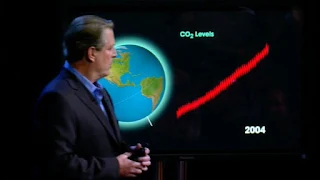 Climate seemed a bipartisan issue for awhile, but the flashpoint might have been the 2006 book and film An Inconvenient Truth by the Democratic presidential candidate who won the popular vote in the 2000 election, Al Gore. Soon after that, no Republican could recognize the reality of the climate crisis any more than they could admit that trickle down economics never works. The influence of big money from the fossil fuel industry, working behind the scenes as well as overtly, cannot be underestimated. Hollywood studios today are no longer independently owned.
As noted above, the US military withheld its assistance to movies that questioned nuclear doctrine, and the right wing--and even moderates--questioned the patriotism of those who questioned the sanity of nuclear weapons. That's one reason that, during or soon after the Blacklist, the undermining of the official view was done by giant ants and fire-breathing and irradiated creatures from prehistory and, not incidentally, from mythology.
The second reason is psychology, principally the denial that is both the villain and (in different contexts) the heroic quality of atomic war films. Wallace-Wells suggests an interesting twist: ecopsychology. The climate crisis and related deformations of the natural world that sustains us and all present life challenge our psychological relationship to nature, as it has solidified in the industrial age. In 1930 Ortega y Gasset wrote that a defining feature of modernity was the inability of the mass of humanity to distinguish between the natural and the artificial. That's only the beginning of our warped relationship with the natural world.
Climate crisis denial appropriates the psychological term as well as the simple meaning. Denial in its most complete sense--denying that something exists or is threatening, etc.--is partly a product of helplessness. People felt helpless about nuclear weapons, because they are beyond the power of an individual to stop, the weapons are in themselves so overwhelmingly powerful, and because the politics and paradox of deterrence forced them to accept nuclear weapons. People feel helpless about the climate crisis because it is beyond the power of individuals to stop it, it is so enormous and complex, and because it seems that addressing it will have a steep cost in the present, for an uncertain future benefit.
However, as we are learning in connection with the intractable problems of racism, once the feeling of powerlessness goes, the denial goes with it. Perhaps a sign of the sense of powerlessness abating is when a realistic (as opposed to metaphorical) story on film or TV is made and is as influential and popular as On the Beach, Dr. Strangelove or The Day After.
 In any case, while I share the frustration and am also puzzled by the avoidance of climate themes, it seems some of these apocalyptic films can be regarded as the equivalent of the atomic monster movies--symbolically and metaphorically about climate crisis effects, particularly the breakdown of society and the stark division of rich and poor.
This is obvious in The Hunger Games series and similar stories but also in the once-fashionable vampire genre and the still prevalent zombie genre. Together they form the same picture: the blood-sucking vampire rich and the mass of blood-drained undead zombies. (Apparently Kim Stanley Robinson noticed this at about the same time I did, but he has a bigger platform. As well as the patent on Zombies v. Vampires.)
The similarity to atomic monster movies breaks down however in terms of cause: the monsters were awakened and augmented or caused by the Bomb, these movies said; but in contemporary apocalyptic and dystopic stories, the failure to mention a deformed climate as a cause significantly weakens their function as cautionary tales, the There's Still Time, Brother effect.
 However, just as Bomb themes in print preceded them on film, science fiction writers are publishing climate themed stories, already pigeonholed as "ecofictions" and "cli/fi." Perhaps one of these will inspire the next climate crisis feature. As was the case with nuclear weapons in the 1980s (if not before), there is a vast public ready for the right stories.
Wallace-Wells argues that it may already be too late--that the realities of the climate crisis are becoming too obvious, and will soon be all-consuming, for anyone to be interested in cautionary tales and climate fiction. Maybe, but maybe not. While it is true that one might not want to watch a movie about nuclear war while living in or after one, climate crisis effects are so various, so local and so long in time, that the appetite for these stories may in fact increase.

The ultimate question is: can climate-themed stories make a difference to the real future? A few months ago it would have seemed very unlikely, even as it still seems it might be too late. But as we've learned recently, things can change radically very fast... And Kim Stanley Robinson has a new near-future novel coming out later this year that deals in part with climate themes, called The Ministry of the Future. Who knows--maybe there will be an actual Secretary of the Future in 2025.
At this point you may be wondering whether any of this applies to pandemic-themed stories. The short answer is that the taboos that barred the way to nuclear and climate themed stories don't appear to be in force, at least not yet.
Besides, there should be no problem for Hollywood to fit pandemic stories into existing genres, or combinations of them: from the medical procedural and the race for a cure to the scary extreme, which would be the zombie apocalypse stories. There have already been successful pandemic films, like The Andromeda Strain and Contagion. Our current reality may make new fictions of this kind too scary. But Hollywood is very likely to try a few. If they can get back to making movies anytime soon.

The movie was the 1959 release On the Beach, starring Gregory Peck, Ava Gardner, Anthony Perkins and Fred Astaire (in his first dramatic role.) Produced and directed by Stanley Kramer (known throughout his career for socially conscious films like Judgment at Nuremberg, Inherit the Wind and Guess Who's Coming To Dinner), the movie was based on the 1957 best-selling novel of the same title, by British/Australian novelist Nevil Shute.
The premise of both novel and movie is that a nuclear war has killed everyone in the northern hemisphere. US Navy Captain Dwight Towers (Peck) sails into the harbor of Melbourne, Australia, in the atomic submarine Swordfish which has been submerged and escaped the lethal radiation. He arrives at an Australian Navy base, where the Australian characters all know that air currents are slowly carrying the deadly fallout to them. They have five months to come to terms with the fact that death is inescapable, that they are among the last living humans because humanity has destroyed itself.
There is some talk about the war, though no one for sure seems to know what happened or even who started it. They occasionally wonder how humanity could create the conditions for its own extinction. But the characters mostly just adapt to their circumstance in their normal lives (they have little oil, for instance, and rely on bicycles, horses and electric trams.) Towers and the Australian military maintain discipline and chain of command to such an absurd extent that towards the end Towers is officially appointed head of the US Navy everywhere, as he is the highest ranking officer left alive, once his commander elsewhere in Australia is about to succumb to the radiation.
 |
| Gregory Peck, Anthony Perkins, Fred Astaire |
About halfway through the movie, The Swordfish goes on one last mission to the Arctic and down the US West Coast, to test a theory that the radiation might be dissipating (it isn't) and to locate the source of radio signals coming from San Diego, beeps from a telegraph key but in no discernible pattern.
The ship pauses briefly in San Francisco Bay, with indelible scenes of the periscope focusing on empty streets and undamaged buildings, and where a seaman jumps ship to spend his last few days in his hometown. In San Diego they find the signals are being keyed by a cola bottle tangled with a window sash, randomly striking the key as the wind blows.
There is more detail in the book about the war, and the use of what Shute calls cobalt bombs, hydrogen bombs that kill with huge amounts of long-lasting radiation. In the movie there appears to be little damage to buildings and infrastructure in San Francisco, which could mean it was not itself hit by bombs, or that these fictional bombs had the reputed (if unproven) characteristic of neutron bombs, of killing people but not destroying things with short-lived radiation.
In the book it is even clearer how most of the characters act with calm and heartbreaking grace. The movie as well tells the story of ordinary people--like those watching in the movie theater-- facing certain doom, but without gruesome scenes (even bodies are never seen) that might alienate viewers, or pulse-pounding action to distract them.
This depiction of the characters' behavior seems to reflect the more Stoic culture of Australia and the kind of diffidence that Shute usually presented in his novels but also (according to Shute) to make the point that nuclear war can happen to good ordinary people living their lives, through no fault of their own. However, it also models behavior in crisis, as well as showing the human race at its best, as it ends.

As the radiation approaches, there are drunken revelers and religious revivals in the city, as well as people calmly registering for their suicide pills, to avoid the lingering radiation sickness. The movie ends with the Swordfish returning to the sea, and shots of the now empty Melbourne streets, and the abandoned revival banner now meant for us: "There is Still Time...Brother."
Even towards the end, characters can't keep themselves from planting gardens and planning for a cancelled future. Each character has an arc of coming to terms in their own way. But it is this constant evocation of ordinary life coming to an end that gives this film such power.
Though Kramer's lyrical powers as a filmmaker were not quite up to Shute's writing, he hit exactly the right notes with the musical score, particularly the repeated theme with the melody of the Australian tune, "Waltzing Matilda." An orchestral version was released as a record, and made it to #47 on the Billboard charts.
The film was not a box office hit but eventually reached a large audience on television. It was more influential among opinion-makers. In a sense it was an ice-breaker, making the subject more acceptable for the movies, and making it generally more acceptable to question and even oppose nuclear weapons. Nobel Laureate and anti-Bomb activist Linus Pauling said, “It may be that some years from now we can look back and say that On the Beach is the movie that saved the world.”

A full Hollywood production with major stars, On the Beach was filmed almost entirely in and around Melbourne, Australia, partly because the US military refused its cooperation, specifically any Navy ships. So even at least one of the scenes set in the U.S. was shot in Australia. The submarine used in the movie belonged to Australia, refitted slightly to look like an atomic sub. Its interior was a set designed from photographs of the real thing.
The Pentagon had objected, not to the portrayal of the American military characters (their behavior is exemplary), but to the film's premise that nuclear war could end human civilization. Official policy was still that war involving nuclear weapons was "survivable." That conclusion was not shared by many scientists and others. On the Beach became the first major nuclear-themed movie to dramatize nuclear war as apocalyptic. It would not be the last.

If On the Beach changed the dialogue with empathy, the next important nuclear war-themed movie changed it with ridicule. In the early 1960s, director Stanley Kubrick became obsessed with the subject of thermonuclear war. He is said to have read Herman Kahn's 1960's book On Thermonuclear War which (unlike Poul Anderson's book of a similar title) provided rationales for nuclear wars.
Kubrick bought the rights to a suspense novel about an accidental nuclear war and began preliminary work on a script, but soon the absurdities inherent in the realistic events convinced him to transform it into a satirical comedy. So he began a new script with the novel's author Peter George and writer Terry Southern, that became the 1964 release Dr. Strangelove.
 |
| Sterling Hayden as General Jack D. Ripper |
The story becomes no more absurd--or less plausible--in summary: officials in Washington learn that a strategic bomber group has gone past its fail-safe point and is on course to douse targets in Russia with nuclear bombs. They have been sent using a plan that allows lower level commanders to issue bombing orders, by a deranged officer who alone knows the recall code.
 |
| Slim Pickens, last actor to be cast in a scene Kubrick dreamed up at the last minute, now the film's most iconic image. |

Arguments ensue, the US people discuss surviving destruction by retreating to mine shafts and the Soviet ambassador engages the doomsday device. When the US bomber gets through and drops its bomb, it essentially blows up the planet, to the tune of a 1940s song, "We'll meet again."

This in itself was not a new thought. That society was insane became a notion at least as far back as between the world wars, as evidenced by Dadaism. But the Bomb seemed to seal the deal, and made the notion more mainstream,
For example, three books published in the mid-1950s (by psychologists Rollo May and Erich Fromm, and social commentator and historian Lewis Mumford) made the same analysis: the system of nuclear weapons was evidence and expression of an insane society, as well as a major contributor to driving it mad. By the mid-1960s (which also happened to be the golden age for popular satire), this was a widely held view.
 |
| Peter Sellers as Dr. Strangelove |
But it had never been so thoroughly presented in a Hollywood film. Sterling Hayden's General Jack D. Ripper, whose delusions about the enemy messing with his "precious bodily fluids" begins the nuclear bomber attack on the Soviet Union, is the most obvious and best-remembered portrait of insanity.
But no less insane is Peter Seller's hyper-rational Dr. Strangelove himself, based on a combination of Herman Kahn and the future Secretary of State Henry Kissinger. (His pedigree as a German scientist with residual fealty to "my Fuhrer"--Seller's most brilliant character note--also suggests the German scientists in the American rocket program, like Wernher von Braun.)
 |
| George C. Scott as Gen. Buck Turgidsen |
Equally crazy as well is George C. Scott's infantile commanding Air Force General Buck Turgidson, a figure based on several actual top military leaders, especially General Curtis LeMay. Accounts of White House deliberations during the Cuban Missile Crisis of 1962 confirm Scott's portrayal as representing the attitude of these Generals that a first strike on the Soviet Union would amount to (as Turgidson says in the movie) "getting our hair mussed" with millions of dead (what Kahn had dubbed "megadeaths.") Their attitude was expressed sincerely by an American General who said that if after a nuclear war there are two Americans left and just one Soviet, then we win.

But no less insane are the overgrown cowboy who rides the Bomb like a bronco, Major Kong (played by the actor whose name sounds like the fictional ones: Slim Pickens) and one of the most minor characters, Colonel Bat Guano (Keenan Wynn) who won't enable a crucial phone call to be made to stop a thermonuclear war because it would involve damaging "private property"--a soft drink machine.
Insane circumstances also made the rote mechanistic behavior and cool, precise astronaut diction of the bomber crewmen (played by James Earl Jones and Frank Berry) seem functionally insane. Meanwhile the only sensible characters (President Muffley and Group Captain Mandrake, both played by Peter Sellers) became straight men and enablers. (Apparently a crazy President was too scary a thought.) Some are clearly exaggerations—and yet, none is truly unreal.
 |
| Dr. S. opens with US gov footage of plane refueled in mid-air to suggest sexual subtext |
The performances, which Kubrick encouraged to be over the top, contrast the emotionally childish and mentally wounded humans with their sober and deadly technology. It can be argued that the film's ending--the destruction of the world to an at best ironic old tune ("We'll meet again/ don't know where, don't know when") leaves the viewer off the hook, even if it is in the same spirit as the rest of the movie.

It was quickly followed by another Hollywood film, this time a drama with a similar if not completely apocalyptic plot, Fail-Safe (1964), directed by Sidney Lumet and starring Henry Fonda. This time humanity is taken to the brink by a technological accident.
Fail-Safe did not have the same impact, possibly because Dr. Strangelove came first, but probably also because the novel by Eugene Burdick and Harvey Wheeler it dramatized was a thoroughly-discussed best seller two years before, especially when it was serialized in the Saturday Evening Post during the Cuban Missile Crisis.
So it was Dr. Strangelove that at the very least encapsulated if not defined attitudes about the insanity of the Bomb and the nuclear arms race. The nuclear mystique was ridiculed away. A hit when it was released, Dr. Strangelove remains high on lists of classic films and film comedies.

I saw Dr. Strangelove at a moviehouse when it came out, at least once. But I also saw it several years later in San Francisco, paired with The War Game, arguably the first film to confront the likely realities of atomic warfare as experienced by civilians where they live.

The War Game was commissioned by the BBC for television in the UK in 1965. It was written and directed by Peter Watkins, a feature film cinematographer and documentary filmmaker. It depicted events in the UK immediately before, during and after a thermonuclear exchange, using both an impressionistic and a documentary style. The aftermath is particularly brutal, with radiation sicknesses and deaths, looting, food riots and eventually a complete breakdown of society. The music it ends with is a version of "Silent Night."
The BBC refused to air it. It was released as a film in 1966, playing mostly at film festivals and in a few moviehouses, like the one where I happened to see it in 1967. It nevertheless won the 1967 Academy Award for Best Documentary, and a similar award in the UK. Roger Ebert called it "one of the most skillful documentaries ever made."
(Director Peter Watkins was just previously the cinematographer for the 1965 Beatles film Help! He urged John Lennon to use his influence on behalf of world peace, which led Lennon and Yoko Ono to their 1969 peace campaign, and the song "Give Peace A Chance.")
The War Game was the first to dramatize the effects of thermonuclear war on ordinary people, not as the easily survivable and limited tragedy as depicted for example in the 1954 US television production, "Atomic Attack" broadcast on the Motorola Television Hour. But it would be some twenty years before it had a widely seen successor.

The Vietnam War blunted attention to the Bomb, but the US and Soviet nuclear arms buildup in the early 1980s returned focus to nuclear threats. The theory of "nuclear winter" was proposed by Carl Sagan and other scientists that asserted that even a relatively small number of nuclear explosions would block enough sunlight to lead to planetary-wide death of huge proportions. The Nuclear Freeze movement (which referred to freezing the number of nuclear weapons) further emphasized the issue.
After The China Syndrome (a feature about a nuclear plant meltdown starring Jane Fonda) was a box-office hit (partly because shortly after it hit theatres, the meltdown at Three Mile Island happened), the ABC television network started developing a television movie about the effects of a nuclear war on a midwestern US city.

The Day After, directed by Nicholas Meyer and starring Jason Robards, aired on Sunday November 20, 1983. The movie followed a cast of characters in Lawrence, Kansas, before, during and after a nuclear attack. There were battles over censored scenes and cuts made to the film before airing. Nevertheless it was the most graphic representation of nuclear war to reach a wide audience, almost 40 years after Hiroshima.
As the main character, Jason Robards was a confident and wealthy doctor, husband and father. His family in Kansas City obliterated by the Bomb, he remained in the Lawrence hospital dealing with the medical effects (similar to the 1955 Medic episode), especially radiation. When he becomes a victim himself, he revisits his demolished home, tries to drive away a family squatting there but he is offered food. The final shot of his character, white hair falling out, embracing another old and dying man among the ruins, is this film's most indelible image.

The movie was castigated from the right as disloyal, and the New York Post branded director Meyer a traitor. It was criticized from the left for not depicting nuclear war as hellish enough, though the movie ended with a printed declaration that an actual nuclear attack would be far worse than the one depicted, which only added to its impact.
The US military refused assistance in making the film because it left open the question of which side had launched missiles at the other first.
The Day After holds the record for the largest audience for a movie in television history. One of its fans was President Ronald Reagan, and it reportedly led him to accelerate talks with the Soviet Union that led to a nuclear missile treaty. The movie was shown around the world, including in the Soviet Union.
 |
| Threads |
There were two more notable dramatizations of nuclear war effects in the 1980s. The BBC produced Threads in 1984, which followed the consequences into the next generation of an ordinary UK town of Sheffield. It was notable also as the first depiction of nuclear winter.
It ends with survivors struggling in a burnt-out world, and a 12 year old giving birth screams at the sight of her stillborn baby. It was a harrowing ending to a truly horrifying film. The Guardian review called it "the most terrifying and honest portrayal of nuclear war ever filmed."
This time the BBC did air it, and a few years later paired a re-broadcast of Threads with the first UK broadcast of The War Games in 1986, 20 years after it was made. Threads also played in the US a few months after its UK airing. It was reputedly the most watched basic cable movie in history. That may be where I first saw it.
 |
| Jane Alexander in Testament |
Another such film was Testament, made for PBS in 1983 but not broadcast immediately. It was released to theaters first, and aired in 1984. It starred Jane Alexander, and depicts the slow dissolution of a small town in northern California, just outside the blast area of San Francisco, as its residents succumb to radiation and societal breakdown. But it is mostly centered on one family, the poignancy of their emotions and actions, a much more realistic counterpoint to the family in the 1954 TV episode "Atomic Attack."
Each of these films builds in one way or another on the previous ones. Testament has the bravery of ordinary people of On The Beach. The characters decide on suicide, but can't go through with it. The ending--a melancholy birthday paired with a birthday party in the innocent past--suggest the same message to viewers: It is not too late.
 |
| President Kennedy with Curtis LeMay and other generals during Cuban Missile Crisis. He defied them and proposed the Nuclear Test Ban Treaty, the first step away from the brink. |
And so far, it has turned out not to be. President Kennedy broke through with the Nuclear Test Ban Treaty in 1963, which had wide public support that surprised political and military leaders in the US and USSR. It's likely these films contributed to this consciousness.
Meaningful arms reductions accelerated in the 1980s, continuing after the dissolution of the Soviet Union. The issue has receded in current times, though there are still enough nuclear missile to destroy the world, many of them ready to launch. That receding has some bad effects, particularly the minimizing of what nuclear bombs really are. How the nature of the Bomb is different from other explosives and weapons is the implied or dramatized message of these films, including the atomic monster movies.
But if the perceived threat of instant nuclear Armageddon that hung over every minute of the 1950s through the 1980s has all but ended, one contributing factor is the perception of nuclear war as insane and suicidal that these stories--in print and on film--reflected, articulated and spread.
So comes the question of how all this applies to our future, and to the phenomena that most threatens it: the climate crisis, and effects (including pandemics) of an overweening human world dependent on a deeply wounded and distressed natural world.
Where are our climate crisis stories? Nicholas Barber and David Wallace-Wells are among the recent writers asking that question. They both list examples of the plethora of pop culture Armageddons and dystopias, especially in film and TV, caused by everything except a deformed climate. Wallace-Wells calls this an "incredible failure of imagination." But is that what it is?

One could argue that the pattern of stories confronting the climate crisis is the opposite of the Bomb stories pattern, in that a fairly literal Hollywood movie happened early (if you can consider 2004 as early for an oncoming crisis known since at least the 1950s.)
Made by the same team that created the hit Independence Day, this film dramatized a set of possible and extreme effects of sudden climate cataclysm, providing or at least referring to the actual science of climate change as it was known in 2004.
Though made and marketed as another future fantasy disaster adventure movie (the team went on to make 2012 and a version of Godzilla), its very title--obviously playing off the nuclear apocalypse of The Day After-- signaled a serious intent as a cautionary tale. There is still time, brother.

At the time The Day After Tomorrow was both hailed and criticized by climate scientists. It took liberties with scientific theories at the time, particularly in the time frame of its major disaster--the sudden deep-freeze of much of North America.
Today, scientists are much more worried about other phenomena than the possible movement of the Atlantic currents that precipitate the movie's crisis, but they've learned not to rule very much out, as the climate is deforming far faster than most models predicted. On the other hand, the opening scenes of climate effects--splitting glaciers, monster hail and sudden huge tornadoes--have been since seen on television news. What was fantasy is now documentary.

But though there have been nonfiction stories and documentaries, plus some fiction (notably Kim Stanley Robinson's 2017 novel, New York 2140, and his Science in the Capital trilogy of novels in the 1990s, which he edited and combined into Green Earth in 2015), Hollywood and all the new and old television entities have arguably not followed up on The Day After Tomorrow.
Barber suggests there haven't been other climate themed films because they don't fit into the Hollywood film form. Could it be, he asks, that climate crisis effects are so immense in extent--global, in fact-- that "it’s just too big and overwhelming for a two-hour adventure" and "it can’t be fixed by a hero defeating a villain?"
Maybe, but probably not. There weren't heroes defeating villains in the later Bomb movies (though that was a reassuring feature of the atomic monster flicks.) And it's hard to define "failure of imagination" in this context.
The atomic era movies can suggest some of the reasons why there haven't been climate crisis films. Let's start with two.
The first is politics, and all the money and power expended to form public opinion. The US government went to great lengths to make questioning nuclear weapons seem disloyal and stupid. Though Republicans went farther in its demonizations, there was so much at stake and so much of US industry, science and universities were invested, that the mainstream of both political parties--much less polarized than today--maintained the fortress of enforced silence, along with the necessary lying.

As noted above, the US military withheld its assistance to movies that questioned nuclear doctrine, and the right wing--and even moderates--questioned the patriotism of those who questioned the sanity of nuclear weapons. That's one reason that, during or soon after the Blacklist, the undermining of the official view was done by giant ants and fire-breathing and irradiated creatures from prehistory and, not incidentally, from mythology.
The second reason is psychology, principally the denial that is both the villain and (in different contexts) the heroic quality of atomic war films. Wallace-Wells suggests an interesting twist: ecopsychology. The climate crisis and related deformations of the natural world that sustains us and all present life challenge our psychological relationship to nature, as it has solidified in the industrial age. In 1930 Ortega y Gasset wrote that a defining feature of modernity was the inability of the mass of humanity to distinguish between the natural and the artificial. That's only the beginning of our warped relationship with the natural world.
Climate crisis denial appropriates the psychological term as well as the simple meaning. Denial in its most complete sense--denying that something exists or is threatening, etc.--is partly a product of helplessness. People felt helpless about nuclear weapons, because they are beyond the power of an individual to stop, the weapons are in themselves so overwhelmingly powerful, and because the politics and paradox of deterrence forced them to accept nuclear weapons. People feel helpless about the climate crisis because it is beyond the power of individuals to stop it, it is so enormous and complex, and because it seems that addressing it will have a steep cost in the present, for an uncertain future benefit.
However, as we are learning in connection with the intractable problems of racism, once the feeling of powerlessness goes, the denial goes with it. Perhaps a sign of the sense of powerlessness abating is when a realistic (as opposed to metaphorical) story on film or TV is made and is as influential and popular as On the Beach, Dr. Strangelove or The Day After.

This is obvious in The Hunger Games series and similar stories but also in the once-fashionable vampire genre and the still prevalent zombie genre. Together they form the same picture: the blood-sucking vampire rich and the mass of blood-drained undead zombies. (Apparently Kim Stanley Robinson noticed this at about the same time I did, but he has a bigger platform. As well as the patent on Zombies v. Vampires.)
The similarity to atomic monster movies breaks down however in terms of cause: the monsters were awakened and augmented or caused by the Bomb, these movies said; but in contemporary apocalyptic and dystopic stories, the failure to mention a deformed climate as a cause significantly weakens their function as cautionary tales, the There's Still Time, Brother effect.

Wallace-Wells argues that it may already be too late--that the realities of the climate crisis are becoming too obvious, and will soon be all-consuming, for anyone to be interested in cautionary tales and climate fiction. Maybe, but maybe not. While it is true that one might not want to watch a movie about nuclear war while living in or after one, climate crisis effects are so various, so local and so long in time, that the appetite for these stories may in fact increase.

The ultimate question is: can climate-themed stories make a difference to the real future? A few months ago it would have seemed very unlikely, even as it still seems it might be too late. But as we've learned recently, things can change radically very fast... And Kim Stanley Robinson has a new near-future novel coming out later this year that deals in part with climate themes, called The Ministry of the Future. Who knows--maybe there will be an actual Secretary of the Future in 2025.
At this point you may be wondering whether any of this applies to pandemic-themed stories. The short answer is that the taboos that barred the way to nuclear and climate themed stories don't appear to be in force, at least not yet.
Besides, there should be no problem for Hollywood to fit pandemic stories into existing genres, or combinations of them: from the medical procedural and the race for a cure to the scary extreme, which would be the zombie apocalypse stories. There have already been successful pandemic films, like The Andromeda Strain and Contagion. Our current reality may make new fictions of this kind too scary. But Hollywood is very likely to try a few. If they can get back to making movies anytime soon.


.jpg)