Friday, March 22, 2019

In Memoriam

Very early this morning--at 2:20 a.m.--marks the 45th anniversary of my mother's death.   Flora Severini Kowinski bore three children, my sisters and me, and lived to know one grandchild.  Eventually there were three grandchildren, all girls.  Now there are five great-grandchildren, all boys but one.

Despite the technical difficulties in rescuing this old print, this is the best photo I ever took (you need to click on it to get the entire photo.)  That's my mother, my sister Kathy and grandfather facing the camera, with my sister Debbie facing them.  I took this squeezing between the sink and the table in my grandparents' tiny kitchen, out of which came so many wonderful meals.  I caught a moment in their card game--such spontaneous moments weren't often considered appropriate for photos back then.

At this time of year I often wish we'd had more time, especially in the middle and later years of my life when I had enough perspective to hear about her life.  But the opening lines of the second Merwin poem I posted had special and specific meaning for me as this anniversary arrives:

  All day the stars watch from long ago
my mother said I am going now
when you are alone you will be all right
whether or not you know you will know

Wednesday, March 20, 2019

R.I.P. W. S. Merwin (1927-2019)


Once Later

It is not until later
that you have to be young

it is one of those things
you meant to do later

but by then there is
someone else living there

with the shades rolled down
how could you have been young there

at that time
with all that was expected

then what happened to
the expectations

there is no sign of them there
a shadow passes across the window shade

what do they know in there
whoever they are

W.S. Merwin
published in New York Review of Books
May 7,2015


Rain Light

All day the stars watch from long ago
my mother said I am going now
when you are alone you will be all right
whether or not you know you will know
look at the old house in the dawn rain
all the flowers are forms of water
the sun reminds them through a white cloud
touches the patchwork spread on the hill
the washed colors of the afterlife
that lived there long before you were born
see how they wake without a question
even though the whole world is burning

W.S. Merwin
published in the New Yorker
March 2008

Merwin, a hero among poets since the 1960s, not only defended the forests but planted one.  The world he spoke for has lost its voice.  And yet..tomorrow we wake without question, even though the whole world is burning.

Thursday, March 14, 2019

History of My Reading/ The Ghost, Lucretia Parsnips and The Great Turkey Heist of 1965


Note to Knox readers: In addition to the usual stuff, this post includes a 54 year old news story.  For the first time anywhere, names are revealed of at least some of the participants in the notorious crime of 1965: the Great Turkey Heist. Read on (or skip down.)

Flipping through a complete set of Knox Students for the 1965-66 school year reveals a few trends.  The college--students, faculty and administrators--was highly focused on the college, with the ongoing Faculty Planning Committee and its preliminary reports, and with pages of Letters to the Editor in the regimes of editors Ed Rust and Bill Barnhart.  Vietnam and related issues began to appear with increasing frequency.   Computers were mentioned, including the Computer Science major to be offered the following year.

Michael Chubrich (right) in debate, Judy Dugan
moderating, Len Borden taking notes. Gale photo.
Michael Chubrich took over as Student Senate president, promising sweeping changes. Guests on campus included Senator Paul Simon of Illinois, J. Allen Hynek, the UFO advocate, the classic filmmaker Joseph Von Sternberg (The Blue Angel) and poets Mark Van Doren, Robert Bly and James Dickey.

Knox theatre's mainstage productions were Shakespeare's The Taming of the Shrew (the last ever to be directed by departing professor Kim Chase) and The Mikado. Kevern Cameron directed Waiting for Godot, locating it in a circus.

Among the Social Board movies was To Kill A Mockingbird.  A few Cinema Club titles inevitably suggest the college ambience: My Life To Live, The Exterminating Angel, Through A Glass Darkly, La Dolce Vita, The End of Innocence.

Immediately upon my return to Knox in the fall of 1965 for my second year, I was very, very busy.  I was news director of WVKC, the campus radio station, and doing music shows as well, which required selecting music from the station's record library (or bringing my own albums), creating a playlist for the engineer, and using a copy of it for my on-air introductions.

I did jazz and folk shows, and filled in occasionally for classical shows--while adopting a slightly different voice suitable for each form (folksy, cool, FM-whispery).  I already had my news voice(s).  As the year wore on and I got more tired and bored, my David Brinkleyisms on the ten o'clock news became more outrageous.

I did have one distinction: I was the first DJ in Knox history to legitimately play a rock song.  They had been forbidden, until the station director (Mike Bourgo) bowed to the inevitable.  The first rock song?  "Help!" by the Beatles. (It was at the end of an original radio mystery that Skip Peterson and I wrote.) My summer conversion to the Beatles was continuing--I was rapidly accumulating Beatles records and other material, as we shall see (read on.)  There was some negative reaction to WVKC's belated rock revolution, however-- from students (including an offended letter to the editor.)

One more note about WVKC.  In February (1966), the first combat death in Vietnam of a Knox alumnus was recorded: Albert Merriman Smith, class of 1960. He'd also worked at WVKC.  His father (also Albert Merriman Smith, though he'd dropped the "Albert" professionally) was the White House correspondent for United Press International, one of the wire news services we used for our newscasts.

I became an editor of Dialogue, the campus essay and issues magazine, now established in its second year.  I joined the editorial board (with students Kevern Cameron, Steve Goldberg and Dennis Stepanek, and faculty members Douglas Wilson, Gordon Dodds and John Pascucci) and by spring, I was functionally the managing editor, preparing the issue for press.

I also began writing a column for the Knox Student, called Metaphor.  I started with a piece ostensibly "explicating" the expression "one book man." For a long time I thought I'd embarrassed myself by totally misunderstanding it. In 1965 I thought it meant a dogmatic person who derived their beliefs from the equivalent of one book.  Later it seemed it really meant an author who manages to write or at least publish only one book.  (An example of that would unfortunately be me.)  But it turns out that the original phrase "man of one book" from Thomas Aquinas meant what I thought it meant in 1965.
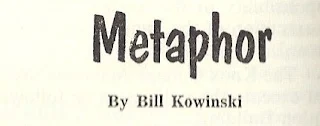
The only Metaphor column anyone remembers was one I wrote on a particularly frenzied night in November (I think I wrote it at the Toddle House, where I spent many late nights after my midnight radio show) that used a strange punning language to describe the weekend as a society or gossip columnist would--in this case "Lucretia Parsnips" or movie columnist Louella Parsons.  The names in particular drew attention (for example,"kafka livingston" was Kathy Lydigsen, "maybe jefferson" was Mary Jacobson, who returned the favor by dubbing me "big coincidence.")

Afterwards I heard from at least one English faculty member about my "Joycean" language, derived from Finnegans Wake by James Joyce.  I smiled and nodded knowingly but in fact I'd never looked at a page of Finnegans Wake.  My model was John Lennon, whose similar punning style was on display in two books, the recently published A Spaniard in the Works and the earlier In His Own Write, which I'd absorbed over the summer.  However, I hastened to acquaint myself with the works of James Joyce outside of A Portrait of the Artist--and he became an obsession for many years.

I have since learned that my experience essentially replicated John Lennon's. When his first book came out, a critic mentioned its Joycean origins, but Lennon hadn't read Joyce either--though he did after he'd been influenced by him.

My fellow columnists for the first semester were Kevern  "Casey"Cameron ("The Noisemaker") and Skip Peterson ("The Styleboat Skipper.") Cameron ignited a letters debate between Professors Brady and Doug Wilson, and Skip and I were envious.  But the three of us also collaborated in different combinations (I believe we may have written each other's columns once--I'm pretty sure I wrote a spoof of Cameron's.) I'm sure the three of us once got together to write a combined letter to the editor we thought was hilarious, after which we repaired to the BV for more liquid refreshment, returning to campus arm and arm and singing, a unique experience in my college career.

Unidentified Englishman (probably a duke by now)
and me
I was still active in the Knox debate club, and in particular participated in a debate with two touring student debaters from Cambridge University in England.  Judy Dugan and I were each paired with one of these lads, on one side or the other of the topic (as we say in America), or the question (as they say in Brit.)  Judy and I did our standard research and serious preparation on whatever it was.  But the Brits were much looser, employing wit, rhetoric and sometimes fanciful argument.  I eventually got into the spirit with a few ripostes of my own that went over well, so we had a great time.

The Gale photo.  Mark Brooks
and Neil Gaston behind me.
But my big public speaking moment that fall was addressing the Student Senate on the issue of how students were selected to participate in the Faculty Planning Committee's work (which is the occasion of my photo on the title page of the 1966 Gale yearbook.)  I was part of a group that drafted a statement, and I wrote the accompanying speech.  I read it first before at least some members of this group, and specifically included the words "denizens of Olympus" so I could see Mary Jacobson make a face--she disapproved of such rhetoric. I made some changes based on their comments (but I kept "denizens of Olympus" in anyway. It gives me a laugh even now.)  As writing, the speech is pretty good--probably more accomplished than my columns--and clearly modeled on the style of Robert Kennedy.

So with all of that elevated activity, none of it having anything to do with college sports, no one would suspect me of collaborating in the crime of the year.  But that was a key to our success--we were not the usual suspects.  So after more than five decades, now it can be told: the true story of....

The Great Turkey Heist of 1965

The closest equivalent college campus to Knox is Monmouth College in nearby Monmouth, Illinois.  The annual football game between the two schools is an historic rivalry, and the winner is awarded the bronze statue of a turkey.  Why?  Beats me.  Anyway, the winning school keeps and displays it until the other school wins it back.  Except...part of the rivalry is finding ways to steal the Turkey in advance of the Big Game.  And this is what a highly unlikely crew did.  Our photos were published in the Knox Student--with our faces obscured.  So prepare to be shocked.

Ed Rust
The mastermind was Ed Rust, editor of the Knox Student.  In a letter to the editor at the end of his tenure I described him: "In conversation he is jittery, his eyes are piercing, his head and shoulders are bent forward, his chin jutted, all giving the impression of disorganized intensity."  Today I would just recall him as a combination of Robert Kennedy and Dennis the Menace.

Rust enlisted the unlikeliest of suspects: Jim Bronson (the tall, clean cut, affable photographer and writer for the Student) and the truly shocking one: Ruth Mesing, recently appointed as one of the first student representatives on the Faculty Committee on Student Affairs, along with Bob Misiorowski.  And, for some reason, little old Indie me.  How Ed talked me into it I don't know, but he could be persuasive about his enthusiasms.  (There were others in that photo but I don't recall who they were.)

RFK with Ed Rust reporting
Rust, who had seen entirely too many James Bond movies (Goldfinger was the latest hit in the series), concocted an elaborate plan, a real caper.  He obtained a car somehow (this was when Knox students weren't permitted to have cars on campus, or even to drive one)and sent Bronson and me to the Monmouth student union.  Jim identified himself as a photographer for the Monmouth student newspaper, and I was his assistant.  He sweet talked the union's (adult) manager into allowing him to take a photo of the Bronze Turkey in the display case.

Only Jim kept getting a reflection from the glass, so he asked the manager to take the Turkey out of the display case.  But we needed still more light--daylight for instance, and so the manager accompanied us as we took it outside.  Just then at that very moment, he got an urgent phone call (Rust? Mesing? calling from a phone booth within sight of us) and had to go back inside.  Bronson was looking into his viewfinder while I held the Turkey.  He motioned me a little farther back.  Then a little farther.  And when he was sure the coast was clear, he waved me away.  We had the Turkey.  It was a heist, though I believe we liked to call it the Great Turkey Coup.

But it wasn't over.  The Rust caper had a few more twists and turns. We met back at the car and Jim drove off, but he didn't head back to our campus directly.  Part way back to Galesburg he pulled off the road into a secluded area, where, under some trees, there was a second getaway car waiting.  It was a station wagon, the back of which had one of those compartments in the floor for the spare tire.  The Bronze Turkey went in there, with a nice rug atop the compartment.

Ruth Mesing and Miz wait for
a Student Affairs meeting to start
Ruth Mesing drove the station wagon, the real getaway car.  I rode to Galesburg with her, while Bronson drove back alone.  So if anyone was looking for two guys riding together, they wouldn't find them.

Meanwhile Ed Rust distributed fake editions of the Monmouth newspaper on their campus, announcing the theft of the Bronze Turkey, by "townies."  My participation ended there, but the fallout continued.  The next day Monmouth dropped a one page edition of the Knox "Stud" on the campus from an airplane.  Later, five pillowcases of feathers were dropped on the Monmouth campus.

 Then Monmouth students tried to raid the Knox campus but one was captured and held overnight in a frat house.  Then Monmouth students did the same to a Knox student.  The escalation might have continued, but by then it was time for the actual football game.  Which Knox won--the team's only victory of the season.

The Theatre of Smoking

I associate two other sets of memories with this school year.  I've previously recounted my New York misadventure with the tape of songs by my hometown folk trio, the Crosscurrents.  But that didn't end the Crosscurrents.  The other two members were high school friends, Clayton and Mike, who attended a college close to home. That fall, Clayton and I decided to write songs together long distance: I would write lyrics, send them to him, and he would write the music.  When I went back, the three of us would work out the song.  We wrote perhaps a half dozen songs that way.  I vividly remember writing one of the lyrics-perhaps the first--on a yellow pad, in the Knox library.  That's a kind of holy memory.  They were good songs, though the lyrics were a little flawed.  One of them became pretty well known among a small audience.

The other memory was of how I took up cigarette smoking.  It happened in the Gizmo, where I was entertaining the table with imitations of how various professors smoked.  Teachers smoking, let alone smoking in class, was new in my experience. But these were the '60s, and pretty much everyone smoked, pretty much everywhere (although at Knox, women were not permitted to smoke and walk at the same time.)  I got laughs by holding a cigarette with two fingers in an erect V, very close to the hand, as Mr. Grutzmacher had.  And smoking the cigarette down to the last quarter inch, as Mr. Haring did in my political science class.

The act was such a hit that I repeated it.  After a few times I just kept on smoking the cigarette, and then I started buying them.  I went from Salems to unfiltered Pall Malls in my senior year with lots of stops between. At some point I discovered the variety of obscure and foreign brands sold in the Knox Bookstore and began trying them all.  I especially got a kick out of the multicolored ones--the actual cigarettes were odd shades of magenta and florescent green and so on.

In the 70s when I quit (after succumbing to Gauloises and Gitanes) I identified this theatricality as part of what made smoking so habitual and (apart from the physical addiction of tobacco) so hard to kick.  How one held the cigarette, when one breathed in and out in rhythm with smoking, especially while talking; the cigarette as "a baton on the end of your gestures," made cigarettes an integral part of personal style and daily identity.

Speaking of theatrical, one of the actual courses I took this year was modern theatre history with theatre professor William Clark, who persuaded me that if I was going to write plays, I ought to know something about theatre.

The text was Mordecai Gorelik's New Theatres For Old.  While I found the class less than mesmerizing  I did get something like a grounding in stagecraft history and theatrical styles.  I read plays and wrote about them.  I particularly enjoyed Ibsen's Ghosts and a little-known Tennessee Williams play, Camino Real.  In later life, when I found myself reviewing and writing about theatre, I maintained the habit of reading the plays I was seeing, and reading as much about them as I could.  This was often more fun and rewarding than seeing the productions.

And speaking of Phil Haring, I took his Modern Political Theory class second semester.  We sat around a large table, and so had plenty of opportunity to observe his smoking.  I remember we read a number of paperbacks, covering political theorists such as Hobbes, John Locke and David Hume, onto more contemporary theories such as applying behavioral psychology in The Behavioral Persuasion in Politics by Heinz Eulau, a taste of things to come.

 I wasn't fond of that approach, as I wrote in a pretty good final paper. I enjoyed instead the observations of Philip Whitaker in his 1964 book we used, that seems to have completely disappeared from the planet since: Political Theory and East African Problems.  His observations on political theory rather than East Africa were on point.  Still, I ended up not being motivated to continue in political science, which I had briefly considered as a possible major.

In future posts, I plan to discuss the two writing courses I took this second year with Sam Moon, and the two literature courses with William V. Spanos (I never could call him "Bill") and the Whitman/Wallace Stevens seminiar with Douglas Wilson--all of which decided me.  But to end this post, I must recount the continuing influence of the man who wasn't there, the Ghost of Fred Newman.

The Ghost Who Talks

Fred Newman's absence was a presence when classes resumed in the fall of 1965. Photos of the demonstration in support of him the previous spring appeared in the Knox Student.  The tensions among students, faculty and administration continued, and Newman was evoked in various commentaries.  Meanwhile Newman himself was in New York, teaching at City College (CCNY.)  That fact led a group of students to a further and ongoing protest--the wearing of CCNY sweatshirts.

 There actually weren't any, we found, and so we had them created.  They arrived all together, and a fairly large group of us repaired to some off-campus apartment (probably Mike Hamrin's) to claim our blue sweatshirts with the white CCNY letters.  We returned to campus together, and entered the Oak Room together for dinner. The effect was slow to sink in but it remained for awhile, including some bitter criticism in letters to the editor, suggesting traitorous behavior.

Newman's ghostly presence continued throughout my year, even academically.  It was most pronounced that fall, when I was using his language and accompanying it with his arm and hand gestures, and the way he rolled back on his heels where he stood.  In the Oak Room after dinner once, Wendy Saul commented on this, and added that I not only was beginning to resemble Fred Newman, "some people think you are Fred Newman."

Since childhood I found myself entering the image, so to speak, of figures I admired.  While other boys got themselves Davy Crockett coonskin caps, I felt myself become Davy Crockett, speaking and moving like Fess Parker had in the TV shows and movies, or rather feeling I was.  I did something similar when I was learning, for example, to play and sing Bob Dylan songs or Beatles songs.  I became them internally, and outwardly imitated their voices and so on.  These were explorations and even ways of learning the songs, so eventually I would integrate their styles in my own way.

But Wendy's comment made me realize I had gone too far this time.  The ghost of Fred was taking over.  I had to let it go. Besides, I had just bought my first John Lennon cap.

Still, all that year the influence remained in my classwork.  I took a philosophy of language course first semester (I don't recall the teacher) and a Theory of Controversy course second semester, taught by speech professor Donald Torrence (who was also in charge of debate.)  That practically was another philosophy of language course; I recall we read A.J. Ayer's Language, Truth and Logic. The text for the philosophy course was probably Readings in the Theory of Knowledge, edited by John Canfield and Franklin Donnell.  I remember we spent a lot of time on long excerpts from Kant's Critique of Pure Reason.

 My papers for both show a marked preference for books from the Newman course the previous year (notably Quine's Word and Object), and a style of discourse often similar to Newman's "Rules and Games" speech.  Even my final paper in Modern Political Theory began with a Wittgenstein/Newman riff on theory, rules and games, and returned to it later.  Reading that paper now, I have to observe that it actually was apropos, and successfully integrated those ideas for observations which I find valuable in looking at political situations today.

Fred Newman however was not actually a ghost, and we were in sporadic contact by letter and phone.  Christmas vacation is often the occasion for big academic conferences (which cover for head-hunting and job-hunting for academic positions) and there was to be a philosophy conference in New York. Senior Michael Hamrin, one of Newman's students (who later entered the Stanford graduate program in philosophy, where Fred got his advanced degrees) had a VW bus at home in Joliet, and the plan was for him to stop by in Greensburg and pick me up on the way to Manhattan.  Judy Dugan, who lived in Chicagoland, would meet up with Hamrin for the trip.

I was excited, not only about New York and the conference, but about the occasion of my two worlds coming together: two Knox friends (especially Judy) would meet my hometown friends, Mike and Clayton.  Hamrin and Judy were scheduled to arrive at my family home on Christmas day.

But the phone rang early on Christmas with Mike Hamrin on the line, explaining how his VW had been rear-ended on a city street.  He and Judy were uninjured but the VW was damaged to the extent that it wasn't safe to drive.  So they didn't come.  There were several further occasions when my two worlds were supposed to meet and didn't.  When they finally did...well, that's another story, for another time.

Fred talked about joining the faculty of Antioch College, a prestigious liberal arts college in Ohio, known for its unconventional academic approach.  I decided to apply for transfer to Antioch, which he encouraged.

By spring, he'd been rejected for the job, and I'd been rejected for a scholarship. He wound up at Case Western Reserve, and I remained at Knox.  Fred also spoke about the possibility of a summer job for me, and for getting me a grant for summer school at Harvard.  Neither of these happened either.  (I'd forgotten most of this, but much of it was recorded in my letters home, which my mother saved.)

Fred Newman returned corporeally to Knox in the spring, gave a well-attended talk in the Commons Room and a long interview on liberal arts colleges in the Knox Student.

There were other highlights to my second year.  Stay tuned for posts on Sam Moon, William V. Spanos and Doug Wilson.  Other posts in this series can be found by clicking the History of My Reading or Knox College labels below.

Tuesday, March 12, 2019

The Recycling Betrayal


There was this hopeful moment--beginning in the 70s and sweeping through the 80s--that Americans not only recognized the damage and the danger, but were willing to do something about it.

The waste that was piling up and poisoning the future was the country's latest harvest of shame.  Environmentalists preached the solution, and, beginning small but soon reaching big cities across the country, recycling became a part of civic and family life.

Techniques were created to recycle paper and cardboard, glass and certain metals and plastics, so they weren't piling up for centuries at the edge of town.  I remember when recycling was about to come to the city of Pittsburgh, and one of the local papers scoffed.  This was the throwaway society, it would never work.

 I wrote an oped that said: but it will, if for no other reason than recycling revives an ethic common to my grandparents and parents generations of working people, especially recent immigrants.  It was thrift and avoiding waste.  Recycling and reusing was simply part of life in the 1930s, and it was patriotic duty in the war years of the 1940s.

When the Commonwealth of Pennsylvania wanted to promote recycling, I proposed a Pennsylvanian's slogan from the 18th century: Waste not, want not.  In the end, it's the same idea.

People did recycle in Pittsburgh, and though it has taken longer in some places, it's now pretty standard.   Except that the whole idea is being betrayed.

When we arrived in Arcata in the 90s, we separated recyclables and hauled them to the recycling center, where I placed them in the proper bins.  A few cars might be lined up at the entrance, but the exercise wasn't bad and you saw people you knew, you met people, you recycled together--it was a community thing.  And if you wanted, afterwards you could park and browse for recycled hardware, and later a kind of thrift shop was added.  There were even piles of books that weren't deemed saleable, free for a period before they got pulped.  This was instant recycling.

You could get a little money back for recycling cans and bottles and a few other things, but basically, you were doing your duty to the environment, the future, and for the health of the community.

Then, like big cities, Arcata got curbside recycling, handled by the same company that handled the garbage. Now you not only didn't get any cash, you pay a monthly fee, which is pretty much mandatory.  The recycling centers soon closed, which made it harder to recycle things like batteries and other material not suitable for the recycling bins--paper, glass, certain plastics and metals.

That was the start. Recycling became a for-fee business.  I really began to smell a rat when the garbage company announced "single stream recycling."  That was so clearly bullshit that I wonder anybody bought into it at all.  Single stream recycling is just three words for one, which is "garbage."

Now we're learning just what bullshit this is.  Once recycling was a matter of business rather than environmental responsibility, it turns out "recycling" meant: send it all to China.

Not my idea of recycling.  And now China doesn't want the stuff.

So what happens?  In some communities, the garbage companies are a little too obvious.  They're burning it, sending toxic fumes into neighborhoods.

Recycling is therefore just about over. Plenty of pretty logos and slogans, but essentially it seems to be dying if not dead already, surviving as a still profitable scam. We're just putting trash into two containers instead of one.

There are at least two reasons for all of this.

The first is that somebody decided that recycling had to be a profit-making business, and when it was no longer profitable, it couldn't be done.  Who decided that?  The cost of recycling should be part of the cost of the packaging we use--it's all the same process, and the same product.  Recycling is a public good and should be subsidized when prices are down.

The second is that recycling was not supposed to be a single solution, let alone the only solution.  The mantra originally was "Reduce, reuse, recycle."  But apart from some efforts on plastic bags and straws, we didn't reduce waste, and we don't reuse as much as we could.  Recycle is the third option, and even when it works, it can't do it alone.

We lost the reason why we need to recycle.  In the 80s and 90s in particular, people were aware that they needed to buy recycled products if recycling was going to work.  Grocery stores and big boxes like Costco sold recycled paper products (toilet paper, paper towels) in green packaging.  You can't find these at our Costco anymore.  Other places, including big box business supply stores, sold recycled printer paper, legal pads and so on.  They often had special sections with recycled products.  I haven't seen that for a decade or more.

These products were the bare minimum, the beginning.  Once recycled paper was available, there was no excuse, economic or otherwise, for cutting down trees to make toilet paper.  But we never moved forward, developing new products for the mass market, or at least non-rich consumers. And now we've retreated.

Actual effort should be made, and actual money spent, to promote recycled products.  Any business trying to create a market does that, but more to the point, the public needs to know why recycling and recycled products are important.

Clearly recycling wasn't doing the entire job--immense quantities of plastics and other trash made their way into the oceans and into the ground.  But instead of expanding the reach of recycling--into textiles for instance--and researching new ways to recycle plastics and so on, we just dropped the ball.  Seduced by seeming convenience, we left it up to monopoly businesses.

To me the most horrifying fact I've read that was revealed in David Wallace-Wells' new book about the climate crisis is that (in the words I quoted from the Guardian summary) "we've done more damage to the environment since...1992 than we did in all the millennia that preceded it."

It was one thing to be ruining the life of the planet unknowingly.  It's quite another to have once recognized it, actually devised something like a solution, and then never done it, or stopped short of doing it right.

 Meanwhile, populations have grown, consumption has grown, life in the deepest and most remote areas of the oceans is choking on plastic while huge expanses of waste the size of states poison the seas.

We have no excuses anymore.  If this makes you feel guilty, too bad.  We are guilty.

Wednesday, March 06, 2019

History of My Reading/ Ticket to Ride Summer 1965

My first year away at Knox College in Illinois, I watched for letters from back home in western Pennsylvania.  I got mail both at my Anderson House residence and in my campus mailbox outside the bookstore in Alumni Hall.  The letters were from family and high school friends, including from girls I hadn't known that well, but who wrote to me at my distant campus with the sweet dutifulness of writing to soldiers at remote postings in countries only slightly more foreign to them than Illinois.

Then when I went home that summer, I watched with even greater anticipation for letters from Knox students I'd met the previous school year.  The situation had become reversed: I was separated from new friends, and a place where I'd begun to feel more at home than my home in Pennsylvania.

The letters I got told of similar feelings--of frustrating jobs, boredom and loneliness.  "I'm going crazy" was a frequent message. One admitted ruefully to a longing to get back to school, but that was implied in several more.  The center of our lives had relocated.

The letters were also something like literary efforts: self-referential (offering a running commentary on themselves) and playful (puns especially.)  My letters back certainly were that way--a reason to write, offer observations and opinions, construct fictions and jokes. One recipient got a call at work from her mother, alarmed that she had received a letter from the Howard Johnson Hotel Complaint Department.  She went home at lunch time to find it was just a letter from me, stuffed in a purloined letterhead envelope. In general, the letters allowed us to reveal interests and a personality that couldn't be expressed in the same way on home grounds.

The bulk of my correspondence was with a young woman I won't name--even a half-century later, I feel the need to be discrete on her behalf.  Our letters were exploratory but ardent and personal. We also exchanged poetry we'd written, and I sent her a short story I wrote that summer.  When fall came our relationship faltered, but her letters were a lifeline that summer.

In response to my letter about events at the end of the school year, I got a letter or two from Mary Jacobson that I can't find.  I recall she passed on a compliment on my writing from Jay Matson, editor of our literary magazine that evidently can No Longer Be Named.  (I agree completely with the decision to dump all official uses of Siwash and Siwashers, but let's face it--the magazine was the Siwasher then, though it appears Knox College no longer describes it as such.)  I remember this compliment because it was one of the first indications I had that my literary writing might be worth pursuing.

I also remember Mary writing that she had just read the Thomas Mann story, "Disorder and Early Sorrow."  I loved the title all right, but found the characters and the story uncompelling, and didn't finish reading it.  But I kept such judgments to myself, while I was learning.

Among the letters that did survive are several from Judy Dugan, a couple from Jim Miller (my Anderson House roommate), and a few from classmate Jill Crawford.  Evidently I'd sent Jill a copy of J.D. Salinger's Nine Stories, and she wrote back enthusiastically about the book, describing the stories she liked best.  She also read the two long Glass family stories collected in Raise High The Roof Beam, Carpenter and Seymour: An Introduction, as well as re-reading the two Glass stories in Franny and Zooey.   


I'd read all of those as well, and in fact the only book I associate with that summer is Salinger: A critical and personal portrait, edited by Henry Anatole Grunwald.  It's a collection of literary essays, book reviews and commentaries by such leading critics of the day as Arthur Mizener, Alfred Kazin and Leslie Fiedler, though the longer and more formal articles were generally by lesser-knowns.  I remember reading it in the bright sunlight in my backyard.

Looking back, that book was probably important for me because it contained a number of differing critiques and evaluations, as well as literary analysis, of a writer whose small body of work I already knew.  I had yet to take a college class that required this kind of literary analysis.  I was still learning about it by osmosis.  It certainly helped that I knew the work being discussed, so I could more or less concentrate on what kinds of things these writers said about it, and how they said it.  I probably was a little aware of this at the time, though it wasn't my principal motive. I was still deeply involved in Salinger's work, and I read this volume of criticism to enrich my experience of the writing. I found some of what I felt articulated, and also plenty to argue with.

Some of the essays and reviews compared Salinger to other authors, which gave me names of books and writers to explore. Fitzgerald was mentioned more than once, for instance, and The Catcher in the Rye compared with Huckleberry Finn. Salinger was very popular in the early to mid 60s, and so some of the critics bemoaned the attention he got over other contemporary writers they named who they considered more worthy. So, more names and more books to investigate. References to Zen and eastern religions piqued my curiosity, just as Salinger's own mention of the Stoic philosopher Epictetus sent me to the Seton Hill College library in high school to peruse a volume of his writings.

portrait of Salinger on the cover of TIME 1961
I saw what criticism could do, for good and for ill.  Editor Grunwald provided a valuable introduction, in which he critiqued the critics for opinions supported and not.  He described literary criticism as many machines: "pull the right lever, and off the conveyor belt will roll social consciousness, depth psychology, historical perspective, neatly stamped-out pedantry and, gratifyingly often, passion for literature."

The pieces I liked best articulated aspects I valued, but did so better than I could. One of these was by literary critic Ihab Hassan (who went on to have a distinguished career), another by a college-age student, Christopher Parker (writing mostly about The Catcher in the Rye.)  They both emphasized the theme of a stubbornly retained openness and innocence--championing innocence as an important ethical element.  Salinger's popularity tracks with the first baby boomers reaching adolescence.  This theme is essential to understanding our experiences and responses, particularly in the second half of the 1960s.

One of the subjects of those letters from home to campus the previous spring had been about summer job prospects.  There seemed to be several decent ones, but none happened.  Finally my father got me a job at the Hempfield Township Supervisors office.  The township of Hempfield surrounded the city of Greensburg, though much of it was to the west.  It was at least as old as the city, beginning with a few large farms in the 18th century. It was now where the postwar housing and population growth was going.  My family lived at the nearest edge since the early 1950s, just a couple of city blocks or so outside the Greensburg city limits, in the district called Carbon, for the mine that used to be there.  Housing was expanding farther out even faster in the 60s, with lots of roadbuilding and so on.

My father was at the time the de facto head of the township's "auxiliary police," which basically did crowd and traffic control as volunteers.  He knew the main administrative supervisor, a fellow Democrat, who wanted to   create an actual township police (paid, and with police powers.) The proposal was to be on the ballot in the fall. My father was set to become the Chief.

So he had some pull and I was hired as one of the young guys with very inspecific job duties.  At first I was sent out with the other two guys to assist the ancient township surveyor, as boring a job as you can imagine, especially in the hot sun.  One of our jobs was fashioning wooden stakes, at which I was spectacularly incompetent.

Westmoreland County courthouse, where I did
research and occasionally viewed trials
Nobody knew what to do with me, but when the young head supervisor learned I could do research and write, he knew a good thing when it fell into his lap. He sent me to the county court house to research deeds and other public information.  Eventually he assigned me the job of researching and writing a report on why having a police force was a good idea.  I did, the report was issued officially and written up in the newspaper--with my father named as the author.  My first experience as a ghostwriter.

However, the police measure failed in the fall, and all that remained of the township police force was a premature gold badge marooned for decades in a basement drawer.

The other aspect of working there I recall--apart from the ambiguous attentions of the township secretary, who chatted enthusiastically about her children as she stroked my arm--was the complaint by the Republican supervisor that I was reading on the job.  Apparently, when I had no assigned duties, it was okay for me to sit and do nothing, but on no account could I read a book.  It was a peek at the working world I would remember.

There were plenty of events on the television and in the newspapers that summer: a couple of Gemini missions and the first flyby of Mars, and after years and years of debate and some drama that summer, both the Voting Rights Act and Medicare passed Congress and were signed into law.

At the same time, there was strife surrounding civil rights demonstrations in Selma and elsewhere in the South, and in August the Watts neighborhood of Los Angeles erupted in six days of violence that resulted in 34 deaths and nearly 300 businesses, public and private buildings burned and destroyed.

In June, the number of U.S. ground troops in Vietnam was increased to 72,000 from the initial 3500 sent in March.  In July, that number was increased again, to 125,000, with draft calls doubled to 35,000 a month.  Anti-war demonstrations continued in Berkeley and a teach-in was held in Washington.

I wrote several letters to the editor published in the Greensburg Tribune Review, often responding to the right wing rantings of an ultra-conservative retiree and frequent letter writer: I defended Medicare (then called "medical care for the aged") and Vietnam war Teach-Ins, and supported Senator Robert Kennedy's efforts to encourage nuclear proliferation treaties.  Something to do in the vacuum of summer.

My big trip of the summer was to New York City in August.  Knox student David Altman was something like assistant station manager at the campus radio station, WVKC, and I had just been named News Director.  He was at NYU for the summer and invited me to visit, and stay in the dorm.

NYU is located in Greenwich Village, so I was keen to visit the folk music clubs there.  I also saw my first off-Broadway plays: what turned out to be the original production of the Albee/Beckett double bill of Zoo Story and Krapp's Last Tape. After seeing Knox studio theatre productions of such contemporary plays, I was at first disconcerted to see adult characters being played by actual adult actors.

We spent a desultory day at the 1964 World's Fair, smothered by the heat and discouraged by the lines.

 Towards the end of my stay, I took a train up to Darien, Connecticut to visit classmate Sue Barry.  I drank beer out of a pewter mug and saw my first four-way stop signs.  I'd written to Sue earlier in the summer about my New York trip, and she invited me to visit.  She mentioned that the Newport Folk Festival would be happening in late July, but I didn't get to New York until August.  That festival would go down in history for Bob Dylan's first "electric" performance with amplified back-up, comprised of players who would later form the Band.

I also had some musical business to do in New York.  I carried with me a tape of several original songs that my folk trio the Crosscurrents recorded in my basement earlier in the summer.  I'd written most of them.  I looked up a talent agency and took it to the address.  They told me to wait and someone would see me.  In the waiting room a slightly older guy advised me that if I had doubts about the quality of my material I should leave, because you usually got only one chance.  But I couldn't come back, so I stayed.

A middle aged man came out and started walking me back to where he would play my tape, his arm on my shoulder.  He was asking about me in a friendly way, and as he held my tape casually inquired what the speed was.  These were reel-to-reel days.  I said 3 and 3/4.  He stopped. He was sorry but they didn't have the equipment to play back at that speed.  Most home recorders had options for 3 3/4 and 7 1/2.  The slower speed meant you could get more on the tape, though at lower quality.  But professional recording was done at 15, and their machinery could play back only that and 7 1/2.

So I left the building without our songs being heard.  As it turned out, that would be as close as the Crosscurrents got to folkie fame.

I found myself blinking in the sunshine, having had my hopes raised and dashed in a matter of moments.  There was a movie theatre across the street, which promised darkness and air conditioning cold.  I went in.  And it was that moment that changed my life.

It was the afternoon and only a few people were in the theater, but I was sure that one guy I saw in front of me was Bob Dylan. I got a pretty good look at him walking past me--he left in the middle of the film.

The movie that was playing was Help! by the Beatles.  It was new that summer. I walked into the theater a folk music snob, and walked out a Beatles zealot.  The music, the style of humor, everything about it blew me away.

I'd been into rock and roll in the 50s (Buddy Holly was my guy) but left it for jazz in high school and then folk music.  I saw the Beatles on Ed Sullivan and all the screaming girls, but it was radio pop, not serious or meaningful or relevant like folk music, so I had no reason to see the Beatles' first movie, A Hard Day's Night. That all started disappearing in the wake of Help!'s opening credits.  By the first musical sequence, the recording of "You're Gonna Lose That Girl," it was gone.  By the ski scenes to "Ticket to Ride" I was transformed.

When I got back home I assembled the Crosscurrents, and we went to see the movie together--several times. (Another time soon after that we saw it again on a double bill with A Hard Day's Night--both of them several times.  Back in Galesburg in the fall I repeated the process at the Orpheum theatre.  I started in the afternoon and was still there for the last show in the evening, when I saw Doug Wilson walk in.)

 Back at his house after the movie that summer, Clayton figured out the chords to all the movie's songs while his younger sister Taffy wrote out the words from memory.  We (Clayton, Mike and I) played them over and over in a frenzy in Clayton's basement, much to the delight of his many younger siblings.  So many things changed, so much of our future direction was reset--musically, culturally and even for me, in my reading and literary pursuits.  It was a new ticket to ride.

Tuesday, March 05, 2019

A Less Devastated World Is Possible (with Update)


Further responses to the Green New Deal, from John Cassidy at the New Yorker:

Of the stated goals:

"Despite these reservations, [Jonathan] Koomey [a special adviser to the chief scientist at the Rocky Mountain Institute] and [Robert] Pollin [ professor of economics at the University of Massachusetts, Amherst, who has helped design a number of Green New Deals for individual states, including New York and Washington], as well as a number of other researchers I spoke with, said the drafters of the Green New Deal were perfectly right to urge large-scale action across many parts of the economy,and they emphasized the technological opportunities that now exist to meet many of the environmental goals that underpin the proposed legislation, if not the exact timetable it lays down. " 

These goals include the end to greenhouse gas emissions using clean energy.

“Right now, we have about ninety per cent or ninety-five per cent of the technology we need,” Mark Jacobson, a professor of civil and environmental engineering at Stanford, told me.

Common to the Green New Deal and similar plans "is converting the electric grid to clean energy by shutting down power stations that rely on fossil fuels and making some very large investments in wind, solar, hydroelectric, and geothermal facilities. Jacobson said this could be completed by 2035, which is only five years beyond the target set out in the Green New Deal. At the same time, policymakers would introduce a range of measures to promote energy efficiency, and electrify other sectors of the economy that now rely heavily on burning carbon, such as road and rail transport, home heating, and industrial heating. “We don’t need a technological miracle to solve this problem,” Jacobson reiterated. “‘The bottom line is we just need to deploy, deploy, deploy.”

Update 3/5: “Facing a showdown vote as early as this month over the embattled ‘Green New Deal,’ Senate Democrats are preparing a counteroffensive to make combating climate change a central issue of their 2020 campaigns — a striking shift on an issue they have shied away from for the past decade,” the New York Times reports.

As science-based or practical action reports like the first one above remind us, addressing the climate crisis is not--and should not be--primarily a political issue. The only thing that makes it political to the current extreme extent is the rigid intransigence of the Republican party, which has made climate crisis denial a dogma.  Excommunication along with trolling, harassment, abuse and threats of violence, not to mention political defeat in party primaries, would instantly follow if any congressional or presidential candidate Republican even whispered doubt about this dogma.  So the only way to enact the big programs that are now necessary to save civilization is now through electoral victory of those who will enact it, and by default they will be Democrats.  The Republican party has abandoned the real world, the real future, for the excessive self-interest of a relative few.

Saturday, March 02, 2019

The Climate Candidate

Politico:

"No one has ever won a major statewide race, let alone a presidential nomination, with a single-issue, climate-focused candidacy. But Jay Inslee is about to try.

The Washington state governor launched a White House bid Friday that stands to have a significant effect on the electoral politics surrounding climate change.

For years, despite scientists’ warnings of the calamitous consequences of a warming world, climate change was relegated to a backwater in America’s political campaigns. Presidential candidates rarely mentioned the issue in debates or put money behind it in campaign ads. Even politicians supportive of policies to reduce greenhouse gas emissions largely skirted the issue, convinced it resonated less with voters than health care, education or other concerns.

But while Inslee barely registers in presidential polls, the issue that the Washington governor is attempting to corner is showing new signs of traction with likely primary voters. The subtle shift — expressed in public opinion polls and in renewed focus on climate change in the Democratic-controlled House — is providing Inslee a small opening. And it is forcing other, higher-profile Democratic presidential contenders to address climate change more explicitly than in any previous presidential campaign."

Gov. Jay Inslee announcing his candiacy for the Democratic
Presidential nomination on Friday

“It’s a very different environment now than we’ve seen in well over a decade,” said Anthony Leiserowitz, director of the Yale Project on Climate Change Communication. For liberal Democrats, he said, climate change “is a top-tier issue, and that is the base of the Democratic Party.”

This article also reveals that former California governor Jerry Brown intends to speak out on climate change as an issue in an effort to get Democratic candidates to make it a priority:

"Will the presidential candidates just concentrate on other stuff?” he asked. “Trump and race and gender and single-payer and inequality — those are all issues that are worthy of discussing. But climate change is going to make all of them worse. So, I will do what I can to get it on the agenda. It kind of boggles my mind that it’s getting the rather minimal treatment that it’s getting."

Amen to that.

Thursday, February 28, 2019

You Make My Dreams


The 80s.  Cable TV was the new big thing and with it, MTV: all music videos all the time.  One of the first acts to make MTV their home was Hall & Oates, and their first big hit of the MTV era was this one, "You Make My Dreams Come True."  The video is an early no-frills effort, but it pops with high spirits and musical energy, and suggests the best of being young in the 80s.  Daryl Hall's t-shirt with a suit coat would become a hot style with Don Johnson and  Miami Vice, and it has never quite left since.  The video also has an improvised, antic, even goofy quality that would soon be replaced by ever-elaborate mini-movies and formalized dance moves in MTV's heyday decade.

I liked this song a lot at the time, as I did their earlier "Rich Girl" (think I had one or two in mind when I heard it) and their  remake of the Righteous Brothers "You've Lost That Lovin' Feeling," which got to be unusual in that John Oates had the lead vocal.  But those were about all of their songs I remember, so I was surprised to read that Hall & Oates sold the most records of any duo in the rock era.  That would include the Everly Brothers and Simon & Garfunkel (before Paul Simon went solo.)  Whatever.  They were valid musicians, and Hall in particular continues in different venues to this day.  Enjoy this one--a bit of infectious fun from a weird decade.

Monday, February 25, 2019

Fear of Climate

David Wallace-Wells' new book, The Uninhabitable Earth, has been getting more attention than most books on the climate crisis.  He presents the latest conclusions from the latest research, which is especially dire considering the sobering fact that things have gotten much worse in the past 25 years, when the climate crisis was a known phenomenon:
"It’s also the revelation that we’ve done more damage to the environment since the United Nations established its climate change framework in 1992 than we did in all the millennia that preceded it," one writer noted. "Or, as Wallace-Wells puts it, “We have now done more damage to the environment knowingly than we ever managed in ignorance.”

One of his conclusions about the near future is precisely what I've been saying here in recent years: “The 21st century will be dominated by climate change in the same way that … the 19th century in the West was dominated by modernity or industry...There won’t be an area of human life that is untouched by it.”

There are signs that the pace of this becoming true is picking up, apart from all the severe weather and accompanying disasters which are still mostly confronted with benumbed and willful ignorance. This January, as both newly elected and reelected or incumbent US governors gave their inaugural or state of the state speeches, at least five used the occasion to strongly endorse major action to address the causes of global heating.  They included the governors of New York, Pennsylvania, Maine, New Mexico and Colorado.  California is already on the books in this regard.

The change to a Democratic administration in Michigan immediately resulted in that state withdrawing from lawsuits against the EPA seeking to challenge its efforts to reduce greenhouse gas pollution. “Under my watch, Michigan will not be a party to lawsuits that challenge the reasonable regulations aimed at curbing climate change and protecting against exposure to mercury and other toxic substances,” said [new attorney general] Nessel in a statement.


But the big national event was the unveiling of the congressional Green New Deal proposal, which several Democratic candidates for President immediately endorsed.  This comprehensive proposal got some immediate good press.  Its premise in terms of the scope of action was endorsed as accurate by climate scientists. A Green New Deal can give us the freedoms to allow humanity to flourish was the headline to a Guardian opinion piece.

Wallace-Wells admitted it was flawed but praised it as a first and urged Democrats to get behind it: "But even in this larval stage, it’s clear that the Green New Deal is an enormous leap forward — fundamentally, even categorically, more serious than the previous approaches to address the unprecedented threat to human civilization as we now know it."

The Atlantic hailed the coming of "the Millennial era of climate politics," particularly in the person of Alexandria Ocasio-Cortez, already known on the Internet as AOC, as a chief proponent of the Green New Deal.  As she put it: "Climate change and our environmental challenges are one of the biggest existential threats to our way of life, not just as a nation, but as a world...“In order for us to combat that threat, we must be as ambitious and innovative as possible." 

But once AOC's popularity began to sink in, along with poll numbers showing overwhelming bipartisan support for Green New Deal proposals, and a public somewhat willing to pay taxes to support these proposals, plus the decline in popularity for climate crisis-denying lawmakers, the complex of unsavory forces that comprise the Republican opposition machine began to amp up.

 AOC was quickly demonized, and attacks on Democrats began, characterizing them and such proposals as the Green New Deal as "socialist" and radical. Pundits began to worry whether Democratic candidates were too far "left" rather than whether their proposed solutions adequately address problems. Under this barrage, press turned negative, and the impression that the Green New Deal "rollout" was "botched," and that this somehow tainted or discredited the proposals became conventional wisdom.

Considerable backlash from the current administration and especially the deliberately distracting elements of election year politics--especially the debate over emotional but meaningless abstractions that nobody can define (like "socialism")-- mean that the efforts to address the problems of climate crisis causes and consequences are still likely to be much less than they need to be.

There are also the perennial debates on messaging, on how to talk about the climate crisis in an effective way.  Some say doom and gloom only paralyzes people, while Wallace-Wells thinks that realistic fear is the needed motivator. (His media book tour interviews appear here and here  , reviewed here and here   and a book excerpt here and here.)

Politico highlighted a "change" in semantics emerging principally from weather people:"leading climate scientists and meteorologists are banking on a new strategy for talking about climate change: Take the politics out of it.

That means avoiding the phrase “climate change,” so loaded with partisan connotations as it is. Stop talking about who or what is most responsible. And focus instead on what is happening and how unusual it is—and what it is costing communities."

This tactic isn't new--it's been used at the community level before.  Its danger is a complete concentration on the effects over addressing the causes.  You can't address the causes of the climate crisis without acknowledging those causes: greenhouse gases.  Yet it is almost surprising that this approach hasn't taken over.

 As the effects become more dire and widespread, that is still likely to happen unless people wake up to that danger, with the result of  never-ending and always accelerating efforts to deal with the effects (and the consequences of those effects), while the causes remain unaddressed--and doom the planet to even worse heating in the future.

We most often know the story of something only when it is over, and can look back at events as if the causes and effects were always obvious.  So we don't know the complete story of our civilization's response to the climate crisis.  While "Too little, too late" now seems the likely story, we are in the middle of the events, with lots of information but some that's missing.  Being in the middle of events, we can only do our best, and enact hope by so doing.