Monday, May 31, 2010

The Dreaming Up Daily Quote

"Over the bleached bones and jumbled residues of numerous civilizations are written the pathetic words: 'Too late.'"

Martin Luther King, Jr.

Friday, May 28, 2010

Oily News That's Fit to Print: Hysteria Isn't Helping

President Obama visited Louisiana and conferred with public officials there. He said: "Understandably, the feelings of frustration and anger, the sense that any response is inadequate -- we expect that frustration and anger to continue until we actually solve this problem. But in the meantime, we’ve got to make sure that everybody is working in concert, that everybody is moving in the same direction. And I want everybody to know that everybody here -- at every level -- is working night and day to end this crisis. We’re considering every single idea out there, especially from folks who know these communities best."

The President is more understanding than I am. Certainly there is justifiable anger, and in particular continuing suspicion about BP's attempt to manage news about the entire situation, including alleged strongarm tactics versus reporters. But the cable hysteria, once started, is apparently unstoppable, and it's getting wilder in its misinformation, misinterpretations and irresponsibility. Hysteria isn't helping.

There's a certain disingenuousness about it, as if reporters who are supposed to be informed are suddenly aware of bullying and deception by oil companies, or that years of stripping the federal government of resources and regulatory ability empowered by their mindlessly repeating the political oversimplifications of the shrink the government until you can drown it in the Gulf of Mexico Rabid Right.

What misinformation and misinterpretation? Chris Matthews and his crew going off half-cocked about the Coast Guard chief who seemed not to know that the Top Kill procedure was "suspended." Well, it wasn't suspended. Sending the mud down the pipes was suspended, according to plan, so the pressure could be more effectively studied. Now CNN is criticizing Allen for saying the mud was being sent down when it wasn't. Is that really what he said? This is media hysteria. Yes, the whole thing is extremely bad and it's going to get worse, and the effects will be felt for a very long time. If the genocide of wildlife species isn't enough, there's the human beings who are going to be sickened as well as driven into poverty. We can expect more hysteria when the Top Kill procedure doesn't work. But as President Obama said, when the cameras move on, the government will still be there, doing what can be done.

In a comment on a Daily Kos thread I wrote this: I agree that limiting media access unless areas are too unsafe is outrageous. But there are two other things going on here, regarding government response.

First is that the Obama administration is hampered by government capabilities that have been shrunk. People don't want to pay for government, and then when they need government, they want them to have every advanced resource on hand immediately.

Second is that some things just can't be done or done instantly--it's not humanly or institutionally possible. Yet we've got 24 hour coverage and panic-inducing screamers like Chris Matthews screeching misinformation and ignorance along with legitimate concerns.

Today I thought about a little history: about the months and months at the start of World War II, before the U.S. fully geared up its resources, that the Allies lost battle after battle. The U.S. forces were getting slaughtered in the Pacific for months. What if the media was panicking people 24 hours a day then?

This is a crisis with no good solution. It's going to have long and deep consequences. We're paying the piper. This is the future. Grow up and put your shoulder to the wheel."

Another commenter replied: "What are you doing on this blog? You make sense for chrissakes."

President Obama ended his remarks in Louisiana with this statement:

"But as I said yesterday, and as I repeated in the meeting that we just left, I ultimately take responsibility for solving this crisis. I’m the President and the buck stops with me. So I give the people of this community and the entire Gulf my word that we’re going to hold ourselves accountable to do whatever it takes for as long as it takes to stop this catastrophe, to defend our natural resources, to repair the damage, and to keep this region on its feet. Justice will be done for those whose lives have been upended by this disaster, for the families of those whose lives have been lost -- that is a solemn pledge that I am making."

Oily News That's Fit to Print: "The Federal Government is Fully Engaged"


Early in his term, President John F. Kennedy listened to CIA and military experts who assured him that their plan to invade Cuba, formulated in the Eisenhower administration, would liberate the island. The result was the Bay of Pigs disaster. Early in his term, President Obama is learning who he can trust--and who he cannot. He's learned one such lesson the hard way, in the Gulf oil gusher crisis. “Where I was wrong,” he said in his one hour-plus press conference Thursday, “was in my belief that the oil companies had their act together when it came to worst-case scenarios.”

The New York Times account noted the novelty and directness of his admission: "But the president’s concessions of missteps were striking. Admitting fault, after all, is not a common presidential habit, and happens only under great duress. The passive voice has been a favorite technique. President George Bush said “mistakes were made” during Iran-contra. President Bill Clinton said “mistakes were made” during campaign finance scandals. And President George W. Bush said “mistakes were made” during the firing of federal prosecutors."

But as well as admitting where he was wrong, President Obama pushed back on critiques he said were contrary to the facts. Though he was "angry and frustrated" about how the gusher situation has transpired, he said that the government has made “the largest effort of its kind in U.S. history” and was in charge of BP’s response. “Those who think we were either slow in our response or lacked urgency don’t know the facts,” he said. “This has been our highest priority since this crisis occurred.”

While noting the disastrous contributions of BP and the regulatory agencies staffed by Bush-Cheney, he made something very clear going forward: “In case you’re wondering who’s responsible, I take responsibility,” Mr. Obama said as he concluded the news conference. “It is my job to make sure that everything is done to shut this down. That doesn’t mean it’s going to be easy. It doesn’t mean it’s going to happen right away or the way I’d like it to happen. It doesn’t mean that we’re not going to make mistakes. But there shouldn’t be any confusion here. The federal government is fully engaged, and I’m fully engaged.”

Full transcript of the press conference here. It's worth reading--it answers a lot of questions the media and its screechers have raised. The President visits Louisiana on Friday.

Meanwhile, BP's Top Kill effort has been re-started after a long suspension. The more I hear about it, and about prior attempts, the less likely it seems that it will be successful. But if it is successful, it will be due mostly to the outside scientists assembled by the federal government who are advising on the procedure. Because oil companies have seldom succeeded with this technique, and never in water this deep.

In other Oily news that's fit to print, a federal team issued a new preliminary estimate of the quantity of oil gushing into the Gulf, at between 12,000 and 19,000 barrels a day, which would certainly make this the largest oil leak disaster in U.S. history.

A preview of the consequences of its extent as well as its nature as a deep ocean gusher, scientists believe they've discovered a huge toxic underwater plume of oil and chemical dispersants, six miles wide and more than 3,200 feet deep-- which is 3/5 of a mile.

Meanwhile, NOAA issued its official hurricane forecast for the coming season, which is in line with other scientific predictions: "The Atlantic hurricane season is likely to be a busy one that may spawn as many as 23 named tropical storms, including up to seven major hurricanes, the National Oceanic and Atmospheric Administration said Thursday. It predicted that 8 to 14 storms would strengthen into hurricanes, with winds of 74 m.p.h. or higher. Three to seven of those could reach Category 3 status or higher — meaning they bring sustained winds of at least 111 m.p.h. “The greater likelihood of storms brings an increased risk of a landfall,” said Jane Lubchenco, the agency’s administrator. “In short, we urge everyone to be prepared.”

This adds yet one more potentially powerful factor to a situation that is unprecedented in several ways. No one knows how the poisoning of deep water will affect the ocean ecology, nor how much the oil will damage endangered species as well as the Gulf fish. Now no one knows how hurricanes will affect the oily waters. Perhaps drive oil to land. Perhaps disperse it faster. It's all beyond what we know, and all very much out of our control.

That's why you take care of the land and the waters in the first place. As President Obama noted today, growing up in Hawaii he learned that "the ocean is sacred." That's a lesson and an attitude that should be foremost, as well as deep in our values.

Thursday, May 27, 2010

The Dreaming Up Daily Quote

The “disposition to admire, and almost to worship, the rich and the powerful, and to despise, or, at least, to neglect persons of poor and mean condition...is...the great and most universal cause of the corruption of our moral sentiments.”
Adam Smith
Illustration: Keeper of the Beach by Tim Paul at Spirit Wrestler Gallery.

Oily News That's Fit to Print: Wednesday Update, Thursday Preview

President Obama will hold a press conference Thursday. He'll announce new oil drilling policies, reportedly including suspension of all drilling in the Alaskan Arctic. But what he has to say about the Gulf will be the most important. If he masters this press conference, he goes to Louisiana on Friday clearly in charge.

In the Gulf, BP is conducting its Big Kill experiment to plug the damn hole, though they say they won't know if it's at all successful for 24 hours or more. Rachel Maddow did report that BP was encouraged because what was coming up from the well was the "mud" they were piping into it, not oil. I'm not sure why this was encouraging, since the mud was on top of the oil and so would naturally be what came up at first, but what do I know?

Rachel also had a real stunner--NBC news footage that showed step by step the uncanny resemblance of this catastrophe to a similiar one in the Gulf in 1979, right down to the same company involved, and especially the same techniques used to to stop it--all of which failed, and the leak went on for months. It wasn't so close to shore, however, and it was in June--not mating season in the marshes, but closer to hurricane season. Plus it was a well 200 feet down, not more than 5,000.

Back to President Obama. The criticism continued today, getting screechier, to the point that a couple of commentators were criticizing Obama for talking about how this disaster suggests the U.S. needs to turn more decisively to clean energy--this was too bloodless for them, not germane to the Gulf. Maybe, except that what they were criticizing was a soundbite, taken out of a speech in which he did talk about the Gulf situation as a tragedy. (Interesting however that making this connection to the energy bill was lauded in the blogosphere.)

Though I think the President needs to take command on this issue, and I hope and expect him to explain just what's been going on, we also have to concede that he has other problems to deal with. It did look for a day that a new Korean war might erupt, and that danger hasn't entirely passed. Immigration, gays in the military, etc. are all heating up in Congress, but the most important and under-covered issue is the Jobs Bill, which includes crucial extensions of unemployment benefits. It's the closest we'll get to a "second stimulus" at a critical moment in economic recovery.

Another under-covered story--and I'm surprised that the Rabid Right media hasn't jumped on this one--is the beheading of the White House Court Jester for inappropriate jokes about the national debt.

Tuesday, May 25, 2010

Oily News That's Fit to Print

Updates late Tuesday:

Reuters:
"Dogged by delays and intense pressure from the Obama administration, BP faces a pivotal day on Wednesday as it attempts a tricky plan to clog the gushing Gulf of Mexico oil well five weeks into the disaster. If the "top kill" procedure joins the list of BP failures to plug the leak, U.S. President Barack Obama's government may have no choice but to take central charge of the response to what is considered the worst oil spill in U.S. history.

Obama has told aides in recent days to "plug the damn hole" and he will head to the Louisiana Gulf coast on Friday for the second time since the April 20 rig blast that killed 11 and unleashed the oil. "

There was some indication that by Tuesday night Pacific, the Top Kill effort had begun.

President Obama is expected to outline new policies regarding deep oil leases on Thursday.

Commentators Lawrence O'Donnell and David Gergen joined the chorus calling for "a bullhorn moment" from President Obama, and a more forceful and coordinated federal effort. Gergen even declared that if World War II had been run like this operation, we would "all be speaking German," which--and somebody might look this up--sounds like something he's said before, perhaps about Katrina.


BP may or may not be about to try something else--the so-called "Top Kill"-- to stop the Gulf gusher. The effort was scheduled for Wednesday but at this moment is in some doubt.

President Obama is scheduled to visit the Gulf region on Friday.

There's a lot of noise, a lot of justified emotion amidst the political opportunism. President Obama needs to speak to this, but actions aren't always dramatic--here's a piece on what the government is doing. It's big but dull and hence invisible.

And speaking of what we can't see, there's as much or more damage happening underwater.

The Washington Post reports growing conflict between some in the Obama administration and BP on efforts related to the Gulf gusher. AP is the latest to show that BP was deeply involved in the notorious Exxon Valdez spill.

The New York Times looks at a forthcoming report that documents the extent to which Bush-Cheney "regulators" were wholly owned by the oil companies.
TIME has a similar story. Bob Herbert writes about the results of this "cosy relationship."

The Gulf gusher has raised concerns over expanded offshore drilling in Canadian waters. Canada's oversight and regulations are much more stringent than U.S., but none of the articles I reviewed confirmed something intriguing I heard on TV: that Canada requires a relief well be dug at the same time as the main well. A relief well is only tested method for stopping the flow. One is being dug at the Gulf site but won't be ready until August at the soonest.

Don't Panic, It's Towel Day!

Among the wisdom embedded in the immortal Hitchhiker's Guide to the Galaxy is the home truth that "A towel is about the most massively useful thing an interstellar hitchhiker can have." So on May 25, Douglas Adams fans carry a towel everywhere they go, in his honor. Earthlings may be turning out to not be mostly harmless, but it's a great fiction anyway. For more on this 9-year tradition, here's Wired.

Monday, May 24, 2010

Danger Zone

The anger and dismay over the visible damage caused by the Gulf oil gusher is increasing, and at this moment the Obama administration is in danger of being swamped politically unless the President gets personally and visibly involved, and there is some direct response and visible action.

Here's why I say this now. First, sharp criticism is coming from Democrats as well as Republicans, particularly those with ties to Louisiana and the Gulf region. Also among them now is Keith Olbermann, who has gone to the extent of dumping his count of the days since Bush declared Mission Accomplished in Iraq, and is now counting the days since that oil rig exploded.

Second, administration responses to criticism and news over the past 24 hours has been awful. The Coast Guard Commandant in charge on the scene may be technically correct, but his message about federal helplessness, and contradiction of the Secretary of Interior, isn't helpful.

There has been no effective answer to the New York Times story about new permits and waivers being granted for even deeper ocean drilling. Energy Secretary Chu made a disastrous joke to Rachel about only knowing what he reads in the papers, about actions presumably within his own department. [Correction: this may have been the Interior Dept.'s area, not Energy.]

Plus, BP has out and out said it is defying an EPA order to use less toxic contaminants, and the EPA seems to be backing down. This may be realistic--it may be that BP hasn't been able to find a substitute in time--but it looks pretty bad.

The bottom line is that the mantra of this becoming Obama's Katrina is gaining traction. When a reporter like Howard Fineman says that his Gulf sources claim the Obama administration "doesn't get it," this is a huge red flag.

President Obama has maybe 48 hours, maybe just 24, to prevent this story from taking control, with disastrous long-term effects on his presidency. And this does mean something beyond politics. A lot of people are seeing very scary imagery--oil on shore next to inserts of oil continuing to gush from the well--and they need visible leadership. All that we load onto our presidents in terms of expectations may not be realistic or fair, but we do it. And people are crying out for visible leadership.

There are two main elements to this crisis: the ongoing gusher that needs to be plugged, and the oil coming onto beaches and marshes and up waterways that needs to be held off, and cleaned up when it does arrive. I don't credit a lot of the barroom proposals for stopping the gusher, but I do listen to experienced people in the Gulf who say they know how to stop the oil from coming in, if they just had the permits. I say give them the damn permits, help them out, it can't be worse than doing nothing, or leaving that aspect of the crisis to BP.

It's the Innocent Who Are Paying

Photo: A young heron lies dying in the oil-soaked marsh.

AP: "Several pelicans were coated in oil on Barataria Bay off Louisiana, their usually brown and white feathers now jet black. Pelican eggs were glazed with rust-colored gunk, and new hatchlings and nests were also coated with crude.

It is unclear if the area can even be cleaned, or if the birds can be saved. It is also unknown how much of the Gulf Coast will end up looking the same way because of a well that has spewed untold millions of gallons of oil since an offshore rig exploded more than a month ago. "As we talk, a total of more than 65 miles of our shoreline now has been oiled," said Louisiana Gov. Bobby Jindal, who announced new efforts to keep the spill from spreading."

Sunday, May 23, 2010

Latest from the War on Terra

Now that oil is reaching land plus the video feed of the continuing gusher, this story is dominating news and the blogosphere. Most of the rec diaries at Kos concern it, including a couple that pick up on this article that suggests the EPA is considering an action that would instantly void all U.S. contracts with BP.

Meanwhile, EPA head Lisa Jackson is on the scene for several days, and Interior Sec Salazar is going to be. The NY Times quotes Salazar as saying about BP: "if we find they’re not doing what they’re supposed to be doing, we’ll push them out of the way, appropriately.”

Though U.S. attention is focused on the Gulf, that Icelandic volcano is still causing problems for air traffic in Europe and the UK. And the coincidence of poor initial media coverage and this monster Gulf story has perhaps permanently obscured the significance of what's being called "Nashville's Katrina"--the superflood in early May that this piece suggests is a harbinger of the Climate Crisis future.

The President v. the Fulminators

All that keen live video of the oil gushing out has given cable bloviators more time to fill than they have knowledge on the Gulf oil gusher. I caught one segment on CNN in which they interviewed just about anybody who said they had an idea on how to stop the spill. Maybe some idea will turn out good, but this is a lot like journalism as barroom bullshit.

President Obama appointed a bipartisan commission to investigate how such spills can be prevented and if not stopped, then dealt with better. As Climate Progress pointed out, this is already more than Bush was willing to do for the monumental failures of Katrina response. But while people are understandably upset at what's going on, and want somebody to solve it--somebody like our official daddy, the President--it's a bit irresponsible (though hardly unusual) for some cablemouths to be fulminating about presidential lassitude without finding out the facts of the matter.

Chris Matthews has been very vocal about it--I want Harry Truman! he shouts. Send in the Seabees, send aircraft carriers and submarines, plug up the damn oil! What he learned from an expert, though, was chastening--and appropriately scary. He found that the President and the federal government are doing all it is possible for them to do--partly because after decades of privatization, tax cuts to the rich and starving the government of resources--the only institutions with the technology to deal with this are corporations, and other countries. For example, the U.S. literally does not have a submarine capable of functioning at those depths. Oil companies do. And so does Russia, China, Japan and France.

This of course is a classic and not unforeseeable problem of depending on corporations like Halliburton and Blackwater to run your wars, disaster relief and increasingly your country. When they're the problem, you have no solution, and no resources to apply.

Here are some excerpts from this interview in a diary by NedSparks at Kos, with links to the full interview transcript and the White House page on what the government is doing in the Gulf to deal with this unfolding tragedy.

Saturday, May 22, 2010

Chickens Arriving to Roost


NPR: "Thick, brown and rust-colored, sticky oil is washing up on the beaches, marshes and wetlands of some parts of southern Louisiana, threatening wildlife and vital habitat. Those communities not yet seeing oil on their shores are bracing for the worst."

CNN: "The damaging effects of the massive oil spill in the Gulf of Mexico will be felt all the way to Europe and the Arctic, a top scientist told a congressional panel Friday."

Climate Progress: President Obama uses his weekly address to talk about the Gulf gusher.

Measuring the Edge of Extinction

We can say that species are "endangered," and that the gulf oil gusher threatens them, but what that means in the context of today's situation of very depleted life comes a great deal clearer with something like this, concerning the threat of this oil and chemical disaster to sperm whales in the Gulf :
"A 2009 stock assessment report by the National Oceanic and Atmospheric Administration (NOAA) estimated that the potential biological removal, or PBR, level for the Gulf of Mexico sperm whale population is three. That means the whales' long-term survival is at risk if, in addition to natural deaths, three sperm whales a year are killed or removed by human causes. The loss of a handful of whales each year can impact a population of hundreds, because sperm whales—especially females—require a very long time to reach sexual maturity. Females then give birth to just three or four calves during their entire lifetimes. "

The Daily Babble

I'm a computer stuck-in-the mud: I use PCs with Microsoft browser, email and word processor. But I'm getting pretty sick of it all. Basically because they keep changing it, and making "improvements" that almost always cost me more time and effort to do what I want to do.

I've got Vista on my desktop. It's not so bad, I've gotten used to it, and I've learned to control the Microsoft Updates. But HP--or somebody--snuck something by me, and now switching between windows is two to three times more time consuming, and I can't figure out even where to find the change it made.

The new version of Explorer was snuck in when I had this machine in the shop, and now cutting and pasting for this blog takes a couple of extra steps each time. My new laptop has the post-Vista operating system, version 7, which is supposed to be so much better, but for my purposes, is just more complicated and worse. Plus I can't work on it for more than a few minutes before some message pops up on the screen demanding that I update this or that, or some damn thing.

And what's with Windows Mail? When email started, the email couldn't be read by anything but the Microsoft program that created it, which made it impossible to store email and read it on another machine, without importing it into the same email program. And damn if however many years later, this hasn't been fixed. Windows Mail isn't read by anything else--it's incompatible with Word and associated programs. I realize most people trash their email immediately. But this is the only way we get mail these days. I have a trunk full of letters from pre-email days. It would be nice to be able to keep letters I receive electronically without copying them into word processing and/or printing them individually. Is that really too much to ask?

I've managed to hold onto my 1998 version of Word, which is the only thing that instantly boots up when I access it. I'm staying away from new versions of Word and Office like the plague they seem to be. Though I don't know how much longer the Lords of the Internet will let me.

And these PCs, apparently loaded with capabilities which remain completely hidden. No explanations, no logical paths, no manual (of course)--print or online. Just a lot of ways to waste tremendous amounts of time and energy, often with no result, because they make a gazillion variations on their machines, and apparently can't keep track of how to do stuff on each one of them.

So that's that. As for these blogs, again I realize how much time I spend on them with little excuse in terms of numbers of readers. I like doing these little essays or feature stories, almost like a real magazine or something, but I don't seem to be doing much else with my non-jobs time. So instead of running away from the traditional blogging concept, I'm experimenting with moving closer to it. It might even be starting to look like tweeting. Don't know how long that will last, but if things seem to be changing around here, don't be too surprised.

Generational Shift

I can remember people and the press complaining in the first years--and what turned out to be the only years--that JFK wasn't doing enough. I've read of the deep disillusionment with FDR from the left. And even I have things I wished the Obama administration was doing, or doing more of, or faster. But maybe the wingnuts have it right, for the wrong reasons: the change now underway is significant.

That in any case is the theme of a New York Times lead article today, that begins: "With the Senate’s passage of financial regulation, Congress and the White House have completed 16 months of activity that rival any other since the New Deal in scope or ambition. Like the Reagan Revolution or Lyndon Johnson’s Great Society, the new progressive period has the makings of a generational shift in how Washington operates."

Friday, May 21, 2010

As the Camera Turns

The Gulf Gusher is a big topic on cable blather stations today. Is there some new compelling story? Not exactly. It's awful and getting worse, but that hasn't focused their attention so much before. The reason is simple: live video of the gushing oil is now available. So they're running it continuously, and so they have to talk about it. As the camera turns.

Thursday, May 20, 2010

Gulf Gusher Updates

More malfeasance and more oil: Jed Lewison has an update with links on the latest news concerning the Gulf gusher. And Climate Progress has even more.

More Light on Heat

The normally conservative National Academy of Science has issued "the most comprehensive report ever on climate change" in response to a congressional request, affirming that "climate change is occurring, the Earth is warming ... concentrations of carbon dioxide are increasing, and there are very clear fingerprints that link [those effects] to humans," and calling for strong action to confront the Climate Crisis, including mechanisms to put a stiff price on carbon.

Another NAS panel noted that "the government and communities need to prepare for threats that are likely no matter what actions we take," such as consequences of sea level rises and the droughts in the Southwest. In other words, they recognize the need to deal with both causes and effects, something I've been advocating here for several years.

Earlier this week, NOAA and NASA regular climate reports concluded that we've just experienced the hottest March and April on record. A weather expert noted that"the three past seasons with record warm April SST anomalies all had abnormally high numbers of intense hurricanes." NASA's figures show it was also the hottest January to April period, and it is very likely that 2010 will be the hottest year on record. NOAA also found a strong multi-year warming trend in the world's oceans.

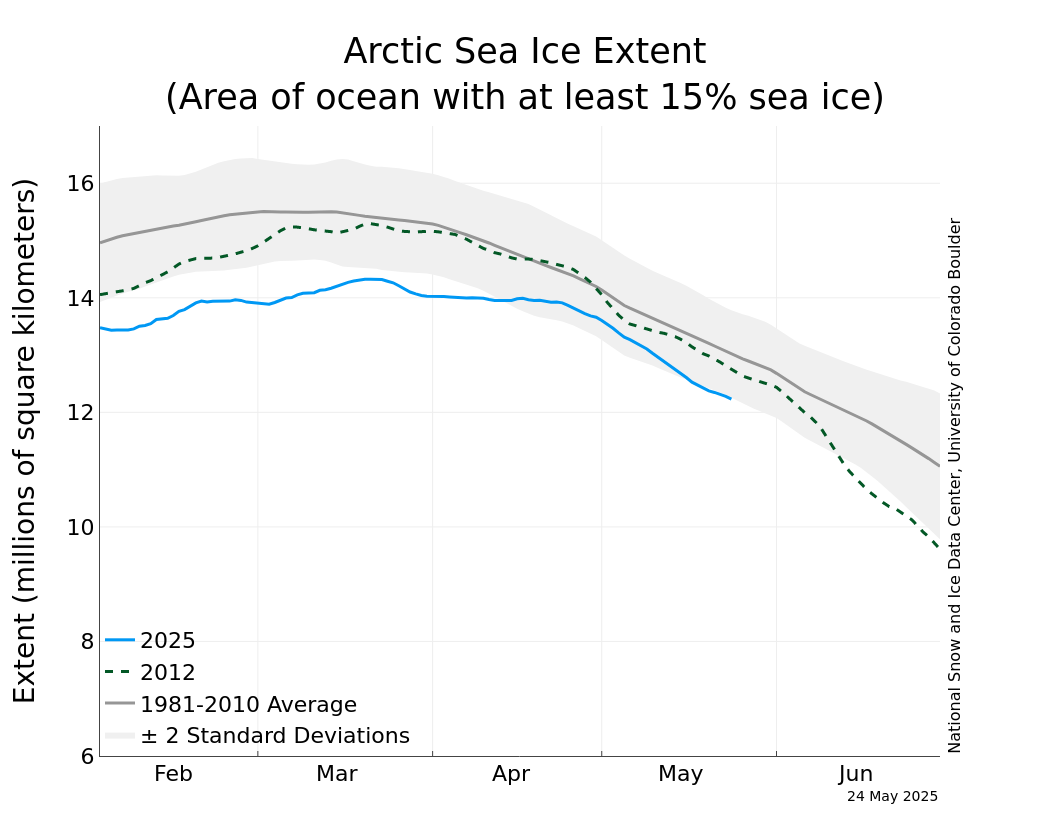
There's both anecdotal evidence (from British explorers) and data suggesting that the Arctic ice is melting faster this year than the previous record year of 2007. The data shows an unusually steep curve in seasonal melting, which suggests 2010 could set a new record. Not exactly something you want to cheer for.

Wednesday, May 19, 2010

Oil Wrongs


photo: wake of a ship through the oil in the Gulf of Mexico


As BP's chief said on Tuesday that the environmental impact of the oil gush is likely to be "very, very modest," and the company whose faulty equipment, shoddy procedures and fraud caused the explosion was busy dividing up more than a billion dollars in dividends, the New York Times reported: "A thin stem of oil stretching east from BP PLC's spill is increasingly likely to enter the Loop Current, a powerful Gulf of Mexico flow that runs past the Florida Keys and up the Atlantic Seaboard, the National Oceanic and Atmospheric Administration chief said today."

Once oil is in the current, it would likely reach the Florida Keys within 10 days. By month's end, the oil could reach Miami, oceanographers have also warned...Any oil or dispersants pulled south to the Florida Straits could pose an environmental hazard, especially for coral reefs, said Nan Walker, the director of the Earth Scan Laboratory at Louisiana State University. "The dispersants could kill corals," Walker said earlier this month.'

According to a TIME Magazine report:

" Federal officials have also raised alarms about the damage that has already been done to turtles, sea birds and marine mammals. And in response to concerns about the impact on undersea species, the National Oceanic and Atmospheric Administration (NOAA) on Tuesday expanded the no-fishing zone; nearly one-fifth of the Gulf, more than 47,000 sq. miles, is now off limits for fishing. Far from having a "very, very modest" effect, the Gulf oil spill will linger for a very long time. "Make no mistake," said Rowan Gould, the acting director of the U.S. Fish and Wildlife Service. "This spill is sufficient to affect wildlife in the Gulf and across the region for years and perhaps decades."

A Reuters' roundup adds: "In a sign of the widening environmental impact, the United States nearly doubled a no-fishing zone in waters seen affected by the oil gushing from the blown well, extending it to 19 percent of U.S. waters in the Gulf." There were reports of oil reaching beaches and marshes.

In Washington, President Obama has called for an independent commission to investigate the situation, several Senators are requesting that the Justice Department open civil and criminal probes, the Secretary of Interior has promised reforms of the responsible regulatory agency, and Senate Republicans are blocking legislation to increase the cap on oil company liability for the effects of their actions.

Meanwhile, this Houston Chronicle article articulates more of the concern expressed in my last post on this subject: "The oil has not yet caused a visible catastrophe — so far only 23 oiled birds have been found dead — but there is increasing concern about the array of life below the Gulf of Mexico's surface, too deep to watch closely. “What concerns us the most is what we can't see,” said Rowan Gould, the U.S. Fish and Wildlife Service's acting director."

A couple of other interesting links: This piece by Douglas Brinkley about the Breton National Wildlife Refuge, one of the places threatened by the oil and chemicals, and this very adept primer, ostensibly for reporters but also a great consumer guide, on the realities and misinformation (or truth and lies) involved in the "Gulf oil geyser," by Mark Sumner, coming out from behind his Kos screenname of Devilstower, which I assume makes him more employable as a science writer elsewhere. He should be--he knows his stuff.

Monday, May 17, 2010

The Dreaming Up Daily Quote

“I am dreaming, and I want to do good. For the good you do is never lost. Not even in dreams.”

Pedro Calderon de la Barca

Sunday, May 16, 2010

Heeding Invisible Voices


Over the past few days, scientists have figured that there's a lot more oil coming out of that gusher in the Gulf--estimated at about ten times more per day. This oil is gushing a mile below the ocean surface, and now scientists believe not all of it is coming up, at least not right away: "Scientists are finding enormous oil plumes in the deep waters of the Gulf of Mexico, including one as large as 10 miles long, 3 miles wide and 300 feet thick in spots. One scientist adds: “There’s a tremendous amount of oil in multiple layers, three or four or five layers deep in the water column.”

Oil depletes oxygen in the water, among other toxic effects, and it happens potentially over a long period of time. It kills life, plain and simple. (This Kos diary puts other relevant articles together.)

There are a lot of lessons about this gusher we're going to painfully learn that apply in a shorter time scale to expected Climate Crisis effects: devastating local effects that accumulate over time, and then cause secondary disasters that spread invisibly to the rest of the world, felt perhaps more measurably as economic effects but with other less quantifiable elements subtracted from the world we know, and the world we need.

We already knew that oil coming into wetlands and shores will kill nesting birds and other wildlife, as we knew that oil on the surface will kill endangered species as well as the fish and shellfish that the Gulf supplies as food to the world. Now underwater oil further threatens species we know, like dolphins, whales and turtles. But such vast quantities of oil so deep may erase a world of life we almost never see, a world of immense beauty, and for all we know, as essential to our own lives as the honey bee. This, too, is a metaphor for the Climate Crisis. A warning if we need one, of what is to come. And of course, it's more than a metaphor. It's a spreading, almost inconceivable reality.

But the time scale is part of our perception problem. Though this is a shorter time scale, it is longer that we are accustomed to pay attention, especially in this novelty-driven data age. We didn't even pay attention to Katrina and New Orleans long enough to understand what really has happened there. We have to use a little imagination, and some perseverance in paying attention.

Our attention to this catastrophe is already waning: there are no new pictures. What is happening is happening invisibly, at least for the moment. This catastrophe is exposing realities, and also our weaknesses.

The Climate/Energy Bill Debate

On the Climate 'n Energy bill in the Senate: the Conventional Wisdom says it doesn't have much of a chance, and like everything else these days, it is attacked from the Right and the Left. From the Left, there's Phil Radford of Greenpeace debating Joseph Romm of Climate Progress. I love Greenpeace but Radford didn't make much sense, and Romm was right to call him out on misstatements. Radford did make one cogent claim, though: the carbon costs imposed by this bill aren't high enough to jump-start clean energy and energy conservation. That's an important concern, although I don't necessarily accept that his opinion is correct. I'd like to see this point joined more specifically.

(His other claim--that the bill isn't strong enough to give Europe and the rest of the world the cover to continue their efforts--was also simply an assertion, surrounded by faulty data. So someone else will have to produce evidence to make this claim more credibly.)

Otherwise, Romm is persuasive: the idea is to turn the ship around, get it going in the right direction: towards penalizing the production of heat-trapping gases and incentives for clean energy. Maybe it's not enough. But the alternative, which is pretty clearly not doing anything at all, is definitely not enough.

But issues that need to be clarified: are individual states going to be prevented from establishing stronger rules, and if so why, and how it that going to work anyway? And if they are going to take the only weapon now in the arsenal away--EPA's ability to regulate carbon based on the Clean Air Act--what enforcement with the force of law will substitute?

Thursday, May 13, 2010

The First Victims


These are among the first known victims of the Gulf gusher: fish, turtles and brown pelicans (bottom photo) are turning up dead, and yesterday it was reported that six dolphins so far are among the dead. For the dolphins, it appears that the chemicals being spread in huge quantities to disperse the oil are as deadly as the oil itself.

Meanwhile, as quoted by Climate Progress, the Washington Post reported on House hearings: A senior House Democrat said that the blowout preventer that failed to stop an oil leak in the Gulf of Mexico had a dead battery in its control pod, leaks in its hydraulic system, a “useless” test version of one of the devices that was supposed to close the flow of oil and a cutting tool that wasn’t strong enough to shear through joints that made up 10 percent of the drill pipe."

Climate Progress also quotes a Coast Guard Captain slams industry "self-certification" of BOP: "Manufactured by industry, installed by industry, with no government witnessing oversight of the installation or the construction."

And the rig flew the Marshall Island flag to further escape U.S. oversight.

Wednesday, May 12, 2010

People to the Power


Joe Rahm and Climate Progress have scooped everyone else with a leaked version and preliminary evaluation of the American Power Act set to be introduced by Senator John Kerry and the other guy later today. The first reviews are good, and thanks to the Gulf oil gush, the chances of passage of some sort of energy bill are better than they've been in a very long time.

The specifics will be explained and debated for awhile, but providing resources and incentives for energy conservation and a clean domestic energy economy are likely to gain plenty of support, especially after all the "listening" (i.e. trading) that Kerry and the other guy have done while crafting this bill.

What's going to be harder to both explain and agree on will be the methods of capping and reducing heat-trapping gases. But the argument that needs to be emphasized, beyond saving the planet's future, is the need to do this in order to accelerate that clean energy economy. And a lot of folks don't think it's possible, at least in the short time that's necessary, without increasing the cost of dirty energy.

And it's necessary not just to head off the worst--the climate cataclysm becoming climate collapse--but to create capacity and competitiveness for clean energy internationally. Or else we'll eventually be buying our windmills and solar panels from China, if we can even afford them by then.

That's the conclusion for example of Europe's climate commissioner Connie Hedegaard, who is now advocating for a 30% cut in heat-trapping gases as Europe's unilateral goal, instead of the current 20%. She said the" 20% cut would not drive the clean energy innovation Europe needed. She said China was investing almost 10 times as much as the EU in plans for a low-carbon economy."

But European industries are resisting that goal, unless and until the U.S. makes the same move, or at least some move, as contemplated in this bill. It may take emphasizing economic self-interest to save the planet, but the argument may be a sound one.

Meanwhile, the Gulf: Amidst the circus of blame in Congress Tuesday, there was this disturbing suggestion about what's happening with the oil: that because of the chemical dispersants being used, it isn't so much that the oil is not coming onshore, but that it's not visible as oil slick, and that the oil is sinking, where it becomes toxic to marine life, but invisible to cameras and satellites. This Kos diary also suggests the possibility that it's headed for the Florida keys.

Tuesday, May 11, 2010

Political Winds

Apart from the apparently growing anti-incumbent trend--which has been building for at least a decade--there are a few other political wrinkles to note.

1. The defeat of veteran and very conservative Senator Bob Bennett of the very conservative state of Utah by presumably even more conservative GOPers backed by Tea Partiers was prompted, some say, by Bennett having worked with Democrats on a few legislative items. Is there going to be more of this extreme ideological purity? Yes. I think the theory of absolute oppositionism among GOPers in Congress is based on the idea that (as a NY Times poll indicated) voters identifying themselves as conservatives is the highest ever (38%) but identifying themselves as GOPers is very low (in the 20s%.) The theory is that the self-identified conservatives are Tea Party ideologues, and oppositionism is needed to bring them into the GOP. That's probably not reality-based but it does seem to be the operative GOPer strategy.

How it plays out politically remains to be seen. But if it is successful enough, it is not a trend that permits effective governing, by anybody. The Dems are likely to lose seats in Congress, and if they retain majorities it may not be by much. It might be a good time for voters to use their imaginations, and picture what absolute unyielding gridlock looks like in a time of mounting peril, before the federal government gets locked into it for two years or more. But that requires imagination to trump emotion, projection, denial etc., not usually a good bet. It did work in 2008, though.

To this trend of hardened extremes, there are however a few other interesting counter-developments.

2. President Obama's nomination of Elena Kagan to the Supreme Court has upset ideologues on both sides. Yet a discussion among legal experts who know her on the PBS News Hour suggests she has excellent personal and legal qualifications to be an effective Justice immediately. These folks have no doubt that her views are progressive. But the appointment is yet another indication of Obama's stubborn insistence on effective governance. (And yes, on ideological grounds, I would have preferred Diane Wood.)

And these two odd events, the significance of which remain to be seen, but they have a common element: the unlikely cooperation of opposites.

3. For the first time in the Obama Presidency, a substantive bill passed the Senate with bipartisan unanimity, by 96-0. And whose bill was this? Which Senator from the mushy middle could convince colleagues on both sides? None. The bill was a strong oversight bill to audit the Federal Reserve, force it to divulge the names of banks and other institutions it lended to during the economic emergency. The sponsor was the Senate's only professed Socialist and a party of one: Bernie Sanders. Moreover, a similar bill passed the House, sponsored by one of its most outspoken liberal Dems (Alan Grayson) and the libertarian GOPer Ron Paul.

4. Finally, the UK has a new government, comprised of a Tory (Conservative) Prime Minister and a Liberal Dem #2. Both made statements expressing their determination to put aside differences to work together for the good of the nation, currently in its own fiscal crisis. All I really knew about this election was that people at the BBC were really worried they would face massive cuts if the Tories took over from Labour. How this all plays out remains to be seen, and will be especially interesting in a country where the ideological difference between extremes is far smaller than in the U.S., and the culture of fact-based governance is greater.

But these last two suggest the possibility that effective governance can occur from the extremes, rather than from the middle. A novel concept, to say the least. And hardly a proven one. Stay tuned.

The Dome That Failed--and That's Not All


Things aren't any better in the Gulf, and they may well be getting worse. A growing collection of crippled equipment littered the ocean floor Sunday near a ruptured oil well gushing crude into the Gulf of Mexico, the remnants of a massive rig that exploded weeks ago and the failed efforts since to cap the leak, begins the NPR story on the failed dome attempt, and other weekend details.

Here's an interesting Internet wrinkle: while BP experts seemingly believed the dome might work, its failure and the reason for it was expected, by bloggers.

Yet the worst of it is very likely still to come. The oil continues to gush and to fill the sea, which winds so far have almost eerily kept offshore. The economic impact has begun, but that, too, could get a lot worse--raising oil and food prices potentially everywhere. Though it seems pretty early to speculate, I did hear one experienced observer suggest that this could be bad enough to bankrupt BP. If so, you can bet a lot of other folks are going to feel the pain first.

The environmental threat is apparently prompting voters to take a more serious look at energy policy. A pollster concluded: “not only do voters support a comprehensive clean energy bill by large double-digit margins, they also indicate their Senator’s vote could be an impactful re-election factor."

BP was getting a lot of criticism Monday, not only for being unprepared but for misleading everyone every step of the way during this crisis. There's apt to be more of that as Congress starts holding hearings. A more quietly expressed view (so far) notes the failure of Bush-era regulation and enforcement--the weakening of regs, the depletion of government regulators, the cosy relationship with oil companies (at least one safety mechanism was xed out by the Cheney energy commission) and the overall reliance on privatization. You won't hear the loudmouth GOPers on that one, but I hope the Dems can make that point.

Saturday, May 08, 2010

The Dreaming Up Daily Quote

"The troubling idea arose...that we are mostly alive in each other's minds and that we're only dead when we're dead to ourselves."
Jim Harrison
"The Summer He Didn't Die"
And R.I.P. Lynn Redgrave, above in Georgy Girl with Alan Bates.

Power to the Future

So the purpose of one set of tasks for the near-term future--edging towards Climate Cataclysm-- is to make things as good as possible for as long as possible.

It's important for the future in general that the life-killing, civilization-ending heat-trapping gases be severely and all but completely curtailed. Clean energy technology and a clean energy economy provide energy to compensate for less fossil fuel burning. But particularly when clean energy is scaled to be locally produced and controlled, it will in itself be vital to making things as good as possible for as long as possible. So every step towards that is worth notice, and there are two today.

The House passed its version of the "Home Star Energy Retrofit Act," and all that needs to happen now is working out differences with the Senate version. It provides incentives to homeowners for energy efficient retrofits. Buildings account for 40% of U.S. energy use, and this program is big enough to create jobs and support businesses engaged in this work. This effort, widely supported by business and labor organizations, is the "low-hanging fruit" of saving energy and cutting heat-trapping gases.

The first big investments in clean energy were part of the Recovery Act, and the Department of Energy reported on progress a year later. Some 5,000 projects have been funded, but since these projects were designed for long-term benefit, most are just beginning to be implemented: conducting research, building wind farms and factories for electric battery.

This last item is a particular emphasis: Currently there are only three battery factories operating in the U.S., he says. Through the Recovery Act and related incentive programs, 30 battery and battery component factories are now being built. This will result in the capacity to build enough batteries for 500,000 electric vehicles a year, “whereas today we can hardly touch the topic,” Rogers says. Meanwhile, the DOE is funding research projects that could increase the performance of batteries threefold to sixfold, while reducing costs by 90 percent or more. All of that is designed to work with other programs with the goal of efficient and affordable electric vehicles.

What concerns me, however, is that so much of the emphasis, at least in what's being publicized, is on battery and wind technology, not so much on solar. Solar seems the most decentralized, and therefore the most adaptable to circumstances. I hope for one thing that people taking advantage of these retrofit programs include home solar. Getting as much power as possible directly from the sun offers a kind of security.

Wednesday, May 05, 2010

The Daily Babble

It's a complete terrorism law enforcement triumph at every level: federal in particular. Just 53 hours after a terrorist bombing was attempted in Times Square, a suspect was in custody and confessed. Possible confederates in Pakistan were being arrested and questioned.

But America as a whole can't applaud those facts, and be reassured, without GOPers braying about reading him his Miranda rights (he confessed without being tortured! What an outrage!), or even that the Obama administration failed to catch the criminal before he committed the crime (that charge by a former NY governor yet.) President Obama said that we won't be terrorized. But GOPers terrorize based on success.

As toxic as this might be on many levels, when the same kind of politics is played over something like the Gulf oil gusher, we get ridiculously distracted from anticipating what the consequences might be, which could lead--who knows?--to dealing with the consequences better, and even taking preventive action.

It's one thing to utter insane charges, but it's quite another to waste public news time on them. Chris Matthews interviewed disgraced former FEMA chief Michael Brown so he could air his charges that the federal government deliberately delayed its response for political purposes. Matthews told him he thought it was insane, but the real question came from his next guest, Howard Dean, who asked, why did you even have that guy on? Well, it gave Chris a chance to do a "tough interview," and get blog time. But as we're going to learn as this situation develops, sometimes what is wasted is lost forever, and in this case, it's the time to consider the real possible impacts. And there are lots of people who are able and willing to talk about that: the range of possible ecological, economic and societal effects.

I don't know, maybe that's what PBS is for. But it seems to me that we can't head off the worst effects if we never discuss the future in real terms, in real possibilities, contingencies, plans, actions. If all the information is from political blogs and shows, we might never know they even exist. In fact, the only place I heard any of that kind of analysis was on CNBC, where the future is of interest only as far as it affects business. But even that's better than political fights over nonsense.

Meanwhile, in the Gulf on Tuesday, favorable winds kept the oil mostly at bay. But that can't last forever. Dana Milbank writes about the anti-government conservatives who are now crying for federal help, in his Washington Post piece, Through oil-fouled water, big government looks better and better.

Meawhile, NPR contributes a narrative of the oil gush from the start until now.

So I leave you to a happy Cinco de Mayo, which is a bigger deal here in California than the rest of the country--or for that matter, Mexico. Which I will be celebrating with a root canal. Oh how I wish that to be a joke.

Monday, May 03, 2010

How It Started

One of several just released photos of the explosions and resulting fires of the oil rig that killed 11 men and led to the mile-deep gusher now shooting oil into the Gulf. Late Monday, Climate Progress flagged allegations in a Tuesday New York Times story: "At least one worker who was on the oil rig at the time of the explosion on April 20, and who handled company records for BP, said the rig had been drilling deeper than 22,000 feet, even though the company’s federal permit allowed it to go only 18,000 to 20,000 feet deep, the lawyers said.

Another worker familiar with the rig told the lawyers that the company had chosen not to install a deep-water valve that would have been placed about 200 feet under the sea floor. Much like blowout preventers, devices that are meant to seal leaks, this valve could have served as a cutoff of last resort in explosions, the lawyers said. “The company took their chances in not having the valve so they could save money,” said Mike Papantonio, one of the lawyers representing the shrimpers and fishermen."